operations

Before the burglary

Vietnam leaks, the Plumbers and the temptation to use government against opponents

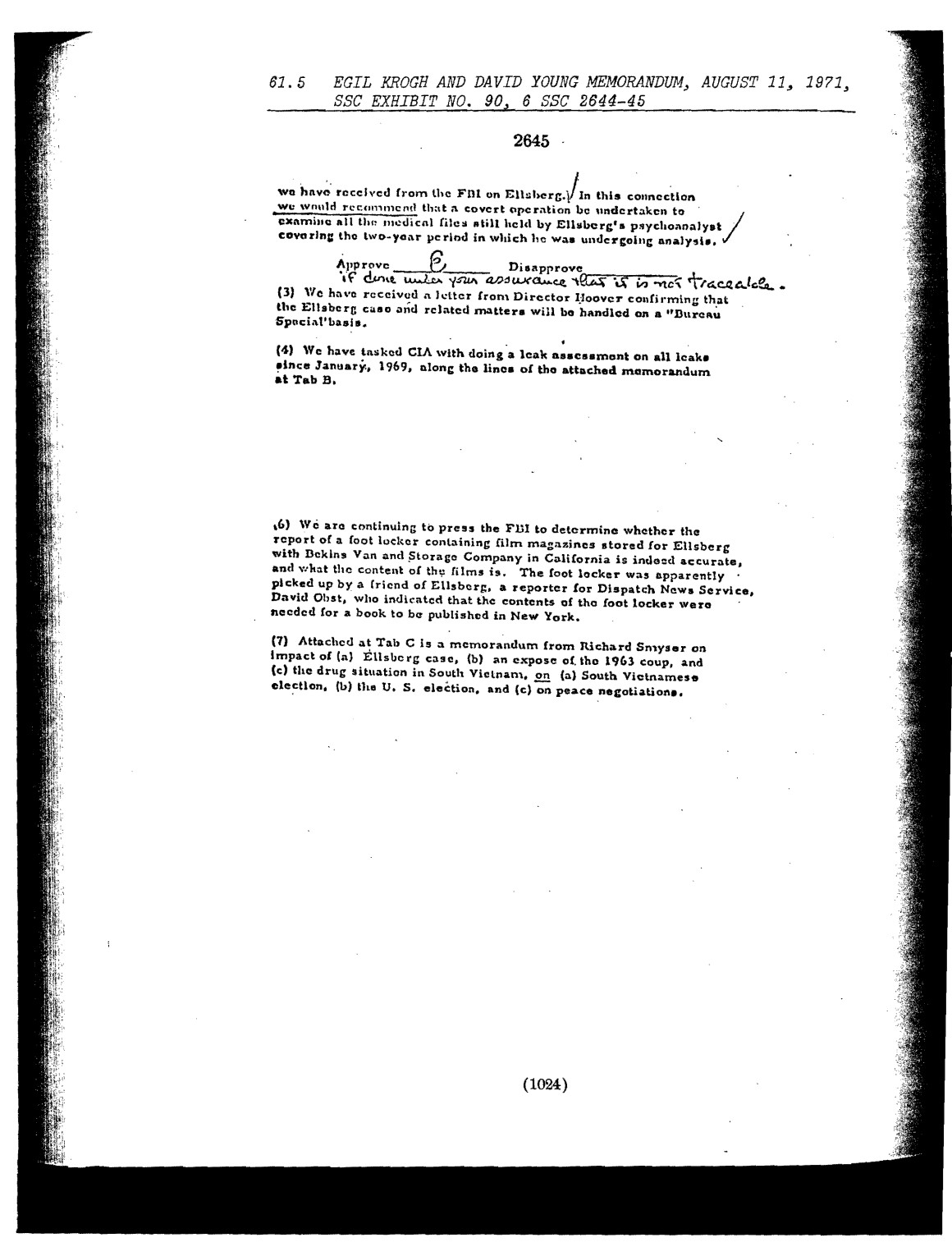
Final page of the 1971 Krogh–Young memorandum proposing a covert examination of Ellsberg’s psychiatrist’s files. A document facsimile, not a reconstruction.
U.S. federal government / National Archives presidential-library collection · Source & image context ↗

RECORD / AT A GLANCE

Documented abuses

The Fielding burglary occurred; proposed schemes and completed operations must remain separate.

THE EVENTS / THE INVESTIGATION / THE STORY

The chronology.

READ THE FILE

Evidence & assessment.

Open an article for its evidence, labeled AI assessment and numbered sources. Read the complete static edition ↗

OPEN THE RECORD

Sources & limits.

Numbered citations in each article identify the relevant sources. These records have different purposes and evidentiary weight.

  1. National Archives — Pentagon Papers: complete declassified study ↗

    Archival introduction to the complete 1945–1967 study, released in 2011. Establishes what the Papers were; does not itself prove the subsequent burglary.

  2. Federal Judicial Center — The Pentagon Papers in the Federal Courts (2019) ↗

    Federal judicial history with reproduced contemporary documents. Separates the newspapers’ prior-restraint case from the Ellsberg–Russo prosecution and its dismissal.

  3. Krogh–Young memorandum to Ehrlichman, August 11, 1971 (congressional exhibit) ↗

    Scanned contemporary memorandum reproduced for the House inquiry; the covert medical-file proposal appears on the final page. Read handwriting from the scan, not unreliable OCR.

  4. Rockefeller Commission report — CIA assistance to Hunt and Ellsberg profiling ↗

    1975 executive commission findings, chapter 14 in this PDF, concerning CIA assistance to Hunt and the Ellsberg profiles. CIA assistance is not identical to CIA direction of the DNC burglary.

  5. Nixon Foundation — Watergate Explained: proposal and approval chronology ↗

    The private Richard Nixon Foundation’s retrospective account, distinct from the federal Nixon Library. Useful for identifying conflicting approval testimony; checked against the appellate opinion.

  6. Nixon Library — proposed Watergate exhibit script and supporting record references (2010) ↗

    An exhibit-planning document released through FOIA, not a trial verdict. Specific claims should be checked against the cited records; used here only for early proposals and the first entry chronology.

  7. U.S. v. Haldeman, 559 F.2d 31 (D.C. Cir. 1976): cover-up convictions affirmed ↗

    Appellate decision affirming Haldeman, Ehrlichman and Mitchell. It explains that its factual narrative views the evidence favorably to the verdict; Mardian’s separate reversal must not be conflated with these affirmances.

  8. John Dean’s cover memorandum for the enemies list, September 14, 1971 ↗

    A contemporary cover memo establishing an effort to select political enemies. It does not establish that each intended retaliation occurred.

  9. Nixon Library — Watergate Exhibit Evidence: original documents and oral histories ↗

    Federal presidential library index distinguishing contemporary recordings and exhibits from later, interested participants’ oral histories. Individual memories can conflict.