The AI Files · DOJ Fair Housing Act suit against Trump Management / Fred & Donald Trump (1973–1978 record) and later public memory · plain reading edition

The 1973 housing discrimination case: every entry

All 50 entries of the guide, grouped by period and case, each with its bottom line and its sources. This page needs no JavaScript. The interactive guide adds the story in 21 chapters, the people, the timeline, the theories, the 15 checked claims and the media.

Act, local complaints, testing 1968–1972

Before the federal complaint

Statute, local rights bodies, testers

The Fair Housing Act arrives

Record · History

Fair Housing Act era prelude — Trump housing discrimination guide
Fair Housing Act era prelude — Trump housing discrimination guide Freely licensed / re-encoded pool image from AI Files sibling guides (EXIF stripped) · Re-encoded; EXIF stripped

1968 federal rental nondiscrimination law.

Congress passed the Fair Housing Act in 1968, barring race discrimination in the rental of dwellings and authorizing Justice Department pattern-or-practice suits. [1]

That statute — not later campaign rhetoric — is the legal basis of the 1973 complaint. [2]

Bottom line History

Without the 1968 Act there is no federal pattern-or-practice case of this form.

What the record can’t settle

Statute text does not itself prove any landlord violated it.

Sources

  1. Fair Housing Act of 1968 — 42 U.S.C. §3601 et seq. (statutory text via Cornell LII) Primary statute: rental discrimination prohibitions that ground the 1973 complaint.
  2. Complaint — United States v. Fred C. Trump, Donald Trump, and Trump Management, Inc. (E.D.N.Y. Oct 15, 1973) Primary complaint PDF: pattern-or-practice under Fair Housing Act; Trump Management ≥14,000 units; Fred chairman; Donald president; alleged refusals, different terms, discriminatory statements, false unavailability.

Back to contents · Open in the interactive guide

NYC CHR trail before DOJ

Record · Alleged

Local human-rights commission motif — Trump housing discrimination guide
Local human-rights commission motif — Trump housing discrimination guide Freely licensed / re-encoded pool image from AI Files sibling guides (EXIF stripped) · Re-encoded; EXIF stripped

Local human-rights materials in the FBI file.

Clearinghouse lists March 1968 NYC Commission on Human Rights documents regarding Trump Management preserved with FBI memoranda. [1]

Its case summary states a 1968 hearing found discrimination at a Trump property and ordered cease-and-desist, damages, and fair-housing referrals. [2]

Those local findings are not the 1975 federal consent order; they are a pre-suit trail. [1]

Bottom line Alleged

Local enforcement preceded the federal suit; treat Clearinghouse’s 1968 finding summary as secondary unless the hearing order is read directly.

What the record can’t settle

Full CHR hearing transcript/order text should be preferred when available beyond the Clearinghouse abstract.

Sources

  1. Clearinghouse — NYC Commission on Human Rights documents re Trump Management (Mar 14, 1968 attachment) Listed in case document table: NYC CHR materials in FBI file; Clearinghouse summary states a 1968 hearing found discrimination at a Trump property and ordered cease-and-desist + damages + fair-housing referrals.
  2. Civil Rights Litigation Clearinghouse — case 15342 (United States v. Trump Management) Secondary synthesis of docket, people, and document list; useful map — prefer underlying PDFs for spines.

Back to contents · Open in the interactive guide

State Division of Human Rights papers

Record · History

Local human-rights commission motif — Trump housing discrimination guide
Local human-rights commission motif — Trump housing discrimination guide Freely licensed / re-encoded pool image from AI Files sibling guides (EXIF stripped) · Re-encoded; EXIF stripped

1970 NYS DHR materials in the investigative file.

Clearinghouse’s document table includes October 1970 State Division of Human Rights documents regarding Trump Management, with a letter to the FBI. [1]

Some complaints in the broader file were mooted when apartments were later offered, per Clearinghouse’s reading of the attachments. [1]

Bottom line History

State-level complaint paper is part of the prelude, not a federal merits judgment.

What the record can’t settle

Individual complaint dispositions vary; mootness by offer is not a finding of no discrimination.

Sources

  1. Civil Rights Litigation Clearinghouse — case 15342 (United States v. Trump Management) Secondary synthesis of docket, people, and document list; useful map — prefer underlying PDFs for spines.

Back to contents · Open in the interactive guide

Open Housing Center tester file

Record · Documented

Fair-housing testing motif — Trump housing discrimination guide
Fair-housing testing motif — Trump housing discrimination guide Freely licensed / re-encoded pool image from AI Files sibling guides (EXIF stripped) · Re-encoded; EXIF stripped

August 1972 tester statements enter the record.

Clearinghouse lists ‘Statements by Testers for the Open Housing Center’ dated August 10, 1972, with an FBI letter. [1]

Those statements are investigative inputs later echoed in the complaint’s differential-treatment theory. [2][3]

Bottom line Documented

Tester documentation is a primary investigative spine for the suit.

What the record can’t settle

Tester programs prove differential treatment in sampled visits; they are not a census of every building every day.

Sources

  1. Clearinghouse — Statements by Testers for the Open Housing Center (Aug 10, 1972) Document list entry: Open Housing Center tester statements with FBI letter; primary investigative inputs to DOJ case.
  2. Complaint — United States v. Fred C. Trump, Donald Trump, and Trump Management, Inc. (E.D.N.Y. Oct 15, 1973) Primary complaint PDF: pattern-or-practice under Fair Housing Act; Trump Management ≥14,000 units; Fred chairman; Donald president; alleged refusals, different terms, discriminatory statements, false unavailability.
  3. Civil Rights Litigation Clearinghouse — case 15342 (United States v. Trump Management) Secondary synthesis of docket, people, and document list; useful map — prefer underlying PDFs for spines.

Back to contents · Open in the interactive guide

FBI opens the Trump Management file

Record · Official

FBI file / investigation motif — Trump housing discrimination guide
FBI file / investigation motif — Trump housing discrimination guide Freely licensed / re-encoded pool image from AI Files sibling guides (EXIF stripped) · Re-encoded; EXIF stripped

September 26, 1972 Director memorandum.

Clearinghouse catalogs an FBI Director internal memorandum of September 26, 1972 with instructions for investigating Trump Management. [1]

The resulting file was FOIA-released on the FBI Vault as ‘Trump Management Company’ in multiple parts. [2]

Bottom line Official

Federal investigators treated the rental allegations as worth a formal file.

What the record can’t settle

Opening a file is not a finding of liability.

Sources

  1. Clearinghouse — FBI Director internal memorandum opening Trump Management investigation (Sept 26, 1972) Document list: instructions for FBI investigation into Trump Management Company.
  2. FBI Vault — Trump Management Company (FOIA file, 8 parts) Primary investigative file released ~Feb 2017: interviews, tester materials, CHR/DHR attachments. Mixed: many interviewees unaware of discrimination; some describe race-based denials/codes.

Back to contents · Open in the interactive guide

A paired-tester day in Brooklyn

Record · Documented

Fair-housing testing motif — Trump housing discrimination guide
Fair-housing testing motif — Trump housing discrimination guide Freely licensed / re-encoded pool image from AI Files sibling guides (EXIF stripped) · Re-encoded; EXIF stripped

Black tester told no; white tester offered units.

The Washington Post’s 2016 reconstruction of the DOJ file describes a July 1972 day when a Black woman was told nothing was available and a white woman was soon offered a choice of apartments at the same complex. [1][2]

That vignette sits inside a larger tester program summarized by Clearinghouse. [4][3]

Bottom line Documented

Paired testing is the vivid mainstream evidence node for differential treatment.

What the record can’t settle

WaPo is secondary synthesis of DOJ FOIA; the underlying tester statements are the deeper primary.

Sources

  1. Washington Post — Inside the government’s racial bias case against Donald Trump’s company (Kranish/O’Harrow, Jan 23, 2016) Major investigative synthesis from DOJ FOIA: tester pairs, alleged codes (‘C’, ‘No. 9’), Cohn defense, consent decree. Secondary — use for campaign-era revival; prefer court PDFs for legal outcomes.
  2. Portside reprint — Inside the Government’s Racial Bias Case (Jan 24, 2016) Open reprint of WaPo investigation details (codes, steering). Secondary mirror.
  3. Clearinghouse — Statements by Testers for the Open Housing Center (Aug 10, 1972) Document list entry: Open Housing Center tester statements with FBI letter; primary investigative inputs to DOJ case.
  4. Civil Rights Litigation Clearinghouse — case 15342 (United States v. Trump Management) Secondary synthesis of docket, people, and document list; useful map — prefer underlying PDFs for spines.

Back to contents · Open in the interactive guide

Alleged racial codes and steering

Record · Alleged

Outer-borough apartment buildings — Trump housing discrimination guide
Outer-borough apartment buildings — Trump housing discrimination guide Freely licensed / re-encoded pool image from AI Files sibling guides (EXIF stripped) · Re-encoded; EXIF stripped

‘C’, ‘No. 9’, and building assignments.

The complaint and later reporting allege that employees marked applications to flag Black applicants and steered minorities toward buildings with more minority tenants. [1][2][5]

FBI interview notes in the Vault, as summarized by Clearinghouse, include an employee who believed codes distinguished Black from white applicants — and many interviewees who reported no awareness of discrimination. [3][4]

Bottom line Alleged

Codes/steering are central allegations on the mainstream path; they were never reduced to a merits judgment.

What the record can’t settle

Interview anecdotes are not the same as a court finding that a company-wide coding system existed.

Sources

  1. Complaint — United States v. Fred C. Trump, Donald Trump, and Trump Management, Inc. (E.D.N.Y. Oct 15, 1973) Primary complaint PDF: pattern-or-practice under Fair Housing Act; Trump Management ≥14,000 units; Fred chairman; Donald president; alleged refusals, different terms, discriminatory statements, false unavailability.
  2. Washington Post — Inside the government’s racial bias case against Donald Trump’s company (Kranish/O’Harrow, Jan 23, 2016) Major investigative synthesis from DOJ FOIA: tester pairs, alleged codes (‘C’, ‘No. 9’), Cohn defense, consent decree. Secondary — use for campaign-era revival; prefer court PDFs for legal outcomes.
  3. Clearinghouse summary of FBI interviews — majority unaware; several describe race-based denials/codes Secondary synthesis of FOIA interviews; points both ways — use with Vault primary.
  4. FBI Vault — Trump Management Company (FOIA file, 8 parts) Primary investigative file released ~Feb 2017: interviews, tester materials, CHR/DHR attachments. Mixed: many interviewees unaware of discrimination; some describe race-based denials/codes.
  5. Portside reprint — Inside the Government’s Racial Bias Case (Jan 24, 2016) Open reprint of WaPo investigation details (codes, steering). Secondary mirror.

Back to contents · Open in the interactive guide

Open: how widespread inside the portfolio

Question · Mixed

Outer-borough apartment buildings — Trump housing discrimination guide
Outer-borough apartment buildings — Trump housing discrimination guide Freely licensed / re-encoded pool image from AI Files sibling guides (EXIF stripped) · Re-encoded; EXIF stripped

Systemic vs pockets.

Tester hits and some interviews support more than isolated incidents. [1][2]

Majority-unaware interviews cut the other way. [2]

Without a trial, the geographic/building-level map stays incomplete. [3]

Bottom line Mixed

Partial knowledge: some buildings some times — full portfolio rate unknown.

What the record can’t settle

Do not invent a percentage.

Sources

  1. Clearinghouse — Statements by Testers for the Open Housing Center (Aug 10, 1972) Document list entry: Open Housing Center tester statements with FBI letter; primary investigative inputs to DOJ case.
  2. Clearinghouse summary of FBI interviews — majority unaware; several describe race-based denials/codes Secondary synthesis of FOIA interviews; points both ways — use with Vault primary.
  3. Consent Order text — without adjudication of the merits / no admission Yardstick limit: no merits finding either way.

Back to contents · Open in the interactive guide

DOJ sues; Cohn fights 1973–1974

The 1973 complaint

Pattern-or-practice pleading

The United States files suit

Record · Official

Federal courthouse / filing era — Trump housing discrimination guide
Federal courthouse / filing era — Trump housing discrimination guide Freely licensed / re-encoded pool image from AI Files sibling guides (EXIF stripped) · Re-encoded; EXIF stripped

October 15, 1973, E.D.N.Y.

The Justice Department sued Fred C. Trump, Donald Trump, and Trump Management, Inc. under the Fair Housing Act. [1]

The complaint identifies Donald as president and Fred as chairman/principal stockholder of a company managing at least 14,000 dwelling units. [1]

It alleges refusals to rent, different terms, discriminatory statements, and false representations of unavailability because of race. [1]

Bottom line Official

The pleading is the formal start of the federal case — allegations, not findings.

What the record can’t settle

A complaint’s ‘pattern and practice’ label is the government’s theory of the case.

Sources

  1. Complaint — United States v. Fred C. Trump, Donald Trump, and Trump Management, Inc. (E.D.N.Y. Oct 15, 1973) Primary complaint PDF: pattern-or-practice under Fair Housing Act; Trump Management ≥14,000 units; Fred chairman; Donald president; alleged refusals, different terms, discriminatory statements, false unavailability.
  2. Complaint ¶6 — pattern and practice / issue of general public importance Primary pleading theory under 42 U.S.C. §3613.

Back to contents · Open in the interactive guide

Front-page introduction — and a denial

Record · History

Federal courthouse / filing era — Trump housing discrimination guide
Federal courthouse / filing era — Trump housing discrimination guide Freely licensed / re-encoded pool image from AI Files sibling guides (EXIF stripped) · Re-encoded; EXIF stripped

Times coverage the next day.

The New York Times reported the suit on October 16, 1973, describing more than 14,000 apartments and alleged antiblack bias. [1]

A later Times Insider piece notes Donald’s first quoted words in the paper: the charges were ‘absolutely ridiculous.’ [2]

Bottom line History

Contemporaneous denial is part of the record alongside the complaint.

What the record can’t settle

Newspaper paraphrase is not a transcript of every allegation.

Sources

  1. New York Times — Major Landlord Accused Of Antiblack Bias in City (Oct 16, 1973) Contemporaneous: DOJ suit vs Trump Management; ≥14,000 apartments; 39 buildings; Donald’s ‘absolutely ridiculous’ denial quoted in later Times Insider recapitulation.
  2. NYT Times Insider — 1973 | Meet Donald Trump (Jul 30, 2015) Recaps Oct 16, 1973 front-page introduction and Donald’s first quoted NYT words denying the charges.

Back to contents · Open in the interactive guide

Portfolio scale in the pleading

Record · Documented

Outer-borough apartment buildings — Trump housing discrimination guide
Outer-borough apartment buildings — Trump housing discrimination guide Freely licensed / re-encoded pool image from AI Files sibling guides (EXIF stripped) · Re-encoded; EXIF stripped

~39 buildings / 14,000+ units.

The complaint and Times put Trump Management’s relevant portfolio in the tens of thousands of apartments across dozens of buildings in Brooklyn, Queens, and Staten Island. [1][2][3]

Scale matters because the case was pleaded as systemic, not a single denied application. [4]

Bottom line Documented

The government’s case was about a large landlord’s practices.

What the record can’t settle

Unit counts are pleading/press figures for the era’s portfolio, not a 2026 property census.

Sources

  1. Complaint — United States v. Fred C. Trump, Donald Trump, and Trump Management, Inc. (E.D.N.Y. Oct 15, 1973) Primary complaint PDF: pattern-or-practice under Fair Housing Act; Trump Management ≥14,000 units; Fred chairman; Donald president; alleged refusals, different terms, discriminatory statements, false unavailability.
  2. New York Times — Major Landlord Accused Of Antiblack Bias in City (Oct 16, 1973) Contemporaneous: DOJ suit vs Trump Management; ≥14,000 apartments; 39 buildings; Donald’s ‘absolutely ridiculous’ denial quoted in later Times Insider recapitulation.
  3. Civil Rights Litigation Clearinghouse — case 15342 (United States v. Trump Management) Secondary synthesis of docket, people, and document list; useful map — prefer underlying PDFs for spines.
  4. Complaint ¶6 — pattern and practice / issue of general public importance Primary pleading theory under 42 U.S.C. §3613.

Back to contents · Open in the interactive guide

Pattern-or-practice theory

Record · Official

Federal courthouse / filing era — Trump housing discrimination guide
Federal courthouse / filing era — Trump housing discrimination guide Freely licensed / re-encoded pool image from AI Files sibling guides (EXIF stripped) · Re-encoded; EXIF stripped

Complaint ¶6.

The United States alleged a pattern and practice of resistance to Fair Housing Act rights and a denial of rights raising an issue of general public importance. [1][2]

That is the statutory hook for a DOJ suit seeking injunctive and affirmative relief. [3]

Bottom line Official

Mainstream legal framing: systemic civil enforcement, not a criminal indictment.

What the record can’t settle

Pattern-or-practice is alleged until proven or settled; here it was settled without admission.

Sources

  1. Complaint ¶6 — pattern and practice / issue of general public importance Primary pleading theory under 42 U.S.C. §3613.
  2. Complaint — United States v. Fred C. Trump, Donald Trump, and Trump Management, Inc. (E.D.N.Y. Oct 15, 1973) Primary complaint PDF: pattern-or-practice under Fair Housing Act; Trump Management ≥14,000 units; Fred chairman; Donald president; alleged refusals, different terms, discriminatory statements, false unavailability.
  3. Fair Housing Act of 1968 — 42 U.S.C. §3601 et seq. (statutory text via Cornell LII) Primary statute: rental discrimination prohibitions that ground the 1973 complaint.

Back to contents · Open in the interactive guide

Donald’s role in 1973

Record · Disputed

Donald Trump portrait pool — Trump housing discrimination guide
Donald Trump portrait pool — Trump housing discrimination guide Freely licensed / re-encoded pool image from AI Files sibling guides (EXIF stripped) · Re-encoded; EXIF stripped

President on the complaint; personal claims later dismissed.

The complaint names Donald Trump as president of Trump Management and alleges the individual defendants were responsible for policies and practices. [1]

The consent order dismisses personal-capacity claims with prejudice. [2]

WaPo/FBI-file coverage has been read as not newly proving hands-on daily rental decisions by Donald beyond the corporate office. [3]

Bottom line Disputed

Corporate presidency is pleaded; personal liability was not adjudicated.

What the record can’t settle

Dismissal with prejudice is not a factual finding that he had no involvement.

Sources

  1. Complaint — United States v. Fred C. Trump, Donald Trump, and Trump Management, Inc. (E.D.N.Y. Oct 15, 1973) Primary complaint PDF: pattern-or-practice under Fair Housing Act; Trump Management ≥14,000 units; Fred chairman; Donald president; alleged refusals, different terms, discriminatory statements, false unavailability.
  2. Consent Order Part I — complaint against Fred and Donald dismissed with prejudice in personal capacity Primary: personal claims dismissed in consideration of company’s affirmative responsibilities.
  3. Washington Post — FBI releases file on 1970s Trump housing discrimination case (Feb 15, 2017) Notes 389-page FBI file release; says it does not newly redefine Donald’s role beyond prior DOJ FOIA reporting.

Back to contents · Open in the interactive guide

Fred Trump as chairman

Record · History

Fred Trump era stand-in — Trump housing discrimination guide
Fred Trump era stand-in — Trump housing discrimination guide Freely licensed / re-encoded pool image from AI Files sibling guides (EXIF stripped) · Re-encoded; EXIF stripped

Principal stockholder and chairman in the pleading.

The complaint identifies Fred C. Trump as principal stockholder and chairman. [1]

His personal claims were likewise dismissed with prejudice in 1975. [2]

Bottom line History

The federal case named the father and son together at the top of the company.

What the record can’t settle

This guide does not retry Fred’s entire career beyond the housing docket.

Sources

  1. Complaint — United States v. Fred C. Trump, Donald Trump, and Trump Management, Inc. (E.D.N.Y. Oct 15, 1973) Primary complaint PDF: pattern-or-practice under Fair Housing Act; Trump Management ≥14,000 units; Fred chairman; Donald president; alleged refusals, different terms, discriminatory statements, false unavailability.
  2. Consent Order Part I — complaint against Fred and Donald dismissed with prejudice in personal capacity Primary: personal claims dismissed in consideration of company’s affirmative responsibilities.

Back to contents · Open in the interactive guide

Steelman: the DOJ case was strong

Steelman · Mixed

Federal courthouse / filing era — Trump housing discrimination guide
Federal courthouse / filing era — Trump housing discrimination guide Freely licensed / re-encoded pool image from AI Files sibling guides (EXIF stripped) · Re-encoded; EXIF stripped

Strongest mainstream civil-rights reading.

Testers, employee/applicant interviews, local CHR trail, and a company-scale portfolio made a coherent pattern-or-practice story. [1][5][2]

DOJ’s willingness to seek a ‘far-reaching’ decree and later to allege noncompliance shows institutional confidence. [6][3]

Still: confidence is not a verdict. [4]

Bottom line Mixed

Steelman for the government’s investigative case — with the settlement limit attached.

What the record can’t settle

Steelman is not a claim that a jury found liability.

Sources

  1. Clearinghouse — Statements by Testers for the Open Housing Center (Aug 10, 1972) Document list entry: Open Housing Center tester statements with FBI letter; primary investigative inputs to DOJ case.
  2. Complaint — United States v. Fred C. Trump, Donald Trump, and Trump Management, Inc. (E.D.N.Y. Oct 15, 1973) Primary complaint PDF: pattern-or-practice under Fair Housing Act; Trump Management ≥14,000 units; Fred chairman; Donald president; alleged refusals, different terms, discriminatory statements, false unavailability.
  3. Letter — AAG Drew S. Days III to Roy M. Cohn re Consent Order compliance (Jan 20, 1978) Primary DOJ notice under Part IX: ‘not satisfied that Trump Management has complied substantially’; believes ‘underlying pattern of discrimination continues.’ Allegation/notice, not a court finding.
  4. Consent Order text — without adjudication of the merits / no admission Yardstick limit: no merits finding either way.
  5. Clearinghouse summary of FBI interviews — majority unaware; several describe race-based denials/codes Secondary synthesis of FOIA interviews; points both ways — use with Vault primary.
  6. Clearinghouse summary — DOJ called the decree ‘one of the most far-reaching ever negotiated’ Attributed DOJ characterization via Clearinghouse; pair with consent-order text rather than treat as adjudication.

Back to contents · Open in the interactive guide

Civil Rights Division roster

Record · History

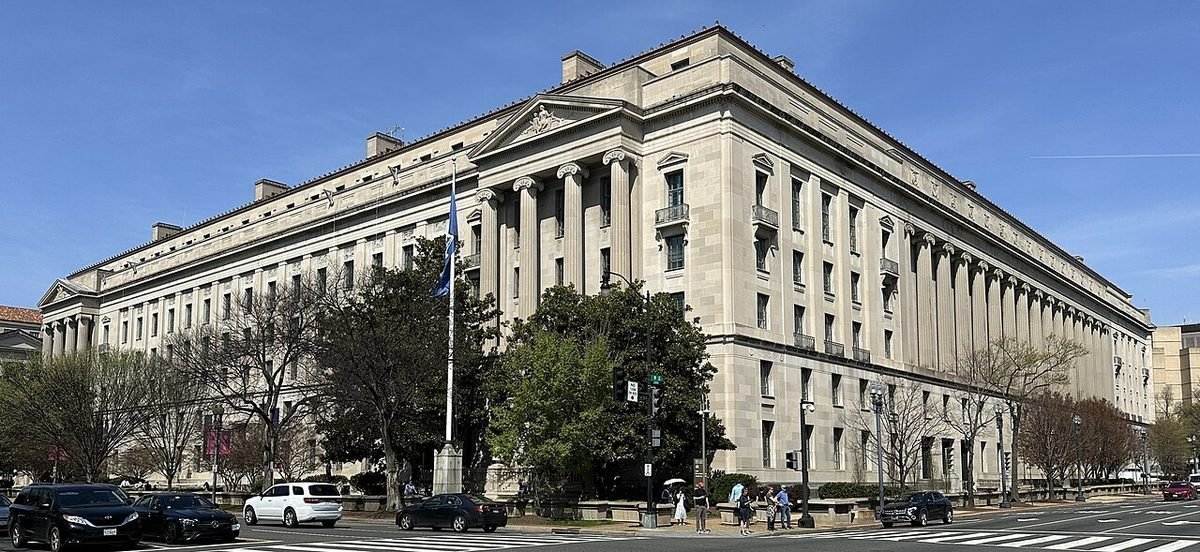
Justice Department motif — Trump housing discrimination guide
Justice Department motif — Trump housing discrimination guide Freely licensed / re-encoded pool image from AI Files sibling guides (EXIF stripped) · Re-encoded; EXIF stripped

Named DOJ lawyers on the case page.

Clearinghouse lists numerous DOJ attorneys including J. Stanley Pottinger, Frank E. Schwelb, Elyse S. Goldweber, and others on the plaintiff side. [1]

Drew S. Days III appears later as the 1978 compliance correspondent. [2]

Bottom line History

Institutional plaintiff, not a lone prosecutor myth.

What the record can’t settle

Roster presence is not a personal cameo in every filing.

Sources

  1. Civil Rights Litigation Clearinghouse — case 15342 (United States v. Trump Management) Secondary synthesis of docket, people, and document list; useful map — prefer underlying PDFs for spines.
  2. Letter — AAG Drew S. Days III to Roy M. Cohn re Consent Order compliance (Jan 20, 1978) Primary DOJ notice under Part IX: ‘not satisfied that Trump Management has complied substantially’; believes ‘underlying pattern of discrimination continues.’ Allegation/notice, not a court finding.

Back to contents · Open in the interactive guide

Brooklyn, Queens, Staten Island focus

Record · History

Outer-borough apartment buildings — Trump housing discrimination guide
Outer-borough apartment buildings — Trump housing discrimination guide Freely licensed / re-encoded pool image from AI Files sibling guides (EXIF stripped) · Re-encoded; EXIF stripped

Where the Times placed the buildings.

Contemporaneous Times coverage emphasized Coney Island, Jamaica Estates, Forest Hills and related outer-borough concentrations. [1]

Clearinghouse likewise frames the complexes as a large New York outer-borough portfolio. [2]

Bottom line History

Geography of the mainstream story is outer-borough rental housing, not Manhattan trophy towers.

What the record can’t settle

Later Trump branding elsewhere is outside this docket’s buildings list.

Sources

  1. New York Times — Major Landlord Accused Of Antiblack Bias in City (Oct 16, 1973) Contemporaneous: DOJ suit vs Trump Management; ≥14,000 apartments; 39 buildings; Donald’s ‘absolutely ridiculous’ denial quoted in later Times Insider recapitulation.
  2. Civil Rights Litigation Clearinghouse — case 15342 (United States v. Trump Management) Secondary synthesis of docket, people, and document list; useful map — prefer underlying PDFs for spines.

Back to contents · Open in the interactive guide

Defense & counterclaim

Cohn, denials, dismissed countersuit

Roy Cohn takes the defense

Record · History

Defense-counsel era stand-in — Trump housing discrimination guide
Defense-counsel era stand-in — Trump housing discrimination guide Freely licensed / re-encoded pool image from AI Files sibling guides (EXIF stripped) · Re-encoded; EXIF stripped

Aggressive denial and a giant counterclaim.

The Trumps retained Roy M. Cohn. [1][4]

Defendants filed a $100 million defamation counterclaim against the government. [2]

Cohn later signed the consent order and received DOJ’s 1978 compliance letter. [5][3]

Bottom line History

The Cohn defense set the confrontational tone that still shapes memory of the case.

What the record can’t settle

Counsel strategy is not itself proof of innocence or guilt.

Sources

  1. Consent Order signature block / Clearinghouse — Roy M. Cohn as defense counsel Cohn listed as attorney for defendants; signs consent order personally with Fred and Donald (With Receipts summary).
  2. Clearinghouse case summary — Neaher dismissed $100M defamation counterclaim Secondary summary of docket outcome: counterclaim dismissed; FHA suit proceeded. Prefer docket/order if separately available.
  3. Letter — AAG Drew S. Days III to Roy M. Cohn re Consent Order compliance (Jan 20, 1978) Primary DOJ notice under Part IX: ‘not satisfied that Trump Management has complied substantially’; believes ‘underlying pattern of discrimination continues.’ Allegation/notice, not a court finding.
  4. Civil Rights Litigation Clearinghouse — case 15342 (United States v. Trump Management) Secondary synthesis of docket, people, and document list; useful map — prefer underlying PDFs for spines.
  5. Consent Order — United States v. Fred C. Trump, Donald Trump, and Trump Management, Inc. (E.D.N.Y. Jun 10, 1975) Primary court order: no adjudication of merits; no admission of liability; personal claims against Fred and Donald dismissed with prejudice; permanent injunction vs company; affirmative program.

Back to contents · Open in the interactive guide

Counterclaim thrown out

Record · Official

Federal judge / courthouse — Trump housing discrimination guide
Federal judge / courthouse — Trump housing discrimination guide Freely licensed / re-encoded pool image from AI Files sibling guides (EXIF stripped) · Re-encoded; EXIF stripped

Neaher dismisses the $100M defamation action.

Clearinghouse’s case summary states Judge Edward R. Neaher dismissed the counterclaim and allowed the Fair Housing Act suit to proceed. [1][2]

The merits fight therefore stayed on the government’s complaint, not on a damages claim against DOJ. [3]

Bottom line Official

The company did not get to try the government for defamation.

What the record can’t settle

Dismissal of a counterclaim is not a finding that the complaint’s facts were true.

Sources

  1. Clearinghouse case summary — Neaher dismissed $100M defamation counterclaim Secondary summary of docket outcome: counterclaim dismissed; FHA suit proceeded. Prefer docket/order if separately available.
  2. Clearinghouse — District Judge Edward R. Neaher assigned Presiding judge; enters consent order June 10, 1975.
  3. Civil Rights Litigation Clearinghouse — case 15342 (United States v. Trump Management) Secondary synthesis of docket, people, and document list; useful map — prefer underlying PDFs for spines.

Back to contents · Open in the interactive guide

Steelman: settlement without proof

Steelman · Mixed

Defense-counsel era stand-in — Trump housing discrimination guide
Defense-counsel era stand-in — Trump housing discrimination guide Freely licensed / re-encoded pool image from AI Files sibling guides (EXIF stripped) · Re-encoded; EXIF stripped

Strongest defense reading.

The order’s own words refuse adjudication and admission. [1]

Personal claims were dismissed with prejudice. [2]

Many FBI interviewees reported no awareness of discrimination. [3]

Still: an injunction and Urban League program are not what a fully exonerated defendant typically bargains for in the abstract — the paper is a compromise. [4][5]

Bottom line Mixed

Steelman for the no-proof / no-admission camp — with the injunction’s existence attached.

What the record can’t settle

‘Couldn’t prove’ is Trump’s later gloss, not a sentence in the order.

Sources

  1. Consent Order text — without adjudication of the merits / no admission Yardstick limit: no merits finding either way.
  2. Consent Order Part I — complaint against Fred and Donald dismissed with prejudice in personal capacity Primary: personal claims dismissed in consideration of company’s affirmative responsibilities.
  3. Clearinghouse summary of FBI interviews — majority unaware; several describe race-based denials/codes Secondary synthesis of FOIA interviews; points both ways — use with Vault primary.
  4. Consent Order Part II — permanent injunction categories Primary: refuses, different terms, discriminatory ads/statements, false unavailability, steering, coercion, etc.
  5. NYT Jun 11, 1975 + Clearinghouse — Urban League vacancy-list / every-fifth-vacancy program Contemporaneous reporting of two-year affirmative mechanics widely cited; consent-order PDF is the controlling text.

Back to contents · Open in the interactive guide

Judge Edward R. Neaher

Record · History

Federal judge / courthouse — Trump housing discrimination guide
Federal judge / courthouse — Trump housing discrimination guide Freely licensed / re-encoded pool image from AI Files sibling guides (EXIF stripped) · Re-encoded; EXIF stripped

The judge who entered the order.

Clearinghouse identifies District Judge Edward Raymond Neaher as the assigned judge who entered the consent order. [1][2]

He also dismissed the counterclaim per the case summary. [3]

Bottom line History

Judicial actor on the mainstream path.

What the record can’t settle

No claim here about his later career beyond this docket.

Sources

  1. Clearinghouse — District Judge Edward R. Neaher assigned Presiding judge; enters consent order June 10, 1975.
  2. Consent Order — United States v. Fred C. Trump, Donald Trump, and Trump Management, Inc. (E.D.N.Y. Jun 10, 1975) Primary court order: no adjudication of merits; no admission of liability; personal claims against Fred and Donald dismissed with prejudice; permanent injunction vs company; affirmative program.
  3. Clearinghouse case summary — Neaher dismissed $100M defamation counterclaim Secondary summary of docket outcome: counterclaim dismissed; FHA suit proceeded. Prefer docket/order if separately available.

Back to contents · Open in the interactive guide

Consent decree years 1975–1977

The 1975 consent order

No admission; injunction; program

Consent order: no admission

Record · Official

1975 consent order document facsimile pool — Trump housing discrimination guide
1975 consent order document facsimile pool — Trump housing discrimination guide Freely licensed / re-encoded pool image from AI Files sibling guides (EXIF stripped) · Re-encoded; EXIF stripped

June 10, 1975.

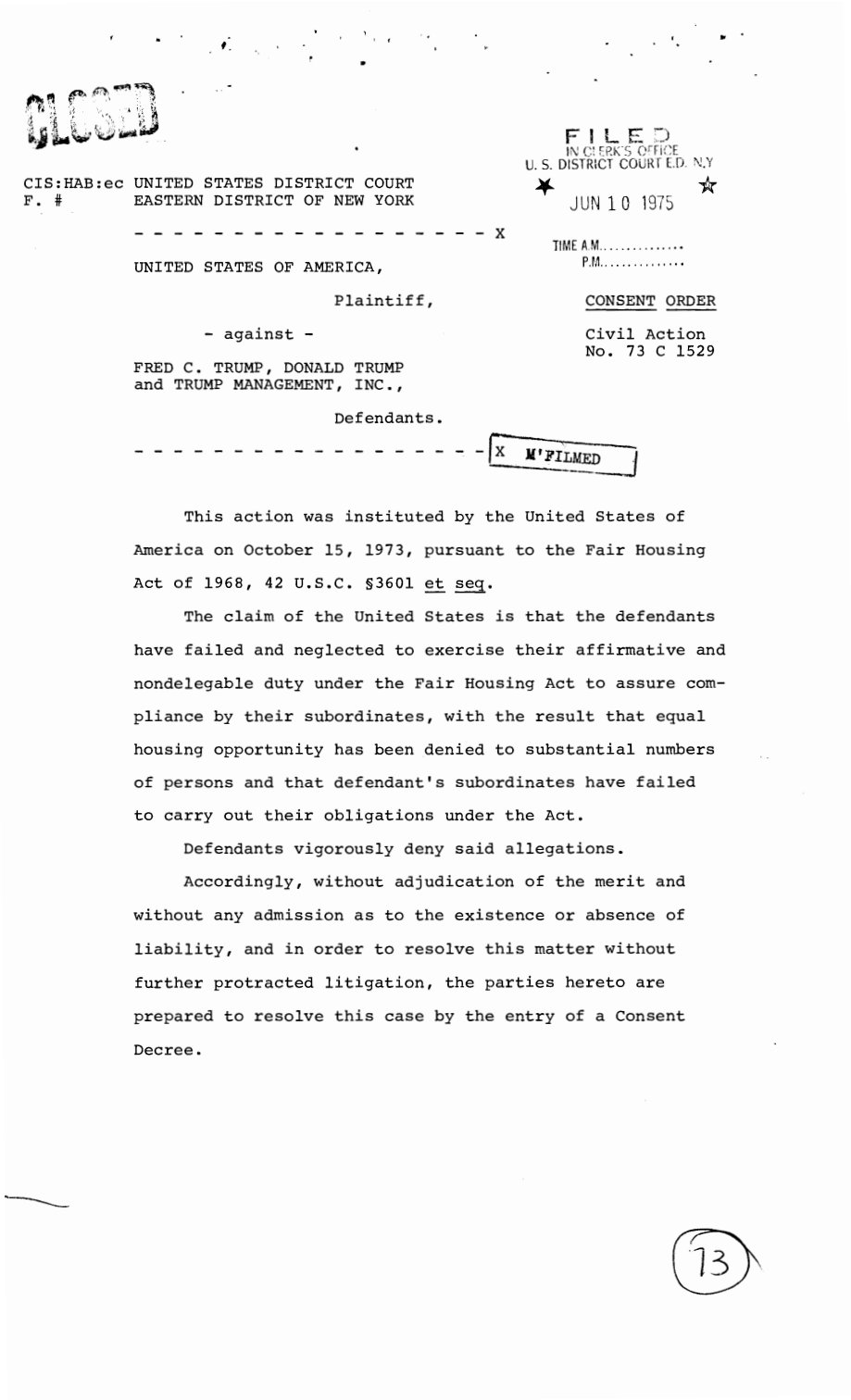
The consent order states the parties resolve the case without adjudication of the merits and without any admission as to liability. [1][2]

It also states Trump Management’s execution is ‘in no way an admission’ of a Fair Housing Act violation. [1]

A DOJ-hosted PDF mirrors the same order. [3]

Bottom line Official

This is the controlling legal end of the merits dispute: settled, not tried.

What the record can’t settle

‘No admission’ is not a judicial finding of innocence; ‘injunction entered’ is not a guilty verdict.

Sources

Back to contents · Open in the interactive guide

Fred and Donald dismissed personally

Record · Official

1975 consent order document facsimile pool — Trump housing discrimination guide
1975 consent order document facsimile pool — Trump housing discrimination guide Freely licensed / re-encoded pool image from AI Files sibling guides (EXIF stripped) · Re-encoded; EXIF stripped

With prejudice, in consideration of company duties.

Part I of the order dismisses the complaint against Fred C. Trump and Donald J. Trump in their personal capacities, with prejudice, as to allegations predating the order. [1]

The company and its agents remain under the injunction and affirmative program. [2]

Bottom line Official

Personal-capacity claims ended without a personal liability finding.

What the record can’t settle

Dismissal with prejudice here is a settlement term, not a trial acquittal narrative.

Sources

  1. Consent Order Part I — complaint against Fred and Donald dismissed with prejudice in personal capacity Primary: personal claims dismissed in consideration of company’s affirmative responsibilities.
  2. Consent Order — United States v. Fred C. Trump, Donald Trump, and Trump Management, Inc. (E.D.N.Y. Jun 10, 1975) Primary court order: no adjudication of merits; no admission of liability; personal claims against Fred and Donald dismissed with prejudice; permanent injunction vs company; affirmative program.

Back to contents · Open in the interactive guide

What the injunction actually forbids

Record · Official

1975 consent order document facsimile pool — Trump housing discrimination guide
1975 consent order document facsimile pool — Trump housing discrimination guide Freely licensed / re-encoded pool image from AI Files sibling guides (EXIF stripped) · Re-encoded; EXIF stripped

Seven categories of conduct, permanently.

Part II permanently enjoins refusals to rent because of race, different terms, discriminatory advertising/statements, false unavailability, influencing residential choice on account of race, and coercion/interference with fair-housing rights. [1]

Principal officers were required to acquaint themselves with the Act and assure subordinate compliance. [2][3]

Bottom line Official

The company accepted forward-looking restraints without admitting past violations.

What the record can’t settle

An injunction’s existence does not narrate which past acts were proven.

Sources

  1. Consent Order Part II — permanent injunction categories Primary: refuses, different terms, discriminatory ads/statements, false unavailability, steering, coercion, etc.
  2. Consent Order — United States v. Fred C. Trump, Donald Trump, and Trump Management, Inc. (E.D.N.Y. Jun 10, 1975) Primary court order: no adjudication of merits; no admission of liability; personal claims against Fred and Donald dismissed with prejudice; permanent injunction vs company; affirmative program.
  3. Motion for Supplemental Relief — United States v. Trump Management, Inc. (Mar 7, 1978) Primary DOJ motion alleging noncompliance with 1975 order; seeks extension, more affirmative relief, victim compensation. Allegations — not adjudicated.

Back to contents · Open in the interactive guide

Urban League vacancy program

Record · Documented

Urban League / referral program motif — Trump housing discrimination guide
Urban League / referral program motif — Trump housing discrimination guide Freely licensed / re-encoded pool image from AI Files sibling guides (EXIF stripped) · Re-encoded; EXIF stripped

Two-year affirmative mechanics.

The New York Times reported that for two years Trump Management would send weekly vacancy lists to the New York Urban League, with a three-day window for the Open Housing Center to submit qualified applicants for every fifth vacancy in buildings under 10% Black tenancy. [1][2]

Clearinghouse’s summary matches that contemporaneous account. [4]

Minority-directed advertising was also part of the decree’s affirmative side. [3]

Bottom line Documented

The decree included concrete access machinery, not only a promise to obey the law.

What the record can’t settle

NYT describes program mechanics; the consent-order PDF is the controlling text if details conflict.

Sources

  1. New York Times — Trump Promises to End Race Bias (Jun 11, 1975) Contemporaneous settlement coverage: weekly vacancy lists to NY Urban League for two years; every-fifth-vacancy referral window where Black tenancy <10%.
  2. NYT Jun 11, 1975 + Clearinghouse — Urban League vacancy-list / every-fifth-vacancy program Contemporaneous reporting of two-year affirmative mechanics widely cited; consent-order PDF is the controlling text.
  3. Consent Order — United States v. Fred C. Trump, Donald Trump, and Trump Management, Inc. (E.D.N.Y. Jun 10, 1975) Primary court order: no adjudication of merits; no admission of liability; personal claims against Fred and Donald dismissed with prejudice; permanent injunction vs company; affirmative program.
  4. Civil Rights Litigation Clearinghouse — case 15342 (United States v. Trump Management) Secondary synthesis of docket, people, and document list; useful map — prefer underlying PDFs for spines.

Back to contents · Open in the interactive guide

DOJ still hosts the order

Record · Official

1975 consent order document facsimile pool — Trump housing discrimination guide
1975 consent order document facsimile pool — Trump housing discrimination guide Freely licensed / re-encoded pool image from AI Files sibling guides (EXIF stripped) · Re-encoded; EXIF stripped

Public PDF mirror.

The Justice Department hosts a Consent Order.pdf under its opa press-release file path. [1]

That hosting keeps the no-admission language one click from official infrastructure. [2]

Bottom line Official

Primary text remains available from the government itself.

What the record can’t settle

Hosting is not a modern DOJ commentary on 2016 politics.

Sources

  1. U.S. Department of Justice — Consent Order.pdf mirror (opa file 1429196) DOJ-hosted PDF of the same consent order (primary mirror).
  2. Consent Order text — without adjudication of the merits / no admission Yardstick limit: no merits finding either way.

Back to contents · Open in the interactive guide

Coded closed in 1977

Record · History

1975 consent order document facsimile pool — Trump housing discrimination guide
1975 consent order document facsimile pool — Trump housing discrimination guide Freely licensed / re-encoded pool image from AI Files sibling guides (EXIF stripped) · Re-encoded; EXIF stripped

Two-year horizon.

Clearinghouse lists a closed date of June 10, 1977 — two years after the consent order. [1]

That timing aligns with the affirmative program’s reported two-year window. [2]

Bottom line History

The decree’s special reporting/program period was built to sunset.

What the record can’t settle

‘Closed’ coding is not a judicial blessing of post-1975 conduct.

Sources

  1. Clearinghouse — case closed date June 10, 1977 Clearinghouse coding: closed Jun 10, 1977 (two years after consent — affirmative-program horizon).
  2. New York Times — Trump Promises to End Race Bias (Jun 11, 1975) Contemporaneous settlement coverage: weekly vacancy lists to NY Urban League for two years; every-fifth-vacancy referral window where Black tenancy <10%.

Back to contents · Open in the interactive guide

Affirmative duties beyond ‘don’t discriminate’

Record · Documented

Urban League / referral program motif — Trump housing discrimination guide
Urban League / referral program motif — Trump housing discrimination guide Freely licensed / re-encoded pool image from AI Files sibling guides (EXIF stripped) · Re-encoded; EXIF stripped

Training, ads, referrals.

Besides the permanent ban, the decree required affirmative steps — including officer education and minority outreach mechanisms reported in the Times. [1][2]

The 1978 motion quotes those officer-acquaintance duties when alleging later failures. [3]

Bottom line Documented

Mainstream path includes affirmative relief, not only negative prohibitions.

What the record can’t settle

How fully the company performed each duty year-by-year is partly what 1978 left unresolved.

Sources

  1. Consent Order — United States v. Fred C. Trump, Donald Trump, and Trump Management, Inc. (E.D.N.Y. Jun 10, 1975) Primary court order: no adjudication of merits; no admission of liability; personal claims against Fred and Donald dismissed with prejudice; permanent injunction vs company; affirmative program.
  2. New York Times — Trump Promises to End Race Bias (Jun 11, 1975) Contemporaneous settlement coverage: weekly vacancy lists to NY Urban League for two years; every-fifth-vacancy referral window where Black tenancy <10%.
  3. Motion for Supplemental Relief — United States v. Trump Management, Inc. (Mar 7, 1978) Primary DOJ motion alleging noncompliance with 1975 order; seeks extension, more affirmative relief, victim compensation. Allegations — not adjudicated.

Back to contents · Open in the interactive guide

Who signed the order

Record · Documented

1975 consent order document facsimile pool — Trump housing discrimination guide
1975 consent order document facsimile pool — Trump housing discrimination guide Freely licensed / re-encoded pool image from AI Files sibling guides (EXIF stripped) · Re-encoded; EXIF stripped

Judge, the Trumps, Cohn.

With Receipts’ consent-order abstract notes personal signatures by Fred C. Trump, Donald Trump, and Roy M. Cohn alongside Judge Neaher’s entry. [1][2]

That personal signing coexists with personal-capacity dismissal in Part I. [3]

Bottom line Documented

The men signed a corporate peace while exiting as personal defendants.

What the record can’t settle

Signature is not an admission clause — the order disclaims admission elsewhere.

Sources

Back to contents · Open in the interactive guide

Equal-opportunity advertising duty

Record · Documented

Urban League / referral program motif — Trump housing discrimination guide
Urban League / referral program motif — Trump housing discrimination guide Freely licensed / re-encoded pool image from AI Files sibling guides (EXIF stripped) · Re-encoded; EXIF stripped

Tell minorities the doors are open.

Clearinghouse summarizes that the agreement required ads informing minorities they had an equal opportunity to seek housing at Trump properties. [1][2]

That duty pairs with the Urban League referral machinery. [3]

Bottom line Documented

Speech/ads were part of the remedy design.

What the record can’t settle

Ad copy archives are not fully reproduced in this guide.

Sources

  1. Civil Rights Litigation Clearinghouse — case 15342 (United States v. Trump Management) Secondary synthesis of docket, people, and document list; useful map — prefer underlying PDFs for spines.
  2. Consent Order — United States v. Fred C. Trump, Donald Trump, and Trump Management, Inc. (E.D.N.Y. Jun 10, 1975) Primary court order: no adjudication of merits; no admission of liability; personal claims against Fred and Donald dismissed with prejudice; permanent injunction vs company; affirmative program.
  3. New York Times — Trump Promises to End Race Bias (Jun 11, 1975) Contemporaneous settlement coverage: weekly vacancy lists to NY Urban League for two years; every-fifth-vacancy referral window where Black tenancy <10%.

Back to contents · Open in the interactive guide

Yardstick limits

Not guilty / not cleared

Clearinghouse as secondary atlas

Record · History

Yardstick / limits motif — Trump housing discrimination guide
Yardstick / limits motif — Trump housing discrimination guide Freely licensed / re-encoded pool image from AI Files sibling guides (EXIF stripped) · Re-encoded; EXIF stripped

Document map, not a court.

The University of Michigan Civil Rights Litigation Clearinghouse aggregates the docket list, PDFs, and a narrative summary (authors noted 2016/2022). [1]

This guide uses it as a map and quotes its summaries with that label — spines still cite the underlying PDFs. [2][3][4]

Bottom line History

Secondary synthesis is allowed when labeled; it is not a substitute primary.

What the record can’t settle

Clearinghouse coding choices (prevailing party, closed date) are editorial metadata.

Sources

  1. Civil Rights Litigation Clearinghouse — case 15342 (United States v. Trump Management) Secondary synthesis of docket, people, and document list; useful map — prefer underlying PDFs for spines.
  2. Consent Order — United States v. Fred C. Trump, Donald Trump, and Trump Management, Inc. (E.D.N.Y. Jun 10, 1975) Primary court order: no adjudication of merits; no admission of liability; personal claims against Fred and Donald dismissed with prejudice; permanent injunction vs company; affirmative program.
  3. Complaint — United States v. Fred C. Trump, Donald Trump, and Trump Management, Inc. (E.D.N.Y. Oct 15, 1973) Primary complaint PDF: pattern-or-practice under Fair Housing Act; Trump Management ≥14,000 units; Fred chairman; Donald president; alleged refusals, different terms, discriminatory statements, false unavailability.
  4. Motion for Supplemental Relief — United States v. Trump Management, Inc. (Mar 7, 1978) Primary DOJ motion alleging noncompliance with 1975 order; seeks extension, more affirmative relief, victim compensation. Allegations — not adjudicated.

Back to contents · Open in the interactive guide

AI Files short nest (2026)

Record · History

Yardstick / limits motif — Trump housing discrimination guide
Yardstick / limits motif — Trump housing discrimination guide Freely licensed / re-encoded pool image from AI Files sibling guides (EXIF stripped) · Re-encoded; EXIF stripped

Earlier thin case page.

The Trump hub short page already stated the consent-decree / no-admission limit and flagged ‘convicted’ as false. [1]

This full guide replaces that thin format as the maintained record while keeping the nest as a gateway. [1][2]

Bottom line History

Continuity: the no-verdict limit was already the site’s short-form bottom line.

What the record can’t settle

Short pages lack rival-path machinery; that is why this rebuild exists.

Sources

  1. AI Files thin nest — 1973 housing case short page Prior short case; becomes gateway after this ship.
  2. AI Files — The Trump Files hub Parent collection.

Back to contents · Open in the interactive guide

Yardstick: not guilty, not cleared

Steelman · Documented

Yardstick / limits motif — Trump housing discrimination guide
Yardstick / limits motif — Trump housing discrimination guide Freely licensed / re-encoded pool image from AI Files sibling guides (EXIF stripped) · Re-encoded; EXIF stripped

The sentence both camps dislike.

There was no civil merits adjudication that Trump Management violated the Fair Housing Act. [1][2]

There was also no trial judgment rejecting the government’s evidence as false. [1]

Personal claims against Fred and Donald were dismissed with prejudice by consent. [3]

The 1978 noncompliance motion never received a ruling. [4]

Sibling guides (University, civil fraud, bankruptcies) are different spines. [5][6][7]

Bottom line Documented

Hold this limit or the page becomes slogan laundry.

What the record can’t settle

Absence of a verdict is not absence of evidence in the investigative file.

Sources

  1. Consent Order text — without adjudication of the merits / no admission Yardstick limit: no merits finding either way.
  2. Consent Order — United States v. Fred C. Trump, Donald Trump, and Trump Management, Inc. (E.D.N.Y. Jun 10, 1975) Primary court order: no adjudication of merits; no admission of liability; personal claims against Fred and Donald dismissed with prejudice; permanent injunction vs company; affirmative program.
  3. Consent Order Part I — complaint against Fred and Donald dismissed with prejudice in personal capacity Primary: personal claims dismissed in consideration of company’s affirmative responsibilities.
  4. Docket sheet — 1978 motion conferenced May 9, 1978 ‘adjourned w/o date’ Primary docket evidence that the supplemental-relief motion was never granted, denied, or withdrawn after adjournment without date.
  5. AI Files — Trump University full guide (cross-link) Sibling consumer-litigation spine; distinct.
  6. AI Files — New York civil fraud full guide (cross-link) Sibling later asset-valuation spine; distinct.
  7. AI Files — Bankruptcies & contractors full guide (cross-link) Sibling business-record spine; distinct.

Back to contents · Open in the interactive guide

No criminal housing case

Record · Documented

Yardstick / limits motif — Trump housing discrimination guide
Yardstick / limits motif — Trump housing discrimination guide Freely licensed / re-encoded pool image from AI Files sibling guides (EXIF stripped) · Re-encoded; EXIF stripped

Civil pattern-or-practice only.

The 1973 action was a civil Fair Housing Act suit for injunction and affirmative relief. [1][2]

There is no parallel criminal conviction in this spine. [3]

Bottom line Documented

‘Felony racism’ talk is off this record.

What the record can’t settle

Civil and criminal standards differ; absence of criminal case is expected for this enforcement mode.

Sources

  1. Complaint — United States v. Fred C. Trump, Donald Trump, and Trump Management, Inc. (E.D.N.Y. Oct 15, 1973) Primary complaint PDF: pattern-or-practice under Fair Housing Act; Trump Management ≥14,000 units; Fred chairman; Donald president; alleged refusals, different terms, discriminatory statements, false unavailability.
  2. Fair Housing Act of 1968 — 42 U.S.C. §3601 et seq. (statutory text via Cornell LII) Primary statute: rental discrimination prohibitions that ground the 1973 complaint.
  3. Consent Order text — without adjudication of the merits / no admission Yardstick limit: no merits finding either way.

Back to contents · Open in the interactive guide

Not University, not civil fraud

Record · History

Yardstick / limits motif — Trump housing discrimination guide
Yardstick / limits motif — Trump housing discrimination guide Freely licensed / re-encoded pool image from AI Files sibling guides (EXIF stripped) · Re-encoded; EXIF stripped

Keep the spines separate.

Trump University ended in a $25M civil settlement with no admission — a rhyme, not the same case. [1]

New York civil fraud and casino bankruptcies are other business-record guides. [2][3]

Bottom line History

Cross-link; do not merge.

What the record can’t settle

Rhetorical bundling (‘always a fraud’) is a theory move, not a docket fact.

Sources

  1. AI Files — Trump University full guide (cross-link) Sibling consumer-litigation spine; distinct.
  2. AI Files — New York civil fraud full guide (cross-link) Sibling later asset-valuation spine; distinct.
  3. AI Files — Bankruptcies & contractors full guide (cross-link) Sibling business-record spine; distinct.

Back to contents · Open in the interactive guide

Open: Donald’s day-to-day rental decisions

Question · Unproven

Donald Trump portrait pool — Trump housing discrimination guide
Donald Trump portrait pool — Trump housing discrimination guide Freely licensed / re-encoded pool image from AI Files sibling guides (EXIF stripped) · Re-encoded; EXIF stripped

What did the president of the company personally order?

The complaint assigns policy responsibility; the personal claims were dismissed; FBI/WaPo materials have been argued both ways on hands-on involvement. [1][2][3]

No trial record resolved that micro-factual question. [4]

Bottom line Unproven

Genuinely under-determined at the personal-instruction level.

What the record can’t settle

Corporate office holding is documented; specific oral orders mostly are not.

Sources

  1. Complaint — United States v. Fred C. Trump, Donald Trump, and Trump Management, Inc. (E.D.N.Y. Oct 15, 1973) Primary complaint PDF: pattern-or-practice under Fair Housing Act; Trump Management ≥14,000 units; Fred chairman; Donald president; alleged refusals, different terms, discriminatory statements, false unavailability.
  2. Consent Order Part I — complaint against Fred and Donald dismissed with prejudice in personal capacity Primary: personal claims dismissed in consideration of company’s affirmative responsibilities.
  3. Washington Post — FBI releases file on 1970s Trump housing discrimination case (Feb 15, 2017) Notes 389-page FBI file release; says it does not newly redefine Donald’s role beyond prior DOJ FOIA reporting.
  4. Consent Order text — without adjudication of the merits / no admission Yardstick limit: no merits finding either way.

Back to contents · Open in the interactive guide

Clearinghouse ‘prevailing party’ metadata

Record · Mixed

Yardstick / limits motif — Trump housing discrimination guide
Yardstick / limits motif — Trump housing discrimination guide Freely licensed / re-encoded pool image from AI Files sibling guides (EXIF stripped) · Re-encoded; EXIF stripped

Plaintiff or mixed.

Clearinghouse codes prevailing party as ‘Plaintiff OR Mixed’ with relief type ‘Injunction / Injunctive-like Settlement’ and ‘Court Approved Settlement or Consent Decree.’ [1]

That metadata reflects settlement structure, not a trial win on findings of fact. [2]

Bottom line Mixed

Database codes can mislead if read as ‘guilty.’

What the record can’t settle

Metadata is not the order’s operative sentences.

Sources

  1. Civil Rights Litigation Clearinghouse — case 15342 (United States v. Trump Management) Secondary synthesis of docket, people, and document list; useful map — prefer underlying PDFs for spines.
  2. Consent Order text — without adjudication of the merits / no admission Yardstick limit: no merits finding either way.

Back to contents · Open in the interactive guide

Noncompliance motion 1978–1979

1978 noncompliance fight

Letter, motion, no ruling

Days III: not satisfied

Record · Alleged

1978 motion / compliance fight — Trump housing discrimination guide
1978 motion / compliance fight — Trump housing discrimination guide Freely licensed / re-encoded pool image from AI Files sibling guides (EXIF stripped) · Re-encoded; EXIF stripped

January 20, 1978 Part IX notice.

Assistant Attorney General Drew S. Days III wrote Roy Cohn that after considering Trump Management’s response and DOJ’s inquiry, the Department was ‘not satisfied that Trump Management has complied substantially’ and believed ‘an underlying pattern of discrimination continues.’ [1]

That letter is a compliance notice under the decree — not a court judgment. [1][2]

Bottom line Alleged

DOJ’s 1978 view was that problems continued; it still had to prove that in court — and did not obtain a ruling.

What the record can’t settle

A prosecutor’s letter is an allegation of noncompliance.

Sources

  1. Letter — AAG Drew S. Days III to Roy M. Cohn re Consent Order compliance (Jan 20, 1978) Primary DOJ notice under Part IX: ‘not satisfied that Trump Management has complied substantially’; believes ‘underlying pattern of discrimination continues.’ Allegation/notice, not a court finding.
  2. With Receipts — The 1978 non-compliance motion was never decided Secondary compilation tying Days letter + motion + docket; grades claim unresolved because never adjudicated.

Back to contents · Open in the interactive guide

Motion for supplemental relief

Record · Alleged

1978 motion / compliance fight — Trump housing discrimination guide
1978 motion / compliance fight — Trump housing discrimination guide Freely licensed / re-encoded pool image from AI Files sibling guides (EXIF stripped) · Re-encoded; EXIF stripped

March 7, 1978.

The United States moved to extend the injunction, add affirmative relief, compensate individual victims, and continue reporting — alleging apartments made unavailable to Black persons, discriminatory terms, discriminatory statements, and false unavailability. [1]

By then the caption focused on the company; the men had been dismissed personally in 1975. [1][2]

Bottom line Alleged

DOJ put noncompliance allegations on the docket.

What the record can’t settle

Filing a motion is not winning a motion.

Sources

  1. Motion for Supplemental Relief — United States v. Trump Management, Inc. (Mar 7, 1978) Primary DOJ motion alleging noncompliance with 1975 order; seeks extension, more affirmative relief, victim compensation. Allegations — not adjudicated.
  2. Consent Order Part I — complaint against Fred and Donald dismissed with prejudice in personal capacity Primary: personal claims dismissed in consideration of company’s affirmative responsibilities.

Back to contents · Open in the interactive guide

Adjourned without date — never ruled

Record · Documented

1978 motion / compliance fight — Trump housing discrimination guide
1978 motion / compliance fight — Trump housing discrimination guide Freely licensed / re-encoded pool image from AI Files sibling guides (EXIF stripped) · Re-encoded; EXIF stripped

The missing judgment.

The docket shows the motion conferenced on May 9, 1978 and ‘adjourned w/o date.’ [1]

Compilations that track the sheet find no later grant, denial, or withdrawal. [2]

So the 1978 noncompliance story ends in unresolved status — a genuine hole in the path. [2]

Bottom line Documented

Anyone who treats 1978 as a second conviction (or as a second clearance) is inventing a ruling the docket does not show.

What the record can’t settle

Why the motion died — negotiation, resource shift, or something else — is not established on the public sheet alone.

Sources

  1. Docket sheet — 1978 motion conferenced May 9, 1978 ‘adjourned w/o date’ Primary docket evidence that the supplemental-relief motion was never granted, denied, or withdrawn after adjournment without date.
  2. With Receipts — The 1978 non-compliance motion was never decided Secondary compilation tying Days letter + motion + docket; grades claim unresolved because never adjudicated.

Back to contents · Open in the interactive guide

Open: why the 1978 motion died

Question · Unproven

1978 motion / compliance fight — Trump housing discrimination guide
1978 motion / compliance fight — Trump housing discrimination guide Freely licensed / re-encoded pool image from AI Files sibling guides (EXIF stripped) · Re-encoded; EXIF stripped

Adjourned — then silence.

The public docket shows adjournment without date and no later disposition. [1][2]

Possible explanations (settlement talks, resource triage, evidentiary problems) are not established on that sheet. [2]

Bottom line Unproven

A real unknown that blocks treating 1978 as closed fact.

What the record can’t settle

Absence of a ruling is itself the documented fact.

Sources

  1. Docket sheet — 1978 motion conferenced May 9, 1978 ‘adjourned w/o date’ Primary docket evidence that the supplemental-relief motion was never granted, denied, or withdrawn after adjournment without date.
  2. With Receipts — The 1978 non-compliance motion was never decided Secondary compilation tying Days letter + motion + docket; grades claim unresolved because never adjudicated.

Back to contents · Open in the interactive guide

Receipts culture around 1978

Record · History

1978 motion / compliance fight — Trump housing discrimination guide
1978 motion / compliance fight — Trump housing discrimination guide Freely licensed / re-encoded pool image from AI Files sibling guides (EXIF stripped) · Re-encoded; EXIF stripped

Modern compilations stressing unadjudicated status.

Projects such as With Receipts publish the Days letter, the 1978 motion, and the docket adjournment as a chained claim that noncompliance was alleged and never decided. [2][3][1]

That chaining matches this guide’s yardstick: keep 1978 visible and unresolved. [4]

Bottom line History

Useful secondary cartography when it points at primaries.

What the record can’t settle

Third-party claim grades are not court holdings.

Sources

  1. With Receipts — The 1978 non-compliance motion was never decided Secondary compilation tying Days letter + motion + docket; grades claim unresolved because never adjudicated.
  2. Letter — AAG Drew S. Days III to Roy M. Cohn re Consent Order compliance (Jan 20, 1978) Primary DOJ notice under Part IX: ‘not satisfied that Trump Management has complied substantially’; believes ‘underlying pattern of discrimination continues.’ Allegation/notice, not a court finding.
  3. Motion for Supplemental Relief — United States v. Trump Management, Inc. (Mar 7, 1978) Primary DOJ motion alleging noncompliance with 1975 order; seeks extension, more affirmative relief, victim compensation. Allegations — not adjudicated.
  4. Docket sheet — 1978 motion conferenced May 9, 1978 ‘adjourned w/o date’ Primary docket evidence that the supplemental-relief motion was never granted, denied, or withdrawn after adjournment without date.

Back to contents · Open in the interactive guide

Part IX notice procedure

Record · Official

1978 motion / compliance fight — Trump housing discrimination guide
1978 motion / compliance fight — Trump housing discrimination guide Freely licensed / re-encoded pool image from AI Files sibling guides (EXIF stripped) · Re-encoded; EXIF stripped

How DOJ had to warn before seeking more relief.

The Days letter and the 1978 motion recite that Part IX of the consent order required notice of complaints and a chance to correct before further court action. [1][2]

DOJ said individual complainants were sometimes accommodated but systemic prevention was inadequate. [2]

Bottom line Official

The decree anticipated compliance disputes — and then one arrived.

What the record can’t settle

Following Part IX procedure does not prove the underlying violations.

Sources

  1. Letter — AAG Drew S. Days III to Roy M. Cohn re Consent Order compliance (Jan 20, 1978) Primary DOJ notice under Part IX: ‘not satisfied that Trump Management has complied substantially’; believes ‘underlying pattern of discrimination continues.’ Allegation/notice, not a court finding.
  2. Motion for Supplemental Relief — United States v. Trump Management, Inc. (Mar 7, 1978) Primary DOJ motion alleging noncompliance with 1975 order; seeks extension, more affirmative relief, victim compensation. Allegations — not adjudicated.

Back to contents · Open in the interactive guide

Quiet memory / Art of the Deal 1980–2015

How it was remembered

Win headlines vs minor settlement

Far-reaching win vs minor settlement

Record · Mixed

Quiet-memory / Art of the Deal era — Trump housing discrimination guide
Quiet-memory / Art of the Deal era — Trump housing discrimination guide Freely licensed / re-encoded pool image from AI Files sibling guides (EXIF stripped) · Re-encoded; EXIF stripped

Same order, rival headlines.

Clearinghouse records that DOJ called the decree one of the most far-reaching ever negotiated, and that the Amsterdam News headlined a minorities’ win. [1][2]

In The Art of the Deal, Trump later wrote that the government couldn’t prove its case and that the parties made a minor settlement without admitting guilt. [3][4]

Bottom line Mixed

Public memory split immediately along camp lines; the order’s text supports neither ‘convicted’ nor ‘exonerated.’

What the record can’t settle

Press characterizations and autobiography lines are not court findings.

Sources

  1. Clearinghouse summary — DOJ called the decree ‘one of the most far-reaching ever negotiated’ Attributed DOJ characterization via Clearinghouse; pair with consent-order text rather than treat as adjudication.
  2. New York Amsterdam News — ‘Minorities win housing suit’ framing (1975, as cited by Clearinghouse) Contemporaneous Black-press framing cited in Clearinghouse summary; camp memory of a civil-rights win. Prefer consent order for legal text.
  3. Donald J. Trump with Tony Schwartz — The Art of the Deal (1987) (housing-case self-characterization) Primary for Trump’s later framing: government ‘couldn’t prove its case’ / ‘minor settlement without admitting any guilt’ (as quoted in Clearinghouse summary). Not a court finding.
  4. Civil Rights Litigation Clearinghouse — case 15342 (United States v. Trump Management) Secondary synthesis of docket, people, and document list; useful map — prefer underlying PDFs for spines.

Back to contents · Open in the interactive guide

Art of the Deal self-mythology

Record · History

Quiet-memory / Art of the Deal era — Trump housing discrimination guide
Quiet-memory / Art of the Deal era — Trump housing discrimination guide Freely licensed / re-encoded pool image from AI Files sibling guides (EXIF stripped) · Re-encoded; EXIF stripped

‘Minor settlement’ enters the brand book.

Trump’s 1987 book line — government couldn’t prove its case; minor settlement without admitting guilt — becomes the durable defense memory. [1]

Clearinghouse quotes that autobiography contrast next to the ‘far-reaching’ DOJ/press memory. [2]

Bottom line History

Primary for Trump’s later framing; not primary for what the order legally did.

What the record can’t settle

Autobiography is advocacy about the past.

Sources

  1. Donald J. Trump with Tony Schwartz — The Art of the Deal (1987) (housing-case self-characterization) Primary for Trump’s later framing: government ‘couldn’t prove its case’ / ‘minor settlement without admitting any guilt’ (as quoted in Clearinghouse summary). Not a court finding.
  2. Civil Rights Litigation Clearinghouse — case 15342 (United States v. Trump Management) Secondary synthesis of docket, people, and document list; useful map — prefer underlying PDFs for spines.

Back to contents · Open in the interactive guide

Campaign revival & FBI Vault 2016–2017

2016–17 revival

WaPo, Vault, campaign shorthand

Washington Post opens the DOJ file (2016)

Record · Documented

2016 campaign revival — Trump housing discrimination guide
2016 campaign revival — Trump housing discrimination guide Freely licensed / re-encoded pool image from AI Files sibling guides (EXIF stripped) · Re-encoded; EXIF stripped

Kranish and O’Harrow.

On January 23, 2016, the Washington Post published a detailed reconstruction from Justice Department FOIA materials: testers, alleged codes, Cohn’s fight, and the consent decree. [1]

That article is the main bridge from a 1970s Brooklyn case file to 2016 national politics. [1]

It is labeled here as major secondary synthesis — court PDFs remain the legal spine. [2][3]

Bottom line Documented

2016 is when mass audiences met the housing case again.

What the record can’t settle

Investigative synthesis can err; prefer PDFs for operative legal language.

Sources

  1. Washington Post — Inside the government’s racial bias case against Donald Trump’s company (Kranish/O’Harrow, Jan 23, 2016) Major investigative synthesis from DOJ FOIA: tester pairs, alleged codes (‘C’, ‘No. 9’), Cohn defense, consent decree. Secondary — use for campaign-era revival; prefer court PDFs for legal outcomes.
  2. Consent Order — United States v. Fred C. Trump, Donald Trump, and Trump Management, Inc. (E.D.N.Y. Jun 10, 1975) Primary court order: no adjudication of merits; no admission of liability; personal claims against Fred and Donald dismissed with prejudice; permanent injunction vs company; affirmative program.
  3. Complaint — United States v. Fred C. Trump, Donald Trump, and Trump Management, Inc. (E.D.N.Y. Oct 15, 1973) Primary complaint PDF: pattern-or-practice under Fair Housing Act; Trump Management ≥14,000 units; Fred chairman; Donald president; alleged refusals, different terms, discriminatory statements, false unavailability.

Back to contents · Open in the interactive guide

Campaign shorthand

Record · Mixed

2016 campaign revival — Trump housing discrimination guide
2016 campaign revival — Trump housing discrimination guide Freely licensed / re-encoded pool image from AI Files sibling guides (EXIF stripped) · Re-encoded; EXIF stripped

‘Racist landlord’ vs ‘witch hunt over a settlement.’

Once WaPo and allies resurfaced the file, rival networks compressed it into slogans that often erased the no-admission clause — or erased the tester evidence. [1][2]

This guide’s job is to put both compressions back against the critical path. [3]

Bottom line Mixed

Polarized shorthand is a memory phase, not a new court finding.

What the record can’t settle

Social-media claims are not added as evidence of 1973 facts.

Sources

  1. Washington Post — Inside the government’s racial bias case against Donald Trump’s company (Kranish/O’Harrow, Jan 23, 2016) Major investigative synthesis from DOJ FOIA: tester pairs, alleged codes (‘C’, ‘No. 9’), Cohn defense, consent decree. Secondary — use for campaign-era revival; prefer court PDFs for legal outcomes.
  2. Consent Order text — without adjudication of the merits / no admission Yardstick limit: no merits finding either way.
  3. Consent Order — United States v. Fred C. Trump, Donald Trump, and Trump Management, Inc. (E.D.N.Y. Jun 10, 1975) Primary court order: no adjudication of merits; no admission of liability; personal claims against Fred and Donald dismissed with prejudice; permanent injunction vs company; affirmative program.

Back to contents · Open in the interactive guide

FBI Vault release (2017)

Record · Official

FBI file / investigation motif — Trump housing discrimination guide
FBI file / investigation motif — Trump housing discrimination guide Freely licensed / re-encoded pool image from AI Files sibling guides (EXIF stripped) · Re-encoded; EXIF stripped

The interview file goes public.

In February 2017 the FBI released its Trump Management Company FOIA file on the Vault. [1][2]

WaPo noted the release did not newly redefine Donald’s presidential-company role beyond prior DOJ FOIA reporting. [2]

Bottom line Official

Primary investigative interviews became readable without a newsroom intermediary.

What the record can’t settle

FOIA files include hearsay, uncharged allegations, and exculpatory denials mixed together.

Sources

  1. FBI Vault — Trump Management Company (FOIA file, 8 parts) Primary investigative file released ~Feb 2017: interviews, tester materials, CHR/DHR attachments. Mixed: many interviewees unaware of discrimination; some describe race-based denials/codes.
  2. Washington Post — FBI releases file on 1970s Trump housing discrimination case (Feb 15, 2017) Notes 389-page FBI file release; says it does not newly redefine Donald’s role beyond prior DOJ FOIA reporting.

Back to contents · Open in the interactive guide

What the interviews say — both ways

Record · Mixed

FBI file / investigation motif — Trump housing discrimination guide
FBI file / investigation motif — Trump housing discrimination guide Freely licensed / re-encoded pool image from AI Files sibling guides (EXIF stripped) · Re-encoded; EXIF stripped

Majority unaware; several describe race bans.

Clearinghouse’s read of the FBI interviews: most interviewees were not aware of discrimination occurring; several described race-based denials or coding. [1]

Examples summarized there include a prospective Black tenant told after a showing that the complex ‘discriminated against blacks,’ and a short-tenure employee told ‘they’re blacks and that’s that.’ [1][2]

Bottom line Mixed

The Vault is not a monolith; cherry-picking either side is easy.

What the record can’t settle

Interview notes are not cross-examined trial testimony.

Sources

  1. Clearinghouse summary of FBI interviews — majority unaware; several describe race-based denials/codes Secondary synthesis of FOIA interviews; points both ways — use with Vault primary.
  2. Civil Rights Litigation Clearinghouse — case 15342 (United States v. Trump Management) Secondary synthesis of docket, people, and document list; useful map — prefer underlying PDFs for spines.
  3. FBI Vault — Trump Management Company (FOIA file, 8 parts) Primary investigative file released ~Feb 2017: interviews, tester materials, CHR/DHR attachments. Mixed: many interviewees unaware of discrimination; some describe race-based denials/codes.

Back to contents · Open in the interactive guide

Papers you can still open

Record · Documented

2016 campaign revival — Trump housing discrimination guide
2016 campaign revival — Trump housing discrimination guide Freely licensed / re-encoded pool image from AI Files sibling guides (EXIF stripped) · Re-encoded; EXIF stripped

Complaint, consent, motion, Vault.

Primaries remain online: complaint PDF, consent-order PDF (Clearinghouse S3 and DOJ mirror), 1978 motion PDF, FBI Vault parts. [1][2][3][4]

That durability is why slogan versions are optional, not mandatory. [5]

Bottom line Documented

The record is still checkable.

What the record can’t settle

Some attachments may be incomplete scans.

Sources

  1. Complaint — United States v. Fred C. Trump, Donald Trump, and Trump Management, Inc. (E.D.N.Y. Oct 15, 1973) Primary complaint PDF: pattern-or-practice under Fair Housing Act; Trump Management ≥14,000 units; Fred chairman; Donald president; alleged refusals, different terms, discriminatory statements, false unavailability.
  2. Consent Order — United States v. Fred C. Trump, Donald Trump, and Trump Management, Inc. (E.D.N.Y. Jun 10, 1975) Primary court order: no adjudication of merits; no admission of liability; personal claims against Fred and Donald dismissed with prejudice; permanent injunction vs company; affirmative program.
  3. Motion for Supplemental Relief — United States v. Trump Management, Inc. (Mar 7, 1978) Primary DOJ motion alleging noncompliance with 1975 order; seeks extension, more affirmative relief, victim compensation. Allegations — not adjudicated.
  4. FBI Vault — Trump Management Company (FOIA file, 8 parts) Primary investigative file released ~Feb 2017: interviews, tester materials, CHR/DHR attachments. Mixed: many interviewees unaware of discrimination; some describe race-based denials/codes.
  5. Consent Order text — without adjudication of the merits / no admission Yardstick limit: no merits finding either way.

Back to contents · Open in the interactive guide

Discussion

Comment, dispute or support a claim, submit a source or rate this page through a short Google Form. It asks you to sign in with Google so we know you are a real person; your email is never shown. Nothing appears here until it has been reviewed. Conversation on X tagged #AIFiles #AIFilesTrump shows up below after the daily refresh.

CommentSubmit a sourceRate this pageStart a discussion on XFull forum topicSee all disputesFollow updates (Google Group)

Reader comments

Approved reader comments and ratings appear here when JavaScript is on.

On X

Posts from the daily snapshot appear here when JavaScript is on. You can read this subject’s threads on the forum: Forum: #AIFilesTrump.

Reader comments are shown only after review, and rows removed from the form’s sheet disappear at the next refresh. X posts are a read-only daily snapshot; posts deleted or made private there are removed at the next refresh. Inclusion is not endorsement. A submitted source stays pending review until a page update says otherwise.