Who belongs?
Constitutional loyalty should determine eligibility for office rather than denomination. In 1963, the national promise is explicitly applied to Black Americans denied equal treatment.
[KW-HOUSTON][KW-CIVILRIGHTS]35th president · 1961–1963
An appeal to national purpose, tested by covert failure, nuclear danger and demands for equal citizenship.
Kennedy paired American strength with negotiation from the outset of his presidency. His short presidency exposed the costs and limits of both. A profile of his life and public arguments helps distinguish documented decisions from the retrospective image of a president whose death left his future unwritten.
All subjects
Filters change the graph and event list below. Choose several subjects to combine them.
Ideas in place and time
Kennedy’s public arguments put national capability and service near the center of politics. They also make room for bargaining with adversaries and for a constitutional membership wider than a particular faith or race. The sequence matters: negotiation appears in the inaugural, while the 1963 addresses make human survival and racial equality more explicit. The speeches show continuity alongside a changing emphasis; they do not establish a sudden passage from pure militancy to pure pacifism. [KW-HOUSTON][KW-INAUGURAL][KW-PEACE][KW-CIVILRIGHTS]
The documents also expose the limits of public self-description. After the Bay of Pigs he accepted presidential responsibility while withholding operational detail. During the missile crisis, the public demand for Soviet withdrawal coexisted with confidential accommodation over U.S. missiles in Turkey. Neither a speech nor a private memorandum, considered alone, is the whole policy. [KW-BAYPIGS][KW-MISSILES][KW-RFK-DOBRYNIN][KW-KHRUSHCHEV]
Constitutional loyalty should determine eligibility for office rather than denomination. In 1963, the national promise is explicitly applied to Black Americans denied equal treatment.
[KW-HOUSTON][KW-CIVILRIGHTS]Public service, scientific mobilization, legislation and organized national capacity are instruments of progress. The moon effort is both a human project and a competitive demonstration of leadership.
[KW-INAUGURAL][KW-RICE]Military resolve is paired with negotiation and safeguards. Adversaries remain human, but claims of restraint do not themselves reveal covert choices or prove compliance.
[KW-BAYPIGS][KW-MISSILES][KW-PEACE]1960-09-12
Addressing Houston ministers as a Catholic presidential candidate, he places constitutional office above ecclesiastical direction while defending everyone’s religious liberty, including the choice not to attend church. His claim to belonging rests on constitutional loyalty and public judgment rather than a religious credential.
Emphasis: He redirects attention to hunger, housing, schools, national power and the space race.
Inside and outside: Equal citizenship, conscience and impartial office are goods; religious tests, persecution and clerical control of public policy are rejected. Catholics join Protestants and Jews as equally eligible Americans. Intolerance is the target, not religious people.
Outside this account: The campaign defense sharply separates religious authority from official duty; it does not explore every way faith or moral reasoning can shape public deliberation.
Limit: An election address establishes his public commitments, not constitutional doctrine or proof of later compliance.
[KW-HOUSTON]1961-01-20
He presents a wartime-tested generation as responsible for liberty abroad, aid to poorer peoples, alliances and national service. Alongside sweeping commitments, he invites adversaries into arms-control negotiations. Resolve and diplomacy are paired from the start; the inaugural cannot support a story in which negotiation first appears in 1963.
Emphasis: Foreign affairs, collective effort, generational renewal and scientific cooperation.
Inside and outside: Freedom, sacrifice and assistance are praised; poverty, tyranny and nuclear self-destruction are dangers. Allies and emerging states are partners; even adversaries can cooperate. New states need not adopt Washington’s every position.
Outside this account: The universal promise gives little specific attention to domestic racial exclusion or the costs of an open-ended promise to defend liberty.
Limit: The pledges are aspirations and rhetoric, not proof that interventions served self-determination or that every burden was justified.
[KW-INAUGURAL]1961-04-21
After the failed Cuba operation, he identifies himself as the responsible officer while refusing further detail on national-interest grounds. He also urges serious opposition to communism rather than allegations about fellow Americans’ loyalty. Public accountability and executive control of information coexist in the same response.
Emphasis: National interest, anti-communist effectiveness and presidential responsibility.
Inside and outside: Responsible leadership and effective analysis are favored; scapegoating and inaccurate loyalty attacks are rejected. Political disagreement does not by itself place Eisenhower, Truman or other domestic figures outside the legitimate community.
Outside this account: He acknowledges responsibility without disclosing the decision chain, advice or operational choices needed to allocate it.
Limit: This is an admission of presidential responsibility, not a complete confession, independent investigation or proof of a subsequent break with covert action.
[KW-BAYPIGS]1962-09-12
At Rice he links the moon goal to knowledge, economic opportunity and peace, while insisting that American leadership is needed to influence space’s future. Scientific progress becomes both a common human project and a test of national preeminence; cooperation and competition remain in tension.
Emphasis: Capability, jobs, regional investment, collective sacrifice and leadership.
Inside and outside: Courage, disciplined effort and peaceful knowledge are goods; passivity and hostile militarization are dangers. Scientists, workers, students and taxpayers form the mobilized national public. A hostile power’s dominance is cast as a threat, while the promised benefits extend beyond Americans.
Outside this account: He acknowledges the large budget and uncertainty of benefits, but does not compare alternative uses of the same resources in detail.
Limit: The speech establishes the case for the program; technological success, distribution of benefits and opportunity costs require separate records.
[KW-RICE]1962-10-22
He condemns Soviet deception, announces a naval quarantine and retaliation policy, and offers negotiations. He distinguishes Cuban people from leaders portrayed as serving foreign power. He presents credible coercion and limited initial action as means of preventing war, not alternatives to diplomacy.
Emphasis: Threat, hemispheric credibility and a controlled American response.
Inside and outside: Security, restraint and freedom oppose intimidation, deception and submission. Cuban civilians are addressed as potential friends; Soviet and Cuban governing actions are the stated adversary.
Outside this account: The speech supplies Washington’s justification, not a full Cuban security perspective or the confidential bargaining that followed. FRUS records preserve the private Turkey-missile assurance alongside public demands.
Limit: The public speech does not establish the legality or complete causes of the crisis. RFK’s record and Khrushchev’s letter are attributed contemporaneous accounts, not interchangeable transcripts.
[KW-MISSILES][KW-RFK-DOBRYNIN][KW-KHRUSHCHEV]1963-06-10 / 1963-06-11
At American University he calls for attainable agreements, recognition of Soviet humanity and nuclear-test talks, while retaining deterrence and alliance commitments. The next evening he identifies racial equality as a national moral obligation and announces legislation. Both addresses connect security to human rights; this is a sharper public emphasis, not evidence that Cold War commitments disappeared.
Emphasis: June 10: shared interests and safeguards. June 11: unequal opportunity, urgency, law and conscience.
Inside and outside: Mutual survival and equal treatment oppose fatalism, humiliation and racial exclusion. Soviet people retain virtues despite ideological conflict. Black Americans belong fully in the national promise; discrimination is a national failure rather than only a Southern problem.
Outside this account: The peace speech affirms American restraint rather than auditing every intervention. The rights speech foregrounds presidential legislation and peaceful remedies while acknowledging protest’s pressure.
Limit: Neither address proves a private conversion or completed policy outcomes; proposed rights legislation was not enacted that night.
[KW-PEACE][KW-CIVILRIGHTS]One reading sees the failures and dangers of 1961–1962 sharpening Kennedy’s preference for limited, negotiated solutions. Another sees adaptation within a continuing Cold War strategy: the inaugural already offered talks, and the American University speech did not renounce deterrence or alliances. Dated drafts, meeting records and operational instructions can test changes of policy. The speeches alone cannot establish a permanent private conversion, what he would have done in Vietnam, or a motive for his assassination. [KW-INAUGURAL][KW-BAYPIGS][KW-MISSILES][KW-PEACE][nsam263]
An account of the missile crisis centered only on public firmness leaves out private bargaining. Robert Kennedy’s October 30 memorandum describes his October 27 meeting with Ambassador Dobrynin; the FRUS editorial note records a deleted passage about a four-to-five-month timetable for Turkey. Khrushchev’s confidential October 28 letter also describes an assurance. The formulations differ, including over a formal exchange. Together they establish accommodation in the record, not a proof that one factor alone prevented war. [KW-RFK-DOBRYNIN][KW-KHRUSHCHEV]
The June 11 civil-rights address can be read as a moral commitment and as a response to movement pressure and a governing crisis. Those explanations need not cancel each other. The address calls for legislation, but also seeks to channel protest into legal remedies. Movement correspondence, legislative drafts, enforcement choices and White House discussions offer evidence about how commitment and calculation interacted; neither reverent memory nor automatic cynicism can replace them. [KW-CIVILRIGHTS][E-king-jfk][E-king-rfk]
Rice presents the moon program as an investment in knowledge, jobs and peaceful progress, while making American leadership central to the argument. Budgets and contemporary alternatives can test its tradeoffs. Later technical success does not establish that every cost was justified or that benefits were evenly shared. [KW-RICE]
Life and linked files
Life milestones appear alongside governing decisions and events examined in the separate historical guides. Speeches document public positions; the linked records place those positions beside decisions and their consequences. Select a subject above to follow one part of the story.
19 events
The Library of Congress records his Massachusetts birth.
Education precedes wartime naval service.
A Japanese destroyer rams and splits his patrol boat in the Solomon Islands. He leads survivors to an island.
He wins a working-class Boston district in Congress at 29.
He unseats Henry Cabot Lodge Jr.
The wedding takes place in Newport, Rhode Island.
Addressing Houston ministers as a Catholic presidential candidate, he places constitutional office above ecclesiastical direction while defending everyone’s religious liberty, including the choice not to attend church.
The 1960 election leads to inauguration as the 35th president.
1961 inauguration — Joint Congressional Committee on Inaugural Ceremonies
He presents a wartime-tested generation as responsible for liberty abroad, aid to poorer peoples, alliances and national service. Alongside sweeping commitments, he invites adversaries into arms-control negotiations.
The force establishes positions but meets resistance and air attack. The battle is a Cuban contest with extensive covert U.S. sponsorship, not a U.S. ground-force landing.
After the failed Cuba operation, he identifies himself as the responsible officer while refusing further detail on national-interest grounds. He also urges serious opposition to communism rather than allegations about fellow Americans’ loyalty.
Before a joint session of Congress, Kennedy asks for a landing “before this decade is out.”
At Rice he links the moon goal to knowledge, economic opportunity and peace, while insisting that American leadership is needed to influence space’s future.
He condemns Soviet deception, announces a naval quarantine and retaliation policy, and offers negotiations. He distinguishes Cuban people from leaders portrayed as serving foreign power.
At American University, Kennedy argues for attainable agreements and recognition of common humanity while maintaining deterrence and alliance commitments.
The address calls for legislation and equal treatment. Enactment is a later event, not an accomplishment completed that evening.
The treaty bans atmospheric, outer-space and underwater nuclear explosions; underground tests remain permitted only if radioactive debris does not cross territorial limits.
The memorandum approves specified recommendations and withholds a formal announcement of plans to withdraw 1,000 personnel by the end of 1963.
Kennedy is killed.
Relationships and their limits
Family, Cabinet authority, constitutional succession, diplomacy and movement pressure are different relationships. The map names those distinctions. A conflict with an official or a benefit from succession does not by itself establish participation in the assassination; a Cabinet officer’s particular authorization is not automatically the president’s.
Lines identify the relationship described in the cards. They do not measure influence or imply knowledge of another person’s conduct.
John F. Kennedy married Jacqueline Bouvier on September 12, 1953 in Newport, Rhode Island. She served as first lady during his presidency. NARA preserves a photograph of their wedding reception at Hammersmith Farm.
Boundary: Marriage and the first lady’s public role establish a family and institutional relationship; they do not establish shared responsibility for every presidential decision.
[E-photo-nara-gallery][E-jacqueline-miller]Robert Kennedy managed his brother’s successful 1960 presidential campaign and became attorney general on January 21, 1961. His attorney-general service continued after John Kennedy’s death until September 3, 1964.
Boundary: Family ties and Cabinet office show access and responsibilities. A particular authorization must be attributed to the official who made it; Robert Kennedy’s actions cannot automatically be assigned to the president.
[E-rfk-doj]Johnson was elected vice president on Kennedy’s 1960 ticket and entered office on January 20, 1961. He became president on November 22, 1963 after Kennedy was assassinated.
Boundary: Election and succession establish a constitutional relationship. Succession or political benefit alone is not evidence of participation in the assassination.
[E-lbj-house][E-lbj-inaugural]Kennedy retained Dulles as CIA director. The CIA-sponsored Bay of Pigs invasion failed in April 1961. On September 27 Kennedy announced John McCone as the incoming director; Dulles’s tenure ended November 29. Kennedy publicly praised him and described a continuing intelligence-consultant role.
Boundary: The Bay of Pigs and leadership change are documented. Kennedy’s public praise records his public position, not the full private relationship; dismissal or policy conflict does not establish an assassination conspiracy.
[E-dulles-transition][E-dulles-award][E-bay-pigs-state]Kennedy and Khrushchev met in Vienna on June 3–4, 1961. Their governments contested Berlin and nuclear security. During the October 1962 Cuban missile crisis they exchanged messages, including Khrushchev’s October 27 proposal linking Soviet missiles in Cuba to U.S. missiles in Turkey.
Boundary: Diplomatic contact can coexist with strategic hostility. A public proposal is not the same thing as an accepted agreement, and these documents do not by themselves establish every private understanding.
[E-khrushchev-vienna][E-khrushchev-letter]Kennedy’s campaign intervened after King’s 1960 imprisonment: John Kennedy telephoned Coretta Scott King, while Robert Kennedy made calls concerning bail. As president, Kennedy met King and other civil-rights leaders; King pressed for federal action and civil-rights legislation. NARA preserves their meeting with March on Washington leaders.
Boundary: Contact did not mean full agreement or an endorsement by King. Stanford’s King Institute attributes October 1963 authorization to wiretap King’s home and office to Attorney General Robert Kennedy; these sources do not establish John Kennedy’s personal authorization.
[E-king-jfk][E-photo-nara-gallery][E-king-rfk]The life spine
John Fitzgerald Kennedy was born in Brookline, Massachusetts, on May 29, 1917. He graduated from Harvard in 1940 and served in the U.S. Navy during the Second World War. In 1943 a Japanese destroyer struck his patrol boat, PT-109; he helped lead survivors to safety despite his own injuries. The naval episode became an enduring part of his public biography. [LOC-BIO][whitehouse-bio]
A Democrat elected to the House in 1946, he represented Massachusetts from 1947 to 1953, then served in the Senate from 1953 to 1960. He married Jacqueline Bouvier on September 12, 1953. His earlier writing on British preparedness and the later Profiles in Courage belong to the development of his political identity, although credited authorship and research assistance require distinction. In 1960 he defeated Richard Nixon and became the first Roman Catholic elected president. [LOC-BIO][whitehouse-bio][E-photo-nara-gallery][E-books-nara]
He took office on January 20, 1961. The presidency included the failed Bay of Pigs invasion, the Cuban missile crisis, the national moon effort, a major civil-rights legislative proposal and the Limited Test Ban Treaty. The treaty barred tests in the atmosphere, outer space and underwater; it was not complete disarmament. Kennedy was assassinated in Dallas on November 22, 1963, and Vice President Lyndon Johnson succeeded him. Those events anchor a short presidency whose possible future remains a counterfactual, not a recorded outcome. [E-lbj-inaugural][E-bay-pigs-state][KW-MISSILES][KW-RICE][KW-CIVILRIGHTS][testban][LOC-BIO][E-lbj-house]
The assassination guide follows the Dallas evidence and competing explanations in depth. Other separate files examine the invasion of Cuba, proposed military pretexts and covert plots against Castro. Their connection to the administration does not erase differences among a proposal, an authorization, an operation and a later allegation about who knew what. [KW-BAYPIGS][E-bay-pigs-state]
Follow the evidence in depth
The separate deep guide follows Dallas, the physical evidence, official inquiries and competing explanations. This profile supplies life and governing context rather than repeating that investigation.
The invasion, its assumptions and the decision chain behind a failure for which Kennedy publicly accepted responsibility.
Intermediaries, proposals and disputed chains of authority. The file distinguishes knowledge of covert pressure from knowledge of a particular assassination proposal.
A Joint Chiefs proposal for pretexts to invade Cuba. A military proposal is not itself presidential authorization or evidence that the proposed acts were carried out.
The program outlived Kennedy. His 1962 case for national commitment belongs beside the engineering and documentary evidence of what followed.
Parent collection that nests the JFK assassination guide with Lincoln, MLK, Reagan attempt and related files.
Castro’s Cuba and the United States across decades; Kennedy’s Bay of Pigs, Missile Crisis era and covert pressure sit on the mid-century spine.
CIA mind-control research overlapping the Kennedy years; Church Committee aftermath later disclosed programs that ran under multiple administrations.
Matthews, Cuba coverage and contested romanticization — press framing that shaped how Kennedy-era Cuba policy was publicly understood.
Parent collection linking Bay of Pigs, Castro plots, Northwoods and related Kennedy-era covert files.
Memphis, 1968 — comparative assassination inquiry that repeatedly references the JFK investigations and later HSCA work.
Read and watch
These works illuminate early strategic concerns, political ideals and immigration arguments. Credited authorship, writing assistance, original publication and later editorial additions are distinguished; none is a complete independent account of the presidency.
An analysis of Britain’s prewar defense preparedness, developed from Kennedy’s Harvard thesis. It illuminates his early strategic concerns rather than supplying a retrospective account of his presidency.
[E-books-why-penn][E-books-nara]Profiles of senators presented as examples of political courage. Published under Kennedy’s name, the project involved research and writing assistance, including Ted Sorensen; it won the 1957 Pulitzer Prize in biography.
[E-books-nara][E-books-nps]An argument for immigration reform and the contributions of immigrants. Its 1958 essay origins, expanded posthumous 1964 book and later updated editions represent different publication stages. Material added after Kennedy’s death is not evidence of his personal views. The linked later edition is dated 2018-10-16; ISBN 9780062859693.
[E-books-adl][E-books-nps][E-books-nation-edition]The Houston, inaugural, Rice, missile-crisis, peace and civil-rights addresses record arguments made to different audiences under different pressures. The dated worldview sections link to each full text.
[KW-HOUSTON][KW-INAUGURAL][KW-RICE][KW-MISSILES][KW-PEACE][KW-CIVILRIGHTS]Life spine, selected governing arguments and relationships through November 1963, with bibliography and links to separate historical guides. This profile does not resolve the assassination inquiry or claim certainty about policies Kennedy would have pursued had he lived. Interpretations concern dated public statements and identified decision records, not access to private psychology.
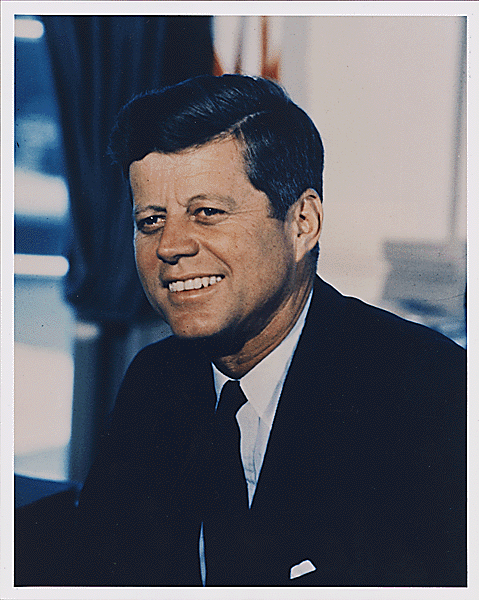
Cecil Stoughton. White House Photographs. John F. Kennedy Presidential Library and Museum, Boston. Public domain in the United States; official government photograph. Rights policy.