Apollo, the evidence, the test program, the physics and the Cold War. The complete offline reading edition, generated from the same source as the interactive files.
This is a selected history, a historical and scientific guide, not a live mission-status feed. The evidence section contains sourced statements and identified physical reasoning; AI assessment is labeled interpretation. Source notes explain the limits. See the editorial method for scope.
Coldwar / 1957–1961 · Established historical record
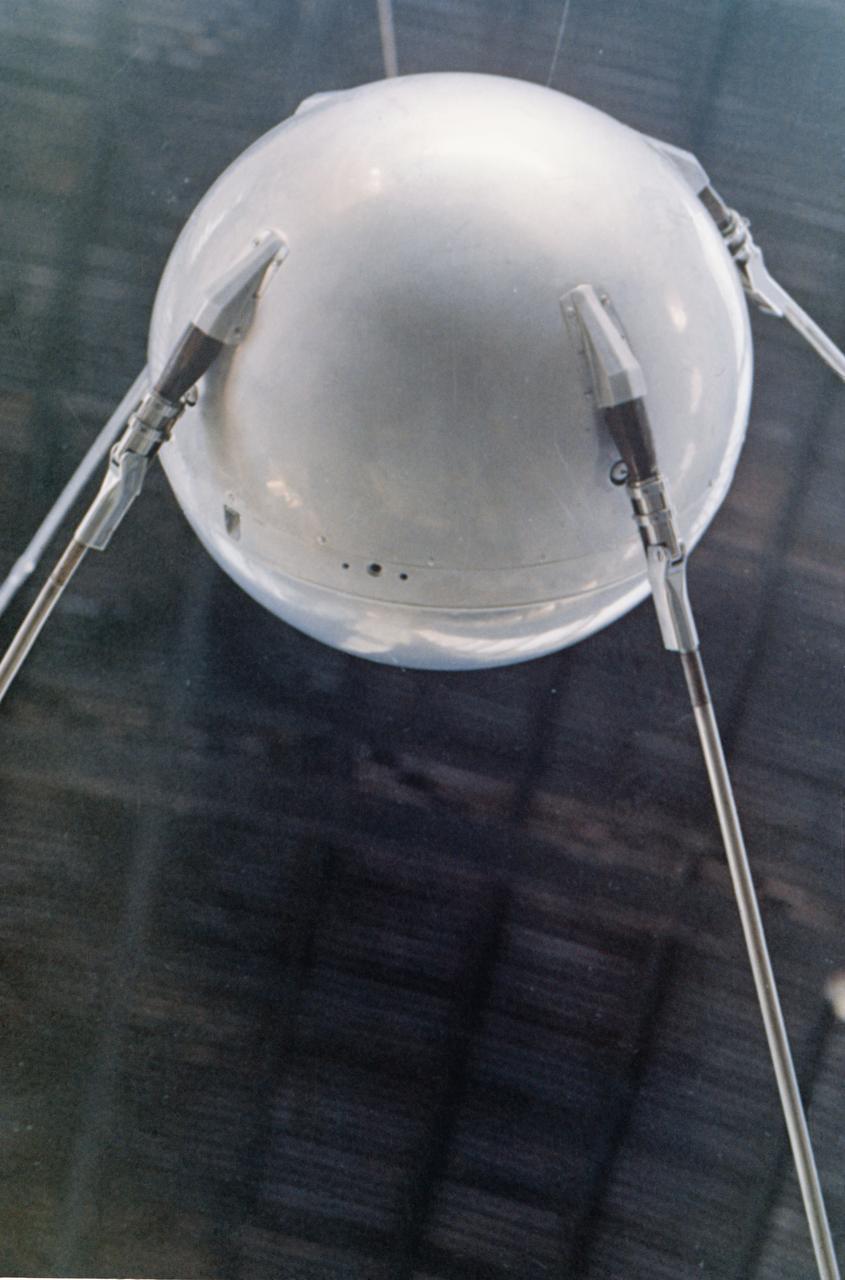
Why a beeping satellite felt like a security crisis
Sputnik made an abstract missile threat visible. Gagarin made technological prestige personal.
A close-up view of the full-scale mockup of the Sputnik 1 spacecraft on display at the Soviet Pavilion at the Paris Air Show, France. Photo credit: NASA or National Aeronautics and Space Administration NASA · NASA media guidelines / U.S. government work · Commons Downloaded NASA image rendition; displayed with layout crops. No scene elements added.
The record
On October 4, 1957, the Soviet Union placed Sputnik 1 in orbit. The satellite’s radio signal could be heard outside Soviet territory: the accomplishment did not depend on believing a press release. Its significance exceeded the little sphere’s scientific equipment. NASA’s history records the American fear that a country able to launch a satellite could also build a ballistic missile able to carry a nuclear weapon across an ocean. That was a serious strategic concern, although a satellite launch did not by itself establish how many dependable missiles the Soviet Union possessed. [1]
The connection was concrete. Sergei Korolev’s R-7 was developed as an intercontinental ballistic missile; a version launched Sputnik. The same family’s space-launch development illustrates genuinely shared technologies: engines, staging, guidance and large-system testing could serve more than one purpose. The ability to reach orbit and the ability to operate a survivable nuclear force nevertheless remained different achievements. A spectacular launch was also an effective political signal, not a complete inventory of a nation’s weapons. [2]
On April 12, 1961, Yuri Gagarin became the first human in space and orbited Earth in Vostok 1. His international celebrity gave the Soviet achievement a human face. NASA’s account describes his goodwill tours as well as the technical milestone. The United States therefore faced a competition over what other countries believed its political and industrial system could accomplish, alongside a real security rivalry. These motives can coexist: genuine exploration can carry propaganda value, and military competition can accelerate genuine science. [3]
This matters when evaluating a claim that a Cold War motive makes the Moon landing suspicious. A government’s incentive to win establishes a reason to invest, take risks and advertise success. It does not tell us whether the announced result happened. To decide that, we still need the physical and observational evidence. The strongest historical account gives the Soviet successes their due and then asks what the American response actually built.
At the time
Sputnik made Soviet launch capability visible to the world in 1957.
What the record shows
The security alarm concerned capability and prestige; orbiting a satellite was not itself an attack.
Civilian NASA, military connections, and an explicit public law
The overlap was written into NASA’s founding law. It did not require a hidden funding scheme.
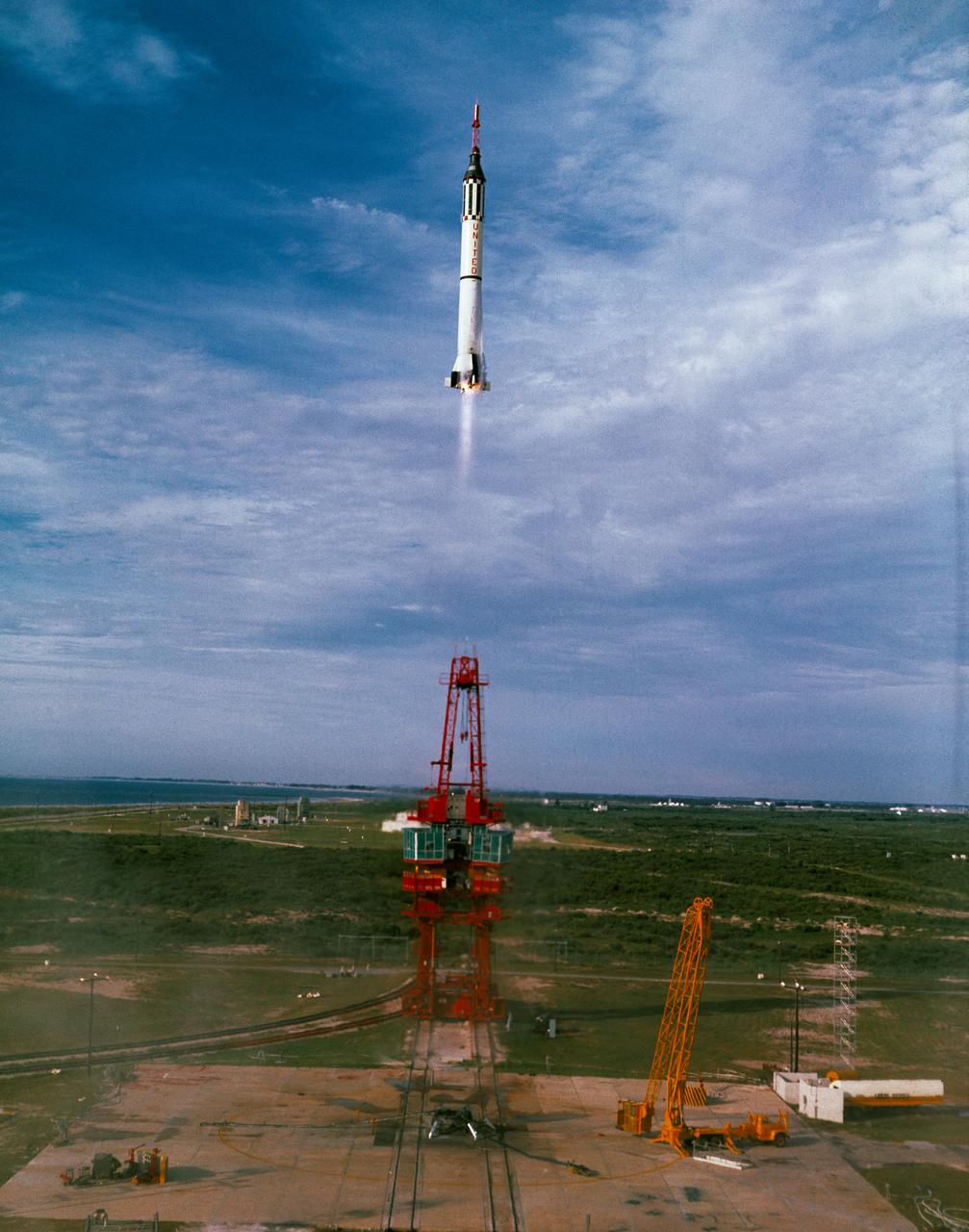
Mercury-Redstone 4 (MR-4) launch of Virgil I. Grissom on July 21, 1961, from Cape Canaveral, Florida. Photo credit: NASA NASA · NASA media guidelines / U.S. government work · Commons Downloaded NASA image rendition; displayed with layout crops. No scene elements added.
The record
President Dwight Eisenhower signed the National Aeronautics and Space Act on July 29, 1958; NASA began operations on October 1. The response to Sputnik did not simply hand all American space activity to one armed service. NASA’s institutional history describes a deliberately civilian organization, built around the National Advisory Committee for Aeronautics, with cooperation between a Republican president and a Democratic-controlled Congress. Scientific and commercial possibilities were part of the discussion alongside strategic anxiety. [1]
The original statute is more revealing than either a purely innocent or a purely sinister summary. It assigned civilian space activity to NASA while leaving weapons development and military operations with the Department of Defense. It also expressly required exchanges of discoveries useful to defense and civilian exploration, and established a civilian–military liaison committee. Peaceful purposes, national leadership, security and scientific knowledge all appeared in the same public framework. Civilian did not mean sealed off from military expertise. [2]
The distinction also produced friction. A November 1963 State Department memorandum reported NASA Administrator James Webb’s concern that military dissatisfaction with its limited space role had hurt the space bill in Congress. That primary document is a useful check against the idea that NASA and the military were one seamless organization with one objective. Their interests overlapped, but their missions, institutional ambitions and budget politics could diverge. [3]
A careful description therefore does not need an all-or-nothing choice. NASA could be a civilian agency, employ military-trained people, draw on military-developed hardware and produce knowledge useful to defense. Those facts explain part of the broad political case for investment. They do not establish that every dollar of Apollo was military spending in disguise, or that the declared lunar objective was merely a cover. Follow the particular transfer, contract or application before claiming a particular military benefit.
At the time
The 1958 law created a civilian space agency while allowing defense cooperation.
What the record shows
Civilian administration and military connections can coexist without making every NASA program a covert weapons project.
Coldwar / 1961–1962 · Established historical record
What Kennedy said in public—and in the room with Webb
Read the inspirational speech alongside the budget conversation. They illuminate different parts of the same decision.
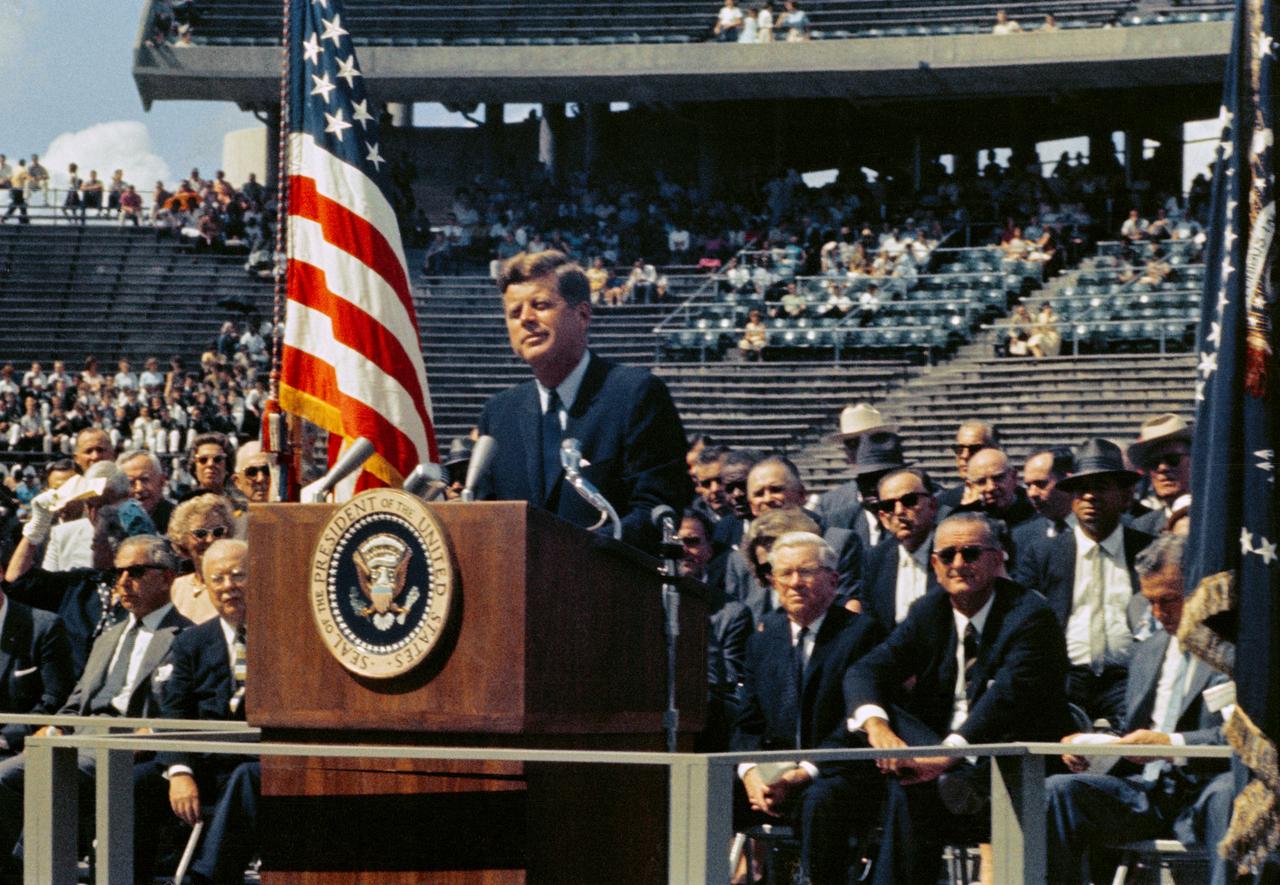
Speech at Rice Stadium, President Kennedy standing at lectern. HOUSTON, TX CN NASA · NASA media guidelines / U.S. government work · Commons Downloaded NASA image rendition; displayed with layout crops. No scene elements added.
The record
On May 25, 1961, Kennedy asked Congress to commit to landing a person on the Moon and returning that person safely before the decade ended. The House’s archival record places the address among urgent needs involving foreign aid, international and civil defense, and space. It was a political commitment with a measurable deadline, not a statement that engineers had already solved the entire problem. The word “returning” was essential: a one-way demonstration could not satisfy the goal. [1]
At Rice University on September 12, 1962, Kennedy made the public argument for an immensely difficult national undertaking. The JFK Library supplies the original film, and NASA supplies the visit’s historical context. Watch the whole speech rather than only the celebrated sentence: its setting is an international competition for leadership, with expensive new facilities and a developing industrial capability. The appeal includes ambition, organization and national purpose, not scientific curiosity alone. [2][3]
The November 21, 1962 White House recording is an especially valuable counterweight to polished rhetoric. In the JFK Library’s transcript, Kennedy presses for beating the Soviet Union to the Moon; Webb argues for a broader conception of preeminence in space. The library’s account identifies a 73-minute discussion, making this a conversation we can examine rather than a later recollection attributed to an unnamed insider. It shows disagreement over what deserved top priority. [4][5]
Our reading is that Kennedy saw the landing as a test of national capacity and international standing. Webb also wanted an enduring scientific and technical institution. Neither interpretation requires pretending the president’s private priorities were identical to an astronaut’s, a scientist’s or a factory worker’s. Large public projects assemble coalitions for different reasons. Recognizing that mixed motivation makes the history more credible; it does not erase the eventual engineering result or settle whether its price was justified.
On September 20, 1963, Kennedy addressed the United Nations General Assembly and included a joint expedition to the Moon among possible areas of cooperation with the Soviet Union. The JFK Library preserves the speech’s archival folder. This is an important complication for a story told only as a straight line from Sputnik humiliation to American victory: a president who had committed to winning the competition also publicly entertained changing its terms. [1]
The idea was more than a sentence that vanished without administrative attention. A December 4 State Department memorandum, preserved in the official Foreign Relations series, discusses NASA’s paper on a joint lunar expedition. It addresses the suggestion as a practical diplomatic question after Kennedy’s death. This does not mean a joint mission had been agreed, funded or technically planned to completion. It means the proposal generated actual governmental discussion. [2]
It is tempting to turn every apparent inconsistency into a secret. Another reading requires fewer unsupported steps: a president could seek bargaining advantages, reduce duplication, limit rivalry or test whether cooperation was possible while continuing an existing national program. The speech and memorandum establish that cooperation was proposed and examined. They cannot by themselves reveal one exclusive private motive or show how a proposal would have worked had the political environment changed.
The relevant lesson for the Moon debate is methodological. Use documents to constrain a story, including documents inconvenient to its simplest version. The national competition was real; so was the public cooperation proposal. A robust account should be able to accommodate both without claiming that one cancels the other. Nor does a failed or unrealized diplomatic alternative tell us that the subsequent American landings were staged. That separate proposition still has to explain the mission evidence.
At the time
Kennedy proposed a possible joint lunar expedition at the United Nations in 1963.
What the record shows
Competition was central, but the documentary record also includes attempts at cooperation.
Coldwar / 1950s–1973 · Established historical record
From military rockets to Saturn V: what transferred, what changed
Rocketry had military roots. The lunar launcher was not simply an operational nuclear missile with a capsule attached.
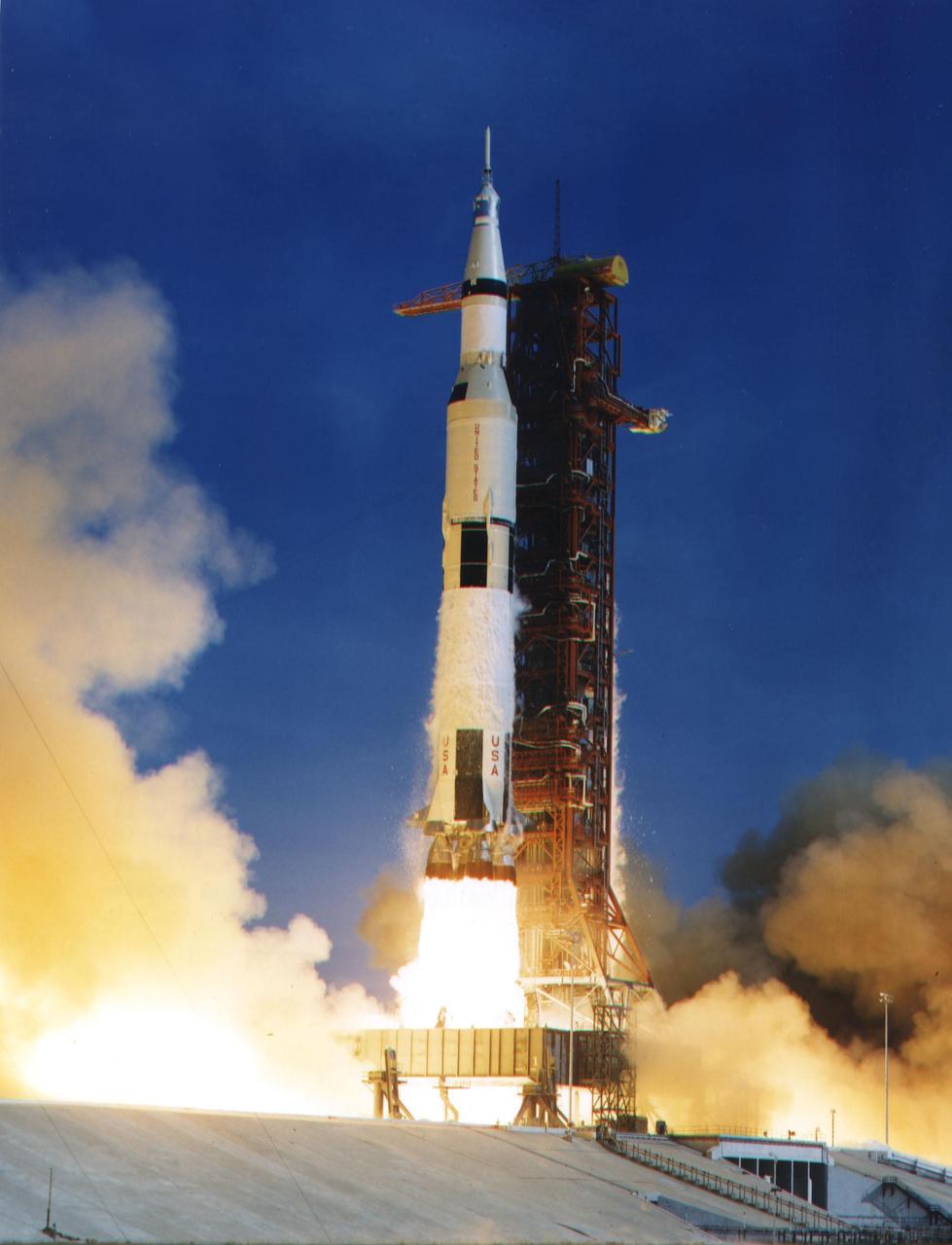
KENNEDY SPACE CENTER, FLA. -- The Apollo 11 Saturn V space vehicle lifted off with Astronauts Neil A. Armstrong, Michael Collins and Edwin E. Aldrin Jr. at 9:32 a.m. EDT July 16, 1969, from Kennedy Space Center's Launch Complex 39A. During the planned eight-day mission, Armstrong and Aldrin will descend in a lunar module to the Moon's surface while Collins orbits overhead in the command module. The two astronauts are to spend 22 hours on the Moon, including two and one-half hours outside the lunar module. They will gather samples of lunar material and will deploy scientific experiments which will transmit data about the lunar environment. They will rejoin Collins in the command module for the return trip to Earth NASA · NASA media guidelines / U.S. government work · Commons Downloaded NASA image rendition; displayed with layout crops. No scene elements added.
The record
The boundary between civilian and military rocketry moved during the early space age. NASA’s Historical Data Book documents the transfer of programs and expertise, including the F-1 engine project from the Air Force and the Army Ballistic Missile Agency team developing Saturn. NASA initially depended heavily on launch vehicles originating in defense programs. This is direct institutional evidence of shared foundations, not a connection inferred from two machines looking alike. [1]
The F-1’s development began before a final lunar vehicle configuration existed. NASA’s Santa Susana history describes its liquid-oxygen and kerosene propulsion and its eventual use in a cluster of five on Saturn V’s first stage. That lineage supports a real story about defense-funded expertise feeding exploration. It does not mean the completed Saturn V was a deployed intercontinental ballistic missile. NASA’s description identifies its actual uses: sending people toward the Moon and launching Skylab. [2][3]
The distinction matters because “a rocket can carry a payload” is much broader than “this rocket was fielded as a weapon.” A lunar launcher and a practical strategic missile face different operational requirements. To establish a deployed weapon, one would need records of that weapon’s program, basing, payload and military deployment. Apollo’s obvious rocket expertise is insufficient by itself. Equally, it would be mistaken to describe the entire propulsion industry as if it had emerged from civilian research untouched by defense funding.
There was a visible post-lunar reuse. A Saturn V launched the uncrewed Skylab station on May 14, 1973; Apollo-derived spacecraft carried its crews. NASA’s account describes extended human operations and scientific work, demonstrating that the hardware and institutional capability could support another mission after the lunar race. This is a specific legacy with identifiable equipment and flights. It is much stronger evidence than a vague promise that every large rocket investment must eventually pay for itself. [4]
At the time
Earlier military programs supplied people, technology and experience to spaceflight.
What the record shows
Saturn V had a distinct lunar heavy-lift purpose; shared ancestry does not make it an operational ICBM.
Coldwar / 1940s–1960s · Established historical record
Von Braun, Paperclip, and the history a success story must not hide
Apollo’s achievement does not excuse the Nazi program or erase the prisoners exploited in rocket production.
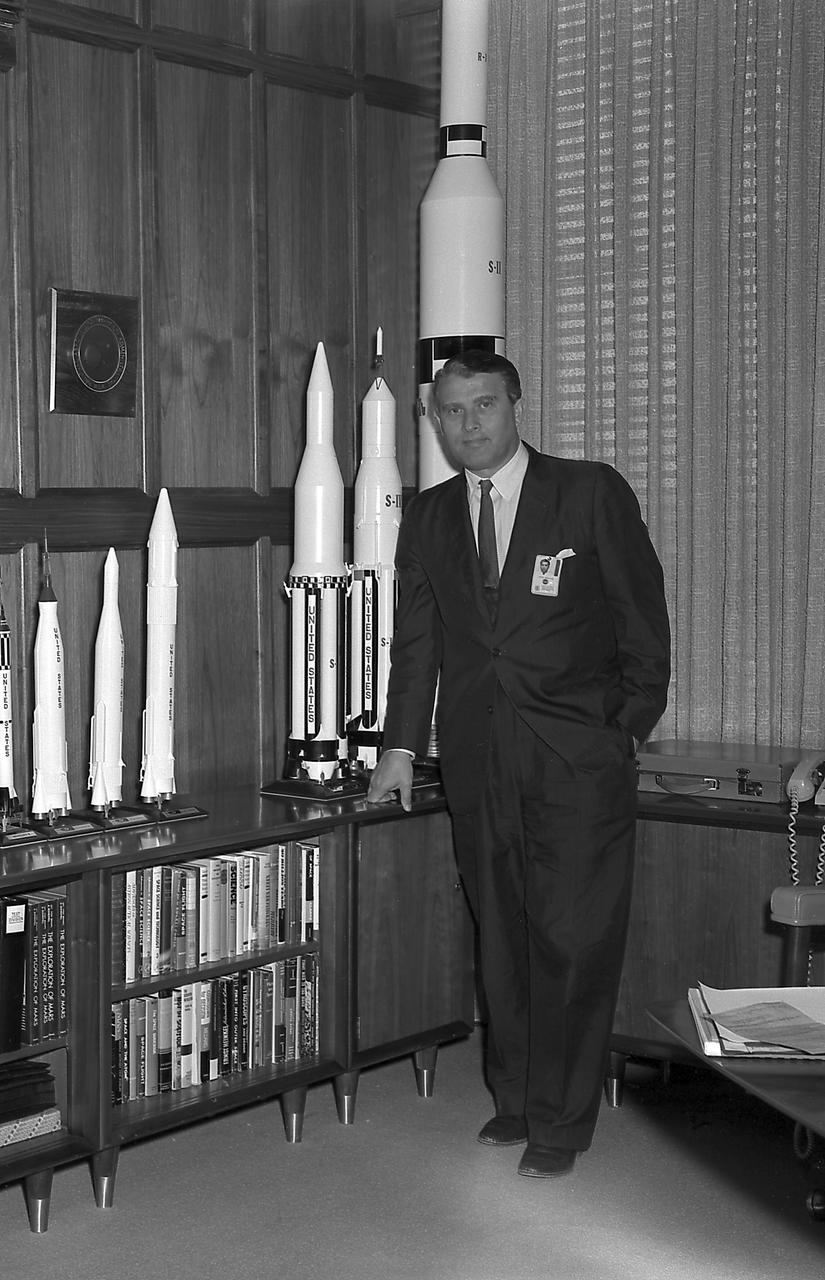
Wernher von Braun in his NASA office with rocket models, April 20, 1962. This later portrait does not depict his earlier wartime activities. NASA · NASA media guidelines / U.S. government work · Commons Downloaded NASA image rendition; displayed with layout crops. No scene elements added.
The record
Wernher von Braun became a central figure in American rocketry and NASA’s Saturn program. His earlier history is not an optional footnote. The Smithsonian National Air and Space Museum identifies him as a Nazi Party member and SS officer, and discusses his involvement with the exploitation of concentration-camp prisoners in missile production. It also describes the American decision to classify that background while bringing him and colleagues to the United States. A responsible Apollo history must include these facts. [1]
The same museum account corrects another oversimplification: Project Paperclip’s specialists were not initially imported simply to help a ready-made American space program. They worked across military and other institutions; von Braun’s group became central to Army ballistic-missile development before transferring to NASA in 1960. That sequence helps explain how military capability, morally compromised wartime expertise and later civilian exploration intersected. The genealogy should neither be sanitized nor flattened into an assertion that all of NASA was identical to its most troubling inherited personnel. [1][2]
This is a place to separate a moral judgment from a physical claim. Nazi persecution, forced labor and the American government’s willingness to use compromised experts raise questions about responsibility and the choices made in pursuit of power. Those questions remain serious even if every Apollo mission fact is accepted. Conversely, establishing a designer’s Nazi background does not demonstrate that a spacecraft failed to reach its destination. An argument about wrongdoing needs to identify which wrongdoing it actually proves.
Our editorial position is that celebrating the landing and confronting this past are compatible obligations. Technical accomplishment is not absolution. The useful question is not whether a hero label can make the earlier record disappear, but whether we can keep the achievement and the victims in the same historical frame. That approach gives readers a fuller account of the cost of the rocket age without treating a disturbing fact as permission to infer unrelated events.
At the time
The United States recruited German specialists after the war, including engineers involved with the V-2.
What the record shows
The Saturn achievement does not erase Nazi involvement or the forced-labor system behind the earlier weapons program.
Coldwar / 1960–1973 · Established historical record
What Apollo cost—and what the famous 4.4% number actually measures
Keep lifetime program costs, one-year agency spending and inflation adjustments separate.
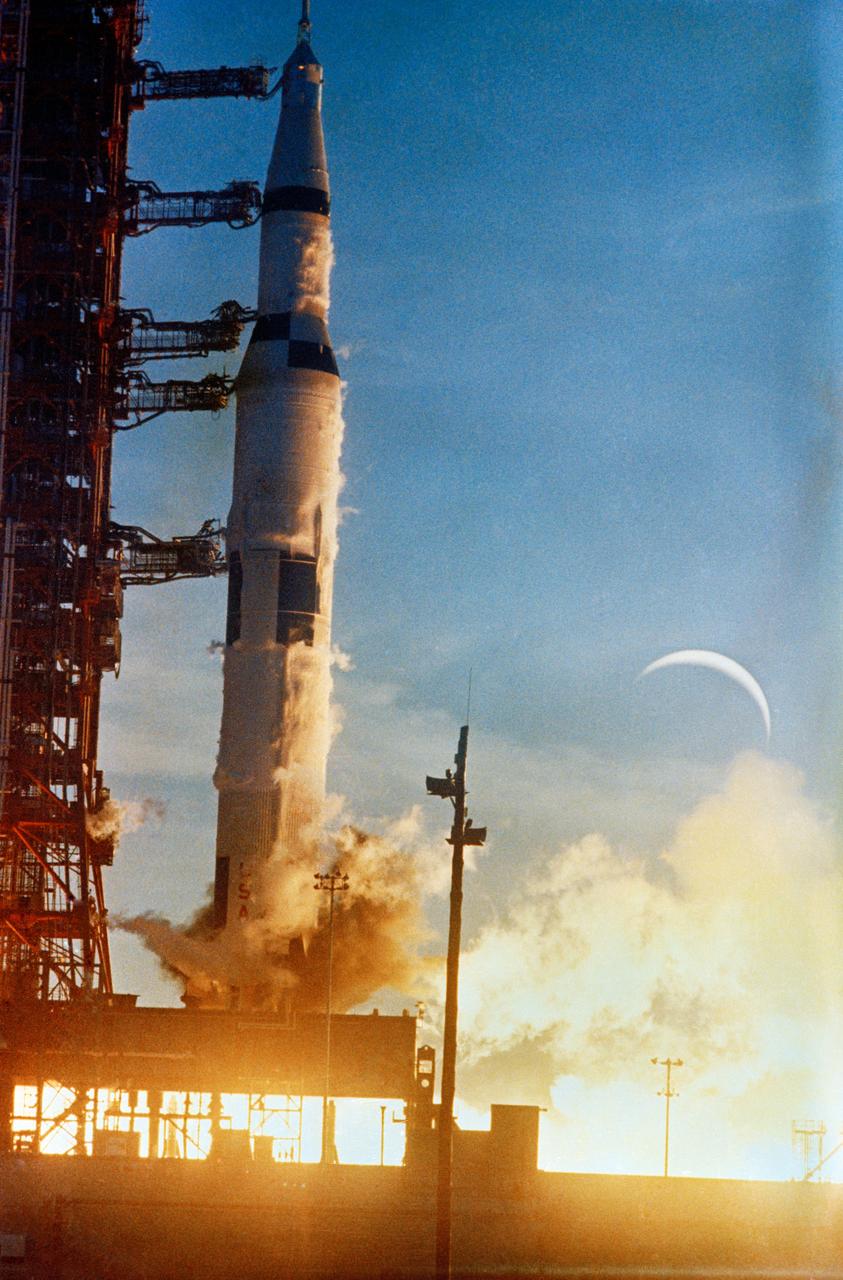
The Apollo 8 (Spacecraft 103/Saturn 503) space vehicle is launched from Pad A, Launch Complex 39, Kennedy Space Center, at 7:51 a.m. (EST), Dec. 21, 1968. The crew of the Apollo 8 lunar orbit mission is astronauts Frank Borman, commander; James A. Lovell Jr., command module pilot; and William A. Anders, lunar module pilot. Apollo 8 was the first manned Saturn V launch. (Just after ignition) NASA · NASA media guidelines / U.S. government work · Commons Downloaded NASA image rendition; displayed with layout crops. No scene elements added.
The record
NASA’s retrospective gives Apollo’s historical cost as $25.4 billion. A newer reconstruction by the Planetary Society, using NASA budget submissions and obligations, totals $25.8 billion for fiscal years 1960–1973. Those figures are broadly consistent but not interchangeable without explanation. They reflect accounting choices and coverage. Neither means Apollo 11 alone cost that amount, and neither is a number in today’s purchasing power. We show the historical dollars and name the source rather than imply a false precision. [1][2]
The familiar peak of approximately 4.4% refers to NASA as a whole in fiscal year 1966 compared with total federal outlays that year. The Congressional Record reports NASA outlays of $5.933 billion; the OMB historical table gives total federal outlays of $134.532 billion. Dividing those quantities gives about 4.41%. This calculation is not Apollo’s share of GDP, not the military budget, and not NASA’s share in every year of the program. It includes other NASA work. [3][4]
The timing is instructive: heavy development and construction spending had to precede the 1969 landing. NASA’s history of Apollo 13 preparations also documents contemporary budget pressure and the cancellation of Apollo 20, with its planned Saturn V reassigned for the space-station program. Political support for a first landing did not guarantee indefinite funding for repeated landings. A real capability can be expensive enough that its owners choose to stop buying and operating it. [5]
A fair cost discussion allows more than one conclusion. A person can accept the landings, value the science and still judge the opportunity cost too high. Another can argue that the combination of exploration, national capability and strategic signaling justified it. Neither judgment is a measurement of whether astronauts walked on the Moon. We also avoid a speculative “return per dollar” slogan: wider economic benefits need their own methods, assumptions and comparisons with what the same money might otherwise have achieved.
At the time
Development spending peaked before the 1969 landing, and budgets were already under pressure.
What the record shows
The cited FY1966 outlays yield a NASA-wide federal share of 4.41%; Apollo lifetime totals use separate accounting.
Apollo, Minuteman, and the market for early silicon chips
NASA helped make integrated circuits reliable and commercially viable. It did not invent the transistor or the chip.
The F-8 Digital Fly-By-Wire aircraft had its hydro-mechanical control systems replaced by an Apollo Guidance Computer for the first such control system to fly. NASA · NASA media guidelines / U.S. government work · Commons Downloaded NASA image rendition; displayed with layout crops. No scene elements added.
The record
The integrated circuit existed before astronauts flew to the Moon. The Computer History Museum’s chronology traces the early planar integrated circuit to the semiconductor industry, then explains why aerospace and military computers were early customers: low weight, small size and low power consumption could justify costs that initially made little sense for ordinary products. Apollo and Minuteman II appear in that account as distinct demanding applications. The historical mechanism was procurement and engineering development, not NASA inventing electronics from nothing. [1][2]
NASA’s computer history describes MIT’s choice of a simple NOR-gate integrated circuit for the Apollo Guidance Computer. Repeating one basic logic type helped testing and reliability even when other arrangements might have used fewer parts. A spacecraft computer needed to work as a complete system under severe constraints. The point was not to win a contest for the newest circuit in the year of the landing: a long development cycle meant a design had to be stabilized and qualified. [3]
The Smithsonian’s account makes the tradeoff clear. By the time Apollo crews flew, the selected early chips were technologically dated, but replacing them with newer devices would have required another round of testing. It also warns against a one-cause Silicon Valley story: the Apollo contract was important, while semiconductor firms and other customers had their own development paths. Minuteman’s parallel demand further complicates any claim that consumer microelectronics can be assigned to one civilian program. [4][1]
This is a strong example of genuine dual use. Civilian exploration and strategic weapons could each buy related components, demand dependable manufacturing and help sustain specialized expertise. It does not follow that Apollo secretly paid the Minuteman bill, or that no consumer electronics would have existed without a lunar landing. The more careful conclusion is still substantial: government customers helped establish a demanding early market, and learning accumulated across institutions. That is a plausible, documented route from a geopolitical program to broader industrial capability.
At the time
Apollo and Minuteman were demanding early customers for integrated circuits.
What the record shows
The documented contribution is procurement, engineering and reliability work, alongside a broader semiconductor industry.
Coldwar / 1972 onward · Established historical record
A transfer you can actually trace: lunar computing to aircraft control
Specific hardware, a test aircraft and a dated technical report make a stronger innovation story than a list of familiar products.
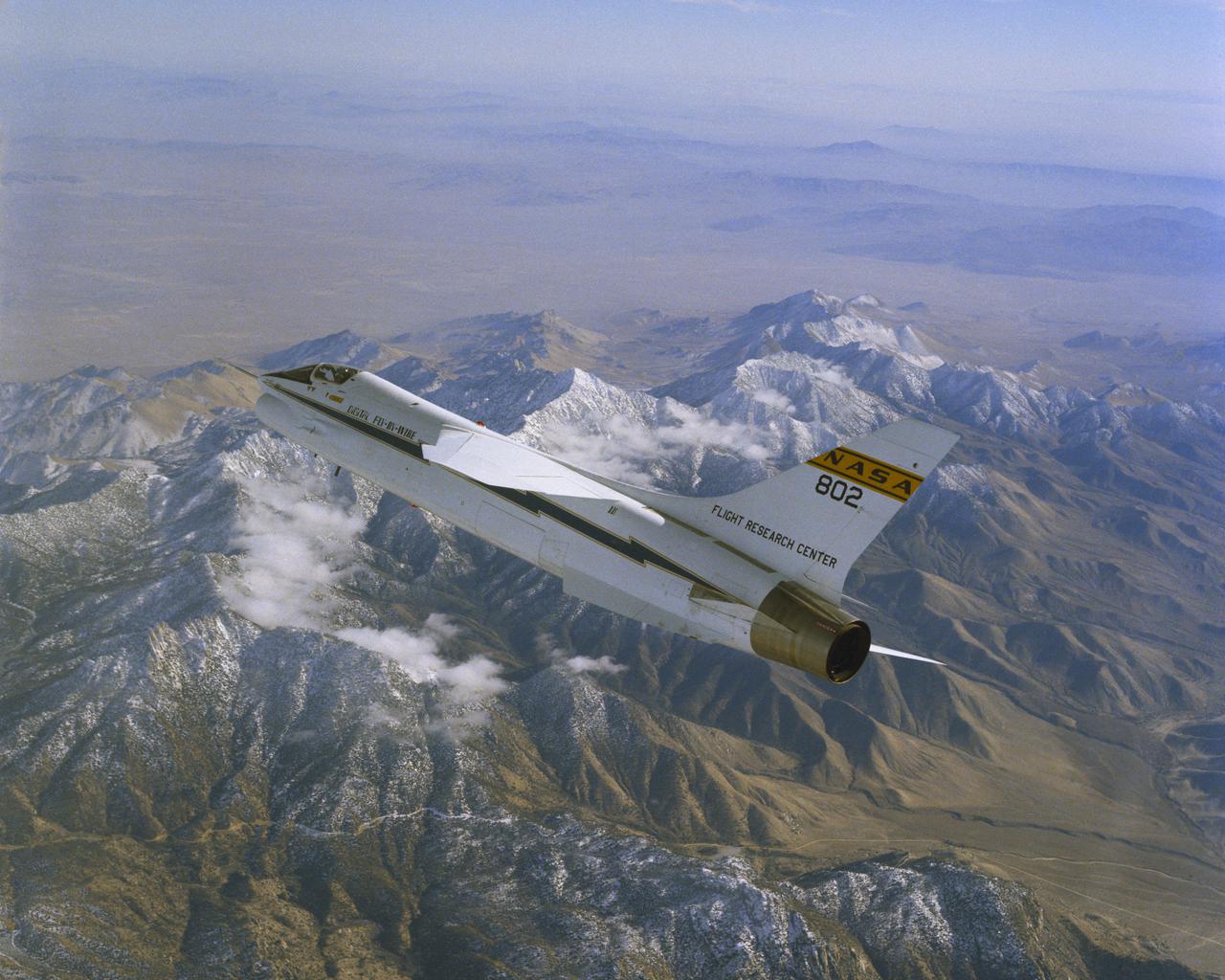
The F-8 Digital Fly-By-Wire aircraft had its hydro-mechanical control systems replaced by an Apollo Guidance Computer for the first such control system to fly. NASA · NASA media guidelines / U.S. government work · Commons Downloaded NASA image rendition; displayed with layout crops. No scene elements added.
The record
On May 25, 1972, NASA flew its F-8 digital fly-by-wire research aircraft with an Apollo computer and inertial sensing at the heart of the experimental control system. NASA’s contemporary technical-report record identifies the lunar guidance computer as the central element. Here the connection is unusually direct: one can identify the equipment, the new application and the flight-test program, rather than merely notice that both spacecraft and aircraft contain computers. [1][2]
The concept sends pilot commands through computerized controls to actuators, reducing dependence on the traditional arrangement of mechanical linkages. NASA’s later account describes a program that evolved to a redundant digital system and accumulated 210 flights over 13 years. It discusses applications in commercial and military aviation. Apollo’s contribution was therefore part of a longer engineering process, including later designers and testing; a successful lunar computer was a foundation rather than a complete ready-made airliner system. [1]
For the reader, the interesting question is what traveled. Hardware architecture, reliable real-time computation, inertial sensing, software experience and confidence gained through testing could be useful beyond the original mission. That gives content to the phrase “we learned things.” It also suggests a way to assess other spinoff claims: look for the originating work, the recipient organization, the adaptation and evidence of practical use. A promotional list with no chain of transfer is much harder to evaluate.
This example supports the user’s central intuition about national investment without overstating it. A lunar program can generate expertise that later serves civilian transport and defense, while remaining an actual lunar program. It does not prove that every technical achievement depended on Apollo, that all benefits were planned in 1961 or that a counterfactual investment would have performed worse. Those are larger claims. The narrower, well-documented transfer is impressive enough and lets us discuss innovation without turning it into mythology.
Coldwar / 1960s onward · Established historical record
Real materials, familiar myths, and the right to question the price
Apollo did not invent Tang, Teflon or Velcro. Its actual benefits survive correcting those stories.
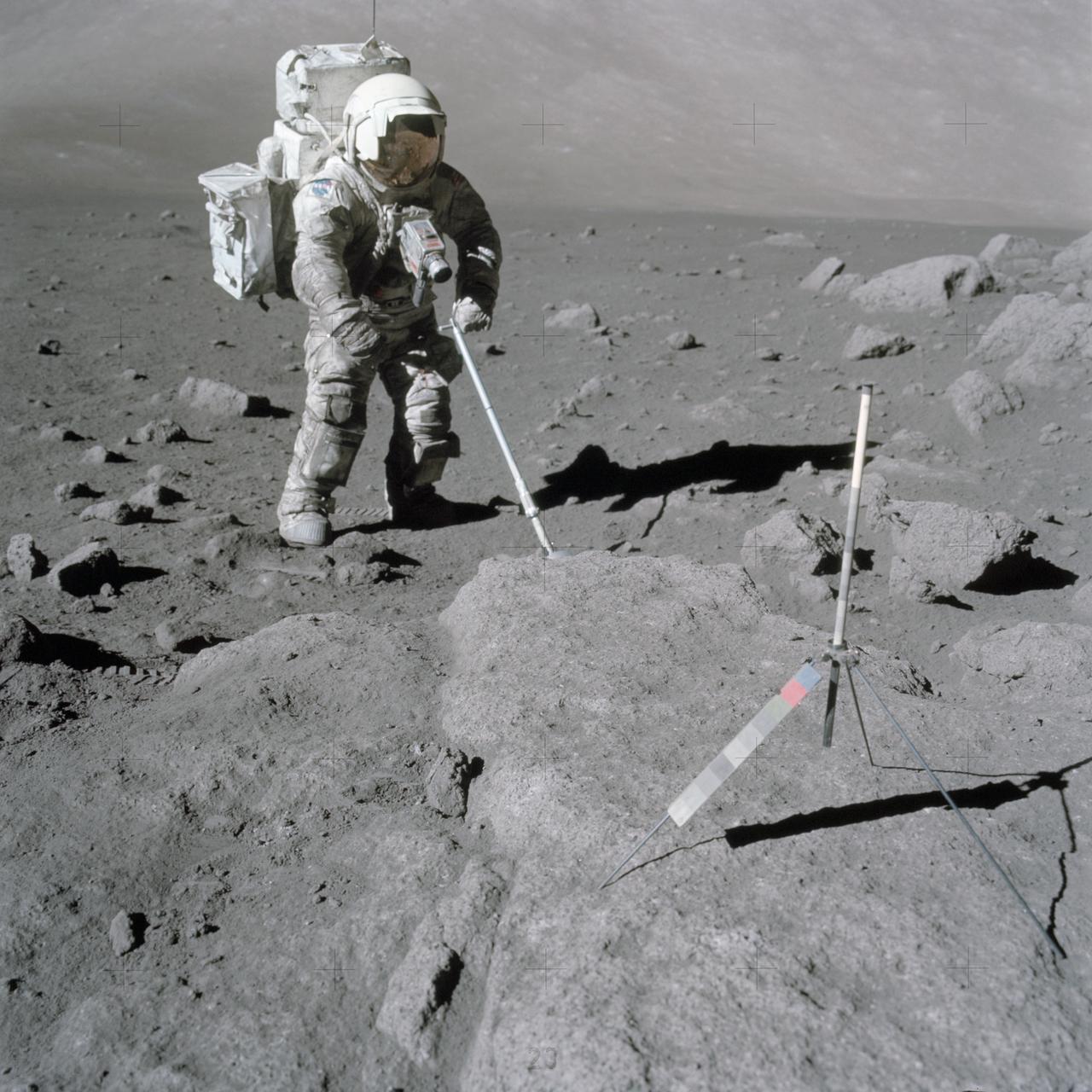
Scientist-astronaut Harrison Schmitt, Apollo 17 lunar module pilot, uses an adjustable sampling scoop to retrieve lunar samples during the second Apollo 17 extravehicular activity (EVA), at Station 5 at the Taurus-Littrow landing site. A gnomon is atop the large rock in the foreground. The gnomon is a stadia rod mounted on a tripod, and serves as an indicator of the gravitational vector and provides accurate vertical reference and calibrated length for determining size and position of objects in near-field photographs. The color scale of blue, orange and green is used to accurately determine color for photography. The rod of it is 18 inches long. The scoop Dr. Schmitt is using is 11 3/4 inches long and is attached to a tool extension which adds a potential 30 inches of length to the scoop. The pan portion, obscured in this view, has a flat bottom, flanged on both sides with a partial cover on the top. It is used to retrieve sand, dust and lunar samples too small for the tongs, another geological tool used by the astronauts. The pan and the adjusting mechanism are made of stainless steel and the handle is made of aluminum. Within the foreground of this scene, three lunar samples were taken--numbers 75060, 75075 and 75080. Astronaut Eugene A. Cernan, crew commander, was using a 60mm lens on the 70mm Hasselblad camera and type SO-368 film to take this photograph. NASA · NASA media guidelines / U.S. government work · Commons Downloaded NASA image rendition; displayed with layout crops. No scene elements added.
The record
NASA’s own Spinoff FAQ rejects several flattering myths. Tang was developed by General Foods in 1957, Teflon by DuPont in 1938, and Velcro by a Swiss engineer in the 1940s. Spaceflight made these products more famous and used them in demanding applications; use is not invention. The same distinction should apply whether a convenient misconception favors NASA or attacks it. A pro-landing site should correct its side’s folklore too. [1]
There are more specific materials stories worth following. NASA’s account of tensile roofs describes the adaptation of PTFE-coated glass-fiber fabric associated with Apollo spacesuit development into architectural membranes. The account identifies companies and an installation history. NASA’s Kennedy newsletter also describes work adapting spacesuit life-support expertise for firefighters’ breathing systems. These are examples of adaptation and collaboration rather than proof that NASA invented every constituent material or every form of protective equipment. [2][3]
Benefits do not eliminate opportunity cost. NASA’s own historical scholarship records Ralph Abernathy’s arrival with protesters before the Apollo 11 launch to draw attention to poverty. That criticism was not a lunar-hoax claim: it asked whether national priorities were defensible. The distinction remains useful. One can dispute where public money went while respecting the workers’ achievement, the astronauts’ risk and the scientific evidence. A budget argument should be answered as a budget argument. [4]
Our view is that Apollo’s value includes scientific knowledge, demonstrated capability, difficult engineering and a lasting example of collective effort. The Cold War made leaders willing to pay for those capabilities at an extraordinary scale. Security interests and later commercial uses belong in the explanation, but a claim that the entire program was merely a trick to fund weapons goes beyond these sources. It is possible to appreciate the benefits, acknowledge the moral compromises and recognize the expense without making the physical landing itself a matter of political taste.
At the time
Space programs used and publicized products that already existed.
What the record shows
NASA itself corrects the Tang, Teflon and Velcro invention stories; documented adaptations deserve their own credit.
Evidence / 2009–2026 · Established historical record
The landing sites are still there
Orbital photographs show descent stages, instruments, rover routes and disturbed soil at the six Apollo sites. Their strength lies in the matching pattern of details, with clear limits to what individual pixels show.
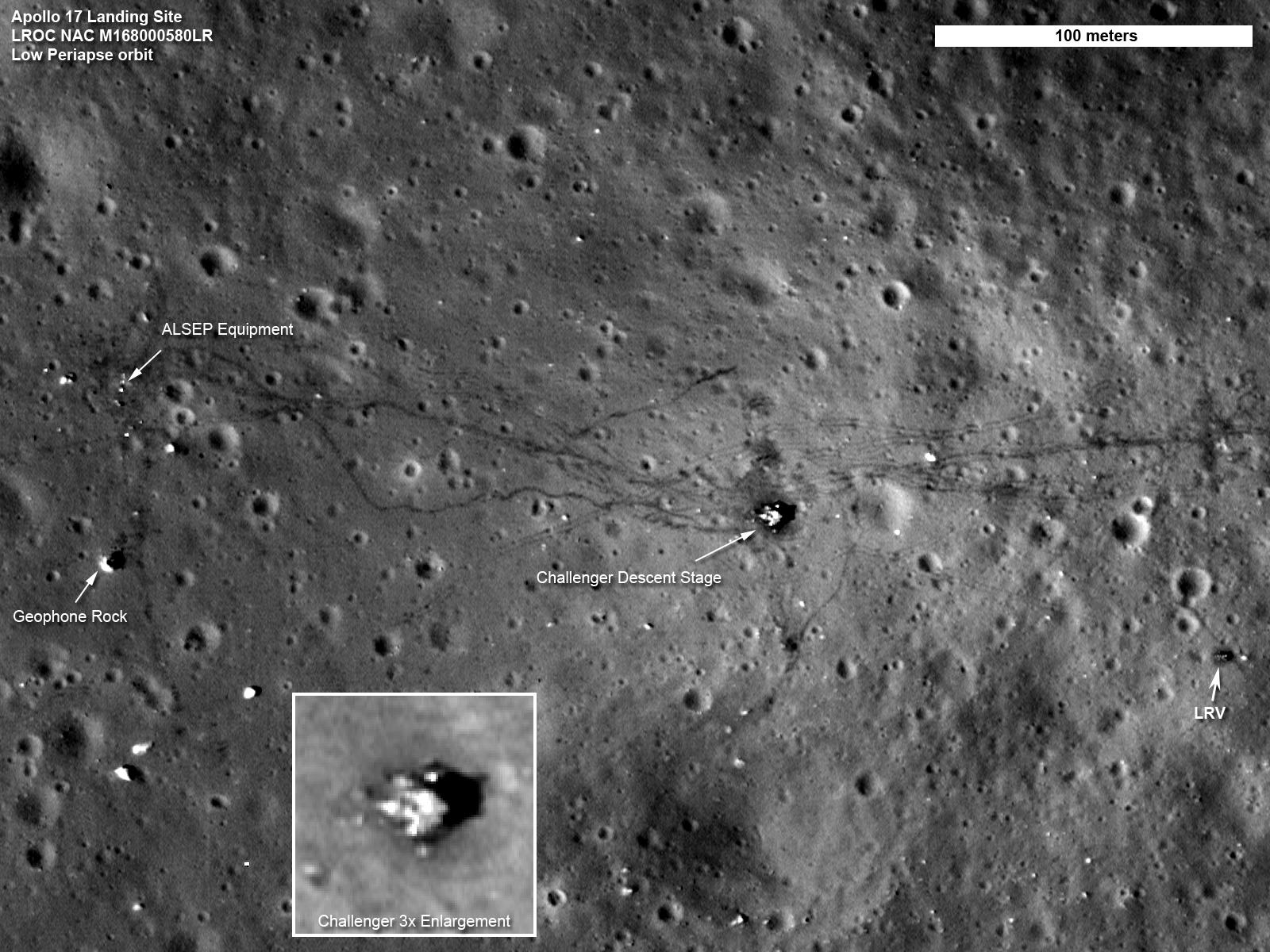
Apollo 17 landing site in a close-orbit LROC image acquired in August 2011 and published September 8, 2011. Source annotations retained; not a continuous live feed. NASA/GSFC/Arizona State University · NASA media guidelines · Commons Downloaded original credited image; annotations and scale retained, no invented detail.
The record
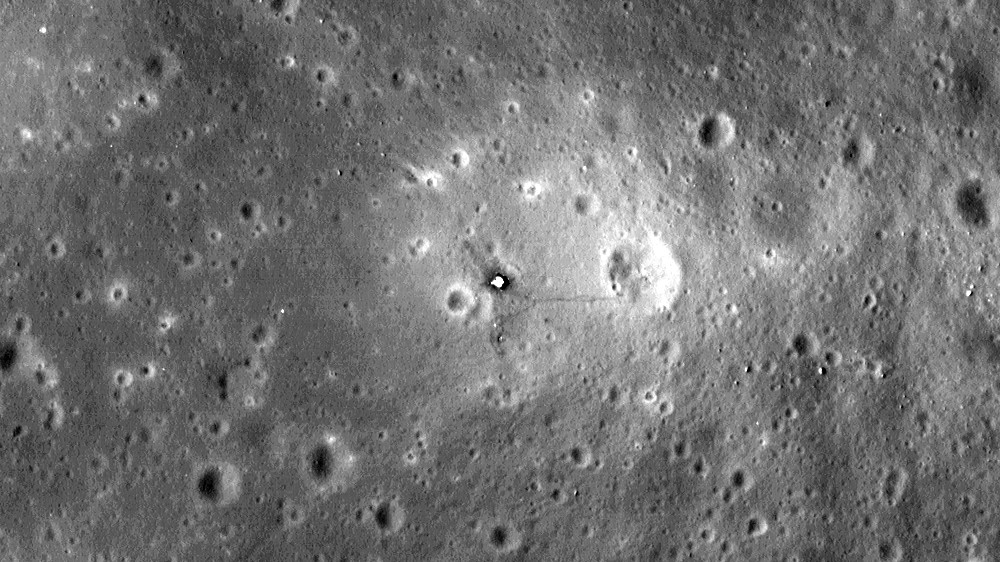
NASA’s Lunar Reconnaissance Orbiter has photographed all six Apollo landing sites. In the closer views, the things to look for are compact lander descent stages, their shadows, instrument locations and routes of disturbed soil. At Apollo 17, the rover route and the astronauts’ walking trails form a recognizable work site rather than a solitary ambiguous bright dot. NASA released especially detailed Apollo 12, 14 and 17 views after a lower-altitude imaging campaign in 2011. [1][3]
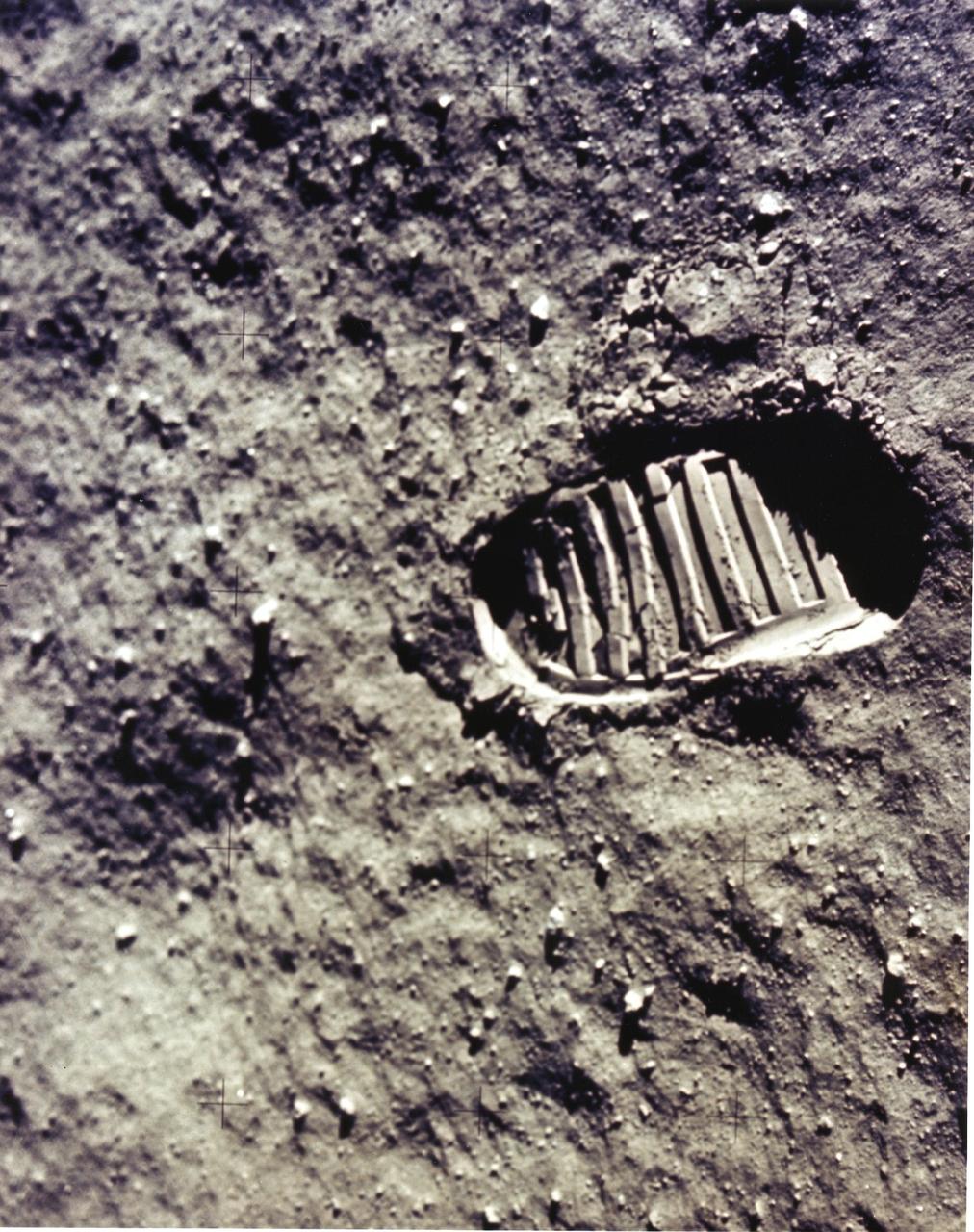
There is a useful distinction between a walking trail and a resolved footprint. A trail is a long region of altered brightness caused by disturbed regolith; an individual boot’s tread is much smaller. These photographs do not show astronaut faces, legible plaques or every footprint separately. Enlarging a compressed web image cannot create details that the camera did not resolve. The linked Apollo 11 resource presents archived imagery and explanation, not a continuously refreshed video feed. [1][2]
The positive argument is the combination: the right objects at the right locations, in the right spatial relationship to craters, surface photographs and documented excursions. A proposed alternative needs to account for that geometry. Calling the picture “NASA again” identifies an institutional limitation, but does not by itself explain the correspondence. Conversely, a site image alone does not recreate every act performed there. This guide treats it as one substantial strand among physical samples, contemporary tracking and the wider mission record. [1][2][3]
Is LRO still orbiting? NASA’s May 18, 2026 management announcement explicitly says that it continues in lunar orbit. It also records a change worth reflecting accurately: Intuitive Machines now manages LROC, and Texas A&M manages its data within NASA’s Planetary Data System. This does not turn an old NASA image into an independent foreign observation. It does establish a current documentary basis for describing LRO as an operating lunar mission, rather than assuming that a 2011 image proves its status today. [4]
Documented checkpoints & limits
Start with the record
Inspect the original source
Orbital photographs show descent stages, instruments, rover routes and disturbed soil at the six Apollo sites. Their strength lies in the matching pattern of details, with clear limits to what individual pixels show. Source ↗
Make a specific test
Keep the mechanism and its limits together
Existing orbital observations show the expected landing-site hardware and activity patterns. “Always shows it” should mean repeated archived observations, not nonstop surveillance. Source ↗
Watch this question
LRO Revisits Apollo Landing Sites ↗ NASA — Verified NASA channel result, September 6, 2011. Explains the low-orbit campaign and visible trails. Not a live feed.
A New Look at the Apollo 11 Landing Site ↗ NASA — Verified embeds in both NASA’s video collection and Greenwich’s astronomy article. Orbital imagery is distinct from surface television.
At the time
Apollo crews left descent stages, experiments and disturbed-soil routes at six sites.
What the record shows
Later LROC observations show the expected spatial patterns. A May 2026 source confirms LRO remained in orbit at that date.
Official May18 2026 statement: continues in orbit; LROC management now Intuitive Machines; data management Texas A&M/PDS. Do not call present manager ASU.
Evidence / 2008–2026 · Established historical record
What other countries’ orbiters actually add
Independent observations are valuable, but “photographed the landing region” and “resolved the lander” are different claims. Japan’s Kaguya provides a particularly clear example.
Apollo 11 landing site seen by the Lunar Reconnaissance Orbiter Camera; NASA published this resource in June 2019. Source annotations retained; not a continuous live feed. NASA/GSFC/Arizona State University · NASA media guidelines · Commons Downloaded original credited image; annotations and scale retained, no invented detail.
The record
In May 2008 Japan’s space agency reported a brighter area at the Apollo 15 site that it interpreted as the exhaust-related halo. Kaguya’s observations also allowed researchers to reconstruct a landscape view corresponding to the astronauts’ photographs. That is a useful cross-check from another country and another instrument: the mountains and broad ground geometry are not merely reprinted Apollo frames. JAXA is explicit about what is being compared. [1]
The same release supplies a limitation that is too often omitted when this becomes a social-media proof. The Terrain Camera’s resolution was about 10 metres. JAXA says that smaller objects, including rocks and the lunar rover, do not appear in its reconstructed scene. Therefore “Japan independently photographed Apollo’s rover” would overstate this source. Its actual contribution is matching topography and an interpreted surface-alteration halo, not a close-up of equipment. [1]
India’s Chandrayaan-2 carried the Orbiter High Resolution Camera, or OHRC. ISRO describes a nominal nadir spatial resolution of 0.25 metres and identifies earlier human-made landing sites among its scientific targets. That specification explains why this mission is relevant to searches for Apollo hardware. It does not automatically authenticate a particular viral annotated crop: a camera specification is not the provenance of an image. [2][3]
For any claimed Indian or Chinese photograph, the fair next questions are concrete: which instrument took it, on what date, under which product identifier, and does the original product actually resolve hardware? A broad regional map can confirm terrain without resolving a descent stage. This guide therefore links the official Indian instrument and science documents while distinguishing them from the directly inspected Japanese release and NASA’s established close orbital views. The distinction avoids making the case for Apollo depend on an exaggerated claim that is easier to challenge than the real evidence. [2][3]
At the time
Japan’s Kaguya mapped Apollo 15 terrain and an interpreted surface halo.
What the record shows
Its 10-metre terrain camera did not resolve the rover. Instrument capability and a particular image’s provenance remain different questions.
Official PDF search text inspected; browser full fetch exceeds14MB tool limit. Supports instrument capability/targets, not authentication of a specific viral Apollo image.
Evidence / 1969–2024 · Established historical record
We can still measure the distance to equipment left there
Lunar laser ranging is a repeatable physical measurement. It demonstrates engineered reflectors on the Moon, while the Soviet robotic reflectors show why it is not a stand-alone proof of astronauts.
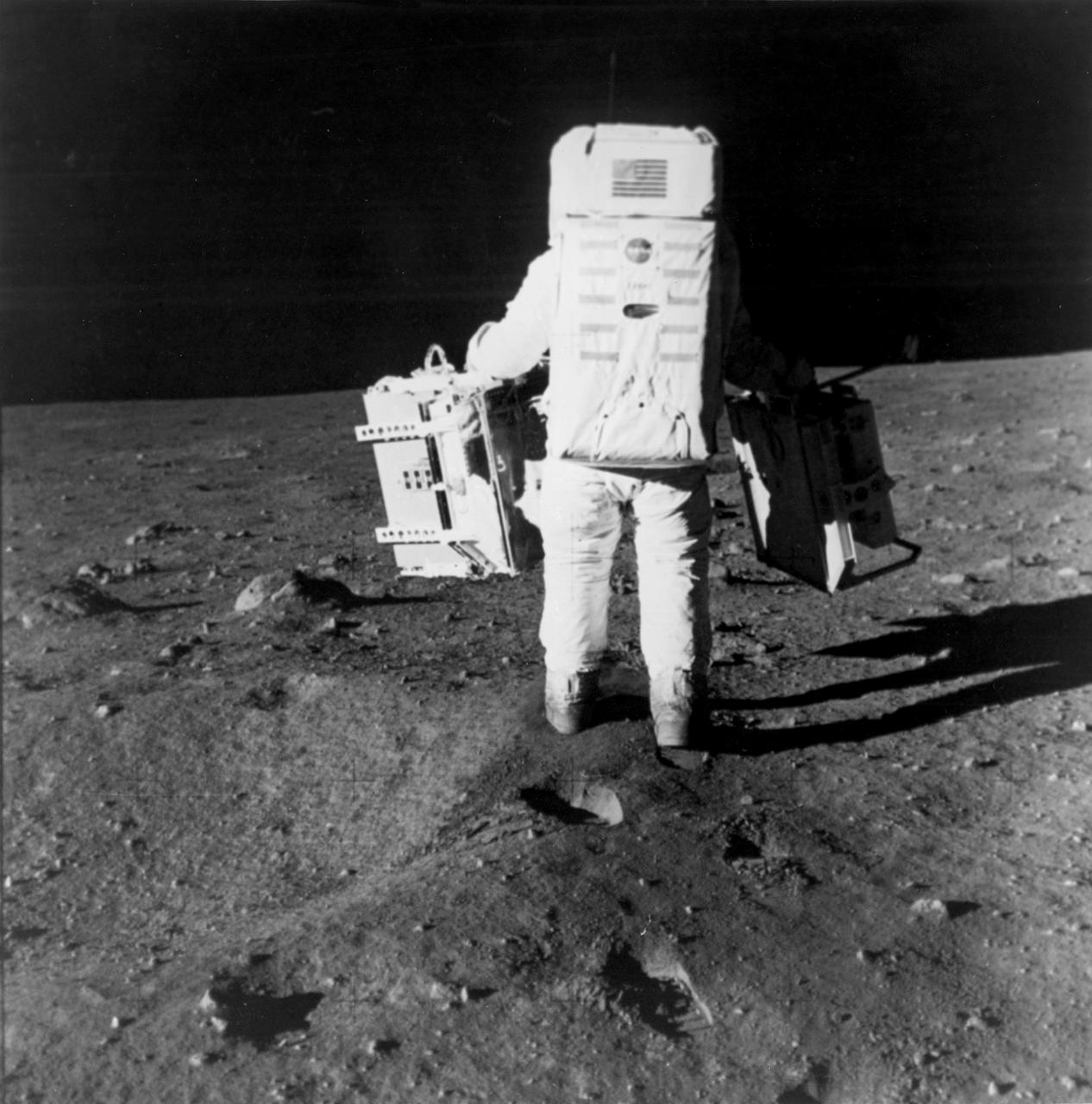
The first manned lunar landing mission, Apollo 11, launched from the Kennedy Space Center (KSC) in Florida via the Marshall Space Flight Center (MSFC) developed Saturn V launch vehicle on July 16, 1969 and safely returned to Earth on July 24, 1969. Aboard the space craft were astronauts Neil A. Armstrong, commander; Michael Collins, Command Module (CM) pilot; and Edwin E. (Buzz) Aldrin Jr., Lunar Module (LM) pilot. The CM, piloted by Michael Collins, remained in a parking orbit around the Moon, while the LM, named “Eagle’’, carrying astronauts Armstrong and Aldrin, landed on the Moon in the Sea of Tranquility. During 2½ hours of surface exploration, the crew set up experiments, collected 47 pounds of lunar surface material for analysis back on Earth, planted the U.S Flag, and left a message for all mankind. In this photograph, Aldrin walks past some rocks, easily carrying scientific equipment which would have been too heavy to carry on Earth. The two packages made up the Early Apollo Scientific Experiment Package (EASEP) on Apollo 11. On the left is the Passive Seismic Experiment Package (PSEP) and on the right is the Laser Ranging Retroreflector (LRR). NASA · NASA media guidelines / U.S. government work · Commons Downloaded NASA image rendition; displayed with layout crops. No scene elements added.
The record
A lunar laser-ranging station sends a precisely timed light pulse toward a reflector array and records the time taken for returned photons to arrive. The distance follows from that round-trip travel time and the speed of light, with careful corrections. This is laboratory-style evidence that can be repeated using a telescope, timing equipment and a known target position; it does not rest on liking an astronaut’s public performance. [1]
The Apache Point team’s 2023 dataset paper describes fifteen years of observations, from April 2006 through December 2020, to five lunar arrays. Its reported median nightly accuracy is 1.7 millimetres. That figure is a characterization of an observing dataset and its uncertainties, not a claim that one casual laser shot determines the whole Earth–Moon distance to a millimetre. The measurements support studies of the lunar interior, orbital motion and fundamental physics. [1]
Here is the essential caveat: Soviet Lunokhod robotic rovers also carried reflectors. The 2010 paper on reacquiring Lunokhod 1 describes how LRO imagery helped locate the previously lost target, after which Apache Point detected its return signal. Consequently, “a reflector exists, therefore a person put it there” is not a logically sufficient argument. Robots could and did deliver such instruments. A strong explanation acknowledges this rather than hiding it. [2]
The arrays still matter to the Apollo record. They are at documented sites and their long-term behavior can be studied; a 2024 research paper examines dust obscuration and changing optical performance of the Apollo arrays. Their evidential role is cumulative: a hoax account must explain the equipment, the placement history and how it fits the other observations. The human landing conclusion rests on that combination, not on pretending a reflector distinguishes a human hand from a robotic lander by itself. [2][3]
At the time
Apollo crews deployed ranging arrays; Soviet robotic missions also deployed reflectors.
What the record shows
Laser returns measure equipment on the Moon. The presence of a reflector alone cannot identify whether a person or robot placed it.
Evidence / 1969–present · Established historical record
A collection of rocks, not just a photograph of one
Apollo returned hundreds of kilograms of documented material. The evidence is strongest when the collection, geological context and laboratory measurements are considered together.
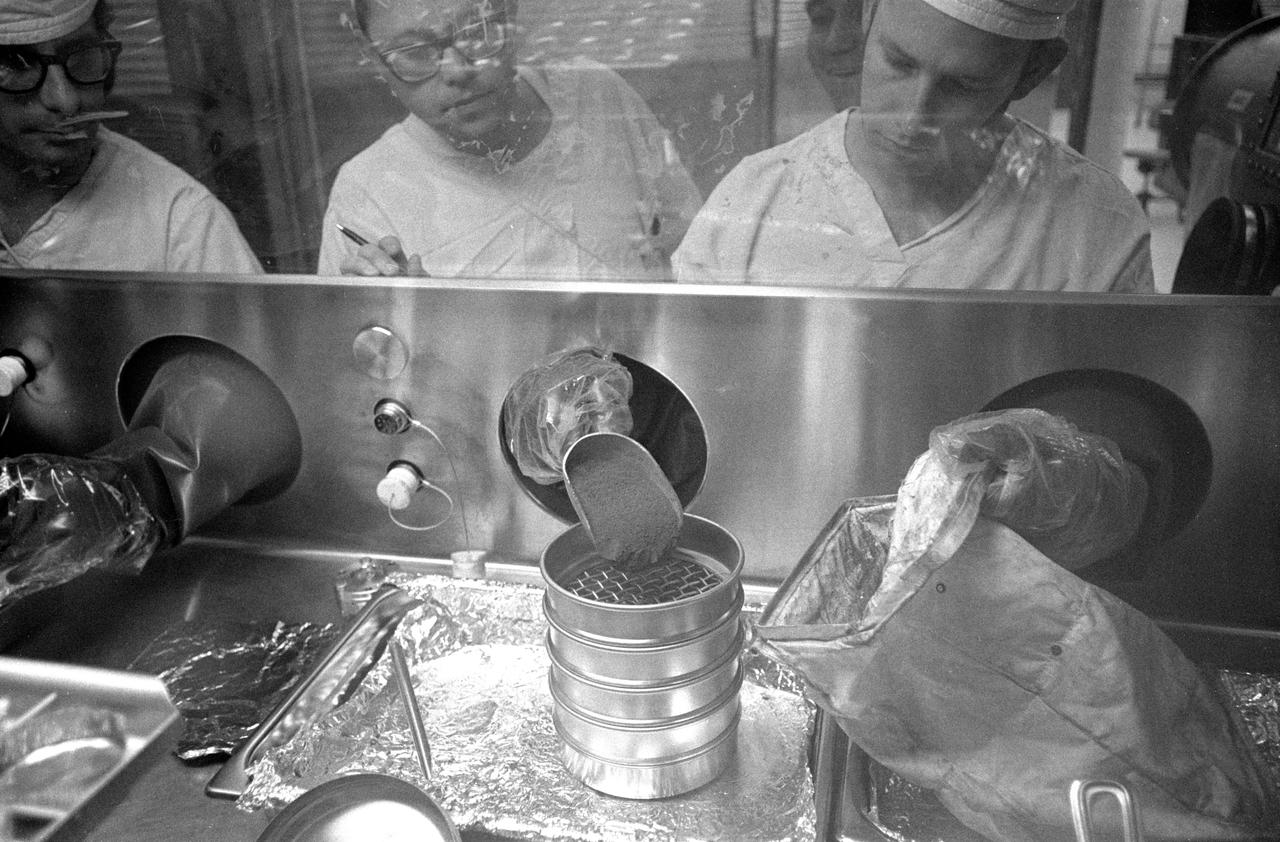
Glove handlers work with freshly opened Apollo 14 lunar sample material in modularized cabinets in the Lunar Receiving Laboratory at the Manned Spacecraft Center. The glove operator on the right starts to pour fine lunar material which he has just taken from a tote bag. The powdery sample was among the last to be revealed of the 90-odd pounds of material brought back to Earth by the Apollo 14 crew members. NASA · NASA media guidelines / U.S. government work · Commons Downloaded NASA image rendition; displayed with layout crops. No scene elements added.
The record
NASA reports 382 kilograms of material from the six landing expeditions, divided into 2,196 original samples. The collection is varied: rocks, soils and cores collected at different locations and under different conditions. The Lunar and Planetary Institute’s atlas lets a reader follow individual samples through surface photographs, laboratory images, thin sections and subdivision diagrams. This is far richer than a ceremonial rock photographed behind glass. [1][2]
Why does the paperwork matter? An identified specimen has a relationship to a particular collection location, neighboring terrain and other specimens. A sample cut into smaller pieces can be examined by different instruments and investigators, producing results that must fit a wider geological account. The atlas exposes parts of that chain to inspection. It is reasonable to ask how a particular rock was authenticated; a single questionable souvenir does not carry the same evidential weight as the documented collection. [2]
Independent scientific analysis does not mean independence from the original collection event. Researchers usually receive material through NASA’s curation system; they did not witness the collection themselves. But their measurements need not be copied from NASA’s conclusions. Ireland and colleagues’ 2006 Nature paper reports oxygen-isotope measurements in solar-wind-exposed grains, including sample 10084. Its result raised difficulties for then-current models of solar-system isotope composition. Scientists were testing material and confronting an unexpected result, rather than merely signing a certificate saying Apollo happened. [3]
The Apollo 16 collection gives a particularly concrete example of context: LPI records 731 individual rock and soil samples totaling 95.7 kilograms, including a core reaching 2.2 metres below the surface. A hypothetical robotic substitution must explain collection variety, depth and location as well as returned mass. Those are testable constraints on an alternative, not an argument that every rock automatically proves its collector’s identity. Lunar meteorites and robotic returns show that lunar material alone is not logically exclusive to a crewed mission. [4]
At the time
Six landing expeditions returned a geographically documented collection of rocks, soils and cores.
What the record shows
The collection’s mass, variety, context and repeated analyses form a stronger argument than one souvenir rock.
Evidence / 2008–present · Established historical record
The samples still change what scientists think
New instruments can extract new answers from old specimens. That is one reason Apollo’s scientific value did not end when television coverage did.
Microscopic views of Apollo XII Lunar rock sample thin sections, with and without polarized light. 1. Lunar Sample - Apollo XII (Thin Sections) NASA · NASA media guidelines / U.S. government work · Commons Downloaded NASA image rendition; displayed with layout crops. No scene elements added.
The record
Apollo’s scientific legacy includes changed minds, not only confirmed expectations. Saal and colleagues’ 2008 Nature paper used improved measurements of lunar volcanic glass to investigate indigenous volatiles, including water. It is an important corrective to older summaries that describe the Moon as if returned samples showed an absolute absence of water. “Dry compared with Earth” and “contains no water at all” are different statements. The composition of particular glasses constrains the Moon’s interior and volcanic history. [1]
This is also why it is misleading to treat an old sentence on an agency history page as the final state of lunar science. An archive may preserve how a question was described before improved analytical methods became available. A reader checking conflicting statements should compare publication dates, the material actually measured and the strength of the conclusion. Scientific revision is not evidence that the original sample was invented; it can reflect a more sensitive instrument or a better-controlled experiment. [1]
NASA’s 2025 sample-science overview describes fresh analyses of material collected more than fifty years earlier. The continuing value comes from keeping physical material available for questions that the original investigators could not fully answer. Unlike an unrepeatable television assertion, a curated specimen can be remeasured. The atlas and its sample-specific records help a reader connect scientific discussion to particular physical material rather than an anonymous jar of dust. [2][3]
The limits remain important. A new result about lunar chemistry does not independently replay the landing, and a paper can be corrected without erasing the whole collection. The appropriate positive conclusion is narrower and stronger: Apollo supplied a durable research resource whose measurements remain scientifically productive. A replacement explanation has to account for that resource as well as the film. This is one reason the accumulated case is substantially larger than the handful of visual puzzles that circulate online. [2][3]
At the time
Early analyses were limited by the instruments and questions available at the time.
What the record shows
Improved methods detected indigenous volatiles in lunar volcanic glass and revised older descriptions of a uniformly water-free Moon.
British and Australian observatories received lunar signals in real time. Their institutional records make the evidence broader than an American television broadcast.
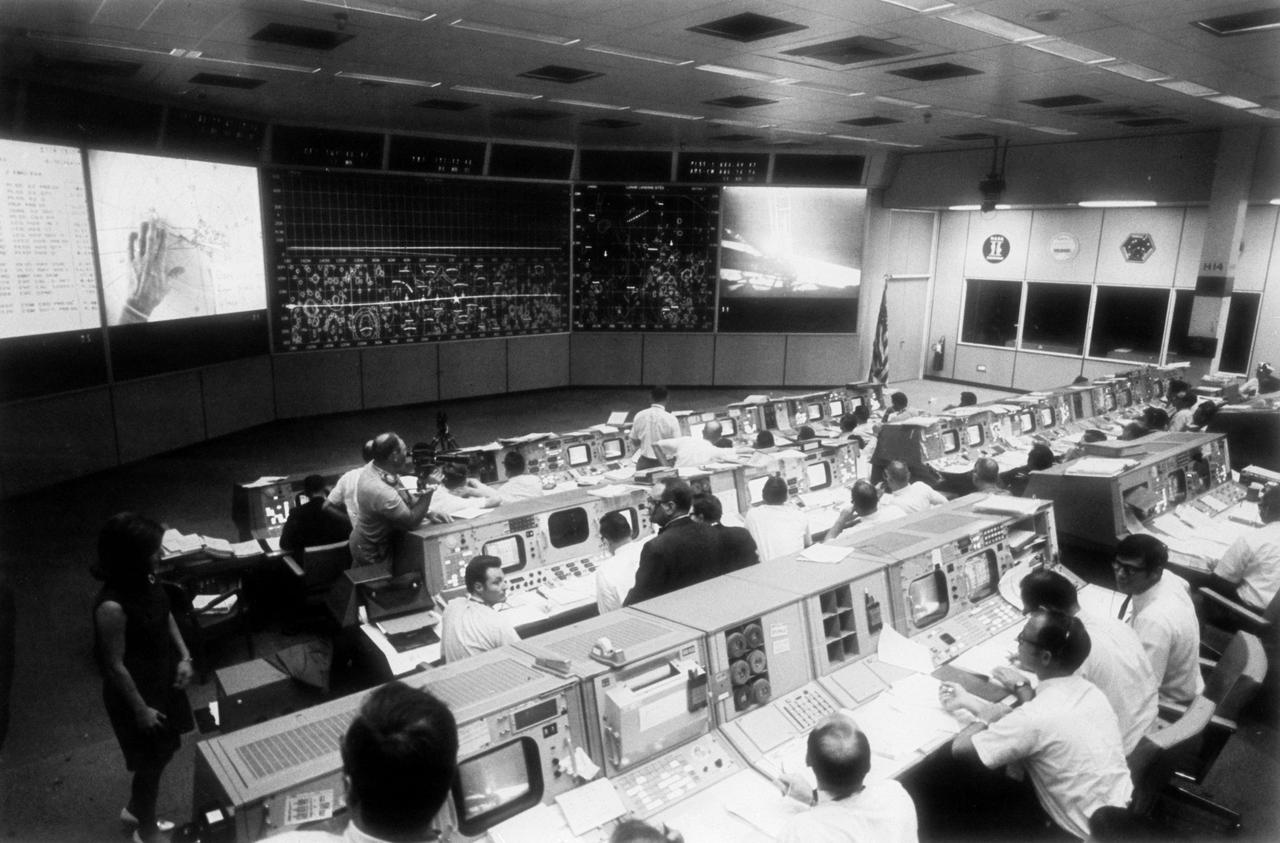
Overall view of the Mission Operations Control Room in the Mission Control Center, bldg 30, during the lunar surface extravehicular activity (EVA) of Apollo 11 Astronauts Neil A. Armstrong and Edwin E. Aldrin Jr. NASA · NASA media guidelines / U.S. government work · Commons Downloaded NASA image rendition; displayed with layout crops. No scene elements added.
The record
At Jodrell Bank in Britain, observers followed the American landing and the Soviet Luna 15 mission during the same historic period. The institution preserves the distinction between the spacecraft and between its instruments. Its World Heritage dossier describes the Apollo tracking record from the 50-foot telescope, including a Doppler trace associated with changes in the lunar module’s motion and its eventual stationary state. The famous Lovell Telescope was tracking Luna 15, which crashed. [1][2]
This is a useful source to inspect rather than reduce to “the British watched it too.” Radio tracking measures properties of a received signal: direction, frequency behavior and timing can constrain the transmitter’s location and motion. A receiver cannot look inside the spacecraft and certify its occupants from Doppler data alone. Yet contemporaneous observations of a lunar mission are a separate evidential burden for a theory that imagines nothing more than a television studio transmitting a film to terrestrial networks. [2]
Australia’s CSIRO explains another frequently misremembered part of the story. Honeysuckle Creek supplied the initial television pictures, including Armstrong’s first steps. Parkes became the selected source about eight and a half minutes later and supplied the following two hours and twelve minutes. The real network involved several stations, including Goldstone, not just the single dish popularized by a movie. Exact attribution matters because verifiable history is more persuasive than a simplified legend. [3]
Parkes was an Australian institution, but it was working in support of NASA’s mission; organizational independence is not the same as having no collaboration. John Sarkissian’s detailed published account documents the receiving chain and operational decisions. Together, these records show why it is useful to separate questions: did a signal arrive from lunar distance, did the descent behavior fit, and did astronauts actually traverse the surface? No one receiver answers everything. The receivers nevertheless provide a substantial check beyond the edited footage most viewers encountered at home. [3][4]
At the time
British and Australian institutions received and recorded lunar signals during the missions.
What the record shows
Their records provide external checks; the receiving stations had different operational relationships with NASA.
Evidence / 1964–1968 · Established historical record
Before people, robots mapped the risks
Ranger, Surveyor and Lunar Orbiter addressed different unknowns. Apollo inherited measurements of terrain and landing conditions instead of leaping directly from an Earth launch to an unexamined surface.
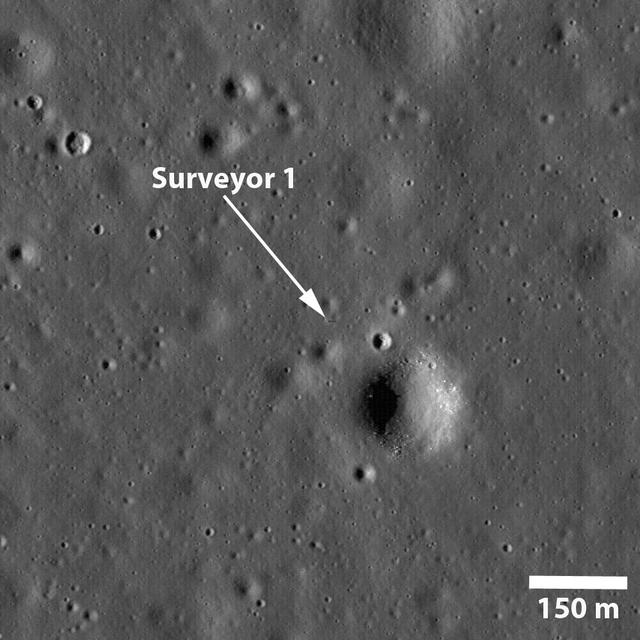
NASA Surveyor 1 spacecraft sitting silently on Oceanus Procellarum, the first US spacecraft to land on another planet on June 2, 1966 in this image taken by NASA Lunar Reconnaissance Orbiter. NASA · NASA media guidelines / U.S. government work · Commons Downloaded NASA image rendition; displayed with layout crops. No scene elements added.
The record
Landing on the Moon required knowing what the spacecraft would encounter. Ranger’s successful impact missions sent increasingly close photographs before striking the surface. Surveyor tested soft landing and surface operations. Lunar Orbiter supplied the broader photographic reconnaissance needed to evaluate candidate landing areas. These were complementary forms of reconnaissance: a close-up impact sequence did not itself demonstrate that a lander could settle safely, and a successful landing at one point did not map every possible route. [1][2]
The chronology makes the learning visible. Ranger 8 photographed terrain on its way into Mare Tranquillitatis in February 1965, years before Apollo 11 landed in that general region. Surveyor 1 achieved a soft landing in 1966, demonstrating practical operations on the lunar surface before astronauts depended on them. These missions turned questions about surface conditions into measurements and engineering experience. They did not make every later risk disappear. [1][2]
There is a useful correction to the idea that the achievement is implausible because nobody could have known what lunar landing would be like. Engineers did not know everything, but they were buying information with separate missions. The flight-test program describes launch-abort, suborbital and orbital phases as parts of a staged effort to qualify equipment, operations and teams. Robotic lunar reconnaissance and spacecraft testing solved different pieces of the same problem. [2][3]
That is also a way to evaluate an alternative history fairly. One can agree that robotic spacecraft reached the Moon and still question human landings. But accepting that preliminary record means accepting much of the infrastructure, navigation and spaceflight capability that Apollo used. The remaining question becomes specific: whether the documented crewed sequence built on those capabilities. It is better discussed through the actual tests and what each demonstrated than through the impression that a landing happened suddenly with no precursor work. [1][3]
At the time
Ranger, Surveyor and Lunar Orbiter investigated the Moon before astronauts landed.
What the record shows
Their results informed terrain selection, surface assumptions and landing preparation; the crewed mission did not begin from a blank map.
Evidence / 1961–1966 · Established historical record
Learning to work in space before going to the Moon
Mercury established basic human spaceflight experience. Gemini tackled the operational problems Apollo needed: endurance, rendezvous, docking and useful work outside a spacecraft.
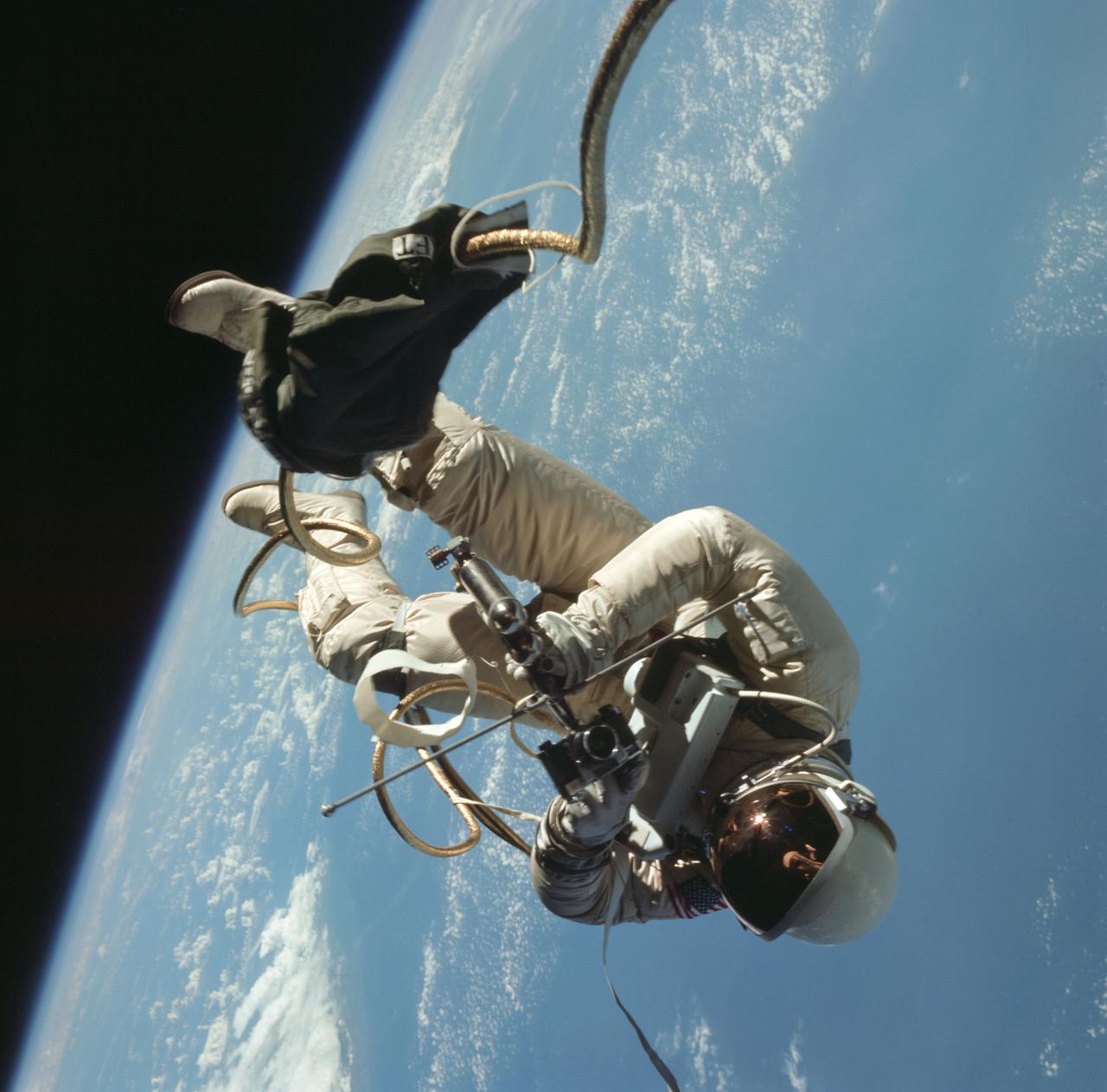
Astronaut Edward H. White II, pilot of the Gemini IV four-day Earth-orbital mission, floats in the zero gravity of space outside the Gemini IV spacecraft. White wears a specially designed spacesuit; and the visor of the helmet is gold plated to protect him against the unfiltered rays of the sun. He wears an emergency oxygen pack, also. He is secured to the spacecraft by a 25-feet umbilical line and a 23-feet tether line, both wrapped in gold tape to form one cord. In his right hand is a Hand-Held Self-Maneuvering Unit (HHSMU) with which he controls his movements in space. Astronaut James A. McDivitt, command pilot of the mission, remained inside the spacecraft. EDITOR'S NOTE: Astronaut White died in the Apollo/Saturn 204 fire at Cape Kennedy on Jan. 27, 1967. NASA · NASA media guidelines / U.S. government work · Commons Downloaded NASA image rendition; displayed with layout crops. No scene elements added.
The record
The early American flights were not miniature lunar landings. Mercury established experience with putting a person into space, controlling a spacecraft and bringing the occupant back. Gemini then concentrated on capabilities that a lunar expedition would require but Mercury had not demonstrated at the needed scale. NASA’s program history identifies longer-duration flight, orbital maneuvering, rendezvous, docking and spacewalking as central objectives. [1]
Rendezvous sounds simple until orbital mechanics enters the problem: approaching another spacecraft is not the same as steering a car toward a stationary target. Gemini 6A and Gemini 7 demonstrated a rendezvous; Gemini 8 made the first docking with an Agena target. Gemini 8 then encountered a stuck thruster and dangerous rotation, forcing Neil Armstrong to undock and stabilize the spacecraft. The failure and recovery were part of the operational experience, not an inconvenient footnote to a flawless success story. [2]
Endurance and work were different challenges. Gemini 7 remained in space for about fourteen days, addressing survival and operations over an interval longer than the planned early lunar round trip. Spacewalking exposed another difficulty: moving outside did not guarantee that a suited astronaut could perform useful tasks without excessive effort. Gemini XII used training and body restraints to improve practical work outside the cabin. Buzz Aldrin accumulated more than five hours outside during that mission. [2][3]
What did these tests buy Apollo? Experience managing a mission for days, meeting another vehicle, docking, controlling an emergency and designing work procedures for a suited person. They do not prove that Apollo 11 landed, but they show the achievement’s technical ancestry. The final lunar mission combined learned operations with new hardware and a more demanding environment. Recognizing that accumulated experience makes the history both more believable and more impressive: expertise was developed through hard practice rather than bestowed fully formed at launch. [1][3]
At the time
Mercury tested crewed flight; Gemini practiced long-duration operations, rendezvous and working outside a capsule.
What the record shows
Those operations supplied experience that the later lunar architecture required, including lessons from difficulties rather than only successes.
Evidence / 1967–1968 · Established historical record
The tests that failed—and changed the spacecraft
Apollo’s development included a fatal ground-test fire and an uncrewed Saturn V flight with serious anomalies. The responses are central to understanding what was learned.
Apollo 1 prime crew: Virgil Grissom, Edward White and Roger Chaffee, pictured before the January 1967 ground-test fire. NASA · NASA media guidelines / U.S. government work · Commons Original NASA image; displayed with layout crops.
The record
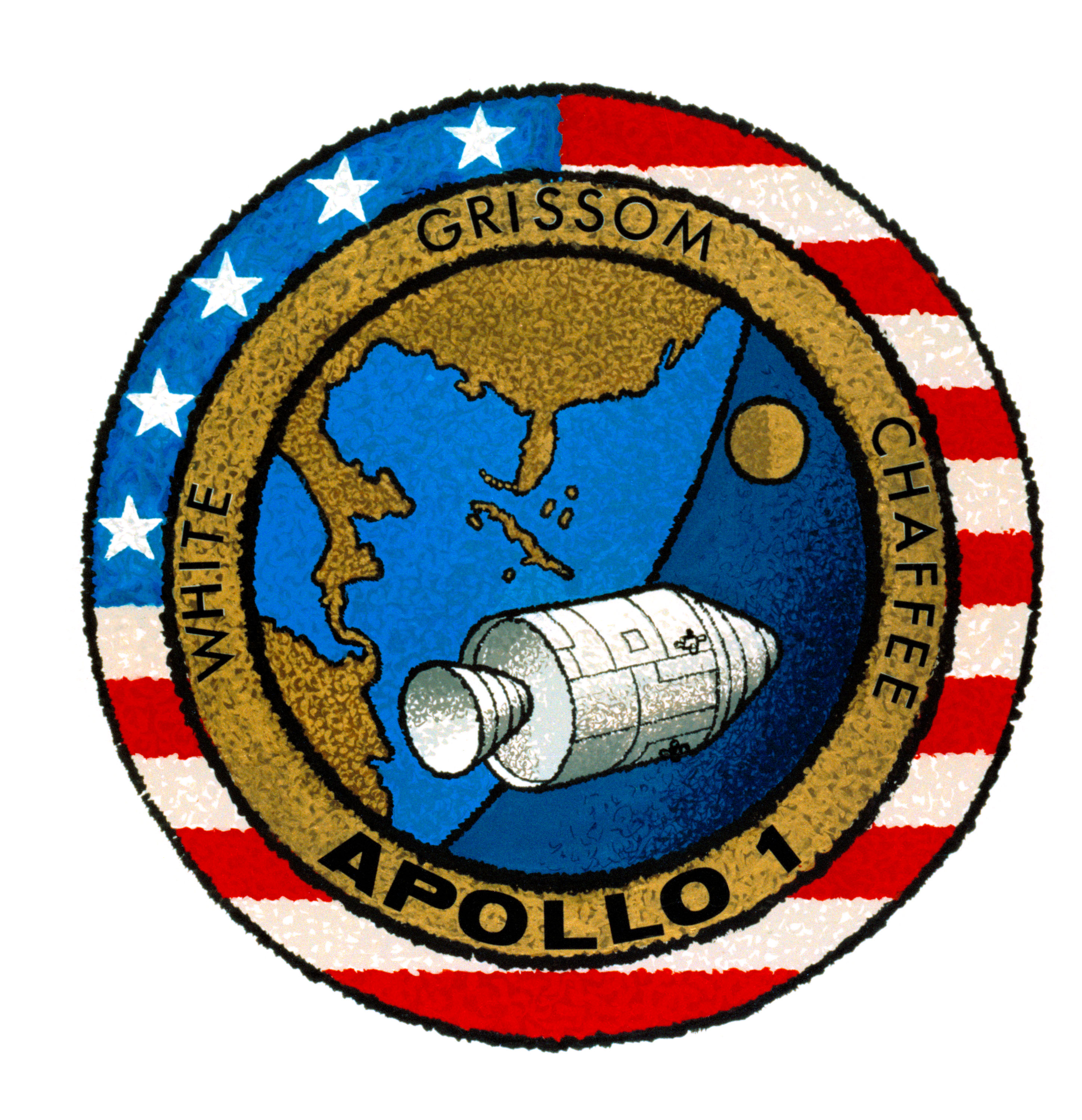
On January 27, 1967, Gus Grissom, Ed White and Roger Chaffee died in the Apollo 1 ground-test fire. The spacecraft’s oxygen-rich, pressurized environment, combustible materials and difficult hatch contributed to a catastrophe from which the crew could not escape. The subsequent changes included a rapidly opening unified hatch, tighter control of flammable material, wiring protection and changes in safety and management practice. It would be wrong to romanticize these deaths as a necessary step; they were a preventable disaster that forced a redesign. [1][2]
Uncrewed Apollo 4 and Apollo 6 flights tested the Saturn V and spacecraft at a scale that smaller component tests could not reproduce. Apollo 5 tested the lunar module without a crew. The contemporary flight-test description explains these as steps toward proving launch systems, reentry performance, spacecraft operation and the competence of ground teams. A rocket firing successfully on a stand is not the same test as an assembled launch vehicle flying through its full environment. [5]
Apollo 6, on April 4, 1968, experienced severe longitudinal vibration—the pogo effect—and engine problems. Those failures mattered because the next Saturn V would carry a crew on Apollo 8. NASA’s engineering history describes the investigation and the helium-filled cavities used to change the behavior of the liquid-oxygen feed system and suppress the first-stage oscillation. The flight was not simply relabeled a perfect success; its anomalies led to diagnosis and hardware changes. [3][4]
This history demonstrates a mechanism of learning: test a system, measure a failure, identify its cause, change the design and assess the residual risk. That does not prove every NASA decision was wise, and the decision to crew the next Saturn V can still be examined critically. But an account of Apollo that skips these tests discards much of the explanation for how a technically difficult landing became possible. Failures are part of the evidential record because they connect the earlier hardware to the later configuration. [1][4][5]
At the time
The Apollo 1 fire killed three astronauts; uncrewed Saturn tests also exposed problems.
What the record shows
Redesign and subsequent testing are documented parts of the path to a landing, not evidence that there were no real risks.
Evidence / 1968–1969 · Established historical record
Four crewed rehearsals before the first landing
Apollo 7 tested the command-and-service spacecraft in Earth orbit; 8 went around the Moon; 9 tested the lunar module near Earth; 10 rehearsed the lunar approach.
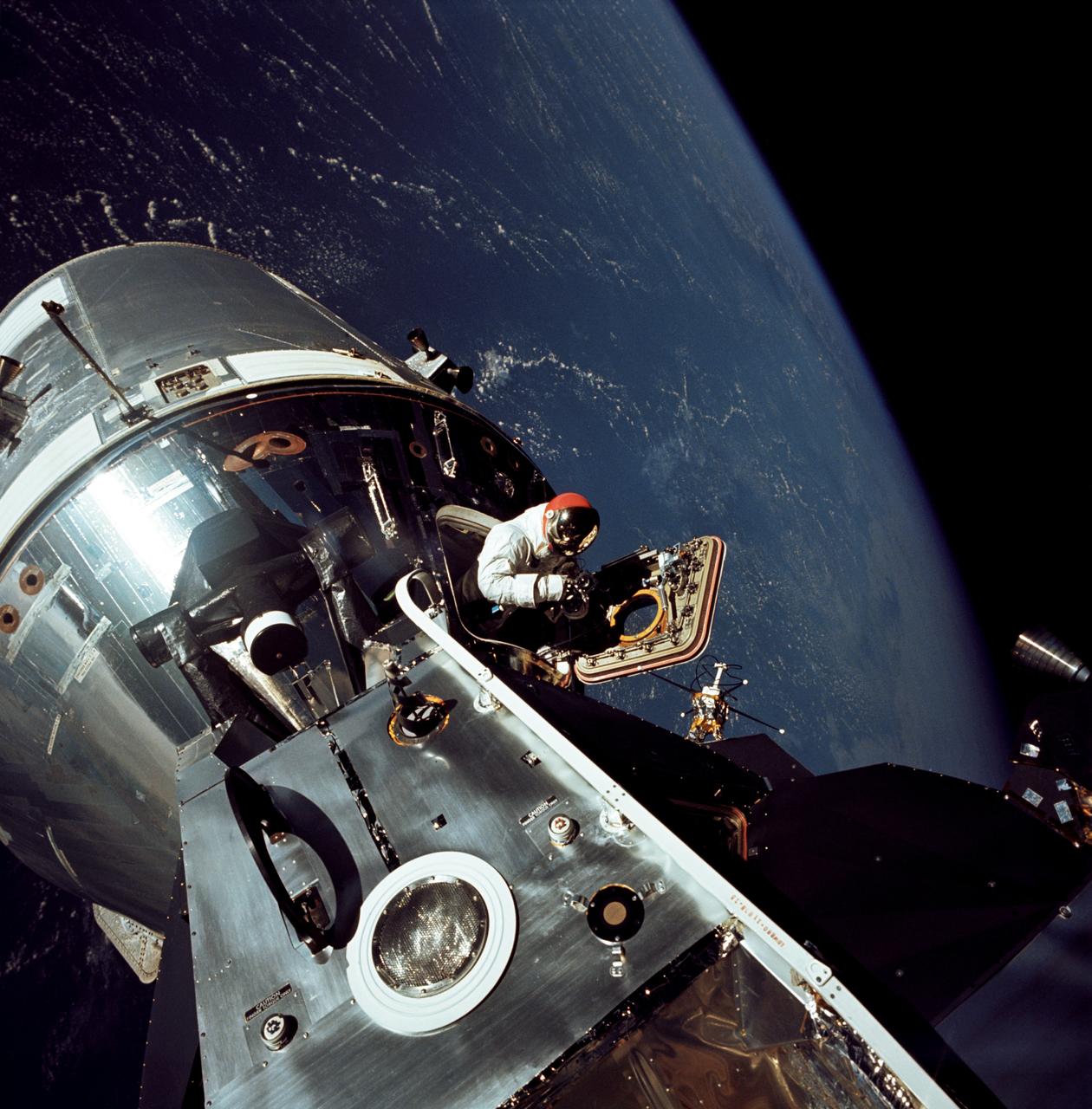
Excellent view of the docked Apollo 9 Command and Service Modules (CSM) and Lunar Module (LM), with Earth in the background, during astronaut David R. Scott's stand-up extravehicular activity (EVA), on the fourth day of the Apollo 9 Earth-orbital mission. Scott, command module pilot, is standing in the open hatch of the Command Module (CM). Astronaut Russell L. Schweickart, lunar module pilot, took this photograph of Scott from the porch of the LM. Inside the LM was astronaut James A. McDivitt, Apollo 9 commander. NASA · NASA media guidelines / U.S. government work · Commons Downloaded NASA image rendition; displayed with layout crops. No scene elements added.
The record
Apollo 7, launched October 11, 1968, was the first crewed Apollo flight. It checked the command-and-service spacecraft in Earth orbit and gave later crews and controllers experience with the equipment they would depend on. Its crew debriefings fed directly into preparation for Apollo 8. The program was not only testing metal and electronics: it was also developing procedures for people, communications and mission management. [1]
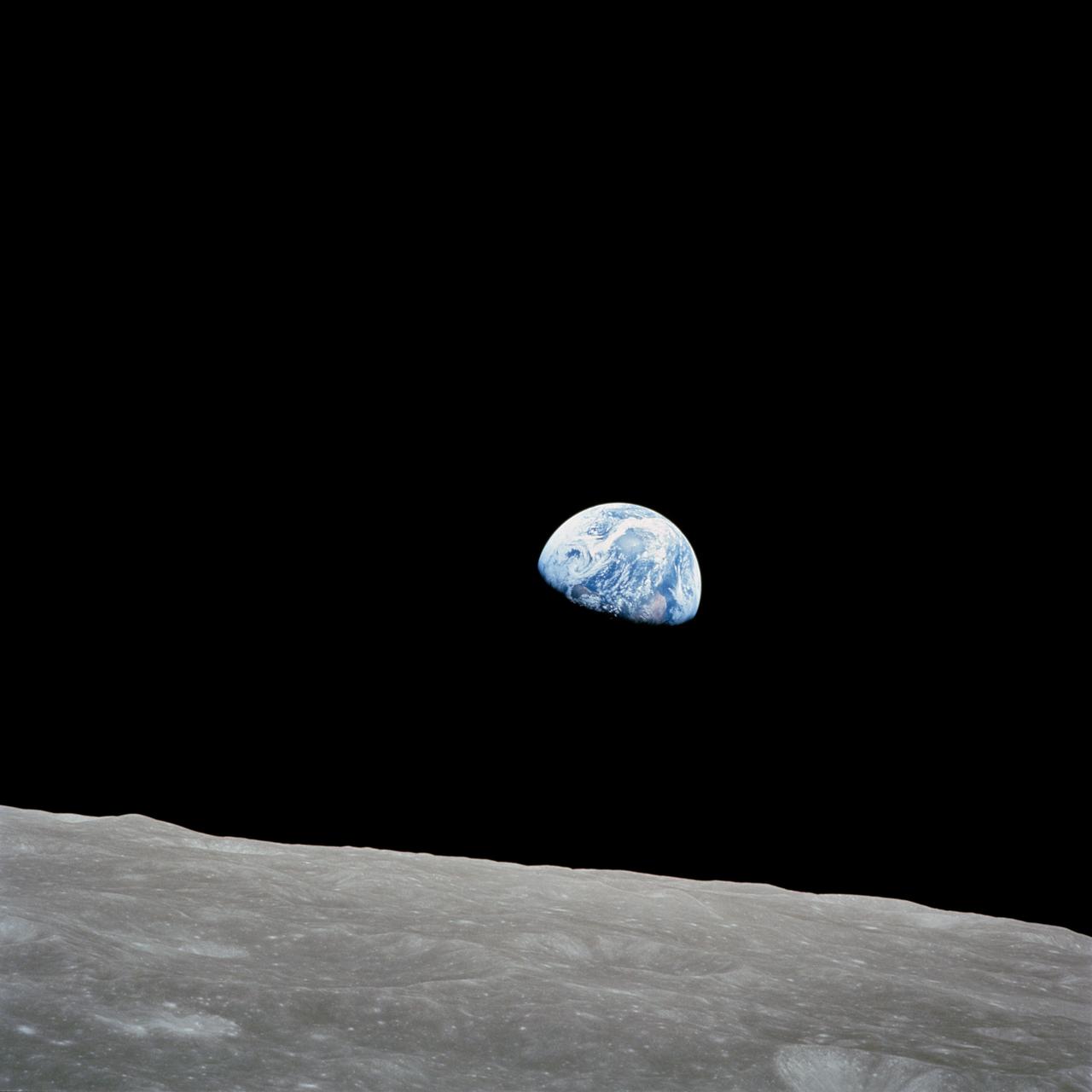
Apollo 8 took Frank Borman, Jim Lovell and Bill Anders to lunar orbit in December 1968. This was a different achievement from landing, but it exercised the long-distance journey, navigation and operation around another world. The Earthrise photograph came from that flight. NASA’s later reconstruction carefully distinguishes original onboard audio and photographs from a modern visualization generated using lunar terrain data. Calling every modern reconstruction “the original film” would create a needless source of confusion. [2][5]
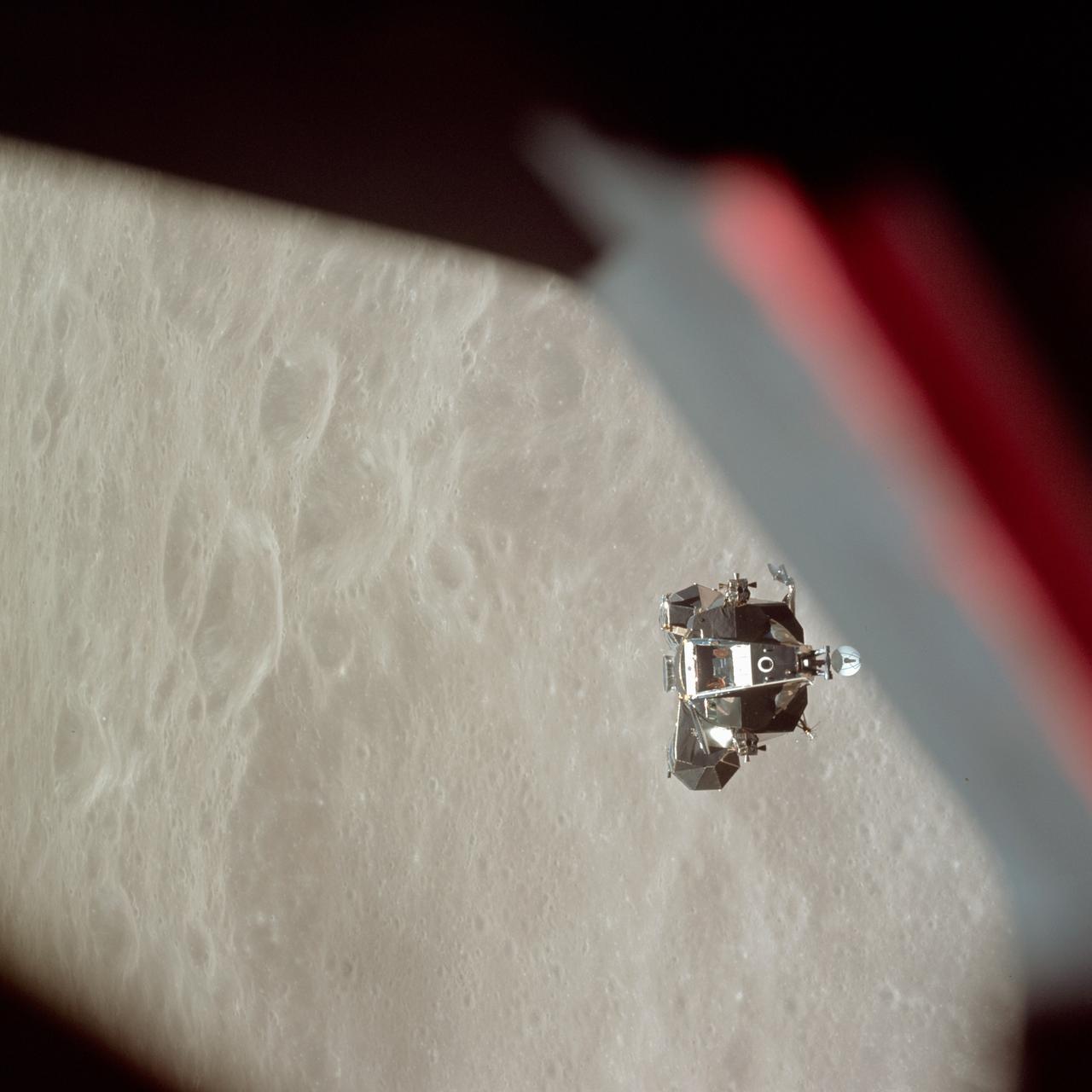
Apollo 9 then stayed in Earth orbit in March 1969 to test the lunar module with a crew and the integrated system’s rendezvous and docking procedures. That ordering can seem surprising: why go back to Earth orbit after Apollo 8? Because the missions were proving different capabilities. The lunar module had to demonstrate that it could work as a separate spacecraft, maneuver and rejoin the command module before crews depended on it at lunar distance. [3]
Apollo 10 in May 1969 carried out the lunar-orbit dress rehearsal. Its lunar module descended to roughly nine miles above the surface without attempting a landing, gathering operational information about trajectories, radar, tracking and control. This left the final descent, surface stay and departure for Apollo 11. Each mission reduced a particular set of unknowns; none made the next mission risk-free. Read together, the four histories show an intelligible chain of increasingly demanding demonstrations rather than an isolated spectacle in July. [4]
Watch this question
NASA | Earthrise: The 45th Anniversary ↗ NASA Goddard — Verified official channel, December 20, 2013. Modern visualization uses original audio, Apollo photography and LRO terrain. Clearly label reconstruction.
Apollo 11’s case includes an engineering report, timed communications, surface activities, imagery, samples and later observations. The connections are more informative than a detached clip.
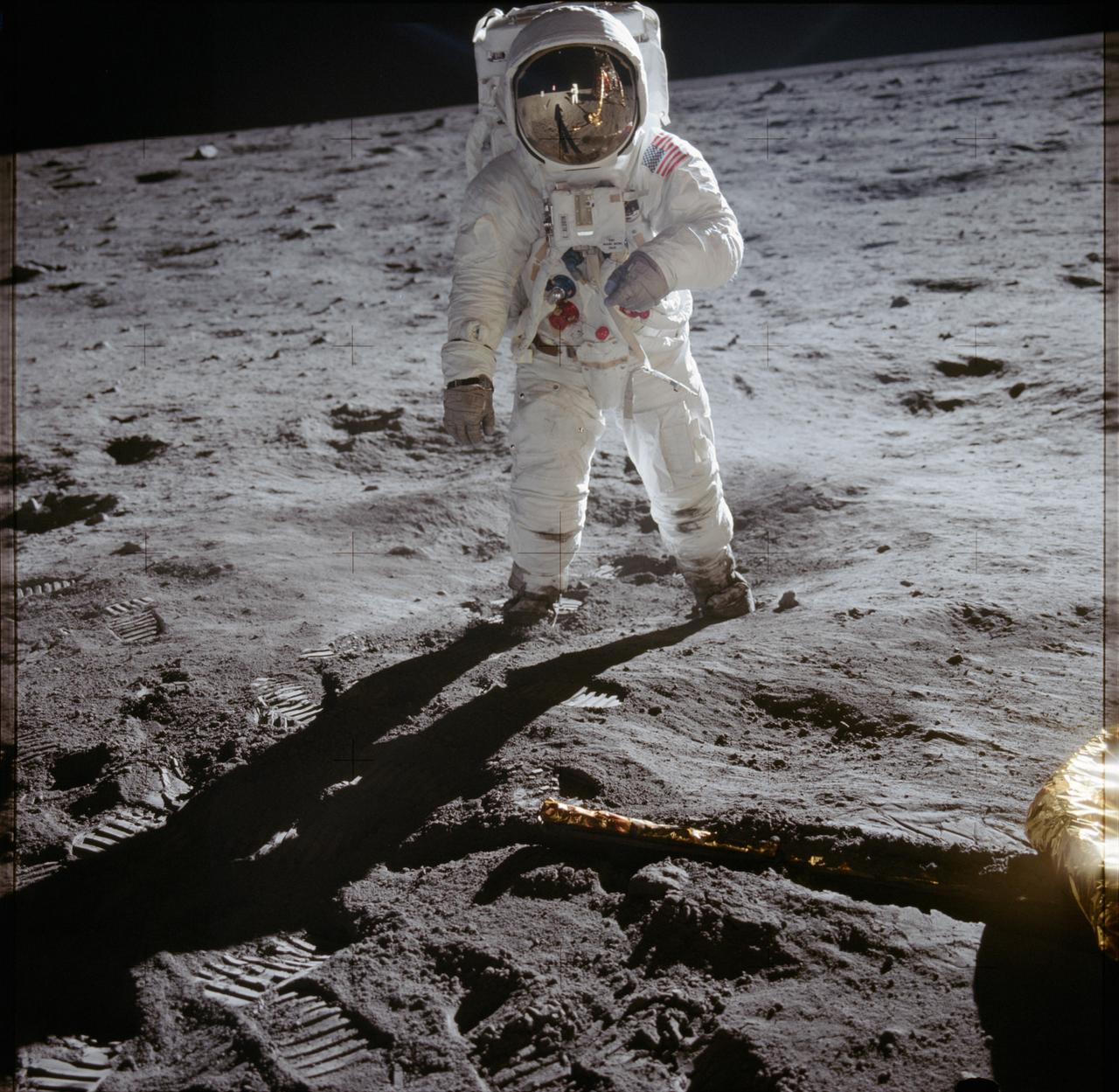
Astronaut Edwin E. Aldrin Jr., lunar module pilot, walks on the surface of the moon near the leg of the Lunar Module (LM) "Eagle" during the Apollo 11 extravehicular activity (EVA). Astronaut Neil A. Armstrong, commander, took this photograph with a 70mm lunar surface camera. While astronauts Armstrong and Aldrin descended in the Lunar Module (LM) "Eagle" to explore the Sea of Tranquility region of the moon, astronaut Michael Collins, command module pilot, remained with the Command and Service Modules (CSM) "Columbia" in lunar orbit. NASA · NASA media guidelines / U.S. government work · Commons Downloaded NASA image rendition; displayed with layout crops. No scene elements added.
The record
Apollo 11’s November 1969 mission report is an engineering record, not just a commemorative story. It describes the spacecraft’s performance, navigation, landing and mission anomalies. The Lunar Surface Journal video library connects footage to mission times and journal passages. Those records let an interested reader follow a sequence: approach, landing, preparation, surface work and departure, rather than treating a few seconds of a flag as the entire event. [1][2]
An important distinction is between original material and the editorial apparatus used to make it easier to understand. The video library includes original mission footage alongside processed presentations, edited clips, stabilized views and modern combinations prepared by named contributors. A useful caption says which is which. A composite that aids geographic understanding is not secretly raw camera output; conversely, finding that a modern explanatory presentation is edited does not establish that the underlying event was staged. [2]
The individual strands can be compared. A surface photograph records nearby terrain and activities; the sample atlas connects some specimens to their collection context; a later orbital image records the site’s surviving objects and disturbed surface. The inference comes from the agreement between records made in different ways, including evidence created decades after the live broadcast. A critique should test an actual mismatch within that framework, not presume that any alteration made for presentation invalidates every independent observation. [2][3][4]
It is fair to say that much of this documentary chain begins with NASA, and that preserved mission records require historical evaluation like any archive. It is not fair to pretend that the record consists only of one grainy television transmission. The most productive discussion chooses a definite claim and asks which records constrain it. That approach leaves room for an archive error, an ambiguous image or a mistaken caption without confusing one local problem with evidence that the entire mission never took place. [1][4]
Watch this question
Apollo 11 Descent: Film and LRO Imagery ↗ NASA — Verified NASA collection embed. Compares historical descent film with later orbital terrain; not a continuous live orbiter feed.
At the time
Armstrong and Aldrin landed while Collins remained in lunar orbit.
What the record shows
The account links flight operations, surface activity, tracking, photography, samples and later site observations.
Evidence / 1969–1972 · Established historical record
Apollo did not end with one flag
Six crews landed; Apollo 13 returned without landing. Later missions expanded science, range and equipment, leaving a larger record than Apollo 11 alone.
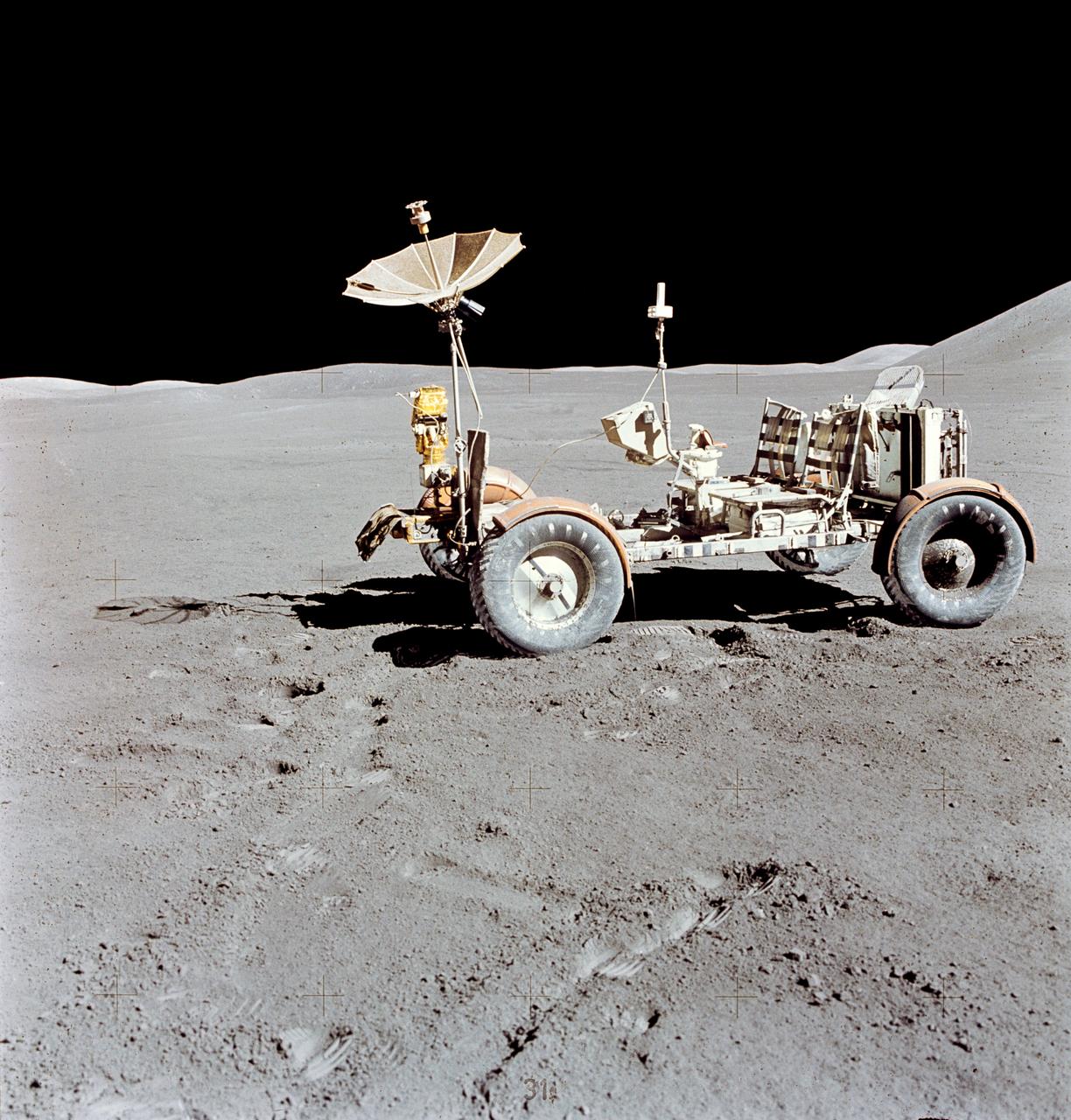
The Lunar Roving Vehicle (LRV) is photographed alone against the desolate lunar background during the third Apollo 15 lunar surface extravehicular activity (EVA) at the Hadley-Apennine landing site. This view is looking north. The west edge of Mount Hadley is at the upper right edge of the picture. Mount Hadley rises approximately 4,500 meters (about 4,765 feet) above the plain. The most distant lunar feature visible is approximately 25 kilometers (about 15.5 statute miles) away. While astronauts David R. Scott, commander; and James B. Irwin, lunar module pilot, descended in the Lunar Module (LM) "Falcon" to explore the moon, astronaut Alfred M. Worden, command module pilot, remained with the Command and Service Modules (CSM) in lunar orbit. NASA · NASA media guidelines / U.S. government work · Commons Downloaded NASA image rendition; displayed with layout crops. No scene elements added.
The record
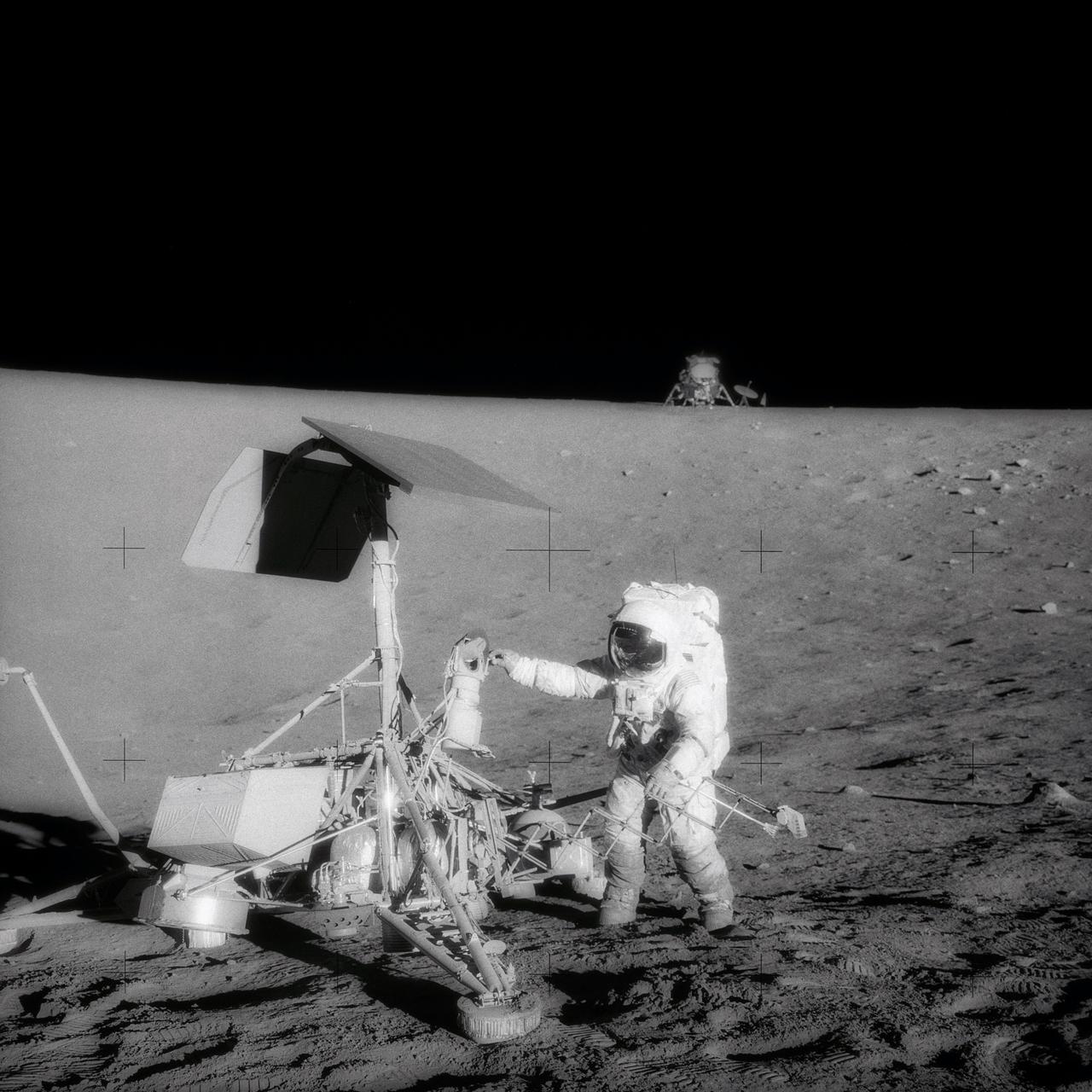
Apollo 12 demonstrated a precision landing near Surveyor 3, which had arrived robotically in 1967. Pete Conrad and Alan Bean visited the older spacecraft and returned components, including its television camera and surface-sampler scoop. Those parts became laboratory specimens for studying exposure and the effect of the lunar module’s nearby arrival. Later LRO imagery shows the Apollo 12 and Surveyor sites in the same landscape. This is a particularly useful intersection of an earlier robot, a crewed mission, returned hardware and later observation. [1][2][3][4]
There were six successful crewed landings: Apollo 11 and 12, then 14, 15, 16 and 17. Apollo 13 is the missing number for a reason. An oxygen-system failure forced the crew to abandon the landing and use the lunar module as a lifeboat. The review led to oxygen-system redesign and recertification. Its survival story is not evidence that the lunar program was safe or that failure was merely theatrical; it documents how close a real expedition came to losing its crew. [5][9]
The final three landings were the longer scientific “J” missions. They carried a rover and supported more ambitious exploration and orbital observations. NASA’s preparation history describes extensive geology training and simulated scientific support operations. David Scott and Jim Irwin’s Apollo 15 exploration is a different scale of fieldwork from Apollo 11’s first excursion near Eagle. A rover did not eliminate operational constraints, but it expanded the territory that astronauts could examine and sample. [6][7]
One short Apollo 15 video is especially approachable: Scott releases a hammer and a feather together and they reach the surface together, illustrating how falling objects behave without significant air resistance. It is not the sole proof of the mission, and the physics can be demonstrated in an Earth vacuum chamber. Its value here is showing an intelligible physical observation within a much larger scientific expedition. Across the landings, samples, instrument deployments, traverses and orbital data created a record that continues to be studied. Apollo’s Cold War significance and its scientific output can both be true. [8][9]
At the time
Apollo continued after 1969, with five further landings and the failed Apollo 13 landing attempt.
What the record shows
Later missions expanded fieldwork and instrument deployment. The record is not limited to one short television event.
A wrinkled flag, a horizontal support and motion introduced by the astronauts are three different things. A still image mixes them together.
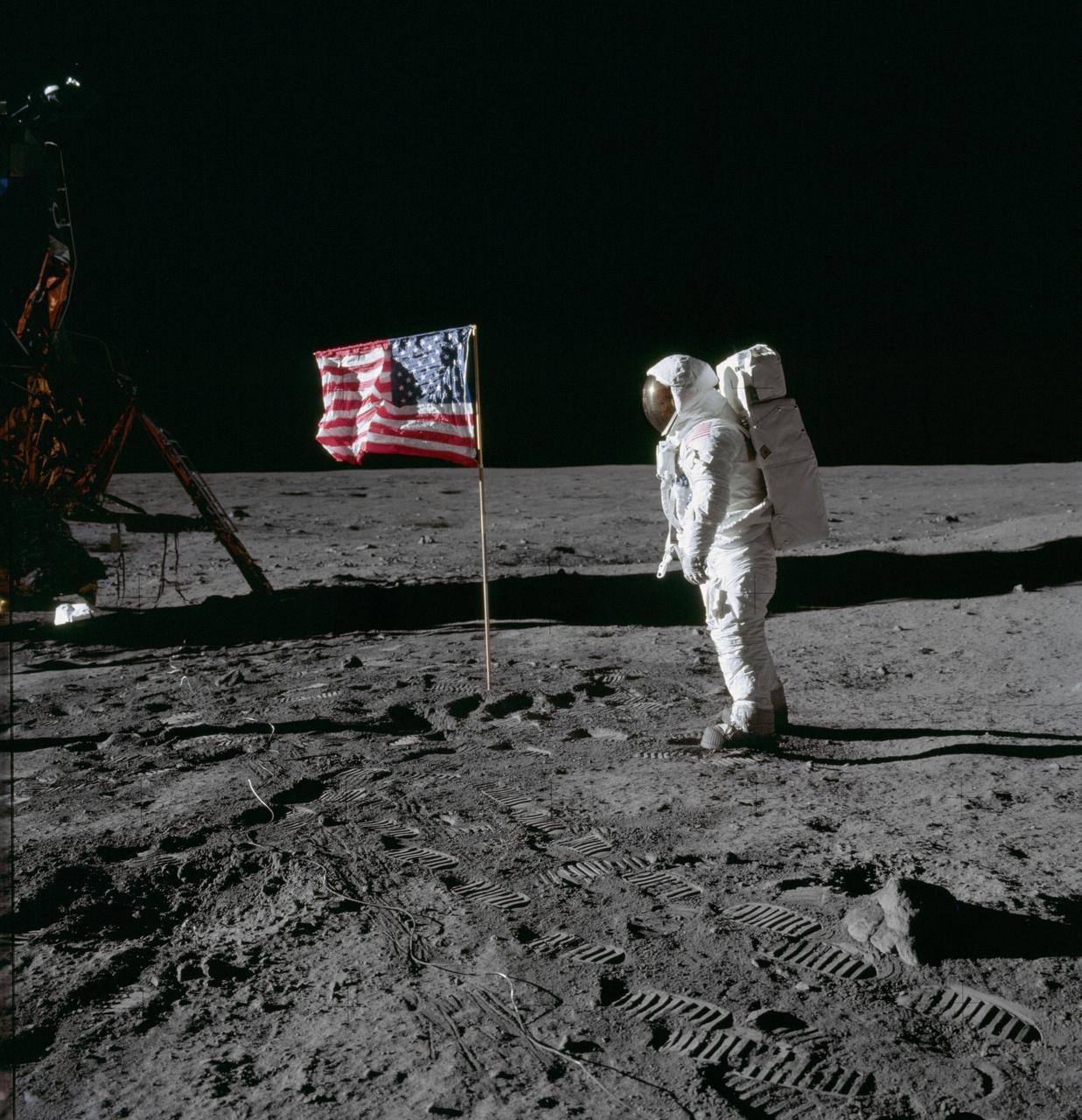
Astronaut Edwin E. Aldrin Jr., lunar module pilot of the first lunar landing mission, poses for a photograph beside the deployed United States flag during an Apollo 11 extravehicular activity (EVA) on the lunar surface. The Lunar Module (LM) is on the left, and the footprints of the astronauts are clearly visible in the soil of the moon. Astronaut Neil A. Armstrong, commander, took this picture with a 70mm Hasselblad lunar surface camera. While astronauts Armstrong and Aldrin descended in the LM, the "Eagle", to explore the Sea of Tranquility region of the moon, astronaut Michael Collins, command module pilot, remained with the Command and Service Modules (CSM) "Columbia" in lunar orbit. Photo credit: NASA NASA · NASA media guidelines / U.S. government work · Commons Downloaded NASA image rendition; displayed with layout crops. No scene elements added.
The record
The photographs really do show a flag with a rippled shape. That is a reasonable thing to notice. NASA did not expect a flag to hang outward in a vacuum: the assembly included a horizontal telescoping rod along its top edge. During Apollo 11 deployment the rod did not extend completely, leaving wrinkles in the nylon. Those folds can look like a flag frozen in a breeze even when nothing is moving. The design and deployment history are documented separately from later arguments about the footage. [1][2]
Actual motion needs a separate explanation from the still shape. Twisting or pushing a pole transfers energy to the fabric and support. A flag can swing after that impulse without a wind continually driving it. Vacuum removes air damping; it does not remove gravity, inertia or internal friction in the fabric and joints. The correct prediction is therefore some settling motion followed by a largely fixed shape, rather than endless fluttering. This is a physics explanation of the assembly, not a claim that every clipped internet video has been independently authenticated.
The useful viewing exercise is to watch the deployment continuously, including the astronauts’ hands and the pole, rather than repeatedly watch a cropped second of fabric motion. NASA’s video collection links the flag-raising sequence. Ask when movement begins, what else moves, and whether the folds keep changing after the astronauts leave. That gives the idea of a breeze a specific test instead of treating the word “wave” as an explanation. [3]
A vacuum is not a force that holds objects motionless. The Moon also has rocket exhaust and human contact, so a particular movement must be judged in its particular sequence. None of those facts means a wrinkled flag requires an atmosphere. The visible support makes that assumption unnecessary.
Documented checkpoints & limits
Start with the record
Inspect the original source
A wrinkled flag, a horizontal support and motion introduced by the astronauts are three different things. A still image mixes them together. Source ↗
Make a specific test
Keep the mechanism and its limits together
The flag’s shape and its brief movements do not require wind. Watch the source sequence before interpreting a crop. Source ↗
Watch this question
Raising the American Flag ↗ NASA — Actual sequence linked by NASA Apollo50th collection; compare hands, pole and fabric. Restored footage, not newly filmed evidence.
At the time
The flag assembly used a top support and retained folds after deployment.
What the record shows
Its visible shape and hand-induced motion do not require atmospheric wind.
Space can have a black sky while the camera is set for daylight. Exposure, rather than a missing universe, explains the familiar Apollo photographs.
Astronaut Edwin E. Aldrin Jr., lunar module pilot, walks on the surface of the moon near the leg of the Lunar Module (LM) "Eagle" during the Apollo 11 extravehicular activity (EVA). Astronaut Neil A. Armstrong, commander, took this photograph with a 70mm lunar surface camera. While astronauts Armstrong and Aldrin descended in the Lunar Module (LM) "Eagle" to explore the Sea of Tranquility region of the moon, astronaut Michael Collins, command module pilot, remained with the Command and Service Modules (CSM) "Columbia" in lunar orbit. NASA · NASA media guidelines / U.S. government work · Commons Downloaded NASA image rendition; displayed with layout crops. No scene elements added.
The record
The lunar sky can look black because there is no substantial atmosphere to scatter sunlight into a blue daytime sky. That does not make the foreground dark. Sunlight is illuminating the ground, suits and spacecraft. A photograph exposed to preserve those bright subjects collects too little starlight for the stars to register. NASA’s Earth-observation explanation describes this difference between a sunlit scene and a sky that merely looks like night. [1]
Think of a photograph of a brightly lit person at night: the camera can record the person while distant dim objects disappear. Increasing exposure to reveal faint light can wash out the bright subject. A dark background is not a measurement that no light existed there; it may mean that the signal was below the useful range of that exposure. This is an ordinary limitation of an image, not an exception invented for Apollo.
There is also an important distinction between what an astronaut could see after adapting to darkness, what a camera recorded on a particular setting, and what can be recovered from a scanned reproduction decades later. Those are three different observing systems. The absence of visible stars in a daytime surface photograph tells us very little about whether someone could perform a separate astronomical observation with suitable equipment and shielding.
The fair test is to identify the exact photograph, its foreground brightness and the photographic equipment used. NASA’s camera history documents the surface still cameras and the larger photographic program; the image library lets a reader examine frames rather than a meme. Not every Apollo image used the same camera or exposure. A blanket claim about “all space photos” ignores those differences. [2][3]
There is an especially useful counterexample to the sweeping claim that Apollo never photographed stars: Apollo 16 carried a dedicated far-ultraviolet astronomical camera. Its technical report describes a tripod-mounted instrument and long exposures that recorded stars. This was a different task with a different camera from photographing a bright spacesuit. The distinction turns a vague argument about what “space should look like” into an equipment-and-exposure question. [4]
Documented checkpoints & limits
Start with the record
Inspect the original source
Space can have a black sky while the camera is set for daylight. Exposure, rather than a missing universe, explains the familiar Apollo photographs. Source ↗
Make a specific test
Keep the mechanism and its limits together
A starless photograph of sunlit astronauts is expected. Black sky does not mean a long nighttime exposure. Source ↗
At the time
The surface cameras photographed brightly sunlit terrain and suits against a black sky.
What the record shows
Exposure explains the missing faint stars; Apollo 16’s dedicated ultraviolet instrument also provides actual stellar observations.
Perspective and sloping ground must be reconstructed before drawn lines can diagnose studio lighting.
This unusual photograph, taken during the second Apollo 12 extravehicular activity (EVA), shows two U.S. spacecraft on the surface of the moon. The Apollo 12 Lunar Module (LM) is in the background. The unmanned Surveyor 3 spacecraft is in the foreground. The Apollo 12 LM, with astronauts Charles Conrad Jr. and Alan L. Bean aboard, landed about 600 feet from Surveyor 3 in the Ocean of Storms. The television camera and several other pieces were taken from Surveyor 3 and brought back to Earth for scientific examination. Here, Conrad examines the Surveyor's TV camera prior to detaching it. Astronaut Richard F. Gordon Jr. remained with the Apollo 12 Command and Service Modules (CSM) in lunar orbit while Conrad and Bean descended in the LM to explore the moon. Surveyor 3 soft-landed on the moon on April 19, 1967. NASA · NASA media guidelines / U.S. government work · Commons Downloaded NASA image rendition; displayed with layout crops. No scene elements added.
The record
Lines that are parallel in the world can converge in a photograph. Railroad tracks are the familiar example. Royal Museums Greenwich applies the same perspective principle to the apparently nonparallel shadows in Apollo pictures. On rough ground there is an additional complication: a shadow can climb or cross a slope. Its projected outline is not a straight arrow laid on a flat sheet. [1]
Try an accessible comparison: photograph several upright objects in low sunlight, then change camera position. Keep the light source fixed. Now place one object on an incline. The picture changes even though the Sun remains the only direct source. This proposed experiment demonstrates why an overlay drawn across a photograph is only a starting observation; it has not yet measured the three-dimensional surface or reconstructed the camera.
A second question often accompanies the first: why is a person visible in shadow if there are no studio lamps? Sunlit terrain and equipment reflect light. Blocking a direct ray from the Sun does not block every reflected ray arriving from surrounding surfaces. A photographer uses a white reflector for the same reason. The amount varies with geometry, surface reflectivity and exposure, so it would also be wrong to promise that all lunar shadows must look equally bright.
A convincing allegation of multiple lamps would need to fit the whole scene: source positions, terrain, camera projection, shadow edges and reflections. Simply finding two differently angled lines is insufficient. A fair reconstruction can be demanding, but that is the standard needed to turn a surprising visual impression into a physical contradiction. The linked Greenwich page includes a video specifically about shadows on other worlds. [1]
Documented checkpoints & limits
Start with the record
Inspect the original source
Perspective and sloping ground must be reconstructed before drawn lines can diagnose studio lighting. Source ↗
Make a specific test
Keep the mechanism and its limits together
Nonparallel lines on a two-dimensional photograph are not evidence, by themselves, of multiple studio lamps. Source ↗
Watch this question
Shadows On Other Worlds ↗ Royal Museums Greenwich-linked explainer — Verified embed in Royal Museums Greenwich’s astronomy article; institutional explanation of lunar shadow geometry.
At the time
Photographs compressed uneven three-dimensional terrain into a two-dimensional image.
What the record shows
Perspective, slopes and reflected light must be modeled before lines on the picture can establish a contradiction.
Institutional astronomy explanation of perspective and the recurring visual claims. The adjacent demonstrations and test proposals are this guide’s explanatory reasoning.
The camera’s measuring marks were real. Their visibility in a reproduction is a different question from their position in the camera.
An Apollo TV camera from the National Electronic Museum in Baltimore, Maryland is on display for NASA's briefing to release restored Apollo 11 moonwalk footage at the Newseum, Thursday, July 16, 2009, in Washington, DC. Photo Credit: (NASA/Bill Ingalls) NASA · NASA media guidelines / U.S. government work · Commons Downloaded NASA image rendition; displayed with layout crops. No scene elements added.
The record
The small crosses in many Apollo still photographs were produced by a calibrated glass Réseau plate near the film plane. NASA’s photography history describes the grid and its use in measurements, along with the conductive treatment needed to prevent static discharge in vacuum. They were not floating markers placed on the lunar ground. Their camera location is relevant because an object in the scene cannot literally move in front of the plate. [1]
A thin dark line against a bright area is vulnerable to loss of contrast, overexposure, analog copying, printing and later resizing. If its middle becomes hard to see on a bright suit while its arms remain visible in darker areas, the picture can look as though the suit was pasted over it. That appearance is not itself a layer analysis. This is a general image-formation explanation; it should not be mistaken for a forensic certification of every JPEG with an Apollo label.
The useful procedure is to recover the exact frame identifier, inspect the best available scan, compare the same cross in neighboring exposures and trace the reproduction’s history. NASA’s image library gives a route back to catalogued photographs. University of Manchester’s account identifies the crosshair allegation as one of the recurring photographic claims in the hoax tradition. A viral crop often removes precisely the surrounding evidence that could distinguish a faint line from an edited image. [2][3]
If someone finds an actually retouched publicity version, that establishes something about that reproduction. It does not automatically establish that the spacecraft, rocks, signals and lunar activities were invented. The scope of a finding matters in both directions: do not dismiss a genuine image alteration, and do not let it silently become a conclusion about an entire mission.
At the time
The calibrated cameras placed reference marks into the photographic image.
What the record shows
Bright objects and reproduction can reduce the apparent visibility of thin dark marks. Work from the highest-quality frame available.
Peter Knight’s cultural history dates Kaysing’s book to 1976; Roger Launius calls an earlier pamphlet 1974. No first edition was inspected. The article’s problematic HSCA chronology is not repeated here.
The descent engine did disturb the soil. A lunar landing plume is not the same event as a rocket launch or a high-speed impact.
A close-up view of a portion of quadrant II of the descent stage of the Apollo 12 Lunar Module (LM), photographed during the Apollo 12 extravehicular activity (EVA). At lower left is the LM's Y footpad. The empty Radioisotope Thermoelectric Generator (RTG) fuel cask is at upper right. The fuel capsule has already been removed and placed in the RTG. The RTG furnishes power for the Apollo Lunar Surface Experiments Package (ALSEP) which the Apollo 12 astronauts deployed on the moon. The LM's descent engine skirt is in the center background. The rod-like object protruding out from under the footpad is a lunar surface sensing probe. Astronaut Richard F. Gordon Jr., command module pilot, remained with the Command and Service Modules (CSM) in lunar orbit while astronauts Charles Conrad Jr., commander; and Alan L. Bean, lunar module pilot, descended in the LM to explore the moon. NASA · NASA media guidelines / U.S. government work · Commons Downloaded NASA image rendition; displayed with layout crops. No scene elements added.
The record
Armstrong reported that the engine had not excavated a crater directly beneath Eagle, while also describing powdery surface material and firmer material below it. NASA’s contemporary mission account records both observations. The absence of a large bowl was not a detail discovered only by later critics; it was part of the original record. [1]
The disputed assumption is that a successful landing necessarily requires a large excavation. The relevant quantities include thrust near touchdown, how the exhaust spreads, how long it acts on each patch, gravity and the strength of the soil. A spacecraft arriving under control is not slamming into the ground like a meteorite. The resemblance to a launch-pad blast on Earth is incomplete because the surroundings and operating conditions differ.
NASA’s later synthesis of Apollo dust experience describes erosion by the gas flowing over the surface. It records serious visibility problems, especially on Apollo 12, and dust contamination of equipment. That is evidence of interaction, rather than evidence that the plume did nothing. A broad, shallow scouring effect and fast-moving grains are compatible with no spectacular deep crater. [2]
This remains an engineering problem. NASA’s updated 2026 account describes vacuum-chamber plume–surface tests intended to understand dust, soil and rock hazards for new landers. Future vehicles with different mass and engines need their own analysis. We should neither demand the wrong crater from Apollo nor assume that every new lunar lander will behave exactly like Eagle. The scientifically productive question is what disturbance a specified engine and surface predict. [3]
Documented checkpoints & limits
Start with the record
Inspect the original source
The descent engine did disturb the soil. A lunar landing plume is not the same event as a rocket launch or a high-speed impact. Source ↗
Make a specific test
Keep the mechanism and its limits together
No giant crater does not mean no engine. The records describe erosion and dangerous dust. Source ↗
At the time
The descent plume interacted with regolith under lunar vacuum conditions.
What the record shows
Dust erosion was real. A very large deep crater is not an automatic prediction of that particular landing.
NASA2005 synthesis of Apollo experience, including descent erosion, visibility and contamination. Official NTRS PDF HTTP200 verified; older ALSJ and SMA mirrors failed in this check.
Van Allen belts: a dose problem, not an invisible wall
Radiation was real and dangerous. The claim that any passage was automatically fatal confuses a hazard with an accumulated dose.
Earth above the lunar horizon, photographed by the Apollo 8 crew on December 24, 1968. NASA frame AS08-14-2383; this was an orbital mission before the first landing. NASA · NASA media guidelines / U.S. government work · Commons Downloaded NASA image rendition; displayed with layout crops. No scene elements added.
The record
The Van Allen belts contain trapped energetic particles. NASA’s overview explains their discovery and the fact that Apollo 8 became the first crewed mission to pass beyond them. A radiation region is not a solid barrier: exposure depends on the particle population, route, shielding and time spent there. Calling it a belt of “deadly radiation” omits the very variables that determine whether a particular journey is survivable. [1]
The strongest historical answer is measured exposure. The Apollo radiation report describes dosimetry, warnings and risk management; its table lists a mean Apollo 11 skin dose of 0.18 rad. The Lunar Surface Journal’s synthesis provides mission comparisons and links dosimeter readings to transcript times, rather than asking readers to rely on an astronaut’s reassurance. Skin dose is an absorbed-dose quantity; it should not be casually relabeled as a whole-body effective dose or compared to an unrelated medical examination without specifying radiation type. [2][3]
Transit through the belts was brief compared with remaining there for days or months. Shielding and trajectory mattered, but did not make astronauts invulnerable. Nor does proving a journey possible establish that it was risk-free. The correct claim is limited: the doses recorded on those missions are consistent with survival, and the physical existence of the belts does not contradict the flights.
A quotation about solving radiation challenges for a modern spacecraft needs its full context. Qualifying new electronics, shielding and mission profiles is necessary even after an older vehicle survived a different trip. To show a contradiction, a critic would need to compare the actual vehicles, environments and exposure durations. “NASA is still studying radiation” is evidence of an active safety problem, not an admission that all earlier journeys were fictional.
Documented checkpoints & limits
Start with the record
Inspect the original source
Radiation was real and dangerous. The claim that any passage was automatically fatal confuses a hazard with an accumulated dose. Source ↗
Make a specific test
Keep the mechanism and its limits together
The belts were crossed with managed exposure. Neither instant death nor perfect safety describes the evidence. Source ↗
The real radiation danger Apollo was fortunate to miss
A major solar particle event between Apollo 16 and 17 shows why a convincing account should acknowledge luck as well as engineering.
The record
Apollo’s radiation history contains an uncomfortable fact for a simplistic victory story: no large solar energetic particle event struck during the lunar missions. The NASA-hosted Lunar Surface Journal review identifies the August 1972 event between Apollo 16 and 17 as potentially dangerous for an inadequately protected crew. That distinction matters. Ordinary transit exposure and a severe storm are different conditions, not interchangeable examples of a single fixed radiation level. [1]
NASA’s modern discussion of lunar radiation uses the Apollo-era events as a warning for future explorers. Leaving Earth’s strong shielding environment creates genuine exposure to galactic cosmic rays and solar events. A short mission that avoided a major storm cannot certify a months-long stay. Longer surface operations need shelter, monitoring and planning for events Apollo did not actually encounter. [2]
This is a place where people can share a premise while disagreeing on the conclusion. If a friend says, “Radiation beyond Earth is a serious problem,” the evidence supports that concern. The unsupported step is “therefore no astronaut could ever have made a short trip.” Demonstrating one severe scenario does not show that every route at every time produced that scenario.
The fair historical conclusion includes a margin of luck. The program accepted substantial risk, and favorable space weather helped. That makes the achievement more precarious than a slogan suggests, while leaving the evidence for the completed flights intact. When evaluating an alarming radiation chart, ask which date and solar event it represents before applying it to a specific Apollo mission.
At the time
A major solar particle event occurred in August 1972, between crewed Apollo missions.
What the record shows
Apollo’s success did not remove the danger of a different space-weather event; risk and the actual flown exposure must be distinguished.
Surface temperature is not the same thing as air temperature, and Apollo equipment did not simply operate unprotected.
The ascent stage of the Apollo 10 Lunar Module (LM) is photographed from the Command Module prior to docking in lunar orbit. The LM is approaching the Command and Service Modules from below. The LM descent stage had already been jettisoned. The lunar surface in the background is near, but beyond the eastern limb of the moon as viewed from Earth (about 120 degrees east longitude). The red/blue diagonal line is the spacecraft window. NASA · NASA media guidelines / U.S. government work · Commons Downloaded NASA image rendition; displayed with layout crops. No scene elements added.
The record
On Earth, hot air can transfer heat over an entire exposed surface. On the Moon, the near-vacuum removes that familiar convective exchange. Sunlight, thermal radiation and conduction through contact still transfer energy, but a camera does not instantly acquire the temperature of a patch of sunlit soil. The right question is how rapidly energy enters and leaves the object, over the period of use.
Apollo’s suits had active thermal support. The documented spacesuit development included a liquid cooling garment and a porous-plate sublimator to reject body and equipment heat. This is a specific engineered system, not the claim that a white layer of cloth made all temperatures irrelevant. An astronaut working hard produces metabolic heat even when some external surfaces are cold. [1]
The still cameras were modified for vacuum operation. NASA’s history describes a silver exterior intended to keep internal temperatures more uniform, changes to lubricants and measures against static electricity. Film was housed in magazines rather than laid directly on hot ground. Different cameras also had different roles and protections; the photographic record should not be collapsed into the idea of an ordinary unmodified consumer camera spending a lunar month outdoors. [2]
The contemporary Apollo 11 account even records Aldrin adjusting his suit’s thermal control after reporting that he felt cool. That is operational detail about a regulated system, rather than proof that temperature posed no problem. To test a claim of inevitable melting, one would need a thermal model with materials, illumination, contact, cooling and exposure time. Quoting an extreme lunar noon temperature alone does not provide one. [3]
At the time
Equipment and suits operated with thermal design, finite exposure times and particular surface conditions.
What the record shows
An extreme environment can be managed without being comfortable or safe for unprotected people.
Dust, falling objects and the limits of slow motion
The films contain more testable physics than a distinctive astronaut hop. Vacuum behavior is especially useful when separated from viewing speed.
JOHNSON SPACE CENTER, HOUSTON, TEXAS -- Armstrong and Aldrin landed on the Moon July 20, 1969, and, after take-off from the Moon July 21, joined Collins in the Command Module circling the Moon. The astronauts splashed down in the Pacific Ocean and recovery was made by the U.S.S. Hornet at 12:50 p.m. EDT, July 24, 1969. NASA · NASA media guidelines / U.S. government work · Commons Downloaded NASA image rendition; displayed with layout crops. No scene elements added.
The record
David Scott’s Apollo 15 hammer-and-feather drop is a particularly clear demonstration. NASA’s archive describes the simultaneous release and the observation that both reached the surface together within the accuracy of the demonstration. Removing air resistance allows objects with very different masses and shapes to share essentially the same gravitational acceleration. The source includes the original footage and the scientific report’s description. [1]
Watching a hop at a different playback speed can make its timing look unfamiliar, which is why an astronaut’s gait alone is a weak discriminator. A stronger approach combines independent features: the time and distance of a fall, motion of several objects, camera timing and the behavior of displaced dust. Changing playback speed scales all timings together; it does not independently supply all the other properties of an airless environment.
Lunar dust is also a physical material, not stage smoke. NASA’s dust overview and Apollo experience synthesis describe troublesome contamination, adhesion and effects on surface work. Dust under an engine is being accelerated by exhaust gas; dust kicked by a boot subsequently moves in an almost airless surrounding. Those situations should not be confused. “No atmosphere” does not mean “no gas can ever come out of a rocket.” [2][3]
Sharp footprints do not require wet beach sand. An engineering paper in NASA’s technical archive explicitly links the crisp Apollo impressions to the cohesion and frictional shear strength of lunar regolith. The paper also warns that terrestrial simulants do not always reproduce those properties; some need added water to obtain similar cohesion. Therefore a home test with ordinary rounded sand can be informative about that sand without disproving the behavior of the real lunar material. Treating every dusty material as mechanically identical is the faulty assumption. [4]
A modern vacuum chamber can reproduce the feather result on Earth. That does not make the demonstration worthless, and it does not mean one short clip uniquely proves an entire mission. It identifies the conditions an alternative explanation must reproduce. The stronger case for Apollo combines such physical consistency with the surface locations, samples and independent observations, rather than asking a single visually memorable experiment to carry the whole argument.
Documented checkpoints & limits
Start with the record
Inspect the original source
The films contain more testable physics than a distinctive astronaut hop. Vacuum behavior is especially useful when separated from viewing speed. Source ↗
Make a specific test
Keep the mechanism and its limits together
Vacuum behavior gives a proposed fake specific requirements. A single hop or one clip is less decisive than a consistent set of measurements. Source ↗
Watch this question
Apollo 15 Hammer-Feather Drop ↗ NASA Solar System — Verified official channel, July 20, 2015 upload of 1971 footage. Demonstrates lack of appreciable air drag, not a unique stand-alone proof of location.
At the time
Footage records low-gravity motion and dust behavior in near-vacuum; astronauts left crisp impressions.
What the record shows
Air drag, granular cohesion and friction matter. Slow motion alone and an assumption that prints require water do not explain the whole record.
NASA2005 synthesis of Apollo experience, including descent erosion, visibility and contamination. Official NTRS PDF HTTP200 verified; older ALSJ and SMA mirrors failed in this check.
Primary engineering paper’s indexed text explicitly connects crisp footprints with cohesion and frictional shear strength; explains why some terrestrial simulants need added water.
Who filmed the first step—and who followed the liftoff?
No extra camera operator needed to be left behind. The first step and the Apollo 17 ascent used different camera arrangements.
Overall view of the Mission Operations Control Room in the Mission Control Center, bldg 30, during the lunar surface extravehicular activity (EVA) of Apollo 11 Astronauts Neil A. Armstrong and Edwin E. Aldrin Jr. NASA · NASA media guidelines / U.S. government work · Commons Downloaded NASA image rendition; displayed with layout crops. No scene elements added.
The record
Armstrong’s first step was recorded by a television camera deployed from the lunar module as he descended. NASA’s contemporary Apollo 11 account describes the pull ring that released it and his later move of the camera onto a tripod. Armstrong did not need a photographer already standing on the surface. Still photographs of Aldrin descending were another system: by then Armstrong was outside with a camera. [1]
Apollo 17’s rising spacecraft is a different puzzle. Controller Edward Fendell’s NASA oral history describes his timed commands for the television camera. He did not simply react to a zero-delay live picture. He sent the first command before liftoff and followed a scripted schedule, using the expected ascent and camera placement. He describes watching the result afterward. That is an engineering solution to delay, not evidence that the delay had disappeared. [2]
Radio travels at the speed of light. At the Moon’s distance there is roughly a second and a third of travel time in each direction, with additional processing and distribution delays possible. NASA human-factors work treats delay as a real constraint and discusses Apollo conversation examples. The practical question for a clip is which feed was recorded and how channels were synchronized. An edited compilation is not necessarily a common-clock measurement. [3]
It is fair to ask how an apparently well-timed shot was achieved. The answer should identify its mission, camera, command method and recording history. Mixing the first step from Apollo 11 with a rover camera from Apollo 17 creates a mystery that no single arrangement could solve, because no single arrangement was used. An effective explanation makes that distinction visible.
At the time
Different cameras and communication links recorded different parts of a multi-spacecraft mission.
What the record shows
Camera placement, signal travel time and the exact clip must be identified before declaring a filming or timing impossibility.
NASA did lose an important original recording format. That is different from losing every image, every copy or every form of mission data.
An Apollo TV camera from the National Electronic Museum in Baltimore, Maryland is on display for NASA's briefing to release restored Apollo 11 moonwalk footage at the Newseum, Thursday, July 16, 2009, in Washington, DC. Photo Credit: (NASA/Bill Ingalls) NASA · NASA media guidelines / U.S. government work · Commons Downloaded NASA image rendition; displayed with layout crops. No scene elements added.
The record
NASA’s search failed to recover the original Apollo 11 telemetry tapes that carried the slow-scan television signal. The agency’s final account describes the likely erasure and reuse of that recording stock. Calling this a real loss is appropriate. The raw-format television could have supported better modern conversion than the degraded broadcast picture that the public remembers. [1]
The conversion chain matters. The lunar camera used a format incompatible with ordinary broadcast television. Ground equipment converted the image, after which relays and distribution further reduced quality. Surviving broadcast recordings were therefore copies of a converted signal, not the original slow-scan telemetry. NASA’s restoration used material from sources including the Sydney switching center, CBS archives and kinescopes at Johnson. [2]
This distinction prevents two opposite mistakes. One is pretending that nothing valuable disappeared. The other is asserting that “NASA lost the moon landing,” as though no moving images, still negatives, transcripts, samples or technical records survived. A loss in one archival channel cannot be used without argument as evidence that every other channel was fabricated.
Restoration should also be labeled. Improving contrast or selecting a better surviving source for a public edition does not create a new independent observation. Viewers deserve to know whether a clip is original broadcast quality, restored video, a film scan or a modern visualization. The honest answer is more interesting than a defensive slogan: a genuine historic event can be documented extensively and still suffer a serious failure of preservation.
Documented checkpoints & limits
Start with the record
Inspect the original source
NASA did lose an important original recording format. That is different from losing every image, every copy or every form of mission data. Source ↗
Make a specific test
Keep the mechanism and its limits together
The missing original SSTV tapes are a legitimate criticism of preservation, not evidence that all Apollo documentation vanished. Source ↗
At the time
NASA recorded the original slow-scan television signal on telemetry tapes.
What the record shows
Those original tapes were not recovered; surviving broadcast recordings and other mission evidence are a separate, much larger record.
Final report’s official indexed text was checked. Its conclusion is likely erasure and reuse, not recovery of the lost tapes. The older ALSJ direct link returned404.
The cameras did fail, and those failures taught engineers
A realistic history includes damaged sensors, dust and returned hardware. Apollo’s record was never a story of every camera working perfectly.
The record
Apollo 12’s live surface television ended after Alan Bean accidentally pointed the camera at the Sun while setting it up, damaging its imaging tube. NASA’s mission history records the failure rather than concealing it. The loss of live TV did not stop the astronauts’ geology or still photography. Television, motion-picture film and still photography were separate tools, with separate vulnerabilities. [1]
That example answers an understandable question about equipment resilience. Surviving the lunar environment did not mean surviving every possible misuse. An optical system concentrating intense sunlight on a sensitive sensor is a different heating problem from a camera exterior passively warming in sunlight. A claim that “the cameras could not survive” should specify the component and mechanism instead of treating a camera as a single invincible or impossible object.
Apollo 12 also supplied a less famous experiment in long exposure: the crew retrieved the camera and other pieces of Surveyor 3, which had landed robotically in April 1967. JPL describes the return for study of what prolonged lunar exposure had done to gears, motors, optics, metals and lubricants. That connects the robotic scouting program, a precision crewed landing and laboratory engineering examination. [2]
The proper lesson is iterative testing. A working mission can return damaged, dirty or degraded equipment and teach designers what to improve. Conversely, one photographed breakdown does not make a successful return inconsistent. Engineering evidence often looks untidy: unexpected trouble followed by diagnosis, operational changes and later testing. That is the record a serious account should let readers inspect.
At the time
Camera equipment sometimes failed during actual missions.
What the record shows
Acknowledging documented failures is more accurate than claiming either perfect equipment or universal photographic impossibility.
Physics / 1969–2001 and after · Evidence-based explanation
How a doubt became a durable hoax story
The modern theory developed through print, television and cultural references. Real Cold War propaganda does not establish a fake landing.
The record
Doubt did not begin with social media. Historian Roger Launius describes reports of disbelief around the first landing and the mid-1970s case assembled by former Rocketdyne technical writer Bill Kaysing. Peter Knight’s University of Manchester account dates the familiar book to 1976; Launius calls a pamphlet version 1974. This guide uses “mid-1970s” rather than concealing that discrepancy or pretending that an unexamined first edition settled it. [1][2]
Knight places the story in a wider crisis of trust associated with Vietnam and Watergate. That is a historical interpretation of why a claim found an audience, not a psychological diagnosis of any individual reader. There really were government deceptions. The inference that another spectacular government project must therefore have been a deception still requires its own evidence. Suspicion can motivate an investigation without deciding its outcome. [2]
The Fox television network gave the claims a much larger platform with its February 15, 2001 special. A NASA scientist’s response, now in the technical reports archive, discusses the program and its neglect of lunar sample evidence. It is useful as a contemporary artifact of the dispute. The network was Fox television; describing the special simply as a Fox News investigation would blur the historical attribution. [3]
Kubrick’s 1968 film 2001: A Space Odyssey and the fictional staged-Mars-mission film Capricorn One supplied imagery with which people could imagine a production. NASA’s history verifies the real Kubrick–Clarke film project; Knight discusses its place in the rumor’s cultural life. A film showing that a deception is imaginable is not production documentation that a particular deception happened. No contract, production record or authenticated confession establishing a Kubrick Apollo shoot is supplied by those sources. [2][4]
The theory has changed because its object can change: no flights, flights only in Earth orbit, real landings with fake pictures, or genuine missions hiding other discoveries. Each version needs to identify what it accepts and what it must explain. The benefit of tracing that evolution is clarity, not ridicule. Evidence that answers one version should not be quietly set aside by switching to another without acknowledging the change.
Documented checkpoints & limits
Start with the record
Inspect the original source
The modern theory developed through print, television and cultural references. Real Cold War propaganda does not establish a fake landing. Source ↗
Make a specific test
Keep the mechanism and its limits together
Real propaganda motives and real earlier deceptions do not demonstrate a staged Apollo mission. Identify a specific claim and test it. Source ↗
At the time
Printed accusations gained an audience in the mid-1970s and later television gave them wider reach.
What the record shows
The sources disagree about the first book’s exact publication year. Later repetition and film references are evidence of circulation, not fabrication of Apollo.
Peter Knight’s cultural history dates Kaysing’s book to 1976; Roger Launius calls an earlier pamphlet 1974. No first edition was inspected. The article’s problematic HSCA chronology is not repeated here.
Coldwar / 1968–1972 · Established historical record
If we could do it, why did we stop?
A demonstrated capability still needs budgets, factories, trained teams and a reason to keep operating it. The cancellations have a paper trail.
KENNEDY SPACE CENTER, FLA. -- The Apollo 11 Saturn V space vehicle lifted off with Astronauts Neil A. Armstrong, Michael Collins and Edwin E. Aldrin Jr. at 9:32 a.m. EDT July 16, 1969, from Kennedy Space Center's Launch Complex 39A. During the planned eight-day mission, Armstrong and Aldrin will descend in a lunar module to the Moon's surface while Collins orbits overhead in the command module. The two astronauts are to spend 22 hours on the Moon, including two and one-half hours outside the lunar module. They will gather samples of lunar material and will deploy scientific experiments which will transmit data about the lunar environment. They will rejoin Collins in the command module for the return trip to Earth NASA · NASA media guidelines / U.S. government work · Commons Downloaded NASA image rendition; displayed with layout crops. No scene elements added.
The record
NASA’s history dates an important decision to August 1, 1968—before the first landing: James Webb declined to fund long-lead items for another run of Saturn V rockets beyond the original fifteen. An industrial production line is a funded activity, not an ability that stays ready forever after one successful flight. The eventual end was not a sudden admission that Apollo 11 had been impossible. [1]
In January 1970, Apollo 20 was cancelled and its Saturn V reassigned to launch the space-station workshop that became Skylab. Further cuts in September reduced the remaining landing schedule. NASA’s mission archive explains an easily confusing detail: planned mission numbers were changed after cancellations, with the surviving advanced missions becoming Apollo 15, 16 and 17. Apollo 13’s accident also changed the landing sequence. [1][2]
The relevant distinction is between knowing physical principles and maintaining a complete transportation system. A drawing cannot replace a qualified supplier, a functioning factory, tested hardware or an operational team. Rebuilding a system decades later is an engineering and funding project, not simply pressing “repeat.” That reasoning does not excuse every delay or cost overrun; it explains why discontinuation alone is weak evidence of fabrication.
The better questions are historical and political: why was the first landing urgent, what additional science did later missions deliver, and why did leaders choose different priorities? A person may disagree with those decisions while accepting the evidence that the flights occurred. The Cold War achievement, the cost and the cancellation all belong to the same history.
Documented checkpoints & limits
Start with the record
Inspect the original source
A demonstrated capability still needs budgets, factories, trained teams and a reason to keep operating it. The cancellations have a paper trail. Source ↗
Make a specific test
Keep the mechanism and its limits together
Stopping an expensive program is not the same as discovering that its earlier missions were impossible. Read the cancellation and production decisions. Source ↗
At the time
The production and budget decisions that curtailed Apollo began before the first landing.
What the record shows
NASA’s cancellation history documents reassignment, cuts and renumbering. Ending a funded industrial capability is not a physical disproof of earlier flights.