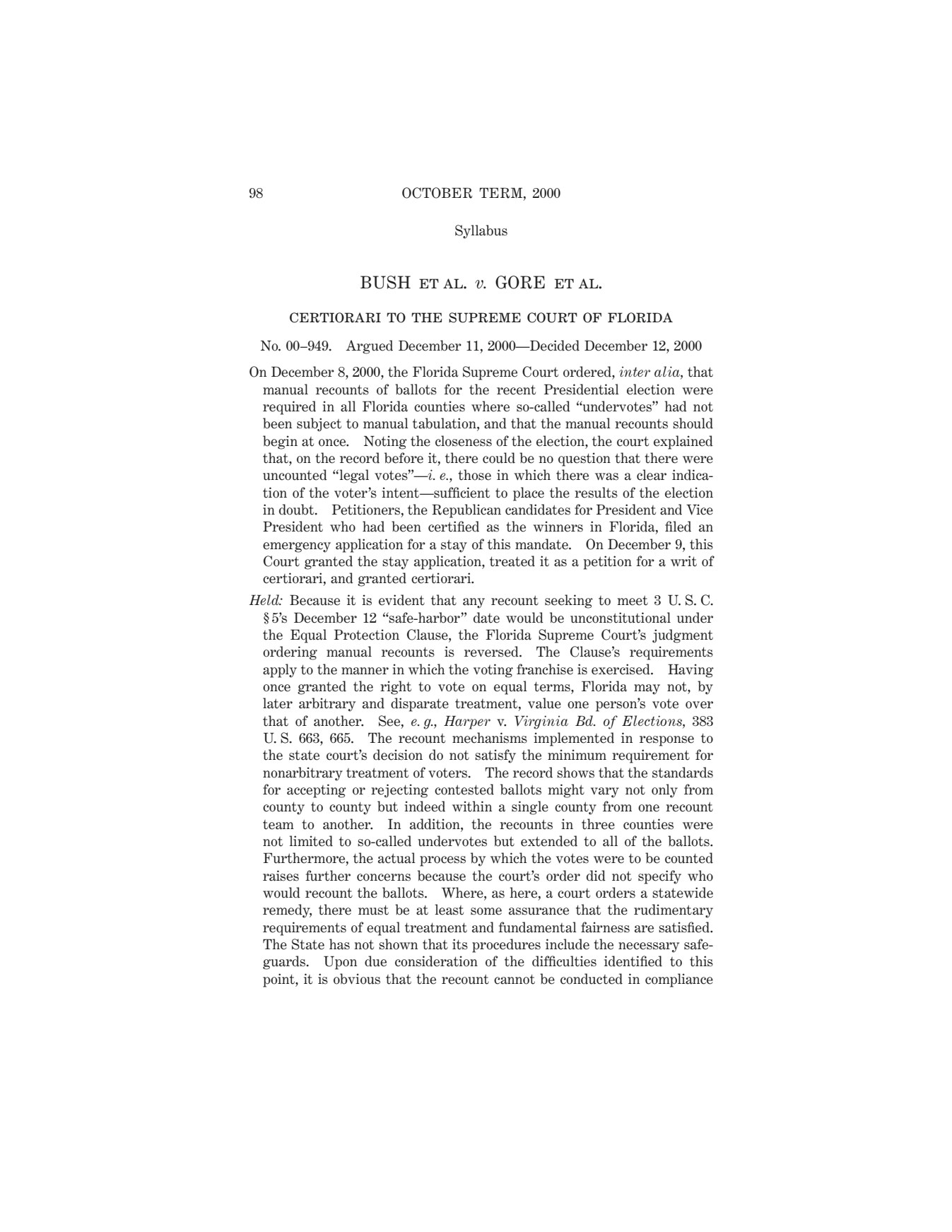
The controlling opinion found that varying standards for judging disputed ballot marks risked treating comparable voters differently. It also identified problems in the scope and supervision of the recount. Five justices joined the judgment that prevented the recount from continuing on a revised basis. The opinion acknowledged that seven justices recognized constitutional problems requiring a remedy; that did not mean seven agreed to end counting.[1]
Justices David Souter and Stephen Breyer supplied the important distinction. Souter accepted a problem in using inconsistent criteria for similarly marked ballots, but favored returning the case for uniform standards and further proceedings. Breyer likewise supported a corrective remand rather than terminating the process. Their disagreement was about what a constitutional remedy should accomplish, not an assertion that every existing recount practice was flawless.[2][3]
Justices John Paul Stevens and Ruth Bader Ginsburg challenged intervention more fundamentally. Stevens argued that the federal Court was departing from the usual respect for state courts and warned of damage to public confidence in judicial impartiality. That warning is a powerful contemporary criticism, but it remains a dissent rather than the Court's legal holding or proof of a secret arrangement.[4]
Calling the whole outcome a seven-justice decision conceals the narrow majority on the remedy that mattered. Calling it merely five justices inventing every constitutional concern overlooks the more complicated alignment. Neither shorthand tells us which candidate a completed, consistently administered count would have elected.