Interpretation 01
A serious independently motivated conspiracy was interrupted
Best supported for the adjudicated record
The strongest version
The defendants chose Muslim residents as targets and pursued a criminal agreement. The informant and undercover contact helped expose and interrupt a plan for which there was evidence of intent and activity beyond government suggestions.
Accept
CP1 · CP2 · CP3 · CP4 · CP5 · CP6
Accepts government participation, paid-source incentives and the need to test recordings; it also accepts the verdict and the residents’ threatened rights.
Remove or revise
No established hinge needs removal. A wholly passive-investigation version would have to revise CP3, which documents active participation.
Add to the path
Authenticated communications or omitted context showing that the charged intent was created through unlawful inducement would weaken this account.
What must be wrong or incomplete
The broader claim that the attack was inevitable without the FBI is not established by the convictions.
Must still explain
It must account for the government’s influence on the sequence and avoid a claim that every investigative decision was flawless.
Assessment
The court identified evidence of readiness and independent activity. This supports the conspiracy finding without requiring certainty about exactly what would have happened without intervention.
What would change this assessment
A material authenticated contradiction in the agreement, independent activity or media record would warrant reassessment.
Sources: S01 · S03 · S05
Interpretation 02
The government manufactured the criminal agreement
Actual defense issue; entrapment threshold rejected
The strongest version
Day’s influence, paid-source incentives, suggestions about the plan and the undercover supply contact could have pushed angry but otherwise unwilling men into a chargeable conspiracy. The complete chronology and context are essential to evaluating that possibility.
Accept
CP1 · CP3 · CP4 · CP6
Accepts that threatening speech and government-created opportunities existed; it need not deny every recording to question inducement.
Remove or revise
Challenge CP2’s inference of independent readiness and CP5’s threshold conclusion; removing the operation from CP3 would remove the theory’s own premise.
Add to the path
Add authenticated handler instructions, complete recording sequences or corroborated testimony contradicting the court’s inducement/predisposition account.
What must be wrong or incomplete
For a legal entrapment version to prevail, the evidence would need to satisfy both components rather than simply show persuasion or payment.
Must still explain
It must explain the evidence of preexisting intent and independent activity identified by the appeal, rather than treating the undercover role as decisive by definition.
Assessment
The court considered the defense’s stated arguments and found no triable issue of inducement or lack of predisposition. The jury did not receive an entrapment instruction.
What would change this assessment
New authenticated material establishing legally sufficient inducement and lack of predisposition would change the assessment; a general policy criticism is a different claim.
Sources: S01 · S03
Interpretation 03
The men were engaging in fantasy and offensive speech
Explains some rhetoric; inadequate for the whole record
The strongest version
The discussions were rambling, the plot had not reached an attack and government actors offered opportunities. Offensive political talk alone should not be substituted for a proved criminal agreement.
Accept
CP1 · CP3 · CP4 · CP6
Accepts CP1’s targeting rhetoric and CP3’s operation, while questioning whether the other conduct showed a genuine agreement.
Remove or revise
Revise or remove CP2’s serious-agreement inference and the readiness findings supporting CP5; these are the parts that conflict with a universally harmless account.
Add to the path
Add reliable contextual evidence showing that particular statements or acts had been misinterpreted, and explain the remaining corroborating conduct.
What must be wrong or incomplete
A successful critique of one excerpt would not automatically dissolve the whole agreement; it must affect a material link.
Must still explain
It must address recorded planning, independent preparations and individual participation, rather than infer harmlessness from the absence of an explosion.
Assessment
The conspiracy convictions and the appellate findings establish more than the presence of hateful speech. A judgment about every overheated remark is unnecessary to that result.
What would change this assessment
Authenticated context demonstrating the absence of agreement or material fabrication of conduct would strengthen this theory.
Sources: S01 · S03
Interpretation 04
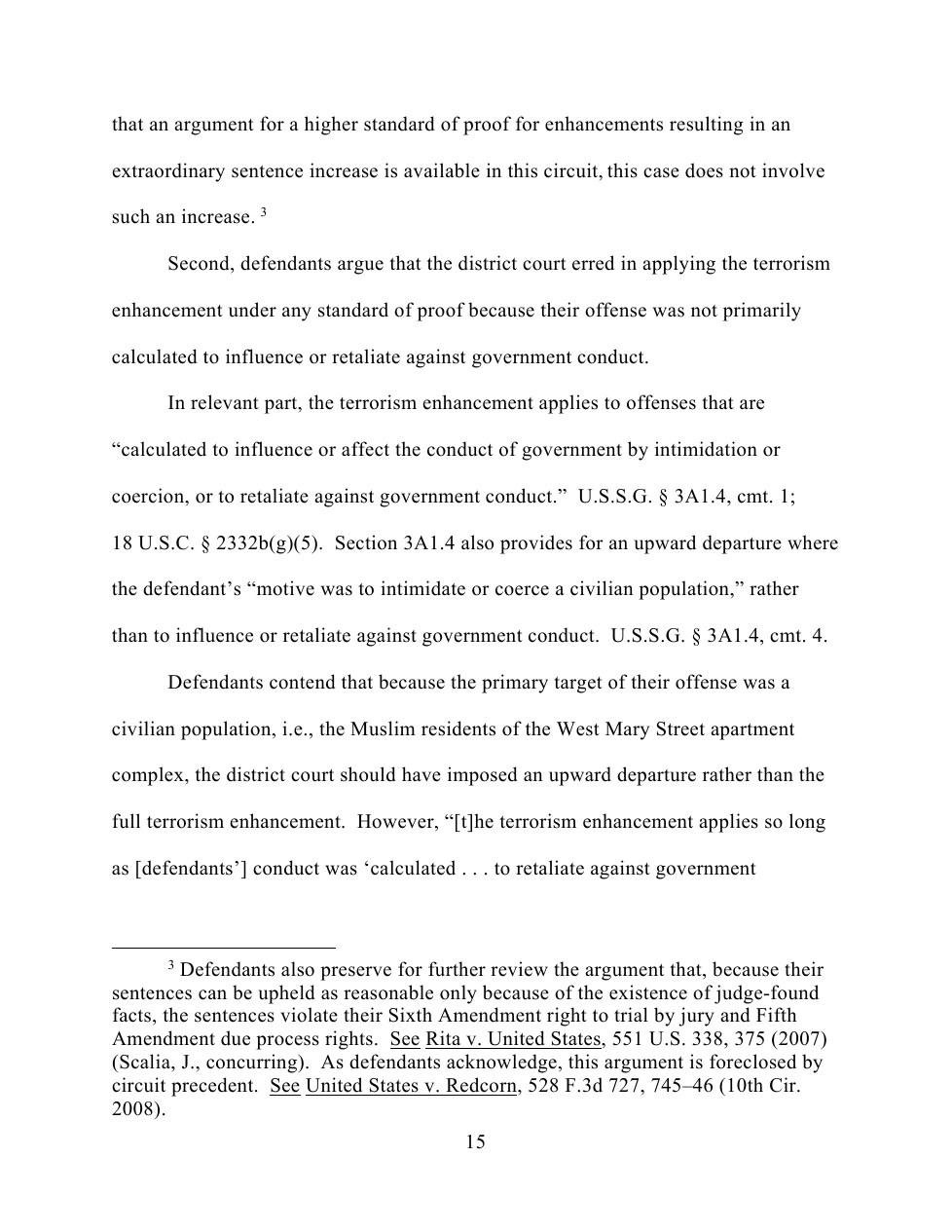
The punishment overstated a civilian-directed plot
Substantive sentencing argument; rejected on appeal
The strongest version
The intended victims were civilians. The full terrorism enhancement required a government-directed purpose, and the increase toward a life guidelines range raised serious questions about findings and proportionality.
Accept
CP1 · CP2 · CP3 · CP4 · CP5
Accepts the conspiracy verdict and government operation; it disputes the legal classification and punishment rather than necessarily claiming factual innocence.
Remove or revise
Challenge CP6’s enhancement rationale, not the existence of a threat or every earlier hinge. A sentencing change would have a defined scope.
Add to the path
Add a relevant new judgment or evidence materially undermining the government-directed-purpose finding; distinguish guideline policy disagreement from the actual holding.
What must be wrong or incomplete
The court found both discriminatory targeting and a governmental purpose. The stronger legal challenge needs that application or governing rule to fail.
Must still explain
It must explain the political purpose found in the record and the ability of governmental and civilian-directed motives to coexist.
Assessment
The appeal upheld the enhancement and separate terms. The district judge nevertheless imposed sentences below the life guidelines range and accepted some objections to other enhancements and conditions.
What would change this assessment
A subsequent controlling decision or order granting relevant relief would change the legal-outcome account to its actual extent.
Sources: S01 · S02 · S06