PRPUBLIC RECORDAn independent history guide

File 024 / Garden City, Kansas / Averted attack & civil rights

The Crusaders and the Garden City plot

A plot interrupted.
A community targeted.

In 2016, three men planned an attack on an apartment complex and mosque used by Somali Muslims in Garden City, Kansas. An informant and an undercover FBI operation helped stop it. A jury convicted the men; the appeal tested the recordings, entrapment arguments and punishment.

2015–2021 / the verified public recordContext & afterlifeConspiracy, intervention and civil rightsThe central years6 chaptersOne continuous story
United States v. Stein / Tenth Circuit / 25 January 2021
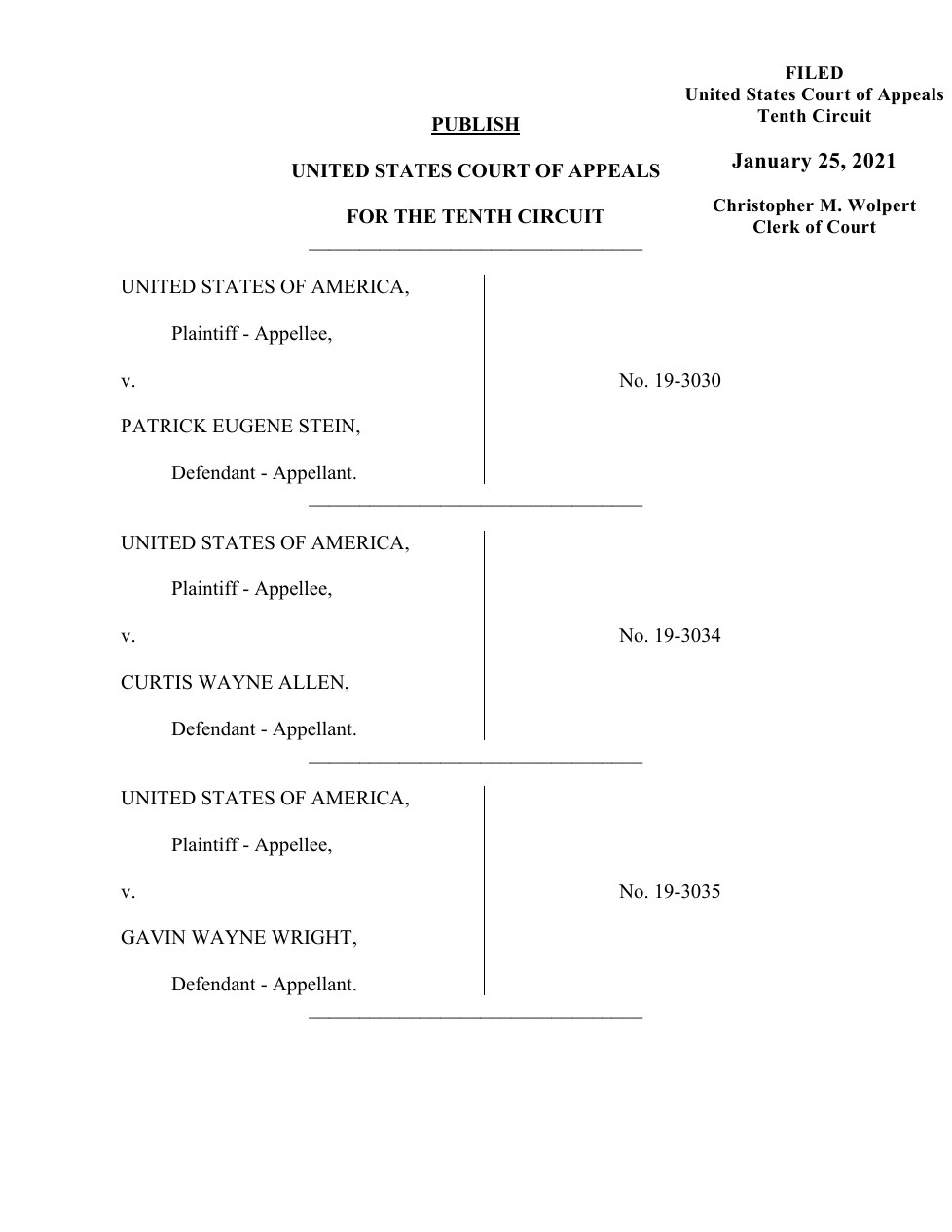
Appellate case cover, 25 January 2021
GARDEN CITY
KANSAS
2016–2021

The published appellate opinion identifies the three defendants and the consolidated appeals. The legal outcome is an anchor for a history that also includes the informant’s role, contested investigative methods and residents’ experiences. Image credit ↗

Scope & method / Edition 1.0

Trace the agreement, the intervention and the adjudication.

Follow the formation of the plot, the paid informant and undercover operation, the jury verdicts, sentencing and appeal. Distinguish the three convicted defendants from the informant and from other militia members who did not join their plan.

Read the chapters for a narrative; use the record below to test it. Established means the specific proposition is documented. Interpretation marks an inference or a historical argument. Unknown means the record here cannot decide. An archive’s possession of a document does not endorse its contents.

Research cutoff: 26 October 2026. The published 2021 appeal and selected 2019 sentencing-order passages lead the account; official announcements, participant interviews and local reporting provide additional perspectives. This is not a complete trial-exhibit or subsequent-docket audit. Full weapon-related source material remains private; only noninstructional judicial pages are reproduced.

01 / The record

The story, in 6 chapters

Six chapters follow a local threat into a federal case, then examine what the verdict, the failed defenses and the community’s response establish.

Appellate case cover, 25 January 2021
The original appellate cover identifies three defendants and three consolidated appeal numbers; it is a later record of the case, not a photograph of a meeting. Image credit ↗

Chapter 01 / 2015–June 2016

A local conspiracy emerged from a wider milieu

Garden City’s Somali Muslim residents were living, working and worshipping in a Kansas community when outsiders began treating their presence as a threat. The eventual target was an apartment complex that also contained a mosque. The people there did not become combatants because a militia imagined that immigration concealed an enemy project. Their homes and religious practice would become the objects of both a violent plan and a federal civil-rights prosecution.

The judicial record describes a wider militia setting and a smaller group of plotters. Dan Day had attended militia meetings, became concerned and approached the FBI. The January 2019 district order places the beginning of the investigation in late 2015 and Day’s meeting with Patrick Stein in February 2016. Stein subsequently brought Day into the Kansas Security Force, where Curtis Allen and Gavin Wright also participated. These organizational labels matter, but they do not make every member of the wider milieu a participant in the eventual conspiracy.

The appellate opinion locates the move toward an attack in June 2016, following the Pulse nightclub massacre in Orlando. The defendants directed their anger at local Muslims who bore no responsibility for that attack. The FBI’s later account describes failed efforts to recruit others and the formation of the smaller Crusaders group. Day occupied a different role: he continued attending and recording under FBI direction. Counting everyone present at a meeting as a willing conspirator would erase that distinction and falsely enlarge the convicted group.

The case began with hateful ideas, but the prosecution depended on more than identifying an ugly worldview. It needed evidence that particular people had entered a criminal agreement and acted within it. That question also shaped the later defense: what intentions existed before government participation, what the informant encouraged, and what the men pursued independently. The early history supplies the setting for that inquiry. It does not permit a conclusion that a whole town or every militia member endorsed the plan.

Sources: S01 · S02 · S07

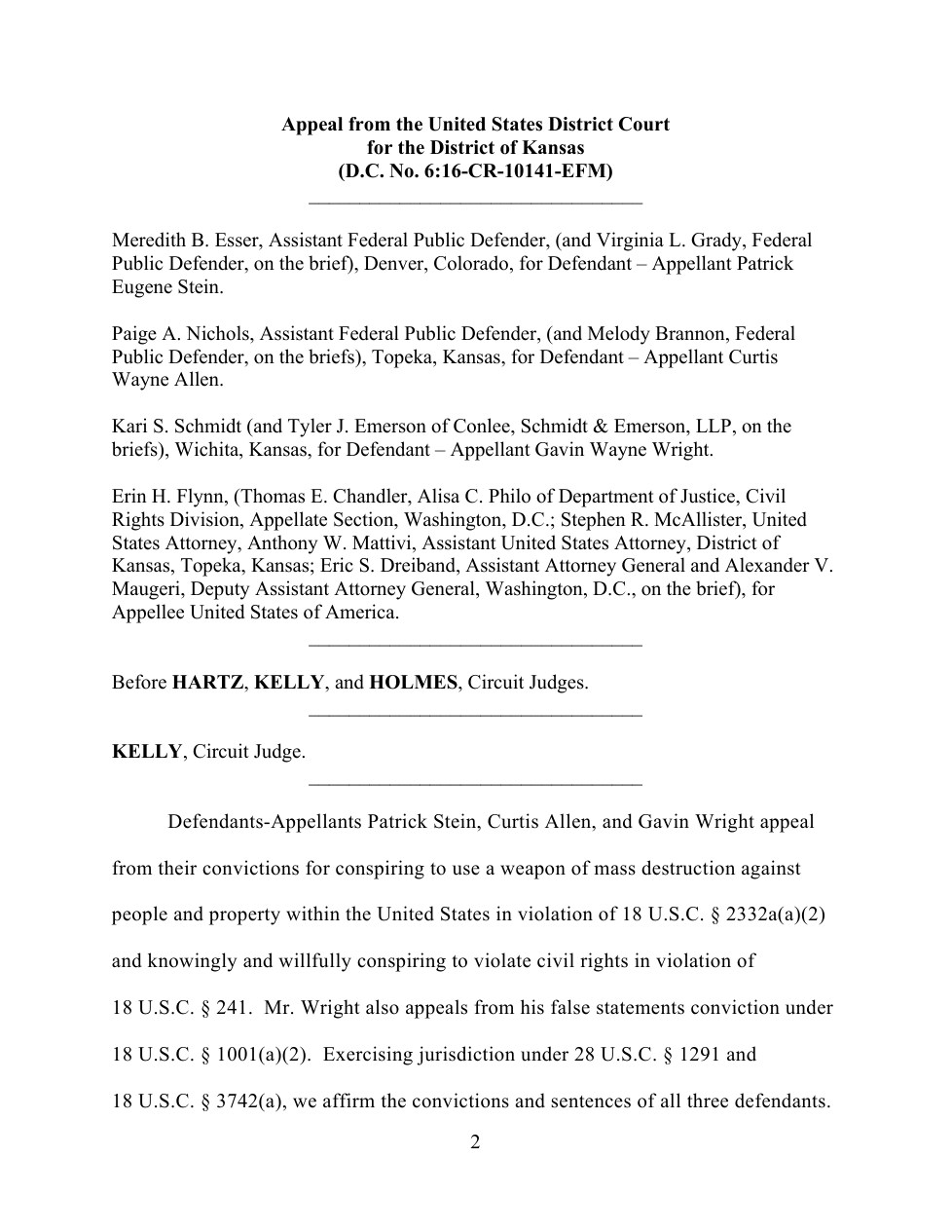
The appellate court states the outcome
Page 2 of the appellate opinion states the convictions and the affirmance. The following narrative distinguishes earlier accusations from later adjudication. Image credit ↗

Chapter 02 / June–October 2016

The recordings documented a developing agreement

The informant’s role gave the FBI access to discussions it otherwise could not easily observe. Day recorded meetings and calls, while an undercover employee later appeared as a potential supplier. Government involvement was substantial and belongs in the explanation of how the evidence and the operation developed. Its existence alone does not determine whether the defendants were induced into a crime they otherwise lacked an inclination to commit.

Across the ensuing months, the men discussed possible victims, settled on the apartment-and-mosque complex and pursued preparations. The appellate court’s account identifies activities undertaken by Allen and Wright apart from the undercover supplier, as well as Stein’s exchanges with that employee. The significance here is their relationship to the agreement and intent. The technical methods, ingredients and placement proposals are not necessary to understand that evidentiary point and are not reproduced in this guide. Later participant reporting describes a proposed attack after the 2016 presidential election; the arrests interrupted that schedule.

The distinction between conspiracy and a completed bombing is central. The government intervened before the planned attack occurred. Prosecutors therefore had to establish the unlawful agreement charged, rather than prove deaths or a building’s destruction. The housing-rights conspiracy identified the residents as people whose protected ability to live in their homes was being targeted. The weapon-of-mass-destruction count used a statutory category covering the contemplated explosive device; it was not a finding that the men possessed a nuclear weapon.

The recordings later became a contested courtroom record rather than self-interpreting transcripts. The government offered selected excerpts; defense lawyers challenged their use and some speaker attributions. Those disputes require attention to the actual audio, context and corroboration. They also make the public court summaries valuable but limited: this guide has not independently heard the complete recording archive. The published opinion supplies the adjudicated account of the evidence, while identifying objections that a serious alternative explanation must address.

Sources: S01 · S03 · S05 · S09

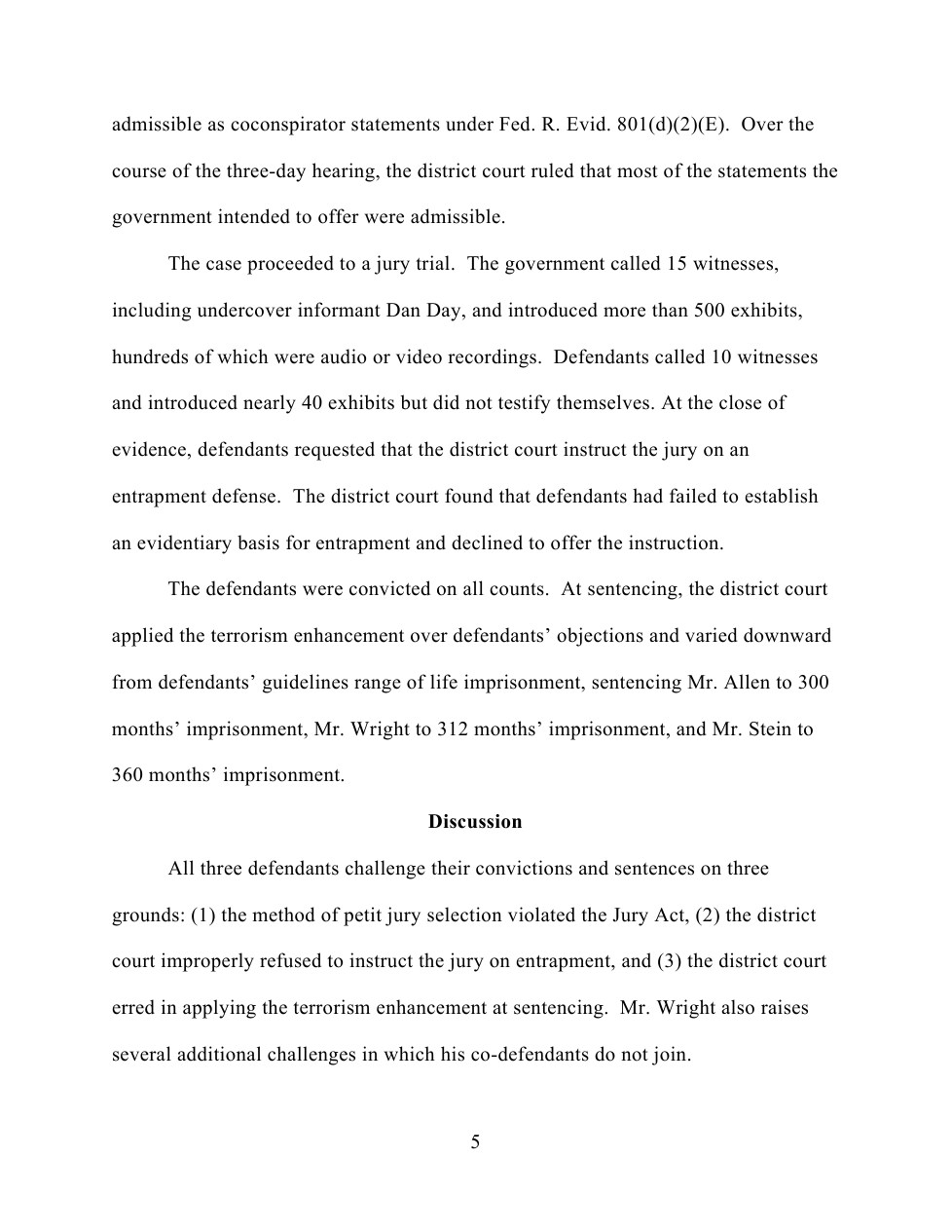
Trial and sentences summarized in the appellate opinion
Appellate page 5 describes the trial record, refusal of an entrapment instruction and separate sentences. The top line continues a paragraph from page 4. Image credit ↗

Chapter 03 / October 2016–April 2018

Intervention became a contested jury case

The operation reached a crisis when a domestic-violence report involving Allen brought local police into contact with further information about preparations. The FBI’s retrospective credits both the confidential source and Allen’s girlfriend with essential assistance. The public sources do not align perfectly on the local-custody date: the FBI gives October 11, while the appellate narrative uses a relative interval that suggests another day. The federal complaint was filed and the charges announced on October 14. Those are separate events, and the disagreement should not be hidden by turning them into one precise arrest date.

The criminal complaint preserved the government’s allegation at that time. It identified a paid confidential source and claimed corroboration from recordings and other information. The defendants were entitled to contest that accusation. Their eventual convictions should not be backdated into a claim that the charging announcement itself established guilt. Equally, the fact that the source was paid is relevant to credibility without automatically invalidating every recording or observation.

The case proceeded through pretrial evidentiary review and a jury trial. The appellate opinion describes a three-day hearing on the use of coconspirator statements, fifteen government witnesses and more than five hundred exhibits. The defense called ten witnesses and introduced nearly forty exhibits. These figures describe the scale of the adversarial record; they are not a mathematical proof of reliability. The three defendants did not testify, a fact that does not itself supply evidence of guilt.

On April 18, 2018, the jury convicted Stein, Allen and Wright of both conspiracies. Wright was also convicted of making false statements to investigators. The verdict transformed the legal status of the case from allegations to convictions. It did not end scrutiny of the investigation or establish every statement in the prosecutors’ public account. Appeals would test the jury-selection procedure, refusal of an entrapment instruction, the sentencing enhancement and Wright’s additional evidentiary arguments.

Sources: S01 · S03 · S04 · S05 · S07

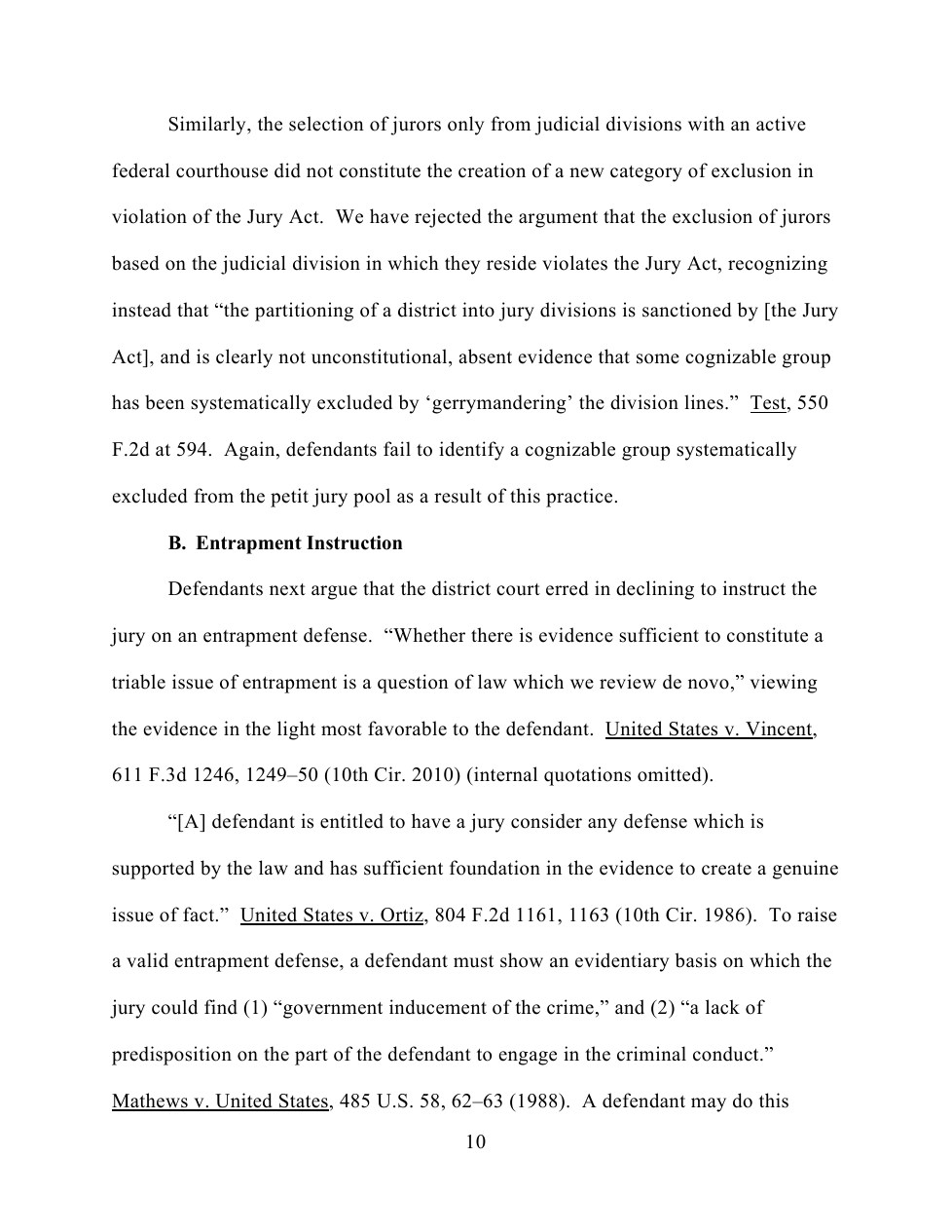
The court states the entrapment-instruction standard
Appellate page 10 states the threshold for an entrapment instruction. This is the court’s legal framework, not a new jury finding. Image credit ↗

Chapter 04 / Trial and 2021 appeal

Entrapment turned on inducement and predisposition

The strongest entrapment argument starts with the operation’s active government role. The defendants argued that Day helped identify the chosen location and timing, encouraged contact with the undercover supplier and echoed their prejudices. They also pointed to the FBI’s efforts to build chargeable offenses. These were actual defense arguments recorded in the appeal, not an imagined objection that can be dismissed merely because an informant was involved.

The legal question was whether the evidence supported putting an entrapment defense before the jury. The Tenth Circuit described two necessary components: government inducement and a lack of predisposition to engage in the charged conduct. It reviewed the evidence in the light most favorable to the defendants. Under the authorities it applied, providing an opportunity, using deception or encouraging conduct did not by itself establish the required inducement.

The judges found that the record did not support a triable entrapment issue. They identified evidence that Stein already knew of the complex and asked Day to show it to him, and that Allen and Wright pursued independent preparations. The defendants’ prior ordinary lives and Wright’s dealings with Muslims did not overcome evidence of their readiness to enter the charged conspiracies. The analysis concerned willingness to join that agreement; it did not require a completed attack before the informant became involved.

The district judge therefore withheld the entrapment instruction, and the appellate court upheld that decision. The jury did not receive the defense and then reject it. That distinction matters to an accurate legal history. A broader policy criticism of proactive investigations can remain a legitimate subject even after this ruling, but it needs its own evidence and criteria. To overturn the historical assessment of this operation, new authenticated communications or a fuller recording context would need to contradict the specific findings about inducement, existing intent and independent conduct.

Sources: S01

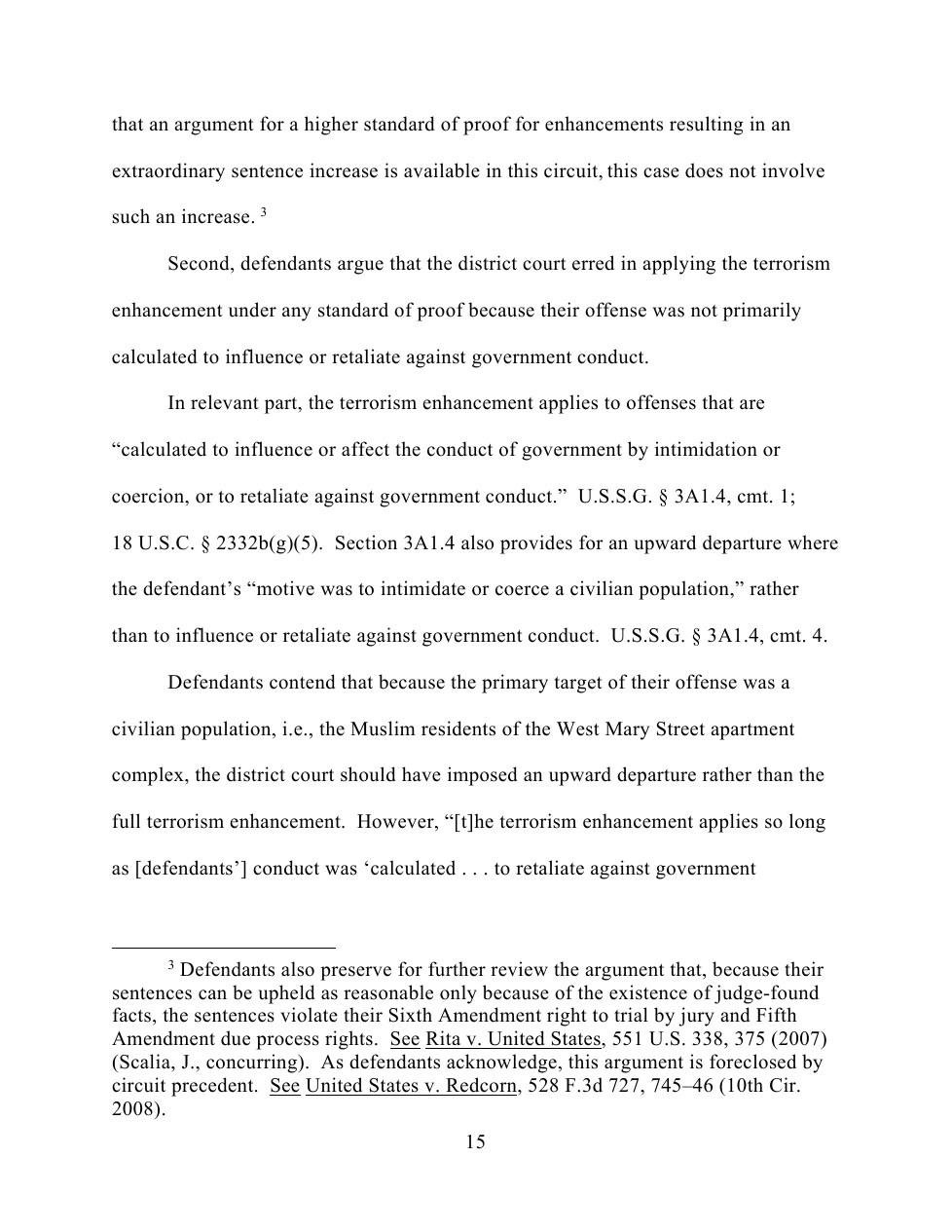
The dispute over the terrorism enhancement
Appellate page 15 records the sentencing-enhancement dispute. The argument continues on page 16 of the original. Image credit ↗

Chapter 05 / January 2019–January 2021

Punishment reflected both motive and individual roles

The sentencing process exposed distinctions that a single label such as terrorist can conceal. On January 15, 2019, Judge Eric Melgren ruled on objections to the presentence report. He rejected challenges to the terrorism enhancement and other calculations, but sustained Stein’s objection to an organizer enhancement and objections to special supervision conditions. A prosecutorial description of Stein as a leader therefore should not silently be converted into a finding that every particular leadership enhancement applied.

At the January 25 sentencing hearing, Allen received three hundred months, Wright three hundred twelve and Stein three hundred sixty: twenty-five, twenty-six and thirty years. The appellate opinion confirms those separate totals. The guidelines calculation had pointed toward life imprisonment, and the judge varied downward. A maximum possible sentence, a guideline range and an imposed prison term are different parts of the record. The January 15 memorandum was an objections ruling before the hearing, not a record that all three were sentenced that day.

The terrorism enhancement generated a substantive legal disagreement. The defendants argued that their principal target was a civilian Muslim community and that the required connection to influencing or retaliating against government conduct had not been established. The court found evidence of both anti-Muslim animus and a governmental target in the political purpose of the plot. The appellate panel held that the government-directed purpose could coexist with other motives, and affirmed application of the enhancement.

The appeal also rejected the jury-selection challenge, on procedural grounds and alternatively on its merits. A later amendment to the district’s jury plan was noted in the opinion, but that amendment was not a judicial admission that these convictions had to be reversed. On January 25, 2021, the Tenth Circuit affirmed the convictions and sentences. This guide verifies that published result. It does not claim a complete audit of every later docket entry, custody change or possible collateral motion.

Sources: S01 · S02 · S06

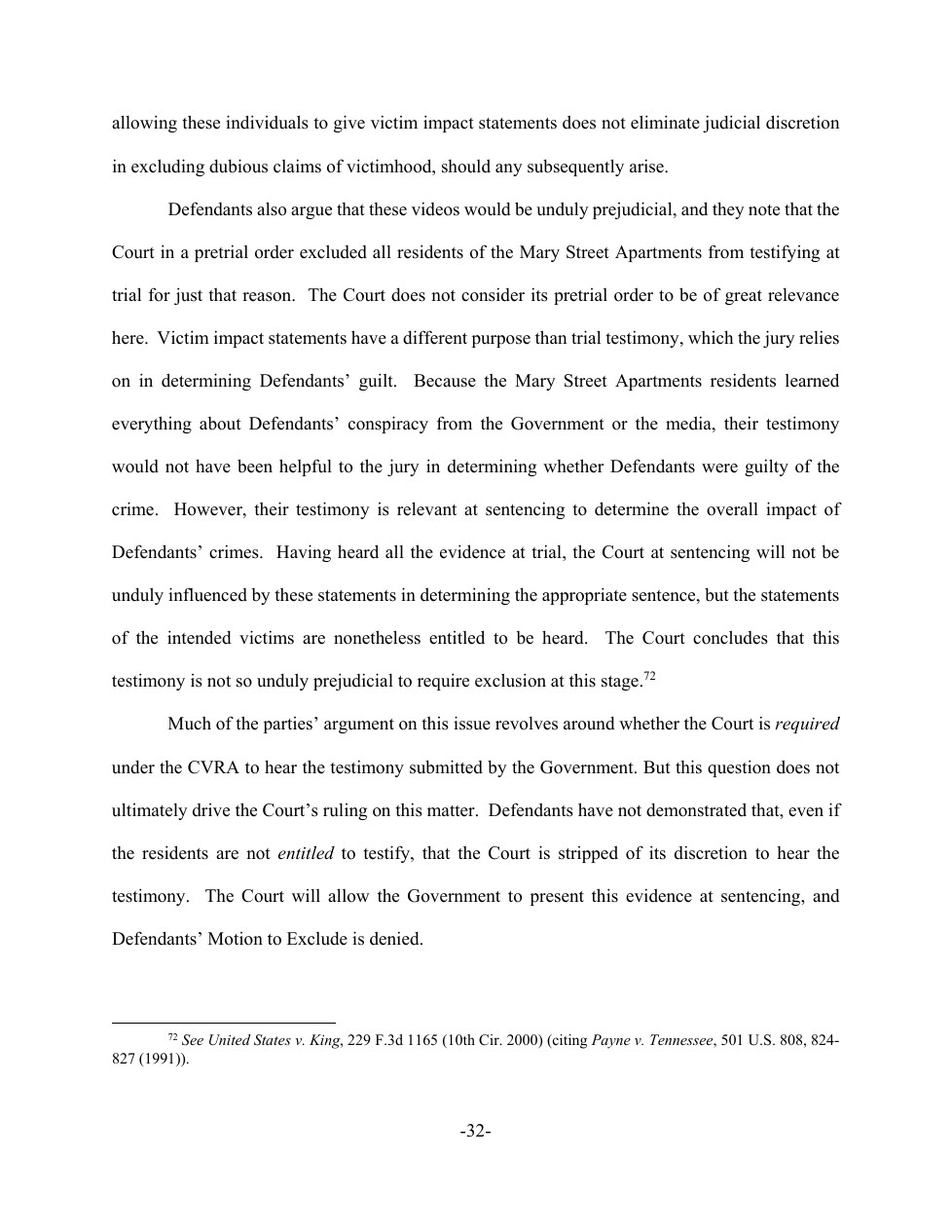
Victim-impact evidence and sentencing discretion
District memorandum page 32 distinguishes proof of guilt at trial from victim-impact evidence at sentencing and denies exclusion. The opening sentence continues page 31. Image credit ↗

Chapter 06 / 2019–2021 / memory

An averted explosion did not erase the community’s injuries

The absence of a bombing changed the outcome profoundly: the planned physical destruction did not occur. It did not leave the intended residents untouched. The sentencing record contains a dispute over approximately twenty victim-impact videos from people who lived or worshipped at the complex. The defense challenged their status and argued that the statements would be prejudicial. Those objections put the meaning of harm from an interrupted conspiracy directly before the judge.

Melgren distinguished the purpose of trial testimony from the purpose of sentencing evidence. Residents who learned of the secret plan from authorities or news coverage could not directly establish whether the defendants had formed the conspiracy. Their experiences could nevertheless illuminate its effects. The judge denied the motion to exclude the videos and also relied on his discretion to hear them. This was a reasoned distinction between proving guilt and assessing consequences, rather than an assumption that any expression of fear proved every allegation.

Local courtroom reporting described continuing anxiety and a request for punishment that would help repair trust. Later narratives examined the aftermath. In a 2021 interview, Dick Lehr identified trial transcripts and recordings as sources for White Hot Hate and emphasized the community’s response. The interview establishes his stated approach; the complete book was not audited here.

The history consequently has more than one ending. The legal chain reaches verdicts, sentences and an affirmed appeal. The community chain includes fear, recognition and efforts to live together after discovering that homes and worship had been selected as targets. An account centered only on an informant’s heroism can obscure those experiences; an account centered only on government manipulation can obscure the defendants’ independently documented decisions. Both explanations have to return to particular acts, records and people rather than allowing the successful prevention of violence to erase the threat that existed.

Sources: S02 · S10 · S08 · S09

02 / The record

The load-bearing chain

The verdict and published appeal are the judicial yardstick

The official legal account is a criminal conspiracy proved to a jury, with the convictions and sentences affirmed in 2021. Its evidentiary chain includes government participation as well as conduct the courts found independent of that participation. The strongest rival asks whether the government induced the crime or distorted its proof. That question has to be tested against the actual instruction ruling, recordings and sequence, while preserving the residents’ civil rights and the distinction between a threat and a completed attack.

Sources: S01 · S02 · S03

Evidence-support labels assess the hinge exactly as stated and identify the records behind it. Cultural-prominence labels separately identify attention in the inspected public accounts. They do not rank people by popularity, estimate audience size or turn an author’s emphasis into a poll. Comparative public belief remains unmeasured.

CP1

A protected community became the target

Evidence support Very strong / verdict and judicial record

Cultural prominence Documented public framing / audience reach unmeasured

The planned victims were residents and worshippers, selected because they were Somali Muslims. The housing-rights conspiracy makes that targeting a central legal fact.

Where it fits

The apartment complex and mosque connect an anti-Muslim campaign to particular homes and civil rights. The appellate background, charging record and verdict distinguish an intended attack from the threatened community’s actual conduct.

Why it is critical

This defines the conduct and rights at stake before debating how the investigation operated.

If this hinge were removed

If the discriminatory selection were disproved, the housing-rights and hate-motive account would weaken. It would not erase an independently proved agreement to destroy property or establish that no other crime existed.

Dependencies

Requires the selected target, the charged agreement and the residents’ relationship to the complex; religious identity alone is no evidence of wrongdoing by the intended victims.

What rival readings must explain

An account centered on government participation must still explain the defendants’ choice of these residents. A broad claim against every militia member must explain the narrower participation evidence.

Gaps and disputes

The guide is not a census of the residents or a complete oral history. The sources differ in how they describe the broader militia setting; membership in that setting does not establish participation in the plot.

Evidence-rank grounds

S01 identifies the conspiracy and target; S05 records the verdict. S02 explains the relevance of residents’ experiences at sentencing.

Cultural-rank grounds

Official announcements and later interview accounts foreground Somali Muslim residents. These publications establish visibility within this corpus, not how widely the public remembers the housing-rights count.

Sources: S01 · S02 · S05

CP2

An agreement was supported by conduct beyond rhetoric

Evidence support Strong / adjudicated record with concrete acts

Cultural prominence Unmeasured cultural prominence

The case concerned a conspiracy, supported by recorded discussions, preparations and evidence of independent activity. An interrupted attack did not require completed destruction to become a prosecutable agreement.

Where it fits

The appeal describes defendants’ pursuit of the plan and cites activities apart from the undercover supplier. These findings matter to both the conspiracy case and the later entrapment analysis. No technical construction details are needed to follow that relationship.

Why it is critical

It separates offensive speech from the charged agreement and associated conduct.

If this hinge were removed

If the preparations were disproved, the case for seriousness and independent readiness would lose support. The remaining recordings and agreement would still need evaluation; conversely, hateful speech without a proved agreement would not establish these convictions.

Dependencies

Depends on authentic recordings, individual participation and evidence of intent rather than ideology alone.

What rival readings must explain

A mere-fantasy account must explain the concrete and independent conduct identified by the courts. A prevention account must avoid treating every hateful statement as a completed offense.

Gaps and disputes

The full exhibit archive has not been independently replayed here. Judicial summaries are consequential primary records of adjudication, not additional eyewitnesses to every recorded act.

Evidence-rank grounds

S01 pages 3–5 and 12–13 connect agreement and independent conduct. The rating is for that account, with the full underlying recordings outside this audit.

Cultural-rank grounds

The public crime narrative includes planning, but this corpus has no comparison measuring how often people distinguish conspiracy from a completed bombing.

Sources: S01 · S03 · S05

CP3

Government participation shaped both access and opportunity

Evidence support Very strong for participation / counterfactual limited

Cultural prominence Documented public framing / audience reach unmeasured

Day was a paid source recording under FBI direction; an undercover employee also participated. That active role is established and must be examined when considering intent, inducement and credibility.

Where it fits

The operation created a record of private discussions and offered a potential supply channel. The appeal records defense arguments about Day’s suggestions and the undercover contact, then examines the evidence for readiness and independent conduct.

Why it is critical

It prevents a false account of a wholly passive investigation while keeping the legal question specific.

If this hinge were removed

Removing the source would change the detection and evidence history substantially. It does not follow that the men had no intent without him. Removing the defendants’ independent conduct, however, would directly weaken the answer to the entrapment claim.

Dependencies

Requires chronology of contacts, directions and recordings; Day’s cooperation differs from the defendants’ agreement.

What rival readings must explain

An entrapment account must identify inducement and lack of predisposition. An institutional success narrative must account for paid-source incentives and how the operation affected the events it observed.

Gaps and disputes

Full handler instructions, every payment and every unexcerpted recording are not assembled here. The paid-source fact is relevant to credibility, but neither payment nor an official endorsement decides credibility by itself.

Evidence-rank grounds

S03 identifies a paid source; S01 records the undercover role and the actual entrapment arguments. What would have happened without the operation remains a narrower counterfactual.

Cultural-rank grounds

The FBI story, participant interviews and author interview emphasize the source. Their attention does not supply a public-opinion percentage or prove an entire population’s view.

Sources: S01 · S03 · S07

CP4

The jury evaluated recordings in an adversarial trial

Evidence support Very strong for verdict / bounded for every exhibit

Cultural prominence Unmeasured cultural prominence

The defendants were convicted after witnesses, exhibits and pretrial review. The appeal distinguishes recordings admitted as evidence from transcript aids that contained some misattributions.

Where it fits

Wright challenged transcript accuracy and excerpts. The appellate court noted that the jury was repeatedly told to consider the recordings, not the transcripts, as evidence; the agent acknowledged some speaker misattributions. The question is the effect of an error on particular admitted evidence.

Why it is critical

It identifies the bridge from investigative allegation to adjudicated guilt and a specific reliability challenge.

If this hinge were removed

If a material recording were falsified or misattributed, the relevant proof would weaken and could affect a judgment. A transcript error alone does not establish that every recording or the entire conspiracy was fabricated.

Dependencies

Depends on the authentic record, admission rulings, jury instructions and the separate treatment of each defendant.

What rival readings must explain

A fabrication account needs a material contradiction in the recordings or their use. A defense of the prosecution must acknowledge the transcript errors and objections rather than pretending the record was flawless.

Gaps and disputes

This guide has not independently synchronized all recordings with transcripts. The opinion’s resolution states the legal result; a complete forensic media audit would be additional work.

Evidence-rank grounds

S01 pages 5 and 17–24 document the trial and challenges. The verdict’s existence is certain; the independent rechecking of all underlying media is outside this guide.

Cultural-rank grounds

The trial and appeal are public, but no audience data compare the prominence of transcript disputes with the better-publicized prevention narrative.

Sources: S01 · S05

CP5

The courts declined an entrapment instruction on a stated threshold

Evidence support Very strong / explicit appellate holding

Cultural prominence Unmeasured cultural prominence

The defense sought an entrapment instruction. The district judge withheld it, and the Tenth Circuit upheld that ruling after considering inducement and predisposition to join the charged conspiracies.

Where it fits

The appeal addresses specific alleged suggestions by Day and the undercover supplier. Its reasoning also distinguishes willingness to conspire from whether a completed attack preceded the government’s involvement.

Why it is critical

It gives the strongest government-manufacture objection its actual legal form and outcome.

If this hinge were removed

If authenticated omitted evidence showed legally sufficient inducement and lack of predisposition, this account of the instruction ruling would require reassessment. A policy objection to proactive investigations could remain even without changing the ruling.

Dependencies

Requires the applicable test and the particular evidence viewed favorably to the defendants, not the mere existence of an informant.

What rival readings must explain

An entrapment path must overcome the findings about existing intent and independent preparations. A claim that the jury rejected entrapment must explain why the instruction was never given.

Gaps and disputes

The guide relies on the published appeal rather than every brief and hearing transcript. It does not convert a legal holding into proof that every investigative choice was optimal.

Evidence-rank grounds

S01 pages 10–13 state the test and reasoning. The claim rated here is that the instruction was properly withheld in this appeal, not a universal defense of undercover methods.

Cultural-rank grounds

Entrapment is a documented appellate issue. No survey establishes how widely that precise instruction ruling is understood.

Sources: S01

CP6

Sentences and victim impact survived as distinct outcomes

Evidence support Very strong for the recorded outcomes

Cultural prominence Documented public framing / audience reach unmeasured

The men received different terms; the appeal affirmed the convictions and sentences. Residents’ sentencing statements addressed harm from a threat that had been stopped.

Where it fits

The court applied an enhancement while imposing terms below the life guidelines range. The district judge separately admitted residents’ statements for sentencing, distinguishing them from evidence of guilt.

Why it is critical

It separates the legal punishment, the unresolved counterfactual and the community’s experience.

If this hinge were removed

If a relevant new judgment changed a sentence, that defendant’s legal history would need updating. It would not automatically negate the other convictions. Excluding the impact evidence would narrow the sentencing record, not prove that the residents experienced no harm.

Dependencies

Requires the January 15 order, January 25 hearing and 2021 appeal; maximums, guidelines and imposed terms must remain separate.

What rival readings must explain

A punishment challenge must address the court’s government-directed-purpose finding. A claim of no harm must confront the victim-impact reasoning without using residents’ fear as proof of the secret agreement.

Gaps and disputes

No full later-docket audit or complete community survey is claimed. Cultural narratives of reconciliation concern particular participants and cannot speak for every resident.

Evidence-rank grounds

S01 states 300/312/360 months and affirmance; S02 pages 31–32 explain impact evidence; S06 fixes the actual sentencing date.

Cultural-rank grounds

The 2019 official announcements and 2021 book/documentary-related accounts present different endings. Their reach and comparative influence are not measured here.

Sources: S01 · S02 · S06

03 / The record

How the accounts branch

Documented source relationships, parallel narratives and recurring hinges. Similar concerns do not by themselves prove borrowing.

Charging allegation → trial record → appellate account

The 2016 complaint and announcement alleged a plan. The 2018 verdict changed its legal status; the 2021 opinion then reviewed the record and specific challenges. This is a sequence of evidentiary and legal stages, not several independent witnesses to the same events.

Borrowing and dependence

The appeal expressly summarizes the trial record. Prosecutorial announcements rely on the same prosecution, so repeating their claims does not multiply independent corroboration. The complaint’s allegations must retain their earlier status when the chronology returns to 2016.

Branch and limit

The transcript-accuracy branch shares CP4 with the overall case. It calls for checking specific recordings and jury instructions, not assuming that a transcription error establishes universal fabrication.

Recurring hinges: CP2 · CP3 · CP4 · CP5

Sources: S01 · S03 · S04 · S05

Active investigation → competing inducement accounts

The paid source and undercover contact appear in the charging and judicial records. The defense used that participation to seek an entrapment instruction; the appellate court identified the required test and the evidence it found insufficient.

Borrowing and dependence

The competing legal readings concern the same recorded operation. No separate cultural or literary borrowing chain is inferred from similar criticism of informants in other cases.

Branch and limit

A legal entrapment branch and a policy criticism of proactive investigations are distinct. The first must satisfy the two-part test applied in this case; the second can dispute acceptable practices while acknowledging the judgment.

Recurring hinges: CP2 · CP3 · CP5

Sources: S01 · S03

Institutional prevention account → participant and author narratives

The FBI’s 2019 story presents public cooperation as central to prevention. ABC’s 2021 published interviews foreground Day’s experience. Lehr’s 2021 author interview identifies recordings and transcripts among his sources and explains his interest in the community’s response.

Borrowing and dependence

These accounts share participants and records. The author’s stated use of trial material is documented; borrowing between the film and book is not established. The full documentary and complete book were not audited here.

Branch and limit

An informant-centered account can highlight personal risk while giving less space to other hinges in a short presentation. This guide attributes emphasis only to the inspected interview texts, without assigning whole-work omissions.

Recurring hinges: CP1 · CP3 · CP4 · CP6

Sources: S07 · S08 · S09

Interrupted attack → sentencing harm → community memory

The district court’s victim-impact ruling distinguishes guilt evidence from sentencing consequences. Local courtroom reporting describes fear, and later public accounts discuss reconciliation. The community’s history does not end simply because the anticipated physical attack was prevented.

Borrowing and dependence

The court order and local reporting concern different evidentiary tasks; neither automatically speaks for all residents. A later narrative’s hopeful ending is not a population-wide finding that the harm disappeared.

Branch and limit

A narrow legal-outcome account and a community-centered account share CP6 but answer different questions. A full reconciliation claim would require further participant evidence, not just institutional assurances.

Recurring hinges: CP1 · CP4 · CP6

Sources: S02 · S10 · S08

04 / The record

Four interpretations tested against the record

Competing interpretations, stated at their strongest and tested against the same chain. Presenting a theory is not endorsing it.

Interpretation 01

A serious independently motivated conspiracy was interrupted

Best supported for the adjudicated record

The strongest version

The defendants chose Muslim residents as targets and pursued a criminal agreement. The informant and undercover contact helped expose and interrupt a plan for which there was evidence of intent and activity beyond government suggestions.

Accept

CP1 · CP2 · CP3 · CP4 · CP5 · CP6

Accepts government participation, paid-source incentives and the need to test recordings; it also accepts the verdict and the residents’ threatened rights.

Remove or revise

No established hinge needs removal. A wholly passive-investigation version would have to revise CP3, which documents active participation.

Add to the path

Authenticated communications or omitted context showing that the charged intent was created through unlawful inducement would weaken this account.

What must be wrong or incomplete

The broader claim that the attack was inevitable without the FBI is not established by the convictions.

Must still explain

It must account for the government’s influence on the sequence and avoid a claim that every investigative decision was flawless.

Assessment

The court identified evidence of readiness and independent activity. This supports the conspiracy finding without requiring certainty about exactly what would have happened without intervention.

What would change this assessment

A material authenticated contradiction in the agreement, independent activity or media record would warrant reassessment.

Sources: S01 · S03 · S05

Interpretation 02

The government manufactured the criminal agreement

Actual defense issue; entrapment threshold rejected

The strongest version

Day’s influence, paid-source incentives, suggestions about the plan and the undercover supply contact could have pushed angry but otherwise unwilling men into a chargeable conspiracy. The complete chronology and context are essential to evaluating that possibility.

Accept

CP1 · CP3 · CP4 · CP6

Accepts that threatening speech and government-created opportunities existed; it need not deny every recording to question inducement.

Remove or revise

Challenge CP2’s inference of independent readiness and CP5’s threshold conclusion; removing the operation from CP3 would remove the theory’s own premise.

Add to the path

Add authenticated handler instructions, complete recording sequences or corroborated testimony contradicting the court’s inducement/predisposition account.

What must be wrong or incomplete

For a legal entrapment version to prevail, the evidence would need to satisfy both components rather than simply show persuasion or payment.

Must still explain

It must explain the evidence of preexisting intent and independent activity identified by the appeal, rather than treating the undercover role as decisive by definition.

Assessment

The court considered the defense’s stated arguments and found no triable issue of inducement or lack of predisposition. The jury did not receive an entrapment instruction.

What would change this assessment

New authenticated material establishing legally sufficient inducement and lack of predisposition would change the assessment; a general policy criticism is a different claim.

Sources: S01 · S03

Interpretation 03

The men were engaging in fantasy and offensive speech

Explains some rhetoric; inadequate for the whole record

The strongest version

The discussions were rambling, the plot had not reached an attack and government actors offered opportunities. Offensive political talk alone should not be substituted for a proved criminal agreement.

Accept

CP1 · CP3 · CP4 · CP6

Accepts CP1’s targeting rhetoric and CP3’s operation, while questioning whether the other conduct showed a genuine agreement.

Remove or revise

Revise or remove CP2’s serious-agreement inference and the readiness findings supporting CP5; these are the parts that conflict with a universally harmless account.

Add to the path

Add reliable contextual evidence showing that particular statements or acts had been misinterpreted, and explain the remaining corroborating conduct.

What must be wrong or incomplete

A successful critique of one excerpt would not automatically dissolve the whole agreement; it must affect a material link.

Must still explain

It must address recorded planning, independent preparations and individual participation, rather than infer harmlessness from the absence of an explosion.

Assessment

The conspiracy convictions and the appellate findings establish more than the presence of hateful speech. A judgment about every overheated remark is unnecessary to that result.

What would change this assessment

Authenticated context demonstrating the absence of agreement or material fabrication of conduct would strengthen this theory.

Sources: S01 · S03

Interpretation 04

The punishment overstated a civilian-directed plot

Substantive sentencing argument; rejected on appeal

The strongest version

The intended victims were civilians. The full terrorism enhancement required a government-directed purpose, and the increase toward a life guidelines range raised serious questions about findings and proportionality.

Accept

CP1 · CP2 · CP3 · CP4 · CP5

Accepts the conspiracy verdict and government operation; it disputes the legal classification and punishment rather than necessarily claiming factual innocence.

Remove or revise

Challenge CP6’s enhancement rationale, not the existence of a threat or every earlier hinge. A sentencing change would have a defined scope.

Add to the path

Add a relevant new judgment or evidence materially undermining the government-directed-purpose finding; distinguish guideline policy disagreement from the actual holding.

What must be wrong or incomplete

The court found both discriminatory targeting and a governmental purpose. The stronger legal challenge needs that application or governing rule to fail.

Must still explain

It must explain the political purpose found in the record and the ability of governmental and civilian-directed motives to coexist.

Assessment

The appeal upheld the enhancement and separate terms. The district judge nevertheless imposed sentences below the life guidelines range and accepted some objections to other enhancements and conditions.

What would change this assessment

A subsequent controlling decision or order granting relevant relief would change the legal-outcome account to its actual extent.

Sources: S01 · S02 · S06
05 / The record

Who makes which part of the story visible

Four inspected public voices: a court, the FBI, a book author and an informant in published interviews. These comparisons concern the specific texts; the complete book and film were not audited.

Tenth Circuit — United States v. Stein, 2021

Published 25-page opinion inspected. This is the appellate account and legal disposition, not a fresh replay of every trial recording.

Amplifies

CP4/CP5: the adversarial record and the entrapment threshold. It also identifies the specific evidence and rules behind the sentencing and jury-selection rulings.

Recasts

The dispute becomes a set of legally defined questions about agreement, instruction entitlement, admitted evidence and punishment, rather than a choice between unqualified official success and universal manufacture.

Does not establish in this inspected account

Affirmance does not establish that every investigative practice was ideal or that no new authenticated evidence could ever matter. Its reasoning must be stated at the scope of the particular claims it decided.

CP2 · CP3 · CP4 · CP5 · CP6

Sources: S01

FBI — Justice in Kansas, 2019

Actual official article read through web retrieval; raw local download 403 logged. This card concerns that institutional presentation.

Amplifies

CP3: the source and another cooperator helped the Bureau observe and stop a violent plan. The story also emphasizes later contact with the intended community.

Recasts

The case is presented as a prevention success made possible by public assistance. That frame has an institutional interest and can be compared with the appeal’s account of the contested operation.

Does not establish in this inspected account

The short story is not a full answer to every evidentiary objection or a survey of residents. Its claims of saved lives do not quantify exactly what would have occurred without the operation.

CP1 · CP3 · CP6

Sources: S07

Dick Lehr — White Hot Hate author interview, 2021

The BU interview was read; the complete book was not audited.

Amplifies

Day’s role and the community’s response are central to Lehr’s stated approach.

Recasts

He describes using recordings and trial transcripts to build a dramatic account with a hopeful ending.

Does not establish in this inspected account

The interview does not establish the book’s every omission, its readership or complete community reconciliation.

CP3 · CP4 · CP6

Sources: S08

Dan Day — ABC documentary-related interviews, 2021

The published participant-interview article was inspected. The full documentary was not watched or packaged.

Amplifies

The personal risk and family burden of cooperation give CP3 a participant’s perspective.

Recasts

Prevention becomes a story of an insider’s choices, alongside the federal investigation.

Does not establish in this inspected account

Personal recollection and documentary framing do not independently adjudicate entrapment or audit every recording. No borrowing from the book is inferred.

CP3 · CP4 · CP5

Sources: S09

06 / The record

Find a thread in the file

Search the chapter and claim index. Every result leads to the full text and its sources.

07 / The record

People and institutions

Open a record for the person’s role and supporting sources. Names identify people; no unverified portrait is substituted for a participant.

SteinBiographical record
Patrick Eugene SteinConvicted defendant

Participant in the conspiracy; sentenced to 360 months. His organizer-enhancement objection was sustained, which is separate from broad descriptions of his role.

Sources: S01 · S02

AllenBiographical record
Curtis Wayne AllenConvicted defendant

Participant sentenced to 300 months. A domestic-violence report brought local police into an important late stage of the investigation. Exact local-custody timing differs across public accounts.

Sources: S01 · S07

WrightBiographical record
Gavin Wayne WrightConvicted defendant

Participant sentenced to 312 months and separately convicted of materially false statements. The appeal distinguishes that conviction from sentencing enhancements.

Sources: S01

DayBiographical record
Dan DayFBI confidential source and trial witness

Attended meetings, recorded under FBI direction and testified. He was a cooperator rather than a fourth convicted plotter. Payment and government direction are part of the credibility and inducement questions.

Sources: S01 · S03

girlfriendBiographical record
Allen’s girlfriendCooperating witness

Reported domestic violence and provided additional information to investigators. This guide uses her described public role without adding unnecessary personal identification.

Sources: S01 · S07

worshippersBiographical record
Somali Muslim residents and worshippersIntended victims and community participants

People living or worshipping at the complex were selected as targets. Their sentencing statements addressed harm; they were not direct witnesses to the secret agreement merely by being targeted.

Sources: S01 · S02

MelgrenBiographical record
Eric F. MelgrenU.S. district judge

Ruled on objections inJanuary 2019 and imposed separate sentences. His order distinguishes trial proof from victim impact.

Sources: S02 · S06

HolmesBiographical record
Hartz, Kelly and HolmesTenth Circuit panel

The published opinion byJudgeKelly affirmed the convictions and sentences inJanuary 2021 and addressed the actual appellate arguments.

Sources: S01

KuhnBiographical record
Amy KuhnFBI agent and trial witness

The appellate opinion records her acknowledgment that transcript aids contained some speaker misattributions; the recordings were the admitted evidence.

Sources: S01

employeeBiographical record
FBI undercover employeeUndercover participant

Posed as a potential supplier. The employee’s active role is relevant to the defense’s entrapment argument; it does not alone settle inducement.

Sources: S01

LehrBiographical record
Dick LehrAuthor of White Hot Hate

Explained his method and emphasis in a 2021 author interview. No complete-book audit is claimed.

Sources: S08 · S11

08 / The record

From investigation to appeal

Horizontal spacing shows elapsed time; separate rows keep close events selectable. Scroll the graph on narrow screens. Exact dates are attributed where records conflict; month- and year-only dates preserve source precision.

20152016201820192021
Day approaches authoritiesInvestigation

The 2019 district order describes concern arising at militia meetings and a late 2015 approach to the FBI. Year precision retained.

Sources: S02

Day meets SteinReported chronology

The district order places the meeting inFebruary; the federal investigation and subsequent recruitment developed over months.

Sources: S02

Planning escalates after PulseJudicial account

The appeal links the June move toward attack planning to anger after the Orlando massacre. Local Muslims bore no responsibility for that attack.

Sources: S01

Independent corroboration dated in the appealEvidence

The appeal atpage 20 refers to another witness’s grand-jury testimony supporting existence of the conspiracy as early asJune 14. This is not a claim that every element began that day.

Sources: S01

Intervention and local custodySources differ

FBI retrospective givesOctober 11 for local custody; appellate relative timing differs. Federal charging and later verdicts are separate events.

Sources: S01 · S07

Federal complaint and announcementAllegation

Complaintfiled 14 October; DOJannounced charges and appearances. These were accusations at that stage.

Sources: S03 · S04

Jury-plan issue discussedPretrial procedure

The appeal identifies this conference as notice of the jury-pool practice relevant to the later timeliness ruling.

Sources: S01

First jury-selection motion filedPretrial challenge

The appeal describes the motion’s timing and missing sworn factual statement.

Sources: S01

First jury motion deniedDistrict ruling

The appeal records denial of the first motion.

Sources: S01

Second jury motion filedPretrial challenge

The later motion included a sworn statement; the appeal still found the challenge untimely and addressed its merits alternatively.

Sources: S01

Day testifiesTrial

Day testifies.

Sources: S12

Jury returns convictionsVerdict

Three defendants convicted of the two conspiracies; Wrightalso convicted of false statements.

Sources: S01 · S05

Sentencing-objections memorandum issuedJudicial order

Court rules on enhancements and permits victim-impact videos. This precedes the sentencing hearing.

Sources: S02

Separate prison terms imposedSentencing

Allen 25 years, Wright 26 years, Stein 30 years; the published appeal confirms 300/312/360 months.

Sources: S01 · S06

FBI publishes prevention accountInstitutional memory

The story emphasizes cooperation and community contact, with the perspective and limits of an institutional retrospective.

Sources: S07

Jury-plan amendment notedLater procedure

The appeal’sfootnote 1 describes an administrative amendment. The original administrative order was not independently acquired; no reversal inference follows automatically.

Sources: S01

Tenth Circuit affirmsPublished appellate judgment

Convictions and sentences affirmed; entrapment instruction, jury selection, enhancement and Wright’s additional arguments addressed.

Sources: S01

Day’s account reaches documentary-related reportingParticipant narrative

ABCpublishes an interview-based account associated with The Informant: Fear and Faith in the Heartland. Full film not audited.

Sources: S09

Lehr discusses his bookAuthor perspective

BUinterview describes the author’s method and emphasis; it does not substitute for full-book reading.

Sources: S08

09 / The record

What the evidence supports

Ratings apply to the precise proposition on the page. Unsupported means the assembled evidence does not establish a claim; it is not interchangeable with false.

Established

The Crusaders case resulted in jury convictions for a bombing conspiracy.

The 2018 verdict and 2021 published appeal establish the convictions. They are distinct from the original 2016 allegations.

Sources: S01 · S05

Contradicted

An attack on the complex actually occurred.

The planned attack was interrupted. The convictions concerned conspiracy; harm from the threat and completed physical destruction are different facts.

Sources: S01 · S02

Established

The FBI had an active role in the operation.

A paid source recorded at FBI direction and an undercover employee participated. This is part of the record, not a reason to omit the defendants’ conduct.

Sources: S01 · S03

Contradicted for this ruling

Government participation by itself established legal entrapment.

The appeal applied inducement and lack-of-predisposition requirements and upheld refusal of an instruction. The mere use of an informant did not meet the test.

Sources: S01

Contradicted

The jury heard and rejected an entrapment defense.

The judge declined the instruction; the appellate court affirmed that threshold decision.

Sources: S01

Not established

Every Kansas Security Force member joined the plot.

The record concerns identified participants, and the FBI describes others refusing to join. A group label cannot establish each person’s conduct.

Sources: S01 · S07

Contradicted

Dan Day was a fourth convicted plotter.

He cooperated with the FBI and testified; the published judgment concerns Stein, Allen and Wright.

Sources: S01 · S03

Not established

Transcript errors prove that the recordings were fabricated.

The appeal acknowledged some misattributions in transcript aids and distinguished them from the recordings admitted as evidence. A material falsification claim needs specific support.

Sources: S01

Contradicted

All three defendants received the same sentence.

Allen 300 months, Wright 312 months andStein 360 months were separately imposed and affirmed.

Sources: S01 · S06

Contradicted for the enhancement

Targeting civilians excluded any government-directed motive.

The court found the necessary governmental purpose could coexist with anti-Muslim targeting and other aims. This is the specific sentencing holding, not a label applied without reasoning.

Sources: S01

Contradicted by the sentencing record

Stopping the attack meant residents had no relevant harm.

The judge permitted victim-impact evidence and distinguished its sentencing purpose from proof of guilt. Individual experiences and complete community reconciliation are not fully measured here.

Sources: S02 · S10

Contradicted

The published 2021 appeal reversed the convictions.

The opinion affirmed all three defendants’ convictions and sentences. No complete subsequent-docket audit is claimed.

Sources: S01

10 / The record

Read the witnesses and the record

Primary voices and documentary context. Outbound records need an internet connection.

Primary appellate record

Read the actual entrapment and evidence rulings ↗

The original opinion explains the threshold, the recordings/transcripts distinction and the judgment. Full PDF remains an outbound source, with selected noninstructional page images local.

11 / The record

How the story changed

Public memory tends to compress contested histories into a turning point. The records leave a less tidy sequence.

Allegations became verdicts

ThenThe 2016 complaint and official announcement alleged a developing plan.

ReconsideredThe 2018 jury verdict and 2021 appeal supply adjudicated outcomes. Later certainty must not be backdated into the initial announcement.

Sources: S03 · S04 · S05 · S01

A prevention story acquired competing public narrators

ThenOfficial accounts emphasized detection, cooperation and interruption.

ReconsideredLater participant and author interviews add personal risk and community response. These perspectives do not replace legal analysis or establish a measured public consensus.

Sources: S07 · S08 · S09

An interrupted attack still entered a sentencing harm record

ThenThe absence of a detonation left the planned physical destruction unrealized.

ReconsideredVictim-impact statements addressed consequences of the threat. Their sentencing use differed from direct evidence of the conspirators’ private agreement.

Sources: S02 · S10

12 / The record

The questions still open

A documented limit is more useful than a confident number or a sweeping lineage the evidence cannot carry.

  1. What would a complete synchronized comparison of the audio, transcript aids and trial excerpts show about each disputed attribution?
  2. Do complete handler instructions or unexcerpted communications materially change the inducement and predisposition chronology?
  3. How did different residents understand the threat and later reconciliation, beyond the particular statements in this record?
  4. What later docket orders, if any, change the verified 2021 legal outcome, and what precisely do they decide?

13 / The record

Go back to the sources

Records, reporting, and firsthand accounts have different evidentiary roles. Each source note explains what it can establish and where caution is needed. Sources consulted for this edition on 25–26 October 2026. Original records and attributed reporting have distinct evidentiary roles.

  1. S01

    Primary judicial opinion

    United States v. Stein, 985 F.3 d 1254, 25 January 2021 ↗

    U.S. Court of Appeals, Tenth Circuit / original opinion mirrored by Justia

    25-page published opinion read. Pages 3–5 cover background/trial;10–13 entrapment;14–16 sentencing;17–24 evidentiary challenges;25 disposition. Direct court download returned 404; official court web text confirms case, date and disposition. Original mirror retained; selected noninstructional pages only public.

  2. S02

    Primary judicial order

    United States v. Allen, sentencing memorandum and order, 15 January 2019 ↗

    U.S. District Court, District of Kansas / Judge Eric F. Melgren

    34-page original retained. Pages 1–2, 31–34 and relevant rulings inspected. This is the January 15 objections order, not the January 25 sentencing hearing. Opening shorthand about Wright does not replace the appellate opinion’s specific false-statements conviction under 18 USC §1001.

  3. S03

    Primary charging record

    Criminal complaint, filed 14 October 2016 ↗

    U.S. District Court / FBI task-force affidavit, hosted by DOJ

    Cover and background paragraphs 7–9 on PDF page 4 inspected. Allegations at charging, including the paid confidential source; not a conviction. Full 13-page original private; operational details not reproduced.

  4. S04

    Contemporary official announcement

    Federal charges announced, 14 October 2016 ↗

    U.S. Department of Justice, Office of Public Affairs

    Official webpage read through web retrieval. Raw local download returned an interstitial, logged honestly. Describes allegations and court appearances, with presumption-of-innocence framing appropriate to that stage.

  5. S05

    Contemporary verdict announcement

    Garden City plot convictions announced, 18 April 2018 ↗

    U.S. Attorney’s Office, District of Kansas

    Actual official page read through web retrieval; raw local response was an interstitial. Conviction date verified. Its anticipated June 27 sentencing date was a future schedule; the eventual hearing was January 25, 2019. Trial-length descriptions vary across releases, so no exact week count is adopted.

  6. S06

    Contemporary sentencing announcement

    Garden City plot sentences announced, 25 January 2019 ↗

    U.S. Department of Justice, Office of Public Affairs

    Official web text read; raw local response was an interstitial. Sentence totals checked against S01: Allen 300 months, Wright 312 months, Stein 360 months. Prosecutorial claims of success remain attributed.

  7. S07

    Institutional retrospective

    Justice in Kansas: Bombing Plotters Sentenced, 12 April 2019 ↗

    FBI

    Full relevant official story read through web retrieval after local 403. Describes informant/cooperator roles and community contact. Local-custody date differs from the relative timing in the appellate background; the guide separates federal announcement from local arrest chronology. No technical methods or surveillance-evasion guidance reproduced.

  8. S08

    Primary author interview / university feature

    Dick Lehr on White Hot Hate, 30 November 2021 ↗

    Boston University / Joel Brown interviewing Dick Lehr

    Author interview read for stated method and emphasis; no complete-book audit. Copyrighted photographs excluded.

  9. S09

    Primary participant interviews in reporting

    Dan Day describes the case in documentary-related interviews, 1 November 2021 ↗

    ABC News

    Published article inspected, with original HTML retained. Interviews support an attributed account of Day’s experience and the documentary’s public framing. The full Hulu documentary was not watched or packaged; copyrighted images/clips excluded.

  10. S10

    Contemporary local courtroom reporting

    Sentencing and residents’ statements, 25 January 2019 ↗

    KCUR / KMUW, Nadya Faulx

    Courtroom report read for the separate sentences, residents’ fear and the judge’s individual treatment. Original court orders control legal rulings; reported statements stay attributed. Full article/photographs not redistributed.

  11. S11

    Primary author/publisher framing

    White Hot Hate — author’s book page ↗

    Dick Lehr

    Book description read as evidence of presentation, not independent corroboration of every event or a full reading of the book. No cover image or promotional text reproduced.

  12. S12

    Courtroom reporting

    AP trial dispatch ↗

    Associated Press via Fox News

    Day testifies before verdict.

Images, documents & licensing

Appellate case cover, 25 January 2021 (PDF page 1) — U.S. Court of Appeals, Tenth Circuit. U.S. federal judicial opinion authored in official duties; public domain in the United States, 17 USC §105.. Source & license ↗. Selected authentic passage or page, cropped where identified in its caption; rasterized and re-encoded. Only selected federal-authored report passages are reproduced; private enclosures and operational instructions are excluded.

The appellate court states the outcome (PDF page 2) — U.S. Court of Appeals, Tenth Circuit. U.S. federal judicial opinion authored in official duties; public domain in the United States, 17 USC §105.. Source & license ↗. Selected authentic passage or page, cropped where identified in its caption; rasterized and re-encoded. Only selected federal-authored report passages are reproduced; private enclosures and operational instructions are excluded.

Trial and sentences summarized in the appellate opinion (PDF page 5) — U.S. Court of Appeals, Tenth Circuit. U.S. federal judicial opinion authored in official duties; public domain in the United States, 17 USC §105.. Source & license ↗. Selected authentic passage or page, cropped where identified in its caption; rasterized and re-encoded. Only selected federal-authored report passages are reproduced; private enclosures and operational instructions are excluded.

The court states the entrapment-instruction standard (PDF page 10) — U.S. Court of Appeals, Tenth Circuit. U.S. federal judicial opinion authored in official duties; public domain in the United States, 17 USC §105.. Source & license ↗. Selected authentic passage or page, cropped where identified in its caption; rasterized and re-encoded. Only selected federal-authored report passages are reproduced; private enclosures and operational instructions are excluded.

The dispute over the terrorism enhancement (PDF page 15) — U.S. Court of Appeals, Tenth Circuit. U.S. federal judicial opinion authored in official duties; public domain in the United States, 17 USC §105.. Source & license ↗. Selected authentic passage or page, cropped where identified in its caption; rasterized and re-encoded. Only selected federal-authored report passages are reproduced; private enclosures and operational instructions are excluded.

Victim-impact evidence and sentencing discretion (PDF page 32) — U.S. District Court, District of Kansas / Judge Eric F. Melgren. U.S. federal judicial opinion authored in official duties; public domain in the United States, 17 USC §105.. Source & license ↗. Selected authentic passage or page, cropped where identified in its caption; rasterized and re-encoded. Only selected federal-authored report passages are reproduced; private enclosures and operational instructions are excluded.

Typefaces: Inter, Playfair Display and Source Serif 4, the shared AI Files reference set, distributed under the SIL Open Font License. Exact files and license text are included in assets/fonts in the offline package. Documentary images reproduce original U.S. federal judicial opinions. No AI-generated photographs, portraits or document facsimiles are used.

The record

What the judgments establish

A jury convicted three named defendants of criminal conspiracies, and the published appeal affirmed their convictions and sentences. The paid source and undercover employee were active participants in the investigation; their presence was part of the defense challenge and the courts’ reasoning. Residents’ sentencing statements addressed consequences rather than serving as direct proof of the secret agreement. These are related parts of the case with different evidentiary roles.

Sources: S01 · S02 · S03

Publication status

Prepared for staging review.

This locally prepared package is intended for the ChatGPT submission lane under Spec v7. It has not received a Grok editorial grade or approval for promotion. The live submission manifest, when registered, records its review status. Submission queue and status ↗