The hijackers, the attack, physical evidence, foreign contacts and the history of conspiracy claims. The complete offline reading edition, generated from the same source as the interactive files.
This is a selected history, a historical and investigative guide, not a live litigation-status service. The evidence section contains sourced statements and identified physical reasoning; AI assessment is labeled interpretation. Source notes explain the limits. See the editorial method for scope.
The road to September 11 / 1979–1998 · Documented history
Before the plot: Afghanistan, al-Qaeda and a declared war
The attacks grew from a real transnational movement, with an ideology and history that can be traced before September 2001.
The 9/11 Commission Report: cover of the 2004 final report. U.S. government publication · Public domain, U.S. government document · Source Faithful rendering of the first PDF page; no text changed.
The record
The Soviet invasion of Afghanistan in 1979 drew foreign volunteers, money and recruitment networks into a war already being fought principally by Afghans. Osama bin Laden helped develop an Arab volunteer and support network; al-Qaeda emerged in the late 1980s. The anti-Soviet struggle supplied relationships, training experience and an example its leaders interpreted as a superpower’s defeat. It did not make every Afghan resistance fighter, donor or Muslim volunteer part of the later organization. [1]
The United States supported Afghan resistance forces through Pakistan during the Cold War. That genuine history is often compressed into the much stronger claim that the CIA created, controlled or employed bin Laden. The Commission distinguished assistance to Afghan factions from the comparatively small Arab volunteer movement, which had its own sources of support. Earlier American policy can be examined critically without assuming that a later terrorist organization remained an American instrument. [1]
After periods in Saudi Arabia and Sudan, bin Laden returned to Afghanistan in 1996. The Taliban’s rise gave al-Qaeda sanctuary, although the two organizations had different histories and priorities. Bin Laden’s 1996 declaration attacked the American military presence in Saudi Arabia; a 1998 statement with Ayman al-Zawahiri and other signatories expanded the call to killing American civilians as well as military personnel. These were the extremists’ claims to religious authority, not a consensus statement by Muslims. [1][2]
The 1998 embassy bombings in Kenya and Tanzania and the 2000 attack on USS Cole belong in this chronology. They show an escalating campaign before the airliner plot, rather than a previously unknown group appearing on television after the event. Understanding that trajectory does not answer every question about financial supporters or government failures. It establishes an independent historical context within which the hijackers’ later movements make sense. [2]
At the time
The attacks grew from a real transnational movement, with an ideology and history that can be traced before September 2001.
What the record shows
The history gives al-Qaeda both agency and continuity; it should not be replaced with a claim that every participant in the Afghan war shared one command structure.
U.S. federal government source; historical record or official reconstruction. Read the document’s dates and qualifications; source confidence is not identical for every underlying claim.
U.S. federal government source; historical record or official reconstruction. Read the document’s dates and qualifications; source confidence is not identical for every underlying claim.
The road to September 11 / 26 February 1993 · Documented history
1993: the first attack on the World Trade Center
The same buildings had already been attacked, and the earlier case supplies a documented link to the later plot’s principal organizer.
The record
On February 26, 1993, a truck bomb exploded beneath the World Trade Center, killing six people and injuring more than a thousand. The towers survived. Investigators traced a damaged vehicle component to the rented van; arrests followed through rental records and other evidence. Ramzi Yousef, a central planner, escaped abroad before his capture in Pakistan in February 1995. [1][2]
This matters because the case existed years before the disputed interpretations of 9/11. Physical evidence, identified defendants and criminal trials established a real extremist network targeting New York. The FBI also disrupted a separate plot against New York landmarks. Those investigations did not reveal the whole future organization or guarantee that the government understood how the threat was changing. [1]
Yousef’s uncle was Khalid Sheikh Mohammed, generally abbreviated KSM. The Commission described KSM’s small financial contribution to the 1993 bombing and his later collaboration with Yousef in the Philippines. It did not treat the 1993 bombing as simply the first phase of a fully worked-out 9/11 plan. People and ideas overlapped while the scale, method and organizational backing evolved. [3]
After the bombing, authorities improved World Trade Center security against vehicles and access threats. That was a rational response to the attack they had experienced, but protection against a parked bomb did not solve the entirely different vulnerability of hijacked aircraft. A recurring lesson of the record is that success at investigating the last attack can coexist with failure to anticipate the next one. [2]
At the time
The same buildings had already been attacked, and the earlier case supplies a documented link to the later plot’s principal organizer.
What the record shows
The 1993 case is a documented precursor with identifiable personnel links, not evidence that the 2001 crime was invented afterward.
U.S. federal government source; historical record or official reconstruction. Read the document’s dates and qualifications; source confidence is not identical for every underlying claim.
U.S. federal government source; historical record or official reconstruction. Read the document’s dates and qualifications; source confidence is not identical for every underlying claim.
U.S. federal government source; historical record or official reconstruction. Read the document’s dates and qualifications; source confidence is not identical for every underlying claim.
The road to September 11 / 1994–1999 · Documented history
From the Manila plot to the “planes operation”
The aircraft plot developed over years, and not every detail of its earliest conception rests on equally strong evidence.
The record
In 1994–95, Yousef and associates planned attacks on commercial aircraft crossing the Pacific. Philippine police uncovered the Manila operation after a January 1995 apartment fire. The case usually called Bojinka produced arrests, documentary evidence and American prosecutions. It demonstrates that mass-casualty aviation terrorism was an established ambition in this circle before 9/11. [1][2]
The Commission reconstructed KSM’s 1996 proposal to bin Laden for hijackers trained as pilots to crash aircraft into American buildings. It placed bin Laden’s approval of a more workable operation in late 1998 or early 1999. KSM supplied the concept and management; bin Laden and operations chief Mohammed Atef supplied organizational authority and resources. This distinction explains why the attacks are described as an al-Qaeda operation even though the principal planner had previously operated with considerable independence. [3]
An important qualification belongs beside that account: much of the dialogue, private decision-making and exact sequence of approvals comes from reports of detainee interrogations. The Commission disclosed that it could not interview those prisoners or their interrogators directly. A public chronology should therefore present the overall reconstruction with that warning, rather than staging undocumented private conversations as if a camera had recorded them. [3]
The developing operation initially considered more participants and geographical components than were used on September 11. Visa difficulties, inadequate pilot candidates and coordination problems narrowed it. That evolution is consistent with a difficult criminal project assembled from imperfect recruits. The record does not require believing that every early idea was implemented or that the eventual nineteen had been selected at the beginning. [3]
At the time
The aircraft plot developed over years, and not every detail of its earliest conception rests on equally strong evidence.
What the record shows
The aircraft idea has a pre-2001 documentary history; precise accounts of leadership discussions deserve explicit source qualifications.
U.S. federal government source; historical record or official reconstruction. Read the document’s dates and qualifications; source confidence is not identical for every underlying claim.
U.S. federal government source; historical record or official reconstruction. Read the document’s dates and qualifications; source confidence is not identical for every underlying claim.
Especially important caveat at the start: chapters 5 and 7 rely heavily on detainee interrogation reports, with no direct access to prisoners or interrogators. Sources for private conversations should remain qualified.
The road to September 11 / 1992–2000 · Documented history
Hamburg: three future pilots and the coordinator who stayed behind
The best-known hijackers were not an interchangeable group: their education, relationships and routes into the plot differed.
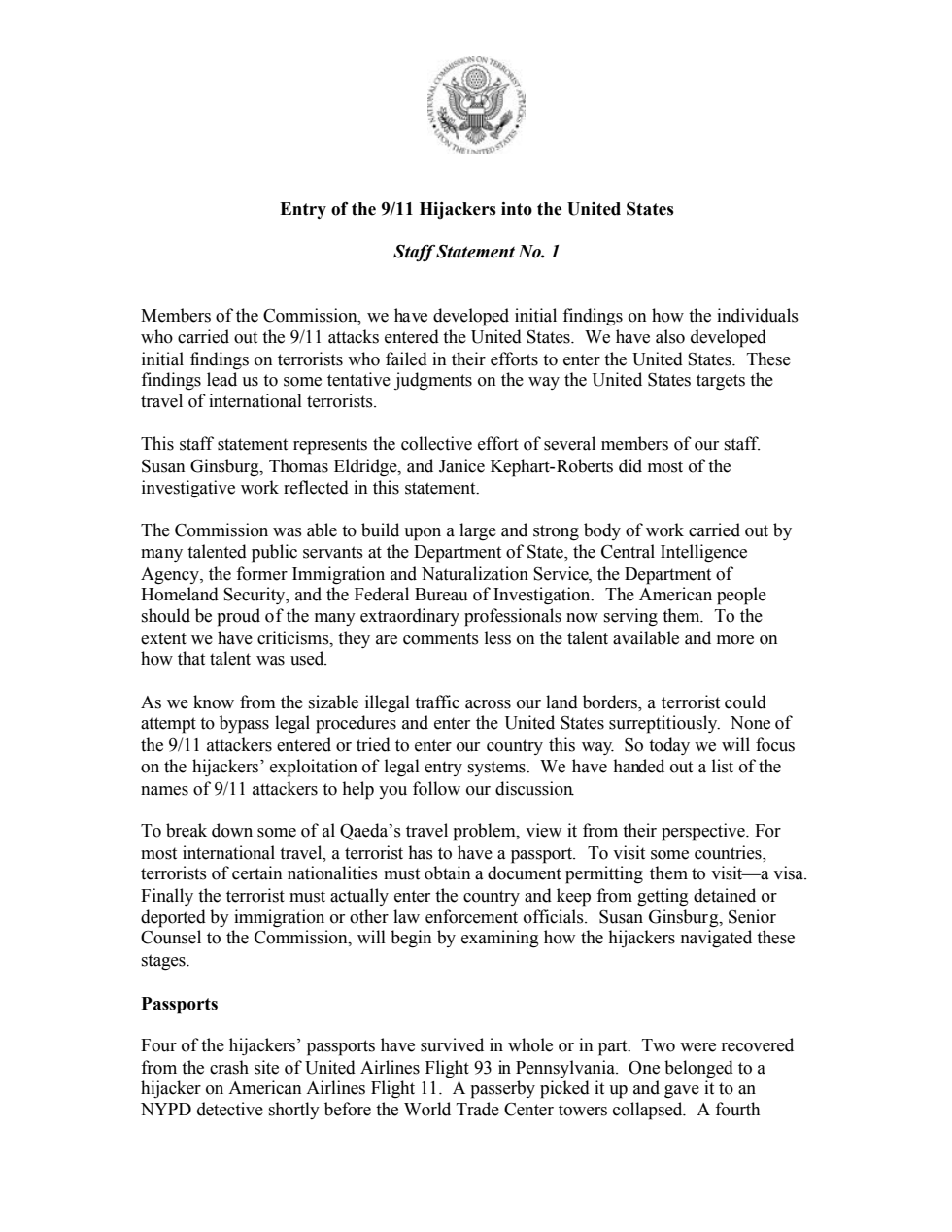
9/11 Commission staff statement on terrorist entry and travel; contemporary document, not the final identity directory. U.S. government publication · Public domain, U.S. government document · Source Faithful rendering of the first PDF page; no text changed.
The record
Mohamed Atta, an Egyptian architecture graduate, moved to Germany in 1992 and studied in Hamburg. Marwan al-Shehhi, from the United Arab Emirates, came to Germany on a military scholarship. Ziad Jarrah, from Lebanon, studied in Germany too; he maintained a relationship with his girlfriend and contact with his family. Ramzi Binalshibh, a Yemeni, became the principal intermediary between the pilots and organizers outside America. [1][2]
Atta, al-Shehhi and Binalshibh shared Hamburg accommodation. Jarrah knew the group but did not share that same residential history. Accounts of discussion at the apartment and meetings around the al-Quds mosque describe increasingly extreme and antisemitic political beliefs. Neither living in Hamburg nor attending the mosque makes every acquaintance a participant: the evidentiary question is what a named person actually knew or did. [1]
The four traveled separately toward Afghanistan in late 1999. The Commission found no evidence establishing that the Hamburg group had joined al-Qaeda before that journey. Its explanation of their recruitment in Afghanistan relies substantially on Binalshibh’s later interrogation accounts; travel records and witnesses provide stronger independent checks on their movements than on private promises allegedly made inside a camp. [1][2]
Atta, al-Shehhi and Jarrah subsequently secured American visas and went to the United States for pilot training in 2000. Binalshibh’s repeated visa refusals kept him out. He did not become an unidentified twentieth passenger: he remained abroad, handling communications and assistance. The split between people physically on the aircraft and people organizing outside the country is essential to understanding the plot’s scale. [2][3]
At the time
The best-known hijackers were not an interchangeable group: their education, relationships and routes into the plot differed.
What the record shows
The Hamburg story is unusually well documented in its travel and social history, while details of recruitment conversations remain less independently testable.
Especially important caveat at the start: chapters 5 and 7 rely heavily on detainee interrogation reports, with no direct access to prisoners or interrogators. Sources for private conversations should remain qualified.
U.S. federal government source; historical record or official reconstruction. Read the document’s dates and qualifications; source confidence is not identical for every underlying claim.
Final travel monograph has a complete all-19 flight roster on its opening page and later entry chronology. Its aggregate visa totals differ from preliminary staff statement 1; do not silently combine them.
The road to September 11 / January–June 2000 · Documented history
January 2000: watched in Malaysia, then living in California
Two future Flight 77 hijackers traveled through a meeting that intelligence agencies were already watching.
The record
Nawaf al-Hazmi and Khalid al-Mihdhar were Saudi nationals with prior militant experience. They attended an early January 2000 gathering in Kuala Lumpur that Malaysian authorities monitored at the CIA’s request. Other participants included men connected to al-Qaeda’s wider operations. Surveillance demonstrated an important connection, but photographs alone did not reveal every conversation or an attack schedule. [1]
The men traveled onward through Bangkok and arrived in Los Angeles on January 15, 2000. They soon moved to San Diego. Their American history includes accommodation, bank and travel records, attempted flight instruction, and assistance from acquaintances. Their limited English and weak flying ability help explain why the operation later relied on trained pilots rather than requiring all nineteen men to be competent aviators. [2]
Omar al-Bayoumi helped them obtain an apartment and settle in San Diego. Their contacts around local mosques and later with imam Anwar al-Awlaki became major investigative issues. These were real relationships worth investigating. It would be inaccurate either to erase them as irrelevant coincidences or to assume that everyone who provided an introduction, a room or language help knew the attack plan. The wider Saudi-evidence section treats later releases and contested allegations separately from this basic travel history. [2]
Mihdhar left America in June 2000 and returned on July 4, 2001; Hazmi remained and eventually joined Hani Hanjour. The failure to connect their known overseas associations with their American presence is one of the most substantial failures in the pre-attack record. It is documented independently of speculation about controlled demolition, fake aircraft or invented passengers. [3]
At the time
Two future Flight 77 hijackers traveled through a meeting that intelligence agencies were already watching.
What the record shows
The California assistance network and the intelligence failures are genuine lines of inquiry; neither needs a fabricated attack to be significant.
U.S. federal government source; historical record or official reconstruction. Read the document’s dates and qualifications; source confidence is not identical for every underlying claim.
Detailed reconstruction of arrivals, training, recruitment, travel and final preparations; many documentary records, but some internal planning details depend on detainee reporting.
U.S. federal government source; historical record or official reconstruction. Read the document’s dates and qualifications; source confidence is not identical for every underlying claim.
The road to September 11 / 2000–2001 · Documented history
Flight schools: what the four pilots actually learned
Poor flying reports are real. So are pilot certificates, instruction records and substantial training.
The record
Atta and al-Shehhi arrived in the United States in the early summer of 2000 and trained at Huffman Aviation in Venice, Florida. Jarrah trained separately at Florida Flight Training Center. Records of their applications, payments, instruction, certificates and subsequent travel establish a sustained American presence. These are not merely identities inferred from a passport found after a crash. [1][2]
By late 2000, the three had progressed from smaller aircraft to simulator instruction for larger jets. Atta and al-Shehhi obtained instrument qualifications and commercial pilot certificates. Hanjour followed a different path: he had first visited America in 1991 and undertook flight training during the 1990s, obtaining an FAA commercial pilot certificate in April 1999. He returned in December 2000 and took refresher and simulator instruction. [1]
Instructors also described weaknesses. Hanjour’s English and flying drew criticism; some schools or instructors declined particular solo flights or discouraged further training. Those statements should be reported rather than edited out. But they do not show that he had never flown or could not operate an aircraft’s basic controls. Airline qualification, a safe instrument approach and landing, and a one-way destructive flight are different tests of skill. A certificate does not make someone an expert; an instructor’s refusal does not erase the documented training. [1]
In March 2002, Huffman received delayed student-status paperwork for Atta and al-Shehhi, triggering an Inspector General investigation. The approvals had been made before the attacks; the scandal was delayed notification and a system that failed to stop it, not the government newly approving dead men to study. The episode illustrates both bureaucratic failure and how a real failure can acquire a misleading shorthand. [2]
At the time
Poor flying reports are real. So are pilot certificates, instruction records and substantial training.
What the record shows
A fair account holds the training records and critical instructor reports together, then asks what level of ability the observed flight demanded.
Detailed reconstruction of arrivals, training, recruitment, travel and final preparations; many documentary records, but some internal planning details depend on detainee reporting.
U.S. federal government source; historical record or official reconstruction. Read the document’s dates and qualifications; source confidence is not identical for every underlying claim.
The road to September 11 / 1999–2001 · Documented history
The other fifteen: recruitment and arrival
Most hijackers were assigned to control cabins, not to fly. Their individual histories are thinner than those of the four pilots.
The record
The nineteen consisted of four trained pilot-hijackers and fifteen other attackers. Nawaf al-Hazmi and Khalid al-Mihdhar had arrived early; thirteen additional men entered in 2001. Twelve of those later recruits were Saudis and one, Fayez Banihammad, was Emirati. Across all nineteen, the nationalities were fifteen Saudi, two Emirati, one Egyptian and one Lebanese. Nationality describes the roster; it does not by itself establish a government order. [1][2]
The later recruits came from several Saudi regions and different family and educational backgrounds. Some had pursued university studies; others had little advanced education. Wail and Waleed al-Shehri were brothers, as were Nawaf and Salem al-Hazmi. Similar surnames among other participants do not necessarily imply close kinship. A roster should distinguish people carefully rather than treating transliteration differences or shared tribal names as mysterious extra identities. [1][3]
The Commission reconstructed recruitment through extremist contacts and training camps in Afghanistan, followed by selection and travel assistance. Those private recruitment accounts are partly interrogation-dependent. Entry dates, onward flights, banking and accommodation offer documentary checks on when particular men actually reached the United States. The later arrivals joined groupings in Florida and the Northeast before teams were finalized. [1][4]
There were unsuccessful candidates. Ramzi Binalshibh could not secure a visa. Mohamed al-Qahtani was refused entry at Orlando on August 4, 2001. Zacarias Moussaoui was in custody before the attacks and was not one of the nineteen passengers. Keeping rejected or detained candidates separate prevents a common confusion in which every person called a possible “twentieth hijacker” is assumed to have held the same role or been aboard a fifth aircraft. [4]
At the time
Most hijackers were assigned to control cabins, not to fly. Their individual histories are thinner than those of the four pilots.
What the record shows
The plot’s personnel history includes recruitment failures and substitutes, not nineteen identical biographies.
Detailed reconstruction of arrivals, training, recruitment, travel and final preparations; many documentary records, but some internal planning details depend on detainee reporting.
U.S. federal government source; historical record or official reconstruction. Read the document’s dates and qualifications; source confidence is not identical for every underlying claim.
Contemporaneous September 28, 2001 release explicitly warned that identity confirmation was still under way. Use the later Commission roster to confirm assignments; early possible birthdates and residences are not final findings.
Final travel monograph has a complete all-19 flight roster on its opening page and later entry chronology. Its aggregate visa totals differ from preliminary staff statement 1; do not silently combine them.
The road to September 11 / 1999–2001 · Documented history
Visas, passports and the gaps between permission and presence
Legal entry, a valid visa and lawful conduct are different things. The public records show both exploitation and occasional successful intervention.
9/11 Commission staff statement on terrorist entry and travel; contemporary document, not the final identity directory. U.S. government publication · Public domain, U.S. government document · Source Faithful rendering of the first PDF page; no text changed.
The record
The hijackers entered through ordinary ports of entry using visas, not by secretly crossing the southern border. The travel monograph documented repeated contact with consular and immigration systems. A visa allowed its holder to seek admission; it did not guarantee entry or authorize a terrorist purpose. Several men made repeated trips, meaning nineteen people generated more than nineteen border encounters. [1]
Investigators found incomplete visa applications, weak interviews and passport indicators that officials had not been trained to recognize. Some recovered passports had been manipulated. The Commission’s initial staff statement and later travel monograph used different aggregate visa-application counts; a careful guide should cite the dated document and its scope rather than silently mixing preliminary and final figures into one supposedly exact total. [1][2]
The Visa Express program in Saudi Arabia is sometimes presented as though it were an instruction to admit the hijackers without government scrutiny. It was a travel-agency submission arrangement, and serious criticism of its setting and use is warranted. The travel monograph examined which hijackers actually used it and how policies differed between consulates. A shortcut that reduced contact with an applicant is an institutional vulnerability; it is not by itself proof that the officer knew the applicant’s hidden plan. [2]
There were genuine refusals, including Binalshibh’s visa applications and al-Qahtani’s attempted Orlando entry. There were also failures after entry: student tracking, status compliance and information sharing did not reliably identify suspicious conduct. The later arrival of paperwork for dead hijackers belongs to that administrative story. Public immigration evidence supports a detailed account of a compromised system without requiring the claim that every border official acted in concert. [1][3]
At the time
Legal entry, a valid visa and lawful conduct are different things. The public records show both exploitation and occasional successful intervention.
What the record shows
Ordinary documents and identifiable system weaknesses explain a great deal; “they had visas” is not evidence of innocence or state sponsorship.
Final travel monograph has a complete all-19 flight roster on its opening page and later entry chronology. Its aggregate visa totals differ from preliminary staff statement 1; do not silently combine them.
U.S. federal government source; historical record or official reconstruction. Read the document’s dates and qualifications; source confidence is not identical for every underlying claim.
U.S. federal government source; historical record or official reconstruction. Read the document’s dates and qualifications; source confidence is not identical for every underlying claim.
The road to September 11 / July–10 September 2001 · Documented history
Spain, reconnaissance and the last weeks
Hotel, airline, bank and communications records anchor the final preparations; private discussions require more caution.
The record
Atta traveled to Spain in July 2001 and met Binalshibh near the Mediterranean coast. Hotel and airline records support the journey. The Commission reconstructed their discussion of timing and targets largely from Binalshibh’s later statements. It is responsible to say that the meeting occurred and to qualify the account of what was said there. The evidence does not turn every tourist or acquaintance in the same town into a co-conspirator. [1]
The pilots took domestic trips that investigators interpreted as familiarization or surveillance flights. Some also undertook practice flights in smaller aircraft. Hanjour and Jarrah requested flights in the Hudson River area; Hanjour’s activities included a flight toward Maryland. These are established historical observations, not proof that every alleged photograph or “casing video” circulating online depicts a hijacker. The separate video section identifies the people and provenance of the UK-recovered material. [1]
By late August, booking and purchasing the September 11 tickets had begun; all nineteen tickets were purchased between August 25 and September 5. Public trial exhibits include individual chronologies, travel records and financial material. Flight assignments became clearer as men moved between New Jersey, Florida, Boston and the Washington area. Some unused money was sent back to facilitators overseas shortly before the attacks. [1][2]
On September 10, Atta and Abdulaziz al-Omari went to Portland, Maine. They flew to Boston the next morning and connected to American 11. Other teams approached Logan, Dulles and Newark. This multi-city record is important because a conspiracy theory must account not only for an impact image but also for a long, interlocking trail of ordinary transactions created before the attacks. Records have limitations, but their convergence is stronger than an isolated anecdote. [2][3]
At the time
Hotel, airline, bank and communications records anchor the final preparations; private discussions require more caution.
What the record shows
The final preparations have a broad documentary footprint. A reconstructed conversation should be labelled differently from a dated ticket or bank transfer.
Detailed reconstruction of arrivals, training, recruitment, travel and final preparations; many documentary records, but some internal planning details depend on detainee reporting.
Actual public trial-exhibit archive. Charts summarize evidence; some entries are prosecution presentations. Label what each item is and do not treat inclusion as proof of every assertion inside it.
U.S. federal government source; historical record or official reconstruction. Read the document’s dates and qualifications; source confidence is not identical for every underlying claim.
Warnings & response / July–September 2001 · Documented history
The warning story: Phoenix, Moussaoui and an unfinished search
There were meaningful warnings and preventable failures. That is more precise than either “nobody knew anything” or “everyone knew the plan.”
The record
On July 10, 2001, an FBI agent in Phoenix circulated a communication expressing concern about extremists attending aviation-related training. The Inspector General found it was not handled effectively or shared widely enough. It was a warning about a possible pattern, not a message naming the four flights, date or nineteen attackers. Describing its actual content makes the failure more understandable, not less serious. [1]
In August, a Minnesota flight school alerted authorities about Zacarias Moussaoui. He was detained on an immigration violation on August 16. Minneapolis agents suspected a terrorism-related aviation threat and sought to search his possessions, but disagreement with headquarters over evidence and legal routes impeded the effort. The Inspector General identified systemic deficiencies while declining to promise that a warrant would necessarily have been obtained or that it would automatically have exposed the whole plot. [2][3]
Separately, intelligence agencies had possessed information about Mihdhar’s American visa and Hazmi’s travel long before the attacks. Critical information was not effectively shared or acted on. Their names were finally watchlisted in August 2001; the domestic search came too late. The Inspector General identified several earlier opportunities involving these men and criticized the lack of urgency even after the late warning. [4]
These cases can support severe criticism of secrecy, management, institutional rivalry and individual decisions. They do not by themselves establish that Bush, the CIA, the FBI or the armed forces ordered the attacks. Deliberately withholding a piece of information and deliberately causing the resulting mass murder are separate propositions requiring separate evidence. Conversely, calling every failure an innocent “communication problem” can understate how consequential the documented decisions were. [3][4]
At the time
There were meaningful warnings and preventable failures. That is more precise than either “nobody knew anything” or “everyone knew the plan.”
What the record shows
The failures were real and specific. Their seriousness does not depend on upgrading a missed lead into demonstrated authorship of the attack.
U.S. federal government source; historical record or official reconstruction. Read the document’s dates and qualifications; source confidence is not identical for every underlying claim.
U.S. federal government source; historical record or official reconstruction. Read the document’s dates and qualifications; source confidence is not identical for every underlying claim.
U.S. federal government source; historical record or official reconstruction. Read the document’s dates and qualifications; source confidence is not identical for every underlying claim.
U.S. federal government source; historical record or official reconstruction. Read the document’s dates and qualifications; source confidence is not identical for every underlying claim.
Warnings & response / 1998–2026 · Documented history
What presidents were told—and what the 2026 releases add
The warning record is broader than one famous August memo, and newer public releases should be read without pretending they reveal a complete attack schedule.
The record
The August 6, 2001 President’s Daily Brief item warned that bin Laden intended to strike in the United States. It referred to information about possible hijackings and suspicious activity, including reported surveillance. It did not give the operational detail that would allow an officer simply to arrest all nineteen or cancel four named flights. Calling it merely historical misses the concern its authors intended to convey; calling it the complete September 11 plan adds information that was not there. [1]
The Congressional Joint Inquiry found that aircraft-as-weapons possibilities had surfaced before September 2001. This undermines the categorical claim that such a threat was beyond anyone’s imagination. There is still a large practical difference between recording a possible attack method, deciding which of many warnings is credible and imminent, and assembling a particular group’s identities, itinerary and target. [2]
On September 11, 2026, the CIA released 71 briefing products spanning 1998 through the day after the attacks. The collection includes earlier warnings about potential attacks inside the United States and aviation threats. The National Archives also announced releases of a Commission summary of presidential briefings and interview records. The publication dates matter: these are old intelligence records newly available for public examination, not intelligence written in 2026 about a new plot. [3][4]
The released records are redacted and do not represent every conversation or every classified file. They can sharpen questions about what senior officials were told and how their offices responded. They should not be promoted as proof of foreknowledge of the exact 9/11 operation unless a specific document actually supplies that missing detail. A reader should be able to open the record, see its original date and separate an analyst’s warning from hindsight about what ultimately happened. [3][4]
At the time
The warning record is broader than one famous August memo, and newer public releases should be read without pretending they reveal a complete attack schedule.
What the record shows
The public warning record justifies scrutiny of preparedness and leadership; it does not justify claiming that a general warning contained an exact attack itinerary.
U.S. federal government source; historical record or official reconstruction. Read the document’s dates and qualifications; source confidence is not identical for every underlying claim.
U.S. federal government source; historical record or official reconstruction. Read the document’s dates and qualifications; source confidence is not identical for every underlying claim.
Browsable primary PDFs with original dates. 2026 is release date, not original creation date. Includes September 10 and December 4, 1998 aviation-threat products.
The road to September 11 / 11 September 2001 · Documented history
Four flights, four hijacking teams, one morning
The sequence rests on air-traffic records, calls, radar, recordings and crash evidence—not on television alone.
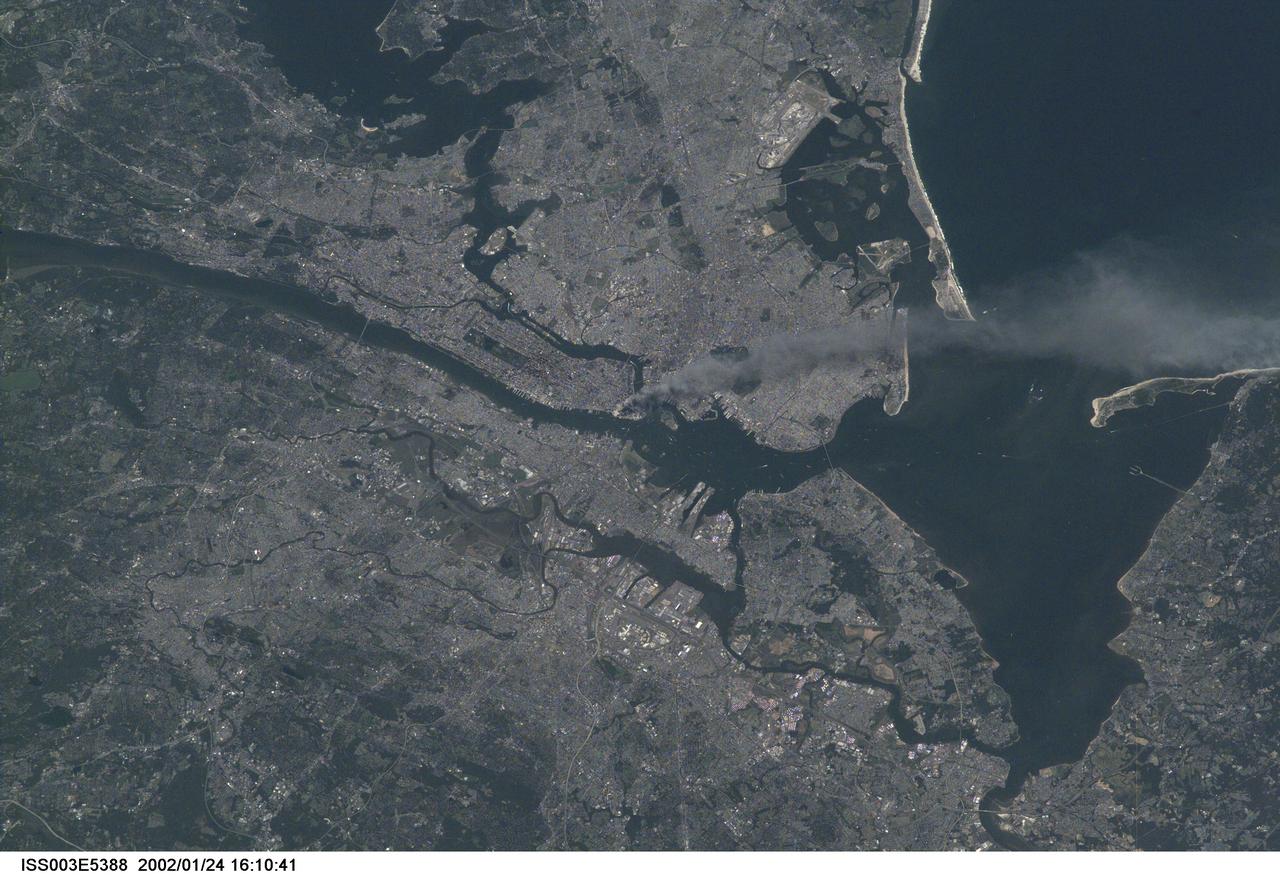
Smoke from lower Manhattan photographed from the International Space Station on September 11, 2001. NASA notes that date identifiers embedded in some related camera frames were incorrect because of a camera problem. NASA / Expedition 3 · NASA media guidelines / U.S. government work · Source Original source image or official web rendition. Displayed without adding scene details.
The record
American 11 left Boston at 7:59 a.m. Eastern time. The hijacking began soon afterward, and flight attendants Betty Ong and Madeline Sweeney communicated critical information to people on the ground. At 8:46, the aircraft struck the North Tower. United 175, also from Boston, took off at 8:14 and struck the South Tower at 9:03. Its final approach was witnessed, recorded and broadcast as the attack unfolded. [1]
American 77 departed Washington Dulles at 8:20. Hijackers took control, turned the aircraft back toward Washington and struck the Pentagon at 9:37. United 93 left Newark at 8:42 after a substantial delay. Its hijacking began around 9:28. By then, passengers and crew making calls could learn that other aircraft had been used in suicide attacks. That changed the context in which they decided to resist. [1][2]
The Flight 93 revolt began around 9:57. The cockpit recording and other evidence show the hijackers reacting to the passengers’ attempt to reach them, then directing the aircraft into the ground near Shanksville at 10:03. The Capitol is the target identified in the principal reconstruction, with the White House also discussed during planning; it was not a destination the plane reached. The passengers and crew prevented the planned Washington strike. [2][3]
Later in the morning the South Tower collapsed at 9:59 and the North Tower at 10:28; World Trade Center 7 collapsed much later, around 5:20 p.m. Those are separate structural events explained in their own articles. Keeping the aircraft chronology distinct from the collapse chronology helps prevent a timing error in one popular retelling from being mistaken for evidence that the entire day’s record is unreliable. [2]
At the time
The sequence rests on air-traffic records, calls, radar, recordings and crash evidence—not on television alone.
What the record shows
Independent records from multiple organizations and ordinary people converge on four real hijackings and their outcomes.
U.S. federal government source; historical record or official reconstruction. Read the document’s dates and qualifications; source confidence is not identical for every underlying claim.
U.S. federal government source; historical record or official reconstruction. Read the document’s dates and qualifications; source confidence is not identical for every underlying claim.
U.S. federal government source; historical record or official reconstruction. Read the document’s dates and qualifications; source confidence is not identical for every underlying claim.
The road to September 11 / 2001–2026 · Documented history
Why al-Qaeda responsibility does not rest on a tortured confession
The documentary case is substantial. The treatment of prisoners and reliance on interrogation reporting remain serious limitations.
The 9/11 Commission Report: cover of the 2004 final report. U.S. government publication · Public domain, U.S. government document · Source Faithful rendering of the first PDF page; no text changed.
The record
The evidentiary trail includes airline bookings, airport images, immigration records, flight-school records, financial transactions, accommodation, vehicle rentals, calls from the aircraft and material recovered from the crash sites. The public Moussaoui exhibit archive allows readers to inspect many individual documents and presentations. The court cautions that different exhibits were admitted for different purposes: possession of a document, for example, does not prove that everything written inside it was true. [1][2]
The FBI described handwritten Arabic instructions recovered from Atta’s untransferred luggage, from the Flight 77 team’s vehicle at Dulles, and from the Pennsylvania crash site. The car also contained training-related material and ordinary transaction records. Such evidence links people and groups without requiring the public to accept an uncorroborated account of a secret meeting in Afghanistan. The value is cumulative: multiple record types reinforce one another. [3][4]
The Commission nevertheless relied heavily on detainee reporting for its account of internal planning. It explicitly said it had not directly interviewed those prisoners or their interrogators. The later Senate study documented torture and serious problems with the CIA’s representations about interrogation. Coercion can produce falsehood, compliance and exaggerated claims. A responsible guide must not treat every detail attributed to KSM or Binalshibh as equally reliable simply because it appears in an official report. [5][6]
This does not mean every immigration record, bank transfer or cockpit recording becomes untrue because a separate source was tortured. The sound approach is to identify which claim rests on which evidence, seek corroboration and lower confidence where corroboration is weak. Al-Qaeda responsibility is supported by converging evidence; the exact wording of some leadership discussions, motives attributed to individual facilitators and the full extent of outside assistance remain questions with different levels of public certainty. [1][5]
At the time
The documentary case is substantial. The treatment of prisoners and reliance on interrogation reporting remain serious limitations.
What the record shows
Rejecting torture and demanding better evidence strengthens an accurate account; it does not require discarding independently documented hijackings.
Actual public trial-exhibit archive. Charts summarize evidence; some entries are prosecution presentations. Label what each item is and do not treat inclusion as proof of every assertion inside it.
U.S. federal government source; historical record or official reconstruction. Read the document’s dates and qualifications; source confidence is not identical for every underlying claim.
U.S. federal government source; historical record or official reconstruction. Read the document’s dates and qualifications; source confidence is not identical for every underlying claim.
Especially important caveat at the start: chapters 5 and 7 rely heavily on detainee interrogation reports, with no direct access to prisoners or interrogators. Sources for private conversations should remain qualified.
2014 Senate executive summary, official Senate-hosted copy; documents coercion and CIA misrepresentations. Does not independently validate each detail of the 9/11 conspiracy narrative.
The Twin Towers: surviving the impact did not mean surviving the fire
The best-supported explanation combines aircraft damage, lost fire protection, spreading fires and instability. The two towers did not fail in identical conditions.
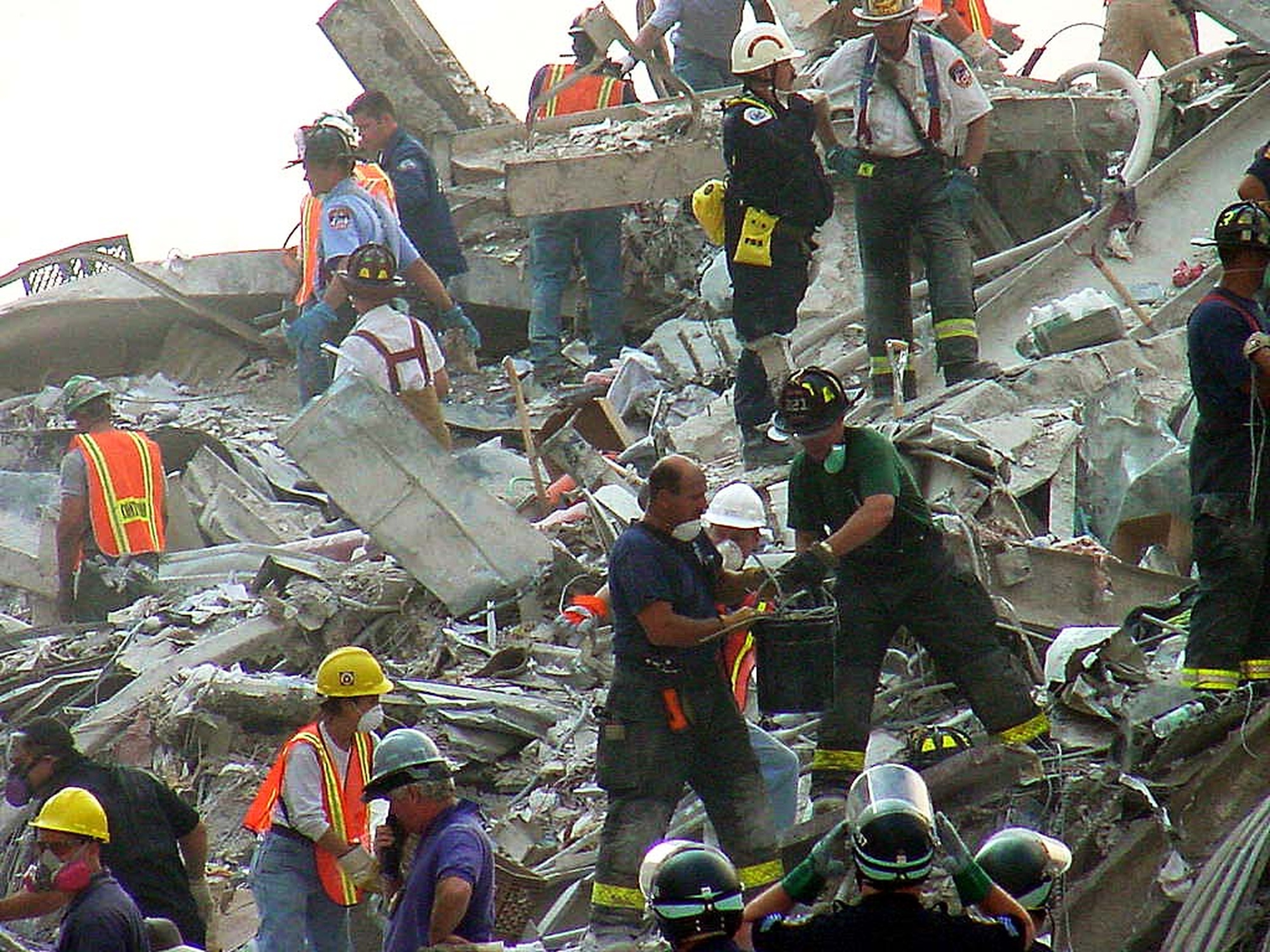
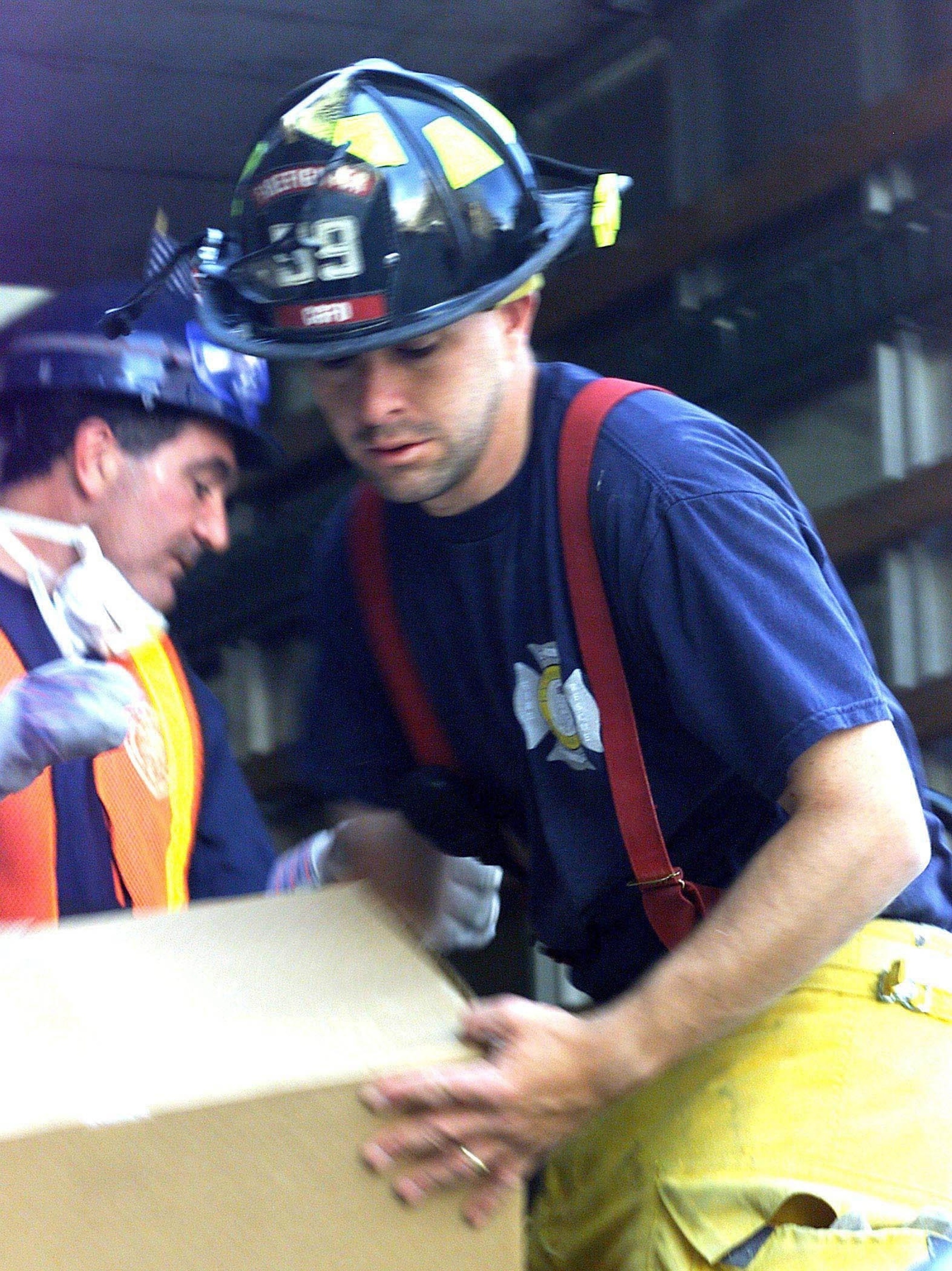
Rescuers search the South Tower rubble after the attacks. The archive posted this historical image later; its displayed 2007 date is not the date of the attack. Capt. Jim Fabio / U.S. Air Force · Public domain (U.S. government photograph); no endorsement implied. · Source No local alteration; downloaded source-provided image rendition.
The record
The first important observation is that both towers remained standing after being struck. Their redundant steel framing redistributed loads around damaged columns. This is evidence of structural resilience, not evidence that the impacts were harmless. Aircraft debris also damaged interiors, dispersed fuel, cut services and removed fire-resistant insulation from steel. The engineering question is what happened to an already injured load-bearing system as fires spread through several floors. [1][2]
NIST’s probable sequence is more specific than “jet fuel melted the beams.” Heating weakened floors and columns; floor assemblies sagged while many connections remained attached. Those connections could pull perimeter columns inward. Photographs and video show inward bowing before collapse. In the final reconstruction the south exterior wall of the North Tower and east exterior wall of the South Tower became unstable, initiating the descent of the upper structures. The observed location of collapse initiation matters: it was at the damaged, burning levels, not a documented series of detonations starting in the basement. [1]
The South Tower was struck second but fell first. Its lower impact region left a substantially larger mass above the failure area; damage distribution, fireproofing loss and fire development also differed. A taller building is not a uniform stack in which every impact must produce the same delay. The changing load paths and local damage make a different failure time entirely compatible with the impact-and-fire explanation. Simply saying that the first tower hit should necessarily fall first assumes away these differences. [1][3]
Confidence should have boundaries. Much interior damage could not be directly observed, and investigators estimated it through models constrained by exterior damage, surviving steel and recorded fire movement. NIST compared alternative damage severities and selected the scenario best matching observations. That is a reconstruction with uncertainty, not a minute-by-minute film of the hidden structure. The combination of independent observations and a physically supported failure mechanism makes the explanation persuasive without making every modeled connection failure certain. [1][2][3]
Documented checkpoints & limits
2001-09-11
Read the record in context
The first important observation is that both towers remained standing after being struck. Their redundant steel framing redistributed loads around damaged columns. This is evidence of structural resilience, not evidence that the impacts were harmless. Aircraft debris also damaged interiors, dispersed fuel, cut services and removed fire-resistant insulation from steel. The engineering question is what happened to an already injured load-bearing system as fires spread through several floors. Source ↗
Evidence limit
Keep the conclusion proportionate
Interior damage and temperatures were reconstructed. Do not call every modeled detail directly observed. Source ↗
At the time
The best-supported explanation combines aircraft damage, lost fire protection, spreading fires and instability. The two towers did not fail in identical conditions.
What the record shows
Aircraft impact and fire form a linked explanation. Immediate survival and later collapse are compatible parts of that explanation.
Final federal technical report. Investigation concentrates on the sequence through collapse initiation, not a complete numerical reconstruction of every subsequent failure. Federal government work; paraphrased.
Agency explanations and admissions: no explosives/thermite residue testing; no full collapse-propagation model. Read alongside underlying reports rather than as an independent replication.
“Jet fuel cannot melt steel”: the premise is mostly right; the conclusion does not follow
Steel can lose strength, stiffness and stability far below its melting point. Gas temperature is also different from the temperature of every steel member.
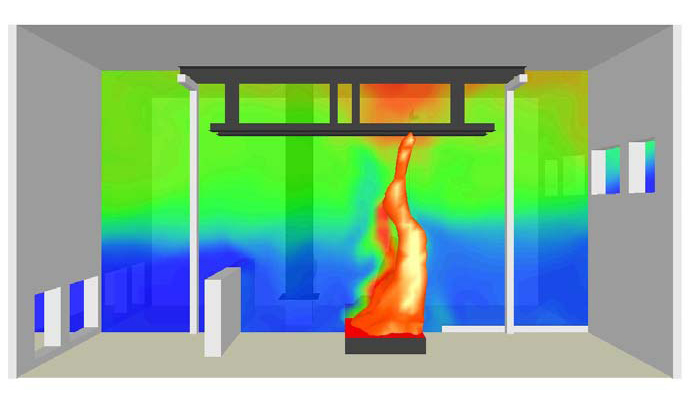
NIST visualization related to structural fire resistance and a bare floor-truss test. It is a simulation/test graphic, not an image of the World Trade Center on September 11. NIST · U.S. government work / NIST · Source Original source image or official web rendition. Displayed without adding scene details.
The record
Ordinary jet-fuel and office fires do not need to melt structural steel to cause failure. Steel melting temperatures are around 1,500°C, depending on composition. Under load, substantial loss of strength and stiffness occurs much earlier. A column can buckle while remaining solid, and a beam can sag or expand enough to damage a connection. Treating melting as the only route to structural failure sets a test that bridges and buildings do not have to meet before becoming unsafe. [1][2]
Temperature numbers need careful handling. NIST reconstructed hot upper-layer gases reaching approximately 1,000°C in some areas. That does not mean every column everywhere was at 1,000°C. How quickly a member heats depends on insulation, thickness, exposure time, ventilation and contact with other materials. The investigation modeled heat transfer into individual components rather than declaring the entire tower a uniformly heated furnace. Its steel-property testing supplied relationships between temperature and material behavior. [1]
Jet fuel was an ignition source and a way of spreading fire over multiple floors. Building contents continued burning after much initial fuel was consumed. Black smoke does not demonstrate a harmlessly cool fire: oxygen-limited combustion can generate soot while still releasing enough heat to damage a structure. Nor does a person visible near a broken window prove the whole interior was cool. Fire temperatures vary sharply in space and time, and incoming air can make an opening relatively survivable beside much hotter areas. [2]
The fireproofing distinction is essential. Protected floor assemblies surviving a standard fire test do not establish that the same assemblies would survive impact damage, missing insulation, impaired sprinklers and a different pattern of loading. Conversely, it is misleading to say steel instantly becomes useless as soon as it is hot. The question is whether the actual combination of load, duration, insulation and geometry was sufficient to cause instability. That is a structural calculation, not a contest between two melting-point numbers. [1][2]
At the time
Steel can lose strength, stiffness and stability far below its melting point. Gas temperature is also different from the temperature of every steel member.
What the record shows
The useful correction is “failure does not require melting,” not “jet fuel burns hotter than steel melts.”
Final federal technical report. Investigation concentrates on the sequence through collapse initiation, not a complete numerical reconstruction of every subsequent failure. Federal government work; paraphrased.
Agency explanations and admissions: no explosives/thermite residue testing; no full collapse-propagation model. Read alongside underlying reports rather than as an independent replication.
Why did the floors below fail, and why did the top not simply tip off?
An intact floor carrying normal loads is different from a damaged structure struck by a moving mass of many floors.
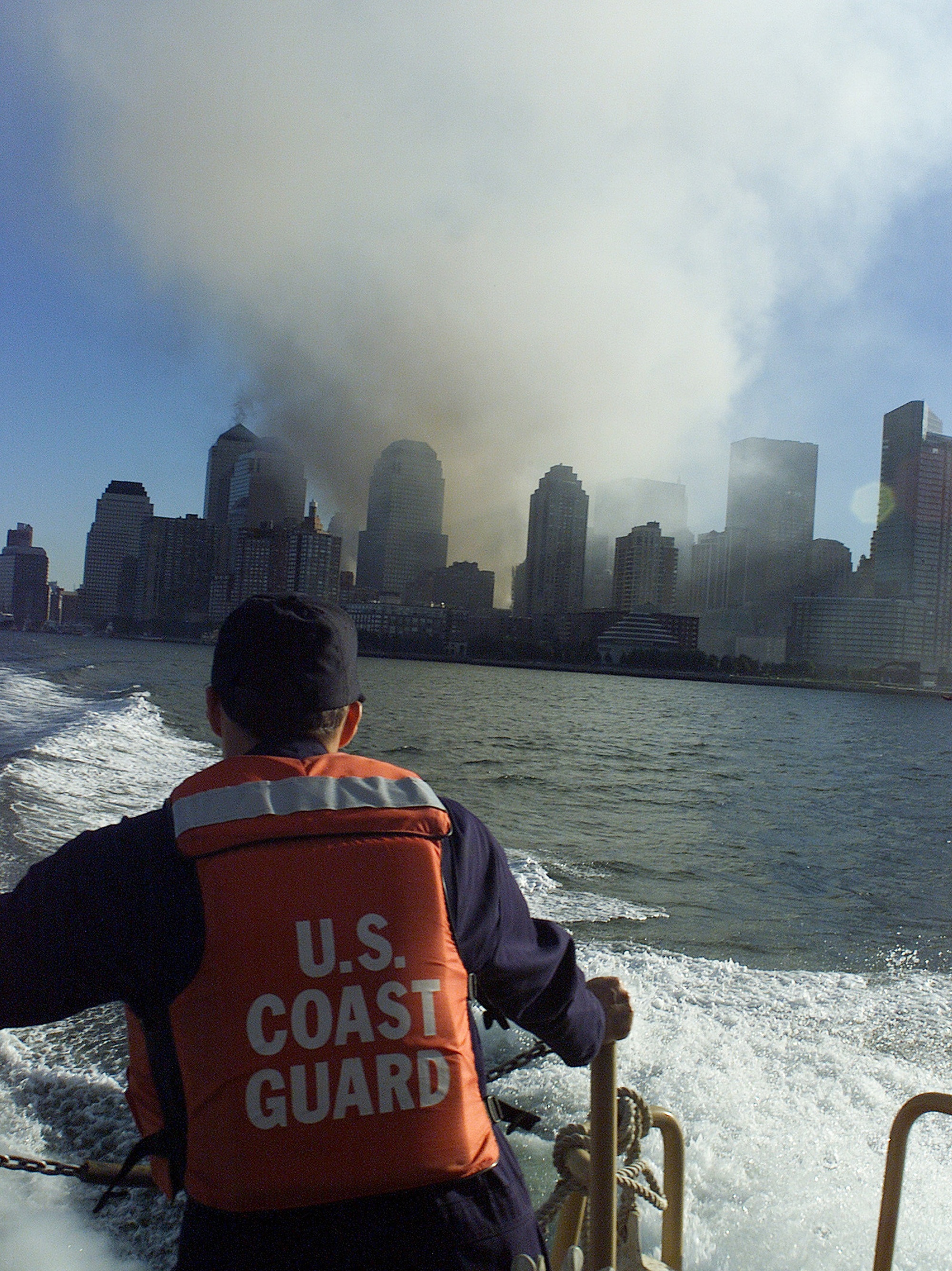
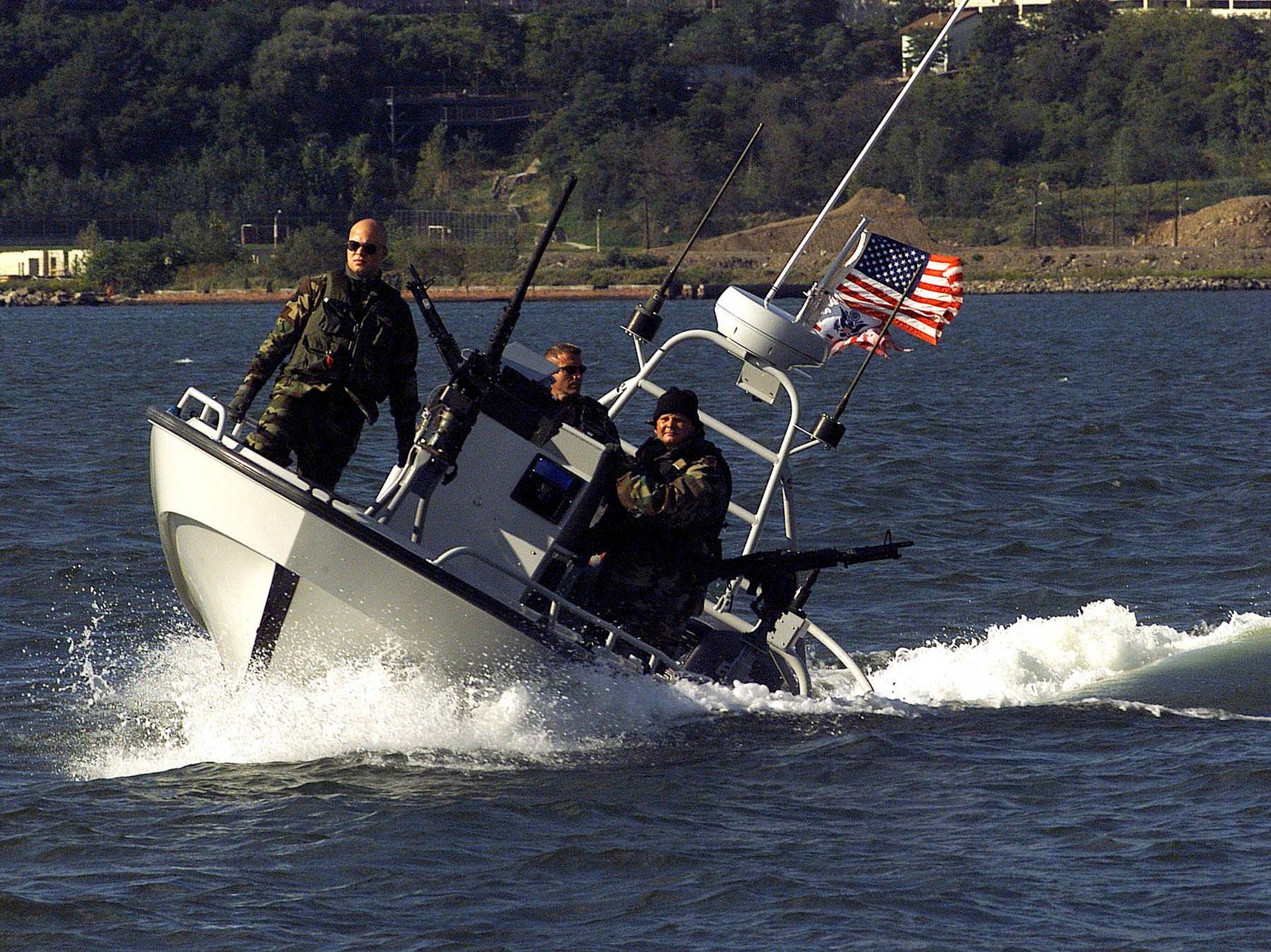
A Coast Guard patrol boat secures New York Harbor as smoke rises from the World Trade Center site, September 11, 2001. PA2 Tom Sperduto / U.S. Coast Guard · Public domain (U.S. government photograph); no endorsement implied. · Source No local alteration; downloaded source-provided image rendition.
The record
The lower towers were designed to carry the normal weight above them through continuous columns. After instability at the impact levels, that supported load became a moving, disintegrating mass. Dynamic loading, column misalignment, loss of lateral support and accumulating debris change the problem. The fact that a structure holds a stationary load does not establish that it can arrest that same mass after it gains downward velocity. [1]
NIST’s simplified floor-connection calculation illustrates the scale: connections of an intact floor could carry about eleven additional floors under gradual loading, and fewer under suddenly applied loading. The upper portions involved approximately twelve floors for the North Tower and twenty-nine for the South Tower at the stated initiation levels. This is not a complete model of all columns and debris. It shows why treating each lower floor as an unlimited braking platform is not justified. [2]
The South Tower’s upper section visibly tilted. A tipping object need not remain rigid and rotate cleanly away like a felled tree. As supports failed across a wide region, the upper structure itself broke apart and lost its ability to transmit the forces required for coherent rotation. Gravity still acted downward on its pieces. Video also shows debris spreading far beyond the original footprint; the towers did not leave the neat bounded pile that “straight into their own footprints” often suggests. [1]
NIST did not perform a complete end-to-end numerical simulation of tower collapse progression. Its detailed work concentrated on the events leading to initiation. That limitation should be stated plainly rather than covered with an animation. It does not mean that gravity-driven progressive failure has no engineering basis; it means a claim that NIST reproduced every floor’s motion would exceed the work actually done. Visible dust fronts and falling external debris are also unreliable clocks for the movement of every hidden structural element. [1][2]
At the time
An intact floor carrying normal loads is different from a damaged structure struck by a moving mass of many floors.
What the record shows
Collapse initiation and collapse progression are separate questions. Dynamic failure offers a coherent explanation without pretending the entire descent was numerically reproduced.
Final federal technical report. Investigation concentrates on the sequence through collapse initiation, not a complete numerical reconstruction of every subsequent failure. Federal government work; paraphrased.
Agency explanations and admissions: no explosives/thermite residue testing; no full collapse-propagation model. Read alongside underlying reports rather than as an independent replication.
Building 7: no aircraft impact, but a different and documented fire problem
The 47-story WTC 7 requires its own explanation. NIST identified fire-driven thermal expansion and progressive interior failure, not jet fuel.
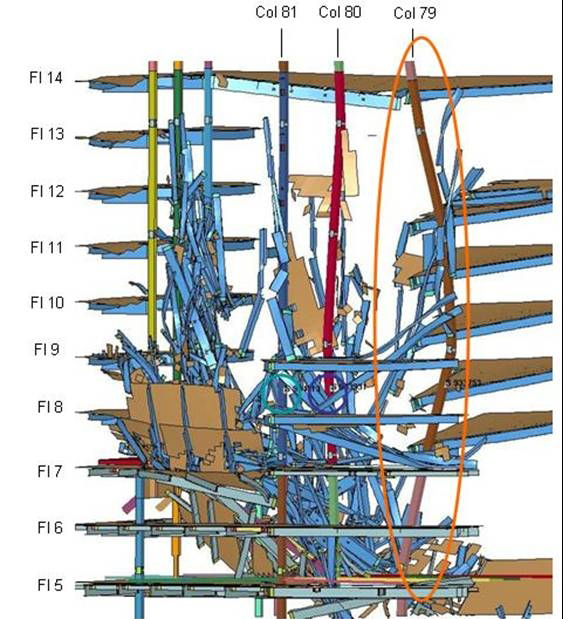
NIST computer visualization of buckling around WTC 7 Column 79 in its modeled sequence. A model output is not a direct observation of an internal column. NIST · U.S. government work / NIST · Source Original source image or official web rendition. Displayed without adding scene details.
The record
World Trade Center 7 was not struck by an aircraft. Debris from the North Tower damaged it and ignited fires; damaged city water supplies impaired suppression on lower floors. Several fires burned uncontrolled for hours before the building collapsed at approximately 5:20 p.m. Calling it an aircraft-impact collapse would be wrong. Calling it an undamaged building with a few isolated paper fires also leaves out important evidence. Its construction and failure mechanism were different from those of the Twin Towers. [1]
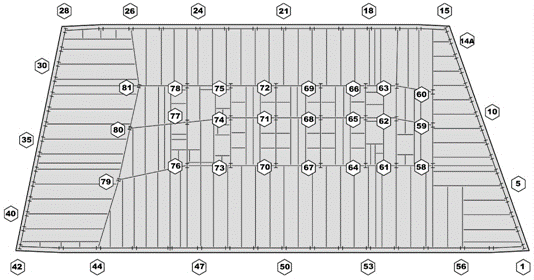
NIST’s final reconstruction begins with thermal expansion of long-span floor framing near Column 79. Expansion and connection failures led to loss of floor support in the northeast interior. A cascade of floor failures deprived this tall interior column of lateral support; it buckled. Interior failures then spread before the exterior frame descended. The visible fall of the east penthouse before the main north roofline is an important observation consistent with interior failure preceding the apparent single-unit exterior drop. [1]
The causal emphasis is easy to misstate. NIST did not find that impact damage alone brought the building down. A separate simulation without debris-impact damage still produced fire-driven collapse. Nor did the final report require diesel tanks, the electrical substation or melting structural steel as its initiating cause. Those hypotheses were examined rather than silently included in a general “everything was on fire” account. Ordinary combustible contents can cause extraordinary structural consequences when geometry, connections and suppressed-fire assumptions create a vulnerable system. [1][2]
This was an unusual event, and that is a fair reason to examine it closely. Other high-rise fires did not bring entire buildings down; different framing, connections, fire spread and available firefighting matter. NIST’s conclusion was that this was the first known total collapse of a tall building primarily from uncontrolled fires. A first occurrence is not a physical impossibility. At the same time, there was less recoverable, identifiable physical evidence than for the towers, making the report more dependent on drawings, observations and modeling. [1][2]
Documented checkpoints & limits
2001-09-11
Read the record in context
World Trade Center 7 was not struck by an aircraft. Debris from the North Tower damaged it and ignited fires; damaged city water supplies impaired suppression on lower floors. Several fires burned uncontrolled for hours before the building collapsed at approximately 5:20 p.m. Calling it an aircraft-impact collapse would be wrong. Calling it an undamaged building with a few isolated paper fires also leaves out important evidence. Its construction and failure mechanism were different from those of the Twin Towers. Source ↗
Evidence limit
Keep the conclusion proportionate
NIST’s sequence is a probable reconstruction, not direct observation of every internal failure. Source ↗
Watch this question
NIST Video: Why the Building (WTC7) Fell ↗ National Institute of Standards and Technology (verified channel) — Verified search result and publisher. Official explanation of thermal expansion and progressive collapse; agency presentation, not an independent recreation.
At the time
The 47-story WTC 7 requires its own explanation. NIST identified fire-driven thermal expansion and progressive interior failure, not jet fuel.
What the record shows
WTC 7 is best understood through its own structure, prolonged fires and interior-first sequence, with the model’s evidentiary limits visible.
Use final November 2008 report, revised January 2009, not the August draft. Sections 3.5–3.6 discuss simulation uncertainty and measured roofline descent.
A roughly 2.25-second interval of roofline free fall is in the final analysis. The dispute is what removed support, not whether that interval exists.
The record
People who point out WTC 7’s free-fall interval are not inventing that measurement. After public comments on its draft, NIST analyzed the displacement of a point near the center of the north roofline more closely. The final report divides the visible descent into three stages over approximately 5.4 seconds: acceleration below gravity, an interval consistent with gravitational acceleration, then reduced acceleration as resistance increased. The middle stage lasted from about 1.75 to 4.0 seconds, or 2.25 seconds. [1]
That observation has a clear physical implication: during this interval, the measured exterior section had negligible support from below. It does not by itself identify the process that removed that support. Explosives could remove support; so could prior structural failures that allowed exterior columns to buckle. Distinguishing those explanations requires the earlier motion, internal failure indicators, sound and physical evidence, not the acceleration measurement alone. [1][2]
The critical distinction is between the exterior roofline’s visible drop and the building’s full failure history. The east penthouse descended before that main exterior movement. NIST places earlier failures inside the building; its exterior-stage interpretation is that columns lost load-carrying capacity after this progression. Whether the proposed sequence reproduces every observed detail is a legitimate modeling question, addressed separately in this guide. [1]
It is equally misleading to say “NIST admitted the entire building fell freely from the start” or to insist “there was no free fall.” A skeptical reader should not have to choose between those errors. Specify the tracked point, the measured interval, the preceding activity and the uncertainties introduced by video perspective and obscuration. A measurement becomes more useful when its actual scope is preserved. [1][2]
Documented checkpoints & limits
2008-11-25
Read the record in context
People who point out WTC 7’s free-fall interval are not inventing that measurement. After public comments on its draft, NIST analyzed the displacement of a point near the center of the north roofline more closely. The final report divides the visible descent into three stages over approximately 5.4 seconds: acceleration below gravity, an interval consistent with gravitational acceleration, then reduced acceleration as resistance increased. The middle stage lasted from about 1.75 to 4.0 seconds, or 2.25 seconds. Source ↗
Evidence limit
Keep the conclusion proportionate
Roofline measurement does not track every floor or prove all columns failed simultaneously at the beginning of the event. Source ↗
At the time
A roughly 2.25-second interval of roofline free fall is in the final analysis. The dispute is what removed support, not whether that interval exists.
What the record shows
The interval is real and officially acknowledged. Acceleration describes motion; it does not uniquely identify a demolition mechanism.
Use final November 2008 report, revised January 2009, not the August draft. Sections 3.5–3.6 discuss simulation uncertainty and measured roofline descent.
The Alaska study and the limits of a computer reconstruction
A university team disputed NIST’s mechanism. Its work deserves examination, but disagreement between models is not a recovered demolition device.
NIST diagram of a typical WTC 7 floor, with numbered columns. The agency identifies Column 79 in its probable collapse sequence. This is an engineering diagram, not a photograph. NIST · U.S. government work / NIST · Source Original source image or official web rendition. Displayed without adding scene details.
The record
A team led by J. Leroy Hulsey, with Feng Xiao and Zhili Quan, released a final University of Alaska Fairbanks project report in March 2020. It challenged the fire-driven mechanism and argued that near-simultaneous failure of the building’s columns best reproduced the visible descent. The project published simulations and substantial input and output data. Architects & Engineers for 9/11 Truth funded it; that relationship should be disclosed, but sponsorship alone does not answer the engineering arguments. [1]
The useful questions concern assumptions: framing details, connection restraints, thermal expansion, material behavior, imposed failures, sensitivity to parameters and how observed motion is compared with output. A model in which columns are deliberately removed can show what such removal would produce. It cannot, merely from reproducing an exterior silhouette, establish what physically removed them on September 11. That second step needs evidence of a mechanism, preparation and operation. [1][2]
NIST also has limits that should not be hidden. It acknowledges that late-stage modeled exterior deformations differ from the videos and that uncertainty increases once breakup and debris interactions dominate. Its public FAQ addresses disputes about girder shear studs and explains withholding some model files under statutory public-safety provisions. Those choices restrict independent reproduction of the exact analysis and are fair subjects for transparency criticism; they are not proof that the hidden files contain a confession. [2][3]
The strongest interpretation of this dispute is narrower than either slogan. The Hulsey team offers a substantial alternative modeling argument, not a criminal attribution or chemical identification. NIST offers a documented fire-driven failure sequence supported by pre-collapse observations, not an exact reproduction of every pixel. Read both with the same demand for assumptions and testable predictions. The existence of uncertainty leaves room for further engineering research without putting every proposed cause on equal evidentiary footing. [1][2][3]
A university team disputed NIST’s mechanism. Its work deserves examination, but disagreement between models is not a recovered demolition device.
What the record shows
Take the technical criticism seriously and keep the inference limited: competing simulations do not by themselves establish explosives or an inside operation.
Original project portal identifies final March 2020 study, simulations and funding by Architects & Engineers for 9/11 Truth. Its model disagreement is not physical identification of an explosive or perpetrators. Page now hosted at a project domain; university links remain visible.
Use final November 2008 report, revised January 2009, not the August draft. Sections 3.5–3.6 discuss simulation uncertainty and measured roofline descent.
Explosions, “squibs” and symmetry: what would distinguish a demolition?
Loud reports and bursts of dust are observations worth preserving. They are not unique signatures of planted charges.
The record
Witnesses used words such as “explosion” to describe frightening sounds. Those reports should not be rewritten as though nobody heard anything. But the ordinary word describes a loud, abrupt event, not a laboratory identification of an explosive. Transformer failures, burning fuel, pressurized systems and structural failures can generate sudden sounds. A demolition hypothesis needs a sequence, location and signature that distinguishes its proposed charges from the other violence already occurring. [1]
Jets of dust below the visible tower collapse front are often called squibs. NIST explains them as compressed air carrying smoke and debris through windows, shafts and damaged floors. Pressure can travel through a structure before an external dust cloud reaches the same level. A dust plume is therefore not a direct view of a cutting charge. Its timing and location need comparison with structural motion and pressure pathways, not just its resemblance to a plume in a demolition video. [1][2]
For WTC 7, NIST evaluated a hypothetical blast capable of causing the critical column failure and estimated conspicuous sound levels that it did not find in available recordings or corroborating witness evidence. That analysis constrains particular blast scenarios; it is not a proof that every imaginable device would have produced the same sound. It should be read alongside the lack of demonstrated charge placements, initiation hardware and a verified preparation trail. [3]
Appearance alone is a weak discriminator. Deliberate demolition works by removing support so gravity can do much of the subsequent work. A gravity-driven failure can consequently share some visual features with it. The better question is which explanation accounts for the full sequence, including the initial damage, fire progression and earlier interior failures, while making the fewest unsupported additions. Being startled by a visual resemblance is reasonable; treating it as a unique forensic test is the step that needs more evidence. [1][3]
At the time
Loud reports and bursts of dust are observations worth preserving. They are not unique signatures of planted charges.
What the record shows
Preserve witness reports while separating descriptions from identified causes. Dust jets and apparent symmetry do not uniquely diagnose explosives.
Final federal technical report. Investigation concentrates on the sequence through collapse initiation, not a complete numerical reconstruction of every subsequent failure. Federal government work; paraphrased.
Agency explanations and admissions: no explosives/thermite residue testing; no full collapse-propagation model. Read alongside underlying reports rather than as an independent replication.
There is a real published dust study behind this claim. Its interpretation is disputed, and it does not establish that thermite brought the buildings down.
The record
In 2009, Niels Harrit and colleagues reported red-gray chips in four privately collected World Trade Center dust samples. They used microscopy, elemental analysis and heating tests and interpreted the red layer as energetic thermitic material. This is more specific than an anonymous internet rumor and should be linked in its original form. Publication, however, does not make a forensic interpretation immune from replication, sample-history questions or competing identifications. [1]
James Millette’s 2012 laboratory report examined other archived dust samples and identified red-gray chips containing materials consistent with coatings, including an organic binder, iron oxide and aluminum-bearing silicate. He reported no elemental aluminum in those chips. Importantly, he did not test the same physical chips as Harrit’s group, which were unavailable to him. Calling this a definitive same-sample disproof would be inaccurate. Calling all red-gray chips thermite because some share those colors would also be inaccurate. [2]
Several distinct questions have to be answered: what a particle contains; whether its heat release demonstrates a particular reaction rather than combustion in air; how securely its collection and storage history is documented; and whether enough material was present, positioned and activated to cut structural supports. A chemical claim about loose mixed dust is not automatically evidence of an installed, functioning demolition system. Neither paper reconstructs such a system or identifies people installing it. [1][2]
NIST explicitly states that it did not test tower steel for explosive or thermite residues. The honest response is not “NIST tested and found none.” Its case rests on the observed failure sequence and lack of corroborating demolition evidence. The absence of those residue tests is a real limitation, but does not turn a disputed dust interpretation into proof. Better characterization, secure provenance and independent same-sample work would be more informative than repeating either side’s certainty. [3]
Documented checkpoints & limits
2009-04-03
Read the record in context
In 2009, Niels Harrit and colleagues reported red-gray chips in four privately collected World Trade Center dust samples. They used microscopy, elemental analysis and heating tests and interpreted the red layer as energetic thermitic material. This is more specific than an anonymous internet rumor and should be linked in its original form. Publication, however, does not make a forensic interpretation immune from replication, sample-history questions or competing identifications. Source ↗
Evidence limit
Keep the conclusion proportionate
Millette used different samples. NIST did not perform the claimed negative residue test. No assertion that a trace-particle test uniquely identifies perpetrators. Source ↗
At the time
There is a real published dust study behind this claim. Its interpretation is disputed, and it does not establish that thermite brought the buildings down.
What the record shows
A genuine paper supports a disputed hypothesis. The available work does not establish an operational thermite demolition.
Original paper, DOI 10.2174/1874412500902010007. Authors interpret four privately collected dust samples. Open-access article; claims described as authors’ findings, not settled forensic identification of demolition.
Original laboratory report mirrored online. Uses different archived dust samples because the Harrit samples were unavailable; therefore not a same-sample replication or exhaustive identification of all dust. Report commissioned by Chris Mohr.
Agency explanations and admissions: no explosives/thermite residue testing; no full collapse-propagation model. Read alongside underlying reports rather than as an independent replication.
Glowing liquid, hot rubble and what a video cannot identify
Images of orange material and accounts of molten metal are real evidence to assess. Color alone cannot identify an alloy or date its formation.
The record
A stream of glowing material from the South Tower shortly before collapse is frequently offered as proof of molten steel and therefore thermite. NIST interpreted it as aircraft aluminum mixed with hot burning contents. Aluminum alloys melt at much lower temperatures than structural steel; mixed debris and surface slag can change the apparent color. That is an explanation of the observation, not a laboratory assay of the stream. No camera image supplies its exact composition. [1]
This distinction works in both directions. “It looks orange” does not establish iron, and “NIST says aluminum” should not be presented as if the material had been collected and chemically tested as it flowed. To distinguish hypotheses confidently, one would want a sample with provenance, its composition and a documented relation to a failure location. The available video cannot supply all of those things. [1]
Later accounts of glowing or molten material in the debris field concern a different environment and time. Deep debris piles retained heat and contained diverse combustible and metallic materials. Even a reliable description of a later molten material would not by itself establish that structural steel was molten before collapse or that it caused the initial failure. The timeline is central: evidence formed during cleanup or prolonged rubble fires cannot simply be moved backward in time. [1][3]
FEMA’s preliminary examination did identify unusual corrosion and local eutectic melting in steel samples. That deserves its own discussion rather than being suppressed or confused with the airborne stream. A lower-melting iron-oxygen-sulfur mixture in a corroded sample is not the same claim as ordinary fire uniformly melting intact steel columns. Specific chemistry, location and timing matter far more than the general word “molten.” [2]
At the time
Images of orange material and accounts of molten metal are real evidence to assess. Color alone cannot identify an alloy or date its formation.
What the record shows
The visible stream was not chemically sampled. A plausible aluminum interpretation and an unproven steel interpretation should retain those different evidentiary labels.
Agency explanations and admissions: no explosives/thermite residue testing; no full collapse-propagation model. Read alongside underlying reports rather than as an independent replication.
Primary preliminary report on two unusually eroded steel samples. Reports oxidation, sulfidation and local eutectic melting. Does not establish when or why the attack occurred or identify a demolition agent.
Final federal technical report. Investigation concentrates on the sequence through collapse initiation, not a complete numerical reconstruction of every subsequent failure. Federal government work; paraphrased.
FEMA Appendix C describes two unusually eroded steel members: one believed to be from WTC 7 and another from a tower. Its metallurgical work found oxidation, sulfidation and localized intergranular melting involving an iron-oxygen-sulfur mixture. The authors recommended further investigation and did not establish the sulfur source or the precise sequence that produced the damage. The uncertainty is in the original official report, not a fact invented by critics. [1]
This evidence is often promoted into a much larger conclusion. The samples did not identify a planted thermate charge, establish when the corrosion occurred, or connect a particular chemical reaction to the first structural failure. Sulfur and heat in a heavily contaminated debris environment require a contextual explanation. “Unusual and not fully explained” is an accurate status; “therefore a specific demolition agent” adds a conclusion the preliminary examination did not demonstrate. [1]
The preservation problem was also real. Recovery and removal operations began long before NIST’s formal investigation. FEMA teams examined steel at the site and salvage yards, and NIST ultimately studied 236 retained pieces from the towers. This was a selected remnant of an enormous structure, not a complete collection. NIST says WTC 7 steel could not later be reliably distinguished in the removed material as tower steel could. That weakens the available direct checks on the WTC 7 model. [2][3]
A fair criticism is that more systematic early preservation and documentation would have made later testing stronger. It is reasonable to want a better evidence record after such a disaster. But a gap does not reveal its own cause: urgency, fragmented responsibility and recovery priorities can destroy information without proving a coordinated cover-up. The remaining photographs, drawings, retained steel and records still have evidentiary value; acknowledging what was lost helps identify where the confidence should be lower. [1][2][3]
At the time
Rapid debris removal limited later investigation. FEMA also documented unusual steel corrosion whose cause was not settled by those samples.
What the record shows
Criticize evidence loss accurately. The unusual metallurgy is unresolved at a specific level, not proof of an identified demolition method.
Primary preliminary report on two unusually eroded steel samples. Reports oxidation, sulfidation and local eutectic melting. Does not establish when or why the attack occurred or identify a demolition agent.
Agency explanations and admissions: no explosives/thermite residue testing; no full collapse-propagation model. Read alongside underlying reports rather than as an independent replication.
The Pentagon: the evidence is larger than one blurry camera frame
Radar, recovered recorder data, witnesses, damage and photographed debris support the Flight 77 impact. Weak security footage is not the whole case.
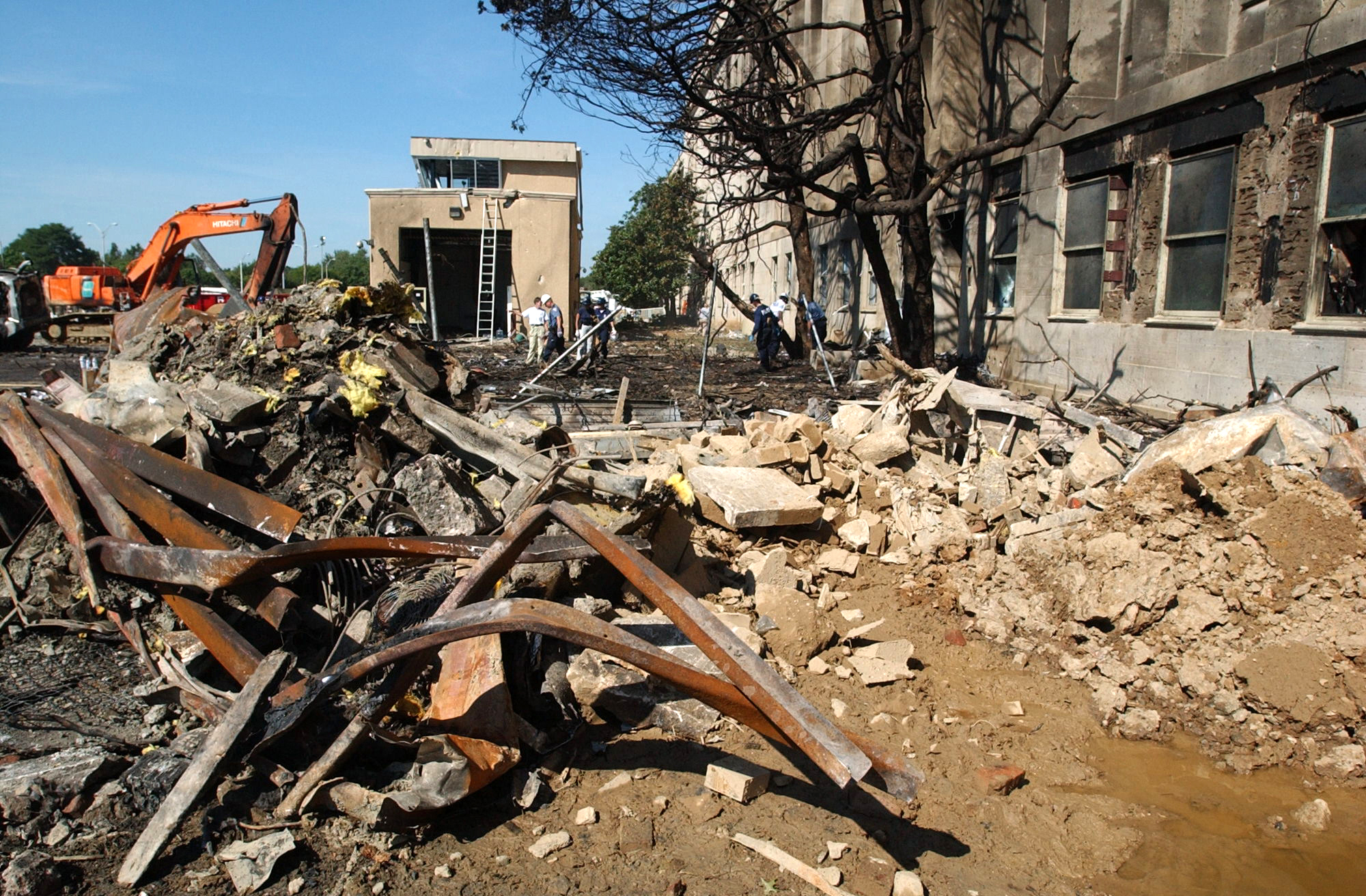
Wreckage and debris on the Pentagon grounds after Flight 77 struck the building. The Navy archive captions this September 12, 2001. Photographer’s Mate 1st Class Michael W. Pendergrass / U.S. Navy, 010912-N-3235P-019 · Public domain, official U.S. Navy photograph. · Source None; original file downloaded.
The record
American Airlines Flight 77 was a Boeing 757. The NTSB flight-path study reproduced in the official Pentagon history combines radar with data from the flight data recorder recovered at the site. Witnesses described an approaching airliner, and physical damage along its approach included struck obstacles. Photographs document aircraft wreckage. These are different types of evidence that should be assessed together, rather than letting one ambiguous frame carry the entire identification. [1][2]
Questions about the opening in the facade deserve the correct image and timing. A high-speed aircraft is not a rigid silhouette-shaped punch: wings and fuselage break up, different components carry different momentum, and structure can fail progressively. Some widely shared images show the site before the later facade collapse, while others focus on an interior opening rather than the full exterior impact region. A small opening in one wall is not a measurement of the entire damage path. [1]
The released security-camera recordings are poor tools for a cinematic view of a rapidly moving aircraft. Low temporal sampling and an unhelpful angle can leave only a fleeting, blurred appearance before the fireball. The FBI Vault provides the released material; it should be linked without claiming a frame shows more detail than it does. Demands for transparency over collected footage are legitimate, but “why is there no satisfying close-up?” is different from positive evidence of a missile. [1][3]
Witnesses can make mistakes, damaged flight recorders have limits and photographs can omit context. Their combined agreement nevertheless presents a much stronger test than any one of them alone. A missile or staged-crash alternative must account for the missing airliner and its occupants, the recovered aircraft data and debris, the approach observations and the actual damage. Pointing to an unresolved detail does not yet provide that integrated account. [1][4]
Documented checkpoints & limits
2001-09-11
Read the record in context
American Airlines Flight 77 was a Boeing 757. The NTSB flight-path study reproduced in the official Pentagon history combines radar with data from the flight data recorder recovered at the site. Witnesses described an approaching airliner, and physical damage along its approach included struck obstacles. Photographs document aircraft wreckage. These are different types of evidence that should be assessed together, rather than letting one ambiguous frame carry the entire identification. Source ↗
Evidence limit
Keep the conclusion proportionate
Do not identify a specific aircraft component solely from an unverified web photo, or imply all collected cameras had a useful view of impact. Source ↗
At the time
Radar, recovered recorder data, witnesses, damage and photographed debris support the Flight 77 impact. Weak security footage is not the whole case.
What the record shows
The airliner conclusion rests on converging records and physical evidence, with poor video quality openly acknowledged.
Contains eyewitness accounts, aircraft path and damage narrative, and NTSB Flight 77 flight-path study based on radar and recovered FDR. Some narrative timings rounded; use NTSB/Commission chronology for precise times.
Released security-camera and emergency-response recordings. A poor camera angle or sparse frames should not be represented as a clear aircraft close-up.
Public chronology, radar/FAA/NORAD reconstruction and shootdown authorization. Corrects some earlier official accounts; includes distinct evidence of communications failure rather than assuming all officials’ first statements were accurate.
Flight 93: a crater, scattered debris and the shootdown question
Recovered recorders, aircraft fragments, calls and the reconstructed timeline support a crash during passenger resistance, not a demonstrated military shootdown.
Flight 93 struck near Shanksville at approximately 10:03 a.m. in a fast, steep, nearly inverted impact. A photograph of a crater without an intact fuselage can look implausible if one expects an ordinary runway accident. The National Park Service describes excavated wreckage, engine parts, landing gear, seat frames and a sizable fuselage fragment, alongside many small pieces. Both flight recorders were recovered underground. The public record is therefore not an empty field and an unsupported assertion that an aircraft once existed. [1][2]
Debris distribution is another example where the material matters. NPS reports lightweight paper as far away as New Baltimore, eight miles from the crater. That is not the same as heavy engines scattered eight miles along an aerial breakup path. Wind and the crash plume can move light material much farther than dense components. Debris distance alone, stripped of its type, direction and recovery context, cannot distinguish a shootdown from a high-energy impact. [1]
The cockpit recording and flight data document a struggle and extreme control inputs before impact. Passenger and crew calls independently establish awareness of the other attacks and a decision to resist. Some calls used seat-back Airfones, so a general assertion that mobile phones could not work at cruise altitude does not dispose of this evidence. The public recorder account supports the hijackers crashing the aircraft as passengers attacked the cockpit, while leaving uncertainty about exactly how close the passengers came to regaining control. [1][2]
The United States did discuss and authorize shootdown, making the question entirely reasonable. The Commission reconstructed serious communications failures and distinguished authorization from successful transmission and execution. Its timeline does not establish an interceptor firing on Flight 93 before the crash; some military understandings of the event arose later amid confusion. An order, a mistaken situation report and a confirmed weapons engagement are different records. The available crash and recorder evidence fits passenger resistance and a deliberate final maneuver by the hijackers rather than a demonstrated missile strike. [3]
Documented checkpoints & limits
2001-09-11
Read the record in context
Flight 93 struck near Shanksville at approximately 10:03 a.m. in a fast, steep, nearly inverted impact. A photograph of a crater without an intact fuselage can look implausible if one expects an ordinary runway accident. The National Park Service describes excavated wreckage, engine parts, landing gear, seat frames and a sizable fuselage fragment, alongside many small pieces. Both flight recorders were recovered underground. The public record is therefore not an empty field and an unsupported assertion that an aircraft once existed. Source ↗
Evidence limit
Keep the conclusion proportionate
Recorder evidence does not show that passengers definitely entered the cockpit. Paper eight miles away is not evidence of engines eight miles away. Source ↗
Watch this question
Investigation of United Flight 93 ↗ FBI — Federal Bureau of Investigation — YouTube destination verified from FBI video page’s official “See on YouTube” link. YouTube fetch itself unavailable; FBI page provides full transcript. Includes discussion of death and recovery; link out without autoplay.
At the time
Recovered recorders, aircraft fragments, calls and the reconstructed timeline support a crash during passenger resistance, not a demonstrated military shootdown.
What the record shows
There was extensive recovered wreckage and recorder evidence. Shootdown authority existed, but execution against Flight 93 is not established.
Crash mechanics, distributed wreckage, recorder recovery and phone calls. Eight-mile debris detail refers to lightweight paper, not an eight-mile trail of heavy engines.
Includes downloadable NTSB flight-path report and recorder-recovery context. NPS graphic uses an edited photo: credit original photographer where required.
Public chronology, radar/FAA/NORAD reconstruction and shootdown authorization. Corrects some earlier official accounts; includes distinct evidence of communications failure rather than assuming all officials’ first statements were accurate.
Foreign contacts / 2000-02-01 · Unresolved support question
The San Diego assistance was real. What did the helpers know?
Two future hijackers received practical help in California. Whether that help was knowingly operational remains central to a live legal dispute.
The record
Nawaf al-Hazmi and Khalid al-Mihdhar arrived in Los Angeles on January 15, 2000. The Commission traced a February restaurant meeting with Omar al-Bayoumi, then help settling in San Diego: an apartment, paperwork, a lease guarantee and assistance with banking. It reported that they reimbursed his deposit advance. These were tangible services, not an invented connection. [1]
Fahad al-Thumairy, a Saudi consular official and imam, also attracted scrutiny; the Commission did not then establish his assistance. California contacts mattered to men lacking English and US experience. Asking who helped them is reasonable. It does not tell us, by itself, what a helper knew. [1]
A separate, devastating institutional failure concerned the United States: information about Mihdhar’s US visa and the men’s travel did not trigger timely, effective identification and pursuit. The Justice Department inspector general documented repeated breakdowns. This is evidence of a missed opportunity to stop identified extremists, rather than proof that every person around them understood their mission. [2]
The evidentiary assessment has changed since 2004. Judge George Daniels’s 2025 opinion drew preliminary adverse inferences about Bayoumi, Thumairy and Saudi employment, allowing jurisdiction. The ruling expressly left contested motives and credibility for trial. A fair account should neither freeze the record at the Commission’s earlier assessment nor turn those preliminary findings into a final liability judgment. [3]
At the time
Two future hijackers received practical help in California. Whether that help was knowingly operational remains central to a live legal dispute.
What the record shows
Established assistance; contested knowledge and state responsibility. Follow the evidence at each level separately.
Foreign contacts / 2016-07-15 · Unresolved support question
The 28 pages, Operation Encore, and a record that kept changing
The public did not receive the entire Saudi-related record in 2004. Later releases deserve attention—and careful reading of what sort of document each is.
The record
The so-called 28 pages were the withheld Part Four of the 2002 congressional Joint Inquiry, not missing pages of the later 9/11 Commission Report. They were released with redactions in July 2016. House Intelligence leaders explicitly warned that the section contained investigative leads rather than vetted final conclusions. The distinction helps explain why a document can be important without every allegation in it being established. [1][2]
The FBI continued examining possible assistance in Operation Encore. Its April 4, 2016 communication became public following the September 2021 declassification order. It records investigators’ analysis and witness-derived claims concerning Bayoumi, Thumairy and a possible support network. It belongs in the evidence trail, with its redactions, secondhand accounts and unresolved questions visible. It is not a verdict. [3]
The FBI’s EO 14040 collection contains multiple batches and subsequent updates. A release date tells us when the public obtained material; the date on the underlying memorandum tells us when it was written. Mixing those dates can make old allegations look like newly discovered events, or make genuinely new public access disappear. [4]
Our assessment: demanding disclosure and revisiting an earlier conclusion are legitimate. The strongest method is to identify the document, the speaker, what observation supports the claim, and what later inquiry did with it. A classified label never made a lead true; declassification alone does not make it false or prove it either.
At the time
The public did not receive the entire Saudi-related record in 2004. Later releases deserve attention—and careful reading of what sort of document each is.
What the record shows
There is a substantial disclosure history, not one final document that answers every Saudi question.
Princess Haifa’s checks: a real money trail with an unproved final step
Payments to the family of a Saudi acquaintance were real. The claim that they financed the hijackers requires an additional evidentiary link.
The record
The Joint Inquiry examined support from Princess Haifa, wife of Ambassador Prince Bandar, to Osama Bassnan’s wife. Some checks were co-endorsed by Bayoumi’s wife. That is a documented reason investigators followed the money; it should not be dismissed as a connection invented on the internet. [1][2]
The later released FBI timeline gives useful transaction-level cautions: three checks were co-endorsed, one attempted deposit was returned because the payee was not verified, and one destination account was unidentified. It explicitly says there was no indication of direct Princess Haifa payments to Bayoumi’s wife. An actual cleared payment, an attempted deposit and an inference about subsequent use are different facts. [2]
The Commission staff’s financing monograph said investigators had not found evidence that Princess Haifa funded the plot directly or indirectly. It also did not establish the purported Saudi donations to the two California hijackers. That was the staff’s finding on the record it examined, not permission to treat every later-produced document as irrelevant. [3]
Our assessment: the missing link is not whether charitable checks existed. It is proof showing that particular funds reached or knowingly enabled the operational conspiracy. Naming a donor, a recipient and an acquaintance in a chain does not establish every step between them. New bank records or credible testimony could change the assessment; repeated diagrams of the same unproved step cannot.
At the time
Payments to the family of a Saudi acquaintance were real. The claim that they financed the hijackers requires an additional evidentiary link.
What the record shows
Real payments and a legitimate investigative lead; knowingly funding the 9/11 operation is not established by these checks alone.
Foreign contacts / 1999 / public release 2024 · Unresolved support question
The Washington video seized in Britain
The recording is real. The important dispute is what Bayoumi was documenting, for whom, and whether it connected to the eventual plot.
The record
Bayoumi filmed Washington, including the Capitol, in 1999. The publicly released recording lets viewers examine the footage instead of relying entirely on descriptions of it. Bayoumi was not one of the 19 hijackers; identifying the cameraman correctly matters. [1]
The provenance runs through British police evidence seized after September 11, later litigation disclosure, and public release in 2024. February reporting described a newly unsealed motion and material supplied by the Metropolitan Police to the plaintiffs. The 2024 public story was not a video newly recorded in Britain. [2]
The recording’s attention to buildings and its narration warrant scrutiny. Plaintiffs interpret portions as reconnaissance; the Saudi side disputes that inference. [4] A physical recording establishes what appears on camera. Establishing that it was commissioned for an attack additionally requires evidence of tasking, recipients, purpose or operational use. The strength of those links should be assessed openly rather than supplied by the ominousness of a clip.
In May 2025, Senators Richard Blumenthal and John Cornyn requested the FBI’s chain of custody for the video and notepad, its analysis, and an explanation for what was supplied to the Commission and CIA. The bipartisan request shows that evidence handling became an explicit oversight issue. Its unanswered questions should not be presented as if they were already findings of deliberate concealment. [5]
The 2025 court opinion also discusses a handwritten airplane diagram recovered at Bayoumi’s home. It treats the existence and handwriting as undisputed while explicitly recognizing a dispute about meaning. This is a useful model for reading the video too: separate an authenticated artifact from the interpretation under litigation. The court did not decide all contested facts at this stage. [3]
Documented checkpoints & limits
1999 / public release 2024
Read the record in context
Bayoumi filmed Washington, including the Capitol, in 1999. The publicly released recording lets viewers examine the footage instead of relying entirely on descriptions of it. Bayoumi was not one of the 19 hijackers; identifying the cameraman correctly matters. Source ↗
Evidence limit
Keep the conclusion proportionate
The CBS link is a brief excerpt, not the entire recording. The footage, its custody history, the handwritten material and allegations about intent require separate assessment. The Senate letter asks oversight questions; it is not a final investigative finding. Source ↗
Watch this question
Omar al-Bayoumi video unsealed in court ↗ CBS / 60 Minutes Overtime — About 59 seconds of source footage within a CBS report; not the complete 1999 recording. Visible content and alleged intent are separate questions.
Foreign contacts / 2026-09-07 · Unresolved support question
The 2026 videos: Bayoumi, Awlaki, and the problem of withheld evidence
Newly public material challenges earlier denials of association. It also raises a distinct question about how investigative agencies handled evidence.
The record
In September 2026, BBC Panorama and Radio 4 reported newly public video of Bayoumi embracing Anwar al-Awlaki and taking part in paintball near San Diego with him and a Saudi religious official. The BBC reported that the material was placed on the public docket on September 4. Awlaki later became an al-Qaeda leader; that later role must not be projected backward as if it proves what everyone in an earlier gathering knew. [1][2]
The investigation reported that British-seized evidence reached the FBI after the attacks, but that some field investigators did not receive key material. It described internal disagreement about pursuing leads. Bayoumi had denied knowing Awlaki in his 2021 deposition. The videos therefore bear on the reliability of a specific denial, not simply on whether the men once attended the same large public event. The FBI declined comment; Bayoumi and Saudi authorities did not answer the BBC’s requests. [2]
An evidentiary failure can be consequential even without proving who caused it or why. If relevant material was not circulated, it may have prevented questions from being asked. Establishing deliberate suppression would require more: the decisions, responsible officials, knowledge and rationale. The observation and the proposed motive should remain separately labeled.
Our assessment: this is precisely the kind of later evidence that makes a current guide necessary. The responsible update is narrower than “the whole case is solved” and more substantial than “nothing new exists.” Watch the full documentary where available, read the supporting disclosures, and compare the new record with the particular earlier statements it challenges. [3][4]
Foreign contacts / 2026-10-07 · Unresolved support question
Where the Saudi lawsuit actually stands
The families cleared a major jurisdictional hurdle in 2025. Saudi Arabia appealed, and the appeal was argued in October 2026.
The record
On August 28, 2025, US District Judge George Daniels denied Saudi Arabia’s renewed motion to dismiss for lack of jurisdiction. His opinion did more than recite allegations: it drew preliminary adverse factual inferences about assistance and Saudi employment. It found the kingdom’s offered innocent explanations insufficient at that stage. [1]
The same opinion explicitly says the dispute includes motives, credibility and the meaning of artifacts, which may require trial. Its conclusion retains subject-matter jurisdiction under JASTA; it does not enter a final judgment holding Saudi Arabia liable for September 11. A jurisdiction ruling with evidence assessment is stronger than a bare accusation and different from a completed merits trial. [1]
The Second Circuit heard Saudi Arabia’s sovereign-immunity appeal on October 7, 2026. AP reported no decision date and no indication of the outcome. Saudi Arabia denies involvement and argues that it and the United States opposed al-Qaeda. The source record checked for this guide, through October 21, does not establish a later appellate outcome or final merits verdict. [2]
Our assessment: families seeking disclosure and compensation are pursuing a real legal controversy. It is misleading either to say Saudi responsibility has already been conclusively adjudicated, or to say the lawsuit was rejected for lack of evidence. Report the particular ruling, standard and date. The distinction protects the reader from headlines that overstate a victory or erase it.
Documented checkpoints & limits
28 August 2025
Read the record in context
On August 28, 2025, US District Judge George Daniels denied Saudi Arabia’s renewed motion to dismiss for lack of jurisdiction. His opinion did more than recite allegations: it drew preliminary adverse factual inferences about assistance and Saudi employment. It found the kingdom’s offered innocent explanations insufficient at that stage. Source ↗
Evidence limit
Keep the conclusion proportionate
The 2025 opinion made substantial preliminary findings while deciding jurisdiction. The identified October 2026 appeal is not reported here as a decided merits case. Source ↗
7 October 2026
The appeal is heard
The identified report describes appellate arguments and announces no outcome. Source ↗
At the time
The families cleared a major jurisdictional hurdle in 2025. Saudi Arabia appealed, and the appeal was argued in October 2026.
What the record shows
A serious, live case. Jurisdiction survived in district court; the October 2026 appeal was pending in the checked public record.
Foreign contacts / 2000–2001 · Unresolved support question
Iran: transit facilitation is real; operational foreknowledge is a different claim
The Commission documented Iranian transit assistance for future hijackers. It did not find that Iran or Hezbollah knew the September 11 plan.
The record
The Commission found strong evidence of facilitated al-Qaeda travel through Iran. At least eight future hijackers transited in October 2000–February 2001, benefiting from unstamped Saudi passports. This concerns transit and passports, not documented Iranian issuance of their US visas. [1]
It also found no evidence that Iran or Hezbollah knew the eventual September 11 plan, and recommended further investigation. Travel assistance, hostility toward America and knowing support for this operation are separate propositions. Neither Sunni–Shia hostility nor pragmatic cooperation resolves them automatically. [1]
US courts later entered default judgments against Iran, including the December 2011 Havlish judgment and later related awards. Those are real judicial findings under civil terrorism law, supported by evidence the court accepted—not imaginary rulings. Iran did not defend the case in an adversarial trial; the procedure and evidentiary record therefore differ from a fully contested criminal prosecution. [2][3]
A 2026 order still addresses issues including service on Iranian defendants. Litigation developments should be described in their actual procedural terms. The default judgments cannot simply be substituted for the Commission’s narrower intelligence conclusion, nor should their existence be concealed because they complicate a familiar summary. Evaluating a claim means asking which legal standard, evidence and specific conduct a source establishes. [4]
Documented checkpoints & limits
2000–2001
Read the record in context
The Commission found strong evidence of facilitated al-Qaeda travel through Iran. At least eight future hijackers transited in October 2000–February 2001, benefiting from unstamped Saudi passports. This concerns transit and passports, not documented Iranian issuance of their US visas. Source ↗
Evidence limit
Keep the conclusion proportionate
Distinguish documented transit facilitation, the Commission’s finding on foreknowledge and later civil default judgments. These are not an adversarial criminal verdict. Source ↗
At the time
The Commission documented Iranian transit assistance for future hijackers. It did not find that Iran or Hezbollah knew the September 11 plan.
What the record shows
Documented travel facilitation; no Commission finding of 9/11 foreknowledge. Later civil defaults require their own clearly labeled explanation.
Early reports about a paymaster hardened into a specific ISI accusation. The later financing reconstruction does not establish that accusation.
The record
One enduring claim says Pakistani intelligence chief Mahmud Ahmad ordered Ahmed Omar Saeed Sheikh to send $100,000 to Mohamed Atta. Early reporting about payments and uncertain paymaster identities helped the allegation spread. An October 2001 CNN transcript still describes investigators following reported payments by “Sheik Syed,” citing sources while the inquiry was developing. It is evidence of what was being reported then, not the completed financial reconstruction. [1]
The later Commission staff financing study traces money through named al-Qaeda facilitators, bank transactions and transfers involving the UAE, Germany and Pakistan. It does not establish the claimed Ahmad–Sheikh instruction. Confusing people who share parts of an Arabic or South Asian name can create apparent corroboration where the underlying identity is not the same. [2]
The Commission distinguished uncertainty about al-Qaeda’s ultimate fundraising sources from its reconstruction of how operational money reached the hijackers. “Some origins remain unknown” does not mean no transfers were traced; equally, tracing transfers does not prove every possible upstream donor. The Commission did not identify a foreign government as supplying the plot’s funding on its examined evidence. [3]
Our assessment: classify this specific ISI wire story as unproved. A reliable advance would be an authenticated bank record tied to the correctly identified sender, plus credible evidence of the alleged instruction. Repeating an early anonymous-source report through several later books or posts does not supply those missing pieces. Pakistan’s broader relationship with the Taliban warrants scrutiny without being treated as proof of this particular transfer.
At the time
Early reports about a paymaster hardened into a specific ISI accusation. The later financing reconstruction does not establish that accusation.
What the record shows
Specific ISI order unproved; early reporting should not outrank the later transaction-based reconstruction without new evidence.
Five arrests, an investigation, and a leap to Israeli responsibility
The New Jersey arrests happened. Treating them as proof that Israel organized the attacks adds conclusions the public evidence does not establish.
The record
Five Israelis were detained after suspicious behavior was reported in New Jersey. [1] Two common retellings go wrong in opposite directions: one says the incident never occurred, while another treats an arrest as completed proof of a state operation. The fact of an investigation does not settle the allegation that motivated it.
A claim about the intelligence affiliations of particular people is distinct from a claim that they knew the attack timetable, and both differ from a claim that they organized the attacks. A complete case would need to bridge each step. The public materials cited here do not provide that bridge. Calling the men suspicious is not a substitute for showing knowledge, tasking or participation.
A separate story concerns messages received by two Odigo employees in Israel before the attacks. Computerworld interviewed a company executive, who described a nonspecific threat that did not mention the World Trade Center. The company supplied information for investigation. That is a real reported warning, with a much narrower content and audience than the viral claim of a warning sent to all Jews in New York. [2]
Our assessment: neither incident establishes Israeli authorship of September 11. A troubling report can deserve investigation without becoming an evidentiary blank check. The same standard should apply to all intelligence services: identify the people, the document and the actual conduct, rather than treating nationality as a finding.
Documented checkpoints & limits
2001–2002
Read the record in context
Five Israelis were detained after suspicious behavior was reported in New Jersey. Source ↗
Evidence limit
Keep the conclusion proportionate
The cited public record does not establish foreknowledge or operational responsibility. Arrest, allegation and proof are distinct; absence of proof is not a claim to have audited all intelligence files. Source ↗
At the time
The New Jersey arrests happened. Treating them as proof that Israel organized the attacks adds conclusions the public evidence does not establish.
What the record shows
Real incidents; public evidence cited here does not establish advance knowledge or Israeli organization of the attacks.
How a missing-person inquiry became “4,000 Jews stayed home”
A false advance-warning story grew by changing what a number meant, who it described, and what those people were supposedly doing.
A white rose at the names around the 9/11 Memorial reflecting pools in New York, photographed during a September 2019 visit. This is a memorial photograph, not a photograph of the attack. U.S. Navy / Mass Communication Specialist 1st Class Sarah Villegas · Public domain / DVIDS · Source Original source image or official web rendition. Displayed without adding scene details.
The record
The story that 4,000 Jewish World Trade Center workers were warned to stay home is false. Contemporary reporting and the State Department’s later review trace the number to inquiries about thousands of Israelis who might have been in the affected areas. A request to locate people after a disaster was transformed into a claim that they had escaped it through advance warning. [1][2]
The categories changed along the way: Israelis became Jews; people possibly in New York and Washington became employees of the towers; relatives seeking news became a secret evacuation. Those substitutions are the mechanism of the rumor, not minor wording differences. The resulting claim does not follow from the original missing-person concern. [1][2]
Jewish people were among those killed. A precise total is not needed to see the fundamental failure of a story claiming an entire population had been forewarned and spared. The State Department’s review discusses victim estimates while warning against turning nationality, religion and missing-person lists into interchangeable statistics. [1]
Our assessment: this is a clear case where following the earliest version is more useful than debating a meme’s confident final sentence. It is possible to scrutinize an Israeli agency, like any government agency, without assigning collective responsibility to Jews or treating a fabricated employee count as evidence. The correction concerns the claim and its evidence, not a reader’s intelligence or motives.
At the time
A false advance-warning story grew by changing what a number meant, who it described, and what those people were supposedly doing.
What the record shows
False claim with a traceable mutation from post-attack missing-person inquiries.
Did traders know? What the put-options investigation found
Some trades looked suspicious enough to investigate. The central question was whether they connected to foreknowledge, rather than whether they were unusual.
The record
Put options can gain value when a share price falls, so buying airline puts before September 11 naturally attracted attention. The SEC began investigating on September 12. Its eventual statement reports examination of more than 9.5 million transactions, 103 companies in six industry groups and several markets, alongside law enforcement and overseas regulators. It said it developed no evidence of trading based on advance knowledge of the attacks. [1]
The Commission’s notes provide more than a general reassurance. One institutional investor accounted for 95 percent of the United Airlines puts bought on September 6 and also bought American Airlines shares on September 10. Another part of the American put activity followed a publicly circulated recommendation. Investigators traced transactions and explanations rather than assuming every bearish trade was suspicious. [2]
This does not mean unusual prices or trading volume were unreal. Nor can a public summary demonstrate the reason for every transaction ever made. It does mean the allegation must confront actual investigated trades and the offered contrary evidence. A chart showing improbability alone does not identify who knew what, how they learned it, or whether a legitimate strategy produced the same position.
Our assessment: suspicious first impressions were investigated; a proven foreknowledge trading network did not emerge from that inquiry. If a critic identifies a particular omitted trade with documents and a credible beneficiary connection, evaluate it specifically. Expanding an unexplained statistical pattern into a story about a named person secretly organizing murder requires evidence of that extra claim. [3]
At the time
Some trades looked suspicious enough to investigate. The central question was whether they connected to foreknowledge, rather than whether they were unusual.
What the record shows
Investigated anomaly, no substantiated attack-foreknowledge trading finding in the cited record.
The lease, insurance, and what a payout actually meant
A recent lease and a large insurance claim are real. They are not, by themselves, evidence that the insured caused the destruction.
A Coast Guard port-security crew patrols the Hudson River in the weeks after the attacks. Archive date fields reflect later publication; the source caption identifies the scene. Chief Petty Officer Brandon Brewer / U.S. Coast Guard · Public domain (U.S. government photograph); no endorsement implied. · Source No local alteration; downloaded source-provided image rendition.
The record
The Port Authority entered the relevant net leases on July 24, 2001. The timing was close to the attacks, and it is understandable that readers notice it. But insuring a major leased property is an ordinary requirement, so the existence of coverage cannot by itself establish foreknowledge. A causal allegation needs more than a short interval between two dates. [1]
The Second Circuit’s 2003 opinion lays out an unusually important contractual dispute: which insurance wording governed, and whether the attacks counted as one “occurrence” or two. Different binders and definitions mattered. The court did not adopt a universal rule that two airplanes automatically entitled the insured to twice every policy limit. [2]
New York’s comptroller reported in 2007 that settlements brought the total from the original World Trade Center insurers to about $4.55 billion, with proceeds shared in the rebuilding arrangements between Silverstein and the Port Authority. That is different from a personal $7 billion profit. A gross insurance recovery cannot be treated as net personal gain while ignoring the destroyed asset, contractual obligations and reconstruction. [3]
Our assessment: the dates, policies, lawsuits and payments can all be checked. None of the cited decisions establishes that Larry Silverstein arranged the attack. A genuine contract dispute after a disaster is not a fraud finding; the size of a recovery does not supply evidence about who caused the loss. Keep the money question open to documents, rather than using it as a shortcut around the causal question.
At the time
A recent lease and a large insurance claim are real. They are not, by themselves, evidence that the insured caused the destruction.
What the record shows
Real lease and insurance litigation; no established plot or insurance-fraud finding in these sources.
“Pull it”: an ambiguous phrase is not a demolition record
The phrase is authentic. Its interpretation should be tested against the whole account and physical evidence, rather than treated as a confession in isolation.
The record
In the 2002 PBS documentary America Rebuilds, Silverstein recalled a discussion about the danger around World Trade Center 7 and used the words “pull it.” Demolition proponents interpret the phrase as an order to destroy the building. His spokesperson later said he meant withdrawing firefighters. Those are the authentic dispute and the response; silently replacing one meaning with certainty obscures what the evidence actually is. [1]
The withdrawal explanation should itself be attributed, rather than presented as a recording of the original conversation. The documentary is a later recollection. An ambiguous expression, especially a pronoun with no independently established referent, cannot bear the same weight as a contemporaneous operational instruction with corroborating witnesses and records.
Our assessment: there is no basis for treating the phrase alone as an admission of preinstalled explosives. The demolition hypothesis must still explain the physical sequence and produce evidence for preparations, devices and execution. Readers can assess that evidence in the engineering entries without first settling a debate about every possible use of a two-word expression.
It is fair to find the wording awkward or to wish the original conversation had been recorded. Uncertainty about wording is not an obligation to accept the most incriminating interpretation. An account should remain proportional to what its source can establish: here, that he later used a phrase and later offered a particular explanation. [1]
Documented checkpoints & limits
2002-09
Read the record in context
In the 2002 PBS documentary America Rebuilds, Silverstein recalled a discussion about the danger around World Trade Center 7 and used the words “pull it.” Demolition proponents interpret the phrase as an order to destroy the building. His spokesperson later said he meant withdrawing firefighters. Those are the authentic dispute and the response; silently replacing one meaning with certainty obscures what the evidence actually is. Source ↗
Evidence limit
Keep the conclusion proportionate
The phrase and its later explanation are evidence about a disputed statement. Language alone does not establish a demolition mechanism. Source ↗
At the time
The phrase is authentic. Its interpretation should be tested against the whole account and physical evidence, rather than treated as a confession in isolation.
What the record shows
Authentic phrase, contested interpretation; insufficient evidence of demolition by itself.
The August 6 President’s Daily Brief was titled “Bin Ladin Determined To Strike in US.” It discussed al-Qaeda intentions, possible hijackings, suspicious domestic activity and a reported explosives threat. It did not provide the September 11 date, four-flight plan or identified target list. Calling it merely irrelevant history understates its warning; calling it an operational schedule overstates it. [1]
The Commission’s summer-threat chapter documents rising alarm, fragmented intelligence and failures to combine domestic leads with overseas warnings. The difficult question is not whether somebody somewhere had said terrorism was possible. It is whether the government used the information available to identify a developing operation, and why the system failed to do so. [2]
In September 2026 the CIA published a collection of 71 declassified PDB products, with individual dates ranging across the pre-attack period and a September 12 situation report. It includes previously dated threat discussions, alongside the August 6 brief. These are documents written then and publicly collected or released now, not warnings received by officials in 2026 about an attack that had already happened. [3]
Our assessment: warning failures are a substantial basis for accountability. They do not establish that Bush directed the murders, or that officials who recognized general danger knew the precise plan and deliberately permitted it. Those stronger claims require evidence of specific knowledge and intent. The publication of additional records should refine that assessment, rather than being treated automatically as either total vindication or total proof of a plot.
At the time
The government had serious warnings. A fair account must neither erase them nor convert them into proof of knowing authorization.
What the record shows
Serious warning and prevention failures are documented; operational direction or deliberate permission is not established by the briefing.
“Do the orders still stand?”: air defense and a disputed recollection
A genuinely troubling passage of testimony deserves its full context. The documented defense failure is not evidence of a verified order to let the attacks happen.
President George W. Bush and Defense Secretary Donald Rumsfeld inspect Pentagon destruction in the days after the attack. Archive date fields disagree; this caption does not assert an exact day. R. D. Ward / U.S. Department of Defense · Public domain (U.S. government photograph); no endorsement implied. · Source No local alteration; downloaded source-provided image rendition.
The record
Transportation Secretary Norman Mineta testified in 2003 that a young man gave Cheney decreasing distance reports about a plane and asked, “Do the orders still stand?” Cheney affirmed them, according to Mineta. He associated this with the approach to the Pentagon. Under questioning he said he had not been present for the original decision and did not know about the shoot-down order at the time. The passage does not itself identify a stand-down instruction. [1]
The Commission’s reconstructed timeline differs from Mineta’s recollection about the bunker sequence. That discrepancy should be acknowledged, not quietly edited away. The report relied on contemporaneous communications, radar and other records to revise several early military accounts. Conflicting recollection is a reason to examine records; it does not uniquely identify which participant supposedly concealed a plan. [2]
Fighters did launch, while false information about an aircraft still airborne, delayed notifications and communication failures impaired the response. The Commission found that earlier public accounts of when the military learned about particular hijackings were wrong. Those corrections make blanket claims that the response was simply prompt and normal untenable. They also contradict the claim that no defensive action occurred. [2]
Vigilant Guardian, a real NORAD exercise, explains why a controller initially asked whether the alert was real. The Commission’s chapter 1 note 116 says it examined interference and found extra staffing helped the response; General Eberhart described a roughly 30-second transition. That is the Commission’s assessment, not a claim that every training scenario or decision was flawless. The existence of a drill does not itself establish deliberate obstruction. [2][3]
Our assessment: the stand-down case needs an actual instruction to withhold interception, with evidence tying it to the attacks. The quoted question does not establish that content. Read the whole hearing exchange, then compare it with the records-based timeline. The institutional failure remains grave even when the dramatic conclusion attached to one recollection is not proved.
At the time
A genuinely troubling passage of testimony deserves its full context. The documented defense failure is not evidence of a verified order to let the attacks happen.
What the record shows
Documented confusion and incorrect early accounts; this testimony does not establish a deliberate let-it-happen order.
A surviving passport: surprising does not mean physically impossible
The passport stories often combine several different recoveries. Begin with which document, where it was found, and when.
The record
The Commission’s first travel statement describes four hijacker passports surviving in whole or part: two from the Flight 93 site, one picked up near the World Trade Center and handed to a detective before the towers collapsed, and one recovered from luggage that did not reach the connecting American 11 flight. These are four different recovery circumstances. A document left in luggage did not have to survive the aircraft impact at all. [1]
The street recovery is the item usually raised as an impossibility. It is reasonable to ask for its provenance and chain of custody. But an impact, fire and later building collapse do not expose every object to an identical history. Some material can be expelled or shielded while other material is destroyed. “The building was devastated” does not specify the temperature, duration or forces experienced by one small object. Nor does “survived in whole or part” mean every passport was pristine.
The Commission also reported document manipulation in some surviving passports, and acknowledged that most attackers’ original passports did not survive. Those limits matter. The travel reconstruction combines visas, entry records, other recovered papers and investigative work; it should not be described as nineteen perfectly preserved passports found in the rubble. The FBI’s Flight 93 retrospective separately discusses recovered passports and other evidence. [1][2]
This guide has not independently recreated the street document’s entire custody chain. It therefore does not ask that one object carry the full identification case. A serious challenge would identify a specific inconsistency in its record and compare that with the rest of the documentary evidence. A surprising survival, by itself, is not a physical demonstration of planting.
Documented checkpoints & limits
2001–2004
Read the record in context
The Commission’s first travel statement describes four hijacker passports surviving in whole or part: two from the Flight 93 site, one picked up near the World Trade Center and handed to a detective before the towers collapsed, and one recovered from luggage that did not reach the connecting American 11 flight. These are four different recovery circumstances. A document left in luggage did not have to survive the aircraft impact at all. Source ↗
Evidence limit
Keep the conclusion proportionate
The surviving-passport account is a published investigative account. This edition did not inspect the original documents or independently audit every custody transfer. Source ↗
At the time
The passport stories often combine several different recoveries. Begin with which document, where it was found, and when.
What the record shows
Keep the separate recoveries separate, and test a custody allegation with records rather than an assumption that all objects must be destroyed alike.
Preliminary January 2004 staff findings, including the provenance of four surviving passports. Later final monographs refine other travel totals; this article uses only the passport account.
Investigators’ first-person recollections and transcript. Official retrospective, not an independent custody audit or a publication of every recovered item.
A claim that phones could not work at cruising altitude often overlooks the aircraft’s installed telephone system and the precise call being discussed.
The Commission’s notes distinguish installed airphones from cellular calls. Flight 93 had airphones in passenger rows, with a system capable of carrying eight calls at once; investigators compared records with interviews of recipients. A blanket claim about ordinary mobile coverage at high altitude does not analyze calls made through an aircraft’s dedicated telephone system. The appropriate question begins with the caller, time, equipment and surviving record. [1]
There are genuine uncertainties in the published documentation. For American 77, the Commission says that the available records cannot determine which of four connected calls to unidentified numbers correspond to Barbara Olson’s reported conversations with her husband. It also explains the FBI and Justice Department’s reasoning about those calls and the interviews with the recipients. That is a disclosed evidentiary limitation, not an instruction to pretend every call assignment was independently timed and identified. [1]
For Flight 93, recipients’ accounts, telephone records and the cockpit recording contributed different information. The Commission describes relying principally on interviews conducted while memories were fresh, supplementing some with its own interviews. Human recollection can be imperfect; it is useful precisely because it can be compared with records rather than treated as a substitute for them. The FBI’s retrospective also explains the recovery of the recorders. [1][2]
A voice-fabrication theory needs positive evidence of fabrication in these particular calls. Demonstrating that a recording can be edited, or that a modern synthetic voice can imitate someone, does not establish that either technique produced these 2001 communications. Conversely, acknowledging dedicated airphones does not authenticate every circulated audio file. Work from the identified records, and keep unknown details visible.
Documented checkpoints & limits
2001–2004
Read the record in context
The Commission’s notes distinguish installed airphones from cellular calls. Flight 93 had airphones in passenger rows, with a system capable of carrying eight calls at once; investigators compared records with interviews of recipients. A blanket claim about ordinary mobile coverage at high altitude does not analyze calls made through an aircraft’s dedicated telephone system. The appropriate question begins with the caller, time, equipment and surviving record. Source ↗
Evidence limit
Keep the conclusion proportionate
No original audio or billing database was independently forensically authenticated for this edition. The article distinguishes the published records and their stated uncertainties. Source ↗
At the time
A claim that phones could not work at cruising altitude often overlooks the aircraft’s installed telephone system and the precise call being discussed.
What the record shows
The installed airphone system changes the central technical premise. Remaining uncertainty about one call’s identification should be stated rather than generalized to every call.
Investigators’ first-person recollections and transcript. Official retrospective, not an independent custody audit or a publication of every recovered item.
Why did early reports say some hijackers were still alive?
The first lists contained provisional identifying details. A person with a matching name is not necessarily the person in the later photographic and travel record.
The record
The FBI’s September 27, 2001 photograph release preserves how provisional early descriptions could be: it lists possible nationalities, multiple dates of birth and tentative pilot descriptions. Some men who were not the four hijacker-pilots were described as believed pilots in that early release. Those statements should not be silently promoted into the final account. They are evidence of an identification process still being worked through. [1]
The later FBI investigation summary identifies nineteen attackers, their national origins and two pairs of brothers, while the Commission’s reconstruction ties individuals to travel and flight records. A report about a living person with a matching or similar name is a lead to investigate, not by itself proof that the later identified individual survived. Names, transliteration, dates, photographs and travel history need to be compared together. [2][3]
The continuing dispute is visible in BBC Trust’s 2012 consideration of programme complaints: surviving-hijacker assertions were among the arguments the broadcaster was asked to address. The fact that an older report remains in an archive does not mean it is still the publisher’s final identification finding. It is also fair to expect corrections and changes of identification to be plainly explained to readers. An archive should preserve the original uncertainty without letting it masquerade as a later conclusion. [4]
This guide therefore uses the final travel reconstruction for its nineteen-person flight directory and explicitly labels the early release as preliminary. It does not infer guilt from an Arabic name or nationality, and it does not reproduce unrelated living people’s photographs as if they were attackers. The question is about specific identities in a documented plot, not collective suspicion.
At the time
The first lists contained provisional identifying details. A person with a matching name is not necessarily the person in the later photographic and travel record.
What the record shows
Early identification errors deserve disclosure. The test is whether a claimed living person matches the later documented identity, not just a name on a hurried list.
Contemporaneous preliminary list. Some role descriptions and identifying details were provisional; do not silently use it as the final flight-role table.
Later official identification account, reporting the attackers’ nationalities and flight assignments. It is distinct from the hurried initial descriptions.
Bipartisan commission synthesis, with extensive documentary references and important dependence on intelligence reporting for portions of the planning story. Read the separate interrogation-limits article.
The broadcaster’s review of programme complaints, including surviving-hijacker and evidence-disposal allegations. The existence of a complaint is not a finding that the complaint is correct.
The BBC really did report Building 7’s collapse too early
The error is real. The inference that it proves advance knowledge of a demolition requires additional evidence.
The record
BBC reported that WTC 7 had collapsed while it was still standing. PolitiFact’s review traces the broadcaster’s later explanation to an erroneous Reuters report that was subsequently corrected. It also identifies BBC editor Richard Porter’s public discussions of the episode in 2007. There is no need to deny the original mistake in order to examine what caused it. [1]
A crucial contextual fact is that firefighters and observers had already been concerned about a collapse after hours of uncontrolled fire. NIST documents the building’s damage, fires and the eventual collapse. Reports that a dangerous building might fall, reports that it was falling, and reports that it had fallen are different statements. A news chain can wrongly transform one into another without receiving a demolition timetable. [1][2]
That explanation is not a claim that journalism never conceals anything, or that a correction makes a failure unimportant. It identifies a mechanism that can be checked against the source chain. The alternative allegation would need evidence that a reporter or newsroom received information from a planned attack, and that such information explains the report better than the erroneous agency dispatch and the public expectation of collapse.
The fair way to watch the clip is to retain its time, the building visible behind the reporter, the surrounding reports and the later correction. Do not crop away the actual error; do not turn an error into proof of every subsequent inference. The engineering question of why WTC 7 collapsed is examined separately, including the acknowledged free-fall interval and disagreement about modeling.
Documented checkpoints & limits
2001–2021
Read the record in context
BBC reported that WTC 7 had collapsed while it was still standing. PolitiFact’s review traces the broadcaster’s later explanation to an erroneous Reuters report that was subsequently corrected. It also identifies BBC editor Richard Porter’s public discussions of the episode in 2007. There is no need to deny the original mistake in order to examine what caused it. Source ↗
Evidence limit
Keep the conclusion proportionate
The Reuters/BBC source-chain explanation is attributed to the broadcaster and secondary review. This edition did not obtain internal newsroom communications. Source ↗
At the time
The error is real. The inference that it proves advance knowledge of a demolition requires additional evidence.
What the record shows
The premature report warrants scrutiny as a reporting failure. It does not supply the missing evidence of a planned demolition or newsroom participation.
Secondary fact-check identifying the erroneous Reuters report and BBC’s explanation. The acknowledgement of an error is not independent verification of every newsroom decision.
Technical agency source for fires, evacuation concerns, collapse evidence and the probable sequence. A predicted risk of collapse is distinct from privileged knowledge of a planned demolition.
The $2.3 trillion problem was real—and public before September 2001
Unsupported accounting entries are a serious control failure. They are not the same quantity as a newly discovered pile of missing cash.
The record
A February 25, 2000 Defense Department Inspector General report identified $6.9 trillion in accounting entries used to prepare fiscal 1999 statements. Of that amount, $2.3 trillion lacked adequate support, $2 trillion was not reviewed because of time constraints and $2.6 trillion was supported. The report’s disclaimer and categories were published long before September 10, 2001. These are accounting-entry totals, not a finding that $2.3 trillion in new cash vanished that day. [1]
Rumsfeld referred to the tracking problem in his September 10 speech. PolitiFact documents both that remark and the preceding public audit record and testimony. The dramatic juxtaposition with the next day’s attack can obscure the chronology: the financial-control problem was already known. A theory that September 11 erased a just-announced discovery must first account for the records that had already been published. [2]
It would also be wrong to dismiss the underlying failure as merely a harmless clerical exercise. GAO has explained how inadequate systems and forced-balance adjustments can undermine reliable reporting. Its May 2026 testimony describes continued material weaknesses and the lack of a clean department-wide opinion. Poor accounting can conceal waste and impede accountability; those are substantive reasons to demand better controls. [3][4]
The further claim that the attack was arranged to destroy the only accounting evidence needs its own records: which evidence, which office, what copies existed elsewhere, and what establishes attack-planning involvement? A large unsupported-entry total does not answer those questions. Financial mismanagement and murder are different allegations, each requiring evidence appropriate to it.
Documented checkpoints & limits
1999–2026
Read the record in context
A February 25, 2000 Defense Department Inspector General report identified $6.9 trillion in accounting entries used to prepare fiscal 1999 statements. Of that amount, $2.3 trillion lacked adequate support, $2 trillion was not reviewed because of time constraints and $2.6 trillion was supported. The report’s disclaimer and categories were published long before September 10, 2001. These are accounting-entry totals, not a finding that $2.3 trillion in new cash vanished that day. Source ↗
Evidence limit
Keep the conclusion proportionate
No complete defense-accounting audit was conducted for this edition. The article explains the cited reports and rejects an unsupported conversion of journal-entry totals into a cash-loss or attack-planning finding. Source ↗
At the time
Unsupported accounting entries are a serious control failure. They are not the same quantity as a newly discovered pile of missing cash.
What the record shows
Name the actual financial category and preserve the pre-attack timeline. Serious accounting failures do not independently establish a motive-and-mechanism case for the attack.
Original report published eighteen months before the attacks. The accounting-entry categories and the disclaimer are essential to interpreting the sum.
Secondary source locating the September 10 speech in the earlier audit record. No conclusion about the physical attack is inferred solely from this fact-check.
Explains nonroutine and forced-balance adjustments and genuine continuing control weaknesses. It is not a claim that financial mismanagement is harmless.
Contemporary GAO testimony on continued financial-management problems. Later audit failures are not evidence of a particular 2001 attack-planning mechanism.
War, expanded power and the difference between consequence and authorship
The aftermath transformed policy. That does not make every asserted account of the attack’s authorship true.
President George W. Bush and Defense Secretary Donald Rumsfeld inspect Pentagon destruction in the days after the attack. Archive date fields disagree; this caption does not assert an exact day. R. D. Ward / U.S. Department of Defense · Public domain (U.S. government photograph); no endorsement implied. · Source No local alteration; downloaded source-provided image rendition.
The record
The attacks had enormous policy consequences. Congress enacted the Authorization for Use of Military Force on September 18, 2001, authorizing action against those responsible for the attacks and those who harbored them. The enacted text is a direct record of expanded legal authority. One does not need to accept an inside-job theory to examine the scope of that authorization or criticize later uses of power. [1]
Iraq requires particular care. The Commission examined contacts between Iraqi officials and al-Qaeda but did not establish a collaborative operational relationship or Iraqi cooperation in the attacks against the United States. Its separate account of post-attack decision-making describes officials considering Iraq as the response developed. A later war is not evidence that Saddam Hussein organized September 11, nor does rejecting that claim endorse the decisions that followed. [2]
A motive argument can identify a reason someone might welcome a consequence, benefit from it or exploit it afterward. It is not, by itself, evidence that they arranged the event. The missing links would concern planning, orders, communications, resources and actions connecting a particular actor to a particular mechanism. Those links cannot be supplied merely by listing policies a reader strongly opposes.
The same standard protects serious criticism. Intelligence failures, abuse in the response, misleading public arguments and consequential policy choices should be judged on their own records. They need not be denied to defend the evidence of al-Qaeda’s operation, and they need not be converted into proof of a staged attack to deserve investigation.
At the time
The aftermath transformed policy. That does not make every asserted account of the attack’s authorship true.
What the record shows
The consequences are part of the history. Criticize and investigate them directly, while testing an authorship allegation against evidence of participation.
The enacted authorization demonstrates a real policy consequence. A subsequent benefit or expansion of power is not itself proof of who organized the prior attack.
Bipartisan commission synthesis, with extensive documentary references and important dependence on intelligence reporting for portions of the planning story. Read the separate interrogation-limits article.
The first stage was not a finished, single theory. Incomplete reports, contradictory broadcasts and unanswered questions appeared while the rescue and investigation were still unfolding. Later histories of the movement describe how internet distribution let selected images and interpretations travel beyond the audiences of books and conventional broadcasts. Conflicting explanations could share the same broad suspicion while disagreeing about the mechanism. [1][2]
The online release of Loose Change in 2005 became a major point in that circulation. A contemporaneous September 2006 public debate between its filmmakers and Popular Mechanics editors records the arguments meeting an organized rebuttal. This is useful as a historical artifact, not as a shortcut for deciding an engineering or intelligence question by which speaker sounds more persuasive. The specific claim still needs its underlying source. [1][3]
Old material can acquire a new date when it is reposted. A premature 2001 report or a grainy security frame may look like a fresh disclosure to someone encountering it for the first time. By contrast, a newly released document or video can genuinely add evidence. The distinction is whether the material is newly public, newly interpreted, or merely newly viral. Those categories can overlap, but they should not be silently substituted for one another.
This is why the guide gives the Saudi footage and new intelligence releases their own dated files while retaining separate examinations of physical claims. A 2026 disclosure does not automatically validate a 2005 film, and a mistaken claim in a film does not make every later disclosure unimportant. Respect for the reader means allowing the record to become more specific rather than demanding allegiance to a package of beliefs.
At the time
The claims have a history too: early mistakes, films, public debates, recycled clips and genuine later document releases.
What the record shows
A claim’s spread and a claim’s truth are different histories. Follow the original date, the original material and the specific evidence added by a later release.
History of circulation, including the first 2005 online film. Describes how claims spread, rather than proving a psychological account of any particular viewer.
Institutional historical discussion of conflicting claims and their circulation. The museum is a memorial and educational institution, not a criminal court.
A contemporaneous artifact showing a public confrontation of the claims. Linked as a historical debate, not as an endorsement of either speaker’s every assertion.
Egyptian, educated in architecture in Cairo and Hamburg. Trained in Florida in 2000 and coordinated the American teams. Connected from Portland to Boston on the morning of the attack.
Saudi; a university graduate according to the Commission. Arrived in the United States in 2001 and traveled with Atta through Portland on September 10–11.
Saudi, from Asir province; brother of Waleed. Arrived in the United States in 2001. Similar names elsewhere in early news reports should not be assumed to identify this man.
Saudi, from Asir province; brother of Wail. The public record includes his American travel before joining the Boston team. Neither brother is the same person as Marwan al-Shehhi.
Saudi, from Riyadh. Arrived in the United States in 2001. A passport recovered near the World Trade Center was attributed to him; his identity also appears in the wider travel record.
Emirati; studied in Germany through a military scholarship and joined the Hamburg circle. Trained with Atta at Huffman Aviation in Florida and took simulator instruction.
Emirati, one of the two non-Saudi members of this flight team. Worked with financial facilitator Mustafa al-Hawsawi before reaching the United States in 2001.
Saudi, associated with the al-Bahah regional group. Entered through Dulles on May 2, 2001 with Majed Moqed. Later moved to the team that boarded United 175 in Boston.
Saudi, from the al-Bahah region. Entered the United States in 2001. A shared tribal surname is insufficient evidence that he was a brother of every other al-Ghamdi in the roster.
Saudi, from Asir province. Had begun university studies according to the Commission. Distinct from Wail and Waleed al-Shehri and from the flight’s pilot Marwan al-Shehhi.
Saudi, from Taif. First came to the United States in 1991; earned an FAA commercial pilot certificate in April 1999. Returned in December 2000 and trained further before joining the Washington team.
American 77 / Cabin-control hijacker; senior operative
Saudi and an early al-Qaeda recruit for the operation. Arrived in Los Angeles with Mihdhar on January 15, 2000; lived in San Diego and later joined Hanjour. Brother of Salem.
Saudi national with family connections in Yemen. Appeared at the watched Kuala Lumpur gathering, entered America in January 2000, left in June and re-entered on July 4, 2001.
Saudi, born in Mecca; younger brother of Nawaf. Entered the United States in 2001. His biography and entry history should not be merged with those of his older brother.
Lebanese, from an affluent family; studied in Germany and joined the Hamburg circle. Trained separately in Florida, maintained family and romantic ties, and returned from a final German visit before the attacks.
Saudi, associated with the al-Bahah regional group. Entered the United States in 2001. Distinct from another prospective operative also called Saeed al-Ghamdi in the travel monograph.
Saudi, from the al-Bahah region. Entered the United States in 2001 and spent time in Florida before boarding United 93. Transliteration as Ahmed does not establish a separate person.