Michigan childhood and family split
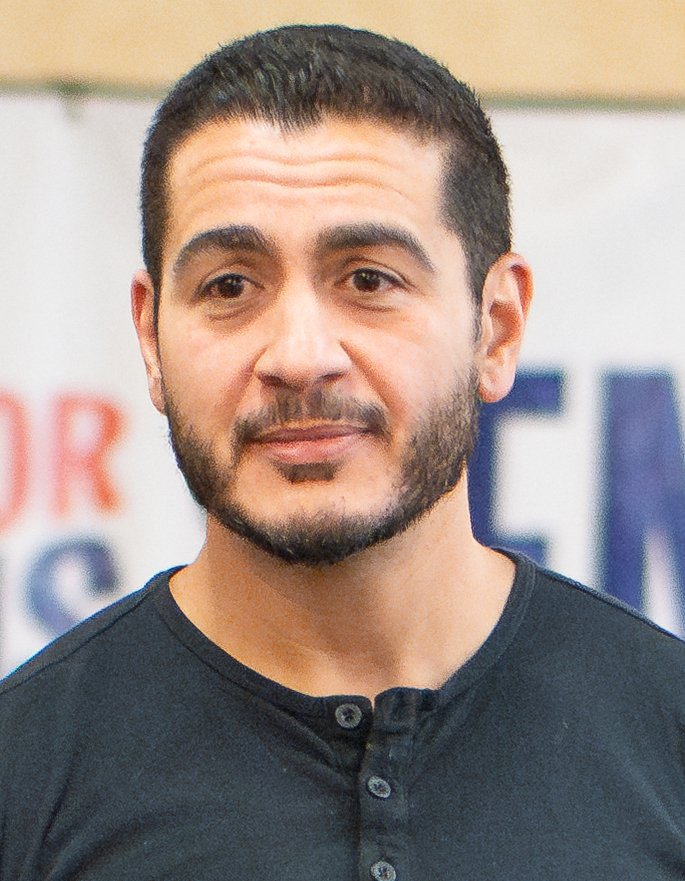
El-Sayed was born in 1984 in suburban Detroit. Contemporaneous biographical accounts place him largely raised by his father, Mohamed El-Sayed, after his parents’ divorce (commonly dated around 1987), with his mother Fatten Elkomy’s household and network remaining part of the later public file. The birthplace and family structure are not themselves controversies; they are the start of affiliation chapters that campaigns later treat as a pipeline.[1]
The full guide keeps stepmother Jacqueline El-Sayed and maternal half-sister Eman Abdelhadi on labeled edges — family facts first, political inferences second.
Egyptian-American identity and Dearborn-area Muslim community context appear throughout later affiliation chapters as setting — not as a loyalty verdict. The hub biography keeps childhood geography and household structure separate from IARA employment and letter-signature fights that arrive decades later.
Michigan, Rhodes, Oxford, Columbia
He earned a University of Michigan bachelor’s (biology and political science, 2007), a Rhodes Scholarship (2009), an Oxford DPhil in public health, and a Columbia MD (2014). He did not complete a residency and built a public-health / academic / podcasting identity rather than a clinical practice — a credential fight opponents later compressed into “not a real doctor.” University records document the degrees; licensing and residency gaps are also documented and argued in-guide.[2]
The biography treats the credential spine as load-bearing chronology, not as a smear or a clearance.
Essays, the Morsi letter, early politics
In 2011 he published essays on Egypt’s revolution that critics later read as optimistic about the Muslim Brotherhood’s role. On November 25, 2012 he appears among signers of a public statement backing Mohamed Morsi’s constitutional declaration — a dated primary that opposition ads treat as proof of Brotherhood loyalty and that defenders treat as a snapshot of a contested democratic moment. The full guide rates “secret Brotherhood operative” as unproven against that spine; a signature is not a membership card.[3]
Half-sister Eman Abdelhadi’s social posts (2012–2013, resurfaced 2026) sit on a separate contested edge — her words are not automatically his program.
Opposition research packages often collapse essays, the Morsi letter, half-sister posts, and later streamer/undercover clips into one “Brotherhood” sticker. The full guide’s critical path refuses that collapse: each hinge must stand on its own dated primary before a stronger theory can borrow it.
Detroit health and Wayne County
From 2015 he led Detroit’s health-department rebuild after emergency management, with lead testing and institutional recovery as the public spine. Later Wayne County health, human services, and detention responsibilities, plus national medical-debt advocacy (including July 2024 Senate HELP testimony), form the governing brand his Senate campaign amplifies. Lead progress and juvenile-detention emergency fixes are documented with limits — real work, unfinished problems.[4]
Wayne County’s juvenile-detention emergency and lead-testing limits are part of the same public-health brand voters meet in 2026 ads. The collection does not treat unfinished municipal problems as proof of malice — or as automatic clearance of every campaign metric.
2018 governor race; books and debt advocacy
El-Sayed ran for Michigan governor in 2018 with progressive backing, won a ballot-eligibility fight in court, and lost the Democratic primary. He wrote, podcasted (America Dissected), and pressed medical-debt narratives that Bridge Michigan and others later audited — including a contested “$700 million” framing. The collection keeps advocacy metrics and campaign slogans as labeled strands.[5]
FEC categories, consulting income, and overseas rental disclosure fights sit beside the debt-advocacy brand. Money chapters in the full guide date the filings; this hub only names the strand so visitors know where to open the deep file.
2026 Senate race and the affiliation fight
After Sen. Gary Peters announced retirement (January 28, 2025), El-Sayed entered the Democratic primary (April 17, 2025), defeated Haley Stevens after Mallory McMorrow exited, and became the nominee facing Mike Rogers. Harris and Obama endorsements, record fundraising quarters, AIPAC/UDP primary spending against him, Grand Rapids and Detroit debates (family/IARA, Iran/IRGC, loyalty frames), and an on-camera Brotherhood disavowal sit on the 2026 spine. As of the full guide’s late-October 2026 cutoff, Election Day had not yet decided the seat.[6]
See the full guide for chapters, critical path and rival theories. Parent drawer: The Politicians Files.
BIOGRAPHY SOURCES
- Birth year/place (Detroit area, 1984); parents Mohamed El-Sayed and Fatten Elkomy; divorce timing as dated in the full guide / contemporaneous bios.
- University of Michigan degree (2007); Rhodes Scholarship (2009); Oxford DPhil; Columbia MD (2014); residency/licensure limits as cited in-guide.
- 2011 Egypt essays; November 25, 2012 Morsi statement signature list; half-sister posts resurfacing as cited in the full guide.
- Detroit health director period (from 2015); Wayne County leadership; lead-testing and detention reporting cited in-guide.
- 2018 governor primary and eligibility litigation; America Dissected; medical-debt advocacy and July 11, 2024 Senate HELP testimony; Bridge Michigan reviews as cited.
- Peters retirement (Jan 28, 2025); campaign launch; McMorrow exit; Aug 2026 primary; endorsements; debates (Oct 8 and Oct 21, 2026); Brotherhood disavowal; late-October polling averages as cited in-guide.
 FULL GUIDE