Fourteen documentary guides to organizations, local cells and individual cases—and the different evidence behind their outcomes.
A negotiated surrender, an interrupted plot, a conviction and a reversal answer different questions. Begin with the full case files; the comparisons and chronology below keep those differences visible.
Start with the full case files
14 completed guides.
Nine organizational or local-cell histories, Gordon Kahl and his decentralized milieu, the John Birch Society as a separate political-advocacy history, and three related individual cases. These are completed research editions, not a list of alleged members of one movement. The Bund is a historical American Nazi organization; Kaczynski is a separate anti-industrial case. Neither is relabeled as a contemporary right-wing militia.
The pinned content date and original author belong to each selected edition; they are not reassigned to the collection builder.
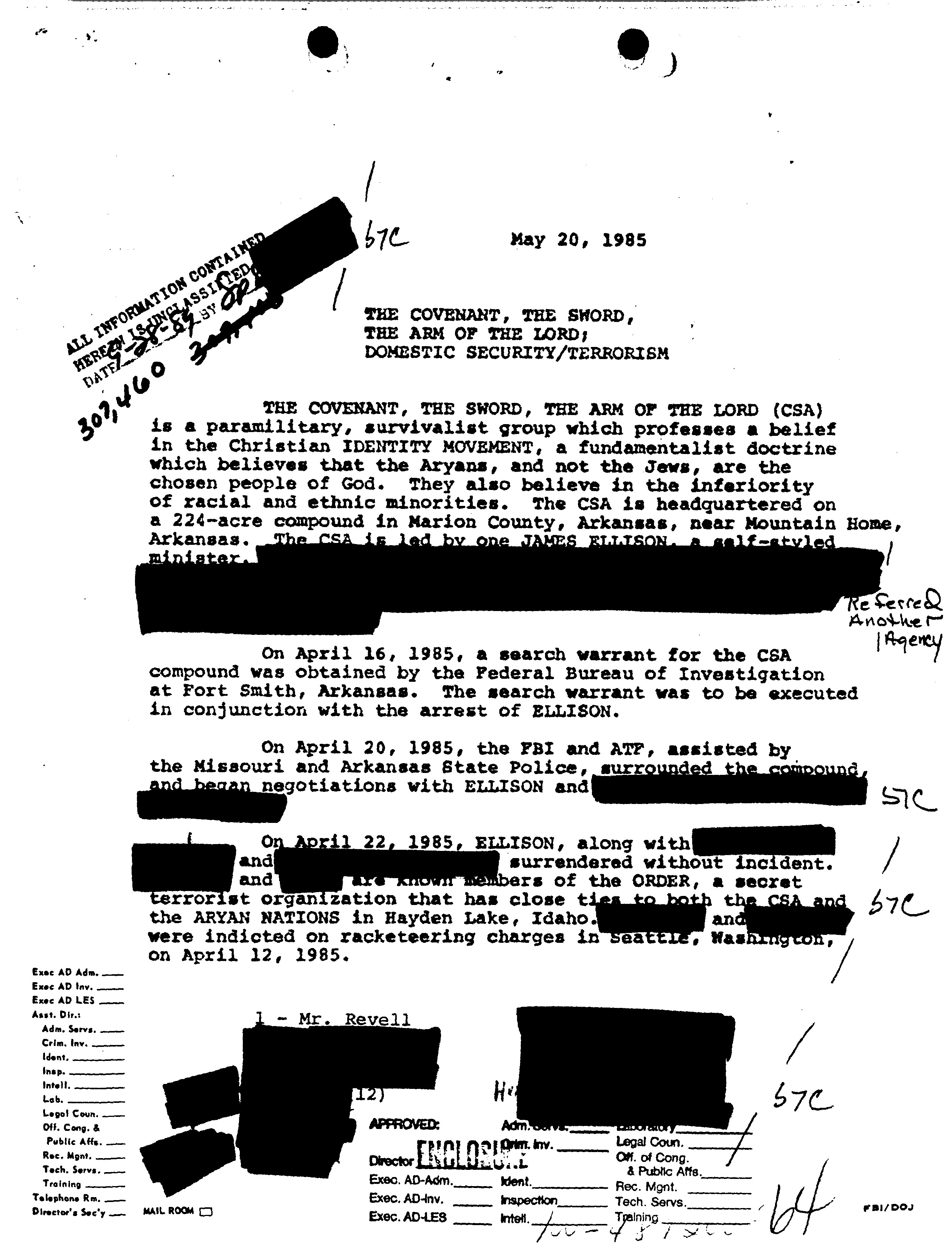
Image: FBI memorandum on the surrender, 20 May 1985
Organization / Klan violence and a particular murder case
The murders of James Chaney, Andrew Goodman and Michael Schwerner, local official participation, federal conspiracy verdicts and Killen’s later state manslaughter convictions.
Context and later records: 1964–2021 / organizing, trials and public memory
Graph division: context/core through 1967; later dates in the second graph.
A paid cooperator’s recordings, the strongest defense accounts, three jury convictions and distinct sentences; no attack on the intended apartment target occurred.
Context and later records: 2015–2021 / the verified public record
Graph division: context/core through 2019; later dates in the second graph.
The FBI-facility plans transaction, informant dispute and individual convictions and acquittals; prosecution claims and appellate findings remain separate.
Context and later records: 1994–2023 / organization, sting and public accounts
Graph division: context/core through 1998; later dates in the second graph.
Foreign connections, public mobilization, leadership fraud and different speech, draft, espionage and citizenship cases; membership alone does not decide individual guilt.
Context and later records: 1936–1941 / origins and selected aftermath, 1924–2024
Graph division: context/core through 1941; later dates in the second graph.
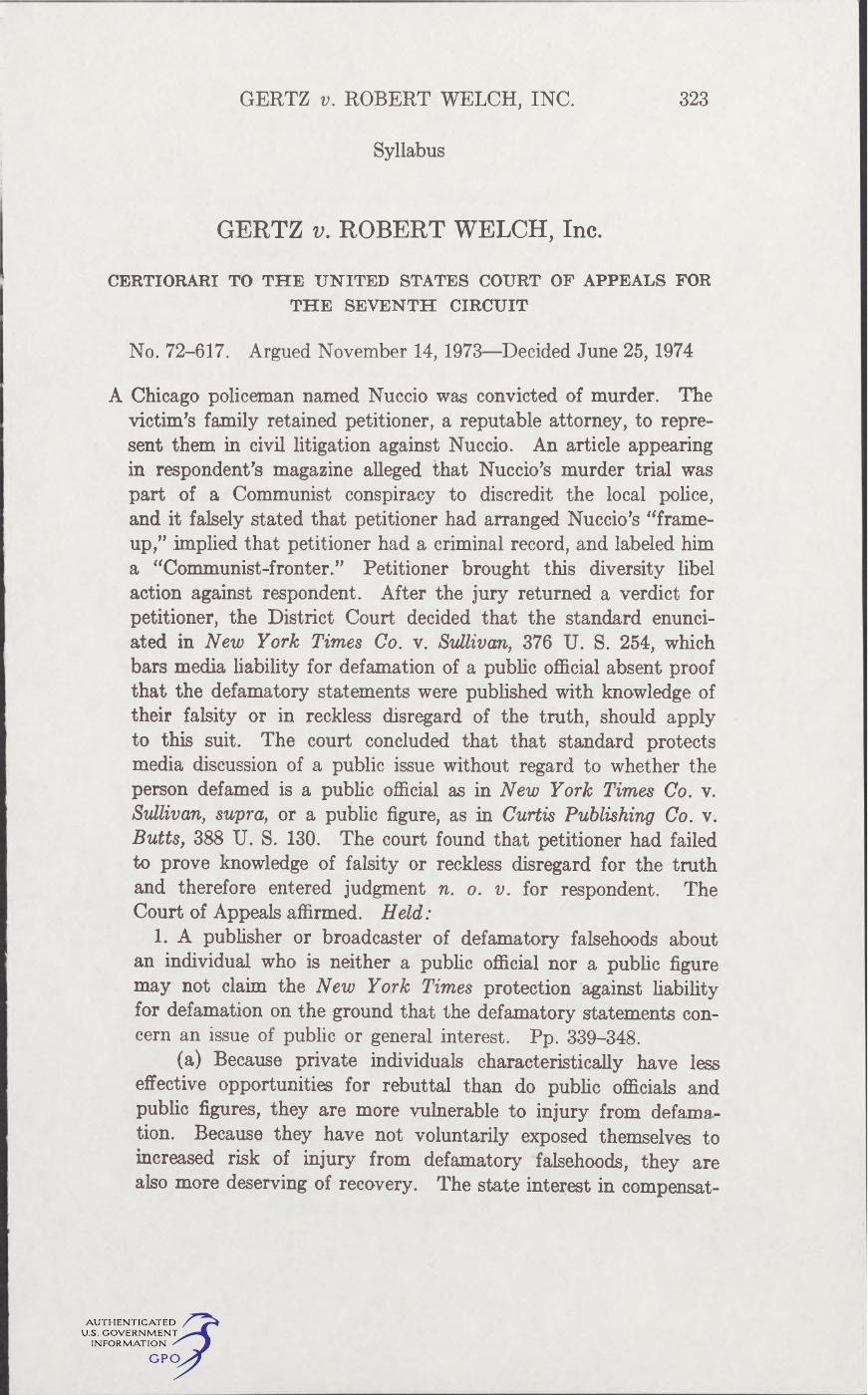
A separate anti-communist political organization: its chapter method, public allegations, conservative disputes and the affiliated publisher’s Gertz litigation. Included without classifying advocacy or membership as militia crime.
Context and later records: 1945–2026
Graph division: context/core through 1982; later dates in the second graph.
Related individual case / anti-government terrorism
The Oklahoma City bombing, different defendants and judgments, witness and alternative-suspect disputes, and the FBI’s late document-disclosure failure.
Context and later records: 1993–2026
Graph division: context/core through 2001; later dates in the second graph.
Related individual case / separate anti-industrial ideology
Publication, family recognition, evidence, the guilty plea and divided legal opinions; property and retention litigation did not reverse the convictions.
Context and later records: 1978–2026
Graph division: context/core through 1998; later dates in the second graph.
Original: ChatGPT (OpenAI) · gpt-6.1-sol · Reasoning medium · Codex.
Pinned content: 2026-10-26T03:00:48-07:00 · ChatGPT (OpenAI) · gpt-6.1-sol · Reasoning medium · Codex. Full history ↗
Historical and institutional overview
Organizations, authority and the people affected.
The names in this collection describe different kinds of association. The Bund had a leadership structure, camps and a Nazi political program. The Order organized a comparatively concentrated criminal enterprise. The Base connected a dispersed network, while its Maryland proceedings established cooperation and unequal roles among particular defendants. The Phineas name could be self-adopted; the Spokane judgments concern identified local people. A shared name, a theological tradition and a proved agreement are different kinds of evidence.
The collection also preserves the distinction between political advocacy and criminal conduct. The John Birch Society’s chapter organization, public campaigns and allegations about hidden control belong to the history of American anti-communism. Its inclusion does not classify the Society or ordinary members as a militia or participants in the other cases. The Gertz litigation concerns a particular affiliated publisher and false allegations about a named lawyer. Courts likewise refused to let Bund membership alone settle every citizenship or criminal case.
Violence had particular victims and intended targets. Chaney, Goodman and Schwerner were murdered in Mississippi in 1964. Alan Berg was killed in Denver in 1984. The Garden City defendants planned an attack on a building occupied by Somali Muslims, but that intended attack did not occur. Those distinctions matter both to the people affected and to the legal record: a conspiracy can be proved before a completed attack, while a murder investigation can encounter jurisdictional limits and years of failed accountability.
Enforcement did not follow one script. Negotiation ended the CSA compound confrontation and the Montana Freemen standoff. The pursuit of Gordon Kahl ended in another fatal confrontation and later litigation over a home’s destruction. Informants and undercover contacts helped build the Mountaineer and Garden City cases, but the resulting defense arguments have to be tested against each case’s actual recordings, admissions and legal rulings. A peaceful surrender does not prove prior innocence; a conviction does not resolve every question about official conduct.
A label is the beginning of an inquiry, not its verdict
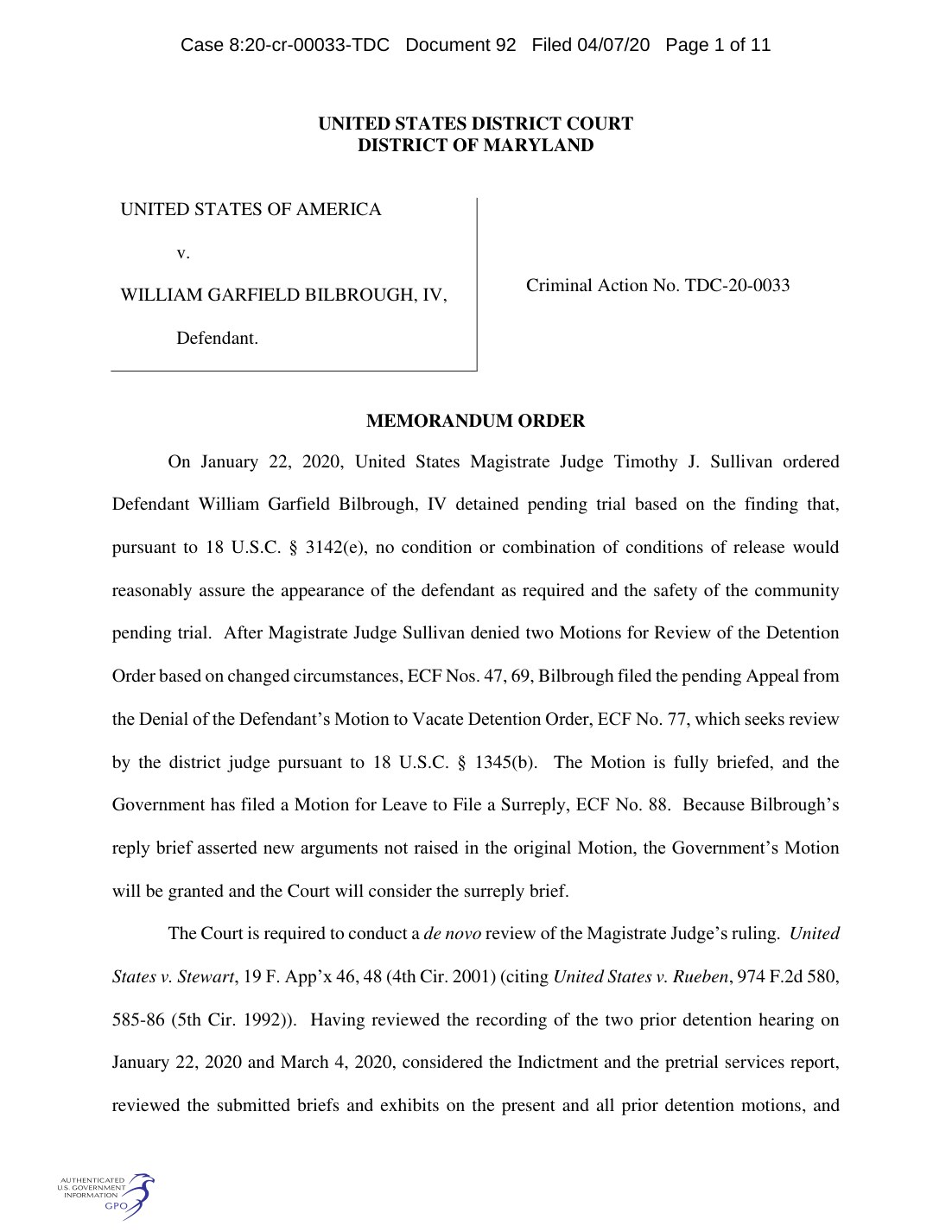
The Bund, The Base and the Phineas/Spokane case expose different problems of scale. Courts examined organized activity and particular conduct; they did not simply assign every act to everyone who appeared under a name. Bilbrough’s assistance to Mathews was criminally significant, but the detention opinion expressly distinguished his role from the specific Virginia-event preparations. The Spokane record concerns a local cell using an identity rather than proof of a nationwide command.
An account of a wider organization has to identify the people, communications or resources connecting it to the act. Conversely, decentralization does not make identified cooperation imaginary. Authenticated instructions, financial records or corroborated communications could change a proposed command relationship; a similar slogan or another case’s conviction would not.
A surrender can end a confrontation without ending its cases
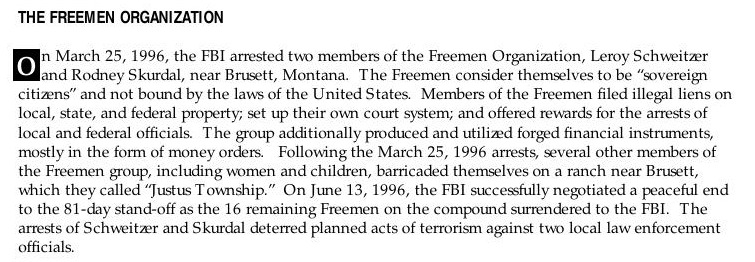
The CSA and Montana confrontations ended through negotiated surrender. The Freemen’s financial and other prosecutions continued afterward; the CSA’s later sedition case produced acquittals distinct from earlier convictions. The collection therefore places the surrender and each subsequent judgment on their own dates.
The CSA record also has a traceable institutional afterlife: Coulson’s discussion in the DOJ Waco report explicitly compares negotiating experience at the earlier compound. That is evidence of a stated lesson moving between official accounts. It does not establish that conditions at the two sites were identical or that a particular alternative would certainly have succeeded. Montana’s negotiation analysis similarly treats outside intermediaries as contingent contributors, not a universal remedy.
Informant participation and entrapment are different propositions
The Garden City guide identifies Dan Day as a paid cooperator, distinct from an undercover government agent. The defense challenged predisposition, the informant’s role and the meaning of recorded conversations. The appellate ruling addressed whether the evidence warranted an entrapment instruction and permitted the jury’s use of recordings with transcripts. The claim that an investigator influenced events is therefore tested against an actual evidentiary and legal sequence.
Mountaineer defendants raised their own statutory and source-credibility objections. Those claims belong to that case’s transaction and convictions, not a pooled theory that every sting is either fabricated or unquestionably proper. Complete unedited recordings, contemporaneous contact instructions and reliable evidence about who originated an agreement would matter to a disputed inducement account. The collection does not claim to have audited all such materials.
A later conviction does not replace an earlier verdict
The Mississippi record separates the 1967 federal civil-rights conspiracy prosecution from the state homicide case brought decades later. Edgar Ray Killen’s 2005 convictions were for manslaughter, not murder. Earlier acquittals and the unresolved jury result in his federal case cannot be silently converted into the later state outcome. The gap also requires attention to local officials and the failure to bring a timely state prosecution.
The same discipline applies elsewhere: a court can reject a broad conspiracy prosecution without undoing a defendant’s separate convictions. These comparisons concern the units of proof and legal authority; they do not equate the victims, offenses or historical circumstances. A new authenticated judgment or order can change an outcome record. An accusation in an investigative file cannot substitute for it.
The number on a document may describe something else
The Freemen opinion distinguishes more than $15 billion in purported instrument face value from millions of dollars in losses. The Order’s financing accounts distinguish a particular robbery and later accounts of its amount from all money circulating through the enterprise. The Bund’s public rally attendance, members and people connected to camps are likewise different counting units.
A large printed figure is not self-interpreting. What was valued, counted, recovered or independently verified determines its use in the story. Ledgers, verified transaction records or reliable membership files could refine these estimates. Repeating one source in several later summaries does not create several independent counts.
A confrontation’s end can leave an unresolved force dispute
Gordon Kahl’s tax case, Medina confrontation, Arkansas refuge and the destruction of a home produced different records and different legal questions. The property litigation preserved disagreements about force and immunity without serving as a criminal trial of every official. The Order guide likewise distinguishes the federal account of flare-caused fire from questions of intent, legality and available alternatives at Whidbey.
Neither a martyr narrative nor an official justification can replace the causal record. Authenticated contemporaneous orders, complete recordings, reliable forensic findings and corroborated witness accounts could alter a particular assessment. A later film’s dramatization or a court’s qualified-immunity ruling alone does not establish every disputed physical fact.
Scientific limits, disclosure failures and legal reversals change different things
The Spokane record follows comparative bullet-lead evidence through later scientific criticism and a rejected collateral challenge. The Oklahoma City record follows the FBI’s late disclosure of documents through an inspector-general inquiry into collection and disclosure failures. Neither development is accurately summarized as proof that every piece of evidence was fabricated; neither can be dismissed just because convictions remained in place.
A court’s power and the question before it also matter. Kaczynski’s later property and retention proceedings did not reverse his guilty plea. A revised sentence, a new scientific limit, a procedural ruling and a finding about guilt belong in separate columns. The underlying opinions and disclosure record, rather than a general claim that a case was ‘reopened,’ establish what changed.
An interrupted plot is an outcome, not a count of hypothetical victims
The Garden City plot was disrupted before the intended apartment attack. The Base arrests interrupted a particular cluster before the Richmond rally; pleas and sentencing findings established serious conduct without turning every proposed future act into a completed event. The Mountaineer prosecution similarly concerned a particular agreement and transfer rather than a destroyed FBI facility.
Prevention claims can be supported without an exact estimate of lives saved. The evidence has to establish steps toward a criminal purpose and the intervention that interrupted them. More complete authenticated planning and communications could strengthen or narrow a claim about readiness or intent. They could not replay the counterfactual with certainty.
Identification needs more than a convincing public story
The related individual cases show different routes from suspicion to an identified defendant. Rudolph’s case preserves Richard Jewell’s wrongful scrutiny. Kaczynski’s case traces family recognition, text comparison and physical evidence. The Oklahoma City proceedings preserve witness disputes and different defendants’ roles. Inclusion together is an investigative comparison, not proof of shared membership or an identical motive.
Recollections, document comparisons and physical evidence can support one another, but their independence and timing matter. A vivid account repeated after publication is not automatically a new witness. The full guides identify what was admitted, tested, disputed or outside the court’s particular ruling.
A remembered resemblance is not yet a transmission trail
Several child guides trace actual publication lineages. The Order’s 2024 film adaptation is connected through a read account to the 1989 book; the Kahl file distinguishes a published book and a later television adaptation from contemporaneous evidence. The Bund guide examines filmmakers’ actual descriptions of their use of archival material. These are documented transformations of particular stories, not proof that their audiences endorsed the organizations.
The Birch guide asks for institutions, people, documents or explicit citation before treating a later movement as an organizational descendant. That test also protects these comparisons from an invented single genealogy of the American right. Cultural prominence remains unmeasured here: a film, ceremony, interview or repeated claim demonstrates an actual public appearance, not a poll or rank across all readers.
Dated records are copied from the fourteen pinned child editions with original precision, case labels, source identifiers and links to their full-guide anchors. For this collection, dates through each displayed graph-division year appear in the first graph; later dates appear in the second. This editorial division supports comparison of initial cases and later records. Original guide focus and coverage spans remain separate; none is presented as an organization’s lifetime. Markers use elapsed-year spacing. Colors identify cases; proximity establishes neither contact nor influence. Source counts measure indexed records, not independent corroboration. Year- or month-only dates are placed at the start of that stated period on the graph; the list retains their original precision.
No dated records match these filters.
The Covenant, the Sword, and the Arm of the Lord
The Order
The Base
Phineas Priesthood and the Spokane bombings
White Knights and Mississippi Burning
The Crusaders and the Garden City plot
The Mountaineer Militia
The German American Bund
Gordon Kahl and Posse Comitatus
The John Birch Society
Timothy McVeigh & Oklahoma City
Eric Rudolph and the bombing campaign
The Unabomber / Theodore Kaczynski
The Montana Freemen
Context and selected core periods
19241948197319972022
Consequences, inquiries and later records
19421963198420052027
Dated records
Teutonia-era organization supplies a predecessorThe German American Bund / Origins / Context or core period
The later district-court reconstruction traces an American National Socialist organization to 1924 and subsequent name changes. This is predecessor context, not a founding date for the 1936 Bund.
The Friends becomes the immediate predecessor. Naturalized citizens and German nationals participated; later Bund citizenship claims did not erase this inheritance.
Dated record in the full guide ↗Kuhn’s delegation visits HitlerThe German American Bund / Foreign connections / Context or core period
The 1940 House report describes the visit, relief contribution and conflicting accounts of what Hitler told Kuhn. It is evidence of a relationship; no comprehensive written command chain follows from the meeting alone.
The new organization inherits members and assets from the Friends under Kuhn. Exact March days differ in the selected accounts, so the event uses month precision.
Dated record in the full guide ↗Justice Department membership estimateThe German American Bund / Counting support / Context or core period
The 1940 report cites an investigative estimate of 6,500 in 1937. It is not interchangeable with Kuhn’s later claimed membership or sympathizer totals.
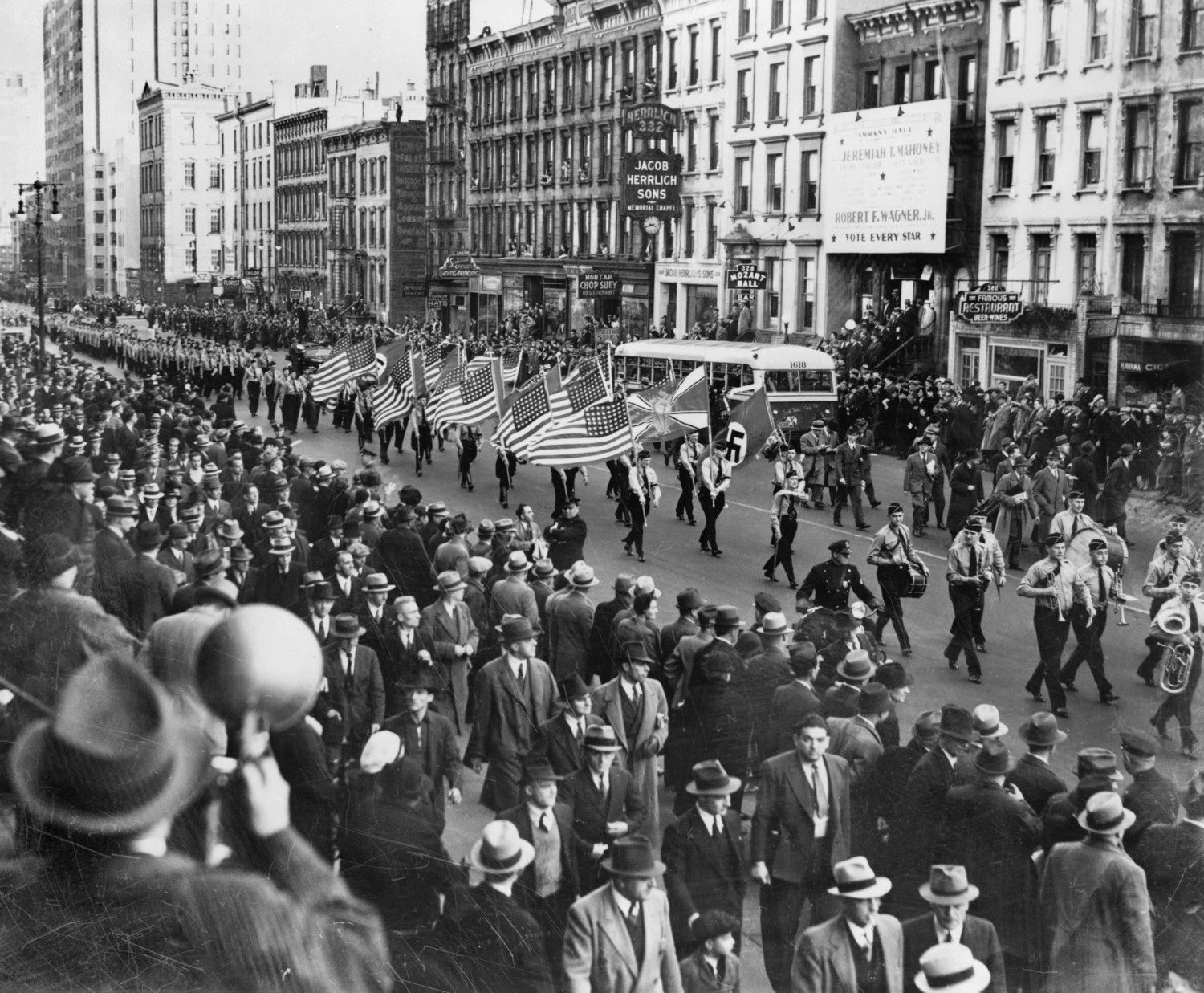
Dated record in the full guide ↗Bund parades on East 86th StreetThe German American Bund / Public mobilization / Context or core period
The selected World-Telegram staff photograph documents a New York procession. Its 1937 date is preserved; it is not a photograph of the 1939 Garden rally.
Dated record in the full guide ↗Gilbert reports German restrictionsThe German American Bund / Diplomacy / Context or core period
The telegram records intended public and confidential instructions restricting German nationals, officials and party members. Freytag describes internal resistance; execution of every measure is not established here.
Dated record in the full guide ↗Hull records Dieckhoff’s notificationThe German American Bund / Diplomacy / Context or core period
The ambassador announces restrictions on German nationals’ participation in organizations interfering in American affairs. Hull refers to prior American complaints and expresses satisfaction.
Dated record in the full guide ↗Madison Square Garden rallyThe German American Bund / Public mobilization / Context or core period
The Bund holds its large New York rally. Archival accounts describe patriotic pageantry joined to antisemitism; attendance is not an audited national membership total.
Dated record in the full guide ↗Kuhn receives a prison sentenceThe German American Bund / Financial case / Context or core period
A contemporary report gives a term of 2½–5 years. Publication and reported sentencing-day accounts differ; this event keeps December precision. The punishment was for theft and forgery, not a judicial ban on his political views.
The FBI retrospective distinguishes acting leadership after Kuhn’s imprisonment from election in 1940. Local organizations and membership did not vanish at the moment of Kuhn’s conviction.
Dated record in the full guide ↗House report publishes its Bund findingsThe German American Bund / Investigation / Context or core period
Report 1476 states a strong foreign-direction conclusion, identifies propaganda and training connections and distinguishes 20–25 kclaimed members from 80–100 ksympathizers. It attributes destruction of lists to Kuhn’s admission.
The Act included an employment restriction on Bund and Communist Party members. The ensuing Bund protest and Command 37 were central to the later conspiracy prosecution.
Dated record in the full guide ↗The defense-information conspiracyThe German American Bund / Espionage case / Context or core period
The later appellate record describes the charged 1941 agreement involving Kunze, Vonsiatsky, Willumeit, Ebell and Molzahn. The indictment, pleas and verdict concerned named people, not all Bund members.
The organization ends amid war, leadership loss and government action. The precise legal basis of every measure described later as “outlawing” is not established by the alien-enemy proclamation alone.
Dated record in the full guide ↗New Jersey reverses speech convictionsThe German American Bund / Speech case / Context or core period
State v. Klapprottreverses convictions under the speech and premises provisions. The court criticizes antisemitic utterances while rejecting the statutory basis for punishment.
Dated record in the full guide ↗German alien-enemy proclamationThe German American Bund / War and government action / Context or core period
Proclamation 2526 covers defined German nationals aged 14 and over who were not actually naturalized. It is not an order declaring every German American or Bund attendee guilty of a crime.
The default judgment follows his 7 Julycriminal arrest. Its later procedural history would extend through a Supreme Court mandate and an adverse 1950 appeal.
The FBI dates his federal sentence following a guilty plea. The later Molzahn appeal records the plea and 15-year term. This was Kunze, not Fritz Kuhn.
Dated record in the full guide ↗Judge Bright decides individual citizenship actionsThe German American Bund / Citizenship / Later record
United States v. Kuhnaddresses 20 consolidated actions, orders judgment against Kuhn and others, and dismisses some cases. March 18 is the opinion date, not the later reported date of Kuhn’s cancellation decree.
Dated record in the full guide ↗Kuhn loses citizenship and is internedThe German American Bund / Citizenship and internment / Later record
A contemporary postwar AP recap dates cancellation to 1 June and internment after release from prison to 21 June. The timeline retains month precision for these related steps and keeps them separate from the March opinion.
The Supreme Court reverses the draft-conspiracy convictions for insufficient proof of the charged agreement. The named case does not adjudicate every other prosecution of Bund figures.
The retained contemporary AP recap dates deportation to September 1945. That conflicts with a later museum article’s 1944 date. The guide adopts the contemporary year/month without claiming a verified departure day.
The Supreme Court finds clear individual proof of a false oath. Its majority rejects automatic membership guilt; the dissent challenges the citizenship power and procedure despite recognizing the adverse evidence.
After the June 1949 hearing, the Third Circuit affirms refusal to vacate. This later result is essential to describing the effect of the 1949 Supreme Court ruling accurately.
Contemporaneous material in the Congressional Record describes Welch’s organization and the controversy surrounding it. Month-level date, not a single founding event.
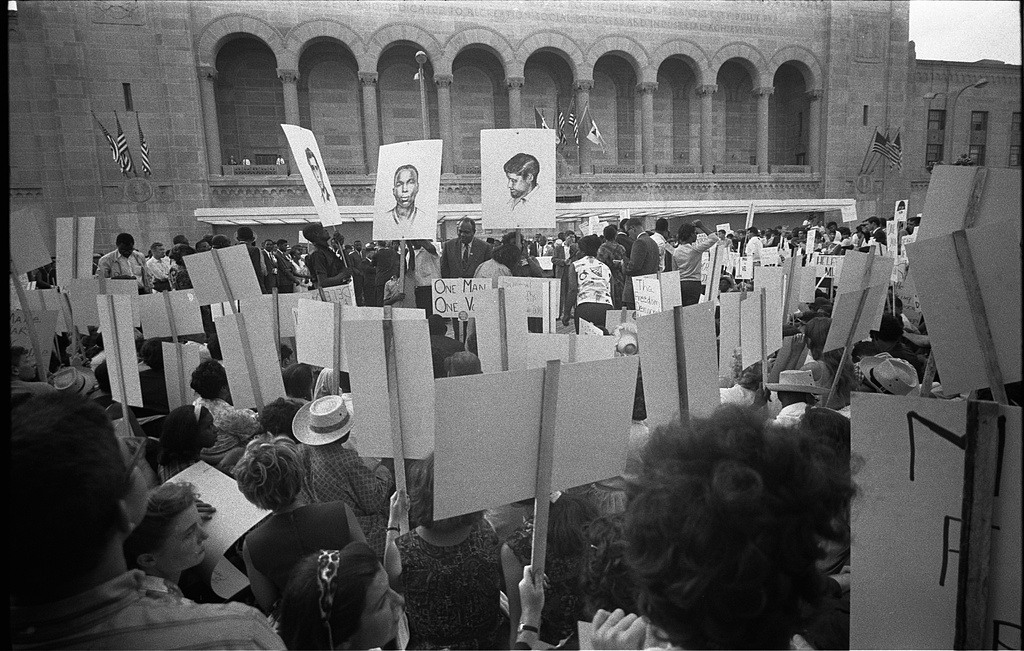
Dated record in the full guide ↗MFDP supporters carry the victims’ imagesWhite Knights and Mississippi Burning / Public memory / Context or core period
Leffler photograph documents political action outside the Democratic Convention.
Dated record in the full guide ↗American Opinion publishes the Gertz accusationThe John Birch Society / Publication / Context or core period
The later appellate opinion dates the article and identifies the publisher as Robert Welch, Inc., a Society affiliate. The assertions about Gertz are described as false in the judicial record.
Dated record in the full guide ↗Preparation takes a paramilitary turnThe Covenant, the Sword, and the Arm of the Lord / Belief / Context or core period
The appellate court dates a reorientation toward government collapse and civil war to 1978.
Dated record in the full guide ↗First device explodes at NorthwesternThe Unabomber / Theodore Kaczynski / Case record / Context or core period
The package was discovered on May 25 and returned to Northwestern; a public-safety officer was injured opening it on May 26. The two dates represent different events.
Dated record in the full guide ↗Civil award affirmed after retrialThe John Birch Society / Civil litigation / Context or core period
The Seventh Circuit affirms 100,000 dollars compensatory and 300,000 punitive against the publishing corporation. No criminal or collective-membership conviction follows from this judgment.
Dated record in the full guide ↗The federal investigation developsThe Covenant, the Sword, and the Arm of the Lord / Investigation / Context or core period
The Eighth Circuit dates the active investigation to 1983 and intensified interviews with former residents to 1984.
Dated record in the full guide ↗The FBI issues a new community updateThe Covenant, the Sword, and the Arm of the Lord / Record / Context or core period
The report describes a smaller population and identifies the Bryant killing. Figures remain attributed investigative estimates.
Dated record in the full guide ↗Search warrant obtained, per FBI memoThe Covenant, the Sword, and the Arm of the Lord / Investigation / Context or core period
The May 20 memorandum in Part 01, PDF p. 17, supplies this date. The appellate opinion later upholds the warrant and search.
Dated record in the full guide ↗Negotiation begins, per FBI memoThe Covenant, the Sword, and the Arm of the Lord / Siege / Context or core period
PDF p. 17 dates the surrounding of the compound to April 20. Other records and recollections date the beginning differently; do not treat this point as a resolved universal chronology.
Dated record in the full guide ↗Surrender, per May FBI memoThe Covenant, the Sword, and the Arm of the Lord / Siege / Context or core period
The May report dates surrender to April 22. An October form lists an April 21 arrest; contemporary reporting and later summaries vary. The peaceful outcome is much more consistent than the exact dates.
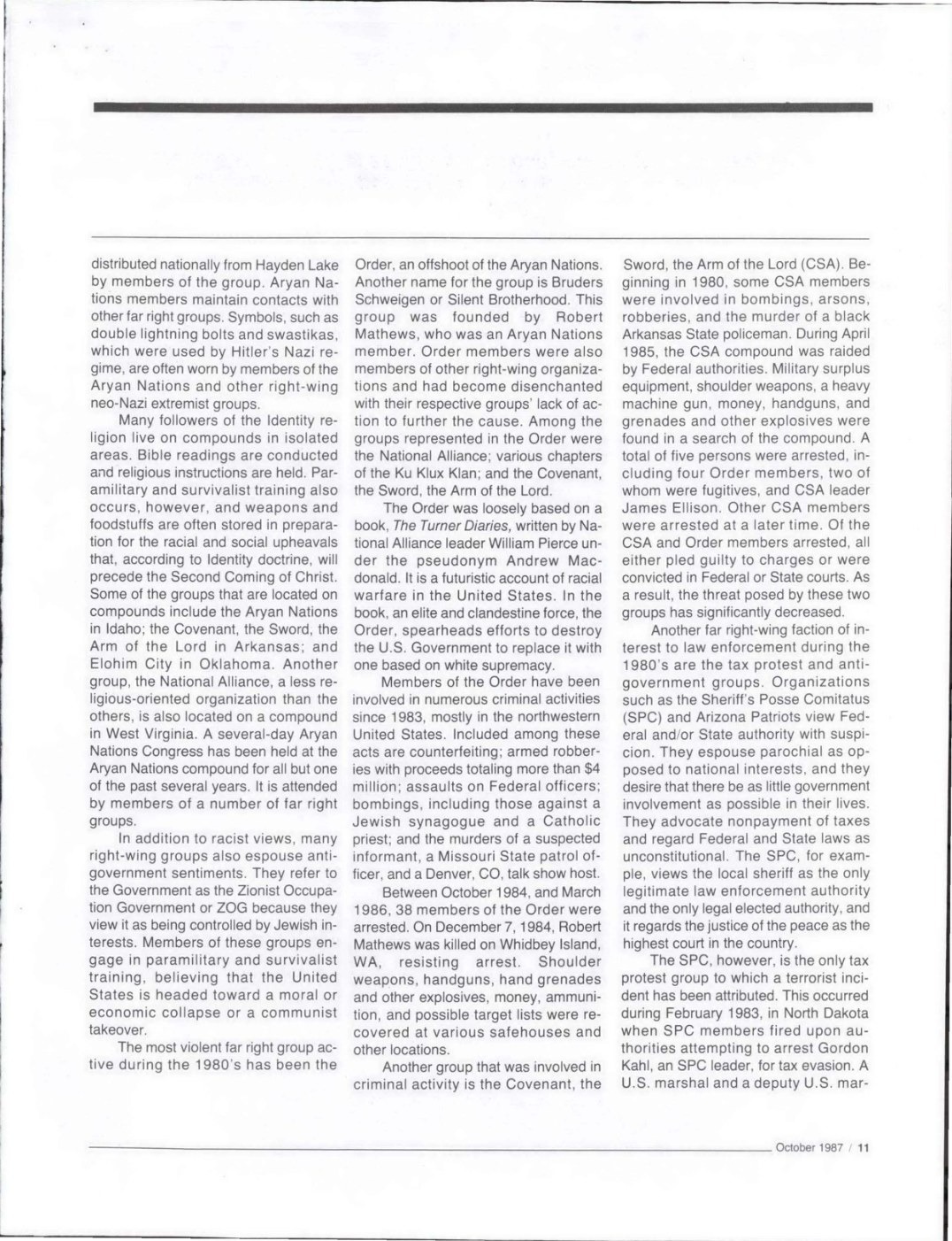
Dated record in the full guide ↗Named FBI analysis interprets the enterpriseThe Order / Institutional memory / Context or core period
Harris’s article identifies his FBI research role and discusses the novel, organization and financing; institutional interpretation is checked against court records.
Dated record in the full guide ↗The Fort Smith sedition case ends in acquittalsThe Covenant, the Sword, and the Arm of the Lord / Courts / Context or core period
The remaining thirteen defendants are acquitted. These verdicts concern the later broad prosecution, not every earlier case involving the milieu.
Dated record in the full guide ↗Hoskins’s book supplies an ideological referencePhineas Priesthood and the Spokane bombings / Attributed context / Context or core period
ADL and SPLC date Vigilantes of Christendom to 1990 and describe its role in the modern Phineas concept. Those profiles are attributed ideological context, not evidence that the book directed particular crimes.
Dated record in the full guide ↗Essay published; recognition followsThe Unabomber / Theodore Kaczynski / Case record / Context or core period
The essay appeared as a special section in The Washington Post under an arrangement with The New York Times. David Kaczynski’s recognition and earlier writing supplied a consequential lead.
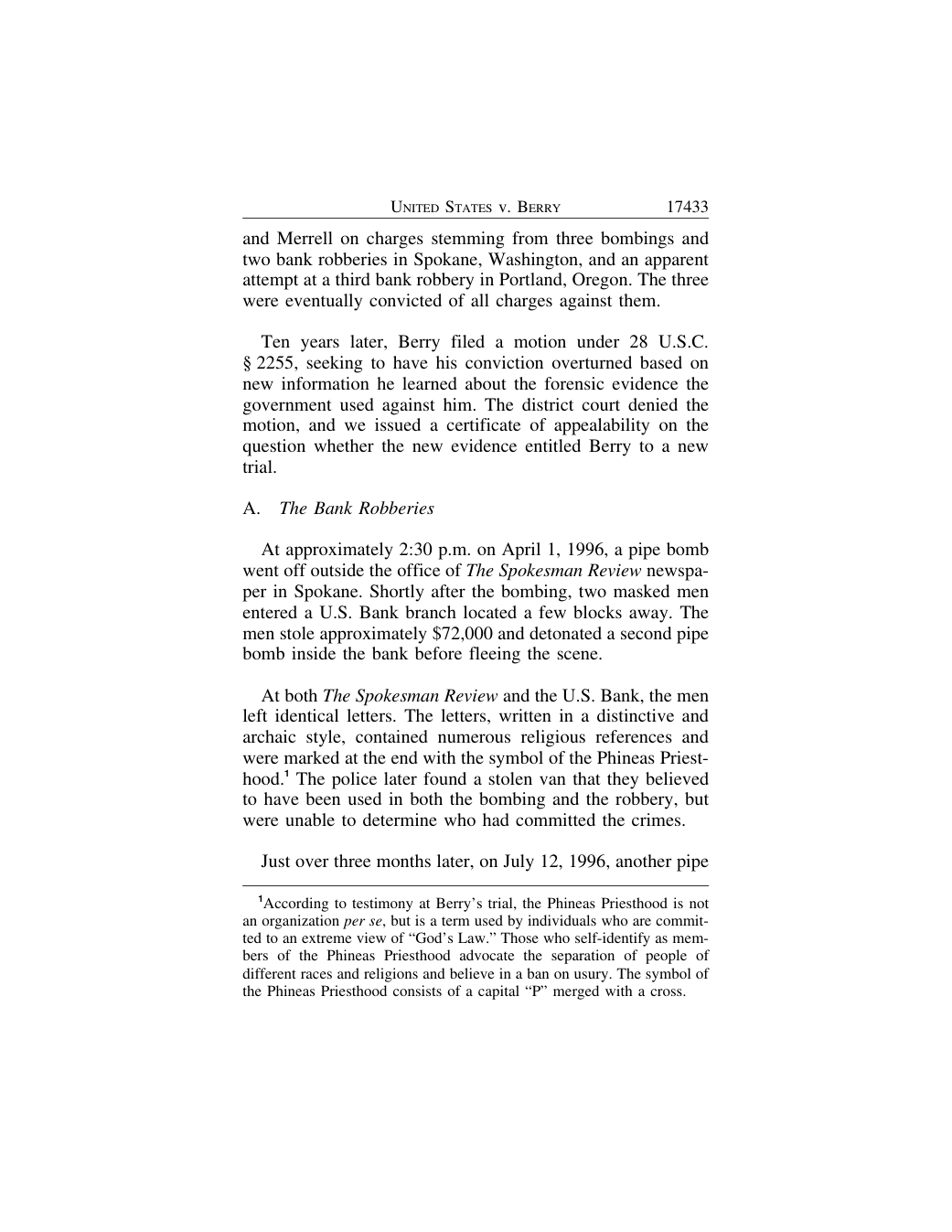
Dated record in the full guide ↗Newspaper bombing and first bank robberyPhineas Priesthood and the Spokane bombings / Attack sequence / Context or core period
An explosion at the Spokesman-Review office was followed by the nearby bank robbery and another explosion. Identical scene letters supplied a religious claim of purpose; identification required additional evidence.
Dated record in the full guide ↗Clinic bombing and second bank robberyPhineas Priesthood and the Spokane bombings / Attack sequence / Context or core period
The Planned Parenthood office was bombed and the same bank was robbed again. Ratigan’s separate prosecution concerned this July sequence, rather than every event attributed to the other three defendants.
Dated record in the full guide ↗Jewell is publicly identified as a suspectEric Rudolph and the bombing campaign / Investigation / Context or core period
News coverage and FBI scrutiny turn on the guard who helped evacuate spectators; he is never charged.
Dated record in the full guide ↗The Portland bank trip is watchedPhineas Priesthood and the Spokane bombings / Investigation / Context or core period
Surveillance followed Berry, Barbee and Merrell to a Portland bank that remained closed after an FBI alert. The prosecution and defendants offered different accounts of the trip’s purpose.
Dated record in the full guide ↗Three defendants arrested near YakimaPhineas Priesthood and the Spokane bombings / Investigation / Context or core period
The FBI’s contemporary report dates the arrests to October 8; the appellate account identifies Union Gap, Washington. Weapons, vehicles and communications became part of the case.
Dated record in the full guide ↗Ratigan’s later arrestPhineas Priesthood and the Spokane bombings / Dated reporting / Context or core period
The November 1997 sentencing report dates Ratigan’s arrest to March 13. The FBI’s account also distinguishes him from the three men arrested after the Portland trip.
Dated record in the full guide ↗Merrell’s testimony and denial are reportedPhineas Priesthood and the Spokane bombings / Court reporting / Context or core period
Contemporary reporting records Merrell’s denial of the attacks, his religious self-description, his explanation of the letters and his account of a Portland publicity action. The article is a report of testimony, not independent confirmation of each assertion.
Dated record in the full guide ↗Defense challenges during the second joint trialPhineas Priesthood and the Spokane bombings / Court reporting / Context or core period
Reporting describes objections about photo lineups, alternative leads and Davidson’s credibility. It says the earlier trial ended in a hung jury on the principal charges; the eventual convictions are recorded in the later appellate opinions.
Dated record in the full guide ↗Congress examines the Jewell investigationEric Rudolph and the bombing campaign / Accountability / Context or core period
House testimony discusses the interview ruse and OPR findings.
Dated record in the full guide ↗Ratigan convicted in his separate casePhineas Priesthood and the Spokane bombings / Court outcome / Context or core period
The Ratigan opinion records September 1997 convictions concerning the clinic bombing, July bank robbery and related counts. Month precision does not identify a particular verdict day.
Dated record in the full guide ↗Merrell’s original life termsPhineas Priesthood and the Spokane bombings / Original sentencing / Context or core period
The FBI annual report records Merrell’s October 30 sentencing. These original terms are part of the history and were later changed through post-conviction proceedings.
Dated record in the full guide ↗Barbee and Berry receive original life termsPhineas Priesthood and the Spokane bombings / Original sentencing / Context or core period
November reporting records the mandatory life terms, their courtroom positions and the judge’s statement about the danger posed by the attacks. Later sentences and release decisions are distinct events.
Dated record in the full guide ↗Ratigan’s original sentencePhineas Priesthood and the Spokane bombings / Original sentencing / Context or core period
The agency report dates his sentencing to December 3. The appellate opinion gives the original term as fifty-five years and three months; later reporting describes subsequent resentencing and release.
July 3 reporting describes verdicts returned Thursday, July 2. Schweitzer was convicted on twenty counts at this stage; other counts and defendants remained unresolved.
Dated record in the full guide ↗Georgia complaint and arrest warrantEric Rudolph and the bombing campaign / Charging record / Context or core period
The task force announces a Georgia complaint covering the Olympic park, Sandy Springs and Otherside attacks. These are accusations; accepted guilty pleas follow in 2005.
Dated record in the full guide ↗Inspector general reports the disclosure failuresTimothy McVeigh & Oklahoma City / Oversight / Later record
The report identifies errors, delayed notification and record destruction while finding no evidence establishing intentional concealment. It warns that the missing universe cannot be counted perfectly.
Dated record in the full guide ↗Ratigan’s procedural appeal is rejectedPhineas Priesthood and the Spokane bombings / Appellate decision / Later record
The opinion distinguishes an FDIC-insurance proof argument from subject-matter jurisdiction and finds procedural default unexcused. It does not find that the bank was actually uninsured.
Dated record in the full guide ↗Scientific review limits source inferencesPhineas Priesthood and the Spokane bombings / Scientific reassessment / Later record
The National Research Council review explains why compositional similarity cannot establish a particular ammunition box or the probability of a defendant supplying the material without adequate distribution knowledge. Year precision follows the report’s publication year.
Dated record in the full guide ↗Defense challenges eyewitness identificationEric Rudolph and the bombing campaign / Pretrial dispute / Context or core period
APR reports a proposed expert challenge. A trial does not adjudicate the whole case because guilty pleas follow.
Dated record in the full guide ↗Property case remanded for a restitution planThe Unabomber / Theodore Kaczynski / Judicial outcome / Later record
The Ninth Circuit required a concrete plan to dispose of seized property with attention to monetary return for victims and families. It did not reverse the convictions.
Dated record in the full guide ↗FBI discontinues bullet-lead examinationsPhineas Priesthood and the Spokane bombings / Agency decision / Later record
The announcement distinguishes the measurement process from interpretation and the significance of an association. Discontinuation did not declare every earlier measurement erroneous.
Dated record in the full guide ↗Berry’s due-process and new-trial challenges failPhineas Priesthood and the Spokane bombings / Appellate decision / Later record
The Ninth Circuit considers the particular testimony, manufacturing evidence and other circumstantial evidence. The government waived the Rule33 timeliness objection, so the new-trial claim was addressed on the merits.
Dated record in the full guide ↗Auction of seized property beginsThe Unabomber / Theodore Kaczynski / Judicial record / Later record
The May 20 order states that the online auction began on May 18 and bidding was scheduled to end June 2. The order is not a final distribution accounting.
Dated record in the full guide ↗Independent corroboration dated in the appealThe Crusaders and the Garden City plot / Evidence / Context or core period
The appeal atpage 20 refers to another witness’s grand-jury testimony supporting existence of the conspiracy as early asJune 14. This is not a claim that every element began that day.
Curry’s published Q&A describes the short film’s assembly from several archives and its deliberate absence of explanatory narration. It is an edited work, not a complete visual record of the Bund.
Dated record in the full guide ↗Sentencing-objections memorandum issuedThe Crusaders and the Garden City plot / Judicial order / Context or core period
Court rules on enhancements and permits victim-impact videos. This precedes the sentencing hearing.
Bilbrough later admitted knowingly helping collect Mathews in Michigan and bring him east after unlawful entry so that he could continue his participation.
Dated record in the full guide ↗Jury-plan amendment notedThe Crusaders and the Garden City plot / Later procedure / Later record
The appeal’sfootnote 1 describes an administrative amendment. The original administrative order was not independently acquired; no reversal inference follows automatically.
Dated record in the full guide ↗Day’s account reaches documentary-related reportingThe Crusaders and the Garden City plot / Participant narrative / Later record
ABCpublishes an interview-based account associated with The Informant: Fear and Faith in the Heartland. Full film not audited.
The retained actual transcript includes former investigators, flare causation and a separate broader sedition-prosecution/acquittal branch; not a complete trial-file audit.
Dated record in the full guide ↗First Step Act resentencing orderedPhineas Priesthood and the Spokane bombings / Appellate decision / Later record
The published majority remands for application of the changed stacking rule, with Boggs dissenting on statutory interpretation. A concurrent memorandum rejects other challenges to the surviving firearm counts. Neither is a factual-innocence ruling.
Dated record in the full guide ↗Merrell’s new sentence imposedPhineas Priesthood and the Spokane bombings / New judgment / Later record
The judgment imposed December 14 and filed December 15 specifies 517 months, or forty-three years and one month, followed by five years total supervision. It continues to list surviving underlying convictions.
Dated record in the full guide ↗Barbee’s new sentence imposedPhineas Priesthood and the Spokane bombings / New judgment / Later record
The original judgment specifies 480 months, or forty years, followed by five years total supervision. This supersedes the original mandatory life terms.
The PBS documentary uses historians and archival material to connect the Bund to American settings and political traditions. Selected transcript passages were examined; no complete film viewing is claimed.
Dated record in the full guide ↗The sedition trial returns through broadcast archivesThe Covenant, the Sword, and the Arm of the Lord / Memory / Later record
KUAF and the Pryor Center revisit the trial’s regional record.
Dated record in the full guide ↗Rehabilitation recognized; release request deniedPhineas Priesthood and the Spokane bombings / Later ruling / Later record
The order acknowledges Barbee’s extraordinary rehabilitation and renunciation of wrongful conduct but finds the requirements for compassionate release unsatisfied. It is a dated ruling, not a current custody report.
Council Decision 2024/2056 and the official announcement identify the historical listing and financial measures; not an individual U.S. conviction or current membership audit.
Montana PBS’s Rise of the Freemen combines archival footage and local interviews; the filmmakers state that Freemen and family members approached declined participation.
Hanlon interviews Flynn and Manis; source-book connection and reported scene changes are attributed. Complete film and book not independently read/viewed.
The full guides carry their own critical paths, documentary lineages, evidence-support and cultural-prominence distinctions, strongest rival accounts, actual narrator reading scopes and authenticated change-evidence tests. The collection links particular hinges where they illuminate a comparison; it does not replace those case-specific analyses with one theory of a common movement.
The combined source index preserves child identifiers and notes. Notes about material being saved or read locally refer to the originating guide builder’s research unless a downloadable edition explicitly includes a selected public excerpt. This collection contains cover images, source metadata and dated records; it does not redistribute complete child books, hearing volumes, original evidence files or every child ZIP. Shared URLs are grouped without merging reading scopes.
An indictment states allegations, a verdict resolves specified counts, and an appellate or collateral decision answers the questions properly before that court. Different defendants, acquittals, dissents, resentencings and state/federal proceedings remain separately dated. The collection’s outcome comparisons are bounded by those records and by each child’s stated archival limits.
Review editions.
These are completed research editions in the ChatGPT review lane, with editorial grading and production promotion controlled by The AI Files arbiter. No official grade, collective score or approval is assigned here. The frozen-input manifest identifies exactly which local revisions supplied this edition; observed earlier registrations are preserved separately so a newly prepared revision is not passed off as an already published official guide.
The collection overview, guide cards, comparisons, chronology, source index, images, fonts and reading edition work offline. Linked full guides, their individual ZIPs and original external sources require an internet connection. The input manifest distinguishes the pinned content snapshots from the registrations observed when this collection was assembled.
The collection’s original ChatGPT (OpenAI) creation record and all prior revisions are preserved. Its original exact creation time was not recorded and remains unavailable. This substantive revision was made in Codex with actual gpt-6.1-sol / medium settings verified from session metadata. Every child retains its own full original and revision provenance; the collection does not assign its own settings or date to those guides.
238 case-specific source records link to 234 distinct URLs. Case prefixes preserve original source identifiers; identical URLs are grouped without merging their different reading scopes. Counts do not measure independent corroboration. Full comparison and chronology data remain in GUIDE.json.
The Covenant, the Sword, and the Arm of the Lord / csa-S01
Federal Bureau of Investigation · Contemporaneous federal records
Original PDF included locally under records/fbi-part-01.pdf. Key PDF pages: 2–3 (July 1982); 9 (July 1984); 17–18 (May 1985); 58 (October 1985 arrest-date entry); 68 (later prosecution summary). Reports preserve redactions and may contain unproven allegations or conflicting dates. Selected original pages 2, 3, 9, 17, 18, 32, 68 visually read in this revision; selected six public-page images individually federal-authored. Full 70-page original retained privately; public selected-page PDF only. October23accomplishment form actualPDF63visually checked: Ellison arrest4/21/85, distinct from Maymemo4/22. Later summaryPDF68charge label differs from appellate opinion; judicial labels control.
The Covenant, the Sword, and the Arm of the Lord / csa-S02
U.S. Court of Appeals for the Eighth Circuit / Justia · Primary appellate opinion
Decided 17 June 1986. Opening paragraphs distinguish the RICO/arson convictions from conditional firearms pleas. The opinion also addresses the search warrant, informants, and enterprise evidence; its description of the record should not be flattened into a verdict on every member.
Decided 15 December 1986. The Stumpp murder case documents individual responsibility and connections with CSA associates. The majority affirms; the dissent objects to the breadth and prejudice of CSA evidence. Both are part of the decision.
The Covenant, the Sword, and the Arm of the Lord / csa-S05
Federal Bureau of Investigation · Institutional retrospective
Describes negotiation and recovered weapons. Its reference to a killed Missouri trooper should not be used to relabel Arkansas Trooper Louis Bryant: regional cases and agencies must be distinguished.
The Covenant, the Sword, and the Arm of the Lord / csa-S06
United Press International · Contemporaneous reporting
A contemporary account emphasizing negotiation and the intention to arrest Ellison and search the camp. Reports a four-day standoff; the exact date/duration is not identical across records.
The Covenant, the Sword, and the Arm of the Lord / csa-S07
Encyclopedia of Arkansas · Regional historical reference
Useful regional synthesis. Some dates diverge from the primary record, including its pawnshop-murder date: the 1986 Snell opinion places Stumpp’s murder on 3 November 1983. This guide follows the court for that event.
The Covenant, the Sword, and the Arm of the Lord / csa-S08
Encyclopedia of Arkansas · Regional trial history
Describes the government’s broad theory, witness disputes, and the failure to obtain guilty verdicts. Read alongside contemporaneous acquittal reporting; do not confuse this case with Ellison’s earlier convictions.
The Covenant, the Sword, and the Arm of the Lord / csa-S09
Jacqueline Froelich / KUAF Ozarks at Large · Reported history / recorded interviews
Recorded reporting drawing on redacted FBI files and interviews. Its contemporary and retrospective voices are evidence with different dates and perspectives. Images on the page have their own credits; they are not assumed freely reusable.
The Covenant, the Sword, and the Arm of the Lord / csa-S10
Kerry Noble / Syracuse University Press · Participant memoir / publisher record
Publisher’s description and contents, not a full-text audit of the memoir. Identifies Noble’s account of radicalization, the attempted church attack he abandoned, and later departure from extremism.
The Covenant, the Sword, and the Arm of the Lord / csa-S11
Syracuse University Press · Primary retrospective interview
Noble dates his arrival to 1977, describes ideological changes, and dates public adoption of the CSA name to 1981. His account is attributed testimony, not an independently verified census or proof of every alleged plot.
The Covenant, the Sword, and the Arm of the Lord / csa-S12
PBS American Experience · Documentary / recorded participant testimony
Includes testimony from Noble within a broader history of the radical right. It is an external video/transcript resource, not footage proving a formal CSA chain of command over the 1995 bombing. Fresh official film description/credits inspected, not full transcript or film. No whole-film omission or direct CSA–McVeigh operation inferred.
The Covenant, the Sword, and the Arm of the Lord / csa-S13
U.S. Department of Justice / OJP archive · Official review, 1993
Printed p. 119, PDF p. 131, compares the CSA operation’s containment and negotiation with Waco. The contexts differ; the comparison is not a controlled test of tactics.
The Covenant, the Sword, and the Arm of the Lord / csa-S14
U.S. Senate / Government Publishing Office · Official record / prosecutor’s retrospective account
Printed p. 25 summarizes United States v. Ellison, its racketeering prosecution, and a prosecutor’s role in negotiating surrender. This is an identified participant’s later professional account.
The Covenant, the Sword, and the Arm of the Lord / csa-S15
KUAF / David and Barbara Pryor Center · Archival broadcast discussion
Audio discussion using regional broadcast archives; separates recollection of the trial from a claim that the indictment itself proved guilt. Fresh actual item description/credits inspected; 22-minute audio not listened to. Fourteen charged is not thirteen remaining at verdict.
The Covenant, the Sword, and the Arm of the Lord / csa-S17
Los Angeles Times / Times Wire Services · Contemporaneous reporting
Contemporary headline and date illustrate the April 1985 press chronology. Publisher access may be restricted. Consult the original FBI memorandum and the caveat about exact dates.
The Covenant, the Sword, and the Arm of the Lord / csa-S18
David and Barbara Pryor Center / University of Arkansas · Primary audiovisual archive finding aid
Inventory p. 131 lists April 1985 CSA interviews, stakeout footage, field tapes, and arrests. A finding aid establishes holdings, not open streaming access or the accuracy of every tape label.
The Covenant, the Sword, and the Arm of the Lord / csa-S19
U.S. Department of Justice,1993; official archived HTML · Federal institutional report / primary
Actual comparison footnote read through web reader. Contrasts peaceful CSA surrender with different Waco conditions. Full PDF route403/reader size limit; ordinary HTML returned challenge, saved honestly. No full report audit or tactical instruction excerpt reproduced.
U.S. Court of Appeals for the Tenth Circuit · Primary judicial opinion
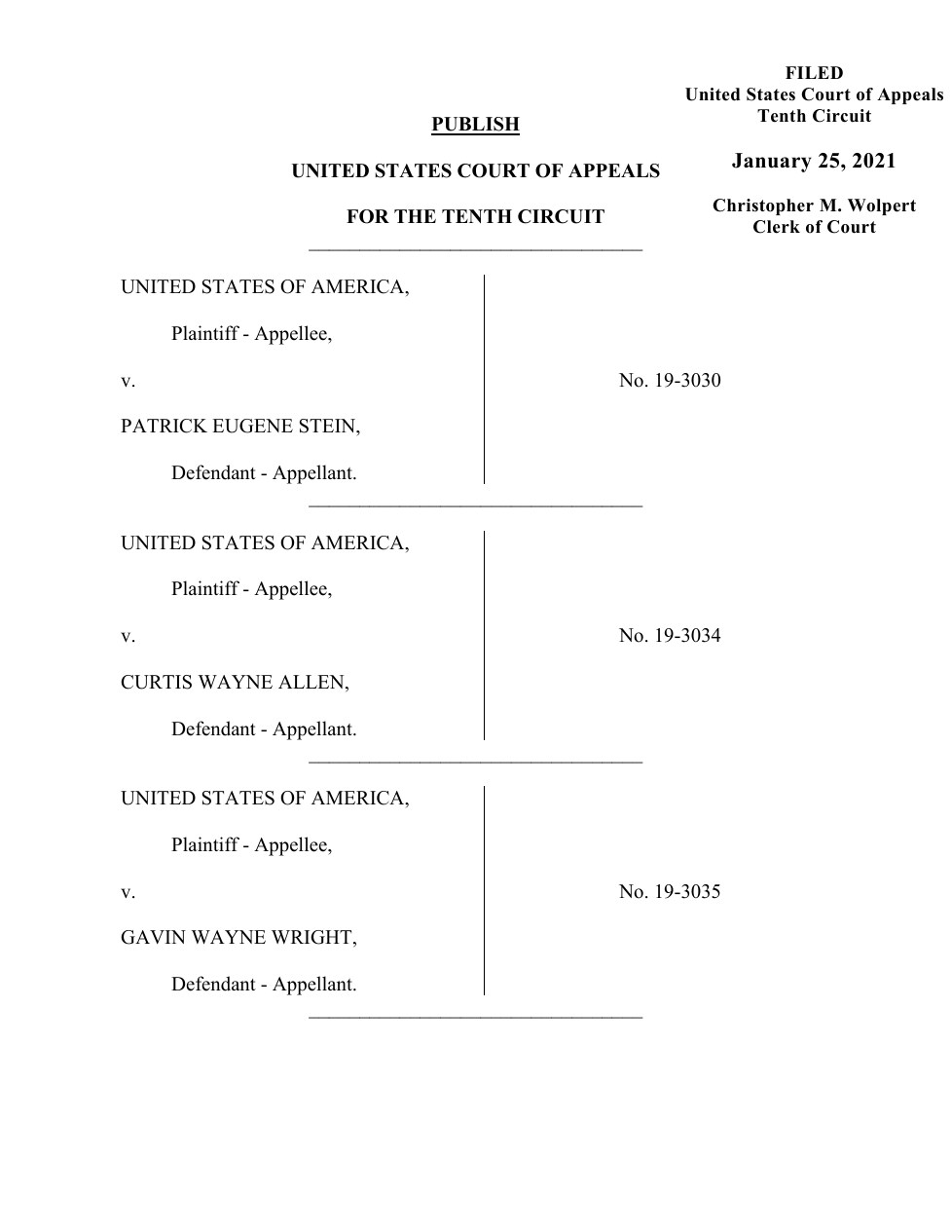
Published Tenth Circuit opinion, 25 August 1989. Paragraphs 7–8 give the distinct verdicts and 150-year sentences; later sections address constitutional authority, double jeopardy and defendant-specific sufficiency. Public-domain judicial text in a legal-repository mirror, not the mirror’s treatment label. Fresh actual reader checked; raw 403 saved. The mirror’s modern treatment labels are not judicial findings. One narration dates a supposed pre-killing June 14 conversation to 1986 while the killing was 1984; this apparent internal date inconsistency is not adopted here.
U.S. Court of Appeals, Ninth Circuit; legal-repository reproduction · Primary judicial opinion
Original judicial text reproduced in full. Facts section establishes the robbery sequence, proceeds and enterprise; sections on co-conspirator statements, plea witnesses and the First Amendment identify actual defense arguments and the court’s reasons for affirming. Fresh raw 200 actual opinion read for dated financing, Rader plea/plain-error, First Amendment and trial-incidents sections.6 July 1988 heading. No independent fulltrial/ledger audit.
PBS / WNET · Documentary video and participant interviews
Nine-minute segment and transcript, including former investigators Wayne Manis and Tom McDaniel. Useful firsthand perspective on the manhunt and flare-caused fire; an edited retrospective, not a complete operational log. Actual retained transcript read, including broader sedition-prosecution/acquittal branch. Freshwebreader 403; fullvideo not replayed or claimed.
The Spokesman-Review / James Hanlon · Established regional reporting / participant interview
Interview with Wayne Manis and discussion of the fictional Terry Husk character. Distinguishes the dramatic composite from the real investigation; not used as proof of specific defendants’ guilt. Actual article read for the attributed book-to-film lineage, fictional composite and interview corrections; complete book/film unread. Its $3.8 million figure differs from Yarbrough’s approximate $3.6 million.
John W. Harris Jr., FBI Terrorism Research and Analytical Center · FBI Law Enforcement Bulletin, October 1987 · Primary institutional analysis
Original full issue retrieved privately; actual article title/byline on PDF7 identifies FBI Intelligence Research Specialist. Selected page 13/printed 11 discusses The Order/novel/funding. Institutional account compared with actual judicial record; full private novel and unrelated issue components are not redistributed.
U.S. Department of Justice · Primary institutional record
Legal analysis at pages 219–220 discusses The Base case and the terrorism sentencing adjustment. It is a government legal analysis, not an independent historical assessment. Actual selected sentencing analysis printed 218–221 and author affiliations/bios read. Cella is DOJ Counterterrorism Trial Attorney; Heeren is EDNY Assistant U.S. Attorney. Selected page 220 is staff-authored analysis, not clearance of every article/privatework in volume.
The Mountaineer Militia / mountaineer-militia-S16
DOJ Journal of Federal Law and Practice 71(2), pp122–123 · Primary institutional legal argument / retrospective
Case discussion and surrounding explanation read; not whole 286-page issue. Cites Looker appeal/news and distinguishes verdict from later pleas. Its abbreviated appeal citation says 30 December; official opinion heading says 31 December. An institutional policy example does not independently corroborate all case evidence.
Reported audio and transcript about the investigation and other alleged cells. Allegations involving other cases are not imported as findings against these defendants. Actual retained full transcript read in this revision; no audio listened to or full earlier-season audit. Dated ongoing-case reports are not current status.
UK Home Office / legislation.gov.uk · Original statutory instrument
Made 15 July 2021, in force 16 July 2021. Adds The Base to Schedule 2. Establishes dated UK designation, not a conviction of every member. Full two-page original included locally. Contains public sector information licensed under the Open Government Licence v 3.0.
FOX 5 DC with Associated Press contributions,28 October 2021 · Contemporary court reporting
Records prosecution and defense positions, including the claim of undercover pressure and the argument that conversations lacked a concrete plan. Those are attributed positions, weighed against admissions and the court’s terrorism-purpose finding.
Council of the European Union / Official Journal · Original legal act / primary
Actual English original HTML legal text read through the web reader: recitals, entry-into-force article and annex entry 22 for The Base. PDF/general record views presented a challenge; no CAPTCHA solved or complete underlying dossier acquired. Historical 2024 act, not a claim about current 2026 status.
Council of the European Union · Official institutional explanation / primary
Actual official announcement read. Describes the addition, asset freeze and restriction on making funds available. Identifies Nazzaro as founder; institutional assertion distinguished from an individual criminal judgment. No 2026 membership or current-list audit.
Phineas Priesthood and the Spokane bombings / phineas-priesthood-S01
United States federal court; original opinion or judgment · judicial opinion
Filed 22 October 2010. Rejects Berry’s due-process and new-trial challenges and recounts the trial evidence. A separate late Brady allegation was outside the certificate of appealability and was not adjudicated. The opinion is not a complete trial transcript. Fresh original PDF retrieved200 and selected factual/merits/COA passages reread for this revision.
Phineas Priesthood and the Spokane bombings / phineas-priesthood-S02
United States federal court; original opinion or judgment · judicial opinion
Published June 10, 2022 majority opinion and Boggs dissent on First Step Act resentencing. Distinguishes vacated firearm counts from surviving bank-robbery predicates; the remand was not a factual-innocence finding. Fresh original published PDF retrieved200; majority and Boggs dissent read, keeping nonopinion summary separate.
Phineas Priesthood and the Spokane bombings / phineas-priesthood-S03
United States federal court; original opinion or judgment · judicial opinion
Filed December 11, 2003. Ratigan’s separate appeal concerns FDIC-insurance proof and procedural default. The affirmance did not establish that the branch lacked insurance or resolve a new factual identification dispute. Fresh original PDF retrieved200; actual heading is11 December 2003 despite10 DecemberURL directory.
Phineas Priesthood and the Spokane bombings / phineas-priesthood-S04
Federal Bureau of Investigation · contemporary government report
Contemporaneous law-enforcement account of the 1996 attacks and investigation. Case-stage allegations and an agency’s interpretation are distinct from later verdicts and historical findings. Its first-robbery total differs from the later Berry opinion.
The Mountaineer Militia / mountaineer-militia-S04
Federal Bureau of Investigation · Primary / contemporary institutional report
Selected passages describe 11 October 1996 arrests, actual undercover sale, separate Ohio association and prevention before destruction. Arrest allegations do not establish guilt of all seven. No mugshots or seized-material photographs reproduced.
The Montana Freemen / montana-freemen-S01
Federal Bureau of Investigation · Primary institutional record
Contemporary federal overview. Its descriptions of the group’s conduct are read alongside later adjudicated outcomes.
Phineas Priesthood and the Spokane bombings / phineas-priesthood-S05
Federal Bureau of Investigation · contemporary government report
Annual institutional report recording original convictions and sentences. Later vacatur, resentencing and release decisions changed the punishment record; these original terms are dated history.
Phineas Priesthood and the Spokane bombings / phineas-priesthood-S06
The Spokesman-Review · contemporary local reporting
July 4, 1997 reporting from the second joint trial. Records defense challenges to photo lineups, alternative leads and informant credibility, alongside the FBI’s responses.
Phineas Priesthood and the Spokane bombings / phineas-priesthood-S07
The Spokesman-Review · local reporting
December 28, 2022 reporting on later sentences and dated release/supervision history. The district-court judgments give the exact terms; the article rounds Merrell’s term to 43 years.
Phineas Priesthood and the Spokane bombings / phineas-priesthood-S08
Southern Poverty Law Center · advocacy research profile
Advocacy research profile describing Hoskins’s book, ideological circulation and the difference between a concept and a formal organization. Classification does not establish any individual’s responsibility for a crime.
Phineas Priesthood and the Spokane bombings / phineas-priesthood-S09
The Spokesman-Review · contemporary court reporting
March 26, 1997 courtroom reporting of Merrell’s testimony, denial of the attacks, religious self-description and account of the Portland trip. Establishes his reported position, rather than the truth of each assertion. Retained original article and fresh raw200version read; web-reader fresh request 403, no bypass attempted.
Phineas Priesthood and the Spokane bombings / phineas-priesthood-S10
The Spokesman-Review · contemporary local reporting
November 5, 1997 reporting of the original Barbee/Berry sentences and courtroom responses, with earlier Merrell sentencing context. Later proceedings must be kept separate.
Phineas Priesthood and the Spokane bombings / phineas-priesthood-S11
Federal Bureau of Investigation · agency statement
September 1, 2005 original agency announcement discontinuing bullet-lead examinations. Distinguishes analytical measurement from the significance of an association and records the agency’s institutional assessment.
Phineas Priesthood and the Spokane bombings / phineas-priesthood-S12
National Research Council / National Academies Press · scientific review
Original 2004 scientific review, chapter 4 Interpretation, especially printed pages 106–108. Explains manufacturing variability, coincidentally indistinguishable material and limits on particular-box, date and defendant-source inferences. Retained actual interpretation chapter reread; fresh web reader timed out but ordinary raw fetch returned200 and the selected conclusion passages were verified. Copyrighted private research; no full book or substantial quoted page image shipped.
Phineas Priesthood and the Spokane bombings / phineas-priesthood-S13
FOX13 Seattle · local broadcast reporting
Local television report of Barbee’s intermediate 55-year sentence. The later 2022 appellate ruling and new judgment superseded that term; this is a dated stage of the case.
Phineas Priesthood and the Spokane bombings / phineas-priesthood-S15
United States federal court; original opinion or judgment · judicial record
Concurrent June 10, 2022 four-page memorandum. Rejects the jury-finding and armed-bank-robbery predicate challenges; its affirmance is read alongside the separately published resentencing remand.
Phineas Priesthood and the Spokane bombings / phineas-priesthood-S16
United States federal court; original opinion or judgment · judicial record
Original Eastern District of Washington ECF 499 judgment, imposed/filed December 20, 2022. Pages 1–4 identify surviving counts, 480 months imprisonment and five years total supervised release.
Phineas Priesthood and the Spokane bombings / phineas-priesthood-S17
United States federal court; original opinion or judgment · judicial record
Original Eastern District of Washington ECF 487 judgment, imposed December 14 and filed December 15, 2022. Pages 1–4 specify 517 months, or 43 years and one month, plus five years total supervised release.
Phineas Priesthood and the Spokane bombings / phineas-priesthood-S18
U.S. District Court, Eastern District of Washington / Midpage reproduction · judicial record
May 3, 2024 ECF 521 primary court order reproduced by Midpage. Acknowledges extraordinary rehabilitation and renunciation of wrongful actions while denying compassionate release. It is a dated ruling, not a current custody check. Fresh actual web-reader reproduction checked against retained original reader; ordinary raw request 429 saved, not called a successful original fetch.
White Knights and Mississippi Burning / white-knights-mississippi-burning-S01
U.S. Department of Justice, Civil Rights Division / USAO / FBI; 2016 reinvestigation report · Official investigation / primary
48-page original retained; pp 3–27, 42–48 read in detail, with redacted intervening sections sampled. Distinguishes seven 1967 jury convictions from Jordan’s guilty plea, source payments, conflicting participant accounts, admissibility and further-prosecution limits. Its historical reconstruction is not a new conviction; protected identities remain redacted. It contains minor inconsistencies including a Price citation ending 786 rather than 787 and a Sharpe label contradicted by its own verdict list. Judicial opinions control the legal descriptions here.
White Knights and Mississippi Burning / white-knights-mississippi-burning-S02
U.S. Supreme Court, 28 March 1966; official U.S. Reports scan · Judicial opinion / primary
Original retained; syllabus and opinion pp 787–807 examined, especially 794–799. Statutory coverage and alleged state/private collaboration were decided before the criminal trial. The Court reversed dismissals; it did not enter guilt verdicts.
White Knights and Mississippi Burning / white-knights-mississippi-burning-S03
U.S. Court of Appeals for the Fifth Circuit; 17 July 1969, rehearing denied 28 August; Justia transcription · Judicial opinion / primary
Opening facts, confession/Bruton issues, jury instruction and sufficiency sections actually read in web reader; retained reader snapshot, raw route 403. Affirms seven convictions. The catalog’s August date is rehearing, not the original opinion date. The appellate account uses a verdict-favorable standard, not a neutral transcript of every disputed fact.
White Knights and Mississippi Burning / white-knights-mississippi-burning-S04
Supreme Court of Mississippi, 12 April 2007; judicial PDF mirrored by Justia · Judicial opinion / primary
35-page opinion retained; organization/organizing facts, trial sequence and instruction/delay analysis examined. Affirms three manslaughter counts and three consecutive 20-year terms. Explicitly describes the favorable-to-verdict review standard. This state work is not being reproduced under a federal public-domain claim.
White Knights and Mississippi Burning / white-knights-mississippi-burning-S05
U.S. District Court, Southern District of Mississippi; Daniel P. Jordan III, 23 March 2011 · Judicial order / primary
Eight-page original retained/read. Pleading deficiencies, Heck barriers to damages attacking an intact conviction and immunity supported dismissal. The court used allegations, not an evidentiary trial on every claimed investigative act. Its opening shorthand “murders” does not change the 2005 manslaughter judgments. Complaint and all underlying misconduct allegations were not independently proven by this order.
White Knights and Mississippi Burning / white-knights-mississippi-burning-S06
Christine Lamberson, Federal Judicial Center · Institutional judicial history / secondary
Full narrative read: federal statutory litigation, trial and partial accountability. Useful independent institutional comparison with DOJ’s celebratory conclusion; sentencing-range shorthand differs from the full investigative report, so precise individual sentence figures are not inferred from that summary.
White Knights and Mississippi Burning / white-knights-mississippi-burning-S07
David Cunningham, Mississippi Encyclopedia · Scholarly organizational history / secondary
Entry read in full. Distinguishes White Knights, Original Knights and United Klans of America, Bowers’s spring 1964 leadership and later organizational decline. Aggregate membership/violence estimates are not silently adopted as exact or attributed to every member; separate crimes are not merged into MIBURN verdicts.
White Knights and Mississippi Burning / white-knights-mississippi-burning-S08
Lyndon B. Johnson presidential recording, 23 June 1964; Miller Center catalog · Contemporaneous recording catalog / primary metadata
Catalog explicitly indexes Eastland’s publicity-stunt explanation. Audio playback was not verified here, so no verbatim quotation or full-conversation claim is made. The educational essay provides the contextual paraphrase; the later physical and trial record tests the hoax explanation.
White Knights and Mississippi Burning / white-knights-mississippi-burning-S09
Kent Germany and David Carter, University of Virginia Miller Center · Historical interpretation / secondary with primary recording routes
Essay read, including movement calls, Johnson’s response, Eastland’s explanation and criticism of inadequate protection. Linked DeLoach 4693 page has conflicting heading 5 August/about-this-recording 4 August; no precise audio-date claim is inferred from that mismatch. Audio routes remain external and no listening is asserted.
White Knights and Mississippi Burning / white-knights-mississippi-burning-S10
Alan Parker, official filmmaker website; production essay reflecting 1988 · Filmmaker’s account / primary for adaptation
Opening and research/narrative passages actually read. Parker labels fiction, acknowledges white heroes and describes archive/site research. This is not film playback or a basis for asserting historical truth of scenes. Private copyrighted essay/stills remain outside the package.
White Knights and Mississippi Burning / white-knights-mississippi-burning-S11
Carol Hanisch; Civil Rights Movement Archive · Participant’s critical letter / primary for reception
Two-page letter read through web reader and reader record retained; raw retrieval 406, not a locally downloaded authentic PDF. Criticizes passive depiction of Black communities and FBI-centered rescue. Her 1965–66 experience and later critique are not eyewitness testimony to the June 1964 crime. No full-film or Royko-column audit claimed.
White Knights and Mississippi Burning / white-knights-mississippi-burning-S12
Federal Bureau of Investigation · Institutional public history
Accessible web-reader narrative read, raw route 403 retained. Centers investigation, recovery and convictions; compared with full DOJ report and court opinions. A June 20 transition in this condensed account must not replace the documented 21 June visit; none-on-murder-charges distinction is retained. AP-credit images on the page are not cleared as federal work.
White Knights and Mississippi Burning / white-knights-mississippi-burning-S13
Warren K. Leffler, 24 August 1964; Library of Congress, U.S. News & World Report Collection · Contemporaneous photograph / item metadata
Individual JSON and 1024 px original derivative retained and visually checked. Contact sheet 12470-I frame 35 and date 24 August 1964 specified in item notes. Individual advisory: No known restrictions on publication. This is the precise image-rights basis, not federal employee authorship or proof of every placard’s origin.
White Knights and Mississippi Burning / white-knights-mississippi-burning-S14
White House, 24 November 2014; selected official photograph by Chuck Kennedy · Official commemoration / primary
Selected caption, recipients paragraph and actual photograph read/checked. Relatives accepted posthumous medals for the three organizers. The page’s unrelated Medal of Honor heading is a label error; this event was the Medal of Freedom. Government-produced photo rights checked separately against archived copyright policy.
White Knights and Mississippi Burning / white-knights-mississippi-burning-S15
Mississippi Department of Archives and History, 21 June 2021 · Archival release notice / primary
Full notice read. Records gathered for the 2004 reopening/2005 trial transferred in 2019 and became available; dates 1964–2007. Establishes access/provenance, not independent confirmation of every document’s contents.
White Knights and Mississippi Burning / white-knights-mississippi-burning-S16
Mississippi Department of Archives and History; Shaun Stalzer finding aid, August 2024 · Archival finding aid / primary metadata
Collection description and inventory read, including 1967 testimony, later interviews and prosecution work. Physical holdings were not visited or reviewed in full. Inventory titles are not findings that any listed allegation is true.
White Knights and Mississippi Burning / white-knights-mississippi-burning-S17
Mississippi State Sovereignty Commission, 29 June 1964; MDAH four-page scan · Contemporaneous state investigative report / primary
Approved browser name search→MICHAEL SCHWERNER id 691→120 indexed results→four-page document. All 4 actual PNGs retained and visually read. Repeats Price’s denial and unconfirmed hoax/sighting claims; mislabels the Ford as Chevrolet. Demonstrates what officials recorded, not truth of the claims, prior knowledge or an authenticated pre-murder tip. State pages remain private; no federal 105 claim.
White Knights and Mississippi Burning / white-knights-mississippi-burning-S18
Mississippi Department of Archives and History · Institutional archival history
Agency origins, investigative/public-relations functions, informant use and access chronology read. Establishes state surveillance context distinct from the FBI or Klan; does not by itself prove delivery of a particular intelligence item before 21 June 1964.
The Crusaders and the Garden City plot / crusaders-garden-city-S01
U.S. Court of Appeals, Tenth Circuit / original opinion mirrored by Justia · Primary judicial opinion
25-page published opinion read. Pages 3–5 cover background/trial;10–13 entrapment;14–16 sentencing;17–24 evidentiary challenges;25 disposition. Direct court download returned 404; official court web text confirms case, date and disposition. Original mirror retained; selected noninstructional pages only public.
The Crusaders and the Garden City plot / crusaders-garden-city-S02
U.S. District Court, District of Kansas / Judge Eric F. Melgren · Primary judicial order
34-page original retained. Pages 1–2, 31–34 and relevant rulings inspected. This is the January 15 objections order, not the January 25 sentencing hearing. Opening shorthand about Wright does not replace the appellate opinion’s specific false-statements conviction under 18 USC §1001.
The Crusaders and the Garden City plot / crusaders-garden-city-S03
U.S. District Court / FBI task-force affidavit, hosted by DOJ · Primary charging record
Cover and background paragraphs 7–9 on PDF page 4 inspected. Allegations at charging, including the paid confidential source; not a conviction. Full 13-page original private; operational details not reproduced.
The Crusaders and the Garden City plot / crusaders-garden-city-S04
U.S. Department of Justice, Office of Public Affairs · Contemporary official announcement
Official webpage read through web retrieval. Raw local download returned an interstitial, logged honestly. Describes allegations and court appearances, with presumption-of-innocence framing appropriate to that stage.
The Crusaders and the Garden City plot / crusaders-garden-city-S05
U.S. Attorney’s Office, District of Kansas · Contemporary verdict announcement
Actual official page read through web retrieval; raw local response was an interstitial. Conviction date verified. Its anticipated June 27 sentencing date was a future schedule; the eventual hearing was January 25, 2019. Trial-length descriptions vary across releases, so no exact week count is adopted.
The Crusaders and the Garden City plot / crusaders-garden-city-S06
U.S. Department of Justice, Office of Public Affairs · Contemporary sentencing announcement
Official web text read; raw local response was an interstitial. Sentence totals checked against S01: Allen 300 months, Wright 312 months, Stein 360 months. Prosecutorial claims of success remain attributed.
The Crusaders and the Garden City plot / crusaders-garden-city-S07
FBI · Institutional retrospective
Full relevant official story read through web retrieval after local 403. Describes informant/cooperator roles and community contact. Local-custody date differs from the relative timing in the appellate background; the guide separates federal announcement from local arrest chronology. No technical methods or surveillance-evasion guidance reproduced.
The Crusaders and the Garden City plot / crusaders-garden-city-S09
ABC News · Primary participant interviews in reporting
Published article inspected, with original HTML retained. Interviews support an attributed account of Day’s experience and the documentary’s public framing. The full Hulu documentary was not watched or packaged; copyrighted images/clips excluded.
The Crusaders and the Garden City plot / crusaders-garden-city-S10
KCUR / KMUW, Nadya Faulx · Contemporary local courtroom reporting
Courtroom report read for the separate sentences, residents’ fear and the judge’s individual treatment. Original court orders control legal rulings; reported statements stay attributed. Full article/photographs not redistributed.
The Crusaders and the Garden City plot / crusaders-garden-city-S11
Dick Lehr · Primary author/publisher framing
Book description read as evidence of presentation, not independent corroboration of every event or a full reading of the book. No cover image or promotional text reproduced.
U.S. Court of Appeals for the Fourth Circuit · Primary / judicial opinion
Seven-page opinion read in full. Unpublished, nonbinding precedent under the rule stated on page 2. Records jury conviction, later pleas, conduct findings, sentence and rejected appeal; not a full trial transcript. Official heading dates decision 31 December; some later citations say 30 December. Page 2 repeats CR-96-42 in its case list; do not invent a corrected docket from that typographical ambiguity.
U.S. District Court, Northern District of West Virginia / govinfo · Primary / post-conviction order
All four pages read. Documents prior review and denies motion as unauthorized successive petition, with alternative futility reasoning. It is not a new evidentiary trial resolving every allegation about the investigation.
Federal Bureau of Investigation · Primary / institutional report
Selected Mountaineer passages read. Dates Looker jury verdict 8 August and Coon verdict 27 October 1997; records Phillips/Moore pleas and two Ohio acquittals. Institutional synthesis, not independent witness evidence. Full report and unverified photographic material remain private.
The Montana Freemen / montana-freemen-S07
Federal Bureau of Investigation · Primary institutional record
Follow-up report describing the legal and operational aftermath. A later report is not preferred over a specific judgment on an individual charge.
U.S. Code / U.S. Government Publishing Office · Primary / historical statute
Actual page read. Material-support provision added 13 September 1994, before the Oklahoma City bombing. Historical investigation provision and wording differ from later amendments; modern text is not projected backward.
U.S. Code / U.S. Government Publishing Office · Primary / historical statute
Actual page read, including amendment notes and neighboring §2339B heading. Establishes knowledge/intent link to listed crimes and 1996 amendments. Distinguish support for criminal acts from the separate foreign-organization provision. Edition incorporates October amendments; not every word is assumed applicable at every earlier event.
Bradley C. Whitsel, Journal of Conflict Studies 25(1), 2005 · Scholarly research / primary interpretation
Detailed reading of printed 72–82 and 95–97; not the entire theoretical discussion. Sources include trial transcripts and an anonymous 7 March 1999 former-member interview. Distinguishes broader membership and inner faction. Book influences are reported through that source, not independently read. Footnote 33 explicitly says author could not obtain America Under Siege; no film-viewing claim is made.
Brent L. Smith, Kelly R. Damphousse and Paxton Roberts / University of Arkansas; received May 2006 · Federally funded research / later case synthesis
Cover and Mountaineer case study read; source list sampled. Identifies Johnson and Lewis as acquitted. The cover expressly says not published by DOJ and opinions are the authors’ own. Federal funding does not make the authors federal employees or the whole report public domain. Full 540-page original private, no procedural appendices shipped.
Associated Press, via Washington Post archive · Contemporaneous reporting / verdict and defense
Short story read through web reader; raw original not retrieved. Visible dateline is 25 August although URL says 26 August. Rogers: material-support guilty, conspiracy acquittal; counsel Gary Zimmerman’s drawn-in argument. Contemporary report, not complete verdict form or appellate record.
Actual archived HTML read. Reports Monday sentencing, 2 February 1998: year and a day; Rogers’s repudiation of earlier conspiracy beliefs. Does not establish the outcome of any later appeal.
Looker statement, reproduced by Supreme Law Library · Attributed contemporary defense statement
Full publisher transcript read. Identifies a jail telephone statement to a radio program; original audio and signed original not independently authenticated. Evidence of an attributed defense position, not proof government conspired to fabricate charges. Full statement and rhetoric not reproduced.
Raw retrieval timed out. Retained search-reader excerpts include 17 March objections to investigative predicate, source credibility and reported false Navy SEAL claim. Not a full-page or original motion review. Exact motions and their separate dispositions were not retrieved.
Clarksburg Exponent and Telegram / Associated Press, April 1997 · Contemporaneous reporting / selected reader excerpts
Raw retrieval timed out. Selected 15–16 April excerpts record defense requests to interview Richards, credibility objections, magistrate reservations about broad asset wording and prosecutor’s specific-intent answer. These are attributed pretrial positions, not proof of a final ruling invalidating the statute.
Pages 354–356 and relevant references read. The Mountaineer paragraph cites Anti-Defamation League (1996), The Mountaineer Militia’s Long, Slippery Slope, The Militia Watchdog, October 21, not newly discovered records. The original watchdog article was not retrieved and personal authorship was not verified. Critiques state cultivation and broader racialized enforcement. General post-2001 claims are not treated as a ruling of entrapment in this 1997 case. Full article not reproduced.
Senate Select Committee on Intelligence / prepared statement of Louis J. Freeh · Primary / printed congressional hearing
Actual govinfo PDF page 35 / printed 32 and statement heading checked. The claim that all seven were convicted and received lengthy sentences conflicts with FBI 1997 report’s two acquittals and Coon’s later sentencing. Also dates investigation August 1995 versus annual report June. Prepared statement in printed record; no audio authentication or entire hearing audit claimed.
Louis J. Freeh / Yale Law School Avalon Project transcription · Primary statement transcript / corroborated against printed record
Relevant domestic-threat/Mountaineer passages read. Its all-seven-convicted error is also present in the official printed hearing; not merely a presumed Yale transcription error. Do not repeat it as an accurate verdict summary. Investigation start-month conflict remains unresolved.
Federal Bureau of Investigation · Primary / institutional sentencing report
Selected printed page 10 entry read in authentic retained report, with older National Security Archive mirror also saved. 13 April 1998: 51 months, three interstate-explosives counts and two firearms violations. Agency shorthand about plot involvement does not replace actual charges or erase other acquittals.
Carol M. Highsmith / Library of Congress · Primary photograph / individually checked catalog
Complete item JSON retained. Photograph dated 28 April 2007, made on GSA assignment and donated in 2009. Individual rights advisory: No known restrictions on publication. This is a later courthouse photograph, not a photograph of the 1997 trial or the FBI target. GSA assignment alone is not claimed to establish federal employee public domain.
The German American Bund / german-american-bund-S01
U.S. House Special Committee on Un-American Activities · Primary congressional report
Printed/PDF 14–18 and 24 examined closely. Contains testimony summaries, Bund literature and committee findings; neither every allegation nor the committee’s account of its own accomplishments is a judicial finding. Membership and sympathizer categories are separate, and the report admits the absence of lists. Other portions concern different organizations.
The German American Bund / german-american-bund-S02
U.S. Department of State, Office of the Historian · Contemporary diplomatic record
Complete published telegram read. Reports German public and confidential restrictions on ties with the Bund and disagreement within the German government. It records Freytag’s representations, not a complete audit of enforcement. Earlier despatches mentioned in footnotes are not printed and were not examined. German quoted material has its own authorship; no facsimile is redistributed.
The German American Bund / german-american-bund-S03
U.S. Secretary of State; FRUS · Contemporary diplomatic memorandum
Complete published extract read. Records the ambassador’s notification and Hull’s response to earlier interference. Complements S02; two records of the same diplomatic action are not two independent tests of subsequent compliance.
The German American Bund / german-american-bund-S04
U.S. District Court, S.D. New York, Judge Edward Bright · Primary judicial opinion
Historical background and individual Fritz Julius Kuhn, Heller and Cyler passages examined via the published opinion. The judge ordered adverse judgments for some defendants and dismissed other cases. March 18 is the opinion date; contemporary reporting separately dates Kuhn’s citizenship cancellation to June 1. No assertion that this opinion is a criminal espionage conviction or that its historical background is beyond later correction. Raw mirror retrieval was blocked; selected reading notes retained.
The German American Bund / german-american-bund-S05
U.S. Supreme Court / United States Reports · Primary judicial opinion
Original 29-page scan retained. Judgment and selected Roberts, Black, Rutledge and dissenting passages examined, especially printed 479–495. Twenty-five defendants tried, one acquitted below; convictions at issue reversed for insufficient proof of counseling evasion of service. This does not reverse the separate espionage conspiracy or erase evidence of Nazism. The report’s first page begins with the preceding case’s closing lines.
The German American Bund / german-american-bund-S06
U.S. Supreme Court / United States Reports · Primary judicial opinion
Original 26-page scan retained; majority’s evidence and proof standard, Black concurrence and Rutledge/Murphy dissent examined. Affirmed individual fraud-based denaturalization. Majority p 660 gives naturalization 13 April 1937; a dissenting reference to 1935 is not used as the date. Membership alone expressly insufficient; constitutional criticism of denaturalization survives within an adverse judgment.
The German American Bund / german-american-bund-S07
U.S. Supreme Court / United States Reports · Primary procedural opinion
Original 31-page scan retained. Opening chronology, extraordinary-circumstances discussion and disposition examined. The later amended judgment directed evidence on the petition to vacate the 1942 default; this was not a finding that Klapprott had disproved all allegations. Read with S08 for subsequent proceedings.
The German American Bund / german-american-bund-S08
U.S. Court of Appeals, Third Circuit · Primary appellate outcome
Published opinion examined, including 1949 amended mandate, June 1949 hearing and 1950 affirmance of refusal to vacate. The follow-up prevents treating the 1949 Supreme Court decision as permanent restoration of citizenship. Raw mirror access blocked; bounded notes retained.
The German American Bund / german-american-bund-S09
Supreme Court of New Jersey, Chief Justice Thomas Brogan · Primary state judicial opinion
Selected opinion paragraphs 1–18 and disposition examined. Four convictions under the speech/use-of-premises provisions were reversed; criticism of the antisemitic speech coexists with constitutional and vagueness objections. A different proceeding from S07/S08. No reliance on the mirror’s automated current-law treatment badge.
The German American Bund / german-american-bund-S10
U.S. Court of Appeals, Second Circuit · Primary espionage-conspiracy opinion
Opening disposition and paragraphs 6–18 examined. Records four guilty pleas and Molzahn’s jury conviction/affirmance; Kunze received 15 years. This is conspiracy to transmit defense information, not proof that every Bund member transmitted secrets. Trial exhibits and all later Molzahn proceedings are outside this selected review.
The German American Bund / german-american-bund-S11
Federal Bureau of Investigation · Institutional retrospective with investigative narrative
Overview and Kunze sections read; approved-browser HTML/text retained after direct retrieval failed. The FBI records Kunze’s 21 August 1942 sentence, guilty plea and a crucial limit: no established European contacts demonstrating actual transmission abroad. Some descriptive language is partisan and some incidents are expressly alleged. S10 supplies the separate appellate court record.
The German American Bund / german-american-bund-S12
U.S. President Franklin D. Roosevelt; U.S. Congress · Primary wartime instrument
PDF 37–39 examined; German alien-enemy proclamation begins at printed/PDF 37. Applies to defined German nationals aged 14 and over who were not actually naturalized; not an indiscriminate order against German-American citizens. Volume separately records 11 December state of war with Germany. Retained full volume; selected federal text page reproduced.
The German American Bund / german-american-bund-S13
U.S. National Archives · Archival institutional overview
Brief overview examined. Describes internment administration and weak or unsubstantiated evidence in many cases. Supplies broader context, not proof that a particular Bund member was wrongly or rightly interned; the program included many people with no demonstrated Bund association.
Complete short dispatch read. Reports 29 November jury conviction and 2½–5 year sentence for larceny and forgery. December 6 is publication date and the dispatch says “today”; later sources sometimes give December 5, so the timeline uses month precision for sentencing. Judge Wallace’s distinction concerns punishment for theft rather than political hatred.
The German American Bund / german-american-bund-S15
Associated Press; Indiana University digital collection · Contemporary postwar press record
First clipping page visually/textually examined. Dateline 22 February; the clipping does not print a year on that page. It reports September 1945 deportation and 1 June 1943 citizenship cancellation. The guide relies on those stated dates, not an independently verified clipping publication year or a complete German denazification history. Private press copyright: no reproduction in package.
The German American Bund / german-american-bund-S16
U.S. Holocaust Memorial Museum · Institutional historical synthesis
Article examined for organization overview and ancestry distinction. Its 1944 Kuhn deportation date conflicts with contemporary S15’s September 1945 and is not adopted. Founding is stated at month precision because exact March 1936 days differ among records. Not a substitute for the primary case-specific court sources.
The German American Bund / german-american-bund-S17
PBS American Experience; Peter Yost and named interviewees · Public documentary transcript / selected passages
Selected transcript passages on American symbols, camps, the Metcalfe reporting and legal aftermath read; complete film not independently watched. Some compressed legal chronology and membership language are not adopted. Individual remarks remain attributed; no inference that all interviewees made the same claim.
The German American Bund / german-american-bund-S18
Marshall Curry / Field of Vision · Filmmaker’s account of archival editing
Published Q&A read, especially archive collection, editorial approach, Greenbaum and public response. Claims about passive national support are interpretation, not a survey. Film remains an external video link; no claim to have watched the complete film or to own the private newsreel fragments.
Selected article passages, notes and linkage to Curry read. Whole recording not independently audited. Source distinguishes gaps in original discs from an assumed censorship program. Private AP/Daily News images on the page are not reproduced. External playback requires network.
The German American Bund / german-american-bund-S20
Library of Congress; New York World-Telegram staff · Primary photograph and item-specific rights record
Item JSON and Commons description/license examined. Explicit World-Telegram credit makes the staff-work gift basis applicable. It is a 1937 street procession, not a 1939 Garden image; no individual is identified by an uncertain resemblance.
Gordon Kahl and Posse Comitatus / gordon-kahl-posse-comitatus-S01
U.S. Court of Appeals for the Fifth Circuit / OpenJurist mirror · Primary / judicial opinion
Opinion read through retained web reader; direct raw endpoint returned an interstitial. Failure-to-file conviction affirmed. The government stipulated a publicity-oriented selective enforcement policy, but the court rejected unconstitutional selective prosecution on the evidence. Its finding of a procedural defect in the original tax-case arrest warrant concerned that earlier warrant, not an adjudication invalidating every later warrant.
Gordon Kahl and Posse Comitatus / gordon-kahl-posse-comitatus-S02
U.S. Court of Appeals for the Eighth Circuit / Public.Resource.Org mirror · Primary / judicial opinion and dissent
Full opinion retained; facts, individual outcomes, venue, admission and Lay dissent passages read. Rehearing denied 3 January 1985; that later date is not the original decision. Appellate narrative is a reviewed account of trial evidence, not a complete transcript. Initial identification of Faul as the person who shot wounded Cheshire was abandoned; the court attributes the act probably to Gordon, who was not tried.
Gordon Kahl and Posse Comitatus / gordon-kahl-posse-comitatus-S03
U.S. Court of Appeals for the Eighth Circuit / Public.Resource.Org mirror · Primary / harboring appeal and dissents
Full opinion retained; facts, sentences, knowledge requirement, majority reasoning and Lay dissent/rehearing dissent read. Convictions affirmed. Rehearing denied 28 December 1984. Four judges dissented from denial of en banc review concerning Udey; their objection did not become the judgment. Only the four named appellants receive outcome records here.
Gordon Kahl and Posse Comitatus / gordon-kahl-posse-comitatus-S04
U.S. Court of Appeals for the Eighth Circuit / Justia reader · Primary / civil appeal and concurrence
Full opinion through retained reader; raw page interstitial preserved. Judgment for named defendants affirmed, but blanket public-policy bar on a convicted person recovering lost property reversed. Clearly established protection against unnecessarily destructive searches recognized. Heaney concurred while identifying possible knowledge by other officers; not a verdict that any named officer intentionally killed Kahl. Rehearing denial 19 April is distinct from 6 March decision. Original autopsy not independently retrieved.
Gordon Kahl and Posse Comitatus / gordon-kahl-posse-comitatus-S05
U.S. Court of Appeals for the Eighth Circuit · Primary / collateral review
Authentic 14-page PDF retained and read. Denial of §2255 relief affirmed. Separates untimely new claims from claims assessed for prejudice or evidentiary insufficiency; discusses hospital statements, warrant, juror bias/contact and the late-discovered pistol. Does not certify that every underlying dispute was independently retried.
Gordon Kahl and Posse Comitatus / gordon-kahl-posse-comitatus-S06
U.S. District Court for the District of North Dakota / govinfo · Primary / procedural order
Authentic 16-page order retained. Opening factual/procedural history and summary read, including 2002 evidentiary hearing on jury bias. Motions denied as already resolved or insufficient/untimely. This order is not an original 1983 trial judgment or proof that no evidentiary hearing ever occurred.
Gordon Kahl and Posse Comitatus / gordon-kahl-posse-comitatus-S07
U.S. Court of Appeals for the District of Columbia Circuit · Primary / defamation appeal
Authentic 20-page opinion retained; background and actual-malice reasoning read. Confirms that BNA misattributed prosecutor remarks to the sentencing judge; directs judgment for BNA because evidence of actual malice was insufficient. This civil publisher case did not reverse Yorie’s murder convictions. Documentary/book appearances described by court; no full film or book reading claimed.
Gordon Kahl and Posse Comitatus / gordon-kahl-posse-comitatus-S08
U.S. Marshals Service, 2013 memorial account · Institutional / retrospective witness and memorial narrative
Saved page read for institutional remembrance, officers and chronology. Memorial framing is identified; its account of the Arkansas fire is tested against the more detailed Ginter litigation. A government-hosted retrospective is not a substitute for original autopsy, recordings or disputed testimony.
Gordon Kahl and Posse Comitatus / gordon-kahl-posse-comitatus-S09
Eckard Toy / Oregon Historical Society and Portland State University · Scholarly / movement history
Entry read through retained web reader; raw HTML/PDF endpoints blocked. Documents Beach/Gale borrowing and disputed founder attribution, county supremacy and decentralization. The modern movement is distinct from the federal Posse Comitatus Act. No original Blue Book or recruitment literature is shipped.
Gordon Kahl and Posse Comitatus / gordon-kahl-posse-comitatus-S10
Southern Poverty Law Center / Daniel Levitas interview · Interpretation / scholar interview
Retained interview used for attributed movement lineage and farm-crisis organizing interpretation. This is an actual interview, not a claimed reading of Levitas’s complete book. Watchdog estimates or broad influence claims are not converted into measured public opinion or proof against individual defendants.
Gordon Kahl and Posse Comitatus / gordon-kahl-posse-comitatus-S11
Suzzanne Kelley / North Dakota State University Press · Publication history / first-person publisher note
Whole short post read. Establishes 2005 reissue with Mike Jacobs foreword and publisher framing; complete Corcoran book not read. The post incorrectly calls all three dead officers U.S. marshals and describes Yorie as mortally wounded. Primary court records establish two federal officers at Medina, Arkansas sheriff Matthews and Yorie’s survival. These errors are not reproduced as facts.
Gordon Kahl and Posse Comitatus / gordon-kahl-posse-comitatus-S12
Joan Hanauer / United Press International · Contemporaneous / actor interview and reception
Substantial search-reader text retained; fresh direct-reader retrieval later returned 403. Actual interview/review states the film In the Line of Duty: Manhunt in the Dakotas drew on Corcoran’s book. Used only to establish this documented adaptation and the actor’s stated humanizing approach. Full book/film not inspected; dramatized scenes do not establish historical facts.
Gordon Kahl and Posse Comitatus / gordon-kahl-posse-comitatus-S13
United Press International · Contemporaneous / funeral reporting
Retained substantial reader/search text records 10 June funeral and Reverend Peter Dyck’s peaceful-patriot framing; it also reports Joan’s acquittal on conspiracy and harboring counts. Its loose parole/tax-evasion terminology is corrected using the actual tax appeal and probation history. Funeral testimony is evidence of memory, not proof resolving who fired first.
Gordon Kahl and Posse Comitatus / gordon-kahl-posse-comitatus-S14
Prairie Public · Primary / broadcaster publication history
Saved page’s 2004 section expressly lists premiere of Altered Lives: Stories from the Medina Tragedy. This corrects a later publisher link labelled 2016; no complete documentary playback or omission analysis claimed.
Gordon Kahl and Posse Comitatus / gordon-kahl-posse-comitatus-S15
Bernard Reed / Encyclopedia of Arkansas · Regional / retrospective history
Saved entry used for Arkansas context and historiography. Its autopsy assertions remain attributed unless corroborated by the actual Ginter opinion; no independent autopsy retrieval claimed. Does not replace the individual criminal or civil rulings.
Gordon Kahl and Posse Comitatus / gordon-kahl-posse-comitatus-S16
Carol M. Highsmith Archive / Library of Congress · Image / individual rights and date record
Complete item JSON checked: photographer, 2010 date, GSA assignment, item identifier and no-known-restrictions advisory. Catalogue also lists 2009 gift; do not silently change the photograph’s stated 2010 date. The assignment is not a federal-employee copyright claim. Later courthouse view, not a photographed 1983 proceeding.
Gordon Kahl and Posse Comitatus / gordon-kahl-posse-comitatus-S18
United Press International · Contemporaneous / court reporting
Retained contemporaneous reader/search excerpt establishes sentencing date, after Gordon’s 3 June death. Specific sentence structure taken from actual 1984 appeal. Direct-reader refresh 403 preserved; no current unrestricted access claimed.
The John Birch Society · Organizational primary source
The Society’s account of its founding, campaigns, publications, and survival. Useful for what it claims and when it says it acted; not independent verification of its explanations.
The John Birch Society · Organizational primary source
Current mission and chapter structure. The organization describes itself as non-partisan; that is its self-description, not a finding that it has no political effects.
The John Birch Society · Organizational primary source
The Society’s defense of Welch, its response to criticism, and its account of its reaction to Kennedy’s death. Claims about hostile coordination require evidence beyond this page.
U.S. Government Publishing Office · Contemporaneous public record
Contemporary reporting entered in the Senate record describes small chapters and centrally appointed leaders. Reprinted articles remain the articles’ claims; insertion in the Record does not certify them.
Dated conservative editorial. The publisher’s full text was restricted in this revision; its exact reasoning was not independently read in full. Later archive descriptions document the dispute, with their own limits.
Hoover Institution / American Archive of Public Broadcasting · Primary broadcast transcript
Actual archive description/date/guest and its quoted excerpt read. It identifies Draskovich’s 1966 departure and a discussion of the organization’s value and leadership. Full transcript and video not accessed; no playback or complete-interview audit claimed.
Ryan Reft / Library of Congress · Archival interpretation, 2023
Ryan Reft’s 14 March 2023 essay introducing Dallek’s book/program and identifying actual manuscript collections and a 1966 Warren-campaign postcard. Read as an interpretation and archive guide, not a verdict about all later conservative politics. The full book/program was not audited.
Edward H. Miller / University of Chicago Press · Scholarly biography, 2021
Publisher description of Miller’s scholarly biography and its interpretive argument. The full book was not read in this revision; no claim about everything it includes or omits.
Bart Verhoeven / University of Nottingham · Archival scholarship, 2015
The indexed title page identifies Bart Verhoeven, July 2015; the previous K. Verhoeven attribution was incorrect. The original URL now returns 404, and the correspondence passages were not reacquired or independently reread. Fine-grained letter claims are not used as a deciding hinge in this revision.
NCpedia / Encyclopedia of North Carolina · Historical encyclopedia
Retrospective account of the organization. Its older assessment of obscurity must be read with its publication context, not treated as a current status report.
Popular secondary founding summary. Prefer Blue Book (S22), Society timeline (S01), and Congressional Record (S07) for load-bearing facts. Membership estimates here are not audited totals.
Library of Congress · Research discussion / video route
Official event record for the LOC program. Later historical discussion; not 1960s footage. Same caution as S11: Interpretation, not the deciding frame.
Congressional Record / GPO · Contemporary criticism
A critical account entered in the Senate Record on 23 February 1966, p. 3853. Its growth figures are attributed estimates and its comparisons are argumentative.
Pasadena Museum of History / Online Archive of California · Archival finding aid
Identifies 1961 local newspaper clippings and editions of the Blue Book. A finding aid establishes holdings, not the truth of every item in a collection.
Robert Welch / Internet Archive · Organizational primary text
Actual PDF and OCR acquired. Title pages identify Robert Welch and 1959/1961 copyrights; printing date is not independently fixed by the uploader’s item name. Selected founding foreword and organization/dues/direction passages read. Copyrighted text stays private; no full-book audit claimed.
Robert Welch / Robert Welch University Press; archived OCR · Organizational primary text / retrospective foreword
Corrected source: the previously linked JBS-13 item is a 2019 critical pamphlet, not Welch’s book. Actual public OCR of this 2002 published edition was acquired; title/printing history and selected foreword passages read. Smith expressly discusses Welch’s agent accusation and distinguishes it from party membership. The original 1954 letter and 239 MBfacsimile were not acquired, and the whole book was not read. The old misidentified item is retained privately as an error record.
National Security Agency / Central Security Service · Official declassification overview / primary
Actual official web-reader overview read; ordinary download 403 retained. Describes Soviet diplomatic/espionage communications and public releases beginning 1995. Specific espionage is not evidence that every policy loss reflected a single command, nor proof of what Welch knew in 1958. No full translation corpus audit.
U.S. Supreme Court,25 June 1974; official U.S. Reports · Federal judicial opinion / primary
Original official PDF retained; opening facts, private-person/fault rule and reversal/remand passages read. New trial ordered, not the final later damages award and not a criminal conviction. Selected government-authored page image individually inspected.
U.S. Court of Appeals for the Seventh Circuit, 16 June 1982; Justia transcription · Federal judicial opinion / primary
Actual web-reader opening, privilege/actual-malice analysis and affirmance read; raw route 403 retained. Records retrial 100,000 dollars compensatory and 300,000 punitive, affirmed. Defendant is the publishing corporation, expressly described as a Society affiliate. Judgment is not guilt of every member or every publication.
U.S. Court of Appeals, Tenth Circuit (Justia mirror) · Primary record
Appellate opinion reviewing the conviction and death sentence. The court discusses trial evidence, venue, publicity and asserted errors. Actual 8 September 1998 opinion’s background, alternative-perpetrator proffer/Rule403 and disposition sampled afresh; no complete trial-transcript audit.
U.S. Court of Appeals, Tenth Circuit (Washburn mirror) · Primary record
5 April 2002 collateral appeal affirming denial of relief, distinct from the 1999 direct appeal. Actual instructions/Apprendi and lead-sheet sections read. New interview forms were not before this panel as a separate substantive Brady claim; no all-records exoneration of disclosure practice.
Actual April 15, 2020 institutional article passages about Barry Black, axle identification, analog evidence and partnerships read. No complete video/audio playback or transcript audit claimed. The article’s generic co-conspirator label does not define Fortier’s actual offenses.
Sean Murphy’s 2025 reporting follows survivors and bereaved relatives three decades after the attack. It supplies a perspective beyond the institutional case retrospective.
Oklahoma City National Memorial & Museum · Museum artifact record
Artifact description explains the sketch’s connection to a separate previous-day rental. This identification does not resolve every wider-assistance theory.
DOJ Office of Inspector General,19 March 2002 · Primary inspector-general investigation
Full 199-page report. Printed pp 46–47 distinguish the 1,033 disclosed items from an uncertain universe and discuss John Doe No.2 leads; executive summary and later chapters examine intent, delayed notification and record destruction. The report audits disclosure, not every possible accomplice theory. Original preserved on this Mac; the full report and shorter executive summary are included locally. New offline edition includes only individually checked OIG-authored selected pages; full original remains private. Report is a disclosure audit, not a complete new criminal investigation.
U.S. Court of Appeals for the Tenth Circuit · Justia mirror · Primary judicial opinion
16 March 2001; majority affirms 144 months and $75,000 after resentencing. Porfilio partially dissents on the upward departure’s causal link. Four actual offenses differ from bombing conspiracy/murder. Actual opinion read through web reader; raw403 challenge preserved, not described as a retrieved opinion.
ABC News · 10 August 2004 · Contemporaneous reporting
Reports the separate Oklahoma state case: 161 first-degree murder counts, consecutive life terms without parole. This historical sentence is distinct from the federal conspiracy/involuntary-manslaughter verdict; no present custody claim.
FBI · 8 June 2005 · Primary institutional authorship account
Actual archived story identifies the John Doe No. 1 sketch as FBI Lab forensic-artist work and describes the staffed unit. Supports official-work authorship of the drawing only, not the adjacent state booking photograph. Fresh web reader read; direct raw fetch returns403 and is retained as a failed fetch.
Eric Rudolph and the bombing campaign / eric-rudolph-S01
FBI · Primary / institutional account
Institutional retrospective. Establishes the agency account of identification, arrest and pursuit; Swecker’s belief about help is an assessment, not proof that no help occurred. Local HTML blocked 403; browser extract retained.
Eric Rudolph and the bombing campaign / eric-rudolph-S02
U.S. Department of Justice · Primary record
Contemporaneous announcement of the bargain and recovery of hidden explosives. It precedes acceptance of the pleas. Injury figures differ by counting convention; avoid treating the announcement as a final medical census.
Eric Rudolph and the bombing campaign / eric-rudolph-S04
U.S. Court of Appeals, Eleventh Circuit · Primary judicial record
Original 24-page opinion. Pages 3–8 recount the attacks, Army of God letters, pleas and aggregate sentences; pages 9–24 address collateral-review waivers. The court enforced the bargain rather than resolving every underlying statutory argument. Local PDF: records/2024-appellate-opinion.pdf.
Eric Rudolph and the bombing campaign / eric-rudolph-S05
U.S. District Court / GovInfo · Primary judicial record
Original 43-page opinion. Pages 7–15 reproduce plea terms and factual proffer; the document distinguishes admitted conduct from later statutory questions. Local PDF: records/2021-district-opinion.pdf.
Eric Rudolph and the bombing campaign / eric-rudolph-S06
FBI / Chris Swecker · Primary interview
Near-contemporaneous interview on the search and possible assistance. The official’s interpretation has institutional interests and does not establish the absence of accomplices. Browser extract retained after local-download 403.
Eric Rudolph and the bombing campaign / eric-rudolph-S07
Georgia Public Broadcasting / Celeste Headlee and Sean Powers · Established reporting / audio
Audio discussion with reporter Kathy Lohr and outdoor instructor Kevin Reeve, who questions the survivalist label. The page also credits the FBI wanted image reproduced here. Retrospective commentary, not a judicial finding of aid.
Eric Rudolph and the bombing campaign / eric-rudolph-S08
William J. Clinton Presidential Library and Museum / NARA · Primary archive gateway
Official archival gateway with a finding aid and historical overview. Useful for records and Jewell context; a collection description is not a complete investigative file.
Eric Rudolph and the bombing campaign / eric-rudolph-S09
U.S. House Judiciary Committee · Primary congressional record
Hearing and submitted responses. Printed pages 114–120 discuss OPR’s Jewell interview inquiry; they document the training-video ruse, misleading presentation of rights and major error in judgment. Officials’ conclusions remain attributed.
Eric Rudolph and the bombing campaign / eric-rudolph-S12
NPR / NPR Illinois · Established reporting / interview
Audio with CNN producer Henry Schuster and former Georgia investigator Charles Stone, authors of Hunting Eric Rudolph. Provides investigative perspective; the complete book has not been audited for this edition.
Eric Rudolph and the bombing campaign / eric-rudolph-S13
Dallas Morning News, via The Spokesman-Review · Contemporaneous reporting
Contemporaneous account of DOJ criticism, Freeh’s response and Jewell attorney Lin Wood’s disagreement. Separates official review from the affected party’s claim.
Eric Rudolph and the bombing campaign / eric-rudolph-S14
Alabama Public Radio · Contemporaneous reporting
Contemporaneous report of defense efforts to challenge cross-racial eyewitness identification. Describes a pretrial dispute, not a judicial rejection of all identification evidence.
Eric Rudolph and the bombing campaign / eric-rudolph-S16
Reporters Committee for Freedom of the Press · Legal reporting
Explains the Georgia appellate libel outcome involving the Atlanta Journal-Constitution. Legal protection of reporting suspicion is distinct from proof of guilt; other outlets had separate settlements.
3m22s animated oral history of Emily Lyons speaking with husband Jeff. First-person testimony about surviving the Birmingham attack; animation is labeled and is not contemporaneous event footage. Page lists 22 September 2025 broadcast.
Eric Rudolph and the bombing campaign / eric-rudolph-S19
Atlanta Journal-Constitution, original report 31 July 1996 · Contemporaneous reporting
Contemporaneous local reporting on mourning and reopening. Identifies cameraman Melih Uzunyol’s death after the blast. Images on the page are copyrighted and are not reproduced.
Eric Rudolph and the bombing campaign / eric-rudolph-S20
Supreme Court of the United States · Primary judicial docket
Original docket records denial of certiorari on 13 January 2025. A denial of review leaves the lower judgment in place; it is not a new merits opinion endorsing every part of its reasoning.
Eric Rudolph and the bombing campaign / eric-rudolph-S21
U.S. District Court, Northern District of Georgia; archived PDF mirror at emptywheel · Primary judicial record / archived mirror
Four-page court judgment bearing the case/docket stamp. Page 2 records sentence imposition on 22 August 2005; page 3 specifies four consecutive life terms plus 120 years, consecutive to prior sentences. Original saved locally; the mirror’s commentary is not used as evidence.
Eric Rudolph and the bombing campaign / eric-rudolph-S22
U.S. Department of Justice / Southeast Bomb Task Force · Primary contemporaneous charging announcement
Documents the Georgia criminal complaint and arrest warrant, separately from the February 1998 Birmingham charge. Names Uzunyol and distinguishes his heart-attack death. Allegations at this date; the accepted 2005 pleas supply the later outcome. Local raw HTML blocked; original page text preserved via web retrieval.
Eric Rudolph and the bombing campaign / eric-rudolph-S23
NPR / Kathy Lohr · Established reporting and participant interviews
Contemporaneous reporting documents Donald Spitz publishing Rudolph’s prison writings and the Lyons family’s objection. Establishes later advocacy, not fugitive assistance or direction.
Fran Collins recalls the attack and its psychological aftermath. Used for attributed memory and community impact; unrelated statistics and broad analogies are not adopted.
Eric Rudolph and the bombing campaign / eric-rudolph-S25
North Carolina Department of Natural and Cultural Resources · State historical account
Corroborates arrest date and distinguishes Postell’s initial encounter from later recognition by another officer. Its four-life sentence shorthand is not used; judicial records control that total.
The Unabomber / Theodore Kaczynski / unabomber-S01
FBI · Primary record
Official overview and device chronology. Some injury totals in historical summaries vary; this guide avoids false precision where accounts differ. Its device table labels the first package by discovery date25 May; the later explosion is26 May in the research chronology. Its Mosser entry says19 December 1994; the contemporaneous DOJ charging record and Cornell give10 December, which controls this guide.
The Unabomber / Theodore Kaczynski / unabomber-S03
U.S. Court of Appeals, Ninth Circuit (Justia mirror) · Primary record
Actual 2001 majority and selected Reinhardt dissent passages read through retained reader (fresh raw endpoint403). Filed12 February 2001; affirmed denial of plea challenge on merits, dissent disputed self-representation denial and resulting voluntariness. Complete trial/psychiatric record not audited.
The Unabomber / Theodore Kaczynski / unabomber-S04
Cornell Legal Information Institute · Primary record
Contemporaneous legal explainer with links to case background and the 22 January 1998 plea. Legal competency and criminal responsibility are different questions.
The Unabomber / Theodore Kaczynski / unabomber-S05
DOJ · Primary record
Contemporaneous charging announcement naming victims and alleged offenses. An indictment alone is an allegation; later guilty pleas determine the legal outcome.
The Unabomber / Theodore Kaczynski / unabomber-S10
Associated Press / Spectrum News NY1 · Established reporting
Contemporaneous AP obituary records the death announcement and brings together the case and victims’ experiences. It is a reporting account, distinct from the later released death certificate.
The Unabomber / Theodore Kaczynski / unabomber-S13
US District Court, Eastern District of California / GovInfo · Judicial order
Six-page order records the May 18–June 2, 2011 auction schedule and a separate retention dispute; not a final accounting of proceeds. The separate hypothesized 1982 Tylenolcase was not a prosecution or conviction established by this order; standing/ripeness and injunction requirements controlled.
The Unabomber / Theodore Kaczynski / unabomber-S15
US Department of Justice / Office of Justice Programs research repository · Research report
Case chronology gives May 26, 1978 as the first explosion. Historical case summary, not a new trial finding. Privately authored/grant-funded research is not asserted public domain merely because hosted by DOJ; full report remains private.
The Unabomber / Theodore Kaczynski / unabomber-S16
NPR / Michel Martin, carried by NHPR · Primary / family interview transcript
Actual David Kaczynski passages read from saved transcript. Credits Linda Patrik’s insight, describes comparing letters and the conflict over preventing violence without exposing his brother to execution. A retrospective personal account, not a complete investigative file or audio-playback audit.
The Unabomber / Theodore Kaczynski / unabomber-S17
Duke University Press / David Kaczynski · Publication metadata / memoir
Publisher metadata confirms author, 2016 publication and title. Complete memoir not read; no whole-book omissions or causal conclusion drawn from blurb. No book cover, private photographs or full book shipped.
U.S. General Accounting Office (now Government Accountability Office) · Primary institutional record
October 22, 1996 letter reports an FBI estimate of $7.5 million, about half regular pay. GAO expressly did not validate completeness, reliability or reasonableness. Browser-readable original saved when raw PDF retrieval returned 403.
FBI Law Enforcement Bulletin, October 1998 · Primary institutional record
Stephen J. Romano, October 1998, printed pages 20–24 (PDF pages 22–26). Original full Bulletin retained locally; selected record excerpt contains opening, roles and conclusions. Practitioner account, not independent proof of the optimal tactic.
U.S. Attorney’s Office, District of Minnesota; FBI archive · Primary institutional record
Actual archived U.S. Attorney announcement read: indictment 8 April 2009, jury conviction 22 October 2009, sentence 6 April 2010 of ninety months for six false-lien counts. Distinct from his earlier fifteen-year term and from Cherlyn Petersen. No new original judgment or trial transcript acquired.
July 3 report describes partial verdicts returned July 2 while other counts remained undecided. Cherlyn Petersen’s then-unresolved status must not be mistaken for a final acquittal; see the 2002 appellate opinion.
U.S. Court of Appeals for the Ninth Circuit; opinion mirror · Primary judicial opinion
October 11, 2002 published judicial opinion. Affirms John P. McGuire and Cherlyn Petersen convictions; factual background differentiates checks’ face value from losses and records the first hung jury and retrial. Full original opinion text saved locally. Actual published opinion reviewed, including necessity/minimization/sealing/testimony and premature counsel-claim disposition. Actual approved-browser paragraph captures replace prior reformatted excerpt. No full collateral-docket audit.
Montana PBS; SCETV official station player · Documentary and primary interviews
September 2, 2024 documentary, 1h49m52s, with participant and local-official interviews and a linked full transcript. The film says Freemen and family members approached declined participation. Retrospective reporting, not a substitute for the appellate record. Copyrighted video linked, not copied into package. Actual selected published transcript passages read, not full video or interview archive. Explicit narration says approached Freemen/family members declined participation; no whole-film omission inferred from a blurb.
Documentary covers and rights.
The Covenant, the Sword, and the Arm of the Lord
FBI memorandum on the surrender, 20 May 1985. Federal Bureau of Investigation, U.S. Department of Justice. Public domain — original U.S. federal government document
Selected original item and its specific authorship reviewed in the originating guide. The collection reuses the exact cleared child image bytes, displayed complete and scaled to fit.
FBI institutional analysis of The Order, printed 11. John W. Harris Jr., Intelligence Research Specialist, Terrorism Research and Analytical Center, FBI. Official federal employee-authored institutional text/layout,17 U.S.C. §105.
Actual selected page visually inspected. FBI article byline on original PDF7 explicitly identifies author’s FBI research position; DOJ notice identifies Civil Rights Division and staff publication. No private photograph/contractor work selected; basis is actual authorship/content, not hosting alone. The collection reuses the exact cleared child image bytes, displayed complete and scaled to fit.
United States v. Bilbrough: April 7, 2020 pretrial detention memorandum, PDF page 1; not a final conviction. U.S. District Court, District of Maryland. Public domain in the United States: work of the U.S. federal government (17 USC 105).
Selected original item and its specific authorship reviewed in the originating guide. The collection reuses the exact cleared child image bytes, displayed complete and scaled to fit.
The Berry opinion’s description of the Phineas identity. U.S. Court of Appeals for the Ninth Circuit. Official federal judicial text/layout,17U.S.C.§105. Selected page individually checked.
Actual selected judicial page individually inspected. No private photograph, substantial third-party work, procedural attack instructions or private enclosure selected. Prior forensicpage 18with substantial NRC quotation retired privately; newpage 19is court-authored reasoning. The collection reuses the exact cleared child image bytes, displayed complete and scaled to fit.
Mississippi Freedom Democratic Party supporters outside the Democratic National Convention, 24 August 1964. Warren K. Leffler / U.S. News & World Report; Library of Congress item 2014645505. Library of Congress individual item states: No known restrictions on publication. This is a collection-specific rights advisory, not a 17 USC 105 claim or warranty.
Individual item JSON/description retained; photographer/date/contact sheet 12470-I frame 35 checked. Full photograph retained; no third-party film still or AI generation. The collection reuses the exact cleared child image bytes, displayed complete and scaled to fit.
Appellate case cover, 25 January 2021. U.S. Court of Appeals, Tenth Circuit. U.S. federal judicial opinion authored in official duties; public domain in the United States, 17 USC §105.
Entire selected judicial page individually visually inspected. No separately reproduced private photograph, enclosure, operational recipe or practical weapon procedure. Short case/statute quotations are part of the court-authored legal analysis. Source page rasterized and JPEG-encoded without cropping or substantive alteration. The collection reuses the exact cleared child image bytes, displayed complete and scaled to fit.
Interior lobby of Wheeling Federal Building and U.S. Courthouse, 28 April 2007. Carol M. Highsmith / Carol M. Highsmith Archive, Library of Congress, Prints and Photographs Division. Library of Congress individual item advisory: No known restrictions on publication.
Complete item JSON checked: photographer, 28 April 2007 date, GSA assignment, 2009 gift and individual rights advisory. The GSA assignment is not asserted as federal-employee public domain. The later photograph is not presented as a 1997 trial scene. The collection reuses the exact cleared child image bytes, displayed complete and scaled to fit.
Bund parade on East 86th Street, New York, 30 October 1937. New York World-Telegram staff photographer; Library of Congress, LC-DIG-ds-15209. Library of Congress individual item advisory: No known restrictions on publication for NYWT&S staff photographs. This item expressly credits World-Telegram; the advisory does not extend to private agency photographs in the archive.
Retained exact LOC item96520973 metadata and statement of responsibility checked. The collection relies on that item-specific staff-photo advisory; it does not claim every newspaper archive item is public domain. The collection reuses the exact cleared child image bytes, displayed complete and scaled to fit.
Exterior detail, Federal Building and U.S. Courthouse, Fargo, 2010. Carol M. Highsmith / Carol M. Highsmith Archive, Library of Congress, Prints and Photographs Division. Individual Library of Congress item advisory: No known restrictions on publication.
Exact item 2010719565 JSON confirms photographer, 2010 date,GSAassignment and individual advisory. The assignment is not asserted as federal employee work. Later building detail, not a 1983 trial scene. The collection reuses the exact cleared child image bytes, displayed complete and scaled to fit.
Gertz v. Robert Welch, Inc., 1974, official U.S. Reports syllabus, printed 323. United States Supreme Court / U.S. Government Printing Office. Public domain — U.S. federal government-authored judicial text, 17 U.S.C. 105
Selected original item and its specific authorship reviewed in the originating guide. The collection reuses the exact cleared child image bytes, displayed complete and scaled to fit.
John Doe No.1 composite later connected to McVeigh. Ray Rozycki, FBI laboratory forensic artist; digitization via Oklahoma City National Memorial & Museum / Wikimedia Commons. Public domain in the United States: original drawing made in official FBI duties (17 USC 105). Artist and official work corroborated by the FBI’s 2005 account and 2020 interview. This is a composite sketch, not a photograph.
FBI8June2005actual article identifies this left-hand sketch as FBI Lab forensic-artist work and describes its staffed IPGU unit. Original artifact/artist verification retained; adjacent state booking photograph excluded. Not inferred from government hosting or mere collection ownership. The collection reuses the exact cleared child image bytes, displayed complete and scaled to fit.
First page of the 12 February 2024 appellate opinion. U.S. Court of Appeals, Eleventh Circuit. Public-domain judicial opinion, rendered page 1.
Selected original item and its specific authorship reviewed in the originating guide. The collection reuses the exact cleared child image bytes, displayed complete and scaled to fit.
Original 2005 property appeal cover; not a portrait. United States Court of Appeals for the Ninth Circuit. Official U.S. federal judicial text; 17 U.S.C. §105.
Actual original judicial page individually inspected. No private photograph, editorial headnote, full private work, procedural weapon instructions or private attachment. Quoted legal/source language occurs within the court’s own analysis. Full private/mixed research remains private. The collection reuses the exact cleared child image bytes, displayed complete and scaled to fit.
FBI Terrorism in the United States 1996, printed page7: cropped Freemen section. Federal Bureau of Investigation, U.S. Department of Justice. Public domain — U.S. federal government-authored text (17 U.S.C. 105).
Selected original item and its specific authorship reviewed in the originating guide. The collection reuses the exact cleared child image bytes, displayed complete and scaled to fit.