← Interactive guidePUBLIC RECORD / READING EDITIONOffline ZIP ↓

MHCHAOS — domestic intelligence collection / 1967–1976 / later releases

Foreign questions. American files.

The CIA searched for foreign control of American dissent. Its own studies repeatedly failed to establish that broad theory, while the program accumulated domestic political intelligence. Investigators later found that some activities exceeded the Agency’s authority.

An AI-written documentary history of the CIA’s CHAOS program, its information flows, domestic collection and official investigations.

Scope & method / Edition 1.0

Follow the authority, the tasking and the record.

This guide follows the CIA mission from authorization through collection, retention, internal review and public findings. Related CIA, FBI and NSA programs appear where a documented connection matters, with their separate identities preserved.

Read the chapters for a narrative; use the record below to test it. Established means the specific proposition is documented. Interpretation marks an inference or a historical argument. Unknown means the record here cannot decide. An archive’s possession of a document does not endorse its contents.

Research checked 25 October 2026. The Church and Rockefeller investigations lead, tested against original executive records and later institutional accounts. This is a curated documentary study, not a complete operational-file, individual-subject or archival-disposition audit. Some testimony and identities remain redacted or pseudonymous.

01 / The record

The story

The complete narrative, followed by the supporting record.

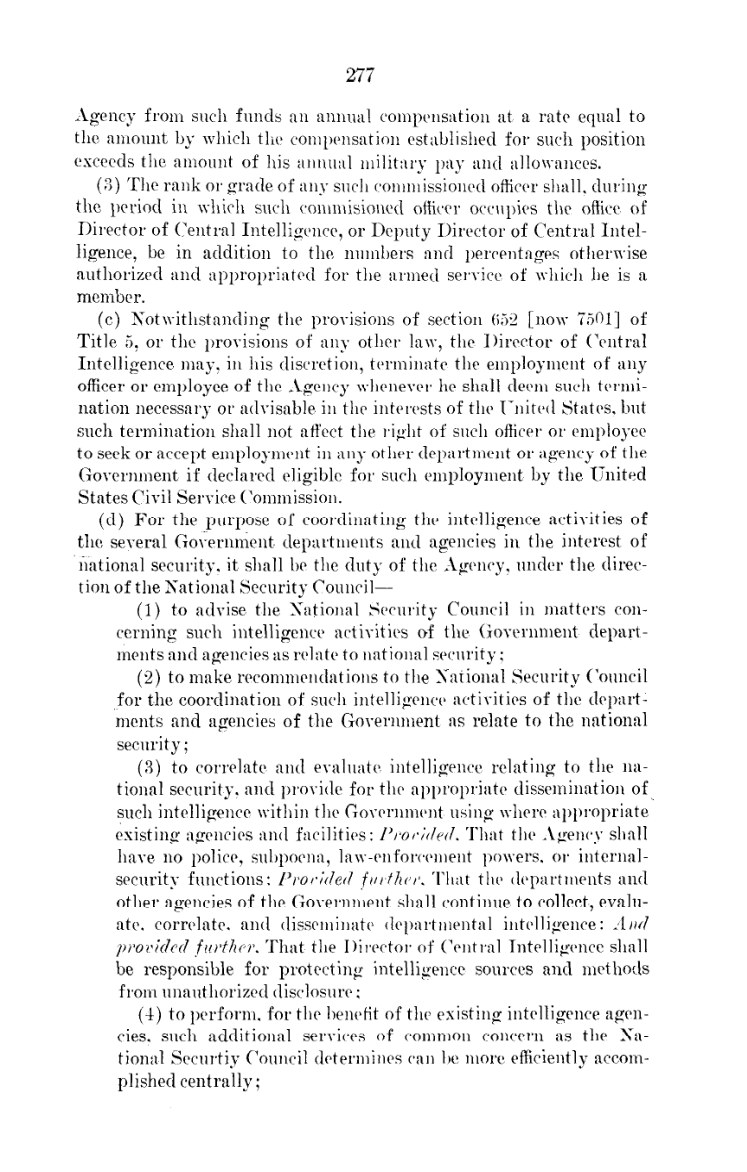
National Security Act text, printed page 277
Historical National Security Act text, reproduced in the Rockefeller report appendix. The CIA’s affirmative duties and express limits belonged to the same statute. Image credit ↗

Chapter 01 / 1947–1967

A foreign mission meets an American political crisis

The CIA’s founding law gave it national-security intelligence responsibilities while denying it police, subpoena, law-enforcement and internal-security functions. Those limits did not mean that every CIA activity physically inside the United States was forbidden. Training personnel, obtaining foreign intelligence from willing sources and protecting Agency secrets required domestic work. The difficult question was when support for a foreign mission became investigation of American political life. CHAOS made that distinction a working problem rather than an abstract debate.

In 1967 racial unrest, urban violence and opposition to the Vietnam War challenged President Lyndon Johnson’s administration. Some protest participants advocated revolutionary change, some pursued nonviolent reform, and some engaged in violence. Foreign governments and Communist organizations had reasons to welcome American division and sometimes offered propaganda, contacts or assistance. None of those facts established that a single foreign power directed the many different movements. The pressure to demonstrate such direction became part of the history the intelligence agencies themselves investigated.

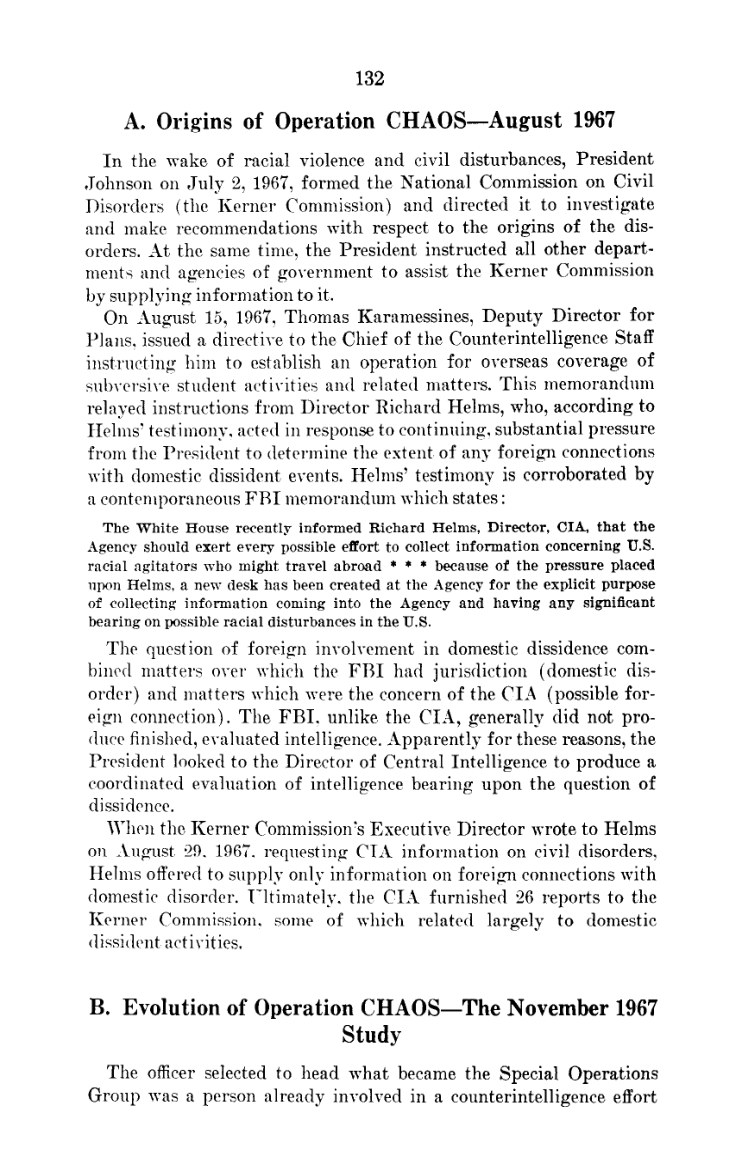
Within the CIA, Richard Ober had already examined possible foreign connections around Ramparts magazine and begun assembling information on Americans. In August, Director Richard Helms broadened the effort. The Church Committee found no written founding directive from Helms to his deputy. The first recorded authorization was a 15 August 1967 memorandum from Deputy Director for Plans Thomas Karamessines to counterintelligence chief James Angleton. It called for an officer to coordinate collection with domestic counterintelligence aspects, secure handling and dissemination to the appropriate domestic agencies. Angleton selected Ober, who led the Special Operations Group.

Helms later described persistent presidential interest rather than a single specific written order launching this exact program. That testimony, the memorandum and contemporary interagency reporting establish a chain of political pressure and agency action without requiring an invented signed presidential instruction. The designation CHAOS was applied after the effort began. Later correspondence also associates the activity with MHPASHA and MHVAPOR. Names changed; the questions about the mission, the information gathered and its use require the underlying records. The central issue is what the CIA actually did under those instructions.
Sources: S01 · S02 · S03 · S04 · S08

Rockefeller Commission: origins, printed page 132
Rockefeller Commission chapter 11, printed page 132: origins, the 15 August directive and corroborating interagency evidence. Image credit ↗

Chapter 02 / 1967–1969

The reports did not confirm the expected conspiracy

In autumn 1967 the CIA assembled information for a White House study of the American peace movement’s international connections. Overseas stations were polled and other agencies supplied material, much of it from the FBI. The study delivered in November found little evidence of foreign involvement and no significant foreign financial support. Gathering information for the study also enlarged the Special Operations Group’s holdings. A negative analytical answer did not automatically end the collection system that had produced it.

Further studies examined demonstration techniques and American students. In 1968, Restless Youth analyzed student unrest in multiple countries, tracing its sources largely to domestic social and political conditions. Its White House version included American student activity. Helms warned that the domestic section was especially sensitive. When he sent the study to Henry Kissinger for President Richard Nixon in February 1969, he explicitly acknowledged that American students lay outside the Agency’s charter. The analytical work was therefore not simply neutral background sitting beyond the authority problem; senior officials recognized the problem while transmitting it.

The strongest security argument was that foreign influence can be concealed and an initial failure to find it may reflect inadequate collection. Presidents could reasonably ask whether agents, money, training or coordinated direction had escaped detection. The evidentiary question was whether that concern generated specific foreign targets and proportionate inquiries, or instead turned the absence of evidence into a reason to catalogue larger portions of domestic opposition. The reports describe the second danger repeatedly, without claiming that no foreign contact had ever existed.

Nixon’s White House renewed the pressure. On 20 June 1969, staff assistant Tom Huston requested an assessment of foreign Communist support, construed broadly, alongside a review of collection gaps and resources. The CIA’s response found only limited assistance and no evidence of direction or control of an American revolutionary protest movement. Much of what it could document was encouragement and propaganda. Subsequent studies preserved the distinction between foreign interest in exploiting unrest and operational control of it. Those findings were the Agency’s analytical results, not proof that every protest group was harmless or that every international relationship had been uncovered. They nevertheless undercut the sweeping foreign-mastermind explanation that drove continued demands.

Sources: S01 · S02 · S12

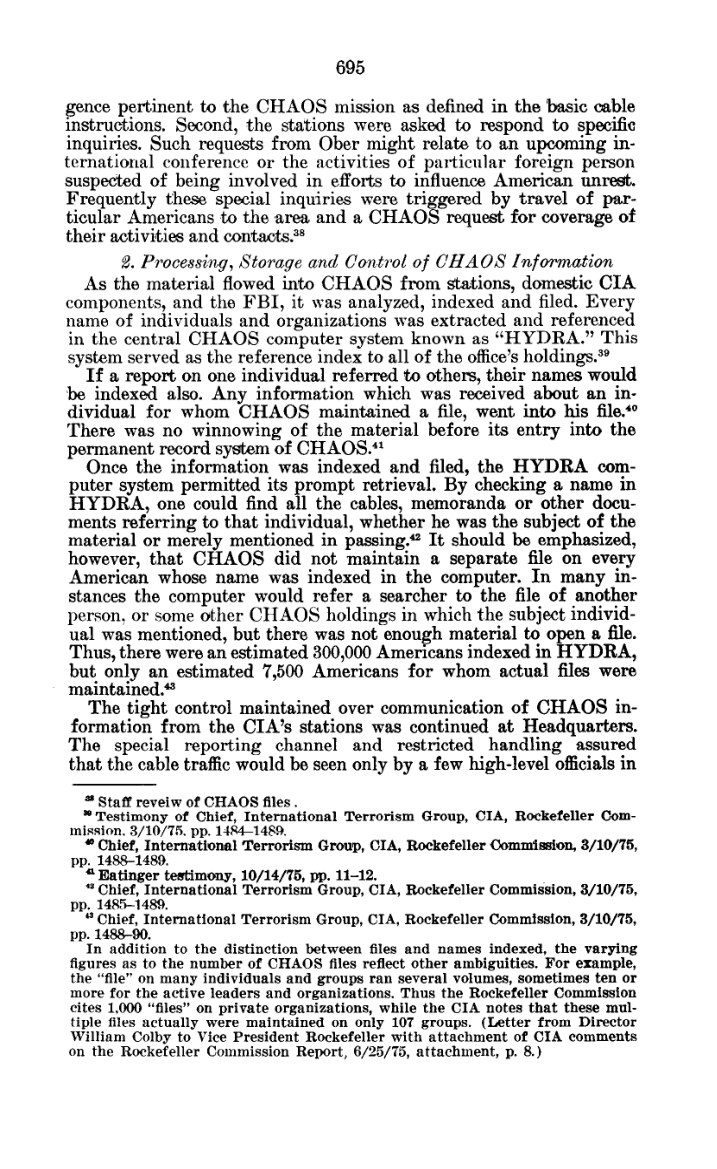
Church Committee: HYDRA, printed page 695
Church Committee staff report, printed page 695: HYDRA indexing, retention and the distinction between names and actual files. Image credit ↗

Chapter 03 / 1967–1973

A name in HYDRA was not the same thing as a dossier

Information flowed into the CHAOS office from CIA stations, domestic components, the FBI and other intelligence channels. The office analyzed, indexed and filed it in a computer reference system called HYDRA. Staff extracted the names of people and organizations mentioned in incoming reports, even when they were incidental to the subject. A search could then locate the reports and memoranda containing a name. The system made scattered information retrievable; it did not establish the accuracy, relevance or wrongdoing of every person it listed.

The Church staff found that information was not winnowed before entering the permanent record. Material about a person with an existing file went into that file. Other names could appear only as references to someone else’s file or to a general report. The Rockefeller Commission described about 13,000 files, including files on 7,200 American citizens, and an index exceeding 300,000 persons and organizations. The Church report estimated about 7,500 Americans with actual files and about 300,000 indexed Americans. These are approximate investigative figures with differences in classification; they should not be merged into a precise, audited count.

Even the word file concealed differences. The Church report noted that one active organization or person could occupy several volumes. In discussing the Rockefeller Commission’s figure of 1,000 organization files, it cited the CIA’s explanation that these covered 107 groups. A later summary’s numerical categories cannot safely be converted into thousands of distinct political organizations or 300,000 individually opened dossiers. The records demonstrate a large collection and retention system without making those stronger numerical claims.

CHAOS also distributed information. Major studies reached senior officials; sensitive special memoranda went to high-level recipients; thousands of reports went to the FBI. Much of the tangible output consisted of raw reporting rather than proof of a foreign conspiracy. The potential consequence was therefore not limited to reading by Ober’s immediate staff. Information could enter another agency’s security files and investigative processes. These records establish the flow, but they do not by themselves show the subsequent use of every report or quantify injury to every named person. Tracing an individual case requires the specific incoming source, file entry, dissemination and recipient action, including evidence that corrects false or misleading information.

Sources: S01 · S02 · S07 · S12

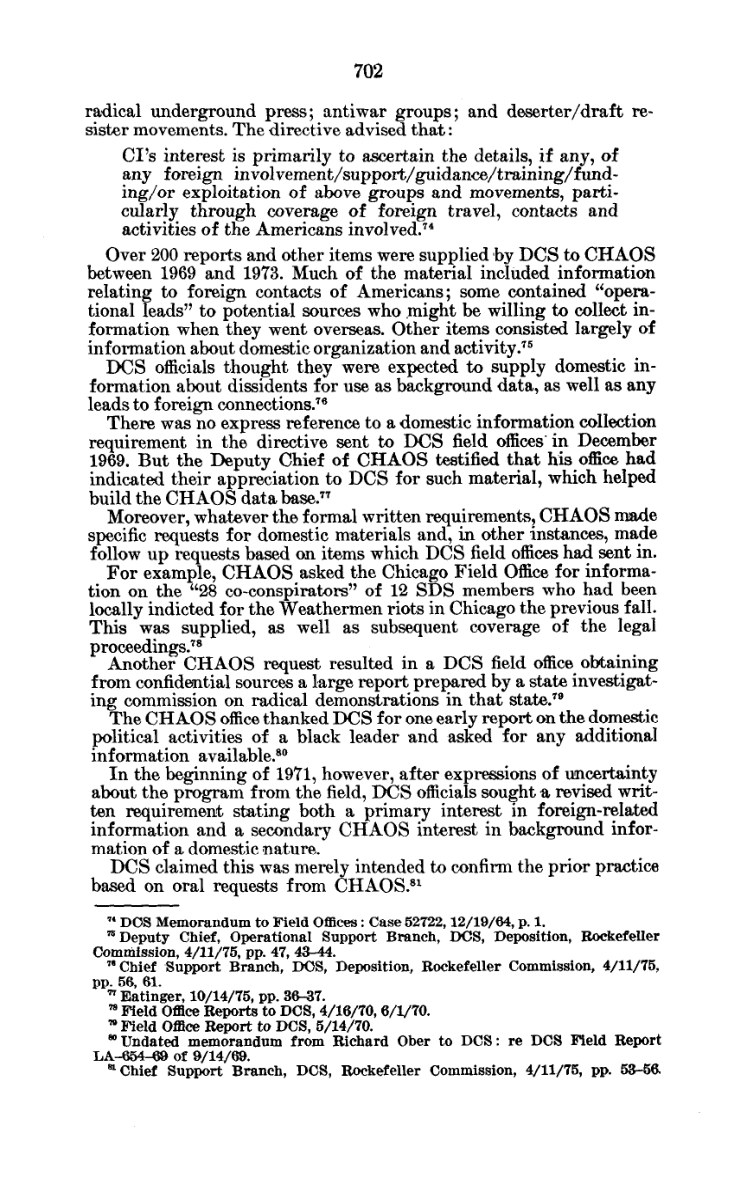
Church Committee: domestic requests, printed page 702
Church report, printed page 702: Domestic Contact Service reporting and specific requests for domestic information. Image credit ↗

Chapter 04 / 1969–1972

Foreign cover brought collection into domestic groups

The 1969 expansion increased both staffing and sources. CHAOS sought cooperation from the CIA’s Domestic Contact Service, whose ordinary mission included obtaining foreign intelligence from willing Americans. Field offices supplied more than 200 reports and items between 1969 and 1973. Some concerned foreign contacts or potential overseas sources; others described domestic organization and activity. The written foreign emphasis did not prevent the CHAOS office from seeking additional domestic material.

The Church investigation identified concrete requests. The CHAOS office asked its Chicago contacts for information on alleged co-conspirators in a local case involving SDS members and the Weathermen disturbances; subsequent legal proceedings were also covered. Another request obtained a state investigating commission’s report on radical demonstrations. A report on a Black leader’s domestic political activity drew thanks and a request for more. These examples matter because they connect the broad mission to actual collection requirements. They are stronger evidence of domestic interest than merely counting every incidental name in an index.

CHAOS also developed agents for overseas assignments. Recruits participated in American radical communities to acquire the language, relationships and credentials that might make their foreign work plausible. Reporting and debriefing during that preparation supplied extensive information about domestic associates and activities. A related area-division operation called Project 2 similarly placed trainees in American universities and radical circles before foreign missions, forwarding their reports to CHAOS. Its foreign purpose and its separate management did not make the domestic reporting vanish.

There were differences within this activity. Most recruits were not given a standing instruction to investigate domestic dissidents, according to the Rockefeller Commission. On three occasions it found CHAOS agents specifically used to gather strictly domestic intelligence. The Church report described directed coverage and instances in which information was collected for the FBI. Distinguishing incidental observation, intensive debriefing and a targeted assignment helps identify responsibility; it does not turn retained domestic intelligence into nothing. Nor does assistance to the FBI grant the CIA every authority the Bureau claimed for itself. The oversight findings examined the CIA’s own statutory limits, including when its agents were collecting on Americans at another agency’s request.

Sources: S01 · S02

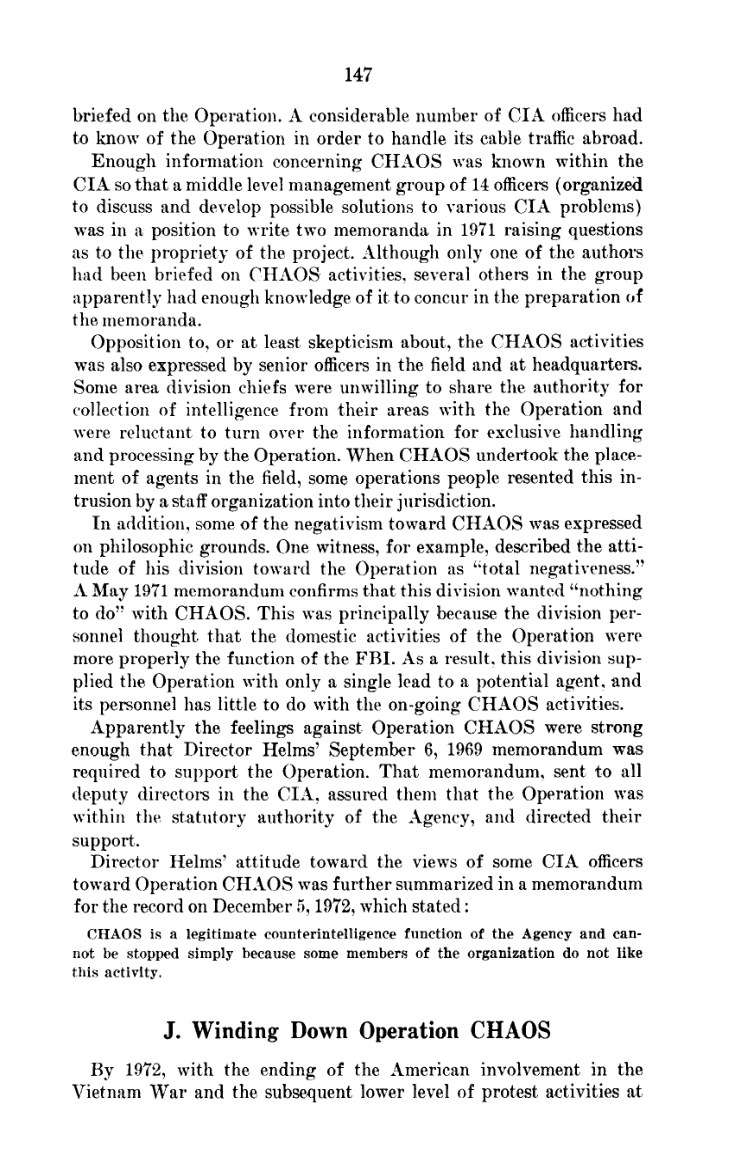
Rockefeller Commission: internal objections, printed page 147
Rockefeller Commission, printed page 147: internal objections, resistance and Helms’ defense of the mission. Image credit ↗

Chapter 05 / 1967–1973

Several agencies and several programs fed the record

CHAOS was part of a wider intelligence environment, but the programs were not one interchangeable apparatus. The CIA’s Office of Security ran MERRIMAC and RESISTANCE separately from Ober’s counterintelligence group. MERRIMAC infiltrated Washington peace and Black activist groups under an asserted need to anticipate threats to CIA personnel and facilities. RESISTANCE gathered information from open sources and contacts including police, campus officials and other local authorities. Both supplied material to CHAOS. The Church report tested whether protective security purposes justified the breadth of what was gathered.

Other inputs came from the CIA’s mail-opening activity and from NSA international communications intercepts. The Church staff found that CHAOS supplied 41 names of individuals and organizations to the mail project’s watch list, and also furnished watch-list names to the NSA. Receiving intercepted material, nominating names and running an interception program were different actions. CHAOS was not the CIA’s name for the NSA, and neither the mail program nor all NSA collection began with it. Their specific operational histories require their own evidence.

The same care applies to the FBI. It supplied large quantities of domestic reporting and requested coverage of Americans traveling abroad; the CIA used foreign stations and liaison services to respond. The FBI’s COINTELPRO covert disruption programs had their own authorizations and actions. Evidence that CHAOS collected and disseminated political intelligence does not automatically establish that its staff ordered every provocation, infiltration, prosecution or violent event attributed to the FBI. Conversely, the FBI origin of a report does not excuse the CIA’s decision to retain or exploit it beyond its mandate.

There was disagreement inside the CIA as well. Some officers resisted what they regarded as domestic work properly belonging to the FBI; others objected to the Special Operations Group intruding on geographic divisions’ authority. Fourteen middle-level officers raised concerns in 1971. In 1972, the Inspector General’s survey team was not allowed to review specific CHAOS files and operations, but relayed station concerns about monitoring Americans not known or suspected to be involved in espionage. Helms defended CHAOS as legitimate counterintelligence. That defense belongs beside the documented objections and findings, not above them. A program’s compartmentation can protect sources while also blocking the review needed to determine whether it has exceeded its authority.

Sources: S01 · S02 · S04

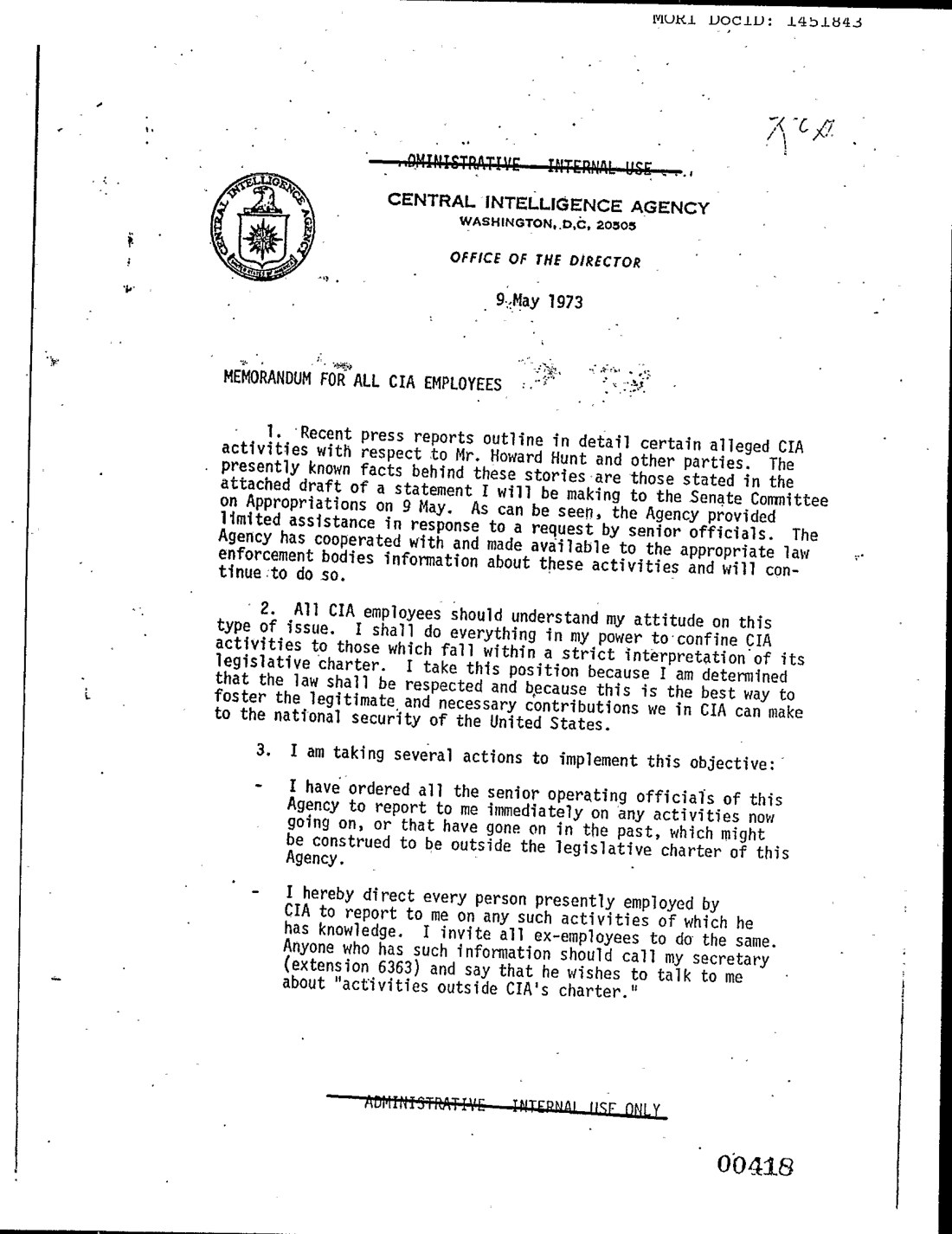
Schlesinger memorandum, 9 May 1973, page 1
Schlesinger’s 9 May 1973 directive asks employees to report possible charter violations. This original internal record precedes the public revelations. Image credit ↗

Chapter 06 / 1972–1974

Restriction, renaming and termination were different steps

As protest declined after 1972, so did the intensity of CHAOS reporting. A July cable reduced the priority of general New Left foreign-contact reporting, while preserving attention to violent groups and residual capabilities. Inspector General William Broe’s November review prompted discussion among senior officers. Helms directed greater emphasis on terrorism and less attention to political dissidents not involved or likely to become involved in it. These were adjustments in collection priority, not a retroactive finding that every preceding activity had been lawful.

On 9 May 1973, Director James Schlesinger ordered employees to report current or past activities potentially outside the CIA’s charter. The ensuing inventory, later called the Family Jewels, included CHAOS alongside other operations. A report of a questionable activity is neither a prosecution nor proof that every allegation is correct. Its importance here is that employees’ doubts and records entered a wider institutional review. They had existed before the program became a front-page public controversy.

William Colby’s 29 August 1973 guidance narrowed the focus to collection abroad about foreign activities related to domestic matters, with Americans incidental to the foreign target. It limited the CIA’s direct role in following Americans abroad and addressed how FBI requests should be handled. A February 1975 CIA response to the Rockefeller Commission identified MHVAPOR as the new designator following that guidance, with MHCHAOS and MHPASHA as earlier names. This authentic naming history cautions against treating a change of cryptonym as evidence that collection either stopped completely or continued unchanged.

The specified CHAOS collection program was terminated in March 1974. The Rockefeller report gives 15 March; the Church report describes a 5 March order and cites a 6 March cable. The sources therefore support a March endpoint more securely than one unqualified universal day. Termination instructions also permitted bounded foreign-targeted counterintelligence work, including specified responses to written FBI requests with senior approval. The office’s records did not disappear. In 1975 the commission found files and the index still held pending investigations, and recommended removal of material without foreign-intelligence value when law permitted. A recommendation to destroy such material is different from proof that every file was destroyed, that evidence was unlawfully erased, or that the original program remains active today.

Sources: S01 · S02 · S05 · S08

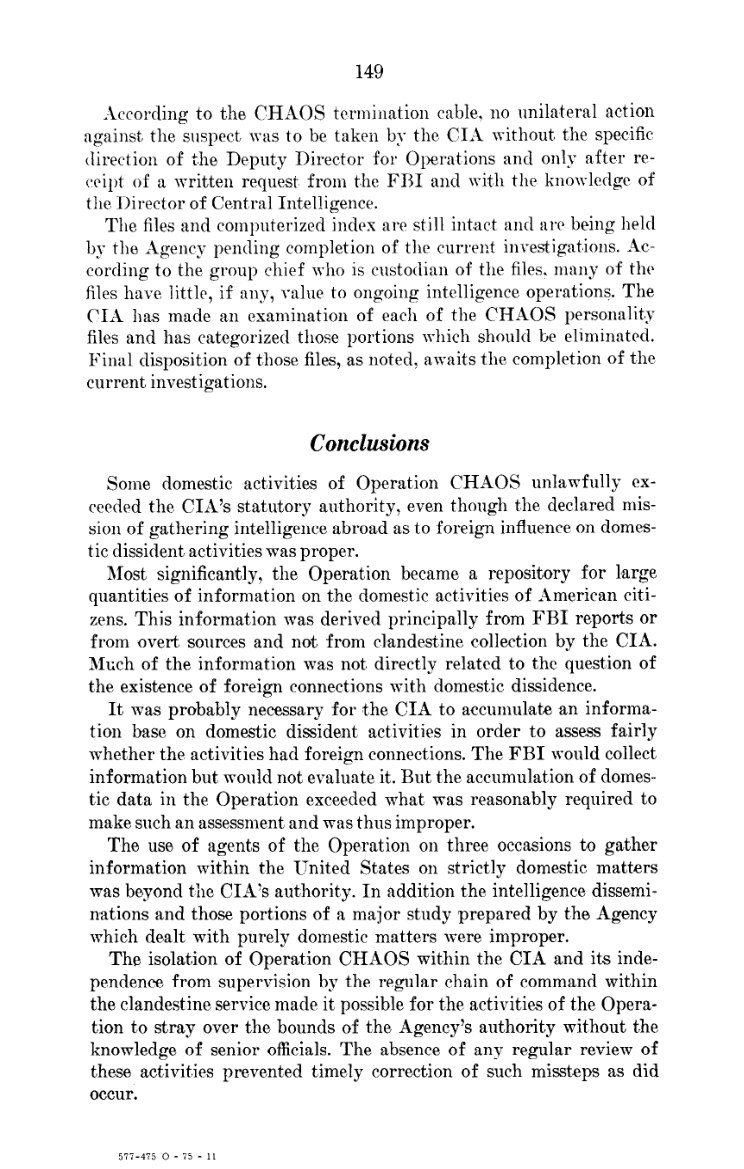
Rockefeller Commission: findings, printed page 149
Rockefeller Commission, printed page 149: its finding that some domestic activities exceeded CIA authority, alongside its distinction between the declared mission and its implementation. Image credit ↗

Chapter 07 / 1974–1976 / later releases

Exposure made the boundary a public question

Seymour Hersh’s 22 December 1974 New York Times report brought CIA domestic activities to a national audience after CHAOS had already been terminated as a specified collection program. The story did not invent the internal concerns; it changed who could demand answers. Colby briefed Justice Department officials at the end of December and President Gerald Ford on 3 January 1975. The meeting record shows officials discussing the dissident operation, who knew about it and how it related to the FBI. Colby’s explanations were part of the evidence that subsequent investigators had to test.

Ford established the Rockefeller Commission, and Congress conducted the separate Church and Pike investigations. In June 1975 the Rockefeller Commission concluded that some domestic CHAOS activities unlawfully exceeded the CIA’s statutory authority, even though the declared mission of gathering foreign intelligence about foreign influence was proper. It criticized excessive domestic holdings, strictly domestic agent assignments and domestic portions of reports. It also found that isolation from ordinary supervision had prevented timely correction. This was an official investigative finding, not a criminal conviction of every participant.

The 1976 Church staff report pressed the broader question of whether an open-ended inquiry into the foreign links of domestic dissidents was itself too close to the internal-security function prohibited by statute. It examined the actual information flows and assignments rather than accepting foreign purpose as a complete answer. Ford’s Executive Order 11905, issued 18 February 1976, reorganized oversight and placed restrictions on collection involving Americans, with defined exceptions. The order was a reform response, not proof that all later intelligence practices complied with it or that legitimate foreign collection had ended.

Later releases made more of the internal record accessible. The National Security Archive documented receiving the Family Jewels collection in June 2007, and CIA historians subsequently revisited the episode. Retrospective accounts can clarify the program while reproducing its defenders’ categories or compressing its statistics. The original reports remain essential. They establish political-intelligence collection and statutory overreach without proving universal foreign control of protest, every alleged act of disruption, or seamless survival into an unspecified present operation. The remaining questions are concrete: which assignments reached which sources, which records were accurate, who received them, what actions followed, and what became of particular files.

Sources: S01 · S02 · S06 · S07 · S09 · S10 · S11 · S12

03 / The record

People and institutions

Open a record for the person’s role and supporting sources. Names identify people; no unverified portrait is substituted for a participant.

JohnsonBiographical record
Lyndon B. JohnsonU.S. president, 1963–1969

Pressed for answers on foreign influence over domestic dissent. Helms described sustained presidential pressure; the record does not supply a single written Johnson launch order for the exact program.

Sources: S01 · S02

NixonBiographical record
Richard NixonU.S. president, 1969–1974

His White House renewed demands for information on foreign Communist support and collection gaps. That pressure contributed to expansion without producing proof of general foreign control.

Sources: S01 · S02

HelmsBiographical record
Richard HelmsDirector of Central Intelligence

Authorized the effort through his deputies, transmitted studies and defended its counterintelligence basis. His own warning about domestic student coverage and internal objections complicate claims of unrecognized overreach.

Sources: S01 · S02

KaramessinesBiographical record
Thomas KaramessinesDeputy Director for Plans

Issued the first recorded authorization on 15 August 1967 and supervised the operations chain. The memorandum is distinguished from a specific written presidential order.

Sources: S01 · S02

AngletonBiographical record
James Jesus AngletonCIA counterintelligence chief

Selected Richard Ober to head the unit within the Counterintelligence Staff. Separate CIA programs also supplied material; they were not all run by the CHAOS office.

Sources: S01

OberBiographical record
Richard OberSpecial Operations Group chief

Coordinated collection and analysis, controlled restricted traffic and oversaw CHAOS holdings and dissemination. His own justifications are tested against staff-reviewed files.

Sources: S01 · S02

HustonBiographical record
Tom Charles HustonNixon White House staff assistant

Requested the 20 June 1969 review of foreign Communist support and collection capability. That request and the later Huston Plan are related but distinct records.

Sources: S01

BroeBiographical record
William BroeCIA Inspector General

Relayed station concerns in November 1972 after an inspection team was denied access to specific files and operations. The objection addressed political monitoring, not merely administrative inconvenience.

Sources: S01

SchlesingerBiographical record
James R. SchlesingerDirector of Central Intelligence in 1973

Ordered the 9 May inventory of activities potentially beyond the CIA charter, initiating the compilation later called the Family Jewels.

Sources: S05

ColbyBiographical record
William E. ColbyDirector of Central Intelligence, 1973–1976

Restricted the mission in August 1973 and terminated CHAOS as a specified collection program in March 1974. Later briefed Justice and President Ford; those explanations did not settle the investigations.

Sources: S01 · S02 · S06 · S07

RockefellerBiographical record
Nelson A. RockefellerVice president / commission chair

Chaired Ford’s inquiry into CIA activities within the United States. The commission distinguished proper declared foreign purpose from unlawful domestic actions.

Sources: S02 · S14

ChurchBiographical record
Frank ChurchSenate investigating committee chairman

Led the separate Senate investigation. Book III examined the mission, information flows, domestic agents and related Office of Security programs.

Sources: S01 · S13

FordBiographical record
Gerald R. FordU.S. president, 1974–1977

Created the presidential commission and issued Executive Order 11905 during the wider intelligence reforms. Investigative findings and executive restrictions were separate from criminal verdicts.

Sources: S06 · S09 · S10

associatesBiographical record
American dissidents and their associatesSubjects, contacts and incidental names

Antiwar, student and Black activist groups differed in aims and methods. Appearance in a file or index did not establish espionage, violence or foreign control. Many names were incidental references.

Sources: S01 · S02

04 / The record

The program and its aftermath

Horizontal spacing shows elapsed time; separate rows keep close events selectable. Scroll the graph on narrow screens. Exact dates are attributed where records conflict; month- and year-only dates preserve source precision.

19471962197719932008
A statutory boundary accompanies the CIA’s creationLaw

The National Security Act assigns intelligence responsibilities while excluding police, law-enforcement and internal-security functions. This is the historical charter, not a summary of today’s complete legal regime.

Sources: S03 · S04

Ober’s narrower inquiry precedes the programPrehistory

Ramparts-related foreign-connection research had generated an early set of names and files before the August expansion.

Sources: S01

First recorded authorizationAuthorization

Karamessines instructs Angleton to establish overseas coverage of student and related matters; the Church staff found no written Helms founding directive.

Sources: S01 · S02

Field collection requirement specifiedCollection

The cable described coverage of radical students and Black expatriates/travelers abroad for possible exploitation by hostile powers. Its historical terminology is not adopted as a judgment of the subjects.

Sources: S01

Peace movement study deliveredAnalysis

The first major study found little foreign involvement and no significant foreign financial support. Collection for the study also enlarged the unit’s holdings.

Sources: S02

Domestic student study sent to White HouseAnalysis

The study examined U.S. student dissent rather than only foreign targets, raising the authority question addressed later by investigators.

Sources: S01 · S02

Restless Youth reaches JohnsonAnalysis

The global student study included domestic coverage in its White House version and attributed unrest largely to homegrown conditions.

Sources: S01 · S02

Helms warns Kissinger about domestic sectionAuthority

The covering letter acknowledged that American students were outside the Agency’s charter.

Sources: S01 · S02

Huston requests a broader reviewPressure

Nixon’s White House asks about foreign Communist support, collection resources and gaps.

Sources: S01

Review reports limited assistance, no directionAnalysis

Cushman’s transmittal described limited assistance, much of it propaganda, and no evidence of direction or control of an American revolutionary protest movement.

Sources: S01

Helms directs cooperation with CHAOSManagement

The memorandum backs the mission and requests cooperation across CIA components.

Sources: S02

New collection sources developedExpansion

Domestic Contact Service work and CHAOS agent development expand; Project 2 is developed separately and implemented in 1970. No exact founding day for every component is inferred.

Sources: S01

Officers question the programInternal dissent

Fourteen middle-level officers raise concerns in two memoranda; other field and headquarters objections are documented.

Sources: S02

Mail watch-list request documentedInteragency input

The Church report cites Ober’s memorandum supplying 41 individual/organization names to the mail project. This does not make CHAOS itself the mail-opening operation.

Sources: S01

General reporting priority reducedRestriction

Foreign contacts of the New Left are no longer generally high priority, while reporting on violence and residual capability is retained.

Sources: S01

Inspector General relays station concernsReview

The review raises doubts about monitoring Americans without known or suspected espionage involvement. Inspection access to specific CHAOS files had been denied.

Sources: S01

Helms defends counterintelligence basisDefense

His memorandum calls CHAOS legitimate and rejects ending it merely because officers dislike it. Investigative findings later test that position.

Sources: S02

Schlesinger orders a charter inventoryReview

Employees are directed to report activities potentially outside legislative authority.

Sources: S05

Colby narrows the missionRestriction

Guidance focuses collection abroad on foreign organizations and individuals, with American contacts incidental. The CIA’s 1975 response associates MHVAPOR with this guidance.

Sources: S01 · S02 · S08

Specified CHAOS program endsTermination

Rockefeller gives 15 March; Church describes a 5 March order and cites a 6 March cable. Bounded foreign-targeted collection and file custody continue under guidelines; this marker preserves the month-level common ground.

Sources: S01 · S02

Public revelations transform accountabilityExposure

Hersh’s New York Times report prompts a wider political response after internal review and termination. Primary meeting records and later archival history document that response.

Sources: S06 · S11

Colby briefs FordExecutive response

The meeting record captures explanations of dissident collection and who knew of it; the account is assessed against subsequent investigations.

Sources: S06

Ford establishes the commissionOversight

The Rockefeller Commission examines CIA activities within the United States. Congress investigates separately.

Sources: S10 · S14

CIA explains the codeword sequenceDocument

The Belin response identifies MHPASHA, MHCHAOS and MHVAPOR as related designators.

Sources: S08

Rockefeller findings distinguish purpose and actsFinding

Some domestic activities unlawfully exceeded the charter, despite a proper declared foreign mission. The report discusses retained files and recommendations.

Sources: S02

Executive Order 11905 issuedReform

Ford establishes intelligence oversight structures and collection restrictions with exceptions. It is not a finding of perfect subsequent compliance.

Sources: S09

Church report publishedFinding

Book III develops the mission, domestic collection and related-program evidence.

Sources: S01 · S13

Family Jewels released to the ArchiveDisclosure

The National Security Archive reports receiving the released compilation. Disclosure of historical material is not evidence of current continuation.

Sources: S11

05 / The record

The load-bearing facts

Six connected steps link political pressure, tasking, collection, retention, restriction and official findings. Open each step for its dependencies, why it matters, and the questions it leaves for rival accounts.

CP1

Political pressure becomes a specific collection mission

Persistent presidential concern is connected to Karamessines’ 15 August 1967 instructions and Ober’s assignment, not an invented signed Johnson launch order.

Why it is critical

Identifies the difference between pressure, formal agency authorization and work already underway.

Dependencies

Requires the initial memorandum, Helms’ testimony and contemporary corroboration, while preserving their different evidentiary roles.

What rival readings must explain

A purely rogue-unit account must explain top-level sponsorship; a direct-presidential-order account must supply the particular order it asserts.

Sources: S01 · S02

CP2

Negative findings produce new demands and expansion

The 1967 study, Restless Youth and 1969–1971 reviews do not establish general foreign control; collection nevertheless expands after requests about gaps.

Why it is critical

Explains why negative analysis did not close the inquiry and connects presidential demands to added sources and staffing.

Dependencies

Depends on distinguishing propaganda, contacts, isolated aid, organizational direction and absence of information.

What rival readings must explain

A justified-security account must explain the specific targets and scope; a claim that no foreign contact ever existed goes beyond the reports.

Sources: S01 · S02

CP3

Data become durable and searchable

HYDRA indexes names in incoming material without winnowing; files and disseminations preserve domestic information beyond the immediate foreign inquiry.

Why it is critical

Shows the concrete institutional consequence and why headline totals need units.

Dependencies

Requires separate counts for index entries, individuals, files, volumes and organizations; source errors cannot be solved by choosing the largest number.

What rival readings must explain

A harmless-background account must explain retention and distribution; a 300,000-dossierclaim must supply separate opened files.

Sources: S01 · S02

CP4

Domestic requirements and agents test the boundary

DCSrequests, intensive debriefings and specifically directed domestic assignments give action-level evidence beyond a foreign-purpose label.

Why it is critical

Locates the conduct later judged improper and separates agency responsibility from the origins of a source.

Dependencies

Requires tasking, agent reports, operational management and recipient records; CIA/FBI/NSA and Office of Security programs remain distinct.

What rival readings must explain

Incidental-collection arguments must explain directed assignments and follow-up requests, while universal-disruption claims need evidence of the particular acts alleged.

Sources: S01 · S02 · S04

CP5

Internal objections lead to limits and a formal endpoint

Officers object, Broe relays concerns, Schlesinger orders an inventory, Colby narrows the mission and the specified program terminates in March 1974.

Why it is critical

Prevents a simple exposure-caused-termination story while recognizing continued file custody and bounded successor activity.

Dependencies

Requires comparing directives with implementation, and preserving conflicting March day references.

What rival readings must explain

A complete-cessation account must explain retained files and future guidelines; a seamless-continuation account must identify successor authority, tasking and actual operations.

Sources: S01 · S02 · S05 · S08

CP6

Public investigation finds statutory excess

The Rockefeller and Church inquiries distinguish declared foreign purpose from domestic collection and broader mission questions; executive reforms follow.

Why it is critical

Establishes the official outcomes without pretending they were criminal convictions or automatic guarantees of future compliance.

Dependencies

Depends on the actual findings, recommendations, order and subsequent record-disposition evidence.

What rival readings must explain

A total-exoneration reading must confront the findings; an all-activities-illegal claim must confront the acknowledged lawful foreign mission and specific limits of each conclusion.

Sources: S01 · S02 · S09 · S10

06 / The record

Four interpretations tested against the record

Competing interpretations, stated at their strongest and tested against the same chain. Presenting a theory is not endorsing it.

Interpretation 01

A foreign-intelligence inquiry that exceeded its mandate

Best supported overall

The strongest version

Foreign influence was a real intelligence question, but open-ended pressure, broad retention and domestic assignments moved the program beyond the CIA’s statutory role.

Accepts

Some collection abroad and support activity at home could be lawful; source material and agents differed.

Must still explain

How particular instructions and review failures produced the domestic acts, and what happened to each record.

Assessment

CP 1–CP 6 link top-level authorization to action, data retention, internal review and official findings. A foreign label does not answer the demonstrated excess.

What would change this assessment

Authenticated tasking, full file histories and recipient actions could refine who directed each excess and its consequences; new foreign contacts would not by themselves authorize all domestic collection.

Sources: S01 · S02 · S04

Interpretation 02

Necessary counterintelligence amid concealed foreign threats

Explains purpose, not every act

The strongest version

Foreign services exploit disorder covertly; presidents and intelligence officers could reasonably demand better sources when initial studies found little. Identifying a foreign connection may require knowledge of the American end.

Accepts

The reports record contacts, propaganda and isolated assistance, and acknowledge a proper foreign mission.

Must still explain

The lack of demonstrated general control, purely domestic tasking, undiscriminating retention and explicit authority concerns.

Assessment

CP 2 and CP 4 show why an unproved threat could not alone settle scope. The commission’s findings reject a blanket justification while preserving a foreign-intelligence role.

What would change this assessment

Specific authenticated foreign-service operational records, payments and tasking could change the assessment of a particular group’s foreign dependence; proportionality and statutory authority would still require separate analysis.

Sources: S01 · S02 · S03

Interpretation 03

A political-surveillance system under a foreign cover story

Substantial support for domestic effects; sweeping motive claims remain limited

The strongest version

Political leaders sought a foreign explanation for American opposition, and the intelligence apparatus accumulated domestic dossiers even when its own analysis did not support that explanation.

Accepts

The unit conducted genuine foreign collection and its analysts repeatedly reported negative conclusions; not every officer shared one motive.

Must still explain

Whether a particular collection decision aimed at repression, bureaucratic reassurance or a specific foreign target, and how information was used downstream.

Assessment

CP 2–CP 4 support collection of political intelligence. They do not establish that CHAOS ordered every disruptive act or that every analysis was fabricated to please the White House.

What would change this assessment

Authenticated instructions to suppress lawful groups, operation-specific plans and recipient records linking reports to punitive actions would strengthen a direct-repression account; documented limits and genuinely foreign targets could narrow particular allegations.

Sources: S01 · S02 · S06

Interpretation 04

A rogue operation invisible to responsible officials

Inadequate as the main account

The strongest version

Compartmentation insulated Ober’s group and blocked normal review; some senior officials did not know the full domestic scope.

Accepts

The isolation and review failures were documented and matter to individual knowledge.

Must still explain

Karamessines’ authorization, Helms’ communications and defenses, White House studies and acknowledged internal objections.

Assessment

CP 1 and CP 5 show official sponsorship and warnings, alongside concealment of details. Unknown knowledge for a specific official is not proof of universal ignorance.

What would change this assessment

Authenticated briefing distribution, meeting notes and orders could establish what particular officials knew at particular times. The documentary chain would need to be confronted rather than replaced by a general denial.

Sources: S01 · S02 · S05

07 / The record

How the story changed

Public memory tends to compress contested histories into a turning point. The records leave a less tidy sequence.

The conspiracy the inquiry did not establish

ThenPresidential pressure sought an explanation in foreign manipulation of domestic unrest.

ReconsideredThe CIA’s studies found limited assistance and no general foreign direction; continued collection expanded the domestic record despite those conclusions.

Sources: S01 · S02

A large index becomes a misleading headline

ThenApproximate totals for names, files, volumes and people described several different things.

ReconsideredThe reports distinguish incidental references from opened dossiers and multiple volumes from distinct organizations. The scale is real without equating every index entry with an individual investigation.

Sources: S01 · S02 · S12

Public exposure follows internal restriction

ThenThe 1974 public revelations can make the program seem to have ended only because it was exposed.

ReconsideredInternal objections, restriction and a March 1974 termination preceded the December story. Retained records and bounded foreign-targeted activity make the aftermath more complex than either total erasure or unchanged continuation.

Sources: S01 · S02 · S05 · S11

08 / The record

What the evidence supports

Ratings apply to the precise proposition on the page. Unsupported means the assembled evidence does not establish a claim; it is not interchangeable with false.

Established

CHAOS collected and retained information about American political activity.

The staff-reviewed information flows, domestic requests, agent reports and holdings establish this precisely; it is not dependent solely on the program’s critics or its name.

Sources: S01 · S02

Contradicted

All CIA activity inside the United States was prohibited.

The historical charter allowed support for foreign intelligence and legitimate functions at home, while excluding internal security. Location alone does not settle authority.

Sources: S03 · S04

Not established

A specific signed Johnson order launching CHAOS is established here.

The first recorded agency authorization is Karamessines’ 15 August 1967 memo. Helms described persistent presidential pressure rather than a particular written launch instruction.

Sources: S01 · S02

Contradicted

The program proved that foreign governments controlled the American antiwar movement.

The investigations describe repeated findings of no significant foreign direction. Contacts, encouragement and isolated aid do not establish general control.

Sources: S01 · S02

Not established

There was no foreign contact or assistance of any kind.

The reports describe propaganda, contacts and some assistance while rejecting the sweeping control hypothesis.

Sources: S01

Contradicted

The index contained 300,000 separate opened American dossiers.

Names mentioned in reports were indexed even without separate files. Approximate counts and units vary; opened American files numbered in the thousands.

Sources: S01 · S02

Established

CHAOS agents were sometimes directed to gather strictly domestic intelligence.

The Rockefeller Commission identified three occasions, and Church staff examined directed assignments and domestic reporting practices.

Sources: S01 · S02

Contradicted

Every report received from the FBI was automatically proper for the CIA to retain.

The origin of information did not remove the CIA’s charter limitations; investigators criticized excessive domestic holdings.

Sources: S01 · S02

Contradicted

CHAOS, MERRIMAC, RESISTANCE, the mail program and NSA interception were one program.

They had distinct administrative and operational histories. Information sharing and watch-list requests establish connections, not identity.

Sources: S01

Contradicted

The program ended only after the December 1974 public revelations.

Restrictions and termination as a specified collection program preceded the story; the reports place termination in March 1974 with different day-level references.

Sources: S01 · S02

Not established

Termination proves every file was destroyed and every related inquiry stopped.

Records remained under custody in 1975 and bounded foreign-targeted work continued under guidelines. A destruction recommendation is not an executed record-by-record accounting.

Sources: S01 · S02 · S08

Established

The Rockefeller Commission found some domestic activities unlawful.

It found statutory excess despite a proper declared foreign-intelligence mission. This is an official investigative finding, not a criminal conviction of every participant.

Sources: S02

Not established

The evidence here proves seamless continuation of CHAOS into the present.

Historical collection, successor guidelines and later disclosure do not establish present tasking or operations. Authenticated continuity evidence would be needed.

Sources: S01 · S02 · S11

09 / The record

Watch, listen and read the witnesses

Recorded voices, reported history, and documentary context. External media need an internet connection.

Investigative reports

Read the Church Committee’s CHAOS section ↗

The full accessible section includes domestic collection, information flows and separate Office of Security programs. It is a historical source, not an embedded video.

10 / The record

The questions still open

A documented limit is more useful than a confident number or a sweeping lineage the evidence cannot carry.

  1. Which authenticated tasking and complete agent reports permit a case-by-case reconstruction of domestic assignments?
  2. What did each official receive, understand and approve at the relevant time?
  3. Which indexed entries contained inaccurate information, and what actions did recipient agencies take?
  4. What file-by-file preservation, transfer or destruction records establish the disposition of domestic material?
  5. How did the 1973–1974 restrictions change practice in particular stations and successor channels, rather than merely their names?

11 / The record

Go back to the sources

Records, reporting, and firsthand accounts have different evidentiary roles. Each source note explains what it can establish and where caution is needed. Sources consulted for this edition on 25 October 2026. Original records and attributed reporting have distinct evidentiary roles.

  1. S01

    Congressional investigation / primary

    CIA Intelligence Collection About Americans: CHAOS and the Office of Security ↗

    Senate Church Committee, Book III, S. Rep. 94-755, 1976

    Printed pages 679–732; especially 690–703 authorization, reports and expansion;705–708 review/termination;708–720 mission and domestic collection issues;721–732 separate Office of Security programs. Full 54-page section retained and relevant passages checked. AARC scan identity confirmed through official Senate index. Official full Book III raw retrieval failed; no claim of full-volume review.

  2. S02

    Presidential commission / primary

    Special Operations Group—Operation CHAOS ↗

    Rockefeller Commission, Report to the President, June 1975

    Printed pages 130–150. Establishes the program, reported scale, internal objections and findings of statutory excess. Proper foreign mission is distinguished from improper domestic acts. Official Ford Library scan; commission findings are not a criminal verdict.

  3. S03

    Legal analysis / primary

    The CIA: Legal Analysis ↗

    Rockefeller Commission, chapter 6, 1975

    Historical discussion of statutory authority and restrictions. Not a statement of today’s complete surveillance law or a judicial determination.

  4. S04

    Statutory text / primary

    National Security Act of 1947, as amended: appendix III ↗

    U.S. Congress / Rockefeller Commission appendix, 1975

    Historical statutory text, including the prohibition on CIA police, subpoena, law-enforcement and internal-security functions. Foreign-intelligence support conducted inside the United States is not automatically identical to prohibited domestic security investigation.

  5. S05

    Internal directive / primary

    Schlesinger memorandum for all CIA employees, 9 May 1973 ↗

    Director of Central Intelligence James R. Schlesinger

    Both scanned pages visually inspected. Orders employees and senior officials to report activities potentially outside the Agency’s legislative charter. The inventory became known as the Family Jewels; compilation, disclosure and remedial action occurred at different times.

  6. S06

    Contemporaneous executive record

    Colby briefs President Ford, 3 January 1975 ↗

    White House memorandum of conversation / Ford Library original

    Five pages visually inspected. Records Colby’s description of the dissident operation, officials who knew and his explanation of interagency cooperation. Statements in a meeting are participant accounts to compare with investigative findings, not exoneration.

  7. S07

    Contemporaneous executive record

    CIA Matters: Wilderotter memorandum, 3 January 1975 ↗

    James A. Wilderotter, Associate Deputy Attorney General

    Six-page summary of 31 December 1974 briefing. Visually checked relevant domestic-surveillance and file items. Reported allegations and Colby’s characterizations are attributed; broad totals here are not silently substituted for later investigated CHAOS counts.

  8. S08

    Original agency correspondence

    CIA status response to David Belin, 7 February 1975 ↗

    CIA / NARA record 178-10002-10045

    Six-page file includes a cover identification sheet. Original letter page 1 is PDF page 2 and was visually read: connects MHPASHA, MHCHAOS and MHVAPOR, the last following 29 August 1973 guidance. Renaming and a change in mandate must not be confused with proof that all collection stopped.

  9. S09

    Executive order / primary

    Executive Order 11905, 18 February 1976 ↗

    President Gerald R. Ford / official Library transcript

    Historical order establishes oversight and restrictions on intelligence activities involving Americans, with specified exceptions. It does not abolish all foreign-intelligence collection touching Americans, prove perfect compliance, or describe the current legal framework.

  10. S10

    Archival institutional history

    Intelligence Community Investigations and Reforms, 1975–1976 ↗

    Gerald R. Ford Presidential Library

    Links the Rockefeller, Church and Pike inquiries to subsequent executive reform. Used for the chronology of the response; separate inquiries are not treated as one report.

  11. S11

    Archival publication and release account

    The CIA’s Family Jewels, 2007 release and original records ↗

    National Security Archive, edited by Thomas Blanton

    Archive’s contemporaneous account records receipt of the released collection on 26 June 2007 and supplies originals S05–S07. Editorial commentary and the collection’s mixed contents are not blanket copyright-cleared or treated as verified facts of every operation.

  12. S12

    Institutional retrospective / interpretation

    US Intelligence, Domestic Surveillance, and the Time of Troubles ↗

    David Robarge, Studies in Intelligence 68(2), June 2024

    Pages 2–3 discuss CHAOS. Its civil-liberties framing and numerical summary are checked against original reports; the article’s disclaimer says its views do not necessarily represent official government positions. The scanned article includes third-party imagery; no pages are redistributed. The guide uses the original investigations’ file and volume distinctions rather than adopting the retrospective summary as a count of distinct groups.

  13. S13

    Official publication index

    Intelligence Related Commissions: Church Committee reports ↗

    Senate Select Committee on Intelligence

    Confirms the identity and structure of S. Rep. 94-755, including Book III. Index downloaded successfully; full-volume PDF fetch did not yield a local file. The accessible AARC section is the source actually read.

  14. S14

    Archival finding aid

    U.S. Commission on CIA Activities within the United States Records ↗

    Library of Congress Manuscript Division

    Establishes the commission’s creation, scope and collection history. Its rights statement distinguishes federal employee work from third-party materials; government custody is not blanket public-domain status.

Local selected records: selected-federal-pages · schlesinger-1973 · cia-belin-letter-excerpt. These filenames match the source-and-rights ledger in the data folder.

Images, documents & licensing

National Security Act text, printed page 277 (PDF page 3) — U.S. Congress / Rockefeller Commission appendix. U.S. federal employee-authored statutory, investigative-report or memorandum page; public domain under 17 USC §105. Source & license ↗. Resized and re-encoded for this edition; embedded metadata removed. Each reproduced page is identified federal employee-authored work; mixed originals and third-party imagery remain private.

Rockefeller Commission: origins, printed page 132 (PDF page 3) — Commission on CIA Activities Within the United States. U.S. federal employee-authored statutory, investigative-report or memorandum page; public domain under 17 USC §105. Source & license ↗. Resized and re-encoded for this edition; embedded metadata removed. Each reproduced page is identified federal employee-authored work; mixed originals and third-party imagery remain private.

Church Committee: HYDRA, printed page 695 (PDF page 17) — U.S. Senate Select Committee investigative staff. U.S. federal employee-authored statutory, investigative-report or memorandum page; public domain under 17 USC §105. Source & license ↗. Resized and re-encoded for this edition; embedded metadata removed. Each reproduced page is identified federal employee-authored work; mixed originals and third-party imagery remain private.

Church Committee: domestic requests, printed page 702 (PDF page 24) — U.S. Senate Select Committee investigative staff. U.S. federal employee-authored statutory, investigative-report or memorandum page; public domain under 17 USC §105. Source & license ↗. Resized and re-encoded for this edition; embedded metadata removed. Each reproduced page is identified federal employee-authored work; mixed originals and third-party imagery remain private.

Rockefeller Commission: internal objections, printed page 147 (PDF page 18) — Commission on CIA Activities Within the United States. U.S. federal employee-authored statutory, investigative-report or memorandum page; public domain under 17 USC §105. Source & license ↗. Resized and re-encoded for this edition; embedded metadata removed. Each reproduced page is identified federal employee-authored work; mixed originals and third-party imagery remain private.

Schlesinger memorandum, 9 May 1973, page 1 (PDF page 1) — Director of Central Intelligence James R. Schlesinger. U.S. federal employee-authored statutory, investigative-report or memorandum page; public domain under 17 USC §105. Source & license ↗. Resized and re-encoded for this edition; embedded metadata removed. Each reproduced page is identified federal employee-authored work; mixed originals and third-party imagery remain private.

Rockefeller Commission: findings, printed page 149 (PDF page 20) — Commission on CIA Activities Within the United States. U.S. federal employee-authored statutory, investigative-report or memorandum page; public domain under 17 USC §105. Source & license ↗. Resized and re-encoded for this edition; embedded metadata removed. Each reproduced page is identified federal employee-authored work; mixed originals and third-party imagery remain private.

Typefaces: Inter, Playfair Display and Source Serif 4, distributed locally under the SIL Open Font License. License texts are included in assets/fonts/. Documentary images reproduce individually checked federal investigative-report, statutory and memorandum pages. No AI-generated photographs, portraits or document facsimiles are used.

Uniform evidence

One standard for every case.

Authorization, expectation, recommendation and executed action are different facts. Participant explanations and official commemorations are claims to test, never deciding proof. The same standard applies to U.S. agencies and the people they investigated. Uncertainty remains labeled.

Publication status

Prepared for staging review.

This locally prepared package is intended for the ChatGPT submission lane under Spec v7. It has not received a Grok editorial grade or approval for promotion. The live submission manifest, when registered, records its review status. Submission queue and status ↗