← Interactive guidePUBLIC RECORD / READING EDITIONOffline ZIP ↓

The plot against Patrice Lumumba / 1960–1961 / selected aftermath to May 2026

The plot. The killing.

The CIA prepared to assassinate Patrice Lumumba. He was later killed in Katanga through a separate custody and execution chain. The evidence connects a real American plot, outside support and Congolese decisions without making them the same act.

An AI-written documentary history of the CIA assassination effort, Lumumba’s removal and the killing of Lumumba, Maurice Mpolo and Joseph Okito.

Scope & method / Edition 2.0

Follow the instruction, the action and the causal link.

The CIA assassination channel and the actual killing are followed separately, with American, Belgian, Congolese and UN roles identified. Selected investigations and accountability developments extend to May 2026.

Read the chapters for a narrative; use the record below to test it. Established means the specific proposition is documented. Interpretation marks an inference or a historical argument. Unknown means the record here cannot decide. An archive’s possession of a document does not endorse its contents.

Research checked 25 October 2026. Primary Senate, FRUS, UN and Belgian inquiry records lead. Redactions, retrospective testimony, access barriers and divergent final-hour accounts limit reconstruction. This is not an exhaustive trial-file, Congolese archive or intelligence-operation audit.

01 / The record

The story

The complete narrative, followed by the supporting record.

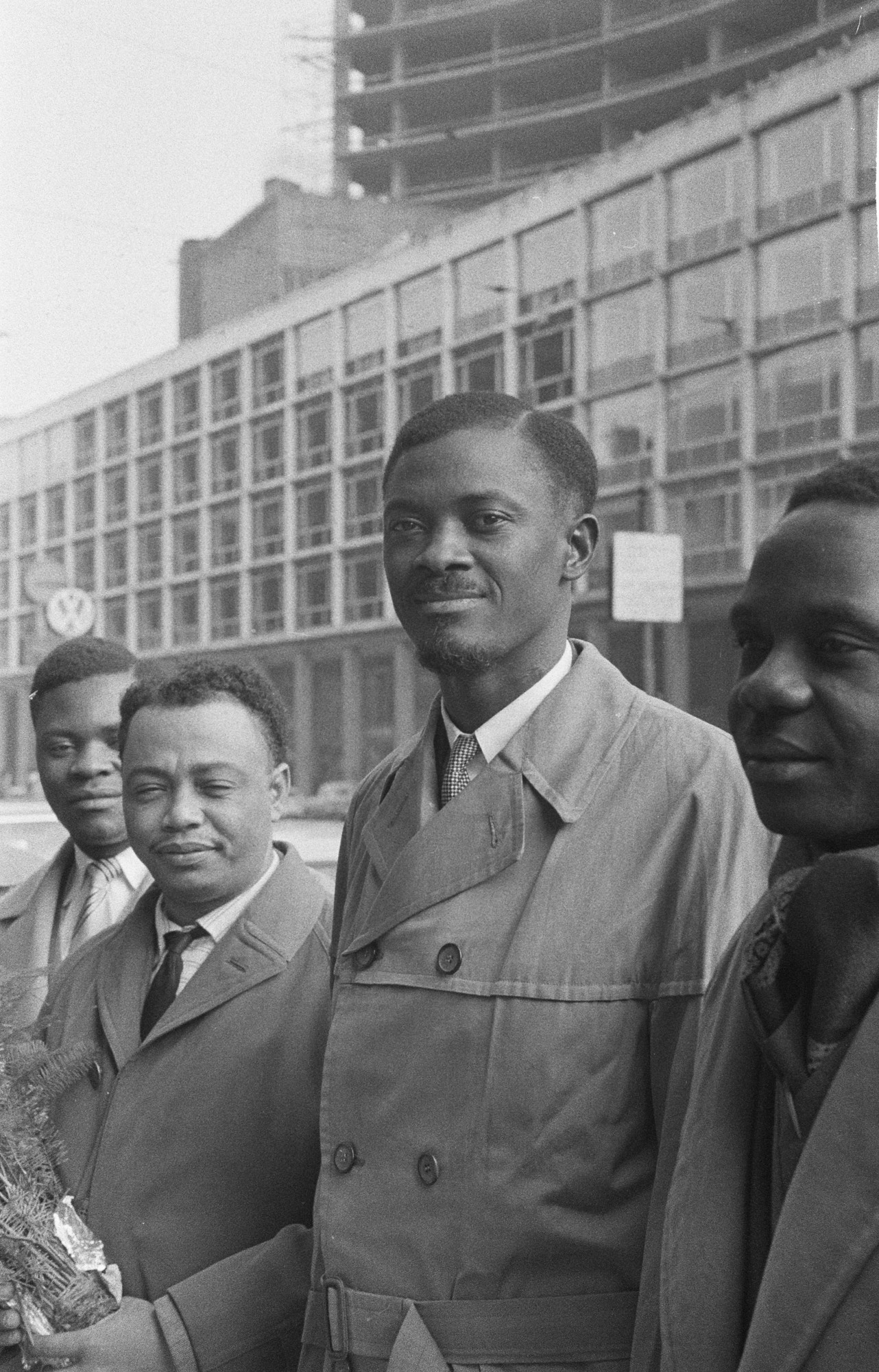
Patrice Lumumba during the Brussels round-table negotiations, 26 January 1960
Patrice Lumumba in Brussels during the round-table negotiations, 26 January 1960. Harry Pot/Anefo; Nationaal Archief collection, CC0. Image credit ↗

Chapter 01 / January–August 1960

Independence opened a struggle over sovereignty

Patrice Lumumba became the first prime minister of an independent Congo on 30 June 1960. The territory emerging from Belgian rule was vast, economically unequal and governed through institutions shaped by colonial coercion. In his independence address Lumumba insisted that freedom had been won through Congolese struggle and recalled the injuries of colonial rule. His politics cannot be understood only through the labels assigned in Washington or Brussels. He sought effective sovereignty for a central government whose authority, revenue and armed forces were already under severe pressure.

An army mutiny, Belgian military intervention and Katanga’s secession rapidly transformed independence into a crisis. Moïse Tshombe’s Katangan government had local constituencies as well as Belgian support, officials and commercial connections. The mining economy gave the conflict material stakes. The Belgian inquiry later emphasized that Union Minière’s tax payments helped make Katangan secession financially possible. Lumumba’s insistence on national unity challenged that arrangement. Congolese regional, party and personal rivalries were not simply inventions of foreign services, but outside money, advice and military power changed their possibilities.

Lumumba and President Joseph Kasa-Vubu sought United Nations assistance. The UN operation, led politically by Secretary-General Dag Hammarskjöld, was not a force placed at Lumumba’s unrestricted disposal. Disagreement over Belgian withdrawal, Katanga and the use of UN troops deepened their conflict. Lumumba turned to Soviet assistance as the crisis intensified. U.S. policymakers interpreted the possibility of a Soviet foothold as a strategic danger; their anxiety about the UN losing its position helped drive action against him. This records their rationale without proving that Lumumba was a Soviet puppet or that assassination was a necessary response.

The CIA’s own pre-independence political-action paper complicates a simple ideological picture. It sought leaders friendly to the West but warned that accepting bloc help did not automatically mean ideological commitment. By August, station reporting was much more alarmed about Lumumba and urged his removal. Both assessments came from institutions pursuing influence. The transition between them matters: a new state’s political conflict was being translated into a Cold War emergency, and an American covert program was moving from cultivation of contacts toward the destruction of a particular leader’s position. The people making those decisions did not share one command chain.
Sources: S03 · S16 · S18 · S25 · S26

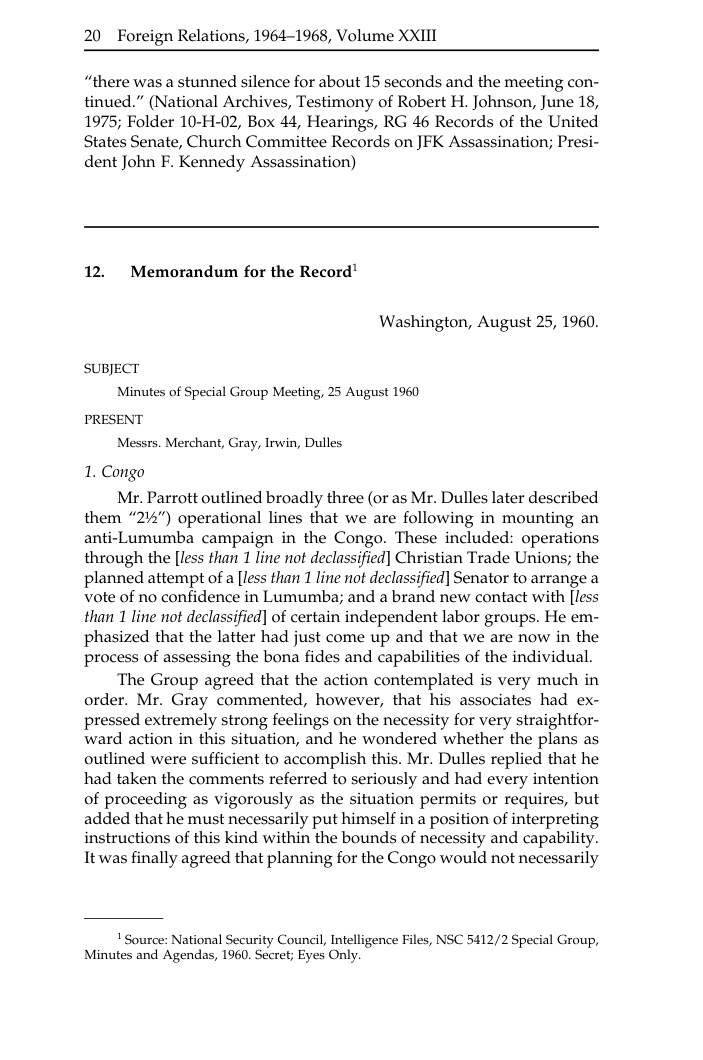
Special Group meeting, 25 August 1960, printed page 20
Special Group minutes of 25 August 1960: political operations and broad language about removing Lumumba. FRUS printed page 20. Image credit ↗

Chapter 02 / August–September 1960

The pressure from above reached an ambiguous threshold

On 18 August 1960 the National Security Council discussed the possibility that Lumumba might force the UN out of the Congo. The contemporary memorandum records Eisenhower’s determination to prevent that outcome. Fifteen years later, NSC staff member Robert Johnson testified that he heard a presidential statement which struck him as an instruction to assassinate Lumumba. He could not reproduce the exact words. Other senior participants did not recall a clear assassination order. Those are conflicting bodies of evidence about presidential intent, rather than a reason to dismiss either the testimony or the surviving record.

The 25 August Special Group minutes supply another link. Officials reviewed political operations, including work toward a parliamentary no-confidence vote. Gordon Gray conveyed very strong feelings from above that more direct action was needed. The group left open consideration of activities that might remove Lumumba. The language did not explicitly order killing. The Church Committee’s chronology dates Dulles’s following personal cable to 26 August; the FRUS overview dates it 27 August. Its demand that removal become a leading covert-action objective is common to both accounts. A one-day discrepancy does not settle what the instruction authorized.

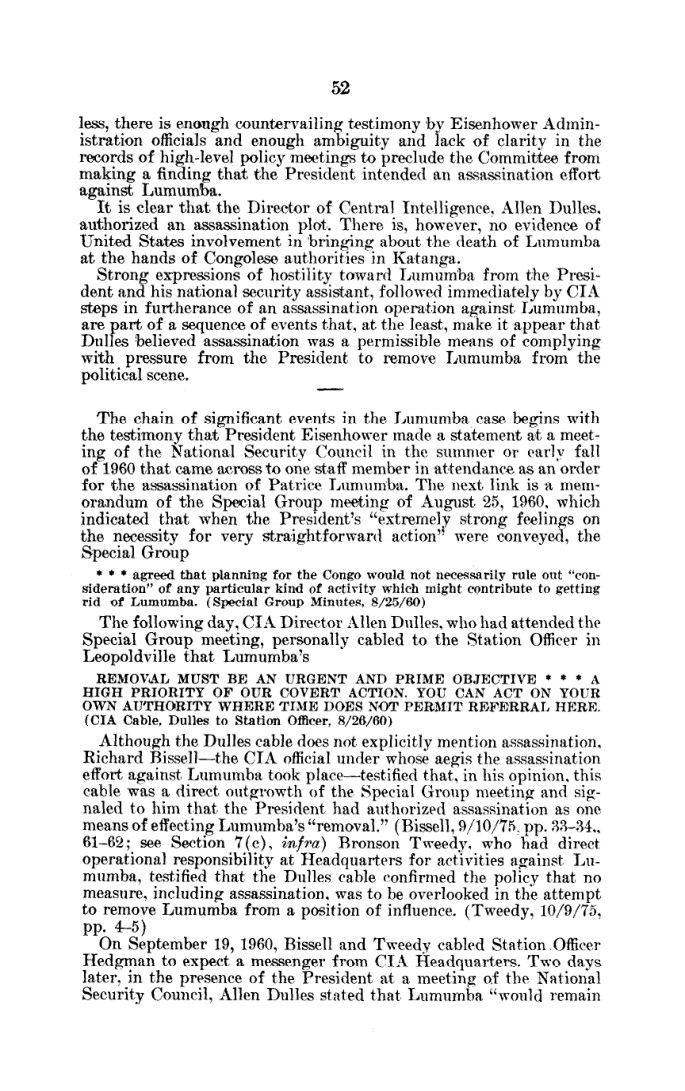
The Church Committee concluded that CIA Director Allen Dulles authorized an assassination plot. It considered it likely that he interpreted Eisenhower’s strong concern as permission, but declined to find that the President intended an assassination effort because of contrary testimony and ambiguity. FRUS’s 2013 editorial overview uses more categorical language about presidential authorization, while its document 11 sets out the underlying conflict. These formulations should not be silently combined into a verbatim presidential order that no surviving contemporaneous minute supplies.

Within the CIA, Deputy Director for Plans Richard Bissell and Africa Division chief Bronson Tweedy translated policy pressure into preparations. A scientist received an assignment described as carrying the highest authority. The later witnesses disagreed about how much approval remained necessary before the station could actually act. The scientist and station officer understood the mission as an instruction to kill; Tweedy described a further headquarters policy decision before implementation. The plot’s existence does not depend on resolving every level of that dispute. Its accountability problem is precisely how broad political demands, restricted communications and assumptions about higher approval could produce a lethal assignment.

Sources: S01 · S02 · S04 · S05

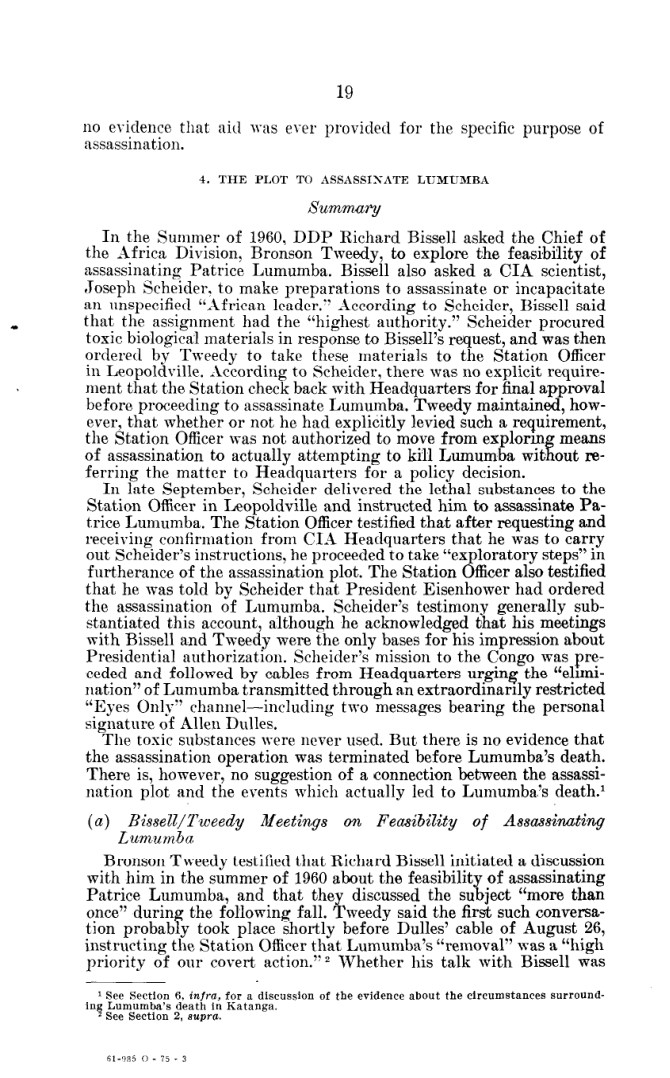
Senate summary of the assassination plot, printed page 19
Church Committee printed page 19 summarizes delivery, exploratory action and the absence of evidence that the toxic materials were used. Image credit ↗

Chapter 03 / September–November 1960

The assassination effort passed beyond a proposal

In late September a CIA scientist carried lethal materials to the Congo station and conveyed an assassination assignment. The Church report used the pseudonyms Joseph Scheider for the scientist and Victor Hedgman for the station officer; later public accounts identify the station chief as Larry Devlin. Retaining awareness of those names helps connect the report to later narratives without inventing additional people. Delivery is a documented act. It is materially different from discussion in Washington, and also different from successful administration of a substance to Lumumba.

The station undertook exploratory action but failed to gain the access it needed. Lumumba’s residence was surrounded by Congolese troops and protected by UN troops, whose purposes differed. The operation confronted barriers in the leader’s household, heavy demands on station personnel and uncertainty about available agents. Contemporary October traffic supports continued interest in implementation. It makes a later account of simple refusal or immediate abandonment too neat. Personal reluctance and failure to complete an operation can coexist with actual steps taken toward it.

The disposition of the lethal materials became a particular dispute in 1975. The scientist recalled destroying their viability and disposing of them before departing on 5 October; the station officer recalled disposal after Lumumba’s later imprisonment. An 8 October cable said the station intended to continue trying. On 15 October an ordinary-channel message described arrest or immobilization as the supportable direct action, while a restricted channel maintained the priority of the specific mission. Reading only one of those messages would hide the compartmented instructions. The Senate found no evidence that the delivered toxic substances were actually used.

Other officers and prospective agents entered the story. An officer called Michael Mulroney in the Senate record testified that he refused assassination but was prepared to turn Lumumba over to Congolese authorities. The record also contains discussion of other means and requests for equipment, which should not be turned into proof that a requested weapon was delivered or employed. Taken together, the records establish an assassination effort that reached delivery and exploratory action, continued through changing plans, and has not been connected by the reviewed evidence to the method of Lumumba’s actual death. Failure of that lethal route did not end American involvement in the surrounding political struggle.

Sources: S01 · S07 · S08 · S09 · S10 · S11

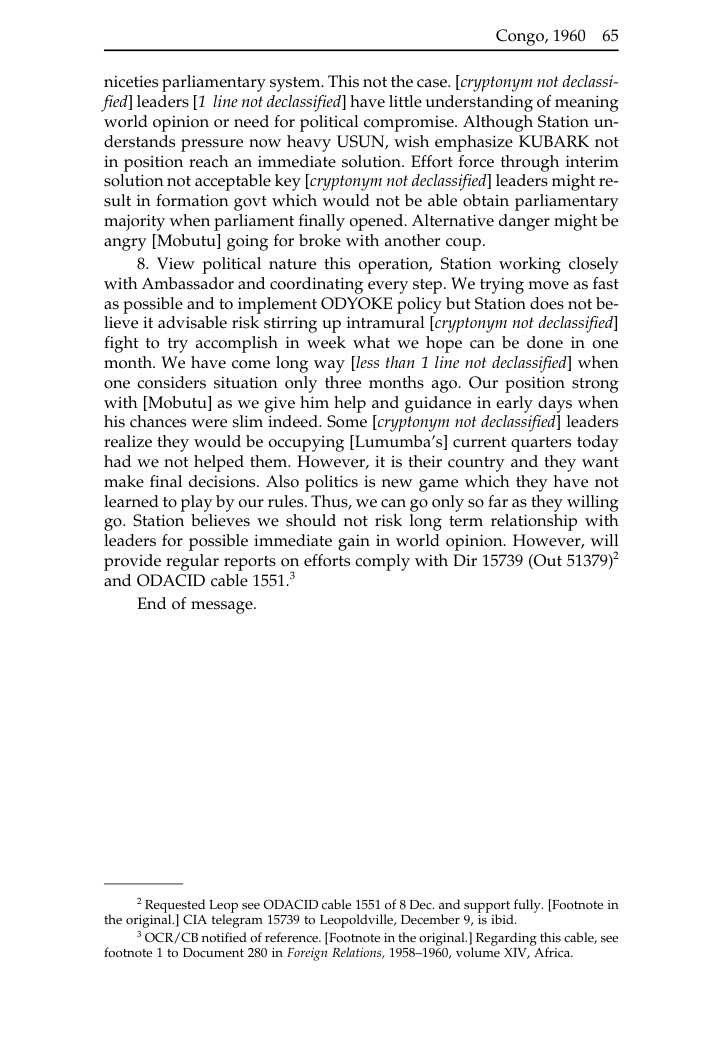
Station report of 10 December 1960, printed page 65
A 10 December station report describes both American assistance and the limits of influence over Congolese leaders. FRUS printed page 65. Image credit ↗

Chapter 04 / September–December 1960

Congolese rivals acted with outside support

On 5 September Kasa-Vubu dismissed Lumumba, who disputed the dismissal and challenged the President in return. Parliamentary support, presidential authority and control of force did not align neatly. Joseph Mobutu’s 14 September intervention suspended the political contest and installed a College of Commissioners. This was a Congolese struggle over power, but it unfolded amid covert American financing and Belgian support for Lumumba’s opponents. The assassination channel belonged inside this larger effort without being identical to every political operation conducted against him.

The station had met Mobutu and supplied financial assistance before his intervention. FRUS document 19 preserves contemporary reports alongside later recollections that differ in detail about the promise of U.S. support. It also records an earlier Mobutu proposal to expose Lumumba to a hostile crowd, and the station’s willingness to back what it regarded as a risky political possibility. These records establish consequential contacts and decisions. They do not justify assuming that Mobutu, Kasa-Vubu or every security official thereafter did nothing without American instructions.

A 10 December station cable makes the relationship unusually explicit. It credited American help and guidance with strengthening Mobutu and his allies, yet acknowledged that the country’s leaders wanted to make the final decisions. The officer’s language was contemptuous and paternalistic; that outlook is part of the record, not a reliable measure of Congolese political capacity. The cable reveals influence negotiated with actors who had their own constituencies, ambitions and capacity to refuse. A sponsor can contribute to an outcome without possessing total control, and local initiative does not erase a sponsor’s contribution.

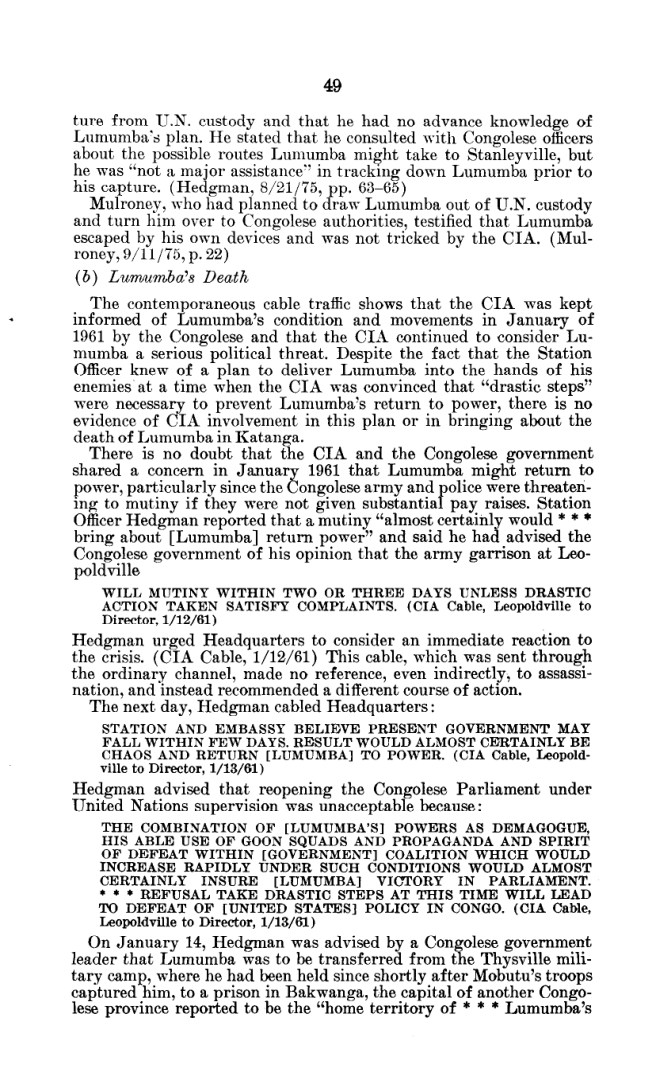
Lumumba remained a political threat to his opponents even under confinement. On the night of 27 November he escaped his residence and tried to reach supporters around Stanleyville, where Antoine Gizenga was organizing an alternative center of authority. Mobutu’s forces captured him on 1 December and returned him to custody. Contemporary messages and later officer testimony differ over the extent of CIA assistance in tracking him; the Senate record should not be reduced to an unqualified denial of contact. His captivity made transfer possible. By then the causal questions concerned who held him, who supported those authorities, who knew the danger and who would decide his destination.

Sources: S01 · S06 · S12 · S13 · S16

Senate analysis of capture, custody and transfer, printed page 49
The Senate’s printed page 49 examines capture, prior knowledge and the distinction between custody decisions and evidence tying CIA to the actual killing. Image credit ↗

Chapter 05 / January–February 1961

A transfer delivered three prisoners to their enemies

Patrice Lumumba, Maurice Mpolo and Joseph Okito were transferred from central-government custody to Katanga on 17 January 1961. Mpolo was a political and military rival of Mobutu; Okito was a senior parliamentary figure. They were killed that evening. The killing destroyed three lives and removed leaders from an unresolved political struggle; it was not the outcome of a public trial establishing a lawful sentence.

The Belgian parliamentary inquiry found that central Congolese authorities organized the transfer with support from Belgian government authorities and advisers. It located the decision to kill with the Katangan authorities and described an execution in the presence of ministers, a Belgian police commissioner and Belgian officers serving under Katangan authority. Its conclusion did not find a document showing a Belgian cabinet member ordered physical elimination or that Brussels premeditated murder through the transfer. It nevertheless found disregard for Lumumba’s safety, support for the transfer and subsequent lies. The absence of a discovered cabinet order is narrower than absence of Belgian participation or responsibility.

Accounts circulating in January and February were inconsistent. A CIA report dated 18 January described the arrival and severe mistreatment but could not establish where Lumumba was held. A 7 February report described execution on 17 January and Belgian involvement. Other cables contained denials or stories of continued survival. Such information reports show what particular channels were being told; their official classification did not make every detail true. The public Katangan account, announced in February, claimed an escape followed by killing by villagers. The UN commission rejected that story and supported a 17 January killing, while acknowledging that it could not reach the crime scene.

The 1961 UN inquiry and the later Belgian inquiry do not agree on every location, shooter or detail of the final hours. The central event is firmer than those particulars: the prisoners were delivered to bitter political enemies and unlawfully killed. The reviewed evidence does not show that CIA poison was used or that the CIA directed the execution team. It also does not remove the prior assassination effort, American support to Lumumba’s opponents, or the question of responsibility for helping create his vulnerability. Direct execution, facilitating custody and transfer, political sponsorship and failure to protect are related inquiries with different evidentiary requirements.

Sources: S01 · S14 · S15 · S16 · S17

Senate authorization findings, printed page 52
Church Committee printed page 52 separates Dulles’s authorization, unresolved presidential intent and the evidence about the actual killing. Image credit ↗

Chapter 06 / 1961–2014

The investigations exposed different parts of the chain

The early international investigation faced missing access, resistant witnesses and conflicting accounts. Its conclusions attributed responsibility to Kasa-Vubu and his aides for handing over the prisoners, and to Tshombe’s government for their fate. It also recorded suspicions about particular perpetrators with varying degrees of confidence. Those qualifications are historical evidence about what investigators could establish in 1961. Later inquiry can confirm the main killing date while correcting a proposed reconstruction of the scene.

The Church Committee’s 1975 investigation had access to CIA documents and witnesses about the American plot. It established an assassination effort and Dulles’s authorization, while finding no evidence of U.S. involvement in bringing about the actual Katangan killing. That was the committee’s finding on the evidence it examined. It was not a criminal acquittal after a trial, nor did it declare the wider political removal campaign imaginary. Its own chapters describe funding, contacts, prior knowledge of danger and the varying positions of officers. A narrow finding about the final execution cannot bear the weight of universal historical exoneration.

Belgium’s 2000–2001 parliamentary inquiry examined a different archive and a different responsibility. It treated Belgian actions, local decisions, transfer and safety as separate issues, and concluded that certain government members and other Belgian participants bore moral responsibility for the circumstances leading to Lumumba’s death. That formulation was neither a criminal conviction nor an assertion that nothing more serious could ever be proved. The inquiry’s institutional conclusions also remain open to criticism about how it weighed evidence. Their strength depends on the identified decisions and records, rather than the prestige of an official commission alone.

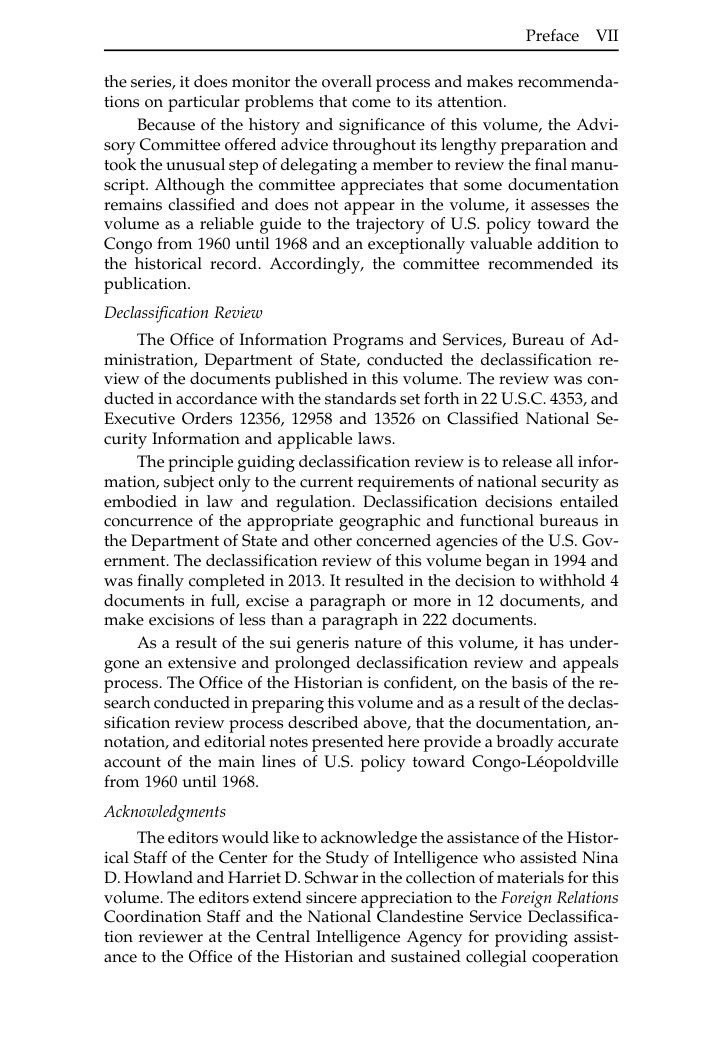
The 2013 FRUS Congo volume broadened the available American documentary record. Its preface explains that earlier volumes had not adequately covered covert activity and that this retrospective volume should be read alongside them. David Robarge’s 2014 CIA historical article described the expanded record and the wider covert program. The article is an institutional interpretation with an explicit disclaimer, not an independent verdict on every allegation. Declassification changed the evidence available for the argument; it did not make the archive complete. The strongest assessment keeps the proven plot, the documented enabling relationships and the unproved direct-execution claim visible at the same time.

Sources: S01 · S02 · S04 · S16 · S17 · S20

FRUS preface: editorial and declassification method, printed page VII
The FRUS preface explains the editorial method and relationship to earlier volumes. It is a guide to the documentary record, not a complete disclosure. Image credit ↗

Chapter 07 / 2001–May 2026

Return, acknowledgment and a trial that did not occur

For Lumumba’s family, the consequences were not confined to debates over a failed CIA technique. The destruction and concealment of the body denied ordinary burial and made the return of remains a political and personal demand. In June 2022 Belgian authorities returned remains to the family. Prime Minister Alexander De Croo acknowledged that the delay had been unacceptable and that Belgian actors had helped with the transfer. He accepted the inquiry’s moral-responsibility finding and criticized the subsequent lies. Official acknowledgment mattered, but its ceremonial setting did not determine every individual’s criminal liability.

The family also sought legal accountability. A complaint filed in Belgium in 2011 led to a long investigation involving Belgian suspects. By March 2026 former diplomat Étienne Davignon was the surviving accused. The Brussels court’s referral moved the case toward a criminal trial; it was not a finding of guilt. Davignon denied wrongdoing and appealed. The allegations concerning detention, transfer and treatment must be kept distinct from a final judgment that he personally ordered or carried out murder. The complete referral and investigative file have not been independently examined for this guide.

The later outcome changed that chronology. In May 2026 Davignon died before trial. His death is independently confirmed by institutional notices and established reporting. On 18 May the family’s legal representatives at ECCHR said that the criminal proceedings were extinguished and announced plans to pursue further action against the Belgian state. Their description is a primary party statement, and their argument about state liability is advocacy rather than an adjudicated civil result. Death before trial produced neither an acquittal nor a conviction. It closed an individual criminal route while leaving the historical record and other demands for redress unresolved.

Public memory often compresses the history into either a CIA killing or a failed American plot unrelated to the death. Each shorthand loses important connections. The documented CIA effort demonstrates intent, preparation and exploratory action; it does not establish use of the delivered materials. The Katangan killing has its own custody, transfer and execution chain, with Belgian and Congolese participation. The wider American removal campaign shaped the political setting in which that chain developed. Establishing responsibility requires following those links individually. New authenticated orders, contact reports, transfer decisions, medical evidence or corroborated testimony could alter particular conclusions without making the already documented plot disappear.

Sources: S16 · S19 · S21 · S22 · S23

02 / The record

The critical path

The official record establishes a CIA assassination effort and a separate custody/transfer/execution chain. The Senate, FRUS, UN and Belgian accounts answer different questions and sometimes differ; their authority does not replace testing the identified evidence.

Evidence support rates the precise hinge within this corpus, with limits. Cultural belief is unmeasured; the observations identify where a hinge recurs in sampled public accounts. No public-opinion survey or ordinal popularity comparison is available in this corpus.

CP1

Political conflict becomes a removal objective

Official-record yardstick

Contemporary U.S. records show a removal objective amid Congo’s independence crisis; they do not establish Soviet control of Lumumba.

Independence, secession, UN conflict and Soviet assistance frame the American decision to remove Lumumba.

Why it is critical

Explains the rationale without treating hostile threat assessments as neutral proof.

If this step is removed

Without this policy setting, the account of why American officials acted would lose its documented rationale. The existence of Congo’s independence or Lumumba’s later killing would not depend on that rationale being correct.

Dependencies

Requires distinguishing Congolese political conflict, actual foreign aid and U.S. assumptions.

What rival readings must explain

A security account must address sovereignty and alternative policies; a puppet account must establish command rather than infer it from aid.

Gaps and disputes

No complete Soviet-Congolese decision archive or counterfactual policy test is provided.

Evidence support: High with stated limits

High for stated U.S. objectives; limited for the necessity or accuracy of hostile assessments.

See this step’s cited contemporary records, investigative findings and explicitly identified disputes.

Cultural prominence: Unmeasured

General cultural belief/popularity; distinct from evidentiary support.

The security rationale is documented in contemporary records and later official interpretation. Its prevalence among present readers is unmeasured.

Sources: S03 · S04 · S16 · S18

CP2

High-level pressure becomes a lethal assignment

Official-record yardstick

The Senate found a CIA assassination plot authorized by Dulles, while presidential intent remains disputed in the evidence and differently framed by FRUS.

Broad removal language is followed by Bissell/Tweedy preparations and a delivered mission.

Why it is critical

The plot is established even where exact presidential intent remains unresolved.

If this step is removed

If delivery and CIA authorization were disproved, a demonstrated assassination effort would become a weaker allegation of intent. If Johnson’s recollection were removed, the specific presidential-order claim would weaken; Dulles’s documented plot would not disappear.

Dependencies

Needs meeting records, testimony, restricted instructions and delivery; broad words alone are insufficient.

What rival readings must explain

A rogue-only account must explain Dulles authorization; a direct presidential-order account must meet the conflicting recollections.

Gaps and disputes

No surviving verbatim presidential assassination directive resolves the conflicting testimony; later institutional formulations differ.

Evidence support: High with stated limits

High for CIA authorization and delivery; contested for a specific presidential instruction.

See this step’s cited contemporary records, investigative findings and explicitly identified disputes.

Cultural prominence: Unmeasured

General cultural belief/popularity; distinct from evidentiary support.

The plot recurs in the Senate inquiry, FRUS overview and Robarge’s article. That establishes public documentary visibility, not a measured distribution of popular beliefs.

Sources: S01 · S04 · S05 · S07 · S08

CP3

Delivery encounters barriers without a proven use

Official-record yardstick

Delivery and exploratory action are established; reviewed findings do not establish use of the delivered toxic materials.

Exploratory action, failed access, disposal disputes and continued planning separate intent from execution.

Why it is critical

Prevents a real plot from being confused with either a completed poisoning or an idle idea.

If this step is removed

Without delivery, the account would lose its concrete step beyond planning. Without evidence of use, delivery cannot explain the cause of death. Changing the disposal date would alter the operational chronology without automatically proving either use or cancellation.

Dependencies

Needs custody of materials, access, operative actions and corroboration of actual use.

What rival readings must explain

Simple refusal/cancellation must meet October traffic; successful-poisoning claims must explain the absence of use evidence and actual killing chain.

Gaps and disputes

Witnesses differed on disposal; restricted and ordinary channels conveyed different instructions. The full operational archive is unavailable.

Evidence support: High with stated limits

High for delivery and continuing effort; no established use in the reviewed corpus.

See this step’s cited contemporary records, investigative findings and explicitly identified disputes.

Cultural prominence: Unmeasured

General cultural belief/popularity; distinct from evidentiary support.

The failed-plot account is prominent in the sampled official investigations. How often readers confuse delivery with use is unmeasured.

Sources: S01 · S09 · S10 · S11

CP4

Supported rivals control custody and transfer

Official-record yardstick

U.S. contacts and support were consequential; Congolese leaders retained choices. Belgian assistance and actual custody/transfer decisions require their own chains.

American assistance and Belgian support operate through Congolese leaders who also make their own decisions.

Why it is critical

Identifies enabling relationships and the limits of control.

If this step is removed

If particular aid and contact records were removed, the enabling-responsibility argument would weaken. The captors’ and transfer authorities’ own acts would still need explanation; they cannot be made to vanish with a sponsor’s role.

Dependencies

Requires contact/funding records, capture accounts, prison authority and actual transfer decisions.

What rival readings must explain

A wholly local account must explain outside support; total foreign direction must demonstrate instructions and compliance.

Gaps and disputes

A full disbursement-to-action ledger, all local orders and complete transfer communications were not acquired.

Evidence support: High with stated limits

High for documented contacts and support; variable for the causal weight of each contribution to custody and transfer.

See this step’s cited contemporary records, investigative findings and explicitly identified disputes.

Cultural prominence: Unmeasured

General cultural belief/popularity; distinct from evidentiary support.

The enabling role appears in contemporary cables and later inquiry, while the full-control shorthand is not quantified as public belief here.

Sources: S06 · S12 · S13 · S16

CP5

Katangan execution follows a distinct chain

Official-record yardstick

The inquiries support the17 January 1961 killing after transfer to Katanga, with Congolese and Belgian participation. They do not establish that CIA poison caused it or a CIA order to the execution team.

The 17 January transfer places three prisoners with enemies who order and execute their killing, with Belgian presence/participation.

Why it is critical

The cause of death and relevant actors cannot be replaced by the unused CIA route.

If this step is removed

Without the custody/transfer/execution chain, the explanation of the actual deaths would fail at its most important causal step. Removing an uncertain final-hour detail does not by itself overturn the central date or establish a different killer.

Dependencies

Needs inquiry findings, transfer support, contemporary reports and corroboration of final-hour details.

What rival readings must explain

Direct CIA execution requires a connecting record; categorical innocence must account for the wider removal and vulnerability chain.

Gaps and disputes

UN and Belgian inquiries differ on some scene and perpetrator details; the UN commission lacked access to the scene. Direct CIA-command links remain unproved in this corpus.

Evidence support: High with stated limits

High for transfer and killing; narrower or disputed for precise final-hour details and outside direction.

See this step’s cited contemporary records, investigative findings and explicitly identified disputes.

Cultural prominence: Unmeasured

General cultural belief/popularity; distinct from evidentiary support.

The killing and Belgian moral-responsibility finding recur in inquiries and official remembrance. This is observed public-record prominence, not polling of public attribution.

Sources: S01 · S14 · S15 · S16 · S17

CP6

Inquiries and later proceedings answer different questions

Official-record yardstick

Official investigations, moral acknowledgment, referral, death before trial and a criminal verdict are different outcomes. The 2026 individual case produced no verdict.

UN/Senate/Belgian findings, official acknowledgment and later legal proceedings develop distinct responsibilities.

Why it is critical

Moral responsibility, historical causation, referral and criminal guilt are different outcomes.

If this step is removed

Without the distinct findings and procedural endpoints, the guide could not justify either its allocation of evidentiary weight or its account of accountability. Loss of one institution’s conclusion would require reassessment; it would not erase the underlying documents or create a conviction.

Dependencies

Requires actual scope, evidence limits and disposition of each inquiry or proceeding.

What rival readings must explain

A settled-total-exoneration claim exceeds the findings; a conviction claim fails when no trial verdict occurred.

Gaps and disputes

The full Belgian referral and criminal file were not independently examined; party statements on intended further action are not adjudicated results.

Evidence support: High with stated limits

High for the published findings and confirmed death before trial; limited for inaccessible case-file details.

See this step’s cited contemporary records, investigative findings and explicitly identified disputes.

Cultural prominence: Unmeasured

General cultural belief/popularity; distinct from evidentiary support.

The 2022 return ceremony and 2026 party statements make accountability publicly visible. Relative cultural prominence of each inquiry or theory is unmeasured.

Sources: S01 · S16 · S17 · S19 · S21 · S23

03 / The record

How the accounts developed

Documented disclosure and interpretation lineages. Connections are labeled as explicit source use, parallel inquiry or later response, with evidence for each relationship.

February–November 1961

The official escape story meets a contrary inquiry

Katangan authorities announced escape and death at villagers’ hands; the UN commission rejected that account and supported a 17 January killing, while acknowledging limits on scene access and uncertain particulars.

Lineage

Contemporaneous claim → investigated correction.

Borrowing or relationship

This is an evidentiary contest, not a demonstrated literary borrowing chain.

Evidence for the connection

The UN report explicitly evaluates the announced version and the accounts presented to investigators.

Recurring path nodes

CP5CP6

Branches in this record

The American assassination channel becomes public · Belgian responsibility develops through inquiry and acknowledgment

Sources: S17 · S01

1975

The American assassination channel becomes public

The Church Committee published documents and testimony about authorization, delivery and continued effort. Its finding of no evidence tying the United States to the actual killing addressed a different question from the plot’s existence.

Lineage

Restricted CIA records and witness testimony → Senate report → a public plot account.

Borrowing or relationship

The report identifies the documents and testimony it evaluates; it does not inherit the Katangan public story as fact.

Evidence for the connection

The report’s introduction, authorization discussion and capture/death analysis set out these distinctions.

Recurring path nodes

CP2CP3CP4CP5CP6

Branches in this record

Newly released cables widen the American account

Sources: S01

2001–2022

Belgian responsibility develops through inquiry and acknowledgment

The parliamentary inquiry evaluated Belgian actions and concluded moral responsibility for circumstances leading to the death. De Croo’s 2022 return speech expressly accepted that finding and acknowledged transfer support and later lies.

Lineage

Belgian inquiry → official acknowledgment; parallel to the earlier Senate inquiry, not simply a copy of it.

Borrowing or relationship

The 2022 speech explicitly refers to the parliamentary finding. The inquiries’ precise final-hour reconstructions should not be silently merged.

Evidence for the connection

The retained inquiry conclusions and official speech identify the responsibility being acknowledged.

Recurring path nodes

CP4CP5CP6

Branches in this record

The family pursues a distinct legal route

Sources: S16 · S19

2013–2014

Newly released cables widen the American account

The retrospective FRUS volume filled gaps in earlier coverage of covert operations. Robarge’s 2014 article expressly reviews that volume, places the plot within a larger program and argues against treating the plot as the whole Congo story.

Lineage

CIA and diplomatic records → FRUS editorial reconstruction → an identified institutional review of that release.

Borrowing or relationship

Robarge names the volume and discusses its documents; this is a demonstrated source relationship.

Evidence for the connection

FRUS preface and Robarge’s opening pages describe the retrospective release and its relationship to earlier collections.

Recurring path nodes

CP1CP2CP3CP4CP6

Sources: S02 · S20

2011–May 2026

The family pursues a distinct legal route

The family’s criminal complaint, later referral and Davignon’s death before trial form a procedural lineage. The family’s representatives then described extinction of the individual criminal route and intended action against the state.

Lineage

Complaint → investigation/referral → death before trial; historical responsibility and other remedies remain separate.

Borrowing or relationship

This is a procedural relationship described by the parties and checked against independent reporting, not proof of a final criminal or civil judgment.

Evidence for the connection

ECCHR’s May 2026 statement and independent death reporting identify the sequence and its limits. Full criminal files were not acquired.

Recurring path nodes

CP4CP5CP6

Sources: S21 · S22 · S23

04 / The record

Rival readings on the same path

The strongest versions, the steps they accept or revise, and the evidence they would need.

Interpretation 01

The CIA directly caused the 17 January killing

Plot established; direct execution link not demonstrated

The strongest version

U.S. officials wanted Lumumba removed, prepared assassination, funded rivals and tracked his fate. The strongest version treats the lethal plan and political support as potentially connected parts of one removal campaign.

Accepts

A real delivered CIA plot and consequential support exist; direct shooters were part of a Katangan/Belgian-Congolese chain.

Must still explain

Intent and opportunity do not establish an instruction to the execution team or use of delivered materials. CP3–CP5 require an actual connecting link.

Assessment

The reviewed Senate findings do not establish U.S. involvement in the final killing; that narrow conclusion does not negate enabling political action.

Accept these path nodes

Remove or revise this inference

  • The current absence of a demonstrated CIA-to-execution link at CP5 must be overturned with evidence, not merely bypassed.

Add this evidence

  • Authenticated tasking or a corroborated causal action linking CIA personnel to transfer or execution; proof of the specific act alleged.

What would change this assessment

Authenticated CIA-to-transfer/execution instructions, corroborated advance knowledge with a specific causal action, or reliable operative records connecting the channels would materially strengthen this account. A shared desired outcome alone would not.

Sources: S01 · S06 · S13 · S16 · S17

Interpretation 02

A failed CIA plot, with broader responsibility for removal

Strong support; extent of contribution remains debatable

The strongest version

The assassination channel failed to kill, while funding, guidance and opposition-building weakened Lumumba and supported custodians whose choices exposed him to murder. Causation can operate without a CIA officer firing a shot.

Accepts

Congolese actors chose and acted; not all outcomes were controlled from Washington.

Must still explain

Must identify which support changed custody, transfer or options rather than substitute general Cold War hostility for every causal link. CP4–CP5 remain decisive.

Assessment

Contemporary support and station admissions establish intervention; the full weight of its contribution to the death remains an historical assessment.

Accept these path nodes

Remove or revise this inference

  • Any assumption that failure of the poison route at CP3 implies no enabling responsibility at CP4.

Add this evidence

  • Support-to-custody/transfer evidence to refine the contribution of funding, guidance, protection decisions and local choices.

What would change this assessment

Original budget disbursements tied to arrest/transfer, correspondence on intervention or protection, and independently corroborated local decision records could strengthen or limit specific causal claims.

Sources: S01 · S06 · S12 · S13 · S16

Interpretation 03

Predominantly Congolese and Belgian execution decisions

Strong for final chain; incomplete as a total account

The strongest version

Central authorities delivered prisoners, Katangan leaders ordered killing and Belgian personnel participated within Katangan institutions. Those actors had motives and power distinct from the CIA plan.

Accepts

CIA assassination planning and support to rivals were real; Belgium’s safety failures and assistance cannot be reduced to accidental presence.

Must still explain

A final-chain focus must not erase external enabling action or pretend the Belgian inquiry found no responsibility. CP1–CP4 also require explanation.

Assessment

UN and Belgian inquiries support central/Katangan responsibility and Belgian roles. No discovered Belgian cabinet order is narrower than no Belgian involvement.

Accept these path nodes

Remove or revise this inference

  • An inference that the final-chain focus erases external sponsorship or the prior plot.

Add this evidence

  • Local orders, complete transfer communications and tested witness evidence to allocate responsibility within and beyond CP5.

What would change this assessment

Authenticated local orders, complete transfer communications, witness evidence tested against contemporaneous records or a demonstrated foreign-command link could change the allocation of responsibility.

Sources: S01 · S16 · S17

Interpretation 04

Countering Soviet expansion explains the intervention

Rationale documented; necessity and legitimacy do not follow

The strongest version

Officials feared collapse of UN authority and a strategic Soviet foothold; Lumumba sought Soviet aid amid crisis. A security defender argues political intervention was intended to prevent a dangerous realignment.

Accepts

Congolese sovereignty, colonial interests, civilian harm and the documented lethal plot require scrutiny.

Must still explain

Must show that threat assessments were accurate and alternatives inadequate. CP1–CP2 do not turn belief or presidential pressure into lawful necessity.

Assessment

Sources demonstrate fear and policy intent, not certainty that Lumumba was controlled by Moscow or that assassination was indispensable.

Accept these path nodes

Remove or revise this inference

  • An inference that an expressed security fear proves necessity, accuracy or lawful authority.

Add this evidence

  • Authenticated foreign-command evidence, independent corroboration of threat assessments and contemporaneous evaluation of alternatives.

What would change this assessment

Authenticated Soviet-Congolese command arrangements, contemporaneous intelligence with independent corroboration, and actual evaluation of alternatives could alter particular threat judgments. Later anti-Communist assurances alone could not.

Sources: S03 · S04 · S05 · S16 · S18

05 / The record

What public accounts emphasize

These comparisons concern the identified report and public-statement passages. They distinguish an account’s emphasis from the questions that passage leaves unresolved; the stated scope defines the work examined.

The Church Committee’s 1975 report

Congo section, especially printed 13–19,29–34,48–70; selected source documents and testimony examined.

Amplifies

The real CIA assassination effort, Dulles’s authorization, conflicting accounts of presidential intent and the difference between delivery and use.

Recasts or leaves unresolved

Its focus on the American plot and absence of evidence tying the United States to the actual killing does not answer every Belgian, Congolese or enabling-responsibility question. Its own capture/death discussion prevents reading the negative finding as universal exoneration.

Scope and limits

An investigative finding on the evidence examined, not a criminal acquittal or a certification of complete disclosure.

CP2CP3CP4CP5CP6

Sources: S01

The Belgian inquiry and De Croo’s acknowledgment

Inquiry’s English conclusions and 20 June 2022 official speech; full parliamentary testimony and every case file not audited.

Amplifies

Transfer support, Belgian participation, disregard of safety, lies and moral responsibility. The later speech expressly accepts the inquiry’s finding.

Recasts or leaves unresolved

The absence of a discovered Belgian cabinet murder order is not absence of Belgian action. Moral responsibility and a commemorative acknowledgment cannot determine each person’s criminal guilt.

Scope and limits

This public record does not provide a final individual criminal verdict or settle every final-hour dispute.

CP4CP5CP6

Sources: S16 · S19

David Robarge’s 2014 CIA historical article

Opening pages 1–4 of the 10-page article and its institutional disclaimer, reread for this comparison; no claim of a full literature survey.

Amplifies

The wider, multiyear covert program and the 2013 FRUS release; argues scholarship should move beyond concentrating on Lumumba alone.

Recasts or leaves unresolved

Its strategic-success framing and compressed description of local rivals do not resolve the legitimacy of intervention or the causal weight of each support decision. The article acknowledges the plot and Belgian inquiry rather than denying them.

Scope and limits

The author’s interpretation carries an explicit non-endorsement disclaimer. The underlying cables and inquiries remain the test; a compressed label for local actors cannot replace an operation-specific causal chain.

CP1CP2CP4CP5CP6

Sources: S20 · S02 · S01 · S16

The Lumumba family’s representatives in 2026

ECCHR’s 18 May 2026 statement and appeal/referral material, compared with independent confirmation of Davignon’s death.

Amplifies

The harm of a lost criminal trial, the family’s continuing demand for accountability and prospective action directed at the Belgian state.

Recasts or leaves unresolved

Advocacy for wider state responsibility does not itself establish an adjudicated civil result. A referral before death did not decide guilt; death before trial was neither acquittal nor conviction.

Scope and limits

A primary party account with legal advocacy interests. The full referral and investigative file were not independently read.

CP4CP5CP6

Sources: S21 · S22 · S23

06 / The record

Find a thread in the file

Search the chapter and claim index. Every result leads to the full text and its sources.

Chapter 01Independence opened a struggle over sovereigntyChapter 02The pressure from above reached an ambiguous thresholdChapter 03The assassination effort passed beyond a proposalChapter 04Congolese rivals acted with outside supportChapter 05A transfer delivered three prisoners to their enemiesChapter 06The investigations exposed different parts of the chainChapter 07Return, acknowledgment and a trial that did not occurClaim / EstablishedThe CIA planned to assassinate Lumumba.Claim / EstablishedDulles authorized an assassination plot.Claim / Not establishedA precise presidential assassination order is preserved in the NSC minute.Claim / EstablishedCIA lethal materials were delivered to the Congo.Claim / Not establishedThe delivered CIA poison caused Lumumba’s death.Claim / Not establishedThe assassination effort ended immediately with a station refusal.Claim / EstablishedThe United States provided covert support to Lumumba’s rivals.Claim / EstablishedLumumba, Mpolo and Okito were killed 17 January 1961.Claim / Not establishedThe CIA directed the Katangan execution team.Claim / EstablishedBelgian actors bore responsibility for circumstances leading to the death.Claim / Not establishedNo discovered Belgian cabinet murder order means no Belgian role.Claim / Not establishedThe 1975 Senate inquiry was a criminal acquittal.Claim / Not establishedThe 2026 referral convicted Davignon.Claim / EstablishedDavignon died before the anticipated trial.Timeline / IndependenceLumumba in BrusselsTimeline / SovereigntyCongo becomes independentTimeline / CrisisMutiny, intervention and Katanga secessionTimeline / AuthorityNSC debates Lumumba and the UNTimeline / PolicySpecial Group leaves broad options openTimeline / InstructionDulles demands priority for removalTimeline / Political crisisKasa-Vubu dismisses LumumbaTimeline / ContactsStation meets MobutuTimeline / PowerMobutu intervenesTimeline / ImplementationMessenger’s travel orderedTimeline / PlotLethal materials deliveredTimeline / PlotScientist departsTimeline / InstructionsRestricted mission remains a priorityTimeline / ImplementationStation reports access barriersTimeline / PersonnelAnother officer arrivesTimeline / CustodyLumumba escapes confinementTimeline / CustodyMobutu’s forces capture LumumbaTimeline / SupportStation describes influence and its limitsTimeline / KillingThree prisoners transferred and killedTimeline / ReportingCIA reports arrival and mistreatmentTimeline / ReportingCIA receives an execution accountTimeline / Public storyKatanga announces a false accountTimeline / InquiryUN investigation reportsTimeline / InquiryChurch assassination report publishedTimeline / InquiryBelgian inquiry reaches conclusionsTimeline / AccountabilityFamily initiates Belgian criminal complaintTimeline / DisclosureRetrospective FRUS Congo volume appearsTimeline / MemoryRemains returned and responsibility acknowledgedTimeline / Court procedureDavignon referred toward trialTimeline / Legal outcomeDavignon dies before trialCRITICAL PATHPolitical conflict becomes a removal objectiveCRITICAL PATHHigh-level pressure becomes a lethal assignmentCRITICAL PATHDelivery encounters barriers without a proven useCRITICAL PATHSupported rivals control custody and transferCRITICAL PATHKatangan execution follows a distinct chainCRITICAL PATHInquiries and later proceedings answer different questionsGENEALOGYThe official escape story meets a contrary inquiryGENEALOGYThe American assassination channel becomes publicGENEALOGYBelgian responsibility develops through inquiry and acknowledgmentGENEALOGYNewly released cables widen the American accountGENEALOGYThe family pursues a distinct legal routePUBLIC ACCOUNTThe Church Committee’s 1975 reportPUBLIC ACCOUNTThe Belgian inquiry and De Croo’s acknowledgmentPUBLIC ACCOUNTDavid Robarge’s 2014 CIA historical articlePUBLIC ACCOUNTThe Lumumba family’s representatives in 2026

07 / The record

People and institutions

Open a record for the person’s role and supporting sources. Names identify people; no unverified portrait is substituted for a participant.

Patrice LumumbaPatrice LumumbaPrime minister and independence leader

Sought Congolese sovereignty and national unity; removed from power, detained and killed 17 January 1961. His own independence address is included beside hostile foreign assessments.

Sources: S16 · S18

MpoloBiographical record
Maurice MpoloPolitical leader and fellow prisoner

Rival of Mobutu; transferred to Katanga and killed with Lumumba and Okito. His death is part of the same event, not a footnote to a single victim.

Sources: S16 · S17

OkitoBiographical record
Joseph OkitoSenate leader and fellow prisoner

Transferred and killed with Lumumba and Mpolo; the UN investigation included all three victims.

Sources: S16 · S17

Kasa-VubuBiographical record
Joseph Kasa-VubuPresident of the Congo

Dismissed Lumumba and opposed his return. Central-government transfer decisions and his aides’ responsibility are examined by UN/Belgian inquiries.

Sources: S06 · S16 · S17

MobutuBiographical record
Joseph MobutuArmy commander

MountedSeptember 1960 intervention, received American support and controlled forces involved in Lumumba’s capture. His own political decisions remain distinct from CIA instructions.

Sources: S06 · S12 · S13

TshombeBiographical record
Moïse TshombeKatangan leader

Headed secessionist authorities receiving the prisoners; inquiries locate the killing within Katangan responsibility and Belgian-supported institutions.

Sources: S16 · S17

MunongoBiographical record
Godefroid MunongoKatangan interior minister

UN inquiry emphasized his extensive role in the plot leading to the killing; later evidence must be assessed at the level of individual decisions.

Sources: S16 · S17

GizengaBiographical record
Antoine GizengaLumumba ally and political leader

Organized an alternative center around Stanleyville toward which Lumumba fled. Local support networks made his political return a continuing concern for opponents.

Sources: S12 · S16

EisenhowerBiographical record
Dwight D. EisenhowerU.S. president

Expressed strong hostility to Lumumba; presidential assassination intent is contested in the testimony and documentary record.

Sources: S01 · S04

DullesBiographical record
Allen DullesDirector of Central Intelligence

The Church Committee found he authorized an assassination plot; his August removal cable is not a transcript of a presidential order.

Sources: S01 · S05

BissellBiographical record
Richard BissellCIA Deputy Director for Plans

Directed preparations and interpreted higher-level authority; later testimony distinguishes assumptions from a remembered presidential instruction.

Sources: S01 · S08 · S09

TweedyBiographical record
Bronson TweedyCIA Africa Division chief

Managed the restricted channel and operational instructions; described further approval requirements while preserving priority of the mission.

Sources: S01 · S10

DevlinBiographical record
Larry DevlinCIA station chief in Leopoldville

Called Victor Hedgman in the 1975 report; later identified publicly. Delivery, exploratory action and political support are assessed through contemporary cables as well as later recollections.

Sources: S01 · S06 · S08 · S13

ScheiderBiographical record
Joseph ScheiderScientist’s pseudonym in Senate report

Carried lethal materials and instructions. His account of disposal and higher authority differs in parts from the station officer’s testimony. The pseudonym is retained to match the source.

Sources: S01 · S08 · S09

HammarskjöldBiographical record
Dag HammarskjöldUN Secretary-General

Directed the UN mission amid conflict with Lumumba over sovereignty and Katanga. UN protection, restrictions and political choices require separate analysis.

Sources: S16 · S25

LyndenBiographical record
Harold d’Aspremont LyndenBelgian Minister of African Affairs

Belgian inquiry examines his ministry’s pressure, support for transfer and disregard of safety. Its moral finding is distinct from a criminal conviction.

Sources: S16

DavignonBiographical record
Étienne DavignonBelgian diplomat and later accused

Referred toward trial inMarch 2026, denied wrongdoing and appealed; died inMaybefore trial. No verdict of guilt or acquittal resulted.

Sources: S21 · S22 · S23

familyBiographical record
Lumumba familyRelatives, civil parties and claimants

Pursued return of remains and legal accountability across generations. Their testimony and legal statements have a different role from an institutional historical report.

Sources: S19 · S21

08 / The record

The plot, the killing and the aftermath

Horizontal spacing shows elapsed time; separate rows keep close events selectable. Scroll the graph on narrow screens. Exact dates are attributed where records conflict; month- and year-only dates preserve source precision.

19601977199420102027
Lumumba in BrusselsIndependence

Photographed during round-table negotiations, before the independent state and later crisis.

Sources: S26

Congo becomes independentSovereignty

Lumumba’s address asserts struggle, dignity and sovereignty; Kasa-Vubu is president and Lumumba prime minister.

Sources: S18 · S25

Mutiny, intervention and Katanga secessionCrisis

Army conflict, Belgian intervention and secession undermine central authority. Local and foreign interests intersect.

Sources: S16 · S25

NSC debates Lumumba and the UNAuthority

Contemporary minute and Johnson’s later testimony differ over an assassination instruction.

Sources: S04

Special Group leaves broad options openPolicy

Political operations and strong pressure to remove Lumumba are recorded, without an explicit written order to kill.

Sources: S05

Dulles demands priority for removalInstruction

Church chronology dates the cable 26 August; FRUSoverview 27 August. Both describe the urgent removal objective.

Sources: S01 · S02

Kasa-Vubu dismisses LumumbaPolitical crisis

Lumumba contests dismissal; parliamentary, presidential and military power diverge.

Sources: S16

Station meets MobutuContacts

Contemporary reporting and later recollections show contacts and financial help, with differences in the account of promised support.

Sources: S06

Mobutu intervenesPower

His intervention installs commissioners and sidelines the competing political authorities. CIA support and his agency both matter.

Sources: S02 · S06

Messenger’s travel orderedImplementation

Headquarters tells the station to receive the messenger carrying the mission’s instructions.

Sources: S07

Lethal materials deliveredPlot

The station receives a lethal assignment and takes exploratory steps. Delivery is distinct from actual use.

Sources: S01 · S08

Scientist departsPlot

Later witnesses disagree over disposal timing. Subsequent traffic says the station intends continued efforts.

Sources: S09

Restricted mission remains a priorityInstructions

Ordinary-channel arrest language and restricted-channel continuation coexist.

Sources: S10

Station reports access barriersImplementation

Failed access and competing commitments constrain implementation; requests are not proof of delivered or used equipment.

Sources: S11

Another officer arrivesPersonnel

Officer called Mulroney later says he refused assassination but considered transfer to Congolese authorities.

Sources: S09

Lumumba escapes confinementCustody

Leaves his residence on the night of 27 November to reach political supporters.

Sources: S12

Mobutu’s forces capture LumumbaCustody

Capture enables renewed imprisonment; contemporary traffic and later testimony differ on CIA assistance.

Sources: S12

Station describes influence and its limitsSupport

A cable credits help to Mobutu’s group but acknowledges Congolese leaders make final decisions.

Sources: S13

Three prisoners transferred and killedKilling

Lumumba, Mpolo and Okito reach Katanga and are killed that evening. Belgian and Congolese chains require separate evidence.

Sources: S16 · S17

CIA reports arrival and mistreatmentReporting

The information report contains uncertainty and cannot be treated as a final autopsy or investigation.

Sources: S14

CIA receives an execution accountReporting

Report places death on 17 January, before the official villagers story; particulars require corroboration.

Sources: S15

Katanga announces a false accountPublic story

Authorities claim escape and killing by villagers; the UN inquiry rejects the version.

Sources: S01 · S17

UN investigation reportsInquiry

Supports 17 January killing and central/Katangan responsibility; lack of scene access limits reconstruction.

Sources: S17

Church assassination report publishedInquiry

Documents CIA plot, Dulles authorization and unresolved presidential intent; finds no evidence tying United States to actual killing.

Sources: S01

Belgian inquiry reaches conclusionsInquiry

Identifies moral responsibility for circumstances, transfer support and safety failures; does not find a cabinet order to kill.

Sources: S16

Family initiates Belgian criminal complaintAccountability

Complaint begins a lengthy investigation later described by the family’s legal representatives.

Sources: S21

Retrospective FRUS Congo volume appearsDisclosure

Previously underrepresented covert operations enter the official diplomatic documentary series.

Sources: S02 · S20

Remains returned and responsibility acknowledgedMemory

Belgian official speech recognizes belated return, assistance to transfer and moral responsibility.

Sources: S19

Davignon referred toward trialCourt procedure

Referral does not decide guilt; defendant denies wrongdoing and appeals.

Sources: S21 · S23

Davignon dies before trialLegal outcome

Death confirmed independently; family legal team says criminal proceedings extinguished and plans further state-directed action. No criminal verdict resulted.

Sources: S21 · S22 · S23

09 / The record

How the story changed

Public memory tends to compress contested histories into a turning point. The records leave a less tidy sequence.

From the official escape story to an inquiry record

ThenKatanga announced a killing by villagers after an alleged escape.

ReconsideredThe UN investigation rejected that account and supported 17 January death while labeling uncertain particulars.

Sources: S17

The American plot becomes public

ThenThe assassination planning was compartmented within official channels.

ReconsideredThe 1975 report established a lethal effort; later releases widened the political-action record without establishing the poison caused the death.

Sources: S01 · S02 · S20

Responsibility outlasts one legal route

ThenMoral acknowledgment and a 2026 referral raised expectations of individual criminal adjudication.

ReconsideredDavignon’s death before trial ended that route without a verdict; family demands and planned action against the state continued.

Sources: S19 · S21 · S23

10 / The record

What the evidence supports

Ratings apply to the precise proposition on the page. Unsupported means the assembled evidence does not establish a claim; it is not interchangeable with false.

Established

The CIA planned to assassinate Lumumba.

Senate documents and witnesses establish preparations, delivery and exploratory action, beyond a hypothetical suggestion.

Sources: S01 · S07 · S08

Established

Dulles authorized an assassination plot.

The Church Committee reached this finding; exact presidential intent remains a separate question.

Sources: S01

Not established

A precise presidential assassination order is preserved in the NSC minute.

Johnson’s later recollection and the surviving memorandum differ. The record does not supply a verbatim instruction.

Sources: S01 · S04

Established

CIA lethal materials were delivered to the Congo.

Delivery is documented, but it does not establish that they were used.

Sources: S01 · S08

Not established

The delivered CIA poison caused Lumumba’s death.

No use evidence was found by the Senate; the actual killing has a distinct transfer/execution chain.

Sources: S01 · S16 · S17

Not established

The assassination effort ended immediately with a station refusal.

October traffic records continued intent and priority; later recollections and disposal dates are not uniform.

Sources: S09 · S10 · S11

Established

The United States provided covert support to Lumumba’s rivals.

Contacts, funding and guidance appear in contemporary cables and station reporting. Support did not necessarily give complete control.

Sources: S06 · S13

Established

Lumumba, Mpolo and Okito were killed 17 January 1961.

The central date is supported by international and Belgian investigations; some final-hour details differ.

Sources: S16 · S17

Not established

The CIA directed the Katangan execution team.

A connecting order or operative chain is not demonstrated by the reviewed record. This does not erase the plot or wider support.

Sources: S01 · S16 · S17

Established

Belgian actors bore responsibility for circumstances leading to the death.

The parliamentary inquiry identified transfer support, disregard of safety and moral responsibility; this is not an individual criminal conviction.

Sources: S16

Not established

No discovered Belgian cabinet murder order means no Belgian role.

The inquiry’s narrower negative finding coexists with documented Belgian participation and support.

Sources: S16

Not established

The 1975 Senate inquiry was a criminal acquittal.

It was an investigative finding on available evidence, not an acquittal after trial.

Sources: S01

Not established

The 2026 referral convicted Davignon.

Referral is a procedural step; denial/appeal followed, then death before trial. No verdict resulted.

Sources: S21 · S23

Established

Davignon died before the anticipated trial.

May 2026 death is confirmed independently; the family legal team describes extinction of individual criminal proceedings.

Sources: S21 · S22 · S23

11 / The record

Watch, listen and read the witnesses

Recorded voices, reported history, and documentary context. External media need an internet connection.

Primary speech excerpt

Lumumba in his own words ↗

The independence address’s selected English text places sovereignty and colonial harm beside foreign threat assessments.

External archival video route

The September 1960 interview ↗

INA catalogs Roger Louis’s 4 m 12 s interview with Lumumba. Direct access is robots-blocked in this research environment; playback and a full transcript were not verified.

Official speech / multilingual text

Return and acknowledgment ↗

Read De Croo’s 20 June 2022 acknowledgment at the return ceremony, as an official act with a distinct purpose from a court judgment.

12 / The record

The questions still open

A documented limit is more useful than a confident number or a sweeping lineage the evidence cannot carry.

  1. Which original decision connected political removal with the assassination channel?
  2. What information and support changed Lumumba’s custody and transfer options?
  3. Which final-hour claims survive comparison between contemporary reporting and later inquiries?
  4. What would an authenticated instruction to the transfer or execution authorities change about direct responsibility?

13 / The record

Go back to the sources

Records, reporting, and firsthand accounts have different evidentiary roles. Each source note explains what it can establish and where caution is needed. Sources consulted for this edition on 25 October 2026. Original records and attributed reporting have distinct evidentiary roles.

  1. S01

    Parliamentary investigation / primary

    Alleged Assassination Plots: Congo, printed pages 13–70 ↗

    U.S. Senate Select Committee, S.Rep.94-465, 20 November 1975; AARC scan

    58-page Congo section actually downloaded and read selectively; official Senate full-volume URL returned 403. Introduction pp 13–19, continued planning pp 29–34, capture/death pp 48–51 and authorization pp 51–70 distinguish a documented CIA plot from the evidence about the actual killing. Pseudonyms, retrospective testimony and institutional access limits matter. A finding of no evidence is not a universal acquittal.

  2. S02

    U.S. archival document / editorial apparatus

    Editorial overview: covert operations and assassination planning ↗

    Office of the Historian, FRUS 1964–1968, Volume XXIII, Congo 1960–1968

    Published 2013 retrospective volume, notwithstanding the 1964–1968 series label. Overview covers 1960–1968 and identifies distinct political-action and assassination programs. Its opening treats presidential authorization more categorically than the conflicting testimony set out in document 11; this guide preserves the difference.

  3. S03

    U.S. archival document / editorial apparatus

    CIA position before independence ↗

    Office of the Historian, FRUS 1964–1968, Volume XXIII, Congo 1960–1968

    Undated pre-independence paper, printed pp 10–11. Supports Western political objectives but warns against treating every recipient of bloc aid as ideologically committed; contemporaneous categories are agency judgments, not neutral descriptions of Congolese political maturity.

  4. S04

    U.S. archival document / editorial apparatus

    18 August 1960 NSC meeting and Robert Johnson’s testimony ↗

    Office of the Historian, FRUS 1964–1968, Volume XXIII, Congo 1960–1968

    Editorial note juxtaposes contemporary meeting record, 1975 testimony and a memorandum released 2000. Johnson recalled an assassination instruction without exact words; Dillon/Boggs did not recall a clear order. Presidential intent must not be collapsed into either an invented verbatim order or automatic exoneration.

  5. S05

    U.S. archival document / editorial apparatus

    Special Group minutes, 25 August 1960 ↗

    Office of the Historian, FRUS 1964–1968, Volume XXIII, Congo 1960–1968

    Thomas Parrott memorandum, printed pp 20–21. Records political operations and broad language about removing Lumumba, not a literal signed assassination directive. Read with actual subsequent CIA actions and S01.

  6. S06

    U.S. archival document / editorial apparatus

    Mobutu contacts, financing and competing recollections ↗

    Office of the Historian, FRUS 1964–1968, Volume XXIII, Congo 1960–1968

    Editorial note quotes September 1960 contemporary cables and compares later 1997 radio and 1967 debriefing accounts. Documents influence, funding and agency support; does not prove every later Mobutu decision was an American instruction.

  7. S07

    U.S. archival document / editorial apparatus

    CIA messenger instructions, 19 September 1960 ↗

    Office of the Historian, FRUS 1964–1968, Volume XXIII, Congo 1960–1968

    Contemporary dispatch cable with editorial identification of the mission. The messenger’s travel and later delivery establish implementation beyond a mere suggestion. The dispatch is one link in the separately documented delivery and exploratory effort.

  8. S08

    U.S. archival document / editorial apparatus

    Delivery and the station’s assassination instructions ↗

    Office of the Historian, FRUS 1964–1968, Volume XXIII, Congo 1960–1968

    Editorial note based on September 1960 cable and testimony, printed pp 39–40. Chief of Station’s understanding of authority and exploratory action is evidence; not proof the delivered materials were used.

  9. S09

    U.S. archival document / editorial apparatus

    Continued planning and conflicting disposal testimony ↗

    Office of the Historian, FRUS 1964–1968, Volume XXIII, Congo 1960–1968

    7–8 October 1960 traffic plus 1975 testimony, printed pp 41–43. Scientist and station officer differed about disposal timing; the station planned to keep trying. Covers later officer Mulroney’s refusal and proposed transfer to Congolese authorities. No claim of a clean September cancellation.

  10. S10

    U.S. archival document / editorial apparatus

    Separate channels, 15 October 1960 ↗

    Office of the Historian, FRUS 1964–1968, Volume XXIII, Congo 1960–1968

    Tweedy cable, printed pp 44–45; footnote contrasts a normal-channel arrest/immobilization message with restricted-channel continuing assassination priority. Simultaneous channels defeat a simple inference of cancellation from one message alone.

  11. S11

    U.S. archival document / editorial apparatus

    Station report of implementation barriers, 17 October 1960 ↗

    Office of the Historian, FRUS 1964–1968, Volume XXIII, Congo 1960–1968

    Contemporary cable, printed pp 45–46. Reports failed access and competing commitments. Weapon request is not evidence of actual shipment/use; editorial footnote records witness disagreement. No practical weapon instructions reproduced in prose or selected image.

  12. S12

    U.S. archival document / editorial apparatus

    Lumumba’s escape, recapture and conflicting officer accounts ↗

    Office of the Historian, FRUS 1964–1968, Volume XXIII, Congo 1960–1968

    Editorial note, printed pp 59–61. Night 27 November escape;1 December capture in the contemporary record. Compares operational traffic with later testimony on assistance to capture; not a simple unqualified claim of no CIA contact.

  13. S13

    U.S. archival document / editorial apparatus

    Station, Mobutu and the limits of influence, 10 December 1960 ↗

    Office of the Historian, FRUS 1964–1968, Volume XXIII, Congo 1960–1968

    Station cable, printed pp 63–65. Reports substantial help/guidance yet acknowledges Congolese leaders made final decisions. Its contemptuous language is historical evidence of the officer’s outlook, not adopted by this guide.

  14. S14

    U.S. archival document / editorial apparatus

    Arrival in Elisabethville, 18 January 1961 report ↗

    Office of the Historian, FRUS 1964–1968, Volume XXIII, Congo 1960–1968

    Information report about 17 January arrival, printed pp 79–80. Reports serious beating and uncertainty over confinement; unconfirmed bodily details are not repeated as settled findings. Intelligence reporting is not a final investigative verdict.

  15. S15

    U.S. archival document / editorial apparatus

    Reported execution, 7 February 1961 ↗

    Office of the Historian, FRUS 1964–1968, Volume XXIII, Congo 1960–1968

    Information report and editorial footnotes, printed pp 93–94. Records early execution reports and competing information before the official Katangan story. Precise shooters/time and mutilation claims are not all independently confirmed; guide relies on later inquiry for the central killing finding.

  16. S16

    Parliamentary investigation / primary

    Belgian parliamentary inquiry: conclusions ↗

    Belgian Chamber of Representatives, inquiry 2000–2001

    Official English 13-page conclusions read through indexed PDF; ordinary download returned 246-byte Request Rejected HTML, retained honestly. Pages 2–5 political/local factors;6–8 physical plots, transfer, killing and moral responsibility. Does not find a Belgian cabinet order to kill, but identifies support for transfer, Belgian presence and disregard of safety. Not a criminal judgment. Full foreign-authored document is not cleared for redistribution.

  17. S17

    International investigation / primary

    UN Commission of Investigation report, A/4964–S/4976, 11 November 1961 ↗

    United Nations Commission of Investigation

    Authentic 63-page bilingual PDF downloaded. Conclusions para 124, printed pp 117–118: rejects February-villager story, supports 17 January killing and responsibility of central/Katangan authorities. Could not visit the crime scene; some named-shooter suspicions were provisional and differ from later inquiry. Witness allegations and findings have different evidentiary roles; UN hosting does not establish a U.S. public-domain status.

  18. S18

    Primary speech excerpt / institutional publication

    Lumumba’s 30 June 1960 independence address, selected text ↗

    Africa Renewal / United Nations, 2010 publication of historical speeches

    Selected English excerpt lets Lumumba’s own anti-colonial case appear beside foreign descriptions. It is not a complete translation or transcript of every ceremony speech. UN photo and article not redistributed.

  19. S19

    Official acknowledgment / primary

    Return of Lumumba’s remains:20 June 2022 official speech ↗

    Belgian Prime Minister Alexander De Croo

    Official multilingually published speech read in indexed retrieval; direct PDF 403, raw HTML also 403, access logged separately. Acknowledges moral responsibility, Belgian support for transfer, lies and the long-delayed return. Commemoration does not determine every individual’s criminal liability.

  20. S20

    Institutional historical interpretation

    CIA’s Covert Operations in the Congo, 1960–1968 ↗

    David Robarge, Studies in Intelligence 58(3), September 2014

    Article reviews 2013 FRUS release and broader covert operations. Its views carry an explicit non-endorsement disclaimer. Read against the underlying cables and Senate/Belgian/UN investigations, not as independent proof of the Agency’s innocence or a blanket rights grant. Full article with mixed imagery remains private.

  21. S21

    Primary party statement / advocacy

    Civil parties on Davignon’s referral and death, 18 May 2026 ↗

    ECCHR / Lumumba family legal representatives

    Reports 17 March 2026 referral, May death and extinction of criminal proceedings, with intended further civil action. Participant account with legal advocacy interests; prospective action is not an adjudicated civil result. Read alongside independent death confirmation and reporting. Original full trial/referral file not acquired.

  22. S22

    Institutional notice / primary

    CEPS pays tribute to Étienne Davignon, 19 May 2026 ↗

    Centre for European Policy Studies, of whose board Davignon was a member

    Independently confirms death in May 2026. Tribute supplies that biographical event, not an assessment of Lumumba-case responsibility; conflicting exact death-day notices are not forced into a daily date here. Raw GET 403; institutional indexed notice read, with its output retained privately.

  23. S23

    Established reporting

    Belgian statesman Étienne Davignon dies aged 93, 18 May 2026 ↗

    Belga News Agency

    Indexed report independently describes death before trial, denial of wrongdoing and appeal. Death ends the individual case without an acquittal or conviction. Raw page retrieval/access limitations retained; this is not the original court order.

  24. S24

    Contemporaneous interview / external video catalog

    Patrice Lumumba interview, broadcast 2 September 1960 ↗

    INA; Roger Louis interview / ITN, ORTF, RTBF

    Catalog identifies 4 m 12 s primary interview. Indexed metadata checked; INA direct access is robots-blocked and playback/full transcription not verified. Offered as an external archival route, not a source for claims about words not heard.

  25. S25

    Institutional chronology

    UN Congo chronology, 1960 ↗

    United Nations Dag Hammarskjöld Library

    Independence, government formation and UN intervention chronology checked. UN mandate/political choices require their own record; UN institutional publication is not a finding that every local action was protective or neutral in effect.

  26. S26

    Photographic primary record / rights metadata

    Harry Pot/Anefo photograph of Lumumba, 26 January 1960 ↗

    Nationaal Archief/Anefo partnership image, via Wikimedia Commons

    Individual image dated 26 January 1960, attributed Harry Pot, accession 2.24.01.05, file 910-9740; explicit CC0 license checked and saved. Original JPEG SHA 1 matches the file record. Unlike federal document pages, rights depend on this dedication, not 17 USC 105. Photograph establishes the depicted appearance/event context, not later assassination claims.

Local selected records: selected-federal-pages. These filenames match the source-and-rights ledger in the data folder.

Images, documents & licensing

Patrice Lumumba during the Brussels round-table negotiations, 26 January 1960 (source page not applicable) — Harry Pot / Anefo; Nationaal Archief, accession 2.24.01.05, file 910-9740. CC0 1.0 Universal Public Domain Dedication, recorded individually on the Commons file page for the Nationaal Archief/Anefo partnership image. Not a U.S. federal public-domain claim. Source & license ↗. Resized and re-encoded for this edition; embedded metadata removed. The photograph has its individual CC0 dedication; selected document pages are federal-authored work. Full mixed and foreign originals remain private.

Special Group meeting, 25 August 1960, printed page 20 (source page 53) — Thomas Parrott / Central Intelligence Agency, official memorandum. Public domain in the United States: individually checked federal employee-authored investigative text, memorandum or editorial apparatus;17 USC 105. Source & license ↗. Resized and re-encoded for this edition; embedded metadata removed. The photograph has its individual CC0 dedication; selected document pages are federal-authored work. Full mixed and foreign originals remain private.

Senate summary of the assassination plot, printed page 19 (source page 7) — U.S. Senate Select Committee investigative staff. Public domain in the United States: individually checked federal employee-authored investigative text, memorandum or editorial apparatus;17 USC 105. Source & license ↗. Resized and re-encoded for this edition; embedded metadata removed. The photograph has its individual CC0 dedication; selected document pages are federal-authored work. Full mixed and foreign originals remain private.

Station report of 10 December 1960, printed page 65 (source page 98) — Central Intelligence Agency station / federal FRUS editors. Public domain in the United States: individually checked federal employee-authored investigative text, memorandum or editorial apparatus;17 USC 105. Source & license ↗. Resized and re-encoded for this edition; embedded metadata removed. The photograph has its individual CC0 dedication; selected document pages are federal-authored work. Full mixed and foreign originals remain private.

Senate analysis of capture, custody and transfer, printed page 49 (source page 37) — U.S. Senate Select Committee investigative staff. Public domain in the United States: individually checked federal employee-authored investigative text, memorandum or editorial apparatus;17 USC 105. Source & license ↗. Resized and re-encoded for this edition; embedded metadata removed. The photograph has its individual CC0 dedication; selected document pages are federal-authored work. Full mixed and foreign originals remain private.

Senate authorization findings, printed page 52 (source page 40) — U.S. Senate Select Committee investigative staff. Public domain in the United States: individually checked federal employee-authored investigative text, memorandum or editorial apparatus;17 USC 105. Source & license ↗. Resized and re-encoded for this edition; embedded metadata removed. The photograph has its individual CC0 dedication; selected document pages are federal-authored work. Full mixed and foreign originals remain private.

FRUS preface: editorial and declassification method, printed page VII (source page 8) — U.S. Department of State Office of the Historian editors. Public domain in the United States: individually checked federal employee-authored investigative text, memorandum or editorial apparatus;17 USC 105. Source & license ↗. Resized and re-encoded for this edition; embedded metadata removed. The photograph has its individual CC0 dedication; selected document pages are federal-authored work. Full mixed and foreign originals remain private.

Typefaces: Inter, Playfair Display and Source Serif 4, distributed locally under the SIL Open Font License. License texts are included in assets/fonts/. Images include one Harry Pot/Anefo CC0 photograph and individually checked federal report, memorandum and editorial pages. No AI-generated photographs, portraits or document facsimiles are used.

Uniform evidence

One standard for every case.

Authorization, expectation, recommendation and executed action are different facts. Participant explanations and official commemorations are claims to test, never deciding proof. The same standard applies to American, Belgian, Congolese and UN actors. Uncertainty remains labeled.

Publication status

Prepared for staging review.

This locally prepared package is intended for the ChatGPT submission lane under Spec v7. It has not received a Grok editorial grade or approval for promotion. The live submission manifest, when registered, records its review status. Submission queue and status ↗