COMPLETE STATIC READING EDITION

The USC scholarship

Preferential access, an ethics waiver and someone else’s criminal case.

← Interactive guide and chronology · All Karen Bass chapters

Was the free USC degree a scandal?

The award was real and unusually valuable. Ethical approval and criminal proof answer different questions.

Bass received a USC social-work scholarship valued at roughly $95,000. She sought and received a House ethics waiver. [1] The benefit was substantial; the existence of a waiver does not mean the university’s motives or treatment of other applicants are beyond scrutiny.

In 2022, prosecutors cited Flynn’s hope that a scholarship would win help with legislation expanding private universities’ access to social-work funding, according to contemporary reporting on their filing. Bass denied discussing that funding with Flynn and said her work concerned needed child-welfare policy. The same report said prosecutors did not then identify her as under criminal investigation. [2]

Investigative reporting also identified an unusual scholarship-before-admission sequence. [3] That raises a fair question about preferential access for an officeholder. But an unusual process, a gift-rule exception, a prosecutor’s evidentiary theory and a proved criminal exchange are not interchangeable conclusions.

The narrower, supportable account is that she obtained a major educational benefit through a process that warranted scrutiny and had formal ethics permission. No criminal conviction of Bass over that benefit is identified in the records reviewed here. The separate Ridley-Thomas case cannot supply that missing judgment. [2] [4]
Source limits. The complete waiver correspondence and every relevant university or prosecutorial file were not independently inspected. Reporting about the award is distinguished from court findings against other defendants. The 2022 statement about investigative status is dated, not a claim about every later confidential inquiry.

The sources

  1. Los Angeles Times — scholarship ethics waiver (November 10, 2021) ↗

    Linked reporting on the ethics waiver; this guide has not independently inspected the complete House waiver correspondence.

  2. Spectrum News / City News Service — Bass denies USC bribery connection (September 8, 2022) ↗

    Contemporaneous report of the scholarship controversy and Bass’s response, not a court ruling.

  3. Los Angeles Times — scholarship and admission sequence (October 13, 2022) ↗

    Linked investigative reporting identifies unusual treatment; it does not report a conviction of Bass.

  4. Ninth Circuit — United States v. Ridley-Thomas, August 3, 2026 ↗

    Complete appellate opinion inspected. It affirms Ridley-Thomas’s convictions; Bass is not the defendant. The opinion’s judgment is not an adjudication of her scholarship.

What did the USC corruption case actually prove?

A 2026 appeals ruling sustained Ridley-Thomas’s convictions; it did not adjudicate Bass’s scholarship.

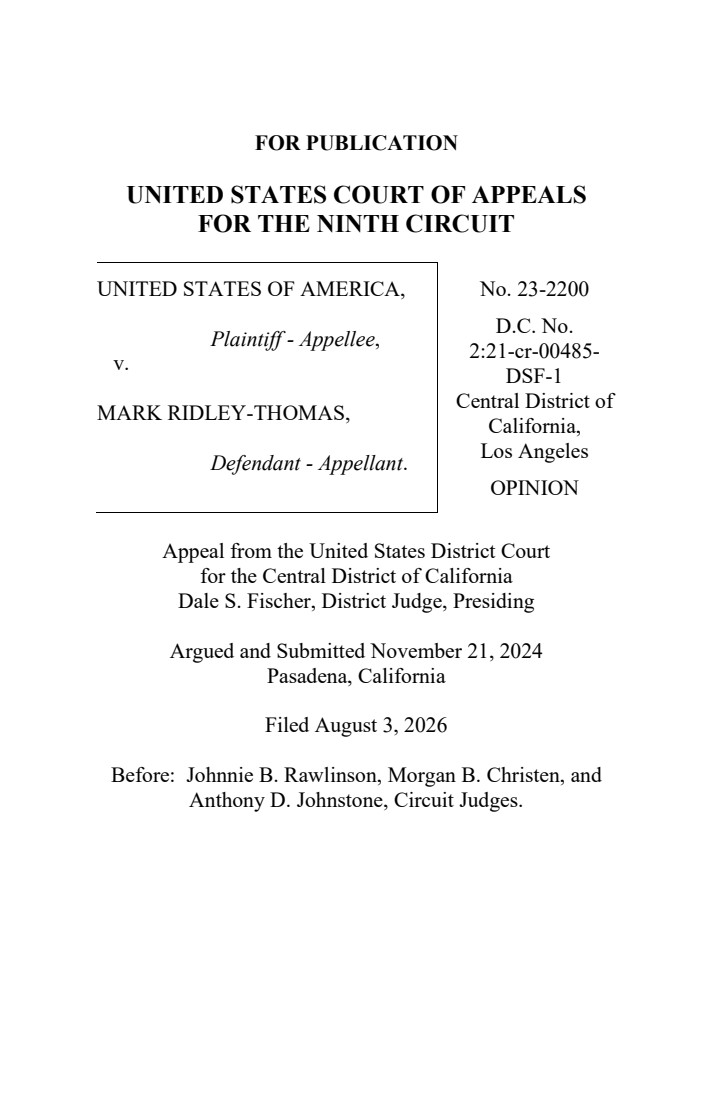
Opening page of the August 3, 2026 Ridley-Thomas appellate opinion. Bass was not the defendant; this is not a judgment convicting her.
Opening page of the August 3, 2026 Ridley-Thomas appellate opinion. Bass was not the defendant; this is not a judgment convicting her. U.S. Court of Appeals for the Ninth Circuit · Image source & rights ↗

The Ninth Circuit’s August 3, 2026 opinion affirmed Mark Ridley-Thomas’s convictions for conspiracy, bribery and honest-services mail and wire fraud. The case concerned his conduct as a Los Angeles County supervisor and dealings with USC’s social-work dean, Marilyn Flynn. It was not a criminal case against Karen Bass. [1]

The opinion describes the arrangement involving university support for the nonprofit employing Ridley-Thomas’s son and a county telehealth contract. It addresses the government’s proof of an exchange, the meaning of a thing of value and challenges to the convictions. Those are particular findings about a particular charged scheme. They are stronger than a rumor that all political relationships with USC were improper—and narrower than a finding that every such relationship was criminal. [1]

Flynn’s connection to Bass’s scholarship provides a reason to examine how the dean cultivated public officials. It does not permit transferring Ridley-Thomas’s guilty verdict to another person. Conversely, the absence of a Bass conviction does not make every question about her scholarship irrelevant. The appropriate analysis follows the act, benefit, knowledge and evidence for each participant separately. [2]

Source limits. The complete appellate opinion was inspected. No later reversal or conviction of Bass over her scholarship was verified; this is not a claim to have accessed confidential investigative files.

The sources

  1. Ninth Circuit — United States v. Ridley-Thomas, August 3, 2026 ↗

    Complete appellate opinion inspected. It affirms Ridley-Thomas’s convictions; Bass is not the defendant. The opinion’s judgment is not an adjudication of her scholarship.

  2. Spectrum News / City News Service — Bass denies USC bribery connection (September 8, 2022) ↗

    Contemporaneous report of the scholarship controversy and Bass’s response, not a court ruling.