The assassination, the evidence, the investigations, competing theories and the released records. The complete offline reading edition, generated from the same source as the interactive files.
This is a historical investigation, not a court verdict or an exhaustive audit of every released file. The evidence section contains sourced statements and identified reasoning; AI assessment is labeled interpretation. Source notes explain the limits. See the editorial method for scope.
People & context / 1917–1963 · Documented record
Before Dallas: the person and the presidency
John F. Kennedy’s life supplies the context for the loss, without turning later admiration into evidence about who killed him.
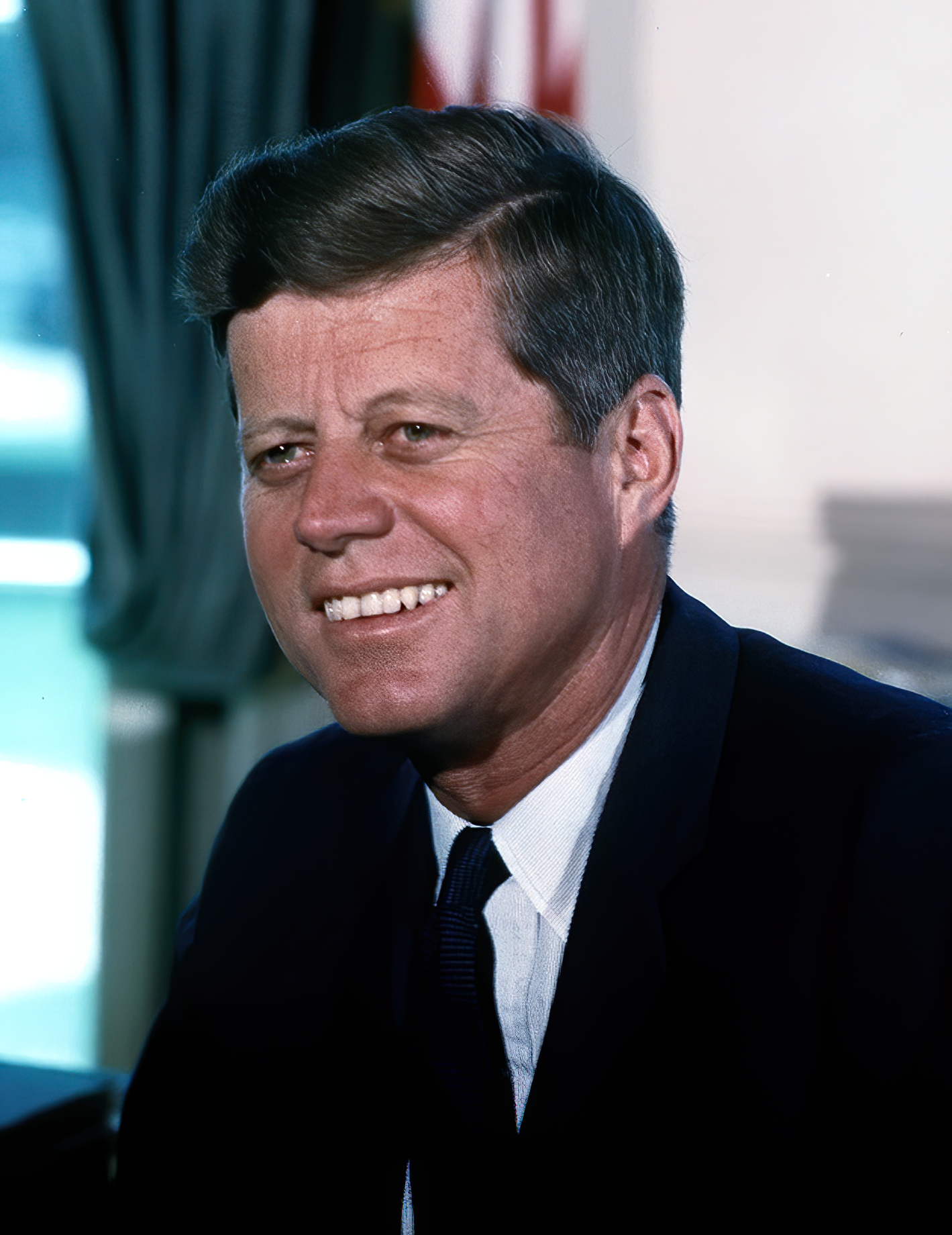
President John F. Kennedy in the Oval Office, July 11, 1963. The archive photograph is used without AI enhancement. Cecil W. Stoughton · Public domain — U.S. government work · Source Archive-provided image or rendition. No scene elements added. Layout crops are for display; no AI enhancement.
The record
John Fitzgerald Kennedy was born in Massachusetts on May 29,1917. He served in the Navy during World War II, entered the House of Representatives, became a senator and won the 1960 presidential election. He took office in January 1961 as the 35th president. These are the foundations of his public biography; assassination speculation should not replace them. [1]
His presidency combined Cold War confrontation, ambitious public projects and domestic political constraints. On June 11,1963, his televised civil-rights address framed equal treatment as a national moral question and called for federal legislative action. That address is an original statement of his position at a particular moment, rather than a claim that his administration had already delivered every promised reform. [2]
Presidential-library biographies necessarily select a narrative. A serious account can recognize military service, political skill, public aspirations and the loss experienced by his family while still examining policy failures and compromises. The assassination does not make every decision wise; criticism of a decision does not explain the murder.
This distinction matters because many proposed plots begin with a disagreement Kennedy had with a powerful institution. Conflict can supply a possible motive. Establishing an assassination operation requires additional evidence: actors, communication, means, opportunity and links to the crime. Biography is the starting context for those questions, not the missing proof.
At the time
John F. Kennedy’s life supplies the context for the loss, without turning later admiration into evidence about who killed him.
What the record shows
Keep the historical president distinct from both a saintly retrospective portrait and a theory built entirely from his enemies.
Original institutional account or document identified in the title. The guide distinguishes the source’s findings from a court verdict and from its own interpretation.
A nuclear confrontation, followed by a search for accommodation
Kennedy’s conflicts and peace initiatives belong together; neither a pure warrior nor a pure peacemaker captures the record.
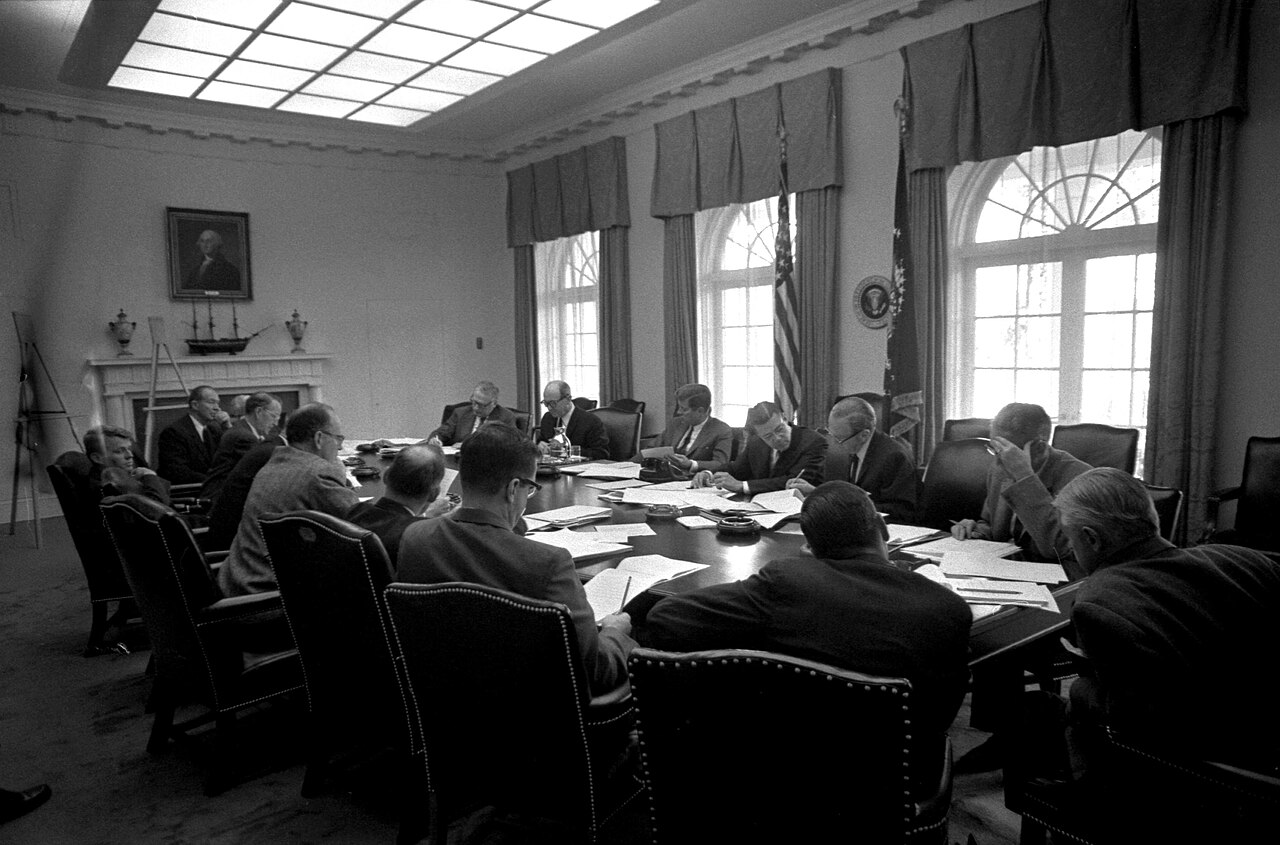
Kennedy meets with the Executive Committee of the National Security Council, October 29, 1962. Cold War context, not an assassination-planning scene. Cecil W. Stoughton / JFK Library · Public domain — U.S. government work · Source Archive-provided image or rendition. No scene elements added. Layout crops are for display; no AI enhancement.
The record
The October 1962 Cuban Missile Crisis brought the United States and Soviet Union into a dangerous confrontation over Soviet missiles in Cuba. Kennedy chose a naval quarantine while negotiation continued; the settlement involved Soviet removal of the missiles and American assurances, including the privately handled issue of U.S. missiles in Turkey. The crisis is indispensable context for the fears surrounding a murdered president a year later. [1]
At American University on June 10,1963, Kennedy urged a practical approach to peace, attention to Soviet security fears and progress toward a test-ban agreement. Reading the full address shows a change in tone and an argument for reducing the risk of war. It does not read as an announcement that every Cold War commitment, intelligence operation or military alliance had ended. [2]
Those two records resist a simple either/or biography. A president could authorize coercive policy and also pursue negotiation; officials could disagree sharply without becoming members of a murder conspiracy. The resulting conflicts are legitimate investigative subjects precisely because the stakes were real.
The guide therefore treats motive as a question to develop. A theory that names Cuba, Moscow, intelligence officers, organized crime or domestic political rivals needs evidence specific to those actors. Demonstrating that a faction disliked a policy does not show it ordered the shots in Dallas; demonstrating a diplomatic opening does not show that future policy was predetermined.
Watch this question
Kennedy’s American University address ↗ JFK Library / June10,1963 recording and transcript — Original presidential speech, provided with a transcript. A statement of policy and aspiration, not evidence that a later assassination plot existed.
At the time
Kennedy’s conflicts and peace initiatives belong together; neither a pure warrior nor a pure peacemaker captures the record.
What the record shows
Read the confrontation and the peace initiative together, then test any proposed plot against evidence beyond motive.
Original institutional account or document identified in the title. The guide distinguishes the source’s findings from a court verdict and from its own interpretation.
Original institutional account or document identified in the title. The guide distinguishes the source’s findings from a court verdict and from its own interpretation.
The November weekend / November 21–22,1963 · Documented record
The Texas trip and the last completed itinerary
The visit was a political trip with a public motorcade, followed by a sudden medical and constitutional crisis.
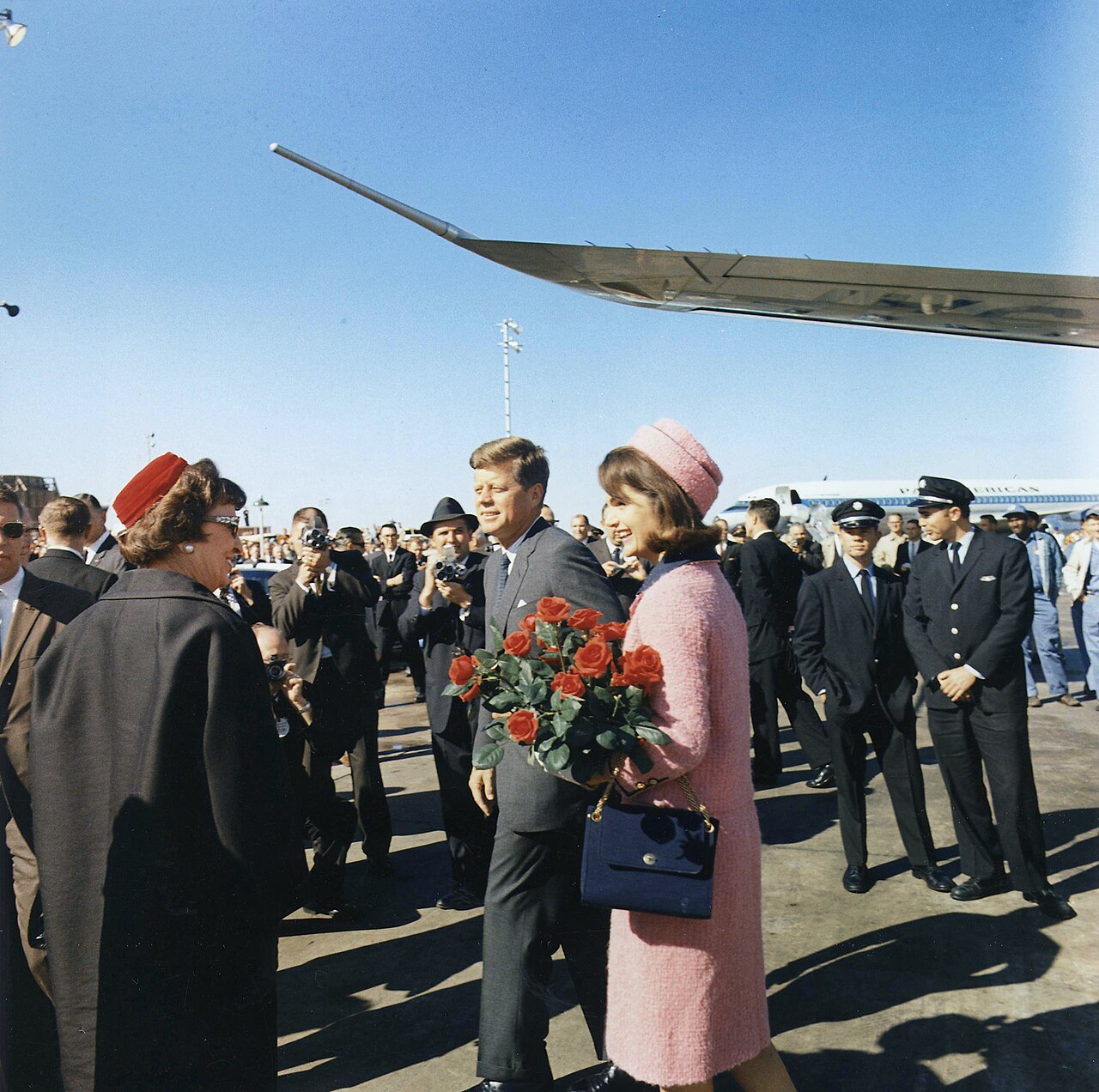
John and Jacqueline Kennedy arrive at Love Field, Dallas, November 22, 1963. A White House photograph taken before the assassination. Cecil W. Stoughton · Public domain — U.S. government work · Source Archive-provided image or rendition. No scene elements added. Layout crops are for display; no AI enhancement.
The record
The Texas visit began on November 21 with San Antonio and Houston, followed by an overnight stop in Fort Worth. Dallas was on the November 22 schedule, with Austin planned afterward. Warren chapter 2 records the earlier change moving San Antonio to Thursday; this is useful when checking later compressed timelines. [1]
A source correction: the JFK Library’s current death-of-the-president narrative contains a paragraph placing a brief San Antonio visit after Dallas. That conflicts with the dated trip chronology. This guide uses the November 21 San Antonio stop and the planned post-Dallas Austin travel rather than repeating that paragraph uncritically. The discrepancy is an itinerary error, not evidence of a concealed second presidential journey. [1][2]
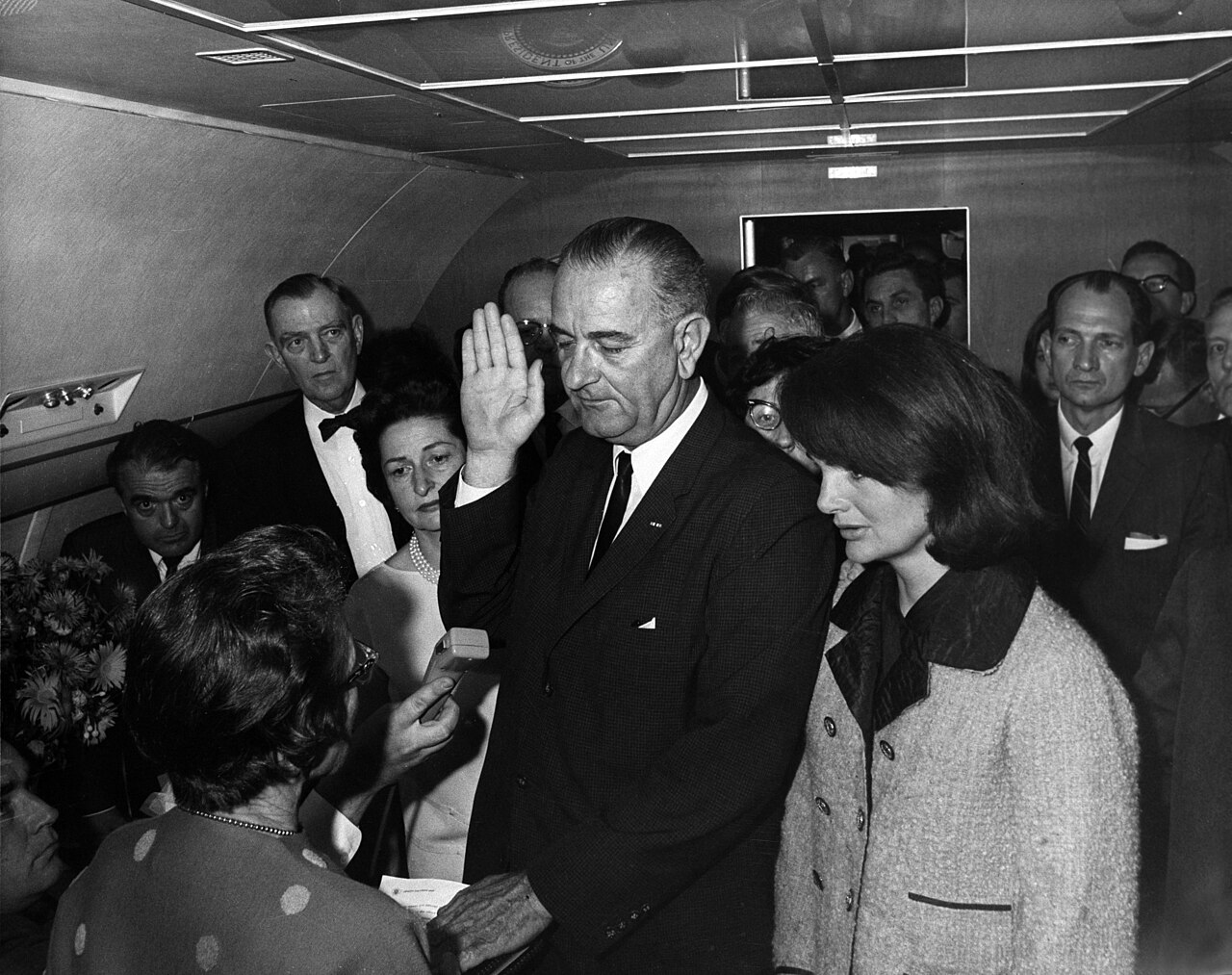
On Friday the Kennedys flew from Fort Worth to Love Field and entered the open limousine with Governor John Connally and Nellie Connally. Around 12:30 p.m., gunfire struck Kennedy and Connally as the motorcade passed through Dealey Plaza. Kennedy was taken to Parkland Memorial Hospital and pronounced dead at 1 p.m.; Connally survived. Later that afternoon Lyndon Johnson took the presidential oath aboard Air Force One. [2]
Chronology is a control on interpretation. Planning a public appearance, choosing a route, recognizing gunfire, reaching a hospital and transferring presidential authority are different actions by different people. A timeline should make those distinctions visible. It should also distinguish a scheduled event that never occurred from one supported by contemporary records.
At the time
The visit was a political trip with a public motorcade, followed by a sudden medical and constitutional crisis.
What the record shows
The day’s sequence is well documented. Check small itinerary details too: an official modern summary can still contain an error.
Presidential-library narrative. Its paragraph placing San Antonio after Dallas conflicts with the dated itinerary in Warren chapter2; that discrepancy is flagged in the article.
A Marine veteran, defector, husband and political activist became the central accused man. His unusual history deserves reconstruction, not a diagnosis by slogan.
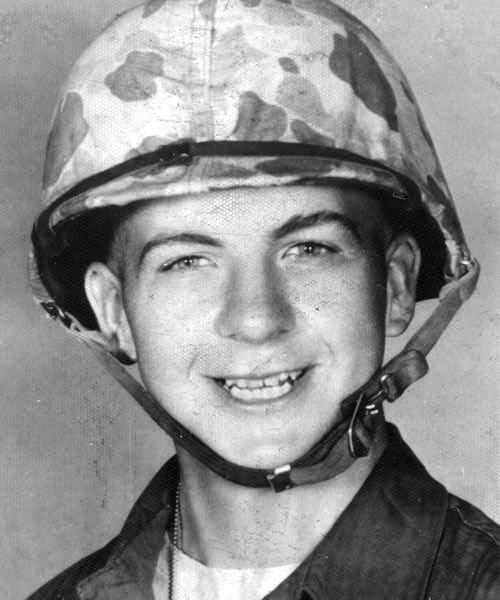
Lee Harvey Oswald in an official U.S. Marine Corps portrait, 1956. U.S. Marine Corps · Public domain — U.S. government work · Source Archive-provided image or rendition. No scene elements added. Layout crops are for display; no AI enhancement.
The record
Lee Harvey Oswald was born in New Orleans in 1939, served in the U.S. Marine Corps, traveled to the Soviet Union in 1959 and lived in Minsk. He married Marina Prusakova and returned to the United States with his family in 1962. In 1963 he lived at different times in the Dallas area and New Orleans, promoted the Fair Play for Cuba cause, traveled to Mexico City and obtained work at the Texas School Book Depository. These stages belong in sequence rather than being treated as interchangeable signs of one operation. [1]
One frequently mishandled detail concerns citizenship. Oswald told American officials that he wanted to renounce it, but the consular record distinguishes that declared intention from completing the formal legal process. The State Department ultimately treated him as retaining U.S. citizenship. His return and documentation therefore cannot simply be described as the admission of a newly naturalized foreign citizen. [2]
Unusual access, travel and political activity can generate legitimate questions about what intelligence agencies knew and whether they interacted with him. The next step is to examine their actual files, surveillance, correspondence and omissions. The same biography alone cannot establish that he was a Soviet agent, a CIA employee or an uninvolved victim of impersonation.
Oswald was accused of killing Kennedy and officer J. D. Tippit, denied the accusations publicly and was killed before trial. Investigative commissions later made findings about him, but no jury heard a completed criminal prosecution of Oswald. Calling attention to that missing trial does not erase physical or testimonial evidence. It sets the correct legal and historical frame for examining it.
At the time
A Marine veteran, defector, husband and political activist became the central accused man. His unusual history deserves reconstruction, not a diagnosis by slogan.
What the record shows
The unusual biography is real; recruitment, operational control and guilt are additional propositions requiring their own evidence.
The November weekend / April 10,1963 / investigated after November 22 · Claim check
The earlier shooting at Edwin Walker
Marina’s account and the recovered note make this a substantial lead, while their evidentiary limits remain important.
The record
Retired general Edwin Walker survived a rifle shot fired at his Dallas home in April 1963. After the assassination, Marina told investigators that her husband had returned home and admitted trying to shoot Walker. In a later HSCA deposition she again described a late return, a note and his explanation that Walker was a dangerous figure. The statement is significant evidence of what she said he admitted; it is not a surviving recording of his own confession. [1][2]
The December 5 FBI interview records her identification of an instruction letter as Lee’s and her description of keeping it to deter another reckless act. Such a letter can corroborate anticipation of danger without, by itself, naming a target in every line. The original context and the witness’s explanation must be evaluated together rather than silently treating one as a complete substitute for the other. [2]
The Warren Commission also assessed the damaged Walker bullet and other circumstances. Its firearm evaluation did not turn that badly damaged specimen into an unqualified individual identification to the assassination rifle. The difference between compatibility and a specific weapon match matters here as it does in the later ballistic dispute. [3]
If accepted, the Walker evidence undermines a portrait of Oswald as someone with no prior connection to political violence. It still does not establish every detail of the Kennedy assassination, prove that no accomplices existed, or settle all questions about Marina’s recollections. An earlier attempt is relevant behavioral evidence, not a mathematical proof of a later event.
At the time
Marina’s account and the recovered note make this a substantial lead, while their evidentiary limits remain important.
What the record shows
The Walker allegation is supported by a specific witness account and documentary context. Describe the confession as reported and the ballistic limit accurately.
Contemporaneous FBI interview record of Marina’s account after the assassination. It records reported statements and the recovered letter, not a confession recorded from Lee Oswald.
Original institutional account or document identified in the title. The guide distinguishes the source’s findings from a court verdict and from its own interpretation.
The November weekend / November 22,1963, early afternoon · Claim check
Officer Tippit’s death is a separate evidentiary case
The shooting in Oak Cliff has witnesses, cartridge cases and disputed timing of its own.
The record
After the assassination, Dallas officer J. D. Tippit was shot and killed in Oak Cliff. The Warren Commission and later House committee attributed the killing to Oswald, considering witnesses who saw the shooting or the gunman’s flight, the revolver taken at the Texas Theatre, cartridge cases and other circumstances. This was not merely an inference that whoever killed Kennedy must also have killed Tippit. [1][2]
The firearms testimony makes an important distinction: the recovered cartridge cases were identified with the revolver, while the bullets recovered from Tippit did not permit the same level of agreement. FBI examiner Cunningham could not individually identify the bullets to the weapon; Joseph Nicol claimed a positive identification of one. Reporting every component as an identical kind of match would overstate the case. [3][4]
Critics dispute witness identifications, descriptions, the timeline and the handling of exhibits. Those are specific questions that can be checked. A witness who saw a man running with a weapon is not the same as a witness who saw the first shot; an approximate clock time is not a synchronized forensic measurement. A fair account should not count those observations as independent copies of one another.
Even strong evidence about Tippit would not, by itself, identify the sixth-floor gunman or exclude a wider Kennedy plot. Conversely, uncertainty about one Tippit witness would not automatically destroy the Kennedy evidence. Keeping the two cases distinct helps prevent both prosecutorial shortcuts and the assumption that a weakness anywhere makes every other item worthless.
At the time
The shooting in Oak Cliff has witnesses, cartridge cases and disputed timing of its own.
What the record shows
Examine the Tippit evidence on its own terms, including the difference between a cartridge-case identification and a damaged bullet.
Original institutional account or document identified in the title. The guide distinguishes the source’s findings from a court verdict and from its own interpretation.
Original sworn FBI expert testimony on cartridge-case identifications and the inability to individually identify damaged Tippit bullets. Nicol’s different conclusion is cited from Warren chapter4, rather than being attributed to this Cunningham extract. Historical individualization language is attributed, not independently validated here.
Original Illinois firearms examiner testimony. His positive identification of one Tippit bullet is on printed page512 (PDF page524), distinct from the FBI examiner’s inability to identify the bullets.
The November weekend / November 22–24,1963 · Claim check
The denied charges and the interrogation that was not recorded
Oswald’s public denials survive. A complete verbatim account of his police questioning does not.
The record
Oswald was held in Dallas police custody after his arrest at the Texas Theatre. He was charged with Tippit’s murder and then Kennedy’s. He publicly denied shooting anyone and sought legal assistance. The commission’s account records attempts to reach New York attorney John Abt and a visit from the Dallas Bar Association president; Oswald had not obtained a lawyer to represent him through a trial before Ruby killed him. [1]
The interrogation record has a major limitation. Appendix 11 says the questioning totaled approximately 12 hours across the weekend, with no stenographic or tape recording. The published reports were prepared by investigators recounting what was asked and answered. They are evidence about an interrogation, not a word-for-word transcript that can resolve every later dispute about wording. [2]
That gap has consequences in both directions. An investigator’s report should not be read as if it were an audio recording. But the absence of a recording does not allow a later author to put any preferred statement into Oswald’s mouth. Each claimed response needs a source, an author, a creation date and attention to differences among the accounts.
The familiar description of Oswald as a patsy is also a claim, not a self-executing explanation. To demonstrate a frame-up, a theory must explain the particular physical and testimonial evidence and identify the mechanism by which it was planted, misread or manufactured. To reject his denial responsibly, an account must address the evidence without pretending he was convicted in a trial that never happened.
Documented checkpoints & limits
November 22–24,1963
Start with the record
Oswald was held in Dallas police custody after his arrest at the Texas Theatre. He was charged with Tippit’s murder and then Kennedy’s. He publicly denied shooting anyone and sought legal assistance. The commission’s account records attempts to reach New York attorney John Abt and a visit from the Dallas Bar Association president; Oswald had not obtained a lawyer to represent him through a trial before Ruby killed him. Source 1 ↗ · Source 2 ↗
Limits of the inference
Read what is established—and what remains open
This historical account does not apply today’s interrogation law retroactively or decide hypothetical rulings that an Oswald trial might have produced. Source 1 ↗ · Source 2 ↗
At the time
Oswald’s public denials survive. A complete verbatim account of his police questioning does not.
What the record shows
The missing verbatim interrogation record is a genuine investigative limitation. It establishes neither a confession nor a frame-up.
Commission account of police custody, access, press activity and the failed transfer; factual reconstruction and official evaluation are both identified.
The online appendix explains that no stenographic or tape recording exists and identifies the retrospective reports. The reports are not a verbatim interrogation transcript.
The November weekend / November 24,1963 · Documented record
Ruby’s gunshot and the trial that Oswald never had
The killing was public and unmistakable. Ruby’s motive and possible assistance require a different evidentiary inquiry.
Lyndon B. Johnson takes the presidential oath aboard Air Force One, November 22, 1963. Cecil W. Stoughton · Public domain — U.S. government work · Source Archive-provided image or rendition. No scene elements added. Layout crops are for display; no AI enhancement.
The record
At 11:21 a.m. on November 24, nightclub operator Jack Ruby shot Oswald in the Dallas police basement during a transfer to the county jail. Oswald died at Parkland. The commission reconstructed Ruby’s arrival and the security breakdown; whatever conclusion one reaches about a plot, police had failed to keep their prisoner alive. That failure deprived the public of a trial and permanently narrowed the investigation. [1]
Ruby later testified to Warren and Ford in Dallas County Jail. His account included emotional explanations for the killing, repeated requests for a lie-detector test and fear that he could not safely tell his story in Dallas. Those passages explain why selective excerpts have become so influential. The whole exchange also contains assertions and anxieties that should not be silently converted into independently verified facts. [2]
There are two questions here: why Ruby killed Oswald, and whether someone directed or knowingly assisted him. A proposed emotional motive does not by itself rule out an accomplice; underworld acquaintances do not by themselves identify a handler. A compelling account needs to connect the proposed explanation to the timing, access, communications and actual choices surrounding the transfer.
Ruby’s act was especially destructive to public confidence because it looked like the silencing of the only accused man. That appearance is a reasonable reason to investigate. It remains necessary to test a silencing theory against records rather than treating the suspicion generated by the act as the proof of who ordered it. The separate organized-crime file examines his associations.
At the time
The killing was public and unmistakable. Ruby’s motive and possible assistance require a different evidentiary inquiry.
What the record shows
The custodial failure is established. A conclusion about an ordered silencing requires evidence beyond the fact that the killing prevented a trial.
Commission account of police custody, access, press activity and the failed transfer; factual reconstruction and official evaluation are both identified.
Original June7 testimony, printed pages181–213. It records Ruby’s explanations, fear, requests and questioning; it is not a verified map of a conspiracy.
Memory & the long aftermath / 1964–1967 · Documented record
Ruby’s conviction was reversed; he died before retrial
A real reversal for trial error is sometimes retold as either exoneration or proof of a larger cover-up. It was neither.
The record
A Dallas jury convicted Ruby of murder in March 1964 and imposed a death sentence. On October 5,1966, the Texas Court of Criminal Appeals reversed. The opinion found that police testimony about a custodial oral statement should not have been admitted and that the refusal to change venue was reversible error. The court directed a new trial outside Dallas County. [1]
This was not a finding that Ruby had not fired the shot. Nor was it a court ruling that the CIA, organized crime or Lyndon Johnson had arranged the Kennedy assassination. It addressed the fairness and legal conduct of Ruby’s prosecution. A reversal can be consequential without proving every theory promoted by a defendant’s supporters or critics.
Ruby was diagnosed with inoperable cancer late in 1966 and died on January 3,1967, before a new trial. That sequence matters when reading a statement that he simply died under an intact death sentence, or that an appeal acquitted him. Neither description captures the procedural history. [2]
The public spectacle surrounding the two killings is also part of the legal story. The obligation to give Ruby a fair trial did not depend on public sympathy for him. The same distinction protects historical reasoning: evidence that a court process failed should lead to the specific ruling and remedy, not to an invented finding about who killed Kennedy.
At the time
A real reversal for trial error is sometimes retold as either exoneration or proof of a larger cover-up. It was neither.
What the record shows
Use the appellate ruling for what it decided: serious trial error and a new trial, not acquittal or adjudication of a presidential murder plot.
Dallas-history journal preserved by the University of North Texas; the relevant historical account places Ruby’s cancer diagnosis in late1966 and death on January3,1967.
The original report contains reservations that are often lost when someone says he passed a lie detector.
The record
Ruby repeatedly requested a polygraph, and an examination was eventually administered in July 1964. Appendix 17 describes the arrangements, questions, interruptions, psychiatric concerns and the examiner’s interpretation. The surrounding reservations are part of the source, not fine print that can be discarded after a favorable headline. [1]
The issue is not whether an instrument recorded physiological responses. The issue is what those responses can establish about a particular answer under particular conditions. Emotional state, the wording and order of questions, interruptions and the examiner’s judgments can all affect the inference. A graph is not a direct recording of a memory or a hidden agreement.
The commission’s own discussion does not justify treating the result as a stand-alone resolution of all conspiracy questions. The relevant historical use is narrower: it documents an effort to test Ruby’s account and the limits acknowledged at the time. It does not make his testimony infallible or supply missing evidence about another person’s acts. [1]
The same standard should govern a claim that the test was manipulated. That allegation needs a demonstrated procedural alteration and an explanation of its effect, rather than the assumption that any disputed result must have been engineered. The best starting point is the actual questions and contemporary qualifications, read beside the wider evidence.
At the time
The original report contains reservations that are often lost when someone says he passed a lie detector.
What the record shows
Read the examination and its reservations together. A polygraph cannot replace corroborating records or a trial.
Investigations & their limits / November 1963–1964 · Documented record
What the Warren Commission was—and was not
A national fact-finding commission produced a major evidentiary record. It was not a criminal trial with Oswald present to contest it.
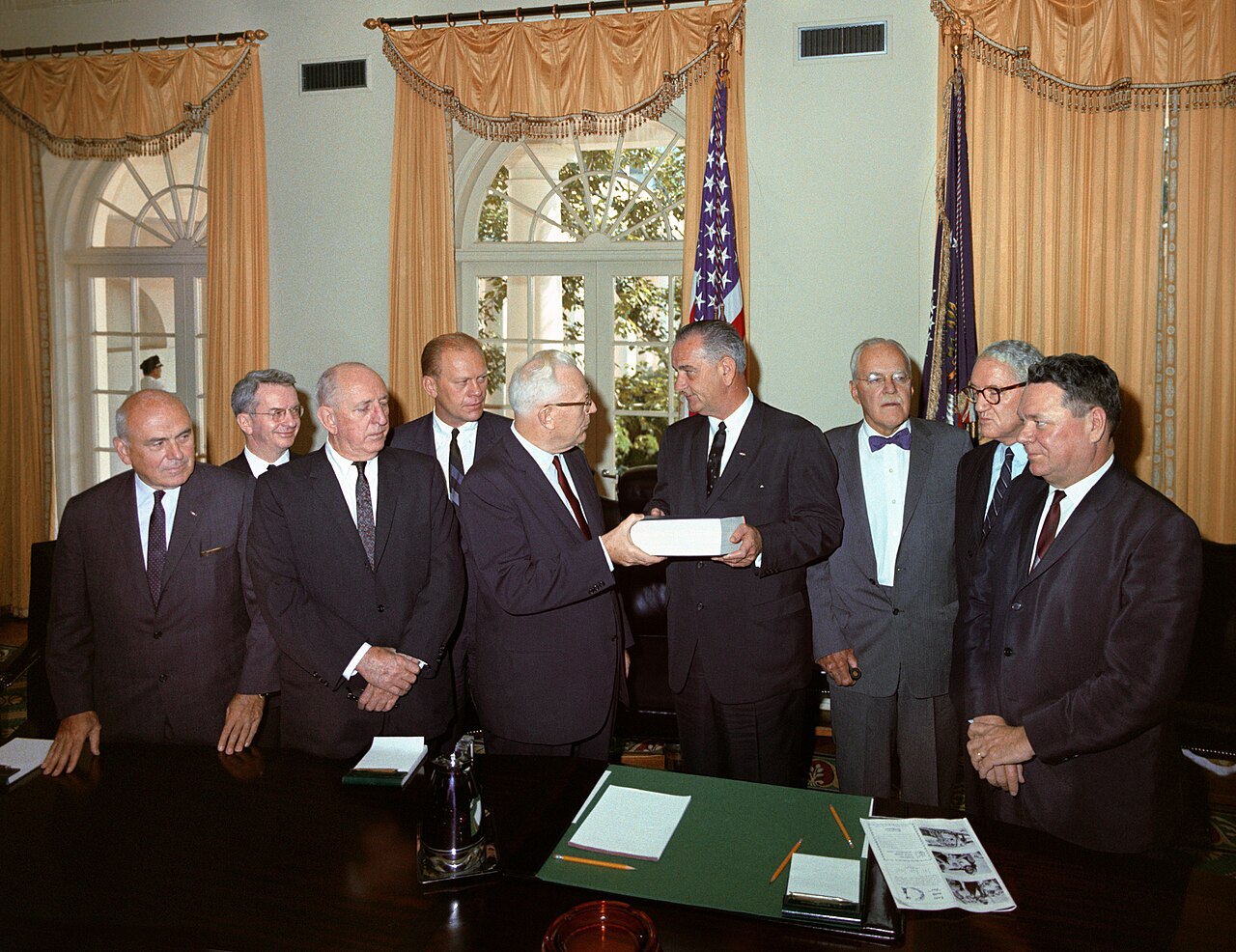
The Warren Commission presents its report to President Johnson, September 24, 1964. Cecil W. Stoughton / LBJ Library · Public domain — U.S. government work · Source Archive-provided image or rendition. No scene elements added. Layout crops are for display; no AI enhancement.
The record
President Johnson appointed the commission after Oswald’s death, with Chief Justice Earl Warren as chair. Its foreword describes a national inquiry intended to establish the facts rather than a continuation of a criminal prosecution. The commission assembled testimony, exhibits and agency material and published its report in 1964. [1]
The written procedures provided for sworn depositions and testimony, transcripts, witness access to counsel and opportunities for counsel to clarify testimony. Those rules are worth reading before calling every interview an unsworn rumor. They also did not supply an adversarial defense team representing the dead accused man across the inquiry. [2]
The distinction is substantive. A fact-finding body can develop important evidence while lacking the safeguards, incentives and cross-examination structure of a murder trial. Its staff must also depend on agencies for records and expertise, creating a vulnerability when an agency withholds information about its own activities. Whether that occurred is a documentary question addressed in the intelligence files.
The responsible alternatives are not total deference and total rejection. A conclusion should be tested against its supporting exhibits, the treatment of contrary evidence and what became available later. An institutional failure can weaken confidence in a particular finding without making every exhibit fictitious. Conversely, the existence of thousands of pages cannot substitute for answering a specific demonstrated omission.
At the time
A national fact-finding commission produced a major evidentiary record. It was not a criminal trial with Oswald present to contest it.
What the record shows
Treat the report as an important, inspectable investigation with a particular institutional design—not as a criminal conviction or an untouchable text.
Original institutional account or document identified in the title. The guide distinguishes the source’s findings from a court verdict and from its own interpretation.
Original written rules for sworn depositions, witness counsel, objections and transcripts. Written rules do not alone establish how fully every lead was pursued.
Memory & the long aftermath / 1963–2026 · Claim check
How suspicion became a lasting public history
Conspiracy belief did not begin with the internet. Polling records its persistence, but does not measure a plot’s probability.
The record
Gallup’s historical series found that 52 percent of Americans surveyed immediately after the assassination thought some group or element beyond the gunman was involved. The organization’s November 2023 report found 65 percent saying there was a conspiracy, compared with 29 percent attributing it to Oswald alone. These are dated surveys, not current 2026 percentages. [1]
The earlier Gallup report tracks a much higher reading in 1976 and continuing majority suspicion across decades. It also discusses books, investigations and the 1991 film JFK as parts of the cultural setting. That history makes it inaccurate to describe all doubt as a recent social-media invention. It does not establish that a popular theory is correct. [2]
The story grows through different mechanisms: newly available evidence, genuine investigative failures, memorable images, speculative connections and repetition of claims after their sources have been forgotten. Those mechanisms should not be conflated. An old theory can acquire new support; an old allegation can also be repackaged as a new discovery without gaining evidence.
This guide therefore follows a claim’s development rather than assigning believers a single motive. It asks what the earliest version said, what later evidence added, what changed in retelling and which underlying assumptions are testable. A reader can reasonably distrust an institution and still reject a weak allegation; a reader persuaded by the Oswald evidence can still insist that withheld records be released.
At the time
Conspiracy belief did not begin with the internet. Polling records its persistence, but does not measure a plot’s probability.
What the record shows
Public doubt is a historical fact to understand respectfully. Popularity and truth remain different questions.
Start with the moving car, elevated window, road grade and incomplete view. A map constrains explanations; it is not a verdict.
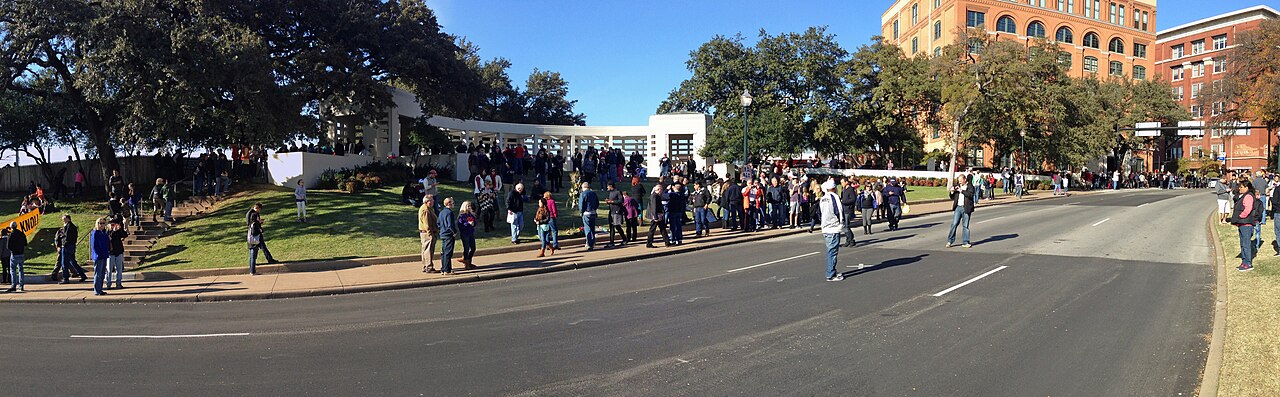
Elm Street and Dealey Plaza in November 2013. Later landscape context; the scene is not presented as unchanged since 1963. Fredlyfish4 · CC BY-SA 3.0 · Source Archive-provided image or rendition. No scene elements added. Layout crops are for display; no AI enhancement.
The record
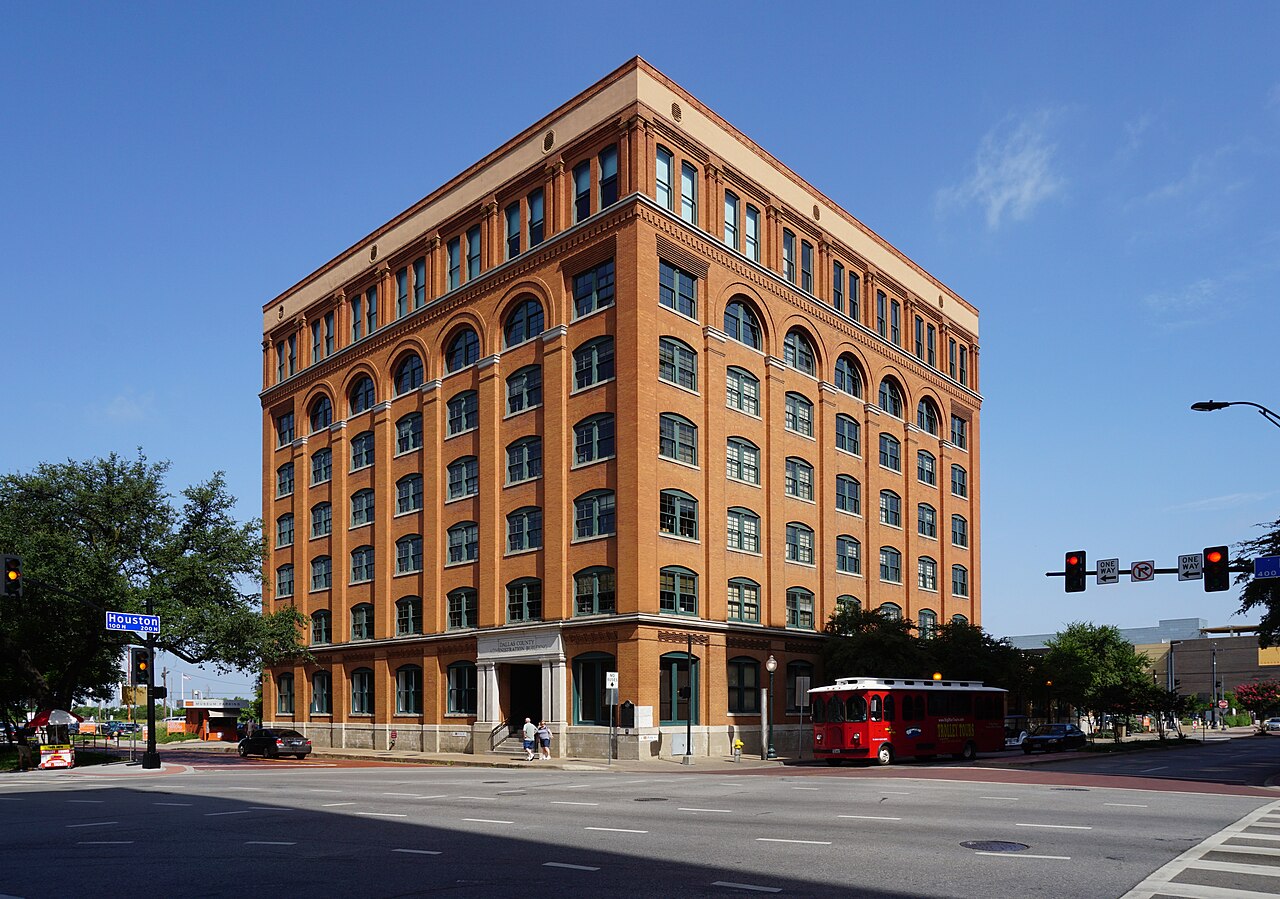
Kennedy’s limousine turned from Houston Street onto Elm Street and traveled toward the triple underpass. The southeast sixth-floor Depository window was behind the car as it moved down Elm. The grassy knoll was ahead and to its right. Those positions matter because “from the right” and “from behind” can describe different places depending on where a witness stood. The Warren investigation reconstructed sightlines on location rather than treating a flat sketch as the whole scene. [1]
The HSCA photographic panel later used photographs, stereoscopic measurements and a trajectory study to examine the occupants’ positions. Its reconstruction found rear trajectories consistent with the sixth-floor window within the uncertainties of posture and wound locations. This was a compatibility test: it did not photograph a bullet in flight or independently identify whoever pulled the trigger. A diagram is only as reliable as its measurements and assumptions. [2]
Zapruder’s silent film supplies a clock, not an audio recording of every shot. His camera ran at approximately 18.3 frames per second; the fatal head impact appears at frame 313. A road sign obscures the occupants during an important earlier interval. That interruption helps explain disagreement about the exact first-hit frame and why counting reactions in a looping clip cannot alone settle the number of shots. [2]
Bystander James Tague reported a sting to his cheek and a fresh mark on a nearby curb. His testimony supports a separate impact in the plaza, but does not identify a recovered complete bullet, establish its exact path or prove which shot caused it. A missed round and a fragment from a round that hit something else are different possibilities. An exact first-shot frame and a definite Tague trajectory require assumptions beyond his observation. [3]
The useful question is which proposed firing location can explain a particular wound or documented impact. Showing that one rearward line is possible does not resolve the broader question of assistance, prior knowledge or concealment. A reconstruction that asks its geometry to answer those intelligence questions is exceeding what geometry can establish. [1][2]
At the time
Start with the moving car, elevated window, road grade and incomplete view. A map constrains explanations; it is not a verdict.
What the record shows
Rearward geometry is supported for the documented wound paths; the exact complete shot sequence is less certain.
Seating, posture, timing and wound uncertainty are central to evaluating the proposed path; a simplified flat diagram cannot settle it.
The record
The single-bullet explanation proposes that one projectile passed through Kennedy’s upper back and neck, then wounded Governor John Connally in the chest, right wrist and left thigh. It does not require two men sitting upright at the same height on a flat bench. Connally occupied a forward jump seat and was turned. The HSCA photographic study explicitly considered relative alignment, rather than using the familiar diagram with both men squarely facing forward. [1]
Counting every entry and exit as a separate obstacle can also mislead. A bullet entering and leaving one body creates two wounds along one passage. Soft tissue, bone, projectile orientation and energy loss affect what happens next. The HSCA wound-ballistics discussion treats these variables as limits on reconstruction, not as a guarantee that any imaginable path works. A full-metal-jacketed projectile can remain substantially intact; that fact alone does not establish the actual sequence. [2]
There was real expert disagreement. Forensic pathologist Cyril Wecht dissented from the panel’s single-bullet conclusion. He disputed alignment, interpretation of the timing, Connally’s retention of his hat and the degree of damage the bullet should have sustained. Those are substantive objections, not an irrational refusal to accept an official answer. His dissent is linked in full so its argument can be read in its own terms. [3]
The disagreement cannot be resolved with certainty manufactured from a single still. Visible reaction can lag impact, and an injured person may briefly retain an object. But a possible delay is not a measurement of Connally’s actual delay. Nor does a general possibility of deflection excuse a reconstruction from specifying entry points, positions and a plausible path. Both the proposal and its criticism need those particulars. [1][2][3]
The strongest defensible assessment is that the explanation is physically plausible and supported by the majority official medical reconstruction, while precise timing and some anatomical assumptions remain contested. “Magic” is a nickname, not a test. Equally, an animation illustrates selected inputs; it cannot erase the original uncertainties or turn the proposal into a directly observed event. [1][2][3]
Documented checkpoints & limits
1964 · debated through 2026
Start with the record
The single-bullet explanation proposes that one projectile passed through Kennedy’s upper back and neck, then wounded Governor John Connally in the chest, right wrist and left thigh. It does not require two men sitting upright at the same height on a flat bench. Connally occupied a forward jump seat and was turned. The HSCA photographic study explicitly considered relative alignment, rather than using the familiar diagram with both men squarely facing forward. Source 1 ↗ · Source 2 ↗ · Source 3 ↗
Limits of the inference
Read what is established—and what remains open
The linked Wecht dissent records a minority expert interpretation. Models cannot determine an unrecorded posture with unlimited precision. Source 1 ↗ · Source 2 ↗ · Source 3 ↗
At the time
Seating, posture, timing and wound uncertainty are central to evaluating the proposed path; a simplified flat diagram cannot settle it.
What the record shows
A simplified zigzag diagram does not represent the proposed reconstruction. Physical plausibility does not prove every detail.
CE 399: condition, identification and an imperfect chain
The stretcher bullet was not untouched. Its condition and its passage through people’s hands are different questions.
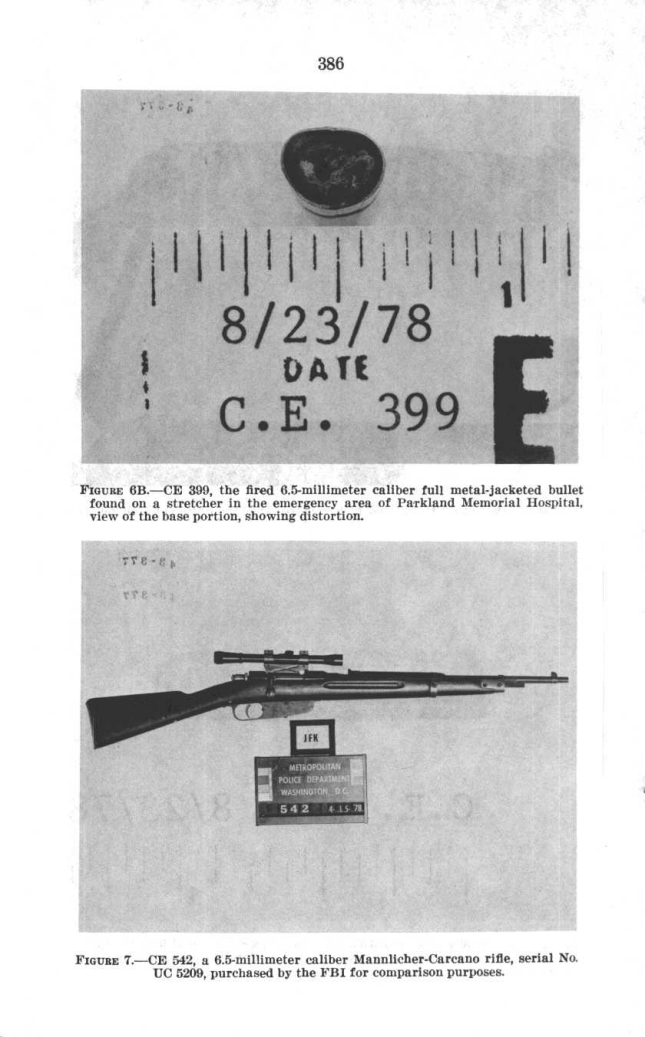
HSCA volumeVII, printed page386: CE399’s distorted base (Figure6B). The rifle pictured below is comparison weapon CE542, not the assassination rifle CE139. House Select Committee on Assassinations / U.S. government · Public domain — U.S. government work · Source Complete federal exhibit page rasterized. No content altered.
The record
Commission Exhibit 399 is often called pristine. It retains its general shape but is visibly deformed, not an unused cartridge or an unmarked projectile. Its flattened surfaces and base matter when comparing it with test ammunition. FBI examiner Robert Frazier identified rifling marks linking it to the recovered Carcano. A firearm identification concerns which barrel marked a bullet; it does not establish every place that bullet traveled before collection. [1]
Orthopedic surgeon Charles Gregory described the fragments associated with Connally’s wrist as small and discussed a projectile arriving with diminished velocity. His testimony contains both clinical observation and uncertainty. The inference that a relatively intact projectile could produce the injuries is different from a demonstration that CE 399 unquestionably did. Conversely, badly crushed test bullets are meaningful comparisons only if velocity, orientation and what they struck are comparable. [2]
The discovery record is weaker than a modern sealed-and-signed trail. Parkland employee Darrell Tomlinson described finding a bullet after moving stretchers but could not confidently resolve which stretcher it came from. The Commission adopted a more definite association with Connally than Tomlinson’s certainty alone justified. Reading his answers makes that distinction visible; it should not disappear behind a caption saying simply “found on Connally’s stretcher.” [3]
The HSCA firearms panel reexamined the preserved projectile and other exhibits. Its work supports the weapon comparison while leaving the discovery question dependent on the earlier records. A later laboratory examination cannot retrospectively supply missing hospital documentation. Equally, a gap does not itself prove substitution or planting. Planting is a positive claim requiring evidence of the act or a demonstrable mismatch. [4]
These are separate tests: can such a projectile survive such wounds; does this exhibit bear the recovered rifle’s marks; and was this the item found in the asserted place? A case can have strong laboratory evidence and an imperfect collection history. That is a better description than either an impossible magic bullet or a flawless chain that cannot reasonably be questioned. [1][2][3][4]
Documented checkpoints & limits
22 November 1963 · examined 1964–1979
Start with the record
Commission Exhibit 399 is often called pristine. It retains its general shape but is visibly deformed, not an unused cartridge or an unmarked projectile. Its flattened surfaces and base matter when comparing it with test ammunition. FBI examiner Robert Frazier identified rifling marks linking it to the recovered Carcano. A firearm identification concerns which barrel marked a bullet; it does not establish every place that bullet traveled before collection. Source 1 ↗ · Source 2 ↗ · Source 3 ↗ · Source 4 ↗
Limits of the inference
Read what is established—and what remains open
Later expert identification cannot repair an undocumented early transfer; a weak chain does not alone prove substitution. Source 1 ↗ · Source 2 ↗ · Source 3 ↗ · Source 4 ↗
At the time
The stretcher bullet was not untouched. Its condition and its passage through people’s hands are different questions.
What the record shows
The rifle comparison is stronger than the precise stretcher identification. The discovery uncertainty should remain visible.
Could one rifle make the shots? Timing tests and their limits
Rapid aimed fire was feasible. Not every reenactment reproduced every condition in Dallas.
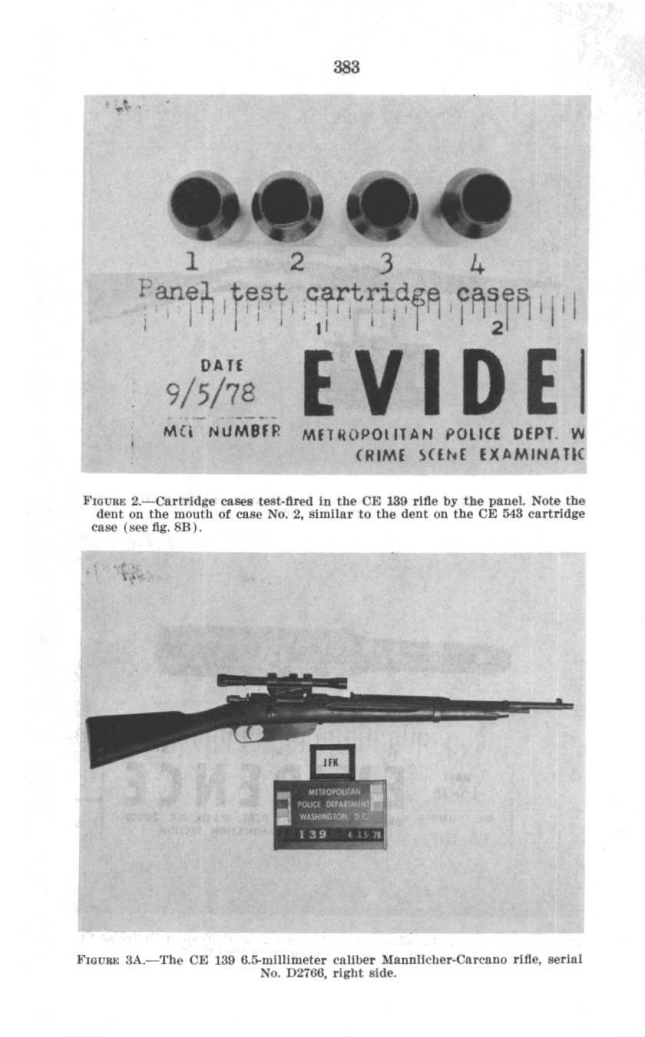
HSCA volumeVII, printed page383: the actual CE139 rifle (Figure3A) and test cartridge cases. A federal investigative exhibit page, not a reenactment. House Select Committee on Assassinations / U.S. government · Public domain — U.S. government work · Source Complete federal exhibit page rasterized. No content altered.
The record
Oswald’s Marine record included sharpshooter and marksman qualifications at different times. That supports trained familiarity with rifles, not a claim that he was an elite sniper. His actual condition, preparation and recent practice in November 1963 are separate questions. [1]
Frazier’s testimony describes testing the actual Carcano, including scope alignment and shooting behavior. A troublesome scope does not automatically make the rifle incapable of accurate fire, and the availability of iron sights complicates claims based entirely on the scope. But a test after adjustments must disclose those adjustments before its results are presented as exactly the task faced in Dallas. [2]
The claim that experts could not fire quickly enough is too categorical. The 1967 CBS inquiry included shooters achieving rapid multi-shot sequences under its conditions. Its transcript survives in the Congressional Record. The useful result is that the operation was feasible for some shooters, not a statistical estimate of Oswald’s chance of success. Repeated attempts, practice, target movement, rifle selection and which attempts are included all affect the result. [3]
Critical examination of the CBS production has questioned how failed trials and the marksmen’s experience were represented. Roger Feinman’s critique is linked as criticism of a media experiment, not as a replacement crime-scene record. A convincing presentation should show the design and distribution of results rather than choosing the fastest success or slowest failure to make a predetermined point. [4]
Three shots also do not require three complete bolt-cycling intervals after the clock starts. The first cartridge can already be chambered; two intervals separate three discharges. The available total depends on when the missed shot occurred. There is no uncontested six-second clock for every proposed sequence. Mechanical feasibility weakens an assertion of impossibility while leaving identification of the shooter to the wider evidence. [2][3]
Documented checkpoints & limits
1964–1967 · continuing dispute
Start with the record
Oswald’s Marine record included sharpshooter and marksman qualifications at different times. That supports trained familiarity with rifles, not a claim that he was an elite sniper. His actual condition, preparation and recent practice in November 1963 are separate questions. Source 1 ↗ · Source 2 ↗ · Source 3 ↗ · Source 4 ↗
Limits of the inference
Read what is established—and what remains open
Test conditions differ from the event. Marine qualification describes training, not a direct measurement of assassination-day performance. Source 1 ↗ · Source 2 ↗ · Source 3 ↗ · Source 4 ↗
At the time
Rapid aimed fire was feasible. Not every reenactment reproduced every condition in Dallas.
What the record shows
“No one could do it” overstates the record; “a reenactment proves Oswald did it” overstates it in the other direction.
Parkland and Bethesda: why the medical dispute is serious
Later panels found rear entry wounds while sharply criticizing the original autopsy. Those findings are compatible.
The record
The Parkland doctors were attempting resuscitation, not a complete forensic examination. Malcolm Perry cut through the small throat wound to establish an airway. Several doctors described a major injury toward the rear of the head. Those observations are contemporary evidence and should not be dismissed because later investigators preferred a different anatomical interpretation. Emergency treatment, however, did not create a systematically measured inventory of all entry and exit wounds. [1]
Perry’s later HSCA interview defines the value and limits of his observation. He recalled a small anterior neck wound and damaged trachea; he did not know of the upper-back wound during treatment. He distinguished looking at the head injury from closely examining it. A surgeon’s first impression of a small wound is clinically important, but is not equivalent to a trajectory determination with both ends available. [2]
The Bethesda autopsy had serious shortcomings. The HSCA’s review found that it fell short of established medicolegal standards, despite authority to perform a complete examination. Inadequate documentation and the failure to resolve issues promptly left a poorer record than investigators should have had. Acknowledging that does not require accepting a particular theory of deliberate falsification. [1]
The HSCA also tested whether the surviving photographs and X-rays were actually of Kennedy, using anatomical and dental comparisons, and examined them for alteration. Its authentication supported their use as genuine evidence. That is different from saying that every photograph was perfectly taken, every original survived or all witnesses agreed about what they remembered. Those broader propositions do not follow from authentication. [3]
The sound approach retains the conflict and compares kinds of evidence. Emergency recollections, measurements, original images and later interpretations each have strengths and weaknesses. The official medical reconstruction supports entry from behind; the deficiencies prevent a claim that the examination was exemplary or every discrepancy eliminated. Asking about that distinction is reasonable. [1][2][3]
Documented checkpoints & limits
22 November 1963 · reviewed 1978–1998
Start with the record
The Parkland doctors were attempting resuscitation, not a complete forensic examination. Malcolm Perry cut through the small throat wound to establish an airway. Several doctors described a major injury toward the rear of the head. Those observations are contemporary evidence and should not be dismissed because later investigators preferred a different anatomical interpretation. Emergency treatment, however, did not create a systematically measured inventory of all entry and exit wounds. Source 1 ↗ · Source 2 ↗ · Source 3 ↗
Limits of the inference
Read what is established—and what remains open
Authentication does not establish completeness; emergency observations were not a full forensic autopsy. Source 1 ↗ · Source 2 ↗ · Source 3 ↗
At the time
Later panels found rear entry wounds while sharply criticizing the original autopsy. Those findings are compatible.
What the record shows
A rear-entry finding and a deficient autopsy can both be true.
Investigations & their limits / 1963–1998 · Documented investigative failure
The missing brain and the burned notes
Missing and destroyed evidence is documented. Its disappearance is not a solved account of who removed it or why.
The record
Kennedy’s brain and other retained autopsy materials were unavailable when later investigators sought them. The HSCA traced handling but could not determine precisely what happened. Its report discussed circumstantial possibilities involving Robert Kennedy and family control, not a demonstrated disposal history. The missing brain is supported; a claim that a named agency stole it to conceal a frontal shot adds an explanation the missing item cannot itself supply. [1]
The loss matters. An absent specimen cannot be reexamined, and missing tissue blocks, slides and supporting records reduce what modern techniques could recover. It is misleading to imply a complete, uninterrupted evidentiary set survives. It is equally misleading to treat the material as if someone had examined it and conclusively found evidence contradicting the surviving images. Neither side can substitute an imagined examination for the absent one. [1]
Autopsy prosector James Humes’s 1996 ARRB deposition establishes another genuine problem. Pressed to distinguish original notes from a draft report, he acknowledged destroying both before retaining the final version. He explained this in terms of bloodstained materials and wanting only his completed account to remain, and described the decision as his own. No surviving copy permits an independent check that nothing important changed. [2]
The ARRB report criticized imprecise or absent measurements, poor accounting of photographs and deficient custody documentation. Its role was to locate and release records, not deliver a new criminal verdict. Staff members’ later personal interpretations should not be represented as findings adopted by the Board. Exposing reasons for distrust does not formally endorse one particular conspiracy. [3]
The conclusion is narrower than a dramatic solution: important evidence was lost or destroyed, accountability was inadequate, and some questions cannot now be closed with the confidence proper preservation might have allowed. Identifying a specific perpetrator or mechanism still requires affirmative evidence beyond the gaps. These failures deserve scrutiny without being erased or used as permission to assert any plot. [1][2][3]
Documented checkpoints & limits
1963–1998
Start with the record
Kennedy’s brain and other retained autopsy materials were unavailable when later investigators sought them. The HSCA traced handling but could not determine precisely what happened. Its report discussed circumstantial possibilities involving Robert Kennedy and family control, not a demonstrated disposal history. The missing brain is supported; a claim that a named agency stole it to conceal a frontal shot adds an explanation the missing item cannot itself supply. Source 1 ↗ · Source 2 ↗ · Source 3 ↗
Limits of the inference
Read what is established—and what remains open
Possible family involvement was circumstantial. ARRB disclosure work was not a new murder investigation. Source 1 ↗ · Source 2 ↗ · Source 3 ↗
At the time
Missing and destroyed evidence is documented. Its disappearance is not a solved account of who removed it or why.
What the record shows
The loss is real; the precise history and purpose are not established.
Physical evidence / 1963 film · scientific analysis through 2018 · Claim check
“Back and to the left”: what body motion can tell us
The movement is real. A wounded human body does not behave like a simple block on a frictionless table.
The record
The Zapruder film shows dramatic backward and leftward movement after the fatal head impact. A frontal shot is an understandable first impression. But later displacement of a head and torso is not simply the bullet’s momentum writ large. A body has muscles, joints and support from a seat; destructive injury can introduce forces after impact. The distinction is between initial movement and the sequence that follows. [1]
Wound-ballistics scientist Alfred Olivier explained in testimony that bodies struck in the central nervous system need not fall away from the firearm. Neurological responses can produce movement unrelated to the incoming projectile’s direction. This is a primary explanation of a limited physical principle, not a claim that an animal experiment precisely recreated Kennedy’s injuries. It rebuts the universal rule that backward movement necessarily establishes frontal entry. [2]
Nicholas Nalli’s 2018 peer-reviewed model considered a small forward impulse followed by rearward motion, including recoil from expelled material and neuromuscular forces. He found the sequence physically consistent with a high-speed projectile from behind. Consistency is not a mathematical identification of one shooter. The simplified model depends on parameters and cannot replace anatomical examination of entrance and exit damage. [1]
Critics dispute how much confidence the model deserves and the interpretation of the small initial motion. The linked JFK Facts discussion presents an opposing assessment. Challenging assumptions, image measurements and the contribution of proposed forces is appropriate. Replaying the large backward motion alone, however, does not address why delayed movement can differ from an initial impact response. [3]
Direction evidence has to be considered together: skull damage, wound characteristics, fragments and film, with their uncertainties. Head motion alone neither proves a knoll shot nor establishes that an additional gunman was impossible. Recognizing the image’s force is compatible with asking which mechanism it actually demonstrates rather than letting one dramatic movement supply the entire answer. [1][2]
Documented checkpoints & limits
1963 film · scientific analysis through 2018
Start with the record
The Zapruder film shows dramatic backward and leftward movement after the fatal head impact. A frontal shot is an understandable first impression. But later displacement of a head and torso is not simply the bullet’s momentum writ large. A body has muscles, joints and support from a seat; destructive injury can introduce forces after impact. The distinction is between initial movement and the sequence that follows. Source 1 ↗ · Source 2 ↗ · Source 3 ↗
Limits of the inference
Read what is established—and what remains open
The one-dimensional model tests consistency, not a unique reconstruction. The linked critique is an opposing interpretation. Source 1 ↗ · Source 2 ↗ · Source 3 ↗
At the time
The movement is real. A wounded human body does not behave like a simple block on a frictionless table.
What the record shows
Backward movement alone does not identify the bullet’s direction. Rear-impact models are physically possible but remain model dependent.
The camera original is not the same object as a restored online clip. Its history and reproduction rights need care.
The record
Abraham Zapruder’s 8 mm film became a central evidentiary record, but it is silent, shows one viewpoint and cannot reveal what is hidden by the sign or outside the frame. Public familiarity often comes from cropped, slowed, stabilized or sharpened copies. Processing can aid viewing while introducing artifacts or obscuring context; a presentation should identify those transformations. [1]
Roland Zavada’s ARRB-related work examined original and early-copy materials through film-stock characteristics, edge markings, processing history, camera optics and printing behavior. This is a stronger authenticity test than judging a blur in a compressed upload. The report files and museum catalog are linked. His examination supports the camera original’s authenticity, not a claim that every circulating copy is untouched. [2][3]
The history includes handling and damage. The Board also investigated photographic work at the CIA’s National Photographic Interpretation Center. Processing at an intelligence facility warrants examination of the records; it does not automatically establish fabrication. Claims based on later recollections need testing against early copies, technical characteristics and the particular alteration proposed. [4]
Ownership of a physical film and rights to reproduce its images are different issues. The Library of Congress account describes acquisition and transfer of claimed copyright to the Sixth Floor Museum. This guide links film resources rather than treating federal possession as permission to reproduce a privately created movie. The footage depicts a real person’s fatal injury and is not used as an autoplaying decorative asset. [1]
Access remains contested. On August 5, 2026, a federal district court partly granted and partly denied dismissal motions in Forum on Open Access v. Dallas County Historical Foundation. Claims concerning the film and NARA’s electronic-publication obligations survived in part. This procedural decision did not finally declare the film public domain or invalidate every copyright claim. The opinion is linked with that limited procedural status. [5]
Watch this question
LIFE: The Day Kennedy Died — film history panel ↗ The Sixth Floor Museum at Dealey Plaza — Recorded 2013 panel with Alexandra Zapruder, Richard Stolley and others. Discussion may include assassination imagery; browser verification may be required.
At the time
The camera original is not the same object as a restored online clip. Its history and reproduction rights need care.
What the record shows
Technical authentication is substantial. Internet artifacts and CIA film processing do not establish fabrication.
The Dictabelt: why Congress found probable conspiracy—and why that evidence weakened
The HSCA’s finding depended heavily on a disputed recording. Follow-up technical work is essential to understanding it.
The record
The House Select Committee on Assassinations concluded in 1979 that Kennedy was probably killed as a result of a conspiracy. Its key affirmative scientific basis for another gunman was analysis of impulses on a Dallas police recording, interpreted as shots including one from the grassy knoll. The committee did not identify that inferred gunman or demonstrate that this shot struck Kennedy. Repeating the verdict without its evidentiary basis omits the crucial qualification. [1]
The recording was attributed to a stuck-open microphone, commonly associated with a motorcycle. Analysts compared impulse patterns with experimental gunshots and echoes in Dealey Plaza. The method required the microphone’s place and movement, sound timing and comparison statistics to be right. It was not a clear audio track on which an ordinary listener could simply count an unmistakable fourth rifle report. [1][2]
The National Research Council’s 1982 review identified statistical and echo-method problems. More decisively, it used radio-channel crosstalk to place the supposed shot impulses about a minute after the assassination. If that synchronization is correct, the impulses cannot be the fatal gunfire regardless of how suggestive an echo comparison seems. The panel unanimously rejected the claim that reliable acoustic data demonstrated a second gunman. [2]
Donald Thomas challenged aspects of that assessment in a 2001 Science & Justice paper. The debate therefore did not end because a prestigious institution issued a report. In 2005, Linsker, Garwin and colleagues revisited recording speeds, crosstalk and possible playback anomalies. They corrected some earlier errors but reaffirmed that the putative shots occurred approximately a minute too late. Both the challenge’s publication record and detailed response are linked. [3][4]
This weakens the acoustic support for the HSCA conspiracy finding; it neither erases the committee’s other work nor logically proves no conspiracy existed. An official historical conclusion must be distinguished from the current strength of the measurement supporting it. “Congress proved two shooters” and “the entire report was debunked” both collapse that necessary distinction. [1][2][4]
Documented checkpoints & limits
1978–2005
Start with the record
The House Select Committee on Assassinations concluded in 1979 that Kennedy was probably killed as a result of a conspiracy. Its key affirmative scientific basis for another gunman was analysis of impulses on a Dallas police recording, interpreted as shots including one from the grassy knoll. The committee did not identify that inferred gunman or demonstrate that this shot struck Kennedy. Repeating the verdict without its evidentiary basis omits the crucial qualification. Source 1 ↗ · Source 2 ↗ · Source 3 ↗ · Source 4 ↗
Limits of the inference
Read what is established—and what remains open
The Thomas citation provides publication metadata; full publisher text was inaccessible. The 2005 response and 1982 report are available. Source 1 ↗ · Source 2 ↗ · Source 3 ↗ · Source 4 ↗
Watch this question
Conflicting Conclusions: G. Robert Blakey and Howard Willens ↗ The Sixth Floor Museum at Dealey Plaza — Recorded 2018 dialogue between HSCA and Warren Commission participants. Compare their reasons; their participation is not independent proof. Browser verification may be required.
At the time
The HSCA’s finding depended heavily on a disputed recording. Follow-up technical work is essential to understanding it.
What the record shows
The recording is not secure proof of a knoll gunman; later timing analysis materially undermines that inference.
Bullet chemistry: an important forensic claim that was overstated
Matching elemental composition does not uniquely identify an individual bullet. That correction changes how this evidence should be described.
The record
Neutron activation analysis compared trace-element concentrations in recovered lead fragments. It was used to argue that the relevant assassination fragments represented just two bullets. This differs from comparing microscopic marks left by a rifle barrel. Calling both simply ballistics can conceal the distinction: chemical composition and physical toolmarks are separate evidentiary tests. A weakness in one does not automatically invalidate the other. [1][2]
Cliff Spiegelman and colleagues tested comparison ammunition and challenged the rarity assumptions behind the earlier interpretation. Their 2007 paper found matching compositions more common than the testimony suggested. Compositionally similar fragments need not all come from one individual bullet. Their results left open three or more source bullets; they did not demonstrate that the actual assassination fragments definitely came from three. [1]
The National Research Council’s broader review of bullet-lead evidence supplies context. Manufacturing can yield many bullets with indistinguishable composition, and interpreting a match requires knowledge of that population. Analytical precision is not identification precision. Measuring elements accurately cannot alone establish how many otherwise similar bullets existed, who owned them or who fired them. [2]
NIST later made detailed three-dimensional digital representations of the preserved assassination bullets and fragments. Its 2019 announcement and Robert Thompson’s 2020 account describe a preservation and measurement project that enables further examination of surfaces. A modern scan is not a newly recovered projectile, a new independent chain of custody or a published proof of a specific murder theory. [3][4]
The responsible update retires the assertion that chemistry uniquely established an exact two-bullet total. Firearm comparisons and other evidence still require assessment on their own merits. “This test cannot exclude an additional bullet” is a meaningful correction, but remains different from “this test found the additional bullet.” Correcting an official overstatement need not manufacture a replacement certainty. [1][2]
Documented checkpoints & limits
1978–2007 · preservation 2019–2020
Start with the record
Neutron activation analysis compared trace-element concentrations in recovered lead fragments. It was used to argue that the relevant assassination fragments represented just two bullets. This differs from comparing microscopic marks left by a rifle barrel. Calling both simply ballistics can conceal the distinction: chemical composition and physical toolmarks are separate evidentiary tests. A weakness in one does not automatically invalidate the other. Source 1 ↗ · Source 2 ↗ · Source 3 ↗ · Source 4 ↗
The backyard photographs: shadows, pose and the surviving negative
Tests of original materials are more informative than visual intuition about a copied print.
The record
The backyard photographs show Oswald holding a rifle and newspapers, with a holstered handgun. According to the interrogation record he denied their authenticity; Marina Oswald said she took them. The HSCA examined first-generation prints and the surviving negative, rather than relying on magazine reproductions retouched for publication. Alteration of a published copy does not establish fabrication of its underlying negative. [1]
The panel investigated grain, edges, stereoscopic relationships, shadows and the camera, finding no evidence of fakery in the materials examined. The record is not perfect: a reported second negative was unaccounted for, and witnesses differed about the number and date of exposures. Those issues deserve acknowledgment, but differ from identifying a pasted-on head or inconsistent lighting in the surviving negative. [1]
Hany Farid’s three-dimensional analysis addressed the recurring shadow argument. One light source illuminating a three-dimensional face and a differently oriented ground plane need not produce shadows appearing parallel in a flat photograph. Modeling showed the facial and body shadows could be mutually consistent. This answers a particular alleged impossibility; it does not claim any computer model can certify every part of a photograph’s history. [2]
A later Dartmouth-associated analysis addressed the unusual-looking stance. The rifle and distribution of body mass affect balance; an apparently precarious pose can be physically feasible. Demonstrating feasibility is narrower than proving the subject’s intentions, establishing every exposure’s date or connecting the photograph directly to the later assassination. The different studies answer different questions and should not be collapsed into a limitless certification. [3]
The stronger reading is that the principal photographic-fabrication objections have not survived the linked detailed examinations. The images support possession and association with the pictured weapons; they do not show the assassination. A fair assessment should neither treat every print artifact as a forged negative nor treat an authentic photograph as a substitute for the rest of the case. [1][2][3]
Documented checkpoints & limits
1963 · examined 1978, 2010 and 2015
Start with the record
The backyard photographs show Oswald holding a rifle and newspapers, with a holstered handgun. According to the interrogation record he denied their authenticity; Marina Oswald said she took them. The HSCA examined first-generation prints and the surviving negative, rather than relying on magazine reproductions retouched for publication. Alteration of a published copy does not establish fabrication of its underlying negative. Source 1 ↗ · Source 2 ↗ · Source 3 ↗
Limits of the inference
Read what is established—and what remains open
Authenticity does not establish who fired a weapon later. Missing negatives limit reconstruction of the complete original set. Source 1 ↗ · Source 2 ↗ · Source 3 ↗
At the time
Tests of original materials are more informative than visual intuition about a copied print.
What the record shows
The main shadow and pose objections have credible technical answers. The cited examinations do not establish fabrication.
The grassy knoll: witnesses, smoke and attribution
Sincere witnesses reported unusual activity. Their accounts deserve comparison, not ridicule or automatic conversion into a confirmed gunman.
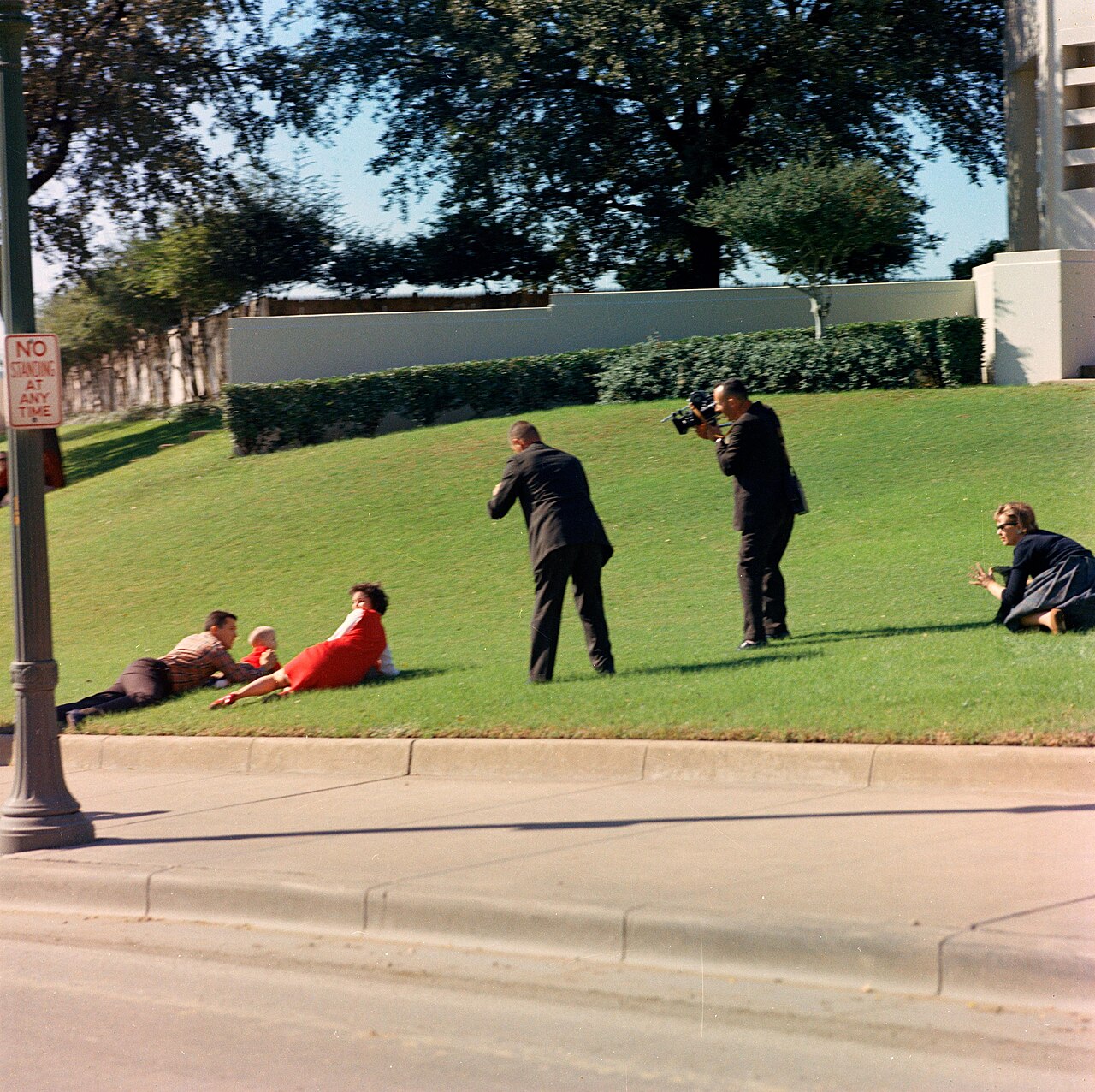
The Newman family shelter on the grass after the shooting, November 22, 1963. This is the White House photographer’s view, not the separately copyrighted news photograph. Cecil W. Stoughton / JFK Library · Public domain — U.S. government work · Source Archive-provided image or rendition. No scene elements added. Layout crops are for display; no AI enhancement.
The record
Railroad signal supervisor S. M. Holland testified that he heard four reports and saw a puff of smoke near the knoll’s trees. He described searching behind the fence and noticing disturbed ground. He was firm about the smoke, while the record includes differences about timing and earlier reporting. This is a specific early eyewitness account, not an internet invention. It still does not identify an observed shooter or a recovered weapon. [1]
Towerman Lee Bowers reported unusual vehicle activity and people in the parking area, and a disturbance that attracted his attention around the shooting. This is often compressed into a claim that he watched a gunman fire behind the fence. His transcript is less definite, distinguishing what he saw, where he could see and what he could not identify. An unidentified disturbance is not a complete identification of its cause. [2]
Other witnesses located shots differently. The HSCA review documented conflicting accounts rather than a uniform knoll observation. Echoes, attention, vantage point and the event’s speed complicate sound localization. This does not make a witness unreliable in every respect. Someone may correctly remember running toward the fence yet mislocate an impulse, or notice smoke without knowing its source. Each observation needs its own test. [3]
Smoke or gunpowder odor may be relevant, but neither supplies a unique position, caliber or shooter without corroboration. A remembered smell also cannot establish which of several firearms in the motorcade discharged or how exact the timing was. Comparison needs wind, timing, actual weapons, contemporary descriptions and physical traces; one sensory detail is not a self-contained solution. [1][3]
The evidence supports legitimate inquiry but falls short of securely identifying a knoll gunman. Strong witness accounts should retain their original wording and dates; stronger later retellings should not replace them. This recognizes why the location became central to suspicion without claiming that a crowd’s movement or a disputed puff proves a coordinated firing team. [1][2][3]
Documented checkpoints & limits
22 November 1963 · testimony 1964–1979
Start with the record
Railroad signal supervisor S. M. Holland testified that he heard four reports and saw a puff of smoke near the knoll’s trees. He described searching behind the fence and noticing disturbed ground. He was firm about the smoke, while the record includes differences about timing and earlier reporting. This is a specific early eyewitness account, not an internet invention. It still does not identify an observed shooter or a recovered weapon. Source 1 ↗ · Source 2 ↗ · Source 3 ↗
Limits of the inference
Read what is established—and what remains open
A witness’s certainty is not calibrated accuracy. A flash, smell or disturbance requires corroboration before attribution to a particular weapon or person. Source 1 ↗ · Source 2 ↗ · Source 3 ↗
At the time
Sincere witnesses reported unusual activity. Their accounts deserve comparison, not ridicule or automatic conversion into a confirmed gunman.
What the record shows
The witness evidence is real and conflicting. It does not independently establish an identified gunman behind the fence.
Badge Man: when enlargement outruns the photograph
A tiny pattern in Mary Moorman’s photograph became a purported uniformed shooter. The photograph does not securely resolve that detail.
The record
The Badge Man claim developed from interpreting Mary Moorman’s Polaroid, not from a clear photograph of an identifiable officer firing. Gary Mack and Jack White highlighted a tiny light-and-dark pattern read as a face, uniform, badge and shooting stance. Television brought the interpretation to a wider audience. Recognizing a human-like shape is the start of an image-analysis question, not the end. [1]
Dale Myers’s geometric analysis challenged its proposed location. He argued that an ordinary-sized human matching the apparent scale would occupy an implausible elevated position farther behind the fence. This is a named researcher’s analysis, not an official finding. Its conclusion depends on image measurements, geometry and the assumption that the pattern is a coherent object whose scale can be measured. [1]
The earlier HSCA panel warned about inherent limits of plaza images. It did not find definitive photographic evidence of additional gunmen, a muzzle flash or smoke in the materials examined. That should not be inflated into a claim that low-resolution photography proves no one stood anywhere outside its resolved detail. Non-detection and positive identification are different results. [2]
An AI-enhanced enlargement is particularly risky here. Enlargement may display recorded grains more clearly; it cannot recover a face, badge number or barrel never resolved by the source. Generative sharpening may add the very detail under dispute. The defensible finding is that the photograph does not securely identify this alleged shooter—not that a viewer who initially sees a human shape is foolish. [1][2]
At the time
A tiny pattern in Mary Moorman’s photograph became a purported uniformed shooter. The photograph does not securely resolve that detail.
What the record shows
Badge Man is not a securely resolved photographic identification. Enhancement cannot supply detail absent from the source.
The umbrella and the windshield: two details, two tests
Odd objects should be investigated individually. Their strangeness does not make them parts of one coordinated plot.
The record
The umbrella in sunny Dealey Plaza inspired theories about signals and a concealed weapon. In 1978 Louie Steven Witt identified himself to the HSCA and explained it as a political heckle associated with Neville Chamberlain and the Kennedy family. The committee examined the umbrella he brought. This is an identifiable witness’s account with an inspectable object, more substantial than an anonymous explanation appended to a photograph. [1]
An explanation offered fifteen years later deserves ordinary scrutiny. A plausible account does not prove every movement in the plaza is understood. But a signal theory needs evidence that someone received a signal and acted on it, not merely that an umbrella opens and closes. A concealed-weapon theory needs a compatible mechanism and physical evidence, not an inference from unusual presence alone. [1]
The limousine windshield is a separate physical question. The Warren examination found damage and lead residue consistent with impact on the inner surface, not a bullet passing through from the front. Some witnesses described a hole or hole-like mark. Damage is established; a complete front-to-back penetration proving frontal gunfire does not follow from that description. [2]
The HSCA firearms panel later examined the preserved glass itself. That is a firmer basis for a penetration question than a distant view of a crack in a reproduced picture. Its conclusions concern the surviving damage, not a complete reconstruction of every possible projectile or fragment in the plaza. [3]
A dramatic montage can make the two details appear mutually corroborative even though they test different hypotheses. An unexplained umbrella cannot authenticate an entrance hole; a cracked windshield cannot identify a signaler. Separating questions is the practical way to prevent several weak inferences from being mistaken for one strong physical demonstration. [1][2][3]
Documented checkpoints & limits
1963 · examined 1964–1978
Start with the record
The umbrella in sunny Dealey Plaza inspired theories about signals and a concealed weapon. In 1978 Louie Steven Witt identified himself to the HSCA and explained it as a political heckle associated with Neville Chamberlain and the Kennedy family. The committee examined the umbrella he brought. This is an identifiable witness’s account with an inspectable object, more substantial than an anonymous explanation appended to a photograph. Source 1 ↗ · Source 2 ↗ · Source 3 ↗
Limits of the inference
Read what is established—and what remains open
Witt’s explanation was retrospective. Glass damage differs from full penetration and from a demonstrated exact fragment path. Source 1 ↗ · Source 2 ↗ · Source 3 ↗
At the time
Odd objects should be investigated individually. Their strangeness does not make them parts of one coordinated plot.
What the record shows
The umbrella has a documented witness explanation. The windshield does not establish the alleged frontal through-shot.
Physical evidence / Theory published 1992 · later documentary revivals · Claim check
Could a Secret Service rifle have killed Kennedy by accident?
George Hickey really handled an AR-15. A fatal accidental discharge is a further claim requiring its own evidence.
The record
The accidental-discharge theory alleges that Secret Service agent George Hickey, in the follow-up car, unintentionally fired while reacting to the attack and inflicted the fatal head wound. Howard Donahue developed the theory, presented by Bonar Menninger in Mortal Error. It explains a real fact—an armed agent—without alleging he deliberately joined an assassination plot. The distinction between possessing a rifle and discharging it is central. [1]
Contemporary Secret Service statements describe Hickey retrieving and readying the AR-15 after the shots; other accounts confirm an agent with a rifle raised. They corroborate the weapon’s presence but do not document an accidental discharge. Agents describing themselves amid chaos are not beyond scrutiny. Rejecting their account, however, does not create a reliable observation of the alternative sequence. [2]
The claim must fit ammunition as well as choreography. The firearms evidence includes a Carcano bullet and identifiable jacket fragments; the HSCA linked relevant identifiable exhibits to that rifle. An AR-15 explanation must demonstrate a compatible different projectile, fragment pattern and path. The destructive head wound cannot automatically identify a different caliber: dramatic injury is not a caliber label. [3]
Hickey sued over the book. The published 1997 federal decision concerned legal timing and publication history; dismissal on limitations grounds was not a judicial finding that the shooting allegation was true. Conversely, a defamation lawsuit is not itself scientific proof the allegation is false. The court record establishes litigation history, not ballistic verification. [1]
The armed agent is documented; his alleged fatal discharge is not established by this record. Photographs of the rifle, gunpowder impressions and uncertain movements may prompt questions but do not connect it to the fatal shot. Investigative failures or institutional incentives to avoid embarrassment cannot supply the missing physical demonstration. An account should identify what would confirm its mechanism rather than treating its explanatory appeal as evidence. [1][2][3]
Documented checkpoints & limits
Theory published 1992 · later documentary revivals
Start with the record
The accidental-discharge theory alleges that Secret Service agent George Hickey, in the follow-up car, unintentionally fired while reacting to the attack and inflicted the fatal head wound. Howard Donahue developed the theory, presented by Bonar Menninger in Mortal Error. It explains a real fact—an armed agent—without alleging he deliberately joined an assassination plot. The distinction between possessing a rifle and discharging it is central. Source 1 ↗ · Source 2 ↗ · Source 3 ↗
Limits of the inference
Read what is established—and what remains open
The court’s limitations ruling did not decide the alleged shooting facts. Agents’ statements are assessable evidence, not infallible accounts. Source 1 ↗ · Source 2 ↗ · Source 3 ↗
At the time
George Hickey really handled an AR-15. A fatal accidental discharge is a further claim requiring its own evidence.
What the record shows
The rifle’s presence is real. A demonstrated physical connection to the fatal shot is missing.
Paul Landis’s late account: testimony, not a newly recovered bullet
An agent said he moved a bullet from the limousine to Kennedy’s stretcher. His story raises a custody question but does not authenticate itself.
The record
In 2023 former Secret Service agent Paul Landis said he found an intact bullet near the limousine’s rear seat at Parkland, picked it up and placed it with Kennedy’s stretcher. This differs from the familiar account linking CE 399’s discovery to Connally. Landis was genuinely in the motorcade, making his testimony relevant while leaving new details subject to normal questions about late recollection. [1]
His contemporary statement describes the attack, Parkland arrival and his actions without this bullet transfer. Silence alone does not show that an event never occurred, particularly amid trauma. It does mean this distinctive new claim lacks a contemporary description in that statement. An account publicized decades later cannot receive the same evidentiary status as a sealed object or contemporaneous corroborated log. [2]
No projectile was newly recovered in 2023. Landis identified a remembered object with a preserved exhibit through memory, rather than producing something with an independent chain or different weapon marks. Movement between stretchers remains a hypothesis about fitting his story to the discovery record. It should not be reported as a newly established fourth bullet. [1][3]
The GBH interview corrects some headlines: Landis explicitly retained his view of one shooter and three shots. That does not settle the case, but prevents presenting his testimony as necessarily endorsing every second-gunman inference drawn from it. The interviewer’s fourth-bullet description and the witness’s own conclusion are not interchangeable. [1]
Landis recorded a Sixth Floor Museum oral history in 2016, an intermediate account to compare with his 1963 statement and memoir-era interviews. The new story deserves investigation, while delay and incomplete corroboration limit what it establishes. Respect for an eyewitness and recognition of memory’s limitations are compatible. Neither requires calling him dishonest or declaring the case solved. [1][2][3][4]
Documented checkpoints & limits
1963 statements · 2016 interview · 2023 memoir
Start with the record
In 2023 former Secret Service agent Paul Landis said he found an intact bullet near the limousine’s rear seat at Parkland, picked it up and placed it with Kennedy’s stretcher. This differs from the familiar account linking CE 399’s discovery to Connally. Landis was genuinely in the motorcade, making his testimony relevant while leaving new details subject to normal questions about late recollection. Source 1 ↗ · Source 2 ↗ · Source 3 ↗ · Source 4 ↗
Limits of the inference
Read what is established—and what remains open
The 2016 catalog confirms an interview occurred; it does not itself corroborate the distinctive 2023 transfer story. Source 1 ↗ · Source 2 ↗ · Source 3 ↗ · Source 4 ↗
Watch this question
Paul Landis in his own words: audio and full transcript ↗ GBH Morning Edition — November 22, 2023 audio interview, not video. Compare the witness’s own conclusion with the interviewer’s fourth-bullet framing. Includes descriptions of the shooting.
At the time
An agent said he moved a bullet from the limousine to Kennedy’s stretcher. His story raises a custody question but does not authenticate itself.
What the record shows
The account raises a custody question but does not establish a new physical bullet or prove a second shooter.
The CIA really plotted to kill Castro. What follows from that?
Real assassination programs and organized-crime partnerships transformed the credibility of later suspicions. They still require a separate evidentiary bridge to Dallas.
The record
The premise is documented: the CIA pursued schemes to kill Fidel Castro, including contacts involving organized-crime intermediaries. The Church Committee exposed this history in 1975, after the Warren inquiry had been denied important context. The issue is not whether such plotting was imaginable. It occurred. The committee also found serious uncertainty about precisely what presidents authorized or knew. [1]
The networks were specific: Robert Maheu connected CIA officials with John Roselli; Sam Giancana and Santos Trafficante also entered the anti-Castro plotting history. Another channel involved Rolando Cubela, codenamed AMLASH. On November 22, 1963, the CIA offered him a poison-needle pen for use against Castro. This striking coincidence is documented; it is not a document ordering the murder occurring in Dallas. [1][4]
After the failed April 1961 Bay of Pigs invasion, Kennedy authorized a broader effort to undermine Castro. Operation Mongoose brought together the White House, State, Defense and CIA. Robert Kennedy was a central driving force; Edward Lansdale coordinated the program and William Harvey ran the CIA component. This was not simply a free-standing agency war that Kennedy uniformly opposed. [2]
The March 1962 guidelines contemplated using Cuban opposition forces and eventually decisive U.S. military intervention. They also restricted immediate actions likely to trigger a revolt requiring that intervention. That combination matters: officials entertained aggressive possibilities while disagreeing about timing, feasibility and control. A planning paper records a policy possibility; it does not establish that every proposed step was executed. [3]
This history gives several assassination theories a plausible setting. Castro had reason to fear U.S. attacks. Exiles had reason to resent restrictions. Criminal figures had both clandestine contacts and grievances against the Kennedys. It also explains why officials might conceal embarrassing activities from an inquiry even if they had not killed the president. That last possibility does not excuse the concealment. [1][2][3]
The missing step is operational evidence connecting a particular Castro-related network to Kennedy’s murder: a corroborated instruction, payment, weapon transfer, participant meeting or demonstrable assistance. “They had the capability” is a reason to investigate, not the completed investigation. Treating all covert actors as one coordinated body erases the conflicts that the original records actually show. [1][2][3]
At the time
Real assassination programs and organized-crime partnerships transformed the credibility of later suspicions. They still require a separate evidentiary bridge to Dallas.
What the record shows
Established covert misconduct supplies essential context; it does not by itself identify Kennedy’s killers.
Original 1975 Senate report mirrored by Georgetown’s intelligence-law library; Castro section, especially printed pages 71–90, distinguishes established plotting from uncertainty about presidential authorization.
Intelligence & concealment / 1959–1995 · Unresolved lead / missing record
Was Oswald an intelligence asset—or a watched defector?
The CIA knew about Oswald before Dallas. Recruitment, operational use and surveillance are different propositions.
The record
An agency can have a personality file on someone because it is investigating that person, recruiting that person, collecting reports about that person or considering whether another service has recruited them. A “201 file” is not an employee contract. The central mistake in many viral claims is to substitute proof of attention for proof of control. [1]
Oswald’s defection to the Soviet Union, return to the United States and public Cuban activism attracted counterintelligence interest. In her 1994 interview, former CIA officer Jane Roman reviewed routing sheets and acknowledged meaningful interest. But she repeatedly qualified her memory. Her observations about tight control were retrospective interpretations of documents shown by researchers, not a recalled admission that she had run Oswald. [1]
The October 10, 1963 headquarters reply to Mexico City is an important unresolved issue because it conveyed incomplete or stale information about a man whose newer activities appeared elsewhere in agency records. A 1995 CIA draft offered a narrower explanation: the passage concerned citizenship status, and newer reports might not yet have reached the central file. That explanation should be weighed against actual routing and receipt dates, not accepted because the CIA wrote it. [2]
James Angleton’s counterintelligence staff is therefore relevant to the history of information handling. So are the Soviet and Cuba specialists who received reports. Yet “Angleton’s organization handled the file,” “Angleton personally read every page” and “Angleton recruited Oswald” are progressively stronger claims. The documents cited here do not let us collapse those three levels. [1][2]
The HSCA examined allegations of CIA employment, including former finance officer James Wilcott’s account of what colleagues supposedly told him, and did not find a credible demonstrated employment relationship. That conclusion cannot make later disclosure unnecessary; nor does later disclosure automatically validate a particular payroll story. An authenticated contemporary recruitment or payment record would change this assessment much more than another proof that officers knew his name. [3]
Documented checkpoints & limits
1959–1995
Start with the record
An agency can have a personality file on someone because it is investigating that person, recruiting that person, collecting reports about that person or considering whether another service has recruited them. A “201 file” is not an employee contract. The central mistake in many viral claims is to substitute proof of attention for proof of control. Source 1 ↗ · Source 2 ↗ · Source 3 ↗
Limits of the inference
Read what is established—and what remains open
Roman’s interview is late and memory-qualified. The CIA’s explanatory draft is an interested institutional account; the HSCA did not possess everything later released. Source 1 ↗ · Source 2 ↗ · Source 3 ↗
At the time
The CIA knew about Oswald before Dallas. Recruitment, operational use and surveillance are different propositions.
What the record shows
Pre-assassination awareness is established. A demonstrated recruitment or assassination tasking relationship has not been established here.
Primary interview conducted by John Newman and Jefferson Morley; retrospective interpretation with repeated memory qualifications, not a contemporaneous operational order.
Includes an internal alternative explanation of the cable’s incomplete information. An agency’s retrospective explanation needs evaluation, not automatic acceptance.
Intelligence & concealment / September–December 1963 · Unresolved lead / missing record
Mexico City: visas, Kostikov, wrong photographs and missing tapes
Some of the hardest questions concern what U.S. intelligence collected, what it passed on and whether every communication attributed to Oswald was really his.
The record
Before the assassination, Mexico City reporting placed a man identifying himself as Lee Oswald in contact with Soviet consular personnel while pursuing travel arrangements. The CIA’s November 24 summary described a call about Valeriy Kostikov and the dissemination of information to other U.S. agencies in October. These are pre-assassination records of attention, not a connection invented entirely after Dallas. [1]
Kostikov’s intelligence role made the contact a legitimate lead. But even the supposed assassination-department connection needs qualification: a May 1982 CIA letter says his possible membership in Department 13 could not be confirmed. A consular encounter while seeking a Soviet visa is not, without further evidence, recruitment. Calling Kostikov Oswald’s proven “KGB assassination handler” upgrades both the institutional assessment and the alleged relationship beyond the records cited here. [1][4]
There was a concrete identification failure: photographs forwarded as potentially showing Oswald depicted a different man. That is not a minor detail to wave away. It raises questions about coverage, assumptions and the reliability of the reports built around those images. It also does not follow that the photographed stranger was knowingly impersonating Oswald. A wrongly associated surveillance photograph and a deliberately planted double are different explanations. [1]
An early FBI memorandum said agents who knew Oswald had compared a voice recording and photograph and thought the person was not him. The HSCA investigated and concluded that the tape-listening assertion was mistaken: Dallas cables reported receiving written accounts rather than tapes, and agents denied hearing such a recording. That is the committee’s resolution, not an independently replayable test today. It separately found witness-based impersonation questions still merited attention. The contradiction should be explained, not advertised as either a surviving voice comparison or a nonexistent issue. [5]
The agency’s chronology records a December plan to avoid mentioning telephone taps in information passed to the Warren Commission, in order to protect an ongoing operation. This is direct evidence of source-protection shaping disclosure. It supports criticism of the investigation’s transparency. It does not identify who created any alleged impersonation, establish a Dallas murder instruction or erase the independent evidence that Oswald traveled to Mexico. [3]
The former Cuban consul Eusebio Azcue said the applicant was not the Oswald later shown as the accused assassin. Consular secretary Silvia Duran identified Oswald but gave some inconsistent descriptive details. The HSCA therefore did not treat all impersonation questions as resolved by correcting the FBI memorandum. Contradictory witness identification is a serious limit; it still does not identify an impersonator, sponsor or murder operation. [5]
Documented checkpoints & limits
September–December 1963
Start with the record
Before the assassination, Mexico City reporting placed a man identifying himself as Lee Oswald in contact with Soviet consular personnel while pursuing travel arrangements. The CIA’s November 24 summary described a call about Valeriy Kostikov and the dissemination of information to other U.S. agencies in October. These are pre-assassination records of attention, not a connection invented entirely after Dallas. Source 1 ↗ · Source 2 ↗ · Source 3 ↗ · Source 4 ↗ · Source 5 ↗
Limits of the inference
Read what is established—and what remains open
The original comparison recording is not available here for replay. The HSCA rejected the memorandum’s tape-listening premise while preserving separate witness-based impersonation questions. Kostikov’s executive-action affiliation was an assessment, not a confirmed fact in the 1982 CIA letter. Source 1 ↗ · Source 2 ↗ · Source 3 ↗ · Source 4 ↗ · Source 5 ↗
At the time
Some of the hardest questions concern what U.S. intelligence collected, what it passed on and whether every communication attributed to Oswald was really his.
What the record shows
Mexico City contains documented reporting failures and concealment. A proven visa contact is not a proven assassination assignment.
Original five-page summary describing Mexico City reporting and mistaken photographs; its self-description is not an independent audit of everything the CIA knew.
Original CIA correspondence says the possible executive-action affiliation could not be confirmed. This qualifies confident modern descriptions of a proven KGB assassination handler.
Joannides and the DRE: a conflict hidden from the investigation
A CIA-supported group confronted Oswald in public. Its former case officer later helped handle Congress’s requests about the assassination.
The record
The Directorio Revolucionario Estudiantil, or DRE, was an anti-Castro exile organization supported by the CIA. Its members were not simply obedient extensions of Washington: the HSCA’s staff report documents tensions, independent initiatives and continuing U.S. support. In New Orleans, Carlos Bringuier and associates confronted Oswald over his public pro-Castro leafleting; the resulting dispute and broadcast debate became part of the assassination record. [1]
George Joannides’s relationship to the DRE is why his records matter. The long-running Morley litigation sought information about an officer whose group had encountered Oswald before Kennedy died. The D.C. Circuit recognized a legitimate potential public benefit in those records. Its decision was a Freedom of Information Act fee ruling, not a finding that Joannides participated in a murder conspiracy. [2]
Joannides also served in the CIA’s handling of the House assassination investigation in 1978. Later agency correspondence acknowledges that service and the release of performance appraisals through the Assassination Records Review Board. A former operational participant in a relevant network occupying a liaison position creates an obvious conflict for investigators who are not told the whole background. Whether a specific written request was evaded should be established from the request and response, not inferred from the job title alone. [3]
The alias memorandum released in the 2025 period supplies an additional concrete detail: the cover name Howard Mark Gebler. An alias can help match records, witnesses and operational roles. It is not a synonym for guilt, and it does not by itself establish that Joannides personally met Oswald or directed every action of every DRE member. The separate releases article follows the newer documents in detail. [4]
The responsible finding is substantial enough: the public deserves a complete accounting of CIA support, what the organization reported about Oswald, which officer received it and what later investigators were told. Disclosure failure can seriously undermine confidence in an institutional assurance without filling the missing evidentiary step from an encounter to a planned assassination. That is why this lead deserves investigation without being advertised as a solved case. [1][2][3][4]
Watch this question
The full Oswald–Bringuier–Butler debate ↗ WDSU / University of North Texas Libraries — Original August 21, 1963 audio, approximately 21 minutes, with transcript. An archival recording rather than a modern reenactment.
At the time
A CIA-supported group confronted Oswald in public. Its former case officer later helped handle Congress’s requests about the assassination.
What the record shows
The DRE relationship and later liaison role are consequential. They establish a disclosure problem, not a complete Dallas plot.
Intelligence & concealment / November 1963–1975 · Documented investigative failure
The FBI destroyed Oswald’s note. That part is real.
The disputed issue is what it said and who ordered its destruction—not whether the destruction is merely a conspiracy rumor.
The record
Before the assassination, Oswald left a note at the FBI’s Dallas office for agent James Hosty. Hosty later admitted destroying it after Ruby killed Oswald on November 24. His account was that his superior, J. Gordon Shanklin, ordered the destruction; Shanklin denied knowing of the note. The incident did not become public until 1975. [1][2]
That conduct matters because the note was potentially relevant evidence. It could have illuminated Oswald’s anger, his relationship with the Bureau, the adequacy of threat assessment and the agents’ later testimony. An institution’s embarrassment is not a legitimate reason to remove evidence from a presidential murder investigation. The Church-era review helped expose failures that the original inquiry had not confronted. [1]
The exact wording cannot now be confidently reconstructed. Accounts ranged from a complaint about contacts with his wife to more threatening language. Presenting one remembered version as a surviving verbatim note gives readers certainty the evidence does not supply. The HSCA considered the episode damaging to the credibility of the officials involved, while acknowledging that destruction prevented a confident finding about its contents. [3]
There is a second inference to test. A hostile note does not itself prove that Oswald was an FBI informant, that Hosty knew of a plan to kill Kennedy, or that headquarters ordered a murder cover-up. It might reflect fear that professional failure would be exposed. It might have contained information of greater importance. Destruction makes the alternatives harder to resolve; it does not license choosing whichever missing contents best fit a preferred theory. [1][2][3]
The appropriate conclusion leaves no need to minimize the misconduct. Evidence destruction is established and blame for the order was disputed. The surviving record supports serious criticism of the FBI’s investigation and candor. Identifying the destroyed note as proof of an assassination partnership goes beyond what can be recovered from it. [1][2][3]
At the time
The disputed issue is what it said and who ordered its destruction—not whether the destruction is merely a conspiracy rumor.
What the record shows
A documented act of evidence destruction warrants criticism without inventing the missing note’s wording.
Contemporary newspaper account of sworn testimony, preserved by the Oklahoma Historical Society. Hosty’s attribution of the order was disputed by Shanklin.
Proposed plots / 1961–1979 · Unresolved lead / missing record
The Mafia theory: motive, Ruby and the missing operational link
Marcello, Trafficante and other criminal figures belonged in the inquiry. Their names should not be converted into an established command chart.
The record
The Kennedy administration’s organized-crime campaign gave major figures real grievances. Carlos Marcello faced deportation and investigative pressure; the HSCA staff examined an alleged threat reported by Edward Becker as well as Marcello’s power and associates. These are substantive investigative leads, not reasons to dismiss the topic because it sounds like a gangster story. [1]
Jack Ruby’s contacts also deserved more scrutiny than a simple portrait of a harmless nightclub owner allowed. The HSCA’s organized-crime work studied his associates, telephone activity and Cuban connections. But a contact list contains several possible relationships—business, social, criminal and incidental. Demonstrating a relationship does not by itself show what a particular call concerned or who instructed Ruby to shoot Oswald. [2]
The CIA’s anti-Castro operations add another real overlap: government operatives used organized-crime intermediaries in efforts against Castro. That history creates possible channels through which people and favors could move. It also complicates motives for secrecy after Kennedy’s murder. Revealing a discreditable covert partnership is not the same event as revealing an order to assassinate an American president. [3]
The Marcello staff report is more qualified than many summaries. It assessed Marcello, Santos Trafficante and Jimmy Hoffa as having the motive, means and opportunity for such a conspiracy, but concluded that involvement by any one was unlikely on the evidence then available, while not precluding it. That is neither a clean exoneration of every individual nor a committee finding that these men organized the murder. [1]
Later researchers and former investigators have reached stronger organized-crime conclusions. Those are arguments to examine through their supporting evidence, not automatic upgrades of the 1979 verdict. A persuasive case needs to connect the murder’s logistics to identifiable participants through corroboration, rather than count grievances and acquaintances until they feel like a confession. The mob remains a serious historical line of inquiry; it is not an established solution in the cited record. [1][2][3]
Documented checkpoints & limits
1961–1979
Start with the record
The Kennedy administration’s organized-crime campaign gave major figures real grievances. Carlos Marcello faced deportation and investigative pressure; the HSCA staff examined an alleged threat reported by Edward Becker as well as Marcello’s power and associates. These are substantive investigative leads, not reasons to dismiss the topic because it sounds like a gangster story. Source 1 ↗ · Source 2 ↗ · Source 3 ↗
Limits of the inference
Read what is established—and what remains open
The distinction between HSCA staff assessments, the final committee report and later investigators’ personal conclusions matters. Source 1 ↗ · Source 2 ↗ · Source 3 ↗
At the time
Marcello, Trafficante and other criminal figures belonged in the inquiry. Their names should not be converted into an established command chart.
What the record shows
Organized-crime motives and relationships are documented; the cited investigations did not establish who ordered Kennedy’s murder.
Oswald’s Soviet residence and Cuban activism made foreign direction a real question. Neither characteristic proves a foreign assignment.
The record
Oswald lived in the Soviet Union and sought travel through Cuba before Kennedy’s death. In the Cold War, those facts naturally alarmed investigators. But political sympathy, surveillance by a foreign service, a consular encounter, recruitment and orders to assassinate are five distinct things. A case for state direction has to establish the stronger links rather than recycle the weaker ones. [1]
The defector Yuri Nosenko said the KGB had not recruited Oswald. His account became entangled in bitter CIA disputes over his own bona fides, including detention and extensive interrogation. The HSCA’s published material shows why his statements should not be treated as a magic answer: investigators examined inconsistencies, institutional evaluations and what he could actually know. Neither the CIA’s suspicion of Nosenko nor its later acceptance independently proves Oswald’s role. [1]
Cuban retaliation was plausible enough to investigate because U.S. plots against Castro were real. Yet Kennedy’s policy in late 1963 also included an exploratory back channel. Original records and audio document efforts involving William Attwood and Cuban representatives. Covert pressure and tentative diplomacy coexisted. The claim that Castro faced only a steadily worsening relationship leaves out part of the record; the existence of talks does not make retaliation logically impossible. [2]
The HSCA considered Soviet and Cuban government involvement and found that the available evidence did not support either. Its discussion also criticized the inadequacy of the original investigation of Cuban contacts. A conclusion based on incomplete investigative work deserves that qualification. It should not be rewritten as either “Congress proved Castro did it” or “every contact was satisfactorily explained.” [3]
Foreign governments also had incentives to deny involvement, and intelligence services can plant or relay false stories. The useful question is therefore not whether a dramatic account appears in an intelligence file, but who supplied it, whether its dates work and whether independent evidence corroborates it. A report of an alleged payment is not the same as a verified payment. These records do not establish a Soviet or Cuban order to kill Kennedy. [1][2][3]
At the time
Oswald’s Soviet residence and Cuban activism made foreign direction a real question. Neither characteristic proves a foreign assignment.
What the record shows
Foreign direction was investigated but has not been established by the cited record. Political affiliation is not operational proof.
Jim Garrison, Clay Shaw and the difference between a trial and JFK
The New Orleans prosecution produced a real trial, a rapid acquittal and enduring disputes about CIA contacts and witness methods.
The record
Jim Garrison arrested New Orleans businessman Clay Shaw on March 1, 1967, accusing him of conspiring to kill Kennedy. A jury acquitted Shaw in 1969. That is the legal outcome. It means the prosecution did not prove its case against Shaw beyond reasonable doubt; it was not a judicial determination that every question surrounding Dallas had been answered. [1]
Perry Russo’s testimony was central to the alleged conspiracy meeting. The original trial transcripts preserve the account and the defense’s challenges to how it developed. Investigators used hypnosis and discussed drug-assisted questioning; those methods create substantial reliability problems when later details are treated as recovered facts. A witness’s confidence after such procedures does not provide independent corroboration of what the procedures may have helped shape. [2][3]
There is also a real CIA-contact issue that should not be dismissed. A CIA memorandum records Domestic Contact Service contacts with Shaw from 1948 through 1956 and intelligence reports he supplied. A businessman providing information from travel or commercial contacts is a genuine relationship. It is nevertheless different from evidence that he was a clandestine assassination operative or that he knew Oswald. [4]
Calling Shaw simply “unconnected to the CIA” is too broad. Calling a contact-service report proof that Garrison’s murder case was correct is also too broad. The relevant questions are what Shaw supplied, when he supplied it, whether the relationship involved operational tasking and whether anything ties it to the alleged 1963 meeting. The CIA relationship cannot repair weaknesses in identification or witness corroboration by itself. [2][3][4]
Oliver Stone’s film gives this history unusual cultural power, but dramatic reconstruction should not become a substitute transcript. The trial, witnesses, institutions and their critics deserve to be examined in their own records. Shaw’s acquittal and the intelligence contact are both facts that can be retained without forcing either into an all-or-nothing story about the entire assassination. [1][2][3][4]
At the time
The New Orleans prosecution produced a real trial, a rapid acquittal and enduring disputes about CIA contacts and witness methods.
What the record shows
Shaw was acquitted. His documented CIA contact history is relevant but does not prove Garrison’s assassination charge.
New Orleans: Banister, Ferrie and the address on Oswald’s leaflets
The same building and overlapping political networks are real. What those overlaps establish is more limited than a single conspiratorial diagram suggests.
The record
One of Oswald’s pro-Castro pamphlets bore the address 544 Camp Street. Former FBI official Guy Banister’s private investigative firm occupied the same building through a different entrance, 531 Lafayette. The coexistence is a real fact, not an invented street address. The HSCA revisited whether the original investigation had prematurely closed this lead. [1]
The tenant chronology matters. An anti-Castro Cuban Revolutionary Council office had already left before Oswald’s 1963 activity. A photograph or diagram of the building cannot establish that all organizations associated with it occupied it simultaneously. The owner denied renting an office to Oswald. Later accounts of a Banister relationship require evaluation as witness evidence, not conversion of the printed address into a signed employment agreement. [1]
David Ferrie did have anti-Castro and investigative connections, including work related to Carlos Marcello’s legal affairs. His weekend journey to Texas looked suspicious to investigators. Yet the HSCA report records corroboration for his being in New Orleans at the time of Kennedy’s shooting, verification of aspects of his later trip and an FBI finding that his own airplane was not flyable then. Those details complicate the familiar “getaway pilot” story. [2]
Oswald’s public quarrel with Bringuier can be studied directly in the August 21 WDSU debate. Hearing the original voices is useful: it shows political self-presentation and an adversarial exchange before anyone knew the assassination would happen. A future event can make an earlier encounter look scripted. To demonstrate scripting, however, we need evidence of prior coordination beyond the fact that both men later became important to the story. [3]
The address, connections and contested witness accounts make New Orleans worth sustained research. They do not establish that everyone in this network shared a single purpose, or that Ferrie and Banister controlled Oswald. Distinguishing a provable overlap from its possible explanation keeps the strongest questions visible and avoids having a weaker claim discredit the entire subject. [1][2][3]
The same building and overlapping political networks are real. What those overlaps establish is more limited than a single conspiratorial diagram suggests.
What the record shows
The address and political overlaps warrant inquiry. They do not independently establish a common assassination operation.
Kennedy approved a withdrawal plan. The claim that Johnson instantly reversed an unconditional decision to end the war does not match the memoranda.
The record
National Security Action Memorandum 263, dated October 11, 1963, approved military recommendations that included planning to withdraw 1,000 U.S. personnel by year-end. The withdrawal was a real policy decision and should not be dismissed as a myth invented after Kennedy died. The short directive, however, did not announce an unconditional end to all American involvement regardless of events. [1]
The October 2 public statement placed the timetable inside a policy of defeating the insurgency and developing South Vietnamese capabilities. McNamara and Taylor anticipated completion of much of the military task by the end of 1965, while allowing a continuing training presence. Historians can disagree about Kennedy’s private intentions under deteriorating conditions without pretending the written record says something simpler. [2]
The September 23 White House recording reveals disagreement over how withdrawal should be discussed with President Diem. Kennedy considered the political leverage of continued support; advisers weighed military conditions. This is valuable precisely because it is a contemporary conversation rather than a later recollection of what Kennedy “would have done.” It shows a developing policy, not an uncomplicated secret promise that every later decision must violate. [3]
Johnson’s November 26 NSAM 273 explicitly retained the withdrawal objectives in the October 2 statement. It also sought planning for increased activity against North Vietnam and operations in Laos. The published editorial history identifies a draft prepared before the assassination and substantive changes to its North Vietnam paragraph. Therefore neither “nothing changed” nor “the withdrawal was canceled immediately” adequately describes the document. [4]
The counterfactual remains consequential: Kennedy might have resisted the massive escalation Johnson later chose. But a plausible difference in future policy does not identify an assassin. To turn a policy-motive theory into a murder finding requires evidence linking identifiable people to the crime. The actual memoranda support a serious debate over continuity, conditionality and escalation, not a documentary proof that a war faction murdered Kennedy. [1][2][3][4]
Documented checkpoints & limits
September–November 1963
Start with the record
National Security Action Memorandum 263, dated October 11, 1963, approved military recommendations that included planning to withdraw 1,000 U.S. personnel by year-end. The withdrawal was a real policy decision and should not be dismissed as a myth invented after Kennedy died. The short directive, however, did not announce an unconditional end to all American involvement regardless of events. Source 1 ↗ · Source 2 ↗ · Source 3 ↗ · Source 4 ↗
Limits of the inference
Read what is established—and what remains open
Kennedy’s response to circumstances he did not live to face is a counterfactual. NSAM 273 contains both continuity and changed operational planning. Source 1 ↗ · Source 2 ↗ · Source 3 ↗ · Source 4 ↗
Watch this question
Kennedy and advisers discuss withdrawal from Vietnam ↗ Miller Center / Presidential Recordings Program — September 23, 1963 original audio and transcript; hear uncertainty and competing policy considerations before reading later counterfactual claims.
At the time
Kennedy approved a withdrawal plan. The claim that Johnson instantly reversed an unconditional decision to end the war does not match the memoranda.
What the record shows
A real withdrawal plan and later escalation are documented. The memoranda do not prove a Vietnam-driven assassination plot.
Dimona and Israel: genuine policy conflict, unproven murder theory
Kennedy pressured Israel over nuclear inspections. That history can be studied without turning diplomatic friction or Jewish identity into evidence of assassination.
The record
Kennedy did press Israeli leaders about the Dimona nuclear complex. The original correspondence shows demands for regular access and concern that inadequate information could jeopardize American support. Ben-Gurion and Eshkol resisted aspects of the requested arrangements. The policy conflict is substantial history; dismissing it merely because it appears in some conspiracy arguments would be a mistake. [1]
The chronology also contains accommodation. In August 1963, Kennedy welcomed Eshkol’s agreement to visits and discussed arrangements for an inspection. That does not establish complete Israeli transparency or erase the earlier pressure. It does challenge stories that depict an uninterrupted march toward a final confrontation which only Kennedy’s death could stop. Read the dated letters as a sequence, not a collection of threatening sentences. [2]
The National Security Archive’s document publication includes the January 1964 inspection that followed Kennedy’s efforts. Its record also shows limitations and unresolved questions about Israel’s nuclear program. The issue persisted across administrations; it did not simply vanish on November 22. A specific claim that Johnson immediately ended every inspection or never raised the subject can be checked against that documentary continuity. [1][3]
The inference to a Mossad operation requires different evidence: identified participants, communications, money, travel, weapons or corroborated operational testimony tying the Israeli state to Dallas. Diplomatic tension supplies a possible motive, not those links. A country’s ability to conduct intelligence operations is also not evidence that it conducted this one. The primary documents linked here establish the nuclear dispute, not an assassination order. [1][2][3]
Jewish ancestry, a Jewish surname or support for Israel is not an operational connection. Claims about a supposed collective ethnic command structure replace accountable actors with an unfalsifiable accusation. The same evidentiary standard applies here as to the CIA, Cuba or organized crime: investigate a specific allegation through specific records, and identify precisely where the demonstrated facts stop. On the cited evidence, Israeli responsibility for Kennedy’s death remains unsubstantiated. [1][2][3]
Documented checkpoints & limits
1963–1969
Start with the record
Kennedy did press Israeli leaders about the Dimona nuclear complex. The original correspondence shows demands for regular access and concern that inadequate information could jeopardize American support. Ben-Gurion and Eshkol resisted aspects of the requested arrangements. The policy conflict is substantial history; dismissing it merely because it appears in some conspiracy arguments would be a mistake. Source 1 ↗ · Source 2 ↗ · Source 3 ↗
Limits of the inference
Read what is established—and what remains open
Diplomatic records establish policy differences, not every participant’s private intentions. The absence of a murder link in these sources is not a claim to have searched every conceivable record. Source 1 ↗ · Source 2 ↗ · Source 3 ↗
At the time
Kennedy pressured Israel over nuclear inspections. That history can be studied without turning diplomatic friction or Jewish identity into evidence of assassination.
What the record shows
The nuclear dispute is real. These documents do not establish Israeli involvement in the assassination.
Proposed plots / November 1963–1979 · Documented investigative failure
Secret Service failures: inadequate protection or a deliberate stand-down?
Serious failures are documented. The route was not secretly switched onto Elm Street at the last moment.
The former Texas School Book Depository, July 2015. Later architectural context. Michael Barera; perspective correction by Dllu · CC BY-SA 4.0 · Source Archive-provided image or rendition. No scene elements added. Layout crops are for display; no AI enhancement.
The record
The HSCA judged Kennedy’s protection inadequate. It criticized threat analysis, communication and preparation for a sniper attack. It also revisited warnings connected with other trips, including Chicago, and found that relevant information was not properly shared. These failures deserve attention on their own terms; there is no need to pretend the security system worked well in order to question a deliberate-stand-down theory. [1]
The route claim can be checked concretely. The Warren report records officials driving the selected route on November 18 and newspaper descriptions published before the visit that included Main, Houston and Elm. The turns served the approach toward the Stemmons Freeway and the Trade Mart. Whatever the wisdom of that choice, the record contradicts the claim that an unsuspected last-second change uniquely placed Kennedy under the Depository window. [2]
Failure and intent require different kinds of proof. An agent reacting slowly can demonstrate poor training, delayed recognition, confusion or negligence. To infer a coordinated stand-down, investigators would need evidence of an instruction, agreement or knowingly deliberate omission. A freeze frame of an agent’s gesture or a short, decontextualized airport clip cannot by itself establish such an order. The full sequence and the agent’s assignment matter. [1][2]
Kennedy’s appetite for public contact is relevant, but blaming the victim for every protective choice is not an explanation. Decisions belonged to an organization with professional responsibilities. At the same time, modern expectations about closed streets, screened buildings and armored vehicles should not be silently projected onto every 1963 practice. A historically normal practice could still have been dangerously inadequate. [1]
The conclusion is more demanding than either slogan. There is a documented institutional failure to explain and improve. The material cited here does not establish a coordinated security operation to enable the murder. Specific claims of foreknowledge or suppressed warnings should be pursued through the dated warning and its actual recipients, rather than treated as interchangeable with the broad fact that protection failed. [1][2]
At the time
Serious failures are documented. The route was not secretly switched onto Elm Street at the last moment.
What the record shows
Protection failed, and the route was publicly described in advance. Deliberate facilitation requires additional evidence.
The “trillions to one” witness-death statistic was withdrawn
The newspaper that published the famous odds acknowledged it had asked the wrong question. Individual suspicious deaths still need individual investigation.
The record
The often repeated astronomical odds for Kennedy witnesses dying did not emerge from a reliable study of a defined witness population. The HSCA obtained the London Sunday Times’s explanation in 1978: its 1967 article had used the answer to the wrong statistical question. The newspaper acknowledged the error and said the piece should not have been published in that form. The hearing reproduces the correspondence. [1]
The distinction is understandable without advanced mathematics. Before anything happens, fifteen particular people all dying in a short interval may be unlikely. After searching a large, expandable list of witnesses, relatives, acquaintances and peripheral figures, finding fifteen deaths is a different event. The first calculation does not answer the second. The denominator—everyone who could have qualified for inclusion—cannot be omitted. [1]
The problem becomes worse when a list grows whenever another person dies. If someone who delivered groceries, knew a witness or investigated a later theory can be added after the fact, the study population has no stable boundary. A genuine calculation would also account for age, health, occupation, elapsed time and cause of death. Treating every member as an identical healthy person at identical risk manufactures misleading precision. [1]
This correction does not prove that every death was natural or unrelated. Homicides, apparent suicides and accidents deserve examination through contemporaneous reports, medical evidence and documented threats. The statistical argument and an individual murder allegation are separate propositions. Disproving the first cannot settle the second; conversely, one suspicious case does not rescue an invalid probability calculation.
The fair conclusion preserves both concerns. Some people associated with the case died violently, and those circumstances can be investigated. But “the odds prove a coordinated cleanup” is not supported by the famous published number. When a video supplies spectacular odds without a defined population and method, ask for those inputs before treating the precision as evidence. The primary hearing makes the history of this particular error visible. [1]
Documented checkpoints & limits
1967–1978
Start with the record
The often repeated astronomical odds for Kennedy witnesses dying did not emerge from a reliable study of a defined witness population. The HSCA obtained the London Sunday Times’s explanation in 1978: its 1967 article had used the answer to the wrong statistical question. The newspaper acknowledged the error and said the piece should not have been published in that form. The hearing reproduces the correspondence. Source 1 ↗
Limits of the inference
Read what is established—and what remains open
No new actuarial estimate is offered here. A post-selected list cannot support the advertised probability without a defensible denominator. Source 1 ↗
At the time
The newspaper that published the famous odds acknowledged it had asked the wrong question. Individual suspicious deaths still need individual investigation.
What the record shows
The famous statistical proof fails because it used the wrong comparison. That does not decide every individual death.
Intelligence & concealment / 1963–1998 · Unresolved lead / missing record
“George Bush of the CIA”: what the memo does and does not identify
An authentic memo contains the name. The identity dispute was not definitively resolved by the Assassination Records Review Board.
The record
A November 29, 1963 Hoover memorandum refers to information furnished to “Mr. George Bush of the Central Intelligence Agency.” The wording is real and deserves an explanation. It is often presented as though the document itself says “George Herbert Walker Bush” and describes the future president directing the assassination. It does neither. The identity and the meaning of the contact must be established separately. [1]
The Assassination Records Review Board asked the CIA to search for an association with George H. W. Bush in the relevant period. The agency reported finding none. The Board also noted that the other George Bush identified in CIA records, a junior analyst, repeatedly denied being the recipient mentioned in the memo. Thus a categorical “it was conclusively the other Bush” overstates what the Board actually recorded. [1]
An agency’s negative search result is evidence about the search, not an infallible guarantee that a covert relationship never existed. Equally, an unresolved name does not transfer the burden of proof so that the most famous person with that name becomes the established recipient. Research needs identifying context: office, job, contact channel, dates and any independent record of the briefing. [1]
Even if the future president were shown to be the person mentioned, receiving information after the assassination would not establish prior knowledge or participation. Claims about oil businesses, anti-Castro circles and later CIA leadership must each be documented and connected to a specific action. They cannot transform the word “furnished” into “ordered.” That inference adds a murder allegation the memorandum does not contain.
The appropriate label is an unresolved historical identification with limits, not a proven confession hidden in a familiar surname. The Board’s careful account is useful precisely because it does not force a clean answer where its records search could not supply one. It also shows why researchers should quote the actual scope of an official finding instead of selecting only the part helpful to their preferred story. [1]
At the time
An authentic memo contains the name. The identity dispute was not definitively resolved by the Assassination Records Review Board.
What the record shows
The memo is genuine; its reference was not conclusively identified in the cited review. It is not evidence of an assassination order.
LBJ, Hoover and Mac Wallace: benefit is not proof of authorship
Johnson inherited the presidency and managed the investigation’s political setting. Several popular allegations require corrections or stronger corroboration.
The record
Johnson benefited constitutionally from Kennedy’s death, but succession alone cannot identify the author of a murder. More useful are contemporary records of what he did. His November 29 conversation with Hoover shows concern about competing investigations, a desire for a high-level review and unresolved allegations from Mexico City. That is evidence of how the inquiry was managed; it should be heard in full rather than reduced to an ominous sentence. [1]
The frequently retold claim of a November 21 Dallas gathering where Johnson learned or announced that Kennedy would be eliminated encounters a concrete chronology problem. The vice president’s diary places him in Houston with the presidential party that evening, then traveling to Fort Worth and arriving at the hotel late at night. A theory requiring his physical attendance elsewhere must explain that contemporaneous itinerary instead of ignoring it. [2]
The Mac Wallace fingerprint claim is a different allegation. In 1998, Nathan Darby asserted that a latent print from a Depository carton matched Wallace, a man connected to Johnson’s political circle. His affidavit establishes that an examiner made the claim. It is not equivalent to a universally accepted forensic identification. A sworn statement can still be mistaken and should be tested against the images, provenance and independent examinations. [3]
The later documentary review reproduces the FBI’s 1999 non-match finding and discusses the material submitted for comparison. That conflict should be visible whenever the alleged match is presented. Even a reliably identified print on a movable carton would require a separate timing and activity argument: when was it deposited, how did the carton arrive and what action does it establish? A print is not automatically evidence of a person firing a rifle. [4]
There are legitimate questions about political pressure, premature certainty and institutional self-protection in the investigation. A claim that Johnson or Hoover commissioned Kennedy’s murder requires corroborated evidence of that specific agreement. Their power, political interests or later misconduct cannot substitute for it. Neither an inaccurate party chronology nor a disputed fingerprint supplies a demonstrated operational chain from the White House to Dealey Plaza. [1][2][3][4]
Documented checkpoints & limits
1963–1999
Start with the record
Johnson benefited constitutionally from Kennedy’s death, but succession alone cannot identify the author of a murder. More useful are contemporary records of what he did. His November 29 conversation with Hoover shows concern about competing investigations, a desire for a high-level review and unresolved allegations from Mexico City. That is evidence of how the inquiry was managed; it should be heard in full rather than reduced to an ominous sentence. Source 1 ↗ · Source 2 ↗ · Source 3 ↗ · Source 4 ↗
Limits of the inference
Read what is established—and what remains open
The fingerprint attribution is disputed. Political motive and post-assassination influence are not evidence of prior agreement to kill. Source 1 ↗ · Source 2 ↗ · Source 3 ↗ · Source 4 ↗
Watch this question
Listen to Johnson and Hoover discuss the inquiry ↗ LBJ Library recording / History Matters — November 29, 1963 full recording and transcript, approximately 15 minutes. Includes discussion of investigative management and Mexico City allegations.
At the time
Johnson inherited the presidency and managed the investigation’s political setting. Several popular allegations require corrections or stronger corroboration.
What the record shows
The investigation’s political management is documented. The cited party and fingerprint claims do not establish an LBJ murder order.
Hunt, Baker and the three tramps: test each part of a big story
A late insider account, a shared workplace and a resemblance photograph are three different kinds of evidence.
The record
In 2007, Rolling Stone reported claims supplied by E. Howard Hunt’s son about his father’s late-life notes and recordings. Hunt was a genuine covert operative and Watergate participant, so the allegation cannot be dismissed merely because the setting is clandestine. But authentic participation in one secret operation does not authenticate every later account of another. The report also describes competing family accounts and previous denials. [1]
The label “deathbed confession” can obscure the chronology: the reported initial discussion occurred years before Hunt died. The questions are what the recording actually says, whether a statement describes personal observation or a story heard from others, and whether the named acts have independent support. A list of familiar intelligence figures is not a demonstrated chain of command without corroborating records. [1]
The three men photographed under police escort near Dealey Plaza supplied another enduring identification theory: some researchers thought they looked like Hunt, Frank Sturgis or other alleged operatives. Recovered Dallas arrest records supported different identifications—Harold Doyle, John Gedney and Gus Abrams—and the Sixth Floor Museum describes how those records changed the inquiry. The documentary identification should not disappear because a visual resemblance feels persuasive. [2]
Judyth Vary Baker’s account makes a different inferential leap. The employment material presented by proponents supports the narrower proposition that she and Oswald worked at the Reily Coffee Company in 1963. It does not by itself establish a romantic relationship, a covert biological project or Oswald’s place in an assassination operation. Those larger allegations require their own contemporary documentation and independent corroboration. [3]
An account can contain a genuine pay record, a correctly named location and a dramatic unsupported addition. The first two facts neither prove the addition nor become false because the addition remains unverified. Separating those components is more useful than treating a witness as wholly reliable or wholly disposable. These examples remain allegations to test; the cited material does not establish their larger assassination narratives. [1][2][3]
At the time
A late insider account, a shared workplace and a resemblance photograph are three different kinds of evidence.
What the record shows
Evaluate authentic context and the central allegation separately. Neither a real covert career nor common employment authenticates an entire conspiracy narrative.
Proposed plots / 1963–1979 · Unresolved lead / missing record
Silvia Odio and Maurice Bishop: serious witness leads with unresolved limits
Some troubling leads are stronger than internet folklore. Preserving them requires retaining uncertainty about identification and meaning.
The record
Silvia Odio described three men visiting her Dallas apartment before the assassination, including an American introduced as “Leon Oswald.” Her account included a later remark attributed to one visitor about Kennedy being killed. The HSCA staff treated her testimony as essentially credible and judged that the American was probably Oswald or someone who appeared to be him. Those are substantive findings, not a blanket dismissal of the witness. [1]
The same report criticized the certainty of the Warren Commission’s proposed resolution. Dates were less fixed than its summary suggested, and the alternative identification involving Loran Hall and companions did not satisfactorily close the matter. Yet the staff could not determine the visit’s significance. “A credible unresolved encounter” and “proof of a specific anti-Castro assassination team” remain different claims. [1]
Antonio Veciana offered a separate route into the intelligence question. In 1976 he described an American handler known as Maurice Bishop and said he had seen that man with someone later recognized as Oswald in Dallas. Investigators pursued whether Bishop was CIA officer David Atlee Phillips. The original report preserves reasons for suspicion, including resemblance and testimony from intelligence-connected witnesses, along with conflicting recollections. [2]
The contemporary identification record is important. Veciana did not identify Phillips as Bishop when investigators arranged an encounter, and he again denied the identification in sworn 1978 testimony. Phillips denied using that name. Later versions of a witness story cannot simply be inserted back into the 1979 report as though the committee had already verified them. Changes deserve explanation and corroboration, not either automatic acceptance or automatic dismissal. [2]
These leads illustrate why “unresolved” should be a precise category. Odio’s visitors and the Bishop account might matter to an explanation of Oswald’s associations or an attempt to misrepresent them. They do not yet supply a verified command chain, participants’ agreement or logistics for Kennedy’s murder. The strongest investigation would preserve original accounts, track each change and seek independent records capable of choosing among the alternatives. [1][2]
At the time
Some troubling leads are stronger than internet folklore. Preserving them requires retaining uncertainty about identification and meaning.
What the record shows
The HSCA preserved consequential, partly unresolved witness evidence. It did not verify the complete plot often built around it.
The released files / 2025–October 2026 · Documented record
The 2025–2026 releases: what changed, and what did not
Newly opened passages matter. Newly uploaded pages are not necessarily newly discovered evidence.
The record
The latest batch listed on the National Archives release index as checked October 21, 2026 is January 30, 2026: 11,022 pages in 140 PDFs. The same index lists several March and April 2025 batches. Those are publication events, not the dates the underlying documents were written. A 1967 memorandum posted in 2025 remains a 1967 memorandum. [1]
Three changes should be distinguished: an existing file with fewer redactions; an older public record newly digitized; and a record newly located or transferred into the collection. Each can improve research, but only comparison with an earlier copy establishes which passage was previously hidden. A giant page count does not measure how much new information has been disclosed. [1][2]
The release has genuine historical value. Schlesinger’s CIA-reorganization proposal, covert-action histories and internal station reviews illuminate the machinery of the Cold War. The National Security Archive provides earlier versions alongside selected 2025 records, making it possible to compare actual deletions rather than guess from a release stamp. [3]
There is also a separate FBI accession. NARA explains that a modern inventory effort located additional material, transferred during February–June 2025 and subsequently digitized. These additions do not carry the old Record Identification Form numbers; some grand-jury material remains protected. This is different from finding a freshly written confession. [1]
This guide inspected selected original pages and comparisons, not every released page. Its assessment is deliberately narrower than either “nothing new” or “the murder has been solved.” A disclosure can establish serious agency secrecy while leaving the identity and number of assassins to be assessed against the whole evidentiary record. Readers should ask what a specific newly visible passage changes, and which earlier conclusion it actually contradicts.
At the time
Newly opened passages matter. Newly uploaded pages are not necessarily newly discovered evidence.
What the record shows
Substantial archival opening; no blanket inference from page count to a solved case.
Current index inspected October 21, 2026. Its latest listed batch is January 30, 2026. Many rows retain March 2025 dates; this guide does not claim to have independently reconstructed the entire January file delta.
The released files / June 30, 1961 · fuller public release in 2025 · Claim check
Schlesinger’s warning: CIA power, State Department control and the leap to motive
A real critique of clandestine power is important evidence of a policy dispute. It is not an assassination order.
Arthur Schlesinger Jr.’s reorganization memorandum, final page, dated June 30, 1961. RIF 176-10030-10422; this page is a proposal about CIA organization, not an assassination confession. U.S. government record / National Archives · Public domain — U.S. government work · Source Complete source PDF page rasterized for display. No text or document content altered.
The record
The document is a substantial memorandum from White House aide Arthur Schlesinger Jr. to President Kennedy proposing CIA reorganization. The original identification sheet says June 30, 1961, with 15 text pages; the linked PDF includes that sheet as a sixteenth page. This matters because a frequently linked secondary listing calls it June 10 and five pages. The scan is the better guide to this particular copy. [1][2]
Schlesinger objected to excessive agency autonomy, inadequate civilian control and the tendency for covert operations to arrive at State as decisions already effectively made. His final pages proposed stronger State Department clearance and separating operational work from research and evaluation. These are specific administrative proposals, not a document ordering an immediate abolition of American intelligence. [1]
The recently opened material also exposes the scale of diplomatic cover and clandestine influence. That is why historians find the record valuable even without a Dallas smoking gun: it makes an otherwise abstract argument about agency power concrete. The surrounding release includes operational histories and internal reviews that can be read alongside the memorandum. [3]
The inference often added is that Kennedy wanted to break the CIA, therefore the CIA killed him. The first clause itself needs precision: an adviser’s recommendation is not automatically the president’s adopted program. Even a fully documented institutional conflict would establish a possible source of resentment, not the participants, planning, weapon, authorization or execution of an assassination.
A reasonable question remains: did officials hide embarrassing or illegal operations from investigators partly to protect the institution? That must be investigated through their actual disclosures and decisions. It should not be answered by treating a memorandum about reorganization as proof of a murder conspiracy. The document strengthens the historical account of conflict and oversight failures; the additional causal steps remain to be demonstrated.
At the time
A real critique of clandestine power is important evidence of a policy dispute. It is not an assassination order.
What the record shows
The dispute is real; the leap from reform proposal to murder authorization is unproven.
Original RIF identifies June 30, 1961 and 15 text pages. The PDF has 16 pages including its identification sheet; some secondary catalog text elsewhere gives a conflicting date or page count.
The released files / 1963–1981 records · July 2025 disclosure · Contested evidence / interpretation
Joannides in the new files: the alias, the medal and the undisclosed conflict
The strongest point is a documented intelligence relationship and a compromised investigative interface, not a proven personal meeting with Oswald.
The record
A January 17, 1963 CIA memorandum requests an alias driver’s permit for George Joannides under the name Howard Mark Gebler. The original scan is clear; automated extraction can garble the surname. This is contemporary administrative evidence of an operational identity. It is not, by itself, a report that Joannides met or directed Lee Harvey Oswald. [1]
A March 20, 1981 career-medal package describes his earlier Miami psychological-warfare assignments and his handling of exile student and teacher groups. It also praises his 1978 work assisting the agency’s coordinator for the House Select Committee on Assassinations. The recommendation covers a long career. Calling it a medal explicitly “for covering up JFK’s murder” adds a purpose the text does not state. [2]
The conflict is still serious. Former HSCA investigator Dan Hardway testified in May 2025 that Joannides restricted access while researchers did not know his earlier operational background. Hardway describes this as obstruction and argues the agency misled investigators about its DRE relationship. His first-person account deserves attention, with his conclusions identified as his conclusions. [3]
Representative Anna Paulina Luna’s July statement presented the release as exposure of a decades-long CIA cover-up. It specifically linked Joannides, CIA funding of the DRE and the group’s encounters with Oswald. That political statement should be compared with the personnel documents and the older investigative record rather than substituted for them. [4]
Two questions remain separate: did the agency conceal a relevant relationship from investigators, and did that relationship form part of a plot to kill Kennedy? Evidence supporting the first can make confidence in the agency’s cooperation untenable without automatically answering the second. An alias is not a confession; an undisclosed conflict is not harmless. Both points can be true while direct operational links to the assassination remain contested.
Documented checkpoints & limits
1963–1981 records · July 2025 disclosure
Start with the record
A January 17, 1963 CIA memorandum requests an alias driver’s permit for George Joannides under the name Howard Mark Gebler. The original scan is clear; automated extraction can garble the surname. This is contemporary administrative evidence of an operational identity. It is not, by itself, a report that Joannides met or directed Lee Harvey Oswald. Source 1 ↗ · Source 2 ↗ · Source 3 ↗ · Source 4 ↗
Limits of the inference
Read what is established—and what remains open
Accessible original-document mirrors are supplied because official CIA endpoints redirected. Personnel-file disclosure is not proof that every operational file has been released. Source 1 ↗ · Source 2 ↗ · Source 3 ↗ · Source 4 ↗
At the time
The strongest point is a documented intelligence relationship and a compromised investigative interface, not a proven personal meeting with Oswald.
What the record shows
Strong reasons to scrutinize CIA candor and investigator access; no demonstrated direct Joannides–Oswald meeting in these personnel documents.
Original scan visually checked. The alias reads Howard Mark Gebler. Official CIA PDF endpoint redirected during this review, so the accessible mirror is supplied.
Original scan visually checked, especially PDF pages 3–4. A career recommendation is an institution’s favorable appraisal, not a neutral investigation of the assassination.
First-person testimony by a former HSCA investigator, with strong conclusions that must remain attributed; it is not a judicial finding of criminal responsibility.
The released files / 1964 death · 1967 memorandum · 2025 recirculation · Claim check
The Underhill “confession” file: whose allegation is actually on the page?
A genuine CIA file quotes a magazine story alleging a CIA clique killed Kennedy. Authentic custody does not authenticate the allegation.
CIA record dated July 19,1967, RIF 104-10170-10145. It reproduces a magazine allegation about Gary Underhill; a claim stored in an intelligence file is not an agency finding that it is true. U.S. government record / National Archives · Public domain — U.S. government work · Source Complete source PDF page rasterized for display. No text or document content altered.
The record
RIF 104-10170-10145 is a seven-page CIA memorandum dated July 19, 1967. It begins by quoting the June 1967 magazine Ramparts. That article recounted friends’ account that Gary Underhill feared a CIA clique responsible for Kennedy’s assassination and later died in a death ruled suicide. The first interpretive step is crucial: those opening words are a quoted magazine account inside a CIA memo, not the memo writer announcing an agency finding. [1]
The memorandum then checks agency records about Underhill and arms dealer Samuel Cummings. It describes limited earlier agency contacts and assessments of Underhill, while distinguishing Cummings’s employment and business relationships. The final page says the subjects had not appeared in the New Orleans investigation materials the author reviewed apart from the cited Ramparts article. Those qualifications disappear in posts presenting page one as an official CIA admission. [1]
The record was not wholly secret until 2025. The Archives’ 2022 index already lists this same RIF, its July 19, 1967 creation date and a redacted release. A new release can remove meaningful deletions; it cannot turn an old quoted allegation into a new firsthand confession merely by changing the release year. [2]
This leaves genuine research questions about Underhill’s statements, contacts and death. The responsible next evidence would include the friends’ original accounts, contemporaneous investigative records, corroborating witnesses and any identifiable operational documentation. This guide does not possess a complete reinvestigation of his death and does not claim that the quoted story has been disproved simply because it is hearsay.
The narrower correction is firm: “the CIA possessed a document recording this allegation” is established; “the CIA admitted that it murdered Kennedy” is not established by this file. Reading beyond the dramatic first page preserves the question without upgrading it into a fact the document does not support.
Documented checkpoints & limits
1964 death · 1967 memorandum · 2025 recirculation
Start with the record
RIF 104-10170-10145 is a seven-page CIA memorandum dated July 19, 1967. It begins by quoting the June 1967 magazine Ramparts. That article recounted friends’ account that Gary Underhill feared a CIA clique responsible for Kennedy’s assassination and later died in a death ruled suicide. The first interpretive step is crucial: those opening words are a quoted magazine account inside a CIA memo, not the memo writer announcing an agency finding. Source 1 ↗ · Source 2 ↗
Limits of the inference
Read what is established—and what remains open
Original scan reviewed, including the quoted passage and closing qualification. No independent determination of Underhill’s cause of death beyond the historical ruling reported in the record. Source 1 ↗ · Source 2 ↗
At the time
A genuine CIA file quotes a magazine story alleging a CIA clique killed Kennedy. Authentic custody does not authenticate the allegation.
What the record shows
An authentic record of an allegation, not a verified agency confession.
Seven-page original scan inspected, including the explicit quotation of Ramparts and the agency record check. An archived magazine allegation is not an agency finding confirming that allegation.
The released files / June 1, 1973 · fuller disclosure in 2025 · Claim check
The “Family Jewels”: genuine misconduct and the limits of analogy
Actual covert abuses are relevant context. They need not be minimized or converted into proof of a different operation.
Walter Elder’s June 1,1973 memorandum on special activities, RIF 104-10303-10007. Documentary context for the later Family Jewels compilation. U.S. government record / National Archives · Public domain — U.S. government work · Source Complete source PDF page rasterized for display. No text or document content altered.
The record
Walter Elder’s June 1, 1973 memorandum to William Colby lists activities potentially exceeding the CIA’s charter. It describes journalist telephone surveillance, an operation against French diplomatic premises and controversial domestic activities. The document also distinguishes proposals that never advanced from actions actually taken. That distinction matters as much here as in any conspiracy claim. [1]
The French operation passage says senior officials, including Kennedy, received briefings. It even contains an apparent internal chronological mistake naming Kennedy in a May 1964 passage, after his death. An authentic official memorandum can contain an error. Researchers must compare dates and underlying records instead of treating every typed line as infallible. [1]
Another released record, a 1964 inspector general survey of the Mexico City station, describes intelligence collection, embassy targets and coordination problems. It gives concrete evidence of clandestine capacities and bureaucracy. The extracts inspected here are operational context, not a finding that those capabilities were used to assassinate Kennedy. [2]
It is reasonable for this material to change a reader’s prior confidence in blanket denials such as “the agency would never do something illegal.” The record makes that defense unsustainable. It also complicates a simple story in which Kennedy opposed every questionable operation and intelligence officials always acted wholly outside presidential knowledge.
The next evidentiary step remains specific. To establish a Dallas operation, one needs reliable links between a particular activity, responsible people and the assassination itself. Past misconduct can justify scrutiny and suggest where to search; it cannot supply the missing links by analogy. A fair assessment acknowledges actual abuses fully while requiring evidence for the additional accusation.
Watch this question
Declassified JFK files: Peter Kornbluh on covert operations ↗ Democracy Now! · March 21, 2025 — Document-based interview with a National Security Archive historian. An interpretive interview, not a substitute for the original records; linked from the Archive’s release guide.
At the time
Actual covert abuses are relevant context. They need not be minimized or converted into proof of a different operation.
What the record shows
The abuses are real historical evidence; capability and precedent do not by themselves identify the Dallas operation.
The released files / January–October 2026 claims · checked October 21 · Claim check
A file allegedly cut from 182 pages to 17: checking both live URLs
The older link serves a short version. A current NARA link serves the full preserved 182-page file.
The record
An independent archive, JFKrecords.org, alleges that NARA silently replaced a 182-page file with a 17-page version. It identifies the record as RIF 124-10273-10083 and supplies preserved files, sizes and SHA-256 fingerprints. That is a concrete, testable claim, and much more useful than a screenshot with no file identification. [1]
This guide downloaded the linked old NARA URL, under the 2022 folder: it currently has 17 pages. It then followed the current 2025 release-index link for the same RIF, whose filename includes DocID 32989703: that file currently has 182 pages and is 11,241,298 bytes. These are different URLs and different document identifiers. [2][3]
The decisive comparison is the full file. Its SHA-256 is b439a00e267fd526026acd9614ed99da5f86dfce6c116e846b2d286f9617d71c. It is byte-for-byte identical to the independent archive’s preserved 182-page copy. Thus the full preserved record is publicly downloadable from NARA at the current link as of this review. [3][4]
This does not independently resolve whether an earlier URL was temporarily changed, whether a routing mistake occurred, or exactly when each version first appeared. The independent archive attributes its preserved copy to January 2026; the current NARA table still assigns a March 2025 release date. This guide did not observe those historical uploads and will not invent certainty about their sequence. [1][3]
The correction concerns present access: an old short version does not establish that the full record is currently suppressed. The general lesson cuts both ways. Archives should preserve clear version histories, and critics should check alternate current identifiers before declaring a record unavailable. A hash can prove two downloaded files match; it cannot, on its own, establish who changed a URL, when, or with what intention.
Documented checkpoints & limits
January–October 2026 claims · checked October 21
Start with the record
An independent archive, JFKrecords.org, alleges that NARA silently replaced a 182-page file with a 17-page version. It identifies the record as RIF 124-10273-10083 and supplies preserved files, sizes and SHA-256 fingerprints. That is a concrete, testable claim, and much more useful than a screenshot with no file identification. Source 1 ↗ · Source 2 ↗ · Source 3 ↗ · Source 4 ↗
Limits of the inference
Read what is established—and what remains open
Independent downloads and byte comparison completed October 21, 2026. No independent witness to January publication or subsequent historical replacements; no inference of intent from URL differences. Source 1 ↗ · Source 2 ↗ · Source 3 ↗ · Source 4 ↗
At the time
The older link serves a short version. A current NARA link serves the full preserved 182-page file.
What the record shows
The full 182-page preserved file is available at the current NARA link. Historical URL-change allegations remain a separate question.
An independent archive’s historical modification claim. This guide separately downloaded the preserved file and both current NARA URLs; it did not independently witness their historical upload dates.
The released files / February 13, 2026 · Claim check
The February 2026 records ruling: disclosure claims, missing files and what the judge decided
A real recent court order is about archival duties and legal remedies. It does not decide who killed Kennedy.
The record
On February 13, 2026, Chief Judge Richard Seeborg issued an order in the Mary Ferrell Foundation records lawsuit against NARA. The order largely treated the legislative-record disclosure dispute as moot after recent releases. It distinguished remaining originating-agency redactions from a duty requiring NARA itself to locate every unredacted original. [1]
The plaintiffs also sought a referral aimed at recovering destroyed records. The court accepted evidence that the identified 1995 Secret Service material had been irretrievably pulped, so referral could not redress that loss. It rejected the requested remedy on standing grounds. That is not a finding that destroying historically important material was desirable or that no destruction happened. [1]
The central-directory claim was more nuanced. Plaintiffs did not win their requested summary judgment, but the order explicitly said that claim would proceed for the time being. Describing this order as a final victory resolving every possible records issue would overstate it. No later procedural outcome is inferred here. [1]
The historical backdrop is significant: the ARRB’s own compliance account recorded the Secret Service’s destruction of protective survey reports for some Kennedy trips in fall 1963. A modern disclosure order cannot recreate a destroyed original. Nor does irretrievability tell us what the lost pages would have shown about Dallas. [2]
This is why legal outcomes need their actual scope. A court can reject a claim because the defendant lacks a particular statutory duty, because a dispute has become moot, or because the requested remedy cannot help. None of those is a ballistics finding or an all-purpose endorsement of agency conduct. Read the order’s reasoning before using the word “cleared” or “proved.” The issue decided here was records litigation, not a homicide verdict.
At the time
A real recent court order is about archival duties and legal remedies. It does not decide who killed Kennedy.
What the record shows
The February order narrows legal claims and remedies; it is not a judicial determination of the assassination’s perpetrators.
Original judicial order reproduced in full, not reliance on an AI-generated case summary. Describes this February order only; no claim that all subsequent proceedings ended.
The released files / 1992–1998 · continuing archival consequences · Claim check
The ARRB: opening the record without pretending to solve the murder
The review board exposed real gaps and released important evidence. Its mandate was documentary disclosure.
The record
The Assassination Records Review Board was created after the 1992 JFK Records Act and worked during 1994–1998. Its executive summary describes a deliberately broad search for records, extending into the political and diplomatic context of the assassination. That breadth is one reason a JFK release can contain important Cold War history with no direct finding about a gunman. [1]
The board’s medical-record chapter expressly says it was not tasked with investigating the assassination or resolving the substantive issues. It nevertheless pursued documentation, deposed participants and highlighted serious weaknesses in the autopsy record and its handling. Calling it “only paperwork” understates its contribution; calling it a new commission that officially solved a conspiracy misstates its mandate. [2]
The report identifies imprecise or absent measurements, incomplete accounting of photographs and chain-of-custody problems. Those are legitimate reasons for criticism and further inquiry, not details to dismiss because they are uncomfortable. They also do not automatically establish which of several competing explanations for a particular inconsistency is correct. [2]
Its accomplishments included acquiring original interrogation notes and opening previously restricted material. Its compliance history also records destruction of some Secret Service protective survey reports in January 1995, after the disclosure law was in force. These are different kinds of archival outcome: recovered evidence, documented absence and irreversible loss. [1][3]
The distinction remains useful today. A newly released item may allow an earlier assertion to be checked. A missing item can leave a question unresolved. An agency’s bad recordkeeping or secrecy can damage its credibility. But a gap is not a blank check to insert whichever answer best fits a preferred theory. The strongest historical account says both what the surviving record establishes and where its incompleteness prevents a confident conclusion.
At the time
The review board exposed real gaps and released important evidence. Its mandate was documentary disclosure.
What the record shows
A disclosure board that materially improved the evidence and documented serious gaps, without issuing a new perpetrator verdict.
The released files / 1961–2026 · a reader’s method · Claim check
How to read a new “bombshell”: document, testimony, inference
Start with who wrote it, what they knew, what kind of statement it is and what comparison makes it new.
The record
A file’s authenticity answers one question: did this document come from the stated archive? Reliability asks another: was the claim inside it true? An intelligence file can contain a rumor, a translated press story, an informant report, an analyst’s inference, a verified administrative fact or an untested allegation. A release stamp does not turn these categories into one another.
Use separate dates. A document can describe an event in 1963, be written in 1967, reviewed in 1998 and uploaded in 2025. Record the RIF number where there is one, the originating agency and the page within the PDF as well as any printed page number. Compare the earlier version: is the newly visible element a name, a source description, an operational fact, or merely an administrative detail?
The April 1, 2025 congressional hearing demonstrates why full context matters. Jefferson Morley argued that the files indicated undisclosed covert activity around Oswald. Asked whether he was saying Angleton, Helms and Joannides plotted to kill Kennedy, he answered that he was not saying that. Elsewhere he advanced a broader argument about culpability. Those are positions a reader should see together, not selectively edited into either a confession or a complete retraction. [1]
The same transcript records a discussion of supposedly revealing film: Morley agreed the footage was long known and not definitive about Oswald’s whereabouts. Congressional presentation can make an old object newsworthy again without making it new evidence. A committee hearing records what witnesses and representatives say; it does not certify every witness’s interpretation as an official finding. [1]
This guide therefore separates the document’s words, the strongest supported conclusion and the remaining inference. It also links original scans when possible and notes inaccessible originals. A source-room link is an invitation to inspect the evidence, not a demand to trust an AI summary. An extraordinary claim should survive the ordinary questions of provenance, chronology, corroboration and alternative explanations.
At the time
Start with who wrote it, what they knew, what kind of statement it is and what comparison makes it new.
What the record shows
Authentic custody, reliable content and a justified conclusion are three different tests.
The released files / 1992–October 2026 · Documented record
“All released” does not mean every record is online or every secrecy rule vanished
Classification, digitization, court seals, tax privacy and donated materials are different access questions.
The record
NARA’s 2025 announcement removes classification withholding for collection records. It separately identifies statutory restrictions for court seals, grand-jury secrecy, tax information and privately deeded material. Declassification does not itself erase those categories. [1][2]
Online access is another issue. The Archives explains that the collection contains millions of pages, photographs, recordings and artifacts and that digitization is continuing. Publicly available in a research room and instantly downloadable worldwide describe different access conditions. A record absent from a particular web search is not, for that reason alone, still classified. [2]
One striking example is clothing. NARA’s FAQ describes the Kennedy family’s deed restrictions on Jacqueline Kennedy’s suit and says access is restricted for 100 years from the 2003 deed. That is not a CIA national-security postponement. Nor should the restriction be presented as evidence that the government has admitted a forensic contradiction about the suit. Its legal basis and evidentiary meaning are separate questions. [2]
NARA also distinguishes assassination-related passages in the Mexico City station history from unrelated portions of that larger document withheld under FOIA. Its relevance judgment can be challenged without misdescribing the published access policy. [1]
The useful follow-up to “where are the files?” is precise: which record, held by whom, under what identifier, restricted for what reason and available through which channel? An unidentified missing web page cannot establish a particular hidden fact. Conversely, a broad transparency announcement does not relieve agencies of explaining specific gaps, inconsistent metadata or records that a documented chain shows should exist.
At the time
Classification, digitization, court seals, tax privacy and donated materials are different access questions.
What the record shows
A major declassification opening coexists with digitization gaps and distinct legal restrictions.
Current index inspected October 21, 2026. Its latest listed batch is January 30, 2026. Many rows retain March 2025 dates; this guide does not claim to have independently reconstructed the entire January file delta.
His actions, contacts and explanations remain central to questions about a possible silencing. His conviction was overturned; he died awaiting retrial.
He became president after the assassination and appointed the Warren Commission. Benefit and investigative influence do not by themselves prove authorship.
Critics, document custodians and technical specialists
Discovery, preservation, interpretation and forensic testing are different contributions. A researcher’s perspective should remain visible beside the source.