PRPUBLIC RECORDAn independent history guide

File 019 / United States / Cold War history

HTLINGUAL — mail interception

Sealed letters.
Secret copies.

For two decades, the CIA opened and copied selected mail passing between the United States and the Soviet Union. An exterior-mail survey became a concealed collection system, feeding foreign intelligence work and domestic surveillance. The record is extensive; the scope of knowledge, authority and responsibility remains a more complicated story.

1952–1973 / investigations and memory to 1998Context & afterlifeNew York mail projectThe central years7 chaptersOne continuous story
Senate report / printed page 571
Different stages of mail interception, Senate report page 571
HTLINGUAL
New York
1952–1973

The Senate report distinguishes letters made available, envelopes photographed and letters actually opened. Its figures describe the New York project, not every CIA and FBI mail operation. Image credit ↗

Scope & method / Edition 1.0

Separate access, opening, knowledge and authority.

The narrative follows the 1952 survey, early openings, formal counterintelligence expansion, FBI sharing, disputed executive knowledge, the 1973 closure and subsequent accountability. Related CIA and FBI projects appear where necessary to distinguish their purposes, dates and totals.

Read the chapters for a narrative; use the record below to test it. Established means the specific proposition is documented. Interpretation marks an inference or a historical argument. Unknown means the record here cannot decide. An archive’s possession of a document does not endorse its contents.

Research checked 25 October 2026. The Rockefeller Commission’s mail chapter and selected Church Committee primary pages lead the account, with court opinions, the Justice Department’s published declination excerpt and the Assassination Records Review Board report. This is not a complete operational-file, letter-by-letter or hearing audit. Historical legal decisions are reported in their own procedural context; no current legal remedy is assessed.

01 / The record

The story, in 7 chapters

Seven chapters follow a collection system from its narrow presentation to its widening reach, public investigation and uneven remedies.

The 1952 survey and early expansion
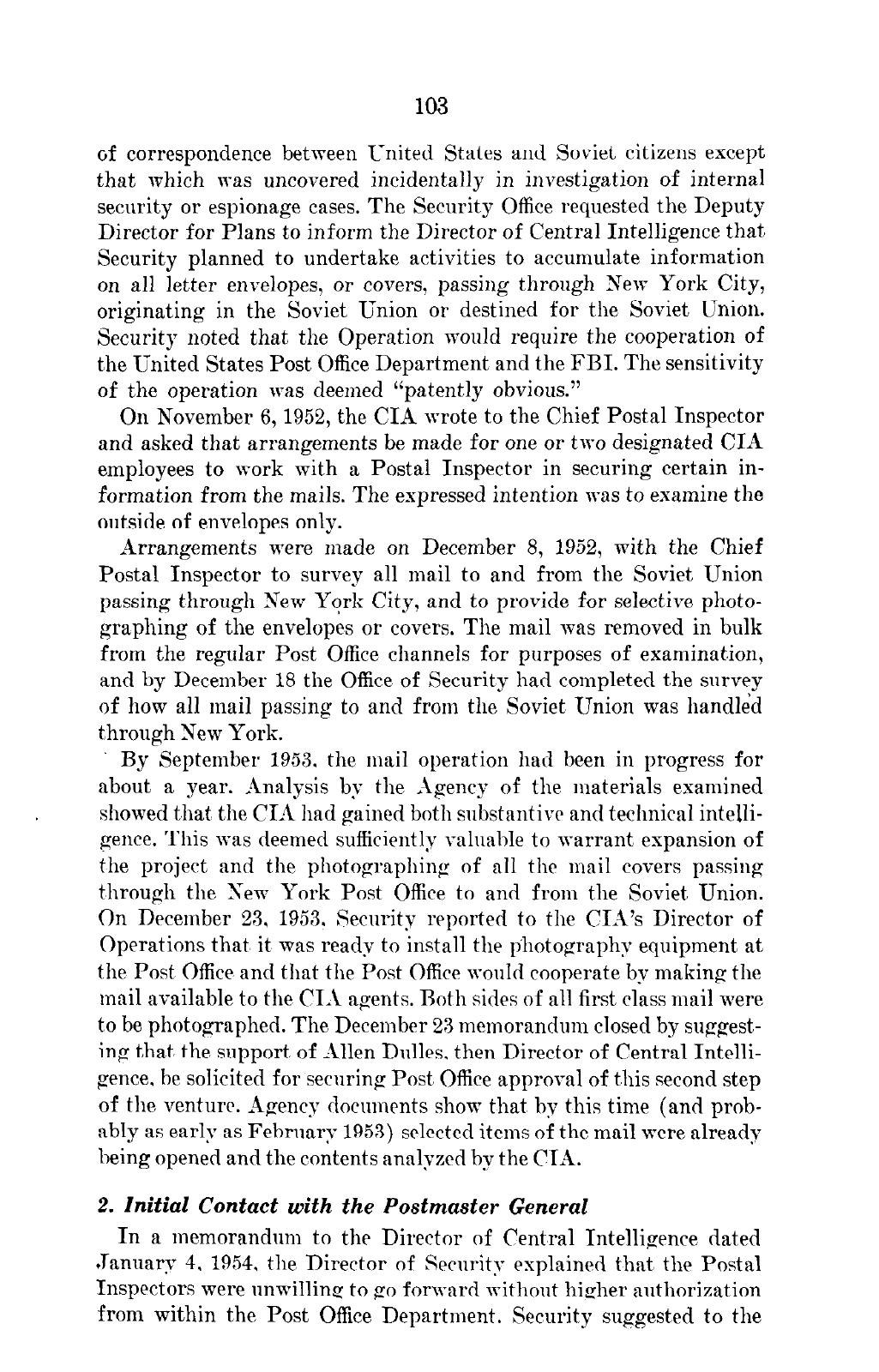
Rockefeller Commission, printed p 103: the survey of envelopes and the growth of the project are different stages. Image credit ↗

Chapter 01 / 1952–1956

The outside of an envelope becomes a doorway

In 1952 the CIA began exploring a seemingly narrow source of information: the outside of mail moving between the United States and the Soviet Union. Names, addresses and postal routes could reveal contacts even without access to a letter’s contents. A July planning memorandum proposed approaching postal authorities cautiously, presenting an initial survey while anticipating expansion once the agency had established access. The institutional foothold preceded the mature operation later called HTLINGUAL.

The Rockefeller Commission traced arrangements made in December 1952 for a New York survey and selective photography of envelope exteriors. By 1953 the CIA was seeking broader photography, while selected letters were already being opened. This is why accounts beginning in 1952 and accounts dating mail opening from 1953 need not contradict one another. They may be dating different activities. A mail cover records information visible on an envelope; an opening crosses the seal and exposes private contents.

Postal cooperation did not make those activities equivalent. When Allen Dulles and Richard Helms met Postmaster General Arthur Summerfield in May 1954, the contemporary memorandum described support for the mail program without clearly recording disclosure of the opening. The distinction would recur for years: officials could assent to cooperation while possessing incomplete knowledge of the operation they were assisting.

In late 1955 James Angleton’s Counterintelligence Staff sought formal expansion. The accompanying proposal acknowledged that mail opening lacked postal approval and anticipated the public consequences of disclosure. Approval within the CIA followed in January 1956; the commission placed the expanded operation’s commencement later that year after organizational delays. Internal approval demonstrated that the activity was institutional, but it supplied neither a judicial warrant nor proof of lawful external authorization. The beginning of HTLINGUAL is therefore a history of widening access and changing practice, not one transparent decision in which every participant knowingly approved the final system.

Sources: S01 · S02 · S06

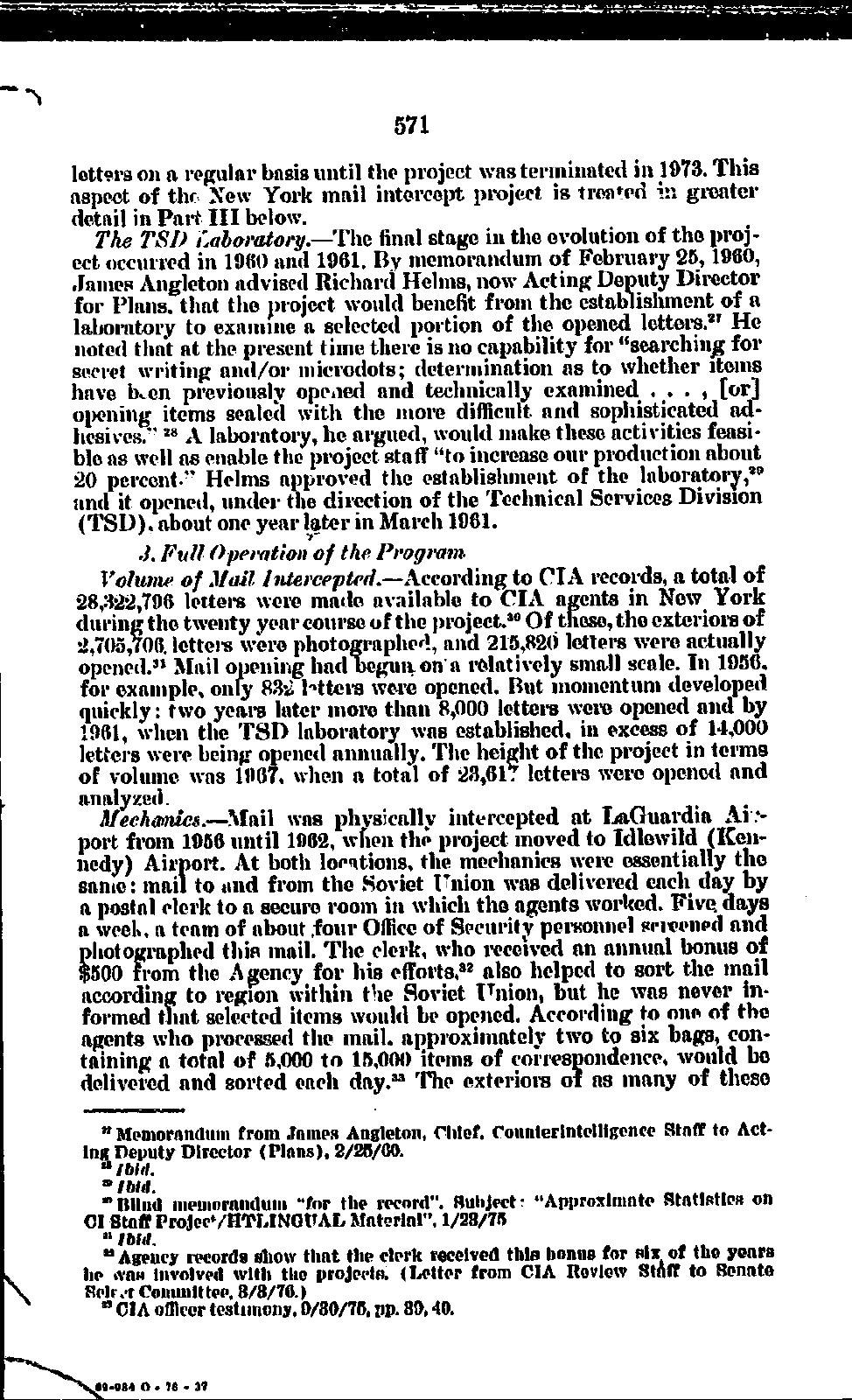
Different stages of mail interception, Senate report page 571
Senate report, printed p 571:28.3 million letters made available,2.7 million exteriors photographed and 215,820 letters opened are distinct counts. Image credit ↗

Chapter 02 / 1956–1973

A collection system, not one enormous reading room

The New York project acquired the rhythm of a continuing service. Mail was sorted and screened; selected envelopes were photographed, opened and copied; the originals were resealed and returned to postal channels. Photographic copies moved to headquarters, where analysts translated or summarized correspondence, indexed it and circulated information. The Senate report describes collection at LaGuardia Airport and a 1962 move to Idlewild, later Kennedy Airport. The system extended beyond the room where the seals were broken.

Its totals measure different stages. According to CIA records reproduced in the Senate report, 28,322,796 letters were made available during the project, 2,705,706 envelope exteriors were photographed and 215,820 letters were actually opened. None of those figures is a count of unique people. Nor does the first figure mean that agents read 28 million letters. Inflating the opening total is unnecessary to describe a large intrusion; collapsing the stages also obscures the scale of exterior surveillance.

Selection combined watch lists with choices outside the lists. The Senate report records one CIA estimate that about a quarter of openings followed watch lists and three quarters were described as random. That label did not mean a carefully designed statistical sample. Other findings describe the influence of individual agents’ preferences and limited guidance. A person’s appearance in the collected material therefore does not by itself establish that the government had specifically targeted that person.

The collection nevertheless became more deliberately domestic as well. The FBI learned of the project in 1958 and supplied names and requirements, receiving copied correspondence through its relationship with the CIA. Operation CHAOS furnished a list of 41 Americans. Information about dissent could enter an operation defended as foreign counterintelligence. The privacy consequence was not only delayed delivery: copying created a second life for a letter, in files and dissemination channels neither sender nor recipient could see. That continuing informational use is essential to understanding the program’s reach.

Sources: S01 · S03 · S04 · S05

The 1962 discussion of exposure and cover stories
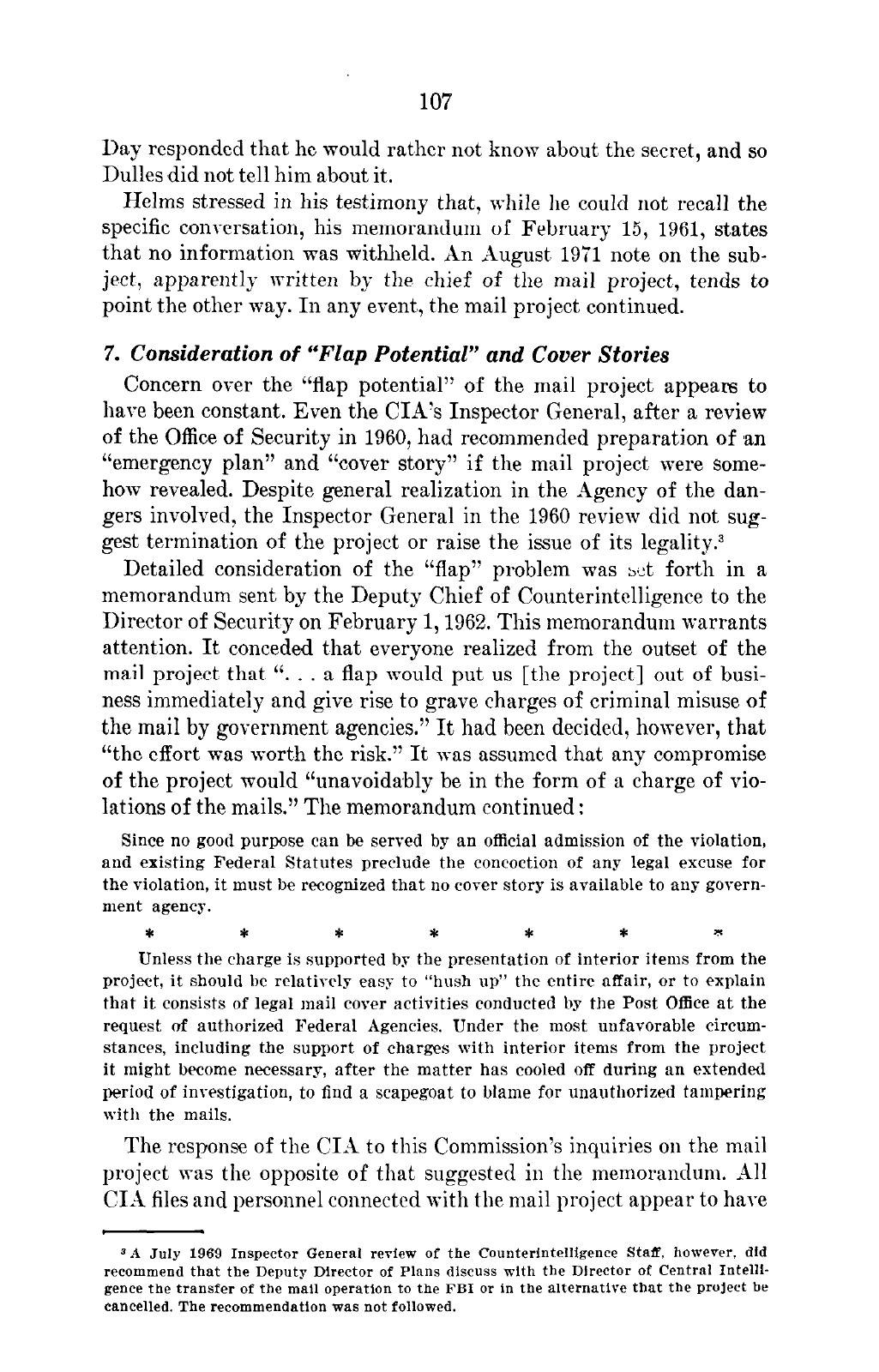
Rockefeller Commission, printed p 107, recounts a 1962 memorandum contemplating denial, a mail-cover explanation and a scapegoat. Image credit ↗

Chapter 03 / 1960–1971

Warnings became plans for surviving disclosure

HTLINGUAL survived repeated awareness that disclosure would be damaging. An early inspector-general review recommended an emergency plan and a cover story. A February 1962 counterintelligence memorandum went further: it recognized the absence of a convincing legal excuse and considered how allegations might be suppressed, explained as ordinary exterior-mail work or attributed to an unauthorized subordinate. This was an internal discussion of concealment. It is not evidence that each proposed response was later carried out.

The same record makes a purely accidental overreach difficult to sustain. The Rockefeller Commission found contemporaneous acknowledgment of legal problems and no indication that counsel had been asked for an opinion before inception. Senate investigators later compared those documents with testimony by officials who understood the activity as unlawful yet considered its national-security benefits more important. Those judgments identify institutional choices; they are not a substitute for a court’s adjudication of each person’s criminal liability.

Knowledge outside the operational circle was uneven. Helms’s memorandum about a February 1961 meeting said that no relevant details were withheld from Postmaster General J. Edward Day. Day later recalled declining to hear the secret in the first place. The Senate report also identified evidence cutting against an inference that every necessary detail had been conveyed. Neither a participant’s assurance nor a participant’s denial resolves that contradiction on its own.

The internal debate was not solely about secrecy. Angleton defended the project as a valuable view of Soviet activity, while reviews in 1961 and 1969 questioned its tangible operational returns. Other officials described usefulness to the FBI as a reason to continue or transfer responsibility. A system can produce some information while yielding too little to justify its costs and intrusions. The record does not support a choice between omnipotent intelligence and absolute uselessness. It shows an entrenched operation whose defenders, critics and external partners were evaluating different benefits, risks and responsibilities.

Sources: S01 · S05 · S06 · S07

Termination on 15 February 1973
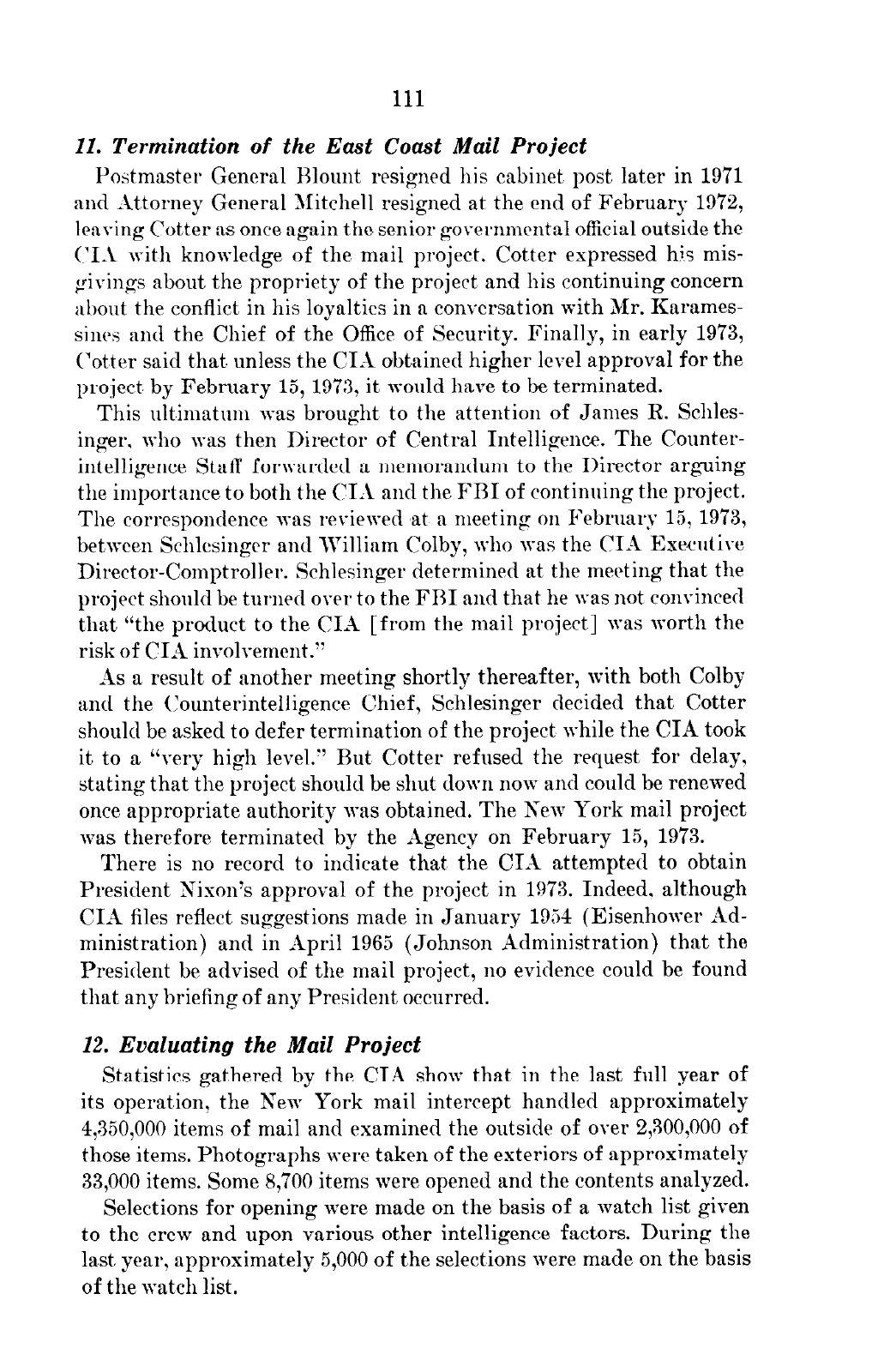
Rockefeller Commission, printed p 111: William Cotter’s demand for higher approval led to termination on 15 February 1973. Image credit ↗

Chapter 04 / 1970–February 1973

The program outlasted a rescinded plan

The 1970 Huston initiative sought broader intelligence techniques amid political unrest. Its report represented covert mail coverage as having been discontinued, although the CIA’s New York operation continued. The Senate investigation later found that the report, signed by Helms, did not disclose that ongoing activity to Nixon. Helms denied intending to mislead, but acknowledged the report could not have told the president that the CIA was still opening mail.

The brief approval of relaxed restrictions and its withdrawal must be kept separate from the older project. A 23 July 1970 communication conveyed apparent presidential approval of covert mail coverage generally; five days later that authorization was withdrawn. It was not a specific, informed authorization of the New York program. The project nevertheless continued for nearly three more years. Its persistence cannot be dated from the Huston proposal or explained as a program that ended when that proposal was rescinded.

William Cotter’s position eventually became decisive. A former CIA officer who knew about the openings, he became Chief Postal Inspector in 1969 and faced divided institutional loyalties. In 1971 Helms reported favorable conversations with Attorney General John Mitchell and Postmaster General Winton Blount. The content and implications of those briefings were later disputed. Cotter ultimately demanded higher approval or termination by 15 February 1973.

New CIA Director James Schlesinger questioned whether the product justified continued CIA involvement and considered turning the operation over to the FBI. Cotter refused a delay while the agency sought higher authority. The New York project stopped on 15 February 1973. This was before the major public investigations of 1975. Public exposure did not cause that already completed closure, although it changed accountability and the subsequent rules. The sequence also separates a proposed transfer from an executed one: discussions about handing responsibility to the FBI do not prove that an identical program continued under another agency after the CIA halt.

Sources: S01 · S06 · S08

Senate findings distinguish four CIA programs
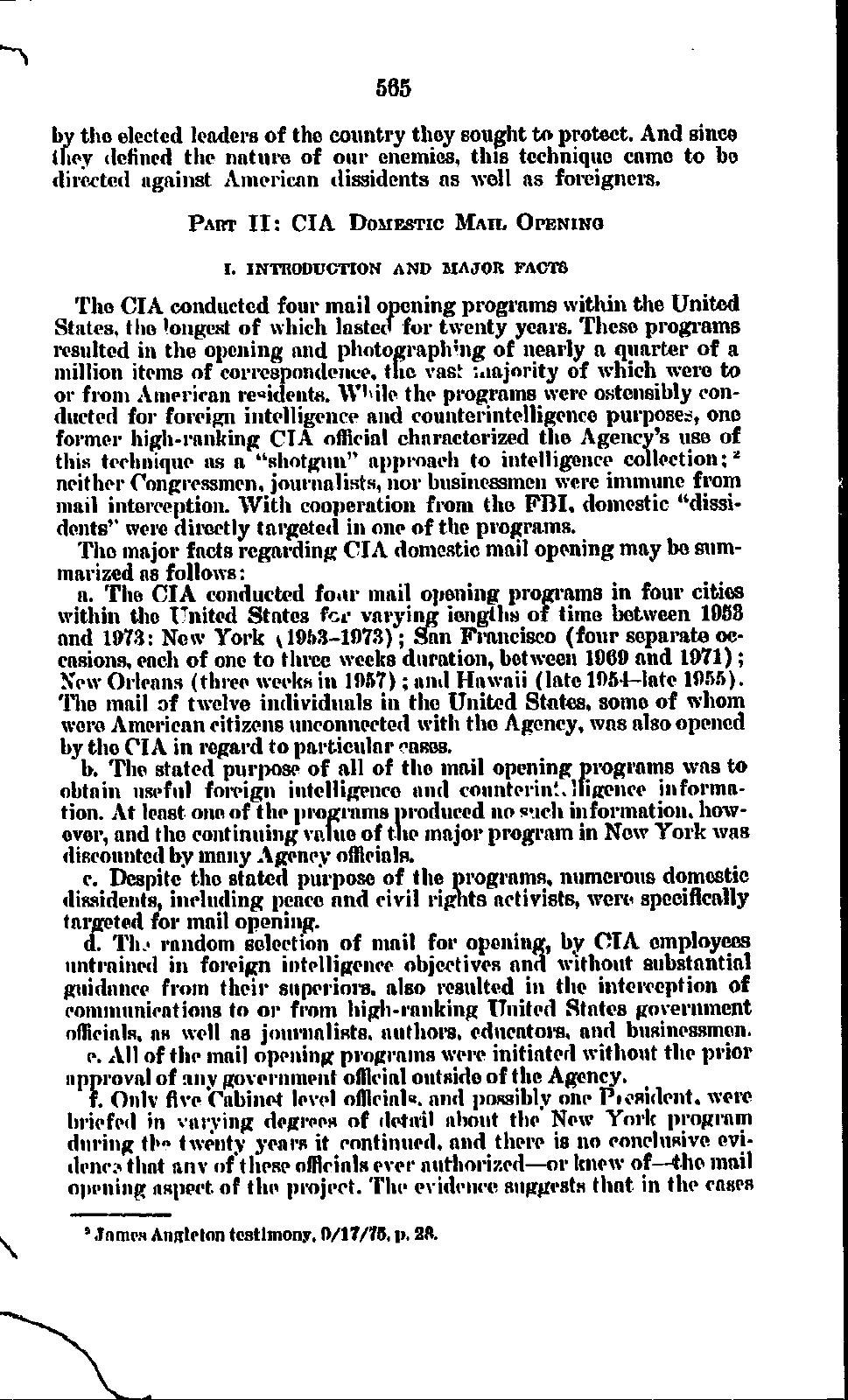
The Senate’s 1976 report distinguishes the four CIA projects from the wider survey of twelve CIA and FBI programs. Image credit ↗

Chapter 05 / 1975–1976

A secret operation becomes a public record

The Rockefeller Commission and the Senate’s Church Committee made the mail operations publicly examinable in 1975 and 1976. Their investigations were not merely a clash of political accusations. They assembled agency documents, sought testimony from intelligence and postal officials, and compared contemporary memoranda with later recollections. The resulting record established actual openings and copying, not just plans or the possibility that envelopes might have been inspected.

The Rockefeller Commission concluded that the domestic mail-opening programs were unlawful and improper. It also found that the New York exterior-mail operation exceeded the limited, selective basis on which lawful mail covers could be conducted under postal regulations. Its conclusion about domestic security assistance addressed the CIA’s statutory boundary, as well as the physical act of opening a letter. An operation’s Soviet connection did not automatically resolve that boundary once it supplied domestic surveillance requirements.

The Senate report offered a wider institutional account. It surveyed twelve programs conducted by the CIA and FBI across different periods, then separated four CIA operations from the Bureau’s own activities and its receipt of the CIA’s product. The New York total must not be silently assigned to all those programs, nor must the broader total be called HTLINGUAL. The shorter CIA projects in San Francisco, Hawaii and New Orleans had different durations and purposes; differences in their value did not validate the New York operation.

Even the question of presidential knowledge remained qualified. Rockefeller investigators found no evidence confirming a presidential briefing; the later Senate report examined assertions of possible knowledge but found no conclusive informed authorization of the mail-opening activity. Receipt of sanitized intelligence could conceal its collection method. That ambiguity does not erase responsibility inside the CIA or among informed partners. It does prevent converting every president under whom the project operated into a documented personal authorizer. Public oversight changed the evidentiary situation: claims once protected by compartmentation could be tested against documents, although neither inquiry reconstructed every opening or every lost record.

Sources: S01 · S02 · S06 · S08 · S15 · S16

The Justice Department explains why it declined prosecution
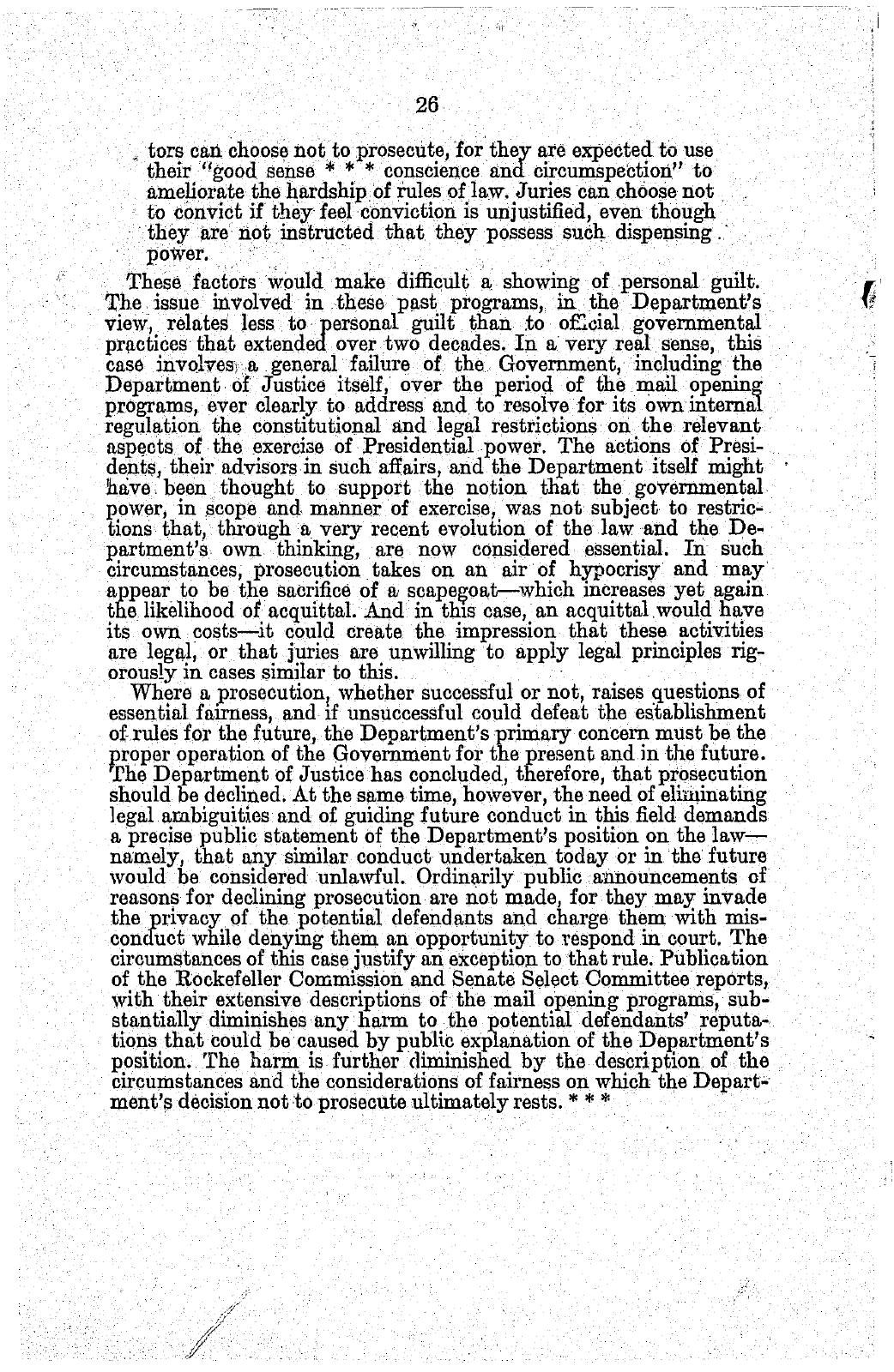
The Justice Department’s 1977 declination, reprinted in a House report, distinguishes prosecution policy from a prospective statement of unlawfulness. Image credit ↗

Chapter 06 / 1977–1989

No prosecution, damages and a later remedial barrier

After investigation, the Justice Department decided in January 1977 not to prosecute individuals for the CIA mail operations. Its published explanation emphasized difficult proof, the state of legal doctrine during the period, reliance on apparently authoritative officials and fairness where responsibility was spread across government. The department also warned that similar future conduct would be considered unlawful. Declining prosecution was not an acquittal, and it did not declare every opening lawful.

Civil litigation asked different questions. In 1978 the Second Circuit’s Birnbaum decision affirmed damages of $1,000 each for Norman Birnbaum, B. Leonard Avery and Mary Rule MacMillen. The court treated the project’s domestic intelligence partnership as beyond the CIA’s statutory discretion. It reversed a separate requirement that the government send apology letters because the governing remedy provided money damages, not that relief. The result was a limited civil judgment, not a criminal verdict against the agency’s leaders.

The legal afterlife was not linear. In his 1989 appeal, Leo Hurwitz challenged the opening of a 1963 letter that he learned about through his own records request decades later. The Second Circuit affirmed dismissal because New York did not recognize the common-law intrusion claim required for that Federal Tort Claims Act route. It expressly rejected Birnbaum’s earlier prediction about New York law and did not decide the limitations issue. The rejection of that remedy did not amount to judicial approval of HTLINGUAL.

A serious rival legal reading goes further than the Justice Department’s prosecutorial caution. In 2009 CIA lawyer Daniel Pines, writing expressly in his personal capacity, argued that a foreign-intelligence exception could justify the openings, especially after Mitchell’s 1971 briefing. That argument depends on the operation’s primary purpose, its targets and valid approval. The evidence of domestic demands, broad non-list selection and disputed briefing details makes those predicates consequential rather than assumed. It also remains distinct from the barrier that defeated Hurwitz’s particular civil claim. Conduct, individual culpability, institutional liability and available remedies cannot be compressed into the single question of whether anyone went to prison.

Sources: S09 · S10 · S11 · S12 · S13

The Review Board reports destruction and surviving working files
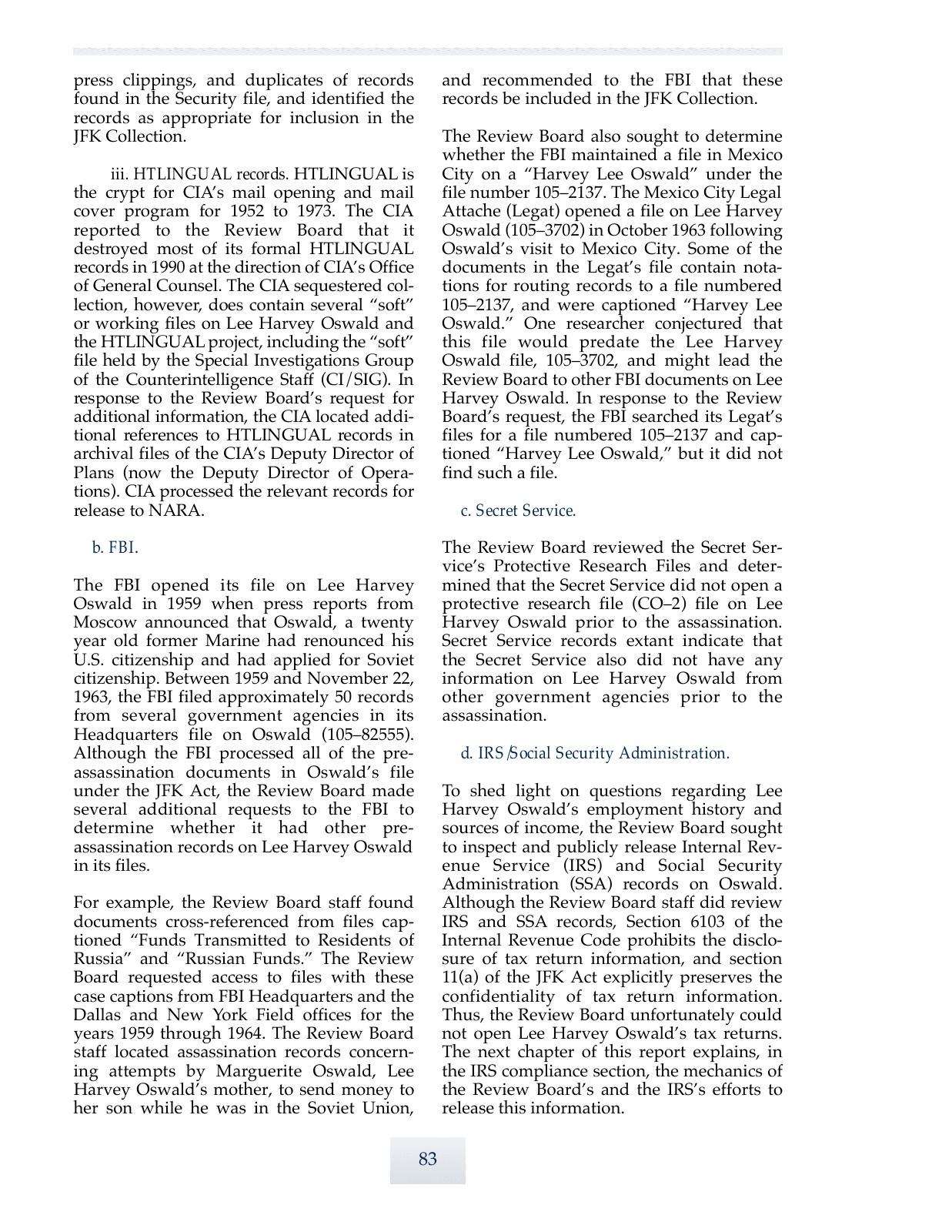
Review Board report, printed p 83: most formal HTLINGUAL records were reportedly destroyed in 1990, while working files and additional references survived. Image credit ↗

Chapter 07 / 1990–2009 and the surviving record

The copies outlived the opened letters

The originals generally returned to their senders’ intended destinations, but their copies became records with a separate history. An index or file could preserve an association long after the physical letter arrived. Learning decades later that correspondence had been opened was therefore a different event from the original intrusion. Hurwitz’s litigation illustrates that delay without establishing that every correspondent had the same experience or the same legal remedy.

The Assassination Records Review Board later examined HTLINGUAL material while searching for records relating to Lee Harvey Oswald. Its 1998 report states that the CIA reported destroying most formal project records in 1990 at the direction of its Office of General Counsel. The same passage records surviving working files and additional references located elsewhere in agency records and processed for release. It is wrong to turn “most formal records” into “every trace,” or to treat surviving fragments as a complete archive.

The destruction is a documented limit on reconstruction and a legitimate subject for scrutiny. The report passage does not by itself identify a destruction schedule’s legal basis, every approval, or a motive tied to the Kennedy assassination. The presence of Oswald-related mail records likewise establishes collection or retention, not recruitment, foreknowledge or operational direction. Those larger propositions require their own authenticated chain of communications and actions. Nor does HTLINGUAL’s existence prove that any present-day damaged or delayed envelope was opened by intelligence personnel.

The record supports a substantial finding without either enlargement or minimization. The CIA developed a concealed system that crossed from exterior inspection into private contents, persisted despite internal warnings and served domestic as well as foreign interests. Its intelligence value was contested; its authorizations were incomplete or disputed; its end did not automatically provide redress. Later releases and changing legal outcomes altered what could be known and what could be remedied. Further authenticated operational ledgers, recipient files, legal advice and destruction instructions could clarify individual responsibility and scope. They would refine a documented program rather than decide whether the program existed in the first place.

Sources: S03 · S10 · S12 · S14 · S18

02 / The record

Find a thread in the file

Search the chapter and claim index. Every result leads to the full text and its sources.

03 / The record

People and institutions

Open a record for the person’s role and supporting sources. Names identify people; no unverified portrait is substituted for a participant.

AngletonBiographical record
James Jesus AngletonChief of CIA Counterintelligence Staff

Defended the project’s counterintelligence value and led the staff that sought formal expansion in 1955. His favorable assessment is compared with internal reviews and evidence of domestic uses; it is not treated as proof of net value.

Sources: S01 · S05 · S07

HelmsBiographical record
Richard HelmsCIA operations official; director 1966–1973

Involved in approvals, postal briefings and the 1970 Huston report. His contemporaneous memoranda are important evidence of what he reported; disputed recollections and incomplete briefing descriptions limit what they establish about others’ knowledge.

Sources: S01 · S06 · S07

DullesBiographical record
Allen W. DullesDirector of Central Intelligence,1953–1961

Participated in the 1954 and 1961 postal meetings. The fact that the project operated under his directorship does not establish approval of every stage at inception or informed authorization from presidents and postal officials.

Sources: S01 · S06

SummerfieldBiographical record
Arthur E. SummerfieldPostmaster General,1953–1961

Met Dulles and Helms on 17 May 1954. The surviving account supports cooperation with photography of envelopes; the investigators did not find clear evidence that he approved or was told about the letter openings.

Sources: S01 · S06

DayBiographical record
J. Edward DayPostmaster General,1961–1963

His account of the 1961 meeting differed from Helms’s memorandum. Day recalled declining to hear the secret. Acknowledged willingness to remain uninformed is relevant to oversight, but it does not prove he knew every operational detail.

Sources: S01 · S06

CotterBiographical record
William J. CotterChief Postal Inspector from 1969

A former CIA officer who knew that letters were opened. His demand for higher approval or termination was central to the 15 February 1973 closure. The record describes his conflicts of institutional loyalty rather than reducing his role to either simple complicity or sole reformer.

Sources: S01

MitchellBiographical record
John N. MitchellAttorney General,1969–1972

Helms reported a favorable 1 June 1971 briefing. Mitchell’s knowledge of actual opening was later contested. The disputed content matters to claims that executive approval legally validated the project.

Sources: S01 · S06 · S13

BlountBiographical record
Winton M. BlountPostmaster General,1969–1971

Helms’s 3 June 1971 memo described Blount as positive about continuation after a 2 Juneconversation. The commission also recorded limits in Blount’s later recall; the memorandum and recollection have different evidentiary roles.

Sources: S01

SchlesingerBiographical record
James R. SchlesingerDirector of Central Intelligence in 1973

Questioned whether the product justified the risk of continued CIA involvement and considered FBI responsibility. The project ended during his tenure after Cotter rejected delay. A considered transfer is not a documented continuation.

Sources: S01

ColbyBiographical record
William E. ColbyCIA executive director in 1973; later director

Participated in the 1973 review and later responded to investigations. His view that reforms had limited effects on agency capability is an institutional assessment, not a quantitative proof that mail opening was either indispensable or worthless.

Sources: S01 · S17

OsbornBiographical record
Howard J. OsbornCIA Director of Security,1964–1974

Described the product as of little value to his office and acknowledged legal concerns. His unit’s evaluation is evidence of internal disagreement, not a universal measure of every recipient’s benefit.

Sources: S05 · S07

ChurchBiographical record
Frank ChurchChairman, Senate intelligence investigation

Led the public investigation whose report compared operational documents, testimony and different programs. The committee’s findings are an institutional investigation, distinct from a criminal judgment.

Sources: S02 · S08 · S15

RockefellerBiographical record
Nelson A. RockefellerChair, Commission on CIA Activities Within the United States

The commission’s 1975 mail chapter publicly documented unlawful openings and recommended safeguards. Its findings and later Senate work should be read together, retaining differences in scope and evidentiary certainty.

Sources: S01 · S16

MacMillenBiographical record
Norman Birnbaum, B. Leonard Avery and Mary Rule MacMillenPlaintiffs in the 1978 mail-opening appeal

The Second Circuit affirmed$1,000 each in damages and reversed mandatory apologies. The judgment’s New York common-law theory did not remain a dependable general precedent after later decisions.

Sources: S11 · S12

HurwitzBiographical record
Leo HurwitzCorrespondent and later civil plaintiff

Learned in 1987 that a 1963 letter had been copied. His 1989 appeal failed because New York did not recognize the required common-law intrusion claim; the court did not affirm on the limitations ground used below.

Sources: S12

PinesBiographical record
Daniel L. PinesAuthor of a 2009 legal reinterpretation

The article identifies him as a CIA Assistant General Counsel writing in a stated personal capacity. Argues that foreign-intelligence authority could support the openings. His institutional affiliation and disclaimer are both disclosed, and the argument is tested on its predicates.

Sources: S13

04 / The record

Access, expansion and accountability

Horizontal spacing shows elapsed time; separate rows keep close events selectable. Scroll the graph on narrow screens. Exact dates are attributed where records conflict; month- and year-only dates preserve source precision.

19521966198019952009
A cautious approach to postal accessPlanning

A CIA planning memo proposes an initial survey and anticipates gradual expansion once access is established.

Sources: S01

New York survey arrangementsExterior access

Arrangements provide a survey of Soviet-route mail and selective photography of envelopes. This stage is distinct from opening contents.

Sources: S01

Selected letters are being openedExecution

The commission places selected openings by late 1953 and probably earlier that year. The year marker preserves that uncertainty.

Sources: S01

Dulles and Helms meet SummerfieldBriefing

The memorandum records support for the program without clearly documenting disclosure of covert opening.

Sources: S01 · S06

Counterintelligence proposes expansionProposal

Angleton’s staff seeks wider access, indexing, analysis and increased opening; the proposal acknowledges lack of postal approval for contents access.

Sources: S01

Expanded program approved internallyInternal approval

Deputy Plans and Security officials approve the proposal. Organizational delays put expanded operations later in 1956; no specific January day is invented.

Sources: S01

FBI sharing relationship establishedInstitutional sharing

CIA and FBI representatives agree on material of internal-security interest and FBI watch-list requirements. This relationship is distinct from the Bureau’s separate mail-opening programs.

Sources: S01

Day receives a disputed briefingKnowledge dispute

Helms’s memorandum describes a full account; Day later recalls declining to hear the secret. The record does not make a meeting synonymous with informed consent to opening.

Sources: S01 · S06

Technical laboratory beginsOperational capacity

Senate account places the laboratory’s opening in March 1961. Its existence improved technical examination but does not prove net intelligence value.

Sources: S03

Exposure memo considers denial and a scapegoatConcealment planning

A contemporary CIA memo recognizes legal vulnerability and considers explanations if exposed. It establishes a proposed response, not execution of every suggestion.

Sources: S01

Mail intercept moves to IdlewildLocation

Senate report places the transfer from LaGuardia in 1962. Idlewild was later renamed Kennedy Airport.

Sources: S03

Internal memo recognizes lack of legal basisLegal awareness

The commission and Senate report discuss an internal acknowledgment about peacetime mail monitoring. It is evidence of agency awareness, not a court verdict against every participant.

Sources: S01 · S07

Peak annual openings in the Senate accountScale

The Senate report gives 23,617 openings for 1967. Annual opened-letter totals remain distinct from envelope photographs and all accessible traffic.

Sources: S03

Cotter becomes Chief Postal InspectorInstitutional responsibility

His prior CIA service gave him knowledge of actual openings. The account later turns on the conflict between secrecy and his postal responsibilities.

Sources: S01

Inspector-general review favors transfer or closureInternal dissent

The Rockefeller chapter describes a July 1969 recommendation to transfer the operation to the FBI or cancel it. The recommendation was not followed then.

Sources: S01 · S05

General approval communicated under Huston initiativeApparent authorization

The Senate report identifies a communication of approval for relaxed techniques generally; it was not a specific informed authorization of the ongoing New York project.

Sources: S06

The general authorization is withdrawnRescission

Five days after the communication, approval was withdrawn. The New York project nevertheless continued.

Sources: S06

Senior CIA officials discuss exposure and Cotter’s positionInternal review

The meeting considers who knows, the risk of public disclosure and possible FBI responsibility.

Sources: S01

Helms meets Attorney General MitchellDisputed briefing

Helms later reports concurrence; the nature of Mitchell’s knowledge is disputed and central to the rival legal account.

Sources: S01 · S06 · S13

Helms meets Postmaster General BlountBriefing

A 3 June CIA memorandum describes a favorable response. It is weighed alongside later uncertainty about what was discussed.

Sources: S01

New York mail project terminatedClosure

Cotter rejects delay without higher approval. The project closes before the 1975 public investigations; proposed FBI responsibility is not treated as proven continuation.

Sources: S01

Rockefeller report makes findings publicInvestigation

Chapter 9 concludes that domestic mail openings were unlawful and improper. Month precision is used here to avoid conflating submission and publication dates.

Sources: S01 · S16

Senate mail-opening hearings beginPublic hearing

Hearings continue on 22 and 24 October. Their catalog identifies witnesses and documentary exhibits; this guide does not claim a full hearing-volume audit.

Sources: S08

Church Committee final reportPublic findings

Book III separates different CIA/FBI projects, describes selection and sharing, and evaluates legality and responsibility.

Sources: S02 · S03 · S04 · S05 · S06 · S07

Justice Department declines prosecutionProsecutorial decision

The published explanation stresses proof, legal uncertainty and fairness, while warning against similar future conduct. This is not an acquittal.

Sources: S10

Birnbaum affirms damages, reverses apologiesCivil judgment

Three $1,000 awards affirmed; mandatory apology letters reversed. The later treatment of its state-law theory is essential context.

Sources: S11

Hurwitz rejects the earlier state-law predictionCivil judgment

Dismissal affirmed because New York did not recognize the required intrusion tort. The court does not reach limitations or declare the operation lawful.

Sources: S12

Most formal records reportedly destroyedRecords history

ARRB later reports CIA’s statement that most formal HTLINGUAL records were destroyed at General Counsel’s direction. The year does not identify every action or surviving record.

Sources: S14

Review Board reports surviving working filesRecords review

The report describes both destruction and surviving working files and references processed for release. Neither total disappearance nor a complete archive is established.

Sources: S14

Family Jewels release adds documentary contextRelease

The public release date is separate from the 1973 compilation and project termination. This guide uses the release catalog without claiming a complete audit of the compilation.

Sources: S18

Pines publishes a rival legal readingInterpretation

The personal scholarly argument emphasizes foreign-intelligence authority and 1971 approval; it is not an official CIA adjudication or a court ruling on the whole program.

Sources: S13

05 / The record

The load-bearing facts

Six connected steps link access, processing, institutional decisions, closure and the limits of accountability. Open each step for its dependencies, why it matters, and the questions it leaves for rival accounts.

CP1

Access expands beyond its initial presentation

The 1952 exterior survey became selected opening and then a larger formal counterintelligence operation.

Why it is critical

This establishes the act at issue. A defense of envelope inspection cannot by itself validate reading contents.

Dependencies

Postal access, personnel and equipment; CIA internal approval at later stages.

What rival readings must explain

An accident-only account must explain the expansion proposals and awareness of missing postal approval. A universal-approval account must identify what each official was told.

Sources: S01 · S02 · S06

CP2

Copies become an intelligence system

Opening, photographing, analysis, indexing and dissemination create records beyond the delivered original. FBI requirements and domestic watch lists shape selection.

Why it is critical

Without this chain the intrusion looks like an isolated delay. With it, the enduring consequence is collection and use of private communications.

Dependencies

CP1’s access, physical processing, analysts, index and recipient channels.

What rival readings must explain

A purely foreign account must explain domestic requests and broad non-list selection. A claim of omniscience must explain the difference between accessible, photographed and opened mail.

Sources: S01 · S03 · S04

CP3

Warning and compartmentation fail to stop the program

Internal legal acknowledgments, cover-story planning and adverse value assessments coexist with continuation and disputed briefings.

Why it is critical

This distinguishes a sustained institutional choice from a program nobody knew existed. It also prevents assuming that every senior office had the same knowledge.

Dependencies

CP2’s established system; decision-makers willing to keep it despite risk and criticism.

What rival readings must explain

A rogue-agent reading must explain senior involvement. A completely informed presidential-command reading must fill the documentary gaps.

Sources: S01 · S05 · S06 · S07

CP4

A boundary finally closes the New York operation

Cotter requires higher approval or termination; Schlesinger questions CIA involvement; the project ends 15 February 1973.

Why it is critical

Closure dates the executed program and prevents later investigations or proposed transfers from being treated as its beginning or continuation.

Dependencies

Postal cooperation, pressure over approval and a CIA leadership review; the earlier Huston rescission had not stopped it.

What rival readings must explain

A post 1973 continuation claim needs an operational successor, personnel, orders and product, not only a discussion of transfer.

Sources: S01 · S06

CP5

Public investigation and legal consequences diverge

Investigative findings establish conduct; DOJ declines prosecution; Birnbaum affirms limited civil damages; Hurwitz later rejects the necessary New York tort theory.

Why it is critical

Illegal or improper conduct, personal criminal guilt and available civil remedies are different propositions. One outcome cannot silently decide the others.

Dependencies

Surviving documents, testimony and individual plaintiffs able to identify intercepted correspondence.

What rival readings must explain

A legal-vindication account must address the findings and charter issue. A complete-accountability account must address no prosecution, limited damages and the later remedial barrier.

Sources: S01 · S07 · S09 · S10 · S11 · S12

CP6

An incomplete archive bounds later inferences

ARRB records both the reported 1990 destruction of most formal files and surviving working files and references.

Why it is critical

The archive can establish HTLINGUAL without establishing every letter, motive or larger conspiracy. Destruction is a fact to investigate, not a universal explanatory key.

Dependencies

CP2’s record creation and later retention, disposal and search decisions.

What rival readings must explain

A deliberate-cover-up claim tied to a particular event needs destruction instructions and evidence of motive; an everything-is-known account must confront the missing formal files.

Sources: S14 · S18

06 / The record

Four interpretations tested against the record

Competing interpretations, stated at their strongest and tested against the same chain. Presenting a theory is not endorsing it.

Interpretation 01

A useful counterintelligence tool exceeded acceptable boundaries

Real rationale; net value and necessity contested

The strongest version

Secret writing, censorship patterns, Soviet contacts and counterintelligence leads made mail a potentially valuable source. Angleton defended the project and some technical benefits were acknowledged. This account accepts CP1–CP4 but sees the operation as a response to genuine intelligence needs.

Accepts

Letters were opened, domestic information was collected and secrecy obstructed review. Some benefits need not make every method lawful.

Must still explain

CP2’s broad selection and domestic use, CP3’s adverse reviews and continued legal concerns must be explained. The volume of material does not measure prevented harm or unique operational success.

Assessment

The record supports some useful information and a serious dispute about whether it justified the program’s scale and risks. Neither total worthlessness nor indispensability is established.

What would change this assessment

Authenticated case records linking particular intercepts to otherwise unavailable outcomes, and an accounting of unsuccessful collection and privacy costs, would change confidence about net value.

Sources: S01 · S03 · S04 · S05

Interpretation 02

Foreign-intelligence authority supplied a lawful exception

A substantive legal argument with disputed factual predicates

The strongest version

Pines argues that foreign-intelligence authority could permit warrantless physical searches and that Mitchell’s 1971 approval supplied a key condition. Exterior covers and contents searches require separate analysis. This account accepts the acts in CP1–CP2 but challenges an unqualified retrospective legal condemnation.

Accepts

No judicial warrant was obtained, early approval was uncertain, and litigation may fail for reasons unrelated to lawful conduct.

Must still explain

The argument requires a primary foreign-intelligence purpose, appropriate foreign-power targets and valid executive approval. CP2’s domestic tasking, non-list selection and CP3’s disputed briefings test those conditions. Birnbaum’s charter holding cannot be replaced with a later dismissal on state-law grounds.

Assessment

This is a published scholarly interpretation, expressly personal rather than an official CIA position. DOJ’s declination provides a different, narrower argument about prosecution fairness and proof.

What would change this assessment

Authenticated legal advice, complete briefing records, targeting rules and case-specific facts meeting the proposed exception would strengthen the defense; records showing knowingly domestic targeting without relevant authority would weaken it. A directly applicable adjudication would carry a different weight from scholarship.

Sources: S01 · S04 · S06 · S07 · S10 · S11 · S12 · S13

Interpretation 03

An institutional system of domestic surveillance

Strongly supported for important uses; every purpose is not reducible to it

The strongest version

The FBI’s requirements, CHAOS watch list, dissident selection and stored copies made HTLINGUAL a working domestic-surveillance resource. CP2–CP3 describe a mechanism, not merely a hypothetical risk. Senior involvement and concealment make isolated rogue conduct an inadequate account.

Accepts

Foreign intelligence and technical aims also existed; knowledge varied and does not prove a single informed presidential command.

Must still explain

The account must distinguish collection, dissemination and subsequent action. Records of an opened letter do not show that its writer was prosecuted, intimidated or otherwise acted against. CP5’s legal complexity remains even where conduct is established.

Assessment

Domestic use and secrecy are documented. A claim that the entire project was devised solely to suppress dissent goes beyond the 1952 origins and mixed product assessments.

What would change this assessment

Recipient case files and orders showing how copied correspondence drove specific domestic actions would establish a fuller causal chain. Evidence that a particular name entered only through non-list selection would narrow an individual-targeting claim.

Sources: S01 · S02 · S03 · S04 · S05 · S07

Interpretation 04

The surviving files conceal a wider operational story

Legitimate inquiry; larger links require independent proof

The strongest version

Destroyed formal records and surviving Oswald-related files make completeness doubtful. Long-lived secret channels might have served additional purposes not visible in the public selections. CP6 justifies scrutiny of gaps rather than assuming a complete archive.

Accepts

The program and record destruction are established; working files survived. A gap is not itself evidence of the content missing from it.

Must still explain

A claim of assassination complicity, recruitment or post 1973 continuation needs a bridge from intercepted correspondence to identified decisions, orders and acts. Neither an Oswald file nor general concealment supplies that chain.

Assessment

The 1998 report establishes a reported destruction history and continuing discoveries. It does not authenticate an all-purpose cover-up motive or an operational relationship with every correspondent.

What would change this assessment

Matching contemporaneous orders, financial or personnel records, full destruction instructions and independently corroborated testimony linking a specific file to a specific additional operation would change the assessment.

Sources: S03 · S14 · S18
07 / The record

How the story changed

Public memory tends to compress contested histories into a turning point. The records leave a less tidy sequence.

A private delivery acquires an unseen second life

ThenA letter that arrived apparently intact gave its writer little reason to know that a government copy existed.

ReconsideredThe investigations and later personal records requests established copying, indexing and dissemination. The delivery of an original did not erase the intrusion; a stored copy still does not prove every later use alleged for it.

Sources: S01 · S03 · S12

The 28 million-letter story becomes three different totals

ThenA compressed account can turn every letter made available into a letter opened and read.

ReconsideredThe Senate’s separate totals establish access, exterior photography and opening. A letter is also not a unique person. Complete project ledgers could refine those records; repeated headlines cannot merge the categories.

Sources: S03

The legal story changes after the first damages judgment

ThenBirnbaum in 1978 affirmed damages and predicted that New York law would recognize the necessary privacy intrusion claim.

ReconsideredHurwitz in 1989 rejected that prediction after later state decisions. The earlier plaintiffs’ awards remain facts of the 1978 judgment; the later remedial defeat is not a retroactive declaration that surveillance was proper.

Sources: S11 · S12

Destruction and discovery appear in the same report

ThenThe project’s end might suggest that all copies vanished, or that official publication left a complete archive.

ReconsideredARRB reported most formal records destroyed in 1990 but identified working files and additional references. The precise disposal authority and missing contents require records of their own; neither total erasure nor complete preservation fits.

Sources: S14

08 / The record

What the evidence supports

Ratings apply to the precise proposition on the page. Unsupported means the assembled evidence does not establish a claim; it is not interchangeable with false.

Established

The CIA secretly opened and copied selected U.S.–Soviet mail.

Contemporary agency records described by two investigations, totals, processing accounts and identified civil plaintiffs establish execution, not just a proposal.

Sources: S01 · S02 · S03 · S11 · S12

Incorrect category

HTLINGUAL opened 28 million letters.

The Senate report records 28,322,796 letters made available, 2,705,706 exteriors photographed and 215,820 letters opened. None is a unique-person count.

Sources: S03

Misleading

Inspecting an envelope and opening its contents were equivalent acts.

The investigations distinguish exterior covers from opening sealed contents. Cooperation with one activity did not necessarily disclose or authorize the other.

Sources: S01 · S06

Established

The project supplied domestic surveillance requirements.

The FBI relationship, CHAOS list and Senate findings on domestic dissident selection establish a domestic component. They do not erase the project’s foreign and technical objectives.

Sources: S01 · S04 · S05

Not established

Every prominent correspondent whose mail was opened was deliberately targeted.

Watch lists were only one selection mechanism. Non-list choices and special-category filing rules mean that collected mail does not automatically prove deliberate personal targeting.

Sources: S04

Not established

Every president during the project knowingly authorized its mail openings.

Investigations found no conclusive record of such authorization. Assertions of knowledge, possible mention, sanitized intelligence and general approval of a technique have different evidentiary weight.

Sources: S01 · S06

Contradicted by chronology

The 1970 Huston plan created HTLINGUAL and its withdrawal stopped it.

The New York operation predated the proposal and continued after the apparent general authorization was rescinded. Its documented termination was 15 February 1973.

Sources: S01 · S06

Established

The New York CIA project ended on 15 February 1973.

The Rockefeller account records the deadline, Cotter’s refusal of delay and termination. A proposed FBI transfer does not establish an executed successor.

Sources: S01

Unsupported inference

The decision not to prosecute proved the operation lawful.

DOJ emphasized the likelihood of acquittal, fairness, apparent authority and evolving law, while warning against future repetition. Declination is distinct from acquittal, lawful authorization and civil liability.

Sources: S09 · S10 · S11

Contradicted by later history

Courts gave all affected correspondents a stable damages remedy.

Birnbaum’s limited 1978 awards and the 1989 Hurwitz dismissal are different outcomes. The later court rejected the necessary New York tort theory; no universal remedy followed.

Sources: S11 · S12

Incorrect scope

All HTLINGUAL records were destroyed in 1990.

ARRB says the CIA reported destruction of most formal records; the same passage identifies surviving working files and references. It does not establish every disposal detail.

Sources: S14

Not established by these records

An Oswald-related mail file proves CIA direction of his actions.

Collection or retention is not recruitment, foreknowledge or command. A larger allegation requires authenticated links from correspondence to decisions and acts; the ARRB passage does not supply them.

Sources: S14

09 / The record

Read the witnesses and the record

Primary interview transcripts and documentary context. Outbound records need an internet connection.

Primary testimony / hearing catalog

The 1975 mail-opening hearings and exhibits ↗

The catalog provides routes to the Senate’s written hearing record, including postal officials, Helms, Mitchell and CIA memoranda. No verified freely reusable mail-hearing video is packaged; the page is not represented as a playable recording.

Primary investigative report

Read the Rockefeller mail chapter ↗

A compact full chapter reconstructs the program and states conclusions. Its documents, attributed testimony, institutional assessments and recommendations perform different evidentiary jobs.

Rival legal analysis

Read the foreign-intelligence defense ↗

Pines’s 2009 article develops a substantive legal argument. Its assumptions about purpose, target and approval can be compared with the primary record and actual judgments; the author’s views are expressly personal.

10 / The record

The questions still open

A documented limit is more useful than a confident number or a sweeping lineage the evidence cannot carry.

  1. Which surviving operational ledgers can identify exactly which letters were opened, why each was selected and where copies went?
  2. What complete briefing records or contemporaneous legal advice survive for the postal officials, attorneys general and presidents whose knowledge was disputed?
  3. Which specific intelligence outcomes depended on HTLINGUAL information unavailable from lawful alternatives, and how were costs and unsuccessful collection counted?
  4. How did recipients use copied correspondence in domestic investigations or other actions, beyond simply retaining the information?
  5. What destruction schedules, approvals and inventories explain the reported 1990 disposal, and which working files or distributed copies survived elsewhere?
  6. Where continuation after 1973 or a larger operational connection is alleged, what identifiable successor, order, personnel and product bridge the gap?

11 / The record

Go back to the sources

Records, reporting, and firsthand accounts have different evidentiary roles. Each source note explains what it can establish and where caution is needed. Sources consulted for this edition on 25 October 2026. Original records and attributed reporting have distinct evidentiary roles.

  1. S01

    Primary investigation / full chapter

    Rockefeller Commission, chapter 9: The CIA’s Mail Intercepts ↗

    Commission on CIA Activities Within the United States,1975; Ford Library

    Printed pp 101–115, PDFpp 1–15, read fully. Covers origin, expansion, disputed briefings, exposure planning,15 February 1973 termination, other cities and legal conclusions. The commission’s institutional findings are distinguished from the underlying memoranda and testimony it recounts.

  2. S02

    Primary investigation / selected sections

    Church Committee, Book III: summary and CIA findings ↗

    U.S. Senate, S.Rep.94-755,1976; CMU scan mirror

    Printed pp 561 and 565 inspected visually (PDF 566 and 570). Twelve CIA/FBI programs are the broad survey, while four CIA programs are a separate subset. These pages and S 03–S 07 are sections of one report, not independent corroborating publications.

  3. S03

    Primary investigation / selected pages

    Church Committee: New York scale and mechanics ↗

    U.S. Senate, Book III,1976

    Printed pp 571–572, PDF 576–577, visually checked.28,322,796 letters made available;2,705,706 exteriors photographed;215,820 letters opened. Describes transport, opening, copying, resealing, return, analysis and indexing. Counts are project totals, not unique people.

  4. S04

    Primary investigation / selected pages

    Church Committee: watch lists and non-list selection ↗

    U.S. Senate, Book III,1976

    Printed pp 573 and 576, PDF 578 and 581, visually checked. One CIA estimate assigns 25%of openings to watch lists and 75%to random selection. This is an attributed estimate; selection by personal taste is not a statistically representative random sample.1971 special-category rules did not prohibit every opening of political figures’ mail.

  5. S05

    Primary investigation / selected pages

    Church Committee: competing assessments of intelligence value ↗

    U.S. Senate, Book III,1976

    Printed pp 576–579, PDF 581–584, visually checked. Angleton’s favorable judgment,1961 and 1969 reviews, limited operational outcomes and FBI benefit are compared. A program producing much material is not automatically a program producing valuable intelligence.

  6. S06

    Primary investigation / selected pages

    Church Committee: external knowledge and the Huston report ↗

    U.S. Senate, Book III,1976

    Printed pp 585,587 and 597, PDF 590,592 and 602, visually checked. Discusses disputed postal briefings, uncertain presidential knowledge, the misleading 1970 report, apparent general authorization and its withdrawal. Does not establish a single informed presidential authorization for the entire project.

  7. S07

    Primary investigation / selected page

    Church Committee: officials’ understanding of legality ↗

    U.S. Senate, Book III,1976

    Printed p 605, PDF 610, visually checked. Compares participant testimony with contemporaneous acknowledgments of legal problems. Official denial, retrospective confidence and national-security rationale are attributed rather than treated as deciding proof.

  8. S08

    Primary hearing catalog / navigation

    Mail Opening hearings, 21, 22 and 24 October 1975 — contents and exhibits ↗

    U.S. Senate hearing, preserved by Assassination Archives and Research Center

    Catalog verified; identifies Stewart, Osborn, postal officials, Helms, Mitchell and Wannall, and the relevant CIA memoranda. Used as a route to testimony, not a claim that the entire hearing volume was read. Report quotations of testimony are cited through the specific report pages examined.

  9. S09

    Primary judicial opinion / repository text

    Avery v. United States, 434 F. Supp. 937 (D. Conn. 1977) ↗

    U.S. District Court, District of Connecticut; Justia

    Pretrial decision on the government’s motion to dismiss, not a final criminal adjudication. Describes no judicial warrant or approval and distinguishes prosecutorial discretion from civil issues.

  10. S10

    Primary prosecutorial statement / excerpt reprint

    Justice Department decision of 14 January 1977, reprinted in House report ↗

    House Committee on Government Operations, H.Rep.96-280,1979; Office of Justice Programs

    Printed pp 24–26(PDF 28–30) reproduce an excerpt of the Justice Department’s declination, not its complete report. It discusses expected acquittals, evolving law, missing evidence, good-faith and apparent-authority defenses, institutional responsibility and a prospective warning. This is a decision against prosecution, not an acquittal or blanket declaration of legality.

  11. S11

    Primary appellate opinion

    Birnbaum v. United States, 588 F.2d 319 (2d Cir. 1978) ↗

    U.S. Court of Appeals for the Second Circuit; Justia

    9 November 1978. Affirms$1,000 each for three plaintiffs and rejects discretionary-function protection for conduct beyond the CIA’s charter; reverses mandatory apology letters. The New York privacy-tort prediction was rejected in later cases, including Hurwitz. Actual opinion checked, not an automated case summary.

  12. S12

    Primary appellate opinion

    Hurwitz v. United States, 884 F.2d 684 (2d Cir. 1989) ↗

    U.S. Court of Appeals for the Second Circuit; Justia

    6 September 1989. Affirms dismissal because New York did not recognize the necessary common-law intrusion claim, expressly rejecting Birnbaum’s state-law prediction. Does not reach the limitations question. Failure of that remedy is not a finding that the mail opening was lawful.

  13. S13

    Legal scholarship / rival interpretation

    Daniel L. Pines, The CIA’s “Family Jewels”: Legal Then? Legal Now? ↗

    Indiana Law Journal 84 (2009),637–701

    Mail section printed pp 666–682 read. Author was CIA Assistant General Counsel; article expressly states personal views, not an official CIA position. Argues cover activity was legal and openings after June 1971 had a foreign-intelligence justification. Its predicates about targets, purpose and approval are tested against the primary record; legal barriers to damages are distinct from lawful conduct.

  14. S14

    Primary records-review report

    Assassination Records Review Board, Final Report (1998) ↗

    Assassination Records Review Board; National Archives

    Printed p 83, PDF 106, HTLINGUAL subsection read. Reports CIA’s statement that most formal records were destroyed in 1990 at General Counsel’s direction, while working files and additional references survived. This is not a complete destruction schedule or proof of an assassination-related motive.

  15. S15

    Institutional history

    Senate institutional history of the Church Committee ↗

    U.S. Senate Historical Office

    Explains the 1975 investigation, criticisms of the committee and the 1976 creation of permanent Senate intelligence oversight. Context for the public turn, not an operational chronology or an inference that oversight eliminated all later abuse.

  16. S16

    Archival research guide

    Ford Library: intelligence investigations and reforms, 1975–76 ↗

    Gerald R. Ford Presidential Library and Museum

    Links Rockefeller report, reform decision book and 18 February 1976 executive order. Used to distinguish closure of the 1973 project from later oversight reforms; no complete present-day surveillance-law analysis is claimed.

  17. S17

    Contemporary official response

    Colby to Rockefeller, 22 March 1975 ↗

    U.S. Department of State, FRUS 1969–76, XXXVIIIpart 2, document 36

    Colby reports limited impact of his 1973–74 directives on operational capability but warns that disclosures affect collaborators. This is the director’s institutional judgment, not a quantified HTLINGUAL benefit assessment or proof that oversight had no costs.

  18. S18

    Research publication / documentary catalog

    The CIA’s Family Jewels — release context ↗

    National Security Archive,26 June 2007

    Catalog identifies mail-opening material in the 1973 internal compilation and its 2007 public release. The compilation’s date, project closure and release date are separate events. Full underlying “jewels” files were not audited for this edition; no source-archive newspaper clipping is redistributed as federal work.

Images, documents & licensing

The 1952 survey and early expansion (PDF page 3) — Commission on CIA Activities Within the United States. Public domain in the United States: original federal work,17 USC §105. Source & license ↗. Resized and re-encoded for this edition; embedded metadata removed. Only federal-authored pages are reproduced; third-party enclosures are excluded.

Different stages of mail interception, Senate report page 571 (PDF page 576) — U.S. Senate Select Committee to Study Governmental Operations with Respect to Intelligence Activities. Public domain in the United States: original federal work,17 USC §105. Source & license ↗. Resized and re-encoded for this edition; embedded metadata removed. Only federal-authored pages are reproduced; third-party enclosures are excluded.

The 1962 discussion of exposure and cover stories (PDF page 7) — Commission on CIA Activities Within the United States. Public domain in the United States: original federal work,17 USC §105. Source & license ↗. Resized and re-encoded for this edition; embedded metadata removed. Only federal-authored pages are reproduced; third-party enclosures are excluded.

Termination on 15 February 1973 (PDF page 11) — Commission on CIA Activities Within the United States. Public domain in the United States: original federal work,17 USC §105. Source & license ↗. Resized and re-encoded for this edition; embedded metadata removed. Only federal-authored pages are reproduced; third-party enclosures are excluded.

Senate findings distinguish four CIA programs (PDF page 570) — U.S. Senate Select Committee to Study Governmental Operations with Respect to Intelligence Activities. Public domain in the United States: original federal work,17 USC §105. Source & license ↗. Resized and re-encoded for this edition; embedded metadata removed. Only federal-authored pages are reproduced; third-party enclosures are excluded.

The Justice Department explains why it declined prosecution (PDF page 30) — U.S. Department of Justice; reprinted by the U.S. House Committee on Government Operations. Public domain in the United States: original federal work,17 USC §105. Source & license ↗. Resized and re-encoded for this edition; embedded metadata removed. Only federal-authored pages are reproduced; third-party enclosures are excluded.

The Review Board reports destruction and surviving working files (PDF page 106) — Assassination Records Review Board. Public domain in the United States: original federal work,17 USC §105. Source & license ↗. Resized and re-encoded for this edition; embedded metadata removed. Only federal-authored pages are reproduced; third-party enclosures are excluded.

Typefaces: Inter, Playfair Display and Source Serif 4, the shared AI Files reference set, distributed under the SIL Open Font License. Exact files and license text are included in assets/fonts in the offline package. Documentary images reproduce original U.S. government-authored documents and telegrams. No AI-generated photographs, portraits or document facsimiles are used.

Uniform evidence

One standard for every case.

Authorization, expectation, recommendation and executed action are different facts. Participant explanations and official commemorations are claims to test, never deciding proof. The same standard applies to all agencies and participants. Uncertainty remains labeled.

Publication status

Prepared for staging review.

This locally prepared package is intended for the ChatGPT submission lane under Spec v7. It has not received a Grok editorial grade or approval for promotion. The live submission manifest, when registered, records its review status. Submission queue and status ↗