← Interactive guidePUBLIC RECORD / READING EDITIONOffline ZIP ↓

Gordon Kahl and Posse Comitatus / 1969–2024 / movement, confrontation and memory

The warrant. The competing memories.

An attempt to arrest Gordon Kahl ended with two federal officers dead at Medina in February 1983. He died in Arkansas that June. The tax case, surviving defendants, harboring prosecutions and disputed destruction of a home left different legal records.

An AI-written documentary history of Gordon Kahl, the Posse Comitatus milieu and the distinct legal cases surrounding the 1983 confrontations.

Scope & method / Edition 1.0

Begin with the warrant, the changed identification and the actual judgments.

The decentralized movement, Gordon’s acts and the roles of relatives, associates and officers are examined separately. Allegations, convictions, acquittals, dissenting opinions and civil immunity judgments do different work.

Read the chapters for a narrative; use the record below to test it. Established means the specific proposition is documented. Interpretation marks an inference or a historical argument. Unknown means the record here cannot decide. An archive’s possession of a document does not endorse its contents.

Research checked 26 October 2026. Primary judicial opinions lead. Full trial transcripts, recordings, original autopsy and all investigative files were not independently audited. Some source endpoints remain accessible only through saved reader versions.

01 / The record

The story

The complete narrative, followed by the supporting record.

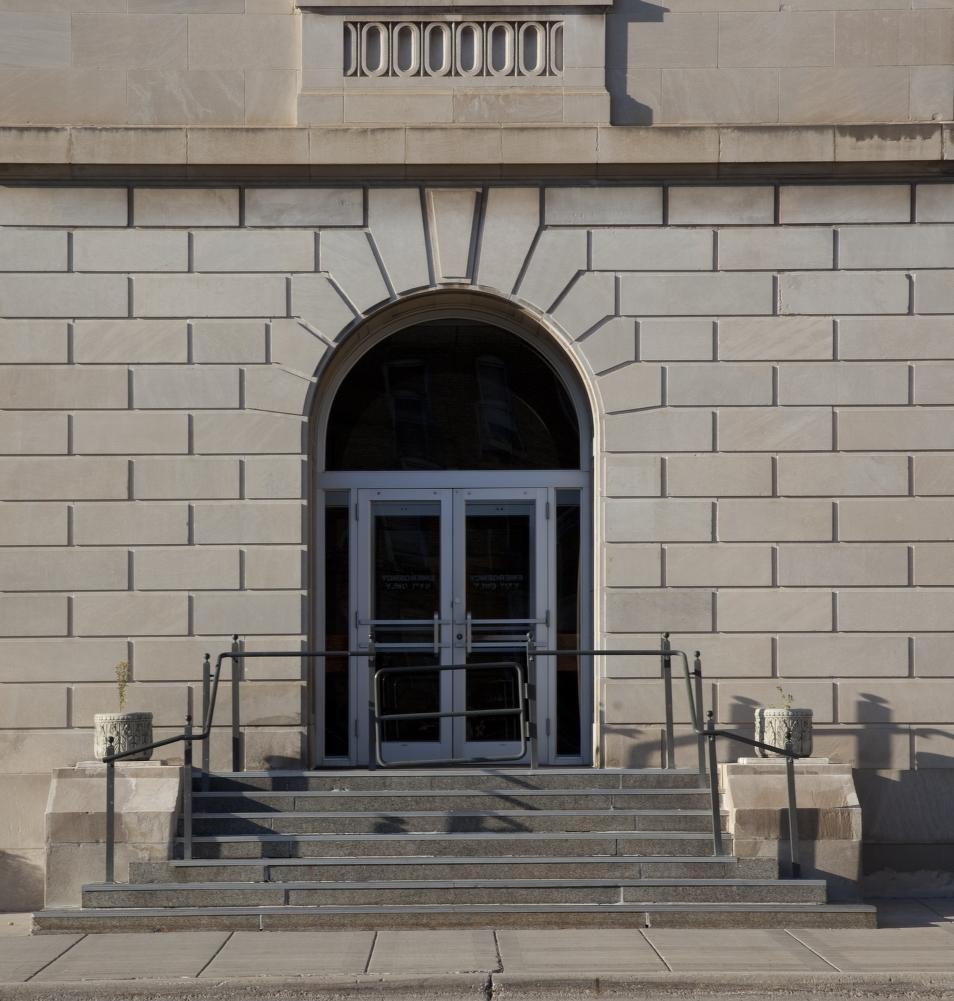
Exterior detail, Federal Building and U.S. Courthouse, Fargo, 2010
Exterior detail of Fargo’s Federal Building and U.S. Courthouse, photographed by Carol M. Highsmith in 2010. A later judicial-setting view; not a scene from the 1983 trial. Image credit ↗

Chapter 01 / 1969–1980

A claim of county sovereignty reaches a federal tax court

The Posse Comitatus milieu offered a sweeping answer to rural grievances: legitimate authority supposedly stopped at the county boundary, with federal taxation and much government beyond it treated as usurpation. The movement was decentralized, with racist and antisemitic Christian Identity currents among its organizers. That ideological setting helps explain Gordon Kahl’s opposition to federal power. It does not establish that every acquaintance shared every doctrine or participated in a national command structure directing the later shootings.

Historians trace overlapping organizational claims to Henry “Mike” Beach and William Potter Gale. Eckard Toy’s account identifies Beach’s 1969 Citizen’s Law Enforcement Research Committee and later charter distribution, while emphasizing borrowed words and ideas from Gale. The disputed founder label matters less than that documented circulation. These private claims of authority were not powers granted by the similarly named federal Posse Comitatus Act. Nor did an asserted county constitution suspend ordinary criminal law.

Kahl’s concrete legal trouble began with failure to file federal income-tax returns for 1973 and 1974. Convicted on two counts in 1977, he received a two-year sentence and a fine, with one year and payment of the fine suspended and five years of probation. The Fifth Circuit affirmed in November 1978. “Tax evasion,” often used loosely in later accounts, obscures the actual failure-to-file offenses and their distinct elements.

The political-prosecution objection had a real evidentiary basis. The government stipulated that selective enforcement favored flagrant violations or notorious protesters because publicity could deter others. The court nevertheless rejected unconstitutional selective prosecution: testimony identified prosecutions of nonprotesters, and Kahl had not shown similarly situated people generally escaped prosecution. The same opinion acknowledged a procedural defect in his original tax-case arrest warrant but held the objection waived. That earlier warrant is not interchangeable with the later probation warrant.

By July 1980, according to the later Medina appeal, Kahl refused a summons to answer a probation-violation charge. A warrant was issued, and attempts to arrest him were unsuccessful. That sequence connects an argument about government legitimacy to a particular arrest attempt. It supplies a legal history, while leaving room to examine the authorities’ choices about how, when and where to enforce the warrant.
Sources: S01 · S02 · S09 · S10

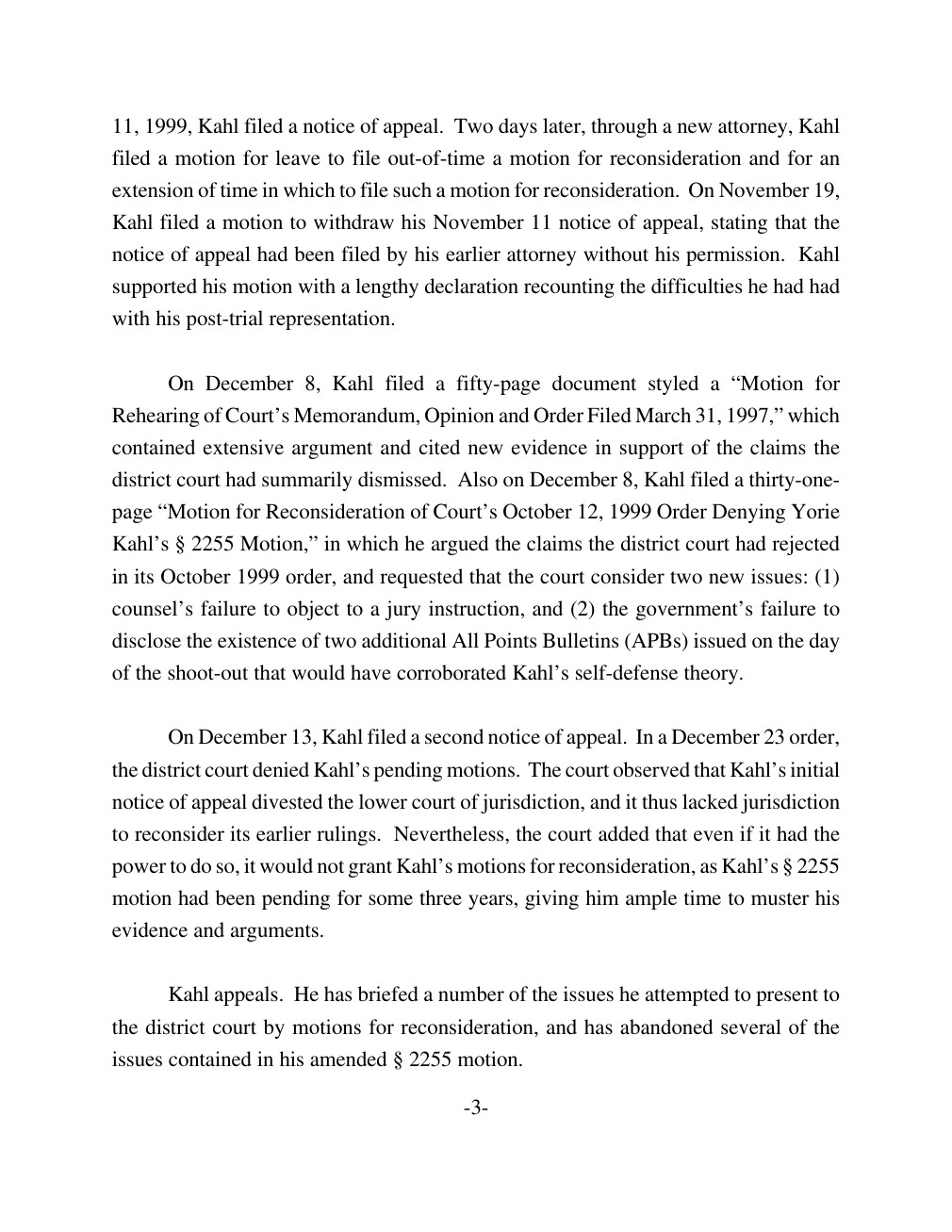
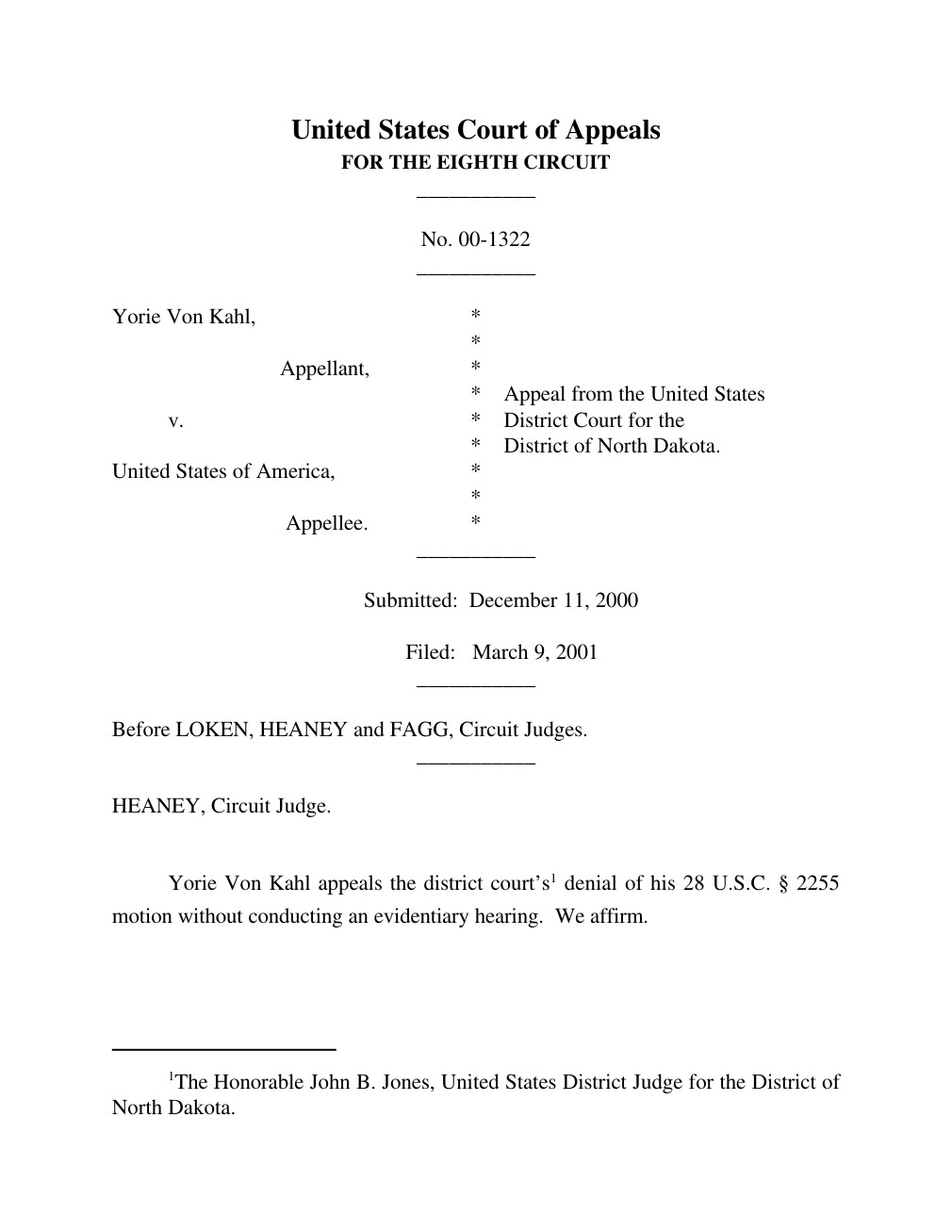
Opening of Yorie Von Kahl’s 2001 collateral appeal
The 2001 appeal opens with the history of the Medina prosecution; it is a later collateral-review record, not a contemporaneous photograph. Image credit ↗

Chapter 02 / 13 February 1983

What the Medina evidence can and cannot identify

On 13 February 1983, Gordon Kahl, his son Yorie, Scott Faul, David Broer and others gathered at a medical clinic in Medina, North Dakota. A deputy recognized a vehicle associated with Gordon, who was wanted on the probation warrant, and arranged surveillance and assistance from federal marshals. An earlier bulletin described Faul’s car because authorities believed Gordon used it. It was not itself proof that Faul had committed a separate offense.

The appellate majority describes discussions about the surveillance, calls checking the bulletin and decisions about vehicles and clothing before the group departed. Officers attempted to stop the departing cars outside Medina. The defense described armed men and unmarked vehicles that defendants did not recognize, threats and fear for their lives. The majority instead credited evidence of police signals, announcements of official identity and notice that Gordon was the arrest target. Those competing perceptions became central to self-defense and intent.

Two federal officers died: Marshal Kenneth Muir and Deputy Marshal Robert Cheshire. Three other law-enforcement officers and Yorie were wounded. The surviving trial account attributes the initial shot to Yorie based on witness testimony and describes Faul firing elsewhere at the scene. A judicially reviewed narrative has substantial weight, but it is not a recording of the entire encounter. This edition has not independently reconstructed every bullet or interviewed the witnesses.

One correction within that account is particularly important. Witnesses initially identified Faul as the person who approached wounded Cheshire and shot him. The appeal explicitly says that identification was abandoned and assigns the act, in its assessment, probably to Gordon. The abandoned identification cannot establish who fired those particular shots. Equally, that correction does not erase Faul’s separate second-degree murder and assault convictions. Gordon himself never stood trial on the 1983 murder charges.

Yorie’s survival and hospital treatment created another evidentiary dispute. His early statements and a pistol produced late in the trial became subjects of suppression and appellate review. Some hospital statements were suppressed; later statements were admitted as voluntary. The pistol corroborated part of the defense account, but the reviewing courts found no evidence supporting the later accusation that the government had deliberately withheld it. These are specific findings about particular evidence, rather than an assurance that every investigative decision was beyond criticism.

Sources: S02 · S05 · S08

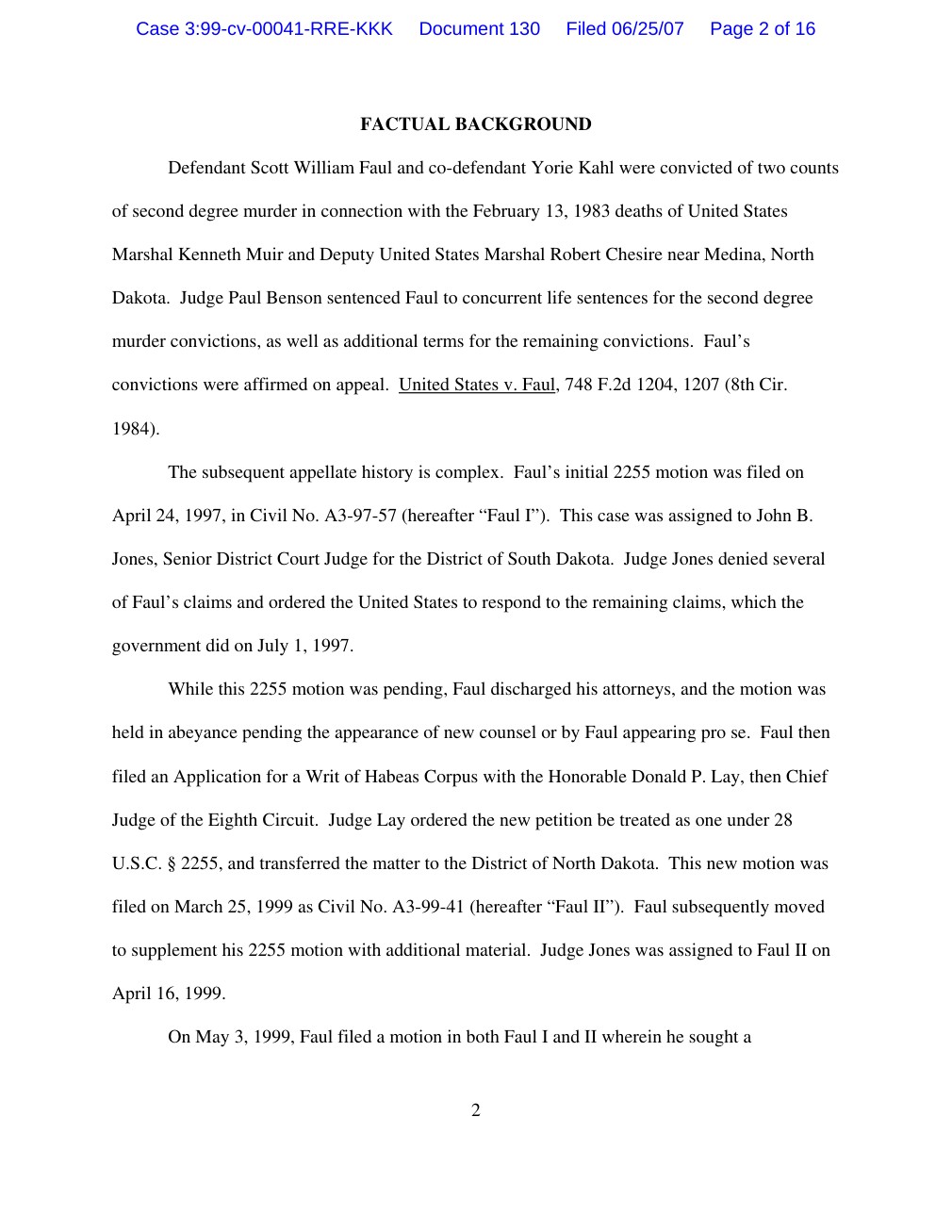
The 2007 order identifies Faul’s convictions and subsequent procedural history
The District of North Dakota’s 25 June 2007 order identifies Faul’s convictions and the later review history. Image credit ↗

Chapter 03 / May–June 1983 / November 1984

The jury’s distinctions and the dissent about a fair trial

The Medina prosecutions did not end with a single collective verdict. Scott Faul and Yorie Von Kahl were charged with first-degree murder but acquitted of that degree of the offense and convicted of lesser included second-degree murder, alongside assault, conspiracy-to-assault and harboring counts. The distinction affects both the historical account of intent and the sentence. Calling their verdicts first-degree convictions would be wrong; calling them acquitted of the killings would be equally misleading.

David Broer was not indicted for murder in the case described by the appellate court. The jury acquitted him of the substantive assaults and convicted him of conspiracy to assault and harboring. His ten-year total therefore cannot be described as a sentence for conspiracy to murder. Joan Kahl’s acquittal on conspiracy and harboring counts is reported in contemporaneous funeral coverage. Marriage to Gordon and presence in the group did not produce the same outcome for every person.

The majority affirmed the appealed convictions on 7 November 1984. It rejected challenges involving judicial bias, trial publicity, severance and evidence. Its approach gave weight to jurors’ answers during selection and the absence of a demonstrated inability to judge the case impartially. Later rehearing proceedings did not turn that decision into a new January 1985 original judgment, even where a database labels the case with the rehearing date.

Chief Judge Donald Lay dissented. His objection was not a declaration that no shooting occurred or that the defendants were innocent. He argued that the intense publicity, community ties to the dead officers and sensational character of the case made a fair trial in North Dakota impossible under the federal supervisory standard. He emphasized that the district court had not explicitly resolved the venue request and that assurances of impartiality could not settle every source of prejudice.

The dissent provides a stronger trial-fairness rival than a generic assertion that courts always protect officials. It points to actual press coverage and jury-selection evidence. The majority’s contrary judgment remains the legal outcome. Later collateral proceedings considered additional allegations about juror bias and contact; some failed on the evidence, while others were procedurally late. Neither the affirmance nor the dissent should be stretched into an answer to a different question. A fair-trial challenge, a self-defense account and an assertion of factual innocence each require their own proof.

Sources: S02 · S05 · S06 · S13

Later claims and the procedural history in the 2001 opinion
The 2001 opinion distinguishes procedural treatment of later claims; the Arkansas harboring outcomes come from the separate 1984 Udey appeal. Image credit ↗

Chapter 04 / March–November 1983 / November–December 1984

Harboring required knowledge, not merely association

After Medina, Gordon Kahl remained a fugitive. A murder warrant issued on 14 February and another followed the March indictment. The Arkansas harboring appeal places him at Arthur Russell’s home from March and at Leonard and Norma Ginter’s residence from late May. The legal question for people who helped him was not simply whether they opposed federal authority. The prosecution had to establish knowledge of the warrant and conduct intended to prevent discovery or arrest.

Four appellants—Edwin Udey, Arthur Russell, Leonard Ginter and Norma Ginter—were convicted of conspiracy to harbor and the substantive harboring offense. The appeal describes different sentences. Udey and Leonard received concurrent five-year terms. Russell’s sentence involved six months of incarceration followed by probation rather than the remaining imprisonment. Norma’s imprisonment was suspended in favor of probation. These convictions do not make them defendants convicted of murdering the officers at Medina or Sheriff Gene Matthews in Arkansas.

The evidentiary chain rested heavily on Karen Robertson, Russell’s daughter. The majority read her testimony together with circumstances indicating defendants’ knowledge and assistance. It upheld the jury’s findings. But Lay’s dissent regarding Udey challenged whether ordinary association and invitations to supper had been transformed into evidence of knowing participation. A crucial discrepancy concerned whether Robertson actually placed Udey in a conversation about the FBI closing in.

Four judges later dissented from denial of en banc rehearing on that issue. They stressed her cross-examination explicitly excluding Udey from the incriminating conversation and argued that an ambiguous earlier question could not support five years in prison. Their position did not overturn the conviction. It nonetheless identifies a narrow factual fault line: whether a particular person knew what the government had to prove, rather than whether the whole circle was morally sympathetic to Kahl.

The confrontation at the Ginters’ home on 3 June killed Gordon and Sheriff Matthews and ended with the house destroyed by fire. Gordon’s identity and the circumstances of the refuge were relevant to the harboring case. Questions about how officers used force and destroyed property later generated a separate civil record. That separation preserves local agency on both sides: witnesses, householders, state officers and federal agents made different decisions. No label such as “the Posse” establishes who knew the warrant, who fired a particular shot or who ordered a particular action.

Sources: S02 · S03 · S04

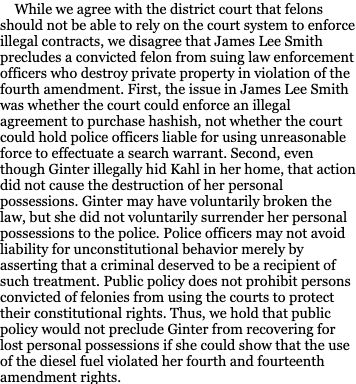
Ginter v. Stallcup, 1989: constitutional property protection, paragraph 9 of the actual web mirror
The actual Ginter opinion’s paragraph 9 rejects a blanket loss of constitutional property protection because of a conviction. Cropped from its modern Public.Resource.Org web mirror; not an original 1989 page scan. The chapter separately explains why judgment for the named officials nevertheless stood. Image credit ↗

Chapter 05 / 3 June 1983 / 1985–1989

A destroyed home and a limited civil judgment

The Arkansas confrontation has often been compressed into a fugitive’s last stand. The later Ginter litigation asks a different question: what constitutional protection remained for the possessions and home of someone convicted of harboring him? Norma Ginter alleged that officials unnecessarily destroyed her property. The defendants disputed responsibility, knowledge and the reasonableness of the force used. The resulting appeal offers more precise evidence than either a memorial summary or an untested claim that the entire incident was a planned execution.

The 1989 opinion records that Gordon was shot before the fire and that officers used fire in their effort to force him out. It discusses contested knowledge of his death and responsibility for the destruction. The legal hinge was whether further destructive force became unreasonable once officers knew that the person they sought was already dead.

The appellate court rejected the district court’s idea that Ginter’s harboring conviction itself prevented her from seeking compensation for unconstitutional destruction. A criminal conviction did not strip her of Fourth Amendment protection or voluntarily surrender all her possessions. The court also held that the prohibition on unnecessarily destructive searches was clearly established by 1983. This was a meaningful correction of the lower court’s reasoning, not an award of damages or a finding that the officials had committed arson.

The court nevertheless affirmed judgment for the named defendants. It found insufficient evidence that Blasingame or Lee knew Gordon was dead or acted unreasonably under the record before it; other claims failed on immunity or separate legal grounds. Judge Gerald Heaney concurred but emphasized evidence that other officers might have known about the death. He agreed that knowledge could not be attributed to those two defendants on the existing record. That concurrence preserves a serious question without supplying the missing proof.

The Ginters also faced state capital-murder charges after Matthews’s death; the civil appeal says those charges were dropped. Their federal harboring convictions remained a different matter. The record therefore supports neither a blanket vindication of every official act nor a judicial finding that the whole household murdered the sheriff. Original autopsy materials and the complete investigative record were not independently obtained here. The opinion’s account of those materials is identified as judicial reporting, with its limits intact.

Sources: S03 · S04 · S08 · S15

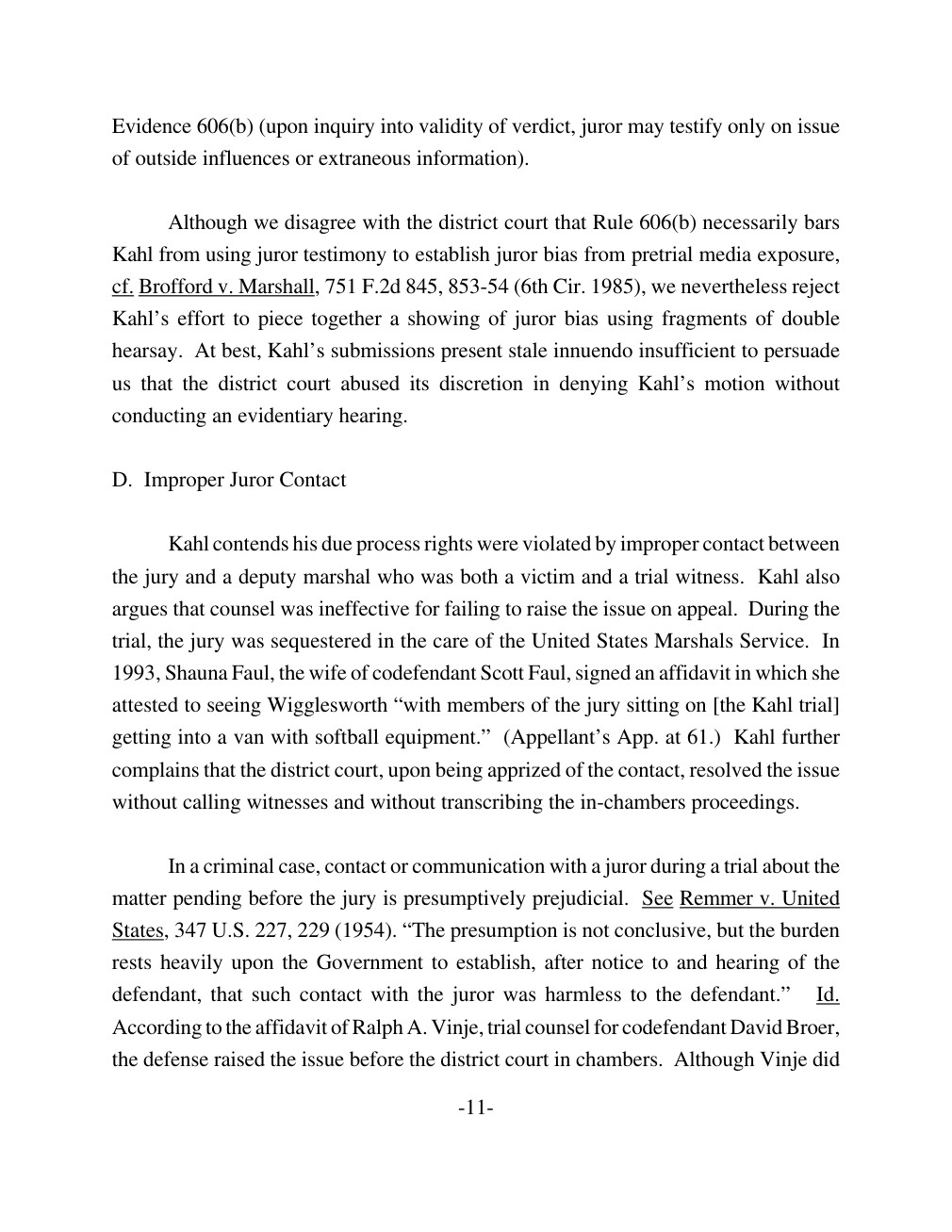
The 2001 opinion addresses alleged improper juror contact
The 2001 court examines the alleged contact between a deputy marshal and jurors, while identifying limits in the available record. Image credit ↗

Chapter 06 / 1996–2017

Later challenges tested particular claims, not a single legend

Yorie Von Kahl continued to challenge his conviction. In 2001 the Eighth Circuit affirmed denial of his motion under §2255. The opinion addressed hospital statements, counsel, the arrest warrant, juror bias and contact, the late-produced pistol and judicial conduct. It also refused claims and supplemental material first advanced too late. Reading the disposition as though every allegation received a fresh evidentiary trial would conceal how collateral review works.

The warrant argument illustrates the difference between assuming a disputed point and deciding it. The court considered the defense theory on the assumption that the warrant might be defective, then rejected the asserted justification for the deadly force used. It found no reasonable probability of a different trial outcome on the ineffective-assistance theory. That analysis is not a historical finding that no defect existed; it is also not recognition of an unlimited right to shoot officers enforcing an invalid warrant.

The juror-contact allegation concerned a deputy marshal who was both a victim and witness, reportedly seen with jurors and softball equipment. The court described the evidence as troubling but found the record too thin to establish a due-process violation or ineffective assistance. An untranscribed chambers discussion and later affidavits constrained review. This identifies an archival gap that matters: an authenticated contemporaneous record of the encounter could carry different weight from much later fragments of recollection.

Faul’s separate 2007 order recounts an extended procedural history, including an evidentiary hearing on jury bias in 2002. His later motions failed because matters had been resolved or the recusal claims were insufficient and untimely. The fact that Yorie’s 2001 motion was denied without an evidentiary hearing does not establish that no defendant ever received a hearing. The names, dates and individual proceedings must remain attached to each claim.

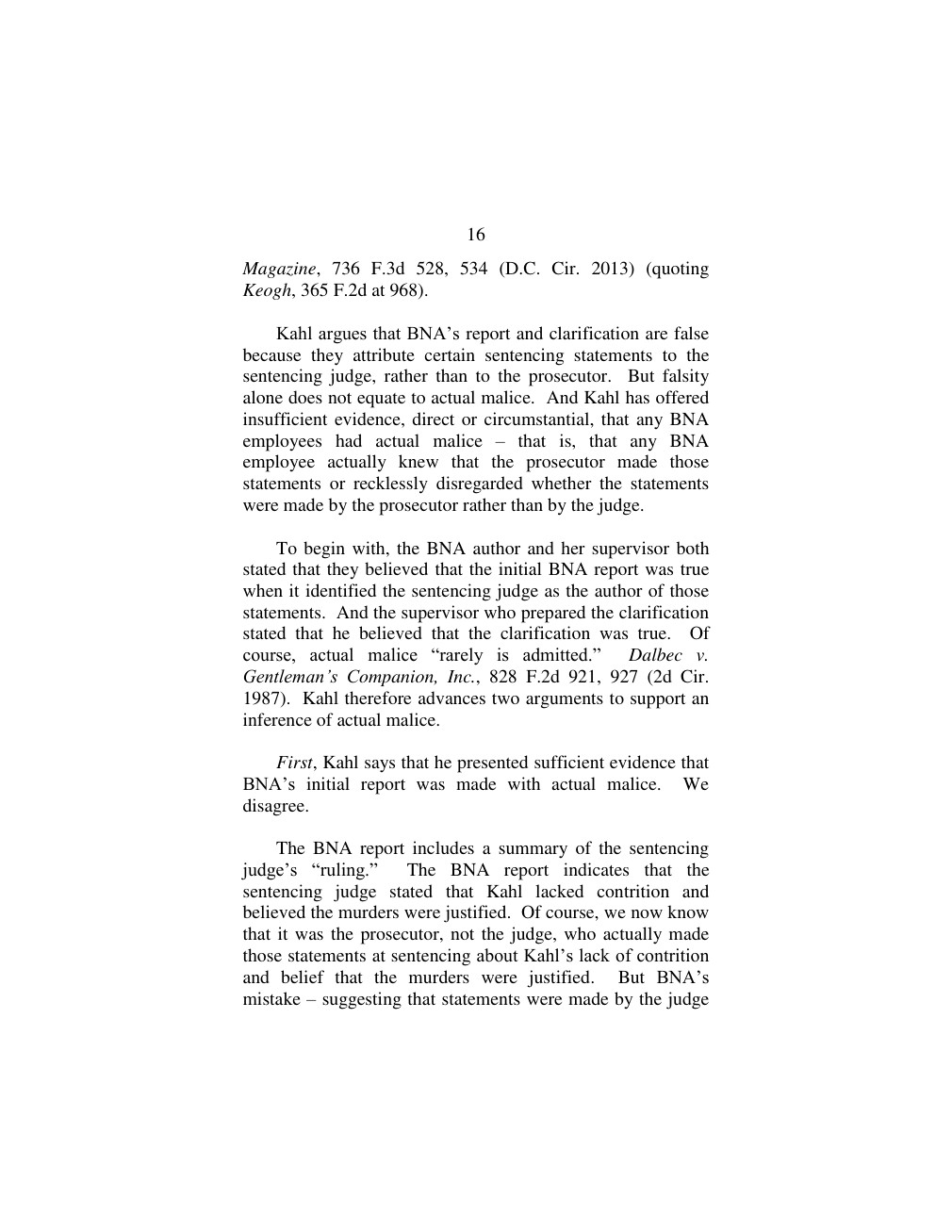
A later civil case confirmed a genuine reporting error. BNA’s legal newsletter attributed a prosecutor’s sentencing remarks about Yorie to the judge, having relied on an ambiguously excerpted transcript attached to Yorie’s petition. In 2017 the D.C. Circuit directed judgment for BNA because evidence of knowing or reckless falsehood was insufficient under the actual-malice standard. It did not declare the attribution true or reverse the murder conviction. Correcting a false attribution and assessing liability for publishing it are separate tasks; the court’s reasoning makes that distinction unusually visible.

Sources: S05 · S06 · S07

The 2017 opinion recognizes the speaker error and distinguishes actual malice
Page 16 of the 2017 opinion recognizes a false speaker attribution while explaining why falsity alone did not establish actual malice. Image credit ↗

Chapter 07 / 1983–2024

How reporting, performance and memorials recast the same hinge

The memory dispute began before the cases were finished. Funeral reporting recorded Reverend Peter Dyck presenting Gordon as a peaceful patriot. That eulogy explains how neighbors could remember a person differently from an indictment or a marshal’s memorial. It does not resolve the witness evidence about Medina or the disputed knowledge of officers in Arkansas. Personal loyalty, political justification and a legal finding are different kinds of testimony.

The publication lineage is partly traceable. Corcoran’s reporting became Bitter Harvest, later reissued by North Dakota State University Press. A 1991 UPI interview and review explicitly connects that book to the television film In the Line of Duty: Manhunt in the Dakotas. Steiger described an approach that sought to understand Kahl as a human being. This establishes an adaptation and an actor’s stated interpretation; the complete film and book were not examined for omissions or scene accuracy in this edition.

Institutional memory has its own selection pressures. The Marshals Service memorial foregrounds the fallen officers and consequences for colleagues and families. The 1989 civil opinion spends its attention on property, evidence of knowledge and constitutional limits. The two documents answer different questions, but a short commemorative account should not erase the more specific judicial record of intentional destructive force and contested responsibility. Nor does that record establish every subsequent allegation of a cover-up.

Even publication histories need checking. NDSU Press’s 2019 note misidentifies the three dead officers collectively as marshals and says Yorie was mortally wounded. The court records establish two federal deaths at Medina, Sheriff Matthews’s death in Arkansas and Yorie’s survival. Prairie Public’s own history places the premiere of Altered Lives in 2004, whereas the publisher links a version labelled 2016. A later link date is not evidence of an original premiere.

The BNA dispute adds a documented transmission error: an excerpted sentencing record passed through a legal newsletter, a clarification and litigation while the speaker attribution remained wrong. That concrete chain is more informative than assuming all accounts borrowed from one hidden source. Cultural prominence here is unmeasured. The selected court cases, memorial, publisher note, eulogy report and actor interview show recurring emphases in an inspected corpus; they cannot measure what the population believes. The durable causal questions remain who knew the authority being asserted, who acted, what the evidence changed and which judgment actually followed.

Sources: S02 · S04 · S07 · S08 · S09 · S11 · S12 · S13 · S14

02 / The record

The critical path

The tax and probation process, particular witness evidence, individual verdicts and distinct criminal/civil review lead. A movement label cannot supply a missing causal step.

Evidence support rates the specified hinge. Cultural prominence is unmeasured; recurrence in the inspected corpus is not an audience or polling rank.

CP1

A tax conviction becomes an outstanding probation matter

Official-record yardstick

Actual failure-to-file convictions, a probation condition and refusal to answer a summons precede the Medina arrest attempt.

The 1978 tax appeal records a stipulated publicity-oriented enforcement policy and rejects unconstitutional selective prosecution. The 1984 appeal supplies the later probation-warrant sequence.

Why it is critical

Separates a real legal process from broad opposition to taxation; also preserves evidence supporting the political-targeting objection.

If this step is removed

Without the probation process, the reason for the officers’ presence disappears. Removing publicity-based enforcement would weaken a targeting explanation, not erase the filing conviction.

Dependencies

The original tax case and later probation process involve different warrants and procedural questions.

What rival readings must explain

A persecution account must explain the offenses and comparator evidence; an account denying any political selection must explain the stipulation.

Gaps and disputes

Original probation file and complete IRS intelligence reports not independently read. The earlier warrant defect does not prove a later warrant invalid.

Evidence support: High for recorded conviction and appellate reasoning

The specified historical or legal hinge in the selected documentary corpus.

Two actual judicial accounts distinguish the proceedings and tests.

Cultural prominence: Unmeasured

General public familiarity and comparative cultural prominence; no polling or audience measurement.

Tax resistance recurs in the memorial, eulogy, film reception and court cases inspected; no population rank follows.

Sources: S01 · S02 · S05

CP2

An attempted arrest becomes a lethal confrontation

Official-record yardstick

The majority credits official announcements and evidence of armed resistance; defense witnesses described fear, unrecognized officers and threats.

Muir and Cheshire died; three other officers and Yorie were wounded. The trial account assigns the initial shot to Yorie through witness testimony, while retaining a separate factual dispute about perceptions.

Why it is critical

Who knew official identity and who initiated deadly force are necessary to both the criminal account and the self-defense rival.

If this step is removed

Remove reliable evidence of recognition or initial force and the self-defense assessment changes; the deaths and ensuing prosecution remain.

Dependencies

Requires CP1’s arrest context and particular testimony; a movement’s rhetoric cannot identify a first shot.

What rival readings must explain

The strongest self-defense case must account for credited announcements and gunfire evidence. A simple official narrative must address conflicting defense testimony and its treatment.

Gaps and disputes

No complete recordings, original ballistics file or independent reconstruction of every shot.

Evidence support: High for deaths and reviewed findings; disputed perceptions

The specified historical or legal hinge in the selected documentary corpus.

The appeal describes physical evidence and trial testimony; no claim that an appeal removes every factual uncertainty.

Cultural prominence: Unmeasured

General public familiarity and comparative cultural prominence; no polling or audience measurement.

The confrontation anchors all selected public accounts; comparative audience prominence unmeasured.

Sources: S02 · S05 · S08

CP3

Changed identification and different verdicts constrain collective blame

Official-record yardstick

The appellate record withdraws the identification of Faul as Cheshire’s close-range shooter; Faul and Yorie nevertheless have second-degree murder convictions.

Broer’s assault acquittals and conspiracy-to-assault/harboring convictions, Joan’s acquittal and Gordon’s untried status prevent a single verdict from being assigned to the whole group.

Why it is critical

Makes the evidentiary correction and the judgment coexist rather than treating one as erasing the other.

If this step is removed

Remove the identification correction and Faul is falsely assigned a specific act. Remove the individual judgments and either guilt by association or sweeping exoneration replaces the actual case.

Dependencies

Depends on the precise charges, jury distinctions and the replacement of an earlier witness identification.

What rival readings must explain

An innocence narrative must explain the surviving verdicts; collective-condemnation accounts must explain lesser offenses, acquittals and the untried defendant.

Gaps and disputes

Original verdict forms and all trial transcript volumes not independently retrieved; contemporaneous reporting contains charge-label errors.

Evidence support: High for the specific reviewed outcomes

The specified historical or legal hinge in the selected documentary corpus.

Actual appeal lists counts and sentences; contemporary accounts corroborate verdict/sentence chronology and Joan’s acquittal.

Cultural prominence: Unmeasured

General public familiarity and comparative cultural prominence; no polling or audience measurement.

The selected publisher and news accounts compress roles differently. No measured public knowledge of the distinctions.

Sources: S02 · S13 · S17 · S18

CP4

The Arkansas refuge requires proof of knowing assistance

Official-record yardstick

The harboring majority affirms convictions based on knowledge and conduct; Lay disputes whether Udey’s knowledge was established.

The disagreement focuses on Robertson’s direct and cross-examination, not merely on political sympathy. Four judges dissented from denial of en banc review; the convictions stood.

Why it is critical

Connects the fugitive’s survival outside North Dakota to individual acts without equating association with criminal agreement.

If this step is removed

Without knowing assistance the harboring account fails for that person. Removing Udey’s conviction would not by itself overturn the Ginters’ separate evidence or the Medina verdicts.

Dependencies

Gordon’s outstanding murder warrants precede assistance; actual knowledge and concealment must be connected person by person.

What rival readings must explain

A uniformly innocent-host account must explain assistance/knowledge evidence; a uniformly culpable-network account must address the Udey dissent and different roles.

Gaps and disputes

Full underlying testimony not retrieved; no outcome assigned here to nonappealing trial participants without verification.

Evidence support: High for affirmed outcomes; contested inference concerning Udey

The specified historical or legal hinge in the selected documentary corpus.

Majority and dissent supply the precise evidentiary disagreement.

Cultural prominence: Unmeasured

General public familiarity and comparative cultural prominence; no polling or audience measurement.

Flight is visible in the inspected film reception and histories; Udey’s narrow evidentiary dispute has no measured audience rank.

Sources: S03 · S04

CP5

Destruction of the house turns on necessity and knowledge

Official-record yardstick

Ginter recognizes clearly established protection from unnecessarily destructive searches while affirming judgment for the named officials.

The public-policy bar based simply on Norma’s conviction was reversed. Heaney’s concurrence identifies potential knowledge by other officers while agreeing the proof did not attribute it to Blasingame or Lee.

Why it is critical

Prevents a civil immunity result from becoming blanket official exoneration or an unsupported finding of intentional execution.

If this step is removed

Remove evidence of knowledge and the strongest unconstitutional-destruction theory weakens. Remove constitutional protection merely because Ginter was convicted and the appellate correction is lost.

Dependencies

The arrest and Gordon’s death precede the question whether further destructive force was necessary; knowledge must attach to particular officers.

What rival readings must explain

Official necessity claims must address Gordon’s prior death and knowledge questions; cover-up claims must identify who knew what and the evidence connecting responsibility.

Gaps and disputes

Original autopsy, complete scene records and subsequent litigation not independently audited. No finding that every official knew of death or that the named defendants committed arson.

Evidence support: High for appellate holding; incomplete individual knowledge

The specified historical or legal hinge in the selected documentary corpus.

The court and concurrence state both the constitutional limit and evidentiary limits.

Cultural prominence: Unmeasured

General public familiarity and comparative cultural prominence; no polling or audience measurement.

Arkansas recurs in memorial, eulogy and regional history; comparative cultural prevalence unmeasured.

Sources: S04 · S08 · S15

CP6

Later evidence and transmission errors alter narrower claims

Official-record yardstick

The 2001 collateral decision and 2017 defamation case resolve particular legal questions without reversing the underlying murder verdicts.

Hospital statements, late evidence, jury contact and an erroneous speaker attribution have different procedural/evidentiary histories. The BNA mistake is real despite judgment for its publisher.

Why it is critical

Shows what actual correction can establish and where a larger innocence or institutional-vindication claim outruns it.

If this step is removed

Without the transcript-speaker distinction a false statement survives. Removing the publication error would not remove the criminal judgments; removing a procedural ruling would not itself prove a claim true.

Dependencies

Requires the original judgments, later claims and actual source chain rather than merely repeated assertions.

What rival readings must explain

A systematic-frame-up account must connect errors to decisive trial evidence. An error-free-official account must explain the acknowledged misattribution and judicially expressed concerns.

Gaps and disputes

Complete sentencing transcript, original documentary footage and all later petitions/current custody records not audited; historical outcomes are not a current incarceration claim.

Evidence support: High for acknowledged error and specific decisions

The specified historical or legal hinge in the selected documentary corpus.

Authentic later court PDFs state the mistake, standard and outcome.

Cultural prominence: Unmeasured

General public familiarity and comparative cultural prominence; no polling or audience measurement.

The error circulated within a legal newsletter and litigation; no readership or population familiarity measurement.

Sources: S05 · S06 · S07 · S11

03 / The record

How the accounts developed

Documented citations, adaptations and publication chains are distinguished from parallel themes and unverified borrowing. Full books and films were not inspected.

1969–1970s

County-supremacy claims circulate through overlapping organizers

Toy identifies Beach’s organization and Gale’s ideas while disputing a simple founder label. Levitas separately stresses Gale’s writings and farm movement organizing.

Lineage

Beach/Gale publications and charters → decentralized county-sovereignty groups.

Borrowing or relationship

Both inspected accounts expressly describe borrowing; no original manual reproduced or claimed independently read.

Evidence for the connection

Actual historian entry and scholar interview identify transmission. They do not establish a national command directing Medina.

Recurring path nodes

CP1CP2

Branches in this record

A selection-policy dispute branches into a self-defense and fair-trial argument · Reporting becomes a book and a television adaptation

Sources: S09 · S10

1978–1984

A selection-policy dispute branches into a self-defense and fair-trial argument

The 1978 tax appeal preserves the enforcement-policy stipulation. The 1984 majority and Lay dissent preserve different tests of the Medina trial.

Lineage

Tax-protester selective-enforcement challenge → warrant dispute → self-defense and venue objections.

Borrowing or relationship

Later criminal opinions explicitly cite the original appeal; these arguments overlap but involve different warrants and legal tests.

Evidence for the connection

Actual judicial citations and named claims, not an inferred hidden source.

Recurring path nodes

CP1CP2CP3CP6

Branches in this record

The destroyed-house account branches into constitutional property litigation · An excerpted transcript produces a traceable speaker error

Sources: S01 · S02 · S05

1983–1991 / 2005–2019

Reporting becomes a book and a television adaptation

The publisher note records Corcoran’s reporting-to-book history and 2005 reissue. The 1991 actor interview/review expressly identifies the book as film source.

Lineage

Contemporaneous journalism → Bitter Harvest → In the Line of Duty: Manhunt in the Dakotas.

Borrowing or relationship

Adaptation is documented in the actual interview; complete book and film not inspected for direct passage matching.

Evidence for the connection

UPI identifies the source book and Steiger’s stated interpretive approach. No invented claim that the film borrowed from Death and Taxes.

Recurring path nodes

CP2CP3CP5

Branches in this record

An excerpted transcript produces a traceable speaker error

Sources: S11 · S12

1983–1989

The destroyed-house account branches into constitutional property litigation

Ginter challenged official force after her harboring conviction; the civil appeal rejected the notion that conviction alone forfeited protection.

Lineage

Arrest/fire → harboring case → civil property claim → majority/concurrence disagreement about knowledge.

Borrowing or relationship

The civil opinion explicitly cites Udey and evaluates the earlier court’s reasoning.

Evidence for the connection

Actual cross-citations and record discussion establish reuse; original autopsy has not been independently inspected.

Recurring path nodes

CP4CP5

Branches in this record

An excerpted transcript produces a traceable speaker error

Sources: S03 · S04

2005–2017

An excerpted transcript produces a traceable speaker error

BNA relied on a sentencing excerpt attached to Yorie’s mandamus petition. Prosecutor remarks became judge remarks, persisted in clarification and reached defamation litigation.

Lineage

Petition appendix → newsletter summary → clarification → civil appeal.

Borrowing or relationship

The 2017 opinion reconstructs the actual publication chain; it rejects actual malice while acknowledging falsity.

Evidence for the connection

The court identifies the source, speaker ambiguity and later correspondence. No claim this error created the 1983 verdict.

Recurring path nodes

CP3CP6

Sources: S07

04 / The record

Rival readings on the same path

The strongest versions, the steps they accept or revise, and the evidence they would need.

Interpretation 01

Lawful enforcement met lethal resistance

Strong core; broader official conduct still examinable

The strongest version

Officers attempted to enforce an outstanding probation matter; credited testimony and physical evidence supported convictions after armed resistance. Political disagreement did not authorize deadly force.

Accepts

The conviction, warrant history, deaths and individual judicial findings.

Must still explain

An earlier identification changed, some defendants were acquitted, and later property litigation recognized limits on police destruction.

Assessment

The majority’s findings and affirmed judgments support the core. They do not establish that every press claim or every later official action was correct.

Accept these path nodes

Remove or revise this inference

  • Remove any inference that conviction validates every official act or all early identifications.

Add this evidence

  • A person-by-person account of knowledge and necessity in the Arkansas destruction.

What would change this assessment

Authenticated contemporaneous audio/video, complete ballistics or undisclosed official orders contradicting recognition/first-fire evidence could change particular findings.

Sources: S01 · S02 · S03 · S04

Interpretation 02

A frightened group faced provocative force and an unfair trial

Serious documented objections; not an acquittal

The strongest version

Defense testimony describes unrecognized armed men and threats. Lay argued that community prejudice and publicity made the federal trial unfair despite juror assurances.

Accepts

Deaths, the attempted arrest and the fact that defendants fired.

Must still explain

The majority credited announcements and contrary evidence, affirmed the convictions and later rejected specific collateral claims.

Assessment

Lay’s venue objection is an actual judicial dissent. It does not decide who fired first or establish an unlimited legal right to use deadly force.

Accept these path nodes

Remove or revise this inference

  • Remove the assumption that the majority’s first-shot/recognition account exhausts all contrary evidence.

Add this evidence

  • Separate proof of perceived immediate threat and prejudice sufficient for the relevant legal remedy.

What would change this assessment

Original unobscured recordings, authenticated first-shot evidence, full voir-dire records or contemporaneous juror-contact documentation could alter the factual or fairness assessment.

Sources: S02 · S05 · S06

Interpretation 03

The Arkansas fire concealed excessive or knowingly unnecessary force

Constitutional theory recognized; specific responsibility incompletely proved

The strongest version

Gordon died before the fire; destruction after officials knew he was dead could be unnecessary. Ginter’s conviction did not forfeit constitutional property protection.

Accepts

The refuge, deaths, destruction and separate harboring convictions.

Must still explain

The majority found insufficient proof against the named officials; Heaney’s concurrence identifies possible knowledge by others, not a verdict against them.

Assessment

The 1989 appeal rejects a blanket bar on recovery yet affirms judgment for defendants. It supports inquiry into knowledge and responsibility, not an established execution conspiracy.

Accept these path nodes

Remove or revise this inference

  • Remove blanket exoneration based solely on immunity or harboring guilt.

Add this evidence

  • Evidence connecting knowledge, orders and unnecessary destruction to named people.

What would change this assessment

Authenticated autopsy/scene chronology, radio logs and contemporaneous reports showing which officer knew of the death before further destruction would directly test this account.

Sources: S03 · S04 · S15

Interpretation 04

Political selection and martyr memory outgrew the adjudicated offenses

Real selection evidence; larger innocence claim unproved

The strongest version

The tax appeal records a deliberate publicity-oriented enforcement policy; supporters interpreted Kahl as resisting oppressive authority and later questioned trial evidence.

Accepts

The original tax case, confrontations and documented mistakes in later narratives.

Must still explain

The court found no unconstitutional selective prosecution on its record; murder convictions and harboring outcomes were not erased by a eulogy, adaptation or publication error.

Assessment

The stipulation defeats a claim that political notoriety played no role. It does not demonstrate that the filing charges or later shooting evidence were fabricated.

Accept these path nodes

Remove or revise this inference

  • Remove the assumption that political selection either never occurred or automatically nullifies the offenses.

Add this evidence

  • A demonstrated causal link between prohibited targeting and a particular legal or factual defect.

What would change this assessment

Authenticated comparator data or suppressed contemporaneous records showing discriminatory purpose and materially false trial evidence could change distinct parts of the assessment.

Sources: S01 · S02 · S07 · S13

05 / The record

What public accounts emphasize

Comparisons apply to the actual memorial, dissents, actor interview/review and publisher post read. No whole-book or whole-film omission claim.

Marshals Service: the fallen officers and enduring loss

Saved 2013 memorial account, relevant incident and remembrance passages.

Amplifies

The two federal deaths, service and harm to families and colleagues.

Recasts or leaves unresolved

Commemorative compression gives less attention than Ginter to contested knowledge and the constitutional limits on property destruction.

Scope and limits

No claim about the agency’s private motives or every institutional publication. The memorial is tested against actual judicial records.

CP2CP5

Sources: S08 · S04

Lay’s dissents: fairness and individual proof

1984 Faul venue dissent; Udey dissent and denial-of-en-banc-review dissent.

Amplifies

Community prejudice, media linkage and the danger of turning association or ambiguous testimony into guilt.

Recasts or leaves unresolved

Recasts the review toward protective federal trial standards and exact knowledge evidence; does not declare every defendant innocent.

Scope and limits

Dissents are actual judicial objections, not the majority judgment or a substitute for complete transcript review.

CP2CP3CP4

Sources: S02 · S03

Steiger’s stated interpretation and the documented adaptation

Joan Hanauer’s 1991 UPI actor interview and review, retained substantial reader text.

Amplifies

The actor’s humanizing interpretation of Gordon and the report’s acknowledged book-to-film relationship.

Recasts or leaves unresolved

Performance frames personality and fear; it cannot resolve the court’s distinct evidentiary questions.

Scope and limits

Neither complete film nor book watched/read. No whole-work omission claim; current direct source fetch 403 retained.

CP2CP3

Sources: S12 · S02

NDSU Press: regional memory with checkable mistakes

Whole short 2019 publisher post by Suzzanne Kelley; 2005 reissue and cover-image memory.

Amplifies

A regional violence-and-alternative-law frame and the continuing relevance of Corcoran’s reporting.

Recasts or leaves unresolved

The post conflates the dead officers’ jurisdictions and incorrectly says Yorie was mortally wounded. These specific errors fail against the court record.

Scope and limits

The publisher post is the inspected text. No claim that the complete book contains the same errors or omits the rival arguments.

CP2CP3CP6

Sources: S11 · S02 · S05

06 / The record

Find a thread in the file

Search the chapter and claim index. Every result leads to the full text and its sources.

Chapter 01A claim of county sovereignty reaches a federal tax courtChapter 02What the Medina evidence can and cannot identifyChapter 03The jury’s distinctions and the dissent about a fair trialChapter 04Harboring required knowledge, not merely associationChapter 05A destroyed home and a limited civil judgmentChapter 06Later challenges tested particular claims, not a single legendChapter 07How reporting, performance and memorials recast the same hingeCritical pathA tax conviction becomes an outstanding probation matterCritical pathAn attempted arrest becomes a lethal confrontationCritical pathChanged identification and different verdicts constrain collective blameCritical pathThe Arkansas refuge requires proof of knowing assistanceCritical pathDestruction of the house turns on necessity and knowledgeCritical pathLater evidence and transmission errors alter narrower claimsGenealogyCounty-supremacy claims circulate through overlapping organizersGenealogyA selection-policy dispute branches into a self-defense and fair-trial argumentGenealogyReporting becomes a book and a television adaptationGenealogyThe destroyed-house account branches into constitutional property litigationGenealogyAn excerpted transcript produces a traceable speaker errorRival accountLawful enforcement met lethal resistanceRival accountA frightened group faced provocative force and an unfair trialRival accountThe Arkansas fire concealed excessive or knowingly unnecessary forceRival accountPolitical selection and martyr memory outgrew the adjudicated offensesNarratorMarshals Service: the fallen officers and enduring lossNarratorLay’s dissents: fairness and individual proofNarratorSteiger’s stated interpretation and the documented adaptationNarratorNDSU Press: regional memory with checkable mistakesClaimGordon was convicted of the 1983 murders.ClaimFaul and Yorie were convicted of first-degree murder.ClaimAll people present received the same outcome.ClaimThe government denied any selective tax enforcement policy.ClaimA defect in the original tax warrant invalidated every later warrant.ClaimFaul remained identified as the close-range shooter of Cheshire.ClaimLay’s dissent overturned the Medina convictions.ClaimUdey’s knowledge was disputed within the appellate court.ClaimThe Ginters were convicted of killing Sheriff Matthews.ClaimA harboring conviction erased Ginter’s constitutional property rights.ClaimThe civil appeal found all official acts proper.ClaimBNA’s speaker attribution was accurate because it won.ClaimYorie died from his Medina wounds.ClaimThe 2001 court decided every new claim on its merits.ClaimThe movement label establishes a national order to carry out the shootings.TimelineBeach forms CLERCTimelineCharters and county-sovereignty claims circulateTimelineTax information filedTimelineGordon convicted and placed on sentence/probation termsTimelineFifth Circuit affirmsTimelineProbation summons refusedTimelineVehicle bulletin issuedTimelineClinic meeting and attempted arrestTimelineTwo federal officers killedTimelineMurder warrant issued for GordonTimelineMurder indictment and warrantTimelineArkansas refuge at Russell homeTimelineMedina verdicts deliveredTimelineGordon moves to Ginter residenceTimelineArkansas confrontation and deathsTimelineFuneral supplies a peaceful-patriot narrativeTimelineMedina defendants sentencedTimelineFaul and Udey appeals decidedTimelineUdey rehearing deniedTimelineFaul rehearing deniedTimelineNorma Ginter files civil actionTimelineGinter appeal decidedTimelineGinter rehearing deniedTimelineSteiger interview documents book-to-film adaptationTimelineDeath and Taxes interviews later discussed in courtTimelineYorie seeks collateral reliefTimelineYorie collateral denial affirmedTimelinePrairie Public premieres Altered LivesTimelineBitter Harvest reissuedTimelineYorie files mandamus petitionTimelineFaul motions deniedTimelineMarshals memorial marks thirty yearsTimelineBNA defamation appeal decidedTimelinePublisher revisits Bitter HarvestTimelineToy’s movement entry updatedTimelineArkansas encyclopedia entry updated

07 / The record

People and institutions

Open a record for the person’s role and supporting sources. Names identify people; no unverified portrait is substituted for a participant.

KahlBiographical record
Gordon KahlTax defendant and 1983 fugitive

Convicted of failure to file returns; wanted on probation and later murder warrants. Died3 June 1983 before trial on the murder charges.

Sources: S01 · S02 · S03

KahlBiographical record
Yorie Von KahlSon and Medina defendant

Survived his wounds. Convicted of second-degree murder and other counts; later collateral and defamation proceedings had different outcomes and standards.

Sources: S02 · S05 · S07

FaulBiographical record
Scott William FaulMedina defendant

Second-degree murder and other convictions affirmed. Initial identification as Cheshire’s close-range shooter was abandoned; that correction did not reverse his separate convictions.

Sources: S02 · S06

KahlBiographical record
Joan KahlWife and acquitted defendant

Contemporaneous reporting records acquittal on conspiracy and harboring; relationship to Gordon did not establish guilt.

Sources: S13 · S17

BroerBiographical record
David Ronald BroerMedina defendant

Not charged with murder in the appealed case. Acquitted of substantive assaults; convicted of conspiracy to assault and harboring.

Sources: S02

MuirBiographical record
Kenneth MuirUnited States Marshal

Killed during the Medina confrontation. Memorial and judicial accounts identify his loss without using it to decide every disputed act.

Sources: S02 · S08

CheshireBiographical record
Robert CheshireDeputy United States Marshal

Killed at Medina; the identification of the person who fired at him after he was wounded changed during the evidentiary record.

Sources: S02 · S08

MatthewsBiographical record
Gene MatthewsLawrence County sheriff

Died during the3 JuneArkansas confrontation. Distinct from the two federal officers killed at Medina.

Sources: S04 · S15

UdeyBiographical record
Edwin C. UdeyHarboring defendant

Convictions affirmed; Lay and other judges challenged sufficiency of proof of his knowledge.

Sources: S03

RussellBiographical record
Arthur H. RussellHarboring defendant

Hosted Gordon; convicted of harboring/conspiracy. His daughter Karen Robertson supplied important testimony.

Sources: S03

GinterBiographical record
Leonard and Norma GinterHouseholders and harboring defendants

Federal harboring convictions; state capital-murder charges later dropped. Norma’s separate civil property suit tested official conduct.

Sources: S03 · S04

RobertsonBiographical record
Karen RobertsonWitness

Russell’s daughter. Her direct and cross-examination about Udey’s presence became central to disagreement about knowing participation.

Sources: S03

LayBiographical record
Donald P. LayAppellate judge

Dissented on Medina trial venue and Udey’s evidence; his objections did not become the judgments.

Sources: S02 · S03

HeaneyBiographical record
Gerald W. HeaneyAppellate judge

Concurred in Ginter while identifying possible knowledge by other officers; authored Yorie’s 2001 opinion.

Sources: S04 · S05

LeeBiographical record
James Blasingame and Tom LeeNamed civil defendants

Judgment in their favor upheld because the record did not establish relevant knowledge or unreasonable conduct; different officials had different roles.

Sources: S04

GaleBiographical record
Henry “Mike” Beach and William Potter GaleMovement organizers

Historical accounts describe overlapping founder claims and borrowing; decentralized milieu does not establish command over individual 1983 acts.

Sources: S09 · S10

08 / The record

The confrontations, the trials and the aftermath

Horizontal spacing shows elapsed time; separate rows keep close events selectable. Scroll the graph on narrow screens. Exact dates are attributed where records conflict; month- and year-only dates preserve source precision.

19691983199720112024
Beach forms CLERCMilieu

Toy traces one organizational branch; founder attribution overlaps with Gale.

Sources: S09

Charters and county-sovereignty claims circulateMilieu

Beach distributes a handbook; original recruitment text is not shipped.

Sources: S09

Tax information filedLaw

Two failure-to-file counts concern 1973 and 1974 returns.

Sources: S01

Gordon convicted and placed on sentence/probation termsLaw

Actual offenses are failure to file, with part of imprisonment and fine suspended.

Sources: S01 · S02

Fifth Circuit affirmsReview

Selection-policy stipulation acknowledged; unconstitutional selective-prosecution claim rejected.

Sources: S01

Probation summons refusedLaw

Later appeal records refusal and subsequent warrant. No exact day established.

Sources: S02

Vehicle bulletin issuedInvestigation

Faul’s vehicle described because of its association with Gordon.

Sources: S02

Clinic meeting and attempted arrestConfrontation

Group departs under surveillance; majority and defense differ about recognition and threats.

Sources: S02

Two federal officers killedConfrontation

Muir and Cheshire die; three other officers and Yorie wounded.

Sources: S02 · S08

Murder warrant issued for GordonLaw

Followed by a separate warrant after indictment.

Sources: S03

Murder indictment and warrantLaw

Gordon remained a fugitive and did not stand trial.

Sources: S03

Arkansas refuge at Russell homeFlight

Date supplied by harboring appeal; individual knowledge remains necessary.

Sources: S03

Medina verdicts deliveredLaw

Yorie/Faul second-degree murder, Broer different counts, Joan acquitted.

Sources: S17 · S02

Gordon moves to Ginter residenceFlight

Harboring appeal places move shortly before final confrontation.

Sources: S03

Arkansas confrontation and deathsConfrontation

Gordon and Matthews die; home destroyed; later property litigation asks separate questions.

Sources: S03 · S04

Funeral supplies a peaceful-patriot narrativeMemory

Eulogy reported next day; not evidence deciding the shooting.

Sources: S13

Medina defendants sentencedLaw

After Gordon’s death; exact structure comes from direct appeal.

Sources: S18 · S02

Faul and Udey appeals decidedReview

Convictions affirmed; different Lay dissents preserved.

Sources: S02 · S03

Udey rehearing deniedReview

Four judges dissent from en banc denial as to proof against Udey.

Sources: S03

Faul rehearing deniedReview

Distinct from original7 November 1984 decision.

Sources: S02

Norma Ginter files civil actionLaw

Property destruction and other constitutional claims; separate from federal harboring conviction.

Sources: S04

Ginter appeal decidedReview

Public-policy bar rejected; named-defendant judgments affirmed; Heaney concurrence.

Sources: S04

Ginter rehearing deniedReview

Later database date does not replace original decision.

Sources: S04

Steiger interview documents book-to-film adaptationMemory

UPI describes a film based on Corcoran’s book; full film not independently viewed.

Sources: S12

Death and Taxes interviews later discussed in courtMemory

2017 court describes Yorie’s participation; no independent full-film viewing claimed.

Sources: S07

Yorie seeks collateral reliefLaw

§2255 claims later produce 2001 appeal.

Sources: S05

Yorie collateral denial affirmedReview

Specific evidentiary, prejudice and procedural grounds separated.

Sources: S05

Prairie Public premieres Altered LivesMemory

Broadcaster’s own history supplies original premiere year.

Sources: S14

Bitter Harvest reissuedMemory

NDSUedition includes Mike Jacobs foreword according to publisher.

Sources: S11

Yorie files mandamus petitionLaw

Excerpted sentencing appendix later produces BNA speaker error.

Sources: S07

Faul motions deniedReview

Order recounts prior resolution and 2002 jury-bias hearing.

Sources: S06

Marshals memorial marks thirty yearsMemory

Institutional remembrance emphasizes officers and families.

Sources: S08

BNA defamation appeal decidedReview

Real misattribution acknowledged; actual-malice evidence insufficient.

Sources: S07

Publisher revisits Bitter HarvestMemory

Publication history retained; specific factual errors checked against courts.

Sources: S11

Toy’s movement entry updatedMemory

Scholarly account documents borrowing and decentralized structure.

Sources: S09

Arkansas encyclopedia entry updatedMemory

Retrospective synthesis kept distinct from original autopsy and judicial evidence.

Sources: S15

09 / The record

How the story changed

Public memory tends to compress contested histories into a turning point. The records leave a less tidy sequence.

The same jury verdict becomes competing vindications

ThenContemporaneous prosecutor and defense reactions emphasized different parts of the second-degree result.

ReconsideredThe appeal supplies exact counts and preserves the venue dissent; neither public reaction replaces them.

Sources: S02 · S17

A funeral’s private memory becomes a political symbol

ThenDyck’s eulogy described a peaceful patriot.

ReconsideredThat framing documents memory; the reviewed shootings and untried allegations remain separately assessed.

Sources: S13 · S02

A publication win does not make a false attribution true

ThenAn excerpted transcript led a newsletter to assign prosecutor words to a judge.

ReconsideredThe actual-malice decision protects the publisher while identifying the factual mistake.

Sources: S07

A 2016 link does not establish a 2016 premiere

ThenA later publisher resource list labels Altered Lives 2016.

ReconsideredPrairie Public’s own history places the premiere in 2004. Full documentary content was not audited.

Sources: S11 · S14

10 / The record

What the evidence supports

Ratings apply to the precise proposition on the page. Unsupported means the assembled evidence does not establish a claim; it is not interchangeable with false.

False

Gordon was convicted of the 1983 murders.

He died before trial; his 1977 conviction involved failure to file tax returns.

Sources: S01 · S02 · S03

False

Faul and Yorie were convicted of first-degree murder.

Jury rejected first degree and convicted of lesser included second degree.

Sources: S02

False

All people present received the same outcome.

Broer had different convictions and acquittals; Joan was acquitted.

Sources: S02 · S13 · S17

False

The government denied any selective tax enforcement policy.

The policy was stipulated. The court rejected unconstitutional selective prosecution on its record.

Sources: S01

Unsupported

A defect in the original tax warrant invalidated every later warrant.

The 1978 appeal and later probation/1983 arguments involve different instruments and legal issues.

Sources: S01 · S02 · S05

False

Faul remained identified as the close-range shooter of Cheshire.

The direct appeal expressly abandons that identification; separate convictions stood.

Sources: S02

False

Lay’s dissent overturned the Medina convictions.

His venue objection did not become the majority judgment.

Sources: S02

Established

Udey’s knowledge was disputed within the appellate court.

Lay and four judges on en banc denial challenged the inference; conviction affirmed.

Sources: S03

False

The Ginters were convicted of killing Sheriff Matthews.

Federal convictions were harboring/conspiracy; later civil appeal reports state capital-murder charge dropped.

Sources: S03 · S04

False

A harboring conviction erased Ginter’s constitutional property rights.

1989 appeal rejected that public-policy bar.

Sources: S04

Overstated

The civil appeal found all official acts proper.

Named-defendant judgment affirmed; constitutional limits recognized and possible knowledge by other officers discussed.

Sources: S04

False

BNA’s speaker attribution was accurate because it won.

Court acknowledged prosecutor-to-judge error but found actual-malice proof insufficient.

Sources: S07

False

Yorie died from his Medina wounds.

He survived and pursued later litigation; publisher’s contrary wording is incorrect.

Sources: S05 · S07 · S11

False

The 2001 court decided every new claim on its merits.

Claims first advanced in the untimely reconsideration motions or proposed appellate supplement were refused on procedural grounds. Other claims received separate evidentiary or prejudice analysis.

Sources: S05

Unsupported

The movement label establishes a national order to carry out the shootings.

The inspected history describes decentralized groups; particular criminal acts need individual evidence.

Sources: S02 · S03 · S09

11 / The record

Read the records and competing accounts

Primary documents, attributed statements and scholarly arguments. External sources need an internet connection.

12 / The record

The questions still open

A documented limit is more useful than a confident number or a sweeping lineage the evidence cannot carry.

  1. What do complete contemporaneous recordings and original ballistics files establish about recognition, threats and the first shot at Medina?
  2. What do the full voir-dire and contemporaneous juror-contact records add to the majority/dissent disagreement?
  3. Which Arkansas officers knew Gordon was dead, when did they know, and what authenticated communications connect that knowledge to further destruction?
  4. Do original IRS comparator records materially change the selective-prosecution analysis rather than merely confirm the admitted enforcement policy?
  5. How did later audiences receive the adaptations and martyr narratives? No population measurement was obtained.

13 / The record

Go back to the sources

Records, reporting, and firsthand accounts have different evidentiary roles. Each source note explains what it can establish and where caution is needed. Sources consulted for this edition on 26 October 2026. Original records and attributed reporting have distinct evidentiary roles.

  1. S01

    Primary / judicial opinion

    United States v. Kahl, 583 F.2d 1351, 16 November 1978 ↗

    U.S. Court of Appeals for the Fifth Circuit / OpenJurist mirror

    Opinion read through retained web reader; direct raw endpoint returned an interstitial. Failure-to-file conviction affirmed. The government stipulated a publicity-oriented selective enforcement policy, but the court rejected unconstitutional selective prosecution on the evidence. Its finding of a procedural defect in the original tax-case arrest warrant concerned that earlier warrant, not an adjudication invalidating every later warrant.

  2. S02

    Primary / judicial opinion and dissent

    United States v. Faul, 748 F.2d 1204, 7 November 1984 ↗

    U.S. Court of Appeals for the Eighth Circuit / Public.Resource.Org mirror

    Full opinion retained; facts, individual outcomes, venue, admission and Lay dissent passages read. Rehearing denied 3 January 1985; that later date is not the original decision. Appellate narrative is a reviewed account of trial evidence, not a complete transcript. Initial identification of Faul as the person who shot wounded Cheshire was abandoned; the court attributes the act probably to Gordon, who was not tried.

  3. S03

    Primary / harboring appeal and dissents

    United States v. Udey, 748 F.2d 1231, 7 November 1984 ↗

    U.S. Court of Appeals for the Eighth Circuit / Public.Resource.Org mirror

    Full opinion retained; facts, sentences, knowledge requirement, majority reasoning and Lay dissent/rehearing dissent read. Convictions affirmed. Rehearing denied 28 December 1984. Four judges dissented from denial of en banc review concerning Udey; their objection did not become the judgment. Only the four named appellants receive outcome records here.

  4. S04

    Primary / civil appeal and concurrence

    Ginter v. Stallcup, 869 F.2d 384, 6 March 1989 ↗

    U.S. Court of Appeals for the Eighth Circuit / Justia reader

    Full opinion through retained reader; raw page interstitial preserved. Judgment for named defendants affirmed, but blanket public-policy bar on a convicted person recovering lost property reversed. Clearly established protection against unnecessarily destructive searches recognized. Heaney concurred while identifying possible knowledge by other officers; not a verdict that any named officer intentionally killed Kahl. Rehearing denial 19 April is distinct from 6 March decision. Original autopsy not independently retrieved.

  5. S05

    Primary / collateral review

    Yorie Von Kahl v. United States, 242 F.3d 783, 9 March 2001 ↗

    U.S. Court of Appeals for the Eighth Circuit

    Authentic 14-page PDF retained and read. Denial of §2255 relief affirmed. Separates untimely new claims from claims assessed for prejudice or evidentiary insufficiency; discusses hospital statements, warrant, juror bias/contact and the late-discovered pistol. Does not certify that every underlying dispute was independently retried.

  6. S06

    Primary / procedural order

    United States v. Faul, order on motions, 25 June 2007 ↗

    U.S. District Court for the District of North Dakota / govinfo

    Authentic 16-page order retained. Opening factual/procedural history and summary read, including 2002 evidentiary hearing on jury bias. Motions denied as already resolved or insufficient/untimely. This order is not an original 1983 trial judgment or proof that no evidentiary hearing ever occurred.

  7. S07

    Primary / defamation appeal

    Kahl v. Bureau of National Affairs, No. 16-7033, 9 May 2017 ↗

    U.S. Court of Appeals for the District of Columbia Circuit

    Authentic 20-page opinion retained; background and actual-malice reasoning read. Confirms that BNA misattributed prosecutor remarks to the sentencing judge; directs judgment for BNA because evidence of actual malice was insufficient. This civil publisher case did not reverse Yorie’s murder convictions. Documentary/book appearances described by court; no full film or book reading claimed.

  8. S08

    Institutional / retrospective witness and memorial narrative

    Medina’s Thirty-Year Echo: Honoring the Memory of Our Fallen ↗

    U.S. Marshals Service, 2013 memorial account

    Saved page read for institutional remembrance, officers and chronology. Memorial framing is identified; its account of the Arkansas fire is tested against the more detailed Ginter litigation. A government-hosted retrospective is not a substitute for original autopsy, recordings or disputed testimony.

  9. S09

    Scholarly / movement history

    Posse Comitatus, updated 23 May 2022 ↗

    Eckard Toy / Oregon Historical Society and Portland State University

    Entry read through retained web reader; raw HTML/PDF endpoints blocked. Documents Beach/Gale borrowing and disputed founder attribution, county supremacy and decentralization. The modern movement is distinct from the federal Posse Comitatus Act. No original Blue Book or recruitment literature is shipped.

  10. S10

    Interpretation / scholar interview

    Interview with Daniel Levitas on Posse Comitatus and Christian Identity ↗

    Southern Poverty Law Center / Daniel Levitas interview

    Retained interview used for attributed movement lineage and farm-crisis organizing interpretation. This is an actual interview, not a claimed reading of Levitas’s complete book. Watchdog estimates or broad influence claims are not converted into measured public opinion or proof against individual defendants.

  11. S11

    Publication history / first-person publisher note

    Bitter Harvest, publisher note, 3 June 2019 ↗

    Suzzanne Kelley / North Dakota State University Press

    Whole short post read. Establishes 2005 reissue with Mike Jacobs foreword and publisher framing; complete Corcoran book not read. The post incorrectly calls all three dead officers U.S. marshals and describes Yorie as mortally wounded. Primary court records establish two federal officers at Medina, Arkansas sheriff Matthews and Yorie’s survival. These errors are not reproduced as facts.

  12. S12

    Contemporaneous / actor interview and reception

    Rod Steiger interview and television review, 10 May 1991 ↗

    Joan Hanauer / United Press International

    Substantial search-reader text retained; fresh direct-reader retrieval later returned 403. Actual interview/review states the film In the Line of Duty: Manhunt in the Dakotas drew on Corcoran’s book. Used only to establish this documented adaptation and the actor’s stated humanizing approach. Full book/film not inspected; dramatized scenes do not establish historical facts.

  13. S13

    Contemporaneous / funeral reporting

    Kahl eulogized as peaceful man, 11 June 1983 ↗

    United Press International

    Retained substantial reader/search text records 10 June funeral and Reverend Peter Dyck’s peaceful-patriot framing; it also reports Joan’s acquittal on conspiracy and harboring counts. Its loose parole/tax-evasion terminology is corrected using the actual tax appeal and probation history. Funeral testimony is evidence of memory, not proof resolving who fired first.

  14. S14

    Primary / broadcaster publication history

    Prairie Public history: the 2000s ↗

    Prairie Public

    Saved page’s 2004 section expressly lists premiere of Altered Lives: Stories from the Medina Tragedy. This corrects a later publisher link labelled 2016; no complete documentary playback or omission analysis claimed.

  15. S15

    Regional / retrospective history

    Gordon Kahl, updated 23 July 2024 ↗

    Bernard Reed / Encyclopedia of Arkansas

    Saved entry used for Arkansas context and historiography. Its autopsy assertions remain attributed unless corroborated by the actual Ginter opinion; no independent autopsy retrieval claimed. Does not replace the individual criminal or civil rulings.

  16. S16

    Image / individual rights and date record

    Exterior detail, Federal Building and U.S. Courthouse, Fargo, 2010 ↗

    Carol M. Highsmith Archive / Library of Congress

    Complete item JSON checked: photographer, 2010 date, GSA assignment, item identifier and no-known-restrictions advisory. Catalogue also lists 2009 gift; do not silently change the photograph’s stated 2010 date. The assignment is not a federal-employee copyright claim. Later courthouse view, not a photographed 1983 proceeding.

  17. S17

    Contemporaneous / court reporting

    Medina jury verdict report, 28 May 1983 ↗

    United Press International

    Substantial retained reader/search text gives verdict date, Joan’s acquittal and opposing prosecutor/defense reactions. Incorrectly calls Broer’s conspiracy a murder conspiracy; actual appeal controls: conspiracy to assault. Loose parole/tax-evasion wording not adopted.

  18. S18

    Contemporaneous / court reporting

    Medina sentencing report, 24 June 1983 ↗

    United Press International

    Retained contemporaneous reader/search excerpt establishes sentencing date, after Gordon’s 3 June death. Specific sentence structure taken from actual 1984 appeal. Direct-reader refresh 403 preserved; no current unrestricted access claimed.

Local selected records: selected-federal-pages. These filenames match the source-and-rights ledger in the data folder.

Images, documents & licensing

Exterior detail, Federal Building and U.S. Courthouse, Fargo, 2010 (source page not applicable) — Carol M. Highsmith / Carol M. Highsmith Archive, Library of Congress, Prints and Photographs Division. Individual Library of Congress item advisory: No known restrictions on publication. Source & license ↗. Resized and re-encoded for this edition; embedded metadata removed. Each image has its own stated rights basis. Selected text pages are federal-authored; mixed report originals, privately authored research and attributed statements remain private.

Opening of Yorie Von Kahl’s 2001 collateral appeal (source page 1) — United States Court of Appeals for the Eighth Circuit. Official U.S. federal judicial text; 17 U.S.C. §105. Source & license ↗. Resized and re-encoded for this edition; embedded metadata removed. Each image has its own stated rights basis. Selected text pages are federal-authored; mixed report originals, privately authored research and attributed statements remain private.

The 2007 order identifies Faul’s convictions and subsequent procedural history (source page 2) — United States District Court for the District of North Dakota. Official U.S. federal judicial text; 17 U.S.C. §105. Source & license ↗. Resized and re-encoded for this edition; embedded metadata removed. Each image has its own stated rights basis. Selected text pages are federal-authored; mixed report originals, privately authored research and attributed statements remain private.

Later claims and the procedural history in the 2001 opinion (source page 3) — United States Court of Appeals for the Eighth Circuit. Official U.S. federal judicial text; 17 U.S.C. §105. Source & license ↗. Resized and re-encoded for this edition; embedded metadata removed. Each image has its own stated rights basis. Selected text pages are federal-authored; mixed report originals, privately authored research and attributed statements remain private.

Ginter v. Stallcup, 1989: constitutional property protection, paragraph 9 of the actual web mirror (source page not applicable: web-mirror paragraph 9) — United States Court of Appeals for the Eighth Circuit; Public.Resource.Org text mirror. Official U.S. federal judicial opinion text; 17 U.S.C. §105. Source & license ↗. Resized and re-encoded for this edition; embedded metadata removed. Each image has its own stated rights basis. Selected text pages are federal-authored; mixed report originals, privately authored research and attributed statements remain private.

The 2001 opinion addresses alleged improper juror contact (source page 11) — United States Court of Appeals for the Eighth Circuit. Official U.S. federal judicial text; 17 U.S.C. §105. Source & license ↗. Resized and re-encoded for this edition; embedded metadata removed. Each image has its own stated rights basis. Selected text pages are federal-authored; mixed report originals, privately authored research and attributed statements remain private.

The 2017 opinion recognizes the speaker error and distinguishes actual malice (source page 16) — United States Court of Appeals for the District of Columbia Circuit. Official U.S. federal judicial text; 17 U.S.C. §105. Source & license ↗. Resized and re-encoded for this edition; embedded metadata removed. Each image has its own stated rights basis. Selected text pages are federal-authored; mixed report originals, privately authored research and attributed statements remain private.

Typefaces: Inter, Playfair Display and Source Serif 4, distributed locally under the SIL Open Font License. License texts are included in assets/fonts/. Images include one LOC courthouse photograph with an individual no-known-restrictions advisory and five selected federal judicial PDF-page images and one actual judicial web-paragraph excerpt. No AI-generated photographs, portraits or document facsimiles are used.

Uniform evidence

One standard for every case.

Authorization, expectation, recommendation and executed action are different facts. Participant explanations and official commemorations are claims to test, never deciding proof. The same standard applies to Organizers, defendants, investigators and courts. Uncertainty remains labeled.

Publication status

Prepared for staging review.

This locally prepared package is intended for the ChatGPT submission lane under Spec v7. It has not received a Grok editorial grade or approval for promotion. The live submission manifest, when registered, records its review status. Submission queue and status ↗