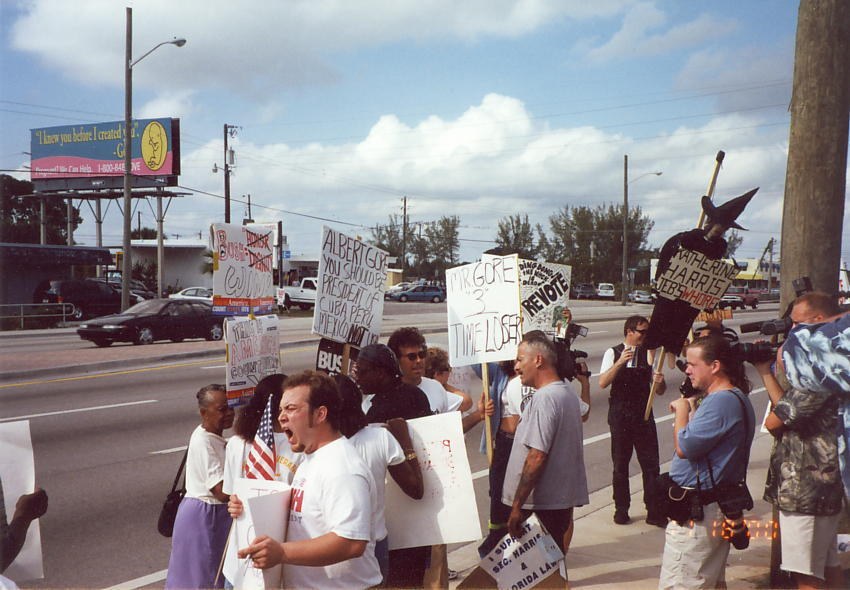
On November 22, Republican demonstrators disrupted Miami-Dade’s recount process. The episode became known as the Brooks Brothers riot because prominent participants included Washington political staffers rather than only local voters. GOP involvement is part of the historical record; presenting the event as merely a fictional grievance would be inaccurate. A later AP account identifies it as an effort by GOP staffers to stop counting. [1]
The same day, the county canvassing board voted to abandon its manual recount. A contemporaneous appellate opinion records the board’s stated explanation: the work could not be completed before the state court’s November 26 deadline. The court rejected an effort to compel its continuation. That establishes the official decision and rationale; it does not audit each board member’s private motivations. [2]
Gore’s legal side argued that intimidation helped force the decision. Lawyers Mitchell Berger and Candice Tobin, themselves participants in the Democratic effort, later documented that claim and cited contemporary reporting that election supervisor David Leahy considered the protest a factor. Their account also acknowledges that the state Supreme Court described the board’s stated problem as lack of time. Attribution and the authors’ involvement belong beside the evidence. [3]
Pressure and intimidation around vote counting are serious irrespective of the eventual tally. The further proposition—that absent this protest Gore certainly becomes president—requires assumptions about a completed count, its rules, deadlines and subsequent litigation. The independent ballot review does not permit that confident single-cause conclusion.