The AI Files · Sharp, Otpor, democracy promotion — and a 2028 claim · plain reading edition
Color Revolutions: every entry
All 29 entries of the guide, grouped by period and case, each with its bottom line and its sources. This page needs no JavaScript. The interactive guide adds the story in 6 chapters, the people, the timeline, the theories, the 11 checked claims and the media.
The Palace of Westminster, where Reagan delivered the June 1982 democracy address. ThatsTheBoss · CC0 (http://creativecommons.org/publicdomain/zero/1.0/deed.en)
June 1982 speech that framed democracy support as infrastructure, not just rhetoric.
On 8 June 1982 President Ronald Reagan told the British Parliament that the West should “foster the infrastructure of democracy — the system of a free press, unions, political parties, universities.” [1]
NED’s own histories treat the speech as the rhetorical origin of the Endowment; the American Political Foundation and a USAID “Democracy Program” grant followed before Congress acted. [2][3]
Bottom line Documented
The speech is primary text; the institutional follow-through is documented in NED and GAO histories.
What the record can’t settle
The speech did not name NED; the Endowment was a later Congressional design.
Carl Gershman, longtime president of the National Endowment for Democracy, 2024. Jindřich Nosek (NoJin) · CC BY-SA 4.0 (https://creativecommons.org/licenses/by-sa/4.0)
1983 statute: a private nonprofit funded by annual appropriation.
The National Endowment for Democracy was established by the NED Act (22 U.S.C. §§4411–4416) as a nongovernmental nonprofit that receives a Congressional appropriation. [1][2]
Four core institutes — CIPE, the International Republican Institute, the National Democratic Institute, and the Solidarity Center — became the main grant channels. [2][3]
A 1984 GAO report chronicled the political path from Project Democracy proposals to the Endowment compromise. [4]
NED rejects the “CIA front” label in its FAQ; critics continue to treat appropriation-plus-plausible-deniability as the point. [5]
Bottom line Documented
Legal creation and structure are not in dispute; purpose and effects are.
What the record can’t settle
Grant-level outcomes vary by country and year; this entry is about founding, not every later program.
The Albert Einstein Institution, associated with Gene Sharp’s nonviolence research. Dominic · CC BY-SA 3.0 (https://creativecommons.org/licenses/by-sa/3.0)
Gene Sharp wrote From Dictatorship to Democracy in 1993 as a practical text for Burmese democrats, not as a US-agency field manual. It compresses his larger Politics of Nonviolent Action into a photocopyable curriculum: roughly 198 methods of nonviolent action, plus the claim that dictatorships crack when “pillars of support” — police, bureaucracy, business, media, churches, unions — withdraw consent. [1][2][6][4]
The Albert Einstein Institution, which Sharp founded in 1983, became the distribution hub: free downloads, workshops, and translations that AEI later counted in the mid-thirties of languages. [3][5][4]
Srdja Popovic told RFE/RL that Otpor began using Sharp’s material in April 2000 — the same month Robert Helvey’s IRI-hosted Budapest workshops taught Sharp-based strategy to Otpor leaders. [1][5][7]
Sharp repeatedly denied being a US government agent. Influence — texts traveling, trainers citing him — is not the same as command. [1][2]
Bottom line Documented
Authorship, Burma origin, AEI distribution, Otpor’s admitted April 2000 use, and Helvey’s AEI link are documented. “CIA wrote FDTD” is not.
What the record can’t settle
AEI’s own achievements page lists other movements that used FDTD; this guide develops Serbia, Georgia and Kyrgyzstan — not Ukraine-war cases.
Albert Einstein Institution, “Important Achievements” AEI self-history: FDTD Burma 1993, 34+ translations; Helvey OTPOR workshop 2000; Kyrgyz FDTD distribution before Tulip. Mentions other cases (incl. Pora) — this guide does not develop Ukraine-war framing from those lines.
The Albert Einstein Institution, associated with Gene Sharp’s nonviolence research. Dominic · CC BY-SA 3.0 (https://creativecommons.org/licenses/by-sa/3.0)
Sharp’s 1983 nonprofit that researched and taught strategic nonviolent struggle.
Gene Sharp founded the Albert Einstein Institution in 1983 to promote research, policy studies and education on the strategic uses of nonviolent struggle against dictatorship and oppression. He served as Senior Scholar until his death in 2018. [1][5]
AEI’s digital library and workshops made Sharp’s shorter texts — especially From Dictatorship to Democracy — free and portable. The Institution reports scores of consultations and multi-day strategy workshops across decades. [2][3]
Robert Helvey, a retired US Army colonel closely associated with AEI, later ran the April 2000 Budapest strategic workshops for Otpor under IRI auspices — the practical bridge from Sharp’s pages to Serbian organizers. [3][4][6]
Bottom line Documented
AEI’s founding, Sharp’s role, free distribution of FDTD, and Helvey’s Otpor workshop are institutionally and journalistically documented.
What the record can’t settle
AEI is a small research/education nonprofit, not a clandestine command node; authoritarian regimes have nonetheless denounced it as a “color revolution” textbook publisher. [@aei-achievements]
Albert Einstein Institution, “Important Achievements” AEI self-history: FDTD Burma 1993, 34+ translations; Helvey OTPOR workshop 2000; Kyrgyz FDTD distribution before Tulip. Mentions other cases (incl. Pora) — this guide does not develop Ukraine-war framing from those lines.
The Albert Einstein Institution — home base for Sharp’s From Dictatorship to Democracy. Dominic · CC BY-SA 3.0 (https://creativecommons.org/licenses/by-sa/3.0)
The catalogue that made Sharp teachable in a weekend workshop.
Sharp’s catalogue of roughly 198 methods — protests, noncooperation, intervention — gave organizers a shared vocabulary shorter than his three-volume Politics of Nonviolent Action. [1][2][3]
The list travels as curriculum: photocopy, translate, drill. AEI’s free digital library and Otpor’s April 2000 turn to Sharp both treat the methods as technique, not metaphysics. [4][1]
Pillars-of-support theory sits beside the list: regimes depend on obedience from security forces, civil servants, business, media and civic institutions; withdraw those pillars and coercion becomes costly. [3][2]
Bottom line Documented
The methods list and pillars framing are Sharp’s published doctrine; their portability is why trainers cite him.
What the record can’t settle
A catalogue is not a guarantee of success; local conditions, elite splits and external pressure still decide outcomes.
The Albert Einstein Institution, associated with Gene Sharp’s nonviolence research. Dominic · CC BY-SA 3.0 (https://creativecommons.org/licenses/by-sa/3.0)
How a Burma handbook became an exportable training lineage.
The documented chain is short and public: Sharp writes FDTD (1993) → AEI distributes it → Helvey teaches Otpor leaders in Budapest (April 2000) as Otpor adopts Sharp’s methods → Otpor veterans found CANVAS (2005) to train activists beyond Serbia → Popovic’s Blueprint for Revolution popularizes the approach. [1][2][3][4][5]
Georgia’s Kmara and Kyrgyzstan’s Tulip-era NGO networks sit in the same “template” literature that treats Otpor aesthetics and Sharp methods as exportable. [6][2][9]
Sharp denied being a US agent; CANVAS presents itself as a training NGO, not a covert service. Influence along this lineage is real. Command-and-control from Washington is the contested leap. [7][3][8]
Bottom line Documented
Each link — text, workshop, Otpor use, CANVAS founding — is independently sourced. The leap from lineage to “CIA ran the revolutions” is not.
What the record can’t settle
This guide prefers Serbia, Georgia and Kyrgyzstan as historical cases; Orange/Euromaidan war framing is excluded.
Albert Einstein Institution, “Important Achievements” AEI self-history: FDTD Burma 1993, 34+ translations; Helvey OTPOR workshop 2000; Kyrgyz FDTD distribution before Tulip. Mentions other cases (incl. Pora) — this guide does not develop Ukraine-war framing from those lines.
CANVAS, “Who We Are” Self-description: founded 2005; Popovic executive director; Otpor founder; trains activists in 50+ countries.
Otpor’s clenched-fist Resistance branding on a Belgrade wall. Jovan Marković from Belgrade, Serbia · CC BY 2.0 (https://creativecommons.org/licenses/by/2.0)
Clenched fist, stickers, humor — a student movement that scaled.
Otpor (“Resistance”) formed in Belgrade in 1998 as a student-led movement against Slobodan Milošević, built around a clenched-fist logo and witty street actions. [1][2]
Branding and decentralized cells mattered as much as ideology; the look was designed to be copyable. [2][3]
Bottom line Documented
Otpor’s existence, aesthetics and anti-Milošević aim are not disputed.
What the record can’t settle
How much of the later victory was Otpor versus parties, unions and geopolitical pressure remains debated.
Panorama of Belgrade, Serbia. ZlatanJovanovic · CC BY 3.0 (https://creativecommons.org/licenses/by/3.0)
Multi-million US democracy aid is documented; exact totals and causal weight are contested.
Michael Dobbs’s December 2000 Washington Post investigation described US advisers, polling, sticker campaigns and funding flowing to Serbian opposition parties and civic groups through IRI, NDI, USAID and related channels. [1]
Sussman & Krader’s Template Revolutions compiles contemporary figures often repeated in the literature — on the order of tens of millions across US and European democracy aid — while stressing marketing and consultant roles. [2]
Institutions describe the same dollars as election assistance and civil-society support, not “buying a revolution.” [3][4]
Bottom line Partly true
That substantial Western democracy aid reached Serbia is documented; that aid alone “caused” Milošević’s fall is not proven.
What the record can’t settle
Published totals disagree by scope (USAID only vs all Western donors) and by year window.
Otpor’s Serbian clenched-fist mark — the brand taught alongside Helvey’s workshops. Le serbe · CC BY-SA 3.0 (https://creativecommons.org/licenses/by-sa/3.0)
Budapest workshops, April 2000.
In April 2000 the International Republican Institute hosted Otpor leaders in Budapest for strategic nonviolence training led by retired US Army Col. Robert Helvey, a Sharp collaborator. [1][2]
Popovic has publicly described Otpor’s turn to Sharp’s methods in that period. [1]
Dobbs’s WaPo piece situates the training inside a broader US advice ecosystem. [3]
Bottom line Documented
The Budapest training happened; participants and sponsors are named in contemporaneous and later accounts.
What the record can’t settle
Training is not remote control; Otpor leaders made on-the-ground choices.
Panorama of Belgrade, Serbia. ZlatanJovanovic · CC BY 3.0 (https://creativecommons.org/licenses/by/3.0)
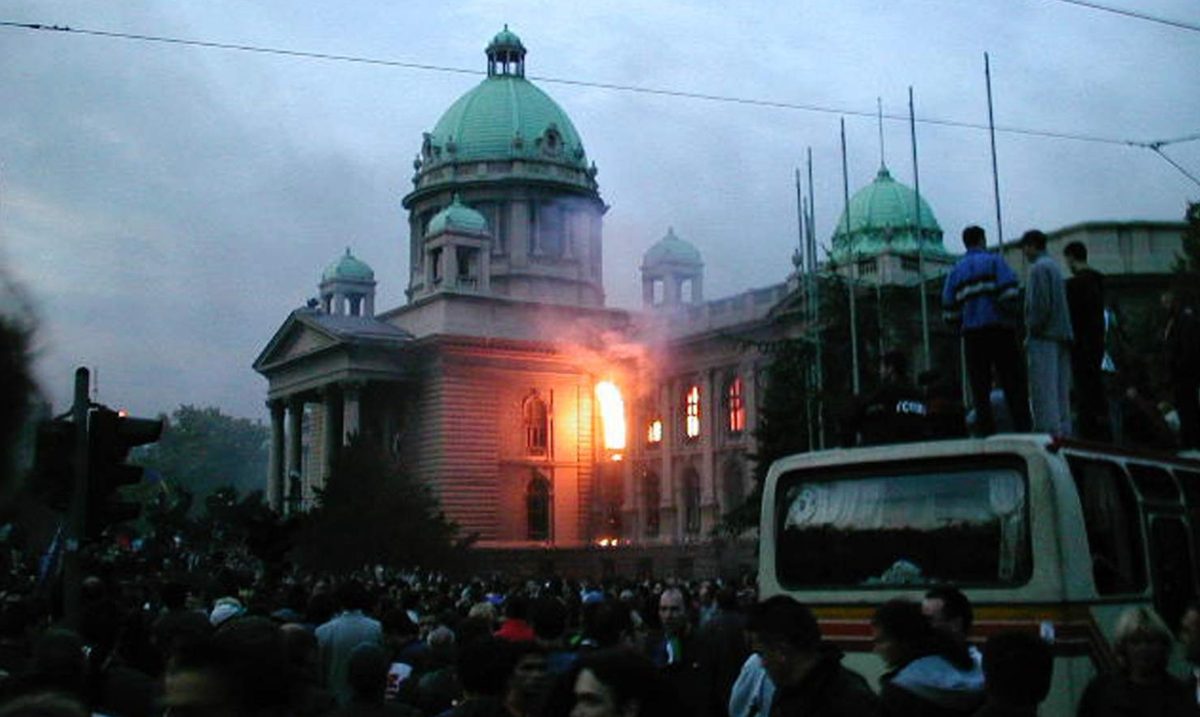
Disputed election, mass protest, Milošević resigns.
After the 24 September 2000 Yugoslav presidential election, opposition forces claimed Vojislav Koštunica had won; Milošević resisted. [1]
On 5 October protesters entered the federal parliament; a bulldozer became the emblem. Milošević resigned shortly afterward. [1][2]
Whether one calls this a democratic transition or a “color revolution” is the contested label — the sequence of election dispute → civic mobilization → resignation is documented. [3]
Bottom line Documented
The political outcome and the protest chronology are documented.
What the record can’t settle
Orange Revolution is a later, separate event and is not treated as a war case study in this guide.
Otpor Resistance imagery linked to the Bringing Down a Dictator teaching film. Jovan Marković from Belgrade, Serbia · CC BY 2.0 (https://creativecommons.org/licenses/by/2.0)
PBS film that turned Otpor into a teachable story.
Peter Ackerman’s production Bringing Down a Dictator (PBS / A Force More Powerful project) narrates Otpor’s campaign as a model of strategic nonviolence. [1]
The film circulated in activist trainings and is part of how the Serbian template was exported. [1][2]
Bottom line Documented
The film exists and was used pedagogically; it is advocacy media, not a neutral archive.
What the record can’t settle
Ackerman’s later Freedom House role is separate from the film’s content.
Srdja Popovic and colleagues created the Centre for Applied Nonviolent Action and Strategies (CANVAS) in 2005 to train activists beyond Serbia. [1]
CANVAS states it has worked with movements in more than fifty countries and publishes free manuals; Popovic’s Blueprint for Revolution popularized the approach. [1][2][3]
Bottom line Documented
CANVAS’s existence, leadership and public training mission are documented by the organization itself.
What the record can’t settle
Country-level impact claims vary widely and are often unverifiable from open sources.
Sources
CANVAS, “Who We Are” Self-description: founded 2005; Popovic executive director; Otpor founder; trains activists in 50+ countries.
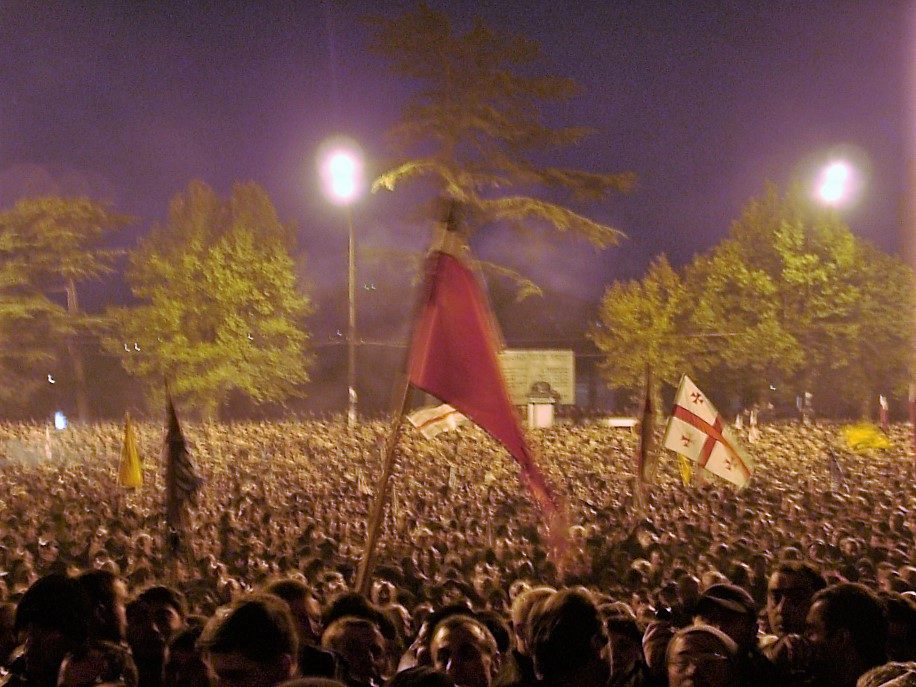
Tbilisi during the Rose Revolution, November 2003. Zaraza · CC BY-SA 3.0 (http://creativecommons.org/licenses/by-sa/3.0/)
Kmara, flawed elections, Shevardnadze resigns.
In November 2003, after parliamentary elections widely viewed as flawed, Georgian opposition and Kmara youth activists pressed Eduard Shevardnadze until he resigned; Mikheil Saakashvili emerged as the central opposition figure. [1][2]
Template Revolutions and contemporaneous reporting describe Otpor-style training and Western democracy-aid channels touching Georgian civic groups — figures and causal weight remain debated. [1]
Supporters call it a democratic breakthrough; critics call it a Western-backed template. Both frames use the same event sequence. [1]
Bottom line Documented
The resignation and protest sequence are documented; the “who really ran it” debate is not settled by a single ledger.
What the record can’t settle
This guide does not treat later Georgian–Russian wars as part of the color-revolution storyline.
Tbilisi during the Rose Revolution, November 2003. Zaraza · CC BY-SA 3.0 (http://creativecommons.org/licenses/by-sa/3.0/)
A 2004–05 Ukrainian event, not a war case study here.
The Orange Revolution (late 2004–early 2005) is widely listed among post-Serbia “color” uprisings in the academic and activist literature. [1]
Per this guide’s HARD STOP, we do not develop Euromaidan, current fighting, Zelensky, or invasion narratives. Orange appears here only as a named historical event in the wider sequence. [1]
Bottom line Documented
Naming is accurate; deep case treatment is deliberately omitted.
What the record can’t settle
Readers seeking Ukraine-war analysis should look elsewhere — not in this preview.
Bishkek, Kyrgyzstan — scene of the 2005 Tulip Revolution. Aitenir · CC0 (http://creativecommons.org/publicdomain/zero/1.0/deed.en)
Disputed elections, Akaev flees.
In March 2005, protests after disputed parliamentary elections in Kyrgyzstan culminated in President Askar Akaev’s departure from the country. [1]
As with Georgia, Western-funded NGOs and youth organizers appear in both celebratory and critical accounts; Template Revolutions groups Kyrgyzstan with the “template” cases. [2][1]
Bottom line Documented
Akaev’s fall and the election-protest sequence are documented.
What the record can’t settle
Subsequent Kyrgyz instability shows that removing a president is not the same as consolidating democracy.
Artwork commemorating Serbia’s 5 October 2000 uprising — a template later cited abroad. WagingNonViolence/Viktor Sekularac · CC BY 4.0 (https://creativecommons.org/licenses/by/4.0)
Marketing, money and consultants as a package.
Gerald Sussman and Sascha Krader’s 2008 open-access paper “Template Revolutions” argues that US and allied democracy-promotion in Eastern Europe combined branding, polling, training and money into a repeatable marketing package for regime change. [1]
The paper compiles secondary reporting (including Dobbs on Serbia) rather than leaking new classified files. [1][2]
Institutions reply that supporting elections and civil society is transparent policy, not a covert coup product. [3][4]
Bottom line Disputed
As a synthesis of open sources it is a real scholarly intervention; as a master-key explanation of every uprising it overreaches.
What the record can’t settle
We use it for sourced dollar/training claims on Serbia and Georgia, not as gospel for every later protest.
Artwork commemorating Serbia’s 5 October 2000 uprising — a template later cited abroad. WagingNonViolence/Viktor Sekularac · CC BY 4.0 (https://creativecommons.org/licenses/by/4.0)
Democracy promotion vs color revolution.
US institutions describe NED/USAID/IRI/NDI work as democracy promotion: elections, parties, independent media, civic groups. [1][2][3]
Critics — including Template Revolutions authors and later Benz/DR claim-makers — use “color revolution” to mean a Western-assisted playbook for removing disfavored governments under a democratic brand. [4][5][6]
Target regimes have also used “color revolution” as propaganda to tar any protest. That abuse does not automatically clear every funding trail. [4]
Bottom line Disputed
The dual vocabulary is the point of this guide: same dollars, rival moral frames.
What the record can’t settle
Orange Revolution is named in the wider literature; this guide does not develop it as a war case.
Sources
NED, “History” Official history: 1983 Act of Congress; four core institutes; Westminster Address context. Self-description.
Erica Chenoweth, co-author of Why Civil Resistance Works. East Point Peace Academy · CC BY 3.0 (https://creativecommons.org/licenses/by/3.0)
A research finding popularized into a slogan.
Erica Chenoweth and Maria J. Stephan’s Why Civil Resistance Works (2011) compared hundreds of campaigns and found nonviolent resistance more often successful than violent force in their dataset. [1][2]
Chenoweth’s 2013 TEDx talk popularized a sharper line: no campaign in their data failed once it achieved active participation of about 3.5% of the population. [3][2]
Chenoweth has described scope conditions and has warned against treating 3.5% as a magic switch; activists and claim-makers sometimes ignore those caveats. [2]
Bottom line Partly true
The book and the TEDx claim are real; “3.5% guarantees regime change” is a popular overread.
What the record can’t settle
Dataset coding choices and what counts as “active participation” are academic debates.
U.S. Capitol — stand-in for domestic “pro-democracy” organizing claims. Martin Falbisoner · CC BY-SA 3.0 (https://creativecommons.org/licenses/by-sa/3.0)
Domestic “pro-democracy” organizing with nonviolent-action language.
The Horizons Project describes itself as advancing Big Tent Democracy Organizing, including Block/Bridge/Build frames and nonviolent action for US politics. [1]
It does not publicly brand a “United Democracy Alliance.” That name appears in Democracy Files claims, not on Horizons’ homepage. [1][2]
Bottom line Documented
Horizons’ public self-description is documented; alleged secret UDA control-plane role is a separate claim.
What the record can’t settle
NGO mission pages are marketing as well as disclosure.
Sources
Horizons Project, official site Self-description: Big Tent Democracy Organizing; Block/Bridge/Build; Nonviolent Action. Does not publicly brand a “United Democracy Alliance.”
The Pentagon — national-security-leaders networks sit near this world. Touch Of Light · CC BY-SA 4.0 (https://creativecommons.org/licenses/by-sa/4.0)
Public toolkit from former national-security leaders.
National Security Leaders for America publishes an Election Interference Toolkit aimed at local officials and engages in midterm endorsements. [1]
Democracy Files cast NSL4A as operationalizing parts of a UDA/Insurrection Act strategy; NSL4A’s own site presents election-security and democratic-norms language. [1][2]
Bottom line Documented
The toolkit’s public existence is documented; secret “color revolution command” status is not admitted.
What the record can’t settle
Membership lists and private working-group minutes are mostly outside the open record.
East front of the U.S. Capitol. Martin Falbisoner · CC BY-SA 3.0 (https://creativecommons.org/licenses/by-sa/3.0)
Public step-by-step technique literature — CrimethInc and “forming a group” zines.
CrimethInc’s 14 March 2017 “Step-by-Step Guide to Direct Action” sequences brainstorm → affinity groups → security culture → legal/media prep → scouting and roles → action → dispersal → debrief. A related Civilian’s Guide sits in the Anarchist Library. [1][2]
Parallel “Forming an Antifa Group” how-tos (It’s Going Down host and similar zine PDFs) teach closed, vetted affinity organizing, security culture, and local research — technique literature published openly, not a State Department cable. [3]
These texts matter for a future-facing watch path because they document how some US organizers teach escalation craft. They are not proof of a single national command, and they are not identical to Sharp’s nonviolent curriculum — affinity-group direct action and strategic nonviolence are overlapping but distinct traditions. [1][4]
Bottom line Documented
The how-tos are real public documents. Treating them as a national color-revolution order sheet is a leap this guide does not make.
What the record can’t settle
Authorship, edition, and local uptake vary; one PDF is not a census of every local group.
Sources
CrimethInc., “A Step-by-Step Guide to Direct Action,” 14 Mar 2017 Public how-to: brainstorm → goals → affinity groups → recruiting → security culture → legal support → media → planning/scouting → roles → action → dispersal → debrief. Technique sequence, openly published.
East front of the U.S. Capitol. Martin Falbisoner · CC BY-SA 3.0 (https://creativecommons.org/licenses/by-sa/3.0)
DSA’s published 2025–2026 program — organize, democracy battle, new constitution.
The Democratic Socialists of America publishes Workers Deserve More as its 2025–2026 program on program.dsausa.org, with a downloadable PDF. The text tells members to build labor and electoral power, defeat the far right, and organize “millions.” [1][2][3]
The same program states the goal to “win the battle for democracy,” draft a new constitution, and create a democratic socialist republic — structural end-state language DSA prints openly. [2][4]
Data Republican’s Democracy Files fold DSA into a “foot soldiers” role for a larger 2026–2028 claim. DSA’s own materials describe a socialist membership organization — not a color-revolution cell. Label: Documented program text vs Claim about UDA coordination. [5][3]
Bottom line Documented
DSA’s program language is primary, public, and citable. What DR asserts about DSA’s role in a UDA plan is a separate claim.
What the record can’t settle
Internal DSA factionalism means “DSA” is not a single command; program text is not an operational order sheet.
Sources
DSA, Workers Deserve More program (program.dsausa.org) Public DSA program: organize workers; “win the battle for democracy”; draft a new constitution; create a democratic socialist republic. Documented self-description — not an admission of a “color revolution.”
DSA, Workers Deserve More 2025–2026 program PDF PDF edition of WDM: defeating the far right, protecting working-class rights, fighting for democracy as top priorities; structural democracy reforms listed.
DSA Political Platform from 2021 Convention Earlier convention platform: democracy, labor, foreign-policy planks. Context for continuity of DSA “battle for democracy” language.
Seal of the United States Agency for International Development. U.S. Government · Public domain
Institutional contraction, persistent people.
USAID’s Democracy, Rights and Governance work is a long-standing agency pillar; personnel and partner NGOs form a recognizable professional community. [1][2]
Democracy Files claim that after recent DRG contraction, alumni reorganized as Resistance to Tyranny (R2T) and related RAD associations and left a ~312 GB Google Drive public by misconfiguration. [3][4][5]
That alumni network socially does not, by itself, prove a coup plan — but it is the claimed substrate for the 2028 watch. [6]
Bottom line Mixed
DRG as a career field is real; the specific R2T archive story is presently one publisher’s account plus whatever documents they host.
What the record can’t settle
Independent forensic verification of the full drive is outside this guide’s scope as of 23 Oct 2026.
U.S. Capitol — stand-in for the claimed R2T/RAD archive exposure. Martin Falbisoner · CC BY-SA 3.0 (https://creativecommons.org/licenses/by-sa/3.0)
Data Republican’s claim package from an alleged public R2T drive.
Beginning 19 October 2026, Data Republican published a multi-part “Democracy Files” series on X, stating that a ~312 GB Resistance to Tyranny / RAD archive was left publicly accessible on Google Drive. [1][2][3]
Named public organizations (Horizons, NSL4A, DSA, Indivisible) exist; the claim is that they (or overlapping personnel) form a coordinated control plane — which those groups do not concede. [7][8][9][10]
Bottom line Theory watch
Treat as a primary claim package under theory watch, not as settled history.
What the record can’t settle
This guide does not cite DR threads that are primarily about the Ukraine war.
Horizons Project, official site Self-description: Big Tent Democracy Organizing; Block/Bridge/Build; Nonviolent Action. Does not publicly brand a “United Democracy Alliance.”
Data Republican’s short form (16–18 Oct 2026): Democrats win big in 2026 with DSA as foot soldiers; 2027 features election-meltdown and Insurrection Act triggers; by 2028 the goal is structural reform under a legitimacy narrative managed by a United Democracy Alliance. [1][2][3]
Chenoweth’s 3.5% rule is cited inside the claim as a participation target, not as Chenoweth endorsing the plan. [4][5]
US DSA is the Democratic Socialists of America — not the EU Digital Services Act. [6]
Bottom line Theory watch
This is the central theory-watch thesis. Confirmation and falsification criteria live in Open questions.
What the record can’t settle
No public institutional document we cite adopts “UDA 2028 structural reform” as an official program name.
East front of the U.S. Capitol. Martin Falbisoner · CC BY-SA 3.0 (https://creativecommons.org/licenses/by-sa/3.0)
Democracy Files role for US Democratic Socialists.
DR’s outline casts the Democratic Socialists of America as street-level capacity for a 2026 realignment — canvassers and disruptors inside a larger alleged architecture. [1][2]
DSA’s own materials describe a socialist membership organization with electoral and movement work — not a color-revolution cell. [3]
Conflating US DSA with the EU Digital Services Act is a common error; this guide means the American socialist group. [3]
Bottom line Theory watch
DSA exists and organizes; the “foot soldiers of a UDA 2028 plan” role is a watch claim.
What the record can’t settle
Internal DSA factionalism means “DSA” is not a single command.
General blob / CIC framing via FFO + X (non-Ukraine).
Mike Benz — executive director of the Foundation for Freedom Online — argues that NED and related “democracy” funders merged classic political aid with counter-disinformation programs that pressure platforms: a “censorship industrial complex” abroad and at home. [1][6][7]
FFO’s site carries the thesis in report form: Censorspeak Decoded (2023), the 2024 Censorship Index, and later pieces on Atlantic Council EU lobbying and an “AI safety blob.” [2][3][4][5]
He contrasts State Department public-diplomacy spending that once funded free-speech initiatives with later censorship-adjacent priorities. [8][1]
USAID–Internews dollar claims circulate in his orbit; treat specific figures as allegations until matched to agency documents. [9][10]
NED’s own materials present counter-disinformation as protecting democratic discourse, not suppressing dissent. [11][12]
Bottom line Disputed
The institutional overlap of democracy grants and “counter-disinfo” programs is real enough to debate; Benz/FFO’s maximal thesis remains contested.
What the record can’t settle
Ukraine-war-focused Benz threads are excluded by HARD STOP. FFO supplements X posts; it does not replace them.
Sources
Foundation for Freedom Online, About Self-description: educational reports, legal assistance, public-policy analysis on digital liberties; Benz as founder/ED, former State DAS for intl communications/IT.
FFO, “The Emerging AI Safety Blob,” 21 Sep 2026 FFO frames an AI-safety network as a successor “blob” shaping rules via evaluators and policy — extends Benz blob thesis beyond classic democracy NGOs.
Benz’s Foundation for Freedom Online glossary of counter-disinfo jargon.
Foundation for Freedom Online — Mike Benz’s free-speech watchdog ([4][3], author page [5]) — published “10 Terms of Censorspeak Decoded” in March 2023, arguing that agencies and partners redefined words like mal-information, friction, resilience and threat actor to justify throttling ordinary domestic speech. [1][2]
FFO’s later Censorship Index and Atlantic Council / AI-safety / Australia digital-crackdown reports extend the same thesis: US and allied “democracy” and security grants feed NGOs and labs that pressure platforms. Treat specific dollar totals as FFO’s reading of disclosed records until matched line-by-line to agency documents. [6][7][8][9]
This entry supplements Benz’s X posts with FFO site primary pages; it does not replace them. Ukraine-war-primary Benz threads remain excluded. [10][4]
Bottom line Disputed
FFO is a real organization with public reports; its maximal “censorship industrial complex” reading remains contested by the institutions it names.
What the record can’t settle
Publisher/advocacy analysis, not a court finding. Separate documented grants from the claim that every grant equals speech coercion.
Foundation for Freedom Online, About Self-description: educational reports, legal assistance, public-policy analysis on digital liberties; Benz as founder/ED, former State DAS for intl communications/IT.
FFO, “The Emerging AI Safety Blob,” 21 Sep 2026 FFO frames an AI-safety network as a successor “blob” shaping rules via evaluators and policy — extends Benz blob thesis beyond classic democracy NGOs.
Harry S. Truman Building, U.S. Department of State headquarters. Paco8191 · CC BY 3.0 (https://creativecommons.org/licenses/by/3.0)
War-on-terror tech partnerships → domestic information control (publisher thesis).
Jacob Siegel’s The Information State: Politics in the Age of Total Control (Henry Holt, on sale ~24 March 2026, ~336 pp.; ISBN 1250363136) argues — per publisher copy — that post-2001 government–tech partnerships built for the war on terror evolved into domestic systems of censorship, surveillance and algorithmic perception-shaping under a “war on disinformation.” [1][2][3][5]
Siegel’s March 2023 Tablet essay “A Guide to Understanding the Hoax of the Century” is the long public preview of that thesis: counter-disinfo as information war, an “NGO Borg,” and the foreign/domestic boundary collapsing. [4]
The book’s marketing blurbs mention Ukraine among other contested speech episodes. This guide uses Siegel for the domestic information-state / counter-disinfo thesis and does not expand Ukraine-war case material. Full-text page quotes are not invented here — descriptions track publisher copy and the public Tablet essay. [1][4]
Siegel overlaps Benz/FFO’s blob framing from a Tablet/journalist lane rather than an FFO report lane. [6][7]
Bottom line Disputed
A major trade book and a prior long essay advance a coherent information-state thesis; whether every institutional link holds is disputed.
What the record can’t settle
We have not treated the full 2026 hardcover as line-checked primary here; rely on publisher description + Siegel’s public 2023 essay unless/until full-text review.
Sources
Jacob Siegel, The Information State: Politics in the Age of Total Control (Google Books) Henry Holt, on sale ~24 Mar 2026; ISBN 1250363136 / 9781250363138; ~336 pp. Publisher description: war-on-terror tech partnerships → domestic information control / counter-disinfo as dissent suppression. Book blurbs mention Ukraine among censorship examples — this guide uses the domestic info-state thesis only.
Foundation for Freedom Online, About Self-description: educational reports, legal assistance, public-policy analysis on digital liberties; Benz as founder/ED, former State DAS for intl communications/IT.
Comment, dispute or support a claim, submit a source or rate this page through a short Google Form. It asks you to sign in with Google so we know you are a real person; your email is never shown. Nothing appears here until it has been reviewed. Conversation on X tagged #AIFiles #AIFilesColorRevolutions shows up below after the daily refresh.
Approved reader comments and ratings are shown on the interactive edition. This plain reading edition does not load them.
On X
This plain reading edition does not load posts. You can read this subject’s threads on the forum: Forum: #AIFilesColorRevolutions.
Reader comments are shown only after review, and rows removed from the form’s sheet disappear at the next refresh. X posts are a read-only daily snapshot; posts deleted or made private there are removed at the next refresh. Inclusion is not endorsement. A submitted source stays pending review until a page update says otherwise.

















Approved reader comments and ratings are shown on the interactive edition. This plain reading edition does not load them.