← Interactive guidePUBLIC RECORD / READING EDITIONOffline ZIP ↓

CIA detention and interrogation / 2001–2009 / selected aftermath to 2022

Secret custody. Public reckoning.

After 9/11, the CIA built a secret detention and coercive interrogation program. Official records establish severe abuse; the dispute over intelligence value and accountability requires a closer chronology.

An AI-written documentary guide to the CIA detention and interrogation program, the people subjected to it, and the records, defenses and proceedings that followed.

Scope & method / Edition 1.0

A documented program, a disputed justification.

The core is CIA detention and interrogation after 11 September 2001, including authorization, actual treatment, intelligence claims and selected accountability outcomes. Military detention and other rendition cases are included only where their relation is documented.

Read the chapters for a narrative; use the record below to test it. Established means the specific proposition is documented. Interpretation marks an inference or a historical argument. Unknown means the record here cannot decide. An archive’s possession of a document does not endorse its contents.

Research checked 25 October 2026. Selected sections of the official Senate study, minority views, CIA response and corrections lead, alongside legal memoranda, public statements and selected judicial/settlement records. This is not a complete detainee ledger, medical audit or survey of all later litigation. Site names remain redacted where this corpus does not establish them.

01 / The record

The story

The complete narrative, followed by the supporting record.

The September 2001 capture-and-detain authority
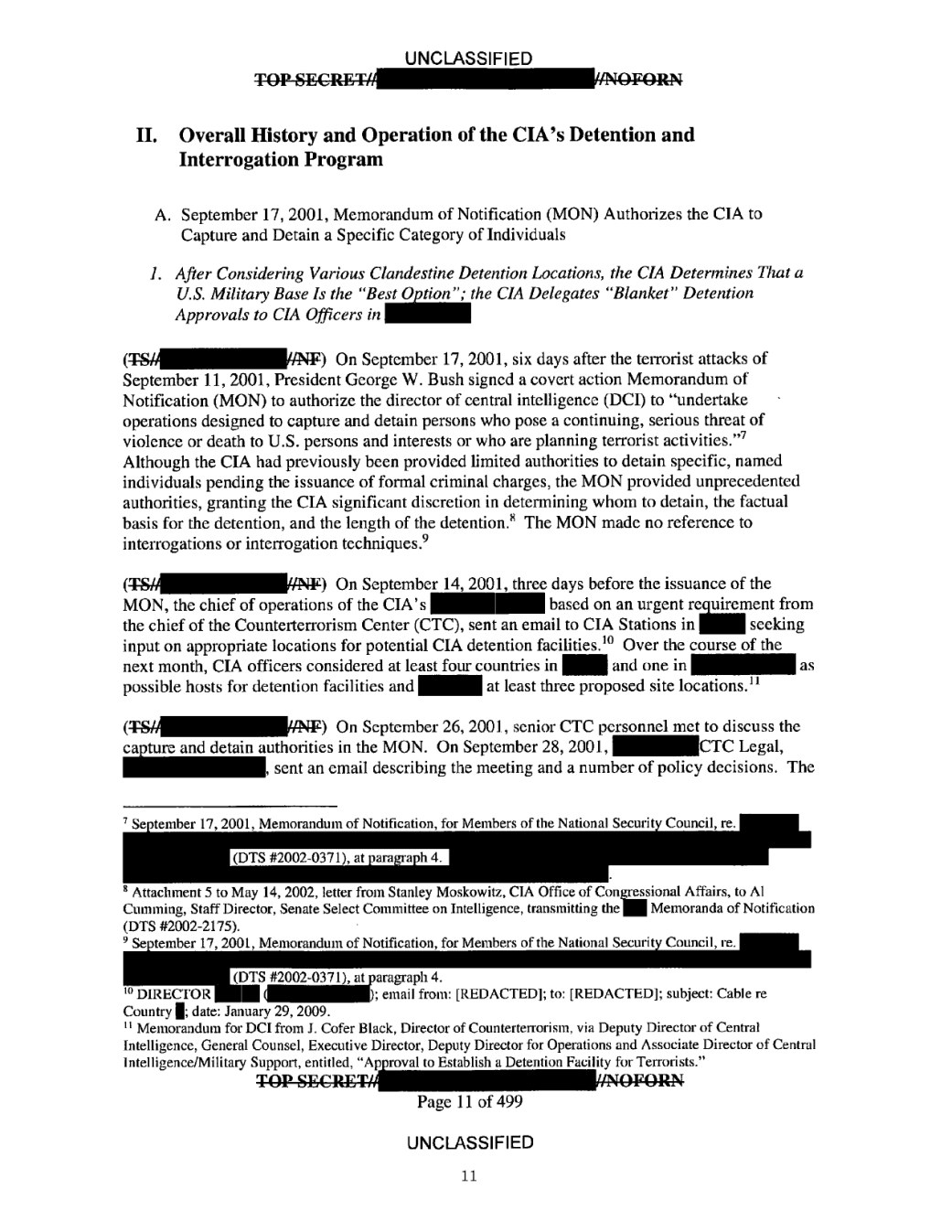
The Senate summary reproduces the September 2001 capture-and-detain authority and notes that it did not specify interrogation methods. Printed page 11 of the executive summary. Image credit ↗

Chapter 01 / 2001–March 2002

A capture authority becomes a detention system

The attacks of 11 September 2001 killed thousands and transformed the demands placed on American intelligence. Officials feared further attacks and believed captured al-Qaeda figures could reveal plots, networks and locations. Those concerns were real features of decision-making. The choices that followed concerned how an intelligence service would imprison and question people outside the ordinary public criminal process, and who would know enough to constrain it. A strategic emergency explained the pressure for information; it did not specify a necessary detention system or settle the legality of its methods.

On 17 September President George W. Bush signed a covert-action Memorandum of Notification authorizing the CIA to capture and detain people posing a continuing serious threat or planning terrorist activity. The Senate study later emphasized that the memorandum did not mention interrogation techniques. Authority to seize and hold someone therefore preceded a separate series of decisions about treatment. The CIA considered locations abroad and initially discussed standards drawn from prisons and prisoner-of-war practice. Its 2013 response acknowledged that it lacked trained interrogators, adequate language capability and a core competence in detention-facility management.

Abu Zubaydah’s capture in Pakistan in March 2002 brought these questions into a concrete case. He was wounded, treated and moved into secret CIA custody. Officials initially assessed him as a senior al-Qaeda figure with knowledge of future attacks. Later records complicated that characterization. The importance attached to him in 2002 is evidence about officials’ beliefs and priorities, rather than proof of every allegation about his position. Detention, intelligence assessment and a criminal determination of guilt are different processes.

The emerging system also depended on other governments: places to hold people, permissions to move them, intelligence relationships and arrangements that concealed custody. The redacted Senate record often identifies sites through colors rather than public place names. This guide follows those documented institutional relationships without reconstructing every flight or assigning a country to a redaction by inference alone. CIA custody also needs to remain distinct from military detention and the wider history of Guantánamo or Abu Ghraib. These systems intersected, but their command chains, detainees and legal proceedings were not identical.
Sources: S01 · S02 · S08

OLC conclusion and signature, 1 August 2002
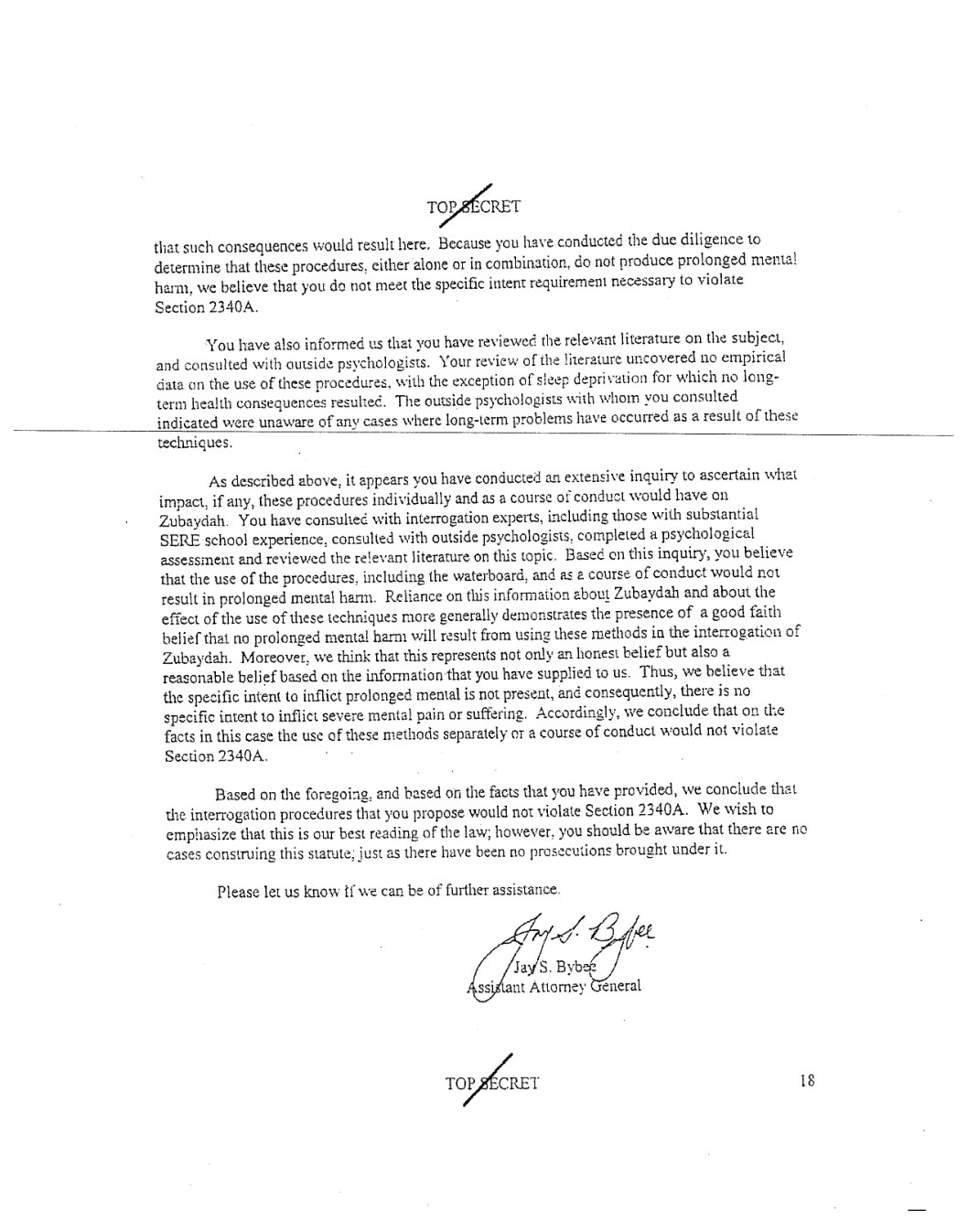
Bybee’s concluding page gives advice based on facts supplied by CIA. The opinion did not establish that actual conduct matched those facts. Image credit ↗

Chapter 02 / 2002–2003

Legal advice met a different operational reality

The 1 August 2002 letter from Assistant Attorney General Jay Bybee to CIA counsel John Rizzo memorialized legal advice about proposed treatment of Abu Zubaydah. It depended expressly on facts supplied by the agency, including claims about his health, the expected effects of the procedures and the interrogators’ intent. The conclusion addressed the federal torture statute under that description. It was neither a judicial hearing of evidence nor a finding that all treatment occurring in every prison was lawful. The assumptions in the request became part of the legal machinery authorizing action.

The program used waterboarding, prolonged sleep deprivation, stress positions and other coercion. The Senate’s account describes severe physical and psychological suffering, incidents exceeding written guidance and additional practices for which prior approval had not been obtained. The CIA response accepts that officers and contractors sometimes used unauthorized or excessive methods, while contesting parts of the committee’s account and its treatment of different periods. These admissions matter, but the harm cannot be confined automatically to whatever a particular office categorized as an unauthorized departure. An approved method still requires scrutiny of its actual use and effects.

Two contract psychologists played central roles in designing and administering the methods and assessing detainees. The Senate identified their backgrounds in military survival training, their limited interrogation and cultural expertise, and conflicts in having people evaluate the effects of techniques they were themselves applying. The later public litigation identified the psychologists as James Mitchell and John “Bruce” Jessen. CIA accepted that it should have done more to prevent conflicts of interest. The record thus places contractors within an agency program, rather than treating outsourcing as a transfer of governmental responsibility out of existence.

The contract figures also describe different things. The Senate reported a potential contract value exceeding $180 million with options and $81 million received before termination in 2009. A possible ceiling is not the amount paid. More broadly, legal advice, operational authority, headquarters approval and an interrogator’s conduct were related but separate links. The 2009 withdrawal of earlier OLC opinions changed the government’s legal position. It did not retroactively supply a criminal verdict against each participant, just as the original legal advice did not prove that every described act occurred within its conditions.

Sources: S01 · S02 · S05 · S07

The Gul Rahman death and accountability record
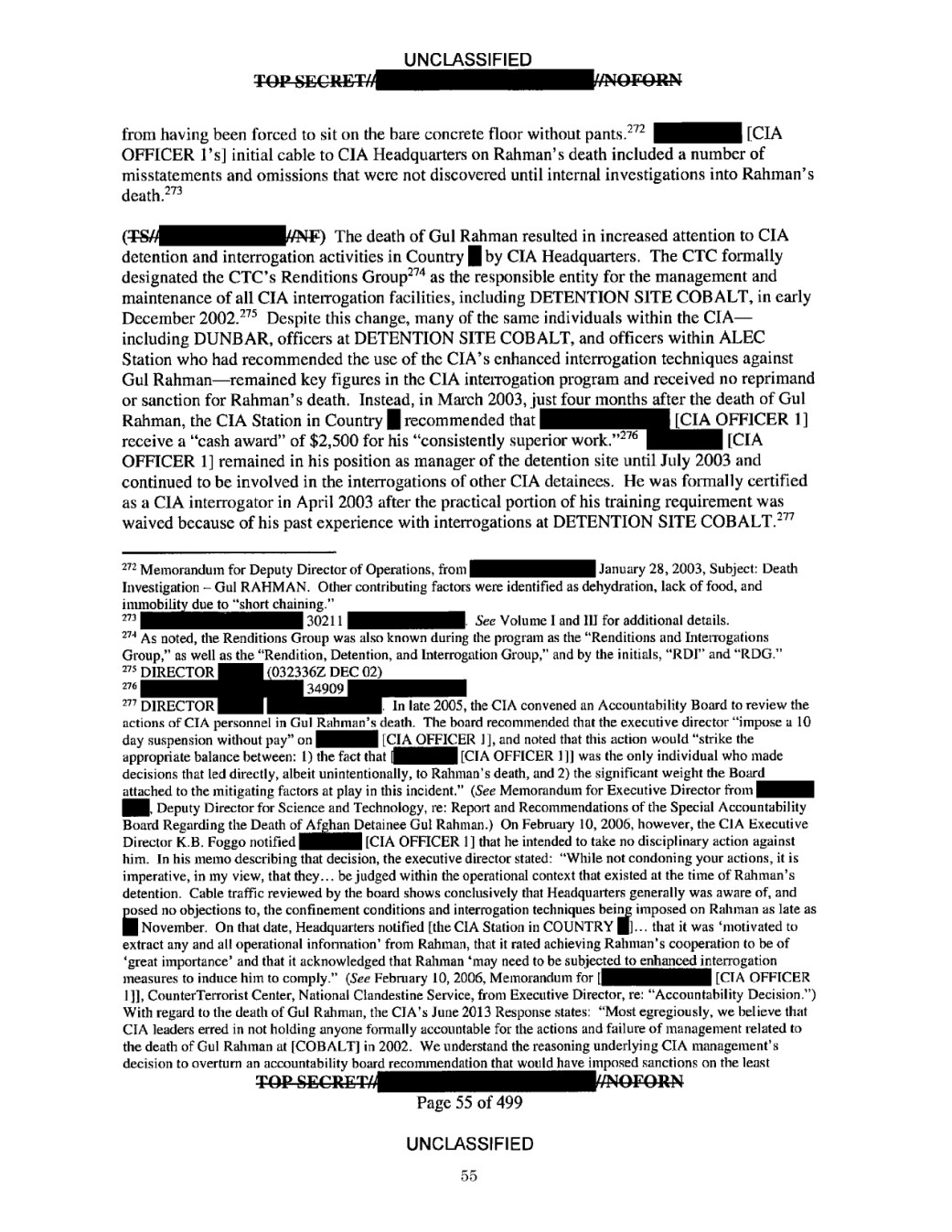
The Senate account links Gul Rahman’s death to detention conditions and describes the subsequent accountability decisions. Executive-summary printed page 55. Image credit ↗

Chapter 03 / 2002–2008

The system failed people it could barely count

The scale of the program was itself a contested administrative fact. The Senate identified at least 119 people in CIA custody and at least 39 subjected to the agency’s enhanced techniques. It found at least 26 who had not met the detention standard in the September 2001 authorization. These categories are not interchangeable. Failure to meet that executive standard is a serious finding about wrongful custody; it is not a judicial declaration about every possible accusation against a person. The study also described incomplete records and detentions continuing after officials recognized problems with their basis.

Among the clearest consequences was the death of Gul Rahman at the facility called COBALT in November 2002. The Senate’s account, drawing on internal investigations and an autopsy, describes a severely cold environment, deprivation and restraint. It reports that he likely died from hypothermia, with dehydration, lack of food and immobility among contributing factors. The narrative does not depend on a speculative total death count or on transferring responsibility for every death in American custody into this particular CIA chain. Rahman’s case has its own documented sequence of treatment, reporting and management response.

The death exposed how little headquarters understood about some site practices. CIA subsequently centralized management under its renditions organization, but the Senate found that key personnel continued in the program and that proposed discipline was not imposed. Its footnotes also preserve the CIA’s contrary emphasis on the responsibility of leaders rather than singling out one officer. This is an accountability dispute about a death within an institution, not evidence that only one person or only one level could have mattered. Orders, supervision, conditions and reporting all belong in the causal chain.

Prisoners also experienced the uncertainty of secret, incommunicado confinement and transfers between sites. Some supplied false information; some were held on the basis of other detainees’ fabrications. The public record does not permit a full clinical history or complete roster of consequences for everyone detained. Survivor statements in later litigation add the experience of people who lived through the system. The 2017 joint settlement statement in Salim v. Mitchell acknowledged the plaintiffs’ suffering and the abuses leading to Rahman’s death while retaining disagreement over the psychologists’ responsibility. That distinction preserves both the admitted harm and the contested allocation of liability.

Sources: S01 · S02 · S03 · S12

CIA response on courier information and alternatives
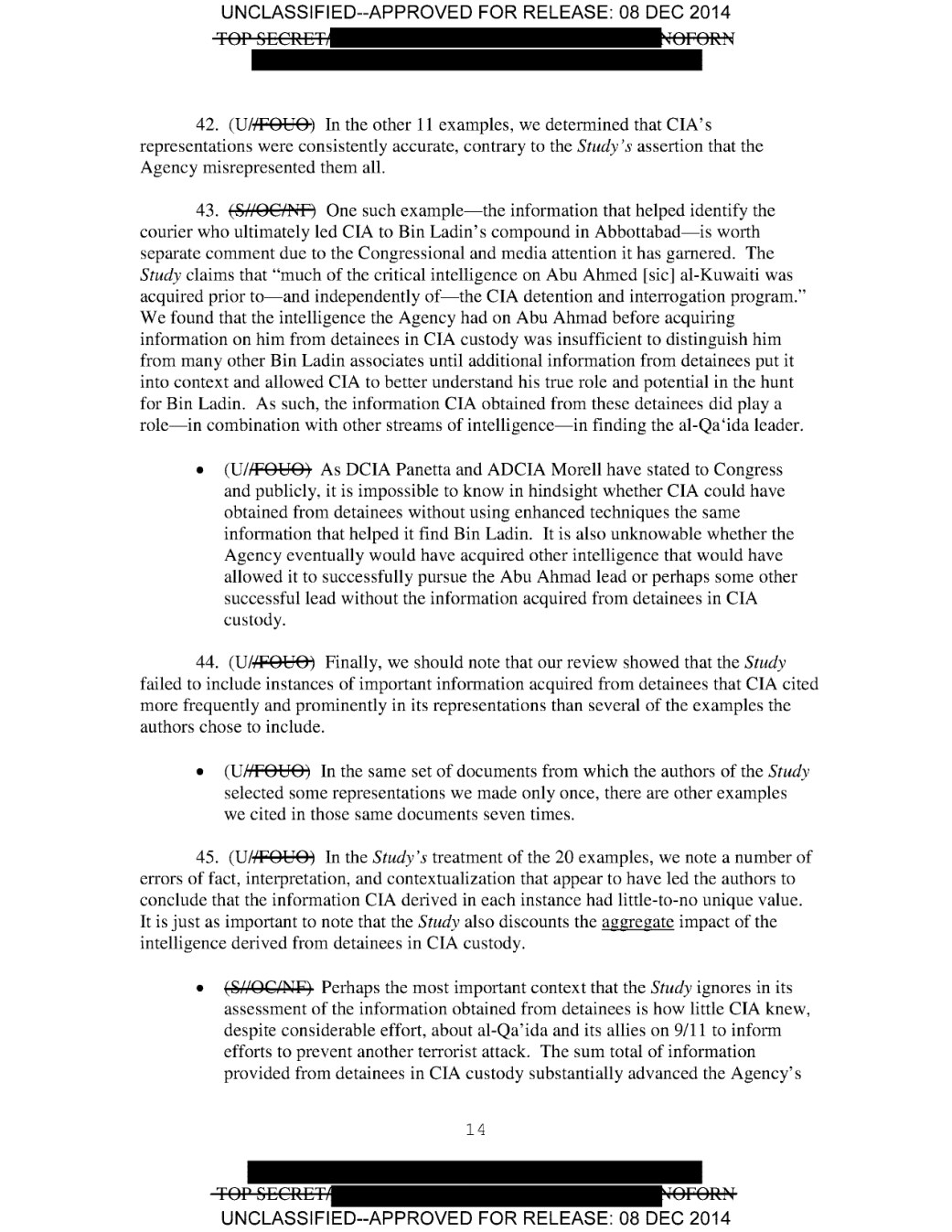
CIA’s response argues that detainee reporting helped identify bin Laden’s courier while acknowledging the unknown alternative course. Printed Tab A page 14. Image credit ↗

Chapter 04 / 2002–2014

Intelligence value became the central dispute

The strongest defense of the program is not that nothing harmful happened. It is that officials facing a poorly understood enemy acquired information that helped identify operatives, interpret networks and prevent attacks. CIA’s 2013 response argued that intelligence from detainees had substantial aggregate value and that corroboration could matter even when a name or fragment was already known. The Senate minority similarly objected to an analysis focused too narrowly on unique reporting. On that reading, a later piece of information can make an earlier lead actionable rather than merely duplicate it.

The majority’s central challenge concerned both causation and representation. It compared claims made for the techniques with the chronology in cables and other records, finding that important information was already available, had come from other sources, or had been obtained before particular coercive measures. Intelligence supplied by someone who had been tortured does not by itself identify torture as its cause. Conversely, knowing one fact beforehand does not establish that all later context was worthless. The question becomes which report changed an identified decision and what the records show about how it was obtained.

Two examples illustrate the difference. CIA defended detainee reporting as part of the combination that identified and located the courier leading to Osama bin Laden. Its response also said it was impossible to know whether the same information, or an alternative route to the target, could have been obtained without the enhanced techniques. In the Hambali narrative, the agency’s 2014 corrections acknowledged errors in the sequence of reporting from Khalid Sheikh Mohammed and Majid Khan. It maintained that the combination of their information remained important. The correction weakens particular earlier representations without automatically resolving every contribution made by either detainee.

Brennan’s public response in December 2014 likewise defended valuable reporting while acknowledging that the alternative interrogation outcome was unknowable. The defense and criticism must therefore be tested at different levels: whether a detainee supplied useful information, whether a technique produced it, whether a particular public claim was accurate, and what costs accompanied the program. Operational logs, original reporting timestamps and documented decisions can alter individual assessments. A hypothetical emergency or an aggregate count of intelligence reports cannot alone establish that the coercive methods were necessary, effective on balance or lawful.

Sources: S01 · S02 · S03 · S04 · S13

Senate minority critique of effectiveness and methodology
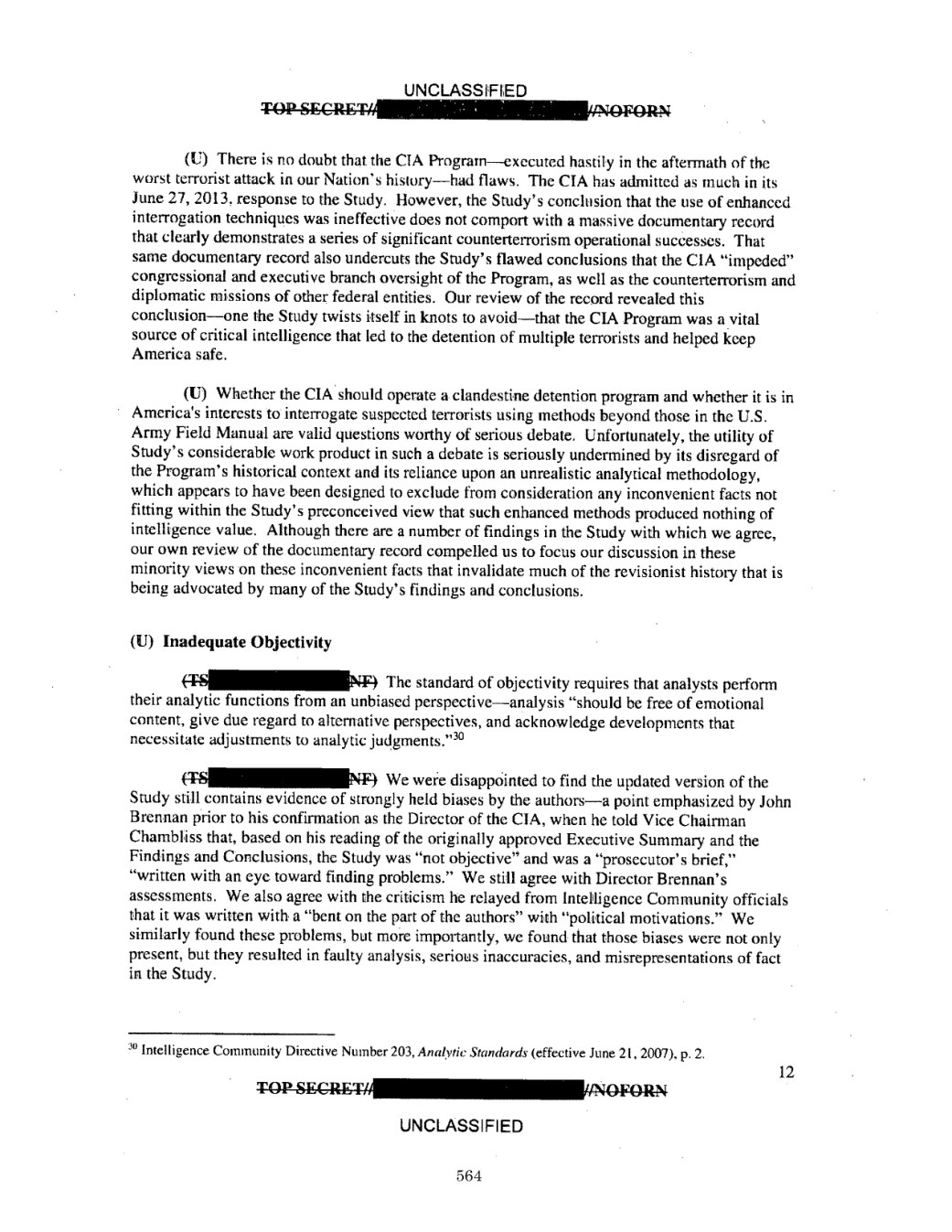
The Senate minority accepts program flaws and disputes the majority’s method and conclusions. This page is part of its published views, not the majority finding. Image credit ↗

Chapter 05 / 2004–2014

Secrecy produced competing documentary histories

The program was never a secret shared equally by everyone in government. Its operation involved legal advice, selected briefings, medical personnel, contractors and foreign partners, but access and knowledge differed. The Senate study found that CIA supplied inaccurate information and impeded oversight. The agency disputed the breadth of that conclusion and argued that records showed approvals, briefings and internal investigation. Establishing that a briefing occurred is one factual question; establishing what it accurately conveyed is another. The record requires attention to content and timing, not just the existence of a meeting.

The CIA inspector general’s 2004 review had already raised concerns about treatment, authorization and management. Another critical event came in November 2005, when CIA destroyed videotapes of interrogations of Abu Zubaydah and Abd al-Rahim al-Nashiri. The Senate chronology dates destruction to 9 November. Loss of the recordings changed what later investigators could inspect directly. It did not leave them without cables, interviews, medical records and internal memoranda, but a written account cannot be assumed to preserve every detail a recording would have shown.

The Senate launched the larger study in 2009 and approved it in 2012. Its staff relied on a vast documentary corpus and existing interview records. It did not conduct new interviews with the principal program participants, a limitation linked in the foreword to the Justice Department’s criminal investigation. The minority and CIA argued that this reduced opportunities to resolve ambiguities or test context. That is a serious methodological criticism. The majority’s reply rested on the specificity of contemporaneous agency records, including contradictions between what officials knew and what they later represented. A missing new interview does not itself make a documented chronology false.

The 2014 release brought the redacted executive summary, findings and competing views into public circulation. CIA’s 2013 response and subsequent corrections belong alongside it. None is a neutral transcript of all the events: the committee majority investigated misconduct, the minority contested its conclusions and the agency defended its record while admitting failures. Their institutional interests affect how claims should be tested. They do not reduce every statement to an equally unsupported opinion. A particular cable, acknowledged correction or authenticated order can carry more weight than a general defense, accusation or retrospective memory.

Sources: S01 · S02 · S03 · S04 · S14

OLC withdraws CIA interrogation opinions, 15 April 2009
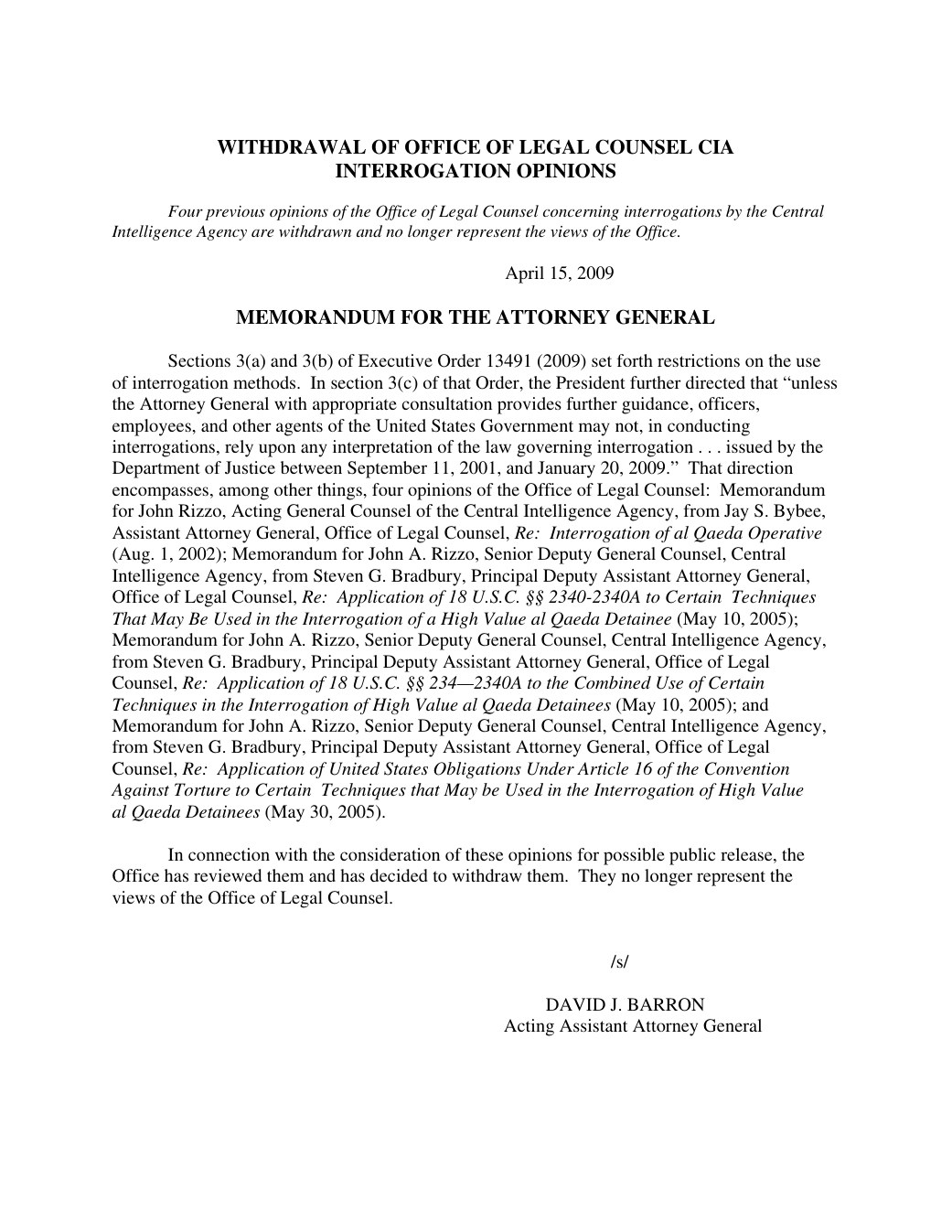
OLC’s 15 April 2009 memorandum formally withdrew four interrogation opinions following the new executive order. It is a policy/legal change, not an individual verdict. Image credit ↗

Chapter 06 / 2006–2015

Acknowledgment did not end the program on one day

On 6 September 2006 Bush publicly acknowledged the CIA detention program and announced that 14 men were being transferred to military custody at Guantánamo. He defended the intelligence it had produced and insisted that the United States did not torture. The speech was both a disclosure and an argument for continuing a distinct intelligence capability. Transfer out of CIA custody did not answer every question about prior treatment, future detention or the evidence that could be used in a prosecution.

The program had already contracted under several pressures. The Senate described host-government resistance, public exposure, legal disputes and difficulty providing medical care or finding an enduring destination for detainees. Its chronology records the last use of the enhanced techniques in November 2007 and no detainees held by CIA after April 2008. Public acknowledgment in 2006, the last recorded use of techniques and formal policy closure in 2009 are therefore different events. No single speech captures the whole operational ending.

Obama’s 22 January 2009 Executive Order 13491 restricted interrogation to the Army Field Manual framework, barred reliance on specified earlier Justice Department interpretations and directed CIA detention facilities to close. It preserved an exception for short-term, transitory custody. The wording matters: the order was a major institutional prohibition on the former model, without asserting that an intelligence agency could never briefly hold a person under any circumstances. In April, OLC formally withdrew four 2002 and 2005 opinions, including Bybee’s letter to Rizzo.

Congress later placed Army Field Manual restrictions and related access provisions in section 1045 of the law enacted 25 November 2015. The statutory text specifies the armed-conflict custody or control to which its restrictions apply. These changes addressed the legal framework for future conduct; they were not findings that every earlier act was either lawful or a prosecutable crime. They also did not end the consequences for detainees transferred into other systems. The central historical result is a secret CIA imprisonment-and-coercion program that was curtailed and formally barred in its prior form, followed by disputes over responsibility, evidence and remedy. The completeness of implementation and the wider detention system remain separate subjects.

Sources: S01 · S06 · S07 · S08 · S15

United States v. Zubaydah: state secrets and documented treatment
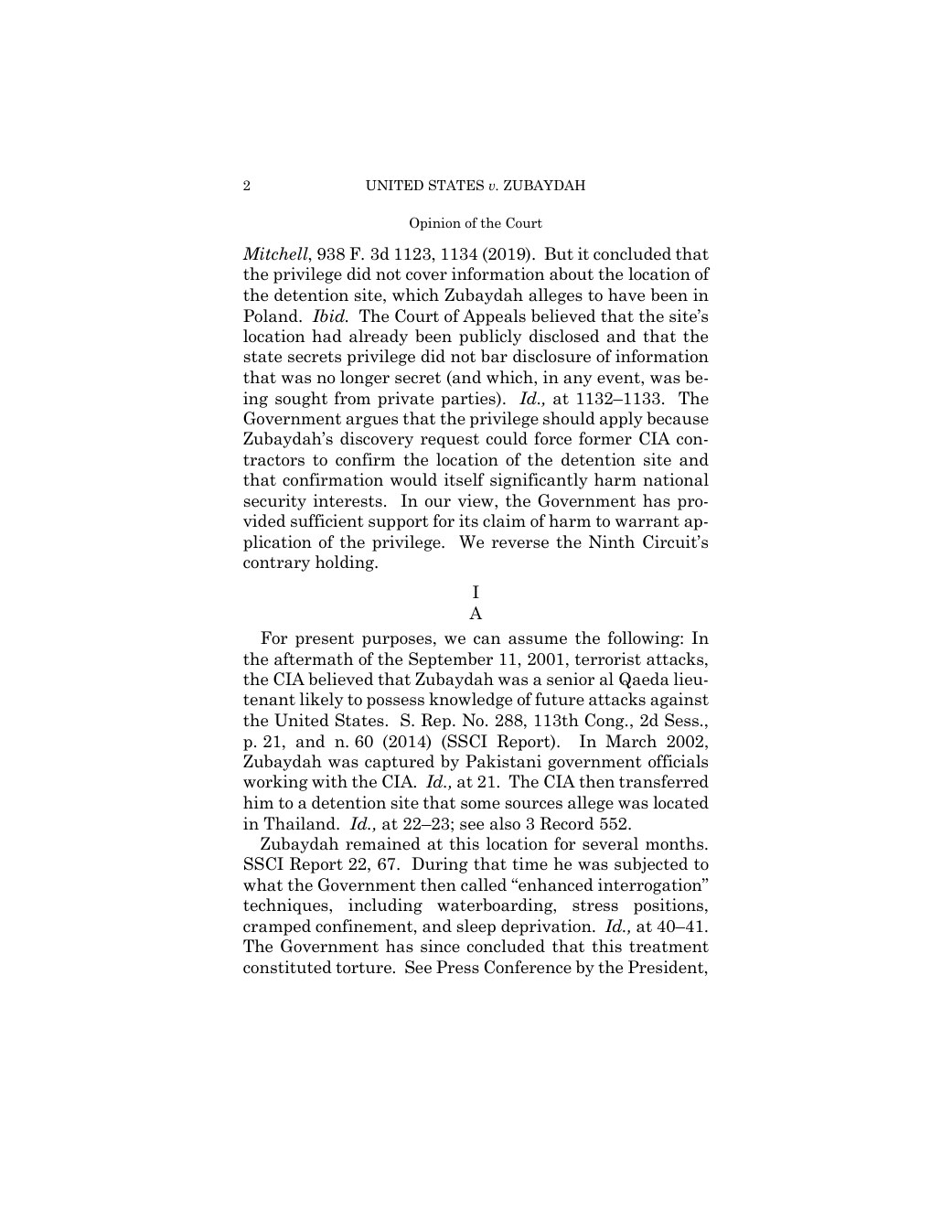
The Supreme Court’s 2022 opinion discusses documented abuse while deciding a state-secrets discovery dispute. The procedural outcome did not authorize interrogation methods. Image credit ↗

Chapter 07 / 2012–2022 / later memory

Different proceedings answered different questions

The absence of a U.S. criminal trial resolving the entire program is consequential, but it is not a finding that no abuse occurred. In August 2012 Attorney General Eric Holder announced that John Durham’s two detainee-death investigations had closed without charges because admissible evidence was insufficient to obtain and sustain convictions beyond reasonable doubt. The review had principally examined unauthorized conduct and excluded prosecution of people acting in good faith within OLC guidance. Holder expressly distinguished prosecutability from broader propriety. A declined prosecution has a different evidentiary and procedural meaning from an acquittal after trial.

European proceedings concerned the obligations of countries that enabled secret detention and transfer. The European Court’s summaries of its 2014 Poland and 2018 Lithuania and Romania judgments describe violations involving cooperation, detention, ill-treatment and failures to investigate. Those were findings of host-state responsibility under the European Convention. The United States was not the respondent, and the judgments were not criminal convictions of American officers. Their factual and legal significance survives that jurisdictional boundary. This guide follows selected outcomes rather than providing a complete survey of country-specific litigation.

In the United States, survivors and Rahman’s family pursued a civil case against Mitchell and Jessen. A 2017 settlement ended Salim v. Mitchell before the scheduled jury trial. The agreed statement acknowledged the coercive program and suffering, while defendants denied responsibility for the particular abuses. The confidential terms do not establish a public damages amount. The case opened discovery and produced testimony; settlement did not transform the plaintiffs’ allegations into a jury verdict. The survivor-centered record adds experiences and claims that an institutional history alone can obscure.

United States v. Zubaydah reached the Supreme Court in 2022 through a request for discovery for Polish proceedings. The Court upheld application of the state-secrets privilege to information confirming a CIA site’s location and directed dismissal of the discovery request. Its opinion discussed the established treatment, including torture; its disagreement with the lower court concerned protected information. Separate opinions disputed deference and the protection of what was already widely known. The result restricted an evidentiary route to accountability. It did not determine that the conduct was lawful or that allegations of abuse were fabricated. Across these proceedings, responsibility, access to evidence, compensation and criminal liability remained different questions with different outcomes.

Sources: S09 · S10 · S11 · S12 · S16

03 / The record

People and institutions

Open a record for the person’s role and supporting sources. Names identify people; no unverified portrait is substituted for a participant.

BushBiographical record
George W. BushPresident, 2001–2009

Authorized the post-9/11 capture-and-detain authority and publicly defended CIA interrogation in 2006. His description of the program is evidence of policy and public representation, not proof of every operational claim.

Sources: S01 · S08

ZubaydahBiographical record
Abu ZubaydahCIA detainee and later litigant

His 2002 custody and treatment were central to the legal opinions and techniques. Later Supreme Court litigation concerned evidence for Polish proceedings, not an adjudication of all allegations about him.

Sources: S01 · S05 · S11

RahmanBiographical record
Gul RahmanDetainee who died at COBALT

His November 2002 death and internal investigation expose treatment and management failures. His family later joined Salim v. Mitchell.

Sources: S01 · S12

RizzoBiographical record
John RizzoCIA legal official

Recipient of the 2002 Bybee letter; legal advice formed part of the agency’s decision chain.

Sources: S05

BybeeBiographical record
Jay BybeeAssistant Attorney General, OLC

Signed advice about proposed treatment on CIA-supplied facts. The opinion was later withdrawn, a legal-policy event distinct from an individual verdict.

Sources: S05 · S07

MitchellBiographical record
James MitchellContract psychologist and civil defendant

Helped develop and implement CIA coercive methods; the 2017 joint statement retains his dispute over responsibility for specific abuses.

Sources: S01 · S12

JessenBiographical record
John “Bruce” JessenContract psychologist and civil defendant

Worked with Mitchell on the CIA program; settlement and subsequent discovery litigation do not equal a criminal conviction.

Sources: S01 · S11 · S12

MohammedBiographical record
Khalid Sheikh MohammedDetainee and intelligence source

His reporting and treatment feature in competing accounts of operational results. The CIA corrected some sequence claims involving him and Majid Khan.

Sources: S01 · S02 · S03

FeinsteinBiographical record
Dianne FeinsteinSenate Intelligence Committee chair

Led the study’s approval/release and defended its documentary approach; findings and minority views remain distinct.

Sources: S01 · S04 · S14

BrennanBiographical record
John BrennanCIA director, 2013–2017

Submitted the CIA response and publicly defended intelligence value while acknowledging failures and uncertainty about alternatives.

Sources: S02 · S13

HolderBiographical record
Eric HolderAttorney General

Expanded Durham’s review and announced 2012 closure of the two death investigations under a stated prosecutorial standard.

Sources: S09

DurhamBiographical record
John DurhamFederal prosecutor

Investigated tapes and selected detainee treatment matters. DOJ describes scope and evidence limits; no program-wide criminal trial resulted from that review.

Sources: S09

ObamaBiographical record
Barack ObamaPresident, 2009–2017

Issued EO 13491 restricting interrogation and CIA facilities in 2009, with a short-term transitory exception.

Sources: S06

SalimBiographical record
Suleiman Abdullah SalimSurvivor and civil plaintiff

Pursued claims against the psychologists with Mohamed Ahmed Ben Soud and Rahman’s family; the settlement statement records suffering and retained responsibility disputes.

Sources: S12 · S16

SoudBiographical record
Mohamed Ahmed Ben SoudSurvivor and civil plaintiff

One of the plaintiffs in the 2017 settlement; personal experience and institutional records provide different kinds of evidence.

Sources: S12

AgencyBiographical record
Central Intelligence AgencyAgency operating the program

Ran the covert program with contractors and foreign partners; its admissions, defenses and corrections are read against other records.

Sources: S01 · S02 · S03

04 / The record

Custody, disclosure and accountability

Horizontal spacing shows elapsed time; separate rows keep close events selectable. Scroll the graph on narrow screens. Exact dates are attributed where records conflict; month- and year-only dates preserve source precision.

20012006201220172023
Attacks create an emergencyContext

The attacks drive fears of further mass-casualty operations and urgent demand for intelligence.

Sources: S01 · S08

Capture-and-detain authority signedAuthority

The MON authorizes CIA capture/detention for specified threats; the Senate notes it does not mention interrogation techniques.

Sources: S01

Abu Zubaydah captured and enters CIA custodyCustody

Abu Zubaydah is captured wounded in Pakistan in March 2002 and transferred into secret CIA detention.

Sources: S01 · S11

Bybee supplies OLC adviceLegal advice

OLC advises CIA about proposed treatment on the factual assurances supplied by the agency.

Sources: S05

Coercive interrogation of Abu Zubaydah escalatesTreatment

CIA uses enhanced techniques; later records scrutinize actual application and the information supplied before and afterward.

Sources: S01 · S02

Gul Rahman dies at COBALTHarm

The official investigation and autopsy account identify likely hypothermia, with dehydration, lack of food and immobility among the contributing conditions.

Sources: S01 · S12

CIA centralizes detention managementManagement

After the COBALT death, the renditions organization assumes formal management responsibility; the Senate disputes the adequacy of accountability.

Sources: S01 · S02

Khalid Sheikh Mohammed enters CIA detentionCustody

His reporting later becomes a central part of the dispute over the intelligence value of the detention program and its interrogation methods.

Sources: S01 · S02

CIA inspector general completes special reviewOversight

The review raised treatment, management and authorization concerns; its history is discussed in the Senate and agency response.

Sources: S01 · S02

Contractors form a company for CIA workContracting

The Senate records a potential contract value exceeding $180 million, including options, and $81 million received by the contractors’ company before termination in 2009.

Sources: S01 · S12

Interrogation tapes destroyedRecords

The Senate chronology dates destruction to the day after a proposed investigation amendment failed; surviving written records do not recreate the tapes in full.

Sources: S01

Bush acknowledges the CIA programPublic record

Bush announces the transfer of 14 detainees to Guantánamo and defends the program’s intelligence value and legality.

Sources: S08

Last use of enhanced techniques in Senate chronologyProgram ending

The majority records this as the final use, distinct from later formal closure.

Sources: S01

CIA holds no further detainees in Senate chronologyProgram ending

This operational endpoint precedes the 2009 executive order.

Sources: S01

Obama orders lawful-interrogation restrictionsPolicy

EO 13491 restricts methods and orders CIA facilities closed, with a short-term transitory exception.

Sources: S06

OLC withdraws four CIA opinionsLegal policy

Barron withdraws 2002/2005 opinions so they no longer represent OLC’s views.

Sources: S07

DOJ closes two death investigations without chargesProsecution

Holder cites insufficient admissible evidence for conviction beyond reasonable doubt and preserves the distinction from broader propriety.

Sources: S09

Senate committee approves the studyInvestigation

The study’s approval precedes later declassification revisions and public release.

Sources: S01 · S14

CIA submits its formal responseInstitutional response

Agency admits serious failures and disputes effectiveness/representation findings; later errata qualify parts of this response.

Sources: S02 · S03

European Court rules in Poland casesCourt

Selected host-state findings concern cooperation, detention, ill-treatment and investigation, not U.S. criminal convictions.

Sources: S10

CIA prepares corrections to its responseCorrection

The note to readers corrects several factual and sequencing errors; release follows in December.

Sources: S03

Redacted study and competing views releasedPublication

The public receives the executive summary/findings and additional/minority views; the whole underlying archive is not thereby opened.

Sources: S01 · S04 · S14

Brennan publicly defends intelligence valuePublic position

He acknowledges failures while defending reporting and the unknowable alternative outcome.

Sources: S13

Congress enacts section 1045 restrictionsLegislation

Army Field Manual rule and related provisions become statute for the custody/control defined in the law.

Sources: S15

Salim v. Mitchell settlement announcedCivil case

Parties settle before trial; joint statement acknowledges coercion/suffering but retains a dispute about specific responsibility.

Sources: S12

European Court rules in Lithuania/Romania casesCourt

The European Court finds host-state responsibility in the Abu Zubaydah v. Lithuania and Al Nashiri v. Romania cases.

Sources: S10

Supreme Court decides Zubaydah state-secrets caseCourt

The Court protects information confirming a foreign site and directs dismissal of the discovery request; it does not approve the interrogation program.

Sources: S11

05 / The record

The load-bearing facts

Six connected steps link authority, actual treatment, human consequences, intelligence claims, disclosure and accountability. Open each step for its dependencies, why it matters, and the questions it leaves for rival accounts.

CP1

Detention authority becomes actual custody

The September 2001 authorization empowered CIA capture and detention; Abu Zubaydah’s 2002 custody made the proposed system operational.

Why it is critical

Authority alone does not specify or prove later treatment.

Dependencies

The memorandum, capture record and transfer/custody chronology must connect.

What rival readings must explain

A security-necessity account accepts the emergency but must establish why particular treatment followed.

Sources: S01 · S02 · S08

CP2

Advice, approval and conduct diverge

OLC advice relied on agency-supplied facts; official reviews document treatment exceeding guidance and harmful approved coercion.

Why it is critical

Determines what legal advice could establish and what actual records contradict.

Dependencies

Requires the text/conditions of advice and contemporaneous records of use, not an approval label alone.

What rival readings must explain

A lawful-reliance defense must account for the limits of guidance and unauthorized acts; program criticism must distinguish decisions and actors.

Sources: S01 · S02 · S05 · S07

CP3

Secrecy and weak management produce concrete harms

Wrongful detention under the MON standard, incomplete counts and Gul Rahman’s death expose failures at capture, site and headquarters levels.

Why it is critical

Prevents a debate about useful information from replacing the people and conduct being evaluated.

Dependencies

Depends on documented custody, conditions, medical findings and the scope of each official finding.

What rival readings must explain

A few-rogue-acts account must explain repeated failures and management decisions, while a universal-control account still needs individual chains.

Sources: S01 · S02 · S03 · S12

CP4

The intelligence claim requires a causal chronology

Detainees supplied reporting; the majority challenges specific claims that coercion produced otherwise unavailable results. CIA/minority emphasize context and aggregate value.

Why it is critical

The defense of effectiveness is load-bearing, yet follows neither from report volume nor from a target’s later capture.

Dependencies

Needs original timestamps, interrogation phases, dissemination and decision records; CIA errata change some claimed sequences.

What rival readings must explain

Necessity must show why alternatives would not have sufficed; total-worthlessness must account for documented detainee reporting.

Sources: S01 · S02 · S03 · S04 · S13

CP5

Disclosure and investigation change the available record

Tape destruction, public acknowledgment, Senate documentary investigation and CIA corrections shape what can now be tested.

Why it is critical

Explains both strong documentary findings and genuine holes in reconstruction.

Dependencies

Requires distinguishing lost recordings, surviving cables, existing interviews and the absence of new Senate interviews.

What rival readings must explain

A procedural-bias critique must meet specific contradictions; a confidence claim must acknowledge missing context and documents.

Sources: S01 · S02 · S03 · S04 · S14

CP6

Policy closure and accountability remain different outcomes

The 2009 order and later legislation constrained future conduct; declinations, host-state judgments, settlement and secrecy litigation answered different legal questions.

Why it is critical

Prevents absence of prosecution or a procedural dismissal from becoming historical exoneration.

Dependencies

Depends on the actual scope, parties, standard and disposition of each proceeding.

What rival readings must explain

A comprehensive-impunity account must acknowledge concrete civil/judicial findings; a vindication account must explain their findings and limited procedural reach.

Sources: S06 · S07 · S09 · S10 · S11 · S12 · S15

06 / The record

Four interpretations tested against the record

Competing interpretations, stated at their strongest and tested against the same chain. Presenting a theory is not endorsing it.

Interpretation 01

A necessary emergency intelligence program

Rationale documented; necessity not established by it

The strongest version

Officials confronted mass-casualty danger and incomplete knowledge. Detainee reporting supplied leads and context that contributed to captures and disrupted plots; the CIA/minority argue a fragmented comparison misses aggregate value.

Accepts

CP 1–CP 4 include real custody, abuse and management failures, as well as useful reporting. The strongest defense does not depend on denying every failure.

Must still explain

The causal claim must address information known before coercion, acknowledged chronology errors, false reporting, human costs and legal limits. The unknown alternative cannot itself prove necessity.

Assessment

CIA response Tab A and minority views make the affirmative case; the majority tests 20 representations, and CIA errata revise particular details.

What would change this assessment

Authenticated tasking/reporting/decision records showing a specific otherwise unavailable result and a defensible comparison with alternatives would strengthen the causal case. A public assurance or an interrogation-report count alone would not.

Sources: S01 · S02 · S03 · S04 · S13

Interpretation 02

A system of abuse justified through overstated success

Strong support for abuse and particular misleading claims

The strongest version

Secrecy, permissive advice, outsourced expertise and weak control enabled severe abuse; inflated claims of effectiveness then helped sustain the system. CP 2–CP 5 connect treatment, oversight and representations.

Accepts

Not every participant knew the same facts; detainees sometimes supplied useful intelligence; each representation needs its own record.

Must still explain

A stronger claim that no detainee intelligence had value would exceed the demonstrated errors. General institutional responsibility does not identify every individual’s criminal intent.

Assessment

The majority’s chronology, agency admissions and corrections support serious findings; some wider causal and intent questions remain disputed.

What would change this assessment

Complete original cables, unredacted oversight records, medical files and independently corroborated participant/detainee testimony could strengthen or revise particular chains. Retrospective denial does not displace a contemporaneous contradiction.

Sources: S01 · S02 · S03 · S05 · S12

Interpretation 03

A flawed investigation overstates a flawed program

Methodological criticism has force; not a blanket rebuttal

The strongest version

The lack of new participant interviews and selected documentary comparisons can omit context, obscure corroborative intelligence and flatten changes over time. CIA/minority argue the program improved after early failures.

Accepts

Abuse and serious management failures occurred; archival inquiry is necessary. CP 5 defines a real evidentiary limitation.

Must still explain

Specific admissions, documented harm and impossible chronologies cannot be dismissed solely because new interviews were absent. The CIA response also acknowledges limits in its own fact-check and later corrects itself.

Assessment

The agency and minority criticism is read against the majority foreword and individual records, not treated as proof that every finding fails.

What would change this assessment

Authenticated testimony resolving a specific contradiction, matched to original documents and tested against other witnesses, could materially change that assessment. Broad claims of bias or good intentions could not.

Sources: S01 · S02 · S03 · S04

Interpretation 04

Accountability was constrained by institutions and secrecy

Supported for identified proceedings; scope remains specific

The strongest version

Prosecutorial limits, classification, lost recordings and state-secrets claims obstructed full adjudication and remedy. CP 5–CP 6 explain how documented harm can coexist with no program-wide criminal verdict.

Accepts

European judgments and the Salim settlement were real outcomes; not every dismissal used the same doctrine; admissibility and burden of proof matter.

Must still explain

A single coordinated cover-up across all bodies would require connecting evidence. A settlement or declined charge does not resolve every fact in either direction.

Assessment

Holder’s stated scope and evidentiary reason, the joint settlement statement and the divided 2022 Supreme Court opinions identify actual mechanisms.

What would change this assessment

Unsealed evidentiary rulings, authenticated interagency instructions or litigation records showing why particular evidence was withheld or excluded could sharpen the account. An outcome alone does not prove motive.

Sources: S09 · S10 · S11 · S12

07 / The record

How the story changed

Public memory tends to compress contested histories into a turning point. The records leave a less tidy sequence.

A secret program acknowledged

ThenThe public had reports and denials while custody details remained concealed.

ReconsideredBush acknowledged the program and fourteen transfers, while defending methods and intelligence value. The speech did not reveal the whole operation.

Sources: S08 · S01

A documentary record becomes public

ThenThe full study, CIA response and competing interpretations had circulated within restricted institutions.

ReconsideredThe released summary, minority views and CIA corrections created a public record for testing specific claims; redactions and missing recordings persisted.

Sources: S01 · S02 · S03 · S04

Accountability has multiple endpoints

ThenA single expectation of either vindication or program-wide punishment compressed different legal questions.

ReconsideredDeclination, host-state judgments, civil settlement and state-secrets litigation produced distinct outcomes, none a substitute for all the others.

Sources: S09 · S10 · S11 · S12

08 / The record

What the evidence supports

Ratings apply to the precise proposition on the page. Unsupported means the assembled evidence does not establish a claim; it is not interchangeable with false.

Established

The CIA operated secret detention and coercive interrogation after 9/11.

Bush publicly acknowledged the program; CIA and Senate records establish operation and treatment. The finding is not based on allegation alone.

Sources: S01 · S02 · S08

Established

The September 2001 MON authorized capture and detention.

The memorandum’s threat standard empowered CIA custody. It did not itself specify interrogation techniques; those followed through separate decisions and advice.

Sources: S01 · S05

Established

OLC advised CIA in August 2002 that proposed treatment would not violate the torture statute.

The advice depended on CIA-supplied facts and proposed conduct. It was not a judicial finding about actual practice, and the opinion was withdrawn in 2009.

Sources: S01 · S02 · S05 · S07

Established

The program caused severe abuse, including torture.

Official treatment records, admissions and court discussion document coercive abuse. This finding is distinct from whether a named individual was convicted of a statutory offense.

Sources: S01 · S02 · S10 · S11

Established

At least 26 known CIA detainees did not meet the program’s detention standard.

The Senate’s review found wrongful custody under the executive authorization’s standard. This is not a universal court acquittal or determination of every person’s alleged conduct.

Sources: S01

Established

Gul Rahman died within the CIA detention system.

Internal investigation/autopsy account in the Senate study describes his November 2002 death and likely hypothermia with other contributing factors.

Sources: S01 · S12

Not established

Useful detainee reporting proves coercion was necessary.

Reporting value, causation by a technique and the alternative outcome are different propositions. CIA acknowledged that the counterfactual was unknowable.

Sources: S01 · S02 · S04 · S13

Established

CIA corrected factual statements in its 2013 rebuttal.

Its later note to readers acknowledged counting and sequencing errors, including the KSM–Majid Khan chronology, while defending broader intelligence value.

Sources: S01 · S02 · S03

Established

Detainees in the program supplied useful intelligence.

The records include useful detainee reporting. That proposition does not establish that coercive methods caused the information, were necessary or were lawful.

Sources: S01 · S02 · S04

Not established

The 2012 declination resolved the broader propriety of the program.

DOJ declined charges in the two death investigations under its stated scope and evidentiary standard. Holder explicitly left broader propriety unresolved.

Sources: S09

Established

The psychologists settled a civil case with survivors and Gul Rahman’s family.

The confidential 2017 settlement preceded trial and retained disagreement about responsibility in the agreed statement. It was not a jury verdict.

Sources: S12

Established

The state-secrets privilege blocked Zubaydah’s requested discovery in 2022.

The Supreme Court directed dismissal of the discovery request after protecting information about a foreign site. It did not decide that interrogation was lawful.

Sources: S11

Established

CIA custody ended before the formal 2009 policy closure.

The Senate records no CIA-held detainees after April 2008; formal policy closure followed in January 2009. The operational and policy dates differ.

Sources: S01 · S06

Established

European judgments found host-state responsibility for the CIA detention system.

The selected judgments concerned host-state obligations under the European Convention. They were not criminal convictions of U.S. officers.

Sources: S10

09 / The record

Watch, listen and read

Primary remarks, participant voices and documentary context. External audio, video and source records need an internet connection.

Video and transcript

Brennan’s public response ↗

The 11 December 2014 press conference presents the agency’s value argument, admissions and counterfactual uncertainty. PBS footage remains external.

Podcast and episode context

Survivor-centered testimony and discussion ↗

ACLU’s 9 September 2021 episode includes survivors, a family representative and their counsel. The published introduction and participant credits are checked; the full audio is an external listening route, not an independently transcribed source in this guide.

Primary speech transcript

Bush acknowledges the program ↗

The 6 September 2006 official speech links disclosure, claimed intelligence value and fourteen transfers to Guantánamo.

10 / The record

The questions still open

A documented limit is more useful than a confident number or a sweeping lineage the evidence cannot carry.

  1. Who was held, where, and on what documented basis?

    A complete roster matched to authenticated custody and transfer records and revised assessments could change the count and responsibility for particular detention decisions. Redacted site colors alone do not establish geography.

    Sources: S01 · S03

  2. Which intelligence changed a particular operational decision?

    Original timestamps, reporting streams and decision records could distinguish unique information, corroboration and information known before coercion. A report count cannot perform that causal test.

    Sources: S01 · S02 · S03

  3. What remains inaccessible about harm and responsibility?

    Medical files, surviving recordings, original orders and tested participant and detainee testimony could sharpen particular chains. The absence of a complete ledger does not erase documented abuse.

    Sources: S01 · S09 · S12

  4. How did secrecy affect each remedy?

    Unsealed litigation records and authenticated interagency instructions could clarify why specific evidence was unavailable. This guide does not exhaustively survey country litigation or later military commission developments.

    Sources: S10 · S11 · S12

11 / The record

Go back to the sources

Records, reporting, and firsthand accounts have different evidentiary roles. Each source note explains what it can establish and where caution is needed. Sources consulted for this edition on 25 October 2026. Original records and attributed reporting have distinct evidentiary roles.

  1. S01

    Congressional investigation

    Senate study: findings, conclusions and executive summary, released 9 December 2014 ↗

    U.S. Senate Select Committee on Intelligence / S. Rept. 113-288

    Official GovInfo 712-page printed edition includes additional and minority views. Selected close reading: executive summary pp 11–17, 54–55; findings 1–20; foreword; accounts of effectiveness and oversight. The majority’s investigative findings are attributed, not called criminal verdicts. Redacted cables and missing records limit reconstruction. Full volume retained privately; only individually cleared federal page images are redistributed.

  2. S02

    Institutional response

    CIA response to the Senate study, 27 June 2013 ↗

    Central Intelligence Agency / Director John Brennan

    Cover memorandum, Tab A management/methodology discussion and effectiveness argument, and selected case-study passages read. CIA acknowledges serious failures while disputing majority conclusions about intelligence value and misleading representations. Read with its 2014 corrections (S03); the response itself says it could not comprehensively fact-check the full study.

  3. S03

    Primary institutional correction

    CIA Note to Readers: corrections to its response, 1 August 2014 ↗

    Central Intelligence Agency; National Security Archive host

    Declassified December 2014. Agency corrects counts, authorization descriptions and the KSM–Majid Khan–Hambali chronology while maintaining its larger intelligence-value argument. Source record and OCR retained; repository commentary is distinct from the government document.

  4. S04

    Congressional dissent

    Minority views of Chambliss, Burr, Risch, Coats, Rubio and Coburn ↗

    U.S. Senate Select Committee on Intelligence / S. Rept. 113-288

    Views begin at PDF page 549 in the official printed edition. Selected executive/methodology passages and case examples checked. The minority disputes causal analysis, context and the lack of new participant interviews; it acknowledges program flaws. These views are not the committee majority’s finding.

  5. S05

    Contemporaneous legal advice

    Bybee to Rizzo: Interrogation of al Qaeda Operative, 1 August 2002 ↗

    U.S. Department of Justice, Office of Legal Counsel

    Image-only 18-page scan. First and concluding pages visually read. The advice concerns proposed conduct on facts supplied by CIA, rather than judicial fact-finding about actual custody. Only the selected first and concluding federal pages are included as images.

  6. S06

    Executive order

    Executive Order 13491: Ensuring Lawful Interrogations, 22 January 2009 ↗

    President Barack Obama / archived White House

    Sections 3–4 restrict methods, prohibit reliance on specified earlier Justice interpretations, and direct closure of CIA detention facilities while preserving short-term transitory detention. The order’s historical content is described; no exhaustive current-law audit is claimed.

  7. S07

    Official legal memorandum

    Withdrawal of OLC CIA interrogation opinions, 15 April 2009 ↗

    David J. Barron / U.S. Department of Justice

    Withdraws four 2002/2005 opinions, including Bybee’s 1 August 2002 letter, so they no longer represent OLC views. Withdrawal is a legal-policy event, not an individual criminal conviction.

  8. S08

    Contemporaneous public speech

    President Bush acknowledges CIA detention program, 6 September 2006 ↗

    George W. Bush / archived White House

    Acknowledges the program and transfer of 14 detainees to Guantánamo while defending its value and legality. His public account is tested against operational records and later corrections; his denial of torture is not deciding proof.

  9. S09

    Prosecutorial decision statement

    Holder closes two detainee-death investigations, 30 August 2012 ↗

    U.S. Department of Justice / Attorney General Eric Holder

    Official full indexed text read and saved; direct raw request returned a blank challenge page, recorded in the retrieval log. Declines charges because admissible evidence was insufficient to obtain/sustain conviction beyond reasonable doubt. Scope/good-faith OLC limits and distinction from broader propriety are explicit. No acquittal or exoneration is inferred.

  10. S10

    Official judicial summary

    Secret detention sites: European Court factsheet, March 2024 ↗

    European Court of Human Rights, Press Unit

    Five-page factsheet expressly nonbinding and nonexhaustive. Summarizes 2014 Poland and 2018 Lithuania/Romania judgments and host-state responsibility. It is not a U.S. criminal judgment. Full country-case litigation history, including later proceedings, is outside this guide’s survey. No foreign-court PDF imagery redistributed.

  11. S11

    Judicial opinion and dissents

    United States v. Zubaydah, 3 March 2022 ↗

    Supreme Court of the United States /595 U.S. 195

    Syllabus, relevant Breyer opinion and separate opinions read for the state-secrets ruling. Court reversed/remanded with dismissal instruction for the discovery request. It did not decide that interrogation was lawful. Judicial discussion of abuse and the information-protection issue are distinct.

  12. S12

    Primary litigation statement / advocacy

    Salim v. Mitchell settlement and joint statement, 17 August 2017 ↗

    ACLU, plaintiffs’ counsel; agreed statement of plaintiffs and defendants

    Full settlement terms confidential. Joint statement acknowledges coercive program and suffering; defendants dispute responsibility for the specific abuses. Source’s advocacy is attributed. Settlement is not a jury verdict, criminal conviction or verified public damages figure.

  13. S13

    Primary public remarks / contemporaneous reporting

    Brennan responds to the Senate report, 11 December 2014 ↗

    PBS NewsHour; John Brennan press-conference footage and transcript

    Working external video/transcript provides the agency’s public defense and admissions about unauthorized abuse. Valuable reporting and an unobservable interrogation counterfactual are distinct. Media remains outbound; no PBS imagery or video redistributed.

  14. S14

    Official release record

    Senate committee releases study, 9 December 2014 ↗

    U.S. Senate Select Committee on Intelligence

    Official release lists majority materials and additional/minority views. Direct raw Senate access returned 403; indexed official page and complete GovInfo volume provide corroboration. The GovInfo primary PDF is the accessible reader route in S01.

  15. S15

    Statute

    Public Law 114-92, section 1045, enacted 25 November 2015 ↗

    U.S. Congress / Government Publishing Office

    PDF pages 253–255, 129 Stat. 977–979. Sets Army Field Manual restrictions for defined armed-conflict custody/control and ICRC provisions. Described as a 2015 legislative event, not a substitute for assessing each historical offense or every current amendment.

  16. S16

    Participant interview / advocacy media

    Survivors of the CIA torture program, 9 September 2021 podcast ↗

    ACLU, At Liberty

    Published episode introduction and credits checked; includes counsel and conversations with clients. Full audio is external and was not independently transcribed. Personal recollection and advocacy are distinguished from operational records. No audio redistributed.

Images, documents & licensing

The September 2001 capture-and-detain authority (PDF page 40) — U.S. Senate Select Committee on Intelligence / original CIA records quoted. Public domain in the United States: individually identified U.S. federal employee-authored document and federal editorial apparatus, 17 USC §105. Source & license ↗. Resized and re-encoded for this edition; embedded metadata removed. Only federal-authored pages are reproduced; third-party enclosures are excluded.

The Gul Rahman death and accountability record (PDF page 84) — U.S. Senate Select Committee on Intelligence / original CIA records quoted. Public domain in the United States: individually identified U.S. federal employee-authored document and federal editorial apparatus, 17 USC §105. Source & license ↗. Resized and re-encoded for this edition; embedded metadata removed. Only federal-authored pages are reproduced; third-party enclosures are excluded.

CIA response on courier information and alternatives (PDF page 20) — Central Intelligence Agency / institutional response signed by Director John Brennan. Public domain in the United States: individually identified U.S. federal employee-authored document and federal editorial apparatus, 17 USC §105. Source & license ↗. Resized and re-encoded for this edition; embedded metadata removed. Only federal-authored pages are reproduced; third-party enclosures are excluded.

Senate minority critique of effectiveness and methodology (PDF page 593) — U.S. Senators Chambliss, Burr, Risch, Coats, Rubio and Coburn / Senate Select Committee on Intelligence. Public domain in the United States: individually identified U.S. federal employee-authored document and federal editorial apparatus, 17 USC §105. Source & license ↗. Resized and re-encoded for this edition; embedded metadata removed. Only federal-authored pages are reproduced; third-party enclosures are excluded.

OLC withdraws CIA interrogation opinions, 15 April 2009 (PDF page 1) — David J. Barron / U.S. Department of Justice, Office of Legal Counsel. Public domain in the United States: individually identified U.S. federal employee-authored document and federal editorial apparatus, 17 USC §105. Source & license ↗. Resized and re-encoded for this edition; embedded metadata removed. Only federal-authored pages are reproduced; third-party enclosures are excluded.

United States v. Zubaydah: state secrets and documented treatment (PDF page 5) — Supreme Court of the United States / Justice Stephen Breyer, Opinion of the Court. Public domain in the United States: individually identified U.S. federal employee-authored document and federal editorial apparatus, 17 USC §105. Source & license ↗. Resized and re-encoded for this edition; embedded metadata removed. Only federal-authored pages are reproduced; third-party enclosures are excluded.

Typefaces: Inter, Playfair Display and Source Serif 4, the shared AI Files reference set, distributed under the SIL Open Font License. Exact files and license text are included in assets/fonts in the offline package. Documentary images reproduce individually identified U.S. federal-authored memoranda, congressional study pages and a judicial opinion. No AI-generated photographs, portraits or document facsimiles are used.

Uniform evidence

One standard for every case.

Authorization, expectation, recommendation and executed action are different facts. Participant explanations and official commemorations are claims to test, never deciding proof. The same standard applies to all institutions and participants. Uncertainty remains labeled.

Publication status

Prepared for staging review.

This locally prepared package is intended for the ChatGPT submission lane under Spec v7. It has not received a Grok editorial grade or approval for promotion. The live submission manifest, when registered, records its review status. Submission queue and status ↗