Biography, public service, financial disclosures, original writings and the evidence behind contested connections. The complete offline reading edition, generated from the same source as the interactive files.
This is a biographical and investigative guide, not a live election-results service. The evidence section contains sourced statements and identified reasoning; AI assessment is labeled interpretation. Source notes explain the limits. See the editorial method for scope.
Life & education / 1984–2015 · Documented record
Michigan roots, real degrees, and the meaning of doctor
His education is independently documented. A medical degree, clinical practice and public-health leadership are different credentials.
The University of Michigan Law Quadrangle. Campus context, not a claim that El-Sayed studied law. AndrewHorne · Public domain, AndrewHorne dedication · Source Original archive crop or archive-provided rendition. No scene elements added. Display crops retain the source image’s license.
The record
Abdul El-Sayed grew up in the Detroit area in an Egyptian-American family. The University of Michigan’s 2017 commencement program identifies him as born and raised in the Detroit area and records a 2007 bachelor’s degree in biology and political science. Contemporary university records document his Rhodes selection, rather than leaving that distinction to a campaign biography. [1][2]
His doctoral training was at Oxford, where DPhil is the university’s name for a Doctor of Philosophy. He subsequently earned his medical degree at Columbia in 2014. These are two different qualifications: an academic doctorate in public health and an MD. He was an assistant professor of epidemiology before returning to Detroit in 2015. [1][3]
The important qualification to a physician biography is that he chose public-health work rather than completing the clinical-residency path he had contemplated. Columbia’s profile describes his withdrawal from residency applications. Calling his MD fictitious is inconsistent with institutional records; presenting him as a practicing, residency-trained surgeon would also go beyond those records. [3]
A reader can accept those credentials and still question his policy judgments. Epidemiology concerns patterns and causes of illness in populations; it does not make a political recommendation automatically correct. The relevant questions are what a proposal would do, what evidence supports it, and whether his administrative claims match the outcomes. Neither the title “doctor” nor a dispute over how he uses it settles those questions.
At the time
His education is independently documented. A medical degree, clinical practice and public-health leadership are different credentials.
What the record shows
The degrees are real. Clinical training, clinical practice and expertise in policy should be described precisely.
Public-health record / 2015–2017 · Documented record
What rebuilding Detroit’s health department meant
A real administrative rebuilding effort, with important work shared across predecessors, staff and partners.
Detroit skyline viewed from Windsor in September 2025. City context for the public-health record. TheWxResearcher · CC0 1.0 · Source Original archive crop or archive-provided rendition. No scene elements added. Display crops retain the source image’s license.
The record
El-Sayed became Detroit’s health director in 2015 during the city’s recovery from bankruptcy. Public-health functions had been transferred to a nonprofit, and most services had returned to city control in 2014, before he arrived. His role was to strengthen the restored department, not to single-handedly originate every service after an empty interval. [1]
The department’s work combined service delivery and prevention: it sought to reconnect residents with government and address conditions that shaped illness. The more useful way to assess that record is through particular programs and dates, rather than a campaign’s compressed story of rescuing a whole city. The university profile is an institutional interview and gives his perspective; it is not an independent performance audit. [1]
One concrete example is the partnership with Vision To Learn, which began in October 2016. A February 2017 announcement reported the program’s thousandth pair of free glasses for Detroit students. The work involved department vision screening, nonprofit eye exams and glasses, donors, schools and basketball-community partners. That announcement already featured his successor, Joneigh Khaldun. [2]
Credit can belong both to an official who helped launch a program and to people who continued it. Later delivery totals should not all be attributed to the months he personally held office. Conversely, the fact that a program needed philanthropic and institutional partners does not erase the administrative work of establishing it.
At the time
A real administrative rebuilding effort, with important work shared across predecessors, staff and partners.
What the record shows
There is a substantive Detroit record; the strongest assessment uses dated program outputs and shared credit.
Lead in Detroit: testing is an achievement, permanent safety is a higher bar
School testing and a prevention coalition are documented. Claims that the city’s lead problem was simply solved are too broad.
The record
Detroit’s official account says its health department organized a coalition of city agencies and community partners in 2016 to coordinate lead prevention and removal. Lead Safe Detroit included education, housing hazards, home and school water testing, enforcement and environmental standards. The city still publishes school-testing records. Those are concrete activities, not merely a campaign slogan. [1][2]
It is important to distinguish the source water, an individual school’s plumbing, residential service lines and lead paint or dust. A school-water testing program cannot by itself certify every route of exposure as safe. Detroit’s 2022 service-line announcement still described a major, multiyear replacement effort. [3]
There were also complications during the period celebrated in campaign biographies. A city announcement reported preliminary data showing the share of children with elevated blood lead rising from 7.5 percent in 2015 to 8.8 percent in 2016. It described a possible association with demolitions, acknowledged study limitations, and sought external evaluation. That is evidence of an unresolved public-health problem, not evidence that testing was pointless. [4]
The fair conclusion is narrower than either campaign praise or blanket dismissal. El-Sayed helped advance prevention and testing while in Detroit; a later claim that all schools or the whole city had become permanently lead-free needs much more specific evidence. Continued monitoring and replacement are part of the work, not proof that the original risk never existed.
At the time
School testing and a prevention coalition are documented. Claims that the city’s lead problem was simply solved are too broad.
What the record shows
Credit the documented testing and coordination; do not convert them into a citywide guarantee of permanent lead elimination.
He lost the Democratic primary. The eligibility question concerned Michigan voter registration, not a finding that he was foreign-born.
Michigan State Capitol in Lansing. Context for the 2018 governor’s race, not a photograph of El-Sayed holding state office. Carol M. Highsmith · Public domain, Carol M. Highsmith / Library of Congress · Source Original archive crop or archive-provided rendition. No scene elements added. Display crops retain the source image’s license.
The record
El-Sayed sought the Democratic nomination for governor in 2018 and finished behind Gretchen Whitmer. The official state election archive records the contest. A primary defeat is a political result; it does not, on its own, establish whether a particular allegation made during that campaign was true. [1][2]
The eligibility issue was real but often gets muddled with other citizenship stories. Michigan’s constitution requires a governor to be at least 30 and to have been a registered elector in the state for the four years preceding election. El-Sayed had registered to vote in New York while studying and working there. That prompted a question about his continuing qualification in Michigan. [3][4]
On May 9, 2018, Michigan Public reported that state election officials found him eligible. Elections director Sally Williams said the official voter file showed uninterrupted Michigan registration from 2003. Her explanation addressed when registration could legally be canceled, rather than pretending his New York registration had never happened. [4]
This was a state administrative eligibility determination, not a general judicial declaration about every detail of his biography. Nor should an old gubernatorial registration requirement be imported into a Senate contest: the U.S. Constitution sets its own requirements concerning age, U.S. citizenship and state inhabitancy. These are distinct offices with distinct rules. [3][5]
At the time
He lost the Democratic primary. The eligibility question concerned Michigan voter registration, not a finding that he was foreign-born.
What the record shows
The New York registration question was examined; state officials allowed the 2018 candidacy. It was not proof of a fabricated American identity.
The $700 million medical-debt claim: a target presented as a result
The relief program is real. The large promised total and the debt actually canceled must be kept separate.
The record
Wayne County announced El-Sayed’s move into its Health, Human and Veterans Services department in December 2022, with the director appointment to begin in March 2023 subject to commission approval. The announcement separately credited predecessor Melita Jordan’s pandemic work. It would be inaccurate to transfer those earlier achievements to him. [1]
Under El-Sayed, the county launched a program with Undue Medical Debt to purchase and cancel eligible residents’ medical debt. Its stated ambition was up to $700 million of face-value debt, not $700 million in direct cash payments to residents or hospitals. The official program description uses that target language. [2]
The discrepancy became a campaign issue because advertising described $700 million as already erased. Bridge Michigan’s June 25, 2026 review reported $57.38 million settled by then; the campaign acknowledged the program remained underway. A county committee packet in March had reported approximately $42 million. The dates matter: neither historical figure should be presented as an independently verified October total. [3][4]
That distinction preserves both the accomplishment and the criticism. Canceling qualifying debt can meaningfully help recipients, while buying old debt at a discount costs much less than its face value. Funding capacity, projected cancellation and completed purchases are different measures. An ambitious authorized program is not the same thing as delivering its full advertised target.
Documented checkpoints & limits
2024–2026
Inspect the underlying record
Wayne County announced El-Sayed’s move into its Health, Human and Veterans Services department in December 2022, with the director appointment to begin in March 2023 subject to commission approval. The announcement separately credited predecessor Melita Jordan’s pandemic work. It would be inaccurate to transfer those earlier achievements to him. Source ↗
Scope and uncertainty
Keep the conclusion proportionate
Full access to the current county program page was restricted in this session. Actual cancellation figures are explicitly dated to March and June 2026; no October cumulative total is asserted. Source ↗
Watch this question
El-Sayed campaign advertisement: public-health record ↗ Abdul for U.S. Senate — Campaign advocacy, not independent verification. Bridge Michigan linked this ad while examining the $700 million debt claim. The source page verifies the video link; playback was not independently available.
At the time
The relief program is real. The large promised total and the debt actually canceled must be kept separate.
What the record shows
The program delivered relief, but the advertised $700 million completion claim exceeded the documented results at the time checked.
Official program description; full page returned an access error in this research session. The target is independently corroborated by county committee records and reporting.
Public-health record / 2023–2026 · Contested interpretation
Juvenile detention: emergency improvements and a record that stayed troubled
A public-health intervention made changes. Later inspection findings challenge the broad claim that the facility was rebuilt and fixed.
The record
In March 2023, county executive Warren Evans and health officer El-Sayed signed an emergency order over dangerous conditions at Wayne County’s juvenile detention facility. Overcrowding, staffing and access to treatment were central problems. This was a response to a genuine crisis involving children in government custody. [1]
When the county lifted the emergency in June, it reported higher wages, 54 additional staff members, fewer detainees and more housing space. Those changes are a substantial part of the record, though the contemporary reporting largely relayed the county’s own figures. El-Sayed also said further work remained. [2]
A July 2026 Detroit News investigation found that serious problems persisted after the emergency ended: state supervision resumed, and later documented violations included sanitation, supervision and care failures. The facility was operating under a provisional license by November 2023. That chronology is difficult to reconcile with a sweeping campaign claim that he had rebuilt the institution into a durable success. [3]
Evans defended El-Sayed’s intervention, while a county commissioner stressed shared responsibility for a longstanding system. Both points can be relevant without excusing failures. An emergency response can improve staffing and daily conditions and still fail to secure lasting safety. This guide does not attribute every individual assault to a health director, or confuse an inspection finding about a facility with a criminal conviction of that official. [3]
At the time
A public-health intervention made changes. Later inspection findings challenge the broad claim that the facility was rebuilt and fixed.
What the record shows
The emergency work was real; the later record supports scrutiny of claims that the underlying institution was successfully fixed.
Contemporaneous local reporting largely conveys county announcements; reported improvements are not an independent finding that all conditions were corrected.
Detroit News investigation by Melissa Nann Burke and Kara Berg, accessed in licensed republication. It describes inspection records and responses; this guide did not independently obtain every underlying inspection file.
The Senate campaign / 2025–2026 · Documented record
The 2026 Senate race: a nomination, not a Senate term
As of October 21, he is the Democratic nominee facing Mike Rogers. The general-election result remains unknown.
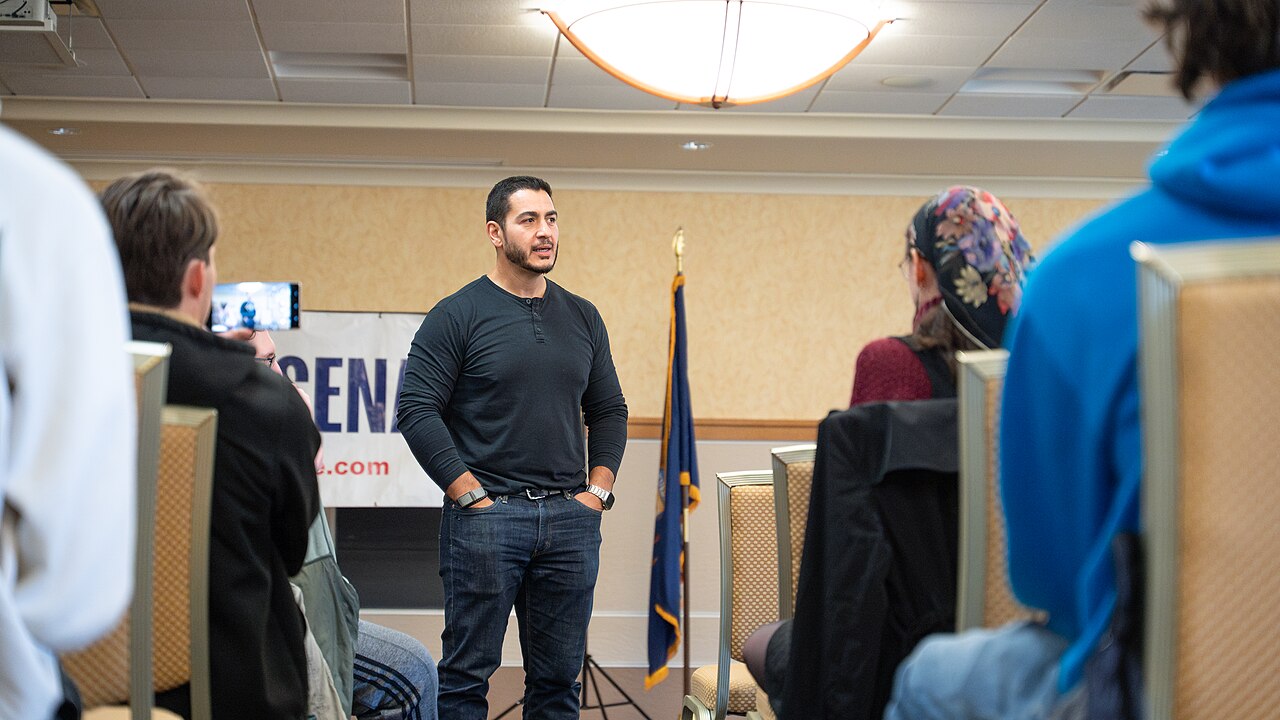
El-Sayed meets voters at Michigan Technological University, October 22, 2025. Conlan Houston · CC BY-SA 4.0 · Source Original archive crop or archive-provided rendition. No scene elements added. Display crops retain the source image’s license.
The record
El-Sayed won Michigan’s August 4, 2026 Democratic Senate primary, defeating Haley Stevens. The victory moved him into the general election against Republican Mike Rogers for the seat being vacated by Gary Peters. This is his current electoral status as of this guide’s October 21 cutoff. He has not yet won or served a term in the U.S. Senate. [1]
The distinction matters when judging his record. His legislative proposals are promises to seek federal action; his administrative experience comes from Detroit and Wayne County. Neither endorsements nor the outcome of a party primary establish that a policy has been enacted or that a candidate can secure votes in Congress.
Michigan’s official election guidance sets the general election for November 3, 2026. Claims that he has already beaten Rogers or become Michigan’s senator are premature. Opinion polling describes a sampled group at a particular time, with uncertainty, rather than a count of votes cast. This guide does not turn a changing poll lead into a result. [2]
A further televised debate was scheduled for October 21 on WXYZ, starting at 7 p.m. Eastern according to the accessible PolitiFact live page. At this research cutoff its retrieved text did not contain a completed transcript or substantive fact-check record. We link the developing source, but do not invent an outcome or imply that every statement made that evening has already been checked. [3]
At the time
As of October 21, he is the Democratic nominee facing Mike Rogers. The general-election result remains unknown.
What the record shows
Judge his completed administrative work separately from a future Senate agenda; the November election is still ahead.
Page accessible at the October 21 research cutoff announced a 7 p.m. EDT WXYZ debate; no completed transcript or outcome was available in the retrieved text.
The Senate campaign / 2026 platform · Contested interpretation
Medicare for All: the proposal and the hard financing questions
Universal coverage is his signature policy. Lower patient bills do not make the costs of providing care disappear.
The record
El-Sayed’s healthcare platform proposes automatic, universal Medicare coverage, including dental, hearing and vision, without patient premiums, copays or deductibles. His current text says additional employer or union private insurance need not be banned, although he expects comprehensive public coverage to make it unnecessary. That qualification matters when describing exactly what he is advocating. [1]
The policy case is straightforward: more dependable coverage and fewer financial barriers to needed care. The tradeoff is how to raise public revenue, pay providers, manage increased demand and change existing arrangements. Removing a household’s premium can be valuable while shifting payment to taxes; it is not the same as eliminating the resources needed for care.
The Congressional Budget Office examined several illustrative single-payer designs in 2020. It found that federal healthcare subsidies would rise substantially, while overall national spending could move in different directions depending on reimbursement, benefits and cost sharing. Lower administrative costs or prices could offset some increased use. These were modeled scenarios, not a legislative score of El-Sayed’s 2026 platform. [2][3]
A serious evaluation therefore needs an actual bill and financing plan, as well as attention to transitions for patients, health workers and facilities. The campaign’s desired outcome and the CBO’s general analytical framework are useful starting points. Neither proves that every household would gain under every design, or that universal coverage is inherently impossible.
At the time
Universal coverage is his signature policy. Lower patient bills do not make the costs of providing care disappear.
What the record shows
The goal is clear; distribution, financing, capacity and transition require more than a slogan.
The Senate campaign / 2026 platform · Documented record
The economic and environmental agenda, beyond the identity debate
His stated program combines labor, industrial policy, housing, technology regulation and a renewable-energy transition.
The record
El-Sayed’s economic platform favors stronger unions, antitrust enforcement, targeted temporary tariffs for developing industries, higher taxes on very large incomes and wealth, and expanded housing construction. It also proposes restrictions on large corporate ownership of homes. These are positions he asks voters to support, not a list of measures he has already delivered as a senator. [1]
His technology proposals include independent AI oversight, safety and incident-reporting standards, and protection against the employment effects of automation. His data-center position calls for rules governing community impacts. Readers can reasonably ask how such rules would balance public protection, investment, electricity demand and local decision-making; labeling all technology criticism anti-innovation would avoid those questions. [1]
The environmental platform calls for renewable-energy investment, stronger pollution safeguards and shutting down Line 5, while addressing safety during its continued operation. His earlier lead-related public-health work is relevant experience, but does not itself demonstrate the feasibility of an entire national energy transition. [2]
The appropriate scrutiny is practical: the text does not by itself establish a final budget, implementation schedule, enacted authority or independent forecast of results. Policies can impose costs and confer benefits on different groups at different times. It is fair to press for those details without turning disagreement over taxes, trade, regulation or energy into an allegation of secret allegiance.
At the time
His stated program combines labor, industrial policy, housing, technology regulation and a renewable-energy transition.
What the record shows
There is a substantive progressive agenda to evaluate on its merits, apart from allegations about his family or faith.
Money & transparency / 2025–2026 · Documented record
Campaign money: direct donations, transfers and outside support
A pledge about corporate donations does not mean there is no PAC support or independent advertising.
The record
The FEC candidate overview opened for this guide lists Abdul for U.S. Senate and Independents for Abdul as authorized committees. Its January 2025–September 30, 2026 snapshot shows about $45.18 million in total receipts, including about $4.95 million in transfers from other authorized committees. Headline receipts therefore should not be called the amount of unique individual donations without checking the underlying categories. [1]
The campaign’s broad language about rejecting corporate money should be read against a specific question: corporate treasury funds, corporate-sponsored PAC contributions, employees’ personal donations and independent spending are different categories. A corporate employee’s lawful personal gift is not, merely because of the employer field, a contribution by that corporation. A pledge requires a defined scope before it can be audited fairly. [1][2]
There is outside support. In June 2026, Axios reported plans by Fighting for Michigan PAC to spend in favor of El-Sayed, with progressive organizations involved. An announced independent-spending budget is not money paid directly into his authorized campaign account. Under FEC guidance, independent expenditures are advocacy conducted without the legally relevant coordination with a candidate or party. [3][4]
That legal distinction does not remove the political question: a candidate who wants to abolish super PAC spending can still benefit from it under existing rules. The fair inquiry is whether he accurately describes the support, what the committees disclose and whether there is evidence of prohibited conduct. The existence of favorable outside ads alone proves neither coordination nor a foreign funding operation.
At the time
A pledge about corporate donations does not mean there is no PAC support or independent advertising.
What the record shows
Read the filings by category. Outside support is real, but it is not interchangeable with campaign receipts or proof of illegal coordination.
Opened candidate overview showed two authorized committees and coverage through September 30, 2026. Headline receipts include transfers; this is a filing snapshot, not an audit of ultimate donor sources.
Family & affiliations / 2012–2013 / October 2026 · Contested interpretation
What his half-sister’s old posts establish—and what they do not
There is a real conflict between a sweeping family denial and posts describing family Brotherhood involvement. Personal membership remains a separate question.
The record
Eman Abdelhadi, El-Sayed’s maternal half-sister, wrote in 2012 that “my family has long been MB.” The same reported post criticized how the movement operated politically; it was not unqualified praise. Reporting also reproduced her descriptions of relatives imprisoned for involvement and a conversation about their mother’s activism in the early 1970s. These are specific statements by a family member, not an allegation invented solely by an opposing campaign. The original post links are provided, although this review could not retrieve X directly. [1][2][3][6][7]
In his October 11 Meet the Press interview, El-Sayed denied ties when asked about both himself and his family. That answer was broader than a denial of his own membership. In the later NBC exchange, he said he had not had these conversations with his mother and had been raised elsewhere; he characterized reliance on the posts as hearsay. Readers can reasonably ask whether a categorical family denial was too sweeping given those statements. His explanation should also be reported. [4][5]
The posts still leave important factual gaps: precisely which relatives belonged, whether the writer meant formal membership or political sympathy, the dates involved, and what El-Sayed himself knew. Half-siblings need not share all relatives or political experience. A shared mother makes that particular part of the account relevant, but does not turn every reference to the writer’s family into a statement about him.
The sound conclusion is narrower than either campaign slogan: there is reported evidence of Brotherhood sympathy or involvement among relatives and a disputed public denial; the cited posts do not establish that El-Sayed joined the organization. Evidence about his own writings and decisions deserves separate examination, rather than being replaced by a family tree.
Documented checkpoints & limits
2012–2013 / October 2026
Inspect the underlying record
Eman Abdelhadi, El-Sayed’s maternal half-sister, wrote in 2012 that “my family has long been MB.” The same reported post criticized how the movement operated politically; it was not unqualified praise. Reporting also reproduced her descriptions of relatives imprisoned for involvement and a conversation about their mother’s activism in the early 1970s. These are specific statements by a family member, not an allegation invented solely by an opposing campaign. The original post links are provided, although this review could not retrieve X directly. Source 1 ↗ · Source 2 ↗
Scope and uncertainty
Keep the conclusion proportionate
Original X retrieval was unavailable. The denial and the reproduced posts are documented by reporting; private family membership records were not obtained. Source ↗
There is a real conflict between a sweeping family denial and posts describing family Brotherhood involvement. Personal membership remains a separate question.
What the record shows
The family-post dispute is substantive; it does not establish inherited membership.
Original reporting reproducing old posts and linking their original URLs. The posts are evidence of what the half-sister said, not independent membership records for every relative.
Original post link supplied by the reporting. Direct X retrieval was unavailable during this review; contents were checked against reproduced posts and contemporaneous reporting.
Original post link supplied by the reporting. Direct X retrieval was unavailable during this review; it is not an independently authenticated membership list.
Useful for locating video, original statement and responses. Its background reference to 2025 designations should be read alongside the actual January 2026 Treasury action.
Reporting reproduces a fuller family tweet that combines a claim of family involvement with criticism of the Brotherhood’s political behavior. Direct X retrieval was unavailable.
Family & affiliations / November 25, 2012 / resurfaced 2026 · Contested interpretation
The 2012 Morsi statement: read the support and the qualification
The original Arabic text supports Morsi’s exceptional decisions and calls for an institutional purge, while also expressing concern about presidential powers.
The record
Al-Ahram Gate published the collective statement on November 25, 2012. Its signatory list includes, at number 33, Dr. Abdul Rahman El-Sayed of New York. The Washington Free Beacon identified that person as the Michigan politician through sources familiar with Arabic-language media. Bridge Michigan and PolitiFact also identify him as a signatory. The Arabic name by itself would not suffice to identify a person; this guide relies on that corroborating reporting rather than pretending to possess a handwritten signature or personal admission. [1][2][3][4]
The statement supports Morsi’s recent exceptional decisions, argues that remnants of the previous regime obstructed the revolution, and asks him to “purge the media and police” promptly. It rejects appeals for American or European action against the Egyptian government. It also expressly acknowledges fear of concentrating such powers in a president and asks him to clarify that the supplementary constitutional declaration expires when constitution-writing is finished. That qualification is part of the document and should not disappear from a fair account. [1]
The criticism remains serious after restoring that context. Morsi’s decree placed presidential decisions beyond judicial review; Human Rights Watch contemporaneously argued that this endangered remedies for rights violations. Hoping extraordinary powers would be temporary did not supply independent checks on their use. Asking which safeguards El-Sayed thought justified that support is a question about his judgment, not his religion. [5]
The document is support for a particular president and course of action, not a membership form or an explicit pledge to the Brotherhood worldwide. Conversely, describing it only as support for democracy understates its troubling institutional language. This review found no detailed, independently verified public explanation from El-Sayed of each contested passage; absence of a located answer is not proof that no answer exists.
Documented checkpoints & limits
November 25, 2012 / resurfaced 2026
Inspect the underlying record
Al-Ahram Gate published the collective statement on November 25, 2012. Its signatory list includes, at number 33, Dr. Abdul Rahman El-Sayed of New York. The Washington Free Beacon identified that person as the Michigan politician through sources familiar with Arabic-language media. Bridge Michigan and PolitiFact also identify him as a signatory. The Arabic name by itself would not suffice to identify a person; this guide relies on that corroborating reporting rather than pretending to possess a handwritten signature or personal admission. Source 1 ↗ · Source 2 ↗ · Source 3 ↗ · Source 4 ↗
Scope and uncertainty
Keep the conclusion proportionate
The original is a published collective statement. Attribution to the candidate is corroborated by reporting; this review did not obtain his own signature authentication or a full response to its wording. Source ↗
At the time
The original Arabic text supports Morsi’s exceptional decisions and calls for an institutional purge, while also expressing concern about presidential powers.
What the record shows
The letter supports a real criticism of political judgment, while not proving organizational membership.
Contemporaneous Arabic publication of the collective statement and 46-item signatory list. English discussion here is a paraphrase of that text; the listed name alone does not establish identity.
Original 2026 reporting identifying signatory 33 as the Michigan politician, citing unnamed sources familiar with Arabic-language media. Its political characterizations are not adopted as findings.
Useful for locating video, original statement and responses. Its background reference to 2025 designations should be read alongside the actual January 2026 Treasury action.
Family & affiliations / January 2011 · Contested interpretation
His 2011 essays: pro-revolution, optimistic about the Brotherhood
The earlier writing concerns support for Egyptian protesters and the risk of Islamist electoral success. It should not be merged with the later power-grab statement.
The record
El-Sayed’s January 2011 HuffPost essay argued that fears of a Brotherhood victory should not stop Washington backing Egypt’s protesters. Its claim that Egypt would not simply become another Iran was a political forecast, open to criticism against later events. Direct retrieval of the original was restricted in this review; the linked original and the passages discussed by Bridge Michigan make the basis of this account visible. [1][2]
That essay predates Morsi’s presidency and his November 2012 decree. Treating both texts as one undated pledge hides a change in the political circumstances. The earlier issue was whether an entrenched authoritarian government should retain American backing because an Islamist opposition might win. The later issue was whether an elected president should receive exceptional authority over institutions. The second question presents a sharper test of support for democratic limits.
His January 2011 Guardian appeal urged Obama to support Egyptian democratic rights. [3] That is compatible with criticizing his expectations about Islamist politics; it does not by itself establish secret allegiance.
CFR’s contemporaneous expert discussion in 2012 emphasized uncertainty about Brotherhood commitments on law, women, foreign policy and political authority. The risks were being debated at the time, not discovered only decades later. [4] The useful accountability question is what El-Sayed predicted, what he supported when facts changed, and what he says now about those judgments. An explanation that distinguishes electoral inclusion from support for authoritarian measures would be more informative than treating any engagement with Egyptian politics as inherently suspicious.
At the time
The earlier writing concerns support for Egyptian protesters and the risk of Islamist electoral success. It should not be merged with the later power-grab statement.
What the record shows
Scrutinize the forecast and the later choices separately. Neither essay is a membership record.
Original essay URL. Direct retrieval was restricted; the discussion relies on its passages reproduced and described by Bridge Michigan and other cited reporting.
Family & affiliations / 1928–October 2026 · Claim check
Which Muslim Brotherhood—and which U.S. designation?
The movement has a consequential Islamist history. Current U.S. sanctions apply to named branches, with different legal designations.
The record
The Brotherhood began in Egypt in 1928, blending religious teaching, social provision and political organizing around an Islamist project. Its history includes violent currents, repression, electoral participation and disputes over power. Hamas grew from the Palestinian Brotherhood milieu; that connection is real, but does not make every group with a historical Brotherhood link organizationally identical to Hamas. CFR’s historical account is useful background, not a substitute for current sanctions records. [1]
On January 13, 2026, Treasury designated the Egyptian and Jordanian branches as Specially Designated Global Terrorists, citing support for Hamas. State simultaneously announced the Lebanese branch as both an FTO and an SDGT. In March, the Sudanese branch was designated under both authorities; the FTO notice states that it took effect on publication on March 16. These are important current developments that an account frozen in 2018 or 2019 would miss. [2][3][4]
FTO and SDGT are distinct legal mechanisms. The named branch, authority and effective date matter. The January action did not designate every Muslim charity, student society or person described by an analyst as part of a broad historical network. Nor was that Egyptian-branch U.S. designation in force when the 2012 statement appeared. That timing does not make the statement beyond criticism; it does prevent retroactively describing it as a contemporaneous endorsement of an already U.S.-designated entity. [2]
The question about El-Sayed still requires individual evidence. An official designation establishes a government legal action against its named subject. It does not, without another evidentiary step, establish that a U.S. candidate is a member, accepts its program, or knowingly financed its prohibited activity. Identifying those missing links is accuracy, not a defense of the Brotherhood’s ideology.
Documented checkpoints & limits
1928–October 2026
Inspect the underlying record
The Brotherhood began in Egypt in 1928, blending religious teaching, social provision and political organizing around an Islamist project. Its history includes violent currents, repression, electoral participation and disputes over power. Hamas grew from the Palestinian Brotherhood milieu; that connection is real, but does not make every group with a historical Brotherhood link organizationally identical to Hamas. CFR’s historical account is useful background, not a substitute for current sanctions records. Source ↗
Scope and uncertainty
Keep the conclusion proportionate
Historical background is older than the sanctions actions. This article covers federal U.S. branch designations, not an exhaustive inventory of every state or foreign-government measure. Source ↗
At the time
The movement has a consequential Islamist history. Current U.S. sanctions apply to named branches, with different legal designations.
What the record shows
Current branch-specific designations are real; broad network labels do not automatically carry the same legal meaning.
Historical background updated in 2019. Its then-current description of U.S. designation policy is superseded by the separately linked 2026 government actions.
Primary government action: Egyptian and Jordanian branches receive SDGT designations; Lebanese branch receives FTO and SDGT designations. Government stated reasons are attributed.
Family & affiliations / July–October 2026 · Unverified inference
The father-in-law connection: real institutions, a further inference
Public organizational roles are documented. A relative’s institutional leadership and political donations deserve scrutiny without silently becoming the candidate’s terrorism finding.
The record
El-Sayed’s father-in-law, physician Jukaku Tayeb, also rendered Tayeb Jukaku, has held roles in ISNA and CAIR-Michigan. ISNA’s own Founders Committee material describes a donor and advisory body supporting the organization’s financial stability, and its public biography identifies his other organizational work. The Washington Free Beacon reported his longstanding service and donations to a super PAC supporting El-Sayed. Those relationships are not imaginary. [1][2]
The committee’s title needs care: a member of a modern Founders Committee is not necessarily an original founder of every organization discussed, and it is not automatically the same office as a governing-board seat. The public requirements include substantial annual giving and advice on financial stability. That establishes a meaningful institutional role, but not an independently proven position in a separate foreign movement. [1]
Critics connect these facts to the Holy Land Foundation litigation and historical Brotherhood documents. The court record deserves its own close reading: it contains adverse association findings as well as due-process rulings. A biography does not erase that record. Equally, an association finding concerning an institution does not convict every officer, donor or relative of that institution of financing terrorism. [3][4]
Questions worth pursuing concern specific money, knowledge and influence: which committee received a donation, when it was made, whether it was lawful, and whether any condition or prohibited coordination accompanied it. The named donor’s support should be disclosed accurately. But describing personal donations to an independent U.S. political committee as money from a terrorist organization requires evidence about the actual source and transaction, not merely a chain of family and organizational connections. This article does not establish such a transfer.
Documented checkpoints & limits
July–October 2026
Inspect the underlying record
El-Sayed’s father-in-law, physician Jukaku Tayeb, also rendered Tayeb Jukaku, has held roles in ISNA and CAIR-Michigan. ISNA’s own Founders Committee material describes a donor and advisory body supporting the organization’s financial stability, and its public biography identifies his other organizational work. The Washington Free Beacon reported his longstanding service and donations to a super PAC supporting El-Sayed. Those relationships are not imaginary. Source 1 ↗ · Source 2 ↗
Scope and uncertainty
Keep the conclusion proportionate
ISNA’s indexed text was accessible although direct page rendering was limited. Donation totals change with reporting periods and are treated separately from proof of illicit funding. Source ↗
At the time
Public organizational roles are documented. A relative’s institutional leadership and political donations deserve scrutiny without silently becoming the candidate’s terrorism finding.
What the record shows
The organizational relationship is documented; allegations about the source or purpose of political money require transaction-specific evidence.
Primary organizational description. Search-indexed full text was available while direct rendering returned a minimal page. Public biographical details unrelated to the controversy are omitted.
Reporting about a relative’s documented organizational and political-finance roles. A leadership position in one organization is not proof of every alleged network relationship.
Primary 20-page federal order hosted by an advocacy organization. Read pages 9–12 on due process and pages 14–19 on the adverse association findings together.
Primary appellate opinion. NAIT was the appellant; ISNA and CAIR were not parties to that appeal. Relief over public naming is distinct from a criminal innocence judgment.
Family & affiliations / 2007–2010 / cited in 2026 · Contested interpretation
Holy Land Foundation: neither a conviction of CAIR/ISNA nor a clean exoneration
The actual orders are more complicated than the slogans used on either side.
The record
The Holy Land Foundation case produced terrorism-financing convictions against the foundation and five former leaders. That serious criminal outcome should not be confused with the status of other names prosecutors put on a separate list of unindicted co-conspirators or joint venturers. CAIR, ISNA and NAIT were not defendants convicted in that trial. [1][2]
Judge Jorge Solis’s July 1, 2009 order refused to strike those organizations’ names. It found sufficient evidence of associations with HLF, the Islamic Association for Palestine and Hamas, discussing historical memoranda, committee relationships and financial records. The judge noted that much of the evidence predated HLF’s designation. Calling all of this merely invented guilt by association would omit an actual adverse judicial assessment. [2]
The same order also found problems with publicly branding uncharged parties without a forum to defend themselves. The 2010 Fifth Circuit appeal concerned NAIT, not an appeal brought by all three organizations. It required the constitutional ruling to be made public while denying other relief. It also cautioned that the lower court’s association discussion was not a criminal adjudication and that broader conclusions were premature. It did not erase the entire analysis or adjudicate all historical allegations false. [2][3]
This distinction changes how the evidence can fairly be used against El-Sayed. The record supports examining what institutions did and how current leaders understand that history. It does not establish that he took part in the old conspiracy, that his father-in-law did so, or that every subsequent donation by an associated American is illicit. A criminal conviction, an evidentiary association finding, a prosecutor’s list and a due-process remedy answer different questions. A reliable account identifies which one it is invoking.
Documented checkpoints & limits
2007–2010 / cited in 2026
Inspect the underlying record
The Holy Land Foundation case produced terrorism-financing convictions against the foundation and five former leaders. That serious criminal outcome should not be confused with the status of other names prosecutors put on a separate list of unindicted co-conspirators or joint venturers. CAIR, ISNA and NAIT were not defendants convicted in that trial. Source ↗
Scope and uncertainty
Keep the conclusion proportionate
District order pages 9–12 and 14–19 are particularly relevant. The appellate plaintiff was NAIT. This guide does not convert a civil motion ruling into a criminal conviction. Source ↗
At the time
The actual orders are more complicated than the slogans used on either side.
What the record shows
Read the adverse findings and the due-process rulings together; neither is a verdict against El-Sayed.
Primary 20-page federal order hosted by an advocacy organization. Read pages 9–12 on due process and pages 14–19 on the adverse association findings together.
Primary appellate opinion. NAIT was the appellant; ISNA and CAIR were not parties to that appeal. Relief over public naming is distinct from a criminal innocence judgment.
Family & affiliations / 1999–2004 / 2010–2016 / resurfaced August 2026 · Unverified inference
His mother and IARA: the underlying records are real
Records connect his biological mother to a sanctioned charity. They do not show that she or her son was convicted of terrorism.
The record
The August 2026 controversy concerns El-Sayed’s biological mother, Fatten Elkomy, and her work for the Islamic American Relief Agency. The Midwesterner identified her in an old federal exhibit list and reported her employment. This is a distinct question from how he was raised and from his stepmother’s biography. The reporting itself states she was not charged. [1]
The prosecution’s May 2010 proposed exhibit list is available to read. Entries name Fatten Elkomy in correspondence, transfer paperwork and donor calls. They include 1999 letters and calls dated in 2003, so a simplified account ending all relevant records in 2002 would be inaccurate. An exhibit list describes material prosecutors proposed to use; it is not the complete underlying correspondence, proof of every transfer’s illicit purpose, or a verdict on the intent of each employee named. [2]
Treasury’s October 2004 action designated the IARA network and senior officials, asserting financial and logistical support for bin Laden and other terrorist activity. In 2016, the American organization pleaded guilty to specific sanctions, money-laundering-conspiracy and tax-obstruction offenses involving nearly $1.4 million sent to Iraq. The sanctions designation and the admitted criminal offenses should both be reported, rather than treated as interchangeable descriptions of a conviction for financing the September 11 attack. [3][4]
Employment in such an organization is a legitimate subject for questions about duties, dates and knowledge. The cited records do not establish a terrorism conviction of Elkomy, nor do they show El-Sayed controlling those transfers or knowingly participating in unlawful activity. Naming an employee in prosecution evidence and proving that employee’s criminal intent are different steps. That evidentiary gap remains even when the organization’s own wrongdoing is firmly established.
Documented checkpoints & limits
1999–2004 / 2010–2016 / resurfaced August 2026
Inspect the underlying record
The August 2026 controversy concerns El-Sayed’s biological mother, Fatten Elkomy, and her work for the Islamic American Relief Agency. The Midwesterner identified her in an old federal exhibit list and reported her employment. This is a distinct question from how he was raised and from his stepmother’s biography. The reporting itself states she was not charged. Source ↗
Scope and uncertainty
Keep the conclusion proportionate
The underlying exhibits were not all obtained. Publicly accessible proposed exhibit descriptions are narrower evidence than authenticated full documents and findings about personal intent. Source ↗
At the time
Records connect his biological mother to a sanctioned charity. They do not show that she or her son was convicted of terrorism.
What the record shows
There is a real charity-employment record and a real organizational case; personal criminal guilt is not established by the cited material.
Conservative original reporting identifying the candidate’s biological mother in the IARA records; it also states she was not charged. Claims about her motives are not adopted.
Primary prosecution filing listing proposed exhibits, not the full underlying exhibits or a verdict against every person named. Fatten Elkomy entries include 1999 correspondence and 2003 calls.
Primary Justice Department announcement identifies the organization’s admitted offenses. It is not a criminal finding against the candidate or his mother.
Family & affiliations / 2012 / 2016 / resurfaced October 2026 · Claim check
The sister-in-law watchlist story: read paragraph 423
A civil complaint exists. It also says she was believed no longer to be listed, a qualification missing from many retellings.
The record
The October campaign claim refers to Mariam Jukaku, El-Sayed’s sister-in-law, who was a plaintiff in litigation challenging federal watchlisting. This article names her only because that specific public case has become a campaign allegation. It does not publish personal contact information or treat her as a candidate. [1][2]
The August 9, 2016 amended complaint in Baby Doe v. Piehota contains her allegations at paragraphs 413–425. It describes extra screening after an SSSS-marked boarding pass, redress requests and lack of an explanation. Crucially, paragraph 423 says, on information and belief, that she was no longer designated on the federal watchlist. The complaint is evidence of what plaintiffs alleged; it is not independent government confirmation of either the original basis for listing or her current status. [2]
A watchlist is an administrative screening system, not a criminal verdict. The related Elhady v. Kable appellate opinion discusses the broader database and rejected constitutional claims in 2021; that ruling should not be presented as a criminal finding that an individual relative was a terrorist. Mariam Jukaku is not named in that appellate caption, so this guide does not claim the opinion individually adjudicated her alleged conduct. [3]
The underlying question is therefore more limited than “a terrorist in the family”: what did the government actually determine, what was contested, and what was resolved? The cited public records do not establish that she committed terrorism or that El-Sayed assisted terrorist activity. They also do not let this review certify every screening decision as baseless. Losing a civil challenge to procedures and proving a substantive terrorism allegation are different propositions. Present-tense claims of continued listing need current evidence.
Documented checkpoints & limits
2012 / 2016 / resurfaced October 2026
Inspect the underlying record
The October campaign claim refers to Mariam Jukaku, El-Sayed’s sister-in-law, who was a plaintiff in litigation challenging federal watchlisting. This article names her only because that specific public case has become a campaign allegation. It does not publish personal contact information or treat her as a candidate. Source ↗
Scope and uncertainty
Keep the conclusion proportionate
Paragraph 423 is an allegation on information and belief, not a public government status certificate. The reviewed records do not establish her present watchlist status. Source ↗
At the time
A civil complaint exists. It also says she was believed no longer to be listed, a qualification missing from many retellings.
What the record shows
A real lawsuit is not a terrorism conviction; the complaint itself undermines an unsupported claim of current listing.
A Republican campaign committee’s presentation of the allegation, included to show how the claim circulated rather than to authenticate its inferences.
Plaintiffs’ allegations in a civil complaint, not a government finding of terrorist conduct. Paragraph 423 itself says, on information and belief, that she was no longer listed.
Primary opinion about the related watchlist litigation. Mariam Jukaku is not listed in this appellate caption; this guide does not describe it as an individual ruling against her.
Family & affiliations / October 17–19, 2026 · Claim check
The October town hall: he did disavow the Brotherhood
The words of disavowal are in the public record. Criticizing the rest of his response is a different claim.
The record
At the October 17 town hall, El-Sayed answered the request to disavow the Muslim Brotherhood affirmatively, then challenged the assumptions behind the question. The CNN transcript preserves the affirmative answer before the extended exchange. In a subsequent appearance he reiterated that he had condemned the organization. [1]
Rogers argued on October 18 that the response did not amount to a real disavowal; CNN’s Dana Bash challenged him on the affirmative words. PolitiFact’s October 19 review found the claim that El-Sayed did not disavow it false. The fact-check links the footage and the competing statements, letting readers examine the sequence rather than relying on a truncated clip. [1][2]
People may still dislike El-Sayed’s tone, find his counter-question unhelpful, or want a fuller answer about the 2012 letter and family posts. Those are legitimate evaluative disagreements. They do not make words of disavowal disappear. Conversely, an affirmative answer at a town hall does not resolve every earlier judgment or establish that every family-related report is false.
The question of religious stereotyping also needs precision. El-Sayed argued that Muslims are asked to prove constitutional loyalty in a way other candidates are not. That argument can be considered on its merits while scrutinizing his own documented political statements. Neither a faith-based presumption of disloyalty nor a blanket refusal to discuss political choices provides a useful account of the evidence. Watch the exchange in order, then ask the separate documentary questions separately.
Documented checkpoints & limits
October 17–19, 2026
Inspect the underlying record
At the October 17 town hall, El-Sayed answered the request to disavow the Muslim Brotherhood affirmatively, then challenged the assumptions behind the question. The CNN transcript preserves the affirmative answer before the extended exchange. In a subsequent appearance he reiterated that he had condemned the organization. Source ↗
Scope and uncertainty
Keep the conclusion proportionate
CNN labels its transcript a rush transcript. This finding concerns the recorded answer, not a comprehensive audit of every other claim in the campaign. Source ↗
Useful for locating video, original statement and responses. Its background reference to 2025 designations should be read alongside the actual January 2026 Treasury action.
Family & affiliations / 2018–October 2026 · Contested interpretation
How the allegation changed: student group, family network, old documents
The current controversy combines an old association argument with genuinely different records introduced years later.
The record
In the 2018 governor’s race, Patrick Colbeck alleged a Brotherhood connection. Contemporary Michigan Public reporting said he offered no evidence to substantiate the personal claim. A Center for Security Policy article that April made the inferential chain explicit: it treated El-Sayed’s student-association office as a Brotherhood affiliation because of the association’s history. The advocacy article is a primary record of that argument, not proof that the inference was correct. [1][2]
By summer 2026, the argument emphasized his father-in-law’s organizational roles and political support, and then his biological mother’s charity employment. In September, reporting highlighted his name on the original 2012 Morsi statement. These strands are not identical: an institutional biography, a relative’s employment and a candidate’s own political endorsement have different evidentiary significance. A later document should be assessed on its contents rather than dismissed merely because earlier arguments were weak. [3][4][5]
October added the half-sister’s old posts, the candidate’s broad denial, and opposing campaign organizations amplifying the conflict. The president then directly asserted membership. A transcript of that allegation establishes what he said, not that investigators had proved the claim. Campaign republication of another outlet’s report is likewise amplification, not a second independent source. [6][7][8]
The record has therefore grown, but the conclusion must still follow the evidence. There are documented affiliations of relatives, a materially troubling political statement attributed to the candidate, and inconsistencies worth pressing him to explain. None of the sources here supplies an authenticated personal membership record or a terrorism conviction of El-Sayed. This is an evidentiary assessment, not a claim to know his private beliefs. Specific new records could change parts of it; repetition alone cannot.
At the time
The current controversy combines an old association argument with genuinely different records introduced years later.
What the record shows
The narrative acquired new evidence over time; the evidence still does not establish every allegation made in its name.
Advocacy argument making the historical-network inference. It is evidence of the argument’s circulation in 2018, not independent proof of personal membership.
Reporting about a relative’s documented organizational and political-finance roles. A leadership position in one organization is not proof of every alleged network relationship.
Conservative original reporting identifying the candidate’s biological mother in the IARA records; it also states she was not charged. Claims about her motives are not adopted.
Original 2026 reporting identifying signatory 33 as the Michigan politician, citing unnamed sources familiar with Arabic-language media. Its political characterizations are not adopted as findings.
Original reporting reproducing old posts and linking their original URLs. The posts are evidence of what the half-sister said, not independent membership records for every relative.
Family & affiliations / October 21, 2021 / resurfaced October 14, 2026 · Claim check
The 2021 Soltan reference: a friendship, a prison case and an inference
The archived essay calls Mohamed Soltan a friend and condemns arbitrary imprisonment. It does not endorse his father or the Brotherhood’s program.
The record
An October 14 report revived a 2021 Substack essay by El-Sayed, framing his defense of Mohamed Soltan as another Brotherhood connection. The original is available in a November 2022 archive capture. Its actual subject is police resistance to vaccination requirements and the use of government power. One sentence identifies Soltan as a friend and uses his Egyptian imprisonment as an example of arbitrary state power. It contains no endorsement of the Brotherhood, its financing or Soltan’s father. [1][2]
That does not mean there was no political context. ABC’s 2013 reporting described Mohamed Soltan working as a liaison between the Brotherhood, the anti-coup coalition and foreign reporters. The 2026 report describes his father, Salah Soltan, as a senior Brotherhood figure and discusses the father’s extremist statements. Father and son must not be merged into the same person. The younger Soltan has denied Brotherhood membership, a denial the report itself includes. [1][3]
An Egyptian life sentence against Mohamed Soltan is also real. In April 2015 the U.S. State Department publicly expressed disappointment and called for his humanitarian release and redress of the verdict. His later congressional testimony described imprisonment and torture; that is his account, not a court finding merely because Congress published it. Support for his release was therefore not a position unique to El-Sayed or equivalent on its face to supporting the Brotherhood. [4][5]
Readers may reasonably ask about the friendship, political donations, and whether El-Sayed examined all aspects of his associate’s record. Those questions require their own evidence. The essay proves what he wrote and the friendship he claimed. It does not show him accepting the elder Soltan’s views or authorizing any illegal act. The archived date also matters: a changed privacy setting in 2026 does not establish when or why a particular post stopped being publicly accessible.
Documented checkpoints & limits
October 21, 2021 / resurfaced October 14, 2026
Inspect the underlying record
An October 14 report revived a 2021 Substack essay by El-Sayed, framing his defense of Mohamed Soltan as another Brotherhood connection. The original is available in a November 2022 archive capture. Its actual subject is police resistance to vaccination requirements and the use of government power. One sentence identifies Soltan as a friend and uses his Egyptian imprisonment as an example of arbitrary state power. It contains no endorsement of the Brotherhood, its financing or Soltan’s father. Source ↗
Scope and uncertainty
Keep the conclusion proportionate
The complete archived essay was read. The State Department statement and firsthand reporting supply separate context; the Egyptian court’s full evidentiary record was not obtained. Source ↗
At the time
The archived essay calls Mohamed Soltan a friend and condemns arbitrary imprisonment. It does not endorse his father or the Brotherhood’s program.
What the record shows
The primary text supports a friendship and a defense against arbitrary imprisonment, not the broader endorsement some retellings imply.
Original 2026 reporting supplies the allegation and its links. The primary archived essay is read separately; its characterization of a friendship as organizational allegiance is not adopted as a finding.
Original archived text was retrieved and read. Publication date is October 21, 2021; archive capture date is November 8, 2022. A current privacy setting is not proof of when or why an individual post became unavailable.
Contemporaneous firsthand reporting describes liaison work among the Brotherhood, anti-coup movement and press. That role is distinguishable from a verified membership determination.
Official contemporaneous U.S. statement on the Egyptian life sentence and call for release. Search-indexed statement was readable; a direct fetch intermittently returned a technical-difficulties page.
First-person testimony submitted to Congress describing imprisonment and alleged torture. Its presence in a congressional repository does not convert every allegation into an adjudicated finding.
The Dubai property: whose asset, and what the form says
There is a disclosed overseas rental. The ownership, value band and associated debt matter more than a skyline photograph.
Dubai skyline in 2010. City context only; none of the buildings is identified here as a property held by El-Sayed or his wife. Stefano Vigorelli · CC BY-SA 4.0 · Source Original archive crop or archive-provided rendition. No scene elements added. Display crops retain the source image’s license.
The record
The July 27 Senate filing lists a Dubai single-family rental under spouse ownership: value $100,001–$250,000, rent $5,001–$15,000. It also lists a spouse-owned Bangalore condo in those same bands. The Ann Arbor condo is joint, within a family trust. A separate spouse developer-credit liability in Dubai is $50,001–$100,000. [1]
Those are different categories. An asset’s reported value is not its annual rent, cash in a bank account, purchase price or net equity. A liability cannot simply be ignored when estimating wealth. Nor does the disclosure independently establish the underlying property’s entire market value if the filer is declaring an ownership interest. The report is a candidate’s certified statement, not a title investigation. [1]
El-Sayed told the Detroit News that the properties came through his wife’s family and argued that highlighting foreign assets alongside his name invoked a familiar stereotype. That explanation is his account; the filing alone does not verify every inheritance or transfer. The geographic allegation should also be precise: Dubai is in the United Arab Emirates, Bangalore is in India. These entries do not establish an Egyptian property holding. [2]
There is a concrete source correction here: the Detroit News described the joint Ann Arbor holding as retail property, while the inspected current disclosure identifies a residential condo/cooperative. For this guide, the primary form controls that description. The useful scrutiny is beneficial ownership, valuation, rental income, debt and disclosure completeness. Foreign ownership does not by itself demonstrate a foreign government’s influence. [1][2]
Documented checkpoints & limits
2026-07-27
Inspect the underlying record
The July 27 Senate filing lists a Dubai single-family rental under spouse ownership: value $100,001–$250,000, rent $5,001–$15,000. It also lists a spouse-owned Bangalore condo in those same bands. The Ann Arbor condo is joint, within a family trust. A separate spouse developer-credit liability in Dubai is $50,001–$100,000. Source ↗
Scope and uncertainty
Keep the conclusion proportionate
The Senate original was not directly retrieved; the full archived eFD printout was inspected. No land-registry or inheritance records were obtained. No street addresses are reproduced. Source ↗
At the time
There is a disclosed overseas rental. The ownership, value band and associated debt matter more than a skyline photograph.
What the record shows
Disclosed spouse-owned property is real; a hidden Egyptian estate or foreign-control conclusion is not established by this filing.
Primary candidate-certified disclosure, inspected as a 12-page printout hosted by the Washington Free Beacon. It reports ranges and declarations; it is not an independent appraisal, land-registry search or tax audit.
Reporting or primary record is identified in the source title; linked material may include partisan arguments or personal information that this guide does not reproduce.
The transparency dispute was real—and the documents are different
A tax return, an asset disclosure and a campaign-finance filing answer different questions.
Bengaluru (Bangalore) skyline from Lal Bagh in 2019. City context only; no pictured building is identified as a family property. Innocentbunny · CC BY-SA 3.0 · Source Original archive crop or archive-provided rendition. No scene elements added. Display crops retain the source image’s license.
The record
WLNS reported that El-Sayed released a joint 2025 tax filing on July 15 showing total income of $686,069 and adjusted gross income of $675,246. Stevens challenged its completeness. The Washington Free Beacon reported that only the first two pages were released, without schedules identifying the underlying additional-income categories. [1][2]
The same reporting distinguishes the legally required Senate financial disclosure from voluntary public release of tax returns. El-Sayed had obtained an extension and promised to file before the primary. He ultimately submitted the Senate report just ahead of the July 27 debate. A lawful extension can still be criticized for leaving voters with less information while ballots are already being cast. [1][3]
The strongest criticism is consequently about timing and completeness, not that a missed deadline has automatically been proved. A broad income category can be lawful tax reporting while still being inadequate public transparency. Conversely, supplying a personal financial disclosure does not supply every tax schedule: the forms are built for different purposes. [1][2][3]
Income and wealth also cannot be swapped. One year’s capital gains may reflect a sale or portfolio event rather than a recurring salary; an asset-range estimate is not a precise net-worth statement. These distinctions do not make a wealthy candidate’s populist message immune from scrutiny. They make the criticism testable: ask what was released, which period it covers, which schedules remain absent and what the candidate promised. That is stronger than declaring unexplained income criminal by definition.
At the time
A tax return, an asset disclosure and a campaign-finance filing answer different questions.
What the record shows
The extension was lawful, and the subsequent release happened before the primary. Completeness and the timing of public accountability remain fair criticisms.
Reporting or primary record is identified in the source title; linked material may include partisan arguments or personal information that this guide does not reproduce.
Reporting or primary record is identified in the source title; linked material may include partisan arguments or personal information that this guide does not reproduce.
Reporting or primary record is identified in the source title; linked material may include partisan arguments or personal information that this guide does not reproduce.
Wayne County: public consulting payments during a Senate campaign
Leaving the health-director job did not end the financial relationship with the county.
Detroit skyline viewed from Windsor in September 2025. City context for the public-health record. TheWxResearcher · CC0 1.0 · Source Original archive crop or archive-provided rendition. No scene elements added. Display crops retain the source image’s license.
The record
An October 2 Washington Free Beacon investigation reported an April 23, 2025 county consulting agreement authorizing up to $72,000: $9,000 monthly for 30 hours, about $300 an hour. It described transition and public-health operational support after El-Sayed left his director post and entered the Senate race. The July disclosure independently lists $72,000 in Wayne County consulting fees. [1][2]
The campaign responded to the outlet by defending his improvements to public services and contrasting Rogers’s business relationships. That is a political defense; it does not independently establish how each consulting hour was used or whether the county received good value. Those are reasonable questions for timesheets, deliverables, procurement records and comparable contracts. [1]
The agreement should not be turned into proof that taxpayers paid his campaign expenses. A candidate can perform professional work while campaigning. To establish misuse, one would need evidence connecting county payments to political work, fictitious services, prohibited procurement or another specific breach. The fact of compensation and the fact of candidacy do not supply that missing evidence.
The fair conclusion is narrower and still substantial: a former department head received a publicly funded consulting arrangement during the campaign, and voters can assess the hourly rate, need, selection process and measurable output. This guide has not obtained the original contract or work logs, and the cited records reporting does not establish an adjudicated violation by El-Sayed.
At the time
Leaving the health-director job did not end the financial relationship with the county.
What the record shows
A documented public-pay relationship deserves value-for-money scrutiny. It is not, on the available evidence here, a proved diversion of money to the campaign.
Conservative investigative outlet; contract terms are attributed to its records reporting. The underlying county contract was not independently retrieved here. A consulting agreement is not itself an illegality finding.
Primary candidate-certified disclosure, inspected as a 12-page printout hosted by the Washington Free Beacon. It reports ranges and declarations; it is not an independent appraisal, land-registry search or tax audit.
One Health: a paid client, a donor, and a genuinely relevant record
The consulting controversy has stronger documentary foundations than an allegation based only on a photograph.
The record
The Senate disclosure names One Health Management as an $82,000 consulting client. Reporting identifies the relationship with the One Health Partners network led by Ali Karim and says Karim also contributed $7,000 to the campaign. El-Sayed described his services as improving nonprofit health-care strategy and access; the company confirmed he was one of its outside consultants. [1][2]
There is a primary record worth reading: Wisconsin’s 2017 securities consent order against Karim and Atlantis Health Group. It sets out findings that investor money was used for personal and other-business expenses without the promised disclosure, and identifies securities-law violations. This is a civil administrative order about that older enterprise, not an order against El-Sayed. [3]
The Free Beacon also reported employee accusations of Medicare exploitation and other civil disputes involving Karim-related ventures. Those accusations are not interchangeable with a Medicare-fraud judgment. One Health presents its nonprofit acquisition model as an alternative to private equity. Its own description cannot establish that every practice is sound, but nonprofit status does not by itself establish wrongdoing either. [2][4]
The serious political question is what diligence El-Sayed performed before accepting this client, what he actually advised, and whether that work fits his criticism of financial extraction from medicine. A donor-client overlap creates a reason to examine incentives. It does not, without an exchange of official action or other evidence, establish a bribe. Neither a clean bill of health for every connected business nor personal culpability for another man’s older conduct follows from these records.
At the time
The consulting controversy has stronger documentary foundations than an allegation based only on a photograph.
What the record shows
The paid relationship and older regulatory order are real. Claims about knowing participation in fraud require evidence this guide has not established.
Primary candidate-certified disclosure, inspected as a 12-page printout hosted by the Washington Free Beacon. It reports ranges and declarations; it is not an independent appraisal, land-registry search or tax audit.
Conservative investigative outlet with linked disclosure and regulatory documents. Its employee allegations are allegations; this guide separately inspected the Wisconsin consent order.
Primary civil administrative consent order involving Karim and Atlantis, years before El-Sayed’s consulting. It is not an order against El-Sayed or a criminal conviction.
Salary versus member draw: does a tax strategy prove tax fraud?
The language of a tax loophole can obscure the question that would actually need an audit.
The record
The Senate report separates AME Higher payments into a $64,000 salary and a $103,000 member draw. The October consulting investigation treated that structure as a payroll-tax issue. Those two labels are disclosed; whether the amounts satisfy the relevant tax rules cannot be decided from labels alone. [1][2]
For S corporations, the IRS says shareholder-employees must receive reasonable compensation for services before nonwage distributions. It can reclassify purported distributions as wages. Relevant considerations include actual duties, time, experience and comparable pay. This is a useful standard for evaluating the allegation; it is not an IRS ruling on this particular business. [3]
The distinction also matters for a common overstatement: avoiding employment taxes on a distribution is not equivalent to the money being exempt from every income tax. Whether a particular LLC elected S corporation tax treatment, how its receipts were generated, what expenses it incurred and what it reported would require the business returns and supporting records. This guide has not established those facts through an audit.
A critic can fairly ask whether a candidate advocating higher contributions from the wealthy is using available tax advantages, and whether his own compensation is reasonable. A finding of evasion would require substantially more. Calling a structure common does not prove its implementation lawful; calling it a loophole does not prove a crime. The defensible finding here is an accountability question with an identifiable legal test, not a completed fraud verdict.
Documented checkpoints & limits
2026-10-02
Inspect the underlying record
The Senate report separates AME Higher payments into a $64,000 salary and a $103,000 member draw. The October consulting investigation treated that structure as a payroll-tax issue. Those two labels are disclosed; whether the amounts satisfy the relevant tax rules cannot be decided from labels alone. Source 1 ↗ · Source 2 ↗
Scope and uncertainty
Keep the conclusion proportionate
IRS guidance supplies the general rule, not El-Sayed’s tax classification or a finding about reasonable compensation. Full business tax returns were not inspected. Source ↗
At the time
The language of a tax loophole can obscure the question that would actually need an audit.
What the record shows
The disclosed salary/draw split warrants precise questions; there is no tax-fraud determination established in these sources.
Primary candidate-certified disclosure, inspected as a 12-page printout hosted by the Washington Free Beacon. It reports ranges and declarations; it is not an independent appraisal, land-registry search or tax audit.
Conservative investigative outlet; contract terms are attributed to its records reporting. The underlying county contract was not independently retrieved here. A consulting agreement is not itself an illegality finding.
Reporting or primary record is identified in the source title; linked material may include partisan arguments or personal information that this guide does not reproduce.
Temple Israel: condemnation, context and the harm of the response
He condemned the attack. Critics objected to what he said immediately afterward, and that criticism deserves a fair account.
The record
El-Sayed’s campaign published a March 12 solidarity statement and a full March 13 video transcript. In the latter he explicitly condemned the attacker and rejected any justification for targeting innocent people or worship. He also separated American Jews from the Israeli government and described the victims as innocent. Any claim that he simply refused to condemn the attack leaves out those words. [1][2]
He then described a cycle of violence, emphasized relatives killed in Lebanon, repeated “hurt people hurt people,” and linked the Michigan attack to war overseas. The force of the criticism is not that these surrounding events are forbidden subjects. It is that this response to a terrorized synagogue could sound like transferring moral attention and responsibility away from the person who chose to attack it. [2][3]
The Jewish Democratic Council of America argued that American Jews must never be made answerable for a government’s actions abroad. That objection need not depend on denying the attacker’s family losses. An explanation of a perpetrator’s grievance and a public message of solidarity serve different purposes; combining them at that moment can be experienced as rationalization even when the speaker explicitly says the violence was wrong. [3]
On August 29, El-Sayed apologized to Jewish Democrats and said he had tried to provide context when it was not the time for context. CNN reported that some attendees regarded the apology as sincere, while political critics remained unconvinced. PolitiFact later documented the original condemnation alongside the qualifying commentary. Both parts belong in the record: the literal condemnation and the judgment voters may make about the broader response. [4][5]
Documented checkpoints & limits
2026-03-13
Inspect the underlying record
El-Sayed’s campaign published a March 12 solidarity statement and a full March 13 video transcript. In the latter he explicitly condemned the attacker and rejected any justification for targeting innocent people or worship. He also separated American Jews from the Israeli government and described the victims as innocent. Any claim that he simply refused to condemn the attack leaves out those words. Source 1 ↗ · Source 2 ↗
Scope and uncertainty
Keep the conclusion proportionate
The campaign transcript is a primary record of his words, not a definitive investigative account of the attack. The apology does not settle how every affected person experienced those words. Source ↗
At the time
He condemned the attack. Critics objected to what he said immediately afterward, and that criticism deserves a fair account.
What the record shows
“He never condemned it” is inaccurate. Whether his added explanation minimized the community’s pain remains a serious question about judgment.
Reporting or primary record is identified in the source title; linked material may include partisan arguments or personal information that this guide does not reproduce.
Reporting or primary record is identified in the source title; linked material may include partisan arguments or personal information that this guide does not reproduce.
Reporting or primary record is identified in the source title; linked material may include partisan arguments or personal information that this guide does not reproduce.
Hasan Piker: an alliance he chose, and statements he did not make
Campaigning together is a meaningful association. Attribution still has to follow the actual speaker.
The record
El-Sayed appeared with Hasan Piker at April 7 campus rallies. The State News interviewed students who said Piker drew them to the event, illustrating the candidate’s stated rationale: reaching younger people through a large online audience. This was an active campaign partnership, not merely being photographed in the same room. [1]
In August, Piker warned that associating American Jews with Israel could expose them to violence while displaying material about Jewish Michigan candidate Jeremy Moss. Michigan Advance documented the remarks and the ensuing criticism. The concern is understandable: a warning about violence can place the burden on potential victims or be heard as normalizing a threat. That assessment should be made from what Piker said, without reassigning his sentence to El-Sayed. [2]
El-Sayed’s August 24 statement said Americans must be able to advocate without fear, condemned antisemitism, opposed rhetoric putting Jews at risk and stated that only he and his spokespeople spoke for the campaign. That is a real distancing statement. It is also different from explicitly severing all relations or condemning Piker by name in the statement’s text. [3]
The strongest criticism of El-Sayed concerns a voluntary choice of ally, the foreseeable effects of that platform, and whether his response was adequate. The strongest defense is that engagement with an audience does not mean adopting every view of its host. Readers need not choose between pretending the alliance did not exist and claiming that every statement by Piker is automatically the candidate’s position. Their words, appearances and subsequent responses can be judged separately.
At the time
Campaigning together is a meaningful association. Attribution still has to follow the actual speaker.
What the record shows
Scrutinize the partnership and response. Do not misattribute the streamer’s words to the candidate.
Reporting or primary record is identified in the source title; linked material may include partisan arguments or personal information that this guide does not reproduce.
Reporting or primary record is identified in the source title; linked material may include partisan arguments or personal information that this guide does not reproduce.
Reporting or primary record is identified in the source title; linked material may include partisan arguments or personal information that this guide does not reproduce.
The Khamenei recording: private electoral calculation is the story
The leaked call supports scrutiny of his messaging strategy; it does not establish foreign allegiance.
The record
The Washington Free Beacon published audio on March 30 that it identified as a March 1 campaign strategy call following Ali Khamenei’s killing. It reported El-Sayed saying he wanted to avoid commenting because some Dearborn residents would be sad, and proposing a pivot to Trump and Jeffrey Epstein if pressed. The campaign’s quoted lawyers objected that the recording was made without permission and said legal options were under consideration. [1]
This supports a criticism more specific than a generic allegation of extremism: the candidate was considering audience reaction and evasive answers to a major foreign-policy event. Voters can reasonably want a direct statement about an authoritarian leader alongside an explanation of why a war or killing was, in his view, wrong. Electoral sensitivity does not make that question disappear.
But three different claims should remain separate. Saying some constituents mourned Khamenei is not saying all Dearborn residents did. Saying he wanted to avoid the subject is not proof that he personally supported the Iranian regime. Opposing military action is not the same proposition as endorsing the government it targets. The audio as reported should be confronted rather than inflated into evidence it does not contain. [1][2]
The suggested Epstein pivot is also evidence of campaign rhetoric, not independent proof of the underlying sexual allegation against Trump. Repeating that allegation as a fact would reproduce the very leap this guide is meant to examine. The record permits a judgment about candor and political calculation while leaving personal allegiance and unproved criminal accusations where the evidence actually places them.
Watch this question
The March strategy call: publisher-linked recording ↗ Leaked recording / published 30 March 2026 — The linked recording accompanies the publisher’s report. Its publication does not independently establish completeness or forensic authenticity. Read the article for the distinction between the March 1 recording and its later release.
At the time
The leaked call supports scrutiny of his messaging strategy; it does not establish foreign allegiance.
What the record shows
The reported strategy was evasive and politically revealing. It does not by itself prove support for Khamenei or a foreign relationship.
The outlet published a recording it attributed to a March 1 private strategy call. The campaign’s quoted legal response objected to recording without permission. This guide has not authenticated an original audio file or established that the published audio is exhaustive.
Reporting or primary record is identified in the source title; linked material may include partisan arguments or personal information that this guide does not reproduce.
Israel, Gaza and Jewish self-determination: what he actually argues
There are substantive policy disagreements here, beyond either a blanket antisemitism label or a blanket dismissal of Jewish concerns.
The record
The Forward’s June profile documented El-Sayed’s demand to end offensive and defensive military aid to Israel, his characterization of the Gaza war as genocide, and his resistance to affirming Israel’s right to exist as a specifically Jewish state. It also reported Jewish supporters and Jewish critics, with disagreement within that community rather than a single unified verdict. [1]
In a July CNN exchange, El-Sayed said Israel exists, challenged why Palestinian statehood was not asked about similarly, and rejected the premise as a political test. He did not give Kasie Hunt the simple affirmative answer she repeatedly requested. The excerpt and transcript are available to compare with summaries of the interview. [2]
The serious criticism is that Jewish national self-determination and the safety of Israelis need a clearer answer than a pivot to American spending. Supporters argue that equal rights cannot depend on a state’s ethno-religious definition and that opposing arms transfers is a legitimate policy stance. Those are real competing political arguments. Neither requires treating all Jewish people as responsible for Israeli policy or all Muslims as responsible for Islamist movements.
On August 29 he described a commitment to equal rights, peace, dignity and self-determination for Palestinians and Jewish Israelis alike. That clarification belongs alongside the earlier exchanges; it does not answer every question about borders, institutions or security. Likewise, this article records his use of “genocide” as his stated position rather than pretending a candidate’s characterization itself supplies a court judgment. Criticism should attach to the specific policy or language being assessed. [3]
At the time
There are substantive policy disagreements here, beyond either a blanket antisemitism label or a blanket dismissal of Jewish concerns.
What the record shows
His foreign-policy position is sharply critical of Israel and leaves substantive questions. The record is more specific than “he hates Jews.”
Reporting or primary record is identified in the source title; linked material may include partisan arguments or personal information that this guide does not reproduce.
Reporting or primary record is identified in the source title; linked material may include partisan arguments or personal information that this guide does not reproduce.
Reporting or primary record is identified in the source title; linked material may include partisan arguments or personal information that this guide does not reproduce.
The Sharia clip: religious freedom versus government coercion
A debate over voluntary religious practice is often recirculated as a plan to replace American law.
The record
In an August 24 exchange with Jesse Watters, El-Sayed compared Muslim religious practice with Christian canon law and said nobody was trying to impose Sharia on others. CNN’s transcript reproduces the clip: his answer defended freedom to practice one’s faith in America, rather than proposing a competing state criminal code. [1]
That matters because “Sharia” can refer to personal religious obligations as well as legal systems enforced by governments. Defending voluntary practice does not necessarily endorse coercive state rules, unequal citizenship or religious penalties. Conversely, a candidate’s appeal to religious freedom does not prevent voters from asking specifically about women’s equality, LGBTQ rights, due process or the limits of religious arbitration.
The stronger question is concrete: would civil rights and the Constitution govern everyone equally, including people who reject the candidate’s religion? The available clip states that faith should not be imposed on others. Turning it into an admission that American law should be replaced reverses the expressed answer. [1]
Watters also challenged his earlier criticism of Sharia bans. The August interview is not the full earlier Oklahoma speech, and this guide does not certify every analogy from that speech from a later excerpt. Readers can dislike the analogy or consider the interview combative without treating that judgment as documentary proof of a secret legal program. A fair assessment asks for an actual policy, proposed law or statement endorsing coercion, rather than inferring it solely from his Muslim identity.
Documented checkpoints & limits
2026-08-24
Inspect the underlying record
In an August 24 exchange with Jesse Watters, El-Sayed compared Muslim religious practice with Christian canon law and said nobody was trying to impose Sharia on others. CNN’s transcript reproduces the clip: his answer defended freedom to practice one’s faith in America, rather than proposing a competing state criminal code. Source ↗
Scope and uncertainty
Keep the conclusion proportionate
The available primary transcript reproduces selected interview clips. The complete earlier Oklahoma speech was not independently authenticated, so claims about every word of that speech remain outside this finding. Source ↗
At the time
A debate over voluntary religious practice is often recirculated as a plan to replace American law.
What the record shows
The inspected answer explicitly rejects imposing religious law on others. A sweeping plan to replace the Constitution is not established by that clip.
Defund the police: the earlier statements and later denial
His explanation of what the slogan meant does not erase his earlier support for it.
The record
After George Floyd’s killing in 2020, El-Sayed supported the language of defunding police in posts and interviews. A public-radio discussion presented his meaning as shifting resources away from incarceration and toward education, community capacity and poverty reduction. That is a policy position with consequences worth debating; it should not be replaced by an assumption that he proposed removing every police officer. [1][2]
When older posts became a campaign issue in 2025, he told The Detroit News that he had never called for defunding, while describing his earlier discussion as an effort to explain the debate. He also said he deleted posts to prevent their being taken out of context. Bridge’s review found the broader denial incompatible with the earlier record. Distinguish his defense of the intended policy from a denial that he supported the terminology. [1][3]
The fair criticism is specific: a candidate should acknowledge a past position accurately and explain whether it changed. Deleting a post does not establish why it was deleted; his stated reason is an explanation to evaluate, not independent proof of motive. Conversely, an archived slogan does not supply a complete current legislative proposal.
For a voter assessing public safety, the next questions concern actual funding, responsibilities, response capacity and measurable consequences. The historical record can establish what he advocated; the merits of a particular reallocation require its details. Neither a campaign’s denial nor an opponent’s most alarming interpretation should stand in for those details.
Documented checkpoints & limits
2020–2026
Inspect the underlying record
After George Floyd’s killing in 2020, El-Sayed supported the language of defunding police in posts and interviews. A public-radio discussion presented his meaning as shifting resources away from incarceration and toward education, community capacity and poverty reduction. That is a policy position with consequences worth debating; it should not be replaced by an assumption that he proposed removing every police officer. Source ↗
Scope and uncertainty
Keep the conclusion proportionate
The linked sources reconstruct statements across different years. This is not a finding that a specific proposed funding change was enacted or that all deleted material has been recovered. Source ↗
At the time
His explanation of what the slogan meant does not erase his earlier support for it.
What the record shows
The record supports criticism of the later denial. It does not justify inventing a more sweeping police-abolition platform than the sources establish.
Dated original statement, complaint or identified reporting. Read the article’s scope note; allegations, interpretations and established events are separated.
Dated original statement, complaint or identified reporting. Read the article’s scope note; allegations, interpretations and established events are separated.
Dated original statement, complaint or identified reporting. Read the article’s scope note; allegations, interpretations and established events are separated.
The sexism attack ads: real insults, mismatched evidence
Some criticism of his tone is grounded in his own words. Other examples in the ads do not establish the advertised pattern.
The record
El-Sayed’s dismissive remarks about Haley Stevens gave critics a real statement to assess. Semafor reported his suggestion that she needed help producing coherent sentences. Whether a voter regards that as sexist, needlessly insulting or ordinary political aggression is an interpretive judgment; the underlying remark should not be denied. [1][2]
The broader advertising case combined different kinds of material: policy criticism of Michelle Obama’s obesity initiative, attacks on Gretchen Whitmer’s fundraising connections, a former employee’s complaints, and allegations in a lawsuit against Mount Sinai. Bridge’s review found that these examples did not, as presented, establish a pattern of gender-based disrespect. Criticizing a woman’s policy is not automatically criticism because she is a woman. [1]
The 2022 complaint is particularly easy to misdescribe. El-Sayed is mentioned in its account but is not a named defendant. It attributes to him a comment about working with a younger team. An allegation in a discrimination suit is not a judicial finding that he discriminated, and a claim concerning age is not automatically proof of a separate claim concerning sex. The complaint must be read in its own procedural and factual scope. [3]
This does not require deciding that all objections to his rhetoric are baseless. Readers can reject cherry-picked evidence and still consider a particular insult unacceptable. A careful account identifies the original statement, the issue being discussed and the additional inference needed to turn an instance into a general character claim.
At the time
Some criticism of his tone is grounded in his own words. Other examples in the ads do not establish the advertised pattern.
What the record shows
The strongest criticism uses his actual remarks. The weak step is treating every harsh statement about a female political opponent—or an unadjudicated allegation about someone else’s employer—as equivalent evidence of sexism.
Dated original statement, complaint or identified reporting. Read the article’s scope note; allegations, interpretations and established events are separated.
Dated original statement, complaint or identified reporting. Read the article’s scope note; allegations, interpretations and established events are separated.
Dated original statement, complaint or identified reporting. Read the article’s scope note; allegations, interpretations and established events are separated.
Harris, the uncommitted vote and a campaign’s claim to be first
Both a favorable endorsement advertisement and an opponent’s attack overstated the record.
The record
An El-Sayed campaign video used a supporter’s spoken claim that he was the first Muslim American leader to endorse Kamala Harris. Its on-screen wording was narrower. Bridge’s review found that other Muslim elected officials endorsed Harris earlier. His support was real; the superlative was not supported by the chronology. The distinction is small enough to state accurately rather than defend a flattering exaggeration. [1][2][3]
The competing attack portrayed him as a leader of the uncommitted movement against Joe Biden in Michigan’s 2024 primary. He participated in that protest but did not lead the movement. His public explanation also distinguished the primary vote from his intention to oppose Trump in November. Participation, leadership and a general-election endorsement are three different facts. [1][4]
His later criticism of Democrats’ celebratory campaign tone during the Gaza war is a separate question from whether he endorsed their nominee. A person can endorse a candidate and criticize how the campaign is conducted. The relevant evidence is the timing and wording of each statement, not an assumption that support must exclude criticism.
The broader lesson here applies to the whole file: scrutinize claims favorable to the subject as well as those made against him. Correcting an advertisement does not settle the policy dispute, and correcting an opponent’s allegation does not certify every statement by the candidate.
Watch this question
Martha G. Scott endorsement advertisement ↗ El-Sayed campaign / July 2026 — Campaign advocacy, examined here for the difference between its spoken claim and on-screen wording—not an independent fact check.
At the time
Both a favorable endorsement advertisement and an opponent’s attack overstated the record.
What the record shows
The endorsement and protest participation are documented. Neither being first nor leading the movement follows from those facts.
Dated original statement, complaint or identified reporting. Read the article’s scope note; allegations, interpretations and established events are separated.
Dated original statement, complaint or identified reporting. Read the article’s scope note; allegations, interpretations and established events are separated.
Dated original statement, complaint or identified reporting. Read the article’s scope note; allegations, interpretations and established events are separated.
Dated original statement, complaint or identified reporting. Read the article’s scope note; allegations, interpretations and established events are separated.