← Interactive guidePUBLIC RECORD / READING EDITIONOffline ZIP ↓

The Unabomber / Theodore Kaczynski / 1978–2026

An anonymous voice. A documented crime.

A seventeen-year bombing campaign, a family’s recognition, and the search that identified Theodore Kaczynski. The evidence links an anonymous writer to specific attacks, while later litigation reveals what the life sentence left unresolved.

An independent documentary guide written by ChatGPT (OpenAI) in Codex. This review copy is not an official FBI publication or an approved AI Files production edition.

Scope & method / Edition 1.3

The event, the evidence, and the limits of inference.

This guide follows the 1978–1995 bombing campaign, publication and identification, the 1996 arrest, the 1998 plea and its later challenge. It treats Kaczynski as an anti-industrial lone offender, separate from the militia collection.

Read the chapters for a narrative; use the record below to test it. Established means the specific proposition is documented. Interpretation marks an inference or a historical argument. Unknown means the record here cannot decide. An archive’s possession of a document does not endorse its contents.

Research checked26 October 2026. Selected judicial majority/dissent passages, original property orders, institutional histories and a family interview lead. Complete trial, search-affidavit, psychiatric and investigative files were not independently audited.

01 / The record

The story

The complete narrative, followed by the supporting record.

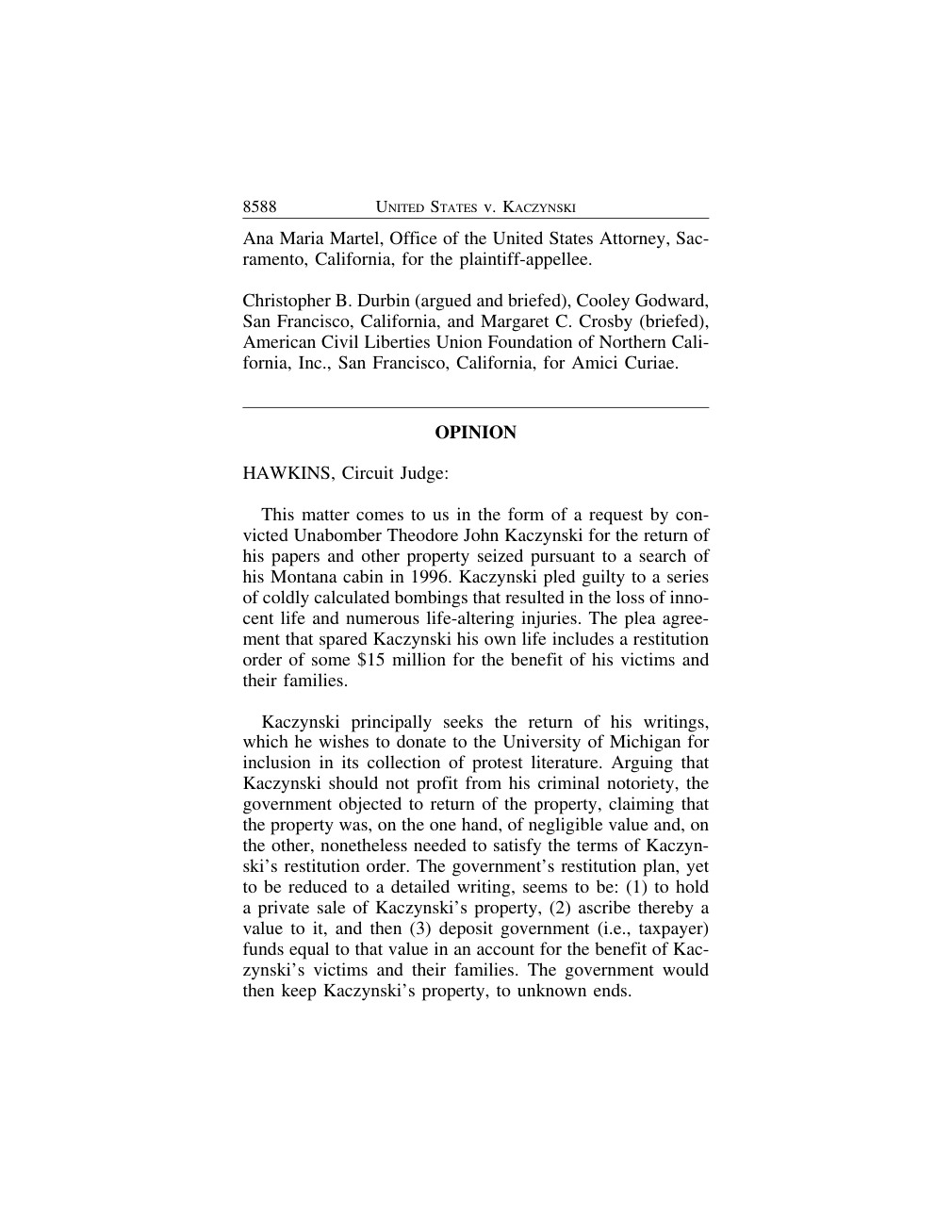
Judicial introduction: bombing admissions and the distinct property claim
The 2005 judicial opinion recalls the admitted bombing crimes while opening a separate dispute about property. A later court record, not a photograph of an attack. Image credit ↗

Chapter 01 / 1978–1995

A campaign with victims, before it had a face

The name UNABOM began as an investigative abbreviation for university and airline bombings. It described a pattern of attacks before investigators knew the offender’s identity. Starting in 1978, packages and devices injured people at universities, offices and other locations. A device aboard an airliner in 1979 brought another dimension of danger. Over the long campaign, the attacks killed three people and injured many others. The familiar nickname can make a series of separate injuries and bereavements sound like a single puzzle. The people receiving the packages had no such distance from the violence.

The dead were Hugh Scrutton, Thomas Mosser and Gilbert Murray. Other victims survived with serious injuries and lasting consequences. Their jobs and institutions were used by the bomber as symbols in a personal war against modern technological society. That symbolic reasoning does not describe the victims’ lives or establish responsibility for the conditions he opposed. It was the offender’s explanation for selecting human targets, not an independent account of why those people should have been attacked.

An FBI-led task force brought together federal investigators, the Bureau of Alcohol, Tobacco and Firearms, and the Postal Inspection Service. Early forensic and biographical leads did not readily identify the bomber. He moved across jurisdictions and left a misleading impression of an organization through the language of his communications. An investigative case name, a signature, or the use of a collective voice should not be mistaken for proof that a group existed.

The earliest package illustrates how the apparent sender could itself become a false lead. It was discovered at the University of Illinois at Chicago and carried a Northwestern professor’s return address. Returned to Northwestern, it exploded when a public-safety officer opened it on May 26, 1978. Discovery and explosion occurred on different days. Across later attacks, the association with universities and airlines helped define an investigative pattern, while subsequent targets broadened beyond that first description. UNABOM remained the case name even as the target list changed.
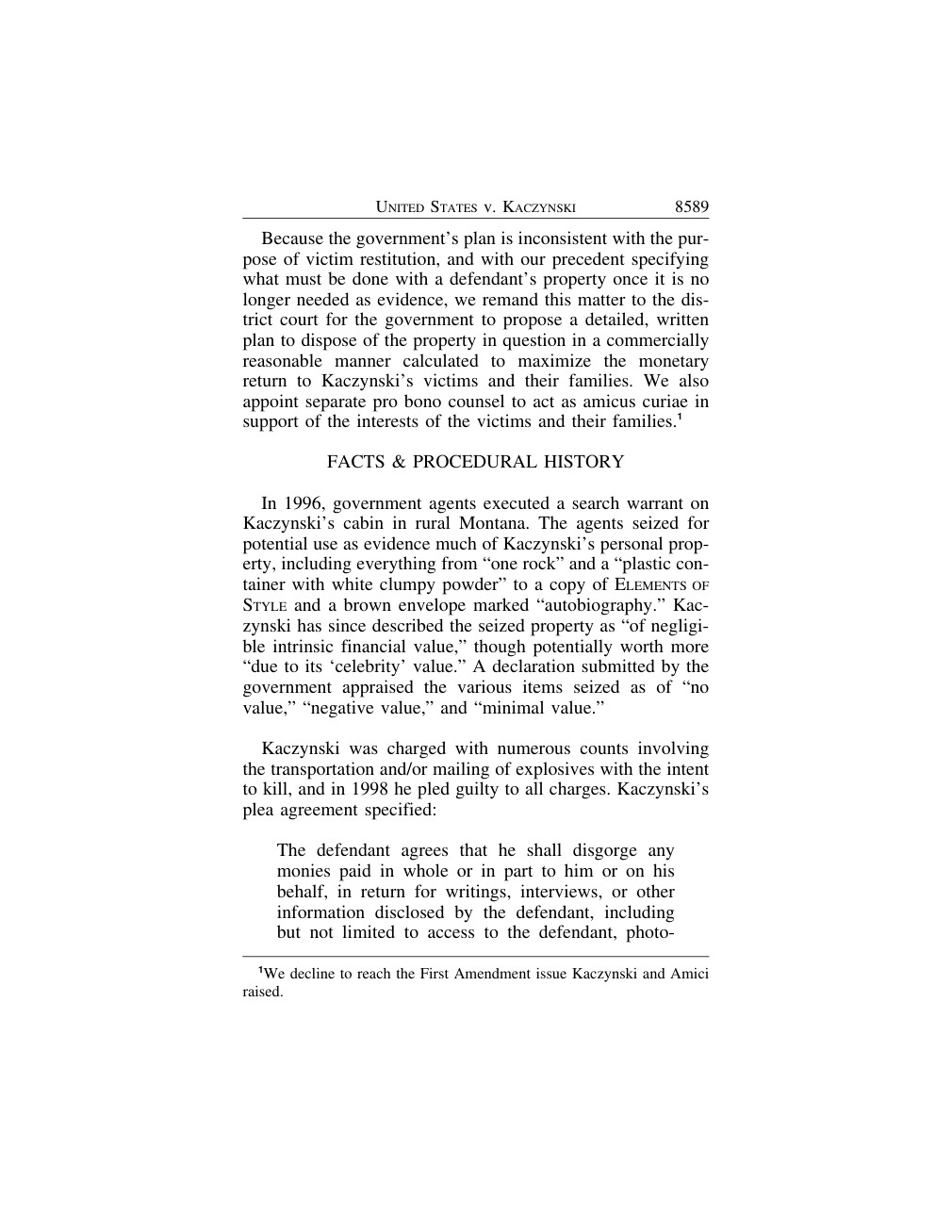
Sources: S01 · S05 · S07 · S14 · S15

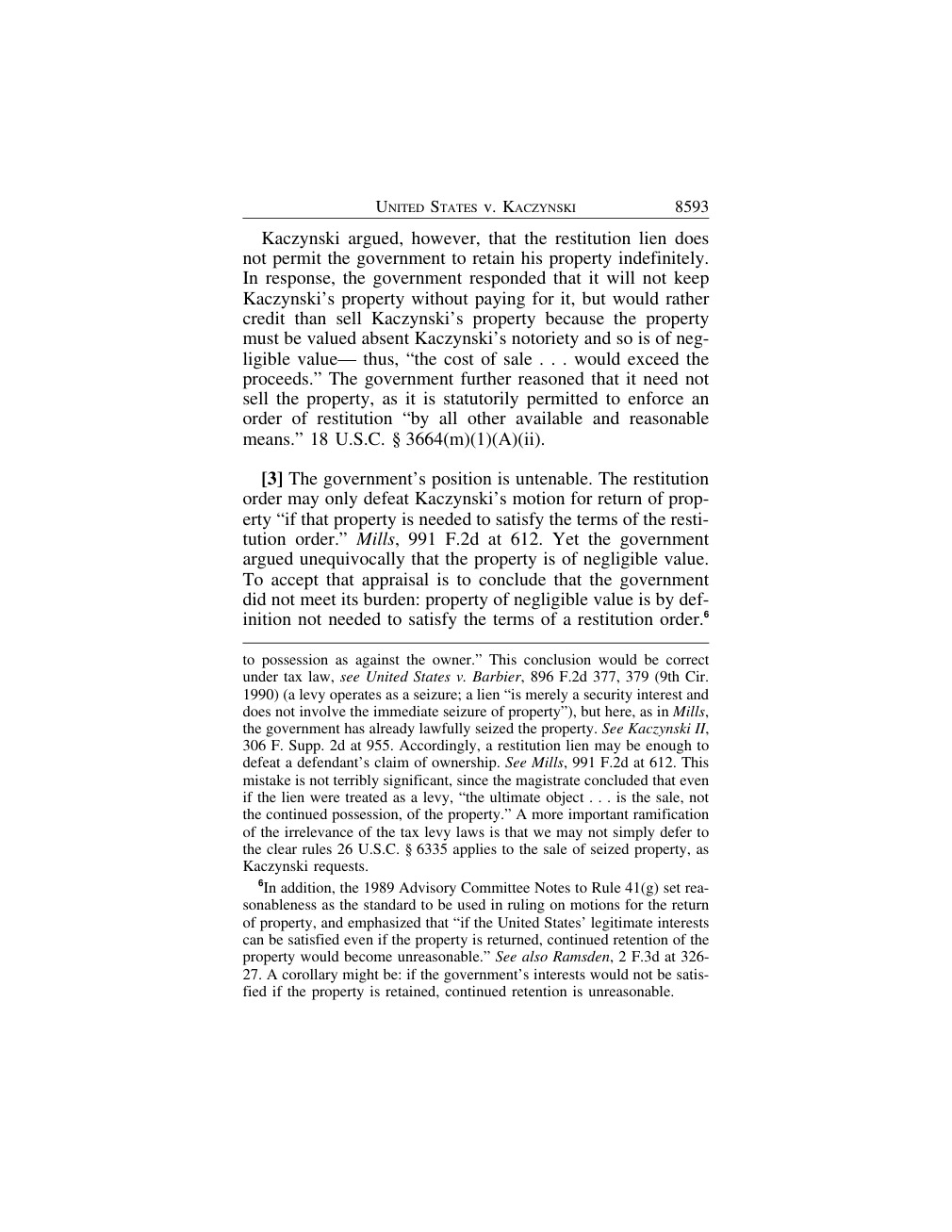
The 2005 opinion connects evidence, plea and restitution
The 2005 opinion distinguishes physical seizure, admissions and later property claims. The publication and recognition sequence is sourced to the investigative accounts and family interview. Image credit ↗

Chapter 02 / 1995–1996

The publication decision and a family’s recognition

In 1995, the bomber sought publication of a long essay setting out his hostility to industrial society. The authorities faced a difficult choice: publication might appear to reward threats, but it might also allow someone to recognize the writer. FBI Director Louis Freeh and Attorney General Janet Reno supported the recommendation to publish. The Washington Post printed it as a special section on September 19, 1995, under an arrangement with The New York Times. Its significance to the investigation was not that the public had been invited to accept its argument. Publication made a previously anonymous voice available for recognition.

Linda Patrik urged her husband David Kaczynski to consider whether his brother was the bomber. David later credited her initial insight in an interview. Reading the essay against Ted’s earlier writing, the couple recognized troubling similarities. He supplied letters and other material through the process that brought the family’s concerns to investigators. This was a painful family decision, not a simple contest in which a brilliant analyst solved an abstract code. David’s cooperation connected the public text with private documents and biographical details that investigators could check. Recognition supplied a lead; corroboration made the lead more than a relative’s suspicion.

Language comparison played an important role. Investigators examined similarities between the manifesto and the earlier documents, then considered them alongside the known bombing history and Kaczynski’s movements. It would be misleading to describe a particular phrase as a magical fingerprint that independently established guilt. The search warrant rested on a combination of circumstances. After the search, physical evidence supplied a far more direct connection between the suspect and the attacks.

The publication decision created a public pool of possible recognizers, but most of the resulting suggestions did not identify the offender. The useful tip had a special feature: David could supply private writing as well as a name. That allowed investigators to compare an established body of correspondence with the newly published text, then check the writer’s movements against the attack history. The cabin search subsequently transformed an inference about authorship into a physical-evidence case. The sequence joined a family’s knowledge to an institutional investigation; neither explains the breakthrough completely on its own.

Sources: S01 · S02 · S08 · S16

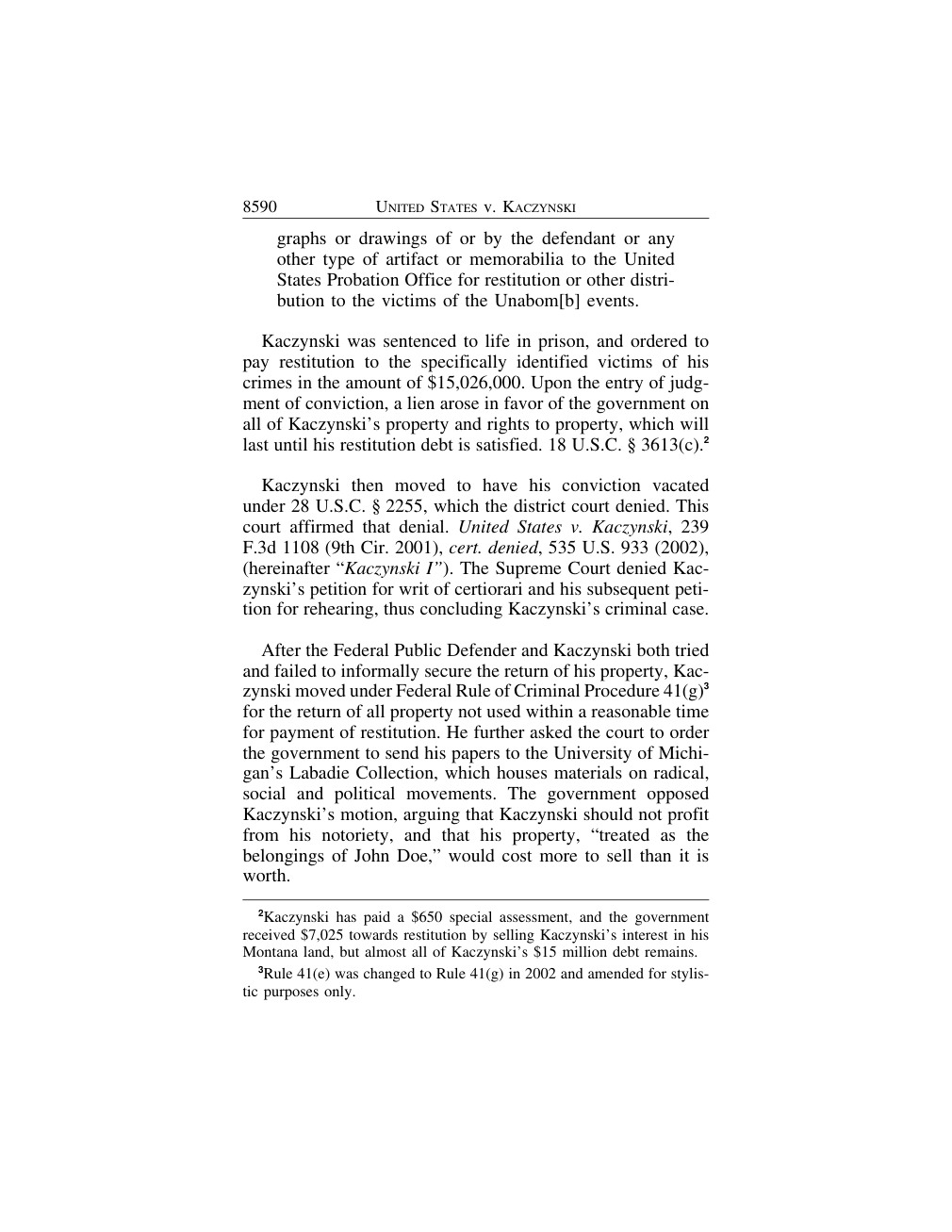
Property-law reasoning in the 2005 opinion; separate from the 2001 plea dispute
The 2005 opinion states the effect of the restitution lien and prior conviction review. The distinct 2001 majority and Reinhardt dissent are identified in the source notes. Image credit ↗

Chapter 04 / 1997–2001

A competent defendant, an unwanted defense and a disputed plea

The prosecution did not end with an arrest announcement. Federal indictments followed, and the defense confronted difficult questions about mental health, legal strategy and Kaczynski’s control over his own representation. His objections to his lawyers’ proposed use of mental-health evidence generated a serious dispute. A court-ordered inquiry addressed competency. These matters must be described through the court record rather than reduced to the claim that an intelligent defendant could not have a mental disorder, or that the existence of a diagnosis automatically resolved criminal responsibility.

On 22 January 1998, Kaczynski pleaded guilty under an agreement that avoided a death sentence and required life imprisonment without parole. The plea agreement included admissions of guilt and waivers of trial and appellate rights. In later proceedings, he sought to challenge the voluntariness of that plea. The Ninth Circuit’s 2001 opinion upheld the denial of relief. The guide records both the challenge and the outcome. Stating that he disputed the circumstances is not the same as treating that dispute as deciding proof that the plea was invalid.

The 2001 appeal records the sentence imposed on 4 May 1998: four consecutive life terms plus 30 years, with restitution of $15,026,000. Its majority assessed the plea’s voluntariness on the merits. It upheld the denial of self-representation, accepting the finding that the request was untimely and directed toward delay. It also considered Kaczynski’s earlier willingness to permit mental-state evidence at the penalty phase inconsistent with the claim that the prospect alone made his later plea involuntary.

Judge Stephen Reinhardt dissented. He disputed the conclusion that the self-representation request was made in bad faith or for delay, pointing to the timing of the court’s decision allowing mental-health evidence and the contemporaneous exchanges. In his view, denying that right made the subsequent plea involuntary as a matter of law. His objection was to the legal process, not a claim that bombing was justified or that the defendant had not committed the crimes. The dissent did not become the judgment.

The legal result also limits a familiar narrative temptation. Kaczynski’s mathematical ability, austere home and extensive writing do not turn murder into a philosophical experiment. Nor does condemning the crimes answer every question about his psychiatric history or his relationship with counsel. A reliable guide can preserve complexity while remaining direct about the settled result: he admitted the charged offenses, received a life sentence without parole, and did not succeed in having that plea vacated in the cited appeal.

Competency to participate in proceedings, control of a defense, criminal responsibility and the validity of a guilty plea are therefore separate questions. A person’s mathematical achievement cannot answer them, and a diagnosis cannot automatically determine the legal outcome. The majority’s affirmance and the dissent’s serious procedural objection belong together in the historical record, with neither silently transformed into a different disposition.

Sources: S03 · S04 · S12

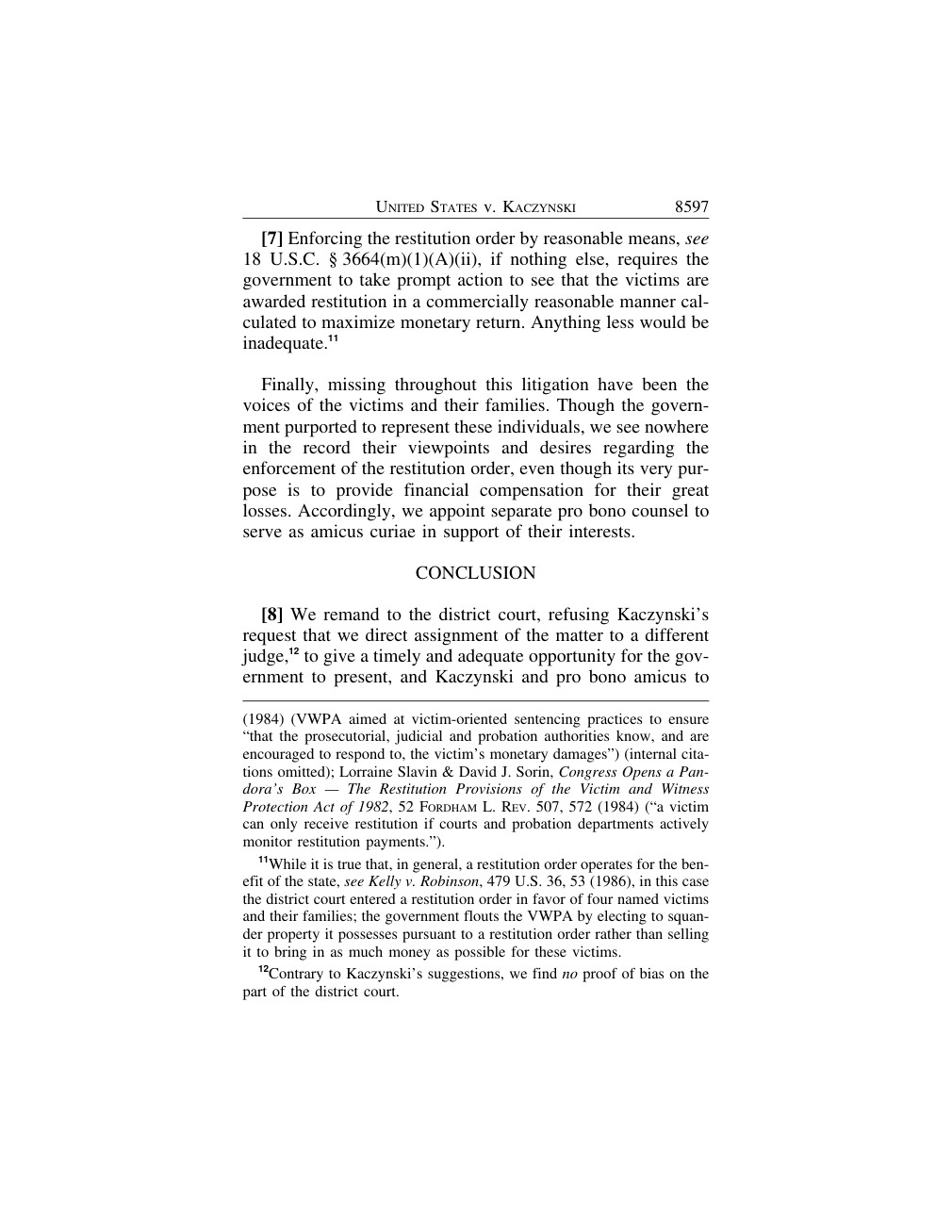
The 2005 court identifies missing victim participation and orders a proper plan
The 2005 appeal emphasizes the restitution interests of victims and families and appoints separate counsel to support those interests. Image credit ↗

Chapter 05 / 2002–2011

Restitution changes the meaning of the seized objects

The afterlife of the case also involved a dispute over the objects seized from the cabin. Kaczynski sought the return of property, while the government proposed a form of disposal that the Ninth Circuit found insufficiently attentive to restitution. In July 2005 the court remanded for a written plan designed to obtain a reasonable financial return for victims and families. A 2011 district-court order records the later auction schedule. The objects therefore acquired two kinds of value: notoriety for purchasers and possible compensation for people harmed. That litigation extended the consequences of the case beyond the life sentence, without revisiting the finding of guilt.

The 2005 opinion describes the government arguing that the objects had little or negative value if treated as an unknown person’s possessions, while seeking to retain them because of the restitution obligation. At argument it proposed a private valuation sale followed by a taxpayer-funded payment and government retention. The court rejected that plan as inconsistent with the purpose of compensating victims. Notoriety could increase what collectors or archives would pay; directing those proceeds toward victims did not amount to enriching the offender.

The distinction matters for a free-expression account too. Kaczynski wanted his papers transferred to the University of Michigan’s Labadie Collection. The court expressly declined to decide the First Amendment issue and instead required a commercially reasonable plan aimed at maximizing monetary return. It appointed separate counsel to support the victims’ and families’ interests because their views were missing from the record. This was a significant limit on government disposition, while leaving the criminal convictions intact.

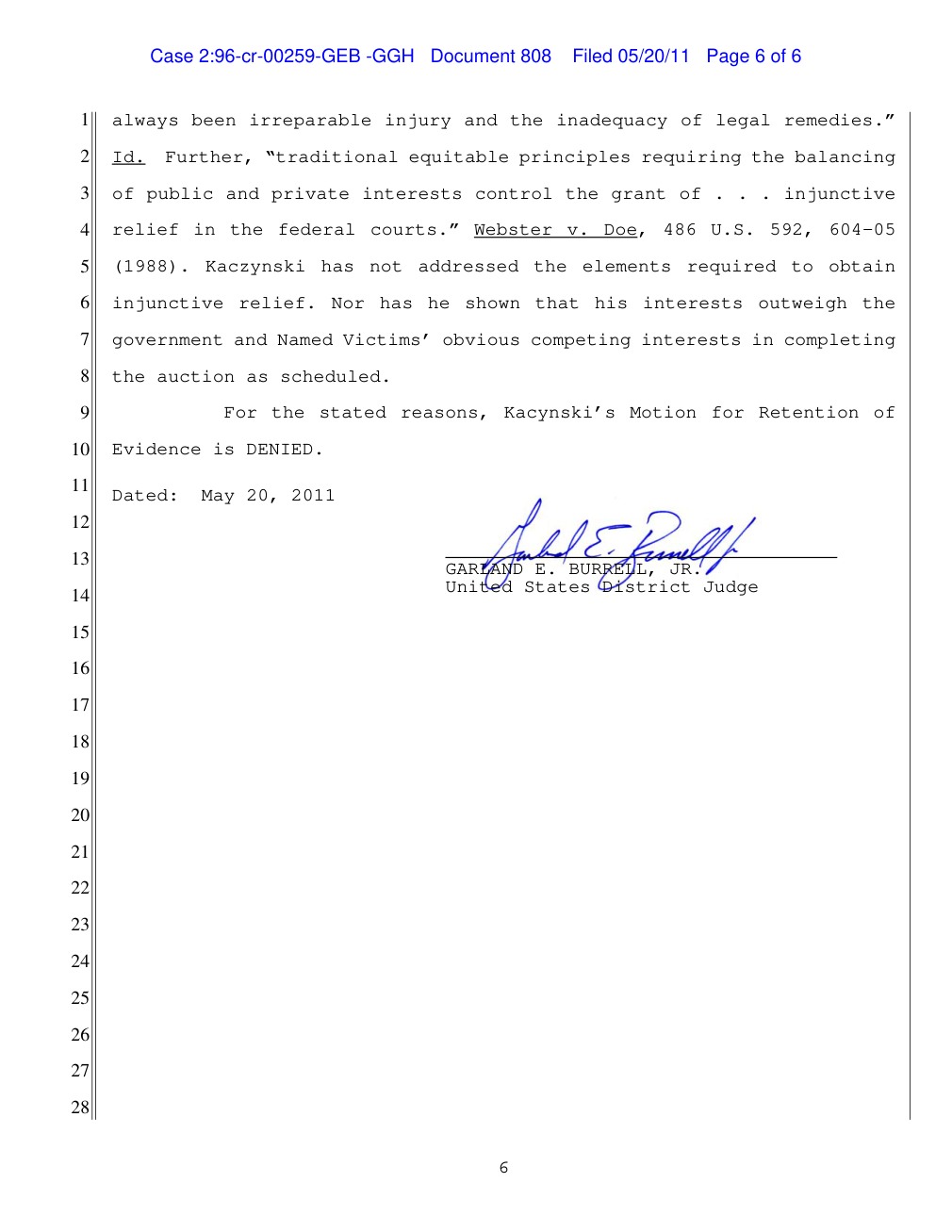
The 2011 order addressed a different request: preservation of seized evidence because Kaczynski feared a possible future prosecution concerning the 1982 Tylenol poisonings. It records his request and the government’s response; it does not establish his responsibility for that incident. The court found the hypothesized future injury insufficient for standing and ripeness, and also found the requirements for injunctive relief unmet. A denied preservation motion cannot be rewritten as a conviction in a separate case.

The order judicially noticed the auction’s 18 Maystart and 2 Junescheduled closing. It is not a final accounting of proceeds or a determination that all losses had been compensated. The property proceedings show why a famous object’s role cannot be inferred from its visual familiarity: it could be evidence, a contested possession, an archival document and a source of restitution, under different legal rules at different stages.

Sources: S12 · S13

The 2011 order denies the narrow evidence-retention motion
The 2011 order concludes a narrow evidence-retention dispute. It is a judicial record, not a portrait or an image of the cabin. Image credit ↗

Chapter 06 / 1998–2023 and after

The person, the icon and the limits of a retrospective

Kaczynski spent the rest of his life in federal custody and died on 10 June 2023. The death certificate released by the Bureau of Prisons fixes that date as a matter of public record. His death ended his own story, but it did not end the injuries, grief or arguments about the case. Victims and relatives continued to live with consequences that a photograph of the cabin or a summary of the manifesto cannot convey. A history of the offender’s afterlife needs to keep those lives visible. AP and Fox also reported his death in federal custody on 10 June 2023.

Popular memory often selects two dramatic objects: the hooded composite image produced during the search and the primitive cabin found in Montana. Each can mislead if detached from chronology. The composite was an investigative aid created before identification, not a portrait made after proof of guilt. The cabin was a real dwelling and evidence location, not evidence that the offender was harmless because he lived with few possessions. The value of either object lies in its relationship to the dated record, not its ability to make an instantly recognizable icon.

A second distortion treats one remembered phrase or a single specialist as the complete explanation for the breakthrough. The case’s documentary sequence is more collaborative. Publication, a family member’s recognition, earlier correspondence, investigators’ comparisons and biographical checks, and the search evidence all contributed. That sequence is compatible with acknowledging an important analytic technique. It resists the idea that a technique alone eliminated the need for witnesses, corroboration or physical evidence.

The later accounts have different centers of gravity. The FBI’s 2021 story foregrounds how writing became an investigative lead and credits several task-force participants. David’s 2013 interview instead describes a family’s moral conflict and Linda’s role in overcoming his initial disbelief. The 2001 opinions debate the right to control a defense; the 2005 opinion asks who speaks for victims in the handling of property. None of those passages supports treating a single specialist, a family member or a single phrase as the entire explanation.

The existence of David’s 2016 memoir is established by its publisher record, but the complete book was not read for this edition. No conclusion about its omissions or the accuracy of a dramatization is inferred from publicity copy. Cultural prominence is likewise unmeasured here: the inspected narratives show which objects and arguments recur in this corpus, not how many people recognize them or which interpretation most audiences accept.

Sources: S01 · S02 · S03 · S06 · S09 · S10 · S11 · S12 · S13 · S16 · S17

02 / The record

The critical path

Attacks, publication, family documents, corroboration, search, admissions and distinct later judicial proceedings form the yardstick. Each link has a different evidentiary role.

Evidence support assesses the stated hinge. Cultural prominence is unmeasured and scoped to recurrence within inspected narratives; no polls or invented audience ranks.

CP1

Separate attacks establish harm before they identify a writer

Official-record yardstick

The campaign killed Hugh Scrutton, Thomas Mosser and Gilbert Murray; separate attacks and injuries precede identification.

An investigative label and collective signature do not identify participants. The later admissions and legal record connect Kaczynski to the crimes; the case name alone does not.

Why it is critical

Preserves the consequences and prevents a writer’s biography from replacing the acts requiring explanation.

If this step is removed

Remove the attacks and the narrative becomes a history of political writing. Remove one institutional date error and the other attacks and later admissions remain.

Dependencies

Dated incident records, individual victims and later attribution; discovery of the first package and its explosion are different events.

What rival readings must explain

A group account must link actual participants to acts; a lone-offender account must explain the collective presentation and the geographic sequence.

Gaps and disputes

No full physical-evidence inventory or independent reconstruction of each device; no procedural details reproduced.

Evidence support: High for deaths and admitted responsibility; qualified for early reconstruction

The particular hinge as stated in the inspected documentary record.

Judicial record, charging announcement and histories converge on core responsibility while differing in chronology details.

Cultural prominence: Unmeasured

General audience familiarity and relative cultural prominence, distinct from evidence support.

The sketch and cabin recur in inspected institutional accounts. This is textual recurrence, not a population familiarity measurement.

Sources: S01 · S03 · S05 · S14 · S15

CP2

Publication gives private recognizers access to the anonymous text

Official-record yardstick

The newspapers published the essay in September 1995 after authorities supported publication as an investigative opportunity.

Publication was a decision under threat with competing costs. It made recognition possible; it did not itself authenticate the essay’s political argument or identify an author.

Why it is critical

Explains how an anonymous communication could become a public source of comparison.

If this step is removed

Without publication, this route to recognition loses its immediate trigger. That does not prove no other investigative route could ever have succeeded.

Dependencies

The bomber’s publication demand, editorial/government decisions and actual dissemination must precede recognition of the published text.

What rival readings must explain

A publication-as-surrender account must address the resulting lead; a triumph-only account must acknowledge the decision’s uncertainty and other possible outcomes.

Gaps and disputes

No complete internal editorial deliberation or quantified counterfactual estimate of investigative alternatives.

Evidence support: High for publication and documented purpose; counterfactual uncertain

The particular hinge as stated in the inspected documentary record.

Official histories and contemporaneous chronology establish the event and stated investigative rationale.

Cultural prominence: Unmeasured

General audience familiarity and relative cultural prominence, distinct from evidence support.

Publication features in the institutional and family accounts inspected; no relative public prominence estimate.

Sources: S01 · S02 · S08 · S14

CP3

Family documents make language comparison testable

Official-record yardstick

Recognition supplied a suspect and earlier writing; investigators combined linguistic similarities with biographical circumstances before a warrant.

The source of the comparison material is part of the explanation. A remembered phrase cannot independently replace authorship comparison, corroboration or a judicial threshold.

Why it is critical

Connects public communication to private evidence without assigning all causal credit to either family intuition or one technique.

If this step is removed

Remove the family writing and this comparison loses its established reference set. Remove one phrase and the combined investigation may still stand; the full warrant record would decide its importance.

Dependencies

Requires CP2’s dissemination, earlier writings whose provenance can be checked and pre-search investigative work.

What rival readings must explain

A specialist-only account must explain where the documents came from. A recognition-only account must explain what made suspicion sufficient for a search.

Gaps and disputes

The complete original affidavit and all rejected leads were not independently audited. Institutional retrospectives allocate credit from hindsight.

Evidence support: High for combined sequence; incomplete for allocating exact credit

The particular hinge as stated in the inspected documentary record.

The institutional account identifies documents and corroboration; the family interview gives a distinct perspective on the decision to cooperate.

Cultural prominence: Unmeasured

General audience familiarity and relative cultural prominence, distinct from evidence support.

Several inspected accounts emphasize words and recognition. Audience preference for a particular hero narrative is unmeasured.

Sources: S01 · S02 · S08 · S16

CP4

The search supplies evidence different from a lead or charge

Official-record yardstick

The 1996 search recovered writings and physical evidence; 1998 pleas admitted the charged offenses.

The affidavit threshold, search results, indictments and admissions are sequential, not interchangeable forms of proof. No complete trial verdict followed the plea.

Why it is critical

Turns a plausible identification into an admitted criminal case and prevents hindsight from being inserted into the pre-search showing.

If this step is removed

Without the recovered evidence, the identification depends much more heavily on pre-search inference. Without admissions, the prosecution’s allegations would require a different adjudication.

Dependencies

Requires a warrant, actual seized evidence, charging instruments and a valid plea process; legality of the plea is separately tested at CP5.

What rival readings must explain

An organizational-assistance claim needs direct corroboration; an account of responsibility must distinguish the plea from a completed evidentiary trial.

Gaps and disputes

Full affidavit, exhibits, recordings and trial-docket corpus not audited; no inference that every conceivable assisting act has been disproved.

Evidence support: High for seizure and admitted offenses

The particular hinge as stated in the inspected documentary record.

Actual court records identify the pleas and later proceedings; institutional account supplies investigative context.

Cultural prominence: Unmeasured

General audience familiarity and relative cultural prominence, distinct from evidence support.

Cabin imagery is prominent within the inspected account, but general recognition and comparative popularity remain unmeasured.

Sources: S01 · S03 · S05 · S06 · S12

CP5

Plea validity turns on legal choices, not intelligence or diagnosis alone

Official-record yardstick

The 2001 majority affirms the plea’s validity; Reinhardt disputes the denial of self-representation and its effect on voluntariness.

Competency, control of mental-state evidence, timeliness/good faith of self-representation and plea voluntariness require different legal inquiries.

Why it is critical

Preserves the strongest actual procedural rival without converting disagreement into a changed judgment or a finding of factual innocence.

If this step is removed

Remove the majority’s good-faith/delay finding and the self-representation analysis could change. Remove the dissent and a serious recorded objection disappears, although the judgment remains affirmed.

Dependencies

Requires contemporaneous counsel/court exchanges, the sequence of defense decisions and the plea colloquy; follows CP4’s prosecution.

What rival readings must explain

A coerced-plea account must answer the plea representations and majority’s findings. A wholly unproblematic-process account must address the dissent’s transcript-based objection.

Gaps and disputes

No independent psychiatric evaluation or complete privileged counsel file; no retrospective diagnosis supplied.

Evidence support: High for outcome and documented disagreement

The particular hinge as stated in the inspected documentary record.

The actual opinion states each side’s reasoning and the affirmed disposition; no reliance on a general official denial.

Cultural prominence: Unmeasured

General audience familiarity and relative cultural prominence, distinct from evidence support.

Legal controversy is visible in the inspected opinions; no measured audience ranking against the cabin/linguistic story.

Sources: S03 · S04

CP6

Property and compensation survive the conviction

Official-record yardstick

The 2005 court remands for a commercially reasonable restitution plan; 2011 retention ruling concerns a different hypothesized future injury.

An offender’s papers can carry evidentiary, archival and monetary value. A property judgment is not a reversal of guilt or a finding in an unrelated poisoning case.

Why it is critical

Connects celebrated artifacts to victims’ financial interests and limits both unrestricted-return and indefinite-government-retention accounts.

If this step is removed

Without the restitution obligation, the justification for retaining non-evidentiary property changes. Removing the 2011 motion would not erase the 2005 remand or establish auction proceeds.

Dependencies

Conviction, restitution lien, evidentiary need and actual disposal plans precede the competing property remedies.

What rival readings must explain

A pure expression account must address victims’ liens; a government-retention account must address the court’s rejection of nominal valuation and missing victim participation.

Gaps and disputes

No final accounting of proceeds or full later property docket audited; 2011 auction schedule is not a complete compensation measure.

Evidence support: High for judicial holdings and schedule; final accounting absent

The particular hinge as stated in the inspected documentary record.

Original federal opinions distinguish the remedies and the 2011 standing/ripeness issue.

Cultural prominence: Unmeasured

General audience familiarity and relative cultural prominence, distinct from evidence support.

The courts explicitly discuss notoriety value, not the population’s preferred interpretation or a popularity poll.

Sources: S12 · S13

03 / The record

How the accounts developed

Direct court citations and the documented evidence chain are separated from parallel participant perspectives. No unread-book or film borrowing is invented.

1978–1995

A collective signature becomes an organizational hypothesis

Investigators encountered communications presenting an organization before an identified individual.

Lineage

Anonymous attacks/communications → collective FC claim → competing offender hypotheses.

Borrowing or relationship

Cornell’s contemporary chronology and later institutional account describe the claim. No complete private manifesto or original communication corpus was independently audited or reproduced.

Evidence for the connection

The inspected chronology explicitly records the group claim; it is evidence of presentation rather than authenticated collaborators.

Recurring path nodes

CP1CP4

Branches in this record

Private comparison writing enters a public success story

Sources: S01 · S14

1995–1996 / later accounts

Private comparison writing enters a public success story

Publication enabled a family lead, while later accounts emphasize different parts of the combined breakthrough.

Lineage

Published text → family documents → investigator comparison/corroboration → warrant and search.

Borrowing or relationship

The FBI story identifies the earlier essay and comparison process. The interview adds the family’s decision perspective, not a new independent physical exhibit.

Evidence for the connection

Both actual read accounts describe links in the chain; no claim that every later retelling independently verifies every exhibit.

Recurring path nodes

CP2CP3CP4

Branches in this record

The plea dispute becomes a cited judicial history · Institutional, family and publication histories run in parallel

Sources: S01 · S02 · S16

1998–2005

The plea dispute becomes a cited judicial history

The 2001 opinion records majority/dissent disagreement; the 2005 property opinion expressly cites the earlier denial of relief.

Lineage

Plea record → collateral appeal → later property opinion’s procedural history.

Borrowing or relationship

The later opinion’s citation establishes documentary reuse. A property court repeating the conviction history is not a second trial of the bombing evidence.

Evidence for the connection

Actual citation to239 F.3d 1108 and explicit distinction between criminal and property proceedings.

Recurring path nodes

CP4CP5CP6

Branches in this record

Notoriety, victims and preservation become competing property frames

Sources: S03 · S12

2005–2011

Notoriety, victims and preservation become competing property frames

The restitution remand and later retention motion assign different legal significance to the same seized material.

Lineage

Government retention proposal/victim restitution → remand → auction and separate retention request.

Borrowing or relationship

The 2011 order judicially notices the auction schedule and analyzes an independent request. It does not provide a final accounting or decide guilt in a different case.

Evidence for the connection

Original opinions state the remedy and later schedule; the chain is legal implementation, not an inferred book-to-film borrowing.

Recurring path nodes

CP6

Branches in this record

Institutional, family and publication histories run in parallel

Sources: S12 · S13

2013–2021

Institutional, family and publication histories run in parallel

The family interview centers moral conflict; the official retrospective centers investigative work. A later memoir’s publication is separately documented.

Lineage

Different participant perspectives → interview/official history and memoir publication.

Borrowing or relationship

No direct borrowing between these particular later texts is asserted. Shared events are distinguished from documented adaptation or copied passages.

Evidence for the connection

Actual interview/story passages and publisher metadata establish what was publicly presented. Complete memoir and dramatizations not inspected.

Recurring path nodes

CP2CP3CP5

Sources: S02 · S16 · S17

04 / The record

Rival readings on the same path

The strongest versions, the steps they accept or revise, and the evidence they would need.

Interpretation 01

A lone offender behind an organizational presentation

Strong core; assistance would need specific proof

The strongest version

Collective language could suggest a group, while a single writer and offender could deliberately present one. The recovered evidence and admissions identify Kaczynski.

Accepts

The campaign, collective communications, identification, evidence and admitted responsibility.

Must still explain

Plural language alone does not establish a second participant; proving one offender’s role does not logically exclude every form of assistance.

Assessment

The judicial/investigative record strongly supports his responsibility and does not authenticate a co-offender in the inspected corpus.

Accept these path nodes

Remove or revise this inference

  • Remove the inference that a collective signature independently proves an organization, or that one conviction disproves all possible assistance.

Add this evidence

  • Direct links between a named person’s knowledge, conduct and particular offenses.

What would change this assessment

Authenticated contemporaneous communications, financial transfers or corroborated participant accounts tied to specific attacks could establish a narrower assistance finding.

Sources: S01 · S03 · S05 · S14

Interpretation 02

An analytic breakthrough depended on a family and corroboration

Best supported combined causal account

The strongest version

The public essay became a useful lead through private comparison writing and investigative checks. Neither a phrase nor recognition by itself supplied the whole case.

Accepts

Publication, family cooperation, language comparison, corroboration and search evidence.

Must still explain

Institutional and personal retrospectives may distribute credit differently; the complete affidavit and rejected leads are not audited here.

Assessment

The inspected sources support the linked sequence, while leaving exact marginal credit and counterfactual alternatives uncertain.

Accept these path nodes

Remove or revise this inference

  • Remove a single-specialist or single-phrase explanation that erases the documents’ source and subsequent evidence.

Add this evidence

  • Contemporaneous comparison files and warrant materials showing which facts were actually necessary to the decision.

What would change this assessment

Dated case files showing a decisive independent identification before the family’s contact, or a materially different warrant basis, would change the allocation of causal credit.

Sources: S01 · S02 · S08 · S16

Interpretation 03

Denial of self-representation made the plea involuntary

Serious judicial dissent; majority outcome affirmed

The strongest version

Reinhardt argued that the request followed the ruling allowing unwanted mental-state evidence and was not made for delay. An unlawful denial of self-representation could invalidate the ensuing plea.

Accepts

The actual counsel conflict, competency inquiry, request, plea and challenge.

Must still explain

The majority accepted the contrary timing/good-faith findings and the defendant’s contemporaneous plea representations. A diagnosis or difficult choice does not itself resolve voluntariness.

Assessment

This is a documented legal disagreement, not proof that the crimes were fabricated. The judgment remained denial of relief.

Accept these path nodes

Remove or revise this inference

  • Remove an assumption that the majority’s outcome means no serious autonomy objection existed; preserve the actual affirmance.

Add this evidence

  • Precise evidence of the request’s timing/good faith and its causal relation to the plea, evaluated under the relevant legal standards.

What would change this assessment

Authenticated contemporaneous material materially changing the timing, assurances or plea representations could alter a historical evaluation; a different legal remedy would require an applicable judicial ruling.

Sources: S03 · S04

Interpretation 04

Return or archival preservation should prevail over state retention

Partial property-law support; restitution limits the remedy

The strongest version

The government should not indefinitely keep papers no longer needed as evidence, or assign nominal value while relying on a restitution lien. An archive could preserve research access.

Accepts

Seizure, conviction, lien, Kaczynski’s requested transfer and the government’s retention.

Must still explain

The property can be valuable because of notoriety, and victims have a restitution interest. The 2005 court did not decide the First Amendment question or order unconditional return.

Assessment

The remand rejects the government’s plan and gives a conditional return remedy, while requiring a commercially reasonable victims-oriented disposition first. The 2011 hypothetical future prosecution did not establish a present injunction claim.

Accept these path nodes

Remove or revise this inference

  • Remove an inference from conviction to unlimited state ownership, or from expression concerns to freedom from restitution obligations.

Add this evidence

  • Actual property valuations, victim participation, sale proceeds and the legal basis for any continued evidentiary retention.

What would change this assessment

A final accounting, authenticated evidence-retention need or actual plan showing compliance/noncompliance with the remand could change the practical assessment; the underlying convictions remain separate.

Sources: S12 · S13

05 / The record

What public accounts emphasize

Cards compare actual inspected institutional, interview and judicial passages. Complete books, films, recordings and privileged files were not audited.

The FBI’s 2021 retrospective: words become a lead

The Words of a Killer story, actual publication, earlier-writing and corroboration passages; no full podcast playback.

Amplifies

Writing analysis, task-force collaboration and the recovery of incriminating material.

Recasts or leaves unresolved

Frames a successful investigation from hindsight. The published excerpt does not allocate exact counterfactual credit among all people or explain the full psychiatric-defense dispute.

Scope and limits

An institutional account is compared with court records; no assumption that its authors or every image were federal employees.

CP2CP3CP4

Sources: S01 · S02 · S03

David’s 2013 interview: a family’s decision

Actual NPR Tell Me More transcript passages, not complete memoir or audio playback.

Amplifies

Linda’s initial insight and the conflict between preventing more harm and exposing a brother to possible execution.

Recasts or leaves unresolved

Recasts recognition as a shared moral decision rather than an effortless act of detection.

Scope and limits

A retrospective participant account, not a judicial ruling about every investigative step or a psychiatric diagnosis endorsed by this guide.

CP2CP3CP5

Sources: S16 · S03

Reinhardt’s dissent: autonomy has legal consequences

Actual 2001 opinion’s self-representation dissent and cited contemporaneous court exchanges.

Amplifies

Good-faith timing, the right of a competent defendant to represent himself and the effect of an unlawful denial on a plea.

Recasts or leaves unresolved

Questions the majority’s characterization of delay; does not turn the political justification for bombing into a meritorious defense.

Scope and limits

The dissent did not become the judgment. It is a legal rival grounded in the record, not a new verdict of innocence.

CP4CP5

Sources: S03

The 2005 court: victims’ interests were missing

Original property opinion’s government-plan, restitution and missing-victim-participation passages.

Amplifies

Reasonable monetary return and separate representation of victims/families in the property dispute.

Recasts or leaves unresolved

Rejects both nominal-value retention and an assumption that notoriety proceeds would necessarily enrich the offender.

Scope and limits

The court declines the First Amendment issue; a remand is not a final sale accounting or a criminal reversal.

CP5CP6

Sources: S12 · S13

06 / The record

Find a thread in the file

Search the chapter and claim index. Every result leads to the full text and its sources.

Chapter 01A campaign with victims, before it had a faceChapter 02The publication decision and a family’s recognitionChapter 03A warrant is a threshold; the search supplies a different kind of proofChapter 04A competent defendant, an unwanted defense and a disputed pleaChapter 05Restitution changes the meaning of the seized objectsChapter 06The person, the icon and the limits of a retrospectiveCritical pathSeparate attacks establish harm before they identify a writerCritical pathPublication gives private recognizers access to the anonymous textCritical pathFamily documents make language comparison testableCritical pathThe search supplies evidence different from a lead or chargeCritical pathPlea validity turns on legal choices, not intelligence or diagnosis aloneCritical pathProperty and compensation survive the convictionGenealogyA collective signature becomes an organizational hypothesisGenealogyPrivate comparison writing enters a public success storyGenealogyThe plea dispute becomes a cited judicial historyGenealogyNotoriety, victims and preservation become competing property framesGenealogyInstitutional, family and publication histories run in parallelRival accountA lone offender behind an organizational presentationRival accountAn analytic breakthrough depended on a family and corroborationRival accountDenial of self-representation made the plea involuntaryRival accountReturn or archival preservation should prevail over state retentionNarratorThe FBI’s 2021 retrospective: words become a leadNarratorDavid’s 2013 interview: a family’s decisionNarratorReinhardt’s dissent: autonomy has legal consequencesNarratorThe 2005 court: victims’ interests were missingTimelineFirst device explodes at NorthwesternTimelineFederal task force formedTimelineHugh Scrutton killedTimelineSalt Lake City bombingTimelineThomas Mosser killedTimelineGilbert Murray killedTimelineEssay published; recognition followsTimelineArrest near Lincoln, MontanaTimelineNew Jersey indictment returnedTimelineGovernment gives death-penalty noticesTimelineGuilty pleaTimelineSentence imposedTimelineMotion challenges convictionTimelineAppellate challenge rejectedTimelinePlea challenge rejected on appealTimelineProperty case remanded for a restitution planTimelineAuction of seized property beginsTimelineEvidence-retention motion deniedTimelineFamily interview describes shared decisionTimelineEvery Last Tie publishedTimelineFBI revisits the writing evidenceTimelineDeath in federal custodyClaimThe Unabomber was Theodore Kaczynski.ClaimKaczynski was a member of a right-wing militia.ClaimA single phrase by itself proved the entire case.ClaimThe 1998 plea provided life without parole.ClaimKaczynski’s later objection invalidated the guilty plea.ClaimLiving in an isolated cabin meant he had ceased harming people outside it.ClaimThe campaign killed three people.ClaimKaczynski died on 10 June 2023.ClaimThe 2005 property appeal reversed the bombing convictions.ClaimThe 2005 property decision reversed the bombing convictions.ClaimThe 2011 order establishes guilt in the Tylenol case.ClaimThe 2001 appeal was unanimous about self-representation.ClaimThe 2005 property court decided the First Amendment question.

07 / The record

People and institutions

Open a record for the person’s role and supporting sources. Names identify people; no unverified portrait is substituted for a participant.

KaczynskiBiographical record
Theodore KaczynskiThe convicted Unabomber

Former academic and anti-industrial extremist who pleaded guilty in 1998 and received life without parole. His case is not evidence of membership in a right-wing militia.

Sources: S01 · S03

KaczynskiBiographical record
David KaczynskiBrother whose cooperation advanced the case

Recognized similarities between the published essay and his brother’s writing, and provided documents that investigators could compare. His decision was a central link in identification.

Sources: S01 · S02

ScruttonBiographical record
Hugh ScruttonVictim killed in 1985

A Sacramento computer-store owner killed in the bombing campaign. He was a person with a life beyond the role assigned to him in the offender’s ideology.

Sources: S05

MosserBiographical record
Thomas MosserVictim killed in 1994

A communications executive killed by a package bomb at his New Jersey home. The 1998 plea encompassed the charged fatal attacks.

Sources: S03 · S05

MurrayBiographical record
Gilbert MurrayVictim killed in 1995

A forestry association executive killed in Sacramento. His death was part of the legal case, not an abstract confrontation between a writer and technology.

Sources: S03 · S05

FreehBiographical record
Janet Reno and Louis FreehPublication decision-makers

The attorney general and FBI director approved publication in hopes that a reader could identify the author. The decision’s purpose was investigative identification, not endorsement.

Sources: S01 · S02

DenvirBiographical record
Judy Clarke and Quin DenvirDefense lawyers

Their representation and the defendant’s objections to mental-health strategy form part of the proceedings discussed in the 2001 appellate opinion.

Sources: S03

PatrikBiographical record
Linda PatrikFamily recognizer

David’s interview credits her initial insight and their shared comparison and decision-making. Her role is distinct from subsequent FBI corroboration.

Sources: S16

ReinhardtBiographical record
Stephen ReinhardtDissenting appellate judge

Disputed the majority’s self-representation analysis and resulting plea voluntariness; his view did not become the judgment.

Sources: S03

08 / The record

The confrontations, the trials and the aftermath

Horizontal spacing shows elapsed time; separate rows keep close events selectable. Scroll the graph on narrow screens. Exact dates are attributed where records conflict; month- and year-only dates preserve source precision.

19781990200220142026
First device explodes at NorthwesternCase record

The package was discovered on May 25 and returned to Northwestern; a public-safety officer was injured opening it on May 26. The two dates represent different events.

Sources: S14 · S15

Federal task force formedCase record

The FBI, ATF and Postal Inspection Service joined the investigation.

Sources: S01

Hugh Scrutton killedCase record

A bombing in Sacramento killed the computer-store owner.

Sources: S01 · S05

Salt Lake City bombingCase record

A serious injury and a witness observation produced evidence later associated with the familiar composite image.

Sources: S01 · S07

Thomas Mosser killedCase record

A package bomb killed Mosser at his New Jersey home. This date follows the DOJ charging record.

Sources: S05

Gilbert Murray killedCase record

A mailed bomb killed Murray in Sacramento.

Sources: S01 · S05

Essay published; recognition followsCase record

The essay appeared as a special section in The Washington Post under an arrangement with The New York Times. David Kaczynski’s recognition and earlier writing supplied a consequential lead.

Sources: S01 · S02

Arrest near Lincoln, MontanaCase record

The search of the cabin supplied direct physical and documentary evidence.

Sources: S01 · S06

New Jersey indictment returnedLaw

Separate federal charging instrument later covered by the plea agreement.

Sources: S03

Government gives death-penalty noticesLaw

The later plea agreement withdrew the capital prosecution.

Sources: S03

Guilty pleaCase record

The agreement avoided a death sentence and provided life without parole.

Sources: S03 · S04

Sentence imposedLaw

Four consecutive life terms plus 30 years; restitution $15,026,000.

Sources: S03

Motion challenges convictionReview

Voluntariness argument later reaches the Ninth Circuit.

Sources: S03

Appellate challenge rejectedCase record

The Ninth Circuit affirmed denial of relief from the plea.

Sources: S03

Plea challenge rejected on appealReview

Majority affirms; Reinhardt dissent contests self-representation ruling.

Sources: S03

Property case remanded for a restitution planJudicial outcome

The Ninth Circuit required a concrete plan to dispose of seized property with attention to monetary return for victims and families. It did not reverse the convictions.

Sources: S12

Auction of seized property beginsJudicial record

The May 20 order states that the online auction began on May 18 and bidding was scheduled to end June 2. The order is not a final distribution accounting.

Sources: S13

Evidence-retention motion deniedProperty

Court separates hypothetical future injury from a ripe claim and records the auction schedule.

Sources: S13

Family interview describes shared decisionMemory

David’s retrospective credits Linda and explains the moral conflict; not a full memoir audit.

Sources: S16

Every Last Tie publishedMemory

Publisher metadata establishes David’s memoir; contents not independently read for this edition.

Sources: S17

FBI revisits the writing evidenceMemory

Retrospective describes family documents and investigative comparison/corroboration.

Sources: S02

Death in federal custodyCase record

The official released death record documents the date.

Sources: S09

09 / The record

How the story changed

Public memory tends to compress contested histories into a turning point. The records leave a less tidy sequence.

The sketch is an investigative aid

ThenA witness observation helped create the familiar image during an unresolved search.

ReconsideredIt should be dated as a lead, rather than used as if it were a portrait based on a conviction.

Sources: S01 · S07

The cabin is a crime-scene artifact

ThenThe small Montana dwelling became a dramatic symbol of withdrawal from modern life.

ReconsideredThe search linked the site to violence against people outside it. Its simplicity is not evidence of innocence.

Sources: S01 · S06

From the writer to the people harmed

ThenCoverage often centers on anonymity, intelligence and the manifesto.

ReconsideredThe names and lives of the dead and injured remain central to what the case was about. The AP obituary placed victims’ experiences beside the chronology of the offender’s life, helping resist a story told only through his notoriety.

Sources: S03 · S05 · S10

Artifacts become a restitution dispute

ThenThe cabin’s contents entered public memory as objects associated with a notorious offender.

ReconsideredThe 2005 opinion required a sale plan attentive to victims’ financial interests; the 2011 order records the ensuing auction schedule.

Sources: S12 · S13

10 / The record

What the evidence supports

Ratings apply to the precise proposition on the page. Unsupported means the assembled evidence does not establish a claim; it is not interchangeable with false.

Established

The Unabomber was Theodore Kaczynski.

The search evidence, admissions and guilty plea establish the identification.

Sources: S01 · S03

Unsupported

Kaczynski was a member of a right-wing militia.

The cited case record identifies Kaczynski’s anti-industrial bombing campaign; it does not establish membership in a right-wing militia.

Sources: S01 · S03

Misleading

A single phrase by itself proved the entire case.

Language comparison mattered alongside family cooperation, biographical checks and evidence obtained by search.

Sources: S01 · S02

Established

The 1998 plea provided life without parole.

The plea and later appellate opinion establish that outcome.

Sources: S03 · S04

False

Kaczynski’s later objection invalidated the guilty plea.

He challenged voluntariness, but the cited appellate decision upheld the denial of relief. An objection and a successful legal challenge are different outcomes.

Sources: S03

False

Living in an isolated cabin meant he had ceased harming people outside it.

The search and case record connected that home to an active bombing campaign.

Sources: S01 · S06

Established

The campaign killed three people.

The dead were Hugh Scrutton, Thomas Mosser and Gilbert Murray. Published injury totals vary, so the guide does not imply a single uncontested count.

Sources: S01 · S03 · S05

Established

Kaczynski died on 10 June 2023.

The Bureau of Prisons released the official death record.

Sources: S09

False

The 2005 property appeal reversed the bombing convictions.

The remand concerned the handling of seized property and victim restitution. The conviction was not reversed by that decision.

Sources: S12

False

The 2005 property decision reversed the bombing convictions.

It remanded property disposition for a reasonable restitution plan; the criminal judgment was separate.

Sources: S12

False

The 2011 order establishes guilt in the Tylenol case.

It addresses a preservation request based on a hypothesized future prosecution and rejects the requested injunction; no such conviction is established.

Sources: S13

False

The 2001 appeal was unanimous about self-representation.

Reinhardt dissented from the majority’s timing/good-faith and voluntariness reasoning; the majority affirmed.

Sources: S03

False

The 2005 property court decided the First Amendment question.

The court expressly declined that issue and remanded on property/restitution grounds.

Sources: S12

11 / The record

Read the records and competing accounts

Primary documents, attributed statements and scholarly arguments. External sources need an internet connection.

Podcast with transcript

Inside the FBI: The Unabomber Case ↗

The official page provides the working audio and transcript. It explains the investigation from the Bureau’s perspective; compare it with the appellate opinion.

Documentary image and historical record

The cabin as an artifact ↗

The FBI’s artifact page dates the arrest and explains why the structure is preserved. It is evidence context, not an invitation to romanticize the offender.

12 / The record

The questions still open

A documented limit is more useful than a confident number or a sweeping lineage the evidence cannot carry.

  1. What does the complete warrant application show about the weight of linguistic similarities relative to other pre-search evidence?
  2. What authenticated records would establish assistance by another person in a particular attack, beyond collective language?
  3. How do complete contemporaneous counsel/court records bear on the majority/dissent disagreement about timing, good faith and voluntariness?
  4. What do final valuation, auction and restitution records show about compensation, beyond the schedule recorded in 2011?

13 / The record

Go back to the sources

Records, reporting, and firsthand accounts have different evidentiary roles. Each source note explains what it can establish and where caution is needed. Sources consulted for this edition on 26 October 2026. Original records and attributed reporting have distinct evidentiary roles.

  1. S01

    Primary record

    Unabomber — FBI case history ↗

    FBI

    Official overview and device chronology. Some injury totals in historical summaries vary; this guide avoids false precision where accounts differ. Its device table labels the first package by discovery date25 May; the later explosion is26 May in the research chronology. Its Mosser entry says19 December 1994; the contemporaneous DOJ charging record and Cornell give10 December, which controls this guide.

  2. S02

    Primary record

    The Words of a Killer: The Unabomber Case 25 Years Later ↗

    FBI

    Retrospective on the publication decision, family recognition, language comparison and arrest.

  3. S03

    Primary record

    United States v. Kaczynski, 239 F.3 d 1108 (2001) ↗

    U.S. Court of Appeals, Ninth Circuit (Justia mirror)

    Actual 2001 majority and selected Reinhardt dissent passages read through retained reader (fresh raw endpoint403). Filed12 February 2001; affirmed denial of plea challenge on merits, dissent disputed self-representation denial and resulting voluntariness. Complete trial/psychiatric record not audited.

  4. S04

    Primary record

    The UNABOM case and the insanity defense ↗

    Cornell Legal Information Institute

    Contemporaneous legal explainer with links to case background and the 22 January 1998 plea. Legal competency and criminal responsibility are different questions.

  5. S05

    Primary record

    Theodore Kaczynski Indicted in Sacramento — 18 June 1996 ↗

    DOJ

    Contemporaneous charging announcement naming victims and alleged offenses. An indictment alone is an allegation; later guilty pleas determine the legal outcome.

  6. S06

    Primary record

    Unabomber Cabin ↗

    FBI

    Documentary artifact page concerning the cabin and the April 1996 arrest.

  7. S07

    Primary record

    Unabomber Bomb Shrapnel ↗

    FBI

    Physical evidence from the February 1987 Salt Lake City bombing; historical context, not device construction guidance.

  8. S08

    Primary record

    Inside the FBI: The Unabomber Case ↗

    FBI

    Working podcast and transcript for the institutional reconstruction; use with the judicial record.

  9. S09

    Primary record

    Theodore John Kaczynski — public death certificate ↗

    Federal Bureau of Prisons / North Carolina public record

    Official released record documenting death on 10 June 2023. This guide does not reproduce private identifiers or unnecessary medical details.

  10. S10

    Established reporting

    Ted Kaczynski, known as the Unabomber for years of attacks that killed 3, dies in prison at 81 ↗

    Associated Press / Spectrum News NY1

    Contemporaneous AP obituary records the death announcement and brings together the case and victims’ experiences. It is a reporting account, distinct from the later released death certificate.

  11. S11

    Established reporting

    Unabomber Ted Kaczynski found dead in prison cell ↗

    Fox News

    Contemporaneous death report.

  12. S12

    Judicial opinion

    United States v. Kaczynski, No. 04-10158, filed July 21, 2005 ↗

    US Court of Appeals, Ninth Circuit

    Thirteen-page opinion on seized property and victim restitution; remands for a sale plan. It does not reverse the bombing convictions.

  13. S13

    Judicial order

    United States v. Kaczynski, order on retention of evidence, May 20, 2011 ↗

    US District Court, Eastern District of California / GovInfo

    Six-page order records the May 18–June 2, 2011 auction schedule and a separate retention dispute; not a final accounting of proceeds. The separate hypothesized 1982 Tylenolcase was not a prosecution or conviction established by this order; standing/ripeness and injunction requirements controlled.

  14. S14

    Contemporaneous legal reference

    UNABOM history ↗

    Cornell Legal Information Institute

    Chronology distinguishes discovery of the first package on May 25, 1978 from the subsequent case; checked against incident chronology.

  15. S15

    Research report

    Pre-Incident Indicators of Terrorist Incidents ↗

    US Department of Justice / Office of Justice Programs research repository

    Case chronology gives May 26, 1978 as the first explosion. Historical case summary, not a new trial finding. Privately authored/grant-funded research is not asserted public domain merely because hosted by DOJ; full report remains private.

  16. S16

    Primary / family interview transcript

    David Kaczynski interview, Tell Me More, 16 May 2013 ↗

    NPR / Michel Martin, carried by NHPR

    Actual David Kaczynski passages read from saved transcript. Credits Linda Patrik’s insight, describes comparing letters and the conflict over preventing violence without exposing his brother to execution. A retrospective personal account, not a complete investigative file or audio-playback audit.

  17. S17

    Publication metadata / memoir

    Every Last Tie: The Story of the Unabomber and His Family, 2016 ↗

    Duke University Press / David Kaczynski

    Publisher metadata confirms author, 2016 publication and title. Complete memoir not read; no whole-book omissions or causal conclusion drawn from blurb. No book cover, private photographs or full book shipped.

Local selected records: property-2005 · property-2011. These filenames match the source-and-rights ledger in the data folder.

Images, documents & licensing

Original 2005 property appeal cover; not a portrait (source page 1) — United States Court of Appeals for the Ninth Circuit. Official U.S. federal judicial text; 17 U.S.C. §105. Source & license ↗. Resized and re-encoded for this edition; embedded metadata removed. Each image has its own stated rights basis. Selected text pages are federal-authored; mixed report originals, privately authored research and attributed statements remain private.

Judicial introduction: bombing admissions and the distinct property claim (source page 3) — United States Court of Appeals for the Ninth Circuit. Official U.S. federal judicial text; 17 U.S.C. §105. Source & license ↗. Resized and re-encoded for this edition; embedded metadata removed. Each image has its own stated rights basis. Selected text pages are federal-authored; mixed report originals, privately authored research and attributed statements remain private.

The 2005 opinion connects evidence, plea and restitution (source page 4) — United States Court of Appeals for the Ninth Circuit. Official U.S. federal judicial text; 17 U.S.C. §105. Source & license ↗. Resized and re-encoded for this edition; embedded metadata removed. Each image has its own stated rights basis. Selected text pages are federal-authored; mixed report originals, privately authored research and attributed statements remain private.

The 2005 opinion records prior plea review and the property lien (source page 5) — United States Court of Appeals for the Ninth Circuit. Official U.S. federal judicial text; 17 U.S.C. §105. Source & license ↗. Resized and re-encoded for this edition; embedded metadata removed. Each image has its own stated rights basis. Selected text pages are federal-authored; mixed report originals, privately authored research and attributed statements remain private.

The 2005 court identifies missing victim participation and orders a proper plan (source page 12) — United States Court of Appeals for the Ninth Circuit. Official U.S. federal judicial text; 17 U.S.C. §105. Source & license ↗. Resized and re-encoded for this edition; embedded metadata removed. Each image has its own stated rights basis. Selected text pages are federal-authored; mixed report originals, privately authored research and attributed statements remain private.

The 2011 order denies the narrow evidence-retention motion (source page 6) — United States District Court for the Eastern District of California. Official U.S. federal judicial text; 17 U.S.C. §105. Source & license ↗. Resized and re-encoded for this edition; embedded metadata removed. Each image has its own stated rights basis. Selected text pages are federal-authored; mixed report originals, privately authored research and attributed statements remain private.

Typefaces: Inter, Playfair Display and Source Serif 4, distributed locally under the SIL Open Font License. License texts are included in assets/fonts/. Images include seven individually checked authentic federal judicial page images. No AI-generated photographs, portraits or document facsimiles are used.

Uniform evidence

One standard for every case.

Authorization, expectation, recommendation and executed action are different facts. Participant explanations and official commemorations are claims to test, never deciding proof. The same standard applies to Organizers, defendants, investigators and courts. Uncertainty remains labeled.

Publication status

Prepared for staging review.

This locally prepared package is intended for the ChatGPT submission lane under Spec v7. It has not received a Grok editorial grade or approval for promotion. The live submission manifest, when registered, records its review status. Submission queue and status ↗