PRPUBLIC RECORDAn independent history guide

File 003 / The Order / Pacific Northwest / United States

The Order

The stolen money.
The silenced voice.

How a white-supremacist criminal enterprise financed a revolution, killed Alan Berg, and unraveled under investigation.

1983–2026Context & afterlife1983–1989The central years6 chaptersOne continuous story
THE ORDER / THE DOCUMENTARY RECORD
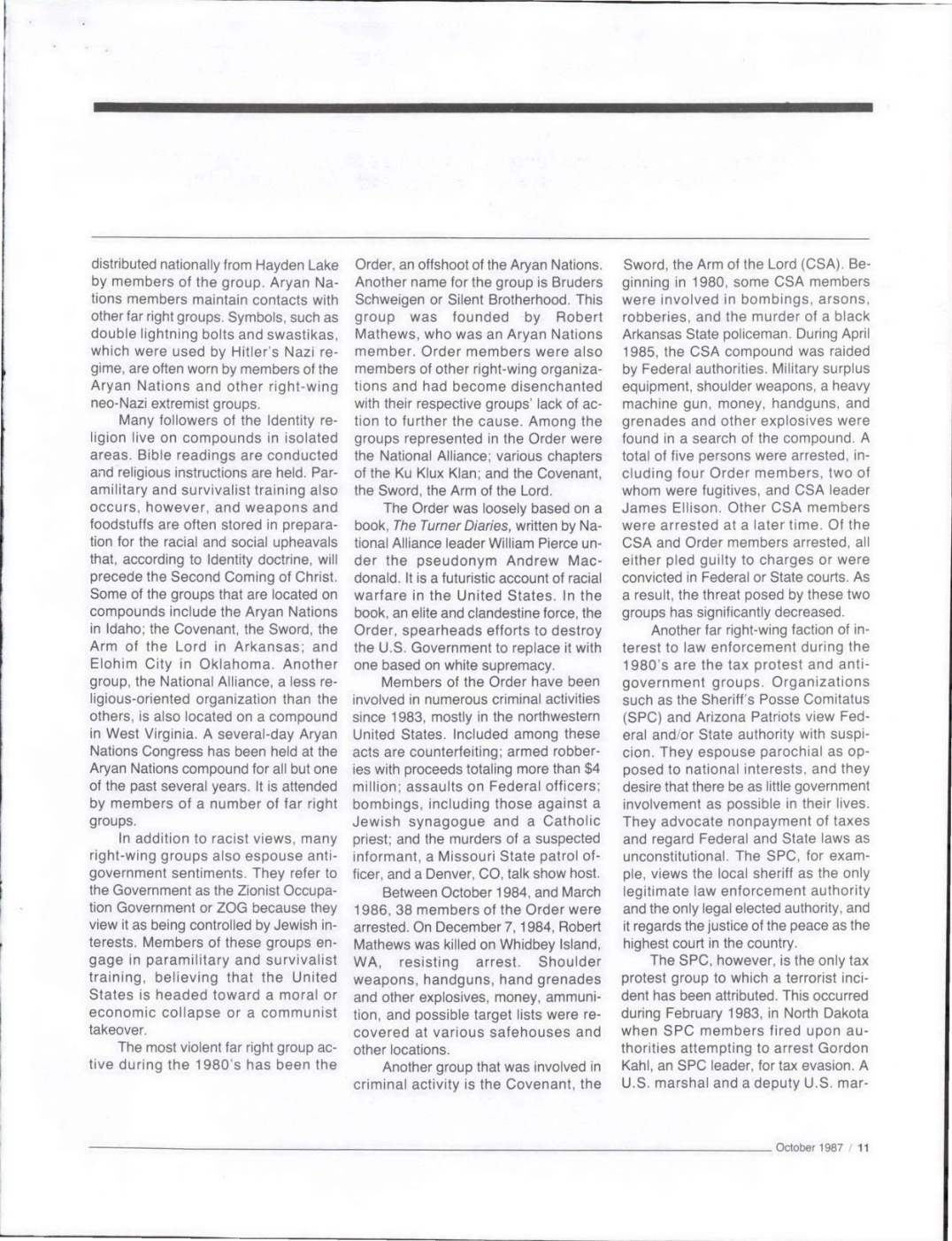
FBI institutional analysis of The Order, printed 11

FBI author John W. Harris Jr.’s 1987 analysis of The Order, authentic printed page 11. A dated institutional interpretation, not a portrait or an original attack scene. Image credit ↗

Scope & method / Edition 1.2

An enterprise, a killing, and the cases that followed.

This guide follows The Order’s formation, financing crimes, Alan Berg’s killing, the Whidbey confrontation and distinct racketeering and civil-rights judgments. It distinguishes documented network connections, tactical uncertainty and later mythology.

Read the chapters for a narrative; use the record below to test it. Established means the specific proposition is documented. Interpretation marks an inference or a historical argument. Unknown means the record here cannot decide. An archive’s possession of a document does not endorse its contents.

A curated historical judicial, institutional and participant-reporting record. Complete trial/exhibit, financial-ledger, sedition-trial and tactical files were not audited; no present custody or organizational-intelligence claim. Complete books and films were not independently read/viewed. Exact source-reading scopes and failed retrievals are retained in the private ledger.

01 / The record

The story, in 6 chapters

Follow recruitment, stolen resources, a targeted killing, the pursuit, the actual defense arguments and the competing afterlives.

FBI institutional analysis of The Order, printed 11
John W. Harris Jr.’s official FBI analysis, printed page 11, describes the organization and its literary reference. An authentic 1987 text page, not a portrait or direct reading of the entire novel. Image credit ↗

Chapter 01 / 1983

A revolution imagined, an organization assembled

In the fall of 1983, Robert Jay Mathews gathered a small group determined to move from white-supremacist organizing into direct action. The Ninth Circuit’s later account describes recruits who had associated with the Ku Klux Klan, National Alliance and Christian Identity movement. Their common setting supplied contacts and beliefs; the new enterprise supplied coordinated activity. The group called itself The Order or the Silent Brotherhood. It was a distinct organization, not another name for every racist group with which its members had associated.

Mathews imagined overthrowing a government he believed Jews controlled. The claim described his antisemitic worldview, rather than an established fact about the government. The Turner Diaries, a racist novel, offered an imagined revolutionary model and helped shape the group’s name and ambitions. Contemporary federal analysis linked that literary model to fundraising through crimes. The significance of the book lies in the political future it encouraged members to imagine, not in a rule that reading it proves participation in an offense.

The organization needed money. Its first robbery, on 28 October 1983, targeted a Spokane adult bookstore and produced little. Counterfeiting followed, but Bruce Pierce’s arrest for passing false currency created another immediate problem: a participant now faced prosecution and the group needed resources. Bank and armored-car robberies offered much larger returns. This progression appears in the racketeering appeal, grounded in testimony from more than a hundred witnesses, including members who had pleaded guilty.

The shift from public advocacy to an enterprise matters because it identifies what the later cases had to prove. Prosecutors needed connections among people, resources and repeated crimes. A defendant’s racist beliefs could explain motive or an association, while leaving the conduct question unresolved. In the eventual appeal, a defendant argued precisely that the prosecution had punished advocacy and association. The court rejected that argument because the instructions required a criminal conspiracy and acts advancing it. The documented transition was therefore a series of choices about recruitment, money and action, rather than the automatic criminalization of an unpopular belief.
Sources: S02 · S08 · S11

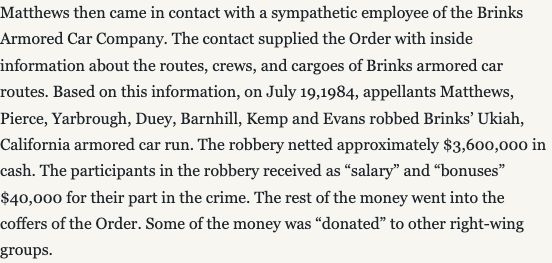
Actual Yarbroughjudicial paragraph: robbery proceeds/distribution
Actual Yarbrough opinion paragraph on the Ukiah robbery and proceeds. Modern web-mirror excerpt of federal judicial text, not a 1988 paper scan. Image credit ↗

Chapter 02 / 1983–1984

Stolen money becomes resources for the enterprise

The financing sequence made the enterprise more than a circle of people sharing racist beliefs. The first Spokane robbery produced little. Counterfeiting also failed to supply a durable solution after Pierce’s arrest. The court’s history then describes bank robberies and progressively larger armored-car thefts. On 16 March 1984 a robbery yielded $39,000; an April robbery produced about $235,000 in cash and $300,000 in checks. Cash, checks and later proceeds are different categories, and the values should not be combined into a fictitious single cash haul.

The 19 July 1984 robbery near Ukiah, California, transformed the available resources. The Ninth Circuit records approximately $3.6 million in cash. It describes payments to participants, money retained for The Order and some money donated to other right-wing groups. That accounting connects individual benefit with a collective project. A purely personal-profit explanation cannot ignore the organizational use of the proceeds; a purely idealistic self-description cannot erase salaries, bonuses or the people from whom the funds were stolen. The court’s approximate figure also differs from the $3.8 million stated in a 2024 regional film article. This guide uses the judicial amount for its historical financing account.

The distribution question is distinct from the command question. A recipient’s acceptance of funds may demonstrate a relationship or benefit. It does not, without further evidence, prove that the recipient selected an earlier target or ordered each offense. The stronger wider-network interpretation would trace particular transfers to particular decisions and people. The narrower enterprise interpretation can establish a coordinated local criminal undertaking even if a comprehensive map of downstream beneficiaries remains incomplete.

The source of this account also matters. The appellate court summarized a trial involving more than a hundred witnesses, including participants who had pleaded guilty. Their cooperation supplied access to internal activity and created credibility questions. The history therefore rests on the tested record as described in the opinion, rather than an independently acquired set of complete financial ledgers. Authenticated transfer records or reliable evidence contradicting a described distribution could change the network assessment without automatically undoing every established robbery.

Sources: S08 · S11

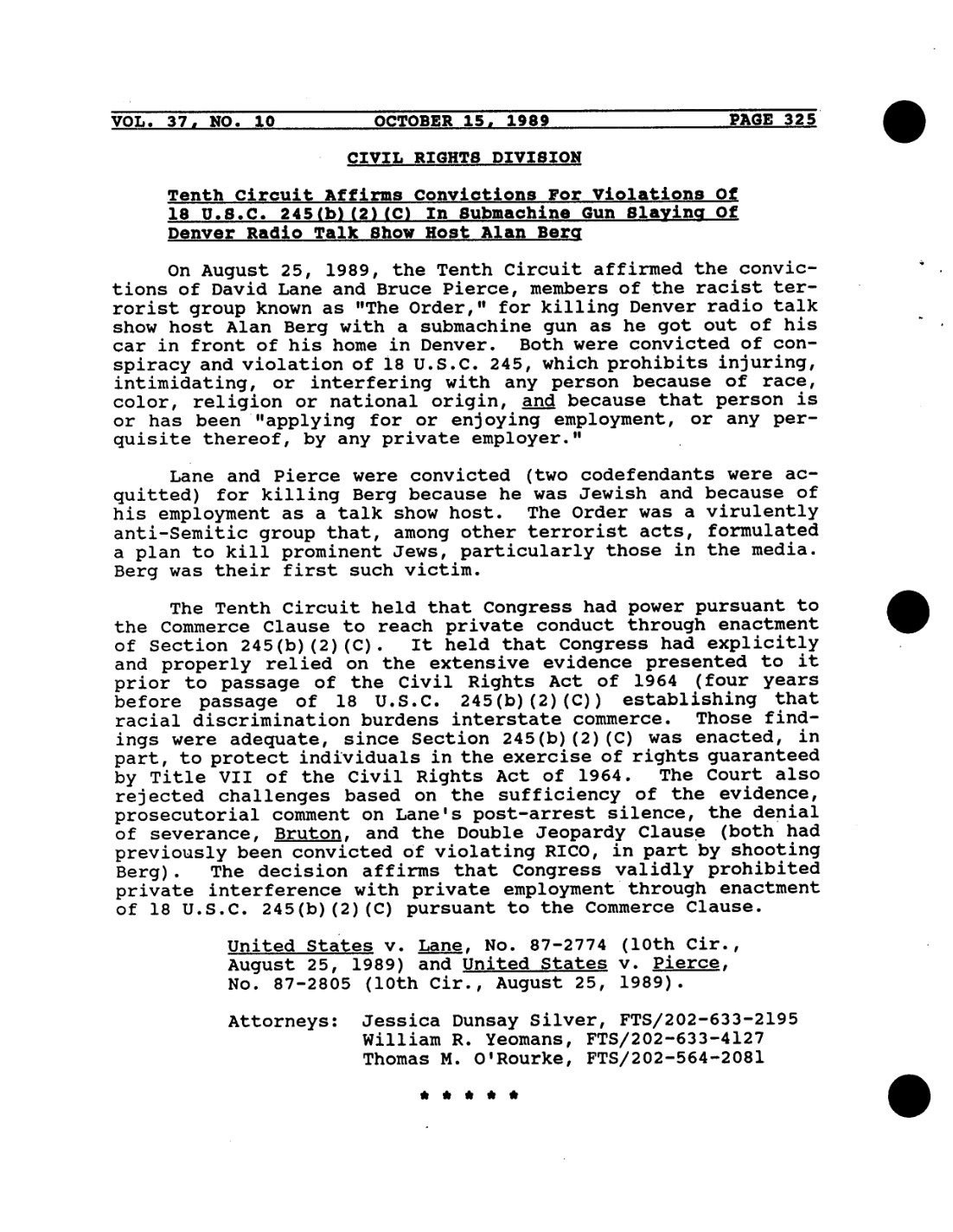
DOJ Civil Rights Divisionnotice of the Bergaffirmance, printed 325
DOJ Civil Rights Division’s contemporary notice of the 1989 affirmance, printed page 325. Its institutional summary is read against the actual Lane/Pierce opinion. Image credit ↗

Chapter 03 / 1984 /1987–1989

Alan Berg’s voice and the particular civil-rights case

Alan Berg was killed outside his Denver home on 18 June 1984. A Jewish radio host known for confronting racists on air, he was a particular person whose work made him visible to his attackers. The Tenth Circuit later described evidence of discussions about attacking Jews in influential positions, hostility to Berg’s broadcasts and defendant-specific connections to the killing. The evidence linked antisemitism and the silencing of a public voice; it did not turn Berg into an abstract representative of a political dispute.

The federal civil-rights prosecution had specific elements. The government had to establish willful interference by force, the protected racial or religious motivation, and the connection to Berg’s employment by a private employer. On appeal, Lane disputed the employment element; Pierce disputed several elements. The panel explained why the witness, travel and physical-evidence record was sufficient when viewed under the appellate standard favorable to the verdict. That is a legal review of an existing trial, not an independent reinvestigation of every exhibit.

The jury also distinguished the defendants. It acquitted Richard Scutari and Jean Craig and convicted David Lane and Bruce Pierce. Each convicted man received 150 years in that case. The 25 August 1989 opinion affirmed. These were federal civil-rights convictions arising from Berg’s killing; describing every person tried as convicted of a generic murder charge would erase both the statutory question and the acquittals. Evidence of an enterprise’s crimes does not permit transferring one defendant’s verdict to another person.

The earlier RICO prosecution and later civil-rights trial overlapped in evidence but were legally distinct. Lane and Pierce argued that the earlier case barred the later one under double jeopardy. The Tenth Circuit rejected the claim because the enterprise offense required a racketeering pattern while the civil-rights offense required its own motivation and employment elements. That ruling explains how the cases could coexist. It does not turn acquittal in an offense-specific case into a complete judgment about every other association, or turn an earlier enterprise conviction into automatic guilt on a later charge.

Sources: S03 · S04 · S08 · S09

Actual Yarbroughjudicial paragraph: pursuit and fugitive flight
Actual Yarbrough opinion paragraph on the Portland capture, escape and Whidbey pursuit. A modern web-mirror excerpt, not an original 1984 scene photograph. Image credit ↗

Chapter 04 / November–December 1984

A manhunt reaches Whidbey Island

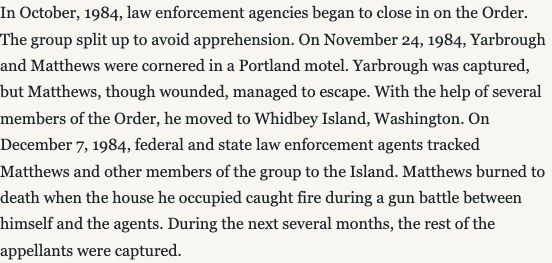
By autumn 1984, investigators were closing in on The Order. On 24 November, Mathews and Gary Yarbrough were cornered at a Portland motel. Yarbrough was captured; Mathews, wounded, escaped. The Ninth Circuit places this encounter within a continuing criminal investigation rather than an operation against political expression alone. Regional accounts add an important consequence: members dispersed, yet others helped Mathews reach Whidbey Island. A fugitive’s movements depended on people and practical assistance, not simply on a leader’s will to survive.

Federal and state officers located Mathews on the island in early December. He refused to surrender and exchanged gunfire with agents. On 8 December, the house burned and he died. Later documentary interviews describe a flare igniting the building. Former investigator Wayne Manis recalled being fired upon; the documentary’s account also makes federal action part of the explanation of the fire. Saying only that a house caught fire would leave out a relevant part of the sequence.

That does not by itself settle the purpose or proportionality of every tactical decision. The available judicial summary and edited recollections do not amount to a complete operational log. A claim that agents deliberately chose an unlawful killing would require evidence of orders, intent and alternatives; a claim that every decision was justified would also require more than the agency’s retrospective confidence. The narrower record supports an armed standoff, attempts to obtain surrender, an illumination-flare fire and Mathews’s death. His associates’ proven crimes are not a substitute for examining how force was used that night.

The fire became an easy endpoint for public memory, but it was not the end of the case. Surviving participants were arrested and prosecuted in the following months. Some pleaded guilty and became witnesses; others contested the government’s case at trial. The enterprise was dismantled through that less dramatic sequence as well as through the manhunt. Treating the entire history as a duel between Mathews and the FBI would hide both the victims whose cases still required proof and the defendants whose legal responsibility had yet to be decided.

Sources: S01 · S05 · S08 · S09

Actual Yarbroughjudicial paragraph: First Amendmentargument and conduct-based holding
The actual Yarbrough opinion describes Evans’s First Amendment argument and the court’s conduct-based answer. Modern judicial web excerpt; not a newly created facsimile. Image credit ↗

Chapter 05 / 1985–1989

The defense arguments the judgments actually answered

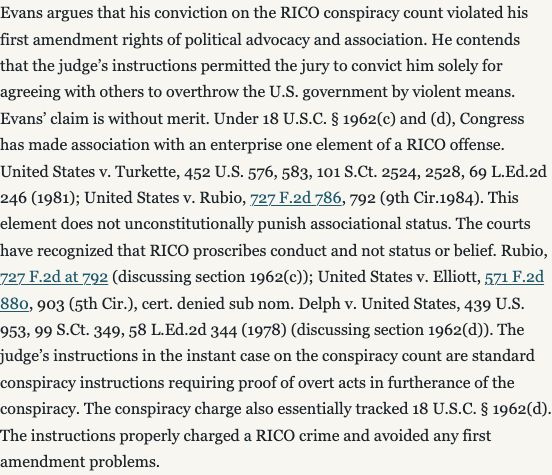
The courtroom history continued on two tracks. The racketeering prosecution concerned participation in an enterprise through a pattern of crimes. In July 1988, the Ninth Circuit affirmed the convictions challenged in United States v. Yarbrough. The separate Berg civil-rights prosecution asked whether particular defendants had attacked him because he was Jewish and because of his employment. In August 1989, the Tenth Circuit affirmed Lane and Pierce’s convictions. Keeping the tracks distinct explains how a person could have one conviction while a different charge against that person produced an acquittal.

The appeals also preserve serious defense arguments that a simple victory narrative would lose. Defendants challenged co-conspirator statements, testimony obtained through plea agreements, jury instructions, searches and consecutive sentences. One argued that the racketeering prosecution punished political association; Lane and Pierce argued that the later Berg case violated double-jeopardy protections after the RICO case. The courts rejected those challenges for stated reasons. The Ninth Circuit held that RICO targeted conduct and that the instructions required acts advancing the conspiracy. The Tenth Circuit treated the enterprise offense and the civil-rights offense as legally distinct.

Affirmance did not mean that every event at trial was flawless. The Ninth Circuit considered improper references to a defendant’s prior imprisonment and a prosecutor’s theatrical accusation of guilt. It concluded that the evidence and instructions prevented those incidents from requiring a new trial. A reader can therefore recognize both a supported conviction and a real argument about procedural fairness. The result should not be inflated into an endorsement of every prosecutorial choice, or reduced to an unresolved accusation because the defendants objected.

Randall Rader’s cooperation was one concrete issue. McBrearty argued that a contingent plea agreement tainted his testimony. The Ninth Circuit used plain-error review because the objection had not been raised below. It described disclosure of the agreement, cross-examination and a cautionary jury instruction about accomplice testimony before rejecting relief. These safeguards are the court’s reasons, not proof that a witness’s incentives disappeared. An authenticated recantation or specific contradiction would need to be evaluated against the particular evidence and the applicable judgment; a plea agreement by itself proves neither truth nor fabrication.

Sources: S03 · S08

FBI article title/byline identifies employee author, printed 5
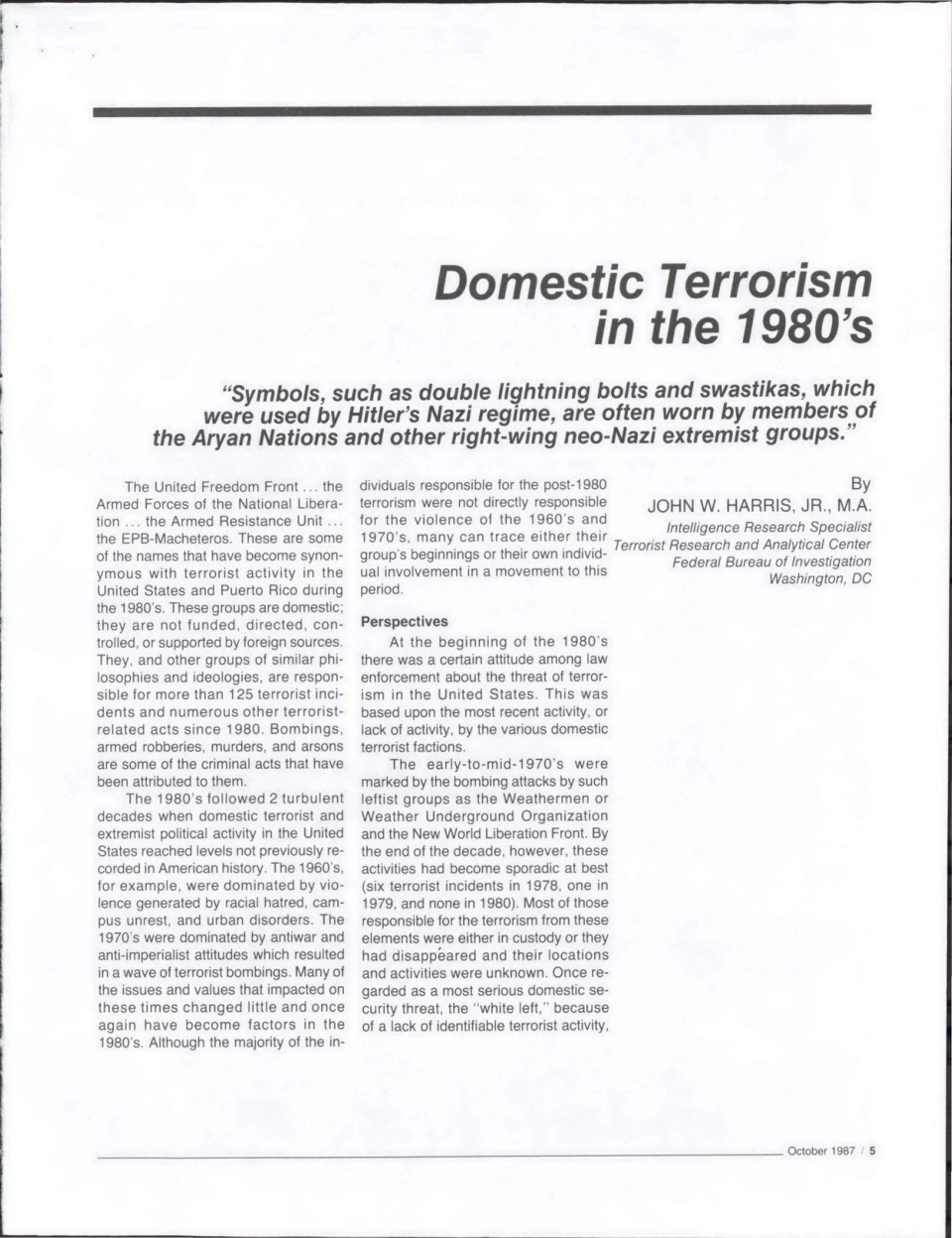
The 1987 FBI article’s title/byline page identifies John W. Harris Jr. and his FBI research position. Institutional interpretation has a named author and a dated scope. Image credit ↗

Chapter 06 / 1987–2024

The enterprise ended; the stories branched

Later accounts compress this history in different ways. The 1987 FBI article treats The Order within a broader classification of domestic terrorism and explicitly connects it to The Turner Diaries. That is an institutional interpretation of a literary model and criminal enterprise. It is not a complete reading of the novel or proof that everyone encountering the text followed the same path. The 1988 and 1989 opinions instead organize the record around charged conduct, evidentiary rules and distinct legal elements.

The 2022 PBS/WNET documentary transcript branches beyond the manhunt. Former investigators describe the danger and the flare-caused fire, while the program also recounts a later effort to prosecute a wider far-right leadership for seditious conspiracy. Its account records acquittals and disputes about cooperating witnesses. This is an edited retrospective, not the complete sedition-trial record, and its narrative changes cannot substitute for the narrower enterprise and Berg judgments. A failed broader prosecution does not erase those convictions; those convictions likewise cannot establish guilt of leaders acquitted elsewhere.

James Hanlon’s 2024 Spokesman-Review article documents another actual lineage: the screenplay of The Order drew on Kevin Flynn and Gary Gerhardt’s 1989 nonfiction book The Silent Brotherhood. It interviews Flynn and investigator Wayne Manis and explicitly identifies Terry Husk as fictional. The article reports altered or conflated scenes, including an encounter inside the burning house that Manis said he would not have undertaken. The guide has not independently watched the complete film or read the complete book. These are attributed statements about adaptation and recollection, not findings derived from an unseen work.

The distinction matters for both admiration and historical credit. A film can foreground a pursuit through a composite investigator, while court records require separate people and evidence. Extremist commemoration can preserve Mathews as a symbol after the enterprise was dismantled, without proving a surviving command chain. Actual continuity would require people, communications, financing and decisions connected across time. The documented ending is therefore a set of criminal judgments and organizational defeat alongside continuing, differently framed memories; the audience reach of those memories is not measured here.

Sources: S08 · S09 · S10 · S11 · S06

02 / The record

The critical path

Recruitment and criminal agreement → stolen resources and distribution → Berg’s killing and distinct outcomes → pursuit/federal force → actual legal/procedural tests → documented symbolic and narrative afterlives.

Evidence support assesses the precise hinge. Cultural prominence is unmeasured; textual recurrence is scoped to inspected accounts, without invented polls or audience rankings.

P1

From milieu to a criminal enterprise

Official-record yardstick

Mathews recruited people from several racist organizations in fall 1983. Shared beliefs supplied a setting; coordinated fundraising crimes established a more specific enterprise. The initial Spokane robbery and subsequent counterfeiting and robberies are concrete acts in the judicial history.

Mathews recruited people from several racist organizations in fall 1983. Shared beliefs supplied a setting; coordinated fundraising crimes established a more specific enterprise. The initial Spokane robbery and subsequent counterfeiting and robberies are concrete acts in the judicial history.

Why it is critical

The account must explain organization and repeated conduct rather than infer guilt from ideology alone. Without this step, a movement-wide label replaces evidence of participation.

If this step is removed

Remove the recruitment and repeated conduct and the narrative becomes a history of shared beliefs. Removing an ideological label alone would not erase independently proved robberies, conspiratorial acts or particular participants.

Dependencies

The founding and early offenses in Chapter 1, as described by the racketeering court.

What rival readings must explain

An association-only defense must account for proved acts; a network theory must distinguish membership, funding and command.

Gaps and disputes

No complete membership census, recruitment archive or full private novel reading. The institutional book-influence assessment is attributed rather than treated as proof of each reader’s conduct.

Evidence support: High for organized conduct; bounded for individual literary influence

The precise hinge in the inspected documentary record, not an overall rating of a movement or every witness.

Actual enterprise appeal connects recruitment, multiple crimes and objectives. FBI article documents an institutional reading of the novel’s role.

Cultural prominence: Unmeasured

General audience familiarity and comparative cultural prominence are unmeasured. Recurrence below is limited to the inspected texts.

Formation and ideology recur in the court/FBI/documentary accounts read; this is not a population rank.

Sources: S08

P2

Stolen proceeds became resources

Official-record yardstick

The 19 July 1984 Ukiah robbery brought approximately $3.6 million. The court records payments to participants, money retained for The Order and donations to other groups.

The 19 July 1984 Ukiah robbery brought approximately $3.6 million. The court records payments to participants, money retained for The Order and donations to other groups.

Why it is critical

A financing claim rests on actual movement of money. It supports an operational network more precisely than a shared slogan.

If this step is removed

Without the major robberies, the documented financing mechanism loses its principal resources. Removing a transfer to one recipient narrows that relationship; it does not prove every other transfer was a command order or that the enterprise lacked funds.

Dependencies

P1 plus dated robberies and court-described distribution.

What rival readings must explain

A wider-command account must identify recipients and decisions; a personal-profit account must explain money retained for organizational aims. Authenticated ledgers could change the map of beneficiaries.

Gaps and disputes

Complete original ledgers and downstream recipient decisions were not independently acquired. Approximate $3.6 millioncourt figure differs from $3.8 millionin a later film article; the latter does not silently replace the primary amount.

Evidence support: High for court-described proceeds; incomplete for every downstream command link

The precise hinge in the inspected documentary record, not an overall rating of a movement or every witness.

The primary opinion identifies approximate proceeds and distribution categories; a complete ledger/decision audit is not claimed.

Cultural prominence: Unmeasured

General audience familiarity and comparative cultural prominence are unmeasured. Recurrence below is limited to the inspected texts.

The major theft appears in the primary financing narrative and later documentary/film reporting; their comparative reach is unknown.

Sources: S08

P3

Berg’s death required defendant-specific proof

Official-record yardstick

Berg was killed 18 June 1984. The civil-rights jury convicted Lane and Pierce but acquitted Craig and Scutari; the 1989 appeal affirmed the two convictions.

Berg was killed 18 June 1984. The civil-rights jury convicted Lane and Pierce but acquitted Craig and Scutari; the 1989 appeal affirmed the two convictions.

Why it is critical

This prevents the group label from erasing divergent outcomes. It also keeps the named victim and the employment-and-religion basis of the case visible.

If this step is removed

Without the killing, the Berg civil-rights case disappears. Without its religious/employment elements, that particular statutory theory changes. Remove one defendant’s conviction and responsibility of other defendants must still follow their own evidence; acquittals cannot be silently removed.

Dependencies

P1; distinguish the enterprise case from the later offense-specific trial.

What rival readings must explain

An innocent-persecution narrative must confront evidence upheld on appeal; a blanket-guilt narrative must preserve the acquittals. Reliable new evidence contradicting particular trial facts would warrant historical reassessment.

Gaps and disputes

Complete trial transcripts, exhibits and every witness credibility challenge not re-audited. The mirror includes an apparent 1986 date for a supposed pre-killing conversation; the 1984 killing date controls and that inconsistent date is not adopted.

Evidence support: High for precise verdicts and affirmed judgments

The precise hinge in the inspected documentary record, not an overall rating of a movement or every witness.

Actual 1989 opinion gives four distinct jury outcomes, sentences and offense elements. Institutional notice is secondary to the exact judicial description.

Cultural prominence: Unmeasured

General audience familiarity and comparative cultural prominence are unmeasured. Recurrence below is limited to the inspected texts.

Berg’s killing appears in the court, institutional notice and documentary. No poll measures which legal distinctions audiences remember.

Sources: S03 · S04

P4

The standoff included both gunfire and federal force

Official-record yardstick

Mathews escaped Portland on 24 November 1984. The Whidbey confrontation ended on 8 December; retrospective participant accounts describe gunfire and a flare-caused fire.

Mathews escaped Portland on 24 November 1984. The Whidbey confrontation ended on 8 December; retrospective participant accounts describe gunfire and a flare-caused fire.

Why it is critical

Both the danger faced by agents and the role of government force belong in the sequence. Crimes committed earlier do not independently justify every tactical decision.

If this step is removed

Without the armed confrontation, the recorded context for federal force changes. Remove the flare’s role and the explanation of the fatal fire becomes incomplete. Neither counterfactual alone establishes which tactics would have succeeded or whether every choice was lawful.

Dependencies

The fugitive investigation and the island confrontation in Chapter 3.

What rival readings must explain

A deliberate-unlawful-killing theory needs evidence of orders, intent and available alternatives. Full tactical logs and authenticated communications could alter the assessment of the final operation.

Gaps and disputes

No complete tactical log, command recordings or independently reconstructed alternatives. An edited participant account supports causal involvement of a flare but does not establish intent or a complete proportionality judgment.

Evidence support: High for death/confrontation; retrospective for detailed fire causation

The precise hinge in the inspected documentary record, not an overall rating of a movement or every witness.

Judicial history and regional/institutional records establish pursuit and death; inspected participant transcript supplies flare causation with a narrower evidentiary scope.

Cultural prominence: Unmeasured

General audience familiarity and comparative cultural prominence are unmeasured. Recurrence below is limited to the inspected texts.

The fatal fire is an ending in inspected manhunt retellings; national familiarity or endorsement of any force interpretation is not measured.

Sources: S05 · S08 · S09

P5

Courts tested conduct and procedure

Official-record yardstick

The 1988 racketeering and 1989 civil-rights appeals considered specific constitutional, evidentiary and sentencing challenges and affirmed. Some trial incidents were criticized without reversal.

The 1988 racketeering and 1989 civil-rights appeals considered specific constitutional, evidentiary and sentencing challenges and affirmed. Some trial incidents were criticized without reversal. The Rader plea issue was reviewed for plain error after disclosure, cross-examination and a cautionary instruction; the same decision criticized trial incidents without reversal.

Why it is critical

The actual reasons for affirmance are more informative than treating either prosecution claims or defense objections as conclusive.

If this step is removed

Without the trial evidence and offense elements, the legal outcomes cannot be inferred from ideology. Remove the disclosed cooperation terms or cautionary instruction and the actual witness-fairness analysis would require reassessment, not an automatic finding of fabrication.

Dependencies

P1–P3 and the separate legal elements of the offenses.

What rival readings must explain

A political-trial account must explain the conduct evidence and instructions. A flawless-trial account must confront the procedural errors discussed. Authenticated evidence of fabrication or concealed material would change the historical assessment.

Gaps and disputes

Actual appellate reasons are read under their standards of review, not as a fresh trial. The later broader sedition case is discussed only through an attributed documentary account, not a complete original docket audit.

Evidence support: High for actual legal reasoning and disposition

The precise hinge in the inspected documentary record, not an overall rating of a movement or every witness.

Opinions state the association, cooperation, evidentiary and double-jeopardy claims and responses. Affirmance does not mean every challenged action was endorsed.

Cultural prominence: Unmeasured

General audience familiarity and comparative cultural prominence are unmeasured. Recurrence below is limited to the inspected texts.

Legal disputes are visible in the opinions inspected. Their relative public prominence compared with the manhunt is unknown.

Sources: S03 · S08

P6

Organizational defeat and symbolic survival

Official-record yardstick

The original enterprise was prosecuted. Subsequent extremist commemoration and a 2024 dramatic retelling kept the name in circulation.

The original enterprise was prosecuted. Subsequent extremist commemoration and a 2024 dramatic retelling kept the name in circulation.

Why it is critical

Memory is evidence of influence; it does not alone establish ongoing operational control.

If this step is removed

Without later commemoration and retellings, an inference of continued symbolic influence loses its cited basis. Remove a film’s fictional character and the actual multiple-investigator history remains. Neither change proves a continuing original command structure.

Dependencies

P4–P5, followed by later reporting rather than an assumed unbroken chain.

What rival readings must explain

A continuity theory needs communications, people, financing or command links. A total-erasure account must explain documented continuing admiration.

Gaps and disputes

No full book/film viewing or readership survey; no present organizational-intelligence assessment. Actual interview/report passages establish their own claims, not an independently proved omission from an unseen film.

Evidence support: High for documented retellings; unmeasured for audience reach or operational continuity

The precise hinge in the inspected documentary record, not an overall rating of a movement or every witness.

Actual film-article interviews and documentary transcript identify frames and a reported adaptation lineage; no present command chain is established.

Cultural prominence: Unmeasured

General audience familiarity and comparative cultural prominence are unmeasured. Recurrence below is limited to the inspected texts.

A real film and reported commemoration establish circulation, not audience prevalence or continuing operational control.

Sources: S06 · S10

03 / The record

How the accounts developed

Direct court discussion, named institutional analysis and an expressly reported adaptation establish the connections. Shared subjects and repeated symbols do not by themselves prove borrowing or continuing command.

1983 /1987assessment

A novel becomes a documented organizational reference

Harris’s FBI article explicitly describes The Order as loosely based on The Turner Diaries.

Lineage

Racist novel → named organizational reference in the 1987 analysis → later documentary and film-report discussion.

Borrowing or relationship

This is an attributed institutional influence claim supported by an explicit title/name connection. It does not demonstrate that every member read every passage or that a book issued an operational order.

Evidence for the connection

Actual article printed 11 and inspected documentary/article passages identify the relationship. Full novel not independently read or reproduced; no invented detailed borrowing analysis.

Recurring path nodes

P1P2

Branches in this record

Enterprise evidence enters a separate civil-rights case · A documented book-to-film lineage changes the narrator

Sources: S11 · S09 · S10

1985–1989

Enterprise evidence enters a separate civil-rights case

The Lane opinion expressly identifies the earlier RICO case and overlapping Berg evidence while explaining distinct offense elements.

Lineage

Trial testimony/enterprise judgment → 1988 appeal → 1989 Berg appeal and double-jeopardy challenge.

Borrowing or relationship

Direct judicial discussion and citations establish reuse; repeated background is not a second independent investigation or a uniform verdict for all defendants.

Evidence for the connection

Actual 1989 paragraphs 35–36 describe prior RICO convictions and distinguish pattern/motivation/employment requirements.

Recurring path nodes

P1P2P3P5

Branches in this record

Institutional summaries compress the judicial record · A documentary branches from cell prosecutions to a failed broader case

Sources: S03 · S08

1987–1989

Institutional summaries compress the judicial record

The FBI article situates the organization within domestic terrorism; the DOJ notice reports the civil-rights affirmance.

Lineage

Investigations/trials → named employee analysis and division notice → later historical retellings.

Borrowing or relationship

The DOJ notice’s named decision/date shows reporting of the outcome. Its institutional wording is checked against the actual opinion rather than used to merge charges or acquitted defendants.

Evidence for the connection

Original byline and notice reviewed; distinct judicial outcome controls. These are official perspectives with stated authors, not anonymous deciding proof.

Recurring path nodes

P1P3P5

Branches in this record

A documented book-to-film lineage changes the narrator

Sources: S03 · S04 · S11

2022retrospective

A documentary branches from cell prosecutions to a failed broader case

The PBS transcript recounts a wider sedition prosecution, cooperating-witness credibility issues and acquittals.

Lineage

Manhunt/enterprise history → retrospective argument about wider command → reported limits of a broader prosecution.

Borrowing or relationship

The edited program relates the cases. It does not transform a broad acquittal into reversal of the local enterprise judgments, or those judgments into proof against every wider figure.

Evidence for the connection

Actual retained transcript has both institutional and critical voices; complete sedition record not audited, so no precise full trial reconstruction or invented numerical reconciliation.

Recurring path nodes

P2P4P5P6

Branches in this record

A documented book-to-film lineage changes the narrator

Sources: S09 · S03 · S08

1989book /2024adaptation reporting

A documented book-to-film lineage changes the narrator

Hanlon’s article identifies The Silent Brotherhood as the screenplay source and interviews coauthor Flynn and investigator Manis.

Lineage

Flynn/Gerhardt 1989 book →2024 screenplay/film → interviews explaining a fictional composite and changed scenes.

Borrowing or relationship

The adaptation link is explicitly reported, not inferred from similar topics. Full book and film not independently read/viewed; criticisms/changes are attributed to the actual interview article.

Evidence for the connection

Actual article identifies the source book and fictional Terry Husk; it records author/investigator comments rather than supplying a new trial record.

Recurring path nodes

P3P4P6

Sources: S10 · S06

04 / The record

Rival readings on the same path

The strongest versions, the steps they accept or revise, and the evidence they would need.

Interpretation 01

An ideological criminal enterprise

Strongly supported

The strongest version

The group used coordinated crimes to obtain resources for a racist political project; its ideology and its financial activity were mutually reinforcing.

Accepts

P1–P3: recruitment, money and defendant-specific evidence.

Must still explain

It must preserve the different offenses and outcomes rather than assign every act to every member.

Assessment

The appellate records connect conduct, funds and objectives. New evidence of a different participant or unreliable trial evidence could change particular attributions without erasing the enterprise.

Accept these path nodes

Remove or revise this inference

  • Remove blanket attribution of every act to every member.

Add this evidence

  • Defendant-specific conduct and independently supported links between resources, agreement and crimes.

What would change this assessment

Authenticated exhibit errors, corroborated recantations or a merits reversal could change individual attributions. New financial documents could change the distribution map without erasing every established offense.

Sources: S03 · S08

Interpretation 02

A wider network, rather than an isolated cell

Documented connections; command limits unresolved

The strongest version

Prior affiliations, practical assistance and transfers of stolen proceeds link The Order to a broader environment capable of benefiting from its crimes.

Accepts

P1–P2 document connections; P3 distinguishes individual liability.

Must still explain

A central-command theory must identify who ordered which act and through what communication. Funding and affiliation do not automatically answer that question. The later documentary recounts acquittals in a broader sedition prosecution; those specific outcomes must remain distinct from the enterprise convictions.

Assessment

S08 establishes money moving beyond the group. Authenticated recipient ledgers, orders or corroborated participants could expand the operational map; generalized resemblance cannot.

Accept these path nodes

Remove or revise this inference

  • Remove automatic equivalence between funding, affiliation and command.

Add this evidence

  • Actual direction, financing and communication linking particular wider figures to specific acts.

What would change this assessment

Verifiable ledgers, directives and participant communications tying a particular recipient or leader to a particular decision would expand the command map. A broad acquittal elsewhere cannot substitute for proving or disproving each link.

Sources: S08 · S09

Interpretation 03

The prosecution criminalized belief or relied on compromised witnesses

Actual defense arguments; convictions affirmed

The strongest version

Cooperating witnesses had incentives and an enterprise case could blur advocacy, association and criminal agreement. Defendants contested precisely those risks.

Accepts

P1–P3 identify the charged conduct; P5 preserves the objections.

Must still explain

It must address the instructions requiring criminal acts and the evidence the courts found sufficient, as well as the Berg case’s acquittals.

Assessment

The courts rejected the legal challenges; affirmation does not imply flawless procedure. Evidence of fabrication, undisclosed inducements or decisive withheld records would alter the historical assessment.

Accept these path nodes

Remove or revise this inference

  • Remove an inference of criminal guilt from beliefs alone, and test disputed testimony against the actual record.

Add this evidence

  • Authenticated incentives, contradictions, exhibit provenance and the exact conduct the jury was instructed to find.

What would change this assessment

Authenticated undisclosed inducements, fabrication or a decisive contradiction in the trial evidence would change the historical assessment; a cooperation agreement or an assertion of innocence alone does not establish either truth or falsehood.

Sources: S03 · S08

Interpretation 04

Federal force and the fatal fire require separate scrutiny

Documented commemoration; no factual exoneration

The strongest version

Federal action helped cause the fire that killed Mathews. His earlier crimes do not alone establish the legality, intent or proportionality of every tactical decision. The strongest scrutiny asks what the command record and available alternatives actually showed.

Accepts

P4: federal action helped cause the fire; P6: commemoration continued.

Must still explain

It must still explain P1–P3 and P5: robberies, Berg’s killing and the subsequent verdicts. Those events do not disappear if a tactical decision is criticized.

Assessment

The fire’s cause merits scrutiny independently of earlier crimes. Logs or orders could change its assessment; commemoration alone does not establish an unlawful-killing conclusion or innocence of the enterprise.

Accept these path nodes

Remove or revise this inference

  • Remove both automatic justification of every federal tactic and a martyr narrative that treats force questions as exoneration of earlier crimes.

Add this evidence

  • Complete command logs, causal records and actual available alternatives for the final operation.

What would change this assessment

Authenticated operational logs, recordings and orders showing purpose, available alternatives or a materially different chronology could change the assessment of federal force. A tactical violation, if established, would not automatically erase the enterprise’s earlier crimes.

Sources: S03 · S08 · S09 · S06

05 / The record

What public accounts emphasize

Cards compare actual judicial, employee-authored institutional, retained documentary-transcript and film-report passages. Complete books, film and tactical/trial archives were not independently audited.

Wiggins’s 1988 opinion: an enterprise proved through conduct

Actual Yarbrough facts/financing, cooperator Rader/plain-error, association and trial-incident sections; not complete trial exhibits.

Amplifies

Repeated conduct, distribution of proceeds and the legal safeguards used to assess witness/procedural objections.

Recasts or leaves unresolved

Rejects association-only characterization and finds the challenged incidents insufficient for reversal.

Scope and limits

An appellate account under standards of review, not a guarantee that every financial transfer or trial act was independently reaudited here.

P1P2P5

Sources: S08

Holloway’s 1989 opinion: Berg’s rights and distinct defendants

Actual Lane/Pierce opinion verdict paragraphs 7–8, double-jeopardy 35–36 and individual sufficiency sections.

Amplifies

Employment and antisemitic motivation, distinct elements and the two acquittals alongside two convictions.

Recasts or leaves unresolved

Declines to treat the RICO and civil-rights cases as the same offense merely because evidence overlaps.

Scope and limits

No separate independent trial of acquitted people; modern mirror treatment labels are not judicial findings.

P3P5

Sources: S03

Harris’s 1987 FBI analysis: a domestic-terrorism category

Actual article title/byline and printed 11 Order paragraphs; not an audit of every unrelated group discussed in the issue.

Amplifies

Milieu, the novel’s stated influence and a group shifting from talk to violent fundraising.

Recasts or leaves unresolved

Places the enterprise in a broader security classification; the later appellate judgments answer more precise individual questions.

Scope and limits

Named FBI employee institutional analysis, compared with the courts rather than adopted as proof of every association.

P1P2P3

Sources: S11 · S03 · S08

PBS/WNET’s 2022 transcript: success, fire and a broader acquittal

Actual retained transcript’s former-agent, Morlin/Potok and wider-prosecution passages; fresh endpoint 403, no complete video replay or operational-log audit.

Amplifies

Manhunt danger, traceable physical evidence and the flare-caused fire, then a wider command theory’s evidentiary limits.

Recasts or leaves unresolved

Extends beyond a heroic endpoint by recounting witness-credibility problems and acquittals in a later broader prosecution.

Scope and limits

An edited retrospective with attributed voices; it is not the full sedition-trial file, nor proof of today’s organizational command.

P2P4P5P6

Sources: S09 · S08

Hanlon’s 2024 film article: a real source, a fictional investigator

Actual article’s source-book identification, Manis/Flynn interviews and quoted filmmaker explanation. Complete book/film not independently read or watched.

Amplifies

A documented adaptation lineage and the difference between Terry Husk and the real multi-person investigation.

Recasts or leaves unresolved

Reports conflated/changed scenes and participant reactions. These are claims within the inspected article, not an independent unseen-film omission audit.

Scope and limits

The article’s $3.8 million figure differs from the primary court’s approximate $3.6 million; historical financing uses the latter. No copyrighted press photo or film still reproduced.

P2P3P4P6

Sources: S10 · S08

06 / The record

Find a thread in the file

Search the chapter and claim index. Every result leads to the full text and its sources.

Chapter 01A revolution imagined, an organization assembledChapter 02Stolen money becomes resources for the enterpriseChapter 03Alan Berg’s voice and the particular civil-rights caseChapter 04A manhunt reaches Whidbey IslandChapter 05The defense arguments the judgments actually answeredChapter 06The enterprise ended; the stories branchedCritical pathFrom milieu to a criminal enterpriseCritical pathStolen proceeds became resourcesCritical pathBerg’s death required defendant-specific proofCritical pathThe standoff included both gunfire and federal forceCritical pathCourts tested conduct and procedureCritical pathOrganizational defeat and symbolic survivalGenealogyA novel becomes a documented organizational referenceGenealogyEnterprise evidence enters a separate civil-rights caseGenealogyInstitutional summaries compress the judicial recordGenealogyA documentary branches from cell prosecutions to a failed broader caseGenealogyA documented book-to-film lineage changes the narratorRival accountAn ideological criminal enterpriseRival accountA wider network, rather than an isolated cellRival accountThe prosecution criminalized belief or relied on compromised witnessesRival accountFederal force and the fatal fire require separate scrutinyNarratorWiggins’s 1988 opinion: an enterprise proved through conductNarratorHolloway’s 1989 opinion: Berg’s rights and distinct defendantsNarratorHarris’s 1987 FBI analysis: a domestic-terrorism categoryNarratorPBS/WNET’s 2022 transcript: success, fire and a broader acquittalNarratorHanlon’s 2024 film article: a real source, a fictional investigatorTimelineThe Order formsTimelineFirst robbery in SpokaneTimelineSeattle armored-car robberyTimelineAlan Berg is killedTimelineUkiah robbery yields about $3.6 millionTimelinePortland confrontationTimelineMathews dies on Whidbey IslandTimelineRacketeering prosecutionsTimelineNamed FBI analysis interprets the enterpriseTimelineRacketeering convictions affirmedTimelineBerg convictions affirmedTimelineDocumentary revisits manhunt and broader prosecutionTimelineThe Order reaches movie audiencesTimelineFilm article identifies the adaptation and fictional compositeClaimThe Order and the CSA were the same organization.ClaimLane and Pierce’s Berg convictions were affirmed.ClaimMathews died during the Whidbey Island confrontation.ClaimThe founder’s death ended every case.ClaimLater admiration proves the original group still controlled operations.ClaimEvery defendant in the Berg prosecution was convicted.ClaimThe racketeering verdict rested only on racist beliefs.ClaimAn illumination flare helped cause the fatal Whidbey fire.ClaimThe 2024 film’s Terry Husk is a literal portrait of Wayne Manis.ClaimAll funds transferred beyond The Orderprove recipients commanded every crime.

07 / The record

People and institutions

Open a record for the person’s role and supporting sources. Names identify people; no unverified portrait is substituted for a participant.

MathewsBiographical record
Robert Jay MathewsFounder and organizer

Led The Order and died during the Whidbey Island confrontation on December 8, 1984. His death preceded the major prosecutions of surviving participants.

Sources: S01 · S05

BergBiographical record
Alan BergMurder victim and broadcaster

Jewish Denver radio host killed outside his home in June 1984. His life and protected rights belong at the center of the civil-rights case, rather than appearing merely as a milestone in the perpetrators’ story.

Sources: S03 · S04

LaneBiographical record
David LaneConvicted participant

His conviction in the Berg civil-rights prosecution was affirmed alongside Bruce Pierce’s in 1989. That specific result does not assign identical responsibility to every member of the organization.

Sources: S03 · S04

PierceBiographical record
Bruce PierceConvicted participant

Convicted in the Berg civil-rights prosecution; the Tenth Circuit affirmed in 1989. The published opinion supplies a stronger basis for this legal claim than later dramatic retellings.

Sources: S03 · S04

YarbroughBiographical record
Gary YarbroughRacketeering appellant

Captured after the Portland motel encounter in November 1984. His appeal and those of other defendants preserve the enterprise’s financial history and their procedural challenges.

Sources: S08

CraigBiographical record
Jean CraigDefendant with distinct outcomes

A racketeering appellant in the Ninth Circuit case; acquitted in the separate Berg civil-rights case. Those outcomes concern different offenses.

Sources: S03 · S08

ScutariBiographical record
Richard ScutariBerg co-defendant acquitted

Acquitted alongside Craig in the Berg civil-rights prosecution. Lane and Pierce’s convictions do not erase that verdict.

Sources: S03

ManisBiographical record
Wayne ManisFBI investigator and later interview subject

His documentary and regional interviews explain the manhunt from an investigator’s perspective. The film’s Terry Husk is a fictional character rather than an exact biography.

Sources: S09 · S10

08 / The record

The attack, the trials and the aftermath

Horizontal spacing shows elapsed time; separate rows keep close events selectable. Scroll the graph on narrow screens. Exact dates are attributed where records conflict; month- and year-only dates preserve source precision.

19831993200420152026
The Order formsOrganization

Mathews’s group emerges within a wider white-supremacist environment.

Sources: S02 · S05

First robbery in SpokaneEnterprise crime

The appellate history identifies an adult-bookstore robbery as the enterprise’s first crime, followed by larger fundraising offenses.

Sources: S08

Seattle armored-car robberyEnterprise crime

The group begins a sequence of armored-car robberies that substantially expands its funds.

Sources: S08

Alan Berg is killedVictim

The Denver broadcaster’s killing becomes the basis of the later federal civil-rights case.

Sources: S03

Ukiah robbery yields about $3.6 millionEnterprise crime

Payments to participants and transfers to the enterprise and other groups connect stolen proceeds to political organization.

Sources: S08

Portland confrontationInvestigation

Yarbrough is captured; Mathews escapes after the Portland motel encounter. The appellate account supplies the day.

Sources: S08

Mathews dies on Whidbey IslandConfrontation

A prolonged confrontation ends in the fire that kills the founder.

Sources: S01 · S05

Racketeering prosecutionsCourt

Arrests, pleas, and trials continue after the founder’s death.

Sources: S05

Named FBI analysis interprets the enterpriseInstitutional memory

Harris’s article identifies his FBI research role and discusses the novel, organization and financing; institutional interpretation is checked against court records.

Sources: S11

Racketeering convictions affirmedCourt outcome

The Ninth Circuit rejects the appellate challenges in Yarbrough, including the claim that the instructions punished belief alone.

Sources: S08

Berg convictions affirmedCourt

The Tenth Circuit affirms Lane and Pierce’s convictions.

Sources: S03 · S04

Documentary revisits manhunt and broader prosecutionMemory

The retained actual transcript includes former investigators, flare causation and a separate broader sedition-prosecution/acquittal branch; not a complete trial-file audit.

Sources: S09

The Order reaches movie audiencesMemory

The film renews attention; reporting also documents continuing extremist commemoration.

Sources: S06

Film article identifies the adaptation and fictional compositeMemory

Hanlon interviews Flynn and Manis; source-book connection and reported scene changes are attributed. Complete film and book not independently read/viewed.

Sources: S10

09 / The record

How the story changed

Public memory tends to compress contested histories into a turning point. The records leave a less tidy sequence.

A siege becomes shorthand

ThenThe final confrontation offers one dramatic end date.

ReconsideredThe surviving defendants’ prosecutions are essential parts of the dismantling.

Sources: S03 · S05

A film becomes an entry point

ThenAudiences encounter a pursuit thriller.

ReconsideredRegional reporting identifies Terry Husk as fictional and describes Wayne Manis’s real investigative role. The film can introduce the history while the legal records retain distinct crimes and outcomes.

Sources: S10

A victory without a flawless-trial claim

ThenThe enterprise’s defeat can be remembered as one unqualified law-enforcement success.

ReconsideredThe appellate opinions preserve actual objections and discuss some trial errors while affirming. The outcomes and the procedural record remain visible together.

Sources: S03 · S08

10 / The record

What the evidence supports

Ratings apply to the precise proposition on the page. Unsupported means the assembled evidence does not establish a claim; it is not interchangeable with false.

False

The Order and the CSA were the same organization.

They belonged to a wider extremist environment but were distinct groups; a connection is not identity.

Sources: S01 · S05

Established

Lane and Pierce’s Berg convictions were affirmed.

The published 1989 appellate opinion and contemporary DOJ notice record the affirmance.

Sources: S03 · S04

Established

Mathews died during the Whidbey Island confrontation.

FBI and regional histories identify December 8, 1984.

Sources: S01 · S05

False

The founder’s death ended every case.

Prosecutions of surviving participants continued.

Sources: S03 · S05

Unsupported

Later admiration proves the original group still controlled operations.

Memory and operational command require different evidence. No contemporary command-chain audit is claimed.

Sources: S06

False

Every defendant in the Berg prosecution was convicted.

The contemporary DOJ bulletin records Lane and Pierce’s convictions and the acquittal of two co-defendants. A shared prosecution did not yield a uniform outcome.

Sources: S03 · S04

Contradicted by the appellate record

The racketeering verdict rested only on racist beliefs.

Evans raised an advocacy-and-association objection. The Ninth Circuit held that the instructions required conspiracy and acts advancing it, and affirmed.

Sources: S08

Supported by retrospective participant accounts

An illumination flare helped cause the fatal Whidbey fire.

The documentary account describes a flare igniting the building during the armed standoff. That causal fact does not by itself establish intent or resolve the legality of every tactical choice.

Sources: S09

False

The 2024 film’s Terry Husk is a literal portrait of Wayne Manis.

The actual regional article explicitly identifies a fictional character and reports the filmmakers’ reason for using a composite. It documents adaptation, not a trial transcript.

Sources: S10

Unsupported

All funds transferred beyond The Orderprove recipients commanded every crime.

The court describes external donations, but direction of a particular act requires its own communication/decision evidence.

Sources: S08

11 / The record

Read the records and competing accounts

Primary documents, attributed statements and scholarly arguments. External sources need an internet connection.

12 / The record

The questions still open

A documented limit is more useful than a confident number or a sweeping lineage the evidence cannot carry.

  1. What would full financial records add to the court-described distribution of stolen money among participants and outside groups?
  2. What do original tactical logs and contemporaneous communications establish about the decisions preceding the Whidbey fire?
  3. Can the complete trial exhibits clarify disputed testimony beyond the appellate summaries reproduced here?
  4. Which later groups demonstrate actual organizational links to the original enterprise, rather than admiration or recycled symbols?

13 / The record

Go back to the sources

Records, reporting, and firsthand accounts have different evidentiary roles. Each source note explains what it can establish and where caution is needed. Fresh and retained source versions have explicit reading scopes. Original records and attributed reporting have distinct evidentiary roles.

  1. S01

    Primary institutional record

    FBI Seattle History ↗

    Federal Bureau of Investigation

    Retrospective institutional history of the investigation and the Washington confrontation; not a substitute for the trial record.

  2. S02

    Primary institutional record

    FBI Portland History ↗

    Federal Bureau of Investigation

    Regional account of the criminal enterprise and the Portland shootout.

  3. S03

    Primary judicial opinion

    United States v. Lane and Pierce, 883 F.2d 1484 (1989) ↗

    U.S. Court of Appeals for the Tenth Circuit

    Published Tenth Circuit opinion, 25 August 1989. Paragraphs 7–8 give the distinct verdicts and 150-year sentences; later sections address constitutional authority, double jeopardy and defendant-specific sufficiency. Public-domain judicial text in a legal-repository mirror, not the mirror’s treatment label. Fresh actual reader checked; raw 403 saved. The mirror’s modern treatment labels are not judicial findings. One narration dates a supposed pre-killing June 14 conversation to 1986 while the killing was 1984; this apparent internal date inconsistency is not adopted here.

  4. S04

    Primary institutional record

    United States Attorneys Bulletin, October 15, 1989 ↗

    U.S. Department of Justice

    Contemporary DOJ notice of the appellate affirmance in the Alan Berg case.

  5. S05

    Historical reference

    Robert Jay Mathews is killed during an FBI siege on Whidbey Island ↗

    History Link; Daryl C. McClary

    Regional historical synthesis with identified source notes. Its historical narrative is separated from the legal basis for individual convictions.

  6. S06

    Reported cultural context

    Jude Law and Nicholas Hoult lead thriller about the real FBI manhunt ↗

    Associated Press

    2024 reporting on the film and the continuing commemoration of Mathews; useful for memory, not trial proof.

  7. S08

    Primary judicial opinion

    United States v. Yarbrough, 852 F.2d 1522 (9 th Cir. 1988) ↗

    U.S. Court of Appeals, Ninth Circuit; legal-repository reproduction

    Original judicial text reproduced in full. Facts section establishes the robbery sequence, proceeds and enterprise; sections on co-conspirator statements, plea witnesses and the First Amendment identify actual defense arguments and the court’s reasons for affirming. Fresh raw 200 actual opinion read for dated financing, Rader plea/plain-error, First Amendment and trial-incidents sections.6 July 1988 heading. No independent fulltrial/ledger audit.

  8. S09

    Documentary video and participant interviews

    The Order — Exploring Hate, 19 April 2022 ↗

    PBS / WNET

    Nine-minute segment and transcript, including former investigators Wayne Manis and Tom McDaniel. Useful firsthand perspective on the manhunt and flare-caused fire; an edited retrospective, not a complete operational log. Actual retained transcript read, including broader sedition-prosecution/acquittal branch. Freshwebreader 403; fullvideo not replayed or claimed.

  9. S10

    Established regional reporting / participant interview

    New film The Order tells story of Coeur d’Alene FBI agent, 1 December 2024 ↗

    The Spokesman-Review / James Hanlon

    Interview with Wayne Manis and discussion of the fictional Terry Husk character. Distinguishes the dramatic composite from the real investigation; not used as proof of specific defendants’ guilt. Actual article read for the attributed book-to-film lineage, fictional composite and interview corrections; complete book/film unread. Its $3.8 million figure differs from Yarbrough’s approximate $3.6 million.

  10. S11

    Primary institutional analysis

    Domestic Terrorism in the 1980’s ↗

    John W. Harris Jr., FBI Terrorism Research and Analytical Center · FBI Law Enforcement Bulletin, October 1987

    Original full issue retrieved privately; actual article title/byline on PDF7 identifies FBI Intelligence Research Specialist. Selected page 13/printed 11 discusses The Order/novel/funding. Institutional account compared with actual judicial record; full private novel and unrelated issue components are not redistributed.

Local selected records: selected-federal-pages. These filenames match the source-and-rights ledger in the data folder.

Images, documents & licensing

FBI institutional analysis of The Order, printed 11 (source page 13) — John W. Harris Jr., Intelligence Research Specialist, Terrorism Research and Analytical Center, FBI. Official federal employee-authored institutional text/layout,17 U.S.C. §105. Source & license ↗. Resized and re-encoded for this edition; embedded metadata removed. Each image has its own stated rights basis. Named FBI employee and DOJdivision pages, plus actual federal judicial excerpts, have separately checked bases. Web excerpts are modern mirror captures, not original paper scans. Vintage photograph license evidence and all mixed/private originals remain private.

Actual Yarbroughjudicial paragraph: robbery proceeds/distribution (source page Modernwebparagraph; not a paper scan) — U.S. Court of Appeals for the Ninth Circuit. Official federal judicial text,17 U.S.C. §105. Source & license ↗. Resized and re-encoded for this edition; embedded metadata removed. Each image has its own stated rights basis. Named FBI employee and DOJdivision pages, plus actual federal judicial excerpts, have separately checked bases. Web excerpts are modern mirror captures, not original paper scans. Vintage photograph license evidence and all mixed/private originals remain private.

DOJ Civil Rights Divisionnotice of the Bergaffirmance, printed 325 (source page 22) — U.S. Department of Justice, Civil Rights Division. Official federal employee-authored institutional text/layout,17 U.S.C. §105. Source & license ↗. Resized and re-encoded for this edition; embedded metadata removed. Each image has its own stated rights basis. Named FBI employee and DOJdivision pages, plus actual federal judicial excerpts, have separately checked bases. Web excerpts are modern mirror captures, not original paper scans. Vintage photograph license evidence and all mixed/private originals remain private.

Actual Yarbroughjudicial paragraph: pursuit and fugitive flight (source page Modernwebparagraph; not a paper scan) — U.S. Court of Appeals for the Ninth Circuit. Official federal judicial text,17 U.S.C. §105. Source & license ↗. Resized and re-encoded for this edition; embedded metadata removed. Each image has its own stated rights basis. Named FBI employee and DOJdivision pages, plus actual federal judicial excerpts, have separately checked bases. Web excerpts are modern mirror captures, not original paper scans. Vintage photograph license evidence and all mixed/private originals remain private.

Actual Yarbroughjudicial paragraph: First Amendmentargument and conduct-based holding (source page Modernwebparagraph; not a paper scan) — U.S. Court of Appeals for the Ninth Circuit. Official federal judicial text,17 U.S.C. §105. Source & license ↗. Resized and re-encoded for this edition; embedded metadata removed. Each image has its own stated rights basis. Named FBI employee and DOJdivision pages, plus actual federal judicial excerpts, have separately checked bases. Web excerpts are modern mirror captures, not original paper scans. Vintage photograph license evidence and all mixed/private originals remain private.

FBI article title/byline identifies employee author, printed 5 (source page 7) — John W. Harris Jr., Intelligence Research Specialist, Terrorism Research and Analytical Center, FBI. Official federal employee-authored institutional text/layout,17 U.S.C. §105. Source & license ↗. Resized and re-encoded for this edition; embedded metadata removed. Each image has its own stated rights basis. Named FBI employee and DOJdivision pages, plus actual federal judicial excerpts, have separately checked bases. Web excerpts are modern mirror captures, not original paper scans. Vintage photograph license evidence and all mixed/private originals remain private.

Typefaces: Inter, Playfair Display and Source Serif 4, distributed locally under the SIL Open Font License. License texts are included in assets/fonts/. Images include three individually checked original federal employee-authored page images and three authentic federal judicial web-paragraph excerpts. No AI-generated photographs, portraits or document facsimiles are used.

Uniform evidence

One standard for every case.

Authorization, expectation, recommendation and executed action are different facts. Participant explanations and official commemorations are claims to test, never deciding proof. The same standard applies to participants, defendants, investigators and courts. Uncertainty remains labeled.

Publication status

Prepared for staging review.

This locally prepared package is intended for the ChatGPT submission lane under Spec v7. It has not received a Grok editorial grade or approval for promotion. The live submission manifest, when registered, records its review status. Submission queue and status ↗