← Interactive guidePUBLIC RECORD / READING EDITIONOffline ZIP ↓

QAnon / 2016–2025

An anonymous promise. A public movement.

Q promised that hidden allies of Donald Trump would expose a criminal ruling cabal. How did anonymous posts become a movement—and what happened when its promises met public events?

An independent documentary guide written by ChatGPT (OpenAI), built in Codex. QAnon is a conspiracy movement with overlapping communities, rather than a single organization or a militia.

Scope & method / Edition 1.2

The promise and the observable record.

This file follows the original Q persona, the movement built around it, dated predictions, political amplification, and documented consequences. It separates posts attributed to Q from claims made by followers and from independently authenticated evidence.

Read the chapters for a narrative; use the record below to test it. Established means the specific proposition is documented. Interpretation marks an inference or a historical argument. Unknown means the record here cannot decide. An archive’s possession of a document does not endorse its contents.

Historical focus: 2017–2021, with selected later developments through the January 2025 clemency proclamation. Original source edition checked 25 October 2026; selected analytical-source passages rechecked 26 October 2026. This is not a census of adherents, a complete audit of every Q post, or a claim to identify the author. Personal responsibility is assessed through specific acts and records.

01 / The record

The story

The complete narrative, followed by the supporting record.

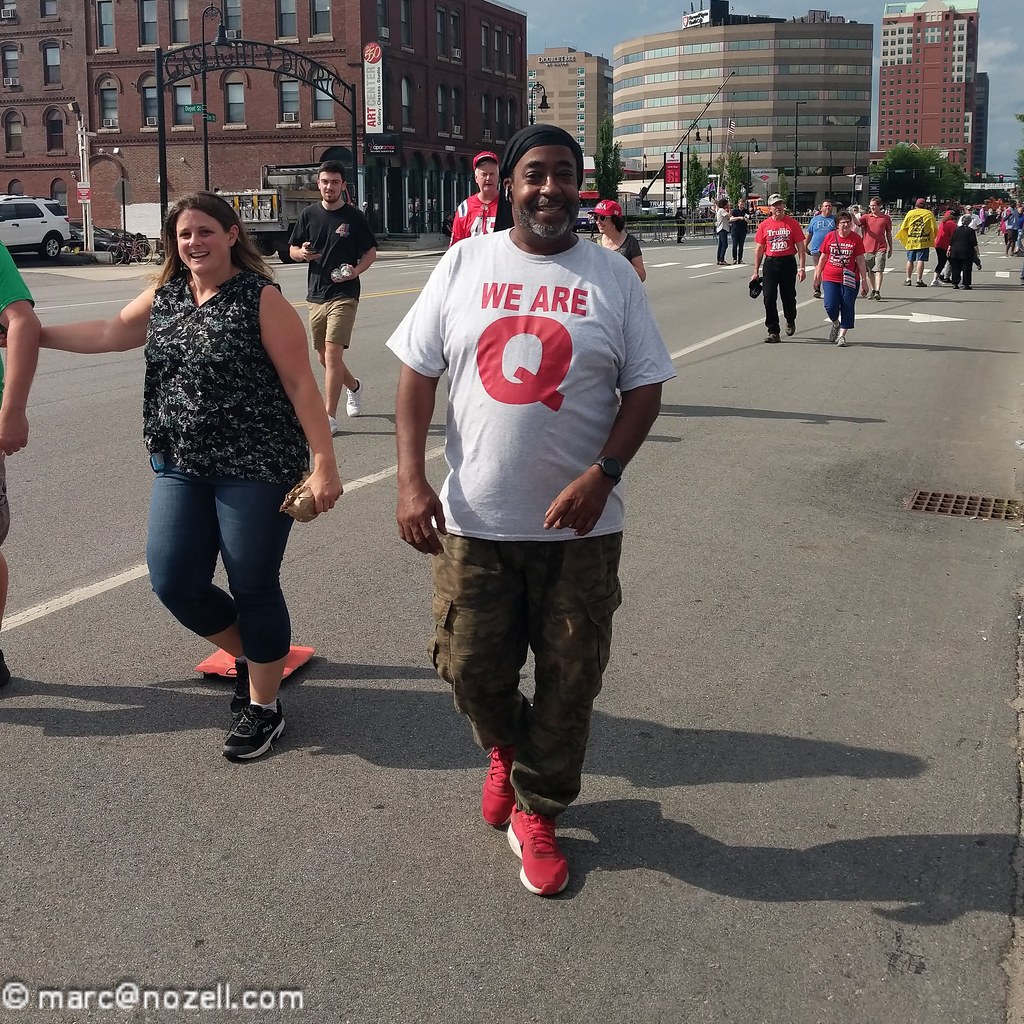
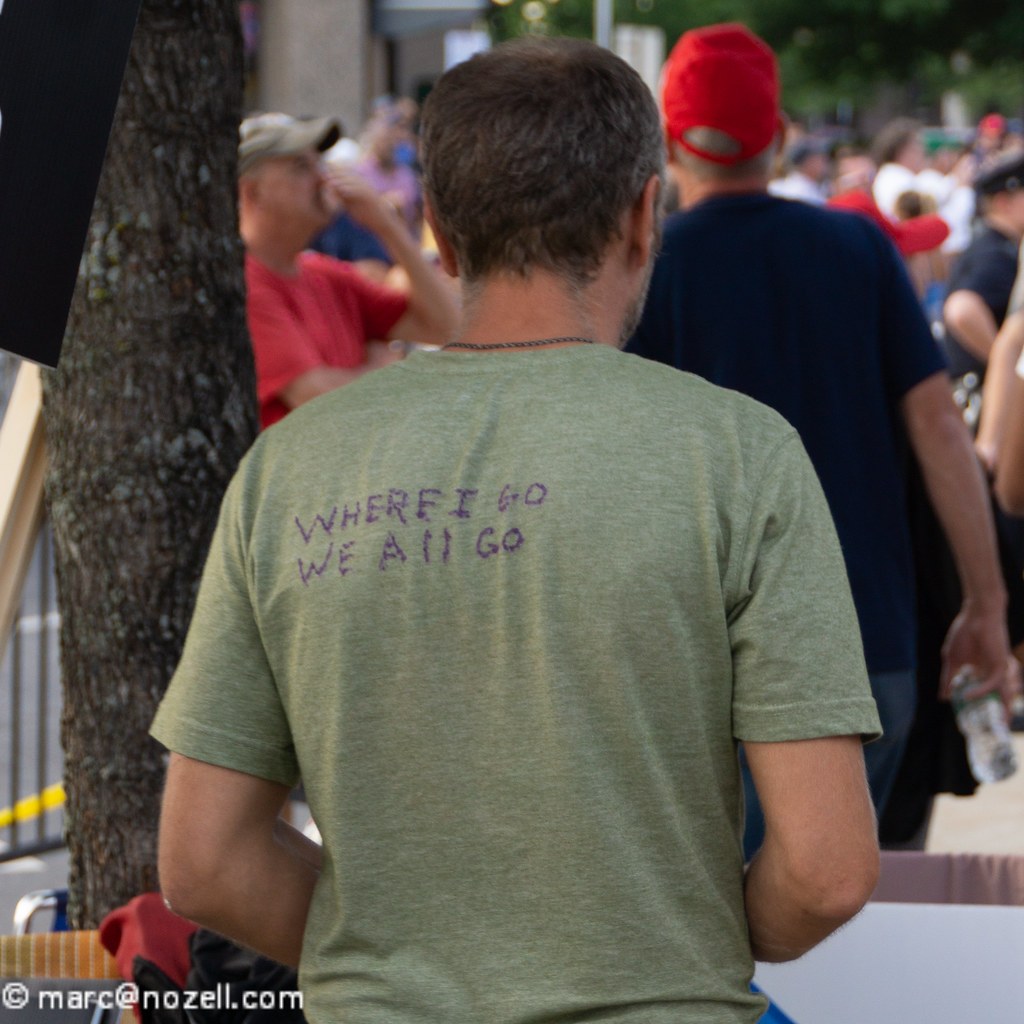
A supporter’s homemade QAnon shirt, 15 August 2019
A supporter’s homemade shirt, photographed in 2019. Shared symbols made an anonymous story recognizable beyond the imageboards. Image credit ↗

Chapter 01 / 2016–2017

The promise of an insider

QAnon began with a claim of access. On 28 October 2017, posts on 4chan forecast dramatic action against Hillary Clinton. The first post collected by the QAlerts archive asserted that extradition arrangements were already underway and directed readers toward an imminent National Guard activation. It answered another anonymous message predicting an arrest on 30 October. That distinction matters: the precise arrest window was in the quoted message, while the reply attributed to Q endorsed the approaching operation. Clinton was not arrested in that predicted period.

The setting was an anonymous imageboard where invented insider identities competed for attention. The name Q suggested a government security clearance. A label on an anonymous post did not establish that its writer held one. Readers nevertheless encountered a compelling explanation for apparent political disorder: Trump and loyal officials were secretly fighting a deeply entrenched criminal enemy. Public conflict could be read as part of a concealed operation rather than evidence that the promised operation did not exist.

This story inherited material from the 2016 Pizzagate rumor, which had falsely placed a child-abuse operation at a Washington restaurant. Edgar Maddison Welch entered that restaurant with guns in December 2016, fired, and later pleaded guilty to weapons offenses. His attack preceded Q’s first posts. Calling him a QAnon operative would reverse the chronology. The connection is an inherited allegation and a recurring idea of civilian rescue, not an established command relationship.

The earliest Q posts also offered unusually concrete opportunities for checking. An October 31 message reproduced by PolitiFact set November dates for indictments of John Podesta and Huma Abedin. Those predicted indictments did not occur. These failures weigh directly against privileged forecasting. They do not establish the poster’s civil identity, explain every follower’s motives, or make actual official misconduct disappear. They establish that the first public tests did not deliver the promised results.

Sources: S01 · S03 · S04 · S09 · S25

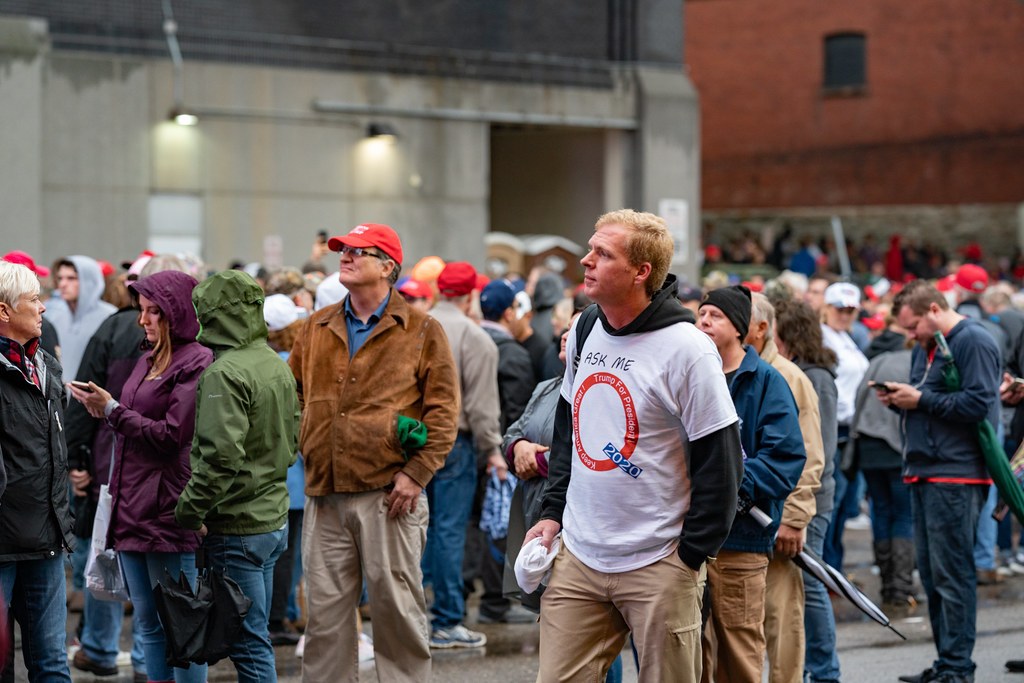
Ask Me Q sign at Minneapolis rally, 10 October 2019
An “Ask Me Q” sign at a Minneapolis Trump rally in October 2019: interpreters helped carry the story into public settings. Image credit ↗

Chapter 02 / 2017–2019

A recognizable signature is not an identity

The Q persona migrated from 4chan to 8chan and later 8kun. These platforms let anonymous writers use tripcodes: visible strings derived from passwords that made a series of posts look continuous. To supporters, continuity could resemble a credential. Technically it was much narrower. Someone who possessed the relevant password, or controlled the infrastructure that validated it, could affect that continuity. A tripcode did not certify government employment, a clearance, or the truth of a post.

The surviving record also depends on collectors. Original imageboard threads could disappear, while supporter-run aggregation sites preserved and numbered selected posts. A 2022 research paper by Antonis Papasavva and colleagues compared six such sites and found disagreements in what they treated as the Q corpus. Its writing-style analysis suggested more than one author. That is valuable evidence against assuming a single unchanged writer, but statistical differences can reflect topic, editing or platform changes as well as authorship. They are not a fingerprint naming a particular person.

A later supervised authorship study by Florian Cafiero and Jean-Baptiste Camps tested writing samples from thirteen candidates and ranked two social-media activists as the closest linguistic matches to different portions of the Q corpus. It sharpened the possibility of a handoff without authenticating a login. Candidate selection, the unusually short and stylized posts, available comparison writing and changes in genre constrain what such a classifier can establish. A successful match among tested samples does not show that every possible author was tested.

Ownership and administration of 8chan and 8kun put Jim Watkins and Ron Watkins near the infrastructure that carried Q. Cullen Hoback’s documentary Q: Into the Storm developed the hypothesis that Ron Watkins operated the persona. Watkins denied being Q in the clip reproduced in Hoback’s televised interview. The competing account is an investigative argument, not a settled identification; the denial does not decide it. The public record assembled here includes neither an authenticated comprehensive account-access log nor a corroborated admission establishing who wrote which posts. Control of a host, motive, opportunity, a verbal slip and writing patterns carry different weights; adding them together does not turn each into direct proof.

This uncertainty does not suspend all judgment. One can test a dated prediction without knowing its author, just as one can establish that a letter contained a false forecast without identifying the writer. Conversely, identifying a writer would not by itself demonstrate a government operation. The authorship question asks who posted. The authority question asks what access they actually possessed. QAnon often made the first mystery do the evidentiary work of the second.

Sources: S02 · S03 · S21 · S23 · S27

QAnon-shirt wearer in Manchester, 15 August 2019
A QAnon-shirt wearer photographed in Manchester, New Hampshire, 15 August 2019. Clothing made the movement visible beyond the forums. Image credit ↗

Chapter 03 / 2018–2020

From decoding to a public community

An obscure post could reach a large audience through people who explained it. Screenshots, videos, livestreams and merchandise translated fragments into a continuous account. A newcomer did not need to read thousands of posts or use an imageboard. They could arrive through a familiar social-media account, a political rally or concern about children. Each interpreter could emphasize a different element: secrecy, political betrayal, a coming victory, spiritual conflict or collective investigation.

By 2020 the movement had an audience well beyond its original setting. Pew Research Center found that 47 percent of US adults had heard at least a little about QAnon in its September survey, up from 23 percent in February. That was awareness, not a count of believers. Even favorable answers among those familiar with the movement cannot be multiplied into an audited membership total. There was no central roll, and the label covered differing degrees of engagement.

Trump’s own words gave supporters a particularly important public event to interpret. At the August 19 White House briefing he said he knew little about the movement, understood that its supporters liked him, and had heard they loved the country. Asked about the theory that he was rescuing the world from a criminal cult, he framed rescuing the world as a desirable goal. The official transcript and event videos establish the exchange. They do not establish that Q was his agent, that he had read the posts, or that an alleged hidden operation existed. They do show why the movement could point to a response from the person at the center of its story.

Platforms then became another arena of conflict. Facebook’s October 6 policy expanded removal to accounts representing QAnon even without violent content. That action constrained channels of distribution while supplying a fresh story of suppression. A platform’s decision is evidence of its policy and enforcement claims. It cannot substitute for investigating an allegation, nor can being removed establish that an allegation was true. QAnon’s reach and the truth of its central narrative remain separate questions.

Sources: S05 · S06 · S07 · S18 · S19

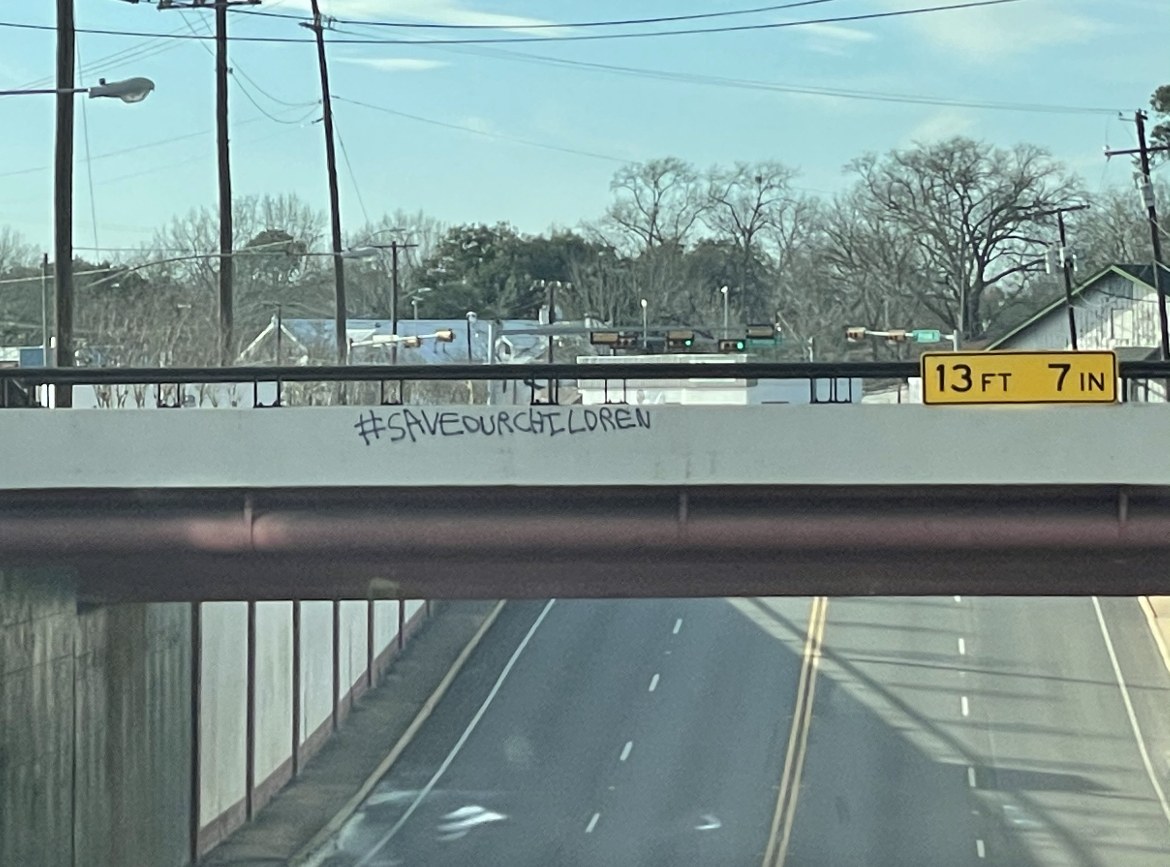
Save our children graffiti in Lufkin, Texas, 2 February 2021
“#saveourchildren” graffiti in Lufkin, Texas, February 2021. The phrase alone cannot establish a writer’s affiliation or endorse a particular allegation. Image credit ↗

Chapter 04 / 2019–2020

Real abuse and an unsupported total explanation

Concern about powerful abusers did not begin with QAnon, and it did not require Q’s predictions to be correct. Jeffrey Epstein’s case exposed grave sexual abuse and failures of accountability. Federal prosecutors charged him with trafficking minors in July 2019; he died before that case reached trial. Ghislaine Maxwell’s later conviction and twenty-year sentence established her criminal conduct through a court process. These were specific cases involving victims, witnesses, documents and adjudication, not merely a generalized suspicion of elites.

For QAnon, such cases could look like confirmation of the larger promised reckoning. The stronger version of that argument starts with a reasonable premise: wealth and connections can impede accountability, and institutions sometimes conceal failure. The missing step is the link to the whole account. Evidence against an identified offender does not authenticate an anonymous military source, identify every person in an address book as an accomplice, or prove a single command structure governing unrelated events. Each additional allegation needs its own chain of evidence.

The 2020 Wayfair rumor illustrates what can happen when resemblance replaces that chain. Expensive products and names matching those in missing-person posts were interpreted as a concealed market in children. PolitiFact traced how screenshots circulated; Polaris, which operated the national trafficking hotline, reported the burden of responding to such rumors. Neither an unusual price nor a common name established a transaction involving a child. The assembled record did not produce authenticated victims tied to the claimed sales, transaction records or corroborated testimony demonstrating the alleged operation.

The harm was not confined to reputations. Polaris described staff time diverted toward viral reports and away from actionable situations. Its account is operational testimony from a service provider, not a complete national measurement. It nevertheless makes the central distinction concrete: caring about trafficking and correctly identifying trafficking are different tasks. Evidence that would change a specific case assessment would include independently corroborated victim accounts, records connecting alleged payments to conduct, and preserved communications with a verifiable chain of custody. A sweeping account does not become stronger by borrowing the suffering documented in a different case.

Sources: S10 · S11 · S12 · S13 · S22 · S24

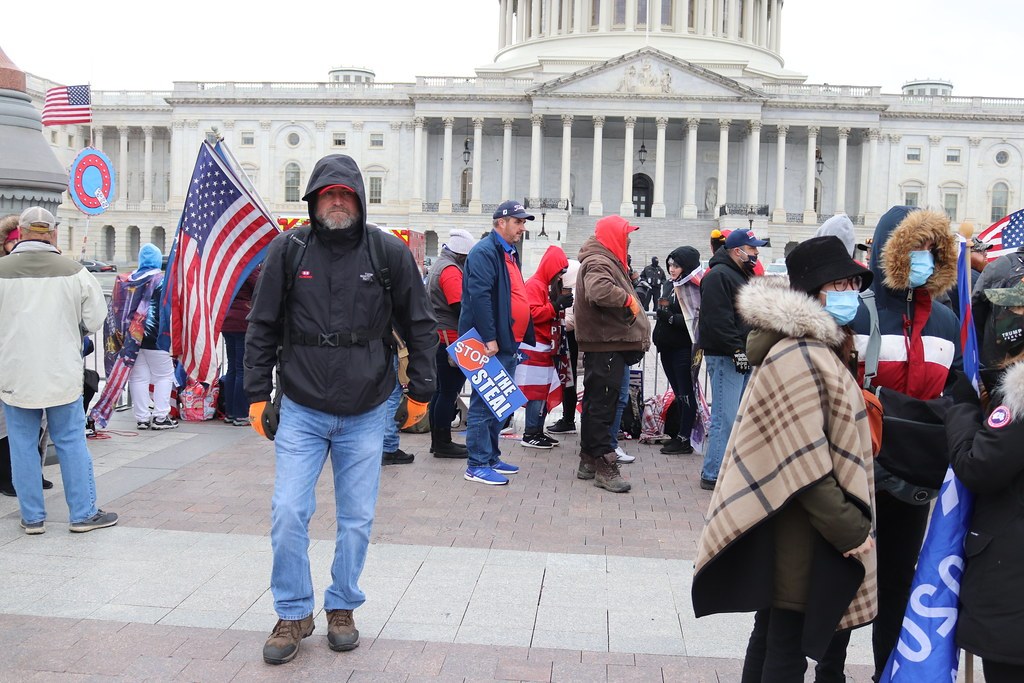
US Capitol east plaza before the breach, 6 January 2021
The east plaza of the US Capitol before the breach, 6 January 2021. The photograph documents the setting and does not identify every participant’s beliefs. Image credit ↗

Chapter 05 / November 2020–January 2021

The reckoning that did not arrive

The 2020 election created a sharper test than an ambiguous phrase in a speech. Trump lost the electoral vote, but QAnon communities anticipated a reversal. Some expected a military intervention or arrests before Joe Biden could take office. The January 6 congressional certification became a focal point within a much wider effort to overturn the result. The House Select Committee’s report documented QAnon adherents and imagery among the mobilization, while also describing other organizers and networks. QAnon did not encompass every person who challenged the election or every person who entered the Capitol.

Jacob Chansley became the most recognizable individual associated with both QAnon and the breach. His case provides evidence of an individual act and a legal outcome. He pleaded guilty in 2021 to obstructing an official proceeding and received a forty-one-month sentence that November. The plea and sentence do not make him the movement’s commander, and his visibility should not stand in for a complete account of the attack. Nor does a particular image of police near him decide all the conduct documented in the case.

On January 20, 2021, Biden was inaugurated. The promised public interruption did not occur. Contemporary reporting described distress, anger, departures and new explanations in QAnon channels. This is a particularly strong test of claims that specified what would happen before the transfer of power. An operation redefined as permanently invisible cannot rescue that forecast: it becomes a different, less testable assertion. Some followers accepted that they had been misled; others treated failure as another stage in the plan.

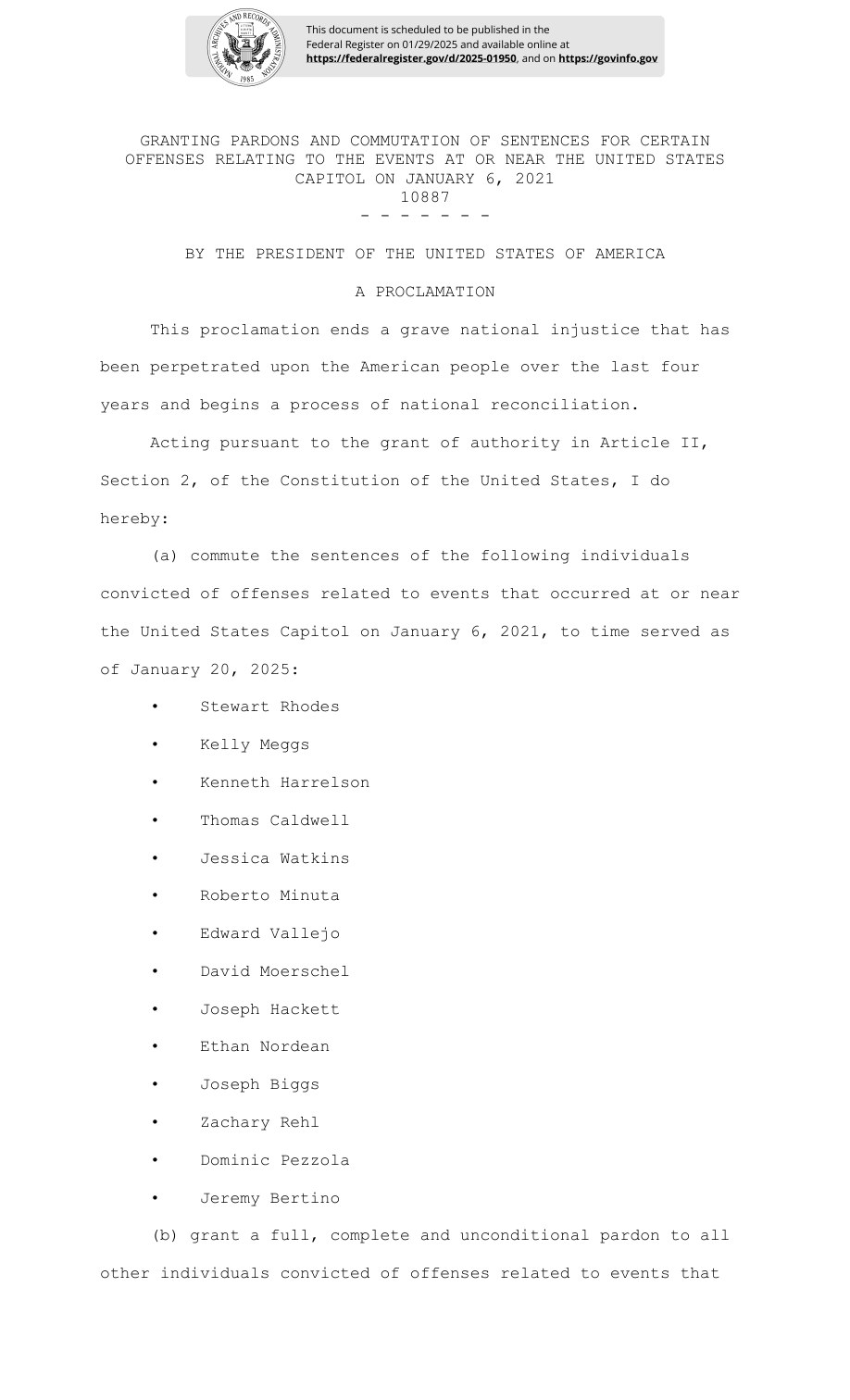
The legal afterlife also needs its own date. On January 20, 2025, Trump issued broad pardons for Capitol-related offenses and commuted specified sentences. That executive act changed legal consequences and directed dismissal of pending cases. It did not make the earlier plea and sentence events vanish, or constitute a trial finding that the breach never happened. The chronology therefore contains both the adjudicated 2021 outcome and the 2025 clemency, without using either as a shortcut to settle every historical dispute.

Sources: S14 · S15 · S17 · S16

Proclamation 10887, January 2025, first page
The first page of the January 2025 clemency proclamation. Its legal relief is distinct from a trial finding about the historical events. Image credit ↗

Chapter 06 / 2021–2025

A movement after the forecast

A failed forecast can end a proposition without ending the community built around it. QAnon gave participants an interpretive routine, relationships and an expectation that apparently unrelated events could be connected. Those functions could survive a silence from Q or the collapse of a particular timetable. A person could also drop the label while keeping part of the account. This makes declarations that QAnon simply ended difficult to support, and it makes sweeping estimates of its current size equally difficult.

The posting persona also returned. QAlerts preserves a message dated June 24, 2022, following the lengthy silence after 2020. The entry documents another appearance of the attributed signature. It does not establish that the same human returned or that the claims of privileged access had become valid. Renewed posting and continued community activity are separate forms of persistence.

Researchers studying Telegram assembled millions of messages from selected QAnon groups and channels and documented circulation beyond English-speaking communities. Their sample showed adaptation across national settings. It did not show that every protest against a pandemic restriction was QAnon, or that every subscriber believed every message. Channel counts can include overlap, inactive users and observers. The study establishes a transnational communications environment rather than a global membership register.

PRRI approached persistence through survey questions rather than counting accounts. Its 2024 analysis classified 19 percent of US adults as QAnon believers using a composite of three propositions about a hidden ruling cabal, a coming restoration and possible patriotic violence. The classification measures agreement with a defined scale. It does not mean that all respondents used the QAnon name, read Q posts or joined an organization. It is therefore not directly interchangeable with Pew’s earlier awareness measure.

There are several competing explanations for this persistence. A hidden-operation account treats reversals as strategic deception. An account centered on deliberate manipulation points to the advantages gained by promoters or operators. A decentralized account emphasizes participants collectively fitting events to a shared story. The latter two can coexist: a promoter can exploit a community whose interpretations they do not fully control. Evidence that an outside actor amplified a message would not, by itself, prove that actor created or commanded the entire movement.

The observable sequence favors an explanation built around anonymous authority claims, participatory interpretation and public amplification. It does not establish one master author or one motive for all participants. The distinction leaves room for real investigations of institutional corruption and abuse while refusing to treat all unresolved questions as evidence for Q’s entire account. An authenticated archive of account control could materially change the authorship assessment. Dated operational orders, corroborated testimony and records demonstrably unavailable to the public could change an insider-operation assessment. Until such evidence is produced and tested, the movement’s documented social reality is much stronger than its claim to privileged knowledge of a coming reckoning.

Sources: S02 · S07 · S08 · S20 · S28 · S29

02 / The record

The load-bearing chain

The anonymous authority claim, its public tests and the community built around it.

The assembled record is strongest about what attributed posts asserted, what public figures said, specific legal outcomes and defined observations of circulation. It is weaker about who controlled every posting account and cannot authenticate a single covert operation or master controller from popularity, secrecy or real misconduct elsewhere. The chain below keeps those propositions separate.

Sources: S01 · S02 · S05 · S24 · S25 · S27 · S29

Evidence support assesses the hinge as worded. Cultural prominence asks a different question: what was publicly circulated or measured. Pew awareness and PRRI’s composite agreement are explicitly scoped observations, not interchangeable membership counts or popularity ranks of rival theories.

P1

A claim of privileged access

Evidence support High for the attributed text and failed dated forecasts; absent for authenticated official access

Cultural prominence Unmeasured for this specific hinge

The first attributed posts ask readers to believe an anonymous source about imminent action. They contain checkable claims as well as a claim to authority.

The documentary yardstick

The first archive entries assert preparations for imminent action; the dated public outcomes do not match the initial forecasts. The mirror preserves a claim, not the poster’s clearance.

Where it fits

The insider reading begins here. The alternative account treats apparent privileged knowledge as a device for making speculation authoritative.

Why it is critical

Without an insider premise, the movement’s original promise becomes political speculation rather than privileged disclosure.

If this hinge were removed

Remove the claim of access and the persona becomes an anonymous political commentator. Remove one failed forecast and the authority question remains, but that particular test no longer weighs against it. Neither change identifies the author.

Dependencies

An accurate archived text and date; separation of the quoted parent post from Q’s reply.

What rival readings must explain

An insider theory must authenticate access and explain failed early forecasts; a fabrication theory must explain why the persona found an audience.

Gaps and disputes

Original thread preservation, attribution and numbering depend partly on supporter-run collectors. The quoted parent’s exact Clinton arrest date must not be assigned verbatim to Q’s reply.

Evidence-rank grounds

The saved post 1 and post 15 artifacts and dated chronology support what was asserted. No credential, tasking record or corroborated insider admission is in this corpus.

Cultural-rank grounds

Pew measured awareness of QAnon, not how many people knew or accepted these particular 2017 predictions.

Sources: S01 · S04 · S25

P2

Continuity passes through a fragile archive

Evidence support High for corpus disagreement; qualified for authorship inference

Cultural prominence Unmeasured for competing named-author hypotheses

Tripcodes and aggregation sites made Q recognizable, but neither independently identifies an author. Different collectors disagreed about the canon. A supervised authorship study later narrowed linguistic candidates, while leaving account access unverified.

The documentary yardstick

Technical studies identify variation in collector corpora and writing; neither a tripcode nor a linguistic match supplies an authenticated civil identity.

Where it fits

A single continuous insider, a changing persona and an infrastructure-assisted takeover make different predictions about account access and text continuity.

Why it is critical

An unbroken, authenticated source is assumed in many insider explanations; the record cannot simply take it for granted.

If this hinge were removed

Without the corpus comparison, the multiple-author inference loses one empirical basis. Even perfect textual continuity would still leave government authority unproved; removing a named-author hypothesis would not erase the archived forecasts.

Dependencies

Preserved threads, collector histories and technical understanding of tripcodes.

What rival readings must explain

A single-writer theory must explain stylistic and corpus discrepancies. A multiple-writer theory still needs direct records before naming authors.

Gaps and disputes

The original threads and comprehensive access logs are incomplete here. Supervised attribution compares selected candidates and samples; the possibility of an untested author remains.

Evidence-rank grounds

Papasavva and colleagues compare six collectors; Cafiero and Camps test a candidate set. Their methods answer narrower questions than direct account authentication.

Cultural-rank grounds

The documentary interview demonstrates public circulation of one hypothesis, not the relative audience belief in it or a poll of all possible authors.

Sources: S02 · S03 · S27

P3

Interpreters and political cues expand the audience

Evidence support High for the public exchange and measured awareness; incomplete for causal effect

Cultural prominence Broad awareness measured; hinge-specific prominence unmeasured

By 2020 QAnon circulated through familiar platforms and rallies. Trump’s public response was an unusually visible cue.

The documentary yardstick

The 19 August 2020 transcript records Trump’s response; Pew separately measures awareness and Meta records its own policy. These are distinct observations.

Where it fits

This is the bridge from imageboards to recognizable public politics. Public encouragement could matter without proving that the politician controlled the anonymous account.

Why it is critical

The movement’s growth cannot be explained by the anonymous posts alone; intermediaries made them intelligible and socially available.

If this hinge were removed

Remove Trump’s exchange and other intermediaries, symbols and platform activity still support diffusion. Remove all amplification evidence and anonymous posts alone no longer explain a broad public audience.

Dependencies

Pew’s defined survey population, public transcript and platform policy chronology.

What rival readings must explain

A centrally directed account must show coordination beyond shared messages. A spontaneous account must allow for deliberate promotion and commercial incentives.

Gaps and disputes

There is no controlled estimate here of how many people changed beliefs because of this briefing, a particular promoter or a removal policy. Platform self-report is not an efficacy audit.

Evidence-rank grounds

A primary official transcript fixes the words; Pew fixes its survey question and population. Neither directly estimates the effect of the exchange on belief.

Cultural-rank grounds

Pew’s 47 percent in September 2020 refers to having heard at least a little about QAnon. It does not rank this briefing, belief in Q or verified membership.

Sources: S05 · S06 · S07

P4

Specific scandals are absorbed into a general story

Evidence support High for specific legal outcomes; unsupported for the universal bridge

Cultural prominence Prominence unmeasured; public reuse documented

Epstein and Maxwell document serious abuse. Wayfair allegations instead relied on product names, prices and supposed code.

The documentary yardstick

Specific abuse cases have their own victims, evidence and outcomes. The claimed bridge from those cases or product screenshots to Q’s comprehensive story requires separate proof.

Where it fits

This is where a reasonable concern about powerful offenders can be converted into an unsupported universal explanation. The two propositions have different evidence burdens.

Why it is critical

The step from an actual case to a universal hidden network is where much of the evidentiary burden lies.

If this hinge were removed

Remove the Wayfair episode and documented abuse remains. Remove Epstein/Maxwell as rhetorical confirmation and Q’s claimed authority still requires authentication; neither operation erases victims or proves all allegations false.

Dependencies

Case-specific testimony and records, accurate missing-person statuses, actual transactions rather than screenshots alone.

What rival readings must explain

A wider-network theory needs corroborated links between actors and offenses. An account of rumor formation must not minimize documented victims or institutional failures.

Gaps and disputes

No census of trafficking or complete audit of all associates is claimed. The absence of an authenticated Wayfair transaction in this corpus does not settle every conceivable trafficking case.

Evidence-rank grounds

The indictment and Maxwell opinion identify case-specific proceedings. Practitioner accounts and transaction/source checks address a different rumor, rather than deciding it through a corporate denial.

Cultural-rank grounds

The inspected reporting and Polaris report show circulation and operational responses. They do not measure how typical this inference was among all adherents.

Sources: S12 · S13 · S22 · S11 · S24

P5

Public predictions meet observable outcomes

Evidence support High for public event and individual legal chronology; scoped for community expectations

Cultural prominence Observed in selected communities; relative prominence unmeasured

Biden’s January 20 inauguration occurred without the arrests or military intervention anticipated by some QAnon communities.

The documentary yardstick

Biden took office on 20 January 2021 without the predicted public military interruption. Chansley’s own plea/sentence and later executive relief are separate legal events.

Where it fits

A visible deadline tests claims about the public world independently of the writer’s identity. Individual participation also tests a claim that the movement was entirely inconsequential.

Why it is critical

If every outcome is redefined as successful secrecy, the original forecast loses its ability to distinguish knowledge from invention.

If this hinge were removed

Remove a particular follower’s forecast and no conclusion about Q’s exact words follows from that example. Remove the inauguration test and earlier failed dates remain. Removing Chansley would not make every participant QAnon or erase the wider breach.

Dependencies

Dated forecasts preserved before the event; a clear distinction between Q and later interpreters.

What rival readings must explain

A hidden-operation theory must supply independent evidence for changed plans. A decentralized account must explain both departures and continued commitment.

Gaps and disputes

Community predictions must not all be attributed to Q. Selected channels are not a census of reactions. The 2025 clemency instrument changes consequences without serving as a trial judgment of innocence.

Evidence-rank grounds

The legal records and dated contemporary reporting support the propositions stated. They do not establish that every follower expected the same deadline or joined the breach.

Cultural-rank grounds

Contemporaneous reporting records distress and reinterpretation in particular channels. No population estimate of those responses is available here.

Sources: S17 · S03 · S14 · S15 · S16

P6

The community outlives the deadline

Evidence support High for persistence in specified records; incomplete for scale and control

Cultural prominence Defined survey agreement measured; comparative narrative rank unmeasured

International networks and reinterpretations continued beyond the failed forecast; legal consequences also changed with 2025 clemency. Attributed posts resumed in June 2022, and PRRI’s 2024 composite survey found continued agreement with Q-related propositions.

The documentary yardstick

Attributed posting resumed in June 2022; research samples and a defined 2024 survey scale record persistence in different ways. None is a membership register.

Where it fits

This distinguishes the failure of an assertion from the survival of a community. It also tests whether a single disciplined command is needed to explain continued reinterpretation.

Why it is critical

Neither a failed prediction nor a policy ban is evidence that a social movement ceased to exist.

If this hinge were removed

Remove the 2022 post and community persistence still has survey/platform evidence. Remove one survey estimate and neither every channel nor every continued belief disappears. These sources cannot determine an exact current global total.

Dependencies

Platform samples with stated limits and dated legal instruments.

What rival readings must explain

An all-powerful controller theory must explain fragmentation; a purely organic theory must examine evidence of organized amplification without assuming it explains everything.

Gaps and disputes

Collectors do not authenticate the returning human. Channel subscribers overlap; survey agreement is not self-identification. Findings from different populations, dates and measures cannot be added.

Evidence-rank grounds

The dated artifact, selected Telegram study and PRRI scale are independent kinds of observation, each with its own denominator and attribution limit.

Cultural-rank grounds

PRRI’s 19 percent category is a three-proposition composite. It does not measure the cultural rank of an author theory or count self-identified organization members.

Sources: S20 · S02 · S16 · S28 · S29

03 / The record

How the accounts branch

Documented source relationships, competing interpretations and recurring hinges. Similar concerns do not establish borrowing.

A rescue story predates Q

2016 Pizzagate allegations and the restaurant attack → a later anonymous story of hidden powerful abusers and impending rescue.

Borrowing and dependence

The chronology and evidence reviews document the antecedent and recurring allegations. Shared motifs do not establish that Welch received instructions from a persona that had not yet appeared.

Branch and limit

The later Epstein/Maxwell cases contain real, independently investigated offenses; borrowing their evidentiary weight does not authenticate the earlier rumor or Q’s entire account.

Recurring hinges: P1 · P4

Sources: S03 · S04 · S09 · S12 · S24

Collectors turn a persona into a research corpus

Anonymous posts and tripcodes → supporter mirrors and numbered archives → competing technical authorship studies.

Borrowing and dependence

The studies explicitly analyze collected Q text. Agreement between mirrors or later research is not a new independent eyewitness to the account’s operator; collector disagreements are part of the evidence.

Branch and limit

The supervised candidate study and the documentary’s Ron Watkins hypothesis use different methods. Neither should be silently substituted for authenticated access logs.

Recurring hinges: P1 · P2

Sources: S01 · S02 · S23 · S25 · S27

A public response becomes an amplification branch

Audience interpretation and public symbols → the August 2020 press question and presidential reply → continuing public arguments over legitimacy and platform policy.

Borrowing and dependence

The official transcript fixes an actual response to a named movement. It does not establish private coordination, that Trump had read Q’s posts, or a causal count of converts. Meta’s policy is a separate institutional response.

Branch and limit

Pew’s awareness measure documents public recognition, while not deciding whether that recognition was favorable. Different intermediaries could give the same exchange different meanings.

Recurring hinges: P3 · P6

Sources: S05 · S06 · S07

The January deadline branches into exit and reinterpretation

Anticipated public reversal → Biden’s inauguration → reported disappointment, departure and revised expectations in selected channels.

Borrowing and dependence

The contemporaneous report observes community responses. It does not establish that every prediction originated in a Q post, nor that all followers responded in the same way.

Branch and limit

Later posting and international channels demonstrate that one failed timetable did not terminate every community. That persistence cannot retrospectively make the timetable accurate.

Recurring hinges: P1 · P5 · P6

Sources: S03 · S17 · S20 · S28

Different public narrators inherit different parts of the record

The same movement becomes an authorship investigation, a practitioner’s account of rumor costs and a defined survey category.

Borrowing and dependence

Hoback publicly explains a documentary inference; Polaris reports service-provider experience; PRRI states its question-based classification. Their different source bases should not be counted as three independent proofs of one hidden controller.

Branch and limit

The film was not watched in full here, hotline experience is not a national trafficking census, and survey classification is not membership. These are limited but useful branches of public knowledge.

Recurring hinges: P2 · P4 · P6

Sources: S11 · S23 · S29

04 / The record

Four rival paths through the same record

The strongest version first, followed by the hinges it accepts, the inferences it would remove or revise and the evidence it needs to add. Rival is not endorsement.

Interpretation 01

A genuine covert operation

Unsupported as an account of Q’s authority

The strongest version

Some powerful people have committed real abuse and institutions have failed to act. An insider might therefore communicate indirectly while an investigation remains covert.

Accept

P1 · P3 · P4

P1’s insider claim, P3’s political resonance and P4’s real scandals; explains ambiguity and delay as security measures.

Remove or revise

Replace the inference from failed dated forecasts to unreliable access with a documented explanation of changed plans; preserve the actual non-events and distinguish later follower forecasts.

Add to the path

Add authenticated contemporaneous tasking, records demonstrably unavailable publicly before posting, and corroborated insiders connecting the persona to an actual operation.

What must be wrong or incomplete

The forecast/authority link would have to be substantially incomplete, rather than every unexplained event simply counted as a secret success.

Must still explain

P1 and P5 include dated failures; P2 does not authenticate identity or authority. Evidence of one actual offender cannot establish the proposed whole network.

Assessment

The assembled sources contain no corroborated operational orders or authenticated source access proving the claimed operation. This assessment would change with independently verified records predating public knowledge, corroborated participants and a chain tying specific Q posts to that operation.

What would change this assessment

Authenticated records linking a named authorized operator to dated posts and actual actions could materially revise the authority assessment. A real abuse case or a politician’s favorable remark alone would not.

Sources: S01 · S02 · S04 · S12 · S13 · S17 · S24

Interpretation 02

A deliberate persona cultivated by insiders to the platform

Plausible in part; named authorship unresolved

The strongest version

A pseudonymous authority could be created or captured by people with access to imageboard infrastructure, then maintained for influence, income or status.

Accept

P1 · P2 · P3 · P5 · P6

P2’s dependence on infrastructure and P3’s amplification; does not require the forecasts to be genuine.

Remove or revise

Remove any jump from platform access or a verbal slip to identification of every post’s writer. A changing persona can still have attracted decentralized interpreters.

Add to the path

Add account-control logs, preserved private communications and corroborated admissions specifying dates, handoffs and particular content.

What must be wrong or incomplete

The present limit on naming the author would have to be overcome with direct records; the social diffusion evidence could remain intact.

Must still explain

Proximity and incentives do not identify the writer of each post. The origin, possible handoffs and responsibility of named people remain separate claims.

Assessment

The documentary and technical research make authorship investigation worthwhile. Authenticated logs, contemporaneous private communications or corroborated admissions would be substantially stronger than a suggestive interview or writing-style match. Supervised linguistic attribution supplies a further comparison among selected candidates; authentication of posting access remains the stronger missing test.

What would change this assessment

Authenticated access history and independently corroborated communications could establish a named operator for a defined period without proving one person wrote everything.

Sources: S02 · S21 · S23 · S27

Interpretation 03

A decentralized participatory conspiracy movement

Best supported account of growth and persistence

The strongest version

Anonymous posts supplied prompts; interpreters and audiences connected them to current events, found community and revised meanings after setbacks. Promoters could shape this without commanding it.

Accept

P1 · P2 · P3 · P4 · P5 · P6

All six steps, including actual abuse cases and the participation of specific adherents in harmful conduct.

Remove or revise

Remove an inference that shared slogans, interpretations and persistence require a single command, while retaining actual deliberate promotion where supported.

Add to the path

Add systematic audience/communication evidence showing how particular messages spread, who supplied them and where concentrated control displaced participation.

What must be wrong or incomplete

This account would be incomplete if authenticated tasking and control explained the supposedly participatory decisions at the relevant nodes.

Must still explain

It must explain concentrated influence, monetization and any authenticated coordination; decentralization cannot excuse ignoring deliberate manipulation.

Assessment

Archive variation, platform migration, public amplification and international adaptation fit a distributed movement better than a single disciplined organization. Evidence of centralized tasking, funding and coordinated operational control could narrow or revise the account.

What would change this assessment

Dated sponsor/operator records tied to particular messages and measurable distribution effects could establish narrower coordination or revise the overall account.

Sources: S02 · S05 · S07 · S20 · S28 · S29

Interpretation 04

A centrally controlled influence operation

Whole-movement control not established

The strongest version

State or political actors can exploit existing distrust and amplify polarizing material. A covert sponsor might use a pseudonymous persona to shape politics.

Accept

P2 · P3 · P6

P3’s amplification and P6’s international reach; those features create opportunity for organized influence.

Remove or revise

Remove any assumption that international reach, repetition or influence by itself establishes original authorship or comprehensive command.

Add to the path

Add attributable funding/tasking, operator access, specific dissemination records and evidence separating controlled activity from participants’ independent choices.

What must be wrong or incomplete

The absence of a demonstrated control chain would have to be replaced by positive authenticated links. Existing forecasts and individual legal outcomes would still require explanation.

Must still explain

Reach, similar slogans and foreign-language posts do not establish authorship or command. It must connect sponsor, operator, funding or tasking, specific content and effects.

Assessment

The record here does not authenticate a sponsor controlling the entire movement. Attributable amplification would support a narrower finding. Verified contracts, financial transfers, tasking messages and account-control records could establish more.

What would change this assessment

Verified contracts, financial records and corroborated tasking could establish a particular influence operation. Its scope would depend on what those records actually controlled.

Sources: S02 · S20 · S08
05 / The record

Which account emphasizes which hinge

Five inspected voices: the attributed persona, a public official, a filmmaker in a dated interview, a service provider and a survey organization. These cards compare the specific inspected passages; the documentary series was not watched in full.

The attributed Q persona

Saved numbered archive artifact 15, not an authenticated government statement or a complete corpus audit.

Amplifies

A specific coming indictment sequence and a claim that concealed information explains public events.

Recasts

Presents the future as already organized behind the scenes; the named public events become tests of that premise.

Does not establish in this inspected account

The mirror does not verify official authority, account ownership or the predicted indictments. The first-post reply and quoted parent are kept distinct.

P1 · P2 · P5

Sources: S25

Trump at the 19 August 2020 briefing

The actual QAnon question-and-answer passage in the official archived transcript; optional event videos linked separately.

Amplifies

Appreciation of people described as supporting him and concern about public disorder.

Recasts

Answers the rescue premise in positive general terms while disclaiming detailed knowledge of the movement.

Does not establish in this inspected account

The exchange does not authenticate Q, demonstrate private instructions or measure how many listeners changed beliefs.

P1 · P3

Sources: S05

Cullen Hoback explaining his inference

April 2021 CNN interview and reproduced documentary clip; no full-series viewing or book audit.

Amplifies

Ron Watkins’s proximity to the infrastructure and an interview moment Hoback interprets as revealing.

Recasts

Turns an ambiguous public exchange into an authorship hypothesis; the reproduced denial does not settle it either way.

Does not establish in this inspected account

A rush transcript and filmmaker’s inference do not supply comprehensive authenticated posting logs or identify the author of every entry.

P2 · P3

Sources: S23

Polaris on the work of responding to rumors

The report’s trafficking-rumor and service-response discussion, not a full audit of hotline operations.

Amplifies

The practical cost of viral allegations and the need for case-specific victim and transaction evidence.

Recasts

Moves attention from a promised elite reckoning toward whether a report supplies actionable information.

Does not establish in this inspected account

Provider experience is not a count of every adherent, a national measure of all trafficking or a reason to dismiss a separately corroborated abuse allegation.

P4 · P6

Sources: S11

PRRI’s defined survey category

The 2024 spotlight’s three-proposition composite and its stated result.

Amplifies

Continuing agreement with a specified set of beliefs after the original failed deadlines.

Recasts

Uses a survey classification to study political attitudes rather than identifying organization members.

Does not establish in this inspected account

The category does not show everyone used the label, read Q or agreed with every other allegation. It cannot rank competing author theories.

P3 · P6

Sources: S29

06 / The record

Find a thread in the file

Search the chapter and claim index; each result leads to the full passage and its sources.

07 / The record

People, not a single cast of mind

Open a record for the person’s role and supporting sources. No portrait is used to imply a verified identification of Q.

QBiographical record
QAnonymous posting persona

No authenticated civil identity is established here. Archive numbering and continuity of tripcodes identify attributed messages, not a verified intelligence officer.

Sources: S01 · S02

TrumpBiographical record
Donald TrumpPresident at the center of the narrative

His August 2020 exchange with reporters is preserved in transcript and video. Political amplification is observable; authorizing Q or directing its posting is not established.

Sources: S05 · S18

WatkinsBiographical record
Ron WatkinsFormer 8kun administrator

His infrastructure role and Hoback documentary interviews matter to authorship hypotheses. They do not conclusively establish which Q posts, if any, he authored.

Sources: S21 · S02 · S23

WatkinsBiographical record
Jim WatkinsImageboard owner

His platform ownership placed him near Q’s distribution infrastructure. The House report discusses his January 6 testimony and attendance; it does not establish him as the author of Q.

Sources: S15

ChansleyBiographical record
Jacob ChansleyQAnon adherent and Capitol defendant

Pleaded guilty to obstruction in 2021 and received a forty-one-month sentence. The 2025 broad clemency proclamation is a separate legal development. He was not a verified commander of the movement.

Sources: S14 · S16

MaxwellBiographical record
Ghislaine MaxwellConvicted Epstein associate

Her 2021 trial and 2022 sentence establish specific criminal conduct involving minors. They do not validate unrelated allegations against other people or Q’s asserted source.

Sources: S13 · S24

HobackBiographical record
Cullen HobackDocumentary filmmaker

Q: Into the Storm explored imageboard infrastructure and proposed an authorship explanation. A documentary’s inference remains distinct from authenticated account records.

Sources: S21 · S23

08 / The record

From posts to public events

Horizontal spacing shows elapsed time; separate rows keep close events selectable. Scroll the graph on narrow screens. Exact dates are attributed where records conflict; month- and year-only dates preserve source precision.

201620182020202220242026
Armed Pizzagate intrusionPrehistory

Welch entered Comet Ping Pong armed and fired. His later plea concerned weapons offenses. This occurred before Q’s first post, so it is background rather than a Q-directed act.

Sources: S09

Migration toward 8chanPlatform

The migration from 4chan toward 8chan occurred in late 2017. Sources differ on the precise start; observed 8chan activity rose in December. This record preserves year-level precision rather than selecting an unsupported day.

Sources: S26

Welch sentencedCourt outcome

A four-year sentence followed the March guilty plea. The incident illustrates consequences of an inherited rumor without establishing later Q leadership.

Sources: S09

The first archived promiseQ post

The first QAlerts entry asserts extradition preparations and suggests imminent National Guard activation. Its quoted anonymous parent post supplies a precise October 30 arrest prediction. Neither has authenticated insider authority.

Sources: S01 · S03

Dates for indictmentsQ post

A post reproduced by PolitiFact predicts Podesta and Abedin indictments on November 3 and 6. Those events did not occur as forecast.

Sources: S04 · S25

Q symbols visible at a Trump rallyPublic visibility

A Tampa rally drew wider media attention to the symbols and interpreters carrying QAnon out of imageboards. Visibility is not a membership count.

Sources: S03

Epstein federal charges announcedCriminal case

The federal indictment charged sex trafficking of minors and conspiracy. Epstein died before trial; the 2019 charges were not a conviction.

Sources: S12

8chan goes offlinePlatform

The host’s interruption disrupted Q’s posting environment. A later return through 8kun did not independently authenticate continuity of the writer.

Sources: S02 · S03

Wayfair rumor circulatesViral allegation

Names and prices in product listings became a purported trafficking code. Contemporary reporting checked specific missing-person claims; the alleged sales were not established.

Sources: S22

Trump answers a QAnon questionPrimary transcript

Trump expressed appreciation for supporters while saying he knew little about the movement. The public exchange did not authenticate Q as a government source.

Sources: S05 · S18 · S19

Pew publishes awareness surveySurvey

Forty-seven percent of US adults had heard at least a little about QAnon. Awareness, favorable views and membership are different measures.

Sources: S06

Facebook broadens removal policyPlatform policy

Facebook announced removal of accounts representing QAnon even without violent content. Its announcement establishes policy; efficacy requires separate evidence.

Sources: S07

Capitol breach interrupts certificationPublic event

QAnon adherents participated among a larger coalition. The House report documents mobilization and imagery; individual criminal responsibility rests on individual evidence.

Sources: S15 · S14

Biden inauguratedPrediction test

The transfer of power occurred despite expectations in QAnon communities of arrests or intervention. Contemporary reports captured dismay and reinterpretation.

Sources: S17

Chansley sentencedCourt outcome

The court imposed forty-one months after his obstruction plea. This is an outcome in an individual case, not a finding about every adherent.

Sources: S14

Attributed Q posting resumesArchive record

QAlerts preserves a new attributed message after the 2020 silence. Resumed posting is observable in the archive; continuity of the individual writer remains unverified.

Sources: S28

Maxwell sentencedCourt outcome

Twenty-year sentence followed her December 2021 jury conviction. The case documents abuse without proving the overarching Q account.

Sources: S13

Capitol-related clemencyExecutive action

Trump granted broad pardons, commuted specified sentences and directed dismissal of pending Capitol-related prosecutions. Legal relief is distinct from historical adjudication of the events.

Sources: S16

09 / The record

What the evidence supports

Ratings apply to the precise proposition on the page. Unsupported means the assembled evidence does not establish a claim; it is not interchangeable with false.

Unsupported

Q had authenticated high-level US government authority.

The persona asserted privileged access; the archive and tripcodes do not verify employment, clearance or official authorization.

Sources: S01 · S02

Contradicted

The early posts correctly forecast the announced 2017 arrests and indictments.

The Clinton arrest expectation and dated Podesta/Abedin indictments did not occur as forecast. The precise Clinton arrest window belongs to the quoted parent post; Q’s reply asserted preparations and imminent activation.

Sources: S01 · S04 · S25

Not established

Ron Watkins has been conclusively identified as the author of all Q posts.

Hoback proposed an authorship hypothesis. The assembled record lacks authenticated logs or corroborated admissions identifying the writer of every post, and writing-style evidence suggests possible multiple authors. The later supervised study supplies probabilistic comparison, not conclusive identification.

Sources: S02 · S21 · S23 · S27

Unsupported

QAnon is a single militia with a verified command structure.

The documented phenomenon includes interpreters, online communities and overlapping political activity. That does not establish a unified armed organization.

Sources: S02 · S08 · S20

Established

Trump publicly expressed appreciation for QAnon supporters in August 2020.

The official transcript and event videos preserve his answer. It establishes his words; it does not authenticate Q as his agent.

Sources: S05 · S18 · S19

Contradicted

Pew’s September 2020 finding means 47 percent of Americans believed QAnon.

Forty-seven percent had heard at least a little. Awareness is not belief, favorable opinion or membership.

Sources: S06

Established

The Epstein and Maxwell cases document real abuse.

Epstein’s 2019 case was a prosecution cut short before trial; Maxwell was convicted and sentenced. Case outcomes must be kept distinct. Neither establishes every allegation about an associate.

Sources: S12 · S13 · S24

Unsupported

Wayfair product names and prices proved a child-trafficking operation.

Screenshots did not establish victims, payments or transactions. Checks found resolved missing-person claims and ordinary product explanations; the conclusion does not depend on the company’s denial.

Sources: S22 · S10

Established

QAnon adherents participated in the January 6 Capitol breach.

The congressional report and Chansley case establish participation by particular adherents. They do not establish that every participant was QAnon or that all adherents participated.

Sources: S15 · S14

Contradicted

The predicted January 2021 public military intervention occurred.

Biden was inaugurated; the expected public arrests and interruption did not happen. Private unseen success is a different proposition requiring independent evidence.

Sources: S17

Contradicted

The 2025 clemency proclamation was a judicial finding that Capitol defendants were innocent.

The proclamation is an executive pardon and commutation instrument, coupled with dismissal directions. It is not a trial judgment of the historical facts.

Sources: S16

Contradicted

QAnon disappeared when the January 2021 deadline failed.

Research documents continued and international channels. It supports persistence, without furnishing a current total of adherents. A June 2022 attributed post and PRRI’s 2024 survey scale provide additional evidence of persistence, with different limits.

Sources: S20 · S02 · S28 · S29

Contradicted

PRRI’s 19 percent category is a membership count.

The 2024 result is a composite classification from agreement with three propositions. It is not a list of members, a count of accounts or proof that every classified respondent adopted the label.

Sources: S29

10 / The record

Hear the argument

Recorded voices, reported history, and documentary context. External media need an internet connection.

Primary event / short clip

The same exchange — Fox News video ↗

A second accessible record of the central August 2020 exchange. A recorded statement establishes the statement, not hidden coordination.

Investigative documentary / interpretation

Q: Into the Storm ↗

Cullen Hoback follows Q’s infrastructure and investigates authorship. Its proposed identification remains an attributed inference. Streaming availability may vary.

11 / The record

How the story changed

Public memory tends to compress contested histories into a turning point. The records leave a less tidy sequence.

An expected arrest becomes an elastic timetable

ThenThe first archived messages offered near-term events that readers could check.

ReconsideredLater interpretations could treat missed dates as deception or a longer plan. The new account does not make the earlier forecast accurate.

Sources: S01 · S04 · S03

A fringe forum becomes a national political reference

ThenThe story began in anonymous threads requiring specialist interpreters.

ReconsideredBy September 2020 nearly half of US adults had heard something about it. Awareness does not retrospectively turn the original source into a verified insider.

Sources: S06 · S05

Saving children becomes a viral investigative template

ThenSpecific abuse cases established real crimes and institutional failures.

ReconsideredThe Wayfair rumor generalized suspicion through product screenshots. Polaris described the practical cost of responding to false leads.

Sources: S12 · S13 · S22 · S11

The inauguration divides the explanation

ThenSome adherents expected intervention before Biden took office.

ReconsideredAfter the inauguration, observed communities showed departures, dismay and new theories. There was no single uniform response.

Sources: S17

A conviction and a pardon enter different narratives

ThenThe Chansley plea and sentence became prominent symbols of consequences after January 6.

ReconsideredThe 2025 proclamation changed legal treatment. It was executive clemency rather than a trial finding resolving the underlying historical record.

Sources: S14 · S16

Silence gives way to resumed posting and survey evidence

ThenThe original persona fell silent after 2020, and some observers treated the failed 2021 deadline as an ending.

ReconsideredAttributed posts appeared again in June 2022. PRRI later measured belief through defined propositions, demonstrating why source activity, community persistence and membership counts must remain distinct.

Sources: S28 · S29

12 / The record

The questions still open

A documented limit is more useful than a confident number or a sweeping lineage the evidence cannot carry.

  1. Who authored which posts, and did control change? Authenticated account logs and contemporaneous private records could discriminate between competing authorship accounts.
  2. Which interventions materially increased reach? Platform data linking exposures to behavior would be stronger than follower counts or selected viral examples.
  3. How many people retained particular QAnon beliefs after dropping the label? Comparable longitudinal surveys would help distinguish changed vocabulary from changed beliefs.
  4. Which claimed links in alleged abuse networks can be independently corroborated? Each person and offense requires its own evidence; proximity alone is insufficient.
  5. What evidence, preserved before events, establishes nonpublic knowledge rather than hindsight matching? Specific predictions and independently authenticated documents would matter most.

13 / The record

Go back to the sources

Records, reporting, and firsthand accounts have different evidentiary roles. Each source note explains what it can establish and where caution is needed. Sources consulted for this edition on 25 October 2026; publisher restrictions may apply.

  1. S01

    Primary claim artifact

    First archived Q post ↗

    QAlerts (supporter-run mirror)

    Archived post dated 28 October 2017; evidence of the claim, not authentication of an intelligence source. Numbering and attribution depend on the mirror.

  2. S02

    Original empirical research

    The Gospel According to Q ↗

    Papasavva et al., ICWSM 2022

    Compares six aggregators and writing styles. Statistical evidence of multiple authors is not identification of a named author. Version 3, 29 April 2022.

  3. S03

    Investigative chronology

    The QAnon Timeline ↗

    Bellingcat

    Dated archive-linked chronology, 29 January 2021; distinguishes Q posts and community developments.

  4. S04

    Reported evidence review

    What is QAnon, the baseless conspiracy spilling into US politics? ↗

    PolitiFact

    27 August 2020; reproduces dated indictment predictions and checks public outcomes.

  5. S05

    Official transcript

    Remarks in press briefing, 19 August 2020 ↗

    Trump White House archive / NARA

    Primary record of what Trump said when asked about QAnon; praise of supporters does not authenticate Q.

  6. S06

    Original survey

    Public awareness and attitudes toward QAnon ↗

    Pew Research Center

    September 2020 survey. Awareness is not endorsement or membership; subgroup denominators matter.

  7. S07

    Platform policy record

    An Update to How We Address Movements and Organizations Tied to Violence ↗

    Facebook / Meta

    Living page containing dated October 6, 2020 policy expansion; company self-report, not an independent efficacy audit.

  8. S08

    Research assessment

    The QAnon Conspiracy Theory: A Security Threat in the Making? ↗

    Combating Terrorism Center at West Point

    2020 analysis by Amarnath Amarasingam and Marc-Andre Argentino; case-based threat assessment is not evidence that all adherents are violent.

  9. S09

    Prosecution account of adjudicated case

    North Carolina man sentenced for armed assault at pizza restaurant ↗

    US Attorney, District of Columbia

    22 June 2017. Welch plea and sentence; event preceded QAnon and is treated as Pizzagate background.

  10. S10

    Practitioner account

    Human Trafficking Rumors ↗

    Polaris

    Anti-trafficking organization addresses specific viral rumors; not a census of all trafficking.

  11. S11

    Practitioner report

    Countering QAnon ↗

    Polaris

    February 2021 report on practical effects of trafficking misinformation; operational estimates belong to Polaris.

  12. S12

    Indictment announcement

    Jeffrey Epstein charged in Manhattan federal court ↗

    US Attorney, Southern District of New York

    8 July 2019 charges; allegations, not a conviction in this case.

  13. S13

    Prosecution account of adjudicated case

    Ghislaine Maxwell sentenced to 20 years ↗

    US Attorney, Southern District of New York

    28 June 2022 sentence following December 2021 trial; specific criminal conduct, not a verdict about all associates.

  14. S14

    Prosecution account of plea and sentence

    Arizona man sentenced to 41 months in Capitol breach ↗

    US Attorney, District of Columbia

    17 November 2021 sentencing announcement; historical outcome must be read alongside 2025 clemency.

  15. S15

    Congressional investigative report

    January 6 Select Committee final report, chapter 6 ↗

    US House Select Committee / GovInfo

    Evidence and conclusions of a congressional investigation, not a criminal verdict. QAnon section and linked underlying material.

  16. S16

    Executive clemency instrument

    Granting pardons and commutations for Capitol-related offenses ↗

    President Donald Trump

    20 January 2025. Operative pardon and commutation text establishes legal relief, not a factual adjudication of innocence.

  17. S17

    Contemporaneous reporting

    QAnon in crisis as day of reckoning fails to materialize ↗

    Financial Times via Ars Technica

    21 January 2021 report of reactions to Biden inauguration; selected observed channels, not every adherent.

  18. S18

    Primary event video and reporting

    WATCH: Trump says QAnon conspiracists love our country ↗

    PBS NewsHour

    19 August 2020 briefing video provides full context for the official transcript.

  19. S19

    Primary event video

    President Trump on QAnon movement ↗

    Fox News

    19 August 2020 direct event clip; inclusion is for the recorded exchange, not endorsement of a channel.

  20. S20

    Original empirical research

    On the Globalization of QAnon Through Telegram ↗

    Hoseini et al.

    Study of 4.5 million messages in 161 channels/groups; selected platform sample is not total movement size.

  21. S21

    Investigative documentary

    Q: Into the Storm ↗

    HBO

    Cullen Hoback documentary (2021), an authorship hypothesis built from interviews and access. Inference is not a verified login record or admission.

  22. S22

    Contemporaneous investigation

    How the Wayfair child sex-trafficking conspiracy theory went viral ↗

    PolitiFact / Daniel Funke

    15 July 2020; follows original posts, checks missing-person claims and product explanations. Company denial is attributed rather than treated as deciding proof.

  23. S23

    Primary interview transcript

    Cullen Hoback interview and documentary clip, 5 April 2021 ↗

    CNN / Anderson Cooper 360

    QAnon segment near 20:40 ET. Hoback explains his inference; the reproduced Watkins clip includes a denial. A rush transcript, not an authenticated account log.

  24. S24

    Judicial opinion

    United States v. Maxwell, appellate opinion, 22-1426 ↗

    US Court of Appeals for the Second Circuit

    Opinion records the 2022 judgment, convictions, sentence and appeal. Original 26-page PDF and extracted text included locally under records.

  25. S25

    Primary claim artifact

    Archived Q post 15, 31 October 2017 ↗

    QAlerts (supporter-run mirror)

    Archive timestamp 31 October 2017, 11:00:47 PM EDT; lists November 3 and 6 indictment predictions. Evidence of the attributed assertion, not of insider authority.

  26. S26

    Original platform research

    Normiefication of QAnon: platform analysis ↗

    Digital Methods Initiative, University of Amsterdam

    Winter school 2019 analysis locates rising 8chan activity in December 2017 and qresearch activity in January 2018. Migration is represented at year precision because accounts vary on its first day/month.

  27. S27

    Original authorship research

    Who could be behind QAnon? Authorship attribution with supervised machine-learning ↗

    Florian Cafiero and Jean-Baptiste Camps

    2023 paper, version 1. Supervised attribution among selected candidates; similarity rankings do not authenticate account ownership or official access.

  28. S28

    Primary claim artifact

    Archived post 4954, 24 June 2022 ↗

    QAlerts (supporter-run mirror)

    Preserves an attributed Q post after the 2020 silence. The archive demonstrates resumed attributed posting, not continuity of civil identity.

  29. S29

    Original survey analysis

    The Rise and Impact of Q: The 2024 Election from the View of QAnon Believers ↗

    PRRI

    2024 analysis uses a composite of three propositions. Its 19 percent category is a defined survey measure, not a register of self-identified members.

Proclamation 10887 — complete local PDF ↗ · Maxwell appellate opinion — local PDF ↗

Images, documents & licensing

License ↗ · QAnon poster in Manchester, New Hampshire, 15 August 2019 — Marc Nozell. CC BY 2.0; derivative image retains this license. https://creativecommons.org/licenses/by/2.0/. Source & license ↗. Resized and re-encoded; embedded metadata removed. Each photograph retains the individual free license shown here; no endorsement is implied.

License ↗ · A supporter’s homemade QAnon shirt, 15 August 2019 — Marc Nozell. CC BY 2.0; derivative image retains this license. https://creativecommons.org/licenses/by/2.0/. Source & license ↗. Resized and re-encoded; embedded metadata removed. Each photograph retains the individual free license shown here; no endorsement is implied.

License ↗ · Ask Me Q sign at Minneapolis rally, 10 October 2019 — Tony Webster. CC BY 2.0; derivative image retains this license. https://creativecommons.org/licenses/by/2.0/. Source & license ↗. Resized and re-encoded; embedded metadata removed. Each photograph retains the individual free license shown here; no endorsement is implied.

License ↗ · QAnon-shirt wearer in Manchester, 15 August 2019 — Marc Nozell. CC BY 2.0; derivative image retains this license. https://creativecommons.org/licenses/by/2.0/. Source & license ↗. Resized and re-encoded; embedded metadata removed. Each photograph retains the individual free license shown here; no endorsement is implied.

License ↗ · Save our children graffiti in Lufkin, Texas, 2 February 2021 — Iamreallygoodatcheckers. CC BY-SA 4.0; derivative image retains this license. https://creativecommons.org/licenses/by-sa/4.0/. Source & license ↗. Resized and re-encoded; embedded metadata removed. Each photograph retains the individual free license shown here; no endorsement is implied.

License ↗ · US Capitol east plaza before the breach, 6 January 2021 — Elvert Barnes. CC BY-SA 2.0; derivative image retains this license. https://creativecommons.org/licenses/by-sa/2.0/. Source & license ↗. Resized and re-encoded; embedded metadata removed. Each photograph retains the individual free license shown here; no endorsement is implied.

License ↗ · Proclamation 10887, January 2025, first page — President of the United States / Federal Register. Public domain in the United States (17 USC 105); derivative image retains this license. https://www.law.cornell.edu/uscode/text/17/105. Source & license ↗. Resized and re-encoded; embedded metadata removed. Each photograph retains the individual free license shown here; no endorsement is implied.

Typefaces: Inter, Playfair Display and Source Serif 4, distributed locally under the SIL Open Font License. License texts are included in assets/fonts/. No AI-generated portraits are used.

Evidence

What each record establishes.

Attributed posts preserve claims; surveys measure defined responses; particular court records establish particular outcomes. The claim and source entries distinguish those findings from an authenticated identity or comprehensive hidden operation.

Publication status

Independent review copy.

This edition is prepared for submissions review. No official AI Files editorial grade or production promotion is claimed. Review manifest ↗