PRPUBLIC RECORDAn independent history guide

File 013 / Phineas Priesthood / Spokane / United States

Phineas Priesthood and the Spokane bombings

A name.
A changing record.

The 1996 Spokane bombings and bank robberies led to four convictions. What connected the defendants to the attacks—and what changed when forensic science, sentencing law and the defendants’ own accounts changed?

1990–2024Context & afterlife1996–1997The central years6 chaptersOne continuous story
SPOKANE / PHINEAS PRIESTHOOD
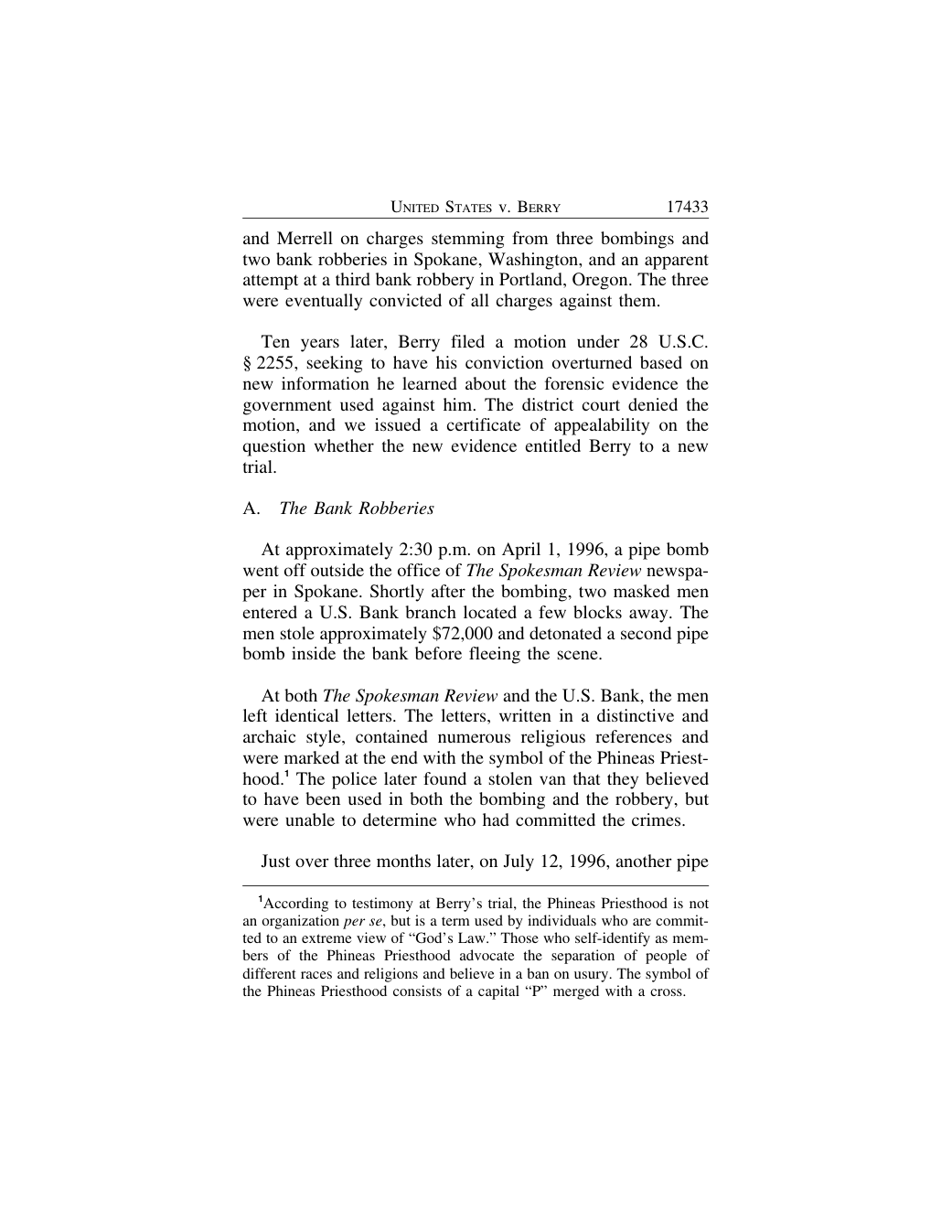
The Berry opinion’s description of the Phineas identity

The 2010 Berry opinion recorded testimony distinguishing a self-adopted Phineas identity from an organization per se. This is a court-document facsimile, not a photograph of the attacks. Image credit ↗

Scope & method / Edition 1.1

A local criminal case and a wider adopted identity.

The file follows the April and July 1996 attacks, investigation, separate prosecutions, forensic challenge and later punishment record. The ideological context explains the name without assuming a nationwide chain of command.

Read the chapters for a narrative; use the record below to test it. Established means the specific proposition is documented. Interpretation marks an inference or a historical argument. Unknown means the record here cannot decide. An archive’s possession of a document does not endorse its contents.

A curated historical court, scientific and reporting record, with the latest judicial development inspected dated May 2024. It is not a complete trial-exhibit, informant, shipping-ledger, recording or current-custody audit. Actual new readings and retained source versions are distinguished in the source ledger. Later scientific limits, legal remedies and personal change answer different questions.

01 / The record

The story, in 6 chapters

The sequence begins with the attacks and messages, follows the competing explanations of the evidence, and ends with the later scientific and legal record.

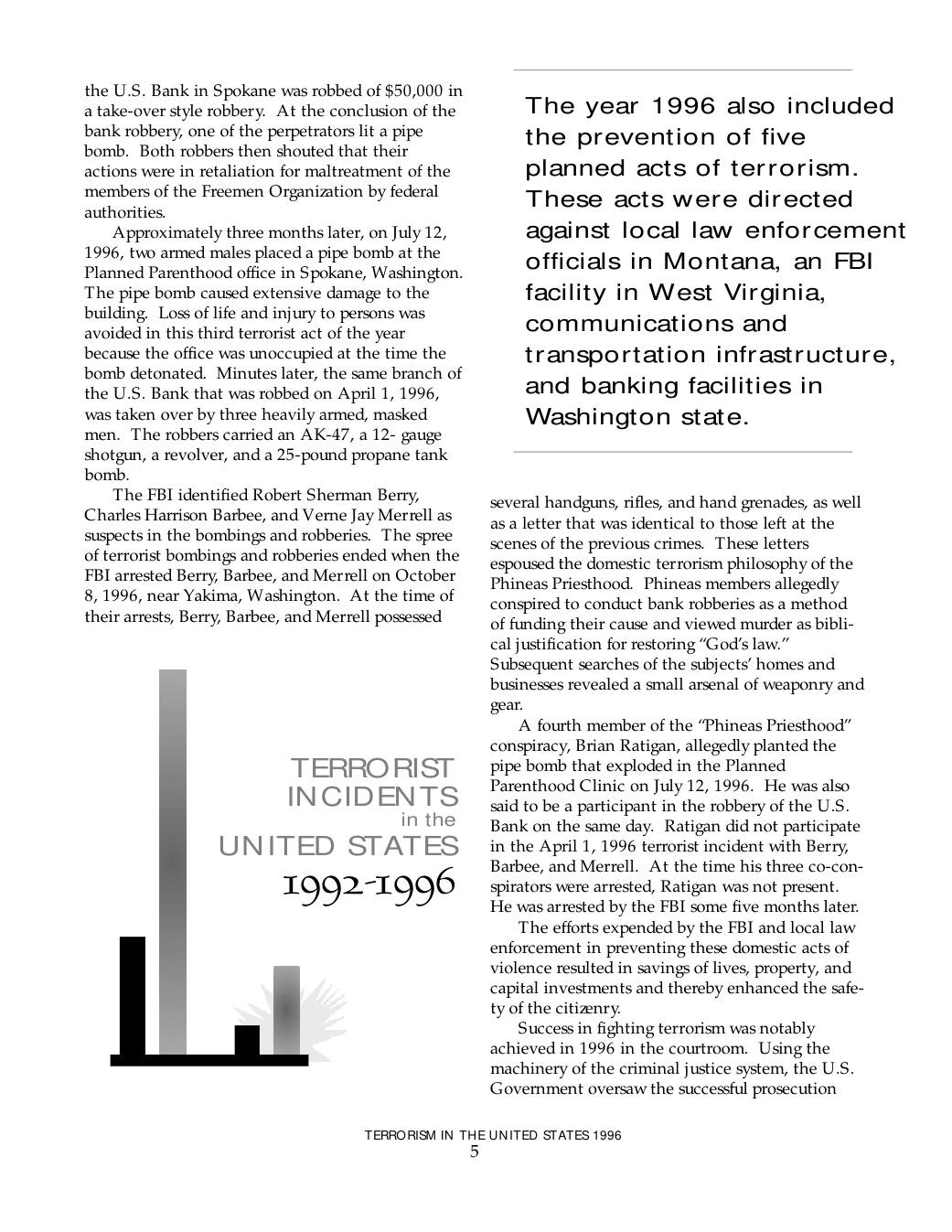
The FBI’s 1996 public account of the Spokane attacks
Contemporaneous agency account; compare its allegations and totals with the later court record. Image credit ↗

Chapter 01 / April–July 1996

Two days in Spokane

On April 1, 1996, an explosion struck the Spokane Valley office of The Spokesman-Review. Shortly afterward, masked men robbed a nearby U.S. Bank branch and left another explosive device inside. The sequence joined publicity, theft and a threat to people carrying out ordinary work. The newspaper was a target in the case as well as the institution whose reporters would cover the investigation and trials.

The scenes also carried a message. Identical letters used religious language and a symbol associated with the Phineas Priesthood. The communications supplied a claim of purpose, but they did not identify every person who had handled the letters or taken part in the attacks. Their later evidentiary importance came from comparisons with other recovered material, rather than from the symbol alone. A name could direct suspicion toward an ideological milieu without establishing a national organization behind the crime.

On July 12, an explosion damaged a Planned Parenthood office, followed by another robbery of the same bank. The FBI's annual account said the clinic was unoccupied when the device detonated. No one was killed in the Spokane campaign, but the absence of a fatality did not make the events harmless. Explosions damaged workplaces, masked robbers confronted employees, and a clinic's ability to provide services was attacked. At the original sentencing, the judge attributed the avoidance of death or serious injury to luck.

The two sequences gave investigators a pattern to compare: locations, vehicles, witness descriptions, recovered communications and physical evidence. They also created the central problem for the later trials. Establishing that attacks occurred was different from establishing who carried them out. The case would turn on the links between a particular set of defendants and those events, while the political and religious language threatened to turn a prosecution of acts into a much wider judgment about belief.

Sources: S01 · S04 · S10

The Berry opinion’s description of the Phineas identity
The footnote describes an adopted identity rather than an organization per se. Image credit ↗

Chapter 02 / 1990s / ideological context

A priesthood without a membership roll

The Phineas name drew on a biblical story in which Phinehas kills an Israelite man and a Midianite woman. In the racial interpretation promoted by Richard Kelly Hoskins's 1990 book Vigilantes of Christendom, such violence became a model for purported defenders of racial purity and divine law. ADL and the Southern Poverty Law Center describe the book as an important source of the modern concept. Their profiles explain the ideology's circulation; they are not evidence that every reader participated in a crime.

The relationship between the name and an organization is unusually important. The Ninth Circuit's 2010 Berry opinion recorded trial testimony describing Phineas Priesthood as a term adopted by individuals, rather than an organization in itself. That is compatible with several people forming a criminal cell. It does not establish a nationwide hierarchy, initiation procedure or chain of command. A portable identity can connect otherwise separate acts through a shared justification without proving that one headquarters directed them.

The Spokane defendants' own language also resists a simple label. During his first trial, Verne Merrell denied the bombings and robberies. Contemporary reporting described him claiming a religious identity and rejecting the Phineas designation because he regarded himself as descended from a different biblical tribe. He nevertheless defended the act in the scriptural story and described interest-taking as a grave offense. His testimony therefore concerned both his position on the crimes and his account of religious authority. Neither can be reduced to a membership card.

Christian Identity supplied a racialized account of biblical ancestry within this milieu. That doctrine is distinct from Christianity generally, and a history of its influence still requires individual evidence. The connection that matters in Spokane is not that a symbol or book existed somewhere on the racist right. It is how scene communications, defendants' statements and recovered records related to the specific attacks. Proof of wider organizational direction would require additional communications, tasking or corroborated participants beyond a repeated name.

Sources: S01 · S08 · S09 · S14

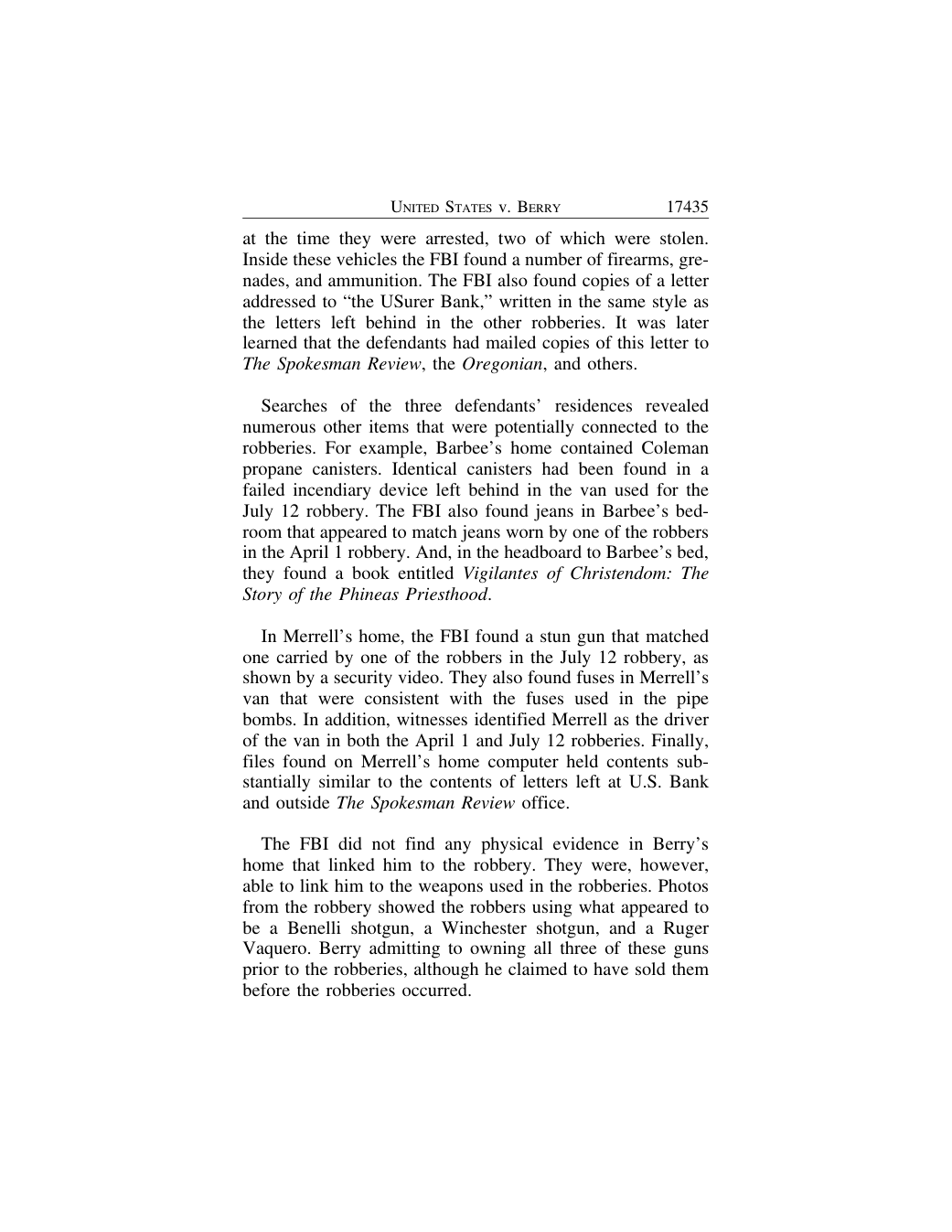
The Berry opinion’s inventory of investigative links
Recovered records, identification comparisons and the limits of home-search evidence are described separately. Image credit ↗

Chapter 03 / July–October 1996

The informant and the corroboration problem

After the second robbery, rewards reached a combined $130,000. Christopher Davidson, who knew Robert Berry, approached investigators with suspicions about Berry, Charles Barbee and Verne Merrell. The incentive belongs in the story: a reward can shape a witness's interests and makes independent corroboration especially important. It does not, on its own, establish that the witness invented an account or that the people he named committed the crimes.

The FBI put the three under surveillance. In October they traveled to a Portland bank that remained closed after authorities alerted its staff. They were later arrested in Union Gap, Washington. The recovered material included weapons, stolen vehicles and copies of communications resembling the earlier scene letters. The prosecution treated the trip as preparation for another robbery. The defendants described a publicity action meant to deliver a religious warning, and said the weapons were equipment they routinely carried. That alternative explanation concerned what the surveillance actually showed as well as its connection to earlier events.

The later appellate account describes a broader set of comparisons. Files on Merrell's computer resembled the scene letters; witnesses and video supplied identification evidence; recovered clothing and objects were compared with items depicted or found during the crimes. These links varied in strength and were defendant-specific. The opinion's statement that no linking physical evidence was found in Berry's home did not mean nothing was recovered elsewhere: material at his auto shop became central to the disputed forensic testimony.

Defense lawyers challenged the investigation's choices. Reporting from the second trial describes objections about photo lineups, other suspects and Davidson's credibility, alongside the FBI's response that alternative leads had been investigated. A convincing frame-up account would have to explain the recovered records and the independent comparisons, not merely Davidson's incentive. A convincing prosecution account likewise had to withstand challenges to identification and inference. The question was whether those separate strands corroborated one another or only appeared to because investigators had already settled on the same suspects.

Sources: S01 · S04 · S06 · S09

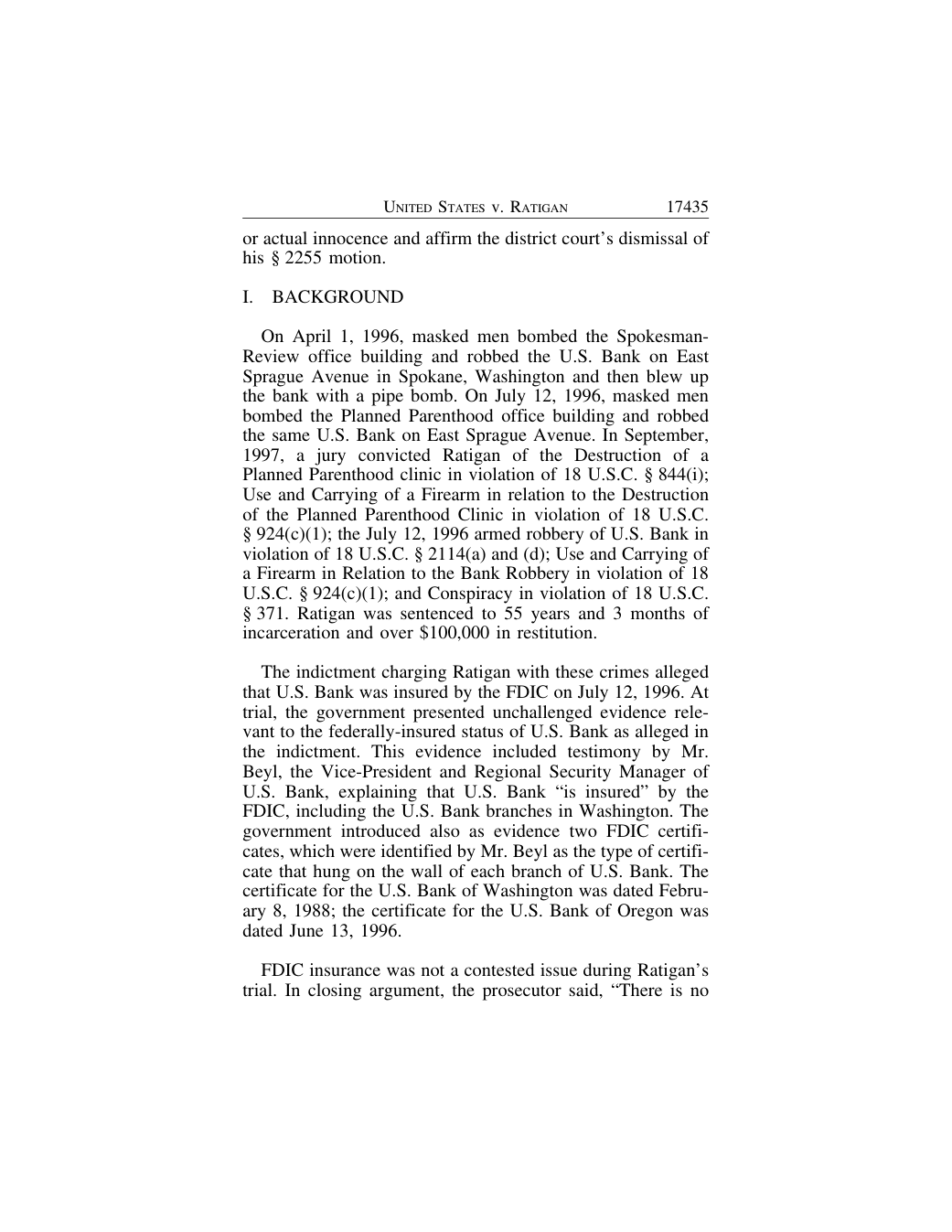
The Ratigan opinion’s separate factual and procedural history
A distinct prosecution concerning the July events; it is not the same judgment as the three-defendant appeal. Image credit ↗

Chapter 04 / 1997–2003

Different defendants, different questions

The first joint trial of Barbee, Berry and Merrell ended with a hung jury on the principal charges. A second trial in 1997 produced convictions. Keeping both events in view avoids treating the prosecution as either an uncontested demonstration from the beginning or a case that never secured verdicts. The disagreement in the first jury was part of the process; it did not determine what the second jury later found.

Brian Ratigan was a separate defendant, tried in connection with the July clinic bombing and bank robbery. His case cannot simply inherit every factual allegation about the other three men's April or October conduct. The 2003 appellate opinion records his September 1997 convictions and a sentence of fifty-five years and three months. Later proceedings changed the punishment record, but the particular claims raised in his earlier appeal are useful for understanding what an appellate decision does and does not decide.

Ratigan argued that the prosecution had not sufficiently proved the bank's federal deposit-insurance status on the robbery date. That was an element of the federal bank-robbery offense. The court distinguished a possible failure of proof on that element from a lack of judicial power to hear a federal prosecution. Because the argument had not been preserved at trial or on direct appeal, procedural default applied. The court said he might have prevailed had he raised the issue on direct appeal, while finding no applicable exception excusing the default.

That outcome was not a finding that the branch lacked insurance, nor a fresh determination of who committed the robbery. It illustrates why a legal challenge must be read at the level of the question actually presented. The same is true of the original life sentences imposed on the three jointly tried defendants. Those judgments established serious criminal consequences in 1997; they cannot be repeated as an unqualified description of later sentences. The history continued through challenges to the evidence, changes in firearm sentencing law and individualized decisions about release.

Sources: S01 · S03 · S05 · S06 · S10

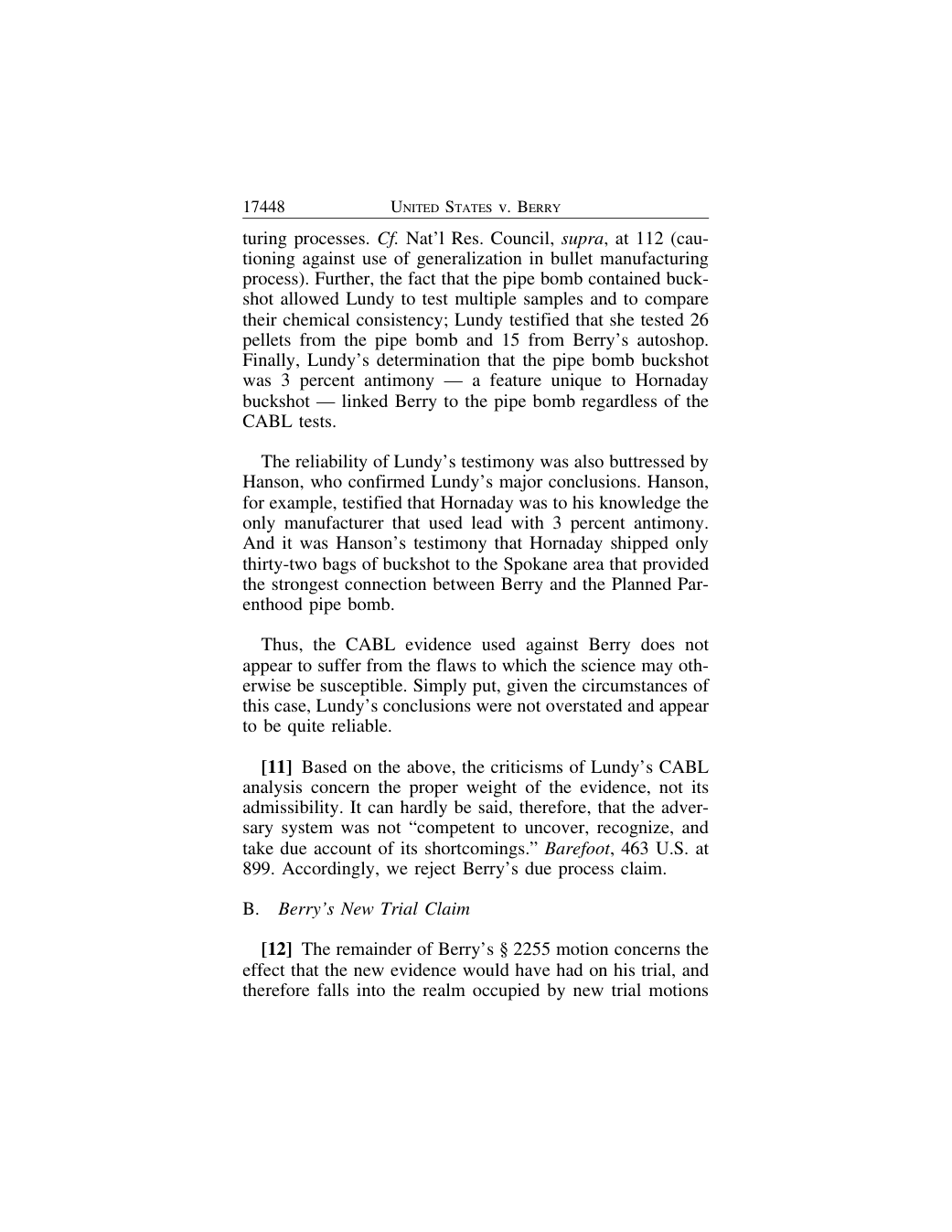
The Berry court’s case-specific reasoning about measurement and source evidence
The court’s own reasoning on the particular testimony and manufacturer/distribution evidence, Berry opinion PDF page 19; not a unique-source identification. Image credit ↗

Chapter 05 / 2004–2010

What changed when the science changed

One disputed link involved the elemental composition of lead recovered from the clinic device and material found at Berry's auto shop. FBI examiner Kathleen Lundy described the samples as chemically indistinguishable. The prosecution also introduced manufacturer testimony about production and regional distribution. Together those strands supported an argument about a narrowed possible source. Chemical similarity alone could not uniquely identify Berry as the owner of the scene material.

The distinction became more consequential after the National Research Council's 2004 review. Its interpretation findings warned against claims that composition identified a particular ammunition box, established a manufacturing date or supplied the probability that material came from a defendant without adequate distribution knowledge. Different lead volumes could sometimes be analytically indistinguishable. In September 2005, the FBI discontinued the examinations, citing uncertainty about the significance of associations alongside costs and probative value. The agency did not announce that every earlier measurement was erroneous.

A second development involved Lundy's false-swearing conviction over testimony in a separate Kentucky case. It raised a real credibility question. It did not establish that she falsified measurements in Berry's case. Berry sought a new trial and challenged the fairness of the earlier proceeding. In 2010, the Ninth Circuit rejected both requests, emphasizing her limited source claim, manufacturer-specific evidence and the independent circumstantial record. It held that the new material would not probably produce an acquittal at a retrial.

The court's decision and the scientific reassessment answer different questions. The decision explains why that collateral challenge did not undo the conviction. The reassessment limits what a chemical match can establish. The source argument therefore remains a chain with several links: reliable measurement, manufacturing history, distribution and a defendant-specific connection. Authenticated corrections to the manufacturing or shipment evidence could change the historical weight of that chain even though the 2010 judgment remains a fact. A later admission of dishonesty elsewhere cannot substitute for showing which particular link failed here.

Sources: S01 · S11 · S12

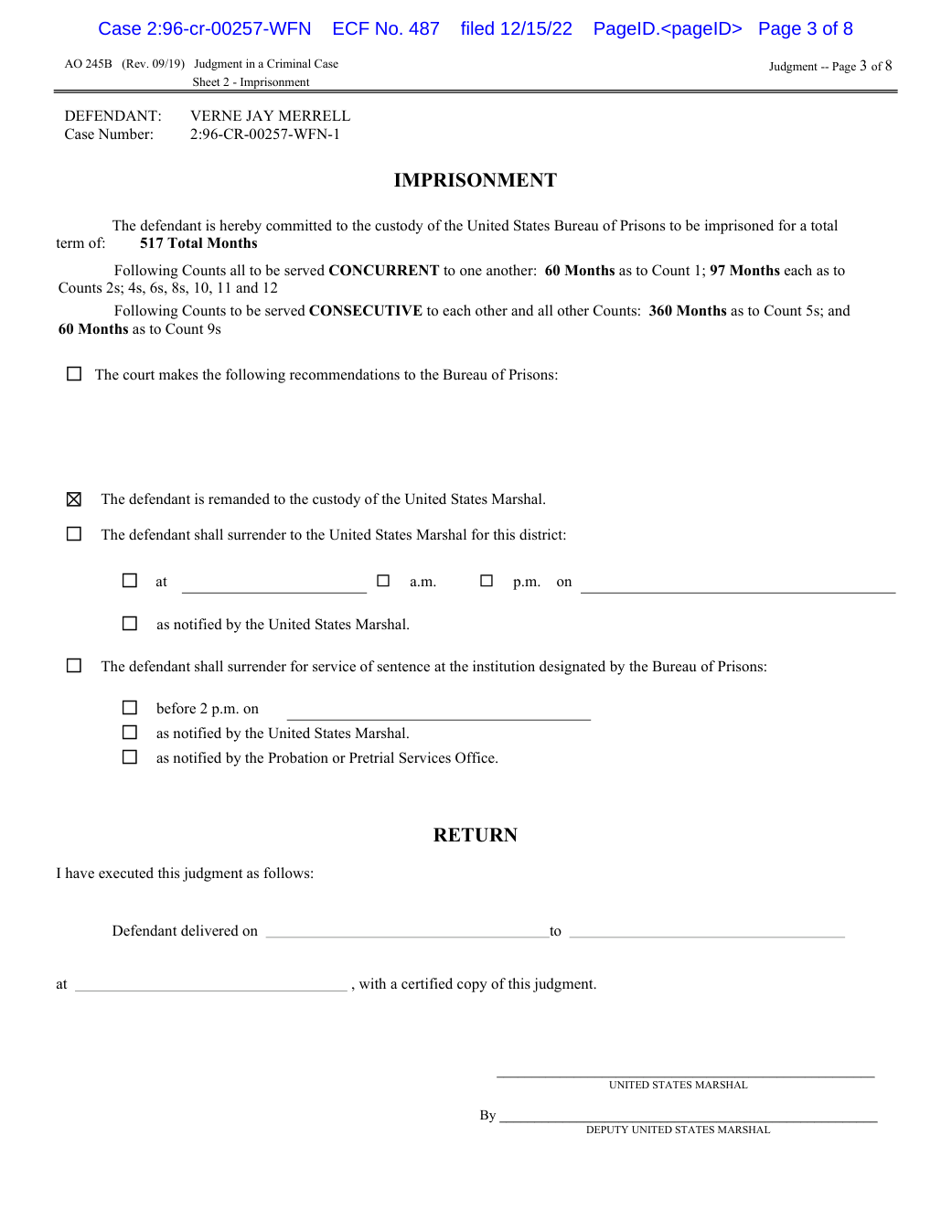
Merrell’s December 2022 imprisonment judgment
The judgment specifies 517 months (43 years and one month). Some contemporary reporting rounded the term to 43 years. Image credit ↗

Chapter 06 / 2019–2024

A changed sentence is part of the history

Later legal changes substantially reduced the original punishment. After the Supreme Court's Davis decision, two firearm counts based on building-arson predicates were vacated. The surviving bank-robbery-related firearm counts remained. This was not a finding that the explosions never occurred or a reversal of every underlying destruction and robbery conviction. The distinction is visible in the later judgments, which continue to list those underlying offenses.

A further dispute concerned the First Step Act's change to the stacking of firearm penalties. In June 2022, the Ninth Circuit majority held that the revised rule applied when defendants were resentenced after their earlier sentences had been vacated. Judge Danny Boggs dissented on the statute's retroactive application. The disagreement concerned punishment and finality, not competing findings about the identity of the robbers. A separately filed memorandum rejected the defendants' other challenges to the surviving firearm convictions.

The district court then imposed new terms. Merrell's December 2022 judgment specifies 517 months: forty-three years and one month. Barbee's specifies 480 months, or forty years. The exact documents are more precise than reporting that rounded Merrell's term to forty-three years. Dated reporting also describes Berry's compassionate release and Ratigan's earlier release after resentencing. Those reports do not establish anyone's present custody or supervision status in October 2026.

Barbee's later record adds another change that a history frozen in 1997 would miss. A May 2024 order acknowledged his renunciation of his wrongful actions, extraordinary rehabilitation and favorable prison-work testimony, while denying compassionate release because the legal requirements were not satisfied. Rehabilitation did not erase the crimes; it changed the account of the person seeking relief. The surviving record thus contains convictions, revised science, statutory relief and a court's recognition of personal change. None needs to be suppressed to make the others intelligible. Each supplies a different answer to what happened, how it was proved, and what consequences followed.

Sources: S02 · S07 · S15 · S16 · S17 · S18

02 / The record

The critical path

Attacks and communications → adopted identity distinguished from command → incentivized lead and corroboration → separate trials/rulings → scientific and case-specific inference → changed punishment and personal record.

Evidence support assesses each precise hinge. Cultural prominence remains unmeasured; observations of recurrence are limited to inspected accounts, with no invented polls or audience rankings.

P1

The attacks and the communications

Official-record yardstick

The April and July sequences link bombings, bank robberies and religious messages. Scene material documents a claim of purpose. Identity depends on connecting that material to people through independent records, witnesses and physical comparisons.

The April and July sequences link bombings, bank robberies and religious messages. Scene material documents a claim of purpose. Identity depends on connecting that material to people through independent records, witnesses and physical comparisons.

Why it is critical

If the scene communications are treated as a membership list, an ideological association becomes an identification without the missing evidentiary work. Conversely, a disputed identification does not make the independently documented attacks disappear.

If this step is removed

Without the attack sequences and actual scene communications, the narrative loses the acts to be attributed. Remove the repeated symbol alone and the physical/witness chain still requires evaluation; an ideological label was never sufficient identification.

Dependencies

The dated scene record, provenance of the letters and recovered objects, and a distinction between an event and its attributed author.

What rival readings must explain

The coordinated-cell account must establish those links rather than assume them. A frame-up account must identify which material was planted, misattributed or differently explained and how that affects the chain.

Gaps and disputes

No complete scene or trial-exhibit re-audit. Contemporaneous FBI and later court accounts give different first-robbery amounts; this guide does not silently reconcile them.

Evidence support: High for events and documented communications

The particular hinge in the inspected historical documents, not an all-purpose rating of every witness or source.

Actual court background and contemporary institutional report establish the sequences; attribution requires later links.

Cultural prominence: Unmeasured

General audience familiarity and relative cultural prominence are unmeasured. The observations below concern only inspected texts.

The attacks and name recur in the court, institutional and local reporting inspected; this is recurrence, not a population rank.

Sources: S01 · S04

P2

A portable identity is not a national command

Official-record yardstick

The Berry opinion records testimony that Phineas Priesthood was a term adopted by individuals rather than an organization per se. The Hoskins book and later advocacy profiles explain an ideological reference that could travel independently of a formal institution.

The Berry opinion records testimony that Phineas Priesthood was a term adopted by individuals rather than an organization per se. The Hoskins book and later advocacy profiles explain an ideological reference that could travel independently of a formal institution.

Why it is critical

A small cell and a wider shared identity are compatible. Conflating them creates a nationwide organization chart that the Spokane prosecution did not establish, and risks assigning crimes through association alone.

If this step is removed

Remove the adopted-identity distinction and the account risks turning a local prosecution into proof of a national hierarchy. Remove the book reference and the particular criminal evidence still exists, while the documented context becomes narrower.

Dependencies

P1 establishes the communications. This step additionally depends on attributed testimony, the provenance of ideological claims and actual evidence of coordination beyond this case.

What rival readings must explain

A national-control theory must produce communications, tasking or corroborated participants. A decentralized account must still explain the specific cooperation among the prosecuted defendants; an adopted identity is not evidence that no cell existed.

Gaps and disputes

The Hoskins book is discussed through actual reference profiles and the judicial record of its recovery; the full book has not been read for this revision. No complete nationwide communication or command archive is claimed.

Evidence support: High for the recorded testimony; bounded for broader ideological transmission

The particular hinge in the inspected historical documents, not an all-purpose rating of every witness or source.

The court explicitly records adopted-identity testimony; reference profiles attribute the modern concept to Hoskins. Neither proves national command.

Cultural prominence: Unmeasured

General audience familiarity and relative cultural prominence are unmeasured. The observations below concern only inspected texts.

The organization-versus-identity distinction appears in the opinion and reference profiles inspected; audience recognition is unknown.

Sources: S01 · S08 · S09 · S14

P3

An incentivized informant and separate corroboration

Official-record yardstick

Davidson approached investigators after rewards reached $130,000. Surveillance, vehicle searches, computer files, witness comparisons and recovered material supplied additional strands. Their significance varied among defendants; evidence absent from Berry’s home was not evidence absent from his shop.

Davidson approached investigators after rewards reached $130,000. Surveillance, vehicle searches, computer files, witness comparisons and recovered material supplied additional strands. Their significance varied among defendants; evidence absent from Berry’s home was not evidence absent from his shop.

Why it is critical

The incentive is a credibility issue, not a complete account of the case. If the remaining strands are unreliable or circular, the prosecution is weaker; if they genuinely corroborate one another, discrediting the informant alone does not resolve them.

If this step is removed

Without Davidson’s lead, the established route into surveillance changes. Without independent comparisons, an incentivized accusation carries much less weight. The complete investigative file would be needed to establish that no other route could have worked.

Dependencies

P1’s scene material must be compared with independently documented searches and observations. The appellate narration is not a replacement for every underlying exhibit or interview.

What rival readings must explain

The media-stunt explanation accepts participation in the Portland trip while disputing its purpose and relationship to the earlier crimes. It must explain the recovered records and earlier comparisons. The prosecution must withstand challenges to identification and chain of custody.

Gaps and disputes

Original surveillance recordings, all identification interviews and every search exhibit were not independently acquired. Neither an official assurance nor an informant incentive resolves those absent materials.

Evidence support: High for the documented evidence chain; qualified for marginal contribution

The particular hinge in the inspected historical documents, not an all-purpose rating of every witness or source.

Judicial background and contemporaneous defense reporting identify the lead, incentive, surveillance and particular comparisons, while leaving trial-level details unaudited.

Cultural prominence: Unmeasured

General audience familiarity and relative cultural prominence are unmeasured. The observations below concern only inspected texts.

The informant and trip appear in the opinion and contemporary defense reporting; comparative public familiarity is not measured.

Sources: S01 · S04 · S06 · S09

P4

Trials and appeals have defendant-specific scope

Official-record yardstick

The initial joint trial did not produce a unanimous verdict on the principal charges; the later joint trial produced convictions. Ratigan’s separate prosecution concerned the July events. His 2003 appeal addressed an unpreserved FDIC-insurance proof argument and procedural default.

The initial joint trial did not produce a unanimous verdict on the principal charges; the later joint trial produced convictions. Ratigan’s separate prosecution concerned the July events. His 2003 appeal addressed an unpreserved FDIC-insurance proof argument and procedural default.

Why it is critical

A verdict in one case does not adjudicate every person or every allegation in a wider milieu. A procedural loss also cannot be paraphrased as a fresh finding that every factual inference was correct.

If this step is removed

Remove the second-trial verdicts and the legal attribution changes. Remove Ratigan’s procedural default and his FDIC proof issue could be reached differently; that alone does not establish the branch was uninsured or someone else committed the robbery.

Dependencies

P3 supplies the identification dispute. This step depends on the actual counts, trial outcomes, appeal issues and standards of review for each defendant.

What rival readings must explain

An account challenging the prosecutions must identify which judgment or evidence it disputes. An institutional-success account must retain the hung jury, specific defense objections and the difference between procedural and factual rulings.

Gaps and disputes

A curated appellate and sentencing record, not every trial transcript. Ratigan’s 2003 procedural ruling and the 2010 Berry merits ruling have different scopes.

Evidence support: High for precise outcomes and procedural scope

The particular hinge in the inspected historical documents, not an all-purpose rating of every witness or source.

Actual separate appellate records and historical judgments establish what was decided, including the difference between procedural default and a factual finding.

Cultural prominence: Unmeasured

General audience familiarity and relative cultural prominence are unmeasured. The observations below concern only inspected texts.

News coverage and judicial records emphasize different legal questions; their relative reach is unknown.

Sources: S01 · S03 · S05 · S06 · S10

P5

The chemical association and the manufacturing argument

Official-record yardstick

The forensic evidence joined chemical consistency with testimony about a particular manufacturing batch and regional distribution. The NRC later limited source inferences and the FBI discontinued the examinations. The 2010 court nevertheless rejected Berry’s due-process and new-trial challenges, relying on the specific testimony and other evidence.

The forensic evidence joined chemical consistency with testimony about a particular manufacturing batch and regional distribution. The NRC later limited source inferences and the FBI discontinued the examinations. The 2010 court nevertheless rejected Berry’s due-process and new-trial challenges, relying on the specific testimony and other evidence.

Why it is critical

Chemistry does not uniquely identify the owner of material. The case-specific manufacturing and distribution evidence carries a separate burden; a general defense of laboratory measurement cannot establish that ownership link.

If this step is removed

Without manufacturing and distribution testimony, chemical consistency loses a central part of this case-specific source argument. Removing CABL alone does not decide the whole case: the 2010 court also relied on independent circumstantial evidence.

Dependencies

P3’s recovered material and P4’s trial record; exact expert testimony, manufacturer evidence and an honest account of the later scientific reassessment.

What rival readings must explain

A forensic-overstatement critique must identify the particular inference affected, rather than equate discontinuation with fabricated measurements. The prosecution’s historical account must explain the source limits and cannot treat the appellate result as an unlimited scientific endorsement.

Gaps and disputes

Original manufacturer/shipment ledger and an independent sample reanalysis are not available. NRC scientific limits are read from the retained actual chapter; fresh web-reader request timed out, but an ordinary raw 200 version matches the retained chapter text. Berry’s late Brady claim was outside the certificate of appealability and not decided.

Evidence support: High for the recorded scientific/legal disagreement; qualified for independent source attribution

The particular hinge in the inspected historical documents, not an all-purpose rating of every witness or source.

NRC chapter and FBI statement establish the reassessment; actual 2010 opinion evaluates specific testimony/manufacturer evidence and denies relief. No original shipping-ledger reanalysis.

Cultural prominence: Unmeasured

General audience familiarity and relative cultural prominence are unmeasured. The observations below concern only inspected texts.

The scientific controversy recurs in NRC/FBI/court texts. No survey establishes its prominence relative to the attack narrative.

Sources: S01 · S11 · S12

P6

Punishment changed without a factual-innocence ruling

Official-record yardstick

The later firearm-count vacatur and First Step Act resentencing changed the punishment. Original 2022 judgments specify 480 months for Barbee and 517 months for Merrell. A 2024 order acknowledged Barbee’s extraordinary rehabilitation and renunciation of wrongful actions while denying compassionate release.

The later firearm-count vacatur and First Step Act resentencing changed the punishment. Original 2022 judgments specify 480 months for Barbee and 517 months for Merrell. A 2024 order acknowledged Barbee’s extraordinary rehabilitation and renunciation of wrongful actions while denying compassionate release.

Why it is critical

Original life terms are not an accurate unqualified account of later sentences. Nor does statutory sentencing relief establish that the underlying attacks never occurred. Later evidence of personal change belongs in the same history.

If this step is removed

Without the partial firearm-count vacatur, the route to resentencing differs. Remove the majority’s First Step Act interpretation and its remand changes, but neither reading of the statute establishes factual innocence. Without rehabilitation evidence, an important later personal finding disappears.

Dependencies

P4’s separate judgments and the surviving counts. The 2022 published opinion and concurrent memorandum must be read together; exact district-court terms supersede rounded reporting.

What rival readings must explain

An innocence interpretation needs a factual basis beyond changes in sentencing law. An account focused on punishment must not erase rehabilitation or use dated release reports to assert present custody. A later authenticated judgment or merits reversal could change the recorded outcome.

Gaps and disputes

No current custody or supervision verification, no claim that all later proceedings were exhausted. The 2022 and 2024 records are dated historical rulings; the complete state of present sentencing law is outside this guide.

Evidence support: High for the dated judgments and disagreement

The particular hinge in the inspected historical documents, not an all-purpose rating of every witness or source.

Actual majority/dissent, concurrent memorandum, district judgments and 2024 order establish separate statutory, sentencing and rehabilitation findings.

Cultural prominence: Unmeasured

General audience familiarity and relative cultural prominence are unmeasured. The observations below concern only inspected texts.

Later local reporting and actual court records update punishment and personal change; public awareness of those changes is unmeasured.

Sources: S02 · S07 · S15 · S16 · S17 · S18

03 / The record

How the accounts developed

Named books actually documented, evidentiary transmission and direct judicial/scientific citations establish the lineages. Parallel retellings are separated from proved borrowing; complete unread books and films are not assigned omissions.

1990–1997 / later profiles

A book supplies a name that travels without a membership roll

Reference profiles identify Hoskins’s 1990 book as a modern source of the concept; the court records recovery of that title from Barbee’s home.

Lineage

Biblical episode as interpreted in Hoskins’s book → ideological circulation described by profiles → named book recovered and scene symbols litigated in Spokane.

Borrowing or relationship

Recovery of the actual title is evidence of access, not proof every passage was read or an order was given. The complete book is not assigned omissions or an invented adaptation history.

Evidence for the connection

Actual retained ADL/SPLCprofiles plus BerryPDF 6identify the book; PDF 4 records testimony that the name is adopted by individuals. No national command link follows.

Recurring path nodes

P1P2P3

Branches in this record

Scene messages become competing trial narratives · Scientific reassessment enters a particular collateral appeal

Sources: S01 · S08 · S14

1996–1997 /2010

Scene messages become competing trial narratives

The defendants’ Portland explanation acknowledged a publicity action while denying authorship of the earlier crimes.

Lineage

Scene communications → recovered letters/computer comparisons → prosecution and defense accounts →2010 judicial summary.

Borrowing or relationship

The court explicitly recounts those testimony/record links. Contemporary reporting independently preserves specific defense objections, but is not a complete transcript or proof of their truth.

Evidence for the connection

Actual opinion and retained courtroom report identify the correspondence, reward and alternative explanation; no assertion that all later retellings independently verify each exhibit.

Recurring path nodes

P1P3P4

Branches in this record

Scientific reassessment enters a particular collateral appeal · Rehabilitation changes the personal account without erasing judgment

Sources: S01 · S06 · S09

2004–2010

Scientific reassessment enters a particular collateral appeal

The FBI commissioned the NRC review, later ended examinations, and Berry invoked both the scientific changes and separate witness misconduct.

Lineage

NRC assessment → FBI 2005 announcement → Berry 2007 motion →2010 opinion’s citation and legal assessment.

Borrowing or relationship

The opinion quotes/cites the scientific report and identifies the announcement; those direct citations demonstrate documentary transmission. Quoted private source text is not automatically federal employee work.

Evidence for the connection

Actual retained NRC chapter/FBI announcement and original opinion establish the connection. The court’s own reasoning is selected publicly; the prior long quotation image remains private.

Recurring path nodes

P3P5

Branches in this record

A changed firearm rule opens a separate punishment branch · Rehabilitation changes the personal account without erasing judgment

Sources: S01 · S11 · S12

2019–2022

A changed firearm rule opens a separate punishment branch

The published opinion recounts partial Davis relief; the majority and Boggs then dispute application of the First Step Act.

Lineage

Davis-based predicate vacatur → new sentencing →2022 majority/dissent and concurrent memorandum → exact December judgments.

Borrowing or relationship

The opinions cite the controlling decisions and distinguish their remedies. District judgments implement the remand; they are not a new jury verdict of factual innocence.

Evidence for the connection

Actual opinion, memorandum and original517/480 month judgments establish the sequence. A court’s nonsubstantive summary is not treated as its holding.

Recurring path nodes

P4P6

Branches in this record

Rehabilitation changes the personal account without erasing judgment

Sources: S02 · S15 · S16 · S17

2022–2024

Rehabilitation changes the personal account without erasing judgment

The 2024 order recounts Barbee’s renunciation, prison work and prior sentencing before denying release.

Lineage

Later defendant/prison-worker evidence → resentencing record →2024 court’s rehabilitation finding and statutory denial.

Borrowing or relationship

The order identifies prior hearing passages and judgments. Local reporting and judicial findings have different evidentiary roles; the same subject does not prove literary borrowing.

Evidence for the connection

Actual retained and freshly read primary order identifies the cited evidence and legal limit. No complete prison file, hearing playback or present custody inference.

Recurring path nodes

P3P4P6

Sources: S07 · S16 · S18

04 / The record

Rival readings on the same path

The strongest versions, the steps they accept or revise, and the evidence they would need.

Interpretation 01

A coordinated Spokane cell

Best supported account of the prosecuted events

The strongest version

A small group combined shared commitments with practical cooperation. Scene communications, recovered records, identification evidence and physical comparisons corroborated a coordinated campaign, rather than simply identifying unpopular beliefs.

Accepts

The attacks and adopted symbolism in P1/P2; the corroboration chain in P3 and defendant-specific verdicts in P4.

Must still explain

The evidence cannot be pooled indiscriminately across defendants. The account must explain the initial jury disagreement, witness incentives, identification objections and the later forensic limits in P5.

Assessment

The convictions and appellate records strongly support this account within the case. Authenticated exhibit errors, credible corroborated recantations, planted evidence or a merits reversal could change particular findings. The appellate narration is not an independent re-examination of every trial exhibit.

Accept these path nodes

Remove or revise this inference

  • Remove pooled guilt across defendants or an assumption that every evidentiary strand has equal strength.

Add this evidence

  • Actual defendant-specific exhibits and corroboration; explanations for both jury disagreement and the later verdicts.

What would change this assessment

Authenticated exhibit errors, independently corroborated recantations, proof of planted evidence or a merits reversal could change particular attributions; mere ideological association cannot fill a missing evidentiary link.

Sources: S01 · S03 · S04 · S06 · S16 · S17

Interpretation 02

The defendants’ frame-up and media-stunt account

A documented defense; not established as the explanation

The strongest version

The informant had a substantial reward incentive, investigators may have interpreted ambiguous objects through an early theory, and the Portland trip could have been a religious publicity action rather than preparation for another robbery.

Accepts

The attacks occurred; the three men participated in the Portland trip and possessed the recovered material. It disputes the authorship and criminal interpretation of that material and the link to earlier events.

Must still explain

It must account for the computer/letter comparisons, witnesses and video, recovered vehicles and objects, and case-specific forensic/manufacturer evidence. Barbee’s later renunciation of wrongful conduct adds a dated development concerning him, without deciding every other defendant’s position.

Assessment

Contemporary defense reporting preserves specific objections; the 2010 court rejected the new-trial challenge. Corroborated evidence of planting, authenticated communications identifying another perpetrator or reliable records undermining the independent links would strengthen this account. A reward or a denial alone does not establish it.

Accept these path nodes

Remove or revise this inference

  • Remove the inference from possession and surveillance to criminal purpose wherever an alternative is independently supported.

Add this evidence

  • Authenticated evidence of planting, misidentification or a different author, tied to a particular item and event.

What would change this assessment

Verified records showing planting or misattribution, credible corroborated testimony placing another actor at a particular crime, or original identification evidence undermining an independent strand would strengthen this account.

Sources: S01 · S06 · S09 · S10 · S18

Interpretation 03

The forensic association was given too much weight

A serious, bounded criticism

The strongest version

Chemical consistency can sound more identifying than it is. Later scientific criticism and a witness’s misconduct in another case gave Berry a concrete basis to question the apparent strength of a forensic link.

Accepts

P1’s events and the existence of the laboratory tests; disputes the strength of the ownership inference in P5 rather than requiring every measurement to have been fabricated.

Must still explain

It must address manufacturer and shipment testimony and the independent evidence, while distinguishing Lundy’s separate false statement from what she actually said in this trial. The 2010 decision treated the particular evidence favorably.

Assessment

The scientific reassessment supports caution about source specificity. Authenticated manufacturer records contradicting the stated batch or distribution, independent reanalysis, or proof of an error affecting the actual samples would materially alter the case-specific assessment. Neither blanket acceptance nor blanket dismissal follows from discontinuation alone.

Accept these path nodes

Remove or revise this inference

  • Remove unique personal identification from chemical consistency alone.

Add this evidence

  • Reliable actual manufacturing/distribution records, sample reanalysis and exact testimony identifying the disputed inference.

What would change this assessment

Authenticated manufacturer/shipment records contradicting the stated batch/distribution, independent reanalysis of actual samples, or case-specific proof of false testimony would alter the inference. General discontinuation alone is insufficient.

Sources: S01 · S11 · S12

Interpretation 04

A nationwide organization directed the attacks

Not established by this case record

The strongest version

Shared symbols, texts and contacts across the racist right can suggest more than isolated adoption. A covert hierarchy could conceal formal membership while directing or encouraging separate cells.

Accepts

P1’s messages and P2’s ideological circulation; it treats the local cooperation in P3 as potentially part of a larger structure.

Must still explain

The national command itself needs proof. The testimony summarized in Berry describes an adopted identity, and the local verdicts do not establish who directed unrelated actors elsewhere.

Assessment

Authenticated tasking, financial transfers, internal communications or corroborated participants linking a wider leadership to these specific actions could support a narrower or broader command claim. Similar beliefs or the same label are starting points for inquiry, not that missing chain. A portable identity remains compatible with a locally coordinated criminal cell.

Accept these path nodes

Remove or revise this inference

  • Remove the assumption that repeated symbols prove a nationwide command hierarchy.

Add this evidence

  • Documented orders, financing and participant communication connecting wider leadership to these crimes.

What would change this assessment

Authenticated tasking, financing, internal communications or corroborated participants tying a wider leadership to these particular acts would support national direction; a shared label does not.

Sources: S01 · S08 · S14

Interpretation 05

Boggs’s statutory reading would deny the First Step Act benefit

Actual judicial dissent; majority remand controlled

The strongest version

The statute asks whether a sentence had been imposed by21 December 2018. Boggs read that as a historical fact not erased by a later vacatur, and emphasized Congress’s choice about retroactivity.

Accepts

The original sentences, later vacatur and the statutory amendment at P6; the underlying convictions are not the object of this disagreement.

Must still explain

The majority treats a vacated sentence as legally null and applies the changed rule to the new sentencing. The actual judgment vacated and remanded; the dissent did not become the outcome.

Assessment

A documented dispute over statutory meaning and sentence finality, not a factual-innocence account. The 2022 judgments implement the majority’s rule.

Accept these path nodes

Remove or revise this inference

  • Remove the inference that later vacatur erases the historical fact of a pre-enactment sentence, under the dissent’s reading.

Add this evidence

  • A controlling legal basis for applying the amended rule despite the earlier imposition; the majority supplies its contrary analysis.

What would change this assessment

A controlling later judicial disposition or authenticated record changing the relevant sentencing/vacatur sequence would alter the legal history. An evaluation of today’s full body of sentencing law would require a separately current legal review.

Sources: S02 · S15 · S16 · S17
05 / The record

What public accounts emphasize

Cards compare actual inspected testimony reporting, scientific chapter, institutional statement and majority/dissent/order passages. Reading scopes are explicit; no complete trial, book, film or recording audit is implied.

Merrell’s reported testimony: a religious publicity action

Actual retained and fresh raw 200 version of Craig Welch’s 26 March 1997 court report read; fresh web-reader request 403. No complete trial transcript or recording.

Amplifies

Denial of the earlier attacks, religious self-description and a Portland media-stunt explanation; the report also records cross-examination and other defense evidence.

Recasts or leaves unresolved

Disputes the criminal purpose attributed to the Portland trip. The judicial record places that explanation against recovered records and comparisons.

Scope and limits

A report of what he said is not confirmation of each claim. His position is distinct from another defendant’s later renunciation.

P2P3P4

Sources: S01 · S09 · S18

The NRC’s 2004 interpretation chapter: the source inference has limits

Actual chapter 4 Interpretation, selected manufacturing/distribution and concluding source-inference passages, reread from retained and matching fresh raw 200 text; web-reader request timed out. Not an independently repeated laboratory test.

Amplifies

Distinctions between chemical similarity, manufacturing/distribution information and a defendant-specific source claim.

Recasts or leaves unresolved

Rejects unsupported particular-box or production-date conclusions from composition alone; this narrows the meaning of a match.

Scope and limits

The complete private book is not reproduced. The 2010 court evaluated a more particular record and denied Berry relief.

P3P5

Sources: S01 · S12

The FBI’s 2005 announcement: stop a test without denying every measurement

Actual retained original1 September 2005 announcement as saved reader text; no new full laboratory-file audit.

Amplifies

Institutional decision to discontinue examinations, uncertain significance of associations, costs and probative value.

Recasts or leaves unresolved

Separates underlying analytical capability from the value of the inference in court; not an admission that every historical measurement was false.

Scope and limits

An agency statement is checked against the scientific review and actual legal record, not treated as deciding proof about its own prior work.

P3P5

Sources: S01 · S11 · S12

Tashima’s 2010 opinion: the exact testimony and other evidence matter

Original 2010 opinion’s factual account, due-process/new-trial reasoning, limited late Brady footnote and disposition.

Amplifies

Manufacturer/distribution evidence, limited expert claims and independent corroboration; government waiver allowed merits treatment of the otherwise late new-trial claim.

Recasts or leaves unresolved

Finds the new material insufficient for relief rather than treating scientific reassessment as an automatic new trial.

Scope and limits

An affirmance does not make compositional evidence uniquely identifying or adjudicate the late allegation outside the certificate of appealability.

P3P4P5

Sources: S01 · S12

Boggs’s 2022 dissent: the historical sentence was imposed

Actual published opinion’s dissent, PDF 15–19, compared with the majority and separate memorandum.

Amplifies

The statutory enactment date, indefinite article and Congress’s choice about retroactivity and finality.

Recasts or leaves unresolved

Rejects the majority’s use of vacatur to treat the prior sentence as a legal nullity for the amendment’s applicability.

Scope and limits

The dissent did not control; both sides address punishment rather than factual innocence. This card is a historical reading, not a current-law advisory.

P4P6

Sources: S02 · S15

Nielsen’s 2024 order: rehabilitation and legal eligibility differ

Actual3 May 2024 order’s rehabilitation, prior hearings and reasons denying release, retained original reader and freshly checked reproduction.

Amplifies

Renunciation, exemplary work and favorable former BOP manager testimony as evidence of change.

Recasts or leaves unresolved

Acknowledges complete rehabilitation while finding no combination of qualifying reasons for compassionate release in that motion.

Scope and limits

A dated court assessment, not an erasure of conviction or a current custody check. The complete hearing/prison record was not independently audited.

P4P6

Sources: S16 · S18

06 / The record

Find a thread in the file

Search the chapter and claim index. Every result leads to the full text and its sources.

Chapter 01Two days in SpokaneChapter 02A priesthood without a membership rollChapter 03The informant and the corroboration problemChapter 04Different defendants, different questionsChapter 05What changed when the science changedChapter 06A changed sentence is part of the historyCritical pathThe attacks and the communicationsCritical pathA portable identity is not a national commandCritical pathAn incentivized informant and separate corroborationCritical pathTrials and appeals have defendant-specific scopeCritical pathThe chemical association and the manufacturing argumentCritical pathPunishment changed without a factual-innocence rulingGenealogyA book supplies a name that travels without a membership rollGenealogyScene messages become competing trial narrativesGenealogyScientific reassessment enters a particular collateral appealGenealogyA changed firearm rule opens a separate punishment branchGenealogyRehabilitation changes the personal account without erasing judgmentRival accountA coordinated Spokane cellRival accountThe defendants’ frame-up and media-stunt accountRival accountThe forensic association was given too much weightRival accountA nationwide organization directed the attacksRival accountBoggs’s statutory reading would deny the First Step Act benefitNarratorMerrell’s reported testimony: a religious publicity actionNarratorThe NRC’s 2004 interpretation chapter: the source inference has limitsNarratorThe FBI’s 2005 announcement: stop a test without denying every measurementNarratorTashima’s 2010 opinion: the exact testimony and other evidence matterNarratorBoggs’s 2022 dissent: the historical sentence was imposedNarratorNielsen’s 2024 order: rehabilitation and legal eligibility differTimelineHoskins’s book supplies an ideological referenceTimelineNewspaper bombing and first bank robberyTimelineClinic bombing and second bank robberyTimelineThe Portland bank trip is watchedTimelineThree defendants arrested near YakimaTimelineRatigan’s later arrestTimelineMerrell’s testimony and denial are reportedTimelineDefense challenges during the second joint trialTimelineRatigan convicted in his separate caseTimelineMerrell’s original life termsTimelineBarbee and Berry receive original life termsTimelineRatigan’s original sentenceTimelineRatigan’s procedural appeal is rejectedTimelineScientific review limits source inferencesTimelineFBI discontinues bullet-lead examinationsTimelineBerry seeks post-conviction reliefTimelineBerry’s due-process and new-trial challenges failTimelineFirst Step Act resentencing orderedTimelineMerrell’s new sentence imposedTimelineBarbee’s new sentence imposedTimelineRehabilitation recognized; release request deniedClaimThe April and July Spokane attacks occurred.ClaimThe Phineas label establishes a nationwide command organization.ClaimDavidson framed the three jointly tried defendants.ClaimThe Portland trip was intended only as publicity.ClaimChemical consistency uniquely identified material from Berry’s particular bags.ClaimLundy later made a false sworn statement in another case.ClaimThe FBI discontinued bullet-lead examinations in 2005.ClaimThe 2010 court denied Berry a new trial.ClaimRatigan’s FDIC-insurance proof argument deprived the court of jurisdiction.ClaimThe later arson-predicate firearm counts were vacated.ClaimMerrell’s December 2022 judgment specifies 517 months.ClaimA May 2024 order acknowledged Barbee’s extraordinary rehabilitation.

07 / The record

People and institutions

Open a record for the person’s role and supporting sources. Names identify people; no unverified portrait is substituted for a participant.

MerrellBiographical record
Verne Jay MerrellDefendant in the joint prosecution

Merrell denied the attacks and described his religious authority at trial. The record includes computer/letter and witness comparisons. His December 2022 judgment specifies 517 months. His testimony, the prosecution evidence and later legal outcome are distinct parts of the file.

Sources: S01 · S09 · S17

BarbeeBiographical record
Charles Harrison BarbeeDefendant; later rehabilitation ruling

Convicted in the joint case and sentenced anew to 480 months in December 2022. A May 2024 order recognized extraordinary rehabilitation and renunciation of wrongful actions while denying compassionate release. His 1997 courtroom self-description and the 2024 court finding of rehabilitation document different moments in the record.

Sources: S01 · S10 · S16 · S18

BerryBiographical record
Robert Sherman BerryDefendant and forensic-evidence appellant

Berry’s 2010 appeal challenged the trial use of bullet-lead analysis and sought a new trial. The court rejected those requests. Later reporting describes compassionate release for a serious medical condition; that dated report does not establish his present status.

Sources: S01 · S02 · S07

RatiganBiographical record
Brian Edward RatiganSeparately prosecuted July defendant

His separate case concerned the July clinic bombing and bank robbery. The 2003 appeal addressed FDIC-insurance proof and procedural default, rather than a new factual identification trial. Later reporting describes resentencing and release, separately from the other defendants’ 2022 appeal.

Sources: S03 · S04 · S07

DavidsonBiographical record
Christopher DavidsonInformant whose credibility was contested

Davidson approached investigators after a combined $130,000 reward was offered. The incentive and defense criticism are relevant to credibility; the historical question also depends on what surveillance and recovered material independently corroborated.

Sources: S01 · S06

LundyBiographical record
Kathleen LundyFBI forensic examiner and trial witness

Her testimony described chemical consistency and manufacturing-related evidence. Her later false-swearing in a separate Kentucky case raised a credibility issue; the Berry opinion found no evidence that she fabricated these tests or committed perjury at his trial.

Sources: S01

HansonBiographical record
Gregory HansonManufacturer witness

The Berry opinion describes Hanson’s testimony about manufacture and regional shipment of the relevant material. That evidence supplied a case-specific part of the source argument beyond chemical consistency. The original shipping ledger was not independently acquired for this guide.

Sources: S01

NielsenBiographical record
William Fremming NielsenFederal district judge

Presided over the original sentencing and later proceedings. The 2022 judgments set new terms, while his May 2024 order addressed Barbee’s rehabilitation and compassionate-release request under different legal requirements.

Sources: S10 · S16 · S17 · S18

HoskinsBiographical record
Richard Kelly HoskinsAuthor associated with the Phineas concept

Advocacy reference profiles identify his 1990 book as a source of the modern Phineas idea. Its circulation is contextual evidence; authorship of a book does not establish direction of the Spokane attacks or a national chain of command.

Sources: S08 · S14

BoggsBiographical record
Danny BoggsDissenting appellate judge in 2022

Disputed application of the First Step Act after vacatur of a pre-enactment sentence; the majority remanded. This was a statutory sentencing disagreement, not a factual-innocence finding.

Sources: S02

08 / The record

The attack, the trials and the aftermath

Horizontal spacing shows elapsed time; separate rows keep close events selectable. Scroll the graph on narrow screens. Exact dates are attributed where records conflict; month- and year-only dates preserve source precision.

19901999200820172026
Hoskins’s book supplies an ideological referenceAttributed context

ADL and SPLC date Vigilantes of Christendom to 1990 and describe its role in the modern Phineas concept. Those profiles are attributed ideological context, not evidence that the book directed particular crimes.

Sources: S08 · S14

Newspaper bombing and first bank robberyAttack sequence

An explosion at the Spokesman-Review office was followed by the nearby bank robbery and another explosion. Identical scene letters supplied a religious claim of purpose; identification required additional evidence.

Sources: S01 · S04

Clinic bombing and second bank robberyAttack sequence

The Planned Parenthood office was bombed and the same bank was robbed again. Ratigan’s separate prosecution concerned this July sequence, rather than every event attributed to the other three defendants.

Sources: S01 · S03 · S04

The Portland bank trip is watchedInvestigation

Surveillance followed Berry, Barbee and Merrell to a Portland bank that remained closed after an FBI alert. The prosecution and defendants offered different accounts of the trip’s purpose.

Sources: S01 · S04

Three defendants arrested near YakimaInvestigation

The FBI’s contemporary report dates the arrests to October 8; the appellate account identifies Union Gap, Washington. Weapons, vehicles and communications became part of the case.

Sources: S01 · S04

Ratigan’s later arrestDated reporting

The November 1997 sentencing report dates Ratigan’s arrest to March 13. The FBI’s account also distinguishes him from the three men arrested after the Portland trip.

Sources: S04 · S10

Merrell’s testimony and denial are reportedCourt reporting

Contemporary reporting records Merrell’s denial of the attacks, his religious self-description, his explanation of the letters and his account of a Portland publicity action. The article is a report of testimony, not independent confirmation of each assertion.

Sources: S09

Defense challenges during the second joint trialCourt reporting

Reporting describes objections about photo lineups, alternative leads and Davidson’s credibility. It says the earlier trial ended in a hung jury on the principal charges; the eventual convictions are recorded in the later appellate opinions.

Sources: S06 · S01

Ratigan convicted in his separate caseCourt outcome

The Ratigan opinion records September 1997 convictions concerning the clinic bombing, July bank robbery and related counts. Month precision does not identify a particular verdict day.

Sources: S03

Merrell’s original life termsOriginal sentencing

The FBI annual report records Merrell’s October 30 sentencing. These original terms are part of the history and were later changed through post-conviction proceedings.

Sources: S05 · S02 · S17

Barbee and Berry receive original life termsOriginal sentencing

November reporting records the mandatory life terms, their courtroom positions and the judge’s statement about the danger posed by the attacks. Later sentences and release decisions are distinct events.

Sources: S10

Ratigan’s original sentenceOriginal sentencing

The agency report dates his sentencing to December 3. The appellate opinion gives the original term as fifty-five years and three months; later reporting describes subsequent resentencing and release.

Sources: S05 · S03 · S07

Ratigan’s procedural appeal is rejectedAppellate decision

The opinion distinguishes an FDIC-insurance proof argument from subject-matter jurisdiction and finds procedural default unexcused. It does not find that the bank was actually uninsured.

Sources: S03

Scientific review limits source inferencesScientific reassessment

The National Research Council review explains why compositional similarity cannot establish a particular ammunition box or the probability of a defendant supplying the material without adequate distribution knowledge. Year precision follows the report’s publication year.

Sources: S12

FBI discontinues bullet-lead examinationsAgency decision

The announcement distinguishes the measurement process from interpretation and the significance of an association. Discontinuation did not declare every earlier measurement erroneous.

Sources: S11

Berry seeks post-conviction reliefMotion

The 2010 opinion dates Berry’s pro se motion to July 2, 2007. It relied on the scientific reassessment and Lundy’s false-swearing in another case.

Sources: S01

Berry’s due-process and new-trial challenges failAppellate decision

The Ninth Circuit considers the particular testimony, manufacturing evidence and other circumstantial evidence. The government waived the Rule33 timeliness objection, so the new-trial claim was addressed on the merits.

Sources: S01

First Step Act resentencing orderedAppellate decision

The published majority remands for application of the changed stacking rule, with Boggs dissenting on statutory interpretation. A concurrent memorandum rejects other challenges to the surviving firearm counts. Neither is a factual-innocence ruling.

Sources: S02 · S15

Merrell’s new sentence imposedNew judgment

The judgment imposed December 14 and filed December 15 specifies 517 months, or forty-three years and one month, followed by five years total supervision. It continues to list surviving underlying convictions.

Sources: S17

Barbee’s new sentence imposedNew judgment

The original judgment specifies 480 months, or forty years, followed by five years total supervision. This supersedes the original mandatory life terms.

Sources: S16

Rehabilitation recognized; release request deniedLater ruling

The order acknowledges Barbee’s extraordinary rehabilitation and renunciation of wrongful conduct but finds the requirements for compassionate release unsatisfied. It is a dated ruling, not a current custody report.

Sources: S18

09 / The record

How the story changed

Public memory tends to compress contested histories into a turning point. The records leave a less tidy sequence.

A name becomes shorthand for an organization

ThenContemporaneous agency accounts used group terminology for the perpetrators and their ideas.

ReconsideredThe 2010 opinion’s account of trial testimony distinguishes the self-adopted identity from an organization per se. A local cell does not, by itself, establish a national hierarchy.

Sources: S01 · S04 · S05

An apparently identifying test acquires limits

ThenChemical consistency was presented with manufacturing and regional distribution evidence as a persuasive link.

ReconsideredThe 2004 review and 2005 discontinuation changed the context in which such evidence must be read. The 2010 court nevertheless rejected Berry’s specific challenge; that judgment and the scientific limits must both remain visible.

Sources: S01 · S11 · S12

Life terms become a changing punishment record

ThenThe original sentencing reports described mandatory life terms.

ReconsideredLater vacatur and resentencing changed those penalties. The 2022 judgments identify 480 and 517 months; the change was not a factual-innocence ruling.

Sources: S02 · S05 · S10 · S16 · S17

A 1997 denial is not the last statement of a person’s life

ThenOriginal sentencing coverage records Barbee’s denunciation of the court and assertion of innocence.

ReconsideredThe 2024 order acknowledges his renunciation of wrongful actions and extraordinary rehabilitation, while denying release under the governing requirements. Personal change does not erase the crimes or make old self-descriptions current.

Sources: S10 · S18

10 / The record

What the evidence supports

Ratings apply to the precise proposition on the page. Unsupported means the assembled evidence does not establish a claim; it is not interchangeable with false.

Established

The April and July Spokane attacks occurred.

Contemporaneous reporting, the FBI accounts and later court records converge on the events. Identification and individual responsibility required additional evidence beyond establishing that the attacks happened.

Sources: S01 · S03 · S04 · S10

Not established

The Phineas label establishes a nationwide command organization.

The Berry opinion records testimony describing an adopted identity rather than an organization per se. A coordinated local cell does not, by itself, establish a national hierarchy.

Sources: S01 · S08 · S14

Not established

Davidson framed the three jointly tried defendants.

This was their documented defense. His reward incentive is relevant, but establishing a frame-up requires evidence explaining or undermining the independent recovered records and comparisons. The later new-trial challenge was rejected.

Sources: S01 · S06 · S09

Contested

The Portland trip was intended only as publicity.

The defendants described a religious media stunt and disputed criminal intent. The prosecution read the surveillance and recovered material differently. The explanation must also be tested against its claimed relationship to the earlier crimes.

Sources: S01 · S04 · S09

Unsupported

Chemical consistency uniquely identified material from Berry’s particular bags.

The examiner did not claim a unique bag identification. Manufacturing and shipment testimony supplied additional circumstantial context; chemistry alone could not establish ownership.

Sources: S01 · S12

Established

Lundy later made a false sworn statement in another case.

The Berry opinion records the separate Kentucky false-swearing conviction. It found no evidence that she fabricated the Berry tests or committed perjury at his trial. Those are different propositions.

Sources: S01

Established

The FBI discontinued bullet-lead examinations in 2005.

The September 1 agency statement documents discontinuation and its rationale. That decision did not announce that every earlier measurement was erroneous.

Sources: S11

Established

The 2010 court denied Berry a new trial.

The opinion rejected the due-process and new-trial claims after addressing the merits. A separate late Brady allegation was outside the certificate of appealability and was not adjudicated there.

Sources: S01

Rejected by the 2003 court

Ratigan’s FDIC-insurance proof argument deprived the court of jurisdiction.

The court treated the argument as an unpreserved question of evidentiary sufficiency, not a defect in subject-matter jurisdiction. It did not find the bank actually uninsured.

Sources: S03

Established

The later arson-predicate firearm counts were vacated.

The 2022 record distinguishes those counts from surviving bank-robbery-predicate firearm counts and underlying convictions. Vacatur did not establish that no bombings occurred.

Sources: S02 · S15 · S16 · S17

Established

Merrell’s December 2022 judgment specifies 517 months.

The original judgment states the exact term: forty-three years and one month. Reporting that says forty-three years rounds the term. This is not a current custody determination.

Sources: S17 · S07

Established

A May 2024 order acknowledged Barbee’s extraordinary rehabilitation.

The court also acknowledged renunciation of wrongful actions, while denying compassionate release because the governing requirements were not satisfied. Rehabilitation did not erase the convictions.

Sources: S18

11 / The record

Read the records and competing accounts

Primary documents, attributed statements and scholarly arguments. External sources need an internet connection.

LOCAL TELEVISION REPORT / INTERMEDIATE SENTENCE

Reporting on Barbee’s intermediate 55-year term ↗

The local report describes a stage of resentencing before the 2022 appellate ruling and new judgment. It is news coverage, not a recording of the original trial; the later outcome is included in this guide.

12 / The record

The questions still open

A documented limit is more useful than a confident number or a sweeping lineage the evidence cannot carry.

  1. What do the underlying manufacturer and shipment records show beyond the testimony recounted in Berry? Authenticated records could refine the case-specific forensic inference.
  2. Which identification comparisons would change under a full examination of original trial exhibits, interview records and chain-of-custody material?
  3. What contemporaneous communications, if any, connect the local cell to direction beyond its own members? Shared symbols do not answer that organizational question.
  4. Have later authenticated judgments or release orders superseded the dated outcomes included here? The guide makes no present-custody claim.
  5. Which accounts of personal change are corroborated beyond a participant’s retrospective statements? The May 2024 order is a specific judicial finding, not a complete biography of every defendant.

13 / The record

Go back to the sources

Records, reporting, and firsthand accounts have different evidentiary roles. Each source note explains what it can establish and where caution is needed. Source-reading scopes distinguish fresh selected originals from retained research versions. Original records and attributed reporting have distinct evidentiary roles.

  1. S01

    judicial opinion

    United States v. Berry (2010), opinion ↗

    United States federal court; original opinion or judgment

    Filed 22 October 2010. Rejects Berry’s due-process and new-trial challenges and recounts the trial evidence. A separate late Brady allegation was outside the certificate of appealability and was not adjudicated. The opinion is not a complete trial transcript. Fresh original PDF retrieved200 and selected factual/merits/COA passages reread for this revision.

  2. S02

    judicial opinion

    United States v. Merrell and Barbee (2022), opinion ↗

    United States federal court; original opinion or judgment

    Published June 10, 2022 majority opinion and Boggs dissent on First Step Act resentencing. Distinguishes vacated firearm counts from surviving bank-robbery predicates; the remand was not a factual-innocence finding. Fresh original published PDF retrieved200; majority and Boggs dissent read, keeping nonopinion summary separate.

  3. S03

    judicial opinion

    United States v. Ratigan (2003), opinion ↗

    United States federal court; original opinion or judgment

    Filed December 11, 2003. Ratigan’s separate appeal concerns FDIC-insurance proof and procedural default. The affirmance did not establish that the branch lacked insurance or resolve a new factual identification dispute. Fresh original PDF retrieved200; actual heading is11 December 2003 despite10 DecemberURL directory.

  4. S04

    contemporary government report

    FBI Terrorism in the United States 1996 ↗

    Federal Bureau of Investigation

    Contemporaneous law-enforcement account of the 1996 attacks and investigation. Case-stage allegations and an agency’s interpretation are distinct from later verdicts and historical findings. Its first-robbery total differs from the later Berry opinion.

  5. S05

    contemporary government report

    FBI Terrorism in the United States 1997 ↗

    Federal Bureau of Investigation

    Annual institutional report recording original convictions and sentences. Later vacatur, resentencing and release decisions changed the punishment record; these original terms are dated history.

  6. S06

    contemporary local reporting

    FBI’s Work Challenged by Defense ↗

    The Spokesman-Review

    July 4, 1997 reporting from the second joint trial. Records defense challenges to photo lineups, alternative leads and informant credibility, alongside the FBI’s responses.

  7. S07

    local reporting

    Pair of Phineas Priesthood bombers see sentences reduced following federal appeal ↗

    The Spokesman-Review

    December 28, 2022 reporting on later sentences and dated release/supervision history. The district-court judgments give the exact terms; the article rounds Merrell’s term to 43 years.

  8. S08

    advocacy research profile

    Phineas Priesthood — ideological profile ↗

    Southern Poverty Law Center

    Advocacy research profile describing Hoskins’s book, ideological circulation and the difference between a concept and a formal organization. Classification does not establish any individual’s responsibility for a crime.

  9. S09

    contemporary court reporting

    Suspect Denies Bombings, Robberies ↗

    The Spokesman-Review

    March 26, 1997 courtroom reporting of Merrell’s testimony, denial of the attacks, religious self-description and account of the Portland trip. Establishes his reported position, rather than the truth of each assertion. Retained original article and fresh raw200version read; web-reader fresh request 403, no bypass attempted.

  10. S10

    contemporary local reporting

    Spokane Bombers Get Life Terms ↗

    The Spokesman-Review

    November 5, 1997 reporting of the original Barbee/Berry sentences and courtroom responses, with earlier Merrell sentencing context. Later proceedings must be kept separate.

  11. S11

    agency statement

    FBI Laboratory Announces Discontinuation of Bullet Lead Examinations ↗

    Federal Bureau of Investigation

    September 1, 2005 original agency announcement discontinuing bullet-lead examinations. Distinguishes analytical measurement from the significance of an association and records the agency’s institutional assessment.

  12. S12

    scientific review

    Forensic Analysis: Weighing Bullet Lead Evidence (2004) ↗

    National Research Council / National Academies Press

    Original 2004 scientific review, chapter 4 Interpretation, especially printed pages 106–108. Explains manufacturing variability, coincidentally indistinguishable material and limits on particular-box, date and defendant-source inferences. Retained actual interpretation chapter reread; fresh web reader timed out but ordinary raw fetch returned200 and the selected conclusion passages were verified. Copyrighted private research; no full book or substantial quoted page image shipped.

  13. S13

    local broadcast reporting

    Last of 4 domestic terrorists who planted bombs in Spokane sentenced to 55 years in jail ↗

    FOX13 Seattle

    Local television report of Barbee’s intermediate 55-year sentence. The later 2022 appellate ruling and new judgment superseded that term; this is a dated stage of the case.

  14. S14

    advocacy research profile

    Phineas Priesthood — ADL reference entry ↗

    Anti-Defamation League

    ADL advocacy reference entry on the origin and symbolic use of the Phineas concept. It is contextual taxonomy, not proof of a particular criminal act.

  15. S15

    judicial record

    2022 concurrent memorandum ↗

    United States federal court; original opinion or judgment

    Concurrent June 10, 2022 four-page memorandum. Rejects the jury-finding and armed-bank-robbery predicate challenges; its affirmance is read alongside the separately published resentencing remand.

  16. S16

    judicial record

    Barbee second resentencing judgment, December 20, 2022 ↗

    United States federal court; original opinion or judgment

    Original Eastern District of Washington ECF 499 judgment, imposed/filed December 20, 2022. Pages 1–4 identify surviving counts, 480 months imprisonment and five years total supervised release.

  17. S17

    judicial record

    Merrell second resentencing judgment, December 15, 2022 ↗

    United States federal court; original opinion or judgment

    Original Eastern District of Washington ECF 487 judgment, imposed December 14 and filed December 15, 2022. Pages 1–4 specify 517 months, or 43 years and one month, plus five years total supervised release.

  18. S18

    judicial record

    Order denying Barbee compassionate release, May 3, 2024 ↗

    U.S. District Court, Eastern District of Washington / Midpage reproduction

    May 3, 2024 ECF 521 primary court order reproduced by Midpage. Acknowledges extraordinary rehabilitation and renunciation of wrongful actions while denying compassionate release. It is a dated ruling, not a current custody check. Fresh actual web-reader reproduction checked against retained original reader; ordinary raw request 429 saved, not called a successful original fetch.

Local selected records: selected-judicial-pages. These filenames match the source-and-rights ledger in the data folder.

Images, documents & licensing

The FBI’s 1996 public account of the Spokane attacks (source page 7) — FBI Counterterrorism Threat Assessment and Warning Unit, National Security Division. Official federal employee-authored institutional text and chart,17U.S.C.§105; selected page has no private photograph. Source & license ↗. Resized and re-encoded for this edition; embedded metadata removed. Each image has its own stated rights basis. Selected judicial text pages and the identified FBI-unit report page have their own stated federal-work bases. A previous substantial private NRC quotation image and all full private/mixed research remain private.

The Berry opinion’s description of the Phineas identity (source page 4) — U.S. Court of Appeals for the Ninth Circuit. Official federal judicial text/layout,17U.S.C.§105. Selected page individually checked. Source & license ↗. Resized and re-encoded for this edition; embedded metadata removed. Each image has its own stated rights basis. Selected judicial text pages and the identified FBI-unit report page have their own stated federal-work bases. A previous substantial private NRC quotation image and all full private/mixed research remain private.

The Berry opinion’s inventory of investigative links (source page 6) — U.S. Court of Appeals for the Ninth Circuit. Official federal judicial text/layout,17U.S.C.§105. Selected page individually checked. Source & license ↗. Resized and re-encoded for this edition; embedded metadata removed. Each image has its own stated rights basis. Selected judicial text pages and the identified FBI-unit report page have their own stated federal-work bases. A previous substantial private NRC quotation image and all full private/mixed research remain private.

The Ratigan opinion’s separate factual and procedural history (source page 4) — U.S. Court of Appeals for the Ninth Circuit. Official federal judicial text/layout,17U.S.C.§105. Selected page individually checked. Source & license ↗. Resized and re-encoded for this edition; embedded metadata removed. Each image has its own stated rights basis. Selected judicial text pages and the identified FBI-unit report page have their own stated federal-work bases. A previous substantial private NRC quotation image and all full private/mixed research remain private.

The Berry court’s case-specific reasoning about measurement and source evidence (source page 19) — U.S. Court of Appeals for the Ninth Circuit. Official federal judicial text/layout,17U.S.C.§105. Selected page individually checked. Source & license ↗. Resized and re-encoded for this edition; embedded metadata removed. Each image has its own stated rights basis. Selected judicial text pages and the identified FBI-unit report page have their own stated federal-work bases. A previous substantial private NRC quotation image and all full private/mixed research remain private.

Merrell’s December 2022 imprisonment judgment (source page 3) — U.S. District Court, Eastern District of Washington. Official federal judicial text/layout,17U.S.C.§105. Selected page individually checked. Source & license ↗. Resized and re-encoded for this edition; embedded metadata removed. Each image has its own stated rights basis. Selected judicial text pages and the identified FBI-unit report page have their own stated federal-work bases. A previous substantial private NRC quotation image and all full private/mixed research remain private.

Typefaces: Inter, Playfair Display and Source Serif 4, distributed locally under the SIL Open Font License. License texts are included in assets/fonts/. Images include five individually checked federal judicial page images and one identified FBI-unit-authored annual-report text/chart page. No AI-generated photographs, portraits or document facsimiles are used.

Uniform evidence

One standard for every case.

Authorization, expectation, recommendation and executed action are different facts. Participant explanations and official commemorations are claims to test, never deciding proof. The same standard applies to participants, defendants, investigators and courts. Uncertainty remains labeled.

Publication status

Prepared for staging review.

This locally prepared package is intended for the ChatGPT submission lane under Spec v7. It has not received a Grok editorial grade or approval for promotion. The live submission manifest, when registered, records its review status. Submission queue and status ↗