PRPUBLIC RECORDAn independent history guide

File 020 / Nicaragua / Cold War history

Nicaragua — harbor mining

Mined ports.
Open record.

In 1984 a CIA-directed operation mined Nicaragua’s ports. Ships and people were harmed, Congress challenged the disclosure, and the International Court of Justice found U.S. breaches. The evidence separates the operation, its public defense and its unfinished remedy.

1979–1991 / memory to 2026Context & afterlifeEarly 1984The central years7 chaptersOne continuous story
National Security Council /2 March 1984
North/Menges memorandum, page 1
Corinto
Economic pressure
Internal memorandum

The North/Menges memorandum reports mining and arranged rebel credit, then considers a further attack. A proposal and an executed operation are different records. Image credit ↗

Scope & method / Edition 1.0

Follow the act and the evidence.

The guide places mining within the Contra war while following the specific chain of authorization, execution, harm, disclosure and adjudication. The wider war provides context; the principal subject is how this particular mission was authorized, executed, disclosed and judged.

Read the chapters for a narrative; use the record below to test it. Established means the specific proposition is documented. Interpretation marks an inference or a historical argument. Unknown means the record here cannot decide. An archive’s possession of a document does not endorse its contents.

Research checked 25 October 2026. Judicial records, an internal NSC memorandum and congressional-oversight history lead. Direct court access was limited; relevant sections of the full merits judgment were read through an independently indexed World Bank legal-exhibit mirror and checked against UN summaries. Complete personnel and harm ledgers remain unavailable.

01 / The record

The story, in 7 chapters

Seven chapters connect regional conflict to a specific operation and its legal aftermath.

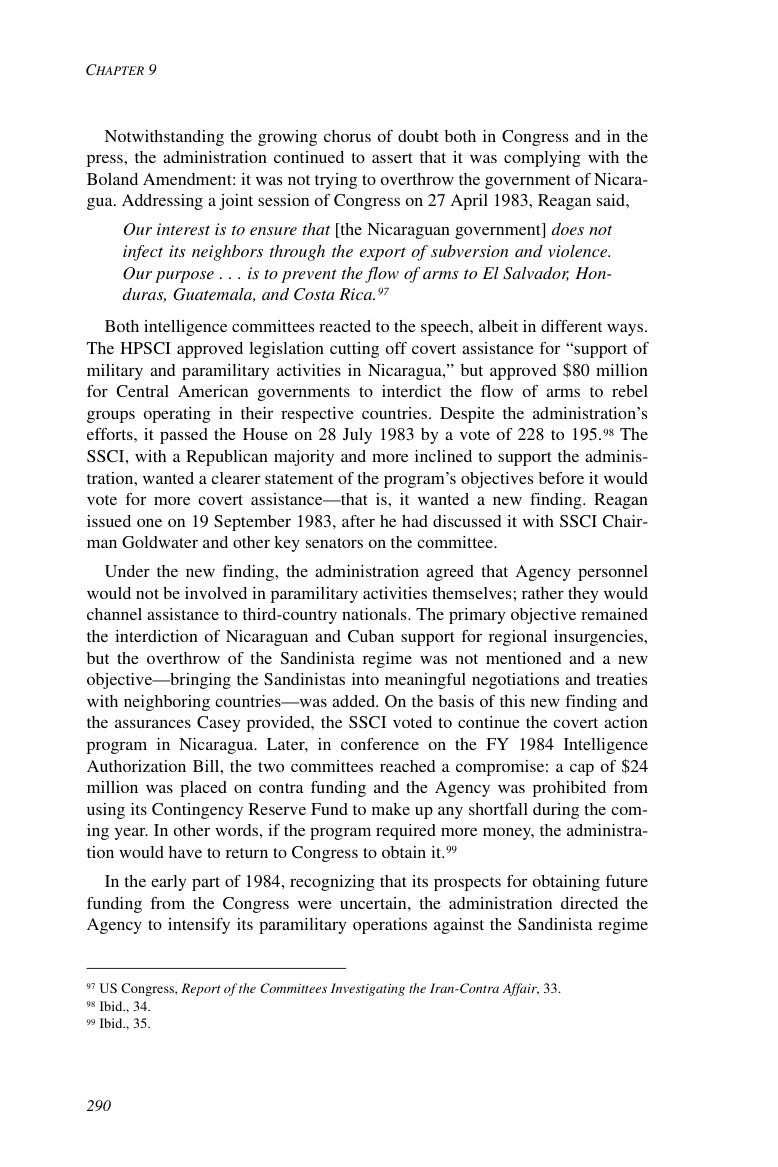
The Agency and the Hill, printed page 290
Snider’s later history, printed page 290, describes the growing program and the funding ceiling. This is retrospective analysis, not a 1984 operations order. Image credit ↗

Chapter 01 / 1979–1983

A regional war reaches the shipping lanes

The Sandinista revolution overthrew Anastasio Somoza’s dictatorship in 1979. The new government’s alignment with Cuba, its domestic concentration of power and its relationship to insurgents in neighboring El Salvador became central to Washington’s policy. The Reagan administration presented Nicaragua as a base for a regional revolutionary threat. Nicaraguan leaders described the armed opposition supported from abroad as an assault on their revolution and sovereignty. The conflict contained real local grievances and armed actors as well as superpower interests. Neither government’s account exhausts that history.

By 1981–82 the United States was supporting the armed opposition commonly called the Contras. Different organizations, commanders and political factions operated under that broad name. U.S. money, arms, training and intelligence were consequential, but they do not make every combatant a CIA employee or every attack an American-directed operation. The eventual ICJ judgment drew a careful distinction between extensive assistance and proof of effective control over particular operations. That distinction also makes the harbor-mining evidence unusually important: it concerned a more direct American chain than general sponsorship alone.

Public explanations emphasized intercepting arms bound for Salvadoran insurgents. The program also developed into pressure on the Sandinista government through attacks on economic infrastructure. Snider’s history describes congressional unease, changes in the program’s objectives and an appropriation ceiling of $24 million for fiscal 1984. A funding limit and a stated policy objective were different restraints. An operation could fit the administration’s broad strategic purpose while raising separate questions about authorization, disclosure and international law.

Ports connected those questions to ordinary economic life. Corinto and Puerto Sandino on the Pacific and El Bluff on the Caribbean served commerce, fuel supplies and transportation. Mining them exposed vessels and crews beyond the immediate government forces. Threatened access could change insurance, freight decisions and the cost of supplies without a formal naval blockade. The mining was a particular episode within the much larger Contra war. Its consequences can be established without assigning it the entire war’s casualties or assuming it alone determined Nicaragua’s later politics.
Sources: S01 · S05 · S06

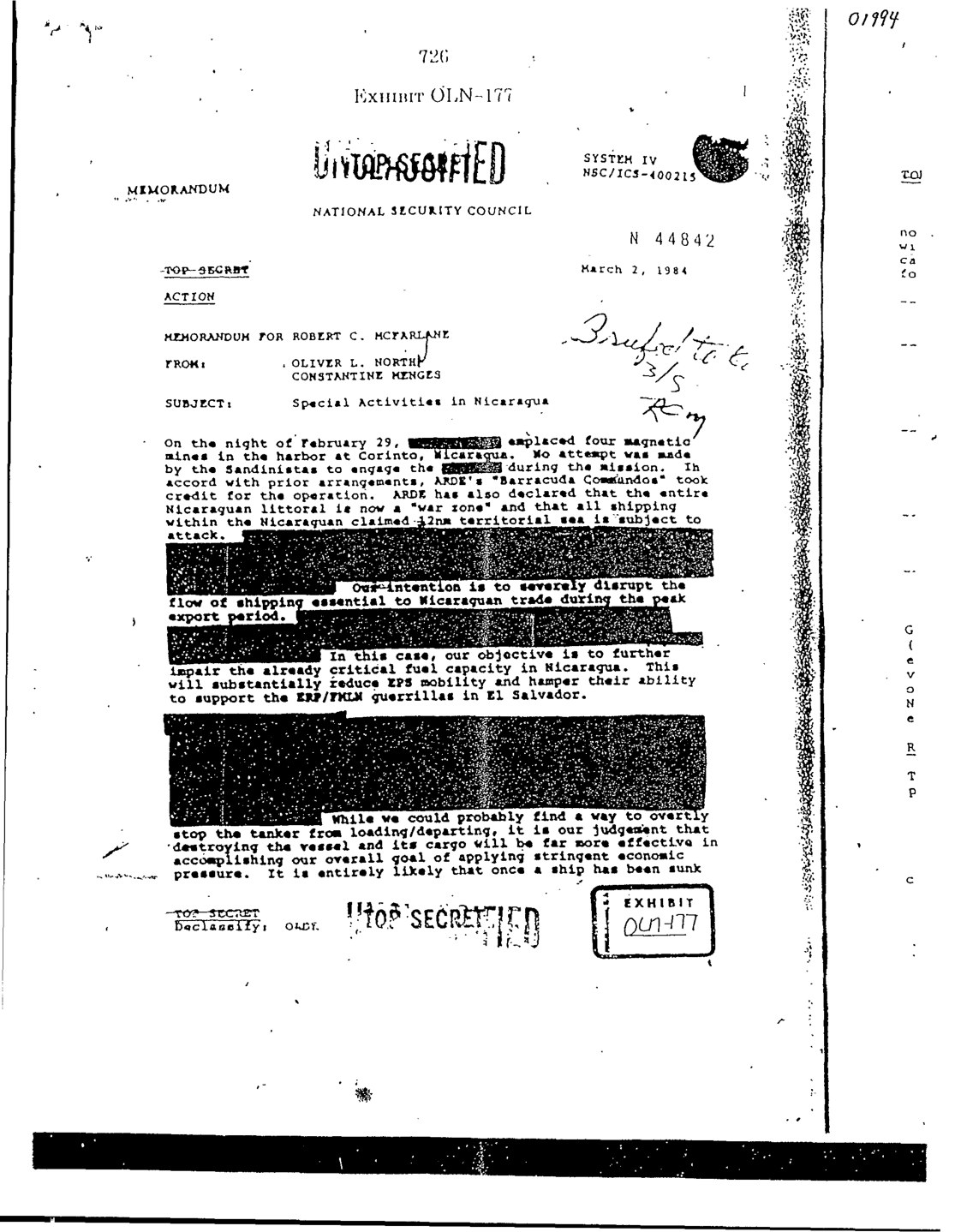
North/Menges memorandum, page 1
NSC memorandum of 2 March 1984, page 1: a report of mining and economic objectives, followed by discussion of a proposed additional operation. Redactions remain visible. Image credit ↗

Chapter 02 / Late 1983–March 1984

Authorization, control and borrowed credit

The Court ultimately found that President Ronald Reagan authorized a U.S. government agency to mine Nicaraguan ports in late 1983 or early 1984. It preserved that range rather than choosing between conflicting public accounts of December and February approval. The agency was the CIA in the congressional and historical record. Presidential authorization, CIA management, the people placing the mines and the organizations publicly claiming credit were separate links. Treating them as interchangeable obscures how the operation could be American-directed while the public explanation described Nicaraguan rebels.

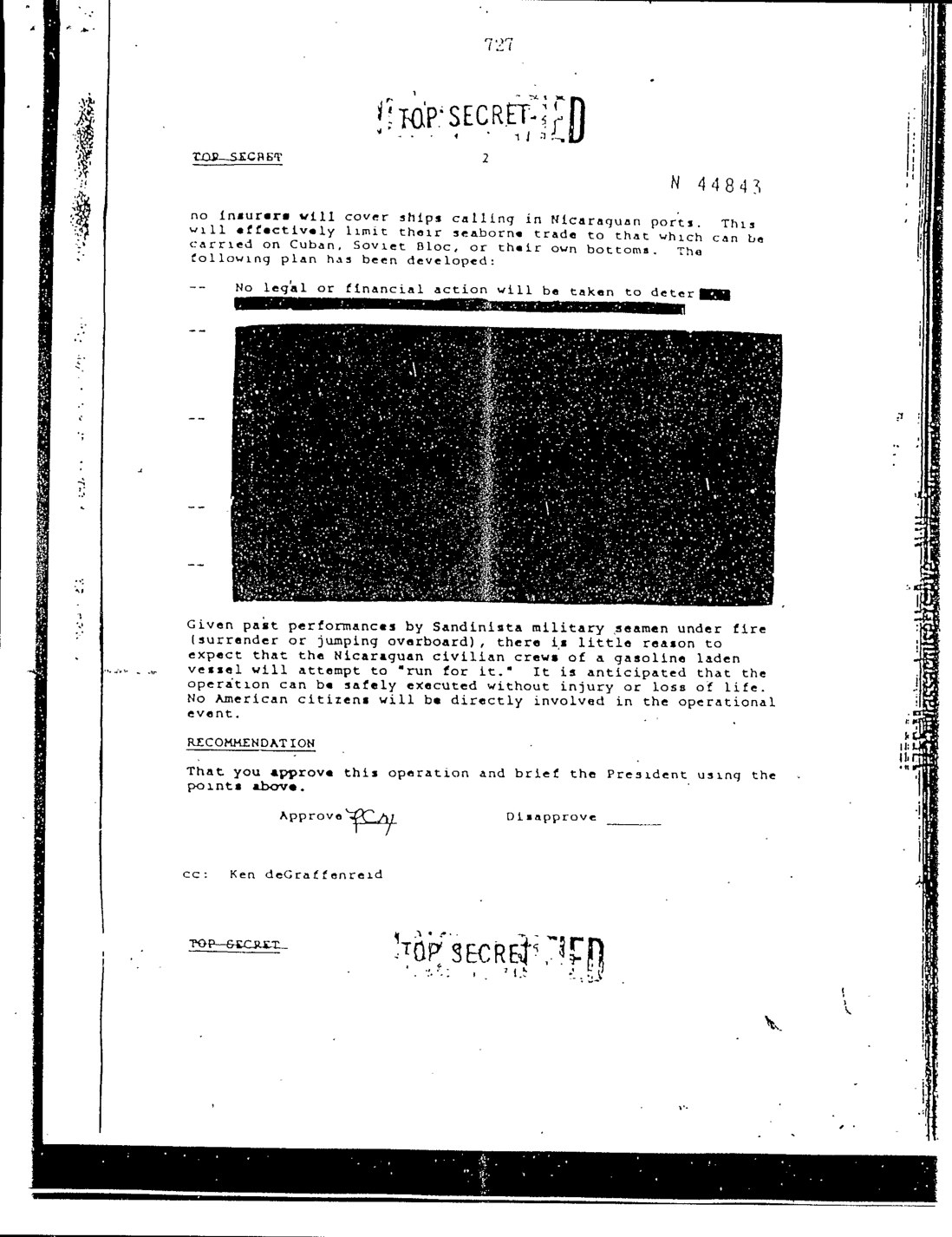
A 2 March 1984 memorandum from National Security Council staff members Oliver North and Constantine Menges to National Security Adviser Robert McFarlane offers a close view. It reports mines placed at Corinto on the night of 29 February and says that, under prior arrangements, ARDE’s Barracuda Commandos took credit. ARDE was an anti-Sandinista organization; its public claim did not establish that its regular forces controlled the operation. The memorandum states an intention to disrupt shipping essential to trade during the peak export period. Its discussion of fuel capacity connected economic damage to both Sandinista mobility and alleged support for Salvadoran guerrillas.

The 1986 judgment found the mines had been laid by paid personnel acting on the agency’s instructions, under U.S. agents’ supervision and logistical support. It discussed reports of Latin American personnel called UCLAs, or Unilaterally Controlled Latino Assets. That label described a reported relationship of control, not a nationality or a conventional Contra unit. The judgment’s finding supports state responsibility even without a complete public roster of contractors, agents and boat crews. It does not establish that every American adviser personally entered territorial waters.

The same memorandum then considers a further operation against a tanker. It recommends approval and carries an approval notation. Its authors expected a damaging incident to deter insurers and shipping, while predicting that crews would not be hurt. This is evidence of intention and a proposal’s internal handling. The document is not an after-action report proving that the proposed tanker destruction occurred. The distinction keeps a severe documented purpose visible without turning every contemplated measure into a completed attack.

Sources: S01 · S04 · S05

North/Menges memorandum, page 2
Second page of the North/Menges memorandum: projected insurance effects and an approval recommendation. Expectations of avoiding casualties were planning claims. Image credit ↗

Chapter 03 / Early 1984

Damage does not stop at the waterline

The mining created physical and economic hazards together. Vessels could be damaged, crews injured and normal voyages delayed or abandoned. The Court found personal and material injury from mine explosions and increased maritime insurance risks. It also found that the United States had given no public, official warning of the mines’ existence and location to international shipping, either before or after placement. An armed organization’s broad declaration that waters were a war zone did not satisfy that specific obligation.

The judgment’s paragraph 76 records specific incidents: two Nicaraguan fishing vessels struck mines at El Bluff on 25 February; the Dutch dredger Geoponte was damaged at Corinto on 1 March; the Panamanian vessel Los Caraibes was damaged there on 7 March; and the Soviet tanker Lugansk was damaged at Puerto Sandino on 20 March. These are identifiable episodes, not a claim that all reported losses have been reconciled. The same paragraph distinguishes Nicaragua’s aggregate casualty claims from the Court’s own evaluation.

The evidence record contains several different sorts of numbers. Nicaragua presented counts of damaged or destroyed vessels and casualties. Contemporary news reports changed as incidents accumulated, and later archival summaries offered their own totals and cost estimates. The judgment’s established conclusion was broader than any one disputed list: people and property were harmed, and commercial risk increased. This guide does not present a reconciled death toll or assign every vessel incident to one mine-laying crew. A complete ledger would require ship logs, registries, repair and insurance records, medical evidence and dated placement records assessed together.

Foreign commercial vessels made the operation an international issue beyond the two governments. The Court described Nicaragua’s evidence concerning ships of several registries and noted uncertainty about at least one incident attributed alternatively to gunfire. This precision matters: a ship’s being attacked in the campaign is not automatically evidence that it struck a mine. Nor does a foreign flag make every cargo civilian or every voyage military. The unlawful mining finding did not depend on proving an innocent cargo manifest for every vessel.

The economic mechanism was not an accidental side effect. The March 2 memorandum expected disruption of exports and restrictions on fuel capacity; it contemplated insurance withdrawal as a means of increasing pressure. Those aims contrast with Reagan’s later public minimization of the mines’ destructive potential. The surviving record can establish intended coercion and actual harm while leaving the total economic loss uncertain. It cannot establish with confidence how Nicaragua’s economy, the regional war or negotiations would have developed had the mining never occurred.

Sources: S01 · S04 · S09 · S12

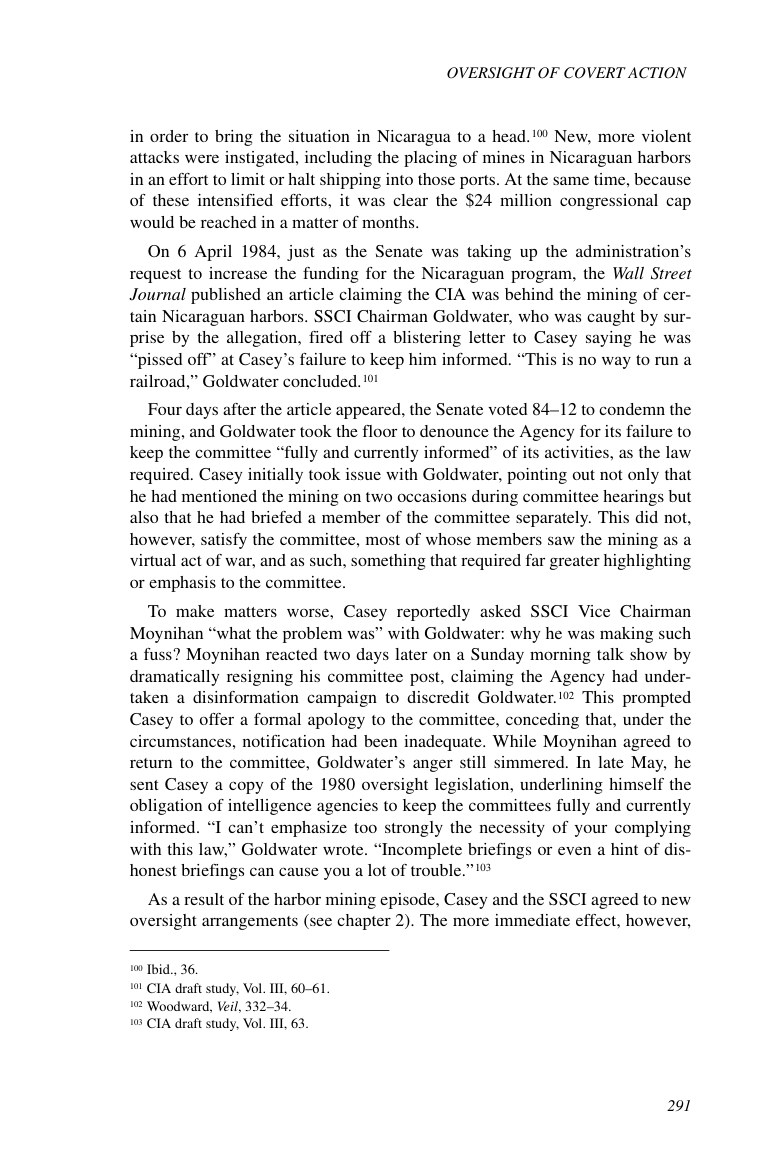
The Agency and the Hill, printed page 291
Snider, printed page 291: the April controversy, Casey’s defense, the Senate vote and the eventual acknowledgement of inadequate notification. Image credit ↗

Chapter 04 / April–May 1984

A secret operation becomes an oversight crisis

Nicaraguan allegations preceded the major Washington disclosures. In early April, American reporting made the CIA role a congressional crisis. Snider’s history identifies a 6 April Wall Street Journal article as the immediate trigger for Senate Intelligence Committee Chairman Barry Goldwater’s angry response. Goldwater was a conservative supporter of a strong intelligence service and of opposition to communism. His objection therefore cannot be reduced to a dispute between the administration and legislators who opposed every part of its regional policy.

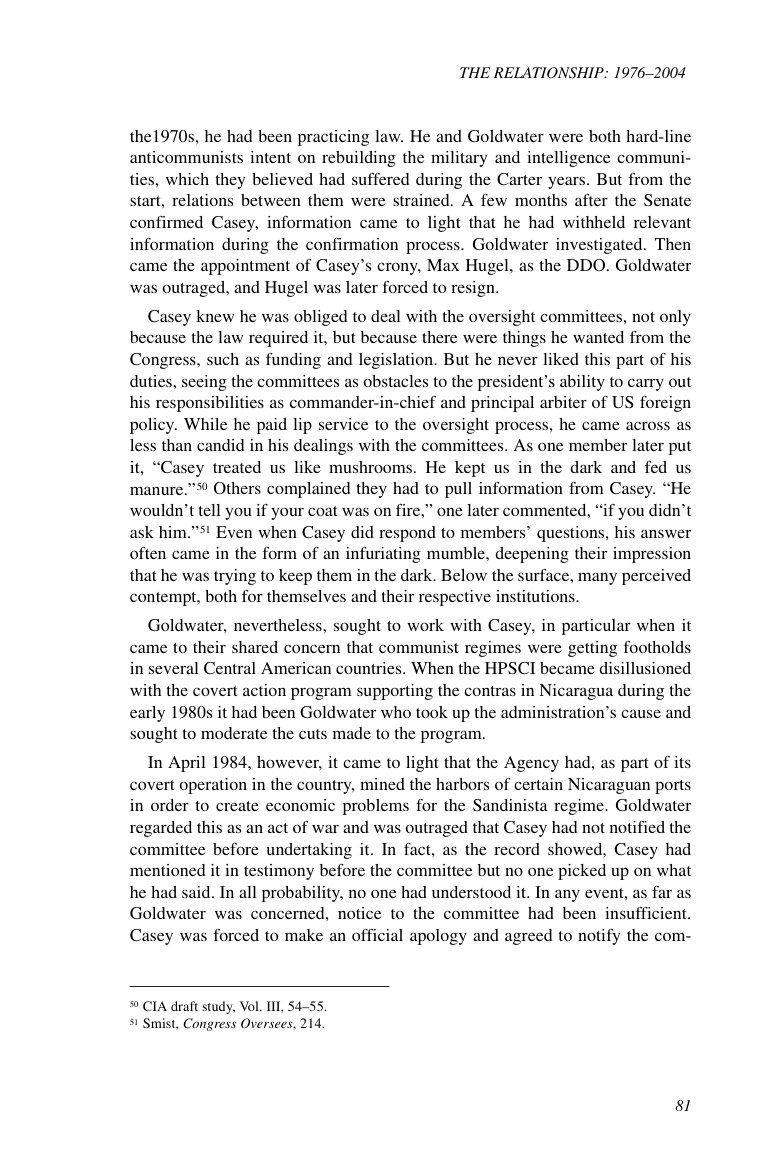
The argument concerned the meaning of informed oversight. CIA Director William Casey maintained that he had mentioned mining in committee sessions and had briefed a member separately. McFarlane publicly insisted that important details had been shared. Committee members replied that an operation of this significance required explicit attention, not a passing reference that failed to convey its nature. Snider concludes that Casey eventually apologized and conceded the inadequacy of notification in the circumstances. A literal reference to mining and effective advance notice were different factual propositions.

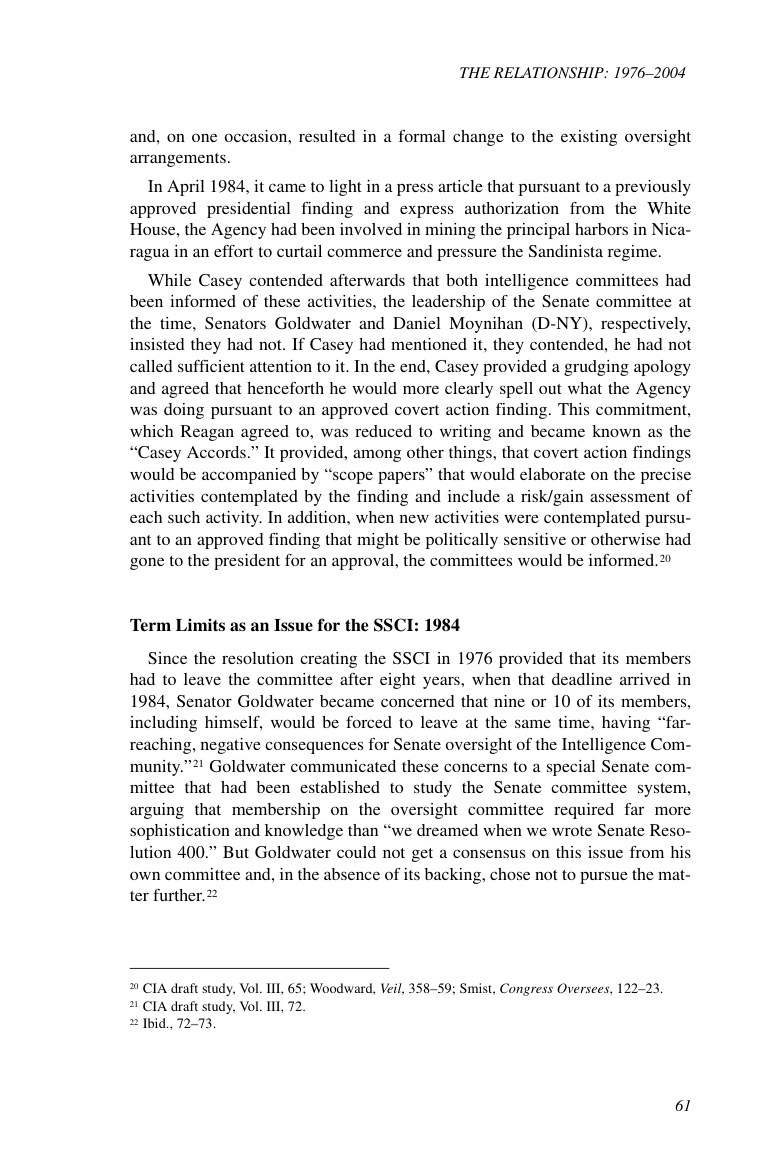
On 10 April the Senate voted 84–12 to condemn the mining. The expression of congressional opposition should not be mistaken for a judicial conviction, a declaration of war or proof that every contemplated funding restriction was already binding law. Congress used resolutions, appropriations and intelligence legislation through different procedures. The episode contributed to tighter notification arrangements: future findings would be accompanied by descriptions of contemplated activities, and significant changes would require attention. Those procedural consequences were distinct from the international legal proceedings Nicaragua had begun the day before.

Reagan’s 28 May interview with Irish broadcaster Brian Farrell supplied a public defense. He depicted the mining as rebel action aimed at interrupting weapons flows and claimed the devices could not sink ships. His words establish how he justified the policy; they do not settle who controlled the operation or whether the risks were negligible. The internal economic-pressure memorandum, the shipping evidence and the Court’s findings must be assessed alongside that explanation. The documentary record supports a dispute over both the conduct and the adequacy of disclosure, not a conclusion that a later defense erased either.

Sources: S01 · S05 · S07 · S13

The Agency and the Hill, printed page 61
Snider, printed page 61, describes changes in covert-action notification after the mining controversy. Congressional oversight and the Court’s jurisdiction were separate processes. Image credit ↗

Chapter 05 / April 1984–January 1985

The Court first decides whether it can hear the case

Nicaragua filed its application at the International Court of Justice on 9 April 1984. The case addressed military and paramilitary activities more broadly than the harbor mines. The ICJ is the United Nations’ principal judicial organ and adjudicates disputes between states under its jurisdiction. It was not conducting a criminal prosecution of Reagan, Casey or individual operatives. Its findings of state responsibility should neither be diluted into mere commentary nor relabeled as criminal convictions.

On 10 May the Court indicated provisional measures, including that the United States should cease and refrain from actions restricting access to or from Nicaraguan ports, particularly mine laying. A provisional order sought to preserve rights pending decision. It was not the final 1986 merits judgment. The Court then addressed jurisdiction and admissibility as a distinct phase, with both Nicaragua and the United States presenting arguments.

The United States challenged the Court’s authority on several grounds. Questions included Nicaragua’s acceptance of compulsory jurisdiction, the effect of the U.S. declaration and its reservations, absent regional states, collective self-defense and the Security Council’s role. Nicaragua also relied on the 1956 Treaty of Friendship, Commerce and Navigation. On 26 November 1984 the Court held it had jurisdiction and found the application admissible. Some questions concerning the multilateral-treaty reservation required further consideration in the merits phase. A disagreement about jurisdiction was real; the fact that it was contested does not make the Court’s resulting judgment nonexistent.

In January 1985 the United States informed the Court that it would not participate in the further proceedings, maintaining that the Court had mishandled jurisdiction and was an unsuitable forum for the regional conflict. Nonappearance did not give Nicaragua an automatic victory. Article 53 required the Court to satisfy itself both about jurisdiction and that the claims were well founded in fact and law. It considered public statements, documents and evidence already before it. The resulting judgment must be read with the limitations of the evidentiary record, but withdrawal was not a veto over adjudication.

Sources: S01 · S02 · S05 · S10

The Agency and the Hill, printed page 81
Snider, printed page 81, later revisited the mining dispute. This is an institutional historian’s account; the judicial findings are linked separately in the chapter’s sources. Image credit ↗

Chapter 06 / 27 June 1986

A merits judgment with distinct findings and limits

On 27 June 1986 the Court decided the merits. The United States’ multilateral-treaty reservation limited adjudication under certain treaty rules, including the UN and OAS Charters as treaty law. The majority nevertheless held that parallel rules of customary international law had an independent existence and could be applied. It also adjudicated relevant obligations under the bilateral 1956 treaty. The outcome was not a ruling that the reservation had never existed, or that all international law was beyond the Court’s reach.

The Court rejected the United States’ collective-self-defense justification. It distinguished an armed attack from other unlawful support and examined the evidence of arms assistance, the positions and requests of the regional states, and necessity and proportionality. It did not hold that every accusation against Nicaragua was invented or that its government’s conduct was beyond criticism. It held that the legal conditions invoked to justify the U.S. actions had not been established. The majority additionally considered mining ports and attacking installations disproportionate to the alleged assistance to Salvadoran insurgents.

The operative decision found that the mining breached customary obligations concerning force, intervention, sovereignty and peaceful maritime commerce, as well as treaty obligations. It separately found a breach in failing to warn shipping. The mining finding under customary law was adopted 12–3; the failure-to-warn finding was 14–1. Votes and separate opinions reveal disagreement, but the majority judgment remains the judicial outcome. Judge Stephen Schwebel’s dissent argued a stronger basis for collective self-defense and distinguished responsibility toward Nicaragua from the unlawfulness of unnotified mining toward third states.

The majority did not attribute every Contra act to Washington. Financing, organizing, training, supplying and even general control were insufficient on the evidence to establish U.S. effective control of every operation involving alleged violations. That limit coexisted with findings against direct American conduct and unlawful support. It does not exonerate the mining, whose command evidence the Court assessed separately. Finally, the Court held that the United States owed reparation, leaving form and amount for agreement or subsequent proceedings. It did not award a final dollar sum in this judgment.

Sources: S01 · S08 · S09

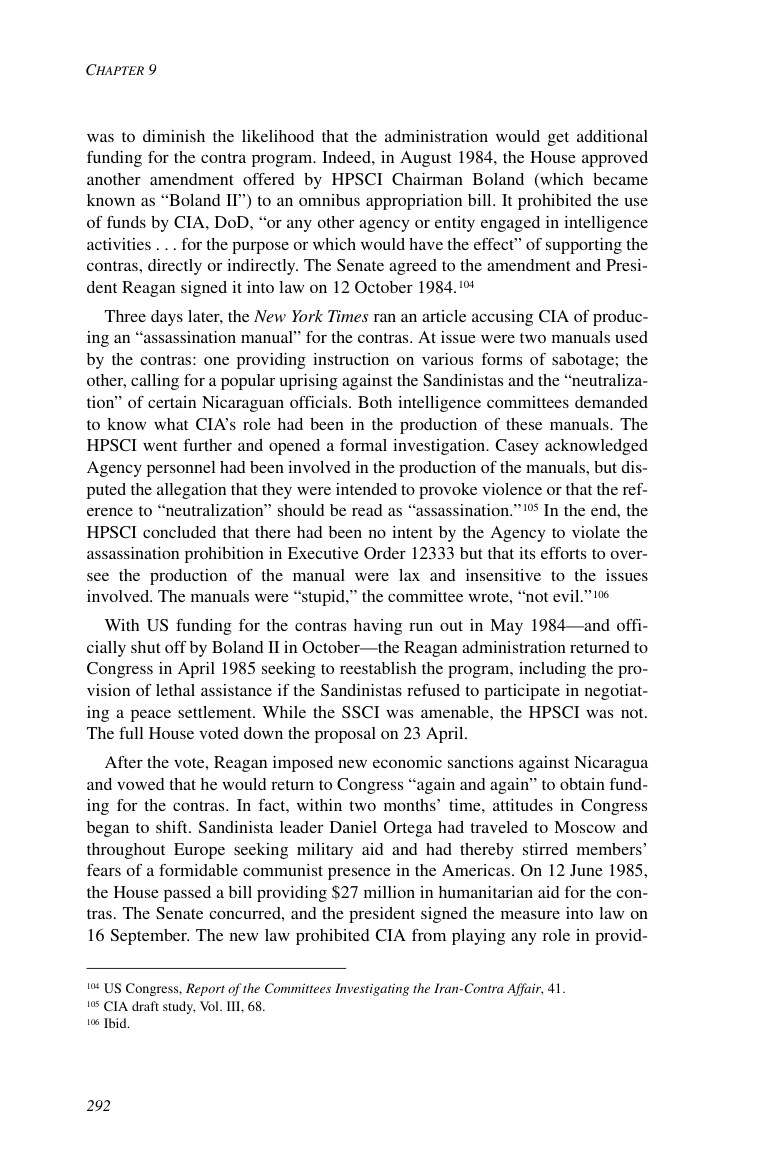
The Agency and the Hill, printed page 292
Snider, printed page 292, places the mining within later funding conflict and the wider Contra program. The 1991 procedural endpoint is documented in the linked court and UN records. Image credit ↗

Chapter 07 / 1986–1991 and memory

A judgment survives an unfinished remedy

The judgment and its enforcement had different histories. The Court could declare responsibility and the duty to make reparation without being able to compel immediate U.S. compliance. The United States continued to dispute the case. A legal finding did not by itself produce a paid award, end the Contra war or settle the political conflict. Subsequent funding debates and the Iran-Contra scandal concerned overlapping actors and policies, but the 1984 harbor operation should not be collapsed into the later secret resupply arrangements.

The reparation phase remained unfinished. Nicaragua filed a memorial, while the Court left room for agreement and later determination of the remedy. Then, after a change of government in Nicaragua, its agent wrote on 12 September 1991 that the government renounced further right of action based on the case and requested discontinuance. The United States did not oppose the request. On 26 September the President of the Court recorded the discontinuance and removed the case from the list.

That procedural endpoint was consequential: the Court would not proceed to fix the form and amount of reparation in the reserved phase. It was not an appellate reversal, a finding that the mining had never happened or an acquittal of the United States. The 1991 order itself recalled the 1986 finding of the obligation to repair injury. Explaining Nicaragua’s political decision requires evidence about the new government’s diplomatic calculations; discontinuance alone cannot prove a secret bargain, coercion or satisfaction of the original claim.

Public memory often compresses the story into either a Cold War necessity or a single spectacular instance of American wrongdoing. The records support a more exact account: presidential authorization, CIA instructions and supervision, paid personnel executing the mining, arranged rebel credit, damage and risk to commerce, inadequate congressional notification, a contested jurisdiction phase, an adverse merits judgment and an abandoned remedy proceeding. Some questions remain open, especially complete personnel rosters, incident-by-incident losses and the implementation of separately proposed attacks. Those gaps do not remove what has been established; established responsibility does not fill them automatically.

Sources: S01 · S03 · S05 · S06 · S11

02 / The record

Find a thread in the file

Search the chapter and claim index. Every result leads to the full text and its sources.

03 / The record

People and institutions

Open a record for the person’s role and supporting sources. Names identify people; no unverified portrait is substituted for a participant.

ReaganBiographical record
Ronald ReaganU.S. president

Authorized the agency’s mining according to the Court; publicly defended interdiction and minimized mine hazards in May 1984. Presidential responsibility and the physical placement of mines are different links.

Sources: S01 · S07

CaseyBiographical record
William J. CaseyDirector of Central Intelligence

Led the CIA during the operation and the notification controversy. He defended prior references to mining, then apologized for inadequate notice in the circumstances.

Sources: S05

McFarlaneBiographical record
Robert C. McFarlaneNational Security Adviser

Recipient of the North/Menges action memorandum and public defender of congressional disclosure. A received recommendation and its execution require separate evidence.

Sources: S04 · S13

NorthBiographical record
Oliver L. NorthNational Security Council staff

Coauthor of the March 2 memorandum reporting mining, arranged credit and economic objectives; later Iran-Contra involvement is related context, not proof of every 1984 event.

Sources: S04

MengesBiographical record
Constantine MengesNational Security Council staff

Coauthor with North of the March 2 memorandum. The redacted document records policy advocacy, a reported operation and a further proposal.

Sources: S04

GoldwaterBiographical record
Barry GoldwaterSenate Intelligence Committee chairman

A conservative intelligence supporter whose dispute with Casey centered on the adequacy of mining notification. His position challenges a purely partisan account of oversight.

Sources: S05

MoynihanBiographical record
Daniel Patrick MoynihanSenate Intelligence Committee vice chairman

Protested the handling of the disclosure controversy and briefly resigned his committee post before returning after Casey’s apology.

Sources: S05

governmentBiographical record
Daniel Ortega and the Sandinista governmentNicaragua’s governing leadership

Faced U.S. supported armed opposition and brought the interstate case. Allegations made by Nicaragua are distinguished from judicial findings; responsibility for mining does not immunize the government’s own conduct.

Sources: S01 · S06

CommandosBiographical record
ARDE and the Barracuda CommandosAnti-Sandinista organization and attributed unit

The March 2 NSC memo says they took credit for the Corinto operation under prior arrangements. Claiming credit did not prove operational independence.

Sources: S04

operativesBiographical record
Paid Latin American operativesExecution chain

The Court found agency-paid people acted on instructions under American supervision and support; a complete authenticated public personnel roster is not assembled here.

Sources: S01

SchwebelBiographical record
Stephen M. SchwebelICJ judge / dissenter

Argued for collective self-defense and disagreed with key majority findings, while identifying obligations to third-state shipping. His opinion documents legal disagreement, not a reversal.

Sources: S08

governmentBiographical record
Violeta Barrios de Chamorro’s governmentNicaraguan government from 1990

The successor government discontinued the reserved case proceedings in 1991. The procedural act did not vacate the 1986 judgment.

Sources: S03 · S06 · S11

04 / The record

The operation and its aftermath

Horizontal spacing shows elapsed time; separate rows keep close events selectable. Scroll the graph on narrow screens. Exact dates are attributed where records conflict; month- and year-only dates preserve source precision.

19791982198619891992
Somoza’s dictatorship fallsContext

The Sandinista-led revolution takes power. Later U.S. policy combines concern over regional insurgency, alignment and internal repression.

Sources: S06

U.S. support for armed opposition developsPolicy

The wider Contra program precedes the mining operation and is not identical to it.

Sources: S01 · S05 · S06

Program and funding disputes sharpenOversight

Snider describes changes in operational goals and a fiscal 1984 appropriation cap. His printed page 290 provides the chronology, without supplying a single exact mining authorization day.

Sources: S05

Authorization window beginsAuthorization

The Court locates presidential authorization in late 1983 or early 1984; this marker represents the beginning of that range, not an asserted December approval date.

Sources: S01

Mines laid near three portsExecution

The Court finds mining in or near El Bluff, Corinto and Puerto Sandino in early 1984 under the American agency’s instruction and support.

Sources: S01

Two fishing vessels strike mines at El BluffHarm

The judgment’s paragraph 76records this specific incident; no total campaign casualty count is inferred.

Sources: S01

Corinto operation reported internallyExecution

North and Menges report this night’s mining in their March 2 memo and describe arranged ARDE credit.

Sources: S04

Dutch dredger Geoponte damagedHarm

The judgment’s paragraph 76records mine damage at Corinto.

Sources: S01

Economic-pressure memorandumInternal record

North and Menges describe trade disruption and fuel objectives, then recommend an additional tanker operation. The memo does not prove its execution.

Sources: S04

Los Caraibes damaged at CorintoHarm

The Panamanian vessel appears among the concrete incidents in paragraph 76.

Sources: S01

Soviet tanker Lugansk damagedHarm

The judgment records mine damage at Puerto Sandino in paragraph 76.

Sources: S01

Nicaragua alleges CIA mining rolePublic record

Contemporaneous UPI report records Nicaragua’s allegation before the central Washington oversight controversy.

Sources: S12

Disclosure triggers Washington crisisDisclosure

Snider identifies the Wall Street Journal report as the immediate trigger for Goldwater’s complaint.

Sources: S05

Nicaragua files ICJ applicationCourt

Proceedings cover military and paramilitary activities, including harbor mining.

Sources: S01 · S02

Senate condemns mining, 84–12Congress

The vote expresses congressional opposition; it is distinct from the Court’s later responsibility findings.

Sources: S01 · S05

McFarlane defends disclosurePublic position

Reportedly argues that important details were shared with committees; that claim is tested against the subsequent apology and oversight record.

Sources: S13 · S05

Provisional measures orderedCourt

The Court orders the United States to cease and refrain from actions restricting port access, particularly mine laying, pending further proceedings.

Sources: S02 · S10

Reagan defends interdictionPublic position

Interview recorded May 28 and released May 29 depicts mines as rebel action and minimizes the danger.

Sources: S07

Jurisdiction and admissibility judgmentCourt

The Court decides it may entertain the case, while preserving issues relevant to the multilateral-treaty reservation.

Sources: S02 · S10

United States declines further participationCourt

The U.S. communication contests the Court’s handling of the case. The Court subsequently applies Article 53 rather than treating nonappearance as automatic admission.

Sources: S01

Merits judgment finds U.S. breachesCourt

Mining and failure to warn are among the findings; the Court rejects collective self-defense and orders reparation without fixing a final sum.

Sources: S01 · S09

Reparation procedure continuesCourt

Procedural order sets the course for the reserved remedy phase recalled in the 1991 discontinuance order.

Sources: S03

Nicaragua requests discontinuanceCourt

Its agent renounces further right of action based on the case and asks removal from the list.

Sources: S03 · S11

Case removed from the listCourt

The United States does not oppose discontinuance. The order records an endpoint to further proceedings, not reversal of the merits judgment.

Sources: S03 · S11

05 / The record

The load-bearing facts

Six connected steps link authorization, execution, harm, disclosure, judgment and remedy. Open each step for its dependencies, why it matters, and the questions it leaves for rival accounts.

CP1

Authorization becomes an agency mission

A presidential authorization existed, with the Court preserving late 1983/early 1984 date uncertainty. Agency instructions connected authority to actual acts.

Why it is critical

Separates a policy preference, an approved mission and an unexecuted proposal.

Dependencies

Requires the Court’s evaluated admissions and documents; no single public day is manufactured.

What rival readings must explain

An independent-rebel explanation must account for authorization, paid personnel and U.S. supervision.

Sources: S01 · S04

CP2

Execution uses paid personnel and arranged attribution

The Court found instruction and logistical supervision; the March 2 memo documents arranged ARDE credit for a Corinto operation.

Why it is critical

Explains why public rebel attribution cannot establish autonomous execution.

Dependencies

Requires distinguishing the CIA chain from Contra organizations and the incomplete roster of individual operatives.

What rival readings must explain

General Contra autonomy is compatible with direct American responsibility for this particular operation.

Sources: S01 · S04

CP3

Hazards reach crews, vessels and commerce

Actual personal and material injury and higher insurance risks were found, without a public official mine warning.

Why it is critical

Identifies concrete consequences rather than treating mining as a harmless signaling device.

Dependencies

Depends on incident evidence and the Court’s assessment, not a reconciled casualty total this guide does not possess.

What rival readings must explain

An interdiction rationale must explain nondiscrimination, warning failures and commercial coercion.

Sources: S01 · S04 · S09

CP4

Disclosure exposes a failure of meaningful notice

Casey’s references to mining did not satisfy the committee; he eventually acknowledged inadequate notification.

Why it is critical

Explains backlash among supporters and subsequent procedural changes.

Dependencies

Depends on separating literal mention from sufficient informed oversight, and resolution from binding appropriation law.

What rival readings must explain

A claim that Congress knew everything must explain the apology and changed arrangements.

Sources: S05 · S13

CP5

Jurisdiction precedes a separate merits decision

The Court rejected jurisdictional objections in 1984 and assessed responsibility in 1986 under customary law and the bilateral treaty.

Why it is critical

Prevents the legal outcome being erased by nonparticipation or misstated as a 1984 criminal conviction.

Dependencies

Requires the declarations, reservations, Article 53 and the Court’s independent fact/law assessment.

What rival readings must explain

A successful defense account must address the majority’s armed-attack, request, necessity and proportionality reasoning, as well as the dissent.

Sources: S01 · S02 · S08

CP6

The remedy ends without undoing responsibility

Reparation was ordered in principle; Nicaragua ended further proceedings in 1991 before the Court fixed the form and amount.

Why it is critical

Explains why there is a judgment without a final judicial damages figure in this record.

Dependencies

Depends on reading the 1991 order alongside the 1986 dispositif, not as an appellate decision.

What rival readings must explain

A political-settlement account needs authenticated negotiation evidence; discontinuance alone proves neither payment nor exoneration.

Sources: S01 · S03 · S11

06 / The record

Four interpretations tested against the record

Competing interpretations, stated at their strongest and tested against the same chain. Presenting a theory is not endorsing it.

Interpretation 01

Coercive economic intervention

Strongly supported for this operation

The strongest version

Mining was deliberately designed to disrupt commerce and pressure the Sandinista state, with rebel credit masking a direct American chain.

Accepts

Regional conflict and arms-flow concerns were real policy claims; not every Contra act was American-controlled.

Must still explain

Which specific attacks occurred under which orders, and how much damage each caused.

Assessment

CP 1–CP 3 are supported by the Court and March 2 memo. Broader claims that every economic difficulty or every military event followed from this operation exceed the evidence.

What would change this assessment

Authenticated authorization annexes, complete mission reports and reconciled shipping/insurance ledgers could refine intent, attribution and losses; a new memo would not by itself prove execution.

Sources: S01 · S04 · S05

Interpretation 02

Collective self-defense and interdiction

Serious argument; rejected by the majority

The strongest version

Nicaragua’s support for Salvadoran insurgency and regional security threats justified assisting its opponents and interdicting supplies; Schwebel disputed the majority’s evaluation.

Accepts

American sponsorship and mining happened; secrecy does not itself settle international legality.

Must still explain

The majority’s findings on armed attack, requests, necessity and proportionality, and the lack of specific mine warnings.

Assessment

CP 3 and CP 5 remain barriers. A security rationale explains purpose; the Court rejected it as legal justification. Schwebel also recognized distinct obligations toward third states.

What would change this assessment

Authenticated contemporaneous evidence establishing the scale of armed attack, timely victim-state requests and mission-specific necessity could change historical assessment; the recorded 1986 judgment would remain a judicial fact unless lawfully revised.

Sources: S01 · S07 · S08

Interpretation 03

Autonomous rebels rather than a U.S. operation

Not supported for the central mining chain

The strongest version

The Contras had local causes and agency; leaders claimed responsibility, and Washington did not control every field operation.

Accepts

Contra autonomy exists in the Court’s attribution analysis and cannot be dismissed.

Must still explain

The presidential authorization, paid operatives, agency instructions, logistical supervision and arranged Corinto credit.

Assessment

CP 1 and CP 2 distinguish this case from general sponsorship. Independence in other operations does not answer evidence of direct control here.

What would change this assessment

Authenticated mission rosters, payroll and command traffic showing a materially different chain could revise individual roles or particular incidents. Mere repetition of a public claim would not.

Sources: S01 · S04 · S07

Interpretation 04

An oversight failure within a contested policy

Supported, but incomplete as a whole explanation

The strongest version

The immediate Washington scandal turned on whether Congress received meaningful notice; an executive could believe its mission authorized while mishandling disclosure.

Accepts

Authorization, actual harm and international responsibility remain separate issues.

Must still explain

Why a procedural reform alone would answer the Court’s substantive findings, and why the 1991 endpoint would undo them.

Assessment

CP 4 is well documented. CP 3,CP 5 and CP 6 show why notification alone cannot explain or clear the operation.

What would change this assessment

Authenticated briefing transcripts and circulated materials could alter the account of who knew what and when; shipping harm and legal responsibility would still require their own evidence.

Sources: S01 · S03 · S05 · S13

07 / The record

How the story changed

Public memory tends to compress contested histories into a turning point. The records leave a less tidy sequence.

From rebel claim to documented command

ThenPublic claims placed responsibility with anti-Sandinista fighters.

ReconsideredThe internal memorandum records arranged credit; the Court’s chain places agency-paid executors under American instruction and support.

Sources: S01 · S04 · S07

From harmless interdiction to concrete risk

ThenThe president minimized the mines’ destructive capacity while defending arms interdiction.

ReconsideredThe judgment establishes injury, property damage and insurance risks; the internal memo makes trade disruption an explicit objective.

Sources: S01 · S04 · S07

From a closed case to an unfinished remedy

ThenDiscontinuance can sound like the claim was withdrawn because it failed.

ReconsideredThe 1991 order recalls the 1986 reparation obligation; it ends the reserved procedure without overturning the merits.

Sources: S01 · S03 · S11

08 / The record

What the evidence supports

Ratings apply to the precise proposition on the page. Unsupported means the assembled evidence does not establish a claim; it is not interchangeable with false.

Established

The United States directed the central 1984 mining operation.

Presidential authorization, paid personnel, agency instructions and U.S. supervision/logistics were found by the Court. This does not identify every individual crew member.

Sources: S01 · S04

Not established

Every Contra action was legally attributable to Washington.

The Court required effective control of the operations at issue; extensive sponsorship alone did not attribute all Contra violations.

Sources: S01

Contradicted

The mining was only an unexecuted proposal.

The Court found actual laying and injury. Separately proposed tanker action in the March 2 memo must not be treated as an execution report.

Sources: S01 · S04

Established

The operation sought economic coercion.

The internal memorandum identifies disruption of trade, fuel capacity and shipping insurance as objectives.

Sources: S04

Contradicted

The mines caused no actual harm.

The judgment found personal and material injury and increased insurance risks. A complete reconciled casualty total is not offered here.

Sources: S01 · S09

Contested

Congress received adequate notice because mining was mentioned.

Casey invoked prior mentions, but the committee found notification inadequate and he apologized. Adequacy cannot be inferred from mention alone.

Sources: S05 · S13

Contradicted

The ICJ ruled on merits in November 1984.

That judgment concerned jurisdiction and admissibility. The merits judgment was 27 June 1986.

Sources: S01 · S02

Contradicted

The U.S. collective-self-defense justification prevailed.

The majority rejected it; Schwebel’s contrary view is a dissent and is presented as such.

Sources: S01 · S08

Established

The mining breached customary law and treaty obligations.

The 1986 operative findings separately address mining, commerce and failure to warn. This was state responsibility, not a criminal conviction.

Sources: S01 · S09

Contradicted

The 1986 judgment fixed a final damages award.

It ordered reparation in principle and reserved form and amount for later determination absent agreement.

Sources: S01 · S03

Contradicted

The 1991 order exonerated the United States.

It recorded discontinuance of further proceedings and recalled the prior reparation obligation; it did not reverse the judgment.

Sources: S03 · S11

Not established

Mining alone determined Nicaragua’s political future.

The counterfactual cannot be isolated from war, domestic politics, economic conditions, diplomacy and later aid decisions with this record.

Sources: S05 · S06

09 / The record

Watch, listen and read the witnesses

Recorded voices, reported history, and documentary context. External media need an internet connection.

Presidential interview transcript

Reagan answers Brian Farrell, 28 May 1984 ↗

Read the president’s arms-interdiction justification and minimization of the mines’ danger in the surrounding exchange. External transcript; no unverified embedded video.

Judicial disagreement

Read the majority alongside Schwebel ↗

The disagreement concerns evidence and the law of collective self-defense. The majority’s judgment and the dissent retain different judicial status.

10 / The record

The questions still open

A documented limit is more useful than a confident number or a sweeping lineage the evidence cannot carry.

  1. Which complete mission logs and payment records identify every executor and supervisory link?
  2. Can ship logs, insurers, medical records and repair files produce a reconciled incident and harm ledger without merging mine strikes with gunfire?
  3. Which additional proposals in the March2 memorandum were carried out, modified or abandoned?
  4. What briefing materials reached each oversight member before the April controversy, and with what explanation?
  5. Which authenticated diplomatic records explain the 1991 decision to abandon further proceedings and any related arrangements?

11 / The record

Go back to the sources

Records, reporting, and firsthand accounts have different evidentiary roles. Each source note explains what it can establish and where caution is needed. Sources consulted for this edition on 25 October 2026. Original records and attributed reporting have distinct evidentiary roles.

  1. S01

    Judgment / primary

    Military and Paramilitary Activities: merits judgment, 27 June 1986 ↗

    International Court of Justice

    Paragraphs 75–80 establish the mining chain and harm; 115–116 distinguish Contra attribution; 172–182 concern customary law; 227–238 address self-defense; 292 is the operative decision. Complete English judgment consulted through an independently indexed ICSID/World Bank legal-exhibit mirror; official endpoint returned 403. This is a judgment of state responsibility, not a criminal conviction.

  2. S02

    Judgment / primary

    Jurisdiction and admissibility judgment, 26 November 1984 ↗

    International Court of Justice

    Separate from the 1986 merits judgment. UN Juridical Yearbook 1984 and official indexed text checked. Addresses optional-clause declarations, the 1956 treaty and admissibility; does not decide the mining merits.

  3. S03

    Order / primary

    Order of 26 September 1991 ↗

    International Court of Justice

    Official indexed text and UN Juridical Yearbook 1991 checked. Records Nicaragua’s September 12 renunciation of further right of action, U.S. non-objection and discontinuance. It does not reverse the 1986 judgment.

  4. S04

    Contemporaneous internal memorandum

    North and Menges to McFarlane: Special Activities in Nicaragua, 2 March 1984 ↗

    National Security Council / National Security Archive repository

    Two original federal-authored pages, Iran-Contra hearing exhibit OLN-177, N44842–43. Visually read because scan has no text layer. Reports February 29 mining, arranged ARDE credit, economic-pressure objectives and a proposed tanker operation. Approval notation is visible; redactions and absence of an execution report limit inference.

  5. S05

    Institutional history

    The Agency and the Hill: CIA’s Relationship with Congress, 1946–2004 ↗

    L. Britt Snider / CIA Center for the Study of Intelligence, 2008

    Printed pages 61–62, 81–82, 290–292 checked. Describes authorization, funding, Goldwater/Casey dispute, subsequent notification arrangements and limits of Contra attribution. Snider wrote under contract after retirement; views are his, not automatically official CIA positions. Selected pages reused under CIA.gov express policy, not presumed federal-employee public domain.

  6. S06

    Government historical synthesis

    Central America, 1981–1988 ↗

    U.S. Department of State, Office of the Historian

    Context for the revolution, Reagan policy, Congress and negotiations. A retrospective U.S. official history, tested against the court’s record rather than used as a neutral substitute for it.

  7. S07

    Presidential public statement

    Interview with Brian Farrell, 28 May 1984 ↗

    Ronald Reagan / American Presidency Project

    Recorded May 28, transcript released May 29. Reagan defended interdiction, described rebels as planters and minimized the danger. Evidence of the administration’s public position, not proof that the hazards or chain of control were as he characterized them.

  8. S08

    Judicial dissent

    Dissenting opinion of Judge Schwebel, 27 June 1986 ↗

    International Court of Justice

    Official indexed excerpts checked, including section R’s heading and surrounding collective-self-defense discussion. Argues a stronger factual/legal case for collective self-defense; differentiates legality toward Nicaragua from obligations toward third states. A dissent, not the Court’s judgment. Full mirrored fetch failed; no claim of full-text archival review.

  9. S09

    Official legal summary

    United Nations Juridical Yearbook 1986, chapter III ↗

    United Nations

    Independent accessible account of the merits reasoning and operative findings, including customary law, the 1956 treaty, force, intervention, commerce and reparation. Kept privately; no assumption that UN documents are U.S. public domain.

  10. S10

    Official legal summary

    United Nations Juridical Yearbook 1984 ↗

    United Nations

    Court section includes the May 10 provisional order and November 26 jurisdiction judgment. Accessible full volume retained privately; not redistributed as an image pack.

  11. S11

    Official legal summary

    United Nations Juridical Yearbook 1991 ↗

    United Nations

    Court section records discontinuance and the United States’ non-objection. Supports procedural endpoint without implying reversal or payment.

  12. S12

    Contemporaneous reporting

    Nicaragua says CIA orders mining of its port, 30 March 1984 ↗

    United Press International

    Attribution in the headline matters: reports Nicaragua’s allegation while the operation was still disputed. Used for public chronology, not as an independent operational order.

  13. S13

    Contemporaneous reporting of official defense

    McFarlane says Hill knew about mining, 13 April 1984 ↗

    Barnard L. Collier, Washington Times / CIA reading room copy

    Records McFarlane’s claim that details had been shared with oversight committees. Currently unavailable at the cited CIA URL: an ordinary request redirects to the Agency’s system-maintenance page. The original citation and indexed article extraction are retained; Snider’s history (S05) independently supports the substantive disclosure chronology. CIA custody does not convert the newspaper article into a CIA-authored report or establish copyright clearance; the clipping is not shipped.

  14. S14

    Archival publication / secondary

    Science, Technology and the CIA: document 38 ↗

    National Security Archive, Jeffrey T. Richelson, 2001

    Provenance and context for the North/Menges memorandum. Editorial estimates of mines, ship damage and costs are not substituted for a reconciled incident ledger. Technical construction detail is outside this guide’s scope.

Local selected records: north-menges · snider-selected-pages. These filenames match the source-and-rights ledger in the data folder.

Images, documents & licensing

North/Menges memorandum, page 1 (PDF page 1) — Oliver North and Constantine Menges / National Security Council. U.S. federal employee work, 17 USC §105; original scan, redactions retained. Source & license ↗. Resized and re-encoded for this edition; embedded metadata removed. NSC pages are federal employee work; Snider pages rely on CIA.gov express reuse permission. Full mixed originals remain private.

North/Menges memorandum, page 2 (PDF page 2) — Oliver North and Constantine Menges / National Security Council. U.S. federal employee work, 17 USC §105; original scan, redactions retained. Source & license ↗. Resized and re-encoded for this edition; embedded metadata removed. NSC pages are federal employee work; Snider pages rely on CIA.gov express reuse permission. Full mixed originals remain private.

The Agency and the Hill, printed page 61 (PDF page 79) — L. Britt Snider / CIA Center for the Study of Intelligence. Reproduced under CIA.gov Site Policies express permission where no copyright is indicated; credit to Snider and CIA. Contract-authored, not assumed federal-employee public domain. Source & license ↗. Resized and re-encoded for this edition; embedded metadata removed. NSC pages are federal employee work; Snider pages rely on CIA.gov express reuse permission. Full mixed originals remain private.

The Agency and the Hill, printed page 81 (PDF page 99) — L. Britt Snider / CIA Center for the Study of Intelligence. Reproduced under CIA.gov Site Policies express permission where no copyright is indicated; credit to Snider and CIA. Contract-authored, not assumed federal-employee public domain. Source & license ↗. Resized and re-encoded for this edition; embedded metadata removed. NSC pages are federal employee work; Snider pages rely on CIA.gov express reuse permission. Full mixed originals remain private.

The Agency and the Hill, printed page 290 (PDF page 308) — L. Britt Snider / CIA Center for the Study of Intelligence. Reproduced under CIA.gov Site Policies express permission where no copyright is indicated; credit to Snider and CIA. Contract-authored, not assumed federal-employee public domain. Source & license ↗. Resized and re-encoded for this edition; embedded metadata removed. NSC pages are federal employee work; Snider pages rely on CIA.gov express reuse permission. Full mixed originals remain private.

The Agency and the Hill, printed page 291 (PDF page 309) — L. Britt Snider / CIA Center for the Study of Intelligence. Reproduced under CIA.gov Site Policies express permission where no copyright is indicated; credit to Snider and CIA. Contract-authored, not assumed federal-employee public domain. Source & license ↗. Resized and re-encoded for this edition; embedded metadata removed. NSC pages are federal employee work; Snider pages rely on CIA.gov express reuse permission. Full mixed originals remain private.

The Agency and the Hill, printed page 292 (PDF page 310) — L. Britt Snider / CIA Center for the Study of Intelligence. Reproduced under CIA.gov Site Policies express permission where no copyright is indicated; credit to Snider and CIA. Contract-authored, not assumed federal-employee public domain. Source & license ↗. Resized and re-encoded for this edition; embedded metadata removed. NSC pages are federal employee work; Snider pages rely on CIA.gov express reuse permission. Full mixed originals remain private.

Selected Snider pages are reproduced under the CIA reuse policy ↗. Typefaces: Inter, Playfair Display and Source Serif 4, distributed locally under the SIL Open Font License. License texts are included in assets/fonts/. Documentary images reproduce an original NSC memorandum and selected pages by L. Britt Snider, credited to Snider and CIA under the Agency’s express reuse policy. No AI-generated photographs, portraits or document facsimiles are used.

Uniform evidence

One standard for every case.

Authorization, expectation, recommendation and executed action are different facts. Participant explanations and official commemorations are claims to test, never deciding proof. The same standard applies to U.S. and Nicaraguan conduct. Uncertainty remains labeled.

Publication status

Prepared for staging review.

This locally prepared package is intended for the ChatGPT submission lane under Spec v7. It has not received a Grok editorial grade or approval for promotion. The live submission manifest, when registered, records its review status. Submission queue and status ↗