← Interactive guidePUBLIC RECORD / READING EDITIONOffline ZIP ↓

The Mountaineer Militia / 1994–2023 / organization, sting and public accounts

The threat. The controlled sale.

An FBI sting exposed illicit transactions and intended support for an attack on its West Virginia complex. Five defendants were convicted or pleaded guilty; two were acquitted. The investigation, the threat and the verdicts need separate explanation.

An AI-written documentary history of the Mountaineer Militia investigation and its individual legal outcomes.

Scope & method / Edition 1.0

Follow the orders, the two undercover roles and the actual judgments.

A West Virginia organization and a particular group of defendants are distinguished from the broader militia movement. Allegations, jury verdicts, guilty pleas, sentencing findings and later review have different evidentiary roles. No completed attack on the FBI facility occurred.

Read the chapters for a narrative; use the record below to test it. Established means the specific proposition is documented. Interpretation marks an inference or a historical argument. Unknown means the record here cannot decide. An archive’s possession of a document does not endorse its contents.

Research checked 26 October 2026. Primary court opinions, historical law, FBI annual reports and a printed congressional statement lead. Complete recordings, informant instructions and full trial files were not independently audited.

01 / The record

The story

The complete narrative, followed by the supporting record.

Interior lobby of Wheeling Federal Building and U.S. Courthouse, 28 April 2007
Wheeling’s federal courthouse lobby, photographed by Carol M. Highsmith on 28 April 2007. A later view of the federal judicial setting; not a scene from the militia trials. Image credit ↗

Chapter 01 / 1994–1995

A citizen-militia claim meets individual criminal acts

The Mountaineer Militia emerged in West Virginia in 1994 under Floyd Raymond “Ray” Looker. Its public case combined emergency assistance, constitutional rights and distrust of federal power. Opposition to government policy was not itself the offense later prosecuted. The central historical question is how a particular set of members and associates moved from that political setting into illicit transactions and plans involving the FBI’s Criminal Justice Information Services facility near Clarksburg.

Bradley Whitsel’s later study distinguishes the broader organization from an inner circle that adopted a more aggressive outlook. Drawing on trial transcripts, published accounts and an anonymous former member, he describes a public defensive mission alongside escalating expectations of confrontation. That distinction matters even where the study’s estimates and retrospective psychology remain uncertain: belonging to the militia cannot substitute for proof of a particular person’s agreement, knowledge or conduct. The eventual cases produced both convictions and acquittals.

The FBI complex became a focal point for fears about federal surveillance and an approaching loss of sovereignty. Those beliefs explain why the institution could acquire symbolic importance; they do not establish the truth of a United Nations takeover or a government plan to imprison militia members. Looker’s later published statement asserted constitutional and religious protection from prosecution. The courts instead examined concrete offenses and the legal consequences of participation. A self-appointed military title did not supply immunity from ordinary criminal law.

The surviving appellate account identifies Looker as organizer and commander, Rogers as a county commander with access to building records through his firefighting job, and other associates as participants in weapons-related dealings. These are different roles, not interchangeable descriptions of seven people planning the same act. Two Ohio defendants were ultimately acquitted. The useful starting point is therefore the smaller chain that can be demonstrated: organization and orders, transfers, the acquisition of photographs, the controlled sale, and individual adjudication. The history becomes less accurate whenever a movement label does the work of those missing links.
Sources: S01 · S03 · S07 · S08

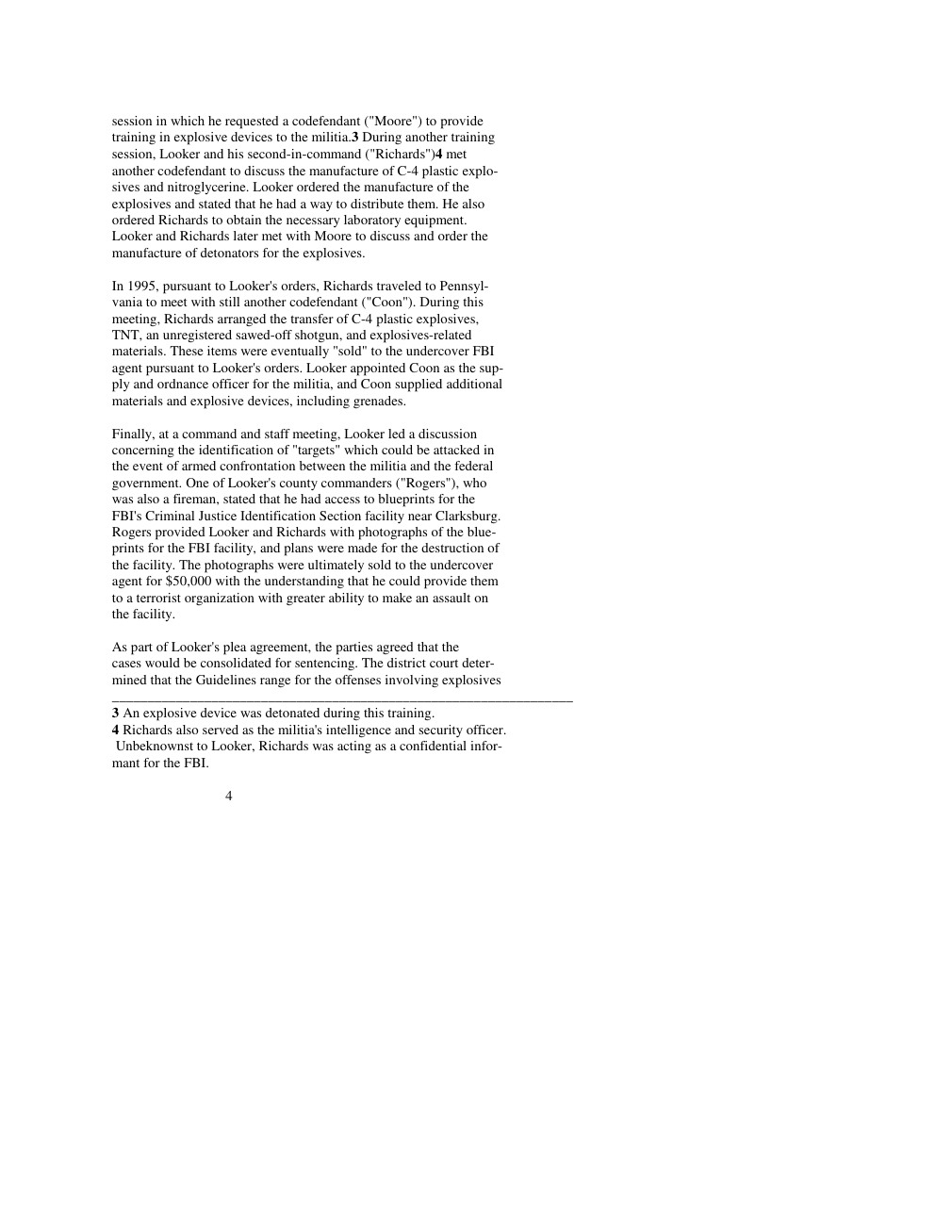
The appellate account distinguishes the informant and undercover buyer
The 1998 appellate opinion identifies Richards as a confidential informant and records a separate undercover buyer. Image credit ↗

Chapter 02 / 1995–1996

An informant and an undercover buyer were different actors

Okey Marshall Richards Jr. occupied an unusually important position. Inside the militia he served as an intelligence and security officer and as Looker’s second-in-command. Unknown to Looker, he was also a confidential FBI informant. A separate undercover FBI agent later posed as a broker able to pass material to a terrorist organization. Confusing these two actors obscures the question raised by the defense: which decisions originated with suspects, which opportunities were supplied by investigators, and what evidence survives of each stage?

The FBI’s 1997 annual report dates the investigation’s beginning to June 1995, following discussion of possible federal targets. Freeh’s January 1998 prepared testimony instead says August 1995. The reviewed records do not resolve whether those descriptions refer to different investigative stages. Both place the inquiry well before the October 1996 arrests. Contemporary reporting described extensive recordings, while the appellate opinion places Richards at meetings and transfers. The complete recordings and original handling files were not reviewed for this edition.

Defense challenges were more substantial than a generic denial of wrongdoing. Contemporary local reporting describes disputes over Richards’s credibility, finances and an asserted military background; lawyers questioned his incentives and sought access to him. Other objections addressed the basis for initiating an investigation and the breadth of the material-support statute. These were arguments about a real source and real governmental powers. They should not be collapsed into Looker’s much broader prediction that a government conspiracy would prevent any valid trial.

At the same time, the existence of an informant does not demonstrate that every participant lacked prior intent. The appeal records Looker’s orders, commissions and personal involvement, not simply his proximity to Richards. The sting plainly shaped the eventual buyer and transaction. Whether the same people would otherwise have attacked the complex is a further counterfactual, which a successful prosecution cannot answer with certainty. The firm conclusion is narrower: an infiltrated group participated in transactions that became the basis of convictions, and the investigation ended without a bombing of the facility.

Sources: S01 · S03 · S11 · S12 · S13

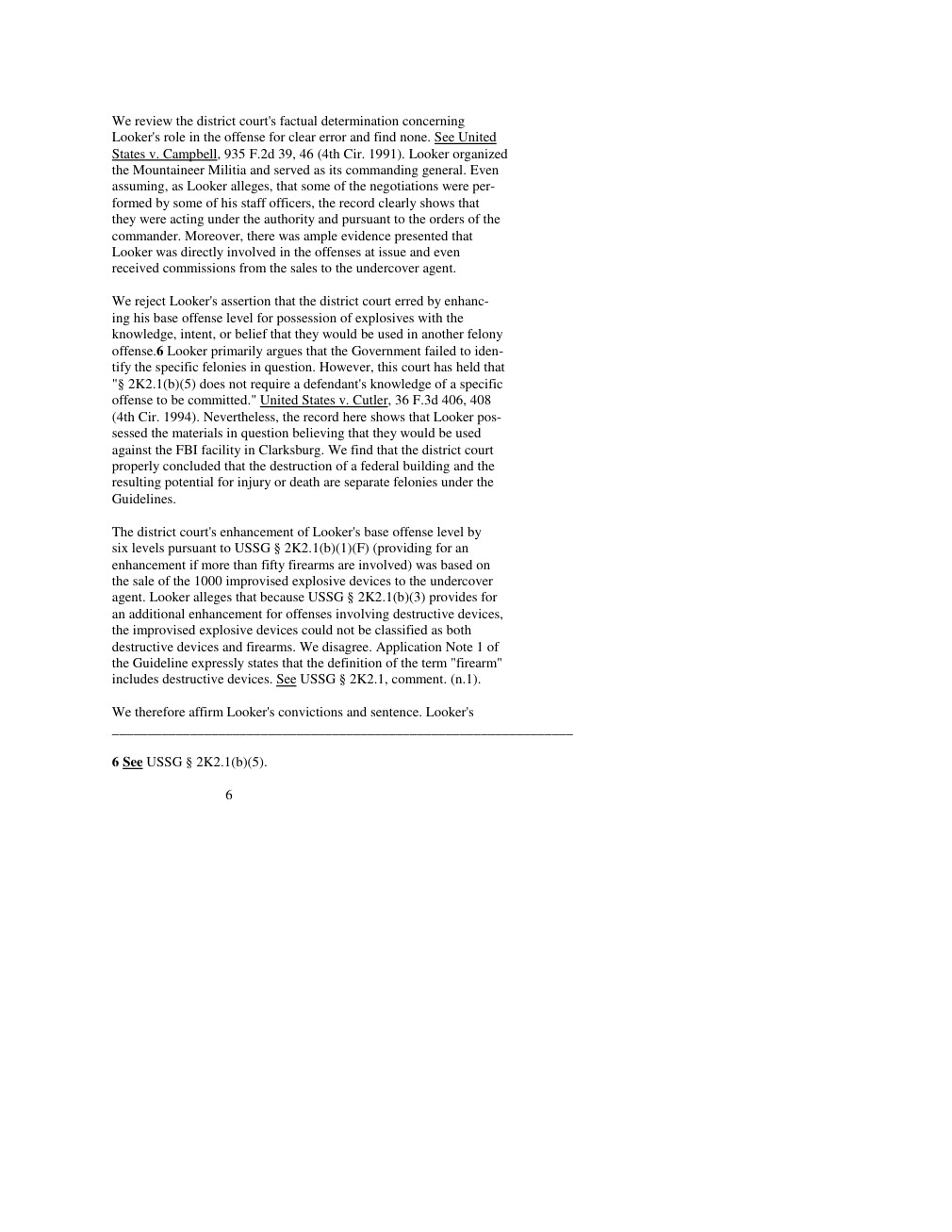
Appellate findings on Looker’s role and intended use
The appellate opinion evaluates Looker’s role and intended use, within an appeal from his actual convictions. Image credit ↗

Chapter 03 / 11 October 1996

The sale was real; the supposed foreign customer was fictitious

The building documents connected an insider’s access to a proposed act of violence. James “Rich” Rogers, a Clarksburg firefighter and militia officer, provided photographs of blueprints to Looker and Richards. The Fourth Circuit’s account describes a command meeting at which targets were discussed for the event of an armed confrontation with the federal government. It then describes plans involving the FBI complex and a sale based on the supposed customer’s greater capacity to attack it. That is evidence of intended assistance, not evidence that a foreign terrorist organization actually existed on the other side.

On 11 October 1996, Looker exchanged the photographed material for $50,000 from an undercover agent. Federal authorities then arrested him and six other men in the wider investigation. The FBI’s contemporaneous annual account says the arrests occurred before destruction at the facility. No completed bombing or resulting deaths at the complex belong in this case’s outcome. The sale, however, was more than a political statement: it transferred material for money in circumstances later treated as criminal support.

This distinction also separates two kinds of capability. The appellate record describes actual weapons-related transactions and Looker’s receipt of commissions. The imagined end user, by contrast, was a government-created identity. The record can support the proposition that Looker believed he was assisting a more capable attacker without proving that such an attacker was waiting to act. Neither the threat’s seriousness nor the investigation’s success requires converting that fiction into a real international network.

Early arrest and indictment reporting grouped seven suspects into a dramatic plot narrative. Their legal positions were never identical. Looker faced four cases; Rogers’s role centered on the photographs; others faced explosives and firearms allegations. The November grand-jury proceedings were separate from the October arrests. The later verdicts provide the necessary correction to any early collective description. In particular, allegations about the Ohio transactions cannot be carried forward as convictions of Johnson and Lewis after their acquittals. The transaction narrative must follow the evidence about each actor rather than the arrest photograph of a group.

Sources: S01 · S03 · S04 · S09

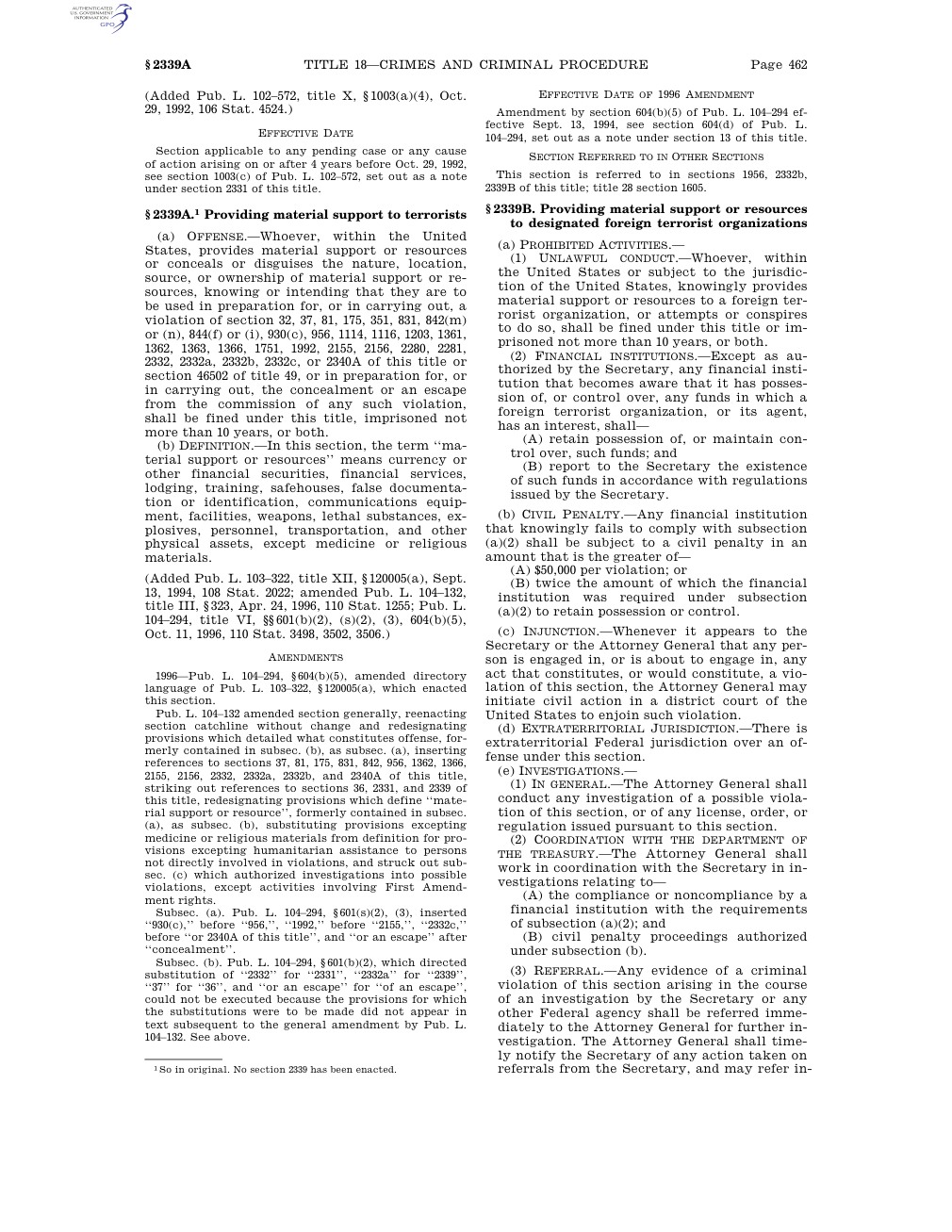
Historical material-support statute and amendment notes, 1996 edition
The 1996 U.S. Code page preserves the material-support law and its amendment history. Image credit ↗

Chapter 04 / 1994–1997

Material support was an existing law, with disputed boundaries

Section 2339A entered federal law in September 1994. It therefore predated the April 1995 Oklahoma City bombing. Congress amended it in 1996, including changes to the listed offenses and the earlier investigation provision. The Mountaineer prosecution became an early domestic use of this material-support offense. It was not an example of the government suddenly discovering that political dissent or militia membership was itself a newly created crime.

The relevant statute linked resources to specified crimes through knowledge or intent that they would be used in preparation for, or commission of, those crimes. A separate provision, section 2339B, addressed designated foreign terrorist organizations. The two should not be merged merely because the undercover buyer used a foreign-terrorist cover story. Looker’s eventual convictions included section 2339A and a conspiracy to provide material support, alongside the explosives and transport offenses.

The defense disputed whether photographed plans fit a broad statutory category of physical assets and whether the wording gave adequate notice. Contemporary reporting records a magistrate’s reservations as well as the prosecutor’s response that specific intent bounded the offense. A reservation during pretrial argument is evidence that a legal issue was contested; it is not a final judgment declaring the statute invalid. Nor can a later account of the law’s usefulness replace the actual verdicts and appeal.

Rogers’s trial demonstrates the importance of that last distinction. The contemporary verdict report records a material-support conviction and an acquittal on the conspiracy charge. His attorney argued that Looker and Richards had drawn him into criminal activity. Later sentencing coverage reported a year and a day in prison and his repudiation of the beliefs that had helped involve him. These developments establish a particular legal and personal sequence, not conviction on every accusation. This guide does not infer the outcome of a planned Rogers appeal from reporting that his lawyer intended to file one.

Modern discussions of domestic terrorism often cite the case as evidence that existing federal statutes can reach preparatory support. That is a defensible description of the prosecution’s legal significance. It remains different from a finding that every targeted person was guilty, every investigative tactic was necessary, or the same acts would have occurred without undercover intervention.

Sources: S01 · S05 · S06 · S09 · S12 · S16

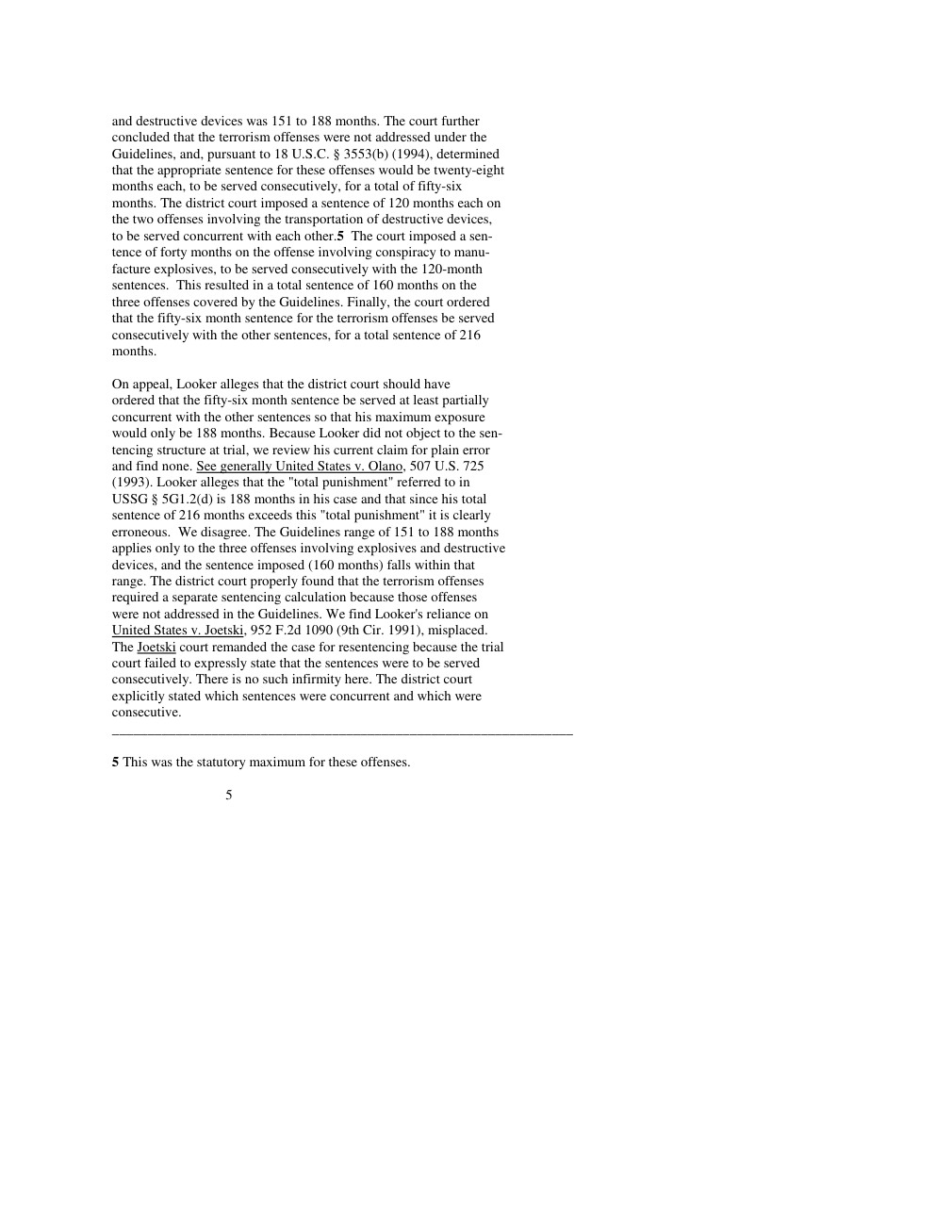
The appellate opinion explains the 216-month sentence
The appellate court explains how concurrent and consecutive terms produced 216 months. Image credit ↗

Chapter 05 / 1997–1998

Five convicted or pleading guilty; two acquitted

On 8 August 1997, a jury convicted Looker of conspiring to manufacture and deal in explosives without a license. He then entered guilty pleas in the other cases. The Fourth Circuit identifies two transport convictions, a material-support conspiracy and the material-support offense. Saying that a jury convicted him of every one of these crimes would erase the pleas and misdescribe how the record was created. The admissions and verdict were both legally consequential, but they were different proceedings.

Jack Phillips and Edward Moore pleaded guilty to explosives charges. Terry Coon was convicted by a jury on 27 October 1997; the FBI’s later report describes three interstate-explosives counts and two firearms violations. Coon received fifty-one months in prison on 13 April 1998, together with supervised release and a fine. These were adjudicated weapons-related offenses. Their relationship to the broader plot should not be used to replace their actual statutory descriptions.

James M. Johnson and Imam A. Lewis were acquitted. The FBI’s own 1997 annual report acknowledges that two Ohio men were acquitted, and the later University of Arkansas case study names them. That result must remain visible wherever their arrest or alleged sales are discussed. The reviewed materials do not supply a sufficiently detailed trial record to explain each jury decision or assign an exact acquittal date. An acquittal is a legal result, not a historical blank that can be filled by repeating the original complaint.

Looker’s combined sentence was 216 months: 160 months for the explosives and destructive-device cases and an additional fifty-six months for the terrorism offenses. The court explained which terms ran concurrently and which consecutively. The eighteen-year total was upheld on appeal. A claim that the sentencing court simply treated all militia members as one interchangeable group cannot account for these different proceedings, pleas, verdicts and penalties.

The individual table below keeps those distinctions together. It also shows why the defensible summary is five defendants convicted or pleading guilty and two acquitted, rather than seven convicted terrorists. That precision does not minimize the crimes proved against Looker or the other convicted defendants. It identifies the limits of what the state actually established about each person.

Sources: S01 · S03 · S04 · S08 · S09 · S10

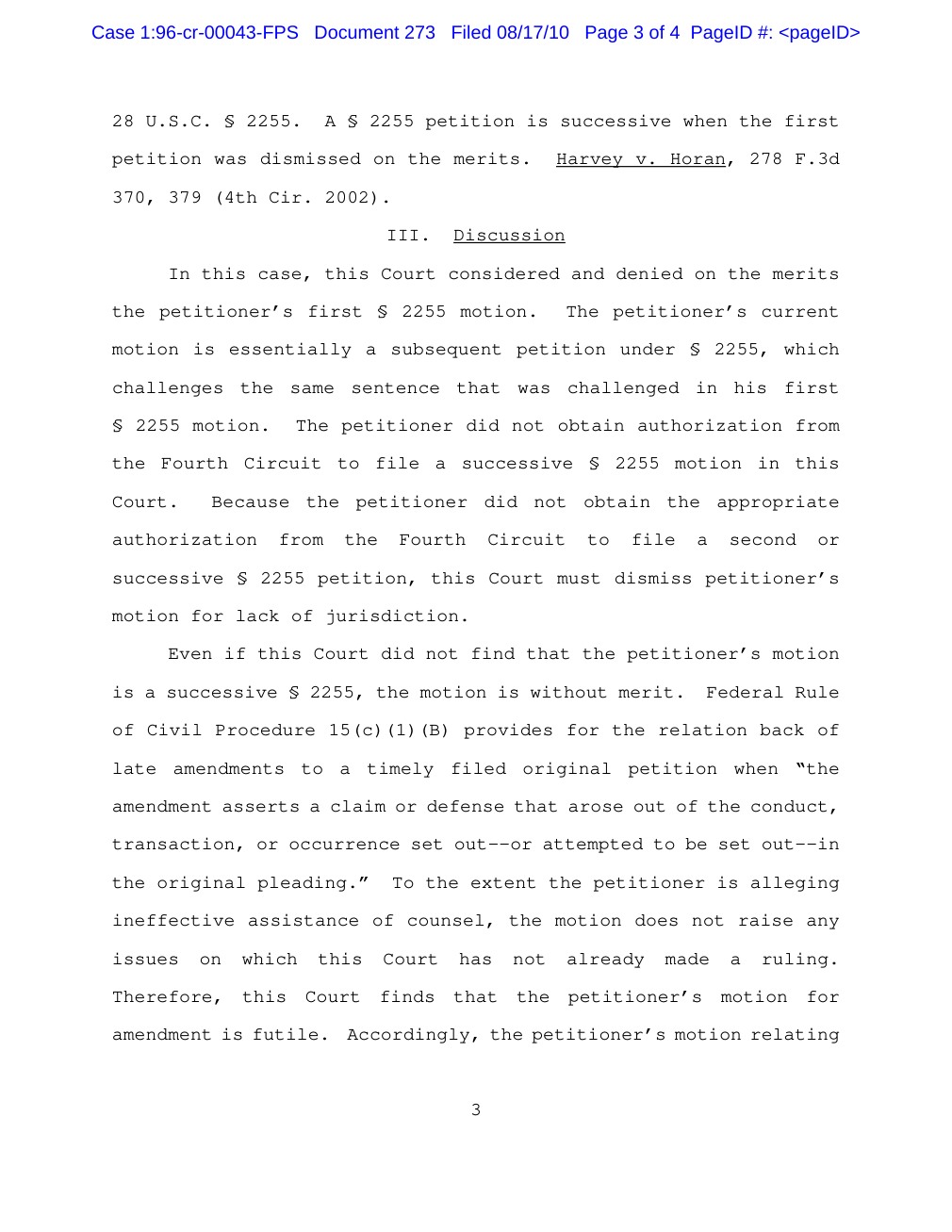
The 2010 order applies successive-petition and futility grounds
The 2010 order distinguishes an unauthorized successive petition from a fresh evidentiary proceeding. Image credit ↗

Chapter 06 / 1998–2010

The judgments survived; later review had limits

The Fourth Circuit affirmed Looker’s convictions and sentence on 31 December 1998. The seven-page opinion was unpublished and stated that it was not binding precedent under the circuit’s then-current rule. Its importance here is documentary: it records the offenses, sentence, principal appellate arguments and court’s disposition in this individual case. Its unpublished status does not make that disposition disappear.

Looker challenged the consecutive sentencing structure, his classification as an organizer or leader, and enhancements involving the intended use and legal treatment of destructive devices. He argued that some negotiations had been performed by staff officers. The court answered that the record showed those officers acting under his authority and orders, as well as his own participation and commissions. It rejected his argument for a lower total sentence and upheld the challenged enhancements.

The judges also allowed a supplemental filing in which Looker asserted problems including statutory vagueness, trial security, the plea agreement, his attempted plea withdrawal and misleading government statements. They rejected those claims without the detailed treatment given to the sentencing issues. That establishes an adverse appellate result. It does not supply a complete factual investigation of every possible allegation about the informant, nor justify inventing a separate published entrapment ruling.

The later district-court order of 17 August 2010 is narrower still. It recounts the denial of his first post-conviction motion and subsequent unsuccessful efforts to obtain further review. The new motion was treated as a successive challenge for which he lacked appellate authorization. The court also said the proposed amendment was futile because the ineffective-assistance issues had already been ruled upon. This was not a new trial about whether the FBI had created the entire case.

The legal outcome and the historical questions can therefore coexist. Looker’s convictions and sentence remained affirmed in the reviewed record. The complete recordings, informant instructions, trial transcripts and original motion files were not independently audited. Authenticated material showing a consequential fabrication, coercion or suppressed exculpatory evidence could alter a historical assessment and might support legal proceedings. Merely pointing to the existence of a sting does not itself change the judgment already entered.

Sources: S01 · S02

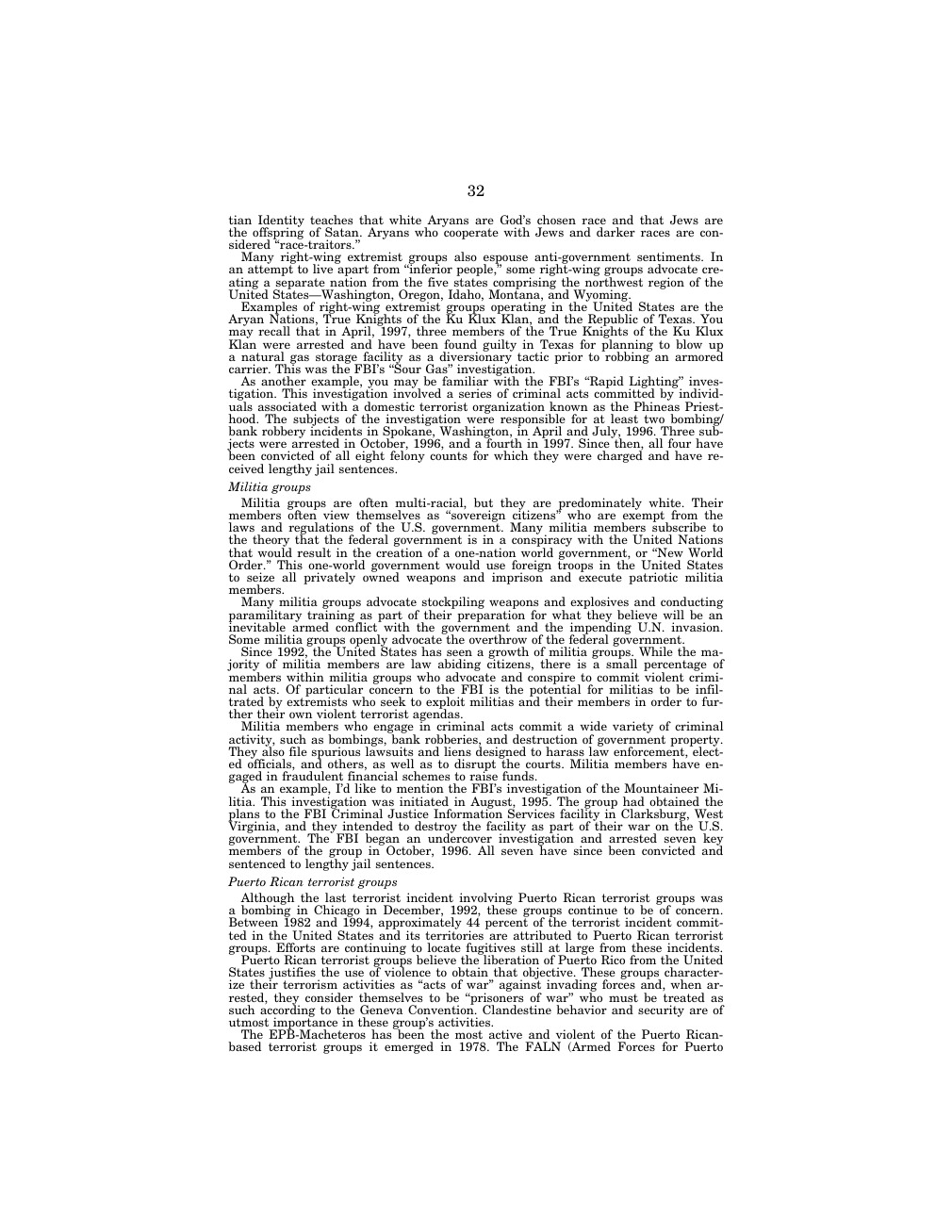
Printed 1998 prepared statement contains the inaccurate collective verdict claim, printed 32
The printed 1998 hearing preserves the inaccurate all-seven-convicted statement, which conflicts with the agency’s own annual verdict summary. Image credit ↗

Chapter 07 / 1998–2023

A successful sting became several different stories

The case did not leave a single stable public account. Law-enforcement reports presented prevention: records and dangerous material reached controlled buyers before any attack on the FBI complex occurred. Whitsel later examined how a small faction could turn a defensive political identity toward violence. Zac Parker used the sting as an example in a broader critique of material-support law, state cultivation and unequal counterterrorism enforcement. Those accounts ask different questions, even when they share the same underlying sale.

An important error appears in the prepared statement attributed to FBI Director Louis Freeh at the Senate Intelligence Committee’s 28 January 1998 hearing. It says all seven had been convicted and received lengthy sentences. The printed hearing and the Yale-hosted transcript preserve that assertion. Yet the FBI’s own annual report records two acquittals, and Coon’s sentencing came in April 1998. Institutional authority did not make the collective verdict summary accurate. The contradiction concerns the reported outcomes; it does not by itself show that the underlying transactions were fabricated.

The later narratives also have visible source dependencies. Whitsel cites trial transcripts, contemporary reporting and a former member interviewed in 1999. Parker’s Mountaineer paragraph cites a 1996 watchdog account rather than presenting newly discovered recordings. The Justice Department’s 2023 prosecutorial discussion cites the Looker appeal and contemporary news. Repetition across these publications should not be counted as three independent witnesses to an event. Their analytical differences remain useful, but their evidentiary roots need to remain attached.

Some claimed cultural links remain less secure. Whitsel describes alternative media and a militia video, America Under Siege, while explicitly noting that he could not obtain the video. This edition likewise does not claim to have watched it or the original recruitment footage. Books reported as influences are not treated as if their full texts had been read. No general audience ranking, prevalence estimate or measured popularity contest between the rival accounts is available from this source sample.

The case’s durable lesson lies in the conjunction of findings: serious, adjudicated preparatory crimes; an investigation that helped create the transaction it detected; defendants with distinct legal outcomes; and official as well as oppositional narratives that require checking. None of these facts licenses a prediction of exactly what would have happened without the FBI. Together they define what a more complete release of recordings, instructions and trial records would need to explain.

Sources: S03 · S07 · S11 · S14 · S15 · S16 · S17

02 / The record

The critical path

Specific orders/transactions, intended assistance, individual dispositions and review lead. The sting and no actual attack are part of that yardstick.

Evidence support rates the particular hinge. Cultural prominence is Unmeasured; textual recurrence in inspected accounts is not an audience or polling rank.

CP1

Organization is connected to acts through specific roles

Official-record yardstick

Looker’s organizer/commander role and orders are recorded in the appeal; membership alone is not criminal guilt.

The appeal’s leadership analysis depends on Looker’s authority over staff, personal participation and commissions. It does not turn a general political belief into proof against every member.

Why it is critical

It identifies who directed what, while preserving the broader organization and the two acquittals.

If this step is removed

Remove proof of individual agreement/ordering and the account becomes guilt by association. Removing militia membership would not itself erase the transactions.

Dependencies

Formation and political beliefs precede the charged acts; official rank does not authorize private crime.

What rival readings must explain

A purely political-persecution account must explain Looker’s orders/commissions; a collective-guilt account must explain the acquittals.

Gaps and disputes

Complete membership and internal orders not reviewed; retrospective factional study cannot assign guilt to everyone.

Evidence support: High for Looker’s judicially reviewed role

The specified hinge in the selected documentary record.

The appeal expressly upholds leadership findings and personal participation; factional context is less direct.

Cultural prominence: Unmeasured

General audience familiarity and comparative cultural prominence; not the evidence-support scale.

The inspected scholar and court opinion foreground leadership; general public familiarity unmeasured.

Sources: S01 · S03 · S07

CP2

The state participates through two different channels

Official-record yardstick

Richards was a confidential informant; a separate FBI agent posed as the buyer.

Richards could both report conduct and participate in meetings. The buyer could solicit and complete a transaction under a false identity. Their separate positions are necessary to examine origin, opportunity and intent.

Why it is critical

Their positions show how state intervention could shape events and evidence without making every participant a government agent.

If this step is removed

Without an undercover buyer, the actual sale’s end customer was not real; without Richards, the observed record and opportunities would differ in unknown ways.

Dependencies

Informing/meetings precede the controlled purchase; Looker’s knowledge of the buyer’s identity differs from ours.

What rival readings must explain

Success accounts must explain government created opportunities; fabrication accounts must identify actual inducement or false evidence.

Gaps and disputes

Full recordings, initial contact records, handler logs and tasking instructions were not reviewed. June and August 1995 start descriptions conflict.

Evidence support: High for identities; incomplete for full influence

The specified hinge in the selected documentary record.

Court opinion identifies both roles; reader excerpts record actual defense challenges but do not settle them.

Cultural prominence: Unmeasured

General audience familiarity and comparative cultural prominence; not the evidence-support scale.

The selected defense and criticism emphasize intervention; this is textual emphasis, not audience ranking.

Sources: S01 · S03 · S12 · S13 · S15

CP3

A controlled sale connects documents to intended assistance

Official-record yardstick

11 October 1996 exchange for $50,000 with fictitious terrorist broker cover; no attack on the facility.

Photographs moved from Rogers to Looker and Richards and then to a controlled buyer. The court’s account attaches intended assistance to that transfer; it does not authenticate a real foreign recipient.

Why it is critical

It is the demonstrated transaction behind material support, distinct from an actual foreign network or completed bombing.

If this step is removed

Without transfer/knowledge evidence, the material support account weakens; removing a fictional actual foreign customer changes nothing because it never existed.

Dependencies

Acquisition of photographs and target discussion precede exchange; buyer identity and defendant belief must be separated.

What rival readings must explain

A harmless-talk account must explain intent and transfer; an inevitable mass-attack account must supply uncontrolled capability/timing beyond the sting.

Gaps and disputes

The full plans and recordings were not reviewed. The sources do not supply certainty about an attack, date or casualties without the sting.

Evidence support: High for transaction and judicially stated intent

The specified hinge in the selected documentary record.

Official contemporary account and appeal consistent on sale; the appeal reviews actual convictions and findings.

Cultural prominence: Unmeasured

General audience familiarity and comparative cultural prominence; not the evidence-support scale.

Sale is repeated in the inspected reports, scholarship and critique; relative cultural prominence unmeasured.

Sources: S01 · S03 · S04

CP4

Legal outcomes divide the original seven

Official-record yardstick

Five defendants were convicted or pleaded guilty; two were acquitted. Rogers was also acquitted of conspiracy.

The original arrest group did not produce one collective judgment. Verdicts and pleas differ by person and count, and Rogers’s own result included both conviction and acquittal.

Why it is critical

This prevents arrest allegations or false official all-seven claim from becoming every person’s record.

If this step is removed

Without verdict/plea precision, the guide would mislabel two acquitted people and misdescribe the basis of Looker’s convictions.

Dependencies

Investigation and charges lead to individual trial/plea decisions; one person’s judgment cannot decide another’s guilt.

What rival readings must explain

Broad threat and success accounts must retain acquittals; broad systematic fabrication accounts must explain convictions/pleas and their actual evidence.

Gaps and disputes

Original verdict forms and some individual appeals not retrieved; exact Ohio acquittal dates unknown.

Evidence support: High for core count; individually bounded

The specified hinge in the selected documentary record.

FBI annual report acknowledges two acquittals; later case study identifies names; Rogers mixed verdict reported contemporaneously.

Cultural prominence: Unmeasured

General audience familiarity and comparative cultural prominence; not the evidence-support scale.

Prepared testimony overstates outcomes; selected later reporting corrects. General reach and belief unmeasured.

Sources: S01 · S03 · S08 · S09 · S18

CP5

Affirmance is a legal result, not a complete archive

Official-record yardstick

31 December 1998 appeal affirms 216 months; 17 August 2010 order rejects later motion.

The appellate judges reviewed specified legal and sentencing issues. The later district order applied limits on successive proceedings; its procedural result is not a new investigation of all source conduct.

Why it is critical

It anchors current reviewed legal outcome without converting procedural review into proof every tactic was necessary or flawless.

If this step is removed

Without affirmance, the procedural history changes; without full tactic files, the judgment still stands but wider historical questions remain.

Dependencies

Convictions/sentencing precede appeal; successive motion requires authorization.

What rival readings must explain

A wrongful conviction account needs material authenticated error; an unqualified vindication account must not claim unlitigated issues were all factually disproved.

Gaps and disputes

No exhaustive post-2010 docket search or full trial/recording audit. Unpublished opinion not binding precedent.

Evidence support: High for reviewed judicial disposition

The specified hinge in the selected documentary record.

Authentic court PDFs state outcomes, dates and review grounds.

Cultural prominence: Unmeasured

General audience familiarity and comparative cultural prominence; not the evidence-support scale.

Inspected legal histories cite affirmance; general awareness unmeasured.

Sources: S01 · S02

CP6

Later accounts inherit evidence and sometimes errors

Official-record yardstick

Printed Freeh statement reports all seven convicted; annual report and later sources contradict it.

The inaccurate claim survives in an authentic prepared statement, while the same institution’s annual report preserves the contrary count. Comparing exact propositions resolves this discrepancy more reliably than choosing one institution to trust.

Why it is critical

It shows exactly why institutional claims and later repetitions need source checking.

If this step is removed

Removing Freeh’s statement does not remove the crimes or acquittals; removing the verdict check leaves a false collective memory.

Dependencies

CP1–CP5 supply conduct and judgments against which success, radicalization and sting criticism can be tested.

What rival readings must explain

Institutional trust accounts must explain wrong outcome statement; counter-conspiracy accounts must show causal effect rather than infer fabrication from an error.

Gaps and disputes

Audience prevalence unmeasured; no original video playback/unread-book omission claim. Source reuse is not independent corroboration.

Evidence support: High for documented contradiction; open for effects

The specified hinge in the selected documentary record.

Actual printed hearing and annual report preserve incompatible outcome statements.

Cultural prominence: Unmeasured

General audience familiarity and comparative cultural prominence; not the evidence-support scale.

Contrasting emphases documented only in the inspected corpus; no poll or ordinal popularity claim.

Sources: S03 · S07 · S14 · S15 · S16 · S17

03 / The record

How the accounts developed

Direct citations and specified source dependencies are distinguished from parallel arguments and unverified borrowing. No unread book/film lineage is invented.

1994–1996

Defense, constitutional authority and perceived global threat

Public emergency mission and threat beliefs gave conditional target talk a meaning for members; Looker’s attributed statement asserted protection from prosecution.

Lineage

Threat narratives → organizational self-description → asserted legal/moral justification.

Borrowing or relationship

Whitsel reports media links and interview recollections; this edition does not claim direct reading of Griffin/Keith books or a particular copied passage.

Evidence for the connection

The actual published statement and Whitsel’s specified source base establish reported beliefs; the appeal tests specific acts against law.

Recurring path nodes

CP1CP3CP4

Branches in this record

Source skepticism becomes a defense argument · An institutional prevention story preserves an outcome error

Sources: S01 · S07 · S11

1996–1998

Source skepticism becomes a defense argument

Pretrial lawyers challenged Richards’s credibility and influence; Rogers’s lawyer said he was drawn in.

Lineage

Witness/investigation dispute → statutory and individual defense claims.

Borrowing or relationship

Contemporaneous arguments are explicit. Not all later criticism is proven to borrow from these lawyers.

Evidence for the connection

Selected reader excerpts and verdict story identify arguments; full motions and recordings unreviewed.

Recurring path nodes

CP2CP3CP4CP5

Branches in this record

The sting becomes a warning about counterterrorism powers

Sources: S09 · S12 · S13

1997–1998 →2023

An institutional prevention story preserves an outcome error

Annual reports present prevention and different outcomes; Freeh printed testimony incorrectly collects them into all seven convicted. Later DOJ legal discussion reuses the appeal.

Lineage

Case files/judgments → agency reports/testimony → prosecutorial legal example.

Borrowing or relationship

DOJ footnotes directly cite the appeal. No evidence that all later writers copied Freeh’s error; the contradiction is demonstrated in this sample.

Evidence for the connection

Retained annual PDFs, printed hearing and DOJ footnotes expose actual dependencies.

Recurring path nodes

CP3CP4CP5CP6

Branches in this record

Behavioral explanations reuse a common evidentiary base

Sources: S01 · S03 · S15 · S16

1996 watchdog account → 2021 critique

The sting becomes a warning about counterterrorism powers

Parker uses Mountaineer within a broader critique of cultivation and racialized enforcement.

Lineage

Contemporary watchdog report → retrospective policy argument.

Borrowing or relationship

Parker’s Mountaineer paragraph cites Anti-Defamation League (1996), “The Mountaineer Militia’s Long, Slippery Slope,” The Militia Watchdog, October 21. Personal authorship was not verified. The original watchdog article was not retrieved; no independent full reading claimed.

Evidence for the connection

Actual article and reference entry show citation relationship; no invented book-to-film lineage.

Recurring path nodes

CP2CP3CP6

Branches in this record

Behavioral explanations reuse a common evidentiary base

Sources: S14

Trial records/reporting → 2005–2006 research

Behavioral explanations reuse a common evidentiary base

Whitsel studies factional change; Arkansas research catalogues preparation and outcomes.

Lineage

Judicial/reporting materials → distinct research questions.

Borrowing or relationship

Whitsel identifies trial pages and former-member interview; grant study provides source list. Later agreement does not create independent eyewitnesses.

Evidence for the connection

Read case passages and notes make evidentiary reuse visible; trial transcripts not independently retrieved.

Recurring path nodes

CP1CP2CP3CP4CP6

Branches in this record

The sting becomes a warning about counterterrorism powers

Sources: S07 · S08

04 / The record

Rival readings on the same path

The strongest versions, the steps they accept or revise, and the evidence they would need.

Interpretation 01

A dangerous conspiracy interrupted before an attack

Strong core support; inevitability not established

The strongest version

Looker directed actual illicit transactions and sold plans believing they would assist attacks on a federal facility. Early intervention can prevent harm without waiting for an explosion.

Accepts

Orders, transactions and convictions.

Must still explain

The customer was fictitious and the FBI shaped opportunities; two people were acquitted.

Assessment

The appeal supports specific intent and conduct. It does not prove a scheduled inevitable attack or maximum casualty scenario.

Accept these path nodes

Remove or revise this inference

  • Remove any inference from a support conviction to a completed or inevitable attack.

Add this evidence

  • Independent pre-intervention intent, capability and timing evidence.

What would change this assessment

Authenticated pre-sting orders, independent buyers, dated attack commitments or contrary recordings would clarify how much danger existed outside the controlled transaction.

Sources: S01 · S03 · S04

Interpretation 02

Investigators cultivated the crime they then announced

Intervention established; full fabrication not established

The strongest version

A central informant and fictitious buyer created opportunities, rewards and an audience that could move boastful politics toward prosecutable conduct. Credibility, incentives and the full conversations matter.

Accepts

Sting and government participation; the sale occurred.

Must still explain

Looker’s orders, commissions, actual transfers and pleas are part of the record; not all participants were convicted.

Assessment

State participation is documented. Case-specific illegal inducement or fabrication requires more than the buyer’s secret identity or a general critique of stings.

Accept these path nodes

Remove or revise this inference

  • Revise claims of independent foreign demand and certainty that suspects would act without state intervention.

Add this evidence

  • Authenticated initiation chronology, inducement, refusals and material evidentiary defects.

What would change this assessment

Complete authenticated recordings, source instructions, payment records and documented refusals/pressures linked to each charged act would materially change the causal assessment.

Sources: S01 · S12 · S13 · S14

Interpretation 03

Political organization was mistaken for individual criminal intent

Valid boundary; inadequate as a blanket innocence account

The strongest version

Constitutional beliefs, group membership and conditional talk of defense should not automatically establish intent to support violent crime. Peripheral defendants require separate proof.

Accepts

Protected politics and individual proof; Ohio acquittals and Rogers mixed verdict.

Must still explain

Specific transactions, knowledge findings and the affirmed leader conviction need explanation.

Assessment

The two acquittals make the boundary concrete. They do not erase other people’s pleas or verdicts; Looker’s broad constitutional assertion was not a legal immunity.

Accept these path nodes

Remove or revise this inference

  • Remove guilt by membership and collective seven-convicted descriptions.

Add this evidence

  • Individual knowledge, agreement and act evidence; actual charge-by-charge dispositions.

What would change this assessment

Original verdict forms, full statements and trial instructions could clarify which specific inferences failed or extended to each individual.

Sources: S01 · S03 · S08 · S09 · S11

Interpretation 04

The prosecution demonstrates a useful law with broader costs

Legal utility documented; policy consequence debated

The strongest version

Existing material support law can reach dangerous preparatory assistance, while its breadth and undercover use can raise fairness and unequal-enforcement concerns. These are compatible policy questions.

Accepts

Actual convictions and statutory knowledge/intent requirements.

Must still explain

Comparative policy criticism does not decide this case’s guilt; prosecutor success does not establish fair application everywhere.

Assessment

The historical statute and DOJ discussion show legal reach; Parker’s criticism raises questions about state cultivation and racialized enforcement. No equivalent dataset was independently audited here.

Accept these path nodes

Remove or revise this inference

  • Remove claims that either a useful statute or broad policy criticism automatically settles every individual case.

Add this evidence

  • Comparable charging and informant data, with consistent population and period.

What would change this assessment

Comparable case files with consistent definitions, charging decisions, source conduct and review outcomes would test broader policy claims.

Sources: S05 · S06 · S14 · S16

05 / The record

What public accounts emphasize

Comparisons apply only to the read prepared statement, article sections and legal example. No whole-book omissions or film/audio playback claimed.

Freeh’s prepared Senate statement, 1998

Selected Mountaineer/domestic-threat passages in actual printed hearing and Yale transcript.

Amplifies

Danger and prevention; distinguishes law-abiding majority from criminal minority.

Recasts or leaves unresolved

Says all seven convicted/sentenced despite two acquittals and later Coon sentencing. The success frame compresses individual outcomes.

Scope and limits

Statement error is verified against printed record; no audio playback or claim about private intent behind the error.

CP1CP3CP4CP6

Sources: S03 · S15 · S17

Whitsel’s movement analysis, 2005

Read pp 72–82 and 95–97; not entire article or books it cites.

Amplifies

Belief change and radical faction within a larger organization.

Recasts or leaves unresolved

Retrospective interpretation and anonymous former-member recollection are not full recordings of the transactions.

Scope and limits

Explicitly did not obtain America Under Siege video; no film omission audit claimed here.

CP1CP2CP3CP6

Sources: S07

Parker’s criticism of material-support stings, 2021

Read pp 354–356 and Mountaineer references; comparative claims not independently recomputed.

Amplifies

State cultivation, broad statutory reach and unequal enforcement.

Recasts or leaves unresolved

The brief Mountaineer example depends on the 1996 watchdog account, not new trial findings. General post-2001 entrapment claims are not case-specific judgments.

Scope and limits

No assessment of unread citations or assertion that this article proves illegal entrapment here.

CP2CP3CP5CP6

Sources: S14

DOJ’s legal-use example, 2023

Article case passage pp 122–123 and surrounding legal explanation read.

Amplifies

Existing section 2339A as available tool against preparatory assistance; correctly separates Looker verdict and later pleas.

Recasts or leaves unresolved

Case illustration does not inspect full source handling or provide a complete verdict list for every original defendant.

Scope and limits

It cites appeal and news; not independent corroboration. Its 30 December appeal citation yields to the official 31 December heading.

CP3CP4CP5CP6

Sources: S01 · S16

06 / The record

Find a thread in the file

Search the chapter and claim index. Every result leads to the full text and its sources.

Chapter 01A citizen-militia claim meets individual criminal actsChapter 02An informant and an undercover buyer were different actorsChapter 03The sale was real; the supposed foreign customer was fictitiousChapter 04Material support was an existing law, with disputed boundariesChapter 05Five convicted or pleading guilty; two acquittedChapter 06The judgments survived; later review had limitsChapter 07A successful sting became several different storiesPersonFloyd Raymond “Ray” LookerPersonOkey Marshall Richards Jr.PersonUndercover FBI buyerPersonJames “Rich” RogersPersonJack Arland PhillipsPersonEdward F. “Fred” MoorePersonTerrell P. “Terry” CoonPersonJames M. JohnsonPersonImam A. LewisPersonFrederick P. Stamp Jr.PersonGary ZimmermanPersonLouis J. FreehPersonBradley C. WhitselPersonZac ParkerPersonWilliam D. WilmothTimelineMountaineer Militia takes shapeTimelineMaterial-support law enactedTimelineOklahoma City bombing changes the settingTimelineAnnual report dates investigation to JuneTimelineRichards participates while informingTimelineCongress amends section 2339ATimelineBlueprint photographs exchanged for $50,000TimelineGrand jury indictmentsTimelineAttributed Looker statement predicts no trialTimelineDefense challenges source and predicateTimelineInformant access and statutory argumentsTimelinePhillips and Moore plead guiltyTimelineJohnson and Lewis acquittedTimelineLooker jury convictionTimelineLooker pleads in remaining casesTimelineRogers mixed verdictTimelineCoon jury convictionTimelinePrepared testimony overstates verdictsTimelineRogers receives a year and a dayTimelineLooker receives 216 monthsTimelineCoon sentenced to 51 monthsTimelineFourth Circuit affirms LookerTimelineFirst post-conviction motionTimelineFirst motion deniedTimelineAppeal dismissed without certificateTimelineSuccessive authorization deniedTimelineWhitsel publishes factional analysisTimelineGrant report receivedTimelineLater motion deniedTimelineParker critiques material-support stingsTimelineDOJ journal revisits legal significanceClaimThe FBI complex was bombed by this group.ClaimAll seven arrested men were convicted.ClaimLooker’s material-support counts were jury verdicts.ClaimRogers was convicted on every charge.ClaimRichards and the undercover buyer were the same person.ClaimLooker’s 216-month sentence was affirmed.ClaimThe support law was created only after Oklahoma City.ClaimAn actual foreign terrorist organization bought the plans.ClaimMilitia membership by itself proves participation.ClaimThe FBI helped shape the prosecuted transaction.ClaimWithout the FBI an attack was certain.ClaimThe existence of a sting proves illegal entrapment.ClaimThe 2010 order retried every misconduct allegation.ClaimLater accounts are independent corroboration simply because they agree.ClaimThe Freeh outcome error appears in the printed hearing.

07 / The record

People and institutions

Open a record for the person’s role and supporting sources. Names identify people; no unverified portrait is substituted for a participant.

LookerBiographical record
Floyd Raymond “Ray” LookerOrganizer and commander

Organized the Mountaineer Militia. A jury convicted him of explosives conspiracy, followed by pleas on other offenses. His total 216-month sentence and convictions were affirmed.

Sources: S01 · S02 · S03

RichardsBiographical record
Okey Marshall Richards Jr.Confidential FBI informant

Militia intelligence/security officer and second-in-command who secretly informed for the FBI. Distinct from the undercover buyer. Credibility and influence were challenged; complete handling records not reviewed.

Sources: S01 · S12 · S13

buyerBiographical record
Undercover FBI buyerAgent posing as a broker

Purchased material under a fictitious terrorist cover. The record does not establish an actual foreign customer or completed attack. Name not asserted.

Sources: S01 · S03 · S04

RogersBiographical record
James “Rich” RogersFirefighter and militia officer

Provided photographed blueprints. Material-support conviction and conspiracy acquittal reported 25 August 1997; sentenced to a year and a day 2 February 1998. His planned appeal is not treated as a verified reversal or affirmance.

Sources: S01 · S09 · S10

PhillipsBiographical record
Jack Arland PhillipsExplosives case defendant

Pleaded guilty to explosives charges, according to the FBI 1997 report. Exact individual sentence not established by the reviewed sources.

Sources: S03 · S08

MooreBiographical record
Edward F. “Fred” MooreExplosives case defendant

Appeal describes involvement in explosives-related meetings/training. Pleaded guilty to explosives charges. Exact individual sentence not asserted.

Sources: S01 · S03 · S08

CoonBiographical record
Terrell P. “Terry” CoonWeapons-related defendant

Jury conviction 27 October 1997; FBI 1998 records three interstate-explosives and two firearms violations, 51 months 13 April 1998.

Sources: S03 · S18

JohnsonBiographical record
James M. JohnsonOhio defendant, acquitted

Associated with Ohio Unorganized Militia in the FBI 1996 report. Later acquitted; arrest allegations are not a conviction or proof of common guilt.

Sources: S03 · S04 · S08

LewisBiographical record
Imam A. LewisOhio defendant, acquitted

Arrested on interstate weapons/explosives allegations and later acquitted. No collective conviction inferred from another defendant’s appeal.

Sources: S03 · S04 · S08

StampBiographical record
Frederick P. Stamp Jr.U.S. district judge

Presided over the federal cases and sentencing; authored 17 August 2010 post-conviction order. Different judgments and review standards remain distinct.

Sources: S01 · S02

ZimmermanBiographical record
Gary ZimmermanRogers defense lawyer

Contemporary verdict report attributes to him the argument that Looker and Richards drew Rogers into crime. Statement is an actual defense position, not a final factual ruling.

Sources: S09

FreehBiographical record
Louis J. FreehFBI director

Prepared 28 January 1998 statement describes investigation as success but incorrectly reports all seven convicted/sentenced. Printed hearing preserves claim; actual annual report records two acquittals.

Sources: S03 · S15 · S17

WhitselBiographical record
Bradley C. WhitselScholar

2005 study examines movement beliefs and a small radical faction using transcript citations, reporting and a former-member interview. Retrospective analysis is not independent transaction evidence.

Sources: S07

ParkerBiographical record
Zac ParkerScholar and critic

2021 article critiques state cultivation and unequal application of counterterror law. Mountaineer paragraph cites a 1996 watchdog account; does not establish case-specific entrapment judgment.

Sources: S14

WilmothBiographical record
William D. WilmothU.S. attorney

Government counsel identified in the Looker appeal; office prosecuted the cases. Official accounts are checked against judgments rather than treated as deciding proof.

Sources: S01 · S13

08 / The record

The transactions, the trials and the aftermath

Horizontal spacing shows elapsed time; separate rows keep close events selectable. Scroll the graph on narrow screens. Exact dates are attributed where records conflict; month- and year-only dates preserve source precision.

19942001200920162024
Mountaineer Militia takes shapeOrganization

Looker promotes a citizen organization in West Virginia; precise founding day not established.

Sources: S07

Material-support law enactedLaw

Section 2339A added to federal law, before Oklahoma City.

Sources: S05

Oklahoma City bombing changes the settingContext

Later study connects heightened threat beliefs to militia leadership. No Mountaineer responsibility for that bombing is asserted.

Sources: S07

Annual report dates investigation to JuneInvestigation

FBI 1997 dates beginning to June; later prepared testimony says August. Month-only precision and conflict retained.

Sources: S03 · S15

Richards participates while informingInvestigation

The appellate account places confidential informant Richards in dealings and meetings. No unsupported handler start day invented.

Sources: S01

Congress amends section 2339ALaw

Amendment history records changes to material support law; modern wording not backdated.

Sources: S06

Blueprint photographs exchanged for $50,000Transaction

Looker sells material to undercover buyer posing as broker; arrests begin. No actual foreign customer materializes.

Sources: S01 · S04

Grand jury indictmentsProsecution

District 2010 order dates indictment 8 November, separate from October arrests.

Sources: S02

Attributed Looker statement predicts no trialDefense

Publisher transcript asserts government conspiracy and constitutional protection. No original audio authenticated.

Sources: S11

Defense challenges source and predicateDefense

Selected contemporary reader excerpts report challenges to informant credibility and investigation. Not full motion file.

Sources: S12

Informant access and statutory argumentsDefense

Contemporary excerpts describe requests for access and asset wording dispute. No final invalidity ruling inferred.

Sources: S13

Phillips and Moore plead guiltyOutcome

FBI report records pleas before Looker’s later plea; exact dates unverified.

Sources: S03

Johnson and Lewis acquittedOutcome

FBI annual reports two Ohio acquittals; later case study identifies names. Exact days not established.

Sources: S03 · S08

Looker jury convictionOutcome

Explosives conspiracy conviction; later cases resolved by pleas.

Sources: S01 · S03

Looker pleads in remaining casesOutcome

Appeal records transport/material support offenses. Exact plea day not asserted from reviewed primary.

Sources: S01 · S03

Rogers mixed verdictOutcome

Contemporary report records material-support conviction/conspiracy acquittal.

Sources: S09

Coon jury convictionOutcome

Separate jury conviction for weapons/explosives offenses.

Sources: S03 · S18

Prepared testimony overstates verdictsPublic account

Freeh printed statement says all seven convicted/sentenced; contradicted by annual report and later sentencing.

Sources: S03 · S15

Rogers receives a year and a daySentencing

Contemporaneous 3 February report dates sentencing to Monday.

Sources: S10

Looker receives 216 monthsSentencing

Appellate opinion confirms 160 plus 56 months; precise hearing day not verified.

Sources: S01

Coon sentenced to 51 monthsSentencing

FBI 1998 records sentence, supervised release and fine.

Sources: S18

Fourth Circuit affirms LookerReview

Official heading controls over later citation’s 30 December date. Unpublished opinion.

Sources: S01

First post-conviction motionReview

Date from district 2010 procedural history.

Sources: S02

First motion deniedReview

District 2010 order recounts prior resolution.

Sources: S02

Appeal dismissed without certificateReview

Procedural history reports certificate of appealability denied.

Sources: S02

Successive authorization deniedReview

Appellate permission for another successive motion denied.

Sources: S02

Whitsel publishes factional analysisInterpretation

Study examines beliefs/organizational change; its source dependencies remain visible.

Sources: S07

Grant report receivedResearch

University research case study lists individual outcomes; not DOJ official position.

Sources: S08

Later motion deniedReview

Unauthorized successive petition and alternative futility; not new trial about all investigative tactics.

Sources: S02

Parker critiques material-support stingsInterpretation

Mountaineer example in broader policy literature; not new case-specific judgment.

Sources: S14

DOJ journal revisits legal significancePublic account

Prosecutor article cites case as domestic use of existing material support law.

Sources: S16

09 / The record

How the story changed

Public memory tends to compress contested histories into a turning point. The records leave a less tidy sequence.

From seven arrests to individual outcomes

ThenEarly reports announced seven arrests in a broad plot case.

ReconsideredActual dispositions divide five convicted/pleading and two acquitted; Rogers himself had a mixed verdict.

Sources: S03 · S04 · S08 · S09

An official success story overstates the result

ThenPrepared 1998 testimony said all seven had been convicted and sentenced.

ReconsideredThe printed claim conflicts with the agency’s annual report and later judicial chronology; authority alone cannot settle the count.

Sources: S03 · S15 · S18

From prevention to policy dispute

ThenAgency reports foregrounded the controlled sale and prevention.

ReconsideredScholarly accounts ask about factional change or state cultivation. Their questions differ, and their shared sources remain traceable.

Sources: S03 · S07 · S14 · S16

10 / The record

What the evidence supports

Ratings apply to the precise proposition on the page. Unsupported means the assembled evidence does not establish a claim; it is not interchangeable with false.

False

The FBI complex was bombed by this group.

The investigation ended without destruction at the facility; no actual bombing casualties belong in this outcome.

Sources: S03 · S04

False

All seven arrested men were convicted.

Five convicted or pleaded guilty; Johnson/Lewis acquitted. The incorrect prepared testimony statement does not control their legal records.

Sources: S03 · S08 · S15

False

Looker’s material-support counts were jury verdicts.

Jury conviction was explosives conspiracy; other cases resolved by pleas.

Sources: S01

False

Rogers was convicted on every charge.

Contemporaneous report records material support guilty and conspiracy acquittal.

Sources: S09

False

Richards and the undercover buyer were the same person.

Appeal identifies Richards as confidential informant; separate agent bought material under broker cover.

Sources: S01

Established

Looker’s 216-month sentence was affirmed.

Seven-page 31 December 1998 opinion affirms sentence and convictions.

Sources: S01

False

The support law was created only after Oklahoma City.

Section 2339A added 13 September 1994 and amended 1996.

Sources: S05 · S06

False

An actual foreign terrorist organization bought the plans.

Buyer was undercover FBI agent; customer identity fictitious. Defendant belief is a different proposition.

Sources: S01 · S03

Unsupported

Militia membership by itself proves participation.

Individual acts/knowledge/agreements and distinct verdicts are essential.

Sources: S01 · S03 · S08

Established

The FBI helped shape the prosecuted transaction.

Confidential informant and fictitious buyer participated. Exact degree of influence on independent intent requires fuller records.

Sources: S01 · S14

Unknown

Without the FBI an attack was certain.

The sting does not provide counterfactual certainty, actual foreign customers or an inevitable attack schedule.

Sources: S01 · S03

Unsupported

The existence of a sting proves illegal entrapment.

State participation is real; case-specific inducement and legal findings require additional proof. No separate entrapment judgment invented.

Sources: S01 · S12 · S13 · S14

False

The 2010 order retried every misconduct allegation.

Successive petition/authorization and futility grounds; not new trial of all investigative methods.

Sources: S02

Unsupported

Later accounts are independent corroboration simply because they agree.

Research and legal articles identify shared trial/news sources. Repetition must retain its dependencies.

Sources: S07 · S08 · S14 · S16

Established

The Freeh outcome error appears in the printed hearing.

Govinfo PDF page 35/printed 32 preserves the all seven claim also found in Yale transcription.

Sources: S15 · S17

11 / The record

Read the records and competing accounts

Primary documents, attributed statements and scholarly arguments. External sources need an internet connection.

12 / The record

The questions still open

A documented limit is more useful than a confident number or a sweeping lineage the evidence cannot carry.

  1. What do complete original recordings and handler instructions show about who initiated each proposal and how refusals were treated?
  2. Which evidence and instructions explain the separate Ohio acquittals, and how did the jury distinguish knowledge from transport allegations?
  3. What is the verified disposition of Rogers’s announced appeal, and what do its filings add to the statutory argument?
  4. Do authenticated pre-intervention records establish attack timing or capability beyond the controlled sales?
  5. How did the all-seven-convicted claim enter the prepared statement, and was a correction circulated?
  6. What comparative case population and source-conduct data would test broader claims about unequal application of material-support law?

13 / The record

Go back to the sources

Records, reporting, and firsthand accounts have different evidentiary roles. Each source note explains what it can establish and where caution is needed. Sources consulted for this edition on 26 October 2026. Original records and attributed reporting have distinct evidentiary roles.

  1. S01

    Primary / judicial opinion

    United States v. Looker, Nos. 98-4291–4294, 31 December 1998 ↗

    U.S. Court of Appeals for the Fourth Circuit

    Seven-page opinion read in full. Unpublished, nonbinding precedent under the rule stated on page 2. Records jury conviction, later pleas, conduct findings, sentence and rejected appeal; not a full trial transcript. Official heading dates decision 31 December; some later citations say 30 December. Page 2 repeats CR-96-42 in its case list; do not invent a corrected docket from that typographical ambiguity.

  2. S02

    Primary / post-conviction order

    Looker v. United States, order denying successive motion, 17 August 2010 ↗

    U.S. District Court, Northern District of West Virginia / govinfo

    All four pages read. Documents prior review and denies motion as unauthorized successive petition, with alternative futility reasoning. It is not a new evidentiary trial resolving every allegation about the investigation.

  3. S03

    Primary / institutional report

    Terrorism in the United States 1997, printed pages 8–9 ↗

    Federal Bureau of Investigation

    Selected Mountaineer passages read. Dates Looker jury verdict 8 August and Coon verdict 27 October 1997; records Phillips/Moore pleas and two Ohio acquittals. Institutional synthesis, not independent witness evidence. Full report and unverified photographic material remain private.

  4. S04

    Primary / contemporary institutional report

    Terrorism in the United States 1996, printed pages 7 and 14 ↗

    Federal Bureau of Investigation

    Selected passages describe 11 October 1996 arrests, actual undercover sale, separate Ohio association and prevention before destruction. Arrest allegations do not establish guilt of all seven. No mugshots or seized-material photographs reproduced.

  5. S05

    Primary / historical statute

    18 U.S.C. §2339A, 1994 edition ↗

    U.S. Code / U.S. Government Publishing Office

    Actual page read. Material-support provision added 13 September 1994, before the Oklahoma City bombing. Historical investigation provision and wording differ from later amendments; modern text is not projected backward.

  6. S06

    Primary / historical statute

    18 U.S.C. §2339A, 1996 edition ↗

    U.S. Code / U.S. Government Publishing Office

    Actual page read, including amendment notes and neighboring §2339B heading. Establishes knowledge/intent link to listed crimes and 1996 amendments. Distinguish support for criminal acts from the separate foreign-organization provision. Edition incorporates October amendments; not every word is assumed applicable at every earlier event.

  7. S07

    Scholarly research / primary interpretation

    Anti-Government Movements and the Revitalization Process ↗

    Bradley C. Whitsel, Journal of Conflict Studies 25(1), 2005

    Detailed reading of printed 72–82 and 95–97; not the entire theoretical discussion. Sources include trial transcripts and an anonymous 7 March 1999 former-member interview. Distinguishes broader membership and inner faction. Book influences are reported through that source, not independently read. Footnote 33 explicitly says author could not obtain America Under Siege; no film-viewing claim is made.

  8. S08

    Federally funded research / later case synthesis

    Pre-Incident Indicators of Terrorist Incidents, case study pp118–124 ↗

    Brent L. Smith, Kelly R. Damphousse and Paxton Roberts / University of Arkansas; received May 2006

    Cover and Mountaineer case study read; source list sampled. Identifies Johnson and Lewis as acquitted. The cover expressly says not published by DOJ and opinions are the authors’ own. Federal funding does not make the authors federal employees or the whole report public domain. Full 540-page original private, no procedural appendices shipped.

  9. S09

    Contemporaneous reporting / verdict and defense

    Firefighter guilty for giving militia plan of FBI site, 25 August 1997 ↗

    Associated Press, via Washington Post archive

    Short story read through web reader; raw original not retrieved. Visible dateline is 25 August although URL says 26 August. Rogers: material-support guilty, conspiracy acquittal; counsel Gary Zimmerman’s drawn-in argument. Contemporary report, not complete verdict form or appellate record.

  10. S10

    Contemporaneous reporting / sentencing

    Ex-firefighter gets 366 days for aiding militia, 3 February 1998 ↗

    Associated Press / Deseret News

    Actual archived HTML read. Reports Monday sentencing, 2 February 1998: year and a day; Rogers’s repudiation of earlier conspiracy beliefs. Does not establish the outcome of any later appeal.

  11. S11

    Attributed contemporary defense statement

    Statement attributed to Ray Looker, 22 November 1996 ↗

    Looker statement, reproduced by Supreme Law Library

    Full publisher transcript read. Identifies a jail telephone statement to a radio program; original audio and signed original not independently authenticated. Evidence of an attributed defense position, not proof government conspired to fabricate charges. Full statement and rhetoric not reproduced.

  12. S12

    Contemporaneous reporting / selected reader excerpts

    Pretrial coverage: statutory objections and source credibility ↗

    Clarksburg Exponent and Telegram / Associated Press, 1997

    Raw retrieval timed out. Retained search-reader excerpts include 17 March objections to investigative predicate, source credibility and reported false Navy SEAL claim. Not a full-page or original motion review. Exact motions and their separate dispositions were not retrieved.

  13. S13

    Contemporaneous reporting / selected reader excerpts

    Pretrial coverage: informant access and material-support argument ↗

    Clarksburg Exponent and Telegram / Associated Press, April 1997

    Raw retrieval timed out. Selected 15–16 April excerpts record defense requests to interview Richards, credibility objections, magistrate reservations about broad asset wording and prosecutor’s specific-intent answer. These are attributed pretrial positions, not proof of a final ruling invalidating the statute.

  14. S14

    Scholarly policy criticism / primary interpretation

    Immaterial Support: Whiteness, Stings, and the AEDPA, 2021 ↗

    Zac Parker / Surveillance & Society 19(3), 354–358

    Pages 354–356 and relevant references read. The Mountaineer paragraph cites Anti-Defamation League (1996), The Mountaineer Militia’s Long, Slippery Slope, The Militia Watchdog, October 21, not newly discovered records. The original watchdog article was not retrieved and personal authorship was not verified. Critiques state cultivation and broader racialized enforcement. General post-2001 claims are not treated as a ruling of entrapment in this 1997 case. Full article not reproduced.

  15. S15

    Primary / printed congressional hearing

    Current and Projected National Security Threats, 28 January 1998, p32 ↗

    Senate Select Committee on Intelligence / prepared statement of Louis J. Freeh

    Actual govinfo PDF page 35 / printed 32 and statement heading checked. The claim that all seven were convicted and received lengthy sentences conflicts with FBI 1997 report’s two acquittals and Coon’s later sentencing. Also dates investigation August 1995 versus annual report June. Prepared statement in printed record; no audio authentication or entire hearing audit claimed.

  16. S16

    Primary institutional legal argument / retrospective

    Prosecuting Domestic Terrorism Cases Using 18 U.S.C. §2339A, August 2023 ↗

    DOJ Journal of Federal Law and Practice 71(2), pp122–123

    Case discussion and surrounding explanation read; not whole 286-page issue. Cites Looker appeal/news and distinguishes verdict from later pleas. Its abbreviated appeal citation says 30 December; official opinion heading says 31 December. An institutional policy example does not independently corroborate all case evidence.

  17. S17

    Primary statement transcript / corroborated against printed record

    Freeh’s 28 January 1998 prepared statement, Yale transcript ↗

    Louis J. Freeh / Yale Law School Avalon Project transcription

    Relevant domestic-threat/Mountaineer passages read. Its all-seven-convicted error is also present in the official printed hearing; not merely a presumed Yale transcription error. Do not repeat it as an accurate verdict summary. Investigation start-month conflict remains unresolved.

  18. S18

    Primary / institutional sentencing report

    Terrorism in the United States 1998, Coon sentencing entry ↗

    Federal Bureau of Investigation

    Selected printed page 10 entry read in authentic retained report, with older National Security Archive mirror also saved. 13 April 1998: 51 months, three interstate-explosives counts and two firearms violations. Agency shorthand about plot involvement does not replace actual charges or erase other acquittals.

  19. S19

    Primary photograph / individually checked catalog

    Interior lobby, Federal Building and U.S. Courthouse, Wheeling ↗

    Carol M. Highsmith / Library of Congress

    Complete item JSON retained. Photograph dated 28 April 2007, made on GSA assignment and donated in 2009. Individual rights advisory: No known restrictions on publication. This is a later courthouse photograph, not a photograph of the 1997 trial or the FBI target. GSA assignment alone is not claimed to establish federal employee public domain.

Local selected records: selected-federal-pages. These filenames match the source-and-rights ledger in the data folder.

Images, documents & licensing

Interior lobby of Wheeling Federal Building and U.S. Courthouse, 28 April 2007 (source page not applicable) — Carol M. Highsmith / Carol M. Highsmith Archive, Library of Congress, Prints and Photographs Division. Library of Congress individual item advisory: No known restrictions on publication. Source & license ↗. Resized and re-encoded for this edition; embedded metadata removed. Each image has its own stated rights basis. Selected text pages are federal-authored; mixed report originals, privately authored research and attributed statements remain private.

The appellate account distinguishes the informant and undercover buyer (source page 4) — United States Court of Appeals for the Fourth Circuit. Official U.S. federal judicial opinion text; 17 U.S.C. §105. Source & license ↗. Resized and re-encoded for this edition; embedded metadata removed. Each image has its own stated rights basis. Selected text pages are federal-authored; mixed report originals, privately authored research and attributed statements remain private.

Appellate findings on Looker’s role and intended use (source page 6) — United States Court of Appeals for the Fourth Circuit. Official U.S. federal judicial opinion text; 17 U.S.C. §105. Source & license ↗. Resized and re-encoded for this edition; embedded metadata removed. Each image has its own stated rights basis. Selected text pages are federal-authored; mixed report originals, privately authored research and attributed statements remain private.

Historical material-support statute and amendment notes, 1996 edition (source page 1) — U.S. Government Printing Office / United States Code, 1996 edition. Official U.S. federal statutory compilation text; 17 U.S.C. §105. Source & license ↗. Resized and re-encoded for this edition; embedded metadata removed. Each image has its own stated rights basis. Selected text pages are federal-authored; mixed report originals, privately authored research and attributed statements remain private.

The appellate opinion explains the 216-month sentence (source page 5) — United States Court of Appeals for the Fourth Circuit. Official U.S. federal judicial opinion text; 17 U.S.C. §105. Source & license ↗. Resized and re-encoded for this edition; embedded metadata removed. Each image has its own stated rights basis. Selected text pages are federal-authored; mixed report originals, privately authored research and attributed statements remain private.

The 2010 order applies successive-petition and futility grounds (source page 3) — United States District Court for the Northern District of West Virginia. Official U.S. federal judicial opinion and order text; 17 U.S.C. §105. Source & license ↗. Resized and re-encoded for this edition; embedded metadata removed. Each image has its own stated rights basis. Selected text pages are federal-authored; mixed report originals, privately authored research and attributed statements remain private.

Printed 1998 prepared statement contains the inaccurate collective verdict claim, printed 32 (source page 35) — Louis J. Freeh, FBI Director, prepared statement / U.S. Senate Select Committee on Intelligence hearing, 28 January 1998. U.S. federal employee’s official prepared-statement text, printed by the U.S. Government Printing Office; 17 U.S.C. §105. Source & license ↗. Resized and re-encoded for this edition; embedded metadata removed. Each image has its own stated rights basis. Selected text pages are federal-authored; mixed report originals, privately authored research and attributed statements remain private.

Typefaces: Inter, Playfair Display and Source Serif 4, distributed locally under the SIL Open Font License. License texts are included in assets/fonts/. Images include one LOC courthouse photograph with an individual no-known-restrictions advisory and six individually checked federal court, statutory and hearing pages. No AI-generated photographs, portraits or document facsimiles are used.

Uniform evidence

One standard for every case.

Authorization, expectation, recommendation and executed action are different facts. Participant explanations and official commemorations are claims to test, never deciding proof. The same standard applies to Organizers, defendants, investigators and courts. Uncertainty remains labeled.

Publication status

Prepared for staging review.

This locally prepared package is intended for the ChatGPT submission lane under Spec v7. It has not received a Grok editorial grade or approval for promotion. The live submission manifest, when registered, records its review status. Submission queue and status ↗