PRPUBLIC RECORDAn independent history guide

File 004 / American political history

The Montana Freemen

The paper claims.
The long surrender.

An invented legal order, a campaign of fraud and intimidation, and an 81-day confrontation that ended in surrender.

1990s–2024Context & afterlife1996–1998The central years6 chaptersOne continuous story
THE FREEMEN / MONTANA, 1996
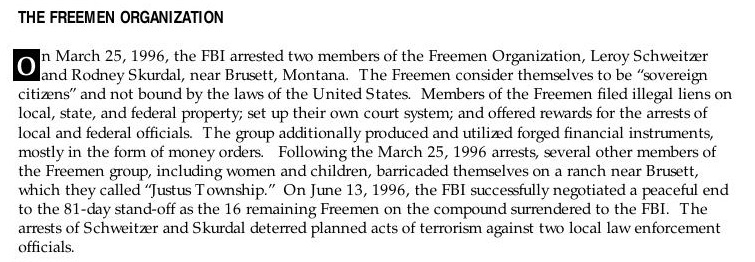
FBI Terrorism in the United States 1996, printed page7: cropped Freemen section

The FBI’s 1996 report, printed page7: its Freemen section records the group’s claims, financial instruments and surrender. Cropped from the original federal document. Image credit ↗

Scope & method / Edition 1.2

The ranch and the record.

The Montana Freemen’s invented jurisdiction, financial fraud and threats, the 1996 negotiated surrender, and the different judicial outcomes that followed.

Read the chapters for a narrative; use the record below to test it. Established means the specific proposition is documented. Interpretation marks an inference or a historical argument. Unknown means the record here cannot decide. An archive’s possession of a document does not endorse its contents.

Research cutoff: 26 October 2026. This curated account follows original federal records, a published appellate opinion, contemporary trial reporting and later local interviews. It does not reconstruct every trial count, interview every affected neighbor or establish current custody status.

01 / The record

The story, in 6 chapters

The television siege began after years of conflict over money, property and authority. Its peaceful ending left those questions to the courts.

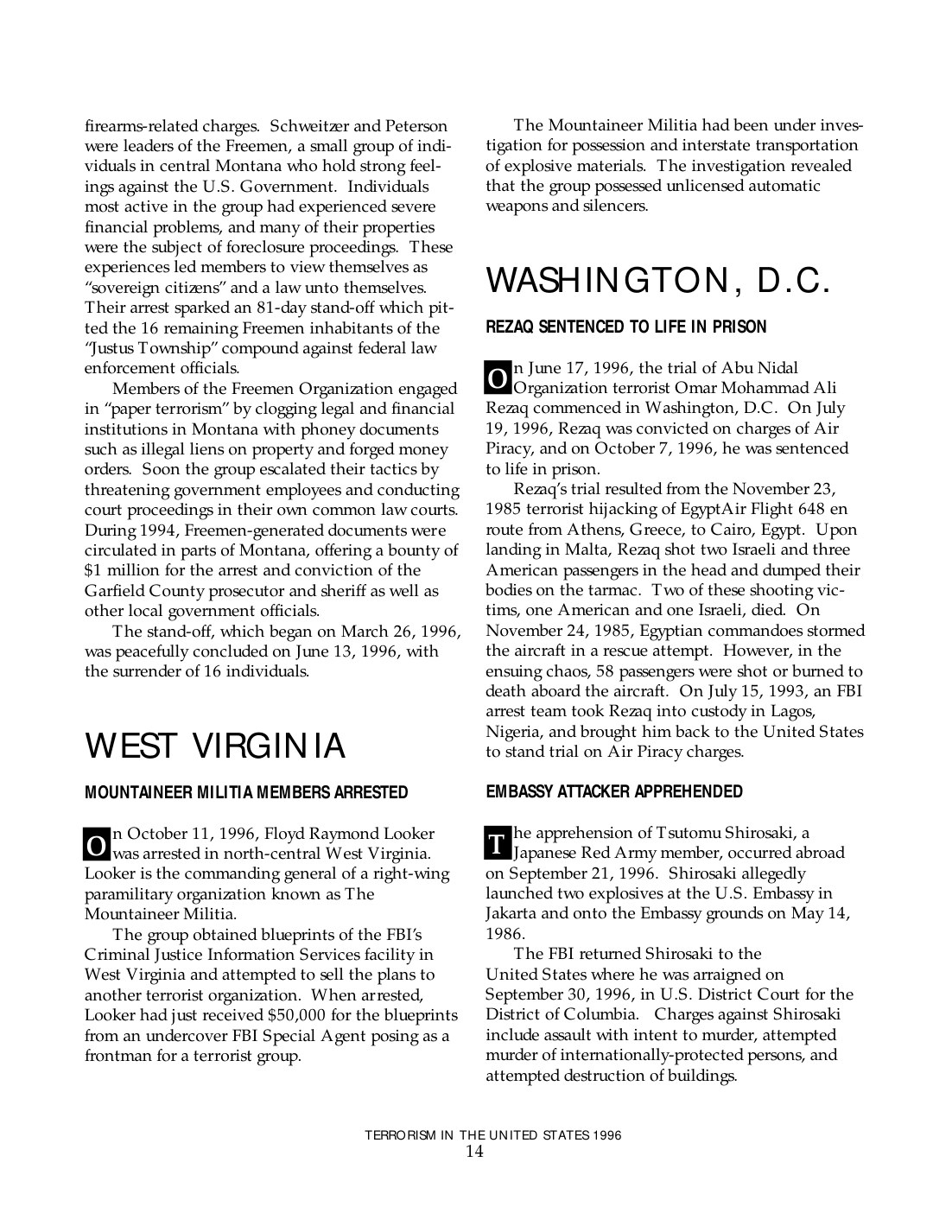
FBI Terrorism in the United States 1996, printed page14: continued Freemen account
The FBI’s 1996 report, printed page14: contemporary account of financial harassment and threats; the page also covers unrelated cases. Image credit ↗

Chapter 01 / Before March 1996

A government invented on a Montana ranch

At Justus Township, a ranch compound near Jordan in eastern Montana, the Freemen claimed that ordinary public institutions had no authority over them. They created their own courts and treated their documents as judgments, liens and money. The dispute reached well beyond a declaration of independence. Creditors, officials and businesses encountered demands carrying the appearance of legal procedure, backed by people prepared to resist the institutions that rejected them.

Property loss helped make that alternative attractive. The FBI’s 1997 report records that the farm had been sold at foreclosure in October 1995, but its occupants remained and kept the new owners out. Its contemporary account connects the group’s hostility to severe financial trouble. In Montana PBS’s later documentary, local interviewees remember neighbors facing the loss of farms and finding Schweitzer’s promises persuasive. Those recollections explain part of the appeal; they cannot establish what every participant believed or intended.

The financial program spread through classes held at a building called the schoolhouse. The Ninth Circuit’s later opinion describes thousands of instruments distributed beyond Montana, drawn against accounts with little or no money. The purported authority of the Freemen’s court supplied a language of legitimacy for transactions that depended on real banks and businesses. An internal claim to jurisdiction did not supply funds to an account or transfer another person’s property lawfully.

This was also a conflict over coercion. The appellate record describes threats to a sheriff and federal judges, as well as widespread firearms possession. The FBI’s 1996 account records documents offering a million-dollar bounty for the arrest and conviction of local officials. These are specific acts in the sources, rather than a conclusion drawn from the word militia. The Freemen belonged to an antigovernment and sovereign-citizen milieu, but their invented legal system, financial transactions and threats explain this investigation more precisely than a broad movement label. By the time television cameras focused on the ranch, the central issue was already how to enforce law against armed suspects who claimed the enforcing institutions had no jurisdiction.

Sources: S01 · S07 · S09 · S10

FBI Terrorism in the United States 1996, printed page7: cropped Freemen section
Cropped Freemen section, printed page7 of the 1996 FBI report. Its preliminary arrest summary differs from other official accounts. Image credit ↗

Chapter 02 / The fraud and intimidation cases

Paper claims with real consequences

The numbers in this case describe two different things. The Ninth Circuit says the Freemen produced more than 3,300 checks purporting to be worth over $15 billion. It separately recounts the trial court’s description of millions of dollars in losses. The face value of the paper was not the amount successfully stolen. Confusing those figures turns a documented fraud into a different and much larger claim than the judicial record makes.

The instruments traveled through a network of classes and followers. Some recipients tried to use them to pay debts or obtain goods. The published opinion identifies John P. McGuire’s use of Freemen checks for merchandise and describes Cherlyn Petersen’s attempted deposits of unfunded instruments. It also records McGuire’s robbery conviction for taking sound-recording equipment from an ABC news crew. The people harmed were not merely abstract representatives of federal power: they included businesses and journalists conducting ordinary work.

At the 1998 trial, the defense argued that followers sincerely believed Schweitzer’s financial claims. Contemporary reporting preserves that argument and the jury’s incomplete response. On July 2, jurors returned many guilty verdicts, including twenty against Schweitzer, while remaining divided on other counts. The July 3 newspaper is a snapshot of deliberations still in progress. Its statement that Cherlyn Petersen had not yet been convicted was not a final account of her case.

The later appellate opinion makes the distinction concrete. After a first trial ended in a hung jury for the appellants, McGuire was convicted of bank fraud, robbery and four firearms violations and received 180 months. Cherlyn Petersen was convicted of two bank-fraud counts and one mail-fraud count, receiving time served and five years of supervised release. Daniel E. Petersen was a different defendant; the 2010 prosecution account reports his earlier fifteen-year sentence. Leadership, participation, belief and adjudicated responsibility therefore require separate names and dates. The records support a substantial criminal enterprise without making every ranch resident responsible for every check, threat or weapon. Sincere reliance was a defense to test against individual evidence, not a finding that the instruments held the value their authors claimed.

Sources: S04 · S05 · S09

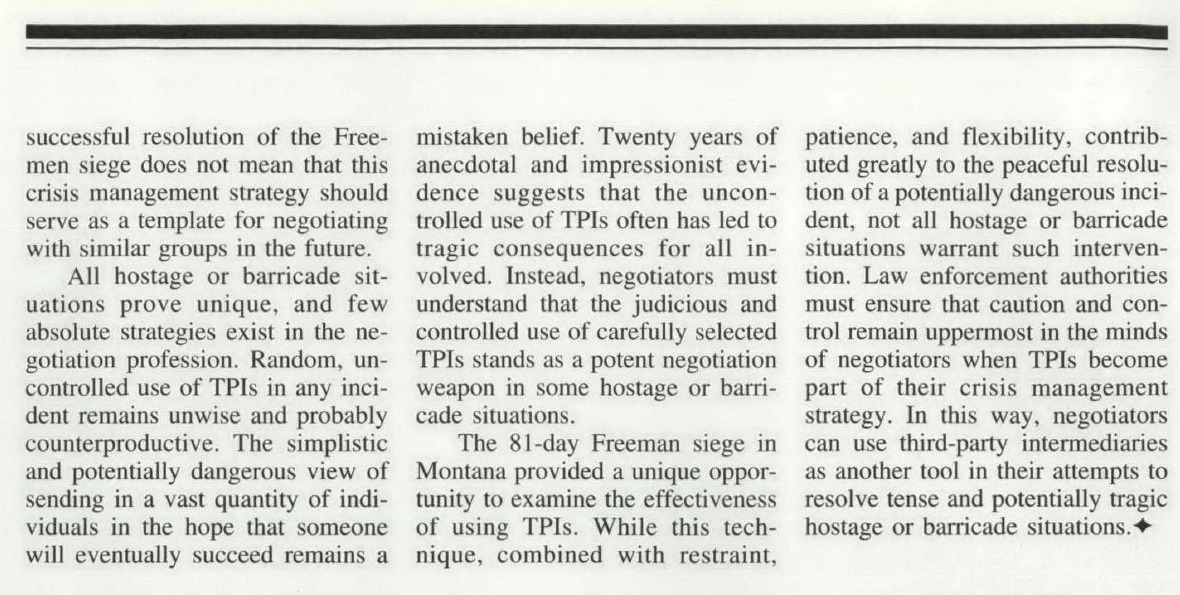
Romano, October 1998, printed page24: cropped federal-staff conclusion
Romano’s conclusion, printed page24: a successful resolution does not make this crisis strategy a universal template. Image credit ↗

Chapter 03 / March 25–June 13, 1996

Eighty-one days without a final assault

The arrests of March 25, 1996 opened an eighty-one-day confrontation. The Ninth Circuit and GAO date its start to that day, while one section of the FBI’s 1996 report says March 26. Institutional summaries also differ in how they count or identify the preliminary arrests. The central sequence is clearer: leaders were taken into custody, armed occupants remained at Justus Township, and the last group surrendered peacefully on June 13.

Federal enforcement now had two objectives that could pull against each other: bringing wanted people into custody and preventing another deadly confrontation. The operation used the FBI’s Critical Incident Response Group, established in 1994 to coordinate crisis capabilities. Containment, surveillance and continued dialogue gave negotiators time, while the danger to residents and agents remained. The earlier threats and arms described in the appellate record make that danger more than a retrospective justification based on the group’s reputation.

Stephen J. Romano’s 1998 professional account explains why outside intermediaries mattered. The Freemen refused to recognize government authority, so people they trusted could open communications that officials could not. His account also records setbacks: intermediaries initially acceptable to the group were later rejected. Family ties and public standing could create access without guaranteeing agreement. Negotiation remained a law-enforcement responsibility, and Romano explicitly rejected the idea that sending in ever more outsiders supplied a universal solution.

The wait imposed measurable costs. GAO’s October 1996 letter reported the FBI’s estimate of approximately $7.5 million as of August 7. About half represented regular salaries and benefits that would have been paid anyway. GAO reviewed supporting information but did not validate the estimate’s completeness, reliability or reasonableness. It therefore supplies a qualified cost account, not a certified total or a finding that every expenditure was necessary. The peaceful surrender is an established outcome; proving which tactic was indispensable would require a fuller operational record. Patience, pressure and dialogue operated together. June 13 ended the immediate armed impasse without a fatal final assault, while leaving criminal responsibility to courts rather than recognizing Justus Township’s claimed sovereignty.

Sources: S01 · S02 · S03 · S09

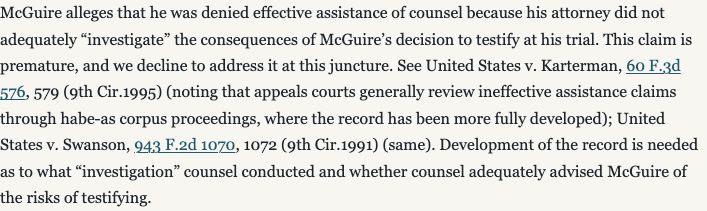
McGuire opinion: actual premature counsel-claim paragraph, browser capture
Actual browser capture of the published McGuire opinion’s counsel-claim paragraph. The court declined to resolve that claim on this record; this is not an official signed-PDF facsimile. Image credit ↗

Chapter 04 / 1998–2002

The government’s case faces legal tests

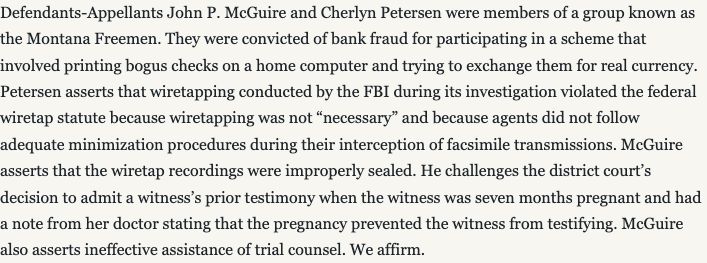
The defendants’ refusal to recognize public authority did not place their own prosecutions outside ordinary legal review. John McGuire and Cherlyn Petersen challenged how the government had collected and presented evidence. Their first trial had ended in a hung jury; a retrial produced convictions and different sentences. The Ninth Circuit’s October 2002 opinion then considered specific questions about surveillance and testimony. That sequence matters because neither the peaceful surrender nor the group’s asserted jurisdiction supplied the answer to whether particular evidence could lawfully be used.

Petersen argued that electronic interception had not been necessary and that agents had failed adequately to limit their examination of fax transmissions. The court accepted the government’s explanation of investigative difficulty and danger, including the limited information available through informants. It also held the minimization procedures reasonable in the circumstances. That was a contextual judgment about this investigation. The opinion did not require the procedures to be optimal, and a footnote expressly declined to assess less rigorous procedures than those actually adopted. Its reasoning cannot fairly be compressed into a claim that every surveillance practice is acceptable whenever officials call a group dangerous.

McGuire raised a different objection about the sealing of recordings. The opinion explored whether earlier judicial postponement orders meant that some delays were not delays within the statute’s meaning. It did not decide that issue. Instead, assuming delays had occurred, it found a satisfactory explanation in the circumstances, including supervision by an out-of-district judge, precautions for the recordings and the judge’s written directions. The distinction between an argument discussed and a question actually decided is part of the judgment’s meaning.

The court also upheld use of an ABC robbery victim’s former testimony after accepting the documented finding that she was unavailable for retrial. But it declined to resolve McGuire’s ineffective-assistance claim, calling it premature and requiring a fuller record. The convictions were affirmed; that did not mean every argument was rejected on its merits or every investigative choice certified beyond criticism. A history concerned with both coercion and public authority has to retain those different dispositions, rather than treating the appellate result as an indivisible endorsement of the entire operation.

Sources: S09

Daniel E. Petersen, 2010 sentence: actual federal announcement paragraph, browser capture
Actual capture of the U.S. Attorney’s 6 April 2010 sentencing announcement, reproduced in the FBI archive. Daniel E. Petersen’s case is distinct from Cherlyn Petersen’s appeal. Image credit ↗

Chapter 05 / 2009–2010

An old paper authority is asserted again

The end of the ranch confrontation did not end every participant’s use of invented legal authority. A later federal case in Minnesota concerned Daniel E. Petersen, a different person from Cherlyn Petersen in the 2002 appeal. The U.S. Attorney’s April 2010 announcement described him as an original founder and reported that his earlier Freemen prosecution had produced convictions on nineteen of twenty counts and a fifteen-year sentence. That institutional account identifies a particular defendant and a separate earlier judgment. It does not make the later offense a new conviction of everyone once associated with Justus Township.

The new case concerned retaliation against three federal judges. According to the prosecution’s account of the trial evidence, Petersen asserted a huge judgment against the government, promoted supposed shares in a company and filed false claims against judges’ property. These were not ordinary rulings issued by a court with authority over the people targeted. The paper borrowed the language of judgments, ownership and obligation while making demands on real officials and institutions. Its significance was the renewed attempt to make an invented authority operate outside the institution that had rejected it.

The procedural dates are clearer than a generalized claim that the Freemen kept operating. Petersen was indicted on 8 April 2009 and a trial jury convicted him on 22 October. On 6 April 2010, Judge Donovan Frank imposed ninety months for six false-lien or encumbrance counts. The announcement described the prosecution as the first under a 2008 federal anti-retaliation statute. A jury conviction, a later sentence and the government’s claim about the law’s first use are distinct propositions. The announcement supplies this account; it is not an independently reconstructed transcript of every exchange at the trial.

This is evidence of persistence at the level of a named person and named conduct. It cannot alone establish that the ranch organization still directed a continuing network, that former residents held identical beliefs, or that every later fraudulent lien had a common origin. Nor does the passage of time convert the earlier convictions into evidence of these later counts without the intervening prosecution. The case is consequential precisely because it is narrower: after the highly visible surrender, an identifiable use of the same kind of asserted paper authority produced another individual criminal judgment.

Sources: S04

McGuire opinion: actual published judicial opening, browser capture
United States v. McGuire: the appellate opinion identifies the two appellants, the challenged procedures and the decision to affirm. Image credit ↗

Chapter 06 / 1996–2024

The confrontation becomes a community’s history

The television siege had a visible ending: people walked out and were taken into custody. The surrounding community’s experience was harder to contain in that final scene. Montana PBS’s 2024 Rise of the Freemen returns to local people and law-enforcement participants, combining their interviews with archival material. Its published transcript presents a history of neighbors, threatened institutions, financial desperation and the promise of an alternative. That perspective changes the unit of attention from a distant compound on a national news broadcast to people whose work and relationships were entangled in the confrontation.

Local recollections help explain why a false financial promise could attract followers without proving that every follower acted innocently. Interviewees remember farmers who faced losing their property and regarded Schweitzer as someone offering a way out. Other memories concern the harm done to the county and the relief when leaders were arrested. These positions can coexist. Financial vulnerability helps explain an appeal; it does not fund an instrument, create jurisdiction or determine the intent behind every transaction. The individual evidence and different verdicts still carry those questions.

The transcript also records an agent’s expectation that the initial arrests would resolve the danger quickly, followed by the long wait and an anticlimactic response to the final surrender. Such recollections preserve the uncertainty of events that later summaries can make seem inevitable. They do not prove that one participant’s preferred explanation was the sole cause of the peaceful outcome. Romano’s professional account similarly describes an effective but conditional use of intermediaries, and GAO’s qualified cost review shows the resources committed while officials waited.

The film’s narration states that Freemen and family members approached by the producers declined to participate. That is an actual limit on the retrospective account’s range, not a presumed omission inferred from a title or publicity blurb. The surviving record therefore contains perspectives with different access and interests: local memory, institutional analysis, judgments and a named later retaliation case. Together they support two substantial findings. A dangerous confrontation ended peacefully, and particular criminal conduct still produced distinct judgments. They do not provide an audited measure of present membership, public belief or a continuing command structure.

Sources: S01 · S02 · S03 · S09 · S10

02 / The record

The load-bearing chain

Asserted authority, actual harm, a negotiated ending and individual judgments.

The strongest chain distinguishes the group’s purported legal power from real property, transactions and threats; the financial instruments’ face value from losses; and a peaceful ending from exoneration. It also distinguishes an interim jury report, later appellate decisions and a named subsequent retaliation case. A continuing command structure or a universal lesson about negotiation requires more than the recurrence of a name.

Sources: S01 · S02 · S03 · S04 · S05 · S09 · S10

Evidence support ranks each hinge as worded. Cultural prominence remains unmeasured. A dramatic siege, an official success account and a later documentary cannot supply an audience poll or decide every participant’s motives.

P1

An alternative authority meets real property

Evidence support High for the documented claims; individual motives vary

Cultural prominence Unmeasured

The October 1995 foreclosure and continued occupation put Justus Township’s claimed jurisdiction against the rights recognized by public institutions. The court claims also framed later financial transactions.

The documentary yardstick

The FBI’s dated account and the judicial description identify the claimed government, foreclosure context, classes and threats. They do not supply an audited account of every resident’s motive.

Where it fits

Chapter 1: the conflict concerns an asserted jurisdiction and actual property.

Why it is critical

Without this conflict, the ranch looks like an arbitrary enforcement target rather than a site where assertions of sovereignty had consequences for other people.

If this hinge were removed

Without the specific claims to authority, the story would become an undifferentiated rural standoff. Removing the purported court’s authority would not itself remove the real transactions and threats that had already occurred.

Dependencies

Precedes P2 and P3; the property dispute alone does not prove bank fraud.

What rival readings must explain

A rural-grievance account explains the appeal but must still explain the refusal to recognize competing property rights. Authenticated foreclosure and correspondence files could refine who knew and decided what.

Gaps and disputes

No complete original internal court archive or resident correspondence; the origin of each participant’s belief remains a separate question.

Evidence-rank grounds

The cited original judicial or federal text supports this bounded proposition. Attributed investigator summaries, interim reporting and retrospective memories remain distinguished.

Cultural-rank grounds

No representative audience survey or comparable reception study ranks this hinge. Visibility in a documentary, agency report or newspaper is evidence of that account’s emphasis, not a popularity measurement.

Sources: S07 · S09

P2

Separate the paper’s face value from the fraud

Evidence support High for the stated distinction and cited convictions

Cultural prominence Unmeasured

Classes and thousands of unfunded instruments extended the campaign beyond the ranch. The appellate opinion distinguishes more than $15 billion in purported face value from millions in losses.

The documentary yardstick

The appellate opinion distinguishes more than 3,300 instruments with a purported value over 15 billiondollars from actual losses described in millions. McGuire’s and Cherlyn Petersen’s conduct and results are not identical.

Where it fits

Chapter 2: instruments, losses and defendant-specific transactions.

Why it is critical

The financial conduct explains victims and jurisdiction; replacing actual losses with face value exaggerates the established record.

If this hinge were removed

Without actual transactions and individual evidence, a fraud account could rest only on an offensive ideology. Removing the paper’s inflated face value would change the scale of the boast, not make losses or the adjudicated offenses disappear.

Dependencies

Builds on P1; precedes warrants and the standoff. Individual use and intent remain separate questions.

What rival readings must explain

Sincere-reliance defenses must account for specific transactions and evidence of knowledge. Authenticated account balances, transaction files or trial exhibits could change an individual attribution or loss calculation.

Gaps and disputes

No complete instrument-by-instrument loss audit or current victim recovery accounting. Face value is not money successfully taken.

Evidence-rank grounds

The cited original judicial or federal text supports this bounded proposition. Attributed investigator summaries, interim reporting and retrospective memories remain distinguished.

Cultural-rank grounds

No representative audience survey or comparable reception study ranks this hinge. Visibility in a documentary, agency report or newspaper is evidence of that account’s emphasis, not a popularity measurement.

Sources: S04 · S05 · S09

P3

Arrests create an armed enforcement crisis

Evidence support High for the broad sequence; exact preliminary details disputed

Cultural prominence Unmeasured

Arrests on March 25 preceded resistance at the compound. The appellate opinion records threats and firearms; the sources converge on June 13 surrender despite differences in preliminary summaries.

The documentary yardstick

The court and GAO begin the confrontation on 25 March; one FBI report section says 26 March. The last surrender on 13 June is better settled. Arrest counts and preliminary episodes remain attributed to their sources.

Where it fits

Chapter 3: enforcing warrants becomes an armed impasse.

Why it is critical

Without the antecedent criminal case, containment appears to punish belief; without the risks, the peaceful result appears effortless.

If this hinge were removed

Without the initial arrests and remaining armed occupants, there would be no explanation of why an investigation became this prolonged confrontation. Removing a calendar discrepancy would not erase the underlying armed enforcement problem.

Dependencies

Depends on P1–P2, but weapons possession is not proof of every charged financial offense.

What rival readings must explain

A government-overreach account must confront the actual warrants, threats and financial evidence. Authenticated arrest logs and unsealed supporting affidavits could resolve preliminary discrepancies.

Gaps and disputes

No complete contemporaneous minute-by-minute log. An institution’s summary is not necessarily consistent across sections or with every participant’s recollection.

Evidence-rank grounds

The cited original judicial or federal text supports this bounded proposition. Attributed investigator summaries, interim reporting and retrospective memories remain distinguished.

Cultural-rank grounds

No representative audience survey or comparable reception study ranks this hinge. Visibility in a documentary, agency report or newspaper is evidence of that account’s emphasis, not a popularity measurement.

Sources: S01 · S02 · S09

P4

Dialogue works within a costly containment operation

Evidence support High for outcome and reported estimate; causal shares unresolved

Cultural prominence Unmeasured

Outside intermediaries helped open dialogue, suffered reversals and assisted the peaceful resolution. Romano cautions against treating them as a universal remedy; GAO reports a qualified FBI cost estimate.

The documentary yardstick

Romano describes intermediaries as useful under controlled conditions, not a universal remedy. GAO reports an FBI estimate around 7.5 milliondollars, about half regular salary/benefit costs, without validating the estimate’s completeness or reliability.

Where it fits

Chapter 3: the ending, the conditions and the qualified cost account.

Why it is critical

The unusual outcome cannot be explained by the word siege alone. The sequence includes both negotiated contact and sustained enforcement pressure.

If this hinge were removed

Without containment and continuing communication, the guide could report a surrender but would lose the documented process that helps explain it. Removing a particular intermediary would not prove that surrender was impossible; indispensability is a narrower unproved claim.

Dependencies

Follows P3; the June 13 endpoint is established, the causal weight of each tactic less certain.

What rival readings must explain

Both an institutional success account and a coercion critique must explain the absence of a fatal final assault. Full authenticated negotiation recordings, decision logs and competing proposals would sharpen the causal assessment.

Gaps and disputes

No complete operational tapes or causal comparison with an otherwise identical event. GAO’s cost review is not a certification of necessity or efficiency.

Evidence-rank grounds

The cited original judicial or federal text supports this bounded proposition. Attributed investigator summaries, interim reporting and retrospective memories remain distinguished.

Cultural-rank grounds

No representative audience survey or comparable reception study ranks this hinge. Visibility in a documentary, agency report or newspaper is evidence of that account’s emphasis, not a popularity measurement.

Sources: S02 · S03

P5

A surrender is followed by separate verdicts and appeals

Evidence support High for the judicial dispositions; interim report scoped

Cultural prominence Unmeasured

Partial July 1998 verdicts left counts unresolved. Later retrial produced convictions of McGuire and Cherlyn Petersen, affirmed in 2002 after procedural challenges.

The documentary yardstick

The July 1998 newspaper records deliberations still in progress. The 2002 opinion supplies the later dispositions for McGuire and Cherlyn Petersen. It affirms but declines to decide the premature counsel claim.

Where it fits

Chapters 2 and 4: separate verdicts and the actual appellate questions.

Why it is critical

Treating a preliminary report as a final acquittal or treating surrender as immunity changes the legal history.

If this hinge were removed

Without the later opinion, the guide could freeze a still-divided jury’s status as the final outcome. Removing a legal objection would not make all defendants’ offenses or sentences identical.

Dependencies

Follows P4; distinguish Daniel from Cherlyn Petersen and each defendant’s counts.

What rival readings must explain

A sincere-belief account must address the final findings, while an official success account must explain the objections and standards of review. A reversal, authenticated missing judgment or material exculpatory record would change the relevant legal or historical assessment.

Gaps and disputes

No complete first-trial/retrial exhibits or later collateral docket audit. An affirmance is not a merits rejection of a claim the court expressly did not reach.

Evidence-rank grounds

The cited original judicial or federal text supports this bounded proposition. Attributed investigator summaries, interim reporting and retrospective memories remain distinguished.

Cultural-rank grounds

No representative audience survey or comparable reception study ranks this hinge. Visibility in a documentary, agency report or newspaper is evidence of that account’s emphasis, not a popularity measurement.

Sources: S05 · S09

P6

Persistence is documented at the level of a named person

Evidence support High for the dated official case account; global continuity unproved

Cultural prominence Unmeasured

Daniel Petersen’s 2010 false-lien sentence shows continued retaliation after the original case. The 2024 documentary returns to community memories with an acknowledged participation gap.

The documentary yardstick

The 2010 official announcement identifies Daniel E. Petersen’s 2009 jury conviction and six-count 90 month sentence. It is separate from Cherlyn Petersen’s appeal and from the earlier fifteen-year term it describes.

Where it fits

Chapter 5 and the final chapter: persistence by a named actor, followed by competing memory.

Why it is critical

The end of one standoff is neither the disappearance of an ideology nor proof of a secretly continuous organization.

If this hinge were removed

Without this prosecution, the record here would not establish this later individual use of false liens after the ranch confrontation. Removing an alleged continuing command structure would not remove the named prosecution or establish guilt for other former residents.

Dependencies

Depends on the distinct earlier outcomes in P5; later conduct is a new case.

What rival readings must explain

A continuing-network theory requires authenticated communications, money or coordinated acts linking participants beyond ideological resemblance. Later interviews may expand memory but cannot alone prove that chain.

Gaps and disputes

No original 2010 judgment/trial transcript or complete later organizational archive; no present custody or membership inference from an old announcement.

Evidence-rank grounds

The cited original judicial or federal text supports this bounded proposition. Attributed investigator summaries, interim reporting and retrospective memories remain distinguished.

Cultural-rank grounds

No representative audience survey or comparable reception study ranks this hinge. Visibility in a documentary, agency report or newspaper is evidence of that account’s emphasis, not a popularity measurement.

Sources: S04 · S10

03 / The record

How the accounts branch

Documented source relationships, competing interpretations and recurring hinges. Similar concerns do not establish borrowing.

A purported court becomes an account of real transactions

Claimed Justus Township authority and financial classes → transactions described in investigation/trial → FBI summaries and later appellate account.

Borrowing and dependence

The opinion describes the group’s instruments and classes while assessing an actual prosecution. This is a documented account of the earlier scheme, not a claim that the guide independently acquired every original instrument or internal judgment.

Branch and limit

A participant’s claimed authority and a court’s finding about transactions are different sources of legitimacy. Financial distress can help explain the appeal without proving lawful value or every person’s intent.

Recurring hinges: P1 · P2

Sources: S01 · S07 · S09 · S10

An incomplete verdict report acquires a later endpoint

First trial and unresolved counts → July 1998 news snapshot → retrial outcomes and 2002 appeal for McGuire and Cherlyn Petersen.

Borrowing and dependence

The later opinion expressly recounts the hung jury, retrial and different sentences. It updates the procedural status; it is not evidence that the earlier reporter described a final verdict incorrectly when deliberations were still continuing.

Branch and limit

Daniel E. Petersen is a different person. A common surname, a movement label and identical fifteen-year terms for different men cannot substitute for named charges and dates.

Recurring hinges: P2 · P5 · P6

Sources: S05 · S09 · S04

The siege becomes a professional lesson with a warning

March–June 1996 confrontation → Romano’s 1998 FBI Law Enforcement Bulletin article → cautious discussion of third-party intermediaries.

Borrowing and dependence

Romano explicitly draws lessons from the Freemen operation in which intermediaries were used. His actual conclusion warns against treating this outcome as a template or sending uncontrolled numbers of outsiders.

Branch and limit

GAO’s separate cost letter reviews the FBI’s estimate, not Romano’s causal theory. Combining the accounts does not produce a controlled test of which tactic saved lives or whether every expense was justified.

Recurring hinges: P3 · P4

Sources: S02 · S03

Earlier paper claims recur in one later retaliation case

Justus Township’s asserted judgments → Daniel E. Petersen’s later false-lien prosecution →2009 jury verdict and 2010 sentence announced by the U.S. Attorney.

Borrowing and dependence

The official announcement explicitly links its named defendant’s earlier role and sentence to the later conduct. That is an identifiable person-level lineage rather than a resemblance between unrelated filings.

Branch and limit

This record cannot establish that the old ranch leadership still commanded everyone using similar arguments. The later six-count case stands on its own defendant and trial.

Recurring hinges: P1 · P2 · P6

Sources: S04

The national siege is recast through local memory

1996 news and agency record →2024 Rise of the Freemen archival material and local/agent interviews.

Borrowing and dependence

The actual selected published transcript combines historical footage, narration and retrospective testimony. It expressly states that Freemen and family members approached declined to participate; this is a documented source limitation, not an omission guessed from a blurb.

Branch and limit

The documentary’s community-centered explanation does not overturn financial or judicial records. Its memories of uncertainty and vulnerability are not a present membership survey or proof of every resident’s innocence.

Recurring hinges: P1 · P3 · P4 · P5 · P6

Sources: S10 · S01 · S09

04 / The record

Four rival paths through the same record

The strongest version first, followed by the hinges it accepts, the inferences it would remove or revise and the evidence it needs to add. Rival is not endorsement.

Interpretation 01

A coercive alternative legal system

Strongly supported for adjudicated conduct

The strongest version

At P1–P3, invented jurisdiction supplied a language for fraud and threats that reached creditors, businesses, journalists and officials.

Accept

P1 · P2 · P3

The financial figures and named convictions in P2/P5; different roles and verdicts remain different.

Remove or revise

Remove the group’s claimed jurisdiction as an actual power over unwilling officials or businesses. Also remove a presumption that every resident shared every threat or transaction.

Add to the path

Add actor-specific instruments, communications, knowledge and actual loss evidence for any wider responsibility claim.

What must be wrong or incomplete

A coercion account becomes too broad if the group label replaces individual proof or if face value is treated as successful theft.

Must still explain

It must demonstrate individual conduct and intent rather than turn all residents into interchangeable members of an enterprise.

Assessment

McGuire supplies particular transactions, threats and outcomes. Authenticated transaction or trial records showing mistaken attribution or missing funds would change those findings; a grievance alone would not.

What would change this assessment

Authenticated records of particular transactions, admissions or exculpatory communications could change an individual finding. A later merits ruling could change a legal outcome.

Sources: S04 · S05 · S09

Interpretation 02

Sincere followers trusted a false financial promise

A material defense and social explanation; not a general acquittal

The strongest version

At P1–P2, threatened property loss and trust in Schweitzer could make followers believe that the instruments were valid. Contemporary defense lawyers argued lack of fraudulent intent.

Accept

P1 · P2

The instruments lacked the funds claimed; the July 1998 deliberations and later P5 convictions must be explained.

Remove or revise

Revise the inference of fraudulent intent for a particular follower, not the factual absence of funds or every other person’s conduct.

Add to the path

Add contemporaneous advice received, representations believed, warnings and the person’s own transactions, rather than retrospective general sympathy.

What must be wrong or incomplete

The belief account must explain what each defendant knew and did. It cannot make an interim absence of conviction the final result after a later retrial.

Must still explain

It must connect reliance and knowledge to a particular defendant and transaction. The earlier hung jury and later conviction cannot be collapsed into one verdict.

Assessment

The trial reporting preserves the defense; the appellate opinion records later outcomes. Authenticated teaching materials, private correspondence, warnings and testimony could change an assessment of knowledge or leadership exploitation.

What would change this assessment

Authenticated contemporary correspondence or trial evidence bearing on specific knowledge could strengthen or weaken sincere reliance. The actual later judgments remain part of the record.

Sources: S05 · S09 · S10

Interpretation 03

Patient enforcement prevented another deadly ending

Established peaceful outcome; incomplete causal proof

The strongest version

At P3–P4, coordinated containment and dialogue brought armed suspects into legal process without a fatal final assault. Intermediaries offered communication where official authority was rejected.

Accept

P3 · P4

The eighty-one-day duration and approximately $7.5 million FBI estimate, with GAO’s qualifications; criminal cases continued at P5.

Remove or revise

Remove an inevitable-final-assault account and a claim that peaceful surrender means the group was harmless.

Add to the path

Add full decision logs, negotiation recordings and resident accounts before assigning indispensable causal credit to one intermediary or official.

What must be wrong or incomplete

An enforcement-success reading overreaches when it treats one peaceful outcome as a universal method or a proven counterfactual casualty count.

Must still explain

It must account for costs, failed intermediaries and alternatives, rather than credit every operational choice merely because the ending was peaceful.

Assessment

Romano is a practitioner’s analysis, not a controlled comparison. Authenticated decision logs and recordings showing which concessions or threats changed behavior could revise the causal account.

What would change this assessment

Authenticated logs or records identifying a different decisive condition could redistribute causal credit while leaving the actual surrender unchanged.

Sources: S02 · S03 · S09

Interpretation 04

A peaceful result still permits scrutiny of state power

Legitimate question; the reviewed appeal was rejected

The strongest version

At P3–P5, surveillance and a prolonged armed enclosure require legal scrutiny even where financial crimes are real. Defendants raised specific wiretap and evidence objections rather than only a general claim of sovereignty.

Accept

P3 · P4 · P5

The judicial opinion affirmed McGuire and Cherlyn Petersen after addressing the objections. It did not erase the financial record or endorse every conceivable tactic.

Remove or revise

Remove an automatic endorsement of every government choice based on the peaceful ending or appellate affirmance. Preserve the adverse holdings actually reached.

Add to the path

Add original surveillance applications, hearing transcripts and later rulings for a specific procedural violation, rather than treating hostility to government as proof of illegality.

What must be wrong or incomplete

The criticism must distinguish an arguable rights concern, a merits rejection and the counsel claim the court left unresolved. It cannot turn a general denial into an acquittal.

Must still explain

The critique must identify a particular violated safeguard and its consequences; state action being coercive does not by itself make the convictions wrongful.

Assessment

The opinion explains necessity, fax minimization, sealing and witness availability. A later reversal or authenticated record undermining a material affidavit, evidence chain or finding would change the relevant assessment.

What would change this assessment

An authenticated omitted order, a later merits decision or reliable evidence contradicting the court’s factual basis could change a specific assessment. The cost estimate’s acknowledged limits already constrain claims about efficiency.

Sources: S02 · S09
05 / The record

Which account emphasizes which hinge

Six actual scoped accounts: the FBI report, the reported reliance defense, Romano’s professional article, the appellate opinion, the later U.S. Attorney announcement and the documentary’s published transcript. Each emphasizes different hinges; no audience rank or unseen interview omission is invented.

The FBI’s 1996 report: a prevented threat and a peaceful ending

Actual selected original report pages 7/14 read; not a complete investigation file or all images’ rights clearance.

Amplifies

Fraudulent instruments, threats and the negotiated surrender of the remaining occupants.

Recasts

The account becomes an institutional enforcement outcome. Its own sections do not agree on the March start date or every preliminary arrest detail.

Does not establish in this inspected account

A single consistent minute-by-minute calendar, guilt for every resident, or a measured number of lives saved.

P1 · P3 · P4

Sources: S01

The reported defense: followers believed the instruments were valid

Actual 3 July 1998 news text read as an interim deliberations report, not final dispositions or the complete defense case.

Amplifies

The defense argument that sincere belief defeated fraudulent intent.

Recasts

The financial scheme is viewed from followers’ asserted reliance rather than only the leaders’ or prosecutors’ account.

Does not establish in this inspected account

That the jury accepted this for everyone, that all counts were resolved when the article appeared, or that the later appellants were never convicted.

P1 · P2 · P5

Sources: S05

Romano’s professional article: intermediaries with limits

Actual original article text and federal-agent affiliation read; selected conclusion image excludes uncredited photographs. No full operational tape audit.

Amplifies

Conditional effectiveness of people trusted by the occupants, together with patience and control.

Recasts

The siege becomes a professional case study. His explicit caution is part of that account, not a qualification added only by later critics.

Does not establish in this inspected account

That every intermediary succeeded, that unlimited outside intervention was safe, or that this ending guarantees another crisis’s outcome.

P3 · P4

Sources: S03

The Ninth Circuit: the evidence and the safeguards

Actual published opinion text read and crosschecked with retained Justia reader; no full trial/collateral docket audit. New images are genuine browser captures of the judicial paragraphs, not signed-PDF facsimiles.

Amplifies

The danger and complexity supporting surveillance, the procedures adopted and individual convictions.

Recasts

The operation becomes a set of legal questions. It accepts reasonable minimization and explained sealing delays while declining to reach a premature counsel claim.

Does not establish in this inspected account

That every possible surveillance practice is lawful, every criticism failed on its merits or all group members received the same judgment.

P2 · P3 · P5

Sources: S09

The U.S. Attorney’s 2010 announcement: a named retaliation case

Actual original archived announcement read; no original judgment/trial transcript acquired in this revision.

Amplifies

Daniel E. Petersen’s later trial conviction and six false-lien counts against judges, with a ninety-month sentence.

Recasts

The paper-authority story continues through a particular defendant and a new prosecution after the ranch episode.

Does not establish in this inspected account

An unchanged global organization, guilt of Cherlyn Petersen in that separate case or present custody inferred from a 2010 statement.

P1 · P6

Sources: S04

Rise of the Freemen: a community remembers

Actual selected published transcript passages/metadata read, including concluding local recollections and stated nonparticipation. No full video, entire interview archive or audience study.

Amplifies

Economic vulnerability, neighbors’ experiences and the uncertain expectations of participants in enforcement.

Recasts

The siege becomes a local history with social consequences beyond the final television scene. Narration expressly identifies absent Freemen/family participation.

Does not establish in this inspected account

A universal motive, an innocent explanation of every transaction, a current membership map or the public’s measured cultural ranking of the case.

P1 · P3 · P4 · P6

Sources: S10

06 / The record

Find a thread in the file

Search the chapter and claim index; each result leads to the full passage and its sources.

07 / The record

People, not a single cast of mind

Open a record for the person’s role and supporting sources. Membership, speech or appearance in this record does not by itself establish an unlawful agreement.

SchweitzerBiographical record
LeRoy SchweitzerFreemen leader

Principal organizer of the financial program. The July 3, 1998 report records twenty convictions at that stage of continuing deliberations; it is not a final count of every later disposition.

Sources: S05 · S08

PetersenBiographical record
Daniel E. PetersenFounder and convicted participant

The 2010 federal announcement recounts his earlier conviction and the separate later prosecution for false liens against federal judges.

Sources: S04

intermediariesBiographical record
Third-party intermediariesNegotiation participants

Negotiators used outside people to communicate with the ranch. The FBI’s professional account explains both the value and limits of the approach; it should not be mistaken for a single-person rescue story.

Sources: S03

officialsBiographical record
Neighbors, creditors, and public officialsPeople affected by the campaign

Fraudulent instruments, intimidation, and the long confrontation imposed burdens beyond the people inside the ranch. The collective label does not replace the individual experiences still missing from this curated record.

Sources: S01 · S04 · S08

McGuireBiographical record
John P. McGuireDefendant and appellant

Convicted after retrial of bank fraud, robbery of ABC recording equipment and four firearms violations; sentenced to 180 months. The Ninth Circuit affirmed in 2002.

Sources: S09

PetersenBiographical record
Cherlyn PetersenDefendant and appellant

Distinct from Daniel Petersen. After a hung jury and retrial, convicted of two bank-fraud counts and one mail-fraud count; time served and five years’ supervision. Her appeal challenged surveillance safeguards.

Sources: S09

RomanoBiographical record
Stephen J. RomanoFBI crisis-negotiation practitioner

Author of the 1998 professional analysis of third-party intermediaries. The original identifies him with the Crisis Negotiation Unit of CIRG at the FBI Academy; his account also stresses the approach’s limits.

Sources: S03

SesnonBiographical record
Alison SesnonABC news producer and robbery victim

The appellate opinion identifies her as a victim whose first-trial videotaped testimony was admitted at retrial after physician-supported findings about her pregnancy. McGuire challenged that decision; the court upheld it.

Sources: S09

08 / The record

Paper claims, surrender and individual judgments

Horizontal spacing shows elapsed time; separate rows keep close events selectable. Scroll the graph on narrow screens. Exact dates are attributed where records conflict; month- and year-only dates preserve source precision.

19901996200220102024
Foreclosure does not end occupationContext

The FBI’s 1997 retrospective records an October 1995 foreclosure sale and occupants keeping the new owners out.

Sources: S07

Arrests trigger the standoffEnforcement

The GAO chronology dates the start to March 25. Accounts vary in how they summarize the initial arrests.

Sources: S02 · S01

The remaining Freemen surrenderNegotiation

The 81-day confrontation ends peacefully; legal proceedings remain ahead.

Sources: S02 · S03

GAO reports the FBI’s cost estimateOversight

The letter reports approximately $7.5 million, about half regular pay, and expressly does not validate completeness, reliability or reasonableness.

Sources: S02

Partial verdicts leave counts undecidedCourt

July 3 reporting describes verdicts returned Thursday, July 2. Schweitzer was convicted on twenty counts at this stage; other counts and defendants remained unresolved.

Sources: S05

Negotiators assess intermediariesMemory

The Law Enforcement Bulletin examines the operation through professional negotiation practice.

Sources: S03

McGuire and Cherlyn Petersen appeal affirmedCourt

The Ninth Circuit distinguishes a first hung jury from retrial convictions and addresses surveillance, evidence and witness-availability objections.

Sources: S09

Daniel Petersen convicted in a new caseCourt

A jury convicts him in the false-lien retaliation case later described in the 2010 sentencing announcement.

Sources: S04

Petersen sentenced in a separate false-lien caseCourt

The new retaliation prosecution is distinct from the original Freemen convictions.

Sources: S04

A documentary returns to the communityMemory

Montana PBS’s Rise of the Freemen combines archival footage and local interviews; the filmmakers state that Freemen and family members approached declined participation.

Sources: S10

09 / The record

What the evidence supports

Ratings apply to the precise proposition on the page. Unsupported means the assembled evidence does not establish a claim; it is not interchangeable with false.

Established

The confrontation ended peacefully on June 13, 1996.

GAO and FBI records describe the end of the 81-day standoff.

Sources: S02 · S03

False

Peaceful surrender meant the charges were erased.

The trials and convictions followed the negotiated ending.

Sources: S04 · S05

False

The group’s financial instruments had value because its leaders said so.

The appellate opinion identifies thousands of instruments drawn against accounts with little or no cash, and affirms named fraud convictions.

Sources: S09

Unsupported

Every ranch resident committed the same offenses.

An organizational label and physical presence do not establish identical acts or intent. Individual outcomes must be checked.

Sources: S05 · S09

Established

Petersen faced a separate later false-lien prosecution.

The 2010 announcement describes the new retaliation case and distinguishes the original convictions.

Sources: S04

Misleading

The Freemen stole more than $15 billion.

That figure is the purported face value of more than 3,300 checks in the appellate opinion. The opinion separately recounts millions in losses; it does not equate the figures.

Sources: S09

False

Cherlyn Petersen’s lack of a conviction in the July 3 report was a final acquittal.

The report described unfinished deliberations. The 2002 opinion records a first hung jury, retrial convictions and affirmance.

Sources: S05 · S09

False

GAO independently certified the full $7.5 million cost.

GAO reported an FBI estimate and explicitly did not validate completeness, reliability or reasonableness. About half was regular pay that would have been incurred anyway.

Sources: S02

Unsupported

One successful standoff proves intermediaries always work.

Romano explicitly rejects a universal template. His account records both useful contacts and rejected intermediaries.

Sources: S03

False

The appellate affirmance rejected every argument on its merits.

The Ninth Circuit declined to resolve McGuire’s ineffective-assistance claim as premature and said a fuller record was needed. The convictions were affirmed, but this claim was not decided on its merits in that opinion.

Sources: S09

10 / The record

Hear the argument

Recorded voices, reported history, and documentary context. External media need an internet connection.

Montana PBS · documentary and local interviews · 2024

Rise of the Freemen ↗

Full program and transcript on an official PBS station player. Copyrighted video is an outbound source; the offline guide remains complete without it.

11 / The record

How the story changed

Public memory tends to compress contested histories into a turning point. The records leave a less tidy sequence.

The compound as the whole story

ThenTelevision attention centered on an armed ranch and a prolonged wait in 1996.

ReconsideredThe fraud transactions, foreclosure and threats explain why enforcement began before the siege became a national image.

Sources: S01 · S07 · S09

A preliminary verdict becomes a misleading endpoint

ThenJuly 3, 1998 reporting said Cherlyn Petersen had not yet been convicted while jurors continued to deliberate.

ReconsideredThe 2002 opinion records her retrial convictions and affirmance. Publication timing changes what that early report can establish.

Sources: S05 · S09

Institutional success and local memory

ThenThe 1998 negotiation account drew professional lessons from peaceful surrender, while warning against a universal template.

ReconsideredThe 2024 documentary returns to local interviews, with an acknowledged absence of participating Freemen or relatives. These perspectives illuminate different parts of the same history.

Sources: S03 · S10

12 / The record

The questions still open

A documented limit is more useful than a confident number or a sweeping lineage the evidence cannot carry.

  1. Which authenticated negotiation logs best distinguish the effects of outside contacts, enforcement pressure and internal disagreement?
  2. What do complete trial exhibits and financial records add to individual knowledge and actual-loss calculations?
  3. How do neighbors and affected businesses describe the costs omitted from the FBI’s operational estimate?

13 / The record

Go back to the sources

Records, reporting, and firsthand accounts have different evidentiary roles. Each source note explains what it can establish and where caution is needed. Sources consulted for this edition on 25 October 2026; publisher restrictions may apply.

  1. S01

    Primary institutional record

    Terrorism in the United States, 1996 ↗

    Federal Bureau of Investigation

    Contemporary federal overview. Its descriptions of the group’s conduct are read alongside later adjudicated outcomes.

  2. S02

    Primary institutional record

    FBI Cost of Freemen Standoff, GGD-97-13R ↗

    U.S. General Accounting Office (now Government Accountability Office)

    October 22, 1996 letter reports an FBI estimate of $7.5 million, about half regular pay. GAO expressly did not validate completeness, reliability or reasonableness. Browser-readable original saved when raw PDF retrieval returned 403.

  3. S03

    Primary institutional record

    Third-Party Intermediaries and Crisis Negotiations ↗

    FBI Law Enforcement Bulletin, October 1998

    Stephen J. Romano, October 1998, printed pages 20–24 (PDF pages 22–26). Original full Bulletin retained locally; selected record excerpt contains opening, roles and conclusions. Practitioner account, not independent proof of the optimal tactic.

  4. S04

    Primary institutional record

    Member of Montana Freeman Militia First to be Sentenced Under Federal Anti-Retaliation Law ↗

    U.S. Attorney’s Office, District of Minnesota; FBI archive

    Actual archived U.S. Attorney announcement read: indictment 8 April 2009, jury conviction 22 October 2009, sentence 6 April 2010 of ninety months for six false-lien counts. Distinct from his earlier fifteen-year term and from Cherlyn Petersen. No new original judgment or trial transcript acquired.

  5. S05

    Contemporary court reporting

    Jurors return guilty verdicts against heads of Freemen ↗

    Deseret News

    July 3 report describes partial verdicts returned July 2 while other counts remained undecided. Cherlyn Petersen’s then-unresolved status must not be mistaken for a final acquittal; see the 2002 appellate opinion.

  6. S07

    Primary institutional record

    Terrorism in the United States, 1997 ↗

    Federal Bureau of Investigation

    Follow-up report describing the legal and operational aftermath. A later report is not preferred over a specific judgment on an individual charge.

  7. S08

    Contemporary regional reporting

    Bogus Checks and Balances Run Amok ↗

    The Spokesman-Review

    Contemporary regional reporting on the spread and asserted backing of the financial instruments.

  8. S09

    Primary judicial opinion

    United States v. McGuire, 307 F.3d 1192 (9th Cir. 2002) ↗

    U.S. Court of Appeals for the Ninth Circuit; opinion mirror

    October 11, 2002 published judicial opinion. Affirms John P. McGuire and Cherlyn Petersen convictions; factual background differentiates checks’ face value from losses and records the first hung jury and retrial. Full original opinion text saved locally. Actual published opinion reviewed, including necessity/minimization/sealing/testimony and premature counsel-claim disposition. Actual approved-browser paragraph captures replace prior reformatted excerpt. No full collateral-docket audit.

  9. S10

    Documentary and primary interviews

    Rise of the Freemen ↗

    Montana PBS; SCETV official station player

    September 2, 2024 documentary, 1h49m52s, with participant and local-official interviews and a linked full transcript. The film says Freemen and family members approached declined participation. Retrospective reporting, not a substitute for the appellate record. Copyrighted video linked, not copied into package. Actual selected published transcript passages read, not full video or interview archive. Explicit narration says approached Freemen/family members declined participation; no whole-film omission inferred from a blurb.

Published judicial text ↗ · Selected original FBI page ↗ · Federal author’s conclusion, transcription ↗

Images, documents & licensing

License ↗ · FBI Terrorism in the United States 1996, printed page14: continued Freemen account — Federal Bureau of Investigation, U.S. Department of Justice. Public domain — U.S. federal government-authored text (17 U.S.C. 105).. Source & license ↗. Resized and re-encoded; embedded metadata removed. Each photograph retains the individual free license shown here; no endorsement is implied.

License ↗ · FBI Terrorism in the United States 1996, printed page7: cropped Freemen section — Federal Bureau of Investigation, U.S. Department of Justice. Public domain — U.S. federal government-authored text (17 U.S.C. 105).. Source & license ↗. Resized and re-encoded; embedded metadata removed. Each photograph retains the individual free license shown here; no endorsement is implied.

License ↗ · Romano, October 1998, printed page24: cropped federal-staff conclusion — Stephen J. Romano, FBI Special Agent, Crisis Negotiation Unit. Public domain — U.S. federal government-authored text (17 U.S.C. 105).. Source & license ↗. Resized and re-encoded; embedded metadata removed. Each photograph retains the individual free license shown here; no endorsement is implied.

License ↗ · McGuire opinion: actual published judicial opening, browser capture — U.S. Court of Appeals for the Ninth Circuit; published text via Neochart. Public domain — U.S. federal judicial text (17 U.S.C. 105).. Source & license ↗. Resized and re-encoded; embedded metadata removed. Each photograph retains the individual free license shown here; no endorsement is implied.

License ↗ · McGuire opinion: actual premature counsel-claim paragraph, browser capture — U.S. Court of Appeals for the Ninth Circuit; published text via Neochart. Public domain — U.S. federal judicial text (17 U.S.C. 105).. Source & license ↗. Resized and re-encoded; embedded metadata removed. Each photograph retains the individual free license shown here; no endorsement is implied.

License ↗ · Daniel E. Petersen, 2010 sentence: actual federal announcement paragraph, browser capture — U.S. Attorney’s Office, District of Minnesota; reproduced by FBI archive. Public domain — U.S. federal government-authored text (17 U.S.C. 105).. Source & license ↗. Resized and re-encoded; embedded metadata removed. Each photograph retains the individual free license shown here; no endorsement is implied.

Typefaces: Inter, Playfair Display and Source Serif 4, distributed locally under the SIL Open Font License. License texts are included in assets/fonts/. No AI-generated portraits are used.

Evidence

What each record establishes.

The judicial record distinguishes face value from losses and identifies named defendants, counts and procedural decisions. Agency accounts and professional retrospectives explain reported enforcement outcomes; local recollections supply another perspective. A peaceful ending does not erase crimes, and neither an old sentence nor a shared label establishes present custody or collective guilt.

Publication status

Independent review copy.

This edition is prepared for submissions review. No official AI Files editorial grade or production promotion is claimed. Review manifest ↗