PRPUBLIC RECORDAn independent history guide

File 006 / Timothy McVeigh / Oklahoma City / United States

Timothy McVeigh & Oklahoma City

A city attacked.
A case tested.

The 1995 bombing killed 168 people. Follow the victims, the evidence that identified Timothy McVeigh, the distinct cases against his associates, and the government’s disclosure failure.

1993–2026Context & afterlife1995–2004The central years6 chaptersOne continuous story
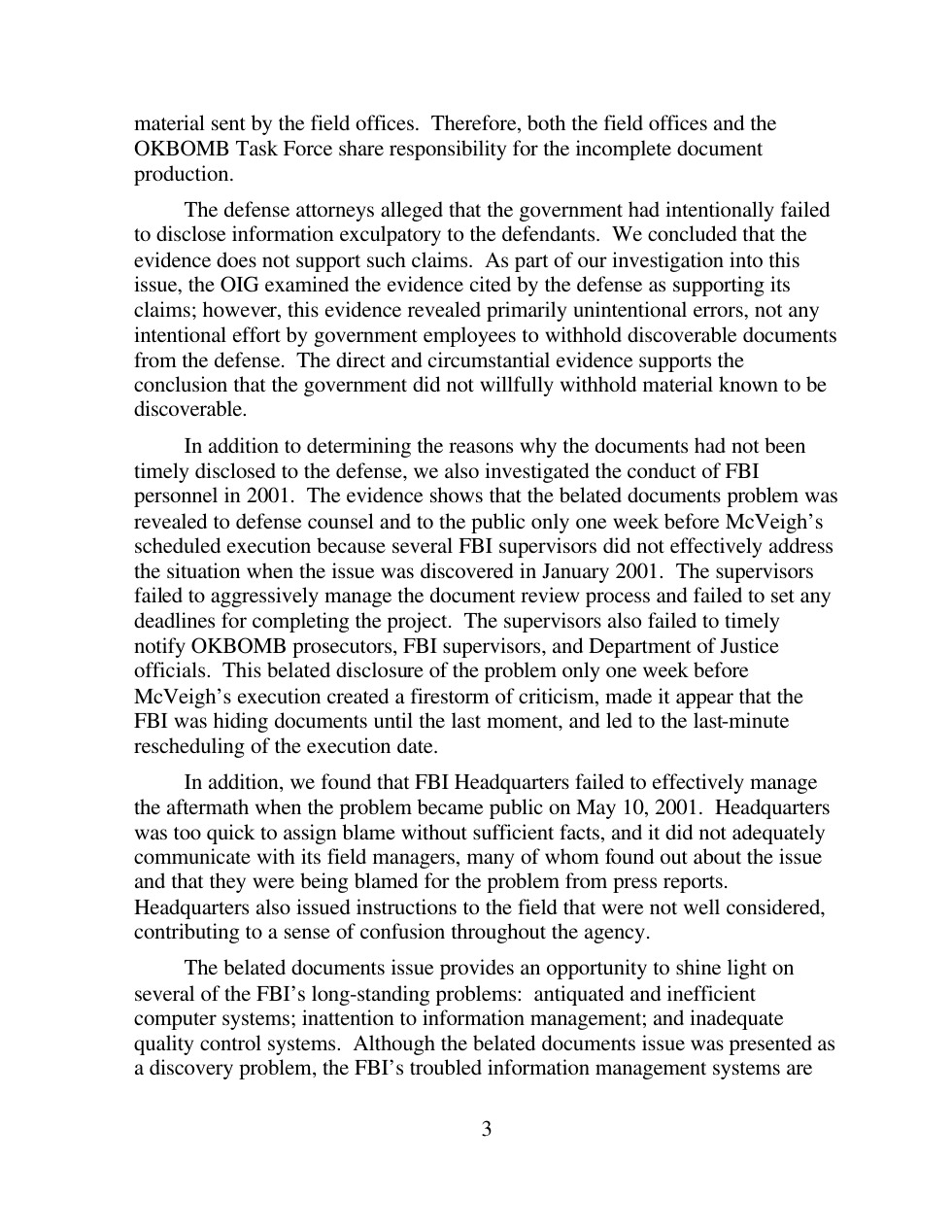
THE IDENTIFICATION / FBI WITNESS-BASED COMPOSITE
John Doe No.1 composite later connected to McVeigh

FBI John Doe No. 1 composite, drawn from witness descriptions in April 1995. The lead helped identify Timothy McVeigh; the sketch itself was not proof of guilt. Image credit ↗

Scope & method / Edition 1.2

The event, the evidence, and the limits of inference.

This guide follows the Oklahoma City bombing and its investigation, federal trials, later document controversy and separate state case against Terry Nichols. It distinguishes anti-government ideology from unproved formal militia membership.

Read the chapters for a narrative; use the record below to test it. Established means the specific proposition is documented. Interpretation marks an inference or a historical argument. Unknown means the record here cannot decide. An archive’s possession of a document does not endorse its contents.

A curated primary-record history, not a complete trial-transcript, psychiatric, raw forensic, every-lead or current-custody audit. Specific legal outcomes and archive limits remain separate. Selected retrospective accounts are read within their stated scope; no full book or film audit is implied.

01 / The record

The story, in 6 chapters

The attack, the identification chain, distinct defendants, an actual defense proffer, the disclosure scandal and the people living with the consequences.

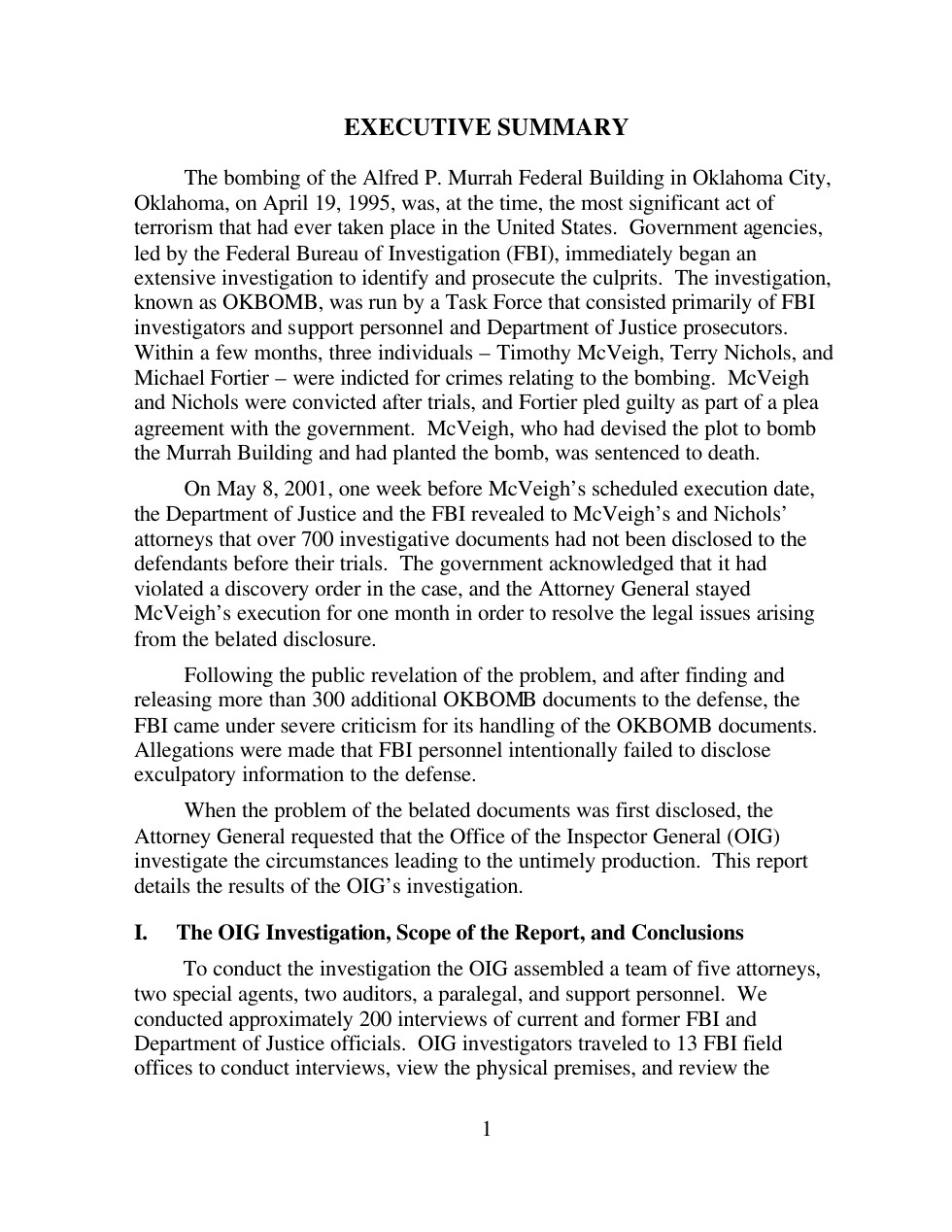
OIG executive summary opening, printed1
The OIG’s 2002 executive summary begins with the attack and the three distinct federal defendants. Authentic federal report, printed page 1; not a contemporary scene photograph. Image credit ↗

Chapter 01 / 19 April 1995

A morning measured in lives

At 9:02 on the morning of 19 April 1995, a truck bomb exploded outside the Alfred P. Murrah Federal Building in Oklahoma City. It killed 168 people, including 19 children, and injured hundreds. The building housed public offices and a day-care center. For people arriving at work, bringing a child to care, or seeking a government service, the attack struck an ordinary weekday. The victims were people living and working in a city, not abstractions in the bomber’s dispute with the government.

Timothy McVeigh parked the rented truck outside the building and left before the explosion. The federal case later established his responsibility for the bombing. He was an Army veteran whose hostility toward the federal government included anger over the 1993 Waco confrontation. That context helps explain his selection of a federal target and an anniversary date. It does not turn the people in the building into participants in a battle, and it does not supply a legal or moral defense for killing them.

The first public explanations were uncertain. Some speculation assumed a foreign terrorist organization; the investigation instead identified an American offender and his associates. The episode cautions against assigning responsibility from a familiar terrorism stereotype. The eventual case depended on physical evidence, witnesses and records, rather than on choosing which category of suspect seemed plausible in the first hours.

McVeigh’s hostility toward the government placed the attack within an extremist political environment. His associates, reading and contacts provide evidence about that environment. The court record establishes responsibility through particular conduct; it does not establish a formal militia command order. McVeigh’s own rationalization that federal workers were guilty by association explains his dehumanizing choice of target. It does not turn civilians and children into participants in a war or make an organization responsible merely because some members shared his grievances.

The losses continued long after the trials. In Associated Press reporting in 2025, Aren Almon emphasized that her daughter Baylee, killed at one year old, was a real child rather than only a symbol. Survivor PJ Allen described the continuing effects of his childhood injuries. Their accounts give the death toll and the word “survivor” individual meaning.
Sources: S01 · S03 · S09 · S10

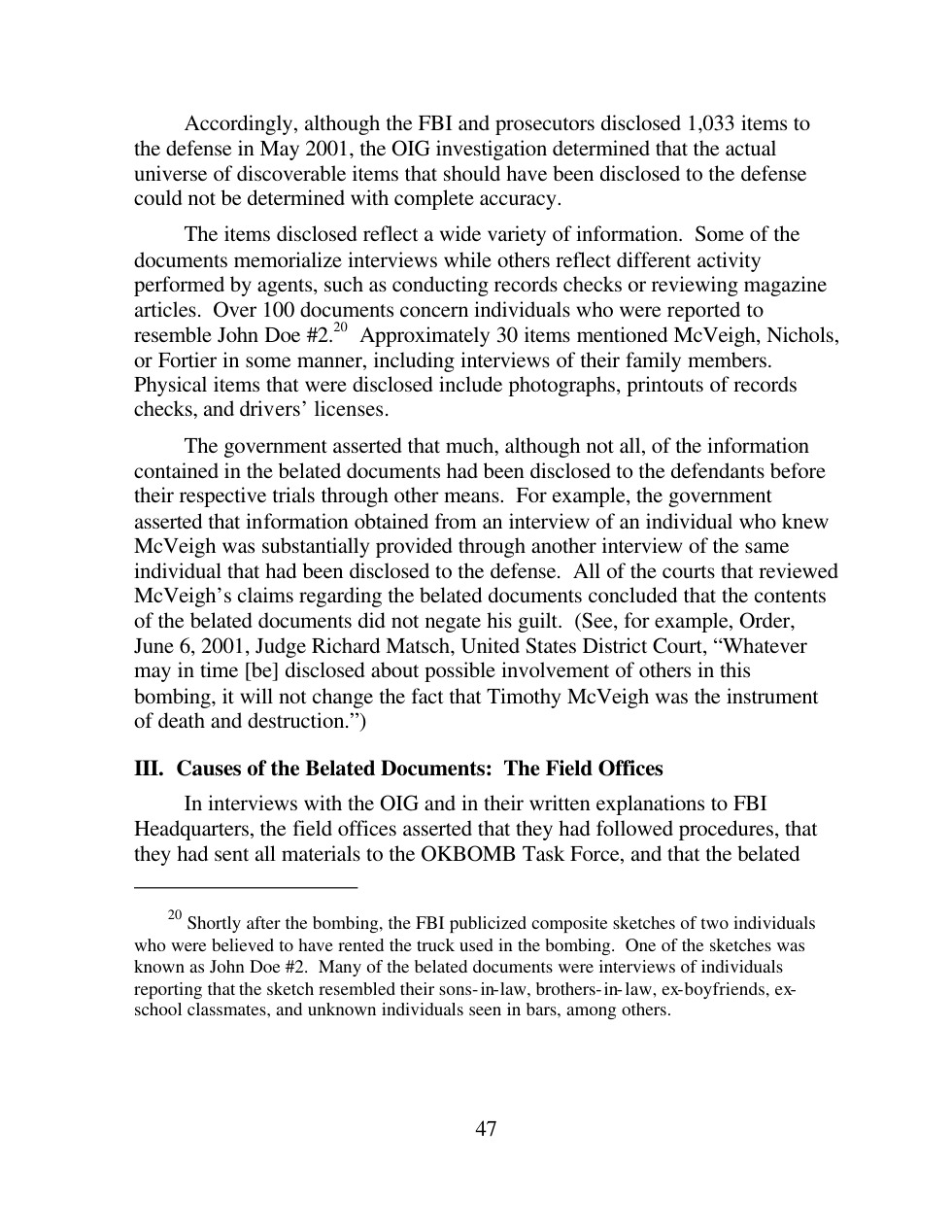
OIG uncertain missing universe, printed47
The OIG’s printed page 47 distinguishes the 1,033-item production from the unknowable exact universe of overdue discoverable material. Image credit ↗

Chapter 02 / April 1995

An axle, a rental record, and a man already in jail

The identification of McVeigh joined two investigations that initially appeared separate. At the bombing scene, investigators recovered a truck axle whose identifying information helped trace the rented vehicle to Kansas. Rental employees and other witnesses helped investigators reconstruct the renter’s movements and identity. Meanwhile, Oklahoma State Trooper Charlie Hanger had stopped McVeigh for a missing license plate soon after the bombing. The appellate chronology places the stop 77 minutes after the blast; the FBI retrospective rounds it to about 90 minutes. The traffic stop led to an arrest for carrying a concealed weapon. McVeigh was already in custody when the bombing inquiry caught up with him.

This was not simply an arrest produced by a famous composite drawing. The drawing helped generate identifications; records and corroborating evidence mattered in turning that lead into a case. The distinction is central to reading the investigation. A witness resemblance can start an inquiry, but it does not by itself establish who rented a truck or committed mass murder. The later trial record assembled a broader chain that included movements, purchases, associations, physical traces and testimony.

Early witness accounts also produced the widely circulated John Doe No.2 sketch. The Oklahoma City National Memorial & Museum identifies that image with a man who rented a truck on the preceding day, unrelated to the bombing. This correction concerns the origin of a particular sketch. It does not, on its own, answer every question about other possible assistance. A witness description, a composite image and an identified participant are different kinds of evidence; the rental records and corroborating trial evidence remain essential to McVeigh’s identification.

The case also depended on agencies beyond the FBI. Local responders worked amid the destruction; state policing placed McVeigh in custody; federal investigators and prosecutors developed the bombing case. Calling it an FBI takedown can obscure that cooperation. It can also imply a single decisive moment where there was a chain: a physical trace, a rental history, identifications, an existing arrest, and an accumulating body of corroboration. Removing any one link changes what the early investigators could responsibly have concluded at that time.

Sources: S01 · S03 · S11

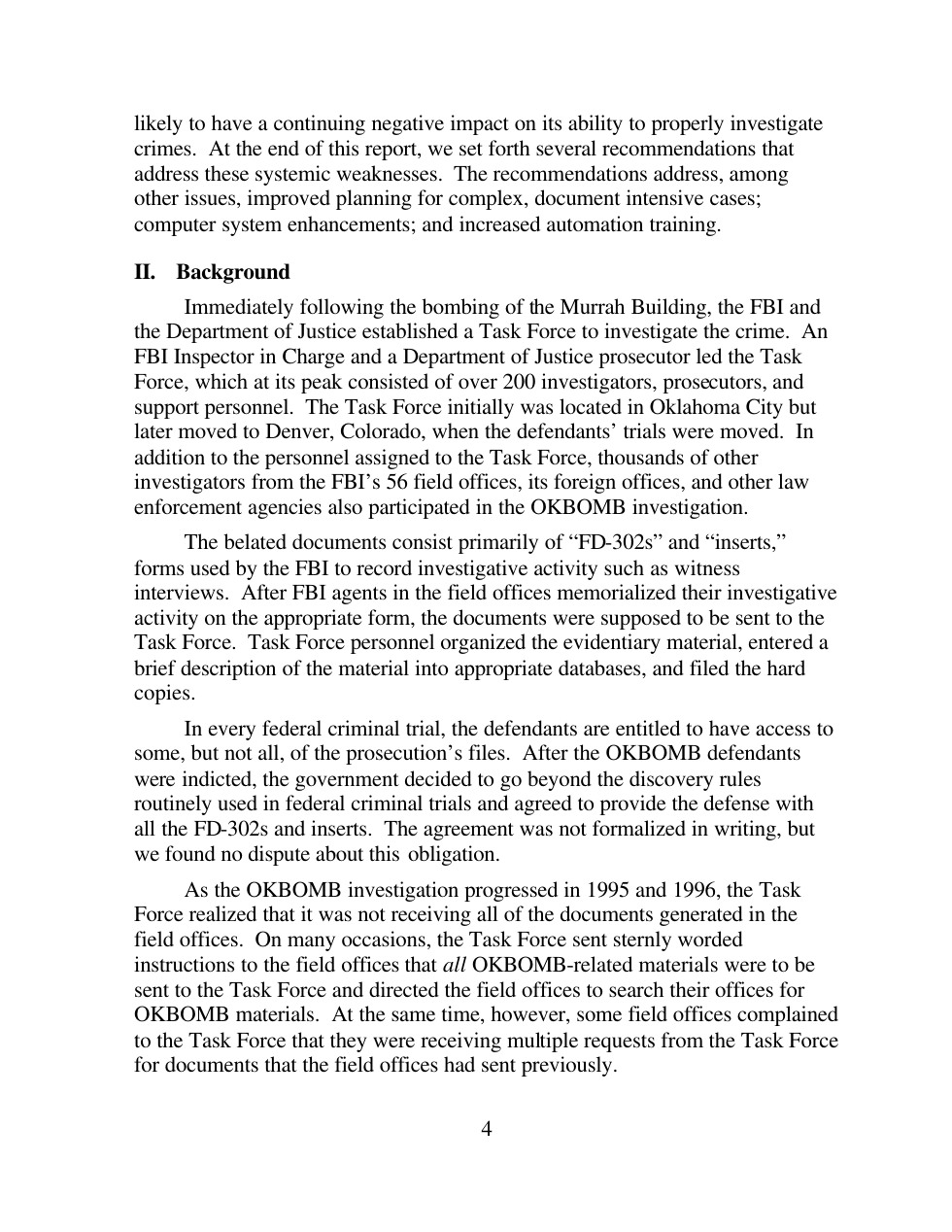
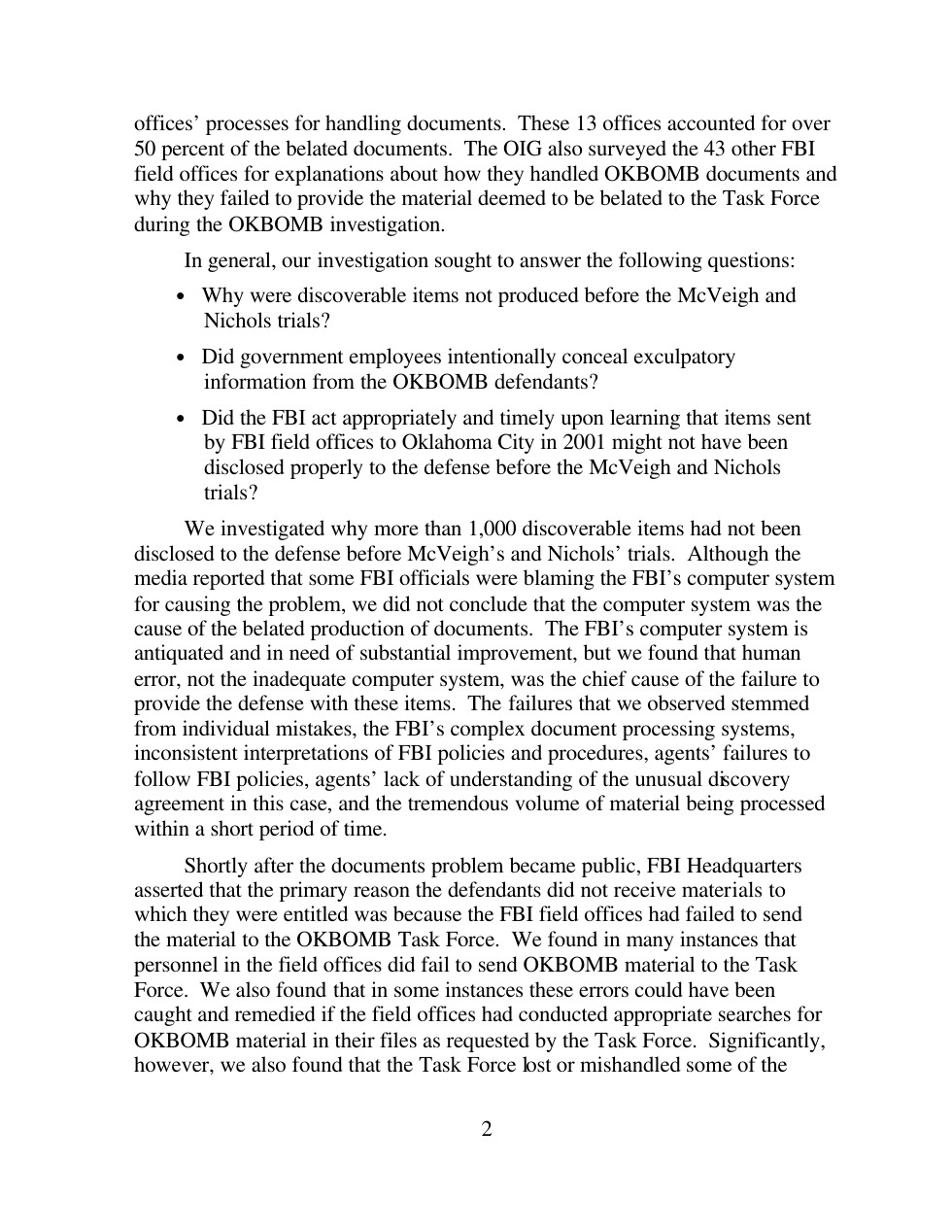
OIG investigation and questions, printed2
The OIG describes its investigative questions and scope, printed page 2. Its disclosure inquiry did not replace the defendants’ separate trials. Image credit ↗

Chapter 03 / 1995–2004

One bombing, distinct defendants and verdicts

McVeigh and Terry Nichols were indicted together, but their cases did not produce identical verdicts. Their trials were separated, and McVeigh went first. On 2 June 1997, the jury convicted him on all eleven federal counts. The jury recommended death in June; Judge Richard Matsch imposed sentence on 14 August 1997. On 8 September 1998, the Tenth Circuit upheld the conviction and sentence after examining challenges involving the trial, publicity, evidence and sentencing. A settled verdict is a fact of the legal record; explaining it does not require treating every statement made by the prosecution as independently established history.

Nichols’s federal jury convicted him of conspiracy and involuntary manslaughter rather than returning the same verdict as McVeigh’s jury. He received a life sentence. Oklahoma later prosecuted him in a separate state case, which resulted in 161 murder convictions and consecutive life terms in 2004. These are separate proceedings, with different charges and findings. Combining them into a generic statement that both men received the same conviction or punishment would erase a meaningful part of the history.

Michael Fortier’s legal position was different again. He pleaded guilty to stolen-firearms conspiracy and transportation, a false statement to the FBI and misprision of a felony. He was not charged as a co-conspirator in the bombing. He knew the plan, sold stolen guns and passed some proceeds to McVeigh; the government could not trace the money to particular bombing expenditures. The 2001 appeal affirmed his renewed twelve-year term and reduced $75,000 fine after an earlier remand. Judge John Porfilio dissented on the causal basis for the upward departure. The majority found the consequences reasonably foreseeable; the dissent emphasized the government’s stipulation and the necessary link to his actual offenses. Neither position made Fortier a convicted murderer.

These distinctions matter beyond procedural completeness. They separate the person who carried out the attack, the person convicted of assisting the conspiracy, and a person whose knowledge and later testimony were central to the prosecution. They also prevent a false choice between a solitary actor and an enormous hidden organization. The proven involvement of associates does not establish every later theory about additional participants. Conversely, rejecting an unsupported wider conspiracy does not require pretending that McVeigh acted without any assistance or prior knowledge by others.

Lori Fortier’s assistance with false identification appears in the appellate account of the rental. Her conduct, Michael’s cooperation agreement and Nichols’s conspiracy verdict are different propositions. Witness incentives remain relevant, but credibility is tested against corroboration and cross-examination rather than decided from the existence of a bargain. These distinctions also keep an institutional retrospective’s loose description of the men as co-conspirators from silently becoming a statement that each was charged with and convicted of the same crime.

Sources: S02 · S03 · S07 · S08 · S13

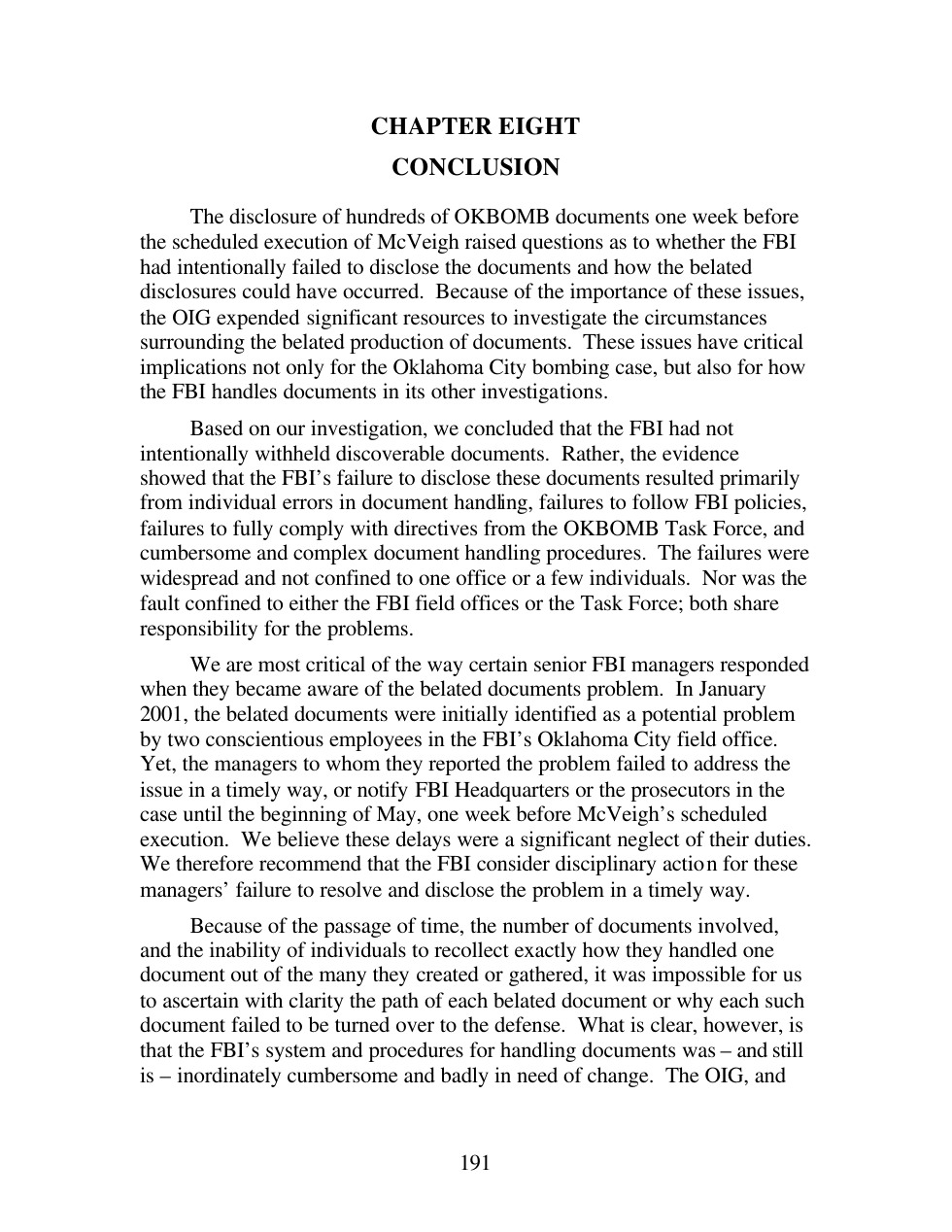
OIG findings on error and intent, printed3
The OIG’s printed page 3 finds primarily unintentional document failures. This later oversight finding is distinct from the 1998 court’s ruling on a defense proffer. Image credit ↗

Chapter 04 / 1997–1998

What the alternative-perpetrator defense actually offered

The strongest recorded challenge to a closed account of the bombing did not rest only on an unidentified face. At trial, McVeigh’s lawyers proposed testimony from Carol Howe about Elohim City, an extremist community. As the appellate opinion recounts the proffer, she would have described hostile statements, discussions of possible federal targets and people she believed resembled the composite drawings. Counsel also offered reports said to show investigators had curtailed an inquiry after McVeigh’s arrest. The proposed purpose was both to suggest other perpetrators and to challenge the investigation’s completeness. A proffer describes what counsel expected to prove; it is not itself an adopted finding that the named people committed this attack.

The Tenth Circuit upheld exclusion under the evidence rules. Even assuming marginal relevance, it judged the proposed connection generalized and speculative, with a substantial risk of confusing the jury. The court required a nexus between an alternative suspect and the charged crime, beyond shared anti-government views or threats about possible targets. That is an evidentiary reason for rejecting this particular offer. It neither makes all investigation of additional assistance irrational nor proves every person discussed in the proffer innocent of every unrelated act. The result was affirmance of McVeigh’s conviction, not a separate trial or acquittal of those other people. On the separate claim that investigators had prematurely ended the Elohim City inquiry, the panel read the offered reports as showing a continuing investigation and concern for Howe’s safety. It also found no demonstrated connection between the alleged investigative shortcomings and the reliability of trial evidence.

The John Doe No. 2 drawing presents a narrower question. The Memorial & Museum’s artifact record identifies its subject as Todd Bunting, who rented a moving truck on the previous day and was unrelated to the bombing. That account explains a particular witness/composite error. It does not establish a universal absence of additional help. Equally, an early resemblance report is not proof that Bunting, or another named person, took part. The correct comparison is between an authenticated participant-specific link and the already documented vehicle, identity, witness and physical-evidence chain.

The later records scandal increased the importance of asking what had been available for defense review. It did not retroactively supply the missing nexus in every alternative-perpetrator claim. To change this assessment, a new record would need a verifiable origin, a reliable connection to the relevant people and dates, and conduct linked to this attack. A dated communication, financial transfer or independently corroborated witness account could matter. Ideological resemblance, a repeated assertion or the mere existence of a lost document would not establish the same thing.

Sources: S03 · S11 · S12

OIG chronology introduction, printed4
The OIG’s printed page 4 begins the document-management chronology. An archival project uncovered a problem that supervisors failed to resolve or report promptly. Image credit ↗

Chapter 05 / 2001–2002

A conviction survives a broken disclosure process

On 8 May 2001, shortly before McVeigh’s scheduled execution, the government informed defense lawyers that investigative material had not been produced before trial. Attorney General John Ashcroft postponed the execution for a month. The inspector general’s later report records 1,033 items disclosed that May, while warning that duplicates and destroyed records made the exact universe of missing material uncertain. The figure counts items, not simply pages, and the disclosure failure was acknowledged as a violation of the case’s discovery order.

The 2002 investigation traced the failure through field-office handling, inconsistent practices, misunderstood discovery requirements and inadequate supervision. It found human error to be the chief cause rather than blaming an old computer system alone. Some officials knew of a potential problem in January 2001, but prosecutors and senior headquarters officials were not notified until May. Thirteen field offices destroyed some records after an archival instruction, and other destruction preceded that process. The OIG could not verify that every destroyed item had previously reached the defense.

The OIG examined eight documents the defense identified as especially significant and found no evidence establishing intentional concealment. That conclusion rested on interviews, document comparisons and analysis, rather than merely accepting an agency denial. Its finding of primarily unintentional errors did not excuse the failure or convert the archive into a complete record. Over one hundred belated items concerned reported resemblances to John Doe No.2; resemblance reports, however, are leads to evaluate, not authenticated identities of additional bombers.

The controversy did not overturn McVeigh’s conviction. He was executed on 11 June 2001 after further proceedings. The fact that his responsibility survived review answers a different question from whether all possible assistance had been identified. The OIG’s mission was to investigate late disclosure and its causes, not conduct a new trial of every theory about the bombing. A broader account would need authenticated participant, communication or financial evidence connected to the attack. The documented disclosure breakdown deserves its full weight without becoming proof, by itself, of a named hidden organizer or a deliberate government operation.

Nichols’s 5 April 2002 collateral appeal must also be read precisely. It concerned the earlier lead-sheet disclosure claim and his challenge to the conspiracy instructions. The court affirmed denial of relief. It did not treat the newly disclosed interview forms as a separately presented substantive Brady claim in that appeal. The judges rejected an inference that the new disclosure failure alone proved the previously reviewed lead-sheet classifications unreliable; Nichols had not supplied evidence of a mischaracterized or improperly withheld sheet in that proceeding. This was a bounded legal ruling, not an independent audit of every newly discovered document or every possible accomplice.

Sources: S04 · S05 · S06 · S10 · S12 · S07

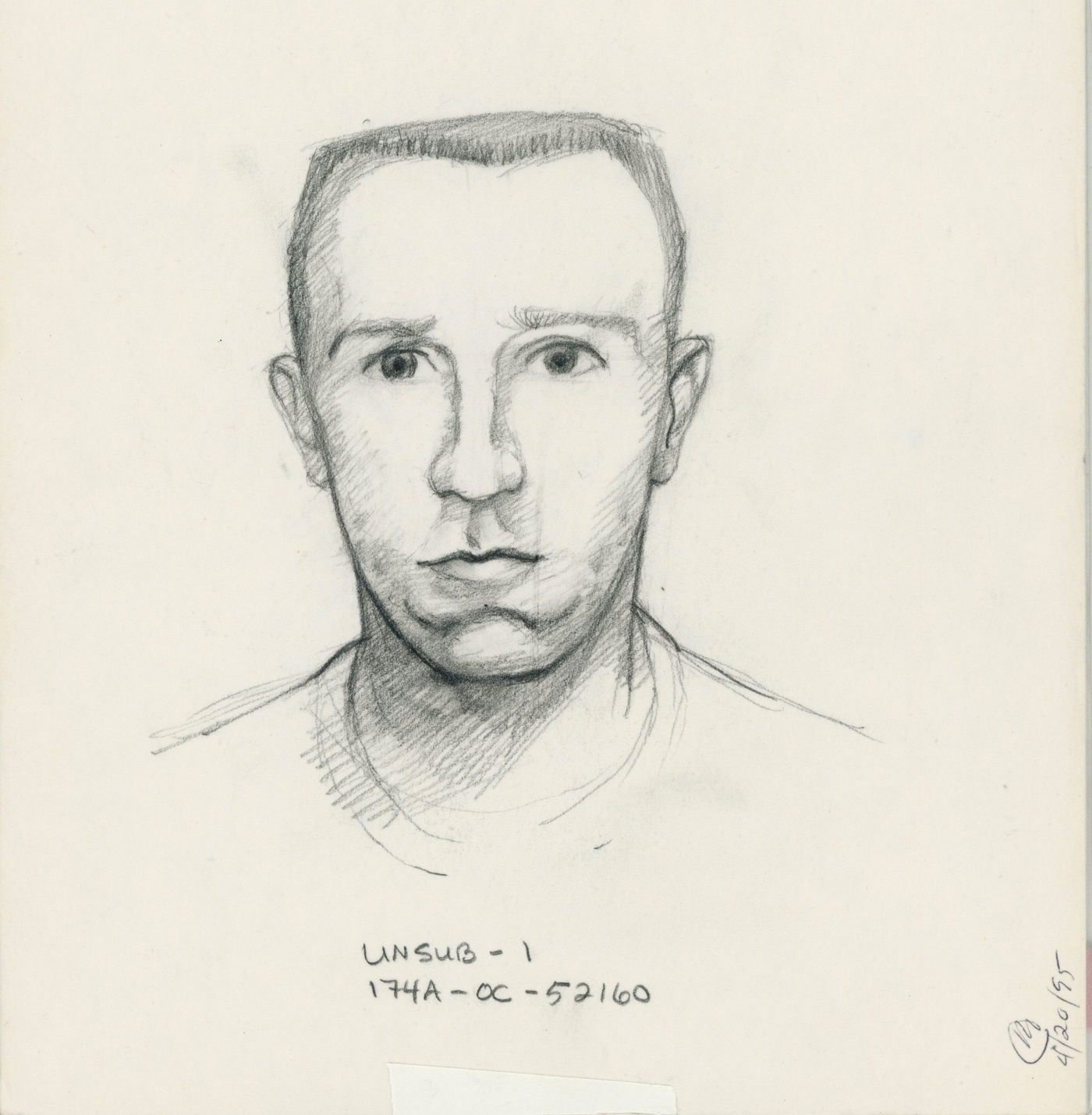
OIG conclusion and supervisory criticism, printed191
The OIG’s printed page 191 finds widespread failure and criticizes senior managers’ delayed response. This is a retrospective conclusion, not a new verdict on bombing guilt. Image credit ↗

Chapter 06 / 2002–2025

What institutional success leaves outside the frame

The FBI’s case history tells an arrest-and-conviction story: the axle, the rental shop, a composite and a man already in state custody. Its claim of an exhaustive inquiry expresses institutional confidence. The OIG’s report supplies a different, documented yardstick. Field offices failed to forward material, the task force also lost or mishandled it, and senior managers failed to report a known potential problem promptly. A reader can accept the investigative chain against McVeigh while rejecting an unqualified account of faultless record handling. The oversight finding rests on interviews, site visits and document comparisons; it is stronger than an accused institution’s bare reassurance.

Barry Black’s 2020 institutional retrospective adds the experience of recovering and tracking evidence in a largely analog investigation. It emphasizes collaboration and the practical difficulty of finding information again in a huge collection. That perspective helps explain workload. It cannot substitute for the OIG’s finding that human decisions and supervision, rather than a computer alone, caused the discovery failure. Nor can technological improvement prove that every historical omission has now been repaired. A completed records inventory and documented disclosure history would be stronger evidence of a repaired archive than an anniversary statement.

Public memory follows another path through the Memorial & Museum, photographs and survivors’ accounts. In Sean Murphy’s April 2025 AP reporting, Aren Almon insisted that her daughter Baylee was a person rather than just a symbol. PJ Allen described continuing physical effects of surviving the attack as a child. Those accounts document individual lives and lasting injuries; they are not measures of national opinion or forensic proof about additional participants. Their presence changes what a history centers without changing the legal standard for convicting a defendant.

The result is neither a one-man legend nor a claim that no reliable conclusion is possible. Particular conduct produced different judgments for McVeigh, Nichols and Fortier. A documented disclosure violation coexists with those outcomes, while the remaining perimeter questions require their own evidence. The 168 deaths are not a rhetorical device for excusing procedural failure, and the procedural failure is not a substitute for evidence against a named additional organizer. The continuing work of remembrance concerns lives that outlast the news cycle, the execution and the institution’s account of its own success.

Sources: S01 · S04 · S09 · S10 · S11 · S12

02 / The record

The critical path

Attack → physical/rental identification plus independent state custody → tested and differentiated responsibility → actual alternative-perpetrator dispute → disclosure accountability → separate legal and personal aftermath.

Evidence support assesses the stated hinge; cultural prominence is unmeasured and any recurrence is scoped to the inspected accounts. No invented polls or popularity rankings.

CP1

The attack establishes consequences before attribution

Official-record yardstick

19 April 1995 at 9:02: 168 people killed, including 19 children; the later legal record attributes the attack to McVeigh.

The toll and location are not inferred from a political affiliation. Survivor histories address lasting harm, while forensic and legal attribution require their own evidence.

Why it is critical

Keeps the event requiring explanation separate from the biography, grievances and later institutional success story.

If this step is removed

Without the attack, this is a political biography. Removing a retrospective’s language does not erase the event or its independently adjudicated consequences.

Dependencies

Dated incident and victim records, later tested attribution and individually attributed survivor accounts.

What rival readings must explain

All accounts must explain the same attack; a motive claim does not change who was harmed or prove who directed it.

Gaps and disputes

No independent re-audit of death/medical records or complete scene reconstruction; no procedural attack details reproduced.

Evidence support: High for the attack and toll

The stated hinge in the reviewed documents; not a general rating of an institution or every investigative lead.

The judicial background and institutional records converge on the core event; the AP accounts concern individual aftermath.

Cultural prominence: Unmeasured

General audience familiarity and comparative cultural prominence are unmeasured. Recurrence described below is limited to inspected accounts.

Deaths and child victims recur in inspected institutional and survivor accounts. No population popularity rank is inferred.

Sources: S01 · S03 · S09 · S10

CP2

Two inquiries converge on someone already in custody

Official-record yardstick

The axle/rental trail and witness identification connect to McVeigh’s separate state traffic arrest.

The sketch generated leads; the rental chronology, records and subsequent corroboration converted identification into a case. Hanger’s arrest preceded the bombing inquiry’s discovery of McVeigh in jail.

Why it is critical

Explains how investigators moved from a scene to a named suspect without replacing corroboration with resemblance.

If this step is removed

Remove the vehicle/rental connection and the established identification route weakens. Remove the sketch alone and the exact marginal effect requires the full contemporaneous investigative file; no certainty about an alternative outcome is claimed.

Dependencies

CP1, provenance of the vehicle component, rental records, witnesses and the independent arrest chronology.

What rival readings must explain

A misidentification account must explain the combined chain. A single-FBI-breakthrough account must explain the state arrest already holding the suspect.

Gaps and disputes

The court says 77 minutes; the FBI overview rounds the stop to 90 minutes. No complete raw chain-of-custody or witness-interview audit.

Evidence support: High for the linked identification; qualified for timing precision

The stated hinge in the reviewed documents; not a general rating of an institution or every investigative lead.

Actual judicial account and institutional retellings describe the sequence, with their timing difference disclosed.

Cultural prominence: Unmeasured

General audience familiarity and comparative cultural prominence are unmeasured. Recurrence described below is limited to inspected accounts.

The axle and sketch recur in the inspected FBI accounts and museum records. Recurrence does not measure national familiarity.

Sources: S01 · S03 · S09 · S11

CP3

Trial and cooperation evidence produce different individual judgments

Official-record yardstick

McVeigh: eleven federal convictions/death. Nichols: federal conspiracy/eight involuntary-manslaughter counts/life. Fortier: four other offenses and a renewed 144-month term.

Corroboration, cooperation incentives and separate mental-state findings matter. The Fortier sentencing majority and Porfilio dissent disagree about a causal link, not whether he received a bombing-murder conviction.

Why it is critical

Turns arrest into adjudication and prevents both an entirely solitary offender story and guilt by association.

If this step is removed

Without tested evidence and the verdicts, an arrest remains an accusation. Remove Fortier’s testimony and the full trial record is needed to assess sufficiency; no automatic acquittal is inferred.

Dependencies

CP2 plus particular charges, witness terms, exhibits, jury findings and review. State Nichols murder judgments are later and separate.

What rival readings must explain

A wider account must preserve the proven participants while adding reliable links. A total institutional triumph must preserve individual verdict differences and the real sentencing dissent.

Gaps and disputes

Full trial exhibits/transcripts and every credibility challenge not re-audited. A narrative summary is not a new evidentiary trial.

Evidence support: High for outcomes; qualified for marginal witness contribution

The stated hinge in the reviewed documents; not a general rating of an institution or every investigative lead.

Actual appellate dispositions identify offenses and sentence reasoning; distinct reporting establishes the state sentence.

Cultural prominence: Unmeasured

General audience familiarity and comparative cultural prominence are unmeasured. Recurrence described below is limited to inspected accounts.

Institutional summaries group the associates together; inspected court records preserve important differences. Audience awareness of these differences is unmeasured.

Sources: S03 · S07 · S08 · S13 · S14

CP4

An alternative-perpetrator proffer needs a connection to this crime

Official-record yardstick

The 1998 appeal upholds exclusion of Howe’s proposed Elohim City testimony under Rule 403; it is a ruling about an actual defense offer.

The defense offered both alternative responsibility and an investigation-bias argument. The court found the proposed nexus generalized/speculative even assuming marginal relevance. On the proposed reports, the court found the investigation had continued and that no shown defect undercut trial evidence.

Why it is critical

Preserves the strongest recorded factual rival and the court’s specific response instead of replacing either with a caricature.

If this step is removed

Remove the missing-nexus assessment and the admissibility balance could change. Remove the proffer from the history and the defense’s documented objection disappears, although the judgment remains affirmed.

Dependencies

CP3’s trial and the precise expected testimony/reports; distinct from later disclosure and the museum’s identification of the second sketch.

What rival readings must explain

A wider-organizer account must supply participant-specific corroboration. A closed-case account must acknowledge what was offered and that exclusion is not an acquittal of every alternative suspect.

Gaps and disputes

No complete underlying informant file or independent adjudication of every allegation about the community. Proposed testimony is not an established finding.

Evidence support: High for ruling and recorded dispute; additional identities unestablished

The stated hinge in the reviewed documents; not a general rating of an institution or every investigative lead.

Actual opinion describes the proffer, two defense purposes and Rule 403 reasoning. The museum resolves a narrower sketch question.

Cultural prominence: Unmeasured

General audience familiarity and comparative cultural prominence are unmeasured. Recurrence described below is limited to inspected accounts.

Alternative suspects and the second sketch occur in inspected court/museum/OIG discussions. No relative public-belief measurement.

Sources: S03 · S11 · S12

CP5

Discovery failure is established without a proved concealment plot

Official-record yardstick

May 2001 production of 1,033 items followed notice shortly before execution; OIG finds primarily human/supervisory error, delayed reporting and an uncertain missing universe.

The OIG distinguishes an accounting of production from a perfect inventory, and tests intent through interviews and comparisons. Nichols’s 2002 lead-sheet ruling resolves a bounded legal claim.

Why it is critical

Makes disclosure accountability independent of the prosecution’s strength, while keeping a proven violation separate from a named covert organizer.

If this step is removed

Without the late disclosure, the documented accountability story loses its trigger. Remove a presumption that every item was innocuous and materiality requires examination, not automatic reversal or automatic concealment.

Dependencies

CP3 discovery obligations, field-office/task-force handling, actual inventories and the OIG’s inquiry; CP4 is not itself proof that a missing item establishes another perpetrator.

What rival readings must explain

Suppression accounts must address the OIG’s affirmative inquiry and contrary findings; all-clear accounts must explain destroyed material and delayed notification.

Gaps and disputes

Duplicates/destruction prevent certainty about the universe. The OIG did not retry all conspiracy theories; the 2002 panel did not hear new 302s as a separate substantive Brady claim.

Evidence support: High for failure and reviewed findings; incomplete for the lost universe

The stated hinge in the reviewed documents; not a general rating of an institution or every investigative lead.

Original OIG summary/accounting/conclusion and actual Nichols appeal distinguish facts, scope and inferences.

Cultural prominence: Unmeasured

General audience familiarity and comparative cultural prominence are unmeasured. Recurrence described below is limited to inspected accounts.

The scandal recurs in the OIG and legal record; no claim it is as widely remembered as the sketch or explosion.

Sources: S04 · S05 · S07 · S12

CP6

Legal finality does not close historical or personal aftermath

Official-record yardstick

McVeigh executed 11 June 2001; Nichols’s separate 2004 state case brings 161 murder judgments/consecutive life terms; survivors’ histories continue.

An execution is a legal event, not a census of everyone with knowledge. The OIG’s management criticism and memorial accounts answer questions beyond the judgment.

Why it is critical

Prevents the ending of an offender’s prosecution from becoming the ending of victims’ lives or archival scrutiny.

If this step is removed

Without the final judgments, the legal history changes. Remove survivor accounts and the record still establishes responsibility but loses a documented part of the lasting consequences.

Dependencies

CP1–CP5, actual historical execution/sentence records and attributed retrospective voices, with no present custody inference.

What rival readings must explain

A wider account needs authenticated new links, not uncertainty alone. A finality-only account must explain why disclosure accountability and remembered losses remain real.

Gaps and disputes

No complete state docket, long-term medical audit, current custody check or survey of national memory.

Evidence support: High for historical outcomes; bounded for aftermath

The stated hinge in the reviewed documents; not a general rating of an institution or every investigative lead.

Execution history, distinct state reporting and read individual accounts establish different propositions.

Cultural prominence: Unmeasured

General audience familiarity and comparative cultural prominence are unmeasured. Recurrence described below is limited to inspected accounts.

Institutional and survivor accounts emphasize different endings. Their relative cultural reach remains unmeasured.

Sources: S06 · S08 · S10 · S12 · S14

03 / The record

How the accounts developed

Actual source chains, judicial citations and documented retellings are separated from parallel perspectives. Shared subjects do not prove literary borrowing; unread books and films are not assigned omissions.

1994–1998

Grievance becomes a stated justification, not a command order

The appellate background records letters and statements invoking Waco, a chosen anniversary and dehumanization of federal workers.

Lineage

Waco grievance → communications to associates/family → motive evidence at trial and in the 1998 opinion.

Borrowing or relationship

The court describes the underlying communications and testimony; this is a documented evidentiary lineage, not proof that all similar rhetoric caused the attack.

Evidence for the connection

Actual judicial narrative identifies the communications and interpretation. No complete political novel, operational text or inferred influence genealogy is reproduced.

Recurring path nodes

CP1CP3CP4

Branches in this record

Two composites generate different identification histories · Testimony and distinct verdicts become appellate histories

Sources: S03

1995 / later museum record

Two composites generate different identification histories

The first drawing is connected to McVeigh through witnesses; the museum identifies the second with a different rental.

Lineage

Witness descriptions → FBI Lab drawings → leads and identifications → artifact interpretation.

Borrowing or relationship

The museum describes both drawings and the second-rental explanation. The 2005 FBI article describes its own official sketch work; parallel accounts do not independently verify every early lead.

Evidence for the connection

The named artifact record and actual FBI article document how witness descriptions became official drawings and were later interpreted. They do not establish the accuracy of every early lead.

Recurring path nodes

CP2CP4

Branches in this record

Discovery objections become a distinct oversight narrative · Investigative memory and lived aftermath run in parallel

Sources: S01 · S11 · S15

1997–2001

Testimony and distinct verdicts become appellate histories

The Fortier opinion cites its prior sentencing appeal; the Nichols order cites McVeigh and its own direct appeal.

Lineage

Trial/plea → separate direct appeals → resentencing/collateral review → later summaries.

Borrowing or relationship

Explicit judicial citations demonstrate reuse. Repeated background is not a new trial; an institution’s generic group label does not change a judgment.

Evidence for the connection

Actual Nichols and Fortier opinions state citations, procedural sequence and outcomes. Fortier’s partial dissent remains part of this branch.

Recurring path nodes

CP3CP6

Branches in this record

Discovery objections become a distinct oversight narrative

Sources: S03 · S07 · S13

1997–2002

Discovery objections become a distinct oversight narrative

Defense objections preceded the 2001 revelation. The OIG examined selected defense-identified items and tracked how the failure occurred.

Lineage

Discovery disputes → archival review → late production → defense claims/OIG investigation and later court review.

Borrowing or relationship

The OIG explicitly identifies defense arguments and its interviews/document comparisons. The Nichols order analyzes the new disclosure’s proposed effect on an earlier lead-sheet claim.

Evidence for the connection

Actual primary texts establish the relationship and their different scopes; the OIG is not merely repeating an FBI public denial.

Recurring path nodes

CP4CP5CP6

Branches in this record

Investigative memory and lived aftermath run in parallel

Sources: S04 · S07 · S12

2005–2025

Investigative memory and lived aftermath run in parallel

FBI retrospectives emphasize identification and collaboration; museum interpretation and survivor reporting center artifacts and continuing lives.

Lineage

Historical investigation → official commemoration / artifact interpretation / attributed survivor reporting.

Borrowing or relationship

These inspected accounts revisit common events. No direct borrowing among them, or complete book-to-film lineage, is asserted without textual evidence.

Evidence for the connection

Actual 2005/2020 FBI passages, museum description and 2025 AP interviews establish their stated frames; comparative audience reach is unmeasured.

Recurring path nodes

CP1CP2CP5CP6

Sources: S09 · S10 · S11 · S15

04 / The record

Rival readings on the same path

The strongest versions, the steps they accept or revise, and the evidence they would need.

Interpretation 01

McVeigh carried out a conspiracy with identifiable assistance

Strongest fit for the adjudicated record

The strongest version

The physical rental trail, trial evidence and testimony identify McVeigh as the bomber, Nichols as a conspirator and other specific forms of help or prior knowledge. The record need not describe a lone man with no assistance to establish his responsibility.

Accepts

CP1–CP3 and the distinct judgments at CP6. Cooperation incentives and witness uncertainty remain relevant to individual propositions.

Must still explain

It cannot extend guilt to everyone sharing a political grievance or turn the conviction into proof that investigators identified every possible participant.

Assessment

The appellate opinion and separate Nichols proceedings support a bounded conspiracy. The OIG’s later criticism concerns a real failure alongside that body of evidence.

Accept these path nodes

Remove or revise this inference

  • Remove a literal no-assistance lone-offender interpretation.

Add this evidence

  • For each additional person, authenticated conduct and connection to the attack.

What would change this assessment

Authentic evidence contradicting a key attribution would require reassessment. New participant-specific evidence could widen the conspiracy while leaving McVeigh’s established conduct intact.

Sources: S01 · S03 · S07 · S08 · S12

Interpretation 02

Additional assistance remained unidentified or incompletely investigated

A legitimate perimeter question; specific wider identities unestablished here

The strongest version

Early witness reports and the later discovery failure justify asking whether every potential helper and lead was pursued adequately. More than one hundred late items concerned reported resemblances to John Doe No.2, and the missing-document universe was not perfectly reconstructable. The actual defense proffer about Howe and Elohim City challenged both alternative responsibility and investigative completeness; the1998court upheld exclusion for insufficient nexus andRule403risks.

Accepts

McVeigh’s responsibility at CP2–CP3 and the proven involvement of associates. Additional help does not require pretending the known defendants were uninvolved.

Must still explain

The origin of the particular John Doe No.2 sketch was linked to a separate rental. Resemblance reports can be mistaken or duplicative. A wider account still needs an authenticated identity, conduct and connection to the attack, rather than a pile of unexplained names.

Assessment

The archive failure sustains scrutiny of completeness, but it does not independently establish an additional bomber or a command organization. The reviewed record leaves particular wider claims unproved.

Accept these path nodes

Remove or revise this inference

  • Remove the inference that a corrected sketch or upheld conviction alone settles all possible assistance.

Add this evidence

  • Contemporaneous communication, transaction, physical evidence or independently corroborated testimony tying a named additional participant to this crime.

What would change this assessment

Authenticated communications, transactions, original contemporaneous witness material or reliable physical evidence tying another person to preparation or execution would materially change the account.

Sources: S03 · S04 · S11 · S12 · S03

Interpretation 03

Intentional suppression concealed a materially different account

Not established by the reviewed evidence

The strongest version

Late production, delayed notification and destroyed records can raise concern that officials protected a preferred narrative. The strongest version identifies a specific withheld, exculpatory item and evidence that people knowingly suppressed it.

Accepts

CP5’s disclosure violation and incomplete accounting; it need not begin by denying the bombers’ already established acts.

Must still explain

The OIG examined the defense’s eight especially significant items, interviewed involved personnel and compared records, finding primarily unintentional error rather than an intent to hide discoverable evidence. The theory must explain that evidence, not rely only on suspicion of an agency.

Assessment

The documented failure is serious. The further claim of deliberate suppression remains unsupported here. The finding is stronger than an accused institution’s bare denial but is also limited by the report’s scope and imperfect archive.

Accept these path nodes

Remove or revise this inference

  • Remove the inference from a late document to a deliberate concealment order.

Add this evidence

  • A particular materially exculpatory item, verifiable knowledge of it, intentional exclusion and a documented decision chain.

What would change this assessment

Authentic concealment orders, proof that a materially exculpatory item was knowingly excluded or a reliable judicial finding of such conduct would change the assessment.

Sources: S04 · S05 · S12

Interpretation 04

The attack expressed anti-government extremist ideas without a proved militia command

Supported motive context; organizational direction remains a separate claim

The strongest version

McVeigh’s stated anger over Waco, anniversary choice and target selection connected his violence to an extremist political environment. Contacts and literature help explain the environment without demonstrating a formal order from a militia organization.

Accepts

CP1–CP3 and the participants’ distinct conduct. Motive is not a moral or legal justification.

Must still explain

It must neither hide actual assistance under the word “lone” nor attribute the bombing to everyone who shared anger at the government.

Assessment

The court record contains motive evidence and particular assistance. It does not establish the broader organizational command claim posed in the claims board.

Accept these path nodes

Remove or revise this inference

  • Remove guilt by ideological resemblance and a purely solitary explanation that erases actual help.

Add this evidence

  • Authenticated orders, financing or communications establishing a particular organization’s direction.

What would change this assessment

Authenticated orders, direction, financing or participant communications would be needed to establish a specific organization’s operational control. Ideological resemblance by itself would not.

Sources: S01 · S03 · S07

05 / The record

What public accounts emphasize

Cards compare actual inspected institutional, judicial, defense-proffer and reporting passages, with exact reading scopes. No complete trial, book, film or audio audit is implied.

The FBI case history: a rapid identification

Actual official overview’s axle, composite, state custody and exhaustive-investigation passages.

Amplifies

Fast identification, volume of work and the successful convictions.

Recasts or leaves unresolved

Frames the inquiry as exhaustive. Its compact success narrative does not resolve the OIG’s documented disclosure failures or distinguish all associates’ offenses.

Scope and limits

An institutional retrospective checked against actual appellate and oversight records; no assumption that every hosted photograph is an employee work.

CP2CP3CP5

Sources: S01 · S07 · S12 · S13

The trial defense: other suspects and a narrowed investigation

The 1998 opinion’s account of counsel’s expected Howe testimony and proposed reports, plus the court’s Rule 403 analysis.

Amplifies

Possible additional perpetrators and a claim that investigators prematurely settled on a preferred account.

Recasts or leaves unresolved

Asks the jury to consider a wider network. The court found the proposed connection to this crime generalized and speculative. The panel also rejected the claimed premature termination on the reports’ actual content and absence of a link to trial reliability.

Scope and limits

A judicially described proffer is not an independently proved account or a complete reading of an informant file; exclusion is not a separate acquittal.

CP3CP4CP5

Sources: S03 · S12

Glenn Fine’s OIG report: failure without a proved concealment purpose

Original executive summary, printed 42–47 accounting and printed 191–192 conclusion; selected intent/notice analysis.

Amplifies

Shared field/task-force responsibility, human error and significant supervisory neglect in delayed reporting.

Recasts or leaves unresolved

Rejects a computer-only explanation and the tested intentional-withholding allegation while preserving destroyed-record uncertainty.

Scope and limits

A disclosure investigation, not a new trial of every theory or proof that all additional assistance has been disproved.

CP4CP5CP6

Sources: S04 · S12

Porfilio’s partial dissent: a sentencing nexus matters

Actual Fortier 2001 majority and partial dissent on the upward departure, including the recorded government stipulation.

Amplifies

The distinction between moral blame, knowledge and harms resulting from the actual crimes of conviction.

Recasts or leaves unresolved

Challenges the causal basis for the enhanced sentence. The majority instead treated the bombing consequences as reasonably foreseeable and affirmed.

Scope and limits

The dissent did not change the judgment; it did not acquit McVeigh or Nichols or make Fortier a convicted bomber.

CP3CP6

Sources: S13

Sean Murphy’s 2025 report: people beyond the iconic image

Actual AP article’s Aren Almon and PJ Allen passages; no full oral-history or photograph-rights license assumed.

Amplifies

A child’s personhood and the continuing effects of surviving severe injury.

Recasts or leaves unresolved

Places individual lives beyond the compressed symbol and the date of the verdict.

Scope and limits

Attributed personal experience, not a poll, forensic finding or proof about every possible organizer. No AP photograph reproduced.

CP1CP6

Sources: S10

06 / The record

Find a thread in the file

Search the chapter and claim index. Every result leads to the full text and its sources.

Chapter 01A morning measured in livesChapter 02An axle, a rental record, and a man already in jailChapter 03One bombing, distinct defendants and verdictsChapter 04What the alternative-perpetrator defense actually offeredChapter 05A conviction survives a broken disclosure processChapter 06What institutional success leaves outside the frameCritical pathThe attack establishes consequences before attributionCritical pathTwo inquiries converge on someone already in custodyCritical pathTrial and cooperation evidence produce different individual judgmentsCritical pathAn alternative-perpetrator proffer needs a connection to this crimeCritical pathDiscovery failure is established without a proved concealment plotCritical pathLegal finality does not close historical or personal aftermathGenealogyGrievance becomes a stated justification, not a command orderGenealogyTwo composites generate different identification historiesGenealogyTestimony and distinct verdicts become appellate historiesGenealogyDiscovery objections become a distinct oversight narrativeGenealogyInvestigative memory and lived aftermath run in parallelRival accountMcVeigh carried out a conspiracy with identifiable assistanceRival accountAdditional assistance remained unidentified or incompletely investigatedRival accountIntentional suppression concealed a materially different accountRival accountThe attack expressed anti-government extremist ideas without a proved militia commandNarratorThe FBI case history: a rapid identificationNarratorThe trial defense: other suspects and a narrowed investigationNarratorGlenn Fine’s OIG report: failure without a proved concealment purposeNarratorPorfilio’s partial dissent: a sentencing nexus mattersNarratorSean Murphy’s 2025 report: people beyond the iconic imageTimelineWaco becomes part of McVeigh’s grievanceTimelineBombing and state arrestTimelineTruck axle helps trace the rentalTimelineInvestigators learn McVeigh is in custodyTimelineFederal indictmentTimelineTrial moved to DenverTimelineSeparate trials orderedTimelineMcVeigh convictedTimelineMcVeigh sentenced to deathTimelineAppellate judgmentTimelineFortier’s renewed sentence affirmedTimelineDefense notified of belated documentsTimelineMcVeigh executedTimelineInspector general reports the disclosure failuresTimelineNichols collateral appeal rejectedTimelineNichols’s distinct state judgmentTimelineBlack’s institutional retrospective publishedTimelineSurvivor reporting revisits lasting harmClaimThe Oklahoma City bombing killed 168 people, including nineteen children.ClaimMcVeigh was convicted on all eleven federal counts.ClaimA militia organization was proved to have ordered McVeigh to bomb the building.ClaimMcVeigh acted without any assistance or prior knowledge by others.ClaimThe FBI’s document disclosure process was faultless.ClaimLate disclosure overturned McVeigh’s conviction.ClaimNichols received the same verdict and punishment as McVeigh.ClaimThe John Doe No. 2 sketch itself establishes another participant in the bombing.ClaimThe OIG report established deliberate concealment of exculpatory evidence.ClaimThe 1,033 items were a perfectly certain count of all documents improperly withheld.ClaimFortier was convicted of the same bombing conspiracy and murders as McVeigh.ClaimThe 2002 Nichols appeal independently resolved every newly disclosed 302 as a substantive Brady claim.ClaimThe 1998 court accepted the Howe proffer as proof that named Elohim City people committed the bombing.ClaimA photograph’s presence in an FBI collection establishes federal employee authorship.

07 / The record

People and institutions

Open a record for the person’s role and supporting sources. Names identify people; no unverified portrait is substituted for a participant.

McVeighBiographical record
Timothy McVeighConvicted bomber

Army veteran convicted on all eleven federal counts in the Oklahoma City bombing case and executed in 2001. His anti-government motives provide context; they do not establish a formal militia command relationship.

Sources: S01 · S03 · S06

NicholsBiographical record
Terry NicholsCo-conspirator; separate trials

Convicted in federal court of conspiracy and involuntary manslaughter, then convicted of murder in Oklahoma’s state prosecution. His verdicts and sentences must be distinguished from McVeigh’s.

Sources: S02 · S07 · S08

FortierBiographical record
Michael FortierCooperating witness

Knew of the plot and testified after a plea agreement. The agreement and the corroboration of his account are both relevant to evaluating the evidence.

Sources: S03

HangerBiographical record
Charlie HangerOklahoma State Trooper

Stopped McVeigh for a missing plate and arrested him on a weapons charge before investigators identified him as the bombing suspect.

Sources: S01

MatschBiographical record
Richard MatschTrial judge

Presided over the federal proceedings; his rulings and the appellate review form part of the legal record.

Sources: S03 · S05

respondersBiographical record
Victims, survivors and respondersPeople at the center of the event

The attack killed 168 people, including nineteen children, and injured hundreds. Their lives and the long recovery must not disappear behind an offender-centered account.

Sources: S01 · S09

FortierBiographical record
Lori FortierIdentification assistance described in court

The appellate background describes help with the false identification used for the rental. Her conduct is distinct from Michael’s particular convictions and the bombing defendants’ verdicts.

Sources: S03

HoweBiographical record
Carol HoweProposed defense witness

Counsel offered testimony concerning Elohim City and alternative suspects. The court upheld exclusion; proposed allegations are not adopted findings about named people.

Sources: S03

PorfilioBiographical record
John PorfilioPartially dissenting appellate judge

Disputed the causal basis of Fortier’s enhanced sentence in 2001; the majority affirmed.

Sources: S13

FineBiographical record
Glenn FineDOJ Inspector General

Signed the 2002 oversight report distinguishing disclosure failure, supervisory neglect and the unsupported intentional-withholding allegation.

Sources: S12

08 / The record

The attack, the trials and the aftermath

Horizontal spacing shows elapsed time; separate rows keep close events selectable. Scroll the graph on narrow screens. Exact dates are attributed where records conflict; month- and year-only dates preserve source precision.

19932000200720142026
Waco becomes part of McVeigh’s grievanceCase record

His anger over the federal confrontation at Waco became part of the motive evidence; it was not a legal justification.

Sources: S01 · S03

Bombing and state arrestCase record

The attack killed 168. The appellate opinion places the independent state traffic stop 77 minutes later; the FBI retrospective rounds to 90 minutes.

Sources: S01

Truck axle helps trace the rentalCase record

Identifying information on the recovered axle helped lead investigators to Kansas.

Sources: S01

Investigators learn McVeigh is in custodyCase record

Identification work connected the bombing suspect to the earlier state arrest.

Sources: S01

Federal indictmentCase record

McVeigh and Nichols faced federal charges; their trials were later separated.

Sources: S02 · S03

Trial moved to DenverLaw

Venue transfer precedes jury selection and the later appellate publicity challenge.

Sources: S03

Separate trials orderedLaw

McVeigh proceeds first; the defendants will not receive identical verdicts.

Sources: S03

McVeigh convictedCase record

The jury found him guilty on all eleven federal counts.

Sources: S03 · S05

McVeigh sentenced to deathLaw

The judge imposes sentence after the June jury verdict and penalty recommendation.

Sources: S03

Appellate judgmentCase record

The Tenth Circuit upheld McVeigh’s conviction and death sentence.

Sources: S03

Fortier’s renewed sentence affirmedLaw

144 months/$75,000; partial dissent disputes the causal link for an upward departure.

Sources: S13

Defense notified of belated documentsOversight

Revelation of missed discovery leads to a one-month execution postponement; the report dates initial 715-item production 9 May.

Sources: S04 · S12

McVeigh executedCase record

The federal execution took place after further review.

Sources: S06

Inspector general reports the disclosure failuresOversight

The report identifies errors, delayed notification and record destruction while finding no evidence establishing intentional concealment. It warns that the missing universe cannot be counted perfectly.

Sources: S04 · S12

Nichols collateral appeal rejectedLaw

Court affirms instructions/lead-sheet ruling; new 302s not a separately presented substantive Brady claim in this appeal.

Sources: S07

Nichols’s distinct state judgmentCase record

Oklahoma’s prosecution produced murder convictions and life sentences.

Sources: S08

Black’s institutional retrospective publishedMemory

Read article describes evidence recovery and analog record volume; full video not independently audited.

Sources: S09

Survivor reporting revisits lasting harmMemory

Actual AP article gives individual experiences rather than a national public-opinion measure.

Sources: S10

09 / The record

How the story changed

Public memory tends to compress contested histories into a turning point. The records leave a less tidy sequence.

From the first assumptions to the evidence

ThenEarly speculation included foreign perpetrators before investigators had established responsibility.

ReconsideredThe physical and testimonial chain identified domestic offenders. An initial stereotype is not an evidentiary starting point.

Sources: S01 · S03

From investigative triumph to accountable record

ThenThe early identification became a story of exceptional investigative speed.

ReconsideredThe later disclosure investigation belongs in that story too. Success at identification does not exempt an agency from procedural duties.

Sources: S04 · S05

The composite and the wider question

ThenA widely circulated second sketch appeared to identify a second rental participant.

ReconsideredThe museum links that sketch to a different rental. That correction does not decide every possible-assistance theory.

Sources: S11 · S12

A precise-looking number and an uncertain archive

ThenThe disclosure controversy produced an apparently definite list of 1,033 items.

ReconsideredThe OIG identified duplication, earlier disclosures and potentially destroyed omissions. The number records a production event, not a perfectly complete archive.

Sources: S12

10 / The record

What the evidence supports

Ratings apply to the precise proposition on the page. Unsupported means the assembled evidence does not establish a claim; it is not interchangeable with false.

Established

The Oklahoma City bombing killed 168 people, including nineteen children.

The toll is documented in the official case history and anniversary record.

Sources: S01 · S09

Established

McVeigh was convicted on all eleven federal counts.

The 1997 verdict and the 1998 appellate decision are facts of record.

Sources: S03 · S05

Unsupported

A militia organization was proved to have ordered McVeigh to bomb the building.

This guide’s court and investigative sources establish specific participants, not a militia command order. Ideological similarity is not proof of organizational direction.

Sources: S03 · S07

False

McVeigh acted without any assistance or prior knowledge by others.

Nichols’s conspiracy conviction and Fortier’s role contradict that broad claim.

Sources: S03 · S07

False

The FBI’s document disclosure process was faultless.

The inspector general documented serious failures and the execution was delayed for review.

Sources: S04 · S05

False

Late disclosure overturned McVeigh’s conviction.

The conviction remained in force and the execution took place on 11 June 2001. Criticism of the process is not a reversal.

Sources: S04 · S06

False

Nichols received the same verdict and punishment as McVeigh.

The separate federal and state cases produced different verdicts and life sentences.

Sources: S02 · S07 · S08

Unsupported

The John Doe No. 2 sketch itself establishes another participant in the bombing.

The museum’s artifact record connects that sketch to a separate previous-day rental. It is not independent proof of another bomber. Broader-assistance claims require their own evidence.

Sources: S11 · S12

False

The OIG report established deliberate concealment of exculpatory evidence.

The report found primarily human and supervisory errors and did not establish intentional concealment. It also documented destroyed records and uncertainty about the full missing universe. A claim of a specific intentional act requires evidence beyond the violation itself.

Sources: S04 · S12

False

The 1,033 items were a perfectly certain count of all documents improperly withheld.

The OIG found duplicates or previously disclosed items within the list and possible omissions due to record destruction. It explicitly warned that the actual discoverable universe could not be determined with complete accuracy.

Sources: S12

False

Fortier was convicted of the same bombing conspiracy and murders as McVeigh.

His four actual offenses concern stolen firearms, a false statement and misprision. The sentencing court’s attribution of foreseeable consequences did not create a bombing-murder conviction.

Sources: S13

False

The 2002 Nichols appeal independently resolved every newly disclosed 302 as a substantive Brady claim.

The court expressly limited that appeal’s disclosure issue to the earlier lead-sheet claim; the new forms were offered as a reason to revisit it.

Sources: S07

False

The 1998 court accepted the Howe proffer as proof that named Elohim City people committed the bombing.

It upheld exclusion and described an insufficiently specific nexus. Counsel’s expected testimony is not an adopted finding.

Sources: S03

False

A photograph’s presence in an FBI collection establishes federal employee authorship.

Collection ownership and hosting do not prove the underlying photographer’s employment or copyright status; the inherited devastation image is excluded from this edition.

Sources: S15

11 / The record

Read the records and competing accounts

Primary documents, attributed statements and scholarly arguments. External sources need an internet connection.

FBI video and transcript context

Barry Black on the Oklahoma City investigation ↗

A former agent explains the evidence recovery. The linked official anniversary page includes the working video and historical images; treat it as an institutional oral history.

12 / The record

The questions still open

A documented limit is more useful than a confident number or a sweeping lineage the evidence cannot carry.

  1. What authenticated contemporaneous evidence connects a particular additional person to the planning or execution, beyond resemblance or shared ideology?
  2. What do complete original informant records and rejected leads add to the precise defense proffer described by the 1998 court?
  3. Can a reconstructed inventory resolve particular lost-item questions and identify actual materiality, beyond the 1,033-item production list?
  4. How do the complete trial record and cooperation terms bear on the marginal role of particular witnesses, rather than assuming a bargain proves truth or falsity?

13 / The record

Go back to the sources

Records, reporting, and firsthand accounts have different evidentiary roles. Each source note explains what it can establish and where caution is needed. Sources consulted for this edition on 26 October 2026. Original records and attributed reporting have distinct evidentiary roles.

  1. S01

    Primary record

    Oklahoma City Bombing — FBI case history ↗

    FBI

    Agency reconstruction of the attack, identification chain and investigative scale. An institutional retrospective, not an independent audit.

  2. S02

    Primary record

    The Oklahoma City Bombing: 20 Years Later ↗

    FBI

    Retrospective covering indictment, separate trials, verdicts and execution; useful for chronology.

  3. S03

    Primary record

    United States v. McVeigh, 153 F.3d 1166 (1998) ↗

    U.S. Court of Appeals, Tenth Circuit (Justia mirror)

    Appellate opinion reviewing the conviction and death sentence. The court discusses trial evidence, venue, publicity and asserted errors. Actual 8 September 1998 opinion’s background, alternative-perpetrator proffer/Rule403 and disposition sampled afresh; no complete trial-transcript audit.

  4. S04

    Primary record

    An Investigation of the Belated Production of Documents: Executive Summary ↗

    DOJ Office of Inspector General

    Independent departmental investigation of serious FBI discovery failures. Do not treat criticism of disclosure as a judicial reversal.

  5. S05

    Primary record

    Oklahoma City bombing document disclosure investigation: Chapter One ↗

    DOJ Office of Inspector General

    Detailed procedural timeline and the disclosure problem that delayed the execution.

  6. S06

    Primary record

    Federal Executions ↗

    Federal Bureau of Prisons

    Official historical record of McVeigh’s execution on 11 June 2001.

  7. S07

    Primary record

    United States v. Nichols — 5 April 2002 ↗

    U.S. Court of Appeals, Tenth Circuit (Washburn mirror)

    5 April 2002 collateral appeal affirming denial of relief, distinct from the 1999 direct appeal. Actual instructions/Apprendi and lead-sheet sections read. New interview forms were not before this panel as a separate substantive Brady claim; no all-records exoneration of disclosure practice.

  8. S08

    Contemporaneous reporting

    Nichols Gets Life, No Parole on State Charges ↗

    Fox News / Associated Press

    Contemporaneous account of the 2004 state sentence, kept distinct from the federal verdict.

  9. S09

    Primary record

    The Oklahoma City Bombing: 25 Years Later ↗

    FBI

    Actual April 15, 2020 institutional article passages about Barry Black, axle identification, analog evidence and partnerships read. No complete video/audio playback or transcript audit claimed. The article’s generic co-conspirator label does not define Fortier’s actual offenses.

  10. S10

    Established reporting

    The Oklahoma City bombing was 30 years ago. Some survivors worry America did not learn the lesson ↗

    Associated Press

    Sean Murphy’s 2025 reporting follows survivors and bereaved relatives three decades after the attack. It supplies a perspective beyond the institutional case retrospective.

  11. S11

    Museum artifact record

    FBI Sketch of John Doe #2 ↗

    Oklahoma City National Memorial & Museum

    Artifact description explains the sketch’s connection to a separate previous-day rental. This identification does not resolve every wider-assistance theory.

  12. S12

    Primary inspector-general investigation

    Belated Production of Documents in the Oklahoma City Bombing Case — full report ↗

    DOJ Office of Inspector General,19 March 2002

    Full 199-page report. Printed pp 46–47 distinguish the 1,033 disclosed items from an uncertain universe and discuss John Doe No.2 leads; executive summary and later chapters examine intent, delayed notification and record destruction. The report audits disclosure, not every possible accomplice theory. Original preserved on this Mac; the full report and shorter executive summary are included locally. New offline edition includes only individually checked OIG-authored selected pages; full original remains private. Report is a disclosure audit, not a complete new criminal investigation.

  13. S13

    Primary judicial opinion

    United States v. Fortier, 242 F.3d 1224 (2001) ↗

    U.S. Court of Appeals for the Tenth Circuit · Justia mirror

    16 March 2001; majority affirms 144 months and $75,000 after resentencing. Porfilio partially dissents on the upward departure’s causal link. Four actual offenses differ from bombing conspiracy/murder. Actual opinion read through web reader; raw403 challenge preserved, not described as a retrieved opinion.

  14. S14

    Contemporaneous reporting

    Oklahoma bomb conspirator gets life ↗

    ABC News · 10 August 2004

    Reports the separate Oklahoma state case: 161 first-degree murder counts, consecutive life terms without parole. This historical sentence is distinct from the federal conspiracy/involuntary-manslaughter verdict; no present custody claim.

  15. S15

    Primary institutional authorship account

    The “Art” of Solving Crimes ↗

    FBI · 8 June 2005

    Actual archived story identifies the John Doe No. 1 sketch as FBI Lab forensic-artist work and describes the staffed unit. Supports official-work authorship of the drawing only, not the adjacent state booking photograph. Fresh web reader read; direct raw fetch returns403 and is retained as a failed fetch.

Local selected records: oig-selected-pages. These filenames match the source-and-rights ledger in the data folder.

Images, documents & licensing

John Doe No.1 composite later connected to McVeigh (source page not a PDF;1995official drawing) — Ray Rozycki, FBI laboratory forensic artist; digitization via Oklahoma City National Memorial & Museum / Wikimedia Commons. Public domain in the United States: original drawing made in official FBI duties (17 USC 105). Artist and official work corroborated by the FBI’s 2005 account and 2020 interview. This is a composite sketch, not a photograph. Source & license ↗. Resized and re-encoded for this edition; embedded metadata removed. Each image has its own stated rights basis. Selected text pages are OIG-authored; the sketch has its separately verified official-work basis. Mixed originals, privately authored research and attributed statements remain private.

OIG executive summary opening, printed1 (source page 8) — U.S. Department of Justice, Office of the Inspector General. Original federal employee-authored OIG report text;17U.S.C.§105. Source & license ↗. Resized and re-encoded for this edition; embedded metadata removed. Each image has its own stated rights basis. Selected text pages are OIG-authored; the sketch has its separately verified official-work basis. Mixed originals, privately authored research and attributed statements remain private.

OIG investigation and questions, printed2 (source page 9) — U.S. Department of Justice, Office of the Inspector General. Original federal employee-authored OIG report text;17U.S.C.§105. Source & license ↗. Resized and re-encoded for this edition; embedded metadata removed. Each image has its own stated rights basis. Selected text pages are OIG-authored; the sketch has its separately verified official-work basis. Mixed originals, privately authored research and attributed statements remain private.

OIG findings on error and intent, printed3 (source page 10) — U.S. Department of Justice, Office of the Inspector General. Original federal employee-authored OIG report text;17U.S.C.§105. Source & license ↗. Resized and re-encoded for this edition; embedded metadata removed. Each image has its own stated rights basis. Selected text pages are OIG-authored; the sketch has its separately verified official-work basis. Mixed originals, privately authored research and attributed statements remain private.

OIG chronology introduction, printed4 (source page 11) — U.S. Department of Justice, Office of the Inspector General. Original federal employee-authored OIG report text;17U.S.C.§105. Source & license ↗. Resized and re-encoded for this edition; embedded metadata removed. Each image has its own stated rights basis. Selected text pages are OIG-authored; the sketch has its separately verified official-work basis. Mixed originals, privately authored research and attributed statements remain private.

OIG uncertain missing universe, printed47 (source page 54) — U.S. Department of Justice, Office of the Inspector General. Original federal employee-authored OIG report text;17U.S.C.§105. Source & license ↗. Resized and re-encoded for this edition; embedded metadata removed. Each image has its own stated rights basis. Selected text pages are OIG-authored; the sketch has its separately verified official-work basis. Mixed originals, privately authored research and attributed statements remain private.

OIG conclusion and supervisory criticism, printed191 (source page 198) — U.S. Department of Justice, Office of the Inspector General. Original federal employee-authored OIG report text;17U.S.C.§105. Source & license ↗. Resized and re-encoded for this edition; embedded metadata removed. Each image has its own stated rights basis. Selected text pages are OIG-authored; the sketch has its separately verified official-work basis. Mixed originals, privately authored research and attributed statements remain private.

Typefaces: Inter, Playfair Display and Source Serif 4, distributed locally under the SIL Open Font License. License texts are included in assets/fonts/. Images include six individually checked authentic federal OIG text pages and one verified official FBI drawing. No AI-generated photographs, portraits or document facsimiles are used.

Uniform evidence

One standard for every case.

Authorization, expectation, recommendation and executed action are different facts. Participant explanations and official commemorations are claims to test, never deciding proof. The same standard applies to participants, defendants, investigators and courts. Uncertainty remains labeled.

Publication status

Prepared for staging review.

This locally prepared package is intended for the ChatGPT submission lane under Spec v7. It has not received a Grok editorial grade or approval for promotion. The live submission manifest, when registered, records its review status. Submission queue and status ↗