PRPUBLIC RECORDAn independent history guide

File 034 / Laos / Covert alliance and air war

The Secret War in Laos

An alliance in secret.
A war in public lives.

The CIA’s force and air network in Laos were real. So were relief flights, contested narcotics allegations, choices to expand the war, unequal escapes and weapons that remained after the missions ended. The documents let those claims be tested separately.

1950–1975 / selected aftermath through 2023Context & afterlifeLaos, 1961–1975The central years7 chaptersOne continuous story
A program described from inside / 17 January 1964
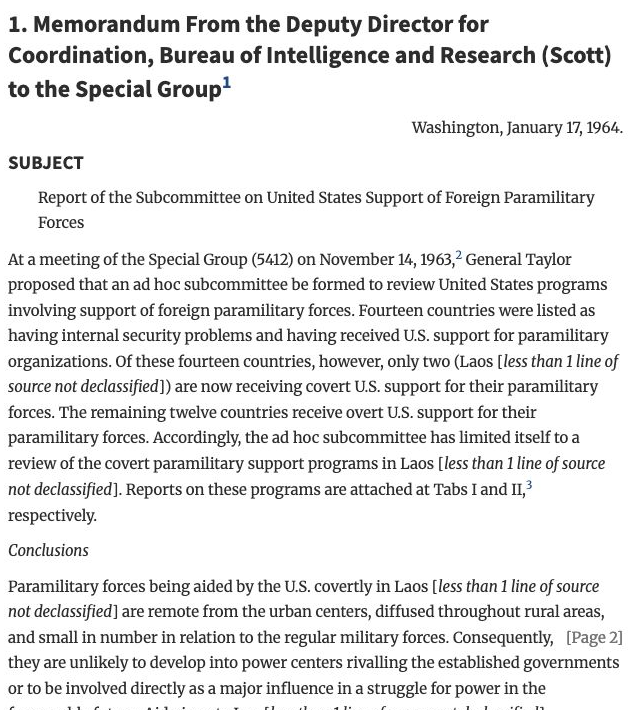
Scott’s 1964 program-review memorandum
Alliance
Secrecy
Consequences

A modern crop of Scott’s memorandum on the official FRUS site. It is federal-authored text, not an original paper scan or a photograph of the fighting. Image credit ↗

Scope & method / Edition 1.0

One network, several kinds of responsibility.

This guide follows the air network and mountain-force alliance, the 1962 neutrality instruments, senior escalation decisions, the 1972 narcotics controversy and the distinct endings of 1973–1975. Selected displacement and unexploded-ordnance records extend the account. Laos’s civil war and the wider Vietnam War exceeded the CIA program; Lao, Hmong, Thai and Vietnamese actors had their own purposes.

An authorized operation, an alleged shipment, a treaty provision and an individual recollection establish different kinds of fact. Their evidentiary limits remain attached to the claim.

Research checked 26 October 2026. Contemporary agreements, internal records and named published recollections lead this selected account. The documentary spine is predominantly American. Complete Lao and neighboring archives, cargo records, refugee manifests, original oral-history collections and the entire narcotics evidence chain have not been audited.

01 / The record

The story, in 7 chapters

Seven chapters follow the alliance, its constraints, expansion, controversies and different endings.

Scott’s 1964 program-review memorandum
Scott’s 1964 program-review memorandum. Cropped current official web rendering; this is a documentary excerpt, not a photograph of the event or a scan of the original paper. The source link opens the complete published text. Image credit ↗

Chapter 01 / 1950–1961

An alliance takes shape before it acquires a familiar name

The secret war did not begin when a film revealed an airline, or when a single American official invented a plan. Laos emerged from French colonial rule into a struggle among royalist, neutralist and communist forces. North Vietnamese involvement, competing foreign assistance and the country’s position beside Vietnam made that struggle international. Lao leaders also pursued their own power, security and visions of the country. Calling them proxies identifies a relationship; it does not explain away their decisions.

The aviation network preceded the large Hmong program. William Leary’s CIA-published history traces the agency’s secret purchase of Civil Air Transport’s assets to August 1950. The airline combined commercial activity with covert missions. In 1955, its aircraft delivered emergency food to remote Lao communities; its later work included military supply, reconnaissance, evacuation and rescue. These functions could share aircraft and landing grounds without having identical purposes. A genuine relief flight did not establish that the whole enterprise was humanitarian, and an intelligence connection did not make every passenger an operative.

The 1960 crisis brought the military relationship into sharper focus. Kong Le’s coup and fighting over Vientiane divided the forces claiming to defend the country. American support for Phoumi Nosavan and the Soviet airlift supporting Kong Le became parts of the confrontation. In late 1960 and early 1961, CIA officers developed a program with Vang Pao, a Hmong officer, and Thai Police Aerial Reinforcement Unit personnel. Air transport made a dispersed mountain force practicable. Contemporary U.S. records locate the program’s approval across the Eisenhower–Kennedy transition; beginning the story with a later presidential image obscures that sequence.

Vang Pao was an ally with local authority and objectives, not simply a name on an American organizational chart. His 2006 interview, excerpted by the Minnesota Historical Society, presents his choice as an alliance with a powerful anti-communist state. That recollection helps explain expectation and commitment. It is not an independently tested prediction that American support would guarantee victory, or evidence that all Hmong chose the same side.
Sources: S01 · S03 · S16 · S19

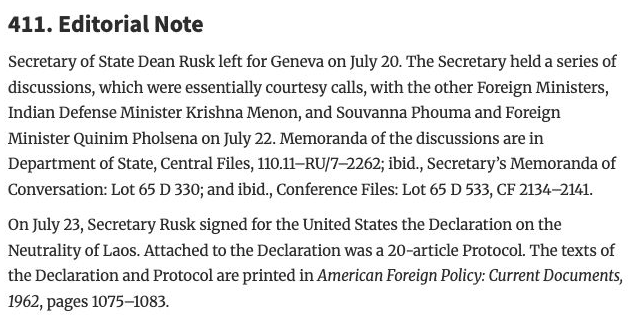
FRUS editorial note on the 1962 Geneva signing
FRUS editorial note on the 1962 Geneva signing. Cropped current official web rendering; this is a documentary excerpt, not a photograph of the event or a scan of the original paper. The source link opens the complete published text. Image credit ↗

Chapter 02 / 1962–1964

Neutrality changes the terms without ending the contest

The 1962 settlement offered an alternative to an openly internationalized war. The Declaration on the Neutrality of Laos and its accompanying protocol recognized Lao sovereignty and restricted foreign military interference. The protocol addressed withdrawal and introduction of foreign personnel, including certain civilians connected with war material, and assigned supervisory functions to the international commission. It also contained an important exception: Article 6 permitted quantities of conventional armaments that the Royal Government considered necessary for national defence. These were different rules for different activities, not a prohibition on every form of foreign assistance.

The arrangement did not produce a common account of compliance. American officials argued that North Vietnamese forces remained and threatened the coalition. Scott’s 1964 program memorandum expressly invoked Article 6 to justify overt aid before separately describing covert support. Critics treated the latter activity as evidence that Washington had not accepted genuine neutrality. The conventional-arms exception does not automatically clear covert foreign personnel, command or air support; nor does continued weapon supply alone establish a breach. Requests for assistance and opposing violations matter, but each activity must be compared with the provision governing it.

The irregular program continued. A January 1964 memorandum in the published Foreign Relations of the United States series described a force of about 19,000 against an authorized strength of 23,000. These are the program’s contemporary reporting categories, not a census of all Hmong people or a complete count of every Lao force. Their importance is institutional: an American-backed military structure survived beyond the agreement that was meant to remove foreign military involvement.

The structure relied on more than weapons. Aircraft moved personnel, food and supplies across terrain where roads offered limited alternatives. Thai personnel, CIA officers, Lao commanders, diplomatic authorities and civilian aviation organizations occupied different positions within it. Air America was a CIA proprietary, but that description does not turn every pilot into an agency staff officer, every contract into an intelligence mission, or every U.S. aircraft over Laos into an Air America aircraft.

Neutrality therefore remained a contested governing framework while outside support and the war continued. Diplomats invoked the agreement to justify some aid, and the covert program’s personnel and operational arrangements raised separate questions. The surviving records establish that continued involvement more firmly than they establish a comprehensive legal conclusion about every participant or mission.

Sources: S02 · S03 · S01 · S20

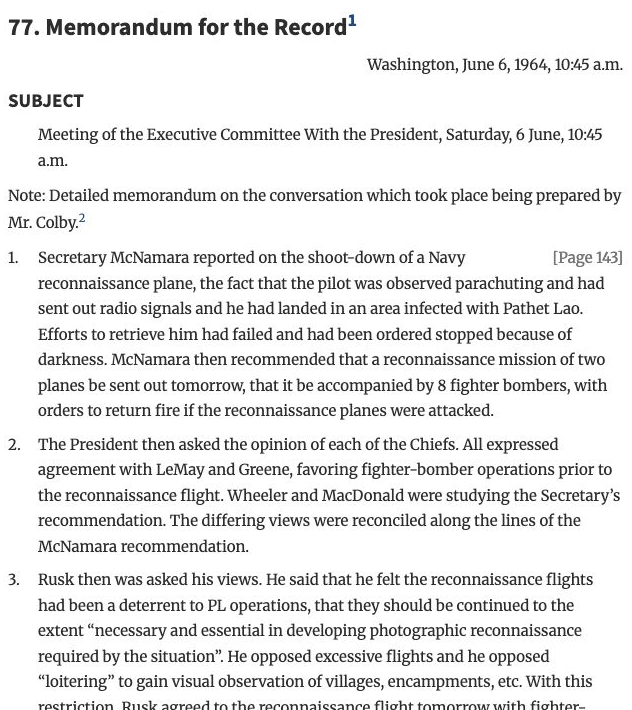
McCone’s record of 6 June 1964 escalation discussions
McCone’s record of 6 June 1964 escalation discussions. Cropped current official web rendering; this is a documentary excerpt, not a photograph of the event or a scan of the original paper. The source link opens the complete published text. Image credit ↗

Chapter 03 / 1964–1973

An air war grows around the covert ground war

The air war in Laos contained related but distinct campaigns. In the north, U.S. aircraft supported forces opposing the Pathet Lao and North Vietnamese around places such as the Plain of Jars and Long Tieng. In the south, interdiction targeted the routes through Laos used to support the war in Vietnam. CIA-supported irregulars, the Royal Lao Air Force, U.S. military aviation and civilian contract aircraft did not form one interchangeable service. Treating every bomb dropped in Laos as a CIA operation hides the decisions and responsibilities of the other institutions involved.

The 1964 records show escalation being chosen, not simply happening. Michael Forrestal’s and John McCone’s accounts of the 6 June National Security Council meeting describe reconnaissance, armed escorts and possible strikes, alongside questions of Souvanna Phouma’s assent and publicity. They are two accounts of one meeting, not two independent operations. A separate memorandum of a 7 June meeting, drafted 10 June, records the next decision stage. The distinction between meeting date and drafting date matters when reconstructing who authorized what.

These discussions reveal officials attempting to combine force with political containment of its consequences. Avoiding publicity or obtaining quiet acquiescence could make an operation easier to conduct. Neither demonstrates that the affected population consented, that every treaty question was resolved, or that the resulting commitment would stay limited. McCone’s numerical expression of the chance of serious opposition was an official’s estimate, not a measured probability.

The fighting subsequently became far larger than the early guerrilla-support model. Anthony and Sexton’s Air Force history describes heavy air support and repeated campaigns around the northern positions. Its perspective emphasizes the effectiveness of airpower and the pressures on defenders. It also acknowledges uncertainty and possible multiple counting in some destruction claims. The missions and the official claims about their results therefore require separate treatment.

By 1973, bombing and negotiations were intertwined. The Air Force account records strikes after the February cease-fire and identifies April sorties as the last USAF bombing in Laos. An agreement’s effective date cannot be used as proof that all combat stopped on schedule. The history of a cease-fire includes the actions taken after it, as well as the terms signed before it.

Sources: S04 · S05 · S06 · S07 · S01

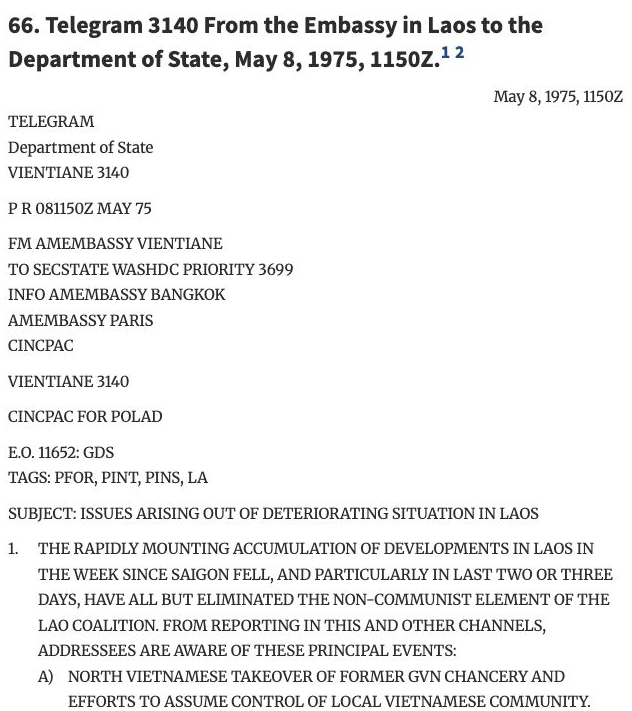
Embassy telegram on deteriorating conditions, 8 May 1975
Embassy telegram on deteriorating conditions, 8 May 1975. Cropped current official web rendering; this is a documentary excerpt, not a photograph of the event or a scan of the original paper. The source link opens the complete published text. Image credit ↗

Chapter 04 / 1961–1975

A military partnership reorganizes civilian life

For people living in the contested areas, the secret war was not an abstract contest over disclosure. Men entered armed units, families moved, food production was disrupted and settlements became dependent on supplied rice. Long Tieng functioned as a military center and a concentration point for people displaced by the fighting. Air transport sustained forces and helped civilians survive conditions partly produced by the same expanding war. These effects belong in one account rather than separate stories of rescue and destruction that never meet.

Community testimony changes the scale of the narrative. Youa Lee’s 2011 interview, excerpted by the Minnesota Historical Society, recalls men leaving her village to fight, her husband’s death and appeals for the killing to end. Lao Thai Vang’s 2009 recollection describes limited earlier educational opportunity and schools accessible to girls and boys as American assistance expanded. The two experiences need not cancel each other. Assistance could create opportunities while war consumed the people and communities it was supposed to protect.

Those accounts are named retrospective perspectives. They do not independently establish every national casualty total or the distribution of support across all Hmong communities. Nor does a force-strength report measure the number of bereaved families. Large aggregate estimates in later timelines need their underlying counting methods before they can be treated as audited totals. The absence of such an audit is a reason to identify the limitation, not to make individual testimony disappear.

The partnership also created expectations about what would happen if the military project failed. The historical society reproduces an excerpt attributed to CIA officer Jerry Daniels recalling promises that Americans would take care of their Hmong allies. This edition has not authenticated the complete original letter or a uniform written evacuation guarantee. The excerpt is evidence of an articulated obligation and remembered commitment; it should not be silently upgraded into a comprehensive contract covering every person.

This distinction makes the abandonment question more concrete. It can be tested through recruitment messages, communications with commanders, evacuation priorities and the people actually moved or left behind. A general assurance of gratitude cannot answer those questions. Neither can a later account of a successful rescue stand for everyone who needed one.

Sources: S16 · S01 · S14

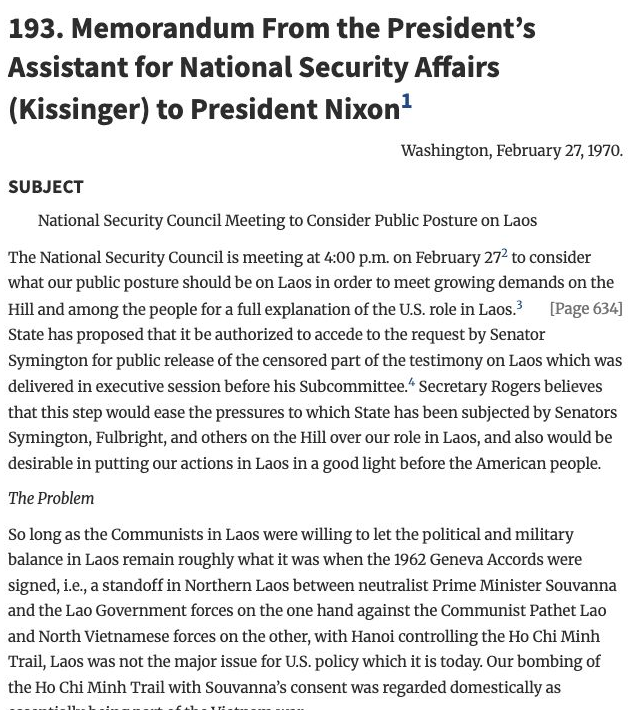
Kissinger’s 1970 public-posture memorandum
Kissinger’s 1970 public-posture memorandum. Cropped current official web rendering; this is a documentary excerpt, not a photograph of the event or a scan of the original paper. The source link opens the complete published text. Image credit ↗

Chapter 05 / 1970–1972 / later interpretation

Secrecy, disclosure and the drug-trade dispute

Secrecy protected operational arrangements, but it also shaped what Americans could evaluate. A February 1970 memorandum from Henry Kissinger considered how the administration should explain its activities in Laos. It distinguished the northern conflict from the supply routes serving the Vietnam war and assessed the political risks of disclosure. A memorandum recommending a public posture is evidence of deliberation. It is not, without the ensuing statement and implementation record, proof that every proposed formulation became policy.

The 1972 narcotics controversy raised a different set of specific questions. Alfred McCoy alleged support for trafficking allies, concealment of their involvement and carriage of opium on CIA-chartered aircraft. A 27 June Congressional Record item preserves Representative Les Aspin’s demand that Richard Helms address such allegations. The record proves that the claims reached Congress and prompted a request for investigation. It does not establish the contents of a particular aircraft’s cargo.

The published correspondence between McCoy, his publisher and the CIA makes the dispute more precise. CIA General Counsel Lawrence Houston defended the agency and relied on Air America management’s denial, inspection procedures and challenges to McCoy’s witnesses. Harper & Row’s reply disputed those challenges and distinguished a 1972 statement about current controls from allegations about 1965–1967. It described interviews and other corroboration claimed by the author. This was a dispute about periods, witnesses and access to evidence, not a choice between believing every official assurance and accepting every allegation as proved.

The strongest complicity argument does not require a single centrally managed CIA profit scheme. An agency could prioritize a military alliance while tolerating, failing to prevent or inadequately investigating an ally’s trafficking. Conversely, proving that some allies trafficked does not prove that a particular company knowingly carried their drugs, that headquarters ordered it, or that drug profits were the war’s principal purpose. Those are additional propositions with additional evidentiary requirements.

Cargo and inspection records, contemporaneous reports, authenticated orders and independently examinable witness material would change the assessment. This edition has not audited a complete shipment archive or McCoy’s underlying interview notebooks. Leary’s later rejection of a cinematic drug-war account remains a sourced interpretation; institutional denial alone is not an investigation’s substitute.

Sources: S08 · S09 · S10 · S11 · S01

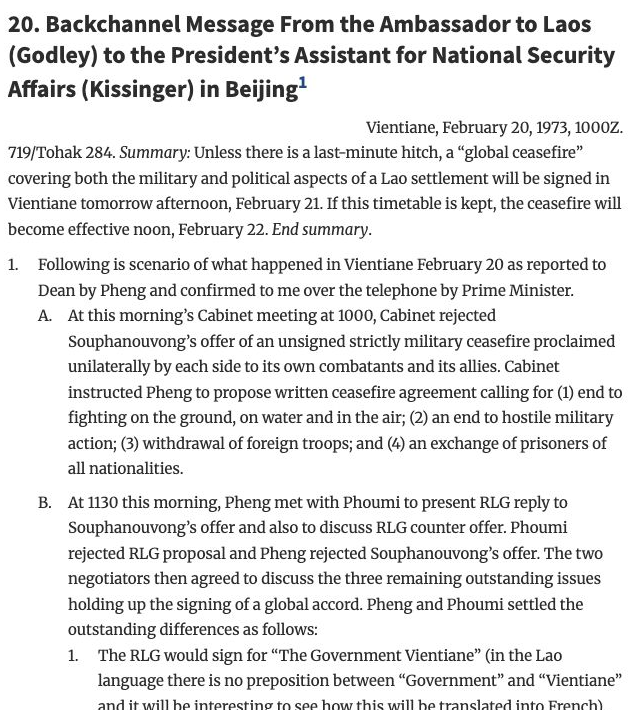
Godley’s 20 February 1973 message anticipating an agreement
Godley’s 20 February 1973 message anticipating an agreement. Cropped current official web rendering; this is a documentary excerpt, not a photograph of the event or a scan of the original paper. The source link opens the complete published text. Image credit ↗

Chapter 06 / 1973–1975

A cease-fire does not deliver everyone to safety

On 21 February 1973, representatives of the Vientiane government and Lao Patriotic Forces signed an agreement intended to stop the war and establish a new political arrangement. The United States was not a signing party to this Lao agreement. The contemporaneous English text retained by the UN is a newspaper reproduction of an unofficial State Department translation, not a signed original. It calls for a cease-fire at noon the next day, an end to foreign bombing and intervention, and withdrawal of foreign forces within a period tied to formation of the provisional political institutions.

Those dependencies matter. The withdrawal deadline was not simply sixty days after the signature. Negotiations over the government continued, and the immediate post-agreement record includes further fighting and bombing. A 20 February U.S. message anticipates the signature and deadlines; it cannot demonstrate that they were subsequently met. The agreement, predictions about it and evidence of compliance are three distinct parts of the record.

Air America’s role also has several endings. Leary dates the company’s departure from Laos to 3 June 1974, after the cease-fire and before the 1975 collapse. The departure of that aviation operation is not the same event as the evacuation of Vang Pao and selected Hmong allies, or the later end of the company itself. Collapsing those dates creates an apparently seamless rescue story that the chronology does not support.

In May 1975, after the fall of Saigon, American diplomatic reporting describes rapidly changing power, pressure on the coalition’s noncommunist side and questions about how to respond if Vang Pao and Hmong forces sought to leave. A subsequent State Department telegram, approved by Kissinger, directed adaptation and requested recommendations about the American mission and assistance. Neither document is a passenger manifest or proof that every proposed rescue occurred. The community account records a limited airlift and many others escaping on foot; its precise totals remain estimates rather than a complete evacuation census checked here.

The military alliance had depended on continuing American support. Its end exposed people whose choices and identities were bound to it. Whether a particular evacuation decision was necessary, avoidable or contrary to a promise requires its own dated evidence. The fact that some people were saved does not settle the responsibility owed to those who were not.

Sources: S12 · S13 · S14 · S15 · S01 · S16

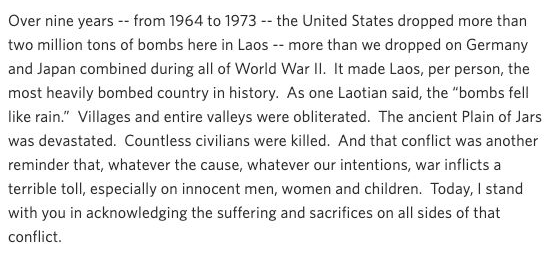
Obama’s 2016 bombing acknowledgment, published speech excerpt
Obama’s 2016 bombing acknowledgment. This is a crop of the official published speech text, not a speech photograph or paper transcript scan. Only the first acknowledgment paragraph is reproduced; the full speech is linked. Image credit ↗

Chapter 07 / 1975–2016 / continuing consequences

The war survives its military ending

The communist victory in 1975 did not end the war’s consequences. Hmong refugees and other people from Laos crossed into Thailand, entered camps and built new lives abroad. The Minnesota Historical Society’s account places the first Hmong family’s arrival in Minnesota in November 1975 and describes later waves of resettlement. That history is not a single journey shared by every family. Departure, camp confinement, return, continuing danger and settlement followed different routes and times.

The landscape retained a different record. Unexploded ordnance continued to injure people long after aircraft stopped attacking. The Lao government’s national development-goal presentation attributes the contamination to wartime bombing and publishes estimates of the scale alongside more recent administrative casualty figures. Estimates of bombs or unexploded submunitions, cumulative casualties since the war and cases recorded within a particular recent decade are different measures. Combining them into one precise-looking total would conceal their definitions and uncertainty.

In September 2016, President Barack Obama publicly acknowledged the secret war and the extraordinary scale of bombing during a visit to Laos. He connected that history to an American obligation to help and announced additional assistance for unexploded-ordnance work. This is significant official acknowledgment of a history that had been obscured. It is not an adjudication of every legal claim, an audit of all casualty estimates, or proof that the announced assistance removed the danger everywhere.

The competing accounts often emphasize different parts of this continuing history. Former officials may foreground North Vietnamese aggression, battlefield resistance and pilots’ rescues. Survivors may foreground loss, promises and escape. Critics may foreground intervention, secrecy and the civilian damage left behind. The records assembled here support substantial elements of each account while limiting claims that go further than their sources. A real communist military threat does not erase American responsibility for chosen intervention; documented American harm does not make Lao and Vietnamese actors disappear.

The useful endpoint is therefore a set of answerable questions: who authorized an activity, what did it do, whom did it affect, what was promised, and what evidence survives? New authenticated records can revise those answers. The already documented war does not need embellishment to justify examining them.

Sources: S16 · S17 · S18

02 / The record

The critical path: the official yardstick

An authorized covert alliance expands into an international air war, then leaves unequal exits and lasting hazards

American records establish an actual CIA-backed force and air network, senior decisions expanding military operations, continuing intervention despite neutrality commitments, and a later withdrawal and collapse. Lao and Thai partners were actors with their own interests; the bombing campaigns involved institutions beyond the CIA.

This documentary yardstick separates the existence of intervention from its claimed necessity or legality, successful rescues from comprehensive protection, and public trafficking allegations from a proved cargo/authorization chain. Named survivor perspectives and later official acknowledgment prevent the institutional ending from becoming the end of the history.

Sources: S01 · S02 · S03 · S04 · S05 · S12 · S14 · S16 · S18

CP1

An American-backed network depends on Lao and Thai decisions

The bounded documentary finding

CIA approval in late 1960 and early 1961, work with Vang Pao and Thai personnel, and the aviation network created a specific intervention. The airline’s earlier commercial and relief operations formed part of the infrastructure.

Why this hinge matters

This distinguishes a documented program from a mere foreign preference for an anti-communist outcome. Local allies explain how the project became an armed force rather than remaining a Washington plan.

If this hinge were removed

Without approval, support and the Lao/Thai partnership, the account cannot explain this particular covert force. Removing one earlier relief mission would not erase the independently documented military program.

What rival readings must explain

A foreign-control account must explain local leaders’ objectives and choices; an entirely domestic account must explain the documented approval, funding and support.

Evidence support

High for the existence of the authorized network and named partnership; incomplete for every participant’s understanding or degree of control.

Cultural prominence: Unmeasured

The partnership appears in operational records and Vang Pao’s selected later recollection. Recurrence in those sources is different from measured public familiarity. No representative audience survey or numerical popularity rank was examined.

Gaps and disputes

Leary is a retrospective author, and the 1964 memo describes the program from an American perspective. A complete recruitment, pay and command archive was not audited. Hmong people did not all take one position.

Dependencies

Leads to CP2’s continuing program and CP4’s dependence on transport and supply. It does not prove any narcotics allegation.

Sources: S01 · S03 · S16 · S19

CP2

Neutrality commitments coexist with continuing covert support

The bounded documentary finding

The 1962 declaration and protocol restrict foreign military involvement and separately permit conventional armaments in quantities the Royal Government considers necessary for national defence. Scott’s January 1964 memorandum expressly invokes Article 6 for overt assistance before describing a continuing covert program.

Why this hinge matters

The agreement supplies an actual standard; the later program supplies conduct to compare with it. A general neutrality label cannot replace either record.

If this hinge were removed

Without the agreement, the specific contradiction between diplomatic commitment and later intervention weakens. Without the later program record, continuation would need different evidence; the signature alone would not prove that the war had stopped.

What rival readings must explain

A defensive-assistance case must identify which activity it justifies and under which provision. A neutrality-breach case must distinguish overt assistance, covert forces and the conduct of other parties rather than treating all foreign contact alike.

Evidence support

High for the text of the commitments and the reported continuation; legal treatment of each activity requires additional activity-specific analysis.

Cultural prominence: Unmeasured

Neutrality is explicit in the agreement and later internal justifications. Its importance within this documentary comparison does not establish the prevalence of a particular legal interpretation. No representative audience survey or numerical popularity rank was examined.

Gaps and disputes

The guide does not adjudicate every legal claim. The arms exception is distinct from the foreign-personnel rules, including certain war-material-connected civilians. Overt weapon supply alone does not establish breach; Article 6 does not automatically clear covert personnel, command or air support. Requests and opposing breaches are relevant, not universal clearance.

Dependencies

Builds on CP1. Provides the diplomatic framework within which CP3’s escalation and CP5’s new settlement occurred.

Sources: S02 · S03 · S20 · S01

CP3

Decisions expand the conflict beyond the CIA-supported ground force

The bounded documentary finding

The June 1964 records show senior officials deciding on reconnaissance, escorts and strikes. Subsequent U.S. military air campaigns in northern Laos and against southern supply routes were related but distinct.

Why this hinge matters

This assigns agency to decisions and institutions. It prevents the term secret war from making every aircraft or bomb a CIA operation, and prevents the war’s expansion from appearing inevitable.

If this hinge were removed

Without the escalation decisions and military operations, a history of the irregular force would not explain the larger bombing campaign. Removing one official’s favorable estimate would not remove the separately recorded authorization sequence.

What rival readings must explain

A limited-support account must explain the growing military air campaign. An all-CIA account must explain U.S. Air Force, Navy, embassy and Royal Lao Air Force roles. A defensive account still needs to test the choices and civilian consequences.

Evidence support

High for the recorded decision sequence and separate campaigns; qualified for the precise effects claimed for every mission and for counterfactual necessity.

Cultural prominence: Unmeasured

The air campaign is emphasized in the military history and Obama’s later acknowledgment. Those different emphases are observed within the selected sources, not ranked by audience belief. No representative audience survey or numerical popularity rank was examined.

Gaps and disputes

Forrestal and McCone describe one 6 June meeting, not independent operations. The 7 June meeting record was drafted 10 June. Official battle-damage claims are not all independently verified; older operational detail is not reproduced as instruction.

Dependencies

Depends on CP1–CP2’s force and diplomatic setting. Intensifies CP4’s military and civilian supply problem; later bombing creates part of CP6’s lasting hazard.

Sources: S04 · S05 · S06 · S07

CP4

Air supply sustains an alliance and a displaced population

The bounded documentary finding

Aviation moved forces, supplies, wounded people and refugees. Continuing support helped make the military partnership viable while displaced communities depended on supplied food. Named community recollections also describe education, bereavement and expectations of protection.

Why this hinge matters

The same infrastructure could perform military and civilian functions. That link explains both genuine relief and a dependence that could not be resolved by simply renaming flights civilian.

If this hinge were removed

Without the supply relationship, the explanation of how the force and displaced communities endured would weaken. Removing one rescue would not negate other relief; proving a particular illicit shipment would require its own cargo and knowledge evidence.

What rival readings must explain

A humanitarian-only account must explain military functions. A coercive-proxy account must also explain local agency, real relief and varied experiences. The narcotics argument must distinguish tolerance of an ally, carriage on an aircraft and ordered trafficking.

Evidence support

High for mixed military/civilian transport and particular attributed recollections; contested and incomplete for the alleged drug shipments and their authorization chain.

Cultural prominence: Unmeasured

Relief, pilots’ rescue and trafficking accusations receive contrasting treatment in the inspected Leary, McCoy/CIA and community accounts. Cultural reach and relative acceptance remain unmeasured. No representative audience survey or numerical popularity rank was examined.

Gaps and disputes

No complete flight-manifest or refugee-supply audit was performed. McCoy’s witnesses and publisher’s claimed checks are represented through their published dispute, not newly authenticated interview notebooks. Denials and inspection policies do not prove all earlier cargo was clean.

Dependencies

Follows CP1 and CP3. Connects the costs of sustained operations to CP5’s withdrawal and CP6’s consequences. Drug allegations test particular uses of this network, not the existence of every other link.

Sources: S01 · S16 · S09 · S10 · S11

CP5

The settlement makes withdrawal conditional without guaranteeing safety

The bounded documentary finding

The 21 February 1973 Lao agreement specifies a cease-fire, political institutions and foreign withdrawal tied to formation of those institutions. Combat did not uniformly stop on the signature date. Air America left Laos in June 1974, before the 1975 collapse.

Why this hinge matters

These dependencies separate a treaty promise, its expected timetable and evidence of implementation. They also prevent different operational departures and evacuations being collapsed into one event.

If this hinge were removed

Without the political and withdrawal provisions, the changing support structure needs a different explanation. Removing the assumption of immediate compliance does not erase the agreement; it makes post-agreement actions part of the test.

What rival readings must explain

A successful-peace account must explain subsequent fighting and delayed institutions. An abandonment account must identify which support or promise ended when, rather than treating every withdrawal as the same decision.

Evidence support

High for the terms and distinct operational chronology; incomplete for comprehensive compliance and the precise coverage of promises.

Cultural prominence: Unmeasured

The chronology is explicit in the agreement, diplomatic anticipation and later aviation history. No survey establishes how often public narratives keep those endings distinct. No representative audience survey or numerical popularity rank was examined.

Gaps and disputes

The UN-retained English text is an unofficial translation in a copyrighted newspaper clipping, not a signed original. Godley’s 20 February message is predictive. This guide has no complete compliance inspection or evacuation manifest.

Dependencies

Revisits CP2’s neutrality framework and changes CP4’s support relationship. Leads to CP6’s separate 1975 evacuation and refugee history.

Sources: S12 · S13 · S01 · S07 · S14 · S15

CP6

The alliance’s collapse leaves both displaced people and unexploded weapons

The bounded documentary finding

In 1975 U.S. reporting describes a deteriorating coalition and evacuation questions. Community accounts record a limited airlift and a larger escape/refugee history. Later Lao and U.S. official statements acknowledge continuing unexploded-ordnance harm.

Why this hinge matters

The history’s consequences survive the end of the military program. A rescue, an assistance announcement and a clearance result answer different questions.

If this hinge were removed

Without evidence of who left and what hazards remained, the account would end with institutional departure while omitting material consequences. Removing one aggregate estimate would not erase named loss or independently acknowledged contamination.

What rival readings must explain

A story of uncomplicated rescue must address people outside the airlift. A total-abandonment account must also identify actual rescues and later assistance. Neither an official estimate nor a public acknowledgment proves every cumulative casualty total.

Evidence support

High for the existence of displacement, limited evacuation and continuing UXO harm; more qualified for aggregate counts and complete responsibility for each outcome.

Cultural prominence: Unmeasured

Survivor memory and later official acknowledgment foreground consequences differently from operational histories. Their relative national or international cultural prominence is unmeasured. No representative audience survey or numerical popularity rank was examined.

Gaps and disputes

Original full interview files, complete passenger rolls, current refugee outcomes and a comprehensive UXO-clearance audit are absent. Cumulative estimates and recent administrative casualty windows remain separate. Obama’s 2016 speech is acknowledgment and policy, not a judicial finding on every wartime act.

Dependencies

Follows CP3’s bombing, CP4’s dependence and CP5’s changing settlement. Later consequences inform responsibility but cannot substitute for evidence about an earlier particular decision.

Sources: S14 · S15 · S16 · S17 · S18

03 / The record

How the accounts inherit and divide the record

Documented citations, responses and branches; not assumed influence.

These connections are actual published records, named responses and attributed excerpting. A shared subject is not evidence of borrowing. Later works can select different facts without creating independent confirmation of every underlying report.

  1. 1964–1975 records → later FRUS editions

    Contemporary decisions become a published documentary spine

    Identified archival publication and parallel accounts

    FRUS publishes the Scott program review, different accounts of the 6 June 1964 meeting, the 1970 public-posture discussion and the 1973/1975 diplomatic records with editorial source notes. The two 1964 meeting accounts describe one decision setting; they should not be counted as independent missions.

    This is a record-publication relationship, not proof that every later historian copied one book or that all surviving reporting is complete. The 1964 program’s future-political-influence judgments remain its authors’ assessments.

    Sources: S03 · S04 · S05 · S06 · S08 · S13 · S14 · S15

  2. 1972

    McCoy’s allegations generate named official and publisher responses

    Explicit quotation, rebuttal and dispute over the same witnesses/periods

    The congressional items preserve public allegations and replies. The published correspondence identifies McCoy’s testimony and manuscript, Houston’s objections, Air America management’s denial and Harper & Row’s response. The publisher contrasts contemporary controls with allegations about earlier years and describes interview notes it says it examined.

    Repeated appearances of the same allegation are not additional independent shipments. The replies reveal real disputes over periods and witness credibility; this guide has not independently authenticated the underlying notes or every source the correspondents invoke.

    Sources: S09 · S10 · S11

  3. 1979 / 1990 → 1999–2000

    Leary answers an existing book-and-film image

    Author’s explicit engagement with named earlier works

    Leary identifies Christopher Robbins’s Air America book and the 1990 film, describes what he considers a distorted drug-war picture, and counters with operational history and interviews. This documents Leary’s response to a named public narrative.

    The account of the film’s plot and its relationship to the book is Leary’s inspected description. This edition does not claim full book reading, full film viewing or that a movie created every earlier narcotics allegation. His military-priority admission and his rejection of carriage/agency involvement require different propositions to be tested.

    Sources: S01 · S11

  4. 2006–2011 interviews and other cited works → MNHS timeline

    Named recollections enter a community history

    Explicit attributed excerpting and curatorial selection

    The Minnesota Historical Society places Vang Pao’s alliance explanation beside accounts such as Lao Thai Vang’s educational experience and Youa Lee’s bereavement. It also reproduces an excerpt attributed to Jerry Daniels about promises. These are identifiable transmitted voices with different scales and interests.

    The guide reads these excerpts, not the complete original interviews or letter. Their presence in one timeline does not make their perspectives identical or authenticate every summary date and casualty total surrounding them. The source’s Paris/Vientiane confusion is not inherited.

    Sources: S16

04 / The record

Four readings of the alliance and its consequences

Each account starts with its strongest form, then identifies what it accepts, removes or adds. A map is not an endorsement.

Interpretation 01

A defensive alliance against an expanding communist military threat

The threat and alliance are documented; necessity and proportionality require further tests

The strongest version

North Vietnamese intervention and Pathet Lao advances endangered the noncommunist government and local allies. Air transport and military support sustained resistance, prevented particular losses and saved people. Vang Pao’s alliance choice had local reasons as well as American sponsorship.

Accept on the path

  • CP1 — Accept the partnership and local decisions.
  • CP3 — Accept the opposing military threat and demonstrated support.
  • CP4 — Accept real relief and rescue functions.

Remove or narrow on the path

  • CP3 — No factual hinge is removed. Revise the causal weight assigned to escalation: this account argues that support was the preferable response to a demonstrated threat, rather than merely establishing that officials chose it. Necessity must be tested against alternatives at CP3 and effects at CP4; CP2 still requires activity-specific legal analysis.

Add on the path

  • CP3 — Add comparisons of viable diplomatic/military options, expected harms and actual outcomes.

What would have to be wrong

The factual yardstick can remain true. The disagreement concerns whether the intervention prevented specified losses and was necessary or proportionate. Evidence that viable alternatives offered comparable protection with less harm would weaken that stronger interpretation.

Evidence and limits

Contemporary officials and later military histories make the defensive case; community recollections also show deliberate anti-communist alliance. Their rationale is evidence, not independent proof of counterfactual necessity.

What would change the assessment

Authenticated opposing plans and unit records could sharpen the threat; contemporaneous rejected alternatives and civilian-impact records could change judgments about necessity or scale.

Sources: S01 · S03 · S04 · S05 · S07 · S16

Interpretation 02

Neutrality was undermined by an externally sustained war

Strong evidence of intervention; each legal and causal claim remains specific

The strongest version

A neutral settlement constrained foreign military activity, yet a covert force, political secrecy and an expanding American air war continued. The arrangement exposed Lao communities to choices made partly outside their country while making the intervention less publicly accountable.

Accept on the path

  • CP1 — Accept an actual foreign-backed military project.
  • CP2 — Accept the neutrality commitments and continuation.
  • CP3 — Accept decisions by named American institutions.
  • CP6 — Accept lasting civilian consequences.

Remove or narrow on the path

  • CP2 — No factual hinge is removed. Give the continuation of particular foreign-controlled activities greater legal and causal significance at CP2. The actual yardstick already recognizes the conventional-arms exception; the disputed conclusion concerns personnel, command and air activity outside that exception.

Add on the path

  • CP2 — Add activity-specific treaty analysis and records of Lao assent, dissent and actual supervision.

What would have to be wrong

The factual yardstick can remain true. A finding about a named breach requires an applicable provision and evidence of the actual activity. Records showing that the named conduct fell within an exception or was materially different would require that conclusion to change.

Evidence and limits

The treaty and internal program records make the contradiction concrete. They do not replace a legal finding for every mission or show that Lao factions lacked independent purposes.

What would change the assessment

Paired Lao, Vietnamese, Soviet, Thai and American records could revise responsibility for particular initiatives; authenticated agreements and inspection records could narrow or strengthen a specific treaty-breach claim.

Sources: S02 · S03 · S04 · S08 · S14 · S17

Interpretation 03

A costly Hmong alliance ended in abandonment

Substantial obligation and unequal-exit questions; exact promises need authentication

The strongest version

People fought within an alliance whose American patrons supplied the means to continue and conveyed expectations of protection. When support contracted and the coalition collapsed, a limited airlift left many others to seek escape. Later refuge cannot erase loss or settle what the alliance owed.

Accept on the path

  • CP1 — Accept Hmong allies’ active choice and expectations.
  • CP4 — Accept dependence, named family losses and attributed promises.
  • CP5 — Accept distinct withdrawal and evacuation stages.
  • CP6 — Accept the limits of the airlift and later refugee history.

Remove or narrow on the path

  • CP6 — No rescue or departure fact is removed. Revise the significance of withdrawal and limited evacuation at CP5–CP6: this account treats specific unfulfilled promises and feasible protection as obligations beyond the help actually delivered.

Add on the path

  • CP4 — Add authenticated recruitment promises, original letters, evacuation decisions and passenger/eligibility records.

What would have to be wrong

The factual yardstick can remain true while the extent of unmet obligation is disputed. Original commitments, feasible options and decisions would have to differ from the abandonment account’s premises to change its judgment about a particular failure.

Evidence and limits

The MNHS voices and contemporary diplomatic questions establish a serious issue. The mediated Daniels letter excerpt is not a complete authenticated guarantee, and museum totals are not a passenger census.

What would change the assessment

Original promises, priorities, requests, refusals and complete movement records could establish who was promised what, what alternatives existed and where a particular failure occurred.

Sources: S01 · S14 · S15 · S16

Interpretation 04

Military priorities enabled narcotics complicity

A serious documented dispute; this corpus does not settle the shipment and authorization chain

The strongest version

An agency could support trafficking allies and neglect or obstruct scrutiny because their military role mattered more. That form of complicity need not require a central profit plan. Specific allegations also claim that aircraft serving the covert network carried opium.

Accept on the path

  • CP1 — Accept the intelligence relationship with local armed partners.
  • CP4 — Accept a transport infrastructure and the priority given to the war.

Remove or narrow on the path

  • CP4 — No established transport or relief fact is removed. Add a specific knowing-tolerance, protection or shipment relationship at CP4. The actual yardstick leaves those propositions contested; higher authorization would be a separate addition requiring its own evidence.

Add on the path

  • CP4 — Add dated manifests, inspection logs, handler communications and examinable witness material for each alleged transaction.

What would have to be wrong

The factual yardstick can remain true. The added claim would fail for a particular shipment if reliable records disproved carriage or knowledge; proof of carriage alone would not establish headquarters direction. Official policy alone does not exonerate earlier cargo.

Evidence and limits

McCoy and his publisher identify witnesses and time periods; the CIA and company contest them and cite controls. The publisher’s claimed corroboration is not independently reauthenticated here. Leary’s military-priority framing does not by itself settle tolerance, carriage or authorization.

What would change the assessment

Authenticated flight/cargo records linked to recipient knowledge, contemporaneous field reporting and independently checked interviews could establish or disprove particular shipments, deliberate tolerance or higher orders. Another repetition of the allegation or denial would add less.

Sources: S01 · S09 · S10 · S11

05 / The record

Reports and public voices change the emphasis

What selected official accounts, published disputes and named recollections emphasize.

The cards compare passages actually read and identify their scales and limits. No full film, complete interview archive or unexamined book is assigned an invented omission. Cultural prominence remains unmeasured.

Supporting the Secret War, 1999–2000

Leary: an operational network and a disputed reputation

Amplifies

Agency ownership, pilots’ varied missions, relief and rescue, and the dependence of the program on aviation.

Recasts

Challenges the drug-war film image and places Air America within a military policy he regards as the central purpose. His acknowledgment that policing trafficking was not the CIA’s main focus leaves a different tolerance question open.

Not resolved in the selected passage

An institutional historical defense does not replace complete cargo records or settle every allegation about an ally. Interview-based history is not independent corroboration of each interview.

Complete 31-page study and notes read; its underlying books/interviews and the 1990 film were not independently audited.

Sources: S01

Selected 1972 correspondence and congressional record

McCoy and his publisher: a disputed infrastructure of complicity

Amplifies

Different allegations of supporting trafficking allies, concealing their involvement and transporting opium, with named and unnamed witnesses.

Recasts

The publisher separates alleged 1965–1967 conditions from 1972 controls and challenges the agency’s interpretation of interviews. This tests specific defenses rather than relying only on the existence of opium in the region.

Not resolved in the selected passage

The correspondence is not an independent cargo audit. Notes reportedly examined by the publisher, anonymous sources and a quoted Monitor interview remain mediated evidence here.

Selected Laos/Air America claims and rebuttals actually read; no complete McCoy book or original interview notebook audit.

Sources: S09 · S10 · S11

CIA/publisher correspondence, 1972

Houston and Air America: denial, controls and contested witnesses

Amplifies

Company inspections, official cooperation against trafficking, denials of knowing carriage and objections to particular informants.

Recasts

Presents management policy and challenges the accuser’s chain of evidence. The stronger claim is that allegations about the company and Vang Pao lack credible proof, not that the region had no drug trade.

Not resolved in the selected passage

A policy or denial does not independently prove every earlier flight was clean. An informant’s conflicting accounts need examination rather than automatic acceptance of the account given to an agency officer.

Selected Houston annex, Velte statement and publisher responses read in published correspondence; not all company inspection files.

Sources: S10 · S11

MNHS excerpt of a 2011 interview

Youa Lee: the household’s loss changes the unit of history

Amplifies

Men leaving her village, her husband’s death and appeals to end the killing.

Recasts

Turns troop strength and strategic endurance into a history of families experiencing loss. It can coexist with another participant’s recollection of educational opportunity.

Not resolved in the selected passage

One recollection does not establish a national casualty count, represent every Hmong position or by itself identify the author of a specific order.

Actual attributed excerpt read; complete original interview/audio not independently acquired.

Sources: S16

The War in Northern Laos, 1993

Anthony and Sexton: airpower, diplomatic constraint and the ending

Amplifies

Threats to defended positions, the choices of air commanders and ambassadors, and the transition from combat to a reduced support structure.

Recasts

Emphasizes operational performance and the costs of restrictions while also warning that some claimed destruction could be counted more than once.

Not resolved in the selected passage

A military institutional viewpoint does not establish the necessity of every strike or a complete civilian-loss history. The epilogue contains chronological errors; this guide does not adopt them as fact.

Frontmatter and selected campaign/epilogue pages read with original scan and local OCR; not the whole 409-page book or its full interview archive.

Sources: S07

Remarks to the People of Laos, 6 September 2016

Obama: acknowledgment becomes a public obligation to assist

Amplifies

The scale of U.S. bombing, human suffering, links with Lao Americans and assistance for unexploded ordnance.

Recasts

Places a formerly secret war within an explicit official acknowledgment and a stated obligation to help Laos heal.

Not resolved in the selected passage

A speech and funding announcement do not prove complete implementation, establish every casualty estimate or decide each legal responsibility.

Selected history/UXO/reconciliation paragraphs read; not a comprehensive subsequent funding/clearance audit.

Sources: S18

02 / The record

Find a thread in the file

Search the chapter and claim index. Every result leads to the full text and its sources.

ChapterAn alliance takes shape before it acquires a familiar nameChapterNeutrality changes the terms without ending the contestChapterAn air war grows around the covert ground warChapterA military partnership reorganizes civilian lifeChapterSecrecy, disclosure and the drug-trade disputeChapterA cease-fire does not deliver everyone to safetyChapterThe war survives its military endingCritical pathAn American-backed network depends on Lao and Thai decisionsCritical pathNeutrality commitments coexist with continuing covert supportCritical pathDecisions expand the conflict beyond the CIA-supported ground forceCritical pathAir supply sustains an alliance and a displaced populationCritical pathThe settlement makes withdrawal conditional without guaranteeing safetyCritical pathThe alliance’s collapse leaves both displaced people and unexploded weaponsTimelineCIA purchases Civil Air Transport assetsTimelineEmergency rice deliveries precede the larger warTimelineA Lao political crisis becomes an international confrontationTimelineA mountain-force program developsTimelineThe Geneva neutrality instruments are signedTimelineScott reviews the covert programTimelineSenior officials consider expansionTimelineA follow-up meeting considers the next stepsTimelineOfficials discuss public presentation of the warTimelineAspin requests investigation of narcotics allegationsTimelineTestimony and denials enter the Congressional RecordTimelineThe CIA correspondence becomes publicTimelineGodley anticipates the settlementTimelineLao parties reach the Vientiane agreementTimelineThe agreement sets a ceasefire beginning at noonTimelineThe selected Air Force history dates its last Laos strikesTimelineAir America leaves LaosTimelineEmbassy officials confront collapse and evacuation questionsTimelineWashington directs adaptation to changed conditionsTimelineFlight and displacement outlast the official missionTimelineObama acknowledges the bombing legacyTimelineThe recent casualty reporting period ends in 2023ClaimThe CIA backed a real force and air network in Laos.ClaimEvery American air operation over Laos was a CIA operation.ClaimThe 1962 protocol prohibited every conventional-arms import.ClaimCalling personnel civilian settled whether their presence was lawful.ClaimThe Geneva settlement ended all foreign military support in 1962.ClaimThe narcotics allegations began with the 1990 film Air America.ClaimAn airline control described in 1972 proves earlier flights were clean.ClaimThe assembled evidence proves CIA headquarters directed an opium-shipment chain.ClaimThe United States signed the 1973 Vientiane agreement.ClaimAll U.S. bombing stopped when the February 1973 ceasefire was scheduled to begin.ClaimAir America’s departure from Laos was the May 1975 evacuation.ClaimThe 2016 assistance announcement established that Laos’s unexploded ordnance had been cleared.

Operations / The record

Decisions, commitments and outcomes

Treaty texts, program reviews, cargo allegations, evacuation choices and later acknowledgment require distinct tests.

Agreements, decisions, allegations and outcomes establish different parts of this history; a commitment is not proof of implementation.
Record / periodIssueRecordOutcome / limit
Geneva neutrality instruments1962Restrictions, withdrawal and conventional-arms exceptionDeclaration and 20-article protocolArticle 6 is narrower than a blanket clearance; implementation requires facts about personnel and conduct.

Sources: S02 · S03

Senior escalation decisions1964Options for military pressure and supportDifferent records of June meetingsAn authorized decision does not prove every predicted result occurred or define all later missions as CIA operations.

Sources: S04 · S05 · S06

Narcotics controversy1972Allies, carriage, knowledge and command responsibilityTestimony, investigation request and named correspondenceAllegation, denial, controls and an authenticated shipment are different types of evidence. No complete chain is established here.

Sources: S09 · S10 · S11

Vientiane settlement1973Ceasefire and conditional foreign withdrawalTranslated agreement and contemporary diplomatic expectationThe United States was not a signatory; scheduled deadlines do not demonstrate immediate compliance.

Sources: S12 · S13 · S07

Departure, collapse and displacement1974–1975Airline departure, mission reduction and evacuation choicesCorporate chronology, diplomatic telegrams and named recollectionsNeither successful rescues nor policy plans establish comprehensive protection for every ally and family.

Sources: S01 · S14 · S15 · S16

Bombing acknowledgment and clearance assistance2016 onwardHistorical acknowledgment and continuing civilian dangerPresidential speech and Lao UXO reportingAcknowledgment and a funding commitment are not a complete casualty census, legal adjudication or clearance audit.

Sources: S17 · S18

03 / The record

People and institutions

Open a record for the person’s role and supporting sources. Names identify people; no unverified portrait is substituted for a participant.

PaoBiographical record
Vang PaoHmong commander and U.S. ally

Built a military alliance with the CIA and Thai partners while pursuing local objectives. His later recollection is used as an attributed interview excerpt, not a statement for every Hmong community.

Sources: S01 · S03 · S16

LairBiographical record
Bill LairCIA officer

Worked with Thai personnel and Vang Pao on the mountain-force program. Leary’s account reconstructs his role from a retrospective institutional history.

Sources: S01

PhoumaBiographical record
Souvanna PhoumaNeutralist prime minister

The Royal Lao Government’s authority and the neutrality settlement shaped the overt justification for assistance. His government’s conventional-arms exception was narrower than permission for every covert foreign activity.

Sources: S02 · S03 · S19

NosavanBiographical record
Phoumi NosavanRoyalist military leader

Received American support during the 1960 crisis. His rivalries with other Lao leaders were part of the conflict, rather than merely a reflection of external orders.

Sources: S01 · S19

LeBiographical record
Kong LeNeutralist officer

His 1960 coup and the ensuing fighting brought the contest over Vientiane and competing foreign airlifts into sharper focus.

Sources: S01 · S19

ScottBiographical record
Joseph ScottState Department official

His January 1964 review describes the program, political calculations and the distinction between overt aid and clandestine arrangements. Its predictions are judgments, not measured outcomes.

Sources: S03

McCoyBiographical record
Alfred W. McCoyHistorian and contemporary critic

Publicly alleged involvement by American allies and aircraft in the regional opium economy. This guide reads selected 1972 testimony and correspondence, not his complete book or every underlying notebook.

Sources: S09 · S10 · S11

HoustonBiographical record
Lawrence R. HoustonCIA general counsel

Responded to McCoy and the publisher in the 1972 correspondence. His objections and requested corrections are evidence of a dispute, not an independent audit of every earlier flight.

Sources: S11

VelteBiographical record
Paul C. Velte Jr.Air America representative

Defended the airline’s controls and challenged the basis of accusations in the published correspondence. The date of a control matters when assessing an allegation about an earlier period.

Sources: S11

LeeBiographical record
Youa LeeHmong witness to wartime loss

Her 2011 interview excerpt, published by the Minnesota Historical Society, describes men leaving her village to fight, her husband’s death and appeals to end the killing. The complete interview was not independently reviewed here.

Sources: S16

LearyBiographical record
William M. LearyHistorian

His CIA-published study reconstructs the air network and challenges the drug-trafficking image associated with McCoy’s book and the film Air America. The full study was read; its underlying interviews were not independently audited.

Sources: S01

ObamaBiographical record
Barack ObamaU.S. president, 2016 acknowledgment

Acknowledged bombing and continuing unexploded-ordnance hazards and announced additional clearance assistance. The speech establishes an acknowledgment and commitment, not completion of the work.

Sources: S18

04 / The record

The alliance, war and aftermath

Horizontal spacing shows elapsed time; separate rows keep close events selectable. Scroll the graph on narrow screens. Exact dates are attributed where records conflict; month- and year-only dates preserve source precision.

Core war and alliance, 1961–1975 · Earlier aviation history and later consequences

195019621975199020162023
CIA purchases Civil Air Transport assetsOrigins

Leary dates the covert purchase to August. Corporate ownership and later mission assignments are separate propositions.

Sources: S01

Emergency rice deliveries precede the larger warAviation

Relief operations belong to the airline’s history alongside later military supply and intelligence work. A relief flight does not characterize every mission.

Sources: S01

A Lao political crisis becomes an international confrontationWar

Kong Le’s coup, fighting over Vientiane and rival foreign assistance intensified the conflict. This year-only entry does not invent a date for the entire crisis.

Sources: S01 · S19

A mountain-force program developsAlliance

CIA officers, Thai personnel and Vang Pao developed the program across the presidential transition. American support and local agency both matter.

Sources: S01 · S03

The Geneva neutrality instruments are signedDiplomacy

The declaration and protocol establish restrictions, withdrawal arrangements and a conventional-arms exception. They are not an absolute ban on every import or a blanket authorization of covert personnel.

Sources: S02 · S20

Scott reviews the covert programDecision

The memorandum discusses military and political purposes and invokes the Article 6 exception for overt assistance. Its account distinguishes several kinds of activity.

Sources: S03

Senior officials consider expansionDecision

Forrestal and McCone record the same decision setting from different positions. Two accounts do not establish two separate operations.

Sources: S04 · S05

A follow-up meeting considers the next stepsDecision

The memorandum was drafted June 10 about the June 7 meeting. Record creation and meeting dates are distinct.

Sources: S06

Officials discuss public presentation of the warPublic record

The Kissinger memorandum considers disclosure and posture. Secrecy for an American audience did not make combat invisible to Lao communities.

Sources: S08

Aspin requests investigation of narcotics allegationsNarcotics dispute

The Congressional Record reproduces a contemporary demand for investigation. A request establishes an allegation and institutional response, not the truth of every shipment claim.

Sources: S09

Testimony and denials enter the Congressional RecordNarcotics dispute

Selected pages reproduce McCoy’s June 9 Thailand testimony and related statements. They are not the complete June 2 Laos testimony.

Sources: S10

The CIA correspondence becomes publicNarcotics dispute

The published exchange distinguishes claims about allies, concealment and carriage and includes challenges by the agency, airline and publisher. Publication date is not the date of every letter.

Sources: S11

Godley anticipates the settlementDiplomacy

The ambassador’s message to Kissinger predicts signature and ceasefire dates. It does not prove later compliance with the agreement.

Sources: S13

Lao parties reach the Vientiane agreementDiplomacy

The reviewed English text is an unofficial translation in a contemporary newspaper clipping. The United States was not a signing party.

Sources: S12 · S13

The agreement sets a ceasefire beginning at noonDiplomacy

This is the scheduled effective time, not a claim that all combat and foreign intervention stopped at once. Withdrawal deadlines depended on political arrangements.

Sources: S12

The selected Air Force history dates its last Laos strikesAir war

The epilogue describes U.S. Air Force bombing April 15–17. This chronology contradicts treating February 22 as the end of all American bombing. It is not a census of every armed actor.

Sources: S07

Air America leaves LaosAviation

Leary dates the airline’s final departure from Laos to June 3, 1974. This differs from its corporate closure in 1976 and from evacuations in 1975.

Sources: S01

Embassy officials confront collapse and evacuation questionsAftermath

The selected telegram discusses deteriorating conditions and difficult choices. It is not a passenger manifest or proof that every requested evacuation occurred.

Sources: S14

Washington directs adaptation to changed conditionsAftermath

A State Department telegram approved by Kissinger directs adaptation and seeks recommendations about the mission and assistance. Issued guidance does not establish which evacuations occurred.

Sources: S15

Flight and displacement outlast the official missionAftermath

The MNHS timeline describes escape and displacement, alongside named accounts of wartime loss and promises of protection. This selected record does not establish one comprehensive evacuation or refugee casualty count.

Sources: S16

Obama acknowledges the bombing legacyPublic acknowledgment

The president announces additional clearance assistance and describes continuing harm. An announcement does not demonstrate delivery of all funds or clearance of every dangerous area.

Sources: S18

The recent casualty reporting period ends in 2023Continuing harm

The selected official page reports a 2013–2023 administrative period separately from cumulative estimates. This date is the end of the reporting window, not an established publication date. The series should not be combined into an independently audited total.

Sources: S17

07 / The record

How the story changed

Public memory tends to compress contested histories into a turning point. The records leave a less tidy sequence.

Neutrality contained an exception from the beginning

ThenThe 1962 agreement can be compressed into a simple promise that no weapons or foreign personnel would remain.

ReconsideredThe actual protocol distinguishes personnel, withdrawal, imports and a conventional-arms exception. The difficult question is what happened under those provisions, not whether an exception can be omitted.

Sources: S02 · S03

Secrecy depended on the audience

ThenAmerican officials considered how much of the war to describe publicly.

ReconsideredLater publication exposes internal choices, while named Lao and Hmong experiences show that a war concealed from one audience could be immediately visible to another.

Sources: S08 · S16

A narcotics controversy acquired competing retellings

ThenThe 1972 correspondence already contained distinct claims and rebuttals.

ReconsideredLeary later challenged the image associated with McCoy and Air America. That documented response establishes an interpretive lineage; the film itself and all earlier cargo records were not reviewed here.

Sources: S11 · S01

The institutional ending did not end the consequences

ThenSettlement, airline departure and the collapse of an allied force can be made into one closing scene.

ReconsideredTheir dates differ. Named displacement accounts and the later acknowledgment of unexploded ordnance extend the history beyond the end of an American mission.

Sources: S12 · S01 · S16 · S17 · S18

08 / The record

What the evidence supports

Ratings apply to the precise proposition on the page. Unsupported means the assembled evidence does not establish a claim; it is not interchangeable with false.

Established

The CIA backed a real force and air network in Laos.

Contemporary program reviews and the institutional aviation history establish the relationship. The debate concerns purposes, conduct and consequences, rather than whether the network existed.

Sources: S01 · S03 · S04

Contradicted

Every American air operation over Laos was a CIA operation.

Covert support, the Air Force’s northern campaign and southern interdiction had overlapping settings but different commands and missions. Agency ownership of one network does not establish control of all bombing.

Sources: S01 · S07

Contradicted

The 1962 protocol prohibited every conventional-arms import.

Article 6 expressly allowed quantities the Royal Government considered necessary for national defense. That exception did not automatically clear foreign military personnel or every covert activity.

Sources: S02 · S03

Contradicted

Calling personnel civilian settled whether their presence was lawful.

The protocol defined relevant personnel by function as well as formal status. Applying its provisions requires the actual duties and arrangements, not only a civilian label.

Sources: S02

Contradicted

The Geneva settlement ended all foreign military support in 1962.

The later program review and escalation records describe continuing intervention. A signed commitment is distinct from verified implementation by every party.

Sources: S03 · S04 · S05

Contradicted

The narcotics allegations began with the 1990 film Air America.

Congressional material and the published 1972 correspondence predate the film. Leary’s later response places the book and film in a public dispute; a dramatization is not an independent cargo record.

Sources: S09 · S10 · S11 · S01

Not established

An airline control described in 1972 proves earlier flights were clean.

The correspondence includes a publisher’s challenge about controls in 1965–1967. Earlier cargo records, enforcement and named personnel would be needed to settle a particular historical shipment.

Sources: S11

Not established

The assembled evidence proves CIA headquarters directed an opium-shipment chain.

Claims about allies, knowing tolerance, aircraft carriage and headquarters orders require different links. This selected corpus does not authenticate a complete shipment and command chain; official denials alone also do not settle it.

Sources: S09 · S10 · S11

Contradicted

The United States signed the 1973 Vientiane agreement.

The reviewed translated agreement identifies Lao parties. American diplomatic involvement does not turn the United States into a signatory. The clipping is not the signed original.

Sources: S12 · S13

Contradicted

All U.S. bombing stopped when the February 1973 ceasefire was scheduled to begin.

The selected Air Force epilogue describes strikes in April. The agreement’s date, conditional withdrawal provisions and subsequent actions must be traced separately.

Sources: S07 · S12

Contradicted

Air America’s departure from Laos was the May 1975 evacuation.

Leary dates departure from Laos to June 1974. The later political collapse and evacuations involved a different stage; corporate closure in June 1976 is a third event.

Sources: S01 · S14 · S16

Not established

The 2016 assistance announcement established that Laos’s unexploded ordnance had been cleared.

The speech announced future assistance while acknowledging continuing danger. Current-area clearance and casualty series would be needed to assess results; an announcement is not an outcome audit.

Sources: S17 · S18

09 / The record

Watch, listen and read

Primary remarks, participant voices and documentary context. External audio, video and source records need an internet connection.

Primary instrument

Read the 1962 neutrality protocol ↗

The complete declaration and protocol are external. Article 6 and the personnel provisions are central; the image in this guide is an official editorial-note excerpt, not a treaty facsimile.

Contemporary dispute

Read the McCoy–CIA correspondence ↗

Selected letters and publisher responses distinguish earlier allegations, airline controls and claims of corroboration. The complete book and underlying notebooks were not independently reviewed.

Institutional history

Read Leary’s air-operations study ↗

The full 31-page study and notes were read for this guide. It is externally linked; the authored study and privately credited photographs are not packaged as cleared federal material.

Named interview excerpts

Read Hmong memories collected by MNHS ↗

The published timeline contains attributed recollections by Vang Pao, Lao Thai Vang and Youa Lee. This guide reviewed the selected excerpts, not complete interview recordings.

Contemporary translated text

Read the Vientiane agreement clipping ↗

This external one-page newspaper clipping carries an unofficial English translation. It is not the signed original and is not reproduced in the offline package.

Official speech transcript

Read Obama’s 2016 remarks in Laos ↗

The selected bombing, UXO and reconciliation passages were read. The local image reproduces one federal-authored bombing paragraph; the separately quoted Lao song lyric is excluded.

10 / The record

The questions still open

A documented limit is more useful than a confident number or a sweeping lineage the evidence cannot carry.

  1. Which specific missions violated which neutrality provisions?

    Personnel rosters, actual duties, instructions, Royal Government requests and contemporary legal analysis could test a named operation against the protocol. A civilian job title or the Article 6 exception alone is insufficient.

    Sources: S02 · S03

  2. What would settle a particular narcotics-shipment allegation?

    An authenticated flight and cargo record, identified witnesses with independent corroboration, contemporary orders and records showing knowledge or enforcement would connect carriage to responsibility. Later controls cannot retroactively supply that chain.

    Sources: S10 · S11

  3. What protection was promised to which allies?

    Contemporaneous agreements, evacuation requests, approval records and passenger manifests could distinguish a concrete commitment from a later recollection and an accomplished rescue. Named survivor accounts remain evidence of experience even without a universal count.

    Sources: S14 · S15 · S16

  4. How did local objectives alter American plans?

    Matched Lao, Hmong, Thai, Vietnamese and American records could identify cases where local commanders rejected, redirected or initiated operations. This guide’s predominantly American documentary spine cannot settle every such relationship.

    Sources: S01 · S03 · S16

  5. What changed after the clearance commitments?

    Geographically matched clearance records, expenditures, survey coverage and comparable casualty reporting could assess results. Historic cumulative estimates and recent administrative counts need their own definitions before comparison.

    Sources: S17 · S18

11 / The record

Go back to the sources

Records, reporting, and firsthand accounts have different evidentiary roles. Each source note explains what it can establish and where caution is needed. Sources consulted for this edition on 26 October 2026. Original records and attributed reporting have distinct evidentiary roles.

  1. S01

    Institutionally published historical interpretation

    Supporting the Secret War: CIA Air Operations in Laos, 1955–1974 ↗

    William M. Leary / CIA Studies in Intelligence

    Complete 31-page study and notes read; underlying interviews/books not independently audited. Useful for corporate and operational chronology, strongly defensive on narcotics. Its appraisal is compared with the actual 1972 dispute. Private credited photographs and the complete authored study are not republished.

  2. S02

    Primary international agreement

    Declaration on the Neutrality of Laos and Protocol, 1962 ↗

    United Nations Treaty Series, volume 456, number 6564

    Seventeen-page official publication retained; declaration and protocol articles 1–20 read. Establishes commitments and supervisory arrangements, not an adjudication of every subsequent breach. Treaty/foreign-author rights are not assumed to be federal 105.

  3. S03

    Contemporary program memorandum

    Scott memorandum and Laos paramilitary program, 17 January 1964 ↗

    U.S. government / FRUS 1964–1968, volume 28, document 1

    Body/program table read. Distinguishes covert program, overt support and actual/authorized strengths. Late 1960/early 1961 approval spans administrations. Figures are contemporary reporting categories, not an ethnic population census or independently verified full force count.

  4. S04

    Contemporary decision memorandum

    Michael Forrestal record of 6 June 1964 NSC meeting ↗

    U.S. government / FRUS 1964–1968, volume 28

    Published body and notes read. Two perspectives on the same meeting, not separate operations or independent confirmations of every effect. Includes escalation, Souvanna assent/publicity and policy risks; McCone probability language is an impression, not a poll.

  5. S05

    Contemporary decision memorandum

    John McCone record of 6 June 1964 NSC meeting ↗

    U.S. government / FRUS 1964–1968, volume 28

    Published body and notes read. Two perspectives on the same meeting, not separate operations or independent confirmations of every effect. Includes escalation, Souvanna assent/publicity and policy risks; McCone probability language is an impression, not a poll.

  6. S06

    Contemporary decision record

    Memorandum of 7 June 1964 White House meeting, drafted 10 June ↗

    U.S. government / FRUS 1964–1968, volume 28, document 80

    Main body and selected notes read. Meeting date differs from drafting date. Records conditional next-step approvals; neither a complete mission log nor proof that every contemplated flight occurred. Operational procedure details are not reproduced.

  7. S07

    Official military retrospective

    The War in Northern Laos, 1954–1973 ↗

    Victor B. Anthony and Richard R. Sexton / Center for Air Force History, 1993

    409-page scanned volume retained; front matter and selected war/epilogue passages read with local OCR, especially printed 360–367. Not a full-book audit. Federal-history officers identified; individual photos still need separate rights. Acknowledges limits on destruction counts. Epilogue chronology contains errors; the guide does not adopt its Thao Ma 1974 or 1977 regime-change conflation.

  8. S08

    Contemporary policy/information-management memorandum

    Kissinger memorandum on public posture in Laos, 27 February 1970 ↗

    U.S. government / FRUS 1969–1976, volume 6, document 193

    Main argument/options read. Distinguishes north and southern Trail and considers disclosure. Recommendations are not automatically implemented policy; its claims about critics and strategic necessity remain attributed judgments.

  9. S09

    Contemporary congressional allegation and inquiry

    Congressional Record, 27 June 1972: Aspin on McCoy allegations ↗

    U.S. Congress / GovInfo

    Selected PDF page 63: Aspin’s remarks and letter to Helms read. They establish contemporary allegations and a request for investigation, not verified aircraft cargo. The complete mixed 74-page volume remains private; inserted private works do not acquire blanket federal clearance.

  10. S10

    Reprinted testimony and executive response

    Congressional Record, 28 June 1972: McCoy testimony and official reply ↗

    U.S. Congress / GovInfo

    Selected PDF pages 69–71 read: McCoy’s June 9 Thailand testimony and Nelson Gross/State Department and Air America responses. This is not the complete June 2 Laos testimony. Current controls and later denials do not independently establish that earlier shipments were clean. The complete mixed volume remains private.

  11. S11

    Published primary correspondence and competing evidence claims

    A Correspondence with the CIA, 21 September 1972 ↗

    Alfred W. McCoy, Harper & Row and Lawrence R. Houston / New York Review of Books

    Selected Laos, Air America and Vang Pao claims, CIA annex and publisher’s August 4 rebuttal read. The exchange distinguishes 1965–1967 allegations from 1972 controls and identifies disputes about witnesses and transmission. Interview notebooks, cargo logs and the cited Monitor report were not independently acquired. No complete McCoy book audit is claimed. Private prose is paraphrased, not republished.

  12. S12

    Contemporaneous translated agreement in newspaper clipping

    Text of cease-fire agreement signed 21 February 1973, unofficial English translation ↗

    Lao parties / State Department translation reproduced by New York Times, retained by UN Peacemaker

    The one-page New York Times clipping of February 22, 1973 was visually read, including all 14 articles. It contains an unofficial English translation, not the signed original or a cleared public-domain facsimile. The Lao parties signed; the United States did not. Articles 2, 4 and 6 specify the ceasefire and deadlines dependent on political institutions. They do not prove full compliance. The clipping remains private because of publisher copyright.

  13. S13

    Contemporary diplomatic message

    Godley message to Kissinger anticipating Laos agreement, 20 February 1973 ↗

    U.S. government / FRUS 1969–1976, volume 10, document 20

    Complete published body read. Predicts signature 21 February and cease-fire 22 February; not proof later deadlines were fulfilled. Differentiates 30-day political formation from 60-day withdrawal tied to formation.

  14. S14

    Contemporary embassy assessment

    Embassy assessment and evacuation questions, 8 May 1975 ↗

    U.S. government / FRUS 1969–1976, E12, document 66

    Selected body paragraphs 1–11 read; not every note or full operational evacuation archive. Reports changed power and asks how to respond if Vang Pao/Hmong leave. Contemporary perspective, not passenger manifest or independent proof of every reported allegation.

  15. S15

    Contemporary policy telegram

    State Department telegram to Embassy Vientiane, 11 May 1975 ↗

    U.S. government / FRUS 1969–1976, E12, document 69

    Published body read. Telegram 109710, approved by Kissinger, directs adaptation to changed conditions and requests recommendations about the mission and assistance. Issued guidance is distinct from a completed evacuation, carrier record or proof of an executed rescue.

  16. S16

    Community history and mediated oral-history voices

    Hmong Timeline: selected war and aftermath accounts ↗

    Minnesota Historical Society and named participants

    Selected war and aftermath sections read, including attributed Vang Pao (2006), Lao Thai Vang (2009), Youa Lee (2011) and Jerry Daniels letter excerpts. Complete original interviews and the letter were not acquired. Summary errors about Paris/Vientiane and initial approval are not adopted. Aggregate casualty and recruitment figures are not treated as an audited census. Privately credited photographs are not reproduced.

  17. S17

    Official development and contamination account

    SDG 18: Lives Safe from UXO ↗

    Government of Lao PDR

    Official estimates and 2013–2023 administrative casualty figures read. Bombing missions, submunitions, estimated unexploded weapons and cumulative versus recent casualties are different categories. No independent audit is claimed. Foreign government hosting is not U.S. federal copyright clearance.

  18. S18

    Official later acknowledgment and policy speech

    Remarks by President Obama to the People of Laos, 6 September 2016 ↗

    U.S. White House / archived Obama administration

    Selected history, UXO and reconciliation passages read. The speech acknowledges bombing and the secret war and announces $90 million in assistance over three years. It does not adjudicate each wartime legal claim or establish that all funds were delivered and every hazard cleared. The entire speech and subsequent implementation were not independently audited.

  19. S19

    Institutional historical overview

    The Laos Crisis, 1960–1963 ↗

    U.S. Department of State, Office of the Historian

    The overview supplies political context and is compared with the program and agreement records. The original article is retained; its account of policy and local politics does not replace comparison with other perspectives.

  20. S20

    Official editorial chronology

    Editorial note: Rusk signs 1962 Declaration on the Neutrality of Laos ↗

    U.S. Department of State / FRUS 1961–1963, volume 24, document 411

    The complete short editorial note was read. It identifies the July 23, 1962 signature and the 20-article protocol, without establishing later compliance. The local image is a selected rendering of the current official HTML, not a UN treaty facsimile.

Images, documents & licensing

Scott’s 1964 program-review memorandum — Joseph Scott / U.S. Department of State. Public domain: selected U.S. federal employee-authored prose, 17 U.S.C. § 105. No blanket clearance of private/foreign enclosures. Source & license ↗. Exact rectangular crop of a modern official HTML rendering; no content alteration. Rights are assessed per item; privately authored agency photographs and enclosures are excluded.

FRUS editorial note on the 1962 Geneva signing — U.S. Department of State, FRUS editors. Public domain: selected U.S. federal employee-authored prose, 17 U.S.C. § 105. No blanket clearance of private/foreign enclosures. Source & license ↗. Exact rectangular crop of a modern official HTML rendering; no content alteration. Rights are assessed per item; privately authored agency photographs and enclosures are excluded.

McCone’s record of 6 June 1964 escalation discussions — John McCone / Central Intelligence Agency. Public domain: selected U.S. federal employee-authored prose, 17 U.S.C. § 105. No blanket clearance of private/foreign enclosures. Source & license ↗. Exact rectangular crop of a modern official HTML rendering; no content alteration. Rights are assessed per item; privately authored agency photographs and enclosures are excluded.

Embassy telegram on deteriorating conditions, 8 May 1975 — U.S. Embassy Vientiane / U.S. Department of State. Public domain: selected U.S. federal employee-authored prose, 17 U.S.C. § 105. No blanket clearance of private/foreign enclosures. Source & license ↗. Exact rectangular crop of a modern official HTML rendering; no content alteration. Rights are assessed per item; privately authored agency photographs and enclosures are excluded.

Kissinger’s 1970 public-posture memorandum — Henry Kissinger / U.S. National Security Council. Public domain: selected U.S. federal employee-authored prose, 17 U.S.C. § 105. No blanket clearance of private/foreign enclosures. Source & license ↗. Exact rectangular crop of a modern official HTML rendering; no content alteration. Rights are assessed per item; privately authored agency photographs and enclosures are excluded.

Godley’s 20 February 1973 message anticipating an agreement — G. McMurtrie Godley / U.S. Department of State. Public domain: selected U.S. federal employee-authored prose, 17 U.S.C. § 105. No blanket clearance of private/foreign enclosures. Source & license ↗. Exact rectangular crop of a modern official HTML rendering; no content alteration. Rights are assessed per item; privately authored agency photographs and enclosures are excluded.

Obama’s 2016 bombing acknowledgment, published speech excerpt — President Barack Obama / U.S. White House. Public domain: selected U.S. federal employee-authored prose, 17 U.S.C. § 105. No blanket clearance of private/foreign enclosures. Source & license ↗. Exact rectangular crop of a modern official HTML rendering; no content alteration. Rights are assessed per item; privately authored agency photographs and enclosures are excluded.

Typefaces: Inter, Playfair Display and Source Serif 4, the shared AI Files reference set, distributed under the SIL Open Font License. Exact files and license text are included in assets/fonts in the offline package. The seven images are modern exact crops of identified federal-authored prose. They are not event photographs or original paper facsimiles. Private photographs, the newspaper agreement clipping and the separately quoted Lao song lyric are excluded. No AI-generated photographs, portraits or document facsimiles are used.

Uniform evidence

One standard for every case.

A real alliance does not prove every allegation about it. An official denial does not settle every disputed act. The same standard applies to necessity, lawfulness, shipments, promises and later acknowledgment: identify the act, date, actor and evidence, then preserve what the record does not resolve.

Publication status

Prepared for staging review.

This locally prepared package is intended for the ChatGPT submission lane under Spec v7. It has not received a Grok editorial grade or approval for promotion. The live submission manifest, when registered, records its review status. Submission queue and status ↗