PRPUBLIC RECORDAn independent history guide

File 006 / American political history

Jack Abramoff

The price
of access.

A trusted adviser secretly took a share of his clients’ bills. Gifts and favors also became a currency for official action. The Abramoff case shows how those two businesses fed each other—and where the proven conspiracy ends.

1981–2025Context & afterlife2001–2008The central years7 chaptersOne continuous story
Jack Abramoff / December 2011
Jack Abramoff at In the Dock, 6 December 2011
Lobbying
Clients
Corruption

Abramoff speaking after prison, at a December 2011 event. His later account of Washington is one source to test against the earlier financial and court records. Image credit ↗

Scope & method / Edition 1.2.1

Follow the money. Identify the agreement.

This file follows the tribal-client fee scheme and the related federal corruption investigation. It distinguishes Senate findings, admitted criminal conduct and broader interpretations of political influence. The Florida SunCruz fraud and the later cryptocurrency and lobbying-registration case are separate proceedings.

Read the chapters for a narrative; use the record below to test it. Established means the specific proposition is documented. Interpretation marks an inference or a historical argument. Unknown means the record here cannot decide. An archive’s possession of a document does not endorse its contents.

Original research edition checked 25 October 2026; selected analytical and rights passages rechecked 26 October 2026. The 2000s investigation is the principal subject. This edition does not claim a complete PACER docket audit, a present restitution balance, or a complete history of Abramoff’s foreign clients and business ventures.

01 / The record

The story, in 7 chapters

Seven chapters follow the relationship between political access, tribal clients’ decisions, concealed profits and the investigation that exposed them.

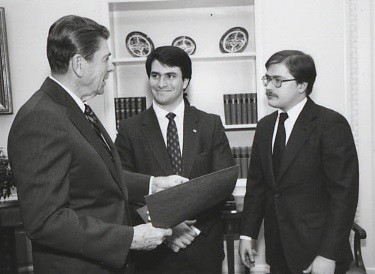
Reagan, Abramoff and Norquist in the Oval Office, 3 December 1981
Ronald Reagan with Abramoff and Grover Norquist in the Oval Office, 3 December 1981. The photograph documents an early political network; it does not establish a later corrupt agreement. Image credit ↗

Chapter 01 / 1981–2001

A useful advocate becomes an expensive one

Jack Abramoff’s value as a lobbyist rested on something real: he understood a conservative political world into which many clients needed an introduction. A White House photograph from 1981 shows him with President Ronald Reagan and Grover Norquist. By the middle of the next decade, after Republicans won control of Congress, he was working at Preston Gates and representing the Mississippi Band of Choctaw Indians. In 2001 he moved to Greenberg Traurig. Political relationships had become a professional asset that clients were prepared to buy.

The Choctaw had reasons to seek representation beyond a desire to preserve casino profits. Tribal government revenue, federal tax proposals and sovereignty were at stake. The Senate investigation credited a history of successful advocacy on their behalf. Nell Rogers, a tribal planner whose interviews appear throughout the report, described how outside groups could support the tribe’s position in Congress. Those early results help explain later trust. A record of useful advocacy made the relationship durable and the later recommendations easier to trust.

Nor were tribal governments one interchangeable customer. The Louisiana Coushatta were concerned about competitors drawing away customers from Texas. The Pueblo of Sandia sought help with a land dispute involving a mountain held sacred by the tribe. Agua Caliente chairman Richard Milanovich opposed the cost and methods of the proposed representation but was outvoted by his council. The contracts arose from particular governmental decisions, arguments and factions; they were not the collective choice of an undifferentiated “Indian casino” interest.

The danger lay in the gap between visible expertise and hidden incentives. Hiring an effective advocate can be rational while relying on that advocate’s undisclosed financial recommendation can expose a client to fraud. Abramoff’s established relationships explain why an endorsement from him carried weight. They do not explain away the secret interest he subsequently acquired in the bills he recommended that clients pay.

Sources: S01 · S02 · S03

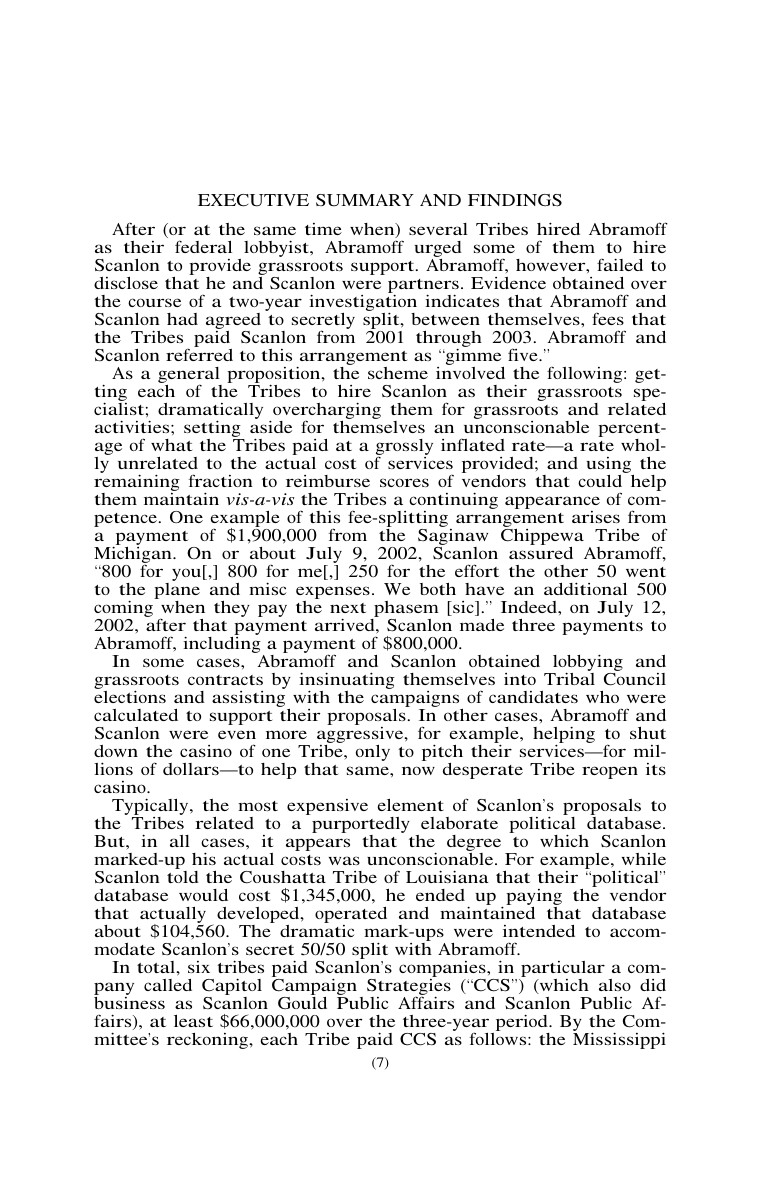
Senate Report 109-325, printed page 7: fee-splitting summary
The Senate’s own summary, printed pages 7–8 of Report 109-325, separates Scanlon-company receipts from other lobbying and third-party payments. Figures describe different financial categories. Image credit ↗

Chapter 02 / 2001–2003

The second bill had a secret beneficiary

The essential fee scheme was not simply that Washington advice cost too much. Abramoff recommended Michael Scanlon’s companies for public relations and grassroots political work while concealing that he would receive approximately half their profits. Clients understood they were hiring an additional specialist. They were also paying a secret beneficiary: the adviser whose recommendation had helped persuade them to sign.

The Senate’s financial reconstruction provides a useful scale. Six tribes paid Scanlon’s companies about $66 million from 2001 through 2003. The reported amounts were approximately $26.70 million from the Louisiana Coushatta, $14.75 million from the Mississippi Choctaw, $10.01 million from the Saginaw Chippewa, $7.20 million from Agua Caliente, $4.20 million from the Tigua and $2.75 million from Sandia. About $24 million went secretly to Abramoff. These are the committee’s receipts and transfer findings, not a declaration that every dollar in every contract was stolen. The $66 million excluded separate law-firm lobbying fees and some payments to other entities.

The records also bring the mechanism down to a single transaction. On a $1.9 million Saginaw payment, the committee quoted Scanlon allocating $800,000 apiece to himself and Abramoff, $250,000 to the effort and $50,000 to aircraft and miscellaneous expenses. It then traced an $800,000 transfer to Abramoff. For the Coushatta, a database presented as costing $1.345 million was developed and maintained by a vendor paid about $104,560. The significance is not a universal rule about acceptable profit margins. These costs and internal allocations support the finding that the sales explanation concealed a large, shared private return.

Client money moved through entities including Capitol Campaign Strategies, Kaygold and the American International Center. Some payments bought actual campaign services. Others became private income or supported unrelated ventures. The mixed activity made the operation more credible and the accounting more important: showing that some work occurred does not disclose a kickback, and finding a shell entity does not by itself quantify every client’s loss.

Sources: S01 · S04 · S05

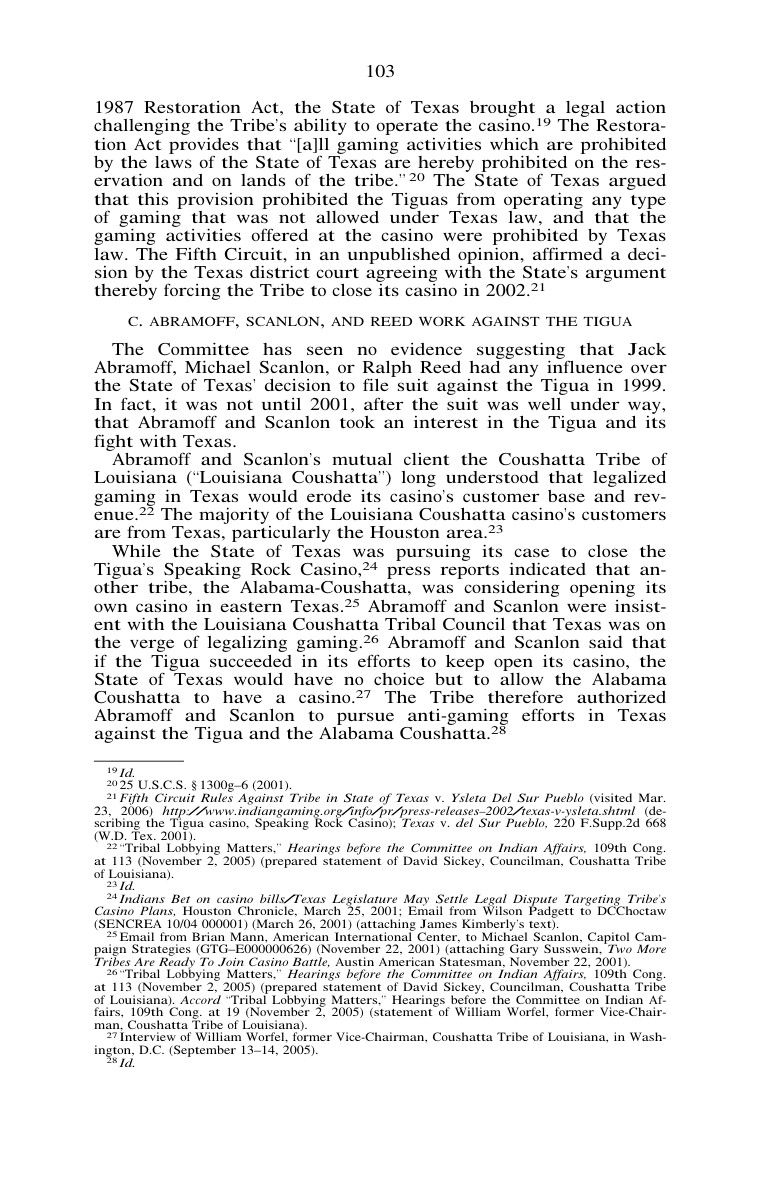
Senate Report 109-325, printed page 103: Texas legal action and later campaign
The report’s Tigua chapter, printed page 103, states a crucial limit: it found no evidence that the lobbying team caused Texas to file its 1999 suit. Its account of the later organizing and concealed representation follows. Image credit ↗

Chapter 03 / 2001–2002

Selling help to the people they had opposed

The Tigua episode is the sharpest example of a manufactured sales opportunity, but it also needs an important boundary. Texas had sued over the legality of the Ysleta del Sur Pueblo’s casino in 1999. The Senate committee found no evidence that Abramoff, Scanlon or Ralph Reed influenced that decision. The state had its own legal position and pursued it in court. A claim that the lobbyists invented the original lawsuit goes beyond the report.

By 2001, however, the team was organizing against expanded gaming in Texas with money from the Louisiana Coushatta. The Coushatta casino drew many customers from Texas. Abramoff and Scanlon argued that a favorable outcome for one Texas tribe could open the door to additional competition. Reed helped mobilize religious opposition to gambling. This was a coalition of interests whose reasons did not have to be identical: church activists could oppose gambling sincerely while a casino operator financed opposition to competitors. The hidden financial sponsorship mattered independently of whether every participant shared the same motive.

After Speaking Rock closed in 2002, Abramoff and Scanlon approached the Tigua to help reopen it. Abramoff offered federal lobbying without a fee while Scanlon would charge millions for the accompanying political work. The offer concealed their profit-sharing arrangement and their earlier role in the opposition. According to the committee, Scanlon received $4.2 million and secretly sent about $1.85 million to Abramoff. “Free” lobbying therefore did not mean Abramoff lacked a financial stake in the engagement.

The promised legislative rescue failed. The plan relied on obtaining language in federal election legislation, a task involving Representative Bob Ney and representations about Senate support. Abramoff said Senator Christopher Dodd was ready to support the plan. The committee’s interviews and records instead showed that the intermediary’s contact with Dodd’s office was limited, and that the office objected to unrelated provisions in the election bill. The episode does not show that every paid campaign can dictate a court or Congress. It shows advisers profiting from clients on opposing sides, concealing that conflict and selling assurances their clients could not independently verify. The failure to deliver is consequential, but the concealment is what makes this more than an ordinary unsuccessful lobbying contract.

Sources: S01 · S06 · S07

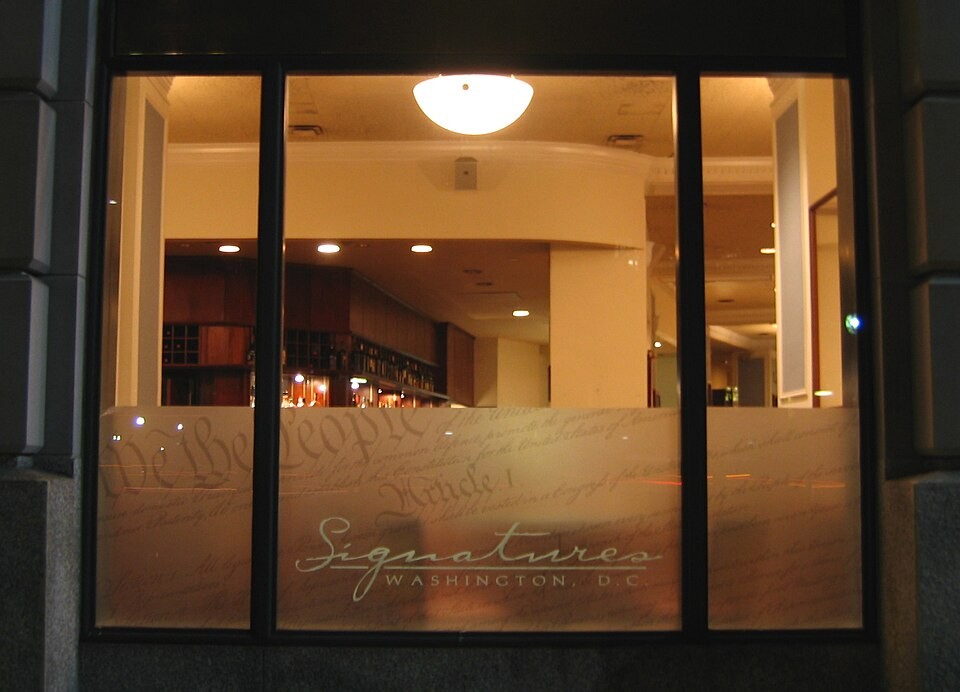
Signatures restaurant, 30 January 2006
Signatures restaurant in Washington, photographed in January 2006 after Abramoff’s ownership. Prosecutors described free and discounted hospitality there as one part of the stream of benefits offered to officials. Image credit ↗

Chapter 04 / 2000–2004

From hospitality to an exchange for action

A second chain ran from access to public office. Abramoff maintained an inventory of things useful for building relationships: meals, sports tickets, luxury suites, trips, campaign assistance and employment opportunities. In its 2008 sentencing memorandum, the government described annual suite costs exceeding $1 million during 2001–2003. It also described Signatures, the Washington restaurant, as a place where officials could receive free or discounted hospitality. These expenditures helped make a lobbying team valuable to clients and welcome to people who could act for them.

The criminal question was the agreement behind the benefits. Prosecutors themselves stated that some of Abramoff’s relationships became corrupt and others did not. An official appearing in an address book, accepting a lawful contribution or supporting a client’s policy position is not, by that fact alone, shown to have sold an official act. The admitted cases went further: benefits were provided and accepted in return for action. Abramoff’s plea and Ney’s later plea identified that exchange, rather than leaving the case at suspicious proximity.

Ney admitted taking trips, meals, tickets and contributions in exchange for agreeing to take and taking official action. The acts included supporting or opposing legislation, inserting statements into the Congressional Record and helping a proposed wireless infrastructure contract in the House. The Scotland golf trip featured prominently in accounts of the scandal, but repeated smaller benefits mattered too. A stream of hospitality could sustain a relationship before a particular request arrived.

The distinction also runs through employment. Congressional staff possessed institutional knowledge and access. The government’s records identify violations of the one-year restriction on certain former staff lobbying contacts, alongside arrangements involving benefits for spouses. Those channels require examination because money need not enter an official’s personal bank account to create a corrupt benefit. At the same time, each spouse, staffer and legislator has a separate evidentiary position. The proven mechanism is broader than a single envelope of cash; the roster of people who can be called guilty remains narrower than the network of everyone who knew Abramoff.

Sources: S08 · S09 · S10

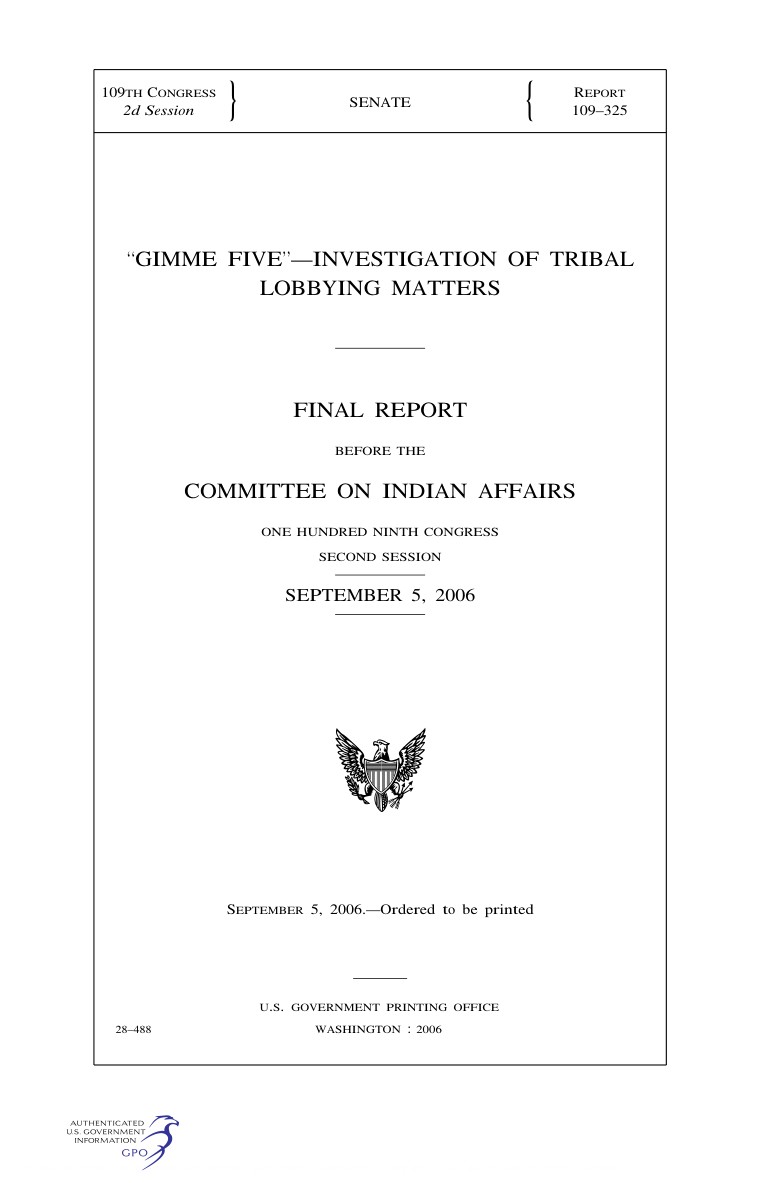
Title page of Senate Report 109-325, ordered printed 5 September 2006
The final Senate report was approved in June 2006 and ordered printed in September. Its 1,407 pages include the committee’s analysis and supporting documents; possession of an exhibit is not endorsement of every assertion within it. Image credit ↗

Chapter 05 / 2003–2006

Clients helped break the story open

The public reckoning depended on people inside the client governments who challenged bills, contracts and political alliances. At the Saginaw Chippewa, Bernie Sprague described asking for records of work and being removed from the council with other dissenters. After a change of council, the tribe questioned Abramoff directly about his financial relationship with Scanlon. Sprague told the Senate that Abramoff denied having one. His testimony is a firsthand account of the tribe’s response, not a substitute for the bank records that later established the concealed arrangement.

Agua Caliente’s Richard Milanovich likewise described disagreement within a functioning government. He and the vice-chairman opposed the contracts but lost the council vote. He signed them in his official capacity. In 2004, he explained that the tribe had suspended the representation, begun an internal inquiry and sought reimbursement. Tribal officials, legal staff and members supplied information, disputed their own leaders’ decisions and sought institutional remedies. Their work helped make the exposure possible.

Susan Schmidt’s Washington Post reporting brought the scale of the fees to national attention in February 2004. The Senate Indian Affairs Committee then used document demands, hearings and interviews to reconstruct dealings that clients could not see from invoices alone. Abramoff appeared at its September hearing and invoked his constitutional privilege against self-incrimination. That invocation was not a conviction. The later emails, transfers and guilty pleas carried the proof.

The investigation also generated a debate about reform. Senator Daniel Inouye supported greater transparency but objected to a recommendation that could single out tribes rather than applying equally to other unincorporated associations. His additional views are part of the record, not a dissent from the central fraud findings. The distinction matters: exposing the misuse of tribal money did not justify treating ordinary tribal participation in politics as inherently suspect. The committee approved the report 13–0 in June 2006. Its findings document exploitation while leaving room to dispute particular recommendations and the reach of the investigation.

Sources: S01 · S03 · S04 · S11 · S12

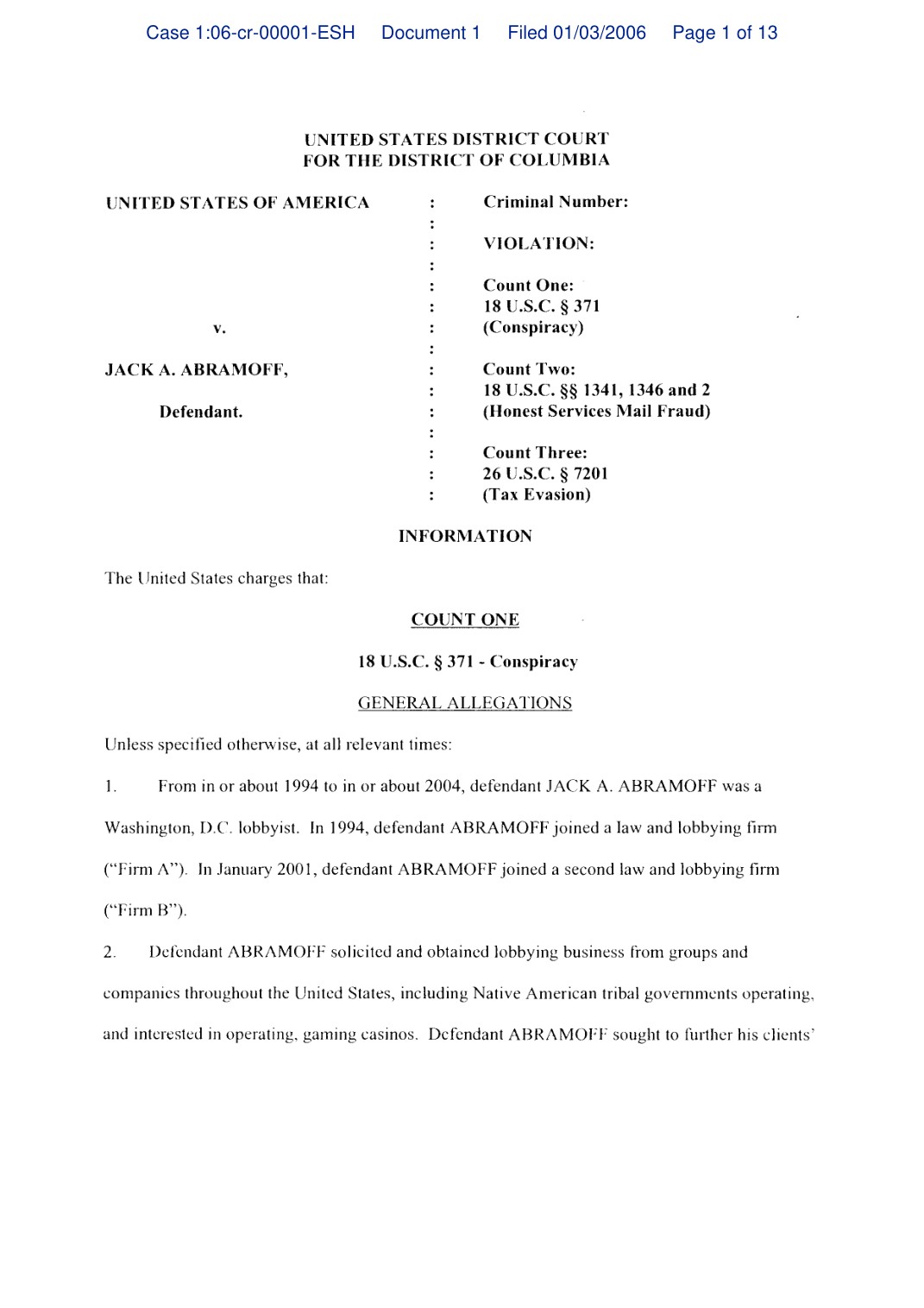
United States v. Abramoff, criminal information, 3 January 2006, page 1
The January 2006 criminal information in the District of Columbia. A charging document states accusations; the guide pairs it with the guilty plea, sentence and later case records rather than treating the filing alone as proof. Image credit ↗

Chapter 06 / 2005–2011

What the courts established

The decisive legal events were admissions and judgments, not the spectacle of hearings. Michael Scanlon pleaded guilty in November 2005. On 3 January 2006, Abramoff pleaded guilty in the District of Columbia to conspiracy, aiding and abetting honest-services mail fraud, and tax evasion. He agreed to cooperate. The admitted scheme included the undisclosed kickbacks, fraudulent client representations and corrupt provision of things of value to officials. Those facts do not depend on whether a later commentator thinks lobbying laws were too permissive.

A separate proceeding followed in Florida. On 4 January 2006 Abramoff pleaded guilty to conspiracy and wire fraud arising from the SunCruz gambling-boat purchase. He and Adam Kidan had used a fictitious $23 million wire transfer to make lenders believe the buyers had contributed cash to the acquisition. The original March sentence was 70 months. This was lender fraud, with different victims and transactions from the tribal representation. The two prosecutions overlapped in time and cooperation arrangements; their dollar amounts should not be merged into a single casino-client loss figure.

Ney formally entered his guilty plea on 13 October 2006 and received a 30-month sentence in January 2007. A plea agreement signed or announced earlier is not the same event as its entry in court. In September 2008, Judge Ellen Segal Huvelle sentenced Abramoff in the Washington case to 48 months and ordered $23,134,695 in restitution. Contemporary accounts explain the interaction with his existing Florida imprisonment; simply adding the original sentences produces a misleading picture of time actually served.

Cooperation affected punishment. Prosecutors described Abramoff’s extensive assistance, and Scanlon ultimately received a 20-month sentence in 2011 plus a restitution order of approximately $20.19 million. Those orders are legal obligations, not proof that victims have been repaid. Nor do they turn every investigative lead into an adjudicated offense. A reliable account can say both that the conspiracy was real and that the public record does not convict everyone appearing around its edges.

Sources: S05 · S07 · S08 · S09 · S10 · S13 · S14 · S15 · S24

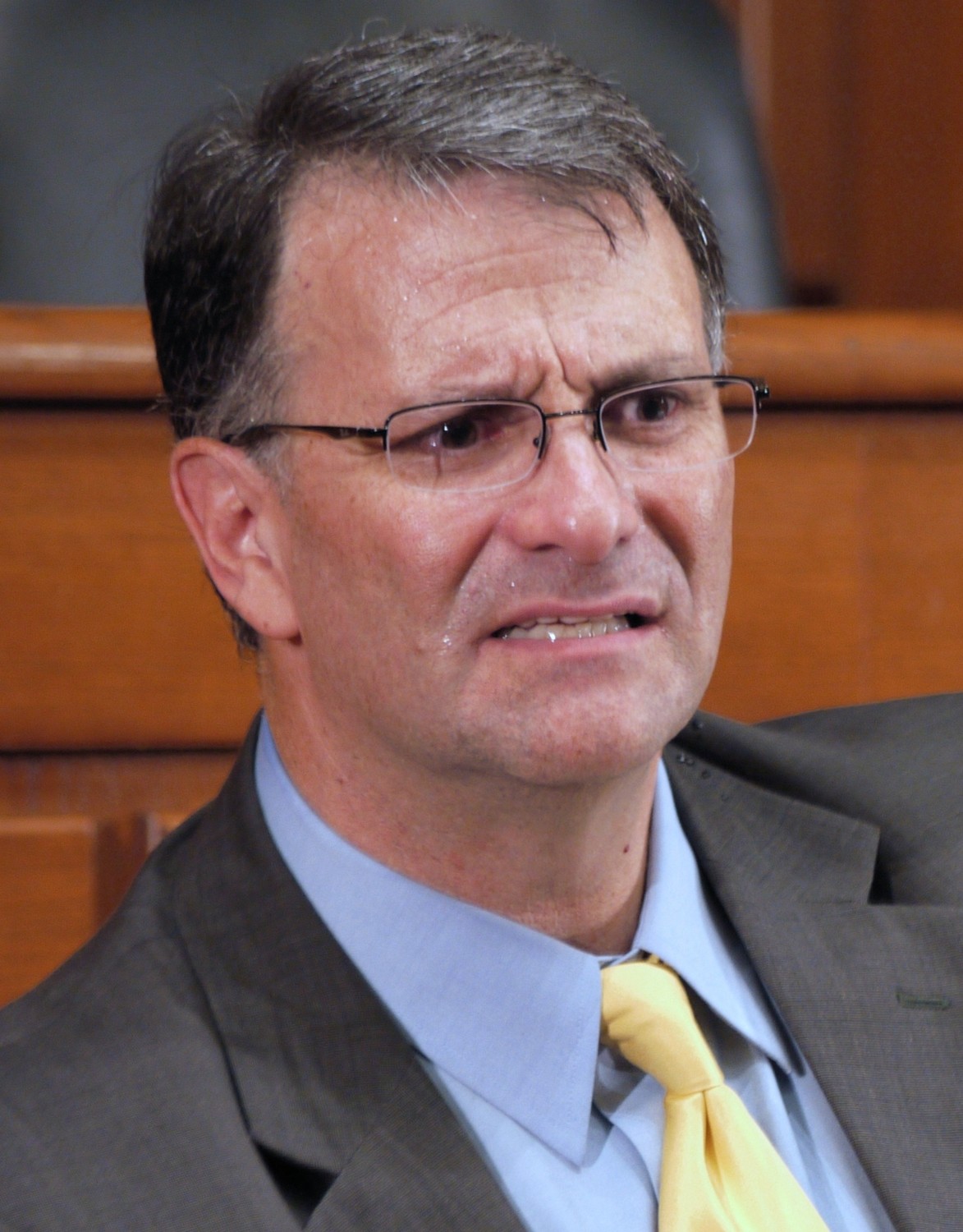
Jack Abramoff at In the Dock, 6 December 2011
Abramoff at the December 2011 event with Lawrence Lessig. The post-prison speaker’s warnings about influence were testimony from a participant, with an interest in how his own story was remembered. Image credit ↗

Chapter 07 / 2011–2025

The reformer’s story and another case

After prison, Abramoff returned as an author and critic of lobbying. In his 2011 television appearances he described a system in which gifts, fundraising access and prospective jobs could put offices within a lobbyist’s reach. His experience gave that account value. His interest in selling a book and recasting himself also made independent checking necessary. A participant’s broad claim that nearly everyone was involved is not a count of proven corrupt agreements.

Congress also changed the governing rules. The Honest Leadership and Open Government Act, enacted on 14 September 2007, required quarterly lobbying reports, added reporting of certain contributions, changed post-employment restrictions and prohibited registered lobbyists from knowingly providing gifts or travel that congressional rules would not allow recipients to accept. These were concrete statutory changes, distinct from Abramoff’s later judgment that the system remained compromised. The JACK Act, approved on 3 January 2019, required registration and quarterly reports to disclose specified criminal convictions of listed lobbyists. Its title refers to 2018; its approval date was in 2019. Disclosure of a conviction is different from a permanent ban on lobbying.

The reception was divided. The conservative writer Matthew Continetti challenged Abramoff’s rehabilitation. In Washingtonian’s 2013 reporting, Tigua lieutenant governor Carlos Hisa and tribal advocate Tom Rodgers rejected his redemption narrative and public return. These criticisms raised a historical question beyond the convictions: did the scandal primarily reveal a criminal exception, or an unusually visible instance of everyday influence? The answer depends on the proposition. Pleas and transfers establish specific frauds. Lobbying practices surrounding those crimes can sustain a wider institutional critique without showing that every policy victory was purchased illegally.

A later prosecution makes a clean “crime, punishment, reform” ending impossible. In 2020 federal prosecutors brought separate charges involving AML Bitcoin promotion and a failure to register under the Lobbying Disclosure Act. GAO’s later oversight report records the July 2020 guilty plea. The registration conduct involved a separate lobbying engagement, not an automatic extension of the earlier tribal case. The 2020 charge announcement preceded the plea and eventual sentence by years.

Bloomberg Law reported on 29 July 2025 that Judge Richard Seeborg imposed three years of probation and approximately $2.2 million in restitution. That later disposition belongs to the cryptocurrency and registration proceeding. It neither changes the identity of the earlier tribal victims nor proves every sweeping statement Abramoff made about Washington. The enduring documentary problem is concrete: which client authorized a payment, who actually benefited, what the recipient knew and what action was promised in return. The surviving records answer those questions strongly in some transactions and leave them unresolved in others.

Sources: S16 · S17 · S18 · S19 · S20 · S23 · S25 · S26

02 / The record

The load-bearing chain

Client instructions, a concealed return and an admitted exchange.

The strongest chain begins with what particular tribal governments sought and authorized, follows the adviser’s hidden financial stake and actual transfers, then identifies which officials knowingly exchanged action for benefits. Senate findings, criminal admissions, sentences, later reporting and reforms occupy different places in that chain. Neither a high fee nor a wide political network can do the work of every missing link.

Sources: S01 · S03 · S04 · S05 · S08 · S09 · S13

Evidence support assesses each precise hinge. Cultural prominence describes only the inspected public narratives; no general audience poll or ordinal popularity ranking was found. Abramoff’s own expansive estimates of influence are attributed participant claims, not measures of public belief or proven corrupt offices.

P1

Useful representation creates trust

Evidence support High for the documented client relationships; bounded for their entire history

Cultural prominence Unmeasured

Successful advocacy and political connections made Abramoff’s recommendations credible. The Choctaw’s tax and sovereignty concerns, Coushatta competition concerns and Sandia’s land issue were concrete client objectives. Milanovich’s opposition shows that client governments debated the purchases.

The documentary yardstick

The Senate report and Milanovich’s prepared testimony show particular client objectives, some useful advocacy and internal disagreement over contracts.

Where it fits

Trust is an entry condition, not proof that every early success was corrupt or that client governments lacked agency.

Why it is critical

Without this first relationship, a recommendation to hire a costly outside public-relations firm would have had less force. It explains entry to the scheme without implying that all the earlier work was fraudulent.

If this hinge were removed

Without the trust and recommendation link, the explanation of why clients accepted Scanlon’s bills weakens. Removing a particular earlier policy success would not erase the later concealed financial interest.

Dependencies

Contracts, records of client objectives and contemporary client accounts. Early policy successes need not have been corrupt to build confidence.

What rival readings must explain

An all-fraud-from-the-start theory must explain acknowledged results. An all-normal-business theory must continue through P2 and disclose the adviser’s private stake.

Gaps and disputes

The complete professional history and all contract deliberations are not audited. Retrospective accounts must be compared with contemporaneous client records.

Evidence-rank grounds

Named testimony and committee evidence identify objectives and disagreement. They do not determine the value or legality of every prior engagement.

Cultural-rank grounds

The inspected client testimony receives direct attention here; no survey ranks its familiarity against the scandal’s better-publicized personalities.

Sources: S01 · S03

P2

The recommended contractor secretly shares the profits

Evidence support High for the admitted concealed arrangement

Cultural prominence Unmeasured

Abramoff steered clients toward Scanlon’s services while privately receiving roughly half the profits. Internal allocations, ledgers and transfers corroborate an arrangement concealed from the clients. The Saginaw $1.9 million transaction is a concrete example.

The documentary yardstick

Internal allocations and traced transfers support the secret profit split; the January 2006 plea account records admissions. Six-tribe gross receipts are not the same quantity as criminal loss.

Where it fits

The hidden adviser stake is the specific bridge from high-cost service to deception. It is not established by an unusually large bill alone.

Why it is critical

This is the bridge from expensive advocacy to client fraud. If the financial interest had been fully and accurately disclosed, the central deception would be materially different.

If this hinge were removed

If clients had knowingly approved the precise profit share beforehand, that transaction’s concealment assessment would change. Removing a markup example would not remove the independently supported secret arrangement.

Dependencies

P1’s trusted-adviser relationship; contract invoices, bank transfers and communications tying Abramoff to Scanlon’s return; admissions in the plea.

What rival readings must explain

High fees or performed work do not resolve concealment. Evidence that would change a particular transaction’s assessment includes authenticated client disclosure and approval before payment, or accounting that disproves the transfer attribution.

Gaps and disputes

Complete contracts, services and collection records are not audited. The Senate’s broader six-client scope differs from the principal criminal four-tribe scheme.

Evidence-rank grounds

The committee’s records and defendants’ admissions converge on a specific mechanism. Rough$66 million receipts, roughly$24 million transfers, loss calculations and restitution orders remain distinct.

Cultural-rank grounds

A large headline figure appears in the inspected narratives, but no audience study measures whether readers understand its accounting category.

Sources: S01 · S05 · S07

P3

Conduits obscure purpose and destination

Evidence support High for specified traced transactions; incomplete for every entity’s activity

Cultural prominence Unmeasured

Entities including Kaygold, the American International Center and the Capital Athletic Foundation received or transmitted funds. Some supported real services; others concealed income or paid expenses outside the clients’ intended purpose. The tax charge concerns misrepresentation, not the mere existence of a nonprofit.

The documentary yardstick

The report traces named entities and uses of money; the plea and sentencing memorandum connect particular misrepresentations to fraud or tax conduct.

Where it fits

Tracing authorization, destination and benefit keeps an entity chart from becoming proof by association or repeated counting of the same funds.

Why it is critical

A list of companies does not explain the crime. The chain needs the authorization, actual use and benefit to the conspirators. It also prevents double-counting a payment every time it crosses an entity.

If this hinge were removed

Remove a particular conduit and a different transfer may still prove the hidden return. Remove the authorization/use link and a nonprofit’s existence alone cannot establish diversion or tax evasion.

Dependencies

P2; the committee’s entity chapters; books, checks and tax records. Gross receipts, transfers, profits, loss findings and restitution are separate quantities.

What rival readings must explain

A benign-administration account must reconcile client instructions with actual expenditures. New authenticated invoices, bank records or authorizations could correct individual allocations; a nonprofit label alone cannot.

Gaps and disputes

Not every flow through every entity is independently reconstructed here. Some services were real, and gross transfers can overlap.

Evidence-rank grounds

Committee reconstruction and federal admissions support particular flows and offenses. They do not make every organization in the network criminal.

Cultural-rank grounds

Entity names appear in the documentary corpus, but their comparative cultural prominence is unmeasured.

Sources: S01 · S05 · S08

P4

A conflict becomes a new sales opportunity

Evidence support High for the stated documentary sequence and its explicit limit

Cultural prominence Unmeasured

The team’s later anti-Tigua organizing and subsequent paid offer to help the Tigua reopen their casino place the hidden interest in a specific sequence. The state’s original lawsuit preceded the lobbying effort and had its own legal basis.

The documentary yardstick

The committee expressly found no evidence of influence over Texas’s 1999 decision to sue. It separately documented 2001 opposition work and the later concealed Tigua engagement.

Where it fits

The timing both supports the conflict-of-interest case and limits a stronger story in which the lobbyists created every adverse event.

Why it is critical

This tests intent and informed consent. It shows why “free” lobbying could still benefit Abramoff and why a failed rescue can reveal more than ordinary inability to win legislation.

If this hinge were removed

Without later opposition and concealed interest, this would look more like ordinary unsuccessful representation. Removing an unsupported claim about the original lawsuit leaves the demonstrated later conflict intact.

Dependencies

P2; 2001 communications, client testimony and the subsequent Scanlon engagement. The report’s explicit limit on the 1999 suit must remain in the chain.

What rival readings must explain

A theory that the lobbyists caused every adverse event overclaims the evidence. A routine-client-service theory must explain undisclosed earlier opposition and profit sharing. Contemporaneous disclosure to the Tigua or contrary authenticated communications would change that assessment.

Gaps and disputes

A later campaign’s effect on the court outcome is not established simply by its existence. The complete state-litigation record is outside this edition.

Evidence-rank grounds

Report page 103 states the 1999 limit; later communications and client engagement records support the narrower subsequent sequence.

Cultural-rank grounds

The contrast is striking in the inspected accounts; no poll establishes how well the original-lawsuit limit is remembered.

Sources: S01 · S06

P5

Benefits are tied to official action

Evidence support High for the admitted exchanges; not established for the whole network

Cultural prominence Unmeasured

The admitted corruption cases identify a stream of trips, tickets, meals, contributions and other benefits exchanged for official action. Ney’s own plea supplies both the recipient’s admission and examples of the action sought.

The documentary yardstick

Ney’s 13 October 2006 plea admitted benefits for official action. The government’s own sentencing memorandum distinguishes corrupt and noncorrupt relationships.

Where it fits

This supplies the agreement/knowledge link between hospitality and public corruption, without making an entire address book a conviction list.

Why it is critical

The exchange separates the proven public corruption from access, friendship and lawful advocacy. Without recipient knowledge and a corrupt agreement, a wide social network would not establish that every office was bought.

If this hinge were removed

Remove a recipient’s corrupt agreement and that person’s contribution or meeting cannot by itself establish bribery. Removing one benefit would not erase other admitted exchanges or the separate client fraud.

Dependencies

P3’s use of funds is relevant but not sufficient; recipient records, communications, official acts and pleas carry the link. The two fraud and corruption chains overlap without being identical.

What rival readings must explain

A broad systemic account must identify which agreements it means. A few-bad-actors account must explain repeatable institutional channels. New authenticated correspondence showing knowledge and exchange could establish further cases; exculpatory timing or a false payment attribution could narrow them.

Gaps and disputes

No comprehensive office-by-office audit is claimed. Particular acquaintances and contributions require their own evidence and legal outcomes.

Evidence-rank grounds

The recipient’s own plea corroborates the exchange account. A photograph, gift or broad insider estimate cannot replace that individual evidence.

Cultural-rank grounds

The golf-trip and hospitality stories appear in inspected records and interviews. Relative public familiarity with each mechanism is unmeasured.

Sources: S08 · S09 · S10 · S05

P6

Admissions corroborate the records; judgments define outcomes

Evidence support High for core official outcomes/statutory text; qualified for later reported disposition

Cultural prominence Unmeasured

Scanlon, Abramoff and Ney entered guilty pleas, and courts imposed sentences. Prosecutors credited cooperation. The Senate findings, including a broader six-tribe financial reconstruction, are not identical to the acts adjudicated in each criminal case. Congress later enacted specific disclosure, gift/travel and post-employment changes in 2007; the 2019 JACK Act added conviction disclosure. These outcomes establish legislative response without proving that the wider influence incentives disappeared.

The documentary yardstick

Court pleas/sentences establish particular outcomes;2007 and 2019 statutes establish particular reforms. A legal obligation or enacted rule does not establish repayment or effectiveness.

Where it fits

This closes the admitted scheme while leaving wider institutional claims to be tested with appropriate records rather than a symbolic redemption or closure narrative.

Why it is critical

The account need not remain an allegation forever. It also cannot extend settled guilt from named defendants to every donor, colleague, official or client connected to them.

If this hinge were removed

Remove a particular reform and the convictions remain. Remove a sentencing announcement and earlier admissions still matter, but its exact sentence/restitution entry needs a replacement court record. A later separate case does not revise the earlier victims.

Dependencies

P1–P5; distinguish charging records, signed agreements, court plea dates, sentencing dates and later reporting. Keep Florida and 2020 proceedings separate.

What rival readings must explain

A partisan-fabrication theory must explain corroborating internal documents and defendants’ admissions, not merely criticize headlines. Changes to court outcomes require actual orders. Broader historical conclusions can change with authenticated records even where a prosecution never occurred.

Gaps and disputes

Current restitution balances and a complete PACER audit are absent. The 2025 later disposition remains attributed reporting, not a newly acquired final judgment.

Evidence-rank grounds

The original federal announcements/laws support their dates and terms. Bloomberg’s 2025 sentence account is explicitly a different evidentiary category.

Cultural-rank grounds

The inspected press/interview narratives circulate different closure and reform frames. Their relative audience acceptance is unmeasured.

Sources: S05 · S08 · S09 · S13 · S14 · S15 · S19 · S20 · S25 · S26

03 / The record

How the accounts branch

Documented source relationships, competing interpretations and recurring hinges. Similar concerns do not establish borrowing.

Client objections become an investigative record

Council dissent and demands for records → public reporting and 2004 hearings → the 2006 committee financial reconstruction.

Borrowing and dependence

Milanovich and Sprague describe their own decisions and later discoveries; the committee combines testimony with records. Reprinting a witness does not create a second independent witness. The press milestone is not a substitute for the bank evidence.

Branch and limit

Client governments were internally contested actors. The later report’s wider six-client inquiry is not identical to the four-tribe principal criminal scheme.

Recurring hinges: P1 · P2 · P6

Sources: S01 · S03 · S04 · S06 · S11

The financial record feeds distinct legal and systemic accounts

Invoices, internal communications and transfers → committee findings and plea-related accounts → sentencing arguments and institutional interpretations.

Borrowing and dependence

The report and prosecution use overlapping transactions; agreement between their retellings is not independent proof of every broader claim. Pleas are additional legal events, not merely another headline.

Branch and limit

Client deception and corrupt benefits can overlap without being the same offense or making every dollar a bribe.

Recurring hinges: P2 · P3 · P5 · P6

Sources: S01 · S05 · S08 · S09

The Tigua conflict has an earlier boundary

Texas’s 1999 lawsuit → later anti-gaming organizing → a paid reopening pitch with an undisclosed shared return.

Borrowing and dependence

The committee reconstructs this sequence and explicitly limits the original-lawsuit claim. The later engagement cannot be projected backward as proof the team initiated that suit.

Branch and limit

A failed legislative rescue and an undisclosed conflict are separable findings. One explains a promised result; the other tests informed authorization.

Recurring hinges: P1 · P2 · P4

Sources: S01 · S06 · S07

The convicted participant returns as a reform narrator

Admissions and prison → Abramoff’s 2011 book-era interviews → contemporaneous criticism of his rehabilitation.

Borrowing and dependence

CBS’s preview supplies actual attributed interview excerpts. Continetti explicitly responds to the profile/book-party rehabilitation cycle. This edition does not claim to have read the whole book or watched every interview.

Branch and limit

A useful account of influence can coexist with self-promotion. Neither participant candor nor a critic’s distrust measures how many offices were corrupt.

Recurring hinges: P3 · P5 · P6

Sources: S08 · S16 · S17 · S22 · S23

Reform takes several routes without one verdict on success

Committee recommendations and Inouye’s additional views → specific 2007 statutory changes →2019 conviction disclosure and later oversight.

Borrowing and dependence

The report records a disagreement over equal treatment in a transparency recommendation; the original statutes establish what was enacted. No claim is made that every later provision directly borrowed his proposed language.

Branch and limit

Enactment, compliance, deterrence and equal treatment need different evidence. The JACK Act’s 2018 short title does not change its 2019 approval date or make disclosure a lifetime ban.

Recurring hinges: P1 · P5 · P6

Sources: S01 · S19 · S25 · S26

04 / The record

Four rival paths through the same record

The strongest version first, followed by the hinges it accepts, the inferences it would remove or revise and the evidence it needs to add. Rival is not endorsement.

Interpretation 01

A criminal enterprise inside a lawful profession

Strongest fit for the admitted conduct

The strongest version

Abramoff and Scanlon exploited real lobbying relationships to extract secret profits, while a subset of officials exchanged public action for benefits. The fraud and public corruption are related activities with distinct legal elements.

Accept

P1 · P2 · P3 · P4 · P5 · P6

P1’s useful early representation, P2’s concealed partnership, P3’s diversions and P5’s admitted exchanges. It does not require that every client victory or contact be corrupt.

Remove or revise

Remove any inference that criminal acts made every service fictitious or every associate guilty.

Add to the path

Add transaction-level authorization and recipient evidence to extend the demonstrated scheme to a proposed additional person.

What must be wrong or incomplete

The concealed-return and admitted-exchange evidence would have to be materially wrong to displace the core criminal account.

Must still explain

P4 shows a particularly aggressive conflict; repeated gifts and staff channels make this more systematic than a single opportunistic theft. The model must avoid treating the profession’s surrounding rules as irrelevant.

Assessment

Internal financial allocations, transfers and guilty pleas support this account directly. The government’s own distinction between corrupt and noncorrupt relationships makes bounded guilt compatible with extensive wrongdoing.

What would change this assessment

Authenticated evidence of client disclosure and consent could alter specific fee-fraud findings; a judicial order would be needed to change a reported plea or judgment. New recipient communications could widen or narrow the corruption map.

Sources: S01 · S05 · S08 · S09 · S13

Interpretation 02

A symptom of a wider influence system

Substantial institutional interpretation; scope is not a conviction count

The strongest version

The affair exposed repeatable incentives: dependence on intermediaries, fundraising access, hospitality and the prospect of well-paid staff employment. Criminal exchanges used channels that also operate legally, so punishing the defendants alone could leave much of the influence problem intact.

Accept

P1 · P2 · P3 · P4 · P5 · P6

P1–P6, especially the relationship between P3’s financing and P5’s official access. Abramoff’s later account offers a participant’s description of these incentives.

Remove or revise

Revise the inference that convictions of named defendants exhaust the significance of recurring access, employment and fundraising channels.

Add to the path

Add comparable records across offices, legal and illegal transactions, enforcement and measured reform outcomes.

What must be wrong or incomplete

The narrowness of the proven roster need not be wrong; what must be shown is that the identified practices also explain a wider institutional pattern.

Must still explain

Legal access and private influence differ from an admitted agreement to exchange an official act for a benefit. The strongest version cannot convert Abramoff’s boast about many offices into proof of guilt for every member or party.

Assessment

The repeated channels in the case records support a systemic critique. The universality of that critique requires evidence beyond these cases. It can be persuasive as political analysis while remaining unproven as a claim that all officials were bribed.

What would change this assessment

A representative documentary sample of additional offices, with payments, knowledge and decisions, would test prevalence. Independent evidence of genuinely effective controls would also matter. Another sweeping insider assertion would not resolve the scale. Enforcement data showing how the enacted 2007 provisions and 2019 conviction disclosure worked in practice would test the claim that the reforms failed.

Sources: S08 · S09 · S16 · S17 · S22 · S25 · S26

Interpretation 03

Clients paid for results in an expensive business

Explains trust and some services; fails as an explanation of the concealment

The strongest version

Lobbying and political campaigns are costly, many clients had urgent problems, early work produced results and some billed services were performed. Rival factions and failed projects could make later client complaints sound more comprehensive than the original bargain. At sentencing, defense counsel Abbe Lowell argued that tolerated practices had been stretched beyond the legal boundary.

Accept

P1 · P2 · P3

P1 and real vendor spending in P2–P3. Milanovich and Sprague’s accounts contain internal political conflict, so contemporaneous documents are needed rather than assuming every accusation was exact.

Remove or revise

Remove an equation between an expensive/failed service and fraud, but retain the separately proven secret interest and admitted exchange.

Add to the path

Add contemporaneous scopes, work products, cost records and informed client disclosure of the actual financial interest before payment.

What must be wrong or incomplete

The documented concealment would have to be incomplete or contradicted by authentic prior disclosure to turn the central scheme into merely a fee dispute.

Must still explain

P2’s secret half-profit interest, the specific cost/markup records, P4’s undisclosed opposition and the admitted P5 exchanges cannot be answered by saying that expensive services sometimes work. Those facts concern disclosure and agreement, not satisfaction alone.

Assessment

The record gives this explanation genuine force for why the relationships began and why not every dollar was an illicit payment. It cannot displace the documented kickbacks and guilty pleas.

What would change this assessment

Complete contemporaneous scopes of work and cost records could revise judgments about service value. To change the concealment assessment they would also need to establish informed client knowledge of the adviser’s financial interest before the payment.

Sources: S01 · S03 · S04 · S05 · S08 · S24

Interpretation 04

Partisan exposure magnified guilt by association

Valid warning about the perimeter; unsupported as a dismissal of the core

The strongest version

An election-year scandal encouraged photographs, donations and friendships to become shorthand for corruption. Republican institutions were central to Abramoff’s access, while tribal clients could contribute across party lines. The public scandal was wider than the list of adjudicated defendants.

Accept

P1 · P5 · P6

P6’s specific convictions and the need for P5’s recipient-level evidence. A partisan framing can exaggerate the network without making the underlying fraud imaginary.

Remove or revise

Remove guilt inferred from a photograph, contribution or partisan affiliation; retain independently corroborated transfers and admissions.

Add to the path

Add authenticated evidence of material editing, false attribution or claim-specific witness problems and the relevant court’s treatment.

What must be wrong or incomplete

The core records and admissions would need specific defects; general partisan incentives for exposure cannot alone overturn them.

Must still explain

The case includes client witnesses, internal emails, money transfers and admissions. The committee approved its report unanimously among voting members. Political incentives for exposure do not explain away P2 or Ney’s separate admission at P5.

Assessment

Guilt by association is a real analytical hazard, and the government expressly distinguished some relationships from criminal ones. That supports narrower individual judgments. It does not support calling the documented scheme merely a partisan fabrication.

What would change this assessment

Authenticated records of selective editing, false transfer attribution, undisclosed witness inducements affecting a specific claim, or court findings rejecting evidence would require revisions. General accusations of bias cannot overturn the corroborated chain.

Sources: S01 · S08 · S09 · S11 · S17
05 / The record

Which account emphasizes which hinge

Five inspected voices: a tribal chairman, prosecutors, the convicted participant in interview excerpts, a contemporary critic and a senator’s additional views. These cards compare specific texts; no omission is assigned to an unread book or an unviewed full broadcast.

Richard Milanovich’s prepared testimony

Prepared statement reprinted in the 2004 hearing, printed 51–53; not a new interview or complete contract audit.

Amplifies

Council disagreement, official decision-making, later discovery and the tribe’s response.

Recasts

Explains why signing in an official capacity and having opposed the contract are compatible. Client institutions made choices and also contained dissent.

Does not establish in this inspected account

His perspective alone cannot allocate every transfer or resolve every accusation; the financial record supplies separate checks.

P1 · P2 · P6

Sources: S03

The government’s 2008 sentencing memorandum

Selected offense/mechanism/cooperation passages in a prosecution filing; not the judge’s findings on every sentence.

Amplifies

The concealed scheme, admitted corruption channels and substantial cooperation.

Recasts

Distinguishes corrupt from noncorrupt relationships while arguing for a particular sentencing treatment.

Does not establish in this inspected account

Advocacy in a filing is not a neutral finding about every person in the network or proof that every investigative lead became a conviction.

P2 · P3 · P5 · P6

Sources: S08

Abramoff in the 2011 CBS interview preview

Actual published interview excerpts; no full-book reading or complete broadcast playback.

Amplifies

The use of favors, access and prospective jobs, along with a broad claim that reform had failed.

Recasts

Frames a convicted participant as someone able to diagnose a continuing system rather than only recount his own crimes.

Does not establish in this inspected account

His sweeping office-count and prevalence claims are not an independent audit, and ordinary influence cannot automatically be relabeled an admitted bribe.

P3 · P5 · P6

Sources: S16

Matthew Continetti’s rehabilitation critique

The published 2011 commentary’s response to the profile/book-party return; not a complete audit of the book.

Amplifies

The narrator’s self-interest and the opportunity to turn notoriety into renewed influence.

Recasts

Challenges the credibility of the public reformer role rather than denying the underlying convictions.

Does not establish in this inspected account

A critic’s distrust does not by itself disprove every account of institutional incentives or establish a new criminal offense.

P5 · P6

Sources: S17

Inouye’s additional views on transparency

The report’s printed 253–254, separate from a dissent on the central fraud findings.

Amplifies

Equal treatment of tribal political participation and comparable unincorporated associations.

Recasts

Moves the reform question from a special restriction on tribes toward a broadly applied transparency proposal.

Does not establish in this inspected account

The recommendation is not evidence that the core fraud finding was rejected or that his wording became every later law.

P1 · P6

Sources: S01

06 / The record

Find a thread in the file

Search the chapter and claim index; each result leads to the full passage and its sources.

Chapter 01A useful advocate becomes an expensive oneChapter 02The second bill had a secret beneficiaryChapter 03Selling help to the people they had opposedChapter 04From hospitality to an exchange for actionChapter 05Clients helped break the story openChapter 06What the courts establishedChapter 07The reformer’s story and another caseClaim · EstablishedAbramoff and Scanlon secretly split profits from tribal-client fees.Claim · MisleadingThe Senate’s $66 million was the total amount stolen.Claim · EstablishedThe Tigua hired advisers who had helped organize against their casino.Claim · ContradictedA free lobbying offer meant Abramoff had no financial stake.Claim · EstablishedNey accepted benefits in return for official action.Claim · UnsupportedEveryone who received a tribal contribution was bribed.Claim · ContradictedActual lobbying successes disprove the client fraud.Claim · ContradictedThe Senate report convicted every person it discussed.Claim · UnsupportedThe case was entirely manufactured for partisan advantage.Claim · ContradictedThe Florida SunCruz case was the same fraud against tribal clients.Claim · UnsupportedThe Washington restitution order proves the tribes were repaid.Claim · UnsupportedThe post-prison interviews establish that nearly all of Congress was corrupt.Claim · Documented reportingA later cryptocurrency and registration case ended with a reported 2025 sentence.Claim · EstablishedThe scandal’s aftermath included concrete changes to lobbying law.Claim · ContradictedThe JACK Act permanently prohibited convicted lobbyists from lobbying.Timeline · 1981-12-03An early conservative networkTimeline · 1995The Mississippi Choctaw hire AbramoffTimeline · 1999Texas sues over the Tigua casinoTimeline · 2000SunCruz purchase and a false transferTimeline · 2001A new firm and a concealed financial partnershipTimeline · 2001-06-18An internal discussion of building Scanlon’s businessTimeline · 2001-11Organizing against Texas gamingTimeline · 2002Speaking Rock closes; the sales pitch changesTimeline · 2002-07-12A transaction makes the split visibleTimeline · 2002-08A Scotland trip becomes part of the corruption recordTimeline · 2004-02-22Tribal fee reporting reaches a national audienceTimeline · 2004-09-29Clients testify; Abramoff invokes the Fifth AmendmentTimeline · 2005-11Scanlon pleads guiltyTimeline · 2006-01-03Abramoff enters the Washington guilty pleaTimeline · 2006-01-04A separate Florida guilty pleaTimeline · 2006-03-29The original Florida sentenceTimeline · 2006-06-22The committee approves its reportTimeline · 2006-10-13Ney’s formal guilty pleaTimeline · 2007-01-19Ney is sentencedTimeline · 2007-09-14Congress enacts new lobbying and ethics legislationTimeline · 2008-09-04The Washington sentence and restitutionTimeline · 2011-02-11Scanlon receives his sentenceTimeline · 2011-11-06Abramoff tells the television audience his accountTimeline · 2019-01-03The JACK Act becomes lawTimeline · 2020-06-25A later criminal case is announcedTimeline · 2020-07-14The later guilty pleaTimeline · 2025-07-29Probation in the later proceeding

07 / The record

People, not a single cast of mind

Open a record for the person’s role and supporting sources. Individual biographies and images do not establish a corrupt agreement merely from association.

Jack AbramoffJack AbramoffLobbyist; admitted participant

Represented clients through Preston Gates and Greenberg Traurig. Pleaded guilty in the Washington and separate Florida cases in January 2006; later cooperated with prosecutors. His 2011 account is informative but cannot independently establish how many other officials were corrupt.

Sources: S01 · S05 · S08 · S13 · S16

ScanlonBiographical record
Michael ScanlonPublic-relations executive; secret profit-sharing partner

A former congressional aide and lobbying colleague who ran Capitol Campaign Strategies and related companies. His concealed sharing of profits with Abramoff was central to the tribal-client fraud. Pleaded guilty in November 2005, cooperated and was sentenced in February 2011.

Sources: S01 · S15

NeyBiographical record
Bob NeyU.S. representative from Ohio; admitted recipient

As a House member, Ney admitted accepting benefits in exchange for official action. His formal guilty plea was entered on 13 October 2006; the sentence was 30 months. His conduct is established through his own case, not inferred from Abramoff’s friendships.

Sources: S09 · S10

MilanovichBiographical record
Richard MilanovichAgua Caliente chairman; client-government witness

Opposed hiring the lobbying team, but signed the contracts after a council majority approved them. His 2004 testimony describes internal disagreement, suspension of the contracts, an inquiry into election interference and efforts to recover money.

Sources: S03 · S06

SpragueBiographical record
Bernie SpragueSaginaw Chippewa sub-chief; client-government witness

Challenged spending and sought records. His Senate testimony describes council conflicts, the later direct questioning of Abramoff about his financial relationship with Scanlon and proposed open contracting safeguards. His firsthand account is paired with documentary corroboration.

Sources: S04 · S06

RogersBiographical record
Nell RogersMississippi Choctaw planner and witness

Helped explain why early lobbying victories generated trust and how later payments were presented to the tribe. Her interviews, quoted and referenced by the committee, give a client-side view of the transition from useful advocacy to concealed diversion.

Sources: S01

ReedBiographical record
Ralph ReedPolitical consultant and anti-gambling organizer

Helped organize religious opposition to competing gambling interests with funding routed from Abramoff’s clients. His role in the Senate account is distinct from the fraud convictions of Abramoff and Scanlon. Knowledge, funding disclosures and particular representations require their own evidence.

Sources: S01 · S21

McCainBiographical record
Ben Nighthorse Campbell and John McCainSenators leading the tribal-lobbying inquiry

Campbell chaired the committee when the 2004 inquiry began; McCain continued it as chairman in the next Congress. Their committee obtained documents and testimony and approved the final report unanimously among members voting. Congressional findings remain distinct from judgments.

Sources: S01 · S06

InouyeBiographical record
Daniel K. InouyeSenator; additional views on fair reform

Supported transparency while warning that the report’s proposed contribution identifiers should cover comparable unincorporated associations rather than singling out tribes. His additional views address policy fairness, not an exoneration of the fee scheme.

Sources: S01

SchmidtBiographical record
Susan SchmidtReporter whose investigation helped expose the fees

Her February 2004 Washington Post article brought the tribal lobbying fees to a national audience. The Senate report records the article as the impetus for its investigation. Client documents and objections helped make the reporting possible.

Sources: S01 · S11

KidanBiographical record
Adam KidanBusiness partner in the separate SunCruz acquisition

Pleaded guilty in the Florida lender-fraud case involving a fictitious transfer used to finance the casino-boat purchase. The Florida financial transactions should not be merged with the tribal-client fee scheme. The entry describes the original lender-fraud transaction.

Sources: S14

08 / The record

Contracts, investigations and outcomes

Horizontal spacing shows elapsed time; separate rows keep close events selectable. Scroll the graph on narrow screens. Exact dates are attributed where records conflict; month- and year-only dates preserve source precision.

198019902000201020202026
An early conservative networkContext

The Reagan Library photograph places Abramoff and Norquist in the Oval Office. It is evidence of early political access, not a later criminal agreement.

Sources: S02

The Mississippi Choctaw hire AbramoffRepresentation

The Senate report dates the beginning of the Choctaw representation to 1995 and credits a history of tax and sovereignty advocacy. Later recommendations benefited from this accumulated trust.

Sources: S01

Texas sues over the Tigua casinoSeparate legal cause

Texas begins its case over Speaking Rock. The Senate report explicitly found no evidence that Abramoff, Scanlon or Reed influenced the decision to bring this suit. Their organizing enters the story later.

Sources: S01

SunCruz purchase and a false transferSeparate Florida case

The casino-boat acquisition was financed in part through lenders’ reliance on a purported $23 million buyer contribution. The later Florida guilty pleas admitted the transfer was fictitious.

Sources: S14

A new firm and a concealed financial partnershipFee scheme

Abramoff’s move to Greenberg Traurig coincides with the period in which he steered clients to Scanlon and secretly shared profits. The Senate financial reconstruction covers 2001–2003.

Sources: S01 · S05

An internal discussion of building Scanlon’s businessDocumentary record

Emails reproduced and analyzed at the beginning of the Senate report discuss growing Scanlon’s business and sharing the return. Earlier transactions also appear in the records; this email is not treated as the unique first act of the conspiracy.

Sources: S01

Organizing against Texas gamingPolitical campaign

The report quotes emails between Abramoff and Reed about mobilizing opposition while Texas’s case was already underway. Louisiana Coushatta interests helped fund the anti-gaming effort.

Sources: S01

Speaking Rock closes; the sales pitch changesClient conflict

After closure, Abramoff and Scanlon seek the Tigua engagement to help reopen the casino. Abramoff offers no-fee lobbying while concealing the financial interest in Scanlon’s paid services. The proposed federal legislative rescue fails.

Sources: S01 · S06

A transaction makes the split visibleMoney trail

The Senate summary traces an $800,000 transfer to Abramoff following a $1.9 million Saginaw Chippewa payment and an internal allocation of the proceeds. This is one transaction, not a whole-case loss estimate.

Sources: S01

A Scotland trip becomes part of the corruption recordBenefits

The public-official benefits described in the criminal records include the 2002 Scotland golf trip. Costs for a whole traveling party are not the same as the personal benefit allocated to any one traveler.

Sources: S08 · S09

Tribal fee reporting reaches a national audienceInvestigation

Susan Schmidt’s Washington Post report helps trigger the Senate inquiry. The print publication date is preserved here; the modern archive may display a preceding-day online timestamp.

Sources: S01 · S11

Clients testify; Abramoff invokes the Fifth AmendmentHearing

Milanovich and Sprague give client-government accounts. Abramoff invokes his privilege against self-incrimination. The invocation is a procedural right, not the guide’s proof of the underlying scheme.

Sources: S03 · S04 · S06 · S12

Scanlon pleads guiltyCourt

Scanlon admits a conspiracy involving bribery and fraud and cooperates. Month precision is used because records distinguish plea paperwork from courtroom events. His sentence follows in 2011.

Sources: S15

Abramoff enters the Washington guilty pleaCourt

The three-count plea admits conspiracy, aiding and abetting honest-services mail fraud, and tax evasion. The plea agreement requires cooperation.

Sources: S05

A separate Florida guilty pleaCourt

Abramoff pleads guilty to conspiracy and wire fraud in the SunCruz financing case. Separate transactions, victims and restitution apply.

Sources: S14

The original Florida sentenceSentence

Abramoff and Kidan receive 70-month sentences and restitution obligations in the SunCruz lender fraud. Subsequent cooperation and the Washington sentencing affect simple comparisons of original terms with actual time served.

Sources: S14 · S08

The committee approves its reportInvestigation

The report records a 13–0 vote to approve. It is ordered printed on 5 September. Additional views on campaign-contribution transparency remain part of the publication.

Sources: S01

Ney’s formal guilty pleaCourt

Ney enters a guilty plea to conspiracy and false-statement charges. This date differs from the preceding September plea agreement and announcement.

Sources: S09

Ney is sentencedSentence

The court imposes 30 months in prison. The sentence is a judicial outcome; it is not a finding about everyone who received a client contribution.

Sources: S10

Congress enacts new lobbying and ethics legislationReform

Public Law 110-81 adds quarterly lobbying reports, certain contribution disclosures and a prohibition on knowingly providing gifts or travel unacceptable under congressional rules, alongside post-employment and other reforms. These enacted provisions are distinct from claims about their eventual effectiveness.

Sources: S25

The Washington sentence and restitutionSentence

Abramoff receives 48 months and an order for $23,134,695 restitution. The interaction with the Florida term means adding original sentences overstates the combined period described in contemporary reports.

Sources: S08 · S13

Scanlon receives his sentenceSentence

20 months in prison and roughly $20.19 million restitution, with cooperation affecting the sentence. A restitution order is not a receipt for repayment.

Sources: S15

Abramoff tells the television audience his accountPublic memory

The 60 Minutes broadcast presents his post-prison critique of lobbying. The breadth of his statements about congressional influence is attributed testimony.

Sources: S16 · S22

The JACK Act becomes lawReform

Public Law 115-418 requires disclosure of specified convictions of listed lobbyists in registrations and quarterly reports. Its short title uses2018, but its approval date is3January 2019. It is a disclosure measure rather than a lifetime lobbying ban.

Sources: S26

A later criminal case is announcedSeparate later case

Northern California prosecutors announce cryptocurrency-related fraud conspiracy and a lobbying-registration charge. The announcement is an allegation-stage document, distinct from the later plea and sentence.

Sources: S18

The later guilty pleaSeparate later case

GAO’s lobbying-disclosure oversight report records the guilty plea under the Lobbying Disclosure Act on this date. The cryptocurrency and registration proceeding concerns later conduct.

Sources: S19 · S20

Probation in the later proceedingAttributed sentence

Bloomberg Law reports three years of probation and approximately $2.2 million restitution in the later cryptocurrency and registration case. An authenticated final judgment is not included in this edition.

Sources: S20

09 / The record

What the evidence supports

Ratings apply to the precise proposition on the page. Unsupported means the assembled evidence does not establish a claim; it is not interchangeable with false.

Established

Abramoff and Scanlon secretly split profits from tribal-client fees.

Internal accounting and communications support the arrangement; Abramoff and Scanlon admitted the scheme in their criminal cases. The deception was the concealed financial stake and fraudulent representations, not simply the existence of a large fee.

Sources: S01 · S05 · S15

Misleading

The Senate’s $66 million was the total amount stolen.

The number describes approximately what six tribes paid Scanlon’s companies in 2001–2003. Some money funded actual services; other law-firm and entity payments were outside that number. Profits, diverted funds, loss and restitution require separate calculations.

Sources: S01

Established

The Tigua hired advisers who had helped organize against their casino.

The committee documents later anti-gaming organizing and the subsequent concealed engagement to help reopen Speaking Rock. It also explicitly found no evidence that the team influenced Texas’s original decision to sue in 1999.

Sources: S01 · S06

Contradicted

A free lobbying offer meant Abramoff had no financial stake.

The Tigua pitch paired no-fee federal lobbying with paid Scanlon services whose profits were secretly shared with Abramoff. The nominal retainer did not reveal the true return.

Sources: S01 · S05

Established

Ney accepted benefits in return for official action.

His formal October 2006 guilty plea admitted the exchange, including support or opposition to legislation and statements placed in the Congressional Record. This is a settled outcome in his case.

Sources: S09 · S10

Unsupported

Everyone who received a tribal contribution was bribed.

A contribution can justify examining access and timing but cannot alone establish a corrupt agreement. The government described corrupt and noncorrupt relationships. Evidence for any additional official must establish the specific knowledge, benefit and exchange.

Sources: S08 · S09

Contradicted

Actual lobbying successes disprove the client fraud.

Real victories explain client trust and can show that a bill was not wholly fictitious. They do not disclose a secret profit interest or authorize misrepresented uses of client money. The records establish both some useful work and fraud.

Sources: S01 · S05

Contradicted

The Senate report convicted every person it discussed.

It is an investigative report with findings, testimony, exhibits and recommendations. Criminal pleas and judgments are separate records; people mentioned in the report do not acquire a conviction by appearing there.

Sources: S01 · S05 · S09

Unsupported

The case was entirely manufactured for partisan advantage.

Partisan arguments affected its public interpretation, but authenticated internal records, traced money, client testimony and defendants’ admissions corroborate the core. The committee’s unanimous vote does not prove every inference, but the core cannot be explained by headlines alone.

Sources: S01 · S05 · S08 · S09

Contradicted

The Florida SunCruz case was the same fraud against tribal clients.

The Florida case concerned false financing representations to lenders during a casino-boat acquisition. It has separate transactions, victims and restitution. Related timing and cooperation do not make it the tribal fee case.

Sources: S14 · S08

Unsupported

The Washington restitution order proves the tribes were repaid.

An order establishes an obligation. The 2008 announcement gives an ordered amount, not current balances or payment receipts. This guide has not audited collection records.

Sources: S13 · S15

Unsupported

The post-prison interviews establish that nearly all of Congress was corrupt.

They establish what Abramoff said about the influence system. His experience is relevant, but his broad prevalence claims require corroboration across individual offices and transactions.

Sources: S16 · S22 · S08

Documented reporting

A later cryptocurrency and registration case ended with a reported 2025 sentence.

The 2020 charge and plea are supported by government records; Bloomberg Law reports three years of probation and approximately $2.2 million restitution in July 2025. This edition attributes that later sentence and does not possess an authenticated final judgment.

Sources: S18 · S19 · S20

Established

The scandal’s aftermath included concrete changes to lobbying law.

The original 2007 statute changes reporting, gifts and travel, post-employment restrictions and enforcement. Enactment is established; whether those measures adequately restrained influence is a separate institutional question.

Sources: S25

Contradicted

The JACK Act permanently prohibited convicted lobbyists from lobbying.

The 2019 law requires registrations and quarterly reports to disclose specified convictions of listed lobbyists. That statutory requirement is disclosure, not a lifetime professional prohibition.

Sources: S26

10 / The record

Hear the argument

Recorded voices, reported history, and documentary context. External media need an internet connection.

Primary interview / video

Abramoff on 60 Minutes: the lobbyist’s playbook ↗

The program page carries the post-prison interview with Lesley Stahl. Its account of tactics is participant testimony, and its broad claims should be compared with the case records. First aired 6 November 2011; this page is the 2012 rebroadcast. Network required.

Documentary / transcript

Capitol Crimes — a contemporary documentary account ↗

PBS’s 2006 documentary includes hearing excerpts and interviews. The transcript remains a readable way to follow the contemporary argument; its editing and interpretations are distinct from the underlying exhibits.

11 / The record

How the story changed

Public memory tends to compress contested histories into a turning point. The records leave a less tidy sequence.

From high-priced specialist to hidden partner

ThenEarly lobbying successes and prominent affiliations could make high retainers look like the price of effective representation. Some clients defended the relationship before seeing its internal records.

ReconsideredThe secret profit split and traced transfers changed the question from “was the advice worth the price?” to “whose financial interest was concealed when the advice was given?” Useful work and fraud can coexist.

Sources: S01 · S03 · S05

From casino shorthand to six distinct clients

ThenThe scandal was often summarized as lobbyists and wealthy gambling tribes, a frame that compressed different governments and purposes.

ReconsideredThe record includes internal dissent, efforts to recover funds, sovereignty and tax advocacy, competition fears and Sandia’s sacred-land issue. Inouye’s additional views warned against using reform to single out tribes.

Sources: S01 · S03 · S04

From a golf-trip spectacle to repeated exchanges

ThenLuxury travel supplied an easily remembered symbol and an image of corruption as a lavish one-time gift.

ReconsideredPlea and sentencing records describe repeated meals, tickets, campaign help, jobs and official actions. The record supplies more than a symbol while keeping individual agreements separate.

Sources: S08 · S09

From conviction to redemption, then a separate proceeding

ThenPost-prison interviews cast Abramoff as a revealing critic of an unchanged influence system. His account became part of public memory of the scandal.

ReconsideredCritics questioned that rehabilitation, and a later guilty plea and reported 2025 sentence complicated the arc. The later case is evidence about later conduct; it does not rewrite who was defrauded in the original case.

Sources: S16 · S17 · S18 · S19 · S20

From “nothing changed” to the contents of the laws

ThenAbramoff’s2011 public argument treated the reforms as ineffective or easily evaded, a claim about their practical effect.

ReconsideredThe original 2007 law documents new reporting, gift/travel and post-employment provisions; the 2019 JACK Act adds conviction disclosure. Their existence does not establish successful enforcement, and criticism of effectiveness does not mean that no rules changed.

Sources: S16 · S25 · S26

12 / The record

The questions still open

A documented limit is more useful than a confident number or a sweeping lineage the evidence cannot carry.

  1. How much has actually been returned to each victim? A current answer needs payment and distribution records, not the original restitution orders.
  2. How did particular client instructions differ from the way nonprofit and consulting payments were eventually spent? Complete bank records, invoices and contemporaneous authorizations could refine the transaction map.
  3. Which additional official relationships involved an agreed exchange, and which remained advocacy or access? Authenticated recipient communications and conduct matter more than a name in a photograph or donor list.
  4. What proportion of the profession’s wider activity resembled these cases? Establishing prevalence requires a representative body of records beyond one lobbyist’s admissions or memoir.
  5. How durable were the clients’ contracting and election reforms? Later tribal records and the governments’ own assessments would be needed; the 2004 testimony documents intentions and early actions.
  6. Can the 2025 disposition and subsequent administration of the later case be verified against an authenticated final judgment and complete docket? This edition’s later sentencing account is attributed to Bloomberg Law.

13 / The record

Go back to the sources

Records, reporting, and firsthand accounts have different evidentiary roles. Each source note explains what it can establish and where caution is needed. Sources consulted for this edition on 25 October 2026; publisher restrictions may apply.

  1. S01

    Congressional investigation

    “Gimme Five”—Investigation of Tribal Lobbying Matters, S. Rept. 109-325 ↗

    U.S. Senate Committee on Indian Affairs, 2006

    Printed pp. 5–12, 13–29, 73–100, 101–128, 137–225 and 253–254; PDF page = printed page +18 for this portion. Committee findings, underlying financial records and reproduced exhibits. Six investigated tribal clients differ from the four tribes in the principal criminal fee scheme. The full 1,407-page PDF is available at the source link. Selected documentary images and the complete guide are local; a report is not a criminal verdict.

  2. S02

    Government photograph

    White House photograph: Reagan, Abramoff and Norquist, 3 December 1981 ↗

    Ronald Reagan Presidential Library / Wikimedia Commons

    Identity and early political setting only. A group photograph establishes presence, not a corrupt agreement decades later.

  3. S03

    Tribal government testimony

    Statement of Richard M. Milanovich, 29 September 2004 ↗

    Agua Caliente Band of Cahuilla Indians / Senate Indian Affairs Committee

    Six-page prepared statement, especially pp. 3–6: opposition to contracts, council vote, investigations and reforms. Preserved in the privately retained original 2004 hearing PDF, printed pp. 51–53. Firsthand testimony; allegations are distinguished from later committee findings.

  4. S04

    Tribal government testimony

    Testimony of Bernie Sprague, 29 September 2004 ↗

    Saginaw Chippewa Indian Tribe / Senate Indian Affairs Committee

    Four-page prepared statement: requests for records, council dissent, Abramoff’s denial of financial ties and proposed open contracting process. Preserved in the privately retained original hearing, printed pp. 53–54. Records the speaker’s perspective and contemporary knowledge.

  5. S05

    Adjudicated plea / government account

    Abramoff guilty plea announcement, 3 January 2006 ↗

    U.S. Department of Justice

    Contemporaneous account of counts, admissions and cooperation. Maximum exposure and initial restitution/tax estimates are not the final 2008 sentence or final loss accounting.

  6. S06

    Hearing and exhibits

    Tribal Lobbying Matters, 2004 hearings, S. Hrg. 108-720 ↗

    U.S. Senate Committee on Indian Affairs

    405-page original retained privately; linked complete at the source, excluded from this public package because the volume contains third-party testimony and exhibits. September 29 and November 17 hearings, including Richard Milanovich, Bernie Sprague, Carlos Hisa and Marc Schwartz. Testimony provides tribal-client accounts; exhibits and final report supply corroboration.

  7. S07

    Court charging record

    United States v. Abramoff, criminal information, 3 January 2006 ↗

    U.S. District Court for the District of Columbia / Indianz archive

    Case 1:06-cr-00001-ESH, Document 1, 13 pages. Original scanned information preserved locally. Allegations in a charging record become admitted facts only to the extent incorporated in the plea; read with S05 and S08.

  8. S08

    Court filing by prosecution

    United States v. Abramoff, Government’s Sentencing Memorandum ↗

    U.S. Department of Justice, filed 27 August 2008 / ProPublica archive

    Case 1:06-cr-00001-ESH, Doc. 33. pp. 2–8 identify corruption mechanisms and distinguish corrupt from noncorrupt relationships; pp. 17–27 discuss cooperation and sentencing. Government advocacy, not a neutral judicial finding on every detail. Local PDF.

  9. S09

    Adjudicated plea / government account

    Congressman Robert W. Ney pleads guilty, 13 October 2006 ↗

    U.S. Department of Justice

    Formal court entry date and specific admitted official acts and benefits. Corrects retrospective accounts that collapse the September agreement into the October plea.

  10. S10

    Government case summary

    United States v. Robert Ney — Significant Cases ↗

    U.S. Department of Justice, Public Integrity Section

    Ney section records his 30-month prison sentence and November 2006 resignation. A concise retrospective summary; S09 supplies the formal plea date.

  11. S11

    Contemporary investigative reporting

    A Jackpot From Indian Gaming Tribes ↗

    Susan Schmidt, The Washington Post, 22 February 2004 print edition

    The reporting that helped trigger the Senate inquiry. Used here for the publication milestone; the later financial reconstruction comes from primary records. Online archive displays a preceding-day timestamp.

  12. S12

    Contemporary reporting

    Abramoff Pleads the Fifth ↗

    Paul Kane, Roll Call, 29 September 2004

    Reports the hearing appearance and invocation of constitutional privilege. Invocation is not treated as proof of guilt.

  13. S13

    Sentence / government account

    Abramoff sentenced to 48 months, 4 September 2008 ↗

    U.S. Department of Justice

    Final Washington sentence and $23,134,695 restitution order. Its tax-loss amount differs from the initial 2006 announcement; this guide avoids choosing one as a universal loss total. Some related-case entries were pending at publication and are not current status statements.

  14. S14

    Contemporary reporting

    Abramoff Sentenced to Five Years in Fraud Case ↗

    Associated Press via Montana Public Radio, 29 March 2006

    Florida SunCruz sentence: 70 months, fictitious $23 million transfer and lender financing. A separate fraud and restitution category. Contemporary forecasts of future prison time are not release records.

  15. S15

    Sentence / government account

    Michael Scanlon sentenced to 20 months, 11 February 2011 ↗

    U.S. Department of Justice

    20-month sentence, $20,191,537 restitution and cooperation in related prosecutions. The amount is an order, not a balance or proof of repayment.

  16. S16

    Primary interview excerpts / video

    “The system has not been cleaned up at all,” 60 Minutes preview ↗

    CBS News / Paramount Press Express, 3 November 2011

    Excerpts from the Lesley Stahl interview broadcast 6 November 2011, including staff job offers and sweeping influence claims. Evidence of Abramoff’s later account, not independent verification of its scope.

  17. S17

    Conservative commentary

    Jack Abramoff’s new guise: Public scold ↗

    Matthew Continetti, The Weekly Standard via CBS, 29 November 2011

    A conservative challenge to the rehabilitation narrative. Included as interpretation, not evidence establishing criminal guilt or innocence.

  18. S18

    Later criminal proceeding

    Lobbyist Jack Abramoff and CEO charged in AML Bitcoin case ↗

    U.S. Attorney, Northern District of California, 25 June 2020

    Separate 2020 charges; describes cryptocurrency promotion and unregistered lobbying. An announcement of intended plea is not itself the plea or sentence. Local information PDF preserved; do not merge this case with the tribal fraud.

  19. S19

    Government oversight report

    2021 Lobbying Disclosure: Observations on Lobbyists’ Compliance, GAO-22-105181 ↗

    U.S. Government Accountability Office, 2022

    Original GAO report, printed p.29 n.35 in the 57-page PDF version freshly read via official web reader, records the 14 July 2020 guilty plea under the Lobbying Disclosure Act. Earlier accessible-version reference used different pagination; this edition identifies the actual inspected version. Ordinary original download returned 403 and that failed attempt is retained. No current docket audit claimed.

  20. S20

    Later court reporting

    Jack Abramoff Gets Three Years Probation for Crypto Fraud ↗

    Bloomberg Law, 29 July 2025

    Reports three years’ probation and $2.2 million restitution in N.D. Cal. case 3:20-cr-00260. Sentence is attributed to this reporting; this edition has not acquired an authenticated 2025 judgment.

  21. S21

    Documentary / interviews

    Capitol Crimes — documentary and transcript ↗

    Bill Moyers / PBS, 2006

    Contemporary documentary perspective with hearing excerpts and interviews. Useful for the public narrative; quotations and allegations must be checked against underlying records.

  22. S22

    Primary interview / video

    Jack Abramoff: The lobbyist’s playbook ↗

    Lesley Stahl, CBS 60 Minutes; 2011 broadcast, 2012 rebroadcast

    Working program page for the later interview. Network access is required for video. Abramoff’s expansive claims remain attributed.

  23. S23

    Reported profile / tribal responses

    44 Million Ways to Say I’m Sorry ↗

    Marisa M. Kashino, Washingtonian, 2 October 2013

    Includes Carlos Hisa’s and Tom Rodgers’s criticism of Abramoff’s public rehabilitation. Used for their attributed views, not a present restitution accounting.

  24. S24

    Contemporary court reporting / defense position

    Abramoff Sentenced to Four More Years ↗

    Paul Singer, Roll Call, 4 September 2008

    Explains interaction with existing Florida imprisonment and records defense counsel Abbe Lowell’s argument that accepted practices had been stretched into illegal conduct. His position is not treated as deciding proof; pleas and records establish the crimes.

  25. S25

    Original public law

    Honest Leadership and Open Government Act of 2007, Public Law 110-81 ↗

    U.S. Congress; approved 14 September 2007

    Original law, especially sections 101,201–206 and211. Establishes actual changes to disclosure, post-employment restrictions and knowingly prohibited gifts/travel. It is not evidence that every legal influence problem ended. 42-page PDF local.

  26. S26

    Original public law

    Justice Against Corruption on K Street Act of 2018, Public Law 115-418 ↗

    U.S. Congress; approved 3 January 2019

    Section 2 requires lobbying registrations and quarterly reports to disclose specified convictions of listed lobbyists. The short title says 2018; approval was 2019. The two-page statute does not establish a lifetime lobbying prohibition. Local PDF.

2006 federal information ↗ · 2008 government sentencing memorandum ↗ · Separate 2020 federal information ↗ · 2007 public law ↗ · 2019 JACK Act ↗

Images, documents & licensing

License ↗ · Jack Abramoff at In the Dock, 6 December 2011 — Madeleine Ball; cropped Commons derivative. CC BY-SA 2.0; image derivative retains this license. Source & license ↗. Resized and re-encoded; embedded metadata removed. Each photograph retains the individual free license shown here; no endorsement is implied.

License ↗ · Signatures restaurant, 30 January 2006 — Aude. CC BY-SA 2.5; image derivative retains this license. Source & license ↗. Resized and re-encoded; embedded metadata removed. Each photograph retains the individual free license shown here; no endorsement is implied.

License ↗ · Reagan, Abramoff and Norquist in the Oval Office, 3 December 1981 — Karl Schumacher / White House; Ronald Reagan Presidential Library. Public domain, U.S. federal government official work. Source & license ↗. Resized and re-encoded; embedded metadata removed. Each photograph retains the individual free license shown here; no endorsement is implied.

License ↗ · Senate Report 109-325, printed page 7: fee-splitting summary — U.S. Senate Committee on Indian Affairs. Public domain, U.S. federal government authored text and filing. Source & license ↗. Resized and re-encoded; embedded metadata removed. Each photograph retains the individual free license shown here; no endorsement is implied.

License ↗ · Senate Report 109-325, printed page 103: Texas legal action and later campaign — U.S. Senate Committee on Indian Affairs. Public domain, U.S. federal government authored text and filing. Source & license ↗. Resized and re-encoded; embedded metadata removed. Each photograph retains the individual free license shown here; no endorsement is implied.

License ↗ · Title page of Senate Report 109-325, ordered printed 5 September 2006 — U.S. Government Printing Office. Public domain, U.S. federal government authored text and filing. Source & license ↗. Resized and re-encoded; embedded metadata removed. Each photograph retains the individual free license shown here; no endorsement is implied.

License ↗ · United States v. Abramoff, criminal information, 3 January 2006, page 1 — U.S. Department of Justice / U.S. District Court for the District of Columbia. Public domain, U.S. federal government authored text and filing. Source & license ↗. Resized and re-encoded; embedded metadata removed. Each photograph retains the individual free license shown here; no endorsement is implied.

Typefaces: Inter, Playfair Display and Source Serif 4, distributed locally under the SIL Open Font License. License texts are included in assets/fonts/. No AI-generated portraits are used.

Evidence

What each record establishes.

Client accounts identify disputed decisions; records trace money; particular pleas and judgments establish particular outcomes. The guide keeps congressional findings, prosecution arguments, admitted exchanges and wider institutional interpretations separate.

Publication status

Independent review copy.

This edition is prepared for submissions review. No official AI Files editorial grade or production promotion is claimed. Review manifest ↗