← Interactive guidePUBLIC RECORD / READING EDITIONOffline ZIP ↓

Italy — covert political funding / 1947–1976 / records to 2026

Secret money. Italian choices.

Washington secretly financed Italian political parties and associated organizations during the Cold War. The payments were real. Their electoral effect is harder to measure—and the documentary record contains interruptions, disputes and approved programs that spent nothing.

An AI-written documentary history of American covert political finance in Italy, the people who sought and received assistance, and what the released records can establish about its effects.

Scope & method / Edition 1.0

Follow the authority, the transfer and the result.

The guide follows the 1948 intervention, continuing support to parties and labor organizations, the 1960s retreat, the Martin program of 1971–72, and the Ford administration’s interrupted and revised plans. It separates covert party finance from public economic aid, diplomacy, propaganda and unrelated clandestine operations.

Read the chapters for a narrative; use the record below to test it. Established means the specific proposition is documented. Interpretation marks an inference or a historical argument. Unknown means the record here cannot decide. An archive’s possession of a document does not endorse its contents.

Research checked 25 October 2026. Contemporary U.S. records lead the funding chronology, with Italian election and archival sources and a participant interview. This is a curated guide, not a complete audit of CIA accounts, Italian party archives or Soviet transfers. Redacted recipients and amounts remain unidentified. Neither American funding nor its secrecy alone establishes that it decided an election.

01 / The record

The story

The complete narrative, followed by the supporting record.

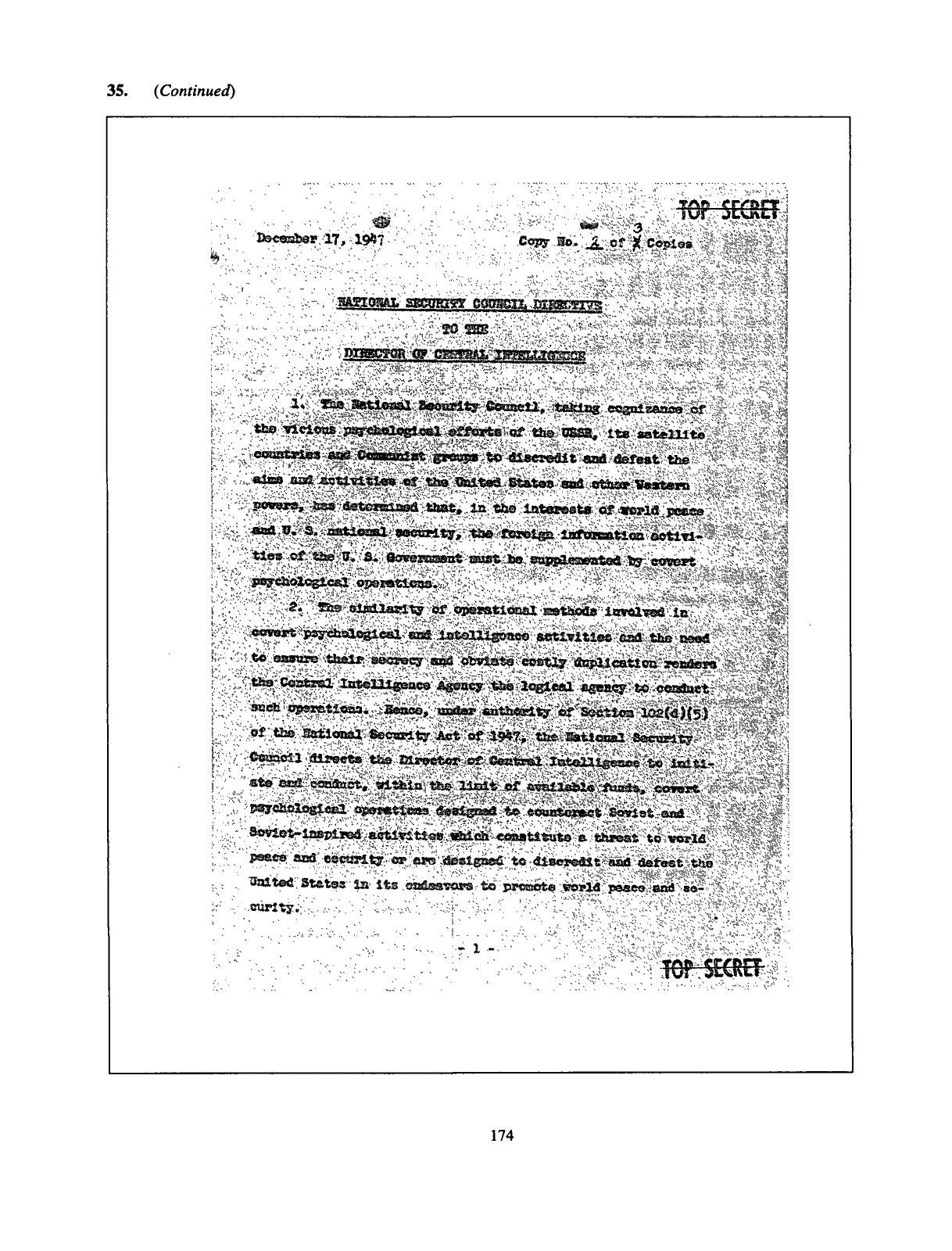
NSC 4-A directive, 17 December 1947
NSC 4-A’s directive, printed page 174: a general covert capability, not a ledger of Italian campaign payments. Image credit ↗

Chapter 01 / 1947–March 1948

An election becomes a security problem

Italy’s first parliamentary election under the new republican constitution became a test of the emerging Cold War. American officials feared that a Communist-led coalition could win through legal elections and then close the political system from within. That was their forecast, shaped by Soviet power and events in Eastern Europe. It was not a description of a completed Italian takeover. The distinction matters because the policy was designed to prevent Communist participation in government before Italian voters had made their choice.

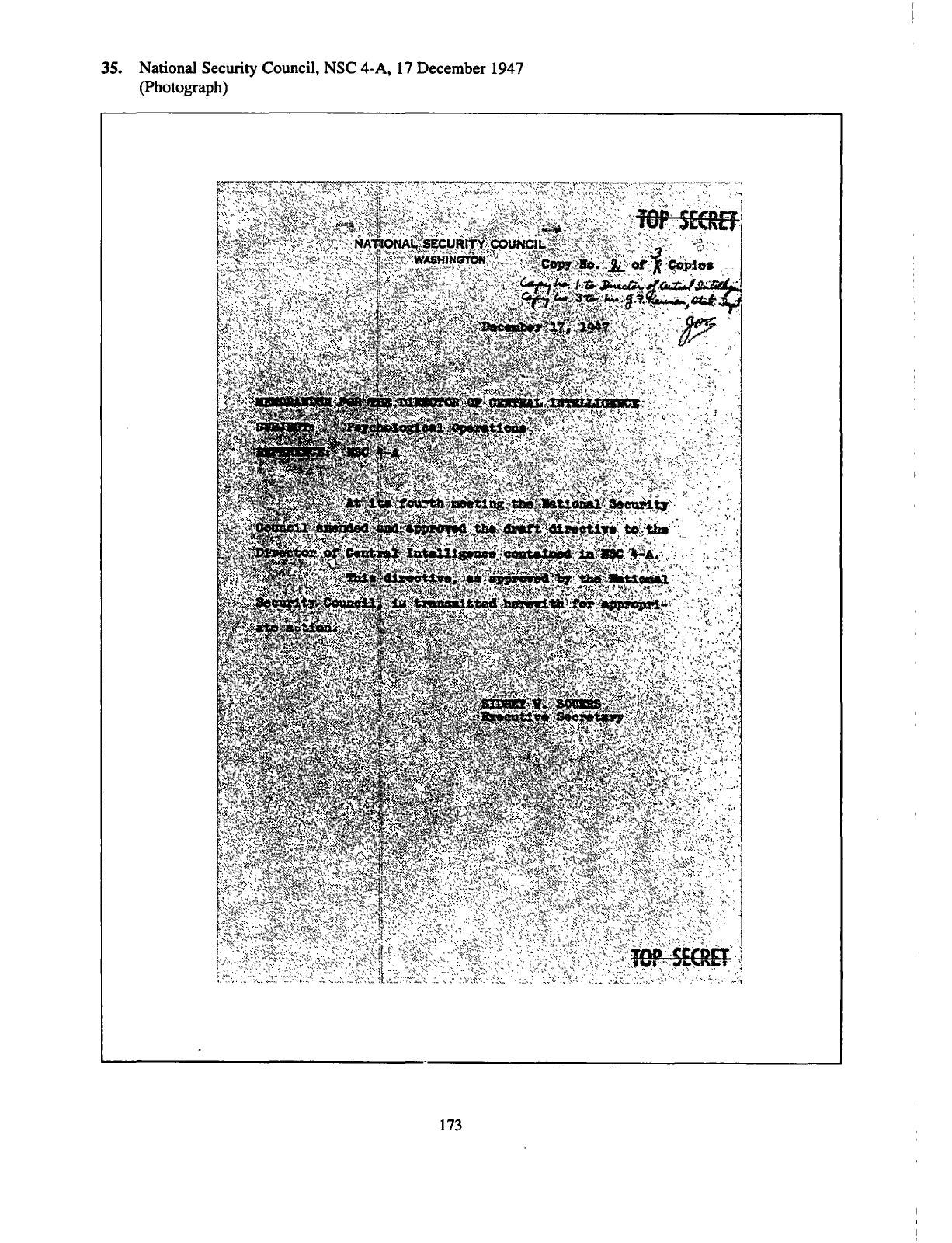
The institutional opening came on 17 December 1947. NSC 4-A directed the CIA to undertake covert psychological operations within available funds, coordinated with foreign policy. It protected operational techniques and contacts from general disclosure. The directive did not name an Italian recipient or document a payment. It created an authority that could be used for intervention. The official documentary edition records NSC approval; it does not supply a presidential approval signature for 4-A itself.

Italy-specific policy followed. NSC 1/2 in February 1948 treated the country as strategically vital to the Mediterranean and tied economic recovery to political stability. NSC 1/3 on 8 March went further, recommending immediate measures to prevent the Communists from entering government through the coming election. Its proposed instruments included public aid signals, speeches, letters and diplomatic initiatives. Editorial notes record presidential approval of the pre-election paragraph and later of the report’s conclusions.

The same report considered what Washington might do if Communists entered or dominated government legally, including aid restrictions and assistance to an anti-Communist underground. Those conditional plans show the depth of the administration’s commitment to a preferred outcome. They do not establish that the contingencies occurred. A history that places an unexecuted emergency plan beside actual campaign finance without identifying the difference changes the event it is trying to explain. The necessary starting point is narrower and firmly documented: American policy was actively interventionist, and a new intelligence organization had acquired a covert instrument.

Sources: S01 · S02 · S03

NSC 4-A transmission, 17 December 1947
The original NSC 4-A transmittal, printed page 173. This 1947 record illustrates the authority behind the later operation; it is not an election-day photograph. Image credit ↗

Chapter 02 / April 1948

Money entered an Italian campaign

The evidence for covert financial assistance does not rest on an American policy paper alone. In a 1996 interview, former CIA officer Mark Wyatt described deliveries to selected politicians for posters, pamphlets and other campaign costs. He recalled advice about explaining the sudden availability of resources without exposing the American source. His account identifies the activity as financial support and political assistance. It is a participant’s retrospective admission, with the strengths and weaknesses of testimony given almost half a century later. It is not a complete contemporaneous set of receipts.

The operation entered a country whose parties and voters already had powerful commitments. Alcide De Gasperi’s Christian Democrats, the Communist Party led by Palmiro Togliatti, the Socialists and smaller parties were not empty vessels waiting for foreign instructions. The Italian archival catalog of Christian Democratic materials lists pamphlets addressed to women and rural populations, activist manuals, youth speeches and local campaigns. Those holdings demonstrate a domestic political organization. They do not identify which particular publication was financed by the CIA.

Catholic mobilization, memories of fascism and resistance, economic insecurity, fear of Soviet domination and the promise of recovery all formed part of the campaign environment. Overt American policy was visible too: Truman publicly announced the transfer of 29 vessels to Italy in March. Such gestures belong in the story without being relabeled secret transfers to political parties. Wyatt himself later emphasized contributions beyond the CIA, even while remembering the operation as a major success.

The Christian Democrats won 48.51 percent of the Chamber vote and 305 seats; the Communist-Socialist Popular Front received 30.98 percent and 183 seats. Turnout was 92.23 percent. The size of that victory establishes the electoral result, not the number of votes caused by secret money. Campaign finance can enlarge a party’s reach, improve organization and convey foreign backing without replacing the choices of millions of voters. The documented conclusion is that Washington intervened on one side and that side won. Whether the same coalition would have won without covert aid requires a counterfactual comparison the payment testimony and national returns cannot supply.

Sources: S04 · S05 · S06 · S07 · S08 · S29

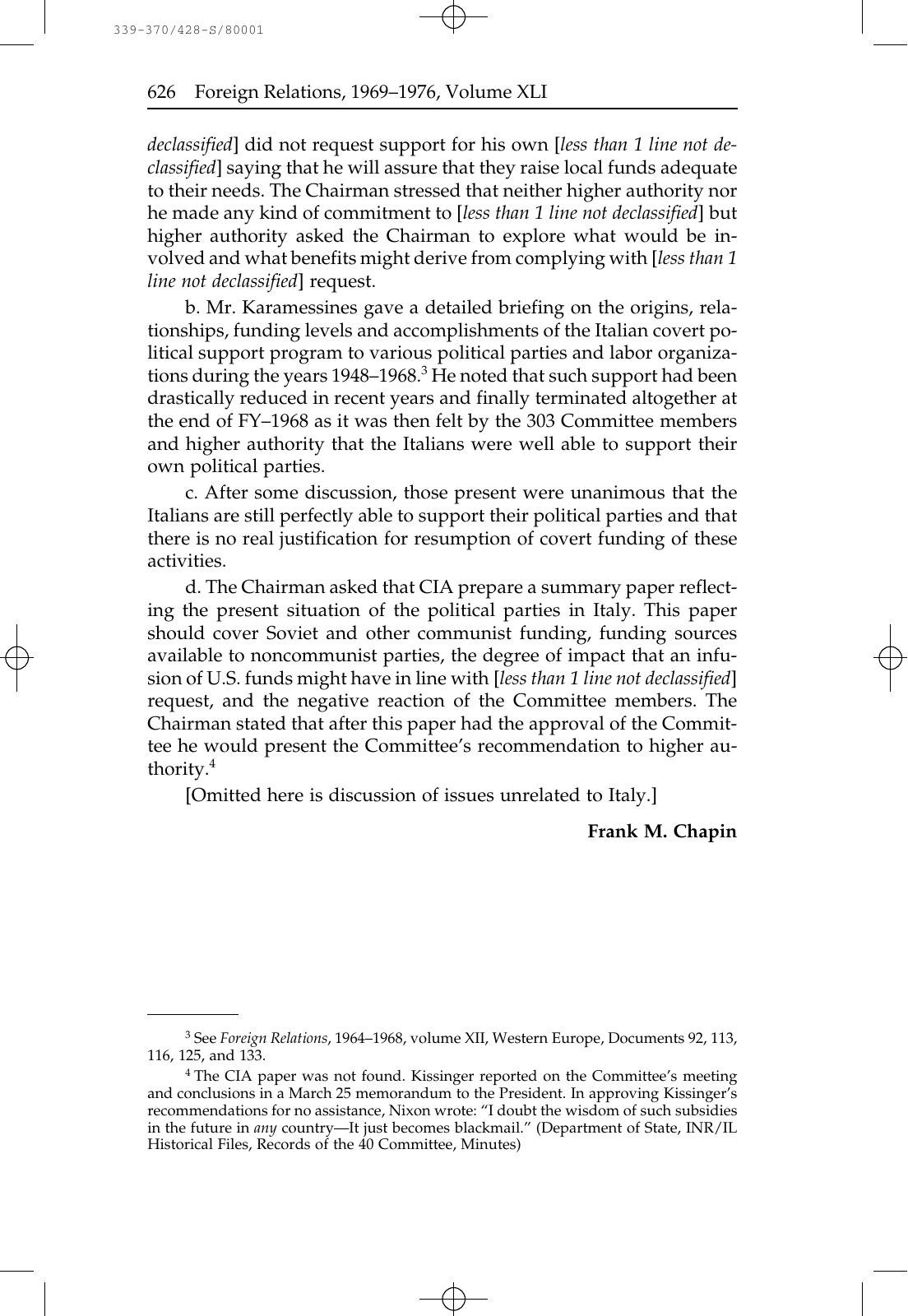
303 Committee rejects renewed subsidies, March 1969
The March 1969 committee record, printed page 626, reports the 1968 termination and rejects a proposed resumption. It retrospectively documents the earlier subsidy system. Image credit ↗

Chapter 03 / 1950s–1969

From an emergency to a recurring subsidy

The 1948 operation did not remain an isolated response to one election. American assistance continued to parties, labor organizations and other political programs. During Clare Boothe Luce’s ambassadorship, covert finance existed alongside pressure exercised through U.S. procurement contracts. These were related instruments of anti-Communist policy, but they were different mechanisms: a contract decision affecting a factory is not the same transaction as a covert campaign contribution.

Ronald Landa’s declassified historical draft reconstructs that 1950s relationship and its disappointments. He judges roughly $5 million annually during the Eisenhower years more plausible than much higher published estimates, using surviving records and a later reported 1948–68 total. This is a historian’s qualified reconstruction, not a newly opened annual ledger. His narrative also describes Luce’s concern that intended political action had become a continuing subsidy for leaders and their followings. Long-term assistance created dependencies and bargaining opportunities as well as influence.

Contemporary 1960s documents make the dissatisfaction unusually clear. In June 1965 the 303 Committee treated continued support as a burdensome necessity, with final approval still dependent on higher authority. Bundy’s August memorandum to Johnson argued that energetic administration mattered more than additional money and that previous support had not produced full value. The released copy has neither presidential response option marked. It proves the recommendation and diagnosis; by itself it cannot prove Johnson’s particular reply.

Ambassador G. Frederick Reinhardt in 1966 described sharp reductions and the ending of unstructured party contributions, while defending specific action programs and a gradual phase-out. The 303 Committee welcomed the wind-down in August 1967. In March 1969 a briefing reported that the support program had ended at the close of fiscal 1968; the committee unanimously opposed resumption, believing Italians could finance their own parties. Nixon accepted a recommendation against renewed assistance. These records make an uninterrupted 1948-to-1976 funding pipeline an inaccurate description of this program. They establish an institutional break without claiming that every intelligence relationship or other form of American influence disappeared.

Sources: S09 · S10 · S11 · S12 · S13 · S14

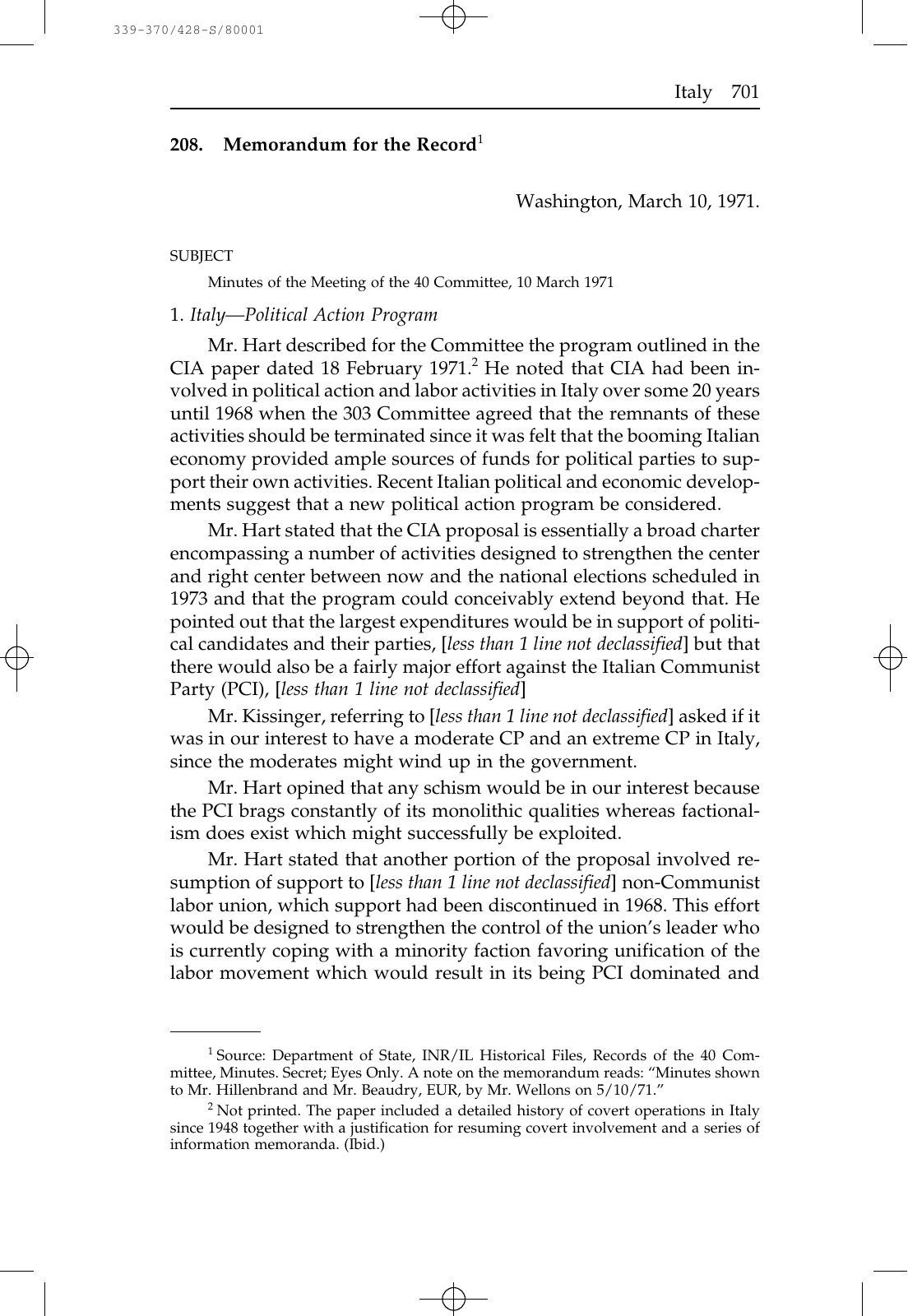
40 Committee considers a new Italy program, March 1971
The 10 March 1971 committee record, printed page 701, begins consideration of a new political action program after the earlier termination. Image credit ↗

Chapter 04 / 1970–1971

Martin argues for a new beginning

Italy’s political difficulties gave the case for renewed intervention a different setting. A 1970 national intelligence estimate described an economy transformed by growth alongside deep dissatisfaction with institutions, public services and political bargaining. Its account did not reduce unrest to Soviet direction. American observers could recognize Italian domestic pressures while still fearing the consequences of a stronger Communist Party for NATO and the Mediterranean.

Ambassador Graham Martin wanted material assistance to strengthen the center and center-right. His December 1970 backchannel reproduced an earlier proposal demanding flexibility, speed and personal control. He criticized broad, indiscriminate subsidies and argued for precise political targets. The advocacy reveals an American attempt to influence Italy’s evolution; its confidence should not be confused with demonstrated capacity to control it. The requested sums remain redacted in the released message.

The 10 March 1971 meeting of the 40 Committee exposed opposing judgments within Washington. Officials recalled the 1968 decision to leave parties to raise Italian resources. Martin argued that American help could restore confidence and stimulate domestic contributions. The proposed activities extended beyond candidate finance to labor, media and efforts against Communist cohesion. Some participants questioned whether the media component would work. Different estimates of Soviet assistance circulated in the same discussion; they were part of the argument for action, not a mutually verified accounting system.

The committee approved a new program. This was a renewed decision after an acknowledged termination, rather than proof that the earlier policy had never ended. It also crossed an important line from intelligence assessment to political action: knowing that Italian institutions were troubled did not dictate that the solution should be secret American funding. The debate turned on whether outside money would have a catalytic effect or simply substitute for resources available inside Italy. Those alternatives remained live when early elections compressed the program’s timetable. Neither the supporters’ strategic alarm nor the skeptics’ frustration removes the need to examine what was actually done.

Sources: S15 · S16 · S17 · S18

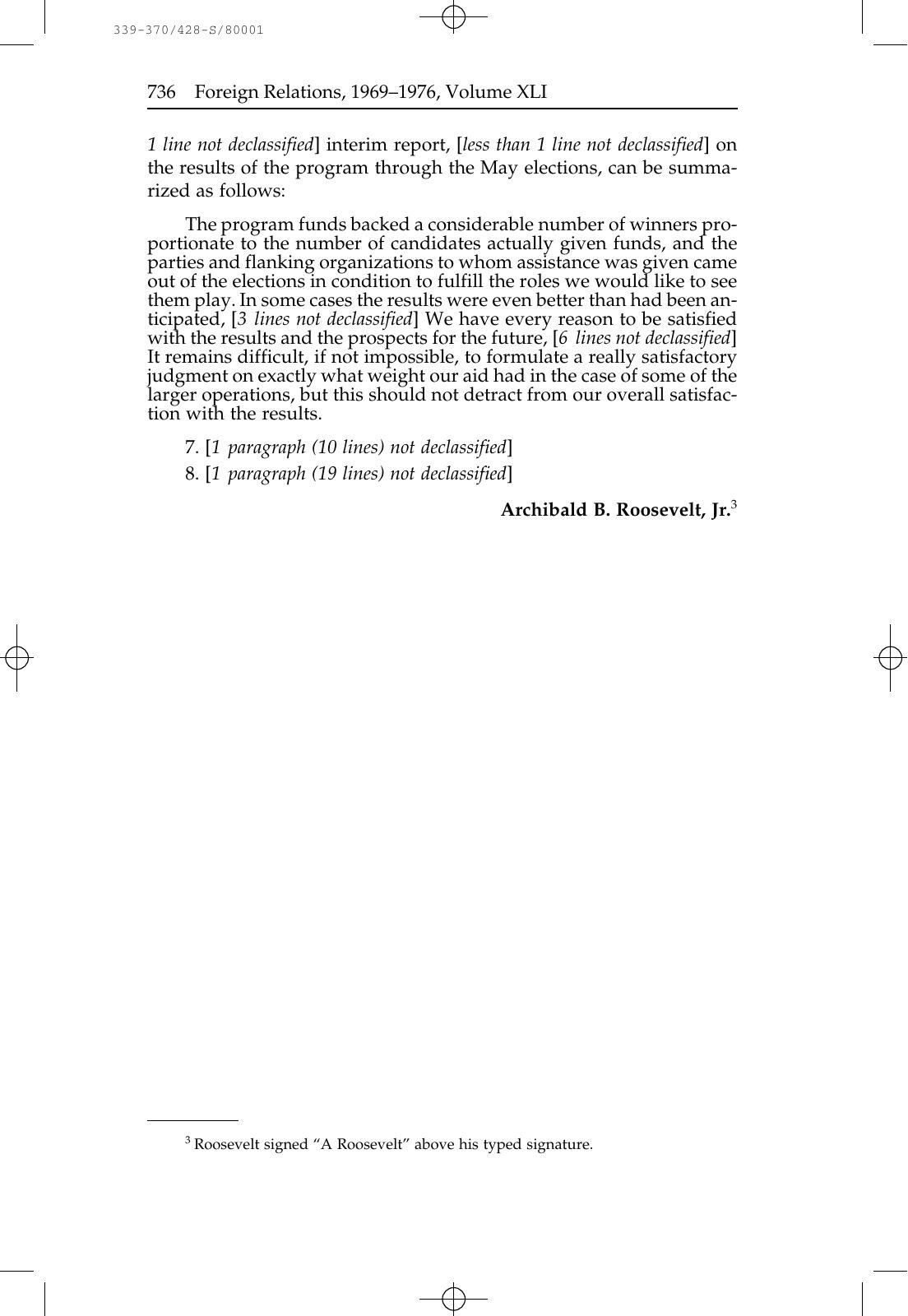
CIA evaluates the political funding program, October 1972
The CIA’s October 1972 assessment, printed page 736, explicitly describes funded candidates and assisted organizations while acknowledging uncertain causal weight. Image credit ↗

Chapter 05 / 1972

A program paid—and could not measure its weight

Early elections called for 7 May 1972 changed the schedule. On 28 February Martin reported a commitment under existing authority and requested a larger election effort. He sought discretion over the mixture and implementation of activities. This is stronger than a general wish to help, but its redacted figures still prevent a full reconstruction of commitments, obligations and transfers. A commitment is not automatically the same as money received by a candidate.

At the 40 Committee meeting on 7 March, the uncertainties were not hidden from the participants. CIA representatives described the proposal as Martin’s program and could not provide all spending details. Kenneth Rush raised the possibility that funds would end in individuals’ pockets and questioned the ambassador’s understanding of the political system. Others worried about exposure, available Italian money and congressional notification. Kissinger favored proceeding while seeking more information. The official edition records Nixon’s approval on 10 March.

A subsequent memorandum by Helmut Sonnenfeldt judged Martin’s response an appeal for trust rather than a real answer to the committee’s questions. This criticism was internal to the approving administration. It is evidence against a picture of perfectly coordinated, thoroughly audited control, while leaving intact the documented decision to intervene.

The decisive evidence of payment comes in Archibald Roosevelt Jr.’s 13 October report to CIA Director Richard Helms. It describes program funds backing candidates who won and assistance to parties and associated organizations. This is an internal account of executed assistance, not merely a proposal or public accusation. Yet its confidence about favorable results was qualified: judging the exact weight of aid in the larger operations remained difficult or impossible. Success for supported candidates did not, in the report’s own reasoning, isolate success caused by the subsidy. Recipients, totals and major paragraphs remain withheld. The defensible finding is therefore both substantial and bounded: there was a renewed covert political funding operation, money reached political beneficiaries, and the released assessment does not establish how many seats or votes it produced.

Sources: S19 · S20 · S21 · S22

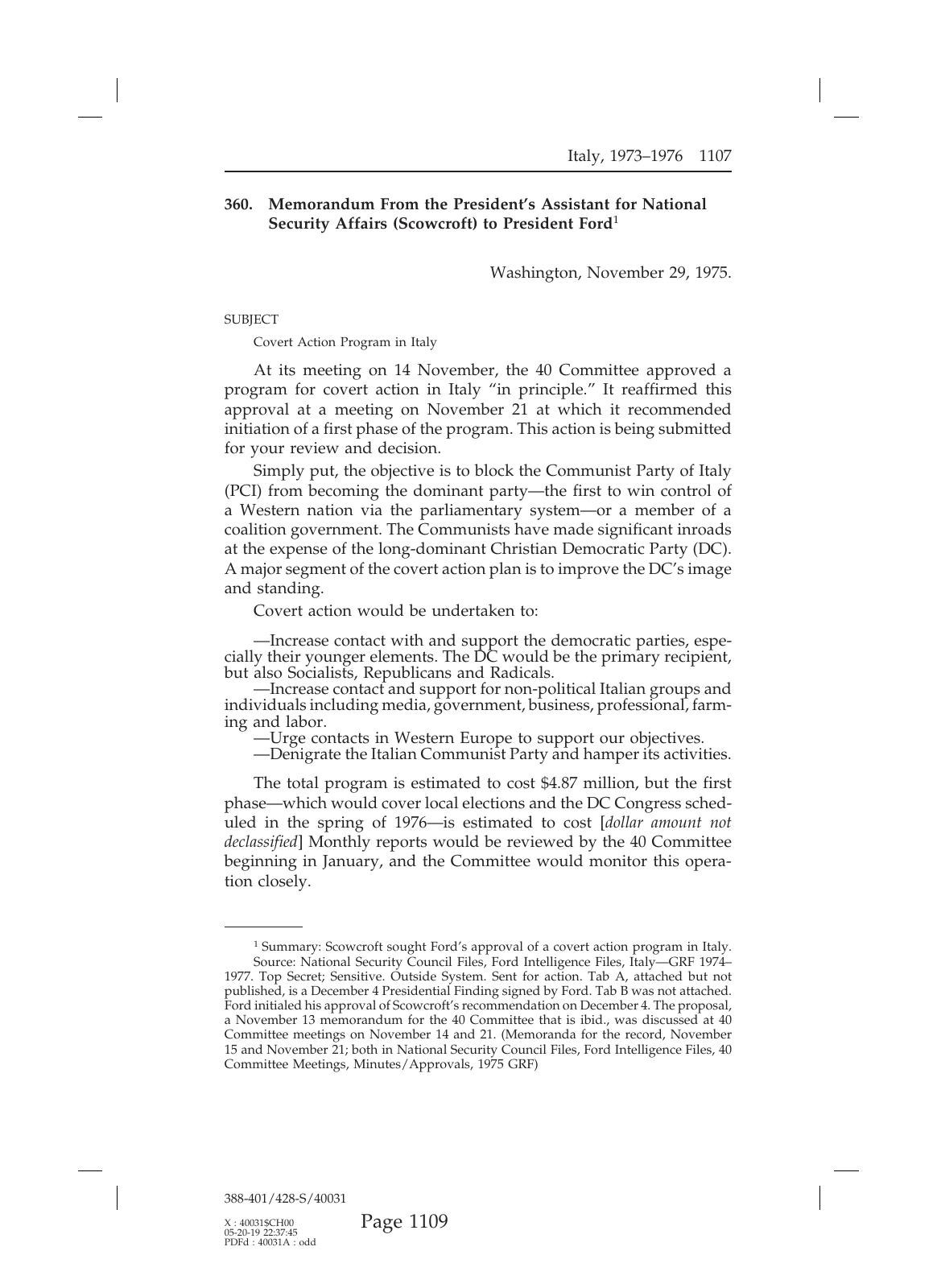
Scowcroft seeks Ford approval, November 1975
Scowcroft’s 29 November 1975 request, printed page 1107. Ford approved on 4 December; later records distinguish that authorization from expenditure. Image credit ↗

Chapter 06 / 1974–February 1976

Ford’s approval did not become the reported cash flood

Under Gerald Ford, American officials again sought ways to keep the Italian Communist Party out of national government. CIA Director William Colby proposed relationships with senior politicians and younger potential leaders in October 1974. A January 1975 plan contemplated selective support and efforts to encourage division within the PCI over its proposed historic compromise. The State Department’s European leadership questioned the need for the operation. Internal debate concerned marginal political gains, competing policy tools and the costs of exposure.

The political problem was not identical to 1948. A November 1975 CIA assessment attributed the PCI’s recent electoral gains largely to frustration with government performance, services and economic pressures, together with newly enfranchised younger voters. It discussed Enrico Berlinguer’s cautious strategy and the constraints of coalition government and public opinion. Military intelligence agencies thought the assessment understated Soviet influence. This was a substantive dispute about an evolving party, rather than proof that one side had access to an infallible forecast.

On 29 November Scowcroft requested approval of a $4.87 million covert program. Some funding would be withheld until further committee approval. Ford approved the recommendation and signed a presidential finding on 4 December. Colby briefed six congressional committees during 8–16 December. The authorization established an interventionist policy and a legally required finding. It did not certify that the entire amount had left American control.

Public reports soon alleged that at least $6 million had already gone to anti-Communist leaders. The 2 February 1976 internal status memorandum states that no money had been spent under the new program and records Kissinger’s 16 January instruction against spending special funds until further notice. That document matters independently of Colby’s public denial: it is a contemporaneous internal account tracking the operation after approval and exposure. Its scope matters just as much. It does not erase the earlier 1971–72 payments or prove that no other political influence occurred. A sweeping assertion that every allegation was true and a sweeping assertion that nothing happened both fail to follow the sequence.

Sources: S23 · S24 · S25 · S26 · S27

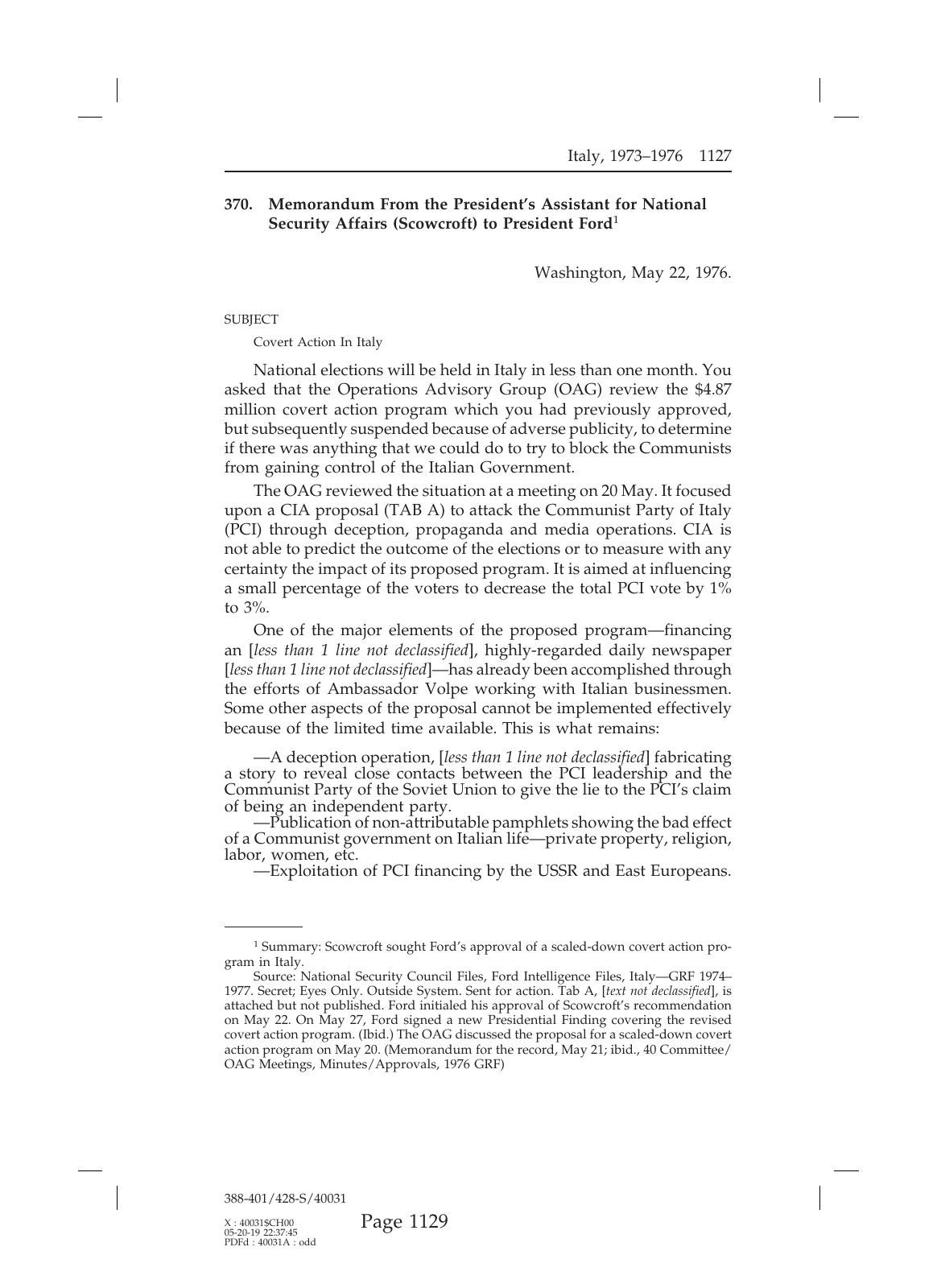
A revised covert media proposal, May 1976
The 22 May 1976 revised proposal, printed page 1127. Its mix of media and deception differs from a renewed direct party subsidy. Image credit ↗

Chapter 07 / May 1976–the released record

Influence, deception and the boundary of the finding

The suspended 1975 program was not the final decision. With national elections approaching, the Operations Advisory Group reviewed a smaller proposal in May 1976. It focused on unattributed propaganda, media and deception, including a fabricated story intended to expose supposed PCI-Soviet contacts. The memo also said a newspaper-financing element had already been arranged through Ambassador John Volpe’s work with Italian businessmen. That account identifies a mechanism distinct from a new CIA payment to a party.

The meeting did not support a program of financial assistance to the Christian Democrats or selected leaders, believing domestic resources were available. CIA favored the remaining operation, while Defense and the budget office judged the likely gains too small for the exposure risk. The agency could not predict the election or measure the proposal’s effects with certainty. A hoped-for one-to-three-point reduction in the Communist vote was a target, not a measured achievement. Scowcroft recommended proceeding; the official edition records Ford’s 22 May approval and a new finding on 27 May. Those decisions establish authorization. The released memo is not an itemized execution report.

The long story therefore contains several different forms of evidence. The 1947 directive establishes authority. NSC 1/3 establishes intent and policy. Participant testimony and the 1972 internal report establish assistance. Committee minutes establish opposition, retrenchment and renewal. The 1976 status memorandum limits what can be said about one approved program’s expenditure. None can perform the job of every other record.

Covert party finance also cannot serve as a universal explanation of Italy’s other secret histories. Gladio, P2 and the Red Brigades are not interchangeable organizations or mechanisms. A connection to a particular financial operation would require identified participants, dates, orders, transfers and a demonstrated causal link; shared secrecy, American contacts or anti-Communism cannot supply those missing steps. The available evidence supports a serious finding without that enlargement: Washington repeatedly sought to shape Italian politics through concealed assistance and, at times, deceptive messaging. It also encountered Italian political agency, inadequate information, domestic resources, institutional dissent and uncertainty about results. Those limits describe how influence worked; they do not make the intervention disappear.

Sources: S28 · S01 · S03 · S22 · S27

03 / The record

People and institutions

Open a record for the person’s role and supporting sources. Names identify people; no unverified portrait is substituted for a participant.

GasperiBiographical record
Alcide De GasperiItalian prime minister; Christian Democratic leader

A central Italian actor in the 1948 contest. His party’s organization, coalition strategy and voters cannot be reduced to foreign money. Wyatt’s later account describes support to Christian Democrats and other reliable parties; no individual recipient list for 1948 is reconstructed here.

Sources: S04 · S06 · S08

TogliattiBiographical record
Palmiro TogliattiLeader of the Italian Communist Party

Led the PCI, which contested 1948 in the Popular Front with the Socialists. U.S. policy papers assessed the coalition as a strategic danger; those assessments do not establish the motives of every supporter or the outcome of an unrealized government.

Sources: S03 · S06

TrumanBiographical record
Harry S. TrumanU.S. president, 1945–1953

Approved the Italy-specific conclusions discussed in NSC 1/3 and publicly emphasized recovery. Distinguish recorded approvals of Italy policy from the separate NSC 4-A document’s more limited approval trail.

Sources: S01 · S03 · S29

WyattBiographical record
Mark WyattCIA officer; later interview participant

Recalled covert campaign finance in a 15 February 1996 interview, including support for campaign materials and secrecy around deliveries. A participant source with retrospective institutional loyalties and uncertain chronology; not an audited expenditure record.

Sources: S04 · S05

LuceBiographical record
Clare Boothe LuceU.S. ambassador to Italy, 1953–1956

Combined anti-Communist political activity with procurement pressure and oversight of covert assistance. Landa’s study documents both forceful advocacy and disappointment with recurring subsidies. The author’s later note supplies corrections to the draft.

Sources: S09 · S30

BundyBiographical record
McGeorge BundyNational security adviser to Kennedy and Johnson

Pressed in 1965 for reductions and evidence that additional funds could be used effectively. The unmarked response options in his Johnson memorandum prevent treating that copy as a signed presidential decision.

Sources: S10 · S11

ReinhardtBiographical record
G. Frederick ReinhardtU.S. ambassador to Italy, 1961–1968

Supported gradual cuts, distinguished structured political action from unstructured party subsidy, and proposed a final phase-out associated with 1968 elections. His recommendation illuminates the transition without making him the sole author of it.

Sources: S12 · S13

MartinBiographical record
Graham A. MartinU.S. ambassador to Italy, 1969–1973

Advocated renewed political finance and sought personal authority over implementation. Colleagues approved a program while questioning his details, exposure risks and assumptions. The 1972 CIA status report describes his direction of the operation.

Sources: S16 · S17 · S20 · S21 · S22

KissingerBiographical record
Henry KissingerNational security adviser; later secretary of state

Chaired committee discussion of the 1971–72 program and favored renewed support despite doubts. In January 1976 ordered no spending of special funds under the exposed Ford program pending further instructions. Different dates refer to different operations.

Sources: S17 · S20 · S27

HelmsBiographical record
Richard HelmsDirector of Central Intelligence, 1966–1973

Participated in the 1969 decision against resumption and later 1972 approval discussions; received Roosevelt’s report on actual assisted candidates and organizations. The sequence records changing policy rather than one permanent personal position.

Sources: S13 · S20 · S22

RooseveltBiographical record
Archibald B. Roosevelt Jr.Chief, CIA European Division

Authored the 13 October 1972 status memorandum that reports funded candidates and assisted organizations. Its satisfaction with results coexists with an explicit inability to determine the precise weight of aid.

Sources: S22

BerlinguerBiographical record
Enrico BerlinguerPCI leader from 1972; historic-compromise advocate

The 1975 estimate discusses his gradual strategy, a softer public approach to NATO and domestic electoral gains. Analysts disagreed over how far PCI policy had become independent of Moscow; forecast and established conduct remain distinct.

Sources: S24 · S25

ColbyBiographical record
William E. ColbyDirector of Central Intelligence, 1973–1976

Proposed renewed relationships and political assistance, briefed congressional committees and publicly denied spending under the new Ford program in January 1976. That denial is weighed alongside the internal 2 February memorandum, rather than accepted as deciding proof.

Sources: S23 · S26 · S27

FordBiographical record
Gerald R. FordU.S. president, 1974–1977

Approved the December 1975 program and finding; later approved a revised May 1976 media/deception proposal. Authorization, suspension and revised authorization are separate events, and none alone supplies an execution ledger.

Sources: S26 · S27 · S28

ScowcroftBiographical record
Brent ScowcroftFord’s national security adviser

Presented the 1975 and 1976 proposals, summarized disagreements and recommended proceeding. His memoranda document policy advocacy and presidential approvals, while noting uncertainty about effect and exposure.

Sources: S26 · S28

VolpeBiographical record
John A. VolpeU.S. ambassador to Italy, 1973–1977

Participated in the Ford-era effort. The May 1976 memorandum attributes a newspaper-financing arrangement to his work with Italian businessmen; that mechanism must not be silently equated with an executed CIA party grant.

Sources: S27 · S28

04 / The record

Money, decisions and electoral competition

Horizontal spacing shows elapsed time; separate rows keep close events selectable. Scroll the graph on narrow screens. Exact dates are attributed where records conflict; month- and year-only dates preserve source precision.

19471965198220002017
NSC 4-A authorizes covert psychological operationsAuthority

The NSC directs CIA to conduct covert psychological operations within available funds. This is general authority; no Italian payment is itemized.

Sources: S01

NSC 1/2 assesses ItalyPolicy assessment

The strategic report links Italian security to recovery and the Mediterranean. Predictions about Communist takeover are contemporary U.S. assessments.

Sources: S02

NSC 1/3 targets Communist electoral participationPolicy proposal

The report recommends immediate action before the election, plus separate conditional responses to a later Communist government.

Sources: S03

Presidential approval of the pre-election paragraph recordedApproval record

An editorial note cites a 12 March memorandum reporting approval of paragraph 8. A later 16 March memorandum records 15 March approval of the conclusions; the related records should not be compressed into one guessed signature date.

Sources: S03

Truman publicly announces vessel transferOvert action

The public statement describes 29 vessels returned or provided to Italy. This economic gesture is distinct from secret political contributions.

Sources: S29

Parliamentary election beginsElection

The national election is dated 18 April. Chamber results: DC 48.51%, 305 seats; Popular Front 30.98%, 183 seats. National returns do not identify marginal votes caused by covert money.

Sources: S06 · S07

Luce arrives amid continuing assistancePolicy context

Landa’s 1953–56 study places covert support alongside procurement pressure. Its approximate annual estimate is not a complete financial account. Year precision is preserved here.

Sources: S09 · S30

303 Committee debates the recurring subsidyConditional decision

The proposal is approved subject to higher authority. Minutes dated 28 June capture internal dissatisfaction, not an unconditional final presidential approval.

Sources: S10

Bundy recommends a reduced budgetRecommendation

Bundy argues that leadership and effective administration matter more than handouts. Neither presidential response option is checked on the released copy.

Sources: S11

Reinhardt argues for gradual phase-outRecommendation

Reinhardt describes reduced spending, cessation of unstructured party contributions and continued program-based support, with a final phase-out connected to the 1968 elections.

Sources: S12

Wind-down endorsedCommittee approval

The 303 Committee welcomes the fiscal 1968 wind-down ahead of schedule.

Sources: S14

Original program terminated by fiscal-year endProgram boundary

The 11 March 1969 briefing reports termination at the close of fiscal 1968. The year marker does not assert that every intelligence relationship ended on one day.

Sources: S13

Committee unanimously opposes resumptionCommittee decision

Members judge domestic funding sufficient. An editorial note records Nixon’s 25 March approval of no assistance.

Sources: S13

State reviews Martin’s new requestProposal and dissent

Hillenbrand reviews earlier assistance and argues against a renewed financial commitment.

Sources: S15

NIE describes domestic pressuresIntelligence estimate

The estimate identifies institutional shortcomings and social dissatisfaction alongside economic growth. It does not find that unrest was simply foreign-directed.

Sources: S18

Martin presses his political action proposalAdvocacy

The backchannel reproduces an October proposal seeking money and flexible implementation authority.

Sources: S16

New program approvedAuthorization

The 40 Committee approves renewed political action after debate over domestic resources, labor and media activities, and anticipated benefit.

Sources: S17

Martin commits funds and asks for expansionCommitment and request

Martin reports a commitment under existing authority and seeks expanded assistance before the early election of 7 May. Amounts remain redacted.

Sources: S19

40 Committee debates the election effortReview

Officials question detail, diversion and exposure but favor proceeding. An editorial note records Nixon’s 10 March approval.

Sources: S20

Internal response criticizes lack of detailInternal dissent

Sonnenfeldt says Martin’s response asks for faith without really answering the questions. It qualifies claims of comprehensive oversight.

Sources: S21

Early parliamentary electionElection

The later 1972 status report describes the resulting centrist government. Favorable outcomes for recipients are not an experiment isolating the effect of aid.

Sources: S22

CIA reports actual funded beneficiariesExecution report

Roosevelt describes funded candidates and assisted organizations while acknowledging uncertain causal weight.

Sources: S22

Colby proposes continued covert relationshipsProposal

Colby seeks support for senior and younger politicians against PCI entry into government.

Sources: S23

Covert action plan meets State oppositionProposal and dissent

The 40 Committee proposal outlines selective support and division within the PCI. The State Department’s European leadership does not concur.

Sources: S24

CIA analyzes domestic sources of PCI gainsEstimate

The assessment attributes gains largely to governance grievances and new voters. Military intelligence agencies dissent about Soviet influence.

Sources: S25

Ford approves $4.87 million programAuthorization

Ford approves Scowcroft’s recommendation and signs a finding. Some funds require subsequent committee release. Approval is not a disbursement.

Sources: S26

Kissinger orders spending heldSuspension

The instruction to Volpe halts spending of special funds pending new instructions.

Sources: S27

Internal status says no expenditureStatus report

The memorandum reports no funds expended under the new program as of this date. This limited finding does not negate the earlier Martin operation.

Sources: S27

Ford approves revised media/deception planRevised authorization

The smaller plan lacks consensus for renewed direct party assistance. Approval is noted in the FRUS footnote, with a new finding on 27 May. An execution ledger is not provided.

Sources: S28

Wyatt gives recorded retrospective interviewMemory

The participant describes funding mechanisms and remembered success. The transcript is a primary interview source with retrospective limits.

Sources: S04 · S05

Landa draft published publiclyRelease

The National Security Archive publishes the declassified 2011 draft. Underlying program dates must not be confused with the publication date.

Sources: S30

05 / The record

The load-bearing facts

Six connected steps link policy, transfers, Italian competition, program changes and the limits of the findings. Open each step for its dependencies, why it matters, and the questions it leaves for rival accounts.

CP1

A preferred result becomes policy

NSC 1/3 made preventing Communist participation an explicit pre-election objective. Its conditional post-election plans show broader intent but require separate proof of execution.

Why it is critical

Without this step, funding would be detached from the policy that gave it purpose. The report establishes intent, not every later method.

Dependencies

General covert capability under NSC 4-A and the Italy-specific assessment in NSC 1/2.

What rival readings must explain

A defensive interpretation must explain why legal electoral participation itself was a target. An account of complete control must not convert contingencies into executed acts.

Sources: S01 · S02 · S03

CP2

Assistance reaches a domestic political system

Wyatt’s admission describes campaign finance. Italian returns and campaign archives establish a vigorous competition in which the intervention operated.

Why it is critical

Without transfer evidence, policy could remain intention. Without Italian context, documented assistance could be mistaken for complete authorship of the outcome.

Dependencies

CP1’s authority and objective; recipient organizations, delivery secrecy and actual campaign activity.

What rival readings must explain

A decisive-CIA account must identify votes or seats dependent on aid. An irrelevance account must explain why additional finance and organization could not matter.

Sources: S04 · S06 · S07 · S08

CP3

A subsidy relationship is cut back and ended

The 1965–69 records trace complaints, structured programs, reductions and termination at the close of fiscal 1968, before an explicit refusal to restart.

Why it is critical

This break determines whether Martin’s later program is continuity or renewal. It prevents combining different budgets into one unbroken stream.

Dependencies

Continuing post-1948 support, Bundy and Reinhardt’s reviews, committee approval and the 1969 retrospective briefing.

What rival readings must explain

A continuity argument needs identified transfers after termination, not just continuing contacts. A clean-break argument must also confront the 1971 restart.

Sources: S10 · S11 · S12 · S13 · S14

CP4

Renewed approval leads to documented payments

The 1971 and 1972 decisions were followed by an October 1972 report of assisted candidates and organizations. The same report could not isolate the aid’s precise weight.

Why it is critical

This bridges proposal and executed covert finance. Its causal reservation limits the outcome claim without weakening the payment finding.

Dependencies

CP3’s interruption, Martin’s advocacy, 40 Committee approval, delivery mechanisms and political recipients.

What rival readings must explain

Doubts about value cannot erase execution; recipients winning cannot prove counterfactual necessity. Authenticated recipient ledgers and district comparisons could change the assessment of scale and effect.

Sources: S17 · S19 · S20 · S21 · S22

CP5

Exposure separates authorization from expenditure

Ford approved the 1975 program, but the internal status report of 2 February 1976 records no expenditure and a spending halt.

Why it is critical

Treating the approved $4.87 million as paid would misstate execution. Using nonpayment to erase earlier payments would misstate the program’s scope.

Dependencies

New 1974–75 proposals, a presidential finding, congressional briefings, public exposure and the 16 January instruction.

What rival readings must explain

A spending allegation needs payment records for this specific operation. A defensive reading must still address secret authorization and earlier funding.

Sources: S23 · S24 · S26 · S27

CP6

A revised mechanism retains an influence objective

The May 1976 approval focused on media, deception and unattributed propaganda, with no OAG consensus for renewed party subsidies.

Why it is critical

The changed mechanism explains why neither complete inactivity nor payment of the entire earlier grant fits. It also exposes an explicit deception proposal.

Dependencies

CP5’s suspension, an approaching election, domestic resources and interagency risk judgments.

What rival readings must explain

A claim of execution for each deception element needs operational records. A wider covert history requires identified links from this mechanism to the alleged events.

Sources: S28

06 / The record

Four interpretations tested against the record

Competing interpretations, stated at their strongest and tested against the same chain. Presenting a theory is not endorsing it.

Interpretation 01

A necessary defense of a fragile democracy

Strategic rationale documented; necessity unproved

The strongest version

Soviet power, the Communist coup in Czechoslovakia and Italy’s strategic position made a Communist government a credible risk to Western security. Covert help could strengthen pluralist parties at lower cost than a later crisis. This account accepts CP1–CP4 and sees them as preventive measures.

Accepts

American funding occurred; Italian parties and voters retained agency; secrecy carried political costs.

Must still explain

CP1 targeted legal participation, not only an insurrection. CP3 records officials’ conclusion that domestic resources were available. CP4’s own evaluation could not measure the aid’s weight. The rationale does not by itself establish necessity or justify every method.

Assessment

The threat assessment is contemporary and real as an American judgment. The record also contains internal dissent and deliberate deception.

What would change this assessment

Authenticated Soviet directives for an imminent Italian seizure of power, together with evidence that specific funded action prevented it, would strengthen necessity; a forecast or denial alone would not.

Sources: S02 · S03 · S13 · S17 · S22 · S28

Interpretation 02

Foreign finance changed the balance of competition

Strong mechanism; exact electoral effect unresolved

The strongest version

Money, organizational advice and the signal of American commitment increased the resources of favored parties and organizations. CP2 and CP4 describe assistance designed to alter political competition; a party can keep formal independence while benefiting from an unequal resource environment.

Accepts

Italian political preferences and domestic organization were substantial; not every approved program paid out; aid need not be the sole cause to be consequential.

Must still explain

A stronger claim that the CIA decided 1948 or purchased the entire postwar order must identify the counterfactual threshold. CP3’s breaks and CP5’s nonpayment prevent an undifferentiated cumulative total.

Assessment

This is the best-supported causal mechanism, while magnitude remains uncertain.

What would change this assessment

Recipient accounts, geographically specific campaign spending and credible comparisons linking assisted work to changes in turnout or party choice would change confidence about effect. National returns and recipients winning are insufficient by themselves.

Sources: S04 · S07 · S08 · S19 · S20 · S22 · S27

Interpretation 03

Italian politics mattered more than the subsidies

Substantial support; complete irrelevance goes beyond it

The strongest version

Party loyalties, Catholic organization, anti-fascist identities, governing performance, domestic wealth and coalition choices explain much of the political trajectory. CP2’s mass turnout and CP3’s assessment of available Italian funds fit this reading. U.S. money may have been marginal or substitutable.

Accepts

Covert intervention and actual payments are established; marginal influence can still violate an electorate’s ability to identify political sponsorship.

Must still explain

CP4 reports recipients and organizations receiving assistance, and Martin sought a catalytic effect. Redundancy must be demonstrated for particular activities rather than assumed because Italian resources existed somewhere.

Assessment

U.S. estimates themselves recognize domestic grievances, and officials repeatedly question return on expenditure.

What would change this assessment

Authenticated recipient budgets showing funded activity would have occurred at the same scale without American money would strengthen substitutability; evidence that key operations stopped without it would weaken it.

Sources: S07 · S08 · S11 · S13 · S18 · S22 · S25

Interpretation 04

Party finance was part of a broader covert system

A research hypothesis requiring specific connecting records

The strongest version

Long-lived secret relationships can overlap: money, intelligence contacts, propaganda and security structures may share intermediaries. The established finance programs justify investigating links rather than treating every alleged connection as inherently implausible.

Accepts

CP1–CP6 establish real concealment and intervention, including an explicit 1976 deception proposal. An institutional break in one program need not end every relationship.

Must still explain

A specific allegation involving Gladio, P2 or the Red Brigades must bridge CP4 or CP6 to named participants, transfers, orders and events. Shared secrecy or anti-Communism does not show that one mechanism directed the other. This guide’s finance documents do not establish that chain.

Assessment

The current corpus cannot decide every allegation in Italy’s other secret histories.

What would change this assessment

Authenticated operational orders, matching financial records and independently corroborated testimony tying a particular finance channel to a specified event would change this finding. Neither blanket official denial nor broad association would settle it.

Sources: S17 · S20 · S22 · S27 · S28
07 / The record

How the story changed

Public memory tends to compress contested histories into a turning point. The records leave a less tidy sequence.

From a remembered victory to a measured causal question

ThenWyatt remembered 1948 as an exciting success and an institutional model for subsequent political action. Such testimony reveals how participants understood what they had done.

ReconsideredHis own account credits other actors, and the 1972 internal assessment distinguishes favorable results from the unknown weight of aid. A success story is evidence of institutional learning, not a statistical estimate of votes caused. New recipient and constituency records could clarify that difference.

Sources: S04 · S05 · S22

A single pipeline becomes several programs

ThenA compressed account can turn decades of activity into an uninterrupted 1948–76 subsidy. Long-running relationships make that picture intuitively plausible.

ReconsideredThe 1967 wind-down, 1969 confirmation of termination and 1971 restart force a program-by-program chronology. Evidence of continued transfers under a separately identified channel would extend the account; it would not justify silently deleting the documented termination.

Sources: S13 · S14 · S17

A spending allegation meets an internal status report

ThenLate 1975 and January 1976 press claims described a new flow of at least $6 million to anti-Communist leaders.

ReconsideredThe 2 February internal memo states no expenditure under the approved program and records a halt. It also acknowledges the earlier Martin operation. Later authenticated transfer records could overturn its nonpayment claim for that operation; the existence of older payments does not do so.

Sources: S26 · S27

A declassified draft refines the scale

ThenPublished accounts offered large recurring totals for the 1950s. Landa reviewed those figures against smaller documented amounts and the program’s later contraction.

ReconsideredThe 2017 release made his 2011 draft accessible, with a qualified estimate around $5 million annually for the Eisenhower years. This is historical reconstruction, not a complete ledger and not a single 1948 budget. A fuller set of authenticated annual accounts would replace estimation with accounting.

Sources: S09 · S30

08 / The record

What the evidence supports

Ratings apply to the precise proposition on the page. Unsupported means the assembled evidence does not establish a claim; it is not interchangeable with false.

Established

The United States covertly financed Italian political activity.

Participant admission, contemporary policy and committee records, and the 1972 internal report of assisted candidates and organizations converge on actual conduct. The evidence supports funding without requiring proof that it decided an election.

Sources: S04 · S13 · S17 · S22

Not established

CIA money by itself decided the 1948 election.

The campaign assistance and Christian Democratic victory are established. The assembled sources do not identify how many votes depended on secret aid or demonstrate that the governing coalition would otherwise have lost.

Sources: S04 · S06 · S07 · S08

Misleading

Public economic aid and covert party finance were the same budget.

Both could serve political objectives, but a public vessel transfer or procurement contract is not the same transaction as a secret party contribution. An identified accounting link would be needed for a claim about a particular fund.

Sources: S09 · S29

Unsupported

A flat $5 million was paid every year from 1948 to 1976.

Landa’s approximation concerns the Eisenhower years, and contemporary records document reductions, termination and renewal. A flat annual series erases both uncertainty and policy changes.

Sources: S09 · S13 · S17 · S27

Established

The earlier political support program ended in 1968.

The 1967 committee endorsed a wind-down, and the March 1969 briefing says support ended at the close of fiscal 1968. This proposition concerns that program, not all intelligence activity in Italy.

Sources: S13 · S14

Established

The Martin operation went beyond proposals and funded beneficiaries.

Roosevelt’s October 1972 report explicitly describes candidates and organizations assisted by program funds. Amounts and many recipients remain redacted; approval totals should not be substituted for a complete disbursement record.

Sources: S19 · S20 · S22

Contradicted by the released record

Internal U.S. officials uniformly understood and controlled the program.

The 1972 minutes contain unanswered spending questions and concern about diversion. Sonnenfeldt criticized Martin’s response. That does not mean no oversight existed; it means a claim of uniform, comprehensive knowledge fails.

Sources: S20 · S21

Established

Ford approved a $4.87 million covert program in December 1975.

The 29 November memo proposes that level, with some funds withheld subject to further approval. The editorial note records Ford’s 4 December approval and finding. This is authorization, not payment.

Sources: S26

Contradicted for the program as of 2 February 1976

That approval proves $4.87 million was paid to Italian politicians.

The internal 2 February memo reports no expenditure under the program and records a spending halt. It does not deny the earlier 1971–72 operation or resolve every other influence channel.

Sources: S26 · S27

Established as a proposal approved in May

The 1976 revised plan included a fabricated story and unattributed propaganda.

Scowcroft’s memo explicitly lists deception and pamphlets. Ford approved the recommendation and then a new finding. The document does not itemize execution of each listed activity.

Sources: S28

Not established

U.S. participants’ Soviet finance figures are a verified common ledger.

Estimates vary among contacts and participants, including within the 1971 meeting. This guide attributes those assertions instead of converting them into independently audited totals. A comparable transfer ledger would change that limit.

Sources: S15 · S16 · S17

Not established by this corpus

The party-finance records prove a single command over Gladio, P2 and the Red Brigades.

These are separate organizations and mechanisms. The assembled record does not show the identified orders, transfers and participants needed to connect a particular finance program to a particular alleged event. Unresolved connections remain research questions, not automatic exoneration.

Sources: S17 · S20 · S22 · S28

09 / The record

Read the witnesses and the record

Primary interview transcripts and documentary context. Outbound records need an internet connection.

Primary interview / transcript

Mark Wyatt describes campaign finance ↗

A 15 February 1996 interview for CNN’s Cold War series, preserved as text by the National Security Archive. Read the recollection alongside contemporary records. The linked page is a transcript, not an embedded playable clip. No verified freely reusable video is packaged.

Primary policy record

The 1972 meeting: money, detail and exposure ↗

The 40 Committee conversation lets readers examine contending official arguments in transcript form. Skepticism and approval coexist. This is a written meeting record, not audio.

Research and release context

Landa’s draft and its publication ↗

The historian’s introduction explains why the declassified draft broadens published coverage and lists corrections. Follow its link to the study. Its headline is not a complete financial ledger.

10 / The record

The questions still open

A documented limit is more useful than a confident number or a sweeping lineage the evidence cannot carry.

  1. What complete recipient and transfer records survive for 1948 and 1971–72, and can they be matched to independently preserved Italian party accounts?
  2. Which assisted activities expanded because of American money, and which would have occurred with domestic resources at the same scale?
  3. Can credible constituency-level comparisons identify a marginal electoral effect without treating national victory as the effect of funding?
  4. How did Italian recipients bargain over aims, redirect resources or conceal assistance from their own parties and voters?
  5. What was executed under the revised May 1976 finding, as distinct from proposed and approved, and what records document each media or deception element?
  6. How do Soviet financial records compare with the changing American estimates, using the same years, currencies and recipient categories?
  7. Where a broader covert connection is alleged, what authenticated order, matching transfer and independent testimony bridges a named finance channel to the specific event?

11 / The record

Go back to the sources

Records, reporting, and firsthand accounts have different evidentiary roles. Each source note explains what it can establish and where caution is needed. Sources consulted for this edition on 25 October 2026. Original records and attributed reporting have distinct evidentiary roles.

  1. S01

    Primary record / official documentary edition

    NSC 4-A: covert psychological operations, 17 December 1947 ↗

    U.S. Department of State, Office of the Historian

    Directive and transmission; paragraphs 2–4 specify CIA authority, policy consistency and protection of operational details. Editorial note distinguishes documented NSC approval from an unlocated presidential approval of 4-A. A general authority, not an Italian disbursement record.

  2. S02

    Primary record / official documentary edition

    NSC 1/2: position toward Italy, 10 February 1948 ↗

    U.S. Department of State, Office of the Historian

    Contemporary strategic assessment, aid and security policy. Its predictions of Communist intentions are U.S. judgments, not findings about every Italian left-wing voter.

  3. S03

    Primary record / official documentary edition

    NSC 1/3: electoral participation and U.S. policy, 8 March 1948 ↗

    U.S. Department of State, Office of the Historian

    Paragraph 8 and editorial notes establish a pre-election intervention policy and presidential approvals; paragraph 10 contains conditional post-victory contingencies. The report is not evidence that those contingencies were executed.

  4. S04

    Participant interview / retrospective

    Mark Wyatt interview, 15 February 1996 — covert finance ↗

    CNN Cold War interview, preserved by the National Security Archive

    Firsthand recollection of deliveries, campaign expenses, advice and secrecy. Valuable admission of conduct; dates, numbers and institutional claims require contemporary corroboration. Text transcript, not an embedded video.

  5. S05

    Participant interview / retrospective

    Mark Wyatt interview — how participants remembered success ↗

    CNN Cold War interview, preserved by the National Security Archive

    Explains the sense of success and contribution of other organizations. The recollection does not isolate the causal effect of CIA money. Later examples in the interview must not be backdated into 1948.

  6. S06

    Italian historical reference

    18 aprile 1948: il primo voto della Repubblica ↗

    Treccani, Atlante

    Italian account of the 1948 campaign, high turnout, results and coalition formation. Chamber figures: DC 48.51%, 305 seats; Popular Front 30.98%, 183 seats. These are Chamber figures, distinct from Senate or later coalition totals.

  7. S07

    Italian institutional publication / reproduced election statistics

    Quaderni del Consiglio regionale delle Marche, no.124 — election table ↗

    Consiglio regionale delle Marche

    Printed page 130: 1948 Chamber national results, turnout 92.23%, DC 48.51%, Popular Front 30.98%; table credits Ministry of the Interior election archive. Full publication retained privately; no reproduced pages in public pack.

  8. S08

    Italian archival description

    1948 Christian Democratic campaign material — archival catalog ↗

    Portale delle fonti per la storia della Repubblica italiana / CNR

    Catalog identifies women’s/rural pamphlets, activist guidance, youth speech and local campaign material. Establishes an organized Italian campaign corpus; does not identify which item was foreign-funded.

  9. S09

    Declassified draft historical study

    Ronald D. Landa, “Shots from a Luce Cannon”: Combating Communism in Italy, 1953–1956 ↗

    Historical Office, Office of the Secretary of Defense; National Security Archive repository

    2011 Defense historical-office draft, declassified 2016; especially printed pp 47–49, 57–60 for subsidy debate, procurement and qualified annual estimate. Its approximate $5 million/year estimate is reconstructed for the Eisenhower years, not a newly released complete ledger. Full draft read locally, not redistributed.

  10. S10

    Primary record / official documentary edition

    303 Committee: continued subsidies debated, 25 June 1965 ↗

    U.S. Department of State, Office of the Historian

    Minutes dated 28 June. Program conditionally approved pending higher authority; officials describe burdens of recurrent subsidy. Final higher-authority approval is not demonstrated by these minutes.

  11. S11

    Primary record / official documentary edition

    Bundy to Johnson: political assistance, 4 August 1965 ↗

    U.S. Department of State, Office of the Historian

    Documents sustained assistance, reductions and administrative concerns. Neither response option is checked in the released copy; the memo alone does not establish Johnson’s specific response.

  12. S12

    Primary record / official documentary edition

    Reinhardt: reductions and a proposed phase-out, 12 September 1966 ↗

    U.S. Department of State, Office of the Historian

    Distinguishes ending unstructured party contributions from continued approved action programs; 35% proposed cut for FY 1967 and a phase-out objective connected with 1968 elections.

  13. S13

    Primary record / official documentary edition

    303 Committee rejects resumption, 11 March 1969 ↗

    U.S. Department of State, Office of the Historian

    Contemporary retrospective briefing says 1948–68 support ended at FY 1968 close. Committee unanimously opposes restart; editorial note records Nixon’s 25 March approval of no assistance. Strong evidence for a program interruption, not for the end of every U.S. intelligence activity.

  14. S14

    Primary record / official documentary edition

    303 Committee welcomes wind-down, 22 August 1967 ↗

    U.S. Department of State, Office of the Historian

    Committee approval and quoted 4 August proposal link reduced impact, domestic funding availability and phase-out; no public total expenditure amount given.

  15. S15

    Primary record / official documentary edition

    Hillenbrand: Martin’s proposal and history, 13 May 1970 ↗

    U.S. Department of State, Office of the Historian

    A State Department recommendation reviews the 1948–68 program and argues against renewed financial assistance. Soviet finance figures are attributed to contacts and estimates, not independently audited here.

  16. S16

    Primary record / official documentary edition

    Martin presses for political action, 21 December 1970 ↗

    U.S. Department of State, Office of the Historian

    Backchannel reproduces an October proposal. Ambassador seeks flexible control, material assistance and a targeted approach. Requested amounts remain redacted; advocacy is not payment proof.

  17. S17

    Primary record / official documentary edition

    40 Committee: renewed Italian political action, 10 March 1971 ↗

    U.S. Department of State, Office of the Historian

    Minutes document disagreements, proposed party/labor/media activity and approval. Soviet finance estimates differ within the meeting. Martin’s claims about Italian attitudes are participant rationales, not neutral national characteristics.

  18. S18

    Primary record / official documentary edition

    NIE 24-70: political and economic trends in Italy, 12 November 1970 ↗

    U.S. Department of State, Office of the Historian

    Estimate distinguishes prosperity from institutional dissatisfaction and political pressures. Forecasts, including expected 1973 elections, must be read as expectations before early 1972 elections.

  19. S19

    Primary record / official documentary edition

    Martin requests expanded election funding, 28 February 1972 ↗

    U.S. Department of State, Office of the Historian

    Backchannel reports a commitment under existing authority and requests expansion after early elections called for 7 May. Dollar amounts and recipients remain redacted.

  20. S20

    Primary record / official documentary edition

    40 Committee: election program, 7 March 1972 ↗

    U.S. Department of State, Office of the Historian

    Detailed discussion exposes doubts about diversion, oversight and effectiveness. Editorial note records Nixon’s 10 March approval. Requested totals are distinct from documented transfers.

  21. S21

    Primary record / official documentary edition

    Sonnenfeldt: Martin asks for faith, 9 March 1972 ↗

    U.S. Department of State, Office of the Historian

    Internal criticism of Martin’s response to oversight questions. Records Washington’s skepticism within an approving administration, rather than a single agreed assessment.

  22. S22

    Primary record / official documentary edition

    Roosevelt to Helms: status of the Italy program, 13 October 1972 ↗

    U.S. Department of State, Office of the Historian

    Paragraph 6 explicitly records funded candidates and assisted organizations but acknowledges difficulty measuring the aid’s weight. Redacted paragraphs prevent a complete recipient or expenditure audit.

  23. S23

    Primary record / official documentary edition

    Colby proposes continued covert relationships, 22 October 1974 ↗

    U.S. Department of State, Office of the Historian

    Proposal to support senior politicians and cultivate younger ones to keep PCI out of government; approval is requested, not demonstrated by this memo alone.

  24. S24

    Primary record / official documentary edition

    40 Committee proposal and dissent, 21 January 1975 ↗

    U.S. Department of State, Office of the Historian

    Three-part plan and assistant secretary’s nonconcurrence; 4 February discussion in editorial note describes marginal expected effect and concern about risk without gain.

  25. S25

    Primary record / official documentary edition

    CIA assessment of increased Communist influence, 3 November 1975 ↗

    U.S. Department of State, Office of the Historian

    Principal judgments attribute recent gains largely to domestic grievances, discuss Berlinguer’s strategy, public opinion constraints and intelligence-community disagreement over Soviet influence. An estimate, not proof of future behavior.

  26. S26

    Primary record / official documentary edition

    Scowcroft to Ford: $4.87 million proposal, 29 November 1975 ↗

    U.S. Department of State, Office of the Historian

    Memo recommends funding with staged release; editorial note documents Ford’s 4 December approval and signed finding. Authorization is a ceiling/approved program, not a transfer receipt.

  27. S27

    Primary record / official documentary edition

    40 Committee status: no expenditure under the new program, 2 February 1976 ↗

    U.S. Department of State, Office of the Historian

    Internal memorandum records briefings, press allegations, no expenditure as of its date and Kissinger’s 16 January spending halt. It corroborates a limited nonpayment proposition, not a denial of earlier covert finance.

  28. S28

    Primary record / official documentary edition

    Scowcroft to Ford: revised media plan, 22 May 1976 ↗

    U.S. Department of State, Office of the Historian

    Proposal includes deception, unattributed pamphlets and media operations, no new party-finance consensus; footnote records 22 May approval and 27 May finding. Some elements already arranged through businessmen; the text does not provide a complete execution ledger.

  29. S29

    Contemporary public presidential statement

    Truman: transfer of vessels to Italy, 16 March 1948 ↗

    Harry S. Truman Presidential Library / Public Papers

    Documents a public economic gesture during the election period, 29 vessels. Distinct from secret party money; the statement does not calculate its effect on votes.

  30. S30

    Research publication and author’s note

    National Security Archive publishes Landa study, 7 February 2017 ↗

    National Security Archive, edited by Ronald D. Landa

    Describes the draft’s scope and declassification, with Landa’s corrections. Its headline’s broad period should not replace the study’s specific estimate for Eisenhower years.

Images, documents & licensing

NSC 4-A directive, 17 December 1947 (PDF page 44) — U.S. government; National Security Council or Central Intelligence Agency original, reproduced in official documentary edition. Public domain in the United States: original federal work, 17 USC §105. Only the individually reviewed page image is redistributed.. Source & license ↗. Resized and re-encoded for this edition; embedded metadata removed. Only federal-authored pages are reproduced; third-party enclosures are excluded.

NSC 4-A transmission, 17 December 1947 (PDF page 43) — U.S. government; National Security Council or Central Intelligence Agency original, reproduced in official documentary edition. Public domain in the United States: original federal work, 17 USC §105. Only the individually reviewed page image is redistributed.. Source & license ↗. Resized and re-encoded for this edition; embedded metadata removed. Only federal-authored pages are reproduced; third-party enclosures are excluded.

303 Committee rejects renewed subsidies, March 1969 (PDF page 665) — U.S. government; National Security Council or Central Intelligence Agency original, reproduced in official documentary edition. Public domain in the United States: original federal work, 17 USC §105. Only the individually reviewed page image is redistributed.. Source & license ↗. Resized and re-encoded for this edition; embedded metadata removed. Only federal-authored pages are reproduced; third-party enclosures are excluded.

40 Committee considers a new Italy program, March 1971 (PDF page 740) — U.S. government; National Security Council or Central Intelligence Agency original, reproduced in official documentary edition. Public domain in the United States: original federal work, 17 USC §105. Only the individually reviewed page image is redistributed.. Source & license ↗. Resized and re-encoded for this edition; embedded metadata removed. Only federal-authored pages are reproduced; third-party enclosures are excluded.

CIA evaluates the political funding program, October 1972 (PDF page 775) — U.S. government; National Security Council or Central Intelligence Agency original, reproduced in official documentary edition. Public domain in the United States: original federal work, 17 USC §105. Only the individually reviewed page image is redistributed.. Source & license ↗. Resized and re-encoded for this edition; embedded metadata removed. Only federal-authored pages are reproduced; third-party enclosures are excluded.

Scowcroft seeks Ford approval, November 1975 (PDF page 1150) — U.S. government; National Security Council or Central Intelligence Agency original, reproduced in official documentary edition. Public domain in the United States: original federal work, 17 USC §105. Only the individually reviewed page image is redistributed.. Source & license ↗. Resized and re-encoded for this edition; embedded metadata removed. Only federal-authored pages are reproduced; third-party enclosures are excluded.

A revised covert media proposal, May 1976 (PDF page 1170) — U.S. government; National Security Council or Central Intelligence Agency original, reproduced in official documentary edition. Public domain in the United States: original federal work, 17 USC §105. Only the individually reviewed page image is redistributed.. Source & license ↗. Resized and re-encoded for this edition; embedded metadata removed. Only federal-authored pages are reproduced; third-party enclosures are excluded.

Typefaces: Inter, Playfair Display and Source Serif 4, the shared AI Files reference set, distributed under the SIL Open Font License. Exact files and license text are included in assets/fonts in the offline package. Documentary images reproduce original U.S. government-authored documents and telegrams. No AI-generated photographs, portraits or document facsimiles are used.

Uniform evidence

One standard for every case.

Authorization, expectation, recommendation and executed action are different facts. Participant explanations and official commemorations are claims to test, never deciding proof. The same standard applies to U.S. and Italian conduct. Uncertainty remains labeled.

Publication status

Prepared for staging review.

This locally prepared package is intended for the ChatGPT submission lane under Spec v7. It has not received a Grok editorial grade or approval for promotion. The live submission manifest, when registered, records its review status. Submission queue and status ↗