PRPUBLIC RECORDAn independent history guide

File 017 / Indonesian and U.S. history

Indonesia, 1958

A covert war.
A failed wager.

The United States armed and supported rebels challenging Indonesia’s central government. Their defeat exposed the limits of covert military leverage—and redirected Washington toward the army that had beaten them.

1956–1962 / later recordsContext & afterlifeFebruary–May 1958The central years6 chaptersOne continuous story
CIA / recommendation for covert support
CIA recommendation for covert outer-island support
Indonesia
1957–1958
PRRI / Permesta

An authentic excerpt from the CIA operational record describes the outer islands as leverage over Java. The policy’s purpose and its outcome were very different. Image credit ↗

Scope & method / Edition 1.1

Follow the support, the fighting and the change of policy.

This guide follows the 1957 policy choice through the 1958 rebellion and the shift to assistance for Indonesia’s national army. The rebels, the central government and outside sponsors are treated as separate actors. Pope’s imprisonment supplies a brief diplomatic aftermath. The 1965–1966 mass killings require a separate history.

Read the chapters for a narrative; use the record below to test it. Established means the specific proposition is documented. Interpretation marks an inference or a historical argument. Unknown means the record here cannot decide. An archive’s possession of a document does not endorse its contents.

Research checked 25 October 2026. Declassified U.S. records lead the decision chronology; Indonesian institutional history and regional scholarship supply essential context. This edition does not claim a complete Indonesian military archive, full CIA operational files or a verified casualty census. Reported civilian harm is attributed; omitted details remain open.

01 / The record

The story, in 6 chapters

Six chapters trace the regional origins, covert backing, military reverses, air operations, exposure and aftermath.

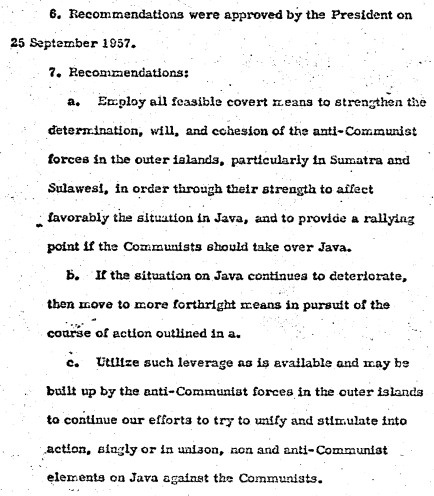
CIA recommendation for covert outer-island support
A surviving excerpt of the CIA’s operational chronology reproduces the recommendation to strengthen anti-Communist forces in the outer islands. This is an archival text excerpt, not an image of an Indonesian declaration. Image credit ↗

Chapter 01 / 1956–January 1958

A regional dispute becomes an international opportunity

Indonesia's rebellion did not begin with an American aircraft. By late 1956, regional army commanders were challenging the central government's authority. Export-producing areas outside Java resented the distribution of revenues, shortages of development funds and the concentration of political power in Jakarta. Territorial commanders already controlled resources and trade channels of their own. Civilian opponents of President Sukarno's political direction joined some of them. These grievances gave an external sponsor an opening; they were not grievances the sponsor had to invent.

The movements were related without being identical. Permesta, proclaimed in eastern Indonesia in March 1957, developed around demands for reform and regional autonomy. Its strongest surviving base lay in North Sulawesi. In Sumatra, military councils and civilian politicians moved toward a rival national government. Their eventual alliance brought Muslim and Christian constituencies, regional officers and former national ministers into the same opposition. Neither a single separatist intention nor a single American command explains that coalition. Its members differed over how far to challenge Jakarta and whether a negotiated political settlement remained possible.

For the Eisenhower administration, the growing Indonesian Communist Party, or PKI, gave these disputes strategic urgency. Sukarno's proposed Guided Democracy, the party's electoral gains and the dispute with the Netherlands over West New Guinea appeared to American officials as parts of a dangerous trend. Their language often compressed nonalignment, nationalist policies and Communist influence into the same threat. Yet the January 1958 policy record itself notes that the cabinet contained no open Communist Party representation. A Communist government was an anticipated danger, rather than the government against which Washington was actually acting.

A special committee's 1957 recommendations proposed covertly strengthening anti-Communist forces in the outer islands while maintaining normal diplomatic relations with Indonesia. Walter Robertson's 2 January 1958 briefing summarized this policy and its disagreements. Ambassador John Allison favored working through non-Communist figures in the existing government and taking Indonesian claims over West Irian more seriously. At the meeting that followed, Secretary of State John Foster Dulles rejected a deal with Sukarno's government and favored building a position of strength outside Java. The split was consequential: Washington chose leverage through dissidents before it possessed evidence that those dissidents could replace the national government.

Sources: D001 · D002 · D011 · I01

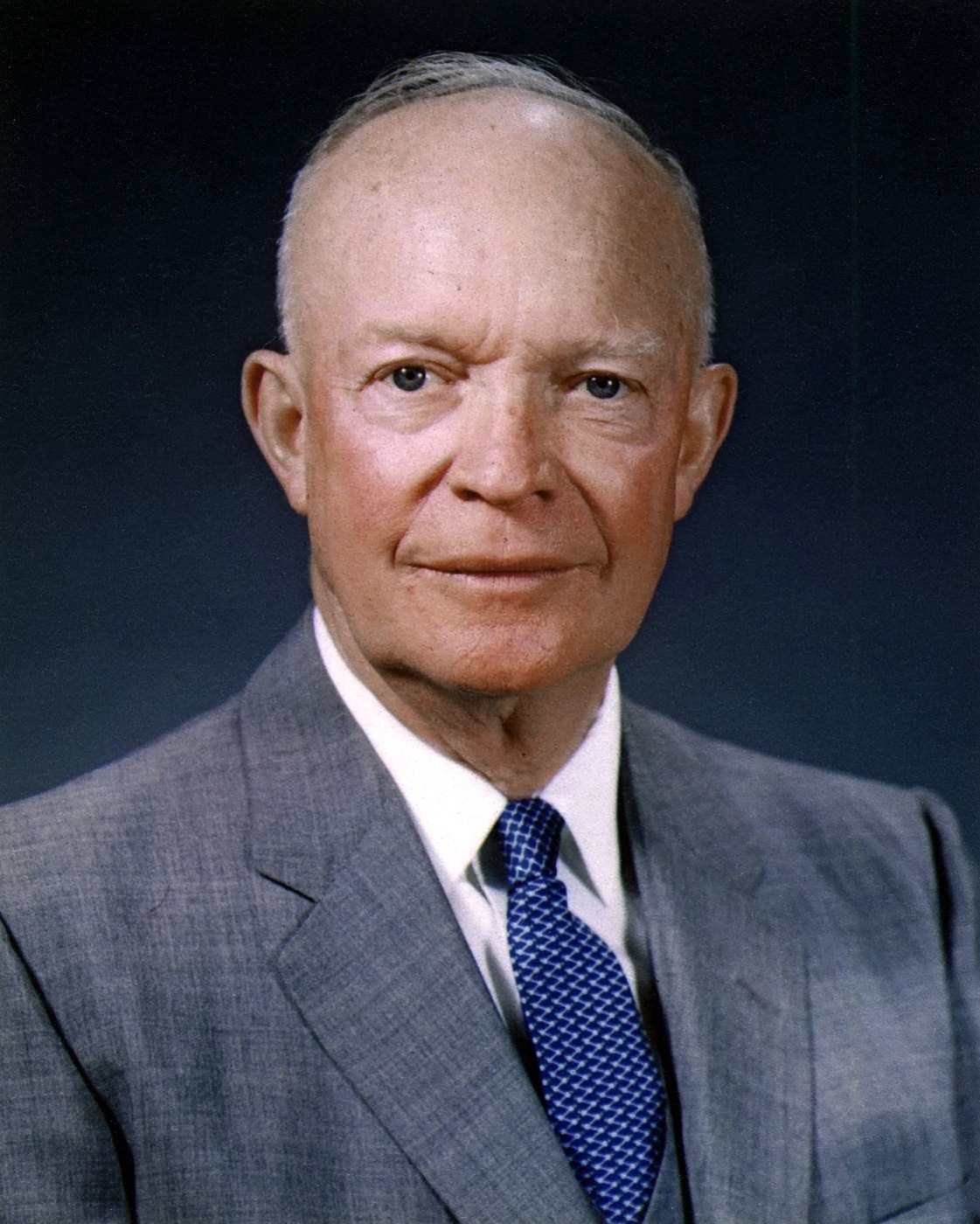
Dwight D. Eisenhower, official photograph, 29 May 1959
Dwight D. Eisenhower in his official 1959 portrait. The authorization record places U.S. responsibility above the CIA field operation; this photograph was made after the rebellion. Image credit ↗

Chapter 02 / January–February 1958

Backing a challenge to Jakarta

By January 1958 the American intelligence estimate recognized both the rebels' political objectives and the importance of their expectations of outside support. Allen Dulles's 31 January memorandum described a prospective ultimatum seeking a new government, limits on Communist influence, greater regional autonomy and a larger regional share of revenues. The estimate also said that the dissidents probably believed they could obtain Western, especially American, backing. That expectation could alter the risks Indonesian leaders were willing to take even before a decisive battle occurred.

On 10 February the dissidents issued an ultimatum. On 15 February, after its rejection, they proclaimed the Revolutionary Government of the Republic of Indonesia, usually abbreviated PRRI, in Sumatra. Sjafruddin Prawiranegara became its prime minister; Ahmad Husein was a leading military figure. This was a bid to change the republic's government, not simply a declaration that every island beyond Java had become a separate country. Permesta's alignment connected the Sumatran challenge with the eastern conflict, but it did not turn the widely separated forces into a unified army with secure communications and a common battlefield.

The CIA supplied arms and military assistance, including air support. An internal background paper sent to the Kennedy White House in 1961 states this directly. It describes a program approved at a high level in November 1957 to maintain the dissident movement as a force in being, followed by authorization of arms and air assistance. Pilots from Civil Air Transport, the CIA proprietary airline, nominally took leave and flew combat missions as purported private adventurers. The private-employment appearance was part of the arrangement. It does not establish an operation independent of the United States government.

American policymakers nevertheless disagreed about what they should do next. In a 21 February telephone conversation, John Foster Dulles questioned the treaty or congressional basis for overt intervention in an Indonesian civil war. Allen Dulles acknowledged that an actual Communist takeover had not occurred. Six days later, their National Security Council discussion treated rebel defeat as potentially leading to Communist control and considered substantial risks. Eisenhower contemplated intervention if a takeover truly threatened. The important transition is from covert backing to debate over possible overt rescue. Deliberation about recognition, evacuation or intervention is evidence of what officials considered; it is not evidence that every option was executed.

Sources: D011 · D022 · D026 · P01 · I01 · H01 · T01

John Foster Dulles, National Archives portrait detail
Secretary of State John Foster Dulles, from a National Archives photograph. His April discussions linked possible recognition to a rebel demonstration of military staying power. Image credit ↗

Chapter 03 / March–April 1958

A wager the battlefield would not sustain

Jakarta did not respond as the dissidents had hoped. Government forces combined air attacks, maritime pressure and landings against rebel centers. The rebels' control of territory and export revenues did not mean that they could defend ports, airfields and roads against the national armed forces. Nor did shared opposition to the PKI mean that other commanders would abandon the central chain of command. At the March National Security Council briefings, Allen Dulles reported weak coordination and poor communications alongside the rebels' need for aircraft. These were immediate military limitations, not merely later excuses for an embarrassing result.

Washington continued to examine escalation. On 8 April, the Joint Chiefs of Staff urged a relaxation of restrictions and accelerated efforts, including overt measures if required, to prevent Communist domination. That was a recommendation. It did not itself authorize a U.S. invasion. At the White House on 15 April, John Foster Dulles told Eisenhower that the dissidents were unlikely to prevail or survive indefinitely without overt outside support. He proposed a confidential message: a stubborn defense of the Padang area might lead Washington to consider a form of recognition permitting open assistance. The president approved the message while leaving the form of recognition for further study.

The same meeting exposed the fragility of the policy's public-private distinction. Eisenhower rejected the use of U.S. government personnel, including people detached solely to join military operations, while accepting genuinely private activity. The later internal Pope paper describes nominal leave for CAT pilots within an authorized assistance program. Read together, the records show a serious discrepancy between the stated boundary and the mechanism being used. They do not require a conclusion that Eisenhower personally selected each pilot or target. They do prevent nominal private status from resolving the question of state sponsorship.

By 24 April, Allen Dulles was reporting that organized resistance on Sumatra had practically collapsed. Officials characterized the rebels as unwilling to fight and complained about their leadership. Such judgments came from disappointed sponsors and should not be mistaken for a complete account of the soldiers' circumstances. The central fact is less dependent on that characterization: the hoped-for defensible political and military base was disappearing. Recognition conditioned on a convincing battlefield performance lost its foundation. North Sulawesi continued resisting, but air operations there could not restore the lost Sumatran centers or automatically produce a new government in Jakarta.

Sources: D030 · D044 · D050 · D053 · D062 · D070 · D072 · P01

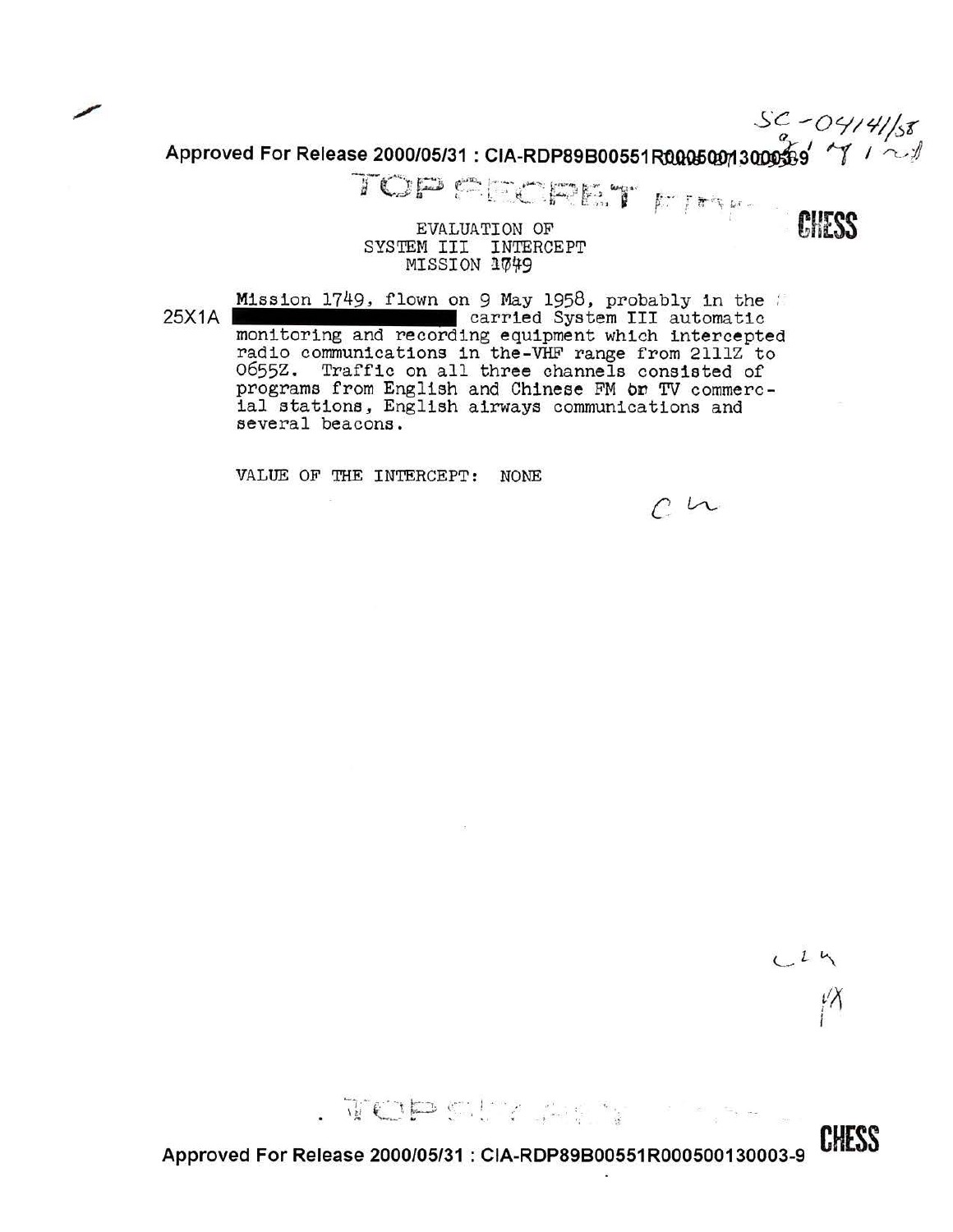
Evaluation of System III intercept, Mission 1749
An authentic federal evaluation of the 9 May 1958 reconnaissance mission records that its communications intercept had no intelligence value. Reconnaissance and rebel combat flights were different activities; an intelligence platform was not proof of effective control. Image credit ↗

Chapter 04 / April–early May 1958

Aircraft, shipping and a closing political space

Air support allowed the eastern rebels to reach beyond their own ground positions. Their aircraft attacked government targets and shipping; Morotai offered a valuable airfield after its capture by dissident forces. At the 1 May National Security Council meeting, Allen Dulles described a small force of P-51s and B-26s conducting effective strikes from the Manado area. He also acknowledged that those strikes had sunk British and Panamanian merchant ships. The operation affected people and property beyond the immediate military contest. Calling it assistance to anti-Communists does not make those consequences disappear.

The Indonesian government protested foreign participation before Allen Pope was captured. On 3 May, Foreign Minister Subandrio asked Ambassador Howard Jones for help stopping the bombings. Jones reported his warning that civilian killings had provoked anger against the rebels, especially around Ambon, and made settlement harder. Subandrio presented claims about aircraft, foreign personnel and supply links. Some of the offered evidence was circumstantial, and Jones challenged a purported arms-dealer connection. Neither that weak item nor Jones's diplomatic response disposes of the independent record establishing U.S. support. The correct question for each allegation is what its own evidence proves.

The bombings also complicated Washington's strategic premise. Jones argued on 12 May that the war was not a simple conflict between Communists and anti-Communists: the central government's army and the rebels both contained anti-Communist forces. He feared a break in diplomatic relations, international exposure of U.S. intervention and a deeper Indonesian turn toward the Soviet bloc. His proposed settlement would use pressure on the rebels alongside inducements to General Abdul Haris Nasution and the government. This was an effort to recover influence through the very army fighting the American-backed rebellion.

The shift remained disputed and conditional. Washington wanted concrete action against Communist influence, not merely expressions of goodwill. Its 17 May instruction nevertheless approved practical gestures toward Jakarta, including pending licenses and economic projects. Thus the reconsideration preceded the famous shootdown. Pope's capture would expose and intensify an already developing failure; it did not create the original military reverses or Jones's strategic objection. The air campaign could damage targets while narrowing the political space in which its sponsors hoped to work. Tactical reach and strategic success had become visibly different things.

Sources: D076 · D078 · D085 · D091 · D093 · D102 · U01

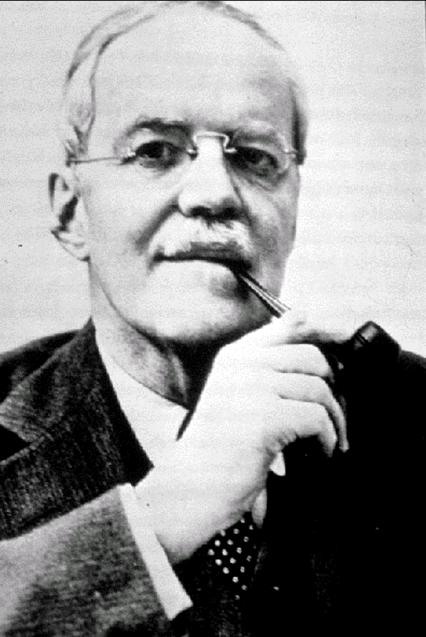
Allen W. Dulles, CIA official portrait
CIA director Allen Dulles. The 18 May meeting brought the director and his deputy together with John Foster Dulles as the secretary argued against another strike. Image credit ↗

Chapter 05 / 18–27 May 1958

Allen Pope and the end of deniability

On 18 May 1958, Indonesian forces shot down a B-26 during a rebel bombing mission near Ambon in the Moluccas, now usually called Maluku. Allen Lawrence Pope, an American pilot, and his Indonesian crewmate were captured. Accounts differ on the precise contribution of ground fire and pursuing aircraft. The internal U.S. background memorandum describes anti-aircraft fire. The immediate Washington meeting records the loss of a rebel aircraft with two crewmen. These details establish a capture during combat without requiring the guide to decide an unresolved air-combat attribution.

Pope's nationality alone would not prove an American state operation. The stronger evidence is the combination of his CAT connection, the authorized assistance program described inside the U.S. government, the combat mission and the documentary trail around his capture. The government's later presentation of him made the private-adventurer explanation much harder to sustain. That explanation had already appeared publicly: at his 30 April press conference, Eisenhower proclaimed neutrality and invoked the familiar phenomenon of private soldiers of fortune. The internal record now shows why that public description was materially incomplete.

At a meeting on 18 May, John Foster Dulles was told about the aircraft loss and pressure to authorize another attack against a government buildup. He urged using American influence to prevent the strike because he could see no winning long-term course. The capture and the operation's deteriorating prospects converged. Washington subsequently pressed toward relations with anti-Communist elements in Jakarta. Chiang Kai-shek, however, wanted to rescue the rebels with additional Nationalist Chinese forces. The May cables show American efforts to restrain him. Allied governments were participants with their own calculations, rather than interchangeable extensions of one American order.

Pope's ordeal continued after the military operation ended. An Indonesian military tribunal convicted him and imposed a death sentence; U.S. officials sought clemency. By December 1960, Secretary of State Christian Herter was advising Eisenhower against tying a plea for Pope too closely to military assistance, fearing Indonesian resentment. A 1961 briefing to Kennedy acknowledged that Pope was guilty of the principal charges while urging assistance on his behalf. The sentence was not carried out, and he returned to the United States in 1962. His case is both evidence of a covert intervention and a separate legal and diplomatic history. It cannot stand for every Indonesian casualty or every rebel's experience.

Sources: D103 · D108 · D113 · D294 · P01 · P02 · A01 · H01

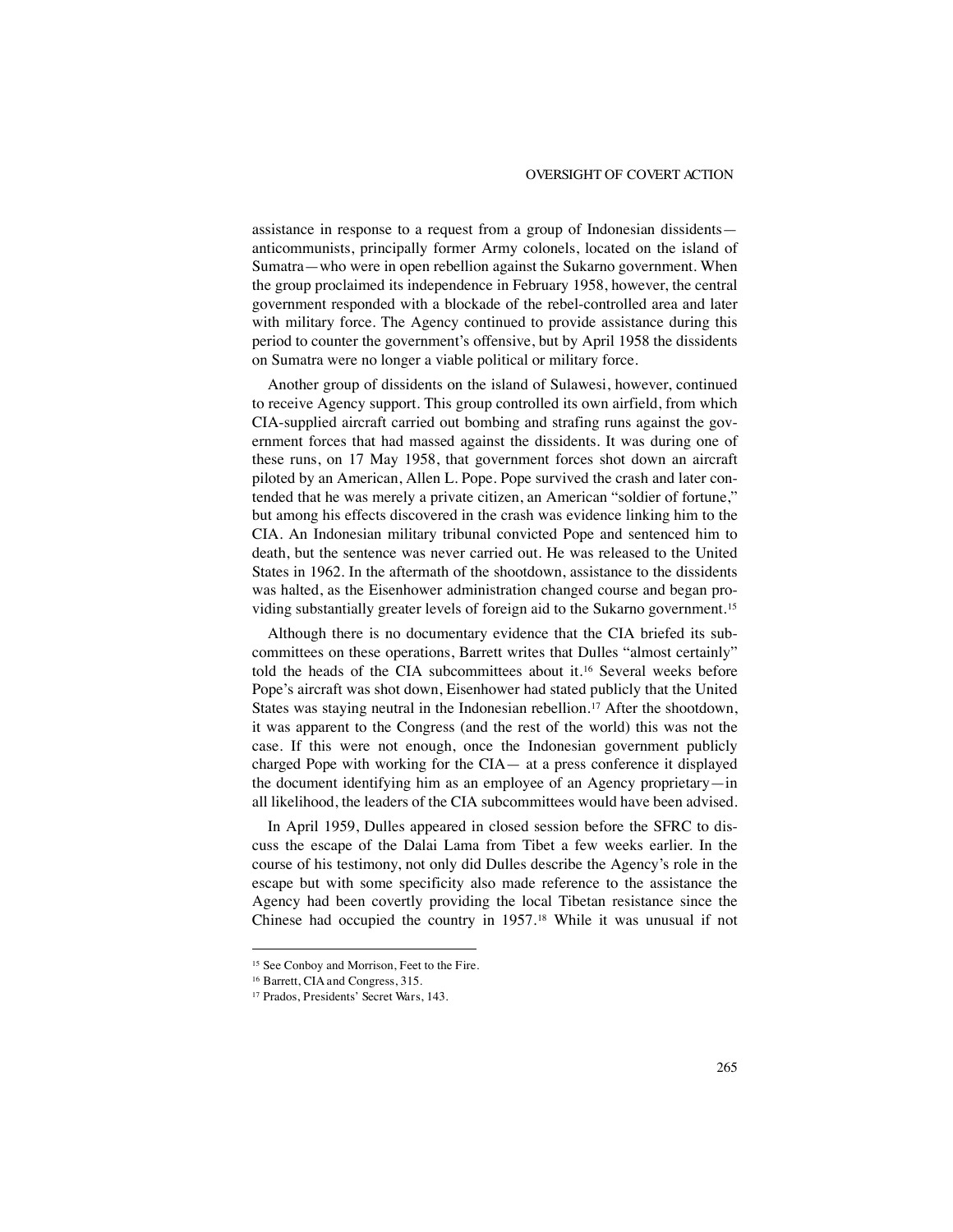
The Agency and the Hill, printed page 265
The CIA’s later institutional history discusses the Indonesia failure and the limits of the surviving congressional-briefing record. Its narrative gives the shootdown date as 17 May; contemporary records establish 18 May. Official histories also require checking. Image credit ↗

Chapter 06 / Mid-1958–1962 / later releases

Defeat, adaptation and the history left behind

The covert project failed to make the rebellion a successful alternative to Jakarta. The government's recovery of the main rebel centers did not instantly eliminate resistance: fighting and guerrilla activity continued, and the regional rebellion persisted into 1961. Nor did the end of large-scale American assistance mean that the rebels' political grievances had been settled. For the people in the affected areas, defeat brought displacement, economic damage and enduring political consequences. A chronology ending with one pilot's capture would erase much of that Indonesian history.

The United States adapted rather than abandoning its anti-Communist objective. Robertson's 30 July memorandum called for strengthening the Indonesian army through a token military-aid program of about seven million dollars. It acknowledged that the dissidents no longer exerted useful leverage and that continued outside encouragement risked worsening America's position. An agreement followed in August. Jones reported Indonesian leaders' relief but also their recognition that accepting American military assistance was a politically significant decision on their side. Aid was an instrument of influence, not proof that its recipients accepted American direction over all national policy.

One interpretation therefore sees a strategic recovery within a failed operation: Washington shifted toward the central army and gained relationships useful to later anti-Communist policy. That is a serious argument about adaptation. It does not turn the rebellion's defeat into the success its supporters had originally sought. Nor does a relationship beginning or strengthening in 1958, by itself, establish a single continuous operational plan for the upheaval and mass violence of 1965–1966. Those later events require their own documentary chain, decisions, actors and victims. The distinction preserves responsibility for the documented intervention without making this guide a substitute for that later history.

The public record expanded unevenly. The 1994 Foreign Relations volume acknowledged covert support while explaining that the compilation had only limited background access to CIA files and that important operational details remained withheld. Later released material and institutional histories add evidence, but neither declassification nor official authorship guarantees completeness or accuracy. The CIA's congressional-relations history, for example, gives Pope's shootdown as 17 May where contemporary records give 18 May. Its discussion also treats likely congressional briefings as inference rather than a located briefing record. The central conclusion survives those limits: the U.S. government covertly supported an armed challenge, the challenge failed, and Washington redirected its effort toward the national army. The remaining uncertainties concern important particulars and consequences, not whether the intervention existed.

Sources: D138 · D143 · D151 · F00 · H01 · I01

02 / The record

Find a thread in the file

Search the chapter and claim index. Every result leads to the full text and its sources.

ChapterA regional dispute becomes an international opportunityChapterBacking a challenge to JakartaChapterA wager the battlefield would not sustainChapterAircraft, shipping and a closing political spaceChapterAllen Pope and the end of deniabilityChapterDefeat, adaptation and the history left behindClaimThe United States covertly supported the 1958 rebels.ClaimThe CIA invented all of the regional grievances and opposition.ClaimThe pilots were only independent private adventurers.ClaimIndonesia was already governed by the Communist Party.ClaimEisenhower approved a message about possible recognition in April.ClaimJoint Chiefs recommendations prove a U.S. invasion was executed.ClaimRebel air strikes sank foreign merchant ships.ClaimBombings produced reports of civilian deaths and political backlash.ClaimPope was captured on 18 May 1958 during a bombing mission.ClaimPope’s capture alone caused Washington’s policy reversal.ClaimThe covert rebellion succeeded in replacing Sukarno in 1958.ClaimPope was convicted and sentenced to death, but was not executed.ClaimLocated records prove exactly what Congress was told about the operation.ClaimArmy aid after 1958 proves a complete CIA script for 1965–1966.TimelineRegional military councils challenge JakartaTimelinePermesta is proclaimedTimelineOuter-island leverage becomes U.S. policyTimelinePolitical-action program approved at a high levelTimelineDulles favors strength outside JavaTimelineEstimate records rebel expectations of U.S. supportTimelineUltimatum to the central governmentTimelinePRRI government proclaimedTimelineWashington debates substantial risksTimelinePoor communications and aircraft needsTimelineJoint Chiefs urge looser restrictionsTimelineConditional recognition message approvedTimelineSumatran collapse reported to the NSCTimelinePublic neutrality and private adventurersTimelineAir strikes and merchant-ship lossesTimelineIndonesia asks for an end to bombingsTimelineCommunications intercept yields no valueTimelineJones urges a decisive policy changeTimelineWashington authorizes gestures to JakartaTimelinePope captured during an Ambon bombing missionTimelineChiang seeks rescue; Washington counsels restraintTimelineArmy aid replaces rebel leverageTimelineMilitary-assistance notes exchangedTimelineClemency and aid kept diplomatically distinctTimelineRegional resistance persists beyond the main defeatTimelinePope returns to the United States

03 / The record

People and institutions

Open a record for the person’s role and supporting sources. Names identify people; no unverified portrait is substituted for a participant.

SukarnoBiographical record
SukarnoPresident of Indonesia

The republic’s founding president defended national unity and developed Guided Democracy. U.S. officials feared his accommodation of the PKI, but feared influence and actual Communist control were different propositions. His government’s victory over the rebels was not a demonstration that he commanded every anti-Communist element in the army.

Sources: D001 · D002 · D078 · D143

KartawidjajaBiographical record
Djuanda KartawidjajaPrime minister of the central government

Led the government challenged by the dissidents and sought improved U.S. relations while the rebellion continued. Accepting U.S. aid after covert intervention was a political choice with domestic costs, not an automatic alignment.

Sources: D078 · D102 · D143

NasutionBiographical record
Abdul Haris NasutionArmy chief of staff

Commanded the national army whose campaign defeated the main rebel centers. Its anti-Communism undercut the idea that the war simply divided Communists from their opponents. Washington increasingly treated the army as an alternative partner.

Sources: D091 · D117 · D138

PrawiranegaraBiographical record
Sjafruddin PrawiranegaraPRRI prime minister

A former national statesman who headed the rival government proclaimed in Sumatra. Regional opposition included civilians with national political claims; the PRRI was not merely a collection of foreign-paid pilots.

Sources: I01 · C01

HuseinBiographical record
Ahmad HuseinCentral Sumatran dissident commander

A leading officer in the councils and PRRI challenge. The movement sought political change and regional resources but overestimated its capacity to force a settlement and withstand the government campaign. Contemporary American expectations are preserved in the January estimate.

Sources: D011 · C01 · I01

SumualBiographical record
Ventje SumualPermesta leader in eastern Indonesia

Led a distinct regional movement that aligned with the PRRI. North Sulawesi continued resisting after the Sumatran reversal. Shared foreign assistance did not erase differences in leadership, geography or military prospects.

Sources: D011 · D044 · D070 · I01

KawilarangBiographical record
Alexander Evert KawilarangSenior dissident officer

Appears in Jones’s May proposal as a potential military interlocutor for negotiating an end to the war. That proposal is evidence of a contemplated channel; it should not be read as a completed agreement.

Sources: D091

Dwight D. EisenhowerDwight D. EisenhowerU.S. president

His administration authorized covert backing and debated overt intervention. On 15 April he approved a conditional message about possible recognition and stated limits on U.S. personnel. Public neutrality must be compared with the internal record.

Sources: D026 · D062 · A01

John Foster DullesJohn Foster DullesU.S. secretary of state

Favored leverage through the outer islands, considered recognition and later urged against another strike. His policy moved as battlefield assumptions failed; it was neither consistent neutrality nor a single unchanging invasion order.

Sources: D002 · D022 · D062 · D103

Allen W. DullesAllen W. DullesDirector of Central Intelligence

Directed the agency supplying assistance and briefed the president and NSC on rebel prospects. His reported military assessments changed sharply between anticipated strength and acknowledged collapse. Agency authorship does not make every assessment impartial or accurate.

Sources: D011 · D044 · D070 · D085

AllisonBiographical record
John M. AllisonU.S. ambassador before Jones

Advocated working with non-Communist elements in the existing government and greater attention to West Irian. Robertson’s January briefing preserves his dissent, demonstrating that covert support was a choice among argued alternatives.

Sources: D001 · D002

JonesBiographical record
Howard P. JonesU.S. ambassador during the crisis

Pressed for accommodation with Jakarta and its army. His 12 May recommendation identified nationalist and anti-Communist interests on both sides. His later favorable assessment of the aid policy is advocacy by an involved official.

Sources: D091 · D143 · D151

SubandrioBiographical record
SubandrioIndonesian foreign minister

Protested the bombings and foreign support while trying to preserve relations with the United States. His accounts of civilian deaths and evidence were reported through Jones; each allegation needs its own corroboration.

Sources: D078 · D143

PopeBiographical record
Allen Lawrence PopeAmerican CAT pilot captured near Ambon

Flew combat missions within the covert air-support program. Captured 18 May 1958, convicted and sentenced to death by an Indonesian tribunal; released in 1962. His official cover and personal conduct do not settle every disputed allegation about particular raids.

Sources: D103 · D294 · P01 · P02 · H01

Kai-shekBiographical record
Chiang Kai-shekPresident of the Republic of China on Taiwan

Wanted additional intervention to save the rebels after Washington began changing course. U.S. diplomats urged restraint. The exchanges reveal an ally’s independent priorities and distinguish proposed forces from forces actually dispatched.

Sources: D108 · D113

04 / The record

Origins, intervention and aftermath

Horizontal spacing shows elapsed time; separate rows keep close events selectable. Scroll the graph on narrow screens. Exact dates are attributed where records conflict; month- and year-only dates preserve source precision.

19561958196019621963
Regional military councils challenge JakartaOrigins

Army-led councils challenged central authority amid disputes over revenue, development and political direction. These local sources of conflict preceded the 1958 combat-air program.

Sources: D001 · I01

Permesta is proclaimedRegional movement

Eastern Indonesian civilian and military leaders pressed autonomy and reform demands. The movement later centered on North Sulawesi; its origins are not interchangeable with the Sumatran PRRI proclamation.

Sources: I01

Outer-island leverage becomes U.S. policyPolicy

A special committee’s recommendations favored covert strengthening of anti-Communist outer-island forces while keeping diplomatic relations. The January brief documents this 1957 decision path.

Sources: D001

Political-action program approved at a high levelAuthorization

A 1961 internal background paper dates approval of the program maintaining a dissident force to November 1957 and describes subsequent authorization of arms and air support. It is a retrospective official explanation, not the missing complete approval file.

Sources: P01

Dulles favors strength outside JavaPolicy choice

A Washington meeting rejected a deal with the present government and preferred building leverage in the outer islands. Allison’s alternative was recorded in the accompanying briefing.

Sources: D001 · D002

Estimate records rebel expectations of U.S. supportIntelligence

Allen Dulles identified dissident goals and anticipated Western backing. The estimate’s predictions about compromise and military resistance were judgments soon tested by events.

Sources: D011

Ultimatum to the central governmentPolitical break

Dissidents demanded a change of government and a revised political course. Rejection led toward the rival government rather than a negotiated settlement.

Sources: C01 · I01

PRRI government proclaimedRebellion

The rival government in Sumatra claimed national political authority, with Sjafruddin as prime minister. The separate Permesta movement aligned with the challenge.

Sources: I01 · C01

Washington debates substantial risksEscalation

The NSC discussion treated dissident defeat as a danger of Communist expansion and considered intervention contingencies. A contingency is not evidence of a completed U.S. landing.

Sources: D026

Poor communications and aircraft needsMilitary assessment

Allen Dulles described fragmented operations and difficulties sustaining a concerted campaign. Some commanders remained neutral, limiting expectations of a general military defection.

Sources: D044

Joint Chiefs urge looser restrictionsRecommendation

Military advisers recommended accelerated efforts including overt measures if required. Civilian authorization of a specific measure must be established separately.

Sources: D053

Conditional recognition message approvedDecision

Eisenhower approved a confidential message linking possible recognition and overt aid to determined resistance. The meeting also recorded his stated bar on government personnel taking part in military operations.

Sources: D062

Sumatran collapse reported to the NSCReversal

The CIA director reported near-collapse of organized resistance. Sponsor frustration is part of the record; it is not the whole explanation of what soldiers or civilians experienced.

Sources: D070 · D072

Public neutrality and private adventurersPublic position

Eisenhower presented U.S. policy as neutrality while referring to private soldiers of fortune. Internal support records show why this was an incomplete account.

Sources: A01 · P01

Air strikes and merchant-ship lossesAir campaign

An NSC briefing acknowledged eastern rebel air activity and the sinking of British and Panamanian freighters. Effects extended beyond the national armed forces.

Sources: D076

Indonesia asks for an end to bombingsDiplomacy / harm

Subandrio protested the raids and described civilian deaths and popular anger. The report is strong evidence of the complaint and political effects, not a complete verified casualty count.

Sources: D078

Communications intercept yields no valueReconnaissance

A contemporary technical evaluation of Mission 1749 records that its intercepted traffic had no intelligence value. One result cannot characterize the entire intelligence effort.

Sources: U01

Jones urges a decisive policy changePolicy turn

The ambassador described two anti-Communist armed camps and proposed pressuring rebels while offering inducements to Jakarta and Nasution. The recommendation predates Pope’s capture.

Sources: D091

Washington authorizes gestures to JakartaPolicy turn

An instruction approved licenses and economic measures while continuing to seek anti-Communist commitments. The shift was underway before the shootdown.

Sources: D102

Pope captured during an Ambon bombing missionExposure

Indonesian forces brought down the rebel B-26 and captured the crew. At a Washington meeting the secretary of state opposed another strike. Specific air-combat credit remains disputed.

Sources: D103 · P01

Chiang seeks rescue; Washington counsels restraintAllied disagreement

The Taipei cable describes proposed additional Nationalist Chinese forces. The U.S. reply favored exploring an arrangement through Jakarta and asked Chiang to suspend his move.

Sources: D108 · D113

Army aid replaces rebel leveragePolicy consolidation

Robertson recommended the approximately $7 million token aid package, judging the dissidents no longer useful leverage. This is adaptation after the project’s failure.

Sources: D138

Military-assistance notes exchangedAftermath

The following day’s embassy report describes the agreement and the political significance Indonesian leaders attached to it. Assistance did not erase disagreements over national policy.

Sources: D143

Clemency and aid kept diplomatically distinctPope case

Herter cautioned against tying a Pope plea to military assistance, warning that Sukarno might reject both. The letter documents a death sentence and available appeal avenues.

Sources: D294

Regional resistance persists beyond the main defeatLong aftermath

The armed challenge did not end everywhere in May 1958. Its extension into 1961 and its regional political consequences complicate a story focused only on CIA withdrawal.

Sources: I01 · C01

Pope returns to the United StatesPope case

The death sentence was not carried out. His release ended years of imprisonment and diplomacy; this guide preserves year-level precision rather than resolving contradictory popular exact-date accounts.

Sources: H01

05 / The record

The load-bearing facts

Six connected steps link local origins, foreign support, military defeat and the policy turn. Open each step for its dependencies, why it matters, and the questions it leaves for rival accounts.

CP1

An Indonesian conflict created the opening

Regional commanders and civilian politicians contested revenue, autonomy and Sukarno’s political direction before the CIA-supported 1958 air campaign. The Sumatran PRRI and eastern Permesta were related movements with distinct roots and constituencies.

Why it is critical

If local agency disappears, foreign support is wrongly made the explanation for every grievance and decision. If the American role disappears, a local origin is wrongly used to erase later sponsorship.

Dependencies

The councils, regional economic grievances, national political parties and divided army commands created both possible allies and limits on coordination.

What rival readings must explain

A wholly manufactured rebellion must explain the documented pre-existing demands and factional differences. A wholly domestic account must pass CP 2 and explain material U.S. support.

Sources: D001 · D011 · I01

CP2

Washington deliberately supplied a political and military instrument

The 1957 policy and later internal background paper establish high-level approval, arms and air support. CAT pilots’ nominal leave supplied a private appearance within the authorized program.

Why it is critical

This is the hinge on state sponsorship. The case does not depend simply on one captured American’s nationality or a hostile accusation.

Dependencies

The covert program depended on U.S. approval, intermediaries, supply and willing Indonesian participants. The available record is incomplete about individual operational orders.

What rival readings must explain

A private-adventurer explanation must account for the 1961 paper’s description of authorized support. A claim of centralized control over every rebel decision needs additional orders and communications.

Sources: D001 · D002 · P01

CP3

The promised political leverage required military staying power

The 15 April meeting tied possible recognition and overt help to resistance sufficient to demonstrate a viable alternative. By 24 April, the CIA director reported organized Sumatran resistance near collapse.

Why it is critical

Without a defensible base, covert supply could not readily become the national political transformation the sponsors wanted. Defeat is an outcome requiring explanation, not evidence that the operation never existed.

Dependencies

Ports, airfields, communications, loyal troops and wider political adhesion were necessary. Central-government military action and nondefecting commanders undermined those conditions.

What rival readings must explain

A betrayal-only account must explain the earlier battlefield reversals and weak coalition. A success account must distinguish later adaptation from the actual performance of this project.

Sources: D044 · D053 · D062 · D070

CP4

The air campaign damaged more than military targets

Eastern rebel strikes reached government positions and merchant shipping. Subandrio’s protest described civilian killings, public anger and shrinking room for a political settlement.

Why it is critical

Aircraft could impose costs without generating a viable government. Civilian harm and attacks affecting shipping are part of assessing the intervention on the same conduct standard as any other sponsor’s.

Dependencies

Aircraft, crews, basing and targets mattered, alongside civilian vulnerability and the diplomatic meaning of foreign participation. This record does not provide a complete casualty census or target-by-target command audit.

What rival readings must explain

A purely tactical victory narrative must explain CP 3 and the political backlash. A claim assigning every reported death to a named American pilot requires authenticated mission and casualty records.

Sources: D076 · D078 · D085

CP5

Exposure reinforced an already developing retreat

Jones’s 12 May recommendation and the 17 May instruction preceded Pope’s 18 May capture. The shootdown brought the private-cover problem into sharper public focus; Dulles opposed another strike that day.

Why it is critical

Chronology changes causation. Pope mattered, but the operation was in trouble before he became its emblem.

Dependencies

Military reverses, fear of a diplomatic rupture, army contacts and the captured crew all contributed. Washington and Taipei then argued over whether to rescue the rebels.

What rival readings must explain

A one-incident explanation must account for pre-capture policy change. An account minimizing exposure must explain the new diplomatic liability and the visible proprietary connection.

Sources: D091 · D102 · D103 · D108 · P01

CP6

Washington redirected its objective toward the national army

The July review and August aid agreement show a new instrument: military assistance for the central armed forces. Regional resistance outlasted the principal covert project; Pope remained imprisoned until 1962.

Why it is critical

This separates operational failure, strategic adaptation and long-term consequences. The later U.S.–army relationship matters without automatically proving a single plan for 1965.

Dependencies

The army’s anti-Communism, Indonesian acceptance of aid and continuing relations with Sukarno shaped the new approach. These were negotiated relationships among actors with distinct interests.

What rival readings must explain

A strategic-recovery account must specify the outcome and date. An uninterrupted master-plan account needs authenticated continuity of direction through later decisions, beyond a shared anti-Communist aim.

Sources: D138 · D143 · D151 · H01 · I01

06 / The record

Four interpretations tested against the record

Competing interpretations, stated at their strongest and tested against the same chain. Presenting a theory is not endorsing it.

Interpretation 01

A U.S. attempt at coercive political change

Documented support; interpretation of the ultimate aim

The strongest version

Washington used covert arms and air power to make Sukarno’s political course untenable and produce a government hostile to Communist influence. Conditional recognition and thoughts of overt help made the rebellion more than passive insurance.

Accepts

CP 1 local origins; CP 2 deliberate sponsorship; CP 3 dependence on a viable military base; CP 4 coercive air action.

Must still explain

The policy included contingencies and disagreements. A precise claim that a named official ordered every raid, or that formal partition was the single fixed objective, exceeds these records.

Assessment

Strongest fit for the support and leverage evidence. The January policy, April recognition discussion and 1961 internal paper establish state intervention.

What would change this assessment

Authenticated full approval papers, target orders or a binding partition directive would refine the objective and the degree of control; their absence does not cancel the documented program.

Sources: D001 · D002 · D062 · P01

Interpretation 02

An indigenous revolt enlarged by foreign aid

Essential explanation of origins; incomplete as the whole case

The strongest version

Revenue, autonomy, army rivalry and resistance to Guided Democracy drove Indonesians into revolt. The rebels sought outside aid to advance their own national and regional aims; external assistance exploited an existing confrontation.

Accepts

CP 1 and the coalition’s divisions; CP 3 Jakarta’s military capacity and the rebels’ mistaken calculations.

Must still explain

CP 2 and CP 4 remain: indigenous agency does not turn CIA supplies and organized air support into an unaffiliated private venture. Sponsors also influenced what rebels thought was possible.

Assessment

This account explains why different regions and commanders behaved differently. It is compatible with documented intervention.

What would change this assessment

Rebel correspondence, cabinet records and orders showing how far expected aid changed the ultimatum or campaign would change the assessment of influence. A claim that local origins negate U.S. responsibility fails to explain the actual support mechanism.

Sources: D011 · D044 · D091 · I01 · C01 · P01

Interpretation 03

A defensive Cold War insurance policy that adapted

Official rationale documented; claimed necessity unproven

The strongest version

U.S. leaders feared that a growing PKI and Soviet-bloc arms would bring a strategically important country under Communist control. Maintaining a dissident force could provide insurance or leverage; after its failure, cooperation with Nasution’s anti-Communist army recovered an avenue of influence.

Accepts

CP 2 the original anti-Communist purpose; CP 6 a real shift in instruments; Soviet-bloc aid and PKI political growth were concerns policymakers recorded.

Must still explain

CP 3 defeat and CP 4 harm cannot be relabeled success simply because later contacts were useful. CP 5 and Jones’s analysis show that central-government soldiers also opposed Communism; imminent takeover was a prediction.

Assessment

A serious account of motive and adaptation, with insufficient evidence that intervention was necessary or that it prevented an otherwise certain takeover.

What would change this assessment

Authenticated contemporaneous PKI seizure plans, a demonstrated timetable and corroborated capabilities would strengthen the urgency argument. Documents proving a planned sacrifice of the rebels from the outset would alter the adaptation account.

Sources: D001 · D022 · D053 · D091 · D138 · D143

Interpretation 04

The CIA manufactured the rebellion and controlled the later outcome

Broad version exceeds the assembled evidence

The strongest version

The same U.S. anti-Communist objective connected covert support in 1958 with later backing for the national army. From this perspective, the apparent failure can look like one stage in a longer strategy against Sukarno and the PKI.

Accepts

CP 2 proves covert support; CP 6 proves the later turn to army aid. Continuing interests and relationships deserve investigation.

Must still explain

CP 1 independent regional origins; CP 3 failed expectations; CP 5 officials’ uncertainty and disagreements; CP 6 distinct later decisions. Continuity of purpose is not a located operational chain.

Assessment

The narrower continuity claim is supported; total manufacture, complete control and a pre-scripted later result are not established.

What would change this assessment

This is not cleared by official denials. Authenticated instructions coordinating rebel action with a planned army victory, and documented continuity into specific later operations, would materially change the assessment. Later violence must be investigated on its own evidence rather than attributed by association.

Sources: D001 · D011 · D070 · D091 · D108 · D138 · F00

07 / The record

How the story changed

Public memory tends to compress contested histories into a turning point. The records leave a less tidy sequence.

Neutrality and the private-adventurer explanation

ThenThe April 1958 public position separated U.S. neutrality from the conduct of private foreign volunteers.

ReconsideredThe internal background paper describes authorized arms and air assistance and nominal CAT leave. Public language must be compared with the mechanism, rather than treated as proof of independence.

Sources: A01 · P01

The captured pilot becomes the whole story

ThenContemporary TIME reporting identified the captured American pilot and his CAT connection. Pope became a vivid public emblem of hidden involvement, concentrating the account on one airman.

ReconsideredThe chronology includes prior regional disputes, government military success, civilian-harm protests and a policy turn underway before 18 May. The pilot’s case is a revealing part of a larger Indonesian conflict.

Sources: D070 · D078 · D091 · D102 · D103 · T02

Official acknowledgment with visible gaps

ThenOperational details remained secret while journalistic and scholarly reconstructions argued about intervention.

ReconsideredThe 1994 FRUS preface acknowledged support and also explained limited CIA access and withheld details. Disclosure established the broad program without making the archive complete.

Sources: F00 · C01

Failure and later strategic relationships

ThenThe end of the rebel project could be told as a straightforward disaster or, retrospectively, as preparation for later anti-Communist success.

ReconsideredThe July–August records show adaptation to defeat through army aid. They do not erase the failed project or authenticate every claimed continuity into later violence.

Sources: D138 · D143 · D151

Errors can persist in authoritative accounts

ThenA later CIA history placed the shootdown on 17 May; an oral-history introduction gave 8 May.

ReconsideredThe contemporary record establishes 18 May. The internal background paper also mislocates Ambon in Celebes. Preserving those discrepancies makes authority testable rather than automatic.

Sources: D103 · P01 · H01 · O01

08 / The record

What the evidence supports

Ratings apply to the precise proposition on the page. Unsupported means the assembled evidence does not establish a claim; it is not interchangeable with false.

Established

The United States covertly supported the 1958 rebels.

The policy brief, internal decision discussions and 1961 Pope background paper establish deliberate support, including arms and air aid. This does not depend solely on Indonesian accusations.

Sources: D001 · D062 · P01

Unsupported

The CIA invented all of the regional grievances and opposition.

Regional councils, autonomy and revenue disputes and civilian opposition predated the 1958 air program. The existence of those local causes is compatible with consequential foreign support.

Sources: D001 · D011 · I01

Contradicted as a complete explanation

The pilots were only independent private adventurers.

The internal Pope paper describes CAT pilots nominally taking leave within a government-approved assistance program. The public soldiers-of-fortune explanation does not account for the state mechanism.

Sources: P01 · A01

Not established

Indonesia was already governed by the Communist Party.

U.S. officials feared growing PKI influence; the January brief explicitly distinguished that influence from open Communist representation in the cabinet. The government’s army also contained anti-Communist forces.

Sources: D001 · D022 · D091

Established

Eisenhower approved a message about possible recognition in April.

The 15 April meeting records approval of a conditional message linked to determined rebel resistance, while leaving the form of recognition for study. This is not recognition itself.

Sources: D062

Unsupported

Joint Chiefs recommendations prove a U.S. invasion was executed.

The 8 April memorandum recommends looser restrictions and overt measures if necessary. Deliberation, planning and execution are different propositions; this source establishes the recommendation.

Sources: D053 · D072

Established

Rebel air strikes sank foreign merchant ships.

The 1 May NSC briefing acknowledged British and Panamanian freighter losses. It supplies strong evidence for the event, without establishing every pilot’s target order or a total casualty figure.

Sources: D076

Documented reports; total unverified

Bombings produced reports of civilian deaths and political backlash.

Jones transmitted Subandrio’s 3 May protest and account of killings and popular anger. This guide does not turn that diplomatic report into a complete independently verified casualty census.

Sources: D078

Established

Pope was captured on 18 May 1958 during a bombing mission.

Contemporary meeting annotation and the 1961 background paper establish the date and combat context. A later CIA history says 17 May; that retrospective error does not displace the earlier records.

Sources: D103 · P01 · H01

Too narrow

Pope’s capture alone caused Washington’s policy reversal.

Jones urged a change on 12 May, and Washington authorized gestures to Jakarta on 17 May. Capture intensified exposure after military and diplomatic reassessment had begun.

Sources: D091 · D102 · D103

Contradicted

The covert rebellion succeeded in replacing Sukarno in 1958.

The rebels lost their principal centers; Washington shifted toward assistance for the national army. Sukarno remained the dominant political figure in the new aid relationship.

Sources: D070 · D138 · D143 · D151

Established

Pope was convicted and sentenced to death, but was not executed.

U.S. clemency documents acknowledge conviction and the sentence. He returned to the United States in 1962. The legal outcome is distinct from unresolved allegations about particular raids.

Sources: D294 · P01 · P02 · H01

Unknown in this record

Located records prove exactly what Congress was told about the operation.

The CIA’s institutional history judges briefings likely while acknowledging no documentary evidence for them. A surviving briefing transcript or distribution record would resolve more than retrospective confidence can.

Sources: H01

Not established by these sources

Army aid after 1958 proves a complete CIA script for 1965–1966.

The records establish continuity of anti-Communist interest and an aid relationship. A single operational script requires a documented chain across later decisions and events. Official denials are not the basis of this limit.

Sources: D138 · D151 · F00

09 / The record

Watch, listen and read the witnesses

Recorded voices, reported history, and documentary context. External transcripts and media need an internet connection.

Primary public press conference / transcript

Read Eisenhower’s 30 April 1958 neutrality explanation ↗

The exchange about Indonesia preserves the public claim and the soldiers-of-fortune distinction. Compare its language with the internal Pope background paper. This link is a transcript, not a verified video.

Participant oral histories / edited extracts

Embassy officers recall the captured pilot ↗

Diplomats describe the imprisonment, cover story and embassy visits. These are recollections. The page’s introduction has a date error; the guide uses 18 May from contemporary records.

10 / The record

The questions still open

A documented limit is more useful than a confident number or a sweeping lineage the evidence cannot carry.

  1. What do surviving full CIA tasking, mission and supply records establish about the authorization of individual strikes, their targets and changes in restrictions?
  2. How did promises or expectations of outside help alter each rebel leader’s decision to issue the ultimatum, reject compromise or continue resistance?
  3. Can Indonesian military, hospital, port, shipping and local records produce a reliable raid-by-raid casualty account, including people beyond the immediate combatants?
  4. Which congressional leaders received briefings, on which dates, with what information about state sponsorship and risks? A probable briefing is not a located one.
  5. How did the aid shift affect particular army units and regional civilians? A national diplomatic account cannot resolve all local consequences.
  6. Which authenticated records connect the 1958 relationships to specific later decisions, and which later claims rest mainly on a shared political objective?
  7. What do Indonesian court files establish about Pope’s precise charges, evidence and appeals beyond the summaries in U.S. diplomatic records?

11 / The record

Go back to the sources

Records, reporting, and firsthand accounts have different evidentiary roles. Each source note explains what it can establish and where caution is needed. Sources consulted for this edition on 25 October 2026. Original records and attributed reporting have distinct evidentiary roles.

  1. D001

    Contemporary U.S. record / official documentary edition

    FRUS document 1 — Memorandum From the Assistant Secretary of State for Far Eastern Affairs (Robertson) to Secretary of State Dulles ↗

    U.S. Department of State, Office of the Historian; FRUS 1958–1960, Indonesia, vol. XVII (1994)

    Robertson’s 2 January briefing summarizes the 1957 covert policy, overt-relations cover and Allison’s alternative. A U.S. policy description, not a neutral characterization of Indonesian politics.

  2. D002

    Contemporary U.S. record / official documentary edition

    FRUS document 2 — Memorandum of Conversation ↗

    U.S. Department of State, Office of the Historian; FRUS 1958–1960, Indonesia, vol. XVII (1994)

    2 January meeting records Dulles’s preference for strength in the outer islands and rejection of a deal with the present government.

  3. D011

    Contemporary U.S. record / official documentary edition

    FRUS document 11 — Memorandum by Director of Central Intelligence Dulles ↗

    U.S. Department of State, Office of the Historian; FRUS 1958–1960, Indonesia, vol. XVII (1994)

    31 January estimate identifies dissident objectives and the importance of expected Western support. Predictions are dated judgments; later defeats test them.

  4. D022

    Contemporary U.S. record / official documentary edition

    FRUS document 22 — Memorandum of Telephone Conversation Between Secretary of State Dulles and Director of Central Intelligence Dulles ↗

    U.S. Department of State, Office of the Historian; FRUS 1958–1960, Indonesia, vol. XVII (1994)

    21 February Dulles brothers’ call distinguishes helping rebels from a legal basis for overt intervention; it explicitly notes there had been no actual Communist takeover.

  5. D026

    Contemporary U.S. record / official documentary edition

    FRUS document 26 — editorial note, 27 February 1958 ↗

    U.S. Department of State, Office of the Historian; FRUS 1958–1960, Indonesia, vol. XVII (1994)

    27 February NSC discussion, published in editorial note. Evidence of risk-taking and contingent intervention debate; it is not an executed invasion order.

  6. D030

    Contemporary U.S. record / official documentary edition

    FRUS document 30 — editorial note, 6 March 1958 ↗

    U.S. Department of State, Office of the Historian; FRUS 1958–1960, Indonesia, vol. XVII (1994)

    6 March staff and NSC discussion includes legal objections and military expectations. Contemplated protection of oil interests must not be confused with a landing.

  7. D044

    Contemporary U.S. record / official documentary edition

    FRUS document 44 — editorial note, 20 March 1958 ↗

    U.S. Department of State, Office of the Historian; FRUS 1958–1960, Indonesia, vol. XVII (1994)

    20 March briefing reports weak communications, factional limits and aircraft needs. An intelligence assessment with incomplete field visibility.

  8. D050

    Contemporary U.S. record / official documentary edition

    FRUS document 50 — Memorandum From the Under Secretary of State (Herter) to Secretary of State Dulles ↗

    U.S. Department of State, Office of the Historian; FRUS 1958–1960, Indonesia, vol. XVII (1994)

    Herter’s 1 April reservations and the editorially quoted later staff discussion expose disagreement and the risk of alienating nationalist opinion.

  9. D053

    Contemporary U.S. record / official documentary edition

    FRUS document 53 — Memorandum From the Joint Chiefs of Staff to Secretary of Defense McElroy ↗

    U.S. Department of State, Office of the Historian; FRUS 1958–1960, Indonesia, vol. XVII (1994)

    8 April Joint Chiefs recommendation favors relaxing restrictions. A recommendation to the civilian leadership, not a decision authorizing every proposed measure.

  10. D062

    Contemporary U.S. record / official documentary edition

    FRUS document 62 — Memorandum of Conversation With President Eisenhower ↗

    U.S. Department of State, Office of the Historian; FRUS 1958–1960, Indonesia, vol. XVII (1994)

    15 April White House meeting records a conditional recognition message and the president’s stated limit on U.S. personnel. Redactions remain visible.

  11. D070

    Contemporary U.S. record / official documentary edition

    FRUS document 70 — editorial note, 24 April 1958 ↗

    U.S. Department of State, Office of the Historian; FRUS 1958–1960, Indonesia, vol. XVII (1994)

    24 April NSC briefing records Sumatran collapse. Sponsors’ claims about willingness to fight are attributed judgments, not a comprehensive soldier history.

  12. D072

    Contemporary U.S. record / official documentary edition

    FRUS document 72 — editorial note, 24 April 1958 presidential letter ↗

    U.S. Department of State, Office of the Historian; FRUS 1958–1960, Indonesia, vol. XVII (1994)

    Eisenhower’s 24 April letter excerpt shows reluctance over multinational military planning without political decisions.

  13. D076

    Contemporary U.S. record / official documentary edition

    FRUS document 76 — editorial note, 1 May 1958 ↗

    U.S. Department of State, Office of the Historian; FRUS 1958–1960, Indonesia, vol. XVII (1994)

    1 May NSC report acknowledges rebel strikes, merchant-ship sinkings and the developing possibility of working with the national army.

  14. D078

    Contemporary U.S. record / official documentary edition

    FRUS document 78 — Telegram From the Embassy in Indonesia to the Department of State ↗

    U.S. Department of State, Office of the Historian; FRUS 1958–1960, Indonesia, vol. XVII (1994)

    Jones’s 3 May report of Subandrio’s protest records civilian-harm claims and competing explanations of foreign assistance. It documents the protest, not an independently audited casualty total.

  15. D085

    Contemporary U.S. record / official documentary edition

    FRUS document 85 — editorial note, 8 May 1958 ↗

    U.S. Department of State, Office of the Historian; FRUS 1958–1960, Indonesia, vol. XVII (1994)

    8 May NSC discussion tracks eastern air success, foreign-participation charges and contacts with the government’s army.

  16. D091

    Contemporary U.S. record / official documentary edition

    FRUS document 91 — Telegram From the Embassy in Indonesia to the Department of State ↗

    U.S. Department of State, Office of the Historian; FRUS 1958–1960, Indonesia, vol. XVII (1994)

    Jones’s 12 May policy recommendation distinguishes two anti-Communist armed camps and proposes pressure plus incentives. A proposal, not proof every item was implemented.

  17. D093

    Contemporary U.S. record / official documentary edition

    FRUS document 93 — Telegram From the Department of State to the Embassy in Indonesia ↗

    U.S. Department of State, Office of the Historian; FRUS 1958–1960, Indonesia, vol. XVII (1994)

    13 May Washington instruction seeks concrete anti-Communist action and defines the conditions of a possible accommodation.

  18. D102

    Contemporary U.S. record / official documentary edition

    FRUS document 102 — Telegram From the Department of State to the Embassy in Indonesia ↗

    U.S. Department of State, Office of the Historian; FRUS 1958–1960, Indonesia, vol. XVII (1994)

    17 May instructions authorize licenses and economic gestures before Pope’s capture. This chronology prevents reducing the policy turn to the shootdown alone.

  19. D103

    Contemporary U.S. record / official documentary edition

    FRUS document 103 — Memorandum of Conversation ↗

    U.S. Department of State, Office of the Historian; FRUS 1958–1960, Indonesia, vol. XVII (1994)

    18 May meeting and editorial footnote establish the aircraft loss, Pope’s capture during an Ambon bombing mission and the secretary’s recommendation against another strike.

  20. D108

    Contemporary U.S. record / official documentary edition

    FRUS document 108 — Telegram From the Embassy in the Republic of China to the Department of State ↗

    U.S. Department of State, Office of the Historian; FRUS 1958–1960, Indonesia, vol. XVII (1994)

    22 May Taipei report and editorial reply record Chiang’s proposed intervention and Washington’s effort to hold it back. Proposed additional forces are not silently counted as deployed.

  21. D113

    Contemporary U.S. record / official documentary edition

    FRUS document 113 — Telegram From the Embassy in the Republic of China to the Department of State ↗

    U.S. Department of State, Office of the Historian; FRUS 1958–1960, Indonesia, vol. XVII (1994)

    26 May Taipei follow-up preserves uncertainty and disagreement over Chiang’s intentions; it shows allied agency and limits of American influence.

  22. D138

    Contemporary U.S. record / official documentary edition

    FRUS document 138 — Memorandum From the Assistant Secretary for Far Eastern Affairs (Robertson) to Secretary of State Dulles ↗

    U.S. Department of State, Office of the Historian; FRUS 1958–1960, Indonesia, vol. XVII (1994)

    30 July policy review states rebels no longer provide useful leverage and proposes the approximately $7 million military-aid package.

  23. D143

    Contemporary U.S. record / official documentary edition

    FRUS document 143 — Telegram From the Embassy in Indonesia to the Department of State ↗

    U.S. Department of State, Office of the Historian; FRUS 1958–1960, Indonesia, vol. XVII (1994)

    14 August embassy report describes the exchange of military-aid notes and Indonesian leaders’ interpretation. An American account of the conversation, not a foreign-authored document.

  24. D151

    Contemporary U.S. record / official documentary edition

    FRUS document 151 — Letter From the Ambassador to Indonesia (Jones) to the Assistant Secretary of State for Far Eastern Affairs (Robertson) ↗

    U.S. Department of State, Office of the Historian; FRUS 1958–1960, Indonesia, vol. XVII (1994)

    2 September Jones letter gives a favorable retrospective assessment of the aid turn; it must be read as advocacy by the ambassador who pressed that policy.

  25. D294

    Contemporary U.S. record / official documentary edition

    FRUS document 294 — Memorandum From Secretary of State Herter to President Eisenhower ↗

    U.S. Department of State, Office of the Historian; FRUS 1958–1960, Indonesia, vol. XVII (1994)

    21 December 1960 Herter memorandum documents the death sentence, appeal options and concern about linking clemency to military aid.

  26. F00

    Official editorial account

    FRUS Indonesia preface: access and declassification limits ↗

    U.S. Department of State (1994)

    Explains limited background-only CIA access during compilation and continued withholding of important operational material. The volume acknowledges covert support but is not a complete operational archive.

  27. P01

    Contemporary U.S. record

    Rusk to Kennedy, 17 March 1961, with Allen L. Pope background paper ↗

    U.S. Department of State / Kennedy Library; FRUS 1961–1963, vol. XXIII, doc.153

    The enclosure explicitly describes high-level approval, arms and air aid, nominal CAT leave and combat flights. Its text incorrectly locates Ambon in Celebes; the guide uses Maluku. It acknowledges Pope’s guilt on principal charges and seeks mitigation.

  28. P02

    Contemporary U.S. record

    Rusk to Kennedy, 12 June 1961, with Kennedy’s 21 June clemency letter ↗

    U.S. Department of State / Kennedy Library; FRUS 1961–1963, vol. XXIII, doc.178

    The 12 June memorandum reports the Supreme Court’s confirmation announced 2 June and recommends discretionary use of a presidential clemency appeal. The enclosure is Kennedy’s signed 21 June letter, substantially revised in his own hand. The enclosure has a separate date from Rusk’s memorandum. This diplomatic record is not an independent trial transcript.

  29. A01

    Primary public statement

    Eisenhower’s press conference, 30 April 1958 ↗

    The American Presidency Project; Public Papers of the Presidents

    Contains the neutrality claim and private soldiers-of-fortune explanation. A public position to compare with internal records; not deciding proof of noninvolvement.

  30. I01

    Indonesian institutional historical synthesis

    PRRI/PERMESTA: origins, rebellion and regional consequences ↗

    Ensiklopedia Sejarah Indonesia / Indonesian Ministry of Culture

    Describes autonomy and distributional origins, 15 February PRRI proclamation and the long regional aftermath. It is a later institutional synthesis, not a complete contemporary rebel or army archive. Indonesian text; synthesis here is independently phrased in English.

  31. C01

    Research article with contemporaneous reporting and participant checks

    An Incident in the PRRI/Permesta Rebellion of 1958 ↗

    Daniel F. Doeppers, Indonesia, Cornell Southeast Asia Program (1972), pp.183–195

    Tests a March reconnaissance-plane incident against press reports, aircraft and personnel records and an interview. Useful regional/military context; the inferred mission is not equivalent to a declassified order. Full article retained privately, not redistributed.

  32. H01

    Official retrospective history

    The Agency and the Hill: CIA’s Relationship with Congress, 1946–2004 ↗

    L. Britt Snider, CIA Center for the Study of Intelligence (2008), pp.264–265

    Acknowledges aid, CIA-provided aircraft and Pope’s proprietary connection. Printed page 265 erroneously gives 17 May; contemporary record supports 18 May. Its assertion that congressional leaders were probably briefed is explicitly inference, not a located briefing document. Only printed page 265 is reproduced locally. Page 265 is reused under CIA.gov’s stated policy, not an assumed federal-employee authorship basis. Snider wrote the book under contract after retirement.

  33. U01

    Primary technical evaluation

    Evaluation of System III Intercept, Mission 1749 ↗

    CIA-released federal intelligence evaluation, via National Security Archive

    Mission flown 9 May 1958; evaluation records no intelligence value for the communications intercept. Repository description supplies Indonesia route context. This is not evidence that every reconnaissance product failed; image and original single-page report are local.

  34. G01

    Federal document image / repository reproduction

    CIA operational recommendation excerpt, reproduced in Indonesian reporting ↗

    CIA text excerpt, as reproduced by Balairungpress (2023)

    Illustration reproduces only the federal text excerpt, with no publisher layout or original reporting. The covert-strengthening language is independently corroborated in FRUS D001. Original full CIA operational document could not be downloaded here; no claim to a complete scan. Publisher narrative is not used as the factual spine.

  35. O01

    Participant recollection / edited oral history

    Diplomats recall Pope’s capture and imprisonment ↗

    Association for Diplomatic Studies and Training; oral-history extracts

    Retrospective embassy memories, including mail visits and the cover story. The introduction mistakenly says May 8; contemporary records fix 18 May. Memories are not treated as mission logs or proof of a one-man air force.

  36. D117

    Contemporary U.S. embassy report

    FRUS document 117 — Jones on prospective talks with Nasution, 3 June 1958 ↗

    U.S. Department of State, FRUS 1958–1960 vol.XVII

    Proposes a further army-aid discussion and explicitly considers offsetting the Pope case. Recommendations and anticipated outcomes remain identified as such.

  37. T01

    Contemporary established press

    Indonesia: Challenge & Response, 24 February 1958 ↗

    TIME

    Contemporary report of the proclamation, proposed leadership and ultimatum. Useful public framing of the rebellion, not access to the secret U.S. approval chain. The initial report’s language does not establish a uniform separatist intention.

  38. T02

    Contemporary established press

    Indonesia: The Man from Florida, 9 June 1958 ↗

    TIME

    Contemporary public report identifies Pope, his CAT connection and other foreign flights. Read alongside the internal U.S. record; the report cannot establish all covert instructions.

Local records: 9 May intercept evaluation · January policy brief · April recognition discussion · Jones’s May recommendation · 18 May meeting · July army-aid review · Later CIA history page. FRUS electronic transcriptions are clearly labeled; they are not facsimiles of archival originals.

Images, documents & licensing

CIA recommendation for covert outer-island support — Central Intelligence Agency; excerpt reproduced by Balairungpress. Public domain in the United States: U.S. federal government work (17 USC 105). Image source ↗ · Rights & reuse ↗. Resized and re-encoded for this edition; embedded metadata removed. Only federal-authored document excerpt reproduced. Publisher layout and narrative excluded. Original full scan unavailable; wording independently checked against FRUS D001.

Allen W. Dulles, CIA official portrait — Central Intelligence Agency. Public domain in the United States: U.S. federal government work (17 USC 105). Image source ↗ · Rights & reuse ↗. Resized and re-encoded for this edition; embedded metadata removed. Commons item credits CIA photograph and PD-USGov-CIA; item page retained. Photographer’s official agency employment stated, not inferred merely from hosting.

John Foster Dulles, National Archives portrait detail — U.S. federal government; National Archives 306-PSC-60-15790. Public domain in the United States: U.S. federal government work (17 USC 105). Image source ↗ · Rights & reuse ↗. Resized and re-encoded for this edition; embedded metadata removed. Commons item identifies federal work and archival reference. Original low resolution preserved honestly; no invented detail or AI enhancement.

Dwight D. Eisenhower, official photograph, 29 May 1959 — White House / Eisenhower Presidential Library. Public domain in the United States: U.S. federal government work (17 USC 105). Image source ↗ · Rights & reuse ↗. Resized and re-encoded for this edition; embedded metadata removed. Official White House photograph, item-specific federal-work rights reviewed; existing repository original reused, with topic-specific metadata.

Evaluation of System III intercept, Mission 1749 — U.S. federal intelligence agency; CIA release CIA-RDP89B00551R000500130003-9. Public domain in the United States: U.S. federal government work (17 USC 105). Image source ↗ · Rights & reuse ↗. Resized and re-encoded for this edition; embedded metadata removed. Original one-page federal technical evaluation visually reviewed; no third-party enclosures or photograph. Repository description is separate from original record.

The Agency and the Hill, printed page 265 — L. Britt Snider; published by the CIA Center for the Study of Intelligence (2008). Reuse permitted by CIA.gov Site Policies, General Disclaimer and Copyright Notice, absent an indicated copyright; source and author credited. No federal-employee-work status assumed. Image source ↗ · Rights & reuse ↗. Resized and re-encoded for this edition; embedded metadata removed. Printed page 265 (PDF page 283) was reviewed with the book’s front matter and text. No contrary copyright notice or third-party image appears on the selected page; text search of all 408 PDF pages found no copyright notice. The page contains brief attributed quotations and citations, not a separately reproduced third-party work. Snider’s 22 October 2009 House testimony, printed page 12, says he wrote the book under contract after retiring in 2001. CIA.gov explicitly permits copying/republication of material without an indicated copyright and requests source/byline credit. Only this page is reproduced; the whole volume remains private.

Typefaces: Inter, Playfair Display and Source Serif 4, the exact shared AI Files reference files, distributed under the SIL Open Font License. Font files and license text are included in assets/fonts in this offline package. Documentary images include federal records, verified official portraits and a CIA-published historical page reused under the Agency’s express policy. Captions identify retrospective images and reproduction limits. No AI-generated photographs, portraits or document facsimiles are used.

Uniform evidence

One standard for every case.

Authorization, expectation, recommendation and executed action are different facts. Participant explanations and official commemorations are claims to test, never deciding proof. The same standard applies to U.S., rebel and central-government conduct. Uncertainty remains labeled.

Publication status

Prepared for staging review.

This locally prepared package is intended for the ChatGPT submission lane under Spec v7. It has not received a Grok editorial grade or approval for promotion. The live submission manifest, when registered, records its review status. Submission queue and status ↗