← Interactive guidePUBLIC RECORD / READING EDITIONOffline ZIP ↓

Guatemala — assassination proposals / 1952–1954 / disclosure and memory to 2012

Plans to kill. An unfinished chain.

Between 1952 and 1954, CIA officers and Guatemalan opposition figures discussed assassination, circulated lists and made preparations. The surviving documents establish serious planning. Whether a particular proposal became an authorized and executed killing requires a further chain of evidence.

An AI-written documentary guide to the assassination proposals associated with PBFORTUNE and PBSUCCESS. The broader Guatemala coup has its own companion guide; this file follows the narrower planning and implementation question.

Scope & method / Edition 1.1

Follow the proposal to its next documented step.

Follow proposal, preparation, authorization, implementation and later disclosure as separate steps. The record includes U.S. officials, Guatemalan opposition leaders, regional sponsors and people whose identities remain redacted. Neither an institutional denial nor a redaction decides an individual case.

Read the chapters for a narrative; use the record below to test it. Established means the specific proposition is documented. Interpretation marks an inference or a historical argument. Unknown means the record here cannot decide. An archive’s possession of a document does not endorse its contents.

Research checked 25 October 2026. Contemporary FRUS records lead alongside the 1995 Haines reconstruction. Selected original pages are reproduced as labeled extracts; no operational killing instructions are included. Source notes distinguish records read from referenced material not obtained. This is not a complete victim-by-victim or operational-file audit.

01 / The record

The story

The complete narrative, followed by the supporting record.

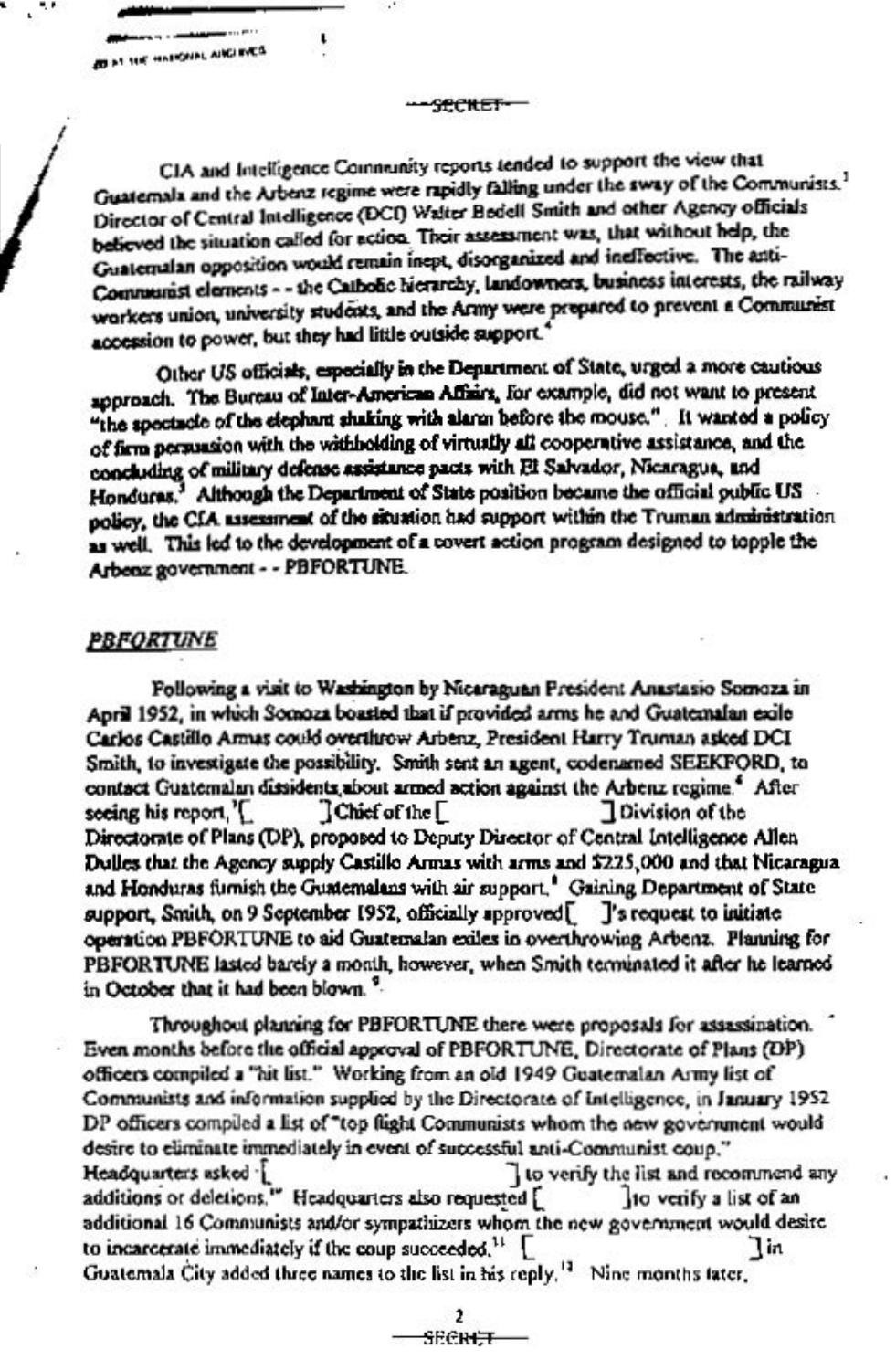
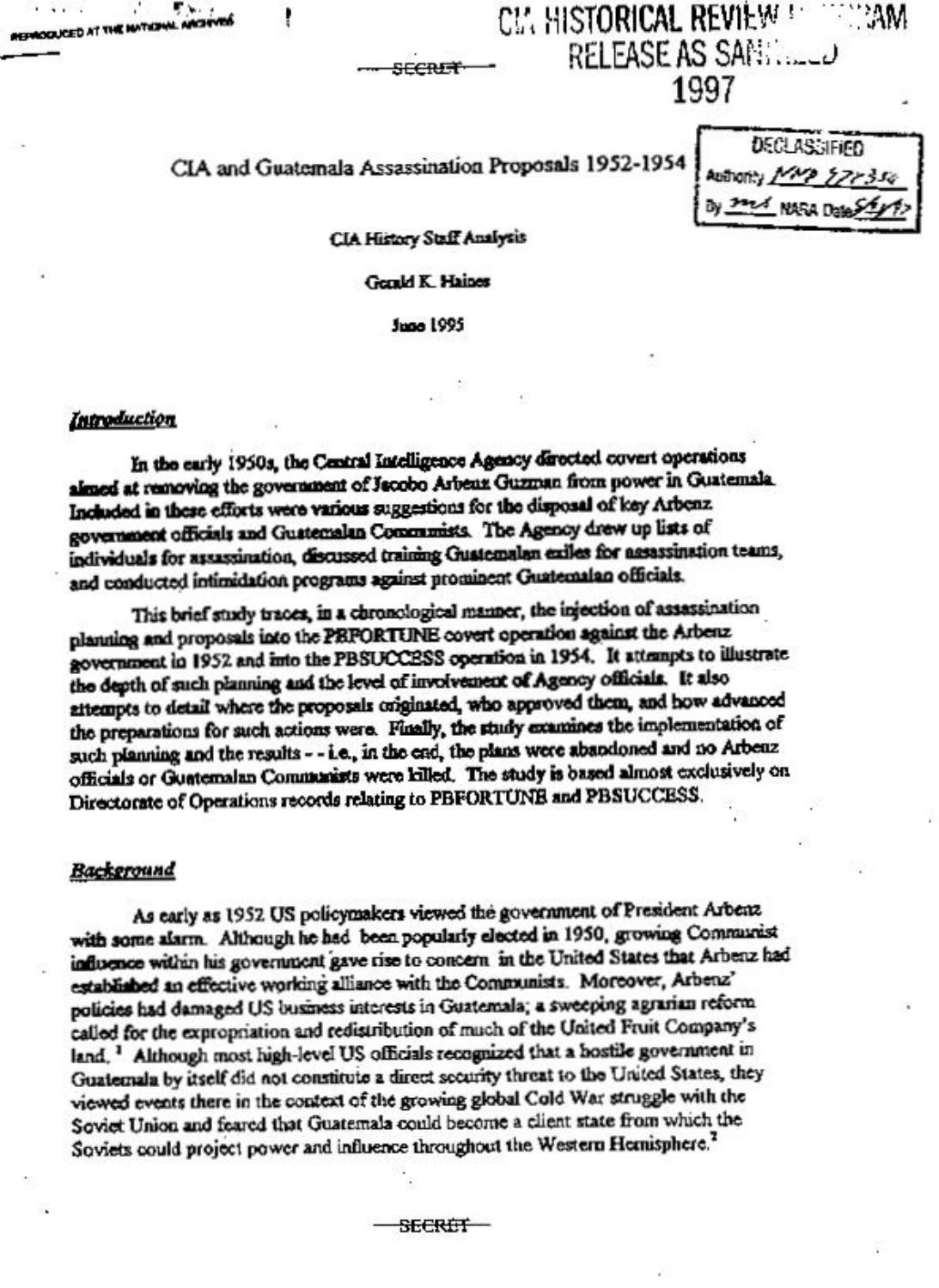
Haines’s study identifies its documentary scope
The opening page of Gerald Haines’s 1995 CIA staff analysis states its subject and its reliance on operational records. Its conclusion remains an institutional historical judgment. Image credit ↗

Chapter 01 / 1952

Before the coup plan, there were already lists

The assassination proposals emerged inside a struggle over Guatemala’s political future. President Jacobo Árbenz had won an election and pursued reforms that challenged established landholding and business interests. Communist organizers exercised influence within his coalition, but their presence did not erase the independent aims of the president, peasant organizations, labor leaders or the army. U.S. officials increasingly understood these conflicts through the Cold War. That interpretation helped make the removal of a constitutional government an acceptable policy objective in Washington; it did not itself establish the truth of every allegation about Soviet control.

Assassination was under discussion before the final covert operation existed. Gerald Haines’s 1995 CIA History Staff study, drawing mainly on operational files, traces headquarters list-making to January 1952. It describes a prospective group for elimination after a successful anti-Communist coup and a separate group for imprisonment. The distinction matters: the record contains several lists, made at different times for different purposes. A proposed death list is evidence of contemplated killing, not a count of people actually killed.

Guatemalan and regional actors were participants with agendas of their own. Carlos Castillo Armas sought outside help for his opposition movement. In an 18 September 1952 memorandum, CIA intermediary Jacob Seekford reported that Dominican ruler Rafael Trujillo’s representative had offered assistance in exchange for the killing of four Dominican exiles in Guatemala. Castillo Armas reportedly agreed in principle while disputing the timing. That is a contemporary report of a bargain being discussed, not evidence here that the four killings occurred or that Washington approved them.

Haines also describes a list forwarded by Castillo Armas that separated 58 prospective execution targets from 74 people intended for imprisonment or exile. The released covering memorandum identifies it as his revision of an original headquarters list prepared in February 1952. This was not simply a local demand observed from a distance: the document preserves a CIA list-making role as well as opposition revision. Public versions conceal the names. Those numbers are not a final 1954 order or a verified victim count. The beginning of this history is therefore neither an imaginary plan nor a completed killing program. It is a documented convergence of outside sponsorship, local opposition ambition and proposals to remove political opponents permanently.

Sources: H01 · F018 · F035 · F006 · L01

PBFORTUNE and earlier list-making
Haines, page 2: PBFORTUNE approval, its subsequent termination and earlier list-making. The page records different decisions at different stages. Image credit ↗

Chapter 02 / 1952–1953

Stopping PBFORTUNE did not settle the question

The first covert effort, PBFORTUNE, developed in 1952 around supplying support to Castillo Armas. Haines dates Director Walter Bedell Smith’s formal approval to 9 September. Contemporary CIA records from October describe the arrangements becoming compromised and the intervention of the State Department. The project was stopped. That organizational decision did not erase earlier discussions, remove opposition leaders’ ambitions, or establish that every associated activity had ended at once.

Haines’s reconstruction follows continued reports about opposition assassination plans after the cancellation. Some were reports of what Castillo Armas’s circle said it was preparing; others were suggestions originating within the U.S. covert apparatus. Their evidentiary status differs. An agent’s report of an ally’s intention does not demonstrate that headquarters directed it. A CIA officer’s own proposal, by contrast, establishes that an American official was advocating the idea even when implementation is unproved. Treating all such papers as either rumor or approved policy would miss the institutional movement between those categories.

By 1953 Washington had returned to regime change through PBSUCCESS. An August 12 Psychological Strategy Board minute authorized the Director of Central Intelligence to proceed at high priority with support from State and Defense. Later filing correspondence explicitly connected the minute to PBSUCCESS. The September general plan combined political, psychological and paramilitary measures, and contemplated dealing with Communists and collaborators after success. This is strong evidence of authorization for the broader operation. It is not a separate signed presidential authorization for the assassination of named people.

The broader mandate made lethal proposals consequential because they were being considered within an active intervention, not an isolated exercise. Yet authority to organize that intervention and authority to carry out an individual assassination remain different propositions. Haines concludes that assassination was absent from the overall plan’s explicit wording and remained controversial. The contemporary planning record must be read for requests, approvals and restrictions rather than allowing a general authorization to answer every later question. The termination of one project and approval of another explain continuity in pressure; they do not supply a missing decision about a particular proposed killing.

Sources: H01 · F020 · F024 · F040 · F051

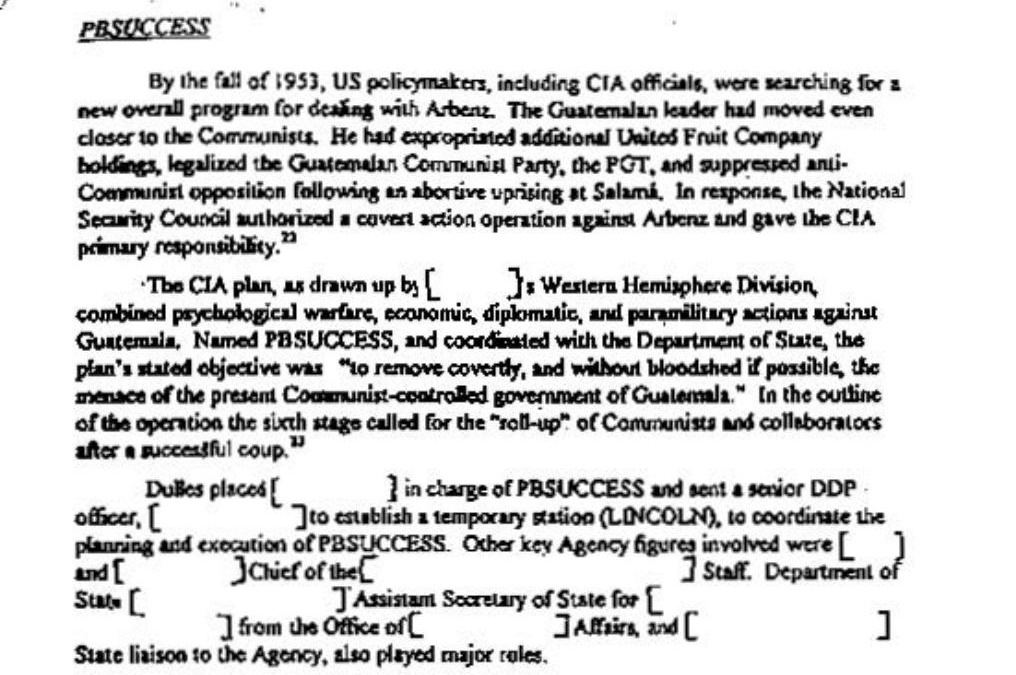
The broader PBSUCCESS mandate and command structure
A selected passage from Haines, page 4, describes the broader PBSUCCESS plan and its command structure. The extract ends before the operational-training discussion. Image credit ↗

Chapter 03 / 1953–early 1954

Preparation went beyond a passing suggestion

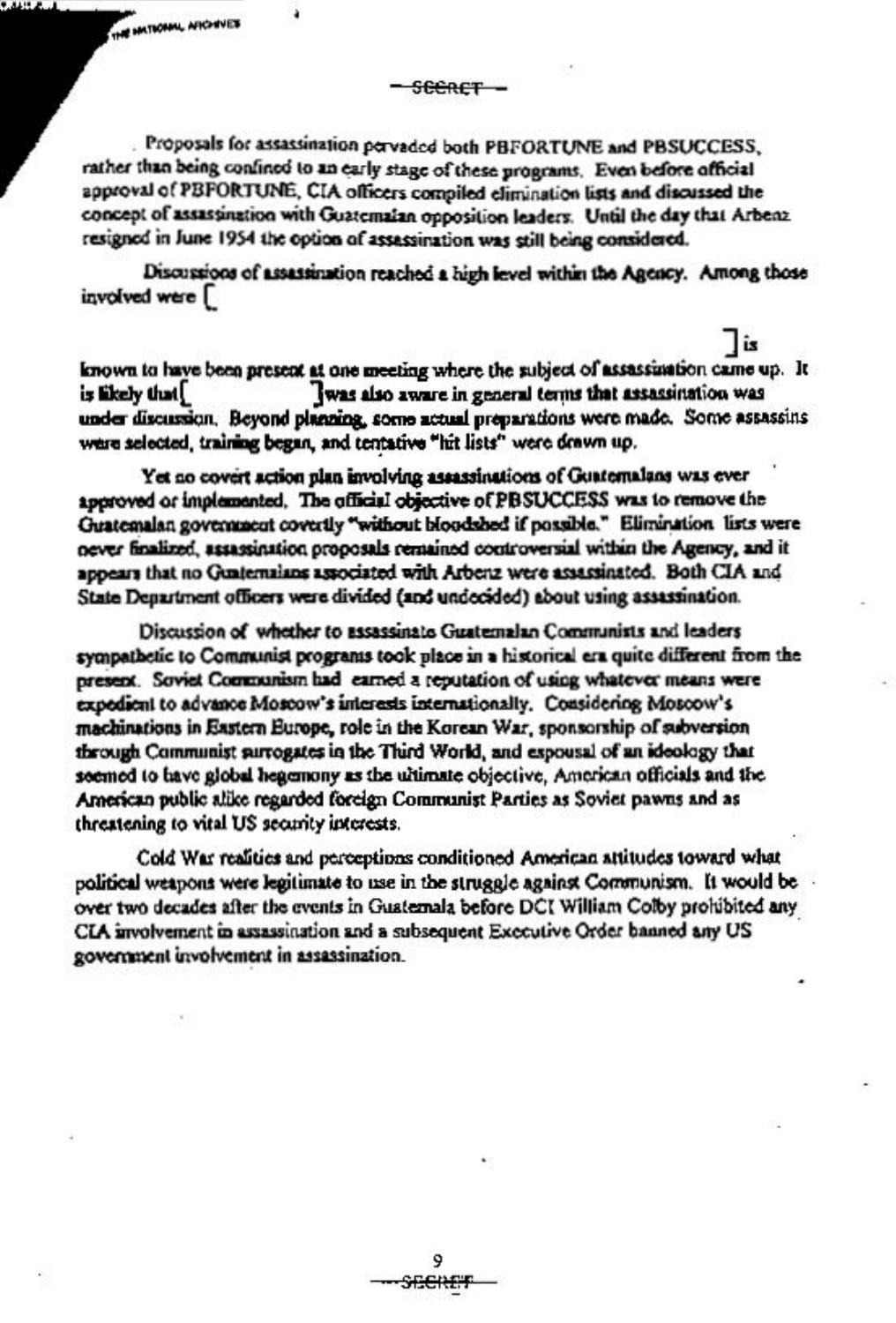
PBSUCCESS acquired offices, personnel, communications channels and a working relationship with Castillo Armas. Its Florida operational headquarters, known as LINCOLN, coordinated much of the project. In that setting, assassination proposals could enter staffing and preparation rather than remain hypothetical remarks. Haines describes repeated discussions of specialist personnel and preparations associated with the opposition’s proposed killing groups. His concluding assessment says some people were selected, training began and tentative lists were drawn up. These are substantive preparations, even though they do not establish an implemented assassination operation.

A document commonly called A Study of Assassination was later found in the operation’s training files. Its presence is historically significant because it shows that killing was treated as a subject for institutional preparation. Its existence does not identify a recipient, prove that a particular person was trained from it, or establish that any proposed attack was carried out. The undated, unsigned document cannot by itself fix a presidential decision or the date of an individual operation. The documentary question is how such material related to actual tasking and conduct.

Political intimidation also formed part of the campaign. Haines distinguishes threats against opponents from proposals to kill them and records objections to moving from one to the other. A LINCOLN communication described destroying a political opponent’s usefulness rather than killing the person. That limitation is relevant evidence of disagreement and restraint in a specific exchange. It is not a universal prohibition governing every other discussion, nor does it make the intimidation benign or prove that all subordinate conduct followed the limitation.

The strongest account of institutional responsibility therefore does not require a claim that a final killing order was executed. Officials and sponsored opposition leaders repeatedly considered assassination, devoted attention to preparation and used threats in a campaign to change Guatemala’s government. Responsibility for those actions can be established at their own level. Claims about a completed assassination require the further chain: an identifiable victim, an instruction or authorization, an operative action and evidence linking the death to that action. The surviving planning papers do not make those later steps interchangeable with preparation.

Sources: H01 · F051 · F119

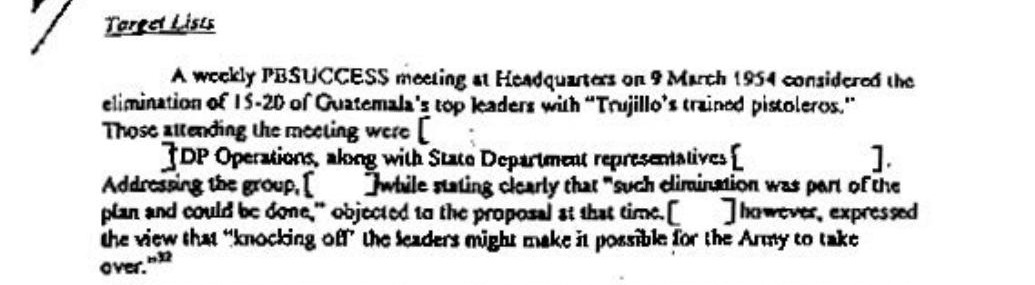
High-level deliberation about proposed targets
A selected passage from Haines, page 6, records high-level discussion of target numbers. It is a historical summary, not a final operational order. Image credit ↗

Chapter 04 / March–June 1954

A list was circulated before its evidence was sound

On 31 March 1954 a CIA memorandum asked staff officers to review individuals for a proposed disposal list associated with the opposition junta. It sought additions, deletions and concurrence, and requested prompt approval of a final list so planning could proceed. The document is evidence of a bureaucratic selection process: named categories, routing, review and an anticipated later decision. Its request for final approval cannot itself serve as proof that approval was subsequently given.

The State Department’s published edition preserves unusually revealing annotations. A handwritten note describes a copy going for checking with the junta, the movement of the original memorandum with biographic material in April, and its return on 1 June. Another annotation disputes the claim that recent intelligence had been used. The associated list is not printed in that edition. These details show continuing handling and unresolved evidentiary questions. They do not reveal the redacted identities or prove that every stage of review was completed.

The 1 June note for the files is more direct. Its author found biographic information out of date, relevant information missing and uncertainty about whether some people listed were Communists at all. The author concluded that no real analysis had yet determined who belonged on the list and recommended careful study before any disposal action. At the same time, the note referred to another memorandum recommending five people and acknowledged related cable traffic. It was not simply a humanitarian rejection of assassination; it was also an objection to the quality and completeness of the targeting process.

This record undermines two easy readings. The list was not merely an invented accusation against the CIA: contemporary officers were circulating it and questioning its contents. But its existence does not establish a settled, accurate and executed roster. The 58-person category in the earlier 1952 record, the March 1954 review, later suggestions about smaller numbers and the five-person reference cannot be added together as if they counted separate victims. Nor can public redactions be filled by matching a familiar Guatemalan political name to a later death. Each proposed target and outcome needs its own authenticated documentary connection.

Sources: H01 · F119 · F166

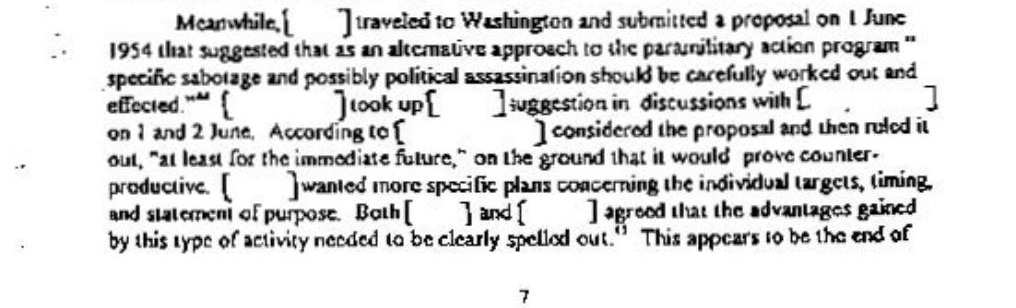
A temporary policy rejection and a request for further justification
Haines, page 7, selected concluding passage: a proposal was discussed and rejected for the immediate future, while further specification was requested. The passage continues on page 8 of the original. Image credit ↗

Chapter 05 / May–June 1954

Officials deferred the option without closing it forever

The late planning record contains more than lists. A 16 May 1954 memorandum proposed specific pre-invasion acts of violence. Its language connects the proposed killing of political figures to pressure on the government and the opposition’s demonstration of strength. The document establishes that officers were proposing lethal action within a political strategy. It does not supply approval or an after-action account. Reconstructing responsibility requires keeping the proposal’s author, its recipients and their responses separate.

Requests continued. Haines reports a 21 May request for permission for a proposal and says no headquarters reply had been located. A surviving 30 May cable asks for identities and information about four people previously discussed for early eradication. It confirms continuing interest and an information request. The absence of a located response is neither an authorization nor a documented refusal. The redacted identities also prevent the cable from supplying a public list of verified intended victims.

A 1 June draft memorandum proposed an alternative course if the integrated paramilitary plan proved difficult, including the possibility of political assassination. The most important recorded policy response appears in Frank Wisner’s 3 June memorandum of conversations with Assistant Secretary of State Henry Holland on June 1 and 2. Concerning a sensitive form of treatment, Holland ruled it out for the immediate future as likely counterproductive. Wisner also wrote that the decision was not conclusive and that more specific justification was requested. Read with the related draft and Haines’s reconstruction, this supports a temporary rejection of the assassination proposal, not a permanent moral or legal ban.

There were differences within State as well as within the CIA. The record of Ambassador John Peurifoy’s April remarks includes a suggestion that Foreign Minister Guillermo Toriello be eliminated. The context and Haines’s treatment make it relevant to the assassination discussions, while the memorandum still records a participant’s remarks rather than a completed order. These documents support serious institutional debate, encouragement and resistance. They do not support assigning every official one position, treating every discussion as authorization, or describing a limited deferral as proof that the option had vanished.

Sources: F151 · F164 · F167 · F170 · H01 · F131

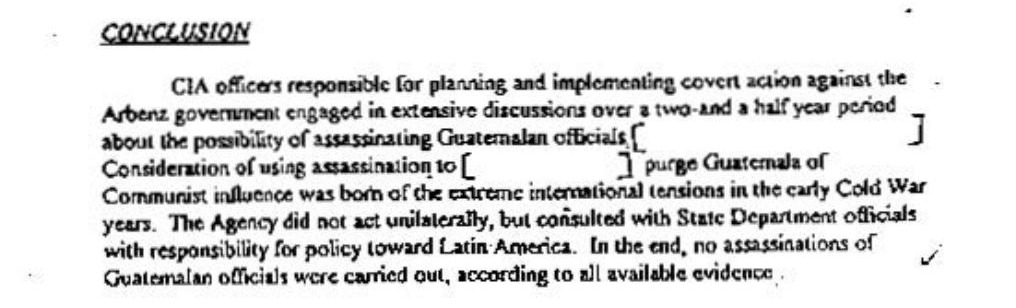
The institutional history’s stated conclusion
The conclusion on Haines, page 8, attributes nonimplementation to the available evidence. The extract excludes the preceding operational narrative. Image credit ↗

Chapter 06 / June 1954

The coup succeeded; the assassination conclusion is narrower

The fall of Árbenz was an accomplished intervention, with political pressure, propaganda, armed incursions and air operations interacting with decisions by Guatemalan officers. A 20 June CIA assessment still judged the outcome uncertain and treated the army’s position as decisive. Castillo Armas’s force was not an automatic substitute for that army. Officers, political leaders and the president made choices under coercive pressure; their actions cannot be reduced to the existence of a target list in an American file.

The assassination option also did not disappear neatly from the paper record. A 27 June memorandum proposed pressuring a potential collaborator and listed the assassination of Árbenz among possible outcomes advantageous to the operation. That is another proposal, written on the day the president resigned. It does not prove that the proposal was adopted, that the suggested pressure occurred, or that Árbenz was killed. His resignation speech instead described an ongoing war and transferred executive authority to Carlos Enrique Díaz. He survived the coup and later left Guatemala.

Haines concludes that no covert action plan involving assassination was approved or implemented and that available evidence showed no assassination of Guatemalan officials through the contemplated program. His access to operational records gives that conclusion weight. Its wording and provenance still matter: it is a retrospective institutional reconstruction, not a criminal judgment or a public, person-by-person reconciliation of all proposed names with all later deaths. The redacted identities and missing responses limit independent verification. They justify further inquiry without proving a hidden execution order.

Nor was the coup or its aftermath bloodless. A 29 June CIA station cable reported that prisoners from Salamá had been badly beaten and that guards had killed several. This is a contemporary report of violence, not a demonstrated link between those prisoners and the assassination lists. It makes a sweeping claim that no Guatemalan was killed untenable, while leaving the narrower implementation question open to its own evidence. The distinction is essential: rejecting an unproved assassination allegation does not erase documented coercion and killings, and documented killings do not automatically establish execution of a particular CIA proposal.

Sources: H01 · F214 · F243 · F260 · SPEECH

Preparation and nonimplementation in the concluding assessment
Haines, page 9: the staff history acknowledges extensive preparation while concluding that no assassination plan was approved or implemented. Both parts require scrutiny. Image credit ↗

Chapter 07 / 1979–2012 / later memory

Disclosure exposed planning and left a verification problem

The public record widened decades after the coup. The National Security Archive reports that assassination-related records were gathered in response to a 1979 freedom-of-information lawsuit but withheld, then encountered again during the CIA’s historical declassification work. Haines wrote his study in June 1995. A selection of records, including the study and redacted lists, was released in May 1997. The sequence distinguishes the date of an event, the date of a historical reconstruction and the date readers could inspect part of its evidence.

Disclosure changed what could responsibly be said. It made assassination planning and substantial preparation documentary facts rather than claims dependent only on critics’ testimony. It also exposed a problem in the agency’s own reassurance: when the public cannot identify the people on proposed lists, it cannot independently trace every person’s fate. The National Security Archive emphasized this limitation. Haines’s nonimplementation conclusion and the archive’s criticism can both be taken seriously. The former weighs the records available to an institutional historian; the latter identifies what the released record does not permit outsiders to check.

Guatemalan memory concerns more than American paperwork. The Árbenz family pursued claims concerning exile, property and the consequences of the overthrow. A friendly settlement signed with Guatemala in May 2011 acknowledged state responsibility for specified rights violations, and the Inter-American Commission approved a settlement report in March 2012. The monitoring record describes reparations and commemorative measures. This was an outcome involving the Guatemalan state and the family; it was not a conviction of CIA officers or a finding that a redacted assassination proposal had been executed.

A sound historical account therefore preserves two kinds of unfinished work. One asks how the coup altered Guatemalan institutions and lives, including abuses whose perpetrators and victims can be investigated in local records. The other asks whether a particular assassination proposal advanced beyond the documented stage. Newly authenticated target identities, complete routing and approval records, operational reports and independently corroborated victim histories could change that assessment. More forceful repetition of either the agency’s conclusion or its critics’ suspicions cannot replace those links. The existing evidence is already grave: political killing entered real official planning, even where the surviving record does not establish its execution.

Sources: H01 · RELEASE · NARA · IACHR · I11

02 / The record

The load-bearing chain

The official history is a starting yardstick, not the end of the inquiry

Gerald Haines’s 1995 CIA History Staff study acknowledges pervasive assassination proposals and real preparations, then concludes that no covert assassination plan was approved or implemented. This is the official institutional account used here as a yardstick; no survey of scholarly consensus is claimed. The contemporary records test particular steps in that account, while redacted names and missing responses limit independent checking.

Sources: H01 · RELEASE · F166 · F170

Evidence-support ranks assess the hinge exactly as stated, using the directness and timing of its records. Cultural-prominence labels separately describe documented attention in the specific public accounts inspected here. Audience reach and population belief are unmeasured: public availability, dramatic language and institutional publication are not popularity polls.

CP1

An intervention creates a setting for lethal proposals

Evidence support Strong / contemporary records plus retrospective reconstruction

Cultural prominence Documented public framing / audience reach unmeasured

Regional opposition agendas and U.S. regime-change policy converge, with lists and bargaining recorded before mature PBSUCCESS.

Where it fits

The early papers place lethal proposals within an intervention that joined American sponsorship to regional opposition projects. Seekford’s September 1952 report records Trujillo’s requested bargain and Castillo Armas’s response; the undated category-list cover separately identifies an original CIA headquarters list from February 1952. Neither source is an execution report.

Why it is critical

Distinguishes local initiative, outside sponsorship and American institutional responsibility.

If this hinge were removed

If the American list-making and sponsorship evidence failed, the account of U.S. institutional participation at this early stage would weaken. It would not erase independently documented opposition proposals or later CIA requests. If the regional initiative failed instead, a purely American origin would become more plausible, without proving that Washington ordered a killing.

Dependencies

Requires dates, the reporting chain and separate treatment of proposed executions and imprisonment.

What rival readings must explain

A Washington-only command narrative must explain regional initiative; an exclusively local account must explain CIA list-making and support.

Gaps and disputes

Seekford reports conversations rather than furnishing each participant’s own signed instruction. The list’s cover is undated, names are concealed, and the January precursor described by Haines is a separate chronological claim. A stronger reconstruction needs the underlying correspondence and version history.

Evidence-rank grounds

F018 and L01 directly support reported bargaining and CIA list origins; H01 supplies the wider reconstruction. Execution is outside this rating.

Cultural-rank grounds

The inspected 1997 Archive introduction foregrounds early lists; NARA’s 2012 guide names the operation and considers assassination. Neither supplies readership or belief data.

Sources: F018 · L01 · H01 · F040

CP2

Ideas become preparation without completing authorization

Evidence support Strong for preparation / mixed directness

Cultural prominence Documented public framing / audience reach unmeasured

Discussion, specialist preparation and tentative lists go beyond idle words, while broad project authority does not settle individual killing authority.

Where it fits

The general PBSUCCESS plan and the assassination proposals occupy different levels of authority. Haines’s conclusion acknowledges personnel selection, initial training and tentative lists, while contemporary memoranda advocate further action. This supports a preparation history even if the proposed operation never acquired a final approval.

Why it is critical

Identifies consequential conduct without substituting preparation for execution.

If this hinge were removed

Removing the preparation evidence would weaken the claim that institutional conduct went beyond discussion. It would leave the documented advocacy and list review intact. Removing the distinction between general project authority and a particular killing approval would change the question rather than supply the missing decision.

Dependencies

Requires staffing/training evidence, specific proposals and the exact scope of authorizing documents.

What rival readings must explain

A harmless-paper account must explain preparations; an approved-killing-program account needs the missing operative decision.

Gaps and disputes

Some preparations are known here through Haines’s retrospective review, not a separately obtained complete training or staffing file. His access gives weight to the account but does not make every underlying event independently corroborated. The missing permission replies remain a distinct gap.

Evidence-rank grounds

H01 explicitly acknowledges substantive preparations; F051 and F151 establish broader planning and advocacy. No final lethal authorization is inferred.

Cultural-rank grounds

The Archive’s document-one description emphasizes preparation and NARA explicitly lists Haines’s study. That verifies public availability and editorial attention, not the prevalence of a belief.

Sources: H01 · F051 · F151

CP3

List review exposes uncertain identities and data

Evidence support Strong / explicit contemporary criticism

Cultural prominence Documented public framing / audience reach unmeasured

March routing and the June 1 critique show a real selection process with inadequate biographic analysis and disputed classifications.

Where it fits

The March 31 memorandum asks for review and final approval, while its annotations trace circulation into June. The June 1 note disputes the currency of biographies and even some Communist classifications. The evidentiary hinge is an active, unresolved selection process, not simply the existence of a dramatic document title.

Why it is critical

Makes list quality and unresolved approval part of the story.

If this hinge were removed

Without the critique, the case that this list’s analysis was demonstrably inadequate would lose its strongest contemporary support. The March request would still establish selection work, and other proposals would survive. Without authenticated target names, neither a precise final roster nor a victim count follows.

Dependencies

Requires versions, annotations, biographies and authenticated target identities; counts from separate proposals cannot be added.

What rival readings must explain

A precise-final-victim-list account must supply the approved roster; an invented-planning account must explain contemporary paperwork.

Gaps and disputes

The associated March list is not printed in FRUS. The earlier 58-person category, the later reference to five people and other numerical proposals cannot be reconciled by addition. Full biographies, initials, replies and disposition records could resolve whether this version was revised, abandoned or used.

Evidence-rank grounds

F119 records the request and routing; F166 directly criticizes the analysis. The rating concerns list review and quality, not the fate of redacted people.

Cultural-rank grounds

The Archive’s selected document descriptions explicitly discuss redacted lists. No survey establishes whether readers remember the June 1 critique as often as the lists themselves.

Sources: F119 · F166

CP4

Policy response limits the immediate proposal

Evidence support Strong for qualified deferral / contextual identification

Cultural prominence Unmeasured cultural prominence

Holland–Wisner discussions reject the sensitive course for immediate future while leaving further justification open.

Where it fits

The June 3 record of Holland–Wisner discussions supplies a response that the other requests alone cannot. It rules the sensitive course out for the immediate future as counterproductive, then says the decision was not conclusive. The June 1 draft and Haines’s account establish the assassination context of that guarded wording.

Why it is critical

Establishes an actual response rather than reading silence as permission or final prohibition.

If this hinge were removed

If this memorandum were removed, the temporary policy rejection would lose its strongest contemporary anchor. Nonimplementation could still be argued from Haines’s review and the absence of a verified execution chain, but it could no longer rely on this specific response. Removing the qualification would falsely turn a deferral into a permanent ban.

Dependencies

Requires cross-reading the June 1 draft, June 3 record and Haines’s reconstruction of the sensitive reference.

What rival readings must explain

A blanket-approval account must confront rejection; a permanently closed-option account must confront the qualification and continuing proposals.

Gaps and disputes

The memorandum’s language is indirect, and identifying its referent depends on cross-reading. It records June 1–2 conversations, not every later discussion or subordinate action. The June 27 proposal prevents treating the earlier exchange as the last word on the option.

Evidence-rank grounds

F170 directly states the limit and qualification; F167 and H01 identify the relevant proposal. F243 shows later advocacy, not subsequent approval.

Cultural-rank grounds

No audience comparison in this corpus establishes how widely the qualified June decision figures in public memory. Its analytical importance is not a claim of public salience.

Sources: F167 · F170 · H01 · F243

CP5

Outcome and victim linkage remain separate questions

Evidence support Strong for survival and reported violence / linkage unestablished

Cultural prominence Documented public framing / audience reach unmeasured

Árbenz survives the coup; contemporary reports document other violence without supplying a match to the assassination lists.

Where it fits

The coup’s outcome and the proposed assassination chain require different evidence. Árbenz’s resignation and survival contradict a claim that he was killed in the overthrow. The June 29 station cable reports prisoners killed by guards, but identifies no link to the redacted lists. Both findings can stand together.

Why it is critical

Prevents both an invented execution chain and erasure of reported killings.

If this hinge were removed

Without the prisoner report, this corpus would lose a concrete contemporary example refuting a bloodless account; that would not prove the coup harmless. Without Árbenz’s survival, the claim concerning his own fate would change, but no other target’s outcome would be decided. A proven list-to-victim link would change the assassination finding for that case.

Dependencies

Requires person-specific orders, operational reports, deaths and independent corroboration, alongside the army’s decisions.

What rival readings must explain

An all-bloodless account contradicts contemporary reporting; a specific CIA-list-execution account needs an identified connection.

Gaps and disputes

The cable is a report, not a completed investigation of each death. The concealed names obstruct matching victims to proposed targets. Opposition, military, police and foreign-sponsored violence must be distinguished using identified perpetrators, orders and independent victim histories.

Evidence-rank grounds

SPEECH and subsequent family records establish survival; F260 documents the reported prisoner killings. These do not establish that a CIA assassination list was executed.

Cultural-rank grounds

The Archive introduction connects the coup to later repression; that is a prominent element within that particular presentation. It does not measure public belief or establish this guide’s narrower victim linkage.

Sources: F214 · F260 · SPEECH · H01 · IACHR

CP6

Disclosure permits scrutiny but not complete reconciliation

Evidence support Strong for the published disagreement / incomplete for all outcomes

Cultural prominence Documented public framing / audience reach unmeasured

1995 history and 1997 release establish the planning record publicly; redactions still limit independent fate-by-fate verification.

Where it fits

Haines’s June 1995 study and the May 1997 disclosure changed the public evidence available about assassination planning. The Archive’s document-one description explicitly repeats Haines’s nonimplementation conclusion and then challenges outsiders’ ability to verify it without the concealed names. This is a dispute about the completeness of verification, not proof that one side found an executed order.

Why it is critical

Keeps an institutional conclusion and its evidentiary limits visible together.

If this hinge were removed

Removing Haines’s conclusion would remove the principal official historical yardstick, while leaving the contemporary planning records. Removing the redactions would potentially improve independent fate-by-fate checking; it would not guarantee either implementation or cancellation. Removing the Archive’s criticism would erase a documented challenge to the release’s limits.

Dependencies

Requires fuller releases, original approval/response records, target identification and Guatemalan victim histories.

What rival readings must explain

A definitive institutional exoneration account overstates verification; a redactions-prove-execution account substitutes absence for positive linkage.

Gaps and disputes

This guide has not independently read the 1979 lawsuit file or every unreleased operational record. The release history here rests on the Archive’s account; NARA establishes an archival route, not a complete inventory. Missing or destroyed evidence cannot be specified without separate documentation of its loss.

Evidence-rank grounds

H01 and RELEASE directly establish the two stated positions. NARA identifies the collections. None completes an independent target-by-target reconciliation.

Cultural-rank grounds

The 1997 Archive presentation and 2012 NARA guide both explicitly route readers to Haines. This shows continuing documentary visibility, not readership, agreement or a population ranking.

Sources: H01 · RELEASE · NARA

03 / The record

How the accounts branch

Documented source relationships, parallel narratives and recurring hinges. Similar concerns do not by themselves prove borrowing.

Operational papers → institutional reconstruction

Contemporary memoranda and cables from 1952–1954 became the evidentiary base for Haines’s 1995 CIA History Staff analysis. His opening note identifies operational records as the principal source; the study’s conclusion joins preparation to nonimplementation.

Borrowing and dependence

This is a documented archival-to-history relationship. It does not make Haines and each cited memo independent witnesses to the same event, and it does not establish that the public version contains his entire source base.

Branch and limit

The uncertainty branch concerns missing replies and redacted identities. No destroyed-file branch is established by the records inspected here; a claim of destruction would need an authenticated destruction schedule, testimony or other specific evidence.

Recurring hinges: CP1 · CP2 · CP3 · CP4 · CP6

Sources: H01 · F119 · F166 · F170

Haines → the Archive’s 1997 critical presentation

Kate Doyle and Peter Kornbluh’s Electronic Briefing Book No. 4 identifies Haines’s study as document one, summarizes his preparation narrative and records his nonimplementation conclusion. It then argues that deleted names prevent outsiders from verifying that none of the targets was killed.

Borrowing and dependence

The citation and summary demonstrate direct use of Haines, rather than merely similar language. The Archive’s criticism changes the emphasis from what an institutional historian concluded to what a public release permits an outsider to check.

Branch and limit

That verification objection supports an open question about specific outcomes. An additional claim that a covert execution occurred is a further branch requiring identified victims and operational links; it is not demonstrated by the objection alone.

Recurring hinges: CP2 · CP3 · CP5 · CP6

Sources: H01 · RELEASE

Contemporary records → a separate test of the conclusion

The State Department’s FRUS edition presents the March routing memorandum, June list critique, qualified policy response and reports of violence as dated records with source notes. They supply a route back from historical conclusions to particular exchanges.

Borrowing and dependence

This guide cross-reads those records with Haines. It does not claim that every FRUS editor borrowed a conclusion from him, or that the same underlying record counts twice as corroboration.

Branch and limit

The June 1 critique supports a list-quality branch; the June 3 memorandum supports a qualified-deferral branch. Both recur in rival accounts because each constrains a different proposed path from planning to execution.

Recurring hinges: CP3 · CP4 · CP5

Sources: F119 · F166 · F170 · F260

Public release → NARA’s 2012 research route

Jason Clingerman’s National Archives essay names the 1994 Cullather history, Haines’s 1995 assassination study and the undated training document among the collection’s notable records. It describes releases in 1997 and 2003 and directs readers to College Park and the CIA reading room.

Borrowing and dependence

Its explicit titles and links establish documentary circulation. This guide has inspected the essay, not the whole Cullather volume or a set of popular histories; no whole-book omissions or literary borrowing chain is assigned to those unread works.

Branch and limit

The archival route broadens the possible inquiry beyond this small public selection, including maps and record groups. It neither endorses every operational allegation nor settles each assassination proposal.

Recurring hinges: CP1 · CP2 · CP6

Sources: NARA · H01 · RELEASE

The overthrow → a distinct Guatemalan rights narrative

The Árbenz family’s friendly settlement with Guatemala, signed in 2011 and reported by the IACHR in 2012, places exile, property, dignity and state responsibility within a later rights process. It carries a different question from the disposition of assassination lists.

Borrowing and dependence

A relationship between the overthrow and the family’s injuries is explicit in the settlement record. Borrowing from Haines or the Archive’s assassination interpretation is not established here.

Branch and limit

This is a parallel memory and accountability branch, not a conviction of CIA officers or a finding that a particular target list was executed. It returns to CP5’s distinction between the harm that is documented and the additional link a specific assassination claim would require.

Recurring hinges: CP5 · CP6

Sources: IACHR · I11 · SPEECH

04 / The record

Four interpretations tested against the record

Competing interpretations, stated at their strongest and tested against the same chain. Presenting a theory is not endorsing it.

Interpretation 01

Extensive planning that did not become an implemented assassination program

Best supported for the documented proposal chain

The strongest version

Haines had access to operational records and describes extensive preparation but no final approved and executed assassination plan; the surviving decision record includes objections and temporary rejection.

Accept

CP1 · CP2 · CP3 · CP4 · CP5 · CP6

Planning and preparation were real and institutionally consequential; the coup and reported violence occurred.

Remove or revise

No established hinge needs removal. The official conclusion must remain bounded to the contemplated program and available records; deleting CP6’s verification limit would overstate it.

Add to the path

Add authenticated cancellation/disposition records and target-by-target reconciliation to strengthen confidence; a linked approval and killing record would defeat the nonimplementation account in that case.

What must be wrong or incomplete

CP4’s actual deferral cannot alone explain every later proposal; this account also depends on Haines’s broader review and the present absence of a verified execution chain.

Must still explain

Redacted identities, missing replies, late proposals and the limits of a retrospective institutional search.

Assessment

CP2–CP5 connect preparation to recorded limitations without a verified victim-operation match. This supports a bounded nonimplementation conclusion, not proof that no political killing occurred.

What would change this assessment

Authenticated final approvals, matched operational reports and independently corroborated target deaths would overturn the conclusion for particular cases; complete rejected/cancelled case files would strengthen it.

Sources: H01 · F166 · F170 · F260

Interpretation 02

Lethal planning continued through informal or concealed authority

A serious verification question; execution not established here

The strongest version

Preparations, persistent requests, wide discretion and incomplete releases make it possible that actions escaped a formal authorization paper trail. Publicly redacted identities prevent outsiders from checking every fate.

Accept

CP1 · CP2 · CP3 · CP5 · CP6

The released record contains no demonstrated execution chain and includes real objections; a missing document does not itself prove what it contained.

Remove or revise

Remove neither the documented June deferral nor reported list-quality problems. Instead challenge the inference that these limited objections and Haines’s review capture every informal decision.

Add to the path

Add identified targets, an authenticated command or delegation channel, operational or financial records and independently corroborated deaths. A demonstrated false or incomplete institutional search would explain a gap but still not identify a victim by itself.

What must be wrong or incomplete

For an executed-program version to stand, the bounded nonimplementation conclusion must be wrong for an identified case, or an action must be shown to lie outside the institutional search’s scope. Redaction alone does not do that.

Must still explain

Which person was killed, by whom, on what instruction, and how the action connects to the proposed CIA program rather than other violence.

Assessment

CP3 and CP6 identify genuine gaps; CP4 supplies a qualified rejection and CP5 requires specific linkage. Broad suspicion cannot resolve that conflict by assuming the missing steps.

What would change this assessment

Newly authenticated target identities plus instructions, operational or payment records and independent victim evidence would strengthen a specific execution claim. A complete version history and disposition record could narrow it.

Sources: RELEASE · F119 · F164 · F170 · H01

Interpretation 03

Opposition and regional actors drove the killing proposals

Substantial evidence of initiative; incomplete as an exclusive account

The strongest version

Castillo Armas supplied lists and Trujillo bargained for deaths of his own opponents. Regional leaders could pursue violence for purposes different from Washington’s.

Accept

CP1 · CP3 · CP5 · CP6

Guatemalan and neighboring actors had agency; reports of their plans are not automatically American orders.

Remove or revise

An exclusively local version would have to remove or explain away CP1’s CIA list-making role and CP2’s American preparation. Regional initiative alone leaves those records standing.

Add to the path

Add opposition command files and communications with sponsors that identify who initiated, controlled and executed a particular action independently of American direction.

What must be wrong or incomplete

The claim that local actors initiated proposals can stand alongside American responsibility. The stronger claim that they alone owned the entire process conflicts with the surviving U.S. planning and review record.

Must still explain

CIA list-making, preparation, staff review, requests for permission and State/CIA discussions within an active U.S.-sponsored intervention.

Assessment

CP1 establishes local initiative; CP2–CP4 make it impossible to explain all proposals as outsiders’ ideas simply observed by uninvolved Americans.

What would change this assessment

Opposition command files, communications with sponsors and corroborated operational records could distinguish independent action, delegated action and American control in particular cases.

Sources: F018 · H01 · F119 · F170

Interpretation 04

The papers were only contingency planning or psychological pressure

Explains some records, understates the whole sequence

The strongest version

Some threats were intended to frighten rather than kill; planning included contingencies, officials objected, and eventual execution is not demonstrated.

Accept

CP1 · CP3 · CP4 · CP5 · CP6

The distinction between intimidation and killing appears explicitly, and final outcomes cannot be inferred from dramatic language alone.

Remove or revise

The harmless-paper version needs CP2’s substantive preparation to be mistaken, mischaracterized or disconnected from the proposals. It cannot simply erase that hinge because no executed killing is yet linked.

Add to the path

Add authenticated cancellation records, training/disposition files and communications identifying which actions were solely threats and which proposals were abandoned.

What must be wrong or incomplete

Evidence for particular intimidation limits can stand. A universal account of empty rhetoric fails if the acknowledged preparations and repeated requests were intended as serious options, even if they were ultimately stopped.

Must still explain

Repeated lethal proposals, specialist preparation, list review and requests for actual permission are more than harmless rhetoric.

Assessment

CP2–CP4 distinguish documented intimidation, contemplated killing and decision points. The absence of a proved assassination does not erase responsibility for preparing or advocating it.

What would change this assessment

Complete training, cancellation and implementation records could show which preparations were abandoned, which served threats, and whether any advanced into actual operations.

Sources: H01 · F151 · F164 · F166
05 / The record

Who makes which part of the story visible

Four inspected public accounts: an institutional history, an archival briefing, an archival guide and a rights record. These comparisons concern the specified texts, not unread books, films or entire institutions.

Gerald K. Haines — CIA History Staff analysis, June 1995

Narrative pages 1–9 inspected, with special comparison of the page 9 conclusion. This card concerns the study, not all CIA publications.

Amplifies

CP2: serious preparation, including personnel selection and tentative lists, is acknowledged. CP4: official disagreement and limits form part of the explanation for nonimplementation.

Recasts

The conclusion presents pervasive proposals alongside a finding that no covert assassination plan was approved or implemented. Planning therefore remains real in an account that rejects the completed-program claim.

Does not establish in this inspected account

The published, redacted narrative does not identify every proposed target or allow a complete independent fate-by-fate reconciliation (CP3/CP6). That is a limit of this inspected text, not a claim that Haines ignored records he privately saw.

CP2 · CP4 · CP6

Sources: H01

Kate Doyle and Peter Kornbluh — National Security Archive, 1997

Introduction and document-one, document-three and category-list descriptions inspected. This is a public archival presentation, not a population survey or a review of all the editors’ books.

Amplifies

CP1/CP2: early lists and substantive preparation. CP6: the release’s small scale and the obstacle created by concealed target identities.

Recasts

Their document-one description repeats Haines’s nonimplementation finding and turns attention to whether outsiders can verify it. The introduction places assassination proposals within the wider coup and subsequent repression.

Does not establish in this inspected account

The inspected presentation does not supply the specific target/order/action/death chain needed by CP5. Its broader account of later violence cannot by itself convert the redacted lists into a verified execution roster.

CP1 · CP2 · CP5 · CP6

Sources: RELEASE

Jason Clingerman — National Archives, 13 February 2012

The complete short essay “The CIA in Guatemala” inspected. Its role is archival orientation; audience reach is not measured.

Amplifies

CP1: the coup’s U.S. and Guatemalan participants. CP6: record groups, releases, maps and practical archival routes that exceed the handful of documents reproduced in a briefing.

Recasts

It describes assassination as considered and identifies Haines’s study as a notable documentary route. Its discussion makes the planning record part of a wider operation rather than presenting a separate assassination verdict.

Does not establish in this inspected account

The short essay does not resolve CP3’s target identities or CP4’s exact qualified policy exchange. This observation is confined to that essay; it makes no claim about every NARA holding or publication.

CP1 · CP3 · CP4 · CP6

Sources: NARA

IACHR — Árbenz family settlement and monitoring record

Agreement/report headings and relevant responsibility and reparation provisions inspected; the 2011 announcement was also read. This is a distinct legal-memory voice.

Amplifies

CP5/CP6: the overthrow’s enduring injuries, Guatemala’s recognition of responsibility and reparations or commemorative measures.

Recasts

The story becomes one of a family’s rights and a state’s obligations, rather than only a dispute about American operational paperwork.

Does not establish in this inspected account

The settlement does not determine whether a redacted CIA assassination proposal was executed and does not convict CIA officers. This is a jurisdictional and claim-scope distinction, not a discounting of the acknowledged harms.

CP5 · CP6

Sources: IACHR

06 / The record

Find a thread in the file

Search the chapter and claim index. Every result leads to the full text and its sources.

Chapter 01Before the coup plan, there were already listsChapter 02Stopping PBFORTUNE did not settle the questionChapter 03Preparation went beyond a passing suggestionChapter 04A list was circulated before its evidence was soundChapter 05Officials deferred the option without closing it foreverChapter 06The coup succeeded; the assassination conclusion is narrowerChapter 07Disclosure exposed planning and left a verification problemClaim / EstablishedCIA-associated assassination proposals in Guatemala are documented.Claim / ContradictedThe earlier 58-person execution category is a verified list of 58 people killed.Claim / Not establishedApproval of PBSUCCESS proves approval of every assassination proposal.Claim / Not establishedThe 31 March list was already a completed, approved execution roster.Claim / EstablishedPreparations went beyond a single casual suggestion.Claim / ContradictedHolland permanently banned assassination in June 1954.Claim / Not establishedA missing headquarters response is affirmative authorization.Claim / EstablishedHaines concluded no covert assassination plan was approved or implemented.Claim / ContradictedNo Guatemalan was killed during the coup or aftermath.Claim / Not establishedThe redactions prove a hidden implemented assassination order.Claim / ContradictedAll initiative came from Washington.Claim / ContradictedÁrbenz was killed in the 1954 coup.Claim / ContradictedThe Árbenz family settlement convicted CIA officers of assassination.

07 / The record

People and institutions

Open a record for the person’s role and supporting sources. Names identify people; no unverified portrait is substituted for a participant.

GuzmánBiographical record
Jacobo Árbenz GuzmánElected Guatemalan president

His reform coalition, opposition and decisions are distinct from Washington’s assumptions about Communist control. Resigned 27 June 1954, survived the coup and later left the country. His family pursued a separate rights and property settlement.

Sources: F035 · F006 · SPEECH · I11

ArmasBiographical record
Carlos Castillo ArmasGuatemalan opposition leader

Proposed violence and sought regional/U.S. sponsorship. His list and reported bargaining are evidence of local initiative; they do not establish execution of every plan or total independence from American support.

Sources: F018 · H01

GarcíaBiographical record
Anastasio Somoza GarcíaNicaraguan ruler

Helped promote the opposition project and offered support. His regional ambitions were part of the intervention’s origins, rather than mere scenery for a Washington-only story.

Sources: H01

TrujilloBiographical record
Rafael TrujilloDominican ruler

An intermediary reported his request for four Dominican exiles to be killed in exchange for assistance. Reported bargaining is not proof those deaths occurred.

Sources: F018

BernardinoBiographical record
Félix W. BernardinoTrujillo intermediary

Named in Seekford’s September 1952 report as the representative conveying the Dominican offer and demand. The report establishes what the CIA contact was told.

Sources: F018

SeekfordBiographical record
Jacob R. SeekfordCIA contact with Castillo Armas

Reported on opposition plans and regional bargaining; his role links outside sponsorship and local proposals without converting every report into headquarters approval.

Sources: F018 · H01

SmithBiographical record
Walter Bedell SmithDirector of Central Intelligence, 1950–1953

Haines dates his formal PBFORTUNE approval to 9 September 1952 and subsequent termination to October. Those decisions concern the project and do not establish approval of an individual assassination.

Sources: H01 · F020 · F024

DullesBiographical record
Allen W. DullesCIA deputy director, then director

Part of the leadership organizing the broader intervention. High-level sponsorship of PBSUCCESS must be distinguished from proof of a particular assassination authorization.

Sources: H01 · F040 · F051

WisnerBiographical record
Frank G. WisnerDeputy Director for Plans

Drafted the 3 June 1954 memorandum recording discussions with Henry Holland, including a temporary rejection of the sensitive proposal and a request for more justification.

Sources: F170

HollandBiographical record
Henry F. HollandAssistant Secretary of State for Inter-American Affairs

In Wisner’s account, ruled out the sensitive form of treatment for the immediate future as counterproductive. The same record says the decision was not conclusive.

Sources: F170

PeurifoyBiographical record
John E. PeurifoyU.S. ambassador in Guatemala

The April 1954 meeting account records a suggestion that Toriello be eliminated. This identifies advocacy in a reported conversation, not a completed operational instruction.

Sources: F131 · H01

TorielloBiographical record
Guillermo TorielloGuatemalan foreign minister

Named in Peurifoy’s recorded remarks. Being mentioned in a proposal does not establish the content of all redacted lists or a subsequent attack.

Sources: F131

DíazBiographical record
Carlos Enrique DíazGuatemalan army chief

Received executive authority in Árbenz’s resignation address. The army’s choices were central to the immediate outcome, beyond any proposed target list.

Sources: SPEECH · F214

HainesBiographical record
Gerald K. HainesCIA History Staff historian

Wrote the June 1995 study based mainly on operational records. Its acknowledgement of extensive preparation and its nonimplementation conclusion both receive scrutiny.

Sources: H01

KornbluhBiographical record
Kate Doyle and Peter KornbluhNational Security Archive editors

Published and interpreted the 1997 release, emphasizing that redacted target identities obstruct independent verification of every fate. Their archival argument is attributed.

Sources: RELEASE

familyBiographical record
Erick Árbenz and the Árbenz familyPetitioners and relatives

Pursued redress through a settlement with Guatemala concerning exile, property and related rights. The outcome is distinct from adjudication of a CIA assassination operation.

Sources: I11

listsBiographical record
People on redacted listsProposed targets with concealed identities

Several records conceal names. Categories and counts cannot safely be joined to later victims without authenticated identification and an event-specific chain.

Sources: F119 · F166 · H01

08 / The record

Proposals, decisions and disclosure

Horizontal spacing shows elapsed time; separate rows keep close events selectable. Scroll the graph on narrow screens. Exact dates are attributed where records conflict; month- and year-only dates preserve source precision.

19521967198219972012
Early list-making described in CIA historyRetrospective reconstruction

Haines traces prospective elimination and imprisonment lists to January 1952. The date comes from his cited reconstruction, not a newly authenticated signature page here.

Sources: H01

Estimate assesses Communist influenceIntelligence judgment

A contemporary estimate documents the security interpretation that helped frame policy; it is an assessment to compare with nationalist and reform objectives.

Sources: F006

Somoza promotes support for oppositionRegional initiative

Haines links Somoza’s Washington visit to investigation of assistance for Castillo Armas. Reported influence and formal approval remain distinct.

Sources: H01

PBFORTUNE formally approvedProject authority

Haines dates Smith’s formal approval to this day; it is broader project approval, not a specific assassination order.

Sources: H01

Seekford reports the Trujillo bargainContemporary report

A report describes aid offered in return for four Dominican exiles’ deaths and Castillo Armas’s reported response. It does not document execution.

Sources: F018

CIA records the project’s haltCancellation

Contemporary chronology and memorandum describe compromised arrangements and State Department intervention. Discussions did not all disappear with cancellation.

Sources: F020 · F024

State analyzes agrarian reformPolicy context

Land reform and company concerns are examined in a State intelligence report. These issues do not prove every subsequent allegation about control.

Sources: F035

High priority authorization recordedBroader operation

Psychological Strategy Board minute and filing correspondence identify PBSUCCESS. No separate assassination authorization is supplied by this minute.

Sources: F040

General plan combines several pressuresPlanning

The broader plan contains political, psychological and paramilitary components; its stages do not establish execution of every suggestion.

Sources: F051

Preparation paper requestedPreparation

Haines describes a request related to assassination training. Its existence is summarized for institutional significance; methods are not reproduced.

Sources: H01

High-level discussion of eliminationDeliberation

Haines describes disagreement at a PBSUCCESS meeting attended by CIA and State representatives. Consideration is not final approval.

Sources: H01

Staff asked to review disposal listList review

Memo requests additions, deletions and prompt final approval. Related names are not printed; annotation disputes use of recent intelligence.

Sources: F119

List and biographies continue circulatingRouting

Annotation records movement of the memorandum and associated biographic data; Haines describes consultation with Castillo Armas. Routing is not execution.

Sources: F119 · H01

Peurifoy’s remarks recordedAdvocacy

Meeting account includes a suggestion about eliminating Toriello; it remains a record of remarks rather than an implemented order.

Sources: F131

Pre-invasion violence proposedProposal

Memo advocates specific lethal acts within a pressure campaign. This guide reports status and significance without operational schedules.

Sources: F151

Permission requested, reply not locatedRequest

Haines reports a request and says no headquarters reply was found. Missing response is neither approval nor documented refusal.

Sources: H01

Cable requests four identitiesInformation request

Contemporary cable requests identities and information about four people discussed for early eradication. It does not establish completed action.

Sources: F164

List critique questions analysisInternal objection

Note finds outdated data, doubtful classifications and no real analysis; recommends study before disposal. A separate five-person recommendation is referenced.

Sources: F166

Alternative course includes assassinationDraft contingency

Draft proposes possible political assassination if the integrated paramilitary course proves difficult. A draft is not a final decision.

Sources: F167

Wisner records a temporary rejectionPolicy response

Memo of June 1–2 discussions says Holland ruled sensitive treatment out for immediate future, but not conclusively, and requested further justification.

Sources: F170

Army position remains decisiveUncertain outcome

CIA assessment says rebel defeat is possible if army remains loyal and commits itself. Guatemalan decisions remain part of the causal chain.

Sources: F214

Another pressure proposal circulatesProposal

Memo includes assassination of Árbenz among possible outcomes of proposed pressure on a collaborator. No adoption or execution is established.

Sources: F243

Árbenz resigns and transfers authorityPolitical outcome

The address transfers executive authority to Díaz. Árbenz survives; his account of the war is a primary participant voice.

Sources: SPEECH

Station reports prisoner killingsReported violence

Cable reports beaten Salamá prisoners and several killed by guards. No authenticated match to the redacted assassination lists is supplied.

Sources: F260

Records gathered in response to lawsuitDisclosure history

National Security Archive describes earlier collection and withholding of assassination records; not a public release at that time.

Sources: RELEASE

Haines completes CIA historyInstitutional review

Study acknowledges extensive discussion and preparation while concluding no assassination plan was approved or implemented.

Sources: H01

Assassination records releasedPublic disclosure

National Security Archive identifies the release date and highlights redactions that obstruct fate-by-fate verification.

Sources: RELEASE

Family and Guatemala sign settlementRights and memory

Agreement concerns Guatemala’s responsibility for specified rights violations against Árbenz and family; not a CIA assassination conviction.

Sources: I11

Commission settlement report publishedLegal outcome

Monitoring record identifies report 30/12. The case’s scope remains distinct from the assassination implementation question.

Sources: IACHR

09 / The record

What the evidence supports

Ratings apply to the precise proposition on the page. Unsupported means the assembled evidence does not establish a claim; it is not interchangeable with false.

Established

CIA-associated assassination proposals in Guatemala are documented.

Contemporary selection, proposal, information-request and policy records establish a real planning history.

Sources: F119 · F151 · F164 · F170

Contradicted

The earlier 58-person execution category is a verified list of 58 people killed.

It is a proposed category in the 1952 record, whose cover identifies headquarters origins and Castillo Armas revision, separate from 74 people for imprisonment/exile. No such victim-count conversion is supported.

Sources: H01 · L01

Not established

Approval of PBSUCCESS proves approval of every assassination proposal.

Broader project authority and a particular lethal decision are distinct; requests and objections require separate reading.

Sources: F040 · F170

Not established

The 31 March list was already a completed, approved execution roster.

The memorandum requests review and approval, while annotations and June 1 critique reveal unfinished evidentiary work.

Sources: F119 · F166

Established

Preparations went beyond a single casual suggestion.

Haines acknowledges personnel selection, training and tentative lists; contemporary records repeatedly propose action and seek information.

Sources: H01 · F151 · F164

Contradicted

Holland permanently banned assassination in June 1954.

Wisner records rejection for immediate future but says the decision was not conclusive and further justification was requested.

Sources: F170

Not established

A missing headquarters response is affirmative authorization.

No located reply cannot decide approval, rejection or later implementation.

Sources: H01 · F164

Established

Haines concluded no covert assassination plan was approved or implemented.

This is the explicit institutional historical conclusion on page 9; its existence and its ultimate completeness are different propositions.

Sources: H01

Contradicted

No Guatemalan was killed during the coup or aftermath.

The June 29 station cable reports several Salamá prisoners killed by guards; it does not identify a match to the assassination lists.

Sources: F260

Not established

The redactions prove a hidden implemented assassination order.

They obstruct verification but cannot supply the missing instruction, action and victim linkage.

Sources: F119 · RELEASE · H01

Contradicted

All initiative came from Washington.

Castillo Armas’s proposals and the reported Trujillo bargain demonstrate local and regional initiative alongside American responsibility.

Sources: F018 · H01

Contradicted

Árbenz was killed in the 1954 coup.

He resigned, transferred authority and survived; later family settlement concerns exile and other harms.

Sources: SPEECH · IACHR

Contradicted

The Árbenz family settlement convicted CIA officers of assassination.

The settlement involved Guatemala’s responsibility for specified rights violations and reparations, not such a conviction.

Sources: IACHR

10 / The record

Read the witnesses and the record

Primary voices and documentary context. Outbound records need an internet connection.

Primary participant voice

Read Árbenz’s resignation address ↗

An educational reproduction of a CIA transcript preserves the president’s account and transfer to Díaz. The accusations are a participant’s explanation to compare with operational records.

Contemporary decision record

Read the Holland–Wisner policy discussion ↗

The sensitive-treatment paragraph records a limited rejection and further requests. Other parts concern the wider intervention; this guide summarizes significance without operational instructions.

Institutional history

Read Haines’s conclusions ↗

Pages 8–9 contain the historical conclusion of nonimplementation and acknowledgement of preparation. The full source contains additional operational material and remains an outbound research reference.

Archival route

Locate the Guatemala collections ↗

National Archives identifies the records and finding routes. There is no claim that every surviving operational or Guatemalan victim file has been examined.

11 / The record

How the story changed

Public memory tends to compress contested histories into a turning point. The records leave a less tidy sequence.

An official secret becomes an inspectable record

ThenOperational planning and earlier withheld records were not available as a public documentary chain.

ReconsideredThe 1997 release established serious planning while concealing target identities. Public knowledge expanded without becoming a complete audit.

Sources: H01 · RELEASE

A conclusion is larger when its limits disappear

ThenThe CIA history found no approved/implemented assassination plan in the available record.

ReconsideredThat bounded finding cannot become a claim that the coup was bloodless or that every victim and instruction has been reconciled.

Sources: H01 · F260

Guatemalan memory extends beyond CIA decision papers

ThenExile, property loss and the consequences of overthrow affected a family and a political community.

ReconsideredThe 2011 settlement and 2012 report provide a distinct rights outcome. They do not adjudicate the redacted assassination proposals.

Sources: I11 · SPEECH

12 / The record

The questions still open

A documented limit is more useful than a confident number or a sweeping lineage the evidence cannot carry.

  1. Which authenticated names belong to each version of the proposed lists, rather than to an unrelated political roster?
  2. What replies, if any, answered the permission requests that the institutional history could not locate?
  3. Can a proposed target be linked through instructions and operational reporting to a specific death documented independently in Guatemalan records?
  4. What do opposition and regional-sponsor archives reveal about action taken independently of, or with, American approval?
  5. What became of the full biographies, review annotations and disposition files underlying the June 1 critique?

13 / The record

Go back to the sources

Records, reporting, and firsthand accounts have different evidentiary roles. Each source note explains what it can establish and where caution is needed. Sources consulted for this edition on 25 October 2026. Original records and attributed reporting have distinct evidentiary roles.

  1. H01

    Declassified institutional history

    CIA and Guatemala Assassination Proposals, 1952–1954 ↗

    Gerald K. Haines, CIA History Staff, June 1995

    Narrative pages 1–9 visually inspected. Relies mainly on Directorate of Operations records; footnotes identify underlying sources, some not separately obtained. Its conclusion of no approved/implemented assassination plan is attributed rather than treated as a judicial finding. Only selected noninstructional federal-authored extracts reproduced; full study private. The page 8 invasion chronology is not used for an exact border-crossing date.

  2. F006

    Contemporary primary record in official edition

    National Intelligence Estimate, 11 March 1952 ↗

    U.S. Department of State, FRUS 1952–1954, Guatemala; CIA/State original identified in source note

    Contemporary assessment of Communist influence and nationalist motives; estimates and forecasts are official judgments, not a substitute for Guatemalan voices. Local original EPUB and extracted record retained from the existing Guatemala primary corpus; this guide’s specific use checked separately.

  3. F018

    Contemporary primary record in official edition

    Seekford to J.C. King, 18 September 1952 ↗

    U.S. Department of State, FRUS 1952–1954, Guatemala; CIA/State original identified in source note

    Contemporary intermediary report of Trujillo’s proposed bargain involving four Dominican exiles. A reported agreement is not proof of CIA authorization or execution. Local original EPUB and extracted record retained from the existing Guatemala primary corpus; this guide’s specific use checked separately.

  4. F020

    Contemporary primary record in official edition

    CIA PBFORTUNE chronology, 8 October 1952 ↗

    U.S. Department of State, FRUS 1952–1954, Guatemala; CIA/State original identified in source note

    Project preparations and State Department intervention; read as an internal reconstruction of the earlier effort. Local original EPUB and extracted record retained from the existing Guatemala primary corpus; this guide’s specific use checked separately.

  5. F024

    Contemporary primary record in official edition

    CIA memorandum on cancellation, 8 October 1952 ↗

    U.S. Department of State, FRUS 1952–1954, Guatemala; CIA/State original identified in source note

    Records cancellation and secrecy issues. Does not prove that every associated discussion ended. Local original EPUB and extracted record retained from the existing Guatemala primary corpus; this guide’s specific use checked separately.

  6. F035

    Contemporary primary record in official edition

    State intelligence report on agrarian reform, 5 March 1953 ↗

    U.S. Department of State, FRUS 1952–1954, Guatemala; CIA/State original identified in source note

    Context for land reform and United Fruit; company concerns, predicted effects and implementation are distinguished. Local original EPUB and extracted record retained from the existing Guatemala primary corpus; this guide’s specific use checked separately.

  7. F040

    Contemporary primary record in official edition

    Psychological Strategy Board authorization minute, 12 August 1953 ↗

    U.S. Department of State, FRUS 1952–1954, Guatemala; CIA/State original identified in source note

    Minute and later filing correspondence authorize the broader PBSUCCESS project; not a separately identified assassination order. Local original EPUB and extracted record retained from the existing Guatemala primary corpus; this guide’s specific use checked separately.

  8. F051

    Contemporary primary record in official edition

    Guatemala general plan, 11 September 1953 ↗

    U.S. Department of State, FRUS 1952–1954, Guatemala; CIA/State original identified in source note

    Broad political, psychological and paramilitary framework. Planned stages are not proof all were executed. Local original EPUB and extracted record retained from the existing Guatemala primary corpus; this guide’s specific use checked separately.

  9. F119

    Contemporary primary record in official edition

    Selection of individuals for disposal by Junta Group, 31 March 1954 ↗

    U.S. Department of State, FRUS 1952–1954, Guatemala; CIA/State original identified in source note

    Original memorandum and editorial transcription of routing annotations; related list not printed. Requests final approval, and the annotation disputes use of recent intelligence. Local original EPUB and extracted record retained from the existing Guatemala primary corpus; this guide’s specific use checked separately.

  10. F131

    Contemporary primary record in official edition

    Peurifoy’s remarks, 21 April 1954 ↗

    U.S. Department of State, FRUS 1952–1954, Guatemala; CIA/State original identified in source note

    CIA meeting account includes the suggestion that Toriello be eliminated. Participant remarks and reporting do not establish an implemented order. Local original EPUB and extracted record retained from the existing Guatemala primary corpus; this guide’s specific use checked separately.

  11. F151

    Contemporary primary record in official edition

    Acts of Force Before D-Day, 16 May 1954 ↗

    U.S. Department of State, FRUS 1952–1954, Guatemala; CIA/State original identified in source note

    Proposal for violence; read for institutional advocacy and request status. Operational details are not reproduced in this guide. Local original EPUB and extracted record retained from the existing Guatemala primary corpus; this guide’s specific use checked separately.

  12. F164

    Contemporary primary record in official edition

    Cadick cable requesting identities, 30 May 1954 ↗

    U.S. Department of State, FRUS 1952–1954, Guatemala; CIA/State original identified in source note

    Contemporary request about four proposed people; identities redacted. Confirms continued interest, not execution. Local original EPUB and extracted record retained from the existing Guatemala primary corpus; this guide’s specific use checked separately.

  13. F166

    Contemporary primary record in official edition

    Disposal List Prepared by C/EW, 1 June 1954 ↗

    U.S. Department of State, FRUS 1952–1954, Guatemala; CIA/State original identified in source note

    Explicit criticism of outdated biographic data and lack of analysis before any disposal action. Refers to a separate five-person recommendation; does not document final approval. Local original EPUB and extracted record retained from the existing Guatemala primary corpus; this guide’s specific use checked separately.

  14. F167

    Contemporary primary record in official edition

    Draft on the possible future course of PBSUCCESS, 1 June 1954 ↗

    U.S. Department of State, FRUS 1952–1954, Guatemala; CIA/State original identified in source note

    Alternative proposal includes possible political assassination. A draft contingency proposal, not an authorization or after-action report. Local original EPUB and extracted record retained from the existing Guatemala primary corpus; this guide’s specific use checked separately.

  15. F170

    Contemporary primary record in official edition

    Wisner memorandum of Holland–Wisner discussions, 3 June 1954 ↗

    U.S. Department of State, FRUS 1952–1954, Guatemala; CIA/State original identified in source note

    Records 1–2 June conversations: sensitive treatment ruled out for immediate future as counterproductive; decision not conclusive and more justification requested. Cross-read with draft 167 and Haines. Local original EPUB and extracted record retained from the existing Guatemala primary corpus; this guide’s specific use checked separately.

  16. F214

    Contemporary primary record in official edition

    CIA assessment of the uncertain outcome, 20 June 1954 ↗

    U.S. Department of State, FRUS 1952–1954, Guatemala; CIA/State original identified in source note

    Army position treated as decisive while rebel success remained uncertain. Does not reduce Guatemalan officers to passive instruments. Local original EPUB and extracted record retained from the existing Guatemala primary corpus; this guide’s specific use checked separately.

  17. F243

    Contemporary primary record in official edition

    Proposal concerning a potential collaborator, 27 June 1954 ↗

    U.S. Department of State, FRUS 1952–1954, Guatemala; CIA/State original identified in source note

    Another pressure proposal mentions assassination of Árbenz as one possible result. Not evidence the proposal was adopted or Árbenz killed. Local original EPUB and extracted record retained from the existing Guatemala primary corpus; this guide’s specific use checked separately.

  18. F260

    Contemporary primary record in official edition

    Guatemala station cable, 29 June 1954 ↗

    U.S. Department of State, FRUS 1952–1954, Guatemala; CIA/State original identified in source note

    Reports badly beaten Salamá prisoners and several killed by guards. Evidence of reported violence, not an authenticated link to redacted assassination lists. Local original EPUB and extracted record retained from the existing Guatemala primary corpus; this guide’s specific use checked separately.

  19. RELEASE

    Document release and archival interpretation

    CIA and Assassinations: The Guatemala 1954 Documents ↗

    Kate Doyle and Peter Kornbluh, National Security Archive, 1997

    Release account and document descriptions consulted. Supports 23 May 1997 disclosure and explains the verification problem posed by redacted target identities. Its criticism and contextual claims remain attributed; historical killing instructions on the page are not reproduced here.

  20. NARA

    Archival guide

    The CIA in Guatemala ↗

    U.S. National Archives, 13 February 2012

    Locates PBSUCCESS/PBHISTORY collections and the Haines study; not a complete surviving-record inventory.

  21. SPEECH

    Primary voice in educational reproduction

    Árbenz’s resignation speech, 27 June 1954 ↗

    Árbenz speech, CIA transcript in UMBC/Baltimore County educational reproduction

    One-page transcript read. Records the president’s accusations and transfer to Díaz. His causal explanation is attributed, not adopted as independent proof of every killing. Copyrighted classroom framing stays private.

  22. IACHR

    Official settlement monitoring record

    Monitoring of friendly settlement, Case 12.546, Juan Jacobo Árbenz Guzmán ↗

    Inter-American Commission on Human Rights

    Pages 1–2 and relevant responsibility/reparation clauses consulted. Agreement 19 May 2011; report 30/12 dated 20 March 2012. Concerns Guatemala’s obligations and family rights, not a CIA assassination conviction. The form has internal date/report-number inconsistencies; this guide uses its clearly identified agreement/report headings, not those stray details. No OAS pages redistributed.

  23. L01

    Original category-list memorandum

    Guatemalan Communist Personnel to be disposed of during Military Operations of Calligeris ↗

    CIA record; originating name and date withheld in the released copy

    Three-page record retained. Cover visually read: separates executive action from imprisonment/exile and says Castillo Armas revised an original headquarters list prepared in February 1952. Names concealed. Undated cover must not be given the date of a different memorandum. Full record remains private; government custody is not used as blanket rights clearance.

  24. I11

    Official contemporaneous settlement announcement

    IACHR welcomes the Árbenz friendly settlement, 20 May 2011 ↗

    Inter-American Commission on Human Rights, press release 46/11

    Actual official webpage read through web retrieval; raw local fetch redirected repeatedly and failed, recorded honestly. Confirms 19 May 2011 agreement and the scope of Guatemala’s recognition of responsibility. No claim of CIA conviction; no reliance on stray case-number/election-year details in the announcement.

Images, documents & licensing

Haines’s study identifies its documentary scope (PDF page 1) — Gerald K. Haines, CIA History Staff. U.S. federal employee-authored CIA History Staff analysis; public domain in the United States under 17 USC §105. Source & license ↗. Selected authentic passage or page, cropped where identified in its caption; rasterized and re-encoded. Only selected federal-authored report passages are reproduced; private enclosures and operational instructions are excluded.

PBFORTUNE and earlier list-making (PDF page 2) — Gerald K. Haines, CIA History Staff. U.S. federal employee-authored CIA History Staff analysis; public domain in the United States under 17 USC §105. Source & license ↗. Selected authentic passage or page, cropped where identified in its caption; rasterized and re-encoded. Only selected federal-authored report passages are reproduced; private enclosures and operational instructions are excluded.

The broader PBSUCCESS mandate and command structure (PDF page 4) — Gerald K. Haines, CIA History Staff. U.S. federal employee-authored CIA History Staff analysis; public domain in the United States under 17 USC §105. Source & license ↗. Selected authentic passage or page, cropped where identified in its caption; rasterized and re-encoded. Only selected federal-authored report passages are reproduced; private enclosures and operational instructions are excluded.

High-level deliberation about proposed targets (PDF page 6) — Gerald K. Haines, CIA History Staff. U.S. federal employee-authored CIA History Staff analysis; public domain in the United States under 17 USC §105. Source & license ↗. Selected authentic passage or page, cropped where identified in its caption; rasterized and re-encoded. Only selected federal-authored report passages are reproduced; private enclosures and operational instructions are excluded.

A temporary policy rejection and a request for further justification (PDF page 7) — Gerald K. Haines, CIA History Staff. U.S. federal employee-authored CIA History Staff analysis; public domain in the United States under 17 USC §105. Source & license ↗. Selected authentic passage or page, cropped where identified in its caption; rasterized and re-encoded. Only selected federal-authored report passages are reproduced; private enclosures and operational instructions are excluded.

The institutional history’s stated conclusion (PDF page 8) — Gerald K. Haines, CIA History Staff. U.S. federal employee-authored CIA History Staff analysis; public domain in the United States under 17 USC §105. Source & license ↗. Selected authentic passage or page, cropped where identified in its caption; rasterized and re-encoded. Only selected federal-authored report passages are reproduced; private enclosures and operational instructions are excluded.

Preparation and nonimplementation in the concluding assessment (PDF page 9) — Gerald K. Haines, CIA History Staff. U.S. federal employee-authored CIA History Staff analysis; public domain in the United States under 17 USC §105. Source & license ↗. Selected authentic passage or page, cropped where identified in its caption; rasterized and re-encoded. Only selected federal-authored report passages are reproduced; private enclosures and operational instructions are excluded.

Typefaces: Inter, Playfair Display and Source Serif 4, the shared AI Files reference set, distributed under the SIL Open Font License. Exact files and license text are included in assets/fonts in the offline package. Documentary images reproduce original U.S. government-authored historical-analysis passages. No AI-generated photographs, portraits or document facsimiles are used.

Uniform evidence

One standard for every case.

Authorization, expectation, recommendation and executed action are different facts. Participant explanations and official commemorations are claims to test, never deciding proof. The same standard applies to all agencies and participants. Uncertainty remains labeled.

Publication status

Prepared for staging review.

This locally prepared package is intended for the ChatGPT submission lane under Spec v7. It has not received a Grok editorial grade or approval for promotion. The live submission manifest, when registered, records its review status. Submission queue and status ↗