PRPUBLIC RECORDAn independent history guide

File 031 / United States / German American Bund

The German American Bund

American flags.
Nazi politics.

The German American Bund sold Nazism as American patriotism. Its public violence and foreign connections were real; its strength, the degree of German control and the government’s case against each individual require separate answers.

1936–1941 / origins and selected aftermath, 1924–2024Context & afterlifeThe Bund, 1936–1941The central years7 chaptersOne continuous story
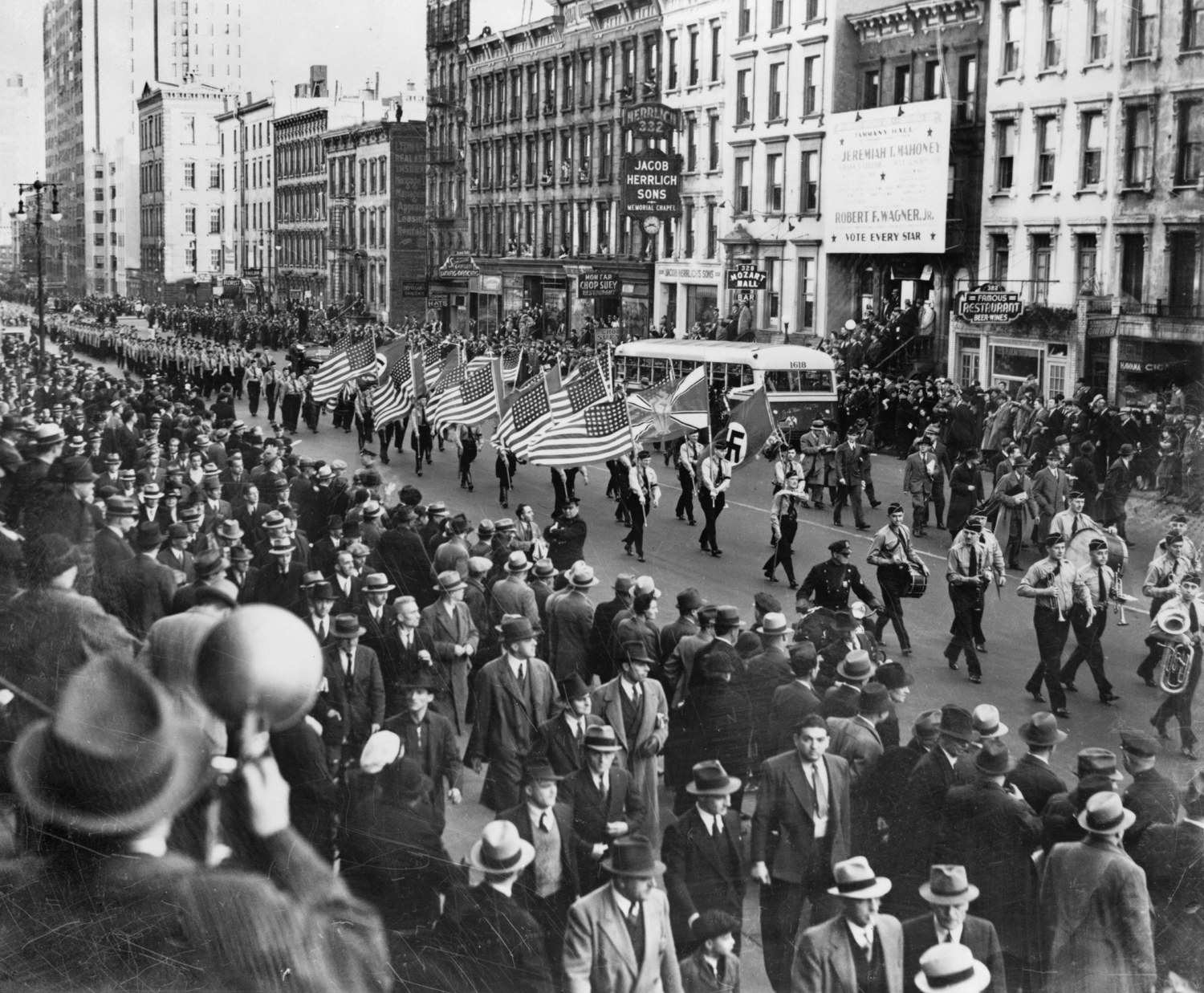
East 86th Street, New York / 30 October 1937
Bund parade on East 86th Street, New York, 30 October 1937
Organization
Allegiance
Conduct

A World-Telegram staff photograph of a Bund procession in Yorkville. This is a 1937 street parade, not the 1939 Madison Square Garden rally. Image credit ↗

Scope & method / Edition 1.0

The organization and the individual are different units of evidence.

The central subject is the German American Bund of 1936–1941. Its predecessors, Nazi German connections, camps, propaganda, leadership fraud and selected wartime and postwar proceedings supply the surrounding history. It was one organization within a larger American antisemitic and fascist milieu, not a synonym for German Americans, all isolationists or every Nazi espionage network.

Findings about the Bund’s program differ from findings about an individual’s acts. An investigation, a conviction, an appellate reversal and an internment order each establish a different part of this history.

Research checked 26 October 2026. Congressional findings, diplomatic records, contemporary reporting and judicial opinions lead this selected account. The source register identifies contested dates, unverified allegations and reading limits. The complete German ministry, local camp, immigration and trial archives have not been audited.

01 / The record

The story, in 7 chapters

Seven chapters follow the movement from its predecessors to public spectacle, financial collapse and sharply different legal outcomes.

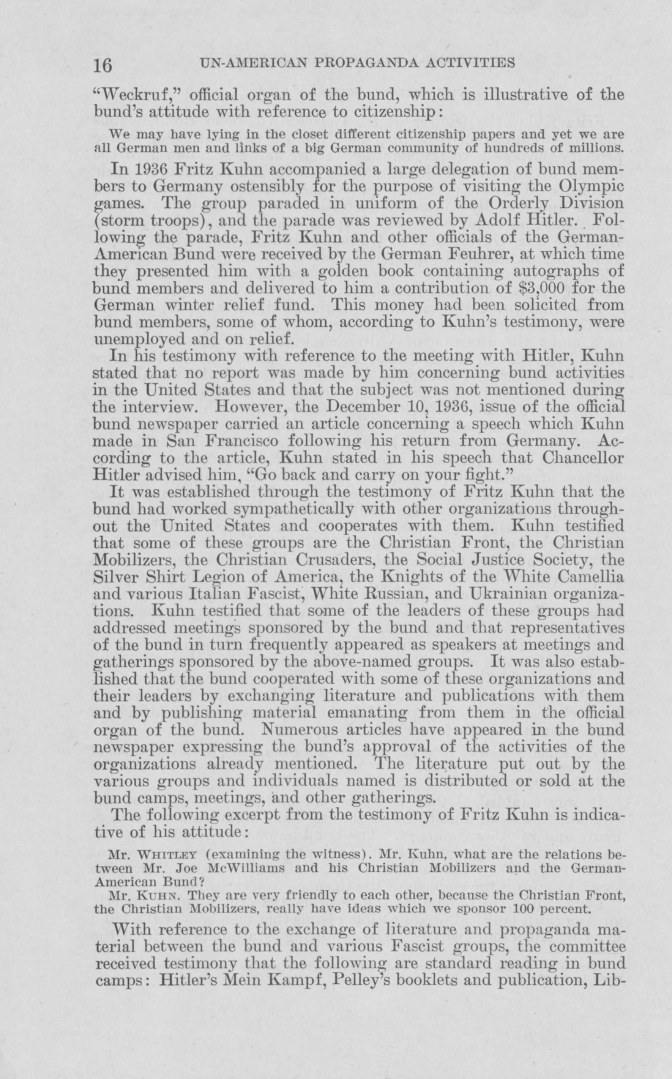
House report: Kuhn’s 1936 delegation and organizational connections
The House committee’s 1940 report describes the 1936 delegation to Germany. Its summary is an investigative conclusion, not a transcript of every conversation. Image credit ↗

Chapter 01 / 1924–1936

A movement becomes an American organization

The German American Bund did not begin with the crowd at Madison Square Garden. It emerged from organizations that had promoted German National Socialism before Hitler took power and then defended his regime afterward. The Teutonia milieu and the Friends of New Germany supplied personnel, property and an existing political vocabulary. March 1936 marked the Bund’s formation under Fritz Julius Kuhn. The change mattered: an organization presented as belonging to American citizens could deny being a foreign party branch while continuing to identify with Hitler’s Germany.

Kuhn had been a leader in the Detroit Friends organization when he became a U.S. citizen in December 1934. His subsequent claim to American political rights was therefore more than a borrowed slogan. It also created the question later posed in court: had he actually transferred his allegiance when he took the naturalization oath? The answer required evidence about him at that time. Neither German birth nor later criticism of American policy automatically answered it.

The 1936 journey to Germany supplied evidence of an active connection. In its 1940 report, the House committee described a uniformed delegation, a meeting with Hitler and a contribution to German winter relief. The report juxtaposed Kuhn’s testimony that Bund business was not discussed with his newspaper’s account of a speech in which he claimed Hitler had encouraged him. Those are conflicting representations by the same movement, not a surviving written order placing every American unit under Hitler’s command.

The continuity was nonetheless substantive. Nazi racial ideas, propaganda publications and the leadership principle traveled across the organizational change. The Bund’s name and citizenship rule did not make it an ordinary cultural association. At the same time, organizational inheritance did not make every German-American club a Bund unit. Even the House committee, while arguing forcefully for exposure of Nazi influence, expressly distinguished the Bund from Americans of German descent who helped investigate it.
Sources: S01 · S04 · S16

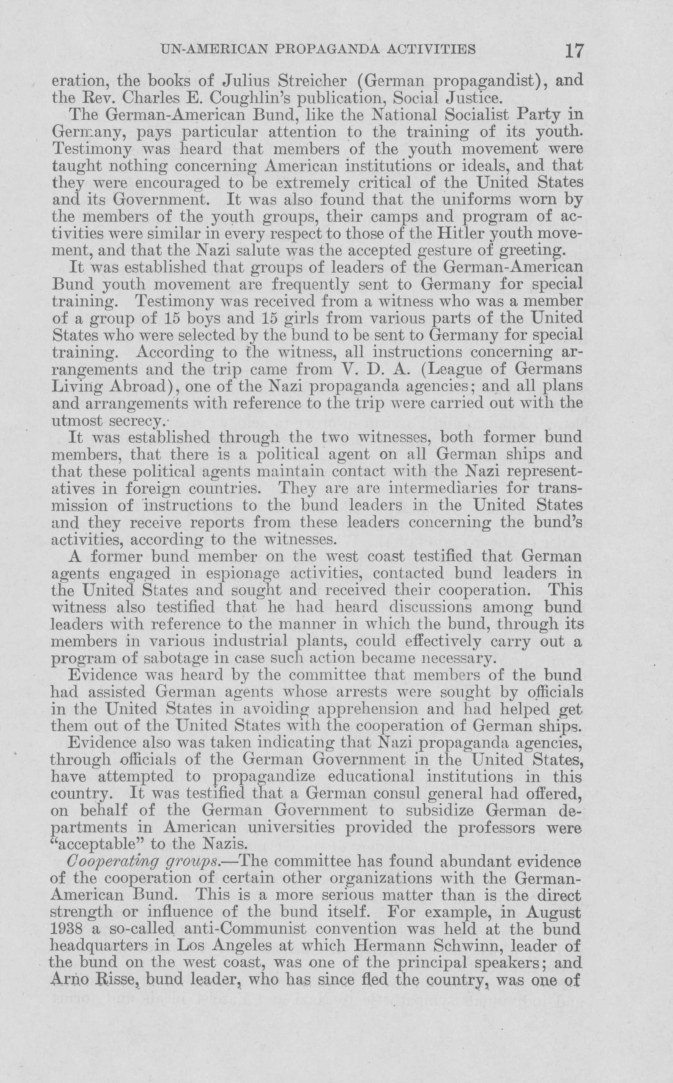
House report: youth training and allegations of foreign contacts
The committee summarized testimony about youth training and foreign contacts on printed 17. Its espionage and sabotage passages report allegations and testimony, not convictions. Image credit ↗

Chapter 02 / 1936–1939

Camps, uniforms and the arithmetic of support

The Bund built an environment in which politics could look like family life. Local units, gatherings, youth activities and camps placed ideological instruction beside recreation and social belonging. Its uniformed Ordnungsdienst supplied drill and meeting security. A national hierarchy made the leader’s commands part of local organizational life. Later judicial opinions described that structure while also distinguishing it from proof of a particular criminal agreement.

The House investigation treated youth work as a central part of the movement. Its report described Nazi-style uniforms and salutes, testimony about instruction and groups selected for training in Germany. These accounts undermine a picture of camps devoted only to harmless recreation. They do not show that every child understood the organization’s international aims or that attendance alone constituted espionage. Adults selected the institutions and the political material; the record does not justify assigning one undifferentiated intention to everyone photographed there.

Its numerical reach is harder to recover. The 1940 committee reported Kuhn’s estimate of 20,000–25,000 members and a separate 80,000–100,000 sympathizers. It also recorded a 1937 Justice Department estimate of 6,500. These figures differ in date, source and category. The committee said Kuhn had acknowledged destruction of membership lists and other records. His claimed totals could therefore not be checked against a complete roll. A rally attendance figure measures another thing again: people at one event, potentially including nonmembers.

That uncertainty affects claims about both weakness and strength. A movement could be small within a large ethnic community yet still organize significant gatherings, intimidate opponents and share propaganda with other groups. The committee listed exchanges and shared appearances with American antisemitic organizations, including the Christian Front and Silver Shirts. Cooperation enlarged the reach of ideas without proving a single national command over every collaborator. Evidence of a coalition belongs beside its documented limits; neither an impressive crowd nor a small membership estimate settles what the movement could accomplish.

Sources: S01 · S05

Bund parade on East 86th Street, New York, 30 October 1937
The photograph shows a 1937 Yorkville parade. Bund street pageantry preceded the 1939 Garden event; this image does not depict that later night. Image credit ↗

Chapter 03 / 1937–1939

The Garden turns propaganda into spectacle

The Bund’s public presentation joined familiar American symbols to an openly Nazi political program. Flags, patriotic ceremonies and claims to defend constitutional rights did not cancel its antisemitism. The movement portrayed Jews as a collective threat and presented hostility to communism as a reason to support racial exclusion. The House report documented the exchange of Nazi and American extremist publications. These were political connections made through texts, speakers and institutions, not merely similarities inferred from uniforms.

On 20 February 1939, roughly 20,000 people attended the Bund rally at Madison Square Garden. Its Washington imagery and Nazi symbols made the attempted fusion especially visible. Isadore Greenbaum interrupted and was beaten by Bund men before police removed him. These central features survive in archival accounts and fragments later assembled by filmmakers. They establish a public episode of antisemitic mobilization and violence; the crowd cannot be converted into a national opinion poll.

The citizenship claim created a practical conflict for authorities and opponents. A democratic government could reject the Bund’s aims while protecting assembly and requiring proof before punishment. Conversely, a lawful meeting permit was no endorsement of its speeches, its treatment of a protester or its political ambitions. The later courts would confront related distinctions in different cases: which words or agreements fell within a criminal statute, and whether evidence about the organization proved the charge against a particular person.

The spectacle also made an argument about power. A visible, disciplined gathering suggested a unified movement larger than its internal disputes. Contemporary investigative findings describe hierarchy, propaganda and cooperating groups, but those categories do not supply a completed plan capable of seizing the American state. The Bund had created a disturbing American platform for Nazism. Whether a particular official or member helped foreign agents, contemplated violence or committed fraud remained a further question, answered through additional records rather than the visual force of the rally alone.

Sources: S01 · S05 · S18 · S19 · S20

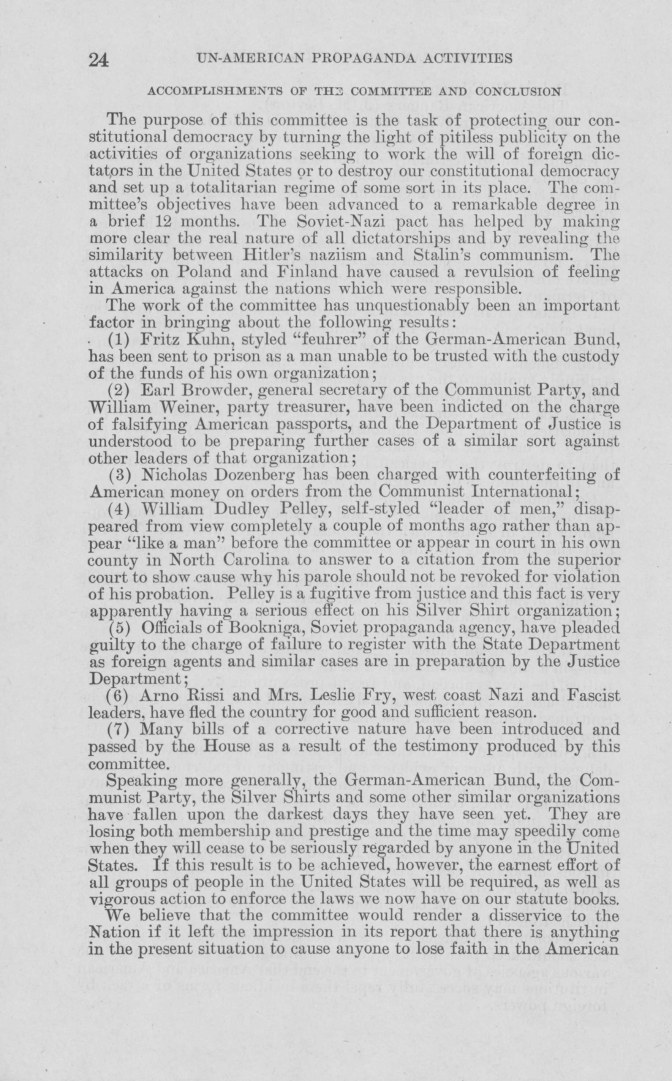
House report’s conclusion: Kuhn imprisoned for misuse of Bund funds
On printed 24, the House committee claimed credit for exposing organizations and noted Kuhn’s imprisonment for misuse of funds. Its claimed causal role is not the jury’s verdict. Image credit ↗

Chapter 04 / 1939–1940

The leader’s money becomes a criminal case

Fritz Kuhn’s imprisonment came through a financial prosecution. A New York jury convicted him on 29 November 1939; a contemporary JTA dispatch reported a December sentence of two and a half to five years for larceny and forgery arising from Bund funds. Judge James Wallace emphasized theft and forgery as the grounds of punishment. The distinction was concrete: the prosecution did not need to make hatred itself the offense in order to prove misuse of money.

That did not make the investigation politically neutral in its origins or consequences. Opponents wanted the Bund weakened, and elected officials were investigating an organization whose conduct they regarded as dangerous. The 1940 House report presented Kuhn’s downfall as one of its own achievements. Such institutional claims explain how the prosecution entered the public struggle over the Bund. They do not, without further evidence, establish that the financial charges were fabricated or that a jury convicted him simply for holding Nazi views.

The case exposed a contradiction within the movement’s leadership principle. A leader who claimed exceptional authority over the organization still operated within ordinary laws governing property and records. Supporters’ acceptance of his command did not by itself decide whether the money had lawfully become his to spend. The conviction concerns that adjudicated conduct. It supplies no automatic answer about the guilt of a camp attendee, the size of a foreign subsidy or a separate espionage conspiracy.

Gerhard Wilhelm Kunze became the principal successor. The FBI’s historical reconstruction places him in national public-relations work from 1937, acting leadership after Kuhn’s imprisonment and national leadership in 1940. His later legal history was different from Kuhn’s. Their similar surnames and overlapping offices invite compression, but Kunze’s eventual espionage-conspiracy plea must not be assigned to Kuhn. The organization continued after its first leader entered prison; financial scandal, changes in leadership, opposition and the coming war together shaped its decline.

Sources: S01 · S11 · S14

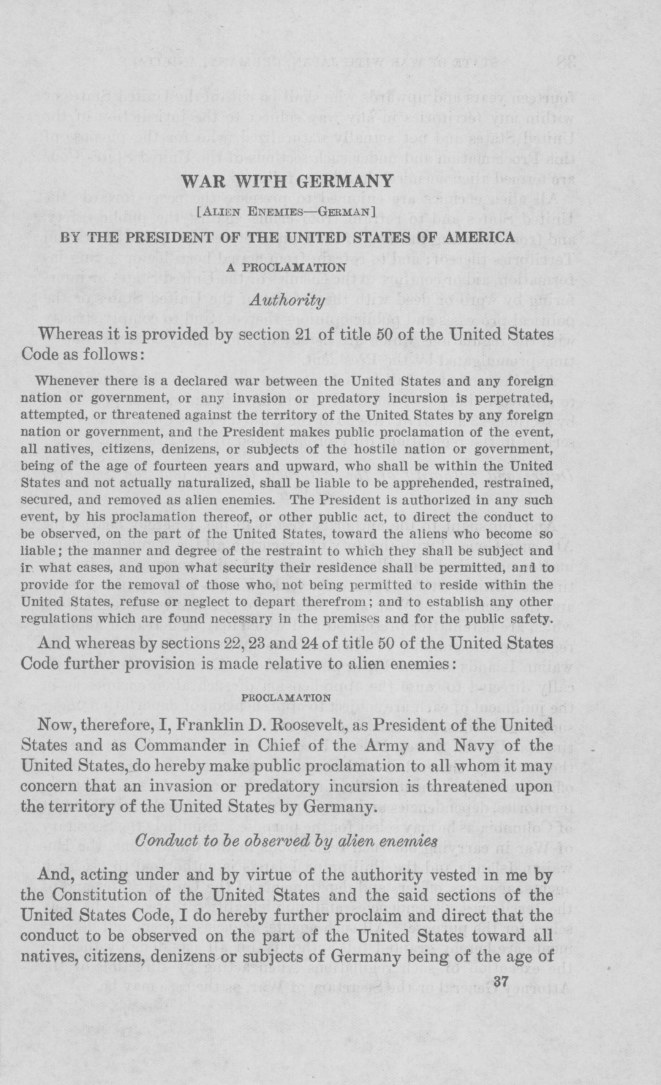
Proclamation2526: German alien enemies, 8 December 1941
Proclamation 2526 begins at printed/PDF 37. It defined German alien enemies; it did not declare all Americans of German ancestry criminal. Image credit ↗

Chapter 05 / 1938–1943

German disavowal, clandestine conduct and war

In February 1938, American diplomats recorded a German effort to distance the Reich from the Bund. Chargé Prentiss Gilbert reported Freytag’s announced ban on German nationals joining it, intended consular enforcement and confidential instructions to German officials and Nazi Party members to avoid relations. Secretary of State Cordell Hull separately recorded Ambassador Dieckhoff’s notification. The telegram also described opposition within the German government to the policy. A claim that Berlin simply spoke and acted with one mind misses that evidence.

These were meaningful representations, including measures not intended for the press. They are stronger evidence of a diplomatic problem than a bare public denial. Yet they are not a complete file of enforcement or secret contacts. The House committee later reached a stronger conclusion about Nazi direction, drawing on publications, travel and witness testimony. The two bodies of evidence should be read together: a regime could see an overseas movement as ideologically useful and diplomatically damaging, while officials and party networks did not necessarily act uniformly.

A separate 1941 conspiracy involved Kunze, Anastase Vonsiatsky, Otto Willumeit, Wolfgang Ebell and Kurt Molzahn. Four pleaded guilty; Molzahn was convicted by a jury, and the Second Circuit affirmed in 1943. Kunze’s 15-year sentence belongs to this case. The FBI later acknowledged that no established European contacts showed actual transmission of espionage material abroad. A proved agreement to transmit defense information remains serious conduct even where completed foreign delivery is not established.

War transformed the legal environment. Roosevelt’s 8 December 1941 proclamation authorized controls over defined German nationals aged 14 and over who were not actually naturalized. The United States declared war on Germany on 11 December. The Bund disintegrated in that setting, but citizenship, internment and criminal prosecution remained distinct processes. NARA’s broader account notes many internments based on weak evidence. That history neither disproves the Kunze conspiracy nor licenses treating every internee as a Bund member or proved spy.

Sources: S01 · S02 · S03 · S10 · S11 · S12 · S13

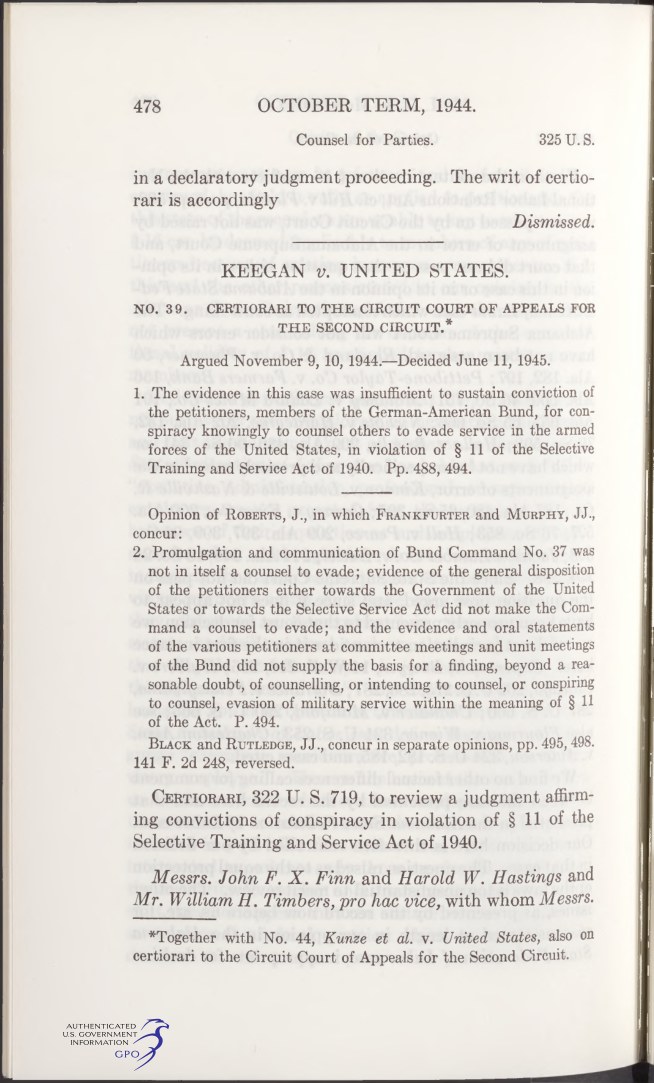
Keegan v. United States: draft-conspiracy convictions reversed, 1945
Keegan’s 1945 judgment reversed the draft-conspiracy convictions. The Court did not decide that the Bund’s political program was benign. Image credit ↗

Chapter 06 / 1941–1945

Convictions reversed without a political acquittal

Courts sometimes rejected the government’s cases against Bund figures. The New Jersey Supreme Court reversed four convictions in State v. Klapprott on 5 December 1941. The charges concerned antisemitic speeches and permission to use premises for them. The court condemned the utterances while finding the statutory restrictions constitutionally defective and too indefinite. That combination matters: a judicial protection for speech was not a finding that the speech contained no hostility or caused no injury.

The larger federal draft-conspiracy case raised a different issue. In 1942, 25 defendants were tried together and one was acquitted. The prosecution’s theory centered on Bund Command 37 and statements about the 1940 Selective Service Act. One provision excluded Bund and Communist Party members from filling jobs vacated by inductees. Bund leaders protested that discrimination and discussed a test of the law. The government argued that their words concealed an agreement to counsel evasion of military service.

On 11 June 1945, the Supreme Court reversed the convictions at issue. Justice Owen Roberts, joined by Frankfurter and Murphy, found the evidence insufficient; Black and Rutledge concurred separately. The opinions did not deny the Bund’s Nazi commitments. Roberts distinguished the large quantity of background material about its ideology and organization from evidence proving the charged agreement beyond a reasonable doubt. The issue was evasion of service, not an uncharged conspiracy to evade registration. The dissent drew a stronger inference from the campaign and its context.

This gives the civil-liberties criticism its strongest factual foundation. Government opposition to Nazism could produce prosecutions that failed to prove a statutory crime. The reversal is an actual limit on state action, not merely a defendant’s denial. Its reach is equally specific. It did not overturn Kunze’s separate espionage-conspiracy plea, cancel Kuhn’s financial conviction or make every claim of foreign allegiance unfounded. Political abhorrence could not replace proof; neither could one reversal settle all the movement’s other conduct.

Sources: S05 · S09 · S10 · S14

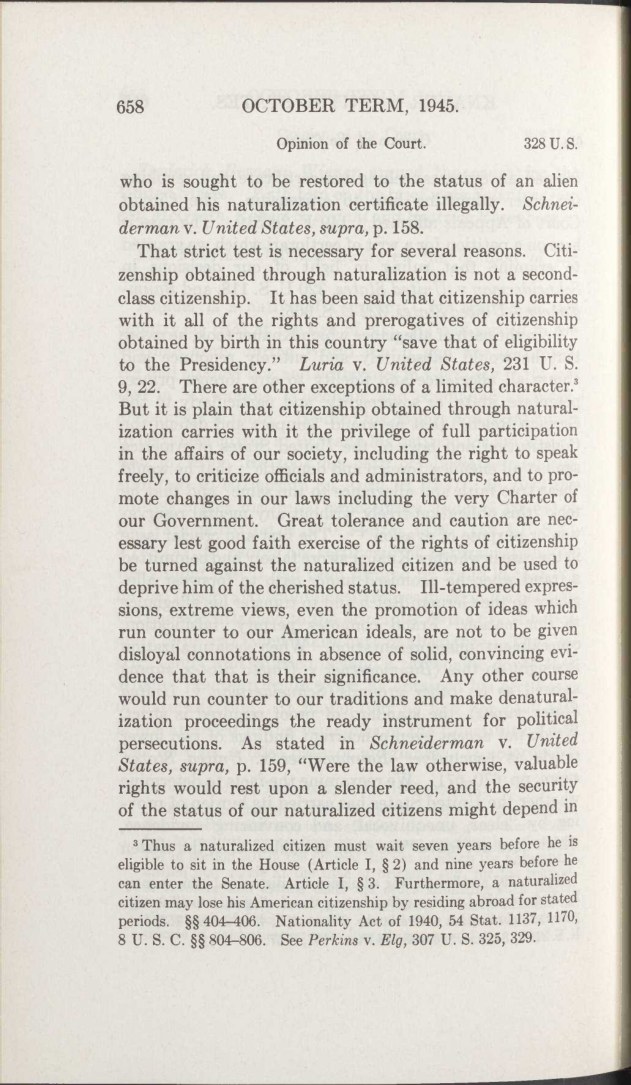
Knauer v. United States: citizenship protections within an adverse judgment
In Knauer, printed 658 sets out protections of naturalized citizenship. The same decision upheld denaturalization on an individual fraud record. Image credit ↗

Chapter 07 / 1943–1950 / later memory

An individual record, and a divided judicial legacy

Citizenship cases placed a different kind of power at stake. In March 1943, Judge Edward Bright considered 20 consolidated actions, including Kuhn’s. He rejected the proposition that Bund membership alone decided them, ordered adverse judgments in some cases and dismissed others. His decision connected Kuhn’s earlier leadership and subsequent conduct to the sincerity of the naturalization oath. Contemporary reporting dates the cancellation of Kuhn’s citizenship to June 1943 and his deportation to September 1945. These were successive events, not an instantaneous consequence of the 1939 jury verdict.

The Supreme Court upheld Paul Knauer’s denaturalization on 10 June 1946. Its majority required clear, unequivocal and convincing proof and said that membership alone was insufficient. It nevertheless found an individual pattern demonstrating a false oath. Justice Black concurred on the strength of Knauer’s own conduct and admissions. Justice Rutledge, joined by Murphy, dissented without portraying him as an innocent cultural enthusiast. Their objection concerned the security of naturalized citizenship and the procedure for taking it away. A defense of rights could coexist with recognition of an especially strong adverse record.

August Klapprott’s case followed another course. A 1942 default had canceled his citizenship while he was in custody. In 1949 the Supreme Court reopened the procedural question; its amended mandate required evidence on his reasons for failing to defend. After that hearing, the lower court again refused to vacate the default, and the Third Circuit affirmed in July 1950. Ending this history with “citizenship restored in 1949” would mistake an opportunity to contest a judgment for the final result.

The Bund’s organizational end did not end argument over it. Official reports, litigation, surviving rally recordings and later documentaries preserve different scales: national danger, individual guilt, constitutional rights and public complicity. No single image or verdict contains the whole history. A durable account retains the movement’s documented Nazism and connections while keeping the legal and evidentiary differences between people, organizations and the larger society that opposed or tolerated them.

Sources: S04 · S06 · S07 · S08 · S15

02 / The record

The critical path: the official yardstick

A documented Nazi movement, with limits on claims of command and collective guilt

The documentary baseline is an American organization committed to Nazism, active in propaganda and public mobilization, with substantial German connections. Congressional conclusions of direction sit beside diplomatic records of German restrictions and internal disagreement. Particular crimes and citizenship judgments require their own evidence.

The six hinges below identify what this account depends on. Judicial outcomes are reported as outcomes; they do not decide every historical question. Evidence ranks concern each proposition as stated. Cultural prominence remains unmeasured: occurrence in the selected reports or documentaries is evidence of emphasis, not a public-opinion survey.

Sources: S01 · S02 · S04 · S05 · S06 · S10

CP1

Organizational succession carried a Nazi political program

The bounded documentary finding

The 1936 Bund inherited people and institutions from the Friends of New Germany. Its hierarchy, publications and racial program establish an organization promoting Nazism within the United States.

Why this hinge matters

This is the basis for calling the Bund a Nazi organization rather than assigning that description from nationality, a flag or an opponent’s epithet.

If this hinge were removed

The account of a continuous organizational vehicle would weaken. Specific speeches, travel and crimes would remain independently assessable.

What rival readings must explain

A cultural-association account must explain the leadership principle, Nazi publications, racial exclusion and transfer from earlier political organizations.

Evidence support

High for the stated political identity and succession; narrower for uniform local practice.

Cultural prominence: Unmeasured

Prominent in the selected House report and later museum account; that is documentary visibility, not measured public familiarity. No representative audience survey or numerical prominence ranking was examined.

Gaps and disputes

Exact founding days differ; the guide uses March 1936. Local enthusiasm and obedience varied; a national constitution is not a complete account of every unit.

Dependencies

Foundation for CP2 and the foreign-relationship question at CP3; not proof of the crimes in CP4–CP6.

Sources: S01 · S04 · S05

CP2

Mobilization was visible, but its size has several counting units

The bounded documentary finding

Camps, units, propaganda exchanges and gatherings show sustained activity. The 1940 report distinguishes claimed members, sympathizers and an older investigative estimate.

Why this hinge matters

The movement’s reach cannot be inferred responsibly by combining incompatible counts. A modest membership and a consequential public presence can both be true.

If this hinge were removed

A precise scale assessment would fall; documented ideology, individual actions and the occurrence of public events would not disappear.

What rival readings must explain

Both a negligible-club account and an all-encompassing fifth-column account must explain organization beyond one rally and the limits of the membership evidence.

Evidence support

High for organizational activity and the report’s distinct categories; incomplete for actual membership totals.

Cultural prominence: Unmeasured

The parade and camps are visible in selected records. Their current recognition relative to the Garden rally is unknown. No representative audience survey or numerical prominence ranking was examined.

Gaps and disputes

Complete rolls are absent. The committee attributed record destruction to Kuhn’s admission. Claimed totals are not audited membership, unique supporters or a national poll.

Dependencies

Builds on CP1. Limits the representativeness assigned to CP3 and every later narrative of mass influence.

Sources: S01 · S05 · S20

CP3

Foreign ties and diplomatic disavowal coexist in the record

The bounded documentary finding

The House investigation and later judicial findings describe Nazi connections. The 1938 FRUS records also report public restrictions, confidential instructions and German internal disagreement.

Why this hinge matters

This hinge separates ideological affinity, party networks, personal contacts and enforceable foreign direction. Those are related, but not interchangeable.

If this hinge were removed

Without connection evidence, a foreign-control reading loses essential support. Without the disavowal record, the narrative overstates a single consistent Berlin policy. Neither removal erases the Bund’s own Nazi politics.

What rival readings must explain

The strongest direct-control reading must explain the confidential restrictions; the strongest independence reading must explain meetings, publications, training and the adverse individual findings.

Evidence support

High for documented connections and the 1938 representations; qualified for a blanket operational-control claim.

Cultural prominence: Unmeasured

The foreign-agency question recurs in contemporaneous investigations and selected court opinions. Comparative cultural reach is unmeasured. No representative audience survey or numerical prominence ranking was examined.

Gaps and disputes

These are selected U.S. records and reports of German statements. Enforcement, covert subsidies and all competing German agencies are not comprehensively reconstructed.

Dependencies

Requires CP1’s identity. CP2 bounds national reach; CP5 supplies a particular later criminal connection, not universal proof of command.

Sources: S01 · S02 · S03 · S04 · S06

CP4

Kuhn’s imprisonment was for adjudicated financial conduct

The bounded documentary finding

The 1939 jury conviction and contemporary sentence report concern larceny and forgery involving Bund funds. Leadership succession followed.

Why this hinge matters

The conviction explains a material rupture without confusing suppression of views with the crime that was actually tried.

If this hinge were removed

The financial explanation for Kuhn’s removal would fail. Opposition to his politics, the Bund’s program and later independent proceedings would remain.

What rival readings must explain

A persecution account must address the conviction’s evidentiary basis, not merely its political usefulness to opponents. A simple self-destruction account must also explain war and government action.

Evidence support

High for conviction and sentence; selected rather than exhaustive for trial evidence and causes of organizational decline.

Cultural prominence: Unmeasured

Kuhn’s fraud appears in the selected official and public narratives; no survey measures how often audiences remember it. No representative audience survey or numerical prominence ranking was examined.

Gaps and disputes

The full state trial record and accounting exhibits were not audited. Committee claims of causing the downfall are institutional self-assessment; sentencing day is kept at month precision.

Dependencies

Depends on evidence specific to Kuhn, not automatic inference from CP1–CP3. CP6 distinguishes later citizenship proceedings.

Sources: S01 · S11 · S14

CP5

A specific espionage conspiracy does not establish every broader allegation

The bounded documentary finding

Kunze and others pleaded guilty in a conspiracy involving defense information; Molzahn’s conviction was affirmed. The FBI account also reports no established European contacts showing completed transmission abroad.

Why this hinge matters

It preserves both a serious proved legal outcome and the limit on claims of an operating transatlantic delivery chain.

If this hinge were removed

Removing the conspiracy record would undermine this particular conduct finding. Removing only the missing-delivery limit would make the claim broader than the cited record.

What rival readings must explain

A harmlessness account must explain guilty pleas and the affirmed conviction. A sweeping espionage account must supply evidence for foreign delivery and additional participants instead of treating shared membership as proof.

Evidence support

High for the named plea/conviction outcomes; actual overseas transmission not established by this assembled record.

Cultural prominence: Unmeasured

The case is substantial in the FBI’s retrospective but less foregrounded in the selected rally-centered presentation. That observation is not an audience rank. No representative audience survey or numerical prominence ranking was examined.

Gaps and disputes

The complete trial and intelligence files were not reexamined. Conspiracy, attempted communication and successful delivery are separate factual categories.

Dependencies

CP3 supplies foreign-relationship context; CP6 prevents this case being confused with the overturned draft-conspiracy case.

Sources: S10 · S11

CP6

Courts reached different outcomes on different proofs and powers

The bounded documentary finding

Keegan reversed draft-conspiracy convictions; Knauer upheld an individual fraud-based citizenship judgment. Klapprott’s 1949 procedural opportunity was followed by an adverse 1950 appeal.

Why this hinge matters

The record cannot support either universal exoneration or collective guilt. This hinge also separates criminal punishment, civil denaturalization and wartime internment.

If this hinge were removed

The guide’s general account of constitutional limits and individual differentiation would need revision; the Bund’s ideology and separately documented events would remain.

What rival readings must explain

Both an unqualified government-vindication account and an all-fabricated-prosecutions account must explain opposite outcomes and the actual issues decided.

Evidence support

High for the specified judicial outcomes; bounded for generalizations about all government action.

Cultural prominence: Unmeasured

These distinctions are explicit in original opinions but often compressed in the selected later narratives. Public familiarity is not measured. No representative audience survey or numerical prominence ranking was examined.

Gaps and disputes

The cases selected are not a census of every member or prosecution. Contemporary doctrine and dissents are described historically, not presented as current legal advice.

Dependencies

Uses the exact defendant, charge, proof standard and disposition. CP4 and CP5 survive only on their own records.

Sources: S04 · S05 · S06 · S07 · S08 · S09 · S12 · S13

03 / The record

How the accounts inherit and divide the record

Documented citations, responses and branches; not assumed influence.

These lineages follow explicit quoted material, judicial review and acknowledged archival reuse. A shared subject or conclusion is not evidence that one author borrowed from another. The map covers selected passages, not every book about American fascism.

  1. 1936–1940

    Bund publications and testimony → congressional account

    Explicit quotation and identification of underlying publications

    The House report quotes Bund newspaper material and compares it with Kuhn’s testimony about the Hitler meeting. It also identifies publications circulating through camps and allied groups. This is a documented transmission of texts and a committee’s interpretation of them.

    The committee’s foreign-direction conclusion is an interpretive branch built on those materials. Its witness summaries and newspaper quotations are not multiple independent witnesses to every secret contact.

    Sources: S01

  2. 1942–1945

    Trial and appellate judgment → Supreme Court division

    Keegan expressly reviews the same prosecution and evidence

    The Supreme Court’s opinions revisit the convictions and the lower appellate judgment. Roberts separates background ideology from proof of the charged conspiracy; the dissent interprets the combined evidence more strongly. The branches arise from one prosecution, not newly discovered, independent archives.

    The recurring question at CP6 is the inference from political purpose to the specific agreement alleged. A dissent records a legal disagreement; it does not turn the reversed judgment into a continuing conviction.

    Sources: S05

  3. 1943–1950

    Earlier citizenship cases → Knauer; Klapprott → remand →1950

    Opinions explicitly cite the earlier standards and ensuing mandates

    Knauer applies the strict evidentiary approach of Schneiderman and Baumgartner while reaching a different result on the individual facts. Its dissent disputes the power and procedure despite an adverse factual record. The 1950 Klapprott opinion expressly follows the 1949 amended mandate and the hearing it required.

    These are related legal lineages, not one continuous case or one shared defendant. Dropping the later Klapprott branch changes the apparent outcome.

    Sources: S06 · S07 · S08

  4. 2017–2019

    Archival fragments → Curry’s film; archive audio → WNYC presentation

    Acknowledged archival assembly and explicit cross-reference

    Curry’s Q&A describes collecting fragments from several archives and editing a short narrative. WNYC explicitly references his film while presenting a much longer surviving audio record. These works foreground a single rally through different media.

    The selection and modern framing do not establish a complete membership count or an unedited visual record of the entire evening. No borrowing by other documentaries is inferred.

    Sources: S18 · S19

04 / The record

Four readings of the organization and the state

Each account starts with its strongest form, then identifies what it accepts, removes or adds. A map is not an endorsement.

Interpretation 01

A centrally directed Nazi fifth column

Documented ties; blanket control remains qualified

The strongest version

The Bund was more than sympathetic. Its predecessors, leadership visits, German training and propaganda networks made it a vehicle of Nazi influence. Congressional investigators and Judge Bright found foreign direction, and the Kunze conspiracy gives that concern a specific criminal example.

Accept on the path

  • CP1 — Accept the political and organizational continuity.
  • CP3 — Accept substantial German connections.
  • CP5 — Accept the particular conspiracy outcomes.

Remove or narrow on the path

  • CP3 — Treat the 1938 disavowal as limited, unevenly enforced or a cover rather than proof of separation.

Add on the path

  • CP3 — Show authenticated instructions, funding routes and compliance connecting named German offices to particular Bund decisions.

What would have to be wrong

The qualified reading would be wrong if restrictions were demonstrably a coordinated deception with a continuing operational command chain across the organization. Conversely, lack of such proof does not erase documented influence.

Evidence and limits

The House and district court provide strong adverse interpretations. The confidential diplomatic measures and German internal disagreement complicate a uniform-command model. A later conspiracy by named men does not itself resolve the entire 1936–1941 organization.

What would change the assessment

Authenticated ministry or party correspondence paired with receipt, money and implementation records could establish where direction became control. Isolated boasts and shared symbols would not do that work.

Sources: S01 · S02 · S03 · S04 · S10

Interpretation 02

An American Nazi movement with uneven foreign relationships

Best fit to the bounded record

The strongest version

American residents and citizens built an authoritarian political organization that served Nazi ideas while pursuing its own status and ambitions. Foreign officials sometimes cooperated and sometimes tried to distance themselves. Ideological allegiance did not require continuous orders from one German office.

Accept on the path

  • CP1 — Accept the Nazi political identity.
  • CP2 — Accept organized mobilization without a uniform support count.
  • CP3 — Accept both connections and restrictions.
  • CP5 — Accept specific criminal cooperation.

Remove or narrow on the path

  • CP3 — Narrow a claim that every unit and action was centrally controlled from Berlin.

Add on the path

  • CP2 — Seek unit-level records showing how much local independence and variation actually existed.

What would have to be wrong

This account would need revision if a complete command-and-finance chain showed effective centralized control of the movement’s major decisions despite the recorded restrictions.

Evidence and limits

It accommodates the confidential restrictions and adverse evidence without making either a universal answer. It remains an interpretation from selected records, not a complete organizational sociology.

What would change the assessment

Paired German and American files showing orders implemented, refused or evaded across several units would sharpen the balance between local agency and foreign authority.

Sources: S01 · S02 · S03 · S05 · S10

Interpretation 03

Political repression displaced the requirement of proof

Substantial in particular cases; not a universal exoneration

The strongest version

Authorities and opponents targeted an unpopular political movement. The New Jersey speech reversal, Keegan judgment and citizenship dissents show real danger in prosecuting an organization’s reputation and keeping naturalized citizens insecure.

Accept on the path

  • CP6 — Accept judicial findings of insufficient proof and constitutional defects.
  • CP1 — Accept that the organization’s views were Nazi; rights do not depend on benign opinions.

Remove or narrow on the path

  • CP6 — Reject automatic guilt from association.
  • CP4 — Question any claim that political hostility alone validates a financial prosecution.

Add on the path

  • CP4 — A claim that the fraud case was fabricated needs trial-specific evidence of falsification or coercion.
  • CP5 — A general exoneration needs evidence overturning or materially undermining the separate conspiracy outcomes.

What would have to be wrong

A universal persecution account must explain why actual pleas, adverse individual findings and a financial verdict should all be rejected. Court reversals in different cases do not establish that.

Evidence and limits

This criticism has primary judicial support in its narrow form. The stronger claim that every proceeding was manufactured outruns those decisions and overlooks opposite results.

What would change the assessment

New authenticated evidence of fabricated exhibits, coerced testimony or undisclosed exculpatory material would require case-specific reassessment. It would not automatically answer all the other cases.

Sources: S04 · S05 · S06 · S07 · S08 · S09 · S10 · S14

Interpretation 04

A small fringe, whose spectacle exceeds its actual power

Limited membership is compatible with consequential mobilization

The strongest version

The Bund represented a minority, not German Americans as a whole. Its foreign style, leadership scandal and hostile environment constrained its appeal. A famous rally can make the movement appear more nationally representative than demonstrated.

Accept on the path

  • CP2 — Keep membership, sympathizers and crowds separate.
  • CP4 — Accept leadership fraud as a serious weakness.
  • CP6 — Reject guilt assigned to an ethnic population.

Remove or narrow on the path

  • CP2 — Remove an inference of national mass consent from one event.

Add on the path

  • CP2 — Measure influence through circulation, repeated attendance, institutional alliances and policy effects, rather than a single count.

What would have to be wrong

The small-fringe reading would be incomplete if authenticated records demonstrated much wider sustained participation or effective political control. Conversely, numerical weakness would not establish harmlessness.

Evidence and limits

The 1940 report’s categories and missing-roll warning support caution. Its documented alliances and youth work also show why a small membership is not the whole measure of influence.

What would change the assessment

Auditable rolls, financial records, publication circulation and repeated local event records would change the scale assessment. Later visual familiarity is not evidence of 1930s organizational strength.

Sources: S01 · S05 · S20

05 / The record

Reports and public voices change the emphasis

What selected investigations, judicial opinions and documentary passages emphasize.

The cards describe passages actually read. Their limits concern those passages, not an assumed omission from an entire film, book or archive. Neither complete documentary was independently watched.

House report 1476, 1940

The committee’s national-danger account

Amplifies

Organizational hierarchy, foreign connections, cooperating groups and youth training.

Recasts

It presents exposure and prosecution as accomplishments of its own inquiry, while acknowledging missing membership records.

Not resolved in the selected passage

The selected pages do not make every witness allegation a verdict, establish a complete roll or measure the success of German restrictions.

Printed/PDF 14–18 and 24 examined; not the entire hearing corpus.

Sources: S01

Keegan and Knauer, 1945–1946

Judges divide proof from political abhorrence

Amplifies

The danger of substituting organizational reputation for a charged agreement or individual oath fraud.

Recasts

Keegan reverses; Knauer affirms after individual scrutiny. Knauer’s dissent contests denaturalization without denying the adverse record.

Not resolved in the selected passage

These opinions do not audit every clandestine connection or decide every member’s guilt.

Selected majority, concurrence and dissent passages examined in the original published scans.

Sources: S05 · S06

Marshall Curry, A Night at the Garden Q&A

The rally as a warning about a crowd

Amplifies

The emotional force of pageantry, antisemitism and spectators’ responses.

Recasts

A deliberately edited, narration-free film frames archival fragments for a modern audience.

Not resolved in the selected passage

Its interview cannot measure passive national support or settle the organization’s entire legal history.

Q&A on discovery and editing read; complete film not independently watched.

Sources: S18

PBS American Experience, Nazi Town, USA transcript, 2024

American symbols and ordinary social settings

Amplifies

Named historians discuss patriotic presentation, recreation and youth work as vehicles for politics.

Recasts

The documentary connects the Bund to wider American conditions. Its broad national frame differs from individual litigation.

Not resolved in the selected passage

The selected passages do not resolve membership categories or the precise legal chronology; the 100,000 “members” language is not adopted here.

Selected published transcript passages read; complete film not independently watched.

Sources: S17

02 / The record

Find a thread in the file

Search the chapter and claim index. Every result leads to the full text and its sources.

Operations / The record

Different cases, different questions

Criminal charges, speech restrictions, civil citizenship actions and administrative control are distinct.

Selected proceedings have different defendants, legal questions and outcomes; one result does not decide the others.
Proceeding / periodIssueRecordOutcome / limit
Kuhn’s financial prosecution1939Larceny and forgery involving Bund fundsJury conviction; prison sentence reportedDifferent from political belief or a later citizenship judgment

Sources: S14

New Jersey speech/use-of-premises cases1941Antisemitic speeches and premises used for themFour convictions reviewedReversed for constitutional/statutory defects

Sources: S09

Defense-information conspiracy1941–1943Agreement to transmit defense informationFour guilty pleas; Molzahn jury verdict and affirmed appealKunze 15 years; no general verdict against all members

Sources: S10 · S11

Federal draft conspiracy1942–1945Alleged counseling of evasion of serviceJoint trial and convictions at issue in KeeganSupreme Court reversed; separate espionage outcome unaffected

Sources: S05

Kuhn and other citizenship actions1943Alleged fraud in naturalizationIndividual evidence considered in consolidated civil actionsJudgments differed; no automatic membership rule

Sources: S04

Knauer citizenship case1946Individual fraud in oathSupreme Court reviews evidence and authorityAffirmed; procedural/power dissent retained

Sources: S06

Klapprott default litigation1942–1950Relief from denaturalization defaultSupreme Court procedural mandate; later evidence hearingRefusal to vacate affirmed in 1950

Sources: S07 · S08

03 / The record

People and institutions

Open a record for the person’s role and supporting sources. Names identify people; no unverified portrait is substituted for a participant.

KuhnBiographical record
Fritz Julius KuhnBund leader

Former Detroit Friends leader and Bund leader from 1936; convicted of financial crimes in 1939. Later civil citizenship proceedings and 1945 removal were separate events. Do not confuse him with successor Kunze.

Sources: S04 · S11 · S14 · S15

KunzeBiographical record
Gerhard Wilhelm KunzeSuccessor and conspiracy defendant

Bund public-relations officer and subsequent national leader. Left for Mexico inNovember 1941; later pleaded guilty in the defense-information conspiracy and received 15 years. The overturned draft-conspiracy case was separate.

Sources: S05 · S10 · S11

VonsiatskyBiographical record
Anastase VonsiatskyRussian fascist organizer; co-defendant

Associated with Bund figures and financed Kunze’s departure. Pleaded guilty in the 1942 conspiracy. His own organization and ambitions were distinct from the Bund’s formal structure.

Sources: S10 · S11

MolzahnBiographical record
Kurt E. B. MolzahnLutheran pastor and conspiracy defendant

Tried by a jury after his co-defendants pleaded guilty. The Second Circuit affirmed the conviction in 1943. His church office does not make other clergy or congregants participants.

Sources: S10

KnauerBiographical record
Paul KnauerIndividual citizenship defendant

The Supreme Court upheld his denaturalization for an individually proved false oath. His case explicitly refused to make Bund membership alone sufficient proof.

Sources: S06

KlapprottBiographical record
August KlapprottBund official; several distinct cases

Appears in the New Jersey speech litigation and a separate federal citizenship proceeding. The 1949 Supreme Court procedural victory was followed by an adverse 1950 appeal.

Sources: S07 · S08 · S09

KeeganBiographical record
Wilbur V. KeeganBund counsel; draft-case petitioner

His statements about a constitutional test of the Selective Service Act were scrutinized in the conspiracy prosecution. The Supreme Court reversed the convictions at issue in 1945.

Sources: S05

BrightBiographical record
Edward BrightFederal district judge

In 1943 he assessed 20 individual citizenship actions, finding against some defendants and dismissing others. His broad historical interpretation did not make membership alone dispositive.

Sources: S04

RobertsBiographical record
Owen RobertsSupreme Court justice

Announced the 1945 Keeganjudgment and distinguished ideology/background from adequate proof of the charged conspiracy. Separate opinions show divisions within the Court.

Sources: S05

RutledgeBiographical record
Wiley RutledgeSupreme Court justice

Dissented in Knauer with Murphy on the insecurity and procedure of denaturalization, while acknowledging the adverse individual record; concurred in Keegan’s reversal.

Sources: S05 · S06

HullBiographical record
Cordell HullU.S. Secretary of State

Recorded Dieckhoff’s 1938 notification and referred to prior U.S. complaints over interference. His satisfaction did not establish complete future enforcement.

Sources: S03

DieckhoffBiographical record
Hans Heinrich DieckhoffGerman ambassador

Delivered the 1938 notification restricting German nationals’ participation. The diplomatic record is part of the evidence, not automatic proof that every covert contact ended.

Sources: S02 · S03

GilbertBiographical record
Prentiss GilbertU.S. chargé in Germany

Reported Freytag’s public and confidential measures, including opposition within the German government. The published telegram is a U.S. record of that conversation.

Sources: S02

GreenbaumBiographical record
Isadore GreenbaumProtester at the 1939 rally

Interrupted the Garden rally and was beaten by Bund men. Curry’s Q&A discusses the episode; no portrait is supplied from an uncertain or privately copyrighted press photograph.

Sources: S18

04 / The record

The organization, war and legal aftermath

Horizontal spacing shows elapsed time; separate rows keep close events selectable. Scroll the graph on narrow screens. Exact dates are attributed where records conflict; month- and year-only dates preserve source precision.

Core organization, 1936–1941 · Earlier origins and later legal and memory context

192419361945195020172024
Teutonia-era organization supplies a predecessorOrigins

The later district-court reconstruction traces an American National Socialist organization to 1924 and subsequent name changes. This is predecessor context, not a founding date for the 1936 Bund.

Sources: S04

Friends of New Germany organizesOrigins

The Friends becomes the immediate predecessor. Naturalized citizens and German nationals participated; later Bund citizenship claims did not erase this inheritance.

Sources: S01 · S04

Kuhn becomes a U.S. citizenCitizenship

Judge Bright later records this date and Kuhn’s Detroit leadership at the time. The sincerity of the oath became an issue in the 1943 civil case.

Sources: S04

Kuhn’s delegation visits HitlerForeign connections

The 1940 House report describes the visit, relief contribution and conflicting accounts of what Hitler told Kuhn. It is evidence of a relationship; no comprehensive written command chain follows from the meeting alone.

Sources: S01

The German American Bund formsOrganization

The new organization inherits members and assets from the Friends under Kuhn. Exact March days differ in the selected accounts, so the event uses month precision.

Sources: S04 · S16

Justice Department membership estimateCounting support

The 1940 report cites an investigative estimate of 6,500 in 1937. It is not interchangeable with Kuhn’s later claimed membership or sympathizer totals.

Sources: S01

Bund parades on East 86th StreetPublic mobilization

The selected World-Telegram staff photograph documents a New York procession. Its 1937 date is preserved; it is not a photograph of the 1939 Garden rally.

Sources: S20

Gilbert reports German restrictionsDiplomacy

The telegram records intended public and confidential instructions restricting German nationals, officials and party members. Freytag describes internal resistance; execution of every measure is not established here.

Sources: S02

Hull records Dieckhoff’s notificationDiplomacy

The ambassador announces restrictions on German nationals’ participation in organizations interfering in American affairs. Hull refers to prior American complaints and expresses satisfaction.

Sources: S03

Madison Square Garden rallyPublic mobilization

The Bund holds its large New York rally. Archival accounts describe patriotic pageantry joined to antisemitism; attendance is not an audited national membership total.

Sources: S18 · S19

Jury convicts KuhnFinancial case

The later contemporary sentence dispatch identifies 29 November as the jury’s conviction date for larceny and forgery involving Bund funds.

Sources: S14

Kuhn receives a prison sentenceFinancial case

A contemporary report gives a term of 2½–5 years. Publication and reported sentencing-day accounts differ; this event keeps December precision. The punishment was for theft and forgery, not a judicial ban on his political views.

Sources: S14

Kunze becomes national leaderOrganization

The FBI retrospective distinguishes acting leadership after Kuhn’s imprisonment from election in 1940. Local organizations and membership did not vanish at the moment of Kuhn’s conviction.

Sources: S11

House report publishes its Bund findingsInvestigation

Report 1476 states a strong foreign-direction conclusion, identifies propaganda and training connections and distinguishes 20–25 kclaimed members from 80–100 ksympathizers. It attributes destruction of lists to Kuhn’s admission.

Sources: S01

Selective Service Act becomes lawDraft case

The Act included an employment restriction on Bund and Communist Party members. The ensuing Bund protest and Command 37 were central to the later conspiracy prosecution.

Sources: S05

The defense-information conspiracyEspionage case

The later appellate record describes the charged 1941 agreement involving Kunze, Vonsiatsky, Willumeit, Ebell and Molzahn. The indictment, pleas and verdict concerned named people, not all Bund members.

Sources: S10

Kunze leaves for MexicoEspionage case

The FBI account dates his departure before American entry into the war. It should not be narrated as a flight that began only after Pearl Harbor.

Sources: S11

The Bund disbandsOrganization

The organization ends amid war, leadership loss and government action. The precise legal basis of every measure described later as “outlawing” is not established by the alien-enemy proclamation alone.

Sources: S04 · S12 · S16

New Jersey reverses speech convictionsSpeech case

State v. Klapprottreverses convictions under the speech and premises provisions. The court criticizes antisemitic utterances while rejecting the statutory basis for punishment.

Sources: S09

German alien-enemy proclamationWar and government action

Proclamation 2526 covers defined German nationals aged 14 and over who were not actually naturalized. It is not an order declaring every German American or Bund attendee guilty of a crime.

Sources: S12

State of war with GermanyWar and government action

Congress and the President recognize a state of war with Germany. The earlier 8 Decemberdeclaration concerned Japan; the two dates are distinct.

Sources: S12

Espionage-conspiracy indictmentEspionage case

The FBI records the Hartford grand-jury indictment of five named men. Allegation at indictment and later plea or verdict are separate stages.

Sources: S11

Default denaturalizes KlapprottCitizenship

The default judgment follows his 7 Julycriminal arrest. Its later procedural history would extend through a Supreme Court mandate and an adverse 1950 appeal.

Sources: S07 · S08

Kunze receives 15 yearsEspionage case

The FBI dates his federal sentence following a guilty plea. The later Molzahn appeal records the plea and 15-year term. This was Kunze, not Fritz Kuhn.

Sources: S10 · S11

Judge Bright decides individual citizenship actionsCitizenship

United States v. Kuhnaddresses 20 consolidated actions, orders judgment against Kuhn and others, and dismisses some cases. March 18 is the opinion date, not the later reported date of Kuhn’s cancellation decree.

Sources: S04

Molzahn’s conviction affirmedEspionage case

The Second Circuit finds sufficient evidence and rejects the appeal. Its opinion records that the other four defendants pleaded guilty.

Sources: S10

Kuhn loses citizenship and is internedCitizenship and internment

A contemporary postwar AP recap dates cancellation to 1 June and internment after release from prison to 21 June. The timeline retains month precision for these related steps and keeps them separate from the March opinion.

Sources: S15

Keegan convictions reversedDraft case

The Supreme Court reverses the draft-conspiracy convictions for insufficient proof of the charged agreement. The named case does not adjudicate every other prosecution of Bund figures.

Sources: S05

Kuhn deported to GermanyRemoval

The retained contemporary AP recap dates deportation to September 1945. That conflicts with a later museum article’s 1944 date. The guide adopts the contemporary year/month without claiming a verified departure day.

Sources: S15 · S16

Knauer’s denaturalization affirmedCitizenship

The Supreme Court finds clear individual proof of a false oath. Its majority rejects automatic membership guilt; the dissent challenges the citizenship power and procedure despite recognizing the adverse evidence.

Sources: S06

Klapprott wins procedural reviewCitizenship

The Supreme Court reverses the refusal to reopen the procedural question. This is not final restoration of citizenship or a general acquittal.

Sources: S07 · S08

Amended Klapprott mandateCitizenship

As quoted in the later appellate opinion, the mandate directs evidence on the truth of the allegations supporting the petition to vacate the default.

Sources: S08

Further Klapprott appeal failsCitizenship

After the June 1949 hearing, the Third Circuit affirms refusal to vacate. This later result is essential to describing the effect of the 1949 Supreme Court ruling accurately.

Sources: S08

Archival fragments become A Night at the GardenMemory

Curry’s published Q&A describes the short film’s assembly from several archives and its deliberate absence of explanatory narration. It is an edited work, not a complete visual record of the Bund.

Sources: S18

Nazi Town, USA broadens the documentary frameMemory

The PBS documentary uses historians and archival material to connect the Bund to American settings and political traditions. Selected transcript passages were examined; no complete film viewing is claimed.

Sources: S17

07 / The record

How the story changed

Public memory tends to compress contested histories into a turning point. The records leave a less tidy sequence.

From a patriotic claim to a documented propaganda organization

ThenKuhn presented the movement as protecting American interests.

ReconsideredThe 1940 report tested that claim against publications, foreign ties and training testimony. Its conclusion remains an investigation’s finding rather than every individual’s verdict.

Sources: S01

One wartime prosecution becomes several judicial answers

ThenLarge quantities of organizational evidence supported the government’s draft-conspiracy case.

ReconsideredKeegan demanded sufficient proof of the actual agreement charged. Knauer’s separate outcome shows why that protection was not universal exoneration.

Sources: S05 · S06

Procedural victory becomes an incomplete ending

ThenThe 1949 Klapprott decision opened a route to further proceedings.

ReconsideredThe 1950 appeal records what followed. An account stopping at the Supreme Court headline misses the adverse result.

Sources: S07 · S08

08 / The record

What the evidence supports

Ratings apply to the precise proposition on the page. Unsupported means the assembled evidence does not establish a claim; it is not interchangeable with false.

Established

The Bund promoted Nazism inside the United States.

Its organizational lineage, publications, racial program and leadership practice supply direct evidence. This finding does not rest on ethnicity or one photograph.

Sources: S01 · S04 · S05

Not established

The Bund had 100,000 verified members.

The 1940 report separates 20–25 kclaimed members from 80–100 ksympathizers and cites an older 6,500 estimate. Missing rolls prevent an audited total.

Sources: S01

Qualified

Berlin continuously controlled every major Bund decision.

There is substantial connection and adverse official interpretation, alongside confidential 1938 restrictions and internal German disagreement. The selected record does not trace every order, subsidy and act of compliance.

Sources: S01 · S02 · S03 · S04

Contradicted

The Bund was simply a harmless cultural club.

The documented political program, Nazi propaganda and training connections exceed that description. No collective criminal verdict follows from rejecting the claim.

Sources: S01 · S05

Established

Kuhn was imprisoned for larceny and forgery involving Bund funds.

A jury convicted him inNovember 1939; the contemporary sentence report gives 2½–5 years. A financial verdict is not itself an espionage conviction.

Sources: S14

Established

Kunze pleaded guilty in the defense-information conspiracy.

The appellate opinion and FBI account record the plea and 15-year sentence. The FBI also states that completed transmission abroad was not established through European contacts.

Sources: S10 · S11

Contradicted

Keegan cleared the Bund of every allegation.

It reversed specified draft-conspiracy convictions for insufficient proof. Other charges and proceedings retained separate records and outcomes.

Sources: S05 · S06 · S10

Contradicted

Bund membership alone established naturalization fraud.

The selected district-court and Supreme Court opinions expressly require more. Knauer’s adverse judgment turned on his individual evidence.

Sources: S04 · S06

Contradicted

The 1949 Supreme Court ruling permanently restored Klapprott’s citizenship.

The amended mandate required a hearing on the petition to vacate. The later refusal was affirmed in 1950.

Sources: S07 · S08

Not established

The Bund represented German Americans as a whole.

The committee itself distinguished German-American citizens and credited their cooperation in exposing Bund activity. Organizational counts are not an ethnic population’s position.

Sources: S01

Contradicted

An internment order proves criminal guilt.

Wartime alien controls were an administrative process; NARA’s overview includes weak or unsubstantiated accusations. A specific criminal outcome requires the specific case.

Sources: S12 · S13

09 / The record

Watch, listen and read

Primary remarks, participant voices and documentary context. External audio, video and source records need an internet connection.

External documentary transcript and video

Nazi Town, USA — PBS ↗

Selected transcript read; external playback may have regional or availability limits.

External archival audio

WNYC’s surviving rally recording ↗

A longer audio presentation; gaps in the original discs do not by themselves establish censorship. Complete recording not independently audited.

10 / The record

The questions still open

A documented limit is more useful than a confident number or a sweeping lineage the evidence cannot carry.

  1. How consistently were German restrictions enforced?

    Paired ministry, party, consular and Bund records could distinguish announced policy from continuing covert relationships and identify which offices disagreed.

    Sources: S01 · S02 · S03

  2. What was the actual membership and wider reach?

    Recoverable rolls, accounts, circulation and unit records would improve estimates. Members, sympathizers, relatives, children and event audiences need distinct categories.

    Sources: S01

  3. How much did each source contribute to the prosecution?

    The complete state financial exhibits and federal trial files could test witnesses and reconstruct causal claims more precisely than a committee’s self-assessment or later summary.

    Sources: S01 · S05 · S10 · S14

  4. Which postwar continuities can be demonstrated?

    The survival of people and prejudices does not establish an uninterrupted chain into every later extremist group. Specific correspondence, membership transfer or acknowledged doctrinal borrowing would be needed.

    Sources: S01 · S06

11 / The record

Go back to the sources

Records, reporting, and firsthand accounts have different evidentiary roles. Each source note explains what it can establish and where caution is needed. Sources consulted for this edition on 26 October 2026. Original records and attributed reporting have distinct evidentiary roles.

  1. S01

    Primary congressional report

    Investigation of Un-American Propaganda Activities, House report 1476, 3 January 1940 ↗

    U.S. House Special Committee on Un-American Activities

    Printed/PDF 14–18 and 24 examined closely. Contains testimony summaries, Bund literature and committee findings; neither every allegation nor the committee’s account of its own accomplishments is a judicial finding. Membership and sympathizer categories are separate, and the report admits the absence of lists. Other portions concern different organizations.

  2. S02

    Contemporary diplomatic record

    Gilbert to Secretary of State, 28 February 1938, FRUS II document 371 ↗

    U.S. Department of State, Office of the Historian

    Complete published telegram read. Reports German public and confidential restrictions on ties with the Bund and disagreement within the German government. It records Freytag’s representations, not a complete audit of enforcement. Earlier despatches mentioned in footnotes are not printed and were not examined. German quoted material has its own authorship; no facsimile is redistributed.

  3. S03

    Contemporary diplomatic memorandum

    Hull memorandum of conversation with Dieckhoff, 28 February 1938, FRUS II document 372 ↗

    U.S. Secretary of State; FRUS

    Complete published extract read. Records the ambassador’s notification and Hull’s response to earlier interference. Complements S02; two records of the same diplomatic action are not two independent tests of subsequent compliance.

  4. S04

    Primary judicial opinion

    United States v. Kuhn and nineteen other cases, 49 F. Supp. 407, 18 March 1943 ↗

    U.S. District Court, S.D. New York, Judge Edward Bright

    Historical background and individual Fritz Julius Kuhn, Heller and Cyler passages examined via the published opinion. The judge ordered adverse judgments for some defendants and dismissed other cases. March 18 is the opinion date; contemporary reporting separately dates Kuhn’s citizenship cancellation to June 1. No assertion that this opinion is a criminal espionage conviction or that its historical background is beyond later correction. Raw mirror retrieval was blocked; selected reading notes retained.

  5. S05

    Primary judicial opinion

    Keegan v. United States, 325 U.S. 478, 11 June 1945 ↗

    U.S. Supreme Court / United States Reports

    Original 29-page scan retained. Judgment and selected Roberts, Black, Rutledge and dissenting passages examined, especially printed 479–495. Twenty-five defendants tried, one acquitted below; convictions at issue reversed for insufficient proof of counseling evasion of service. This does not reverse the separate espionage conspiracy or erase evidence of Nazism. The report’s first page begins with the preceding case’s closing lines.

  6. S06

    Primary judicial opinion

    Knauer v. United States, 328 U.S. 654, 10 June 1946 ↗

    U.S. Supreme Court / United States Reports

    Original 26-page scan retained; majority’s evidence and proof standard, Black concurrence and Rutledge/Murphy dissent examined. Affirmed individual fraud-based denaturalization. Majority p 660 gives naturalization 13 April 1937; a dissenting reference to 1935 is not used as the date. Membership alone expressly insufficient; constitutional criticism of denaturalization survives within an adverse judgment.

  7. S07

    Primary procedural opinion

    Klapprott v. United States, 335 U.S. 601, 17 January 1949 ↗

    U.S. Supreme Court / United States Reports

    Original 31-page scan retained. Opening chronology, extraordinary-circumstances discussion and disposition examined. The later amended judgment directed evidence on the petition to vacate the 1942 default; this was not a finding that Klapprott had disproved all allegations. Read with S08 for subsequent proceedings.

  8. S08

    Primary appellate outcome

    Klapprott v. United States, 183 F.2d 474, 20 July 1950 ↗

    U.S. Court of Appeals, Third Circuit

    Published opinion examined, including 1949 amended mandate, June 1949 hearing and 1950 affirmance of refusal to vacate. The follow-up prevents treating the 1949 Supreme Court decision as permanent restoration of citizenship. Raw mirror access blocked; bounded notes retained.

  9. S09

    Primary state judicial opinion

    State v. Klapprott, 127 N.J.L.395, 5 December 1941 ↗

    Supreme Court of New Jersey, Chief Justice Thomas Brogan

    Selected opinion paragraphs 1–18 and disposition examined. Four convictions under the speech/use-of-premises provisions were reversed; criticism of the antisemitic speech coexists with constitutional and vagueness objections. A different proceeding from S07/S08. No reliance on the mirror’s automated current-law treatment badge.

  10. S10

    Primary espionage-conspiracy opinion

    United States v. Molzahn, 135 F.2d 92, 2 April 1943 ↗

    U.S. Court of Appeals, Second Circuit

    Opening disposition and paragraphs 6–18 examined. Records four guilty pleas and Molzahn’s jury conviction/affirmance; Kunze received 15 years. This is conspiracy to transmit defense information, not proof that every Bund member transmitted secrets. Trial exhibits and all later Molzahn proceedings are outside this selected review.

  11. S11

    Institutional retrospective with investigative narrative

    Vonsiatsky Espionage: FBI historical account ↗

    Federal Bureau of Investigation

    Overview and Kunze sections read; approved-browser HTML/text retained after direct retrieval failed. The FBI records Kunze’s 21 August 1942 sentence, guilty plea and a crucial limit: no established European contacts demonstrating actual transmission abroad. Some descriptive language is partisan and some incidents are expressly alleged. S10 supplies the separate appellate court record.

  12. S12

    Primary wartime instrument

    Proclamation 2526, 8 December 1941, in Senate document 148 ↗

    U.S. President Franklin D. Roosevelt; U.S. Congress

    PDF 37–39 examined; German alien-enemy proclamation begins at printed/PDF 37. Applies to defined German nationals aged 14 and over who were not actually naturalized; not an indiscriminate order against German-American citizens. Volume separately records 11 December state of war with Germany. Retained full volume; selected federal text page reproduced.

  13. S13

    Archival institutional overview

    World War II Enemy Alien Control Program overview ↗

    U.S. National Archives

    Brief overview examined. Describes internment administration and weak or unsubstantiated evidence in many cases. Supplies broader context, not proof that a particular Bund member was wrongly or rightly interned; the program included many people with no demonstrated Bund association.

  14. S14

    Contemporary court reporting

    Kuhn sentenced as a thief and forger, 6 December 1939 ↗

    Jewish Telegraphic Agency

    Complete short dispatch read. Reports 29 November jury conviction and 2½–5 year sentence for larceny and forgery. December 6 is publication date and the dispatch says “today”; later sources sometimes give December 5, so the timeline uses month precision for sentencing. Judge Wallace’s distinction concerns punishment for theft rather than political hatred.

  15. S15

    Contemporary postwar press record

    AP clipping from Munich: Kuhn’s postwar sentence reduced ↗

    Associated Press; Indiana University digital collection

    First clipping page visually/textually examined. Dateline 22 February; the clipping does not print a year on that page. It reports September 1945 deportation and 1 June 1943 citizenship cancellation. The guide relies on those stated dates, not an independently verified clipping publication year or a complete German denazification history. Private press copyright: no reproduction in package.

  16. S16

    Institutional historical synthesis

    The German American Bund, Holocaust Encyclopedia ↗

    U.S. Holocaust Memorial Museum

    Article examined for organization overview and ancestry distinction. Its 1944 Kuhn deportation date conflicts with contemporary S15’s September 1945 and is not adopted. Founding is stated at month precision because exact March 1936 days differ among records. Not a substitute for the primary case-specific court sources.

  17. S17

    Public documentary transcript / selected passages

    Nazi Town, USA: published documentary transcript, 2024 ↗

    PBS American Experience; Peter Yost and named interviewees

    Selected transcript passages on American symbols, camps, the Metcalfe reporting and legal aftermath read; complete film not independently watched. Some compressed legal chronology and membership language are not adopted. Individual remarks remain attributed; no inference that all interviewees made the same claim.

  18. S18

    Filmmaker’s account of archival editing

    A Night at the Garden: filmmaker Marshall Curry’s Q&A ↗

    Marshall Curry / Field of Vision

    Published Q&A read, especially archive collection, editorial approach, Greenbaum and public response. Claims about passive national support are interpretation, not a survey. Film remains an external video link; no claim to have watched the complete film or to own the private newsreel fragments.

  19. S19

    Archival audio presentation / selected historical commentary

    WNYC Archives: the Bund rally’s surviving audio and context ↗

    WNYC Archives, Andy Lanset

    Selected article passages, notes and linkage to Curry read. Whole recording not independently audited. Source distinguishes gaps in original discs from an assumed censorship program. Private AP/Daily News images on the page are not reproduced. External playback requires network.

  20. S20

    Primary photograph and item-specific rights record

    Bund parade photograph, 30 October 1937, LOC96520973 ↗

    Library of Congress; New York World-Telegram staff

    Item JSON and Commons description/license examined. Explicit World-Telegram credit makes the staff-work gift basis applicable. It is a 1937 street procession, not a 1939 Garden image; no individual is identified by an uncertain resemblance.

Images, documents & licensing

Bund parade on East 86th Street, New York, 30 October 1937 — New York World-Telegram staff photographer; Library of Congress, LC-DIG-ds-15209. Public domain under the NYWT&S instrument of gift for staff-created photographs; item explicitly credits World-Telegram. This does not extend to private agency photographs in the same archive. Source & license ↗. Resized and re-encoded for this edition; embedded metadata removed. Rights are assessed per item; privately authored agency photographs and enclosures are excluded.

House report: Kuhn’s 1936 delegation and organizational connections — U.S. Congress / U.S. President. U.S. federal government-authored text, public domain (17 USC105); selected authored prose only, no third-party enclosures. Source & license ↗. Resized and re-encoded for this edition; embedded metadata removed. Rights are assessed per item; privately authored agency photographs and enclosures are excluded.

House report: youth training and allegations of foreign contacts — U.S. Congress / U.S. President. U.S. federal government-authored text, public domain (17 USC105); selected authored prose only, no third-party enclosures. Source & license ↗. Resized and re-encoded for this edition; embedded metadata removed. Rights are assessed per item; privately authored agency photographs and enclosures are excluded.

House report’s conclusion: Kuhn imprisoned for misuse of Bund funds — U.S. Congress / U.S. President. U.S. federal government-authored text, public domain (17 USC105); selected authored prose only, no third-party enclosures. Source & license ↗. Resized and re-encoded for this edition; embedded metadata removed. Rights are assessed per item; privately authored agency photographs and enclosures are excluded.

Proclamation2526: German alien enemies, 8 December 1941 — U.S. Congress / U.S. President. U.S. federal government-authored text, public domain (17 USC105); selected authored prose only, no third-party enclosures. Source & license ↗. Resized and re-encoded for this edition; embedded metadata removed. Rights are assessed per item; privately authored agency photographs and enclosures are excluded.

Keegan v. United States: draft-conspiracy convictions reversed, 1945 — U.S. Supreme Court / Reporter of Decisions. U.S. federal government-authored text, public domain (17 USC105); selected authored prose only, no third-party enclosures. Source & license ↗. Resized and re-encoded for this edition; embedded metadata removed. Rights are assessed per item; privately authored agency photographs and enclosures are excluded.

Knauer v. United States: citizenship protections within an adverse judgment — U.S. Supreme Court / Reporter of Decisions. U.S. federal government-authored text, public domain (17 USC105); selected authored prose only, no third-party enclosures. Source & license ↗. Resized and re-encoded for this edition; embedded metadata removed. Rights are assessed per item; privately authored agency photographs and enclosures are excluded.

Typefaces: Inter, Playfair Display and Source Serif 4, the shared AI Files reference set, distributed under the SIL Open Font License. Exact files and license text are included in assets/fonts in the offline package. The images comprise one World-Telegram staff photograph with an item-specific gift basis and six authored federal text pages. No AI-generated photographs, portraits or document facsimiles are used.

Uniform evidence

One standard for every case.

Political allegiance, an organizational connection and a specific crime require different evidence. Participant denials and official claims are recorded with their sources; neither settles the whole history. Judicial outcomes retain the defendants and questions actually decided.

Publication status

Prepared for staging review.

This locally prepared package is intended for the ChatGPT submission lane under Spec v7. It has not received a Grok editorial grade or approval for promotion. The live submission manifest, when registered, records its review status. Submission queue and status ↗