CIA, intelligence programs and related interventions
Secret action. Public consequences.
Sixteen complete guides to covert action, intelligence collection and detention—and the decisions and consequences within each.
Start with a case file. The overview and comparisons below connect different institutions and kinds of evidence, from political subsidies and armed assistance to mail opening, assassination plots and secret custody.
The full guide doors
16 completed guides.
Sixteen completed documentary guides. Overlapping files cover selected foreign political action, armed support, assassination plotting, intelligence collection affecting Americans and detention. Laos distinguishes CIA-supported ground forces from Lao and Thai agency, U.S. military bombing and diplomacy. Brazil is a related U.S. diplomatic/military contingency; Northwoods is a JCS/Defense planning submission. This is neither an exhaustive CIA history nor sixteen independent operations.
U.S. covert finance supported anti-Communist political action in Italy. The guide separates 1948 from later reductions, termination, restart and suspension. Approved budgets, payments, Italian political choices and election results remain different kinds of evidence.
Context and later records: 1947–1976 / records to 2026
Completed research edition · Prepared for editorial review
CIA mail interception affecting U.S. correspondents
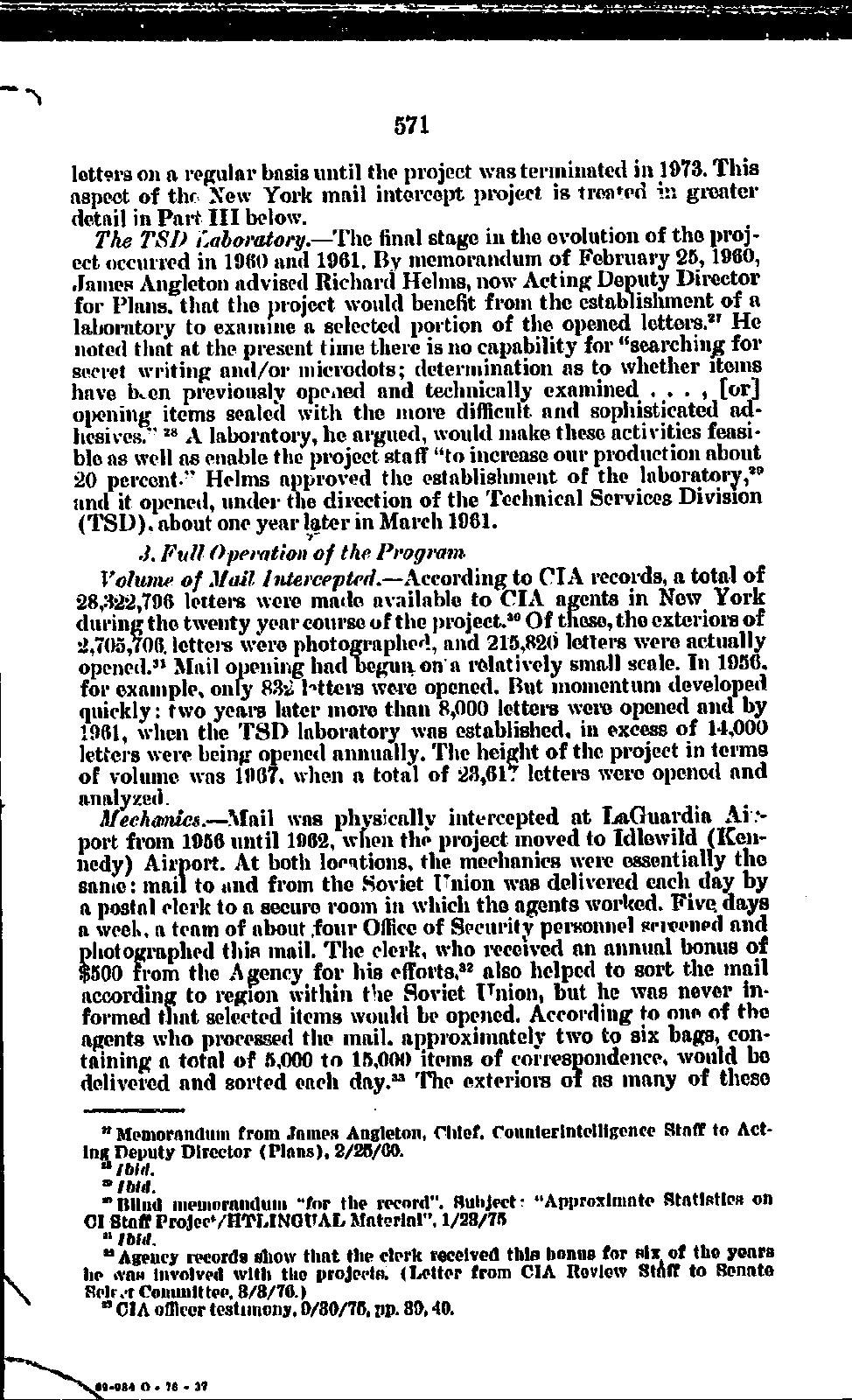
The CIA examined and opened foreign mail passing through the United States. The guide distinguishes mail-cover and opening counts, watch-list selection, officials’ knowledge and later investigations and litigation. A foreign-intelligence rationale did not remove the program’s effects on American correspondents.
Context and later records: 1952–1973 / investigations and memory to 1998
Completed research edition · Prepared for editorial review
CIA and British intelligence; Iranian political actors
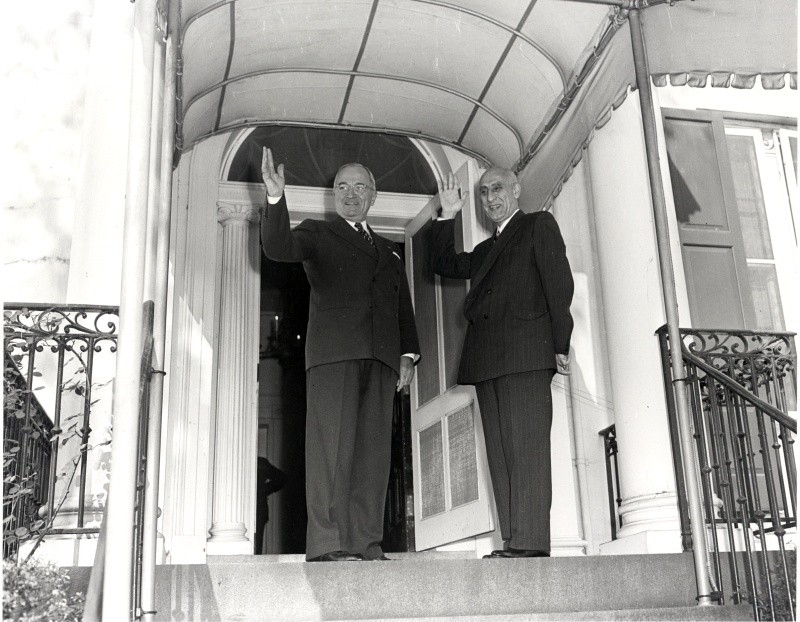
British and U.S. intelligence worked to replace Mohammad Mossadegh with Fazlollah Zahedi. A failed first attempt preceded the 19 August overthrow. The record establishes foreign intervention while leaving important questions about Iranian mobilization and operational control unresolved.
Context and later records: 1951–2026
Completed research edition · Prepared for editorial review
CIA sponsorship and Guatemalan political/military decisions
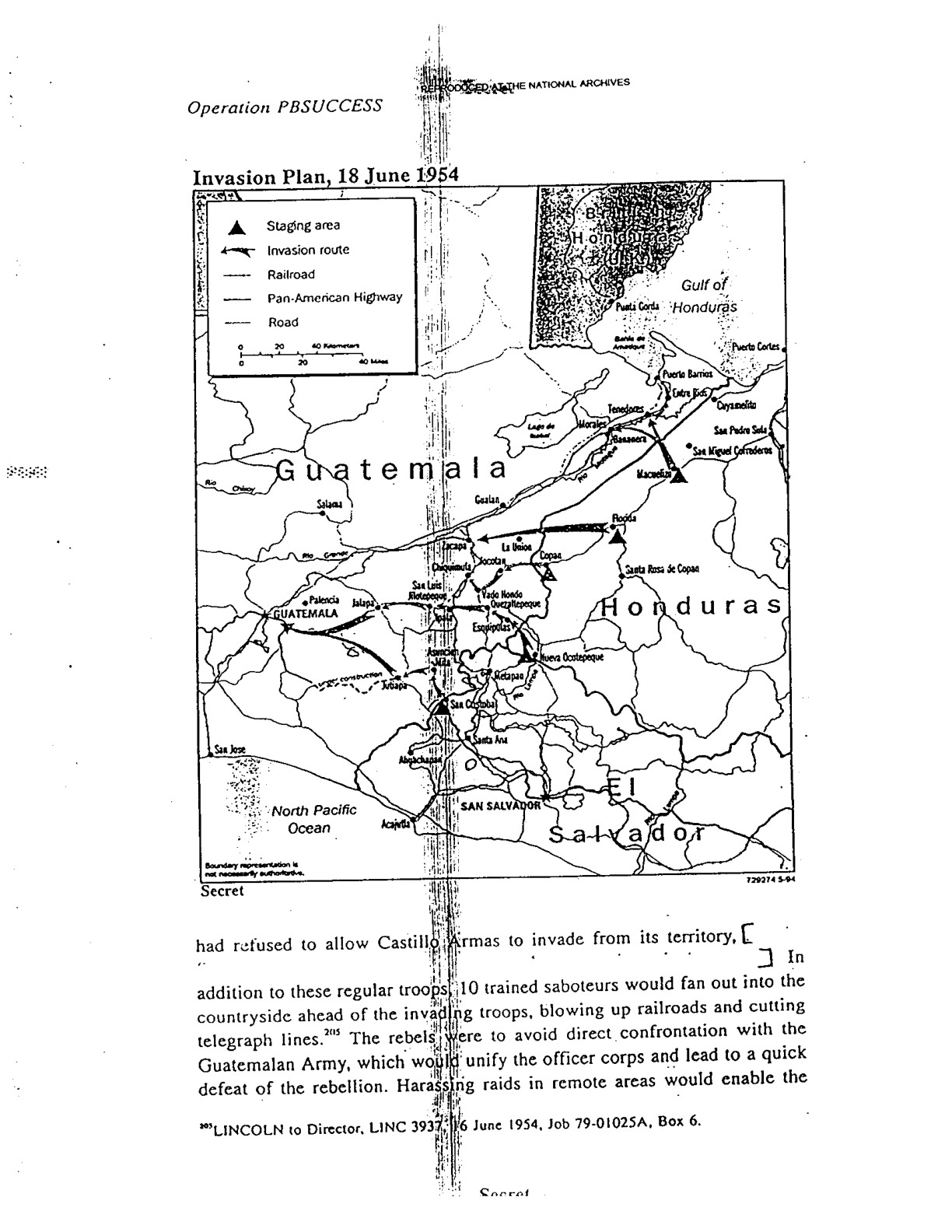
A CIA-directed campaign combined propaganda, political pressure and support for Carlos Castillo Armas’s exile force. Jacobo Árbenz resigned, but the army’s choices and the contested succession were essential parts of the result.
Context and later records: 1944–2003
Completed research edition · Prepared for editorial review
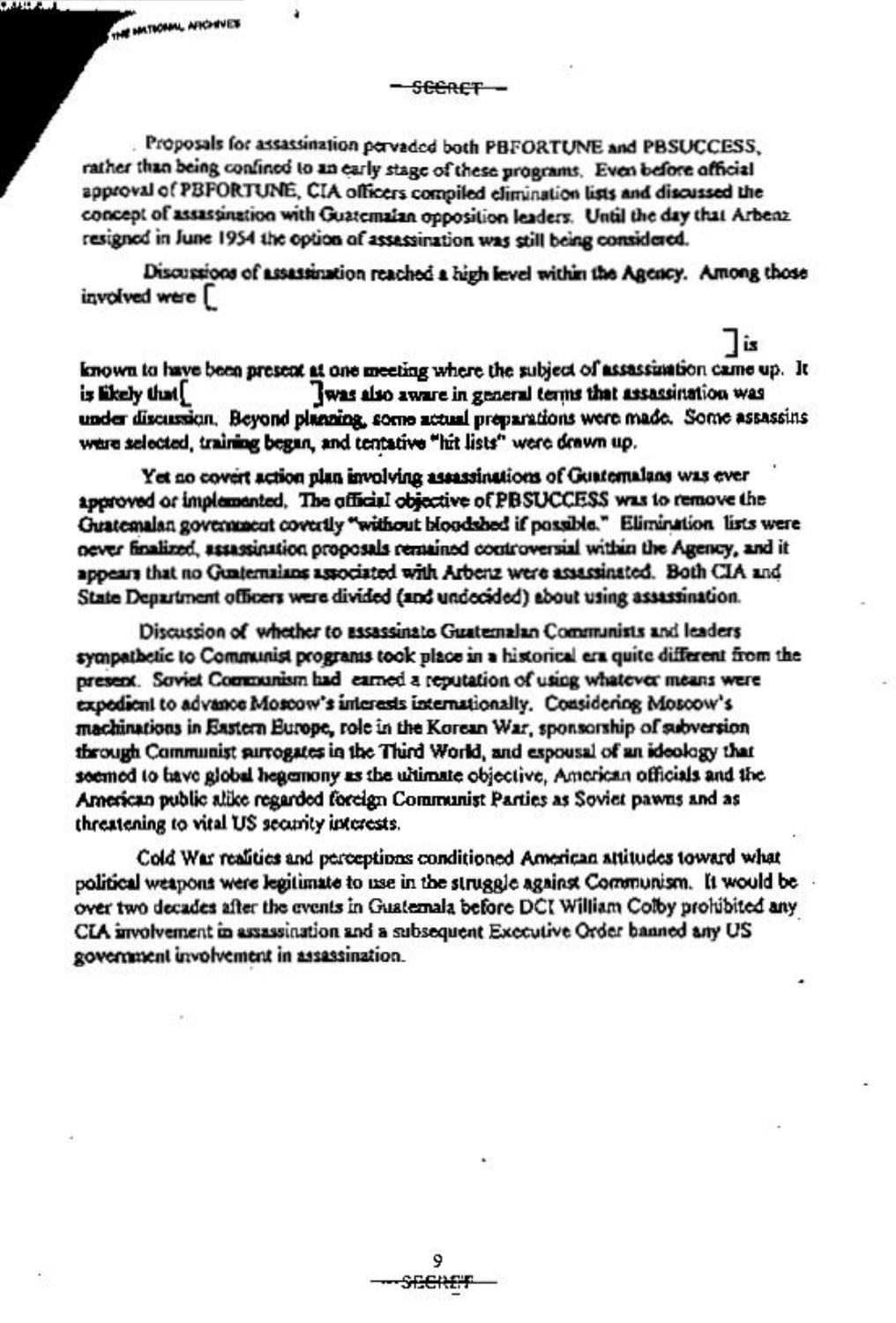
Planning records contain assassination proposals, lists and disputes within the effort against Árbenz. This companion to the coup guide follows what was proposed, approved or withheld. It does not treat every list as a completed killing or erase the seriousness of planning because execution is unproved.
Context and later records: 1952–1954 / disclosure and memory to 2012
Completed research edition · Prepared for editorial review
CIA assistance and Indonesian regional/army politics
CIA support for regional dissidents escalated into arms and combat air assistance. Jakarta defeated the main rebel centers; Allen Pope’s capture exposed a program already in trouble. Washington then turned toward assistance to the central army.
Context and later records: 1956–1962 / later records
Completed research edition · Prepared for editorial review
CIA-sponsored exile invasion; presidential and military decisions
A CIA-organized Cuban exile brigade landed under a changing U.S. plan to remove Fidel Castro. Cuban forces defeated the beachhead. The air-strike decisions, supply collapse and assumptions about popular resistance remain central to explanations of the failure.
Context and later records: 1959–1962 / memory to 2026
Completed research edition · Prepared for editorial review
CIA managers, private intermediaries and Cuban participants
CIA officials organized lethal projects against Fidel Castro through distinct intermediaries and agency channels. The guide separates proposals, technical preparation, transfers and reported teams from verified attacks, and weighs competing readings of senior knowledge. These plots failed to kill Castro; presidential authorization remains a separate evidentiary dispute.
Context and later records: 1960–1965 / origins and selected aftermath, 1959–2016
Completed research edition · Prepared for editorial review
CIA plot; separate Congolese, Katangan and Belgian killing chain
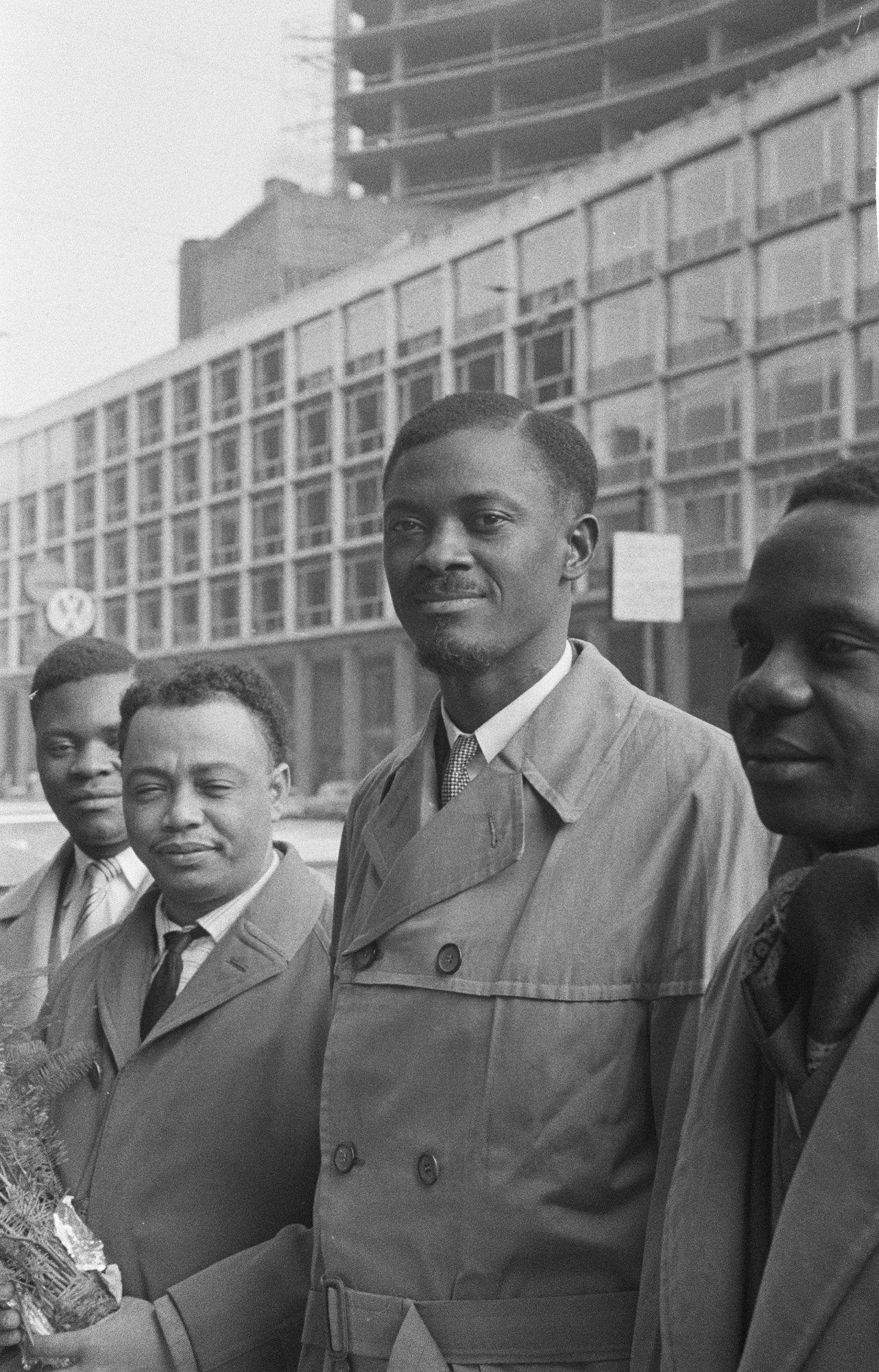
The CIA delivered lethal materials and pursued an assassination project against Patrice Lumumba. His eventual killing followed a distinct custody, transfer and execution chain involving Congolese and Belgian actors. The guide compares the plot with wider U.S. support and later inquiries without assuming the CIA poison was used.
Context and later records: 1960–1961 / selected aftermath to May 2026
Completed research edition · Prepared for editorial review
CIA-supported ground forces; Lao and Thai actors; separate U.S. military aviation and diplomacy
The Laos war linked CIA-supported forces and air supply with Lao, Hmong and Thai decisions, U.S. military bombing and diplomacy. The guide separates neutrality rules, covert support, distinct campaigns, narcotics allegations, the 1973 settlement, 1974 Air America departure and 1975 evacuation. Named community voices and continuing unexploded-ordnance harm remain part of the history.
Context and later records: 1950–1975 / selected aftermath through 2023
Completed research edition · Prepared for editorial review
U.S. diplomacy, Defense and naval command; Brazilian forces
U.S. officials encouraged and prepared to assist opponents of João Goulart. A naval task force sailed but was recalled as Brazilian forces prevailed. Brother Sam belonged to U.S. diplomatic and military command; the ships did not enter combat.
Context and later records: 1961–1985 / memory to 2026
Completed research edition · Prepared for editorial review
CIA foreign-influence inquiry and domestic collection
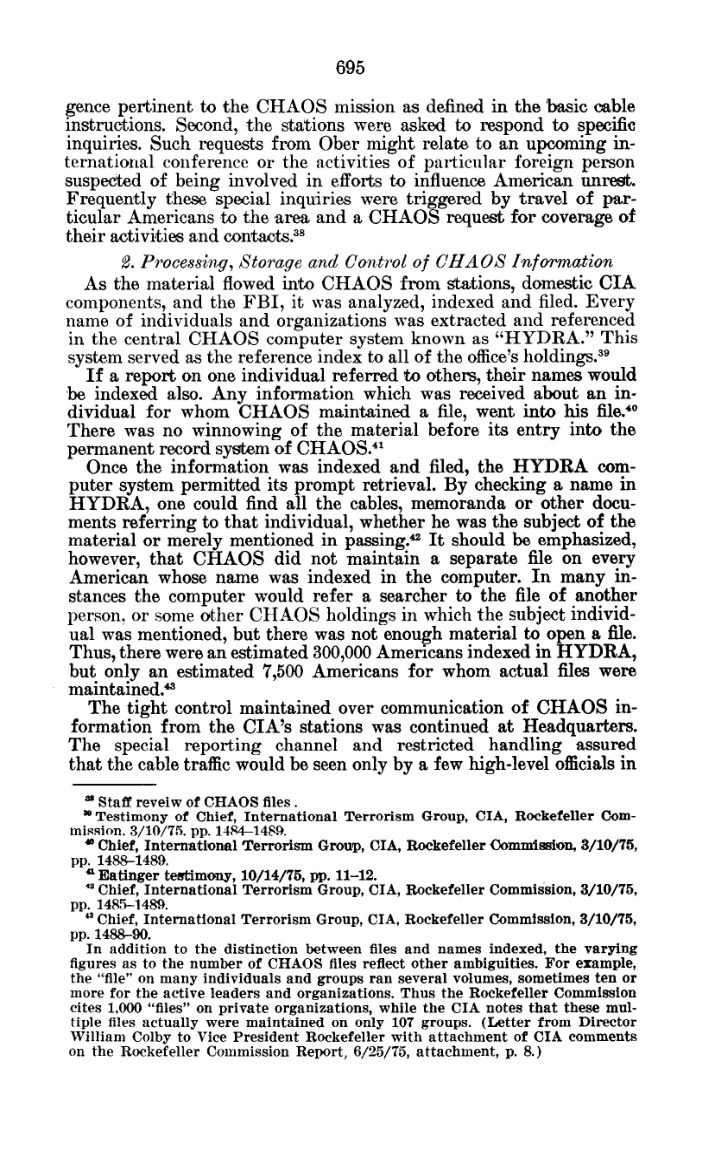
A CIA inquiry into possible foreign influence on American dissent accumulated information on Americans and organizations. The guide distinguishes foreign tasking, domestic collection, indexes, files and relationships to other programs. It follows the investigations and competing assessments of authority, scope and intelligence value.
Context and later records: 1967–1976 / later releases
Completed research edition · Prepared for editorial review
CIA covert political action; Chilean political/military decisions
Nixon ordered a covert effort to prevent Allende taking office in 1970. Track II failed, while political funding and economic pressure continued. The documented campaign and Chile’s 1973 military coup are connected histories with distinct operational evidence.
Context and later records: 1962–2026
Completed research edition · Prepared for editorial review
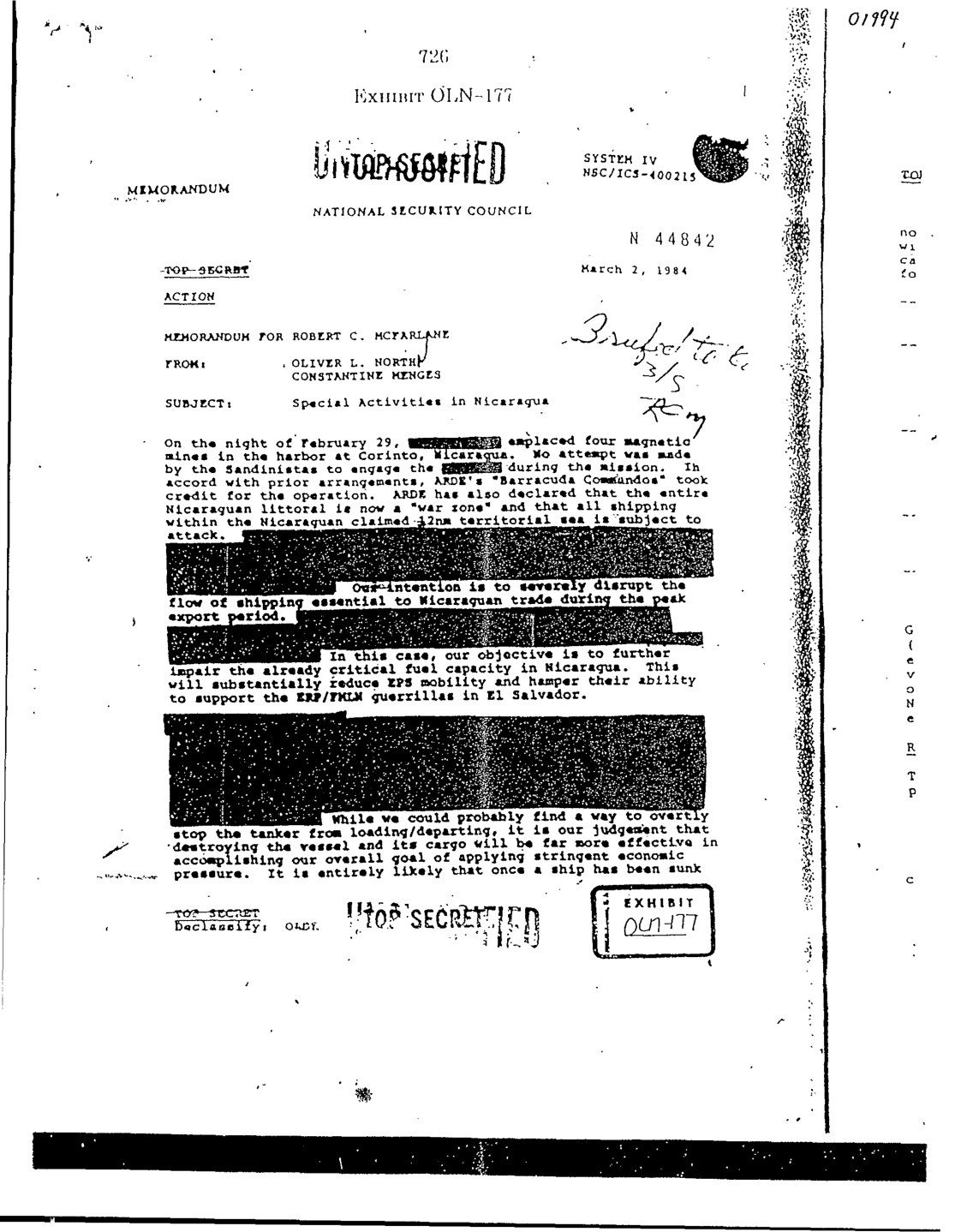
Mining of Nicaragua’s harbors became a public and international legal confrontation in 1984. The guide follows the actual CIA and agent chain, separates it from attribution of every Contra act, and compares the ICJ judgments, U.S. objections and dissent. The 1991 discontinuance did not overturn the merits judgment.
Context and later records: 1979–1991 / memory to 2026
Completed research edition · Prepared for editorial review
CIA custody, contractors, executive legal advice and host states
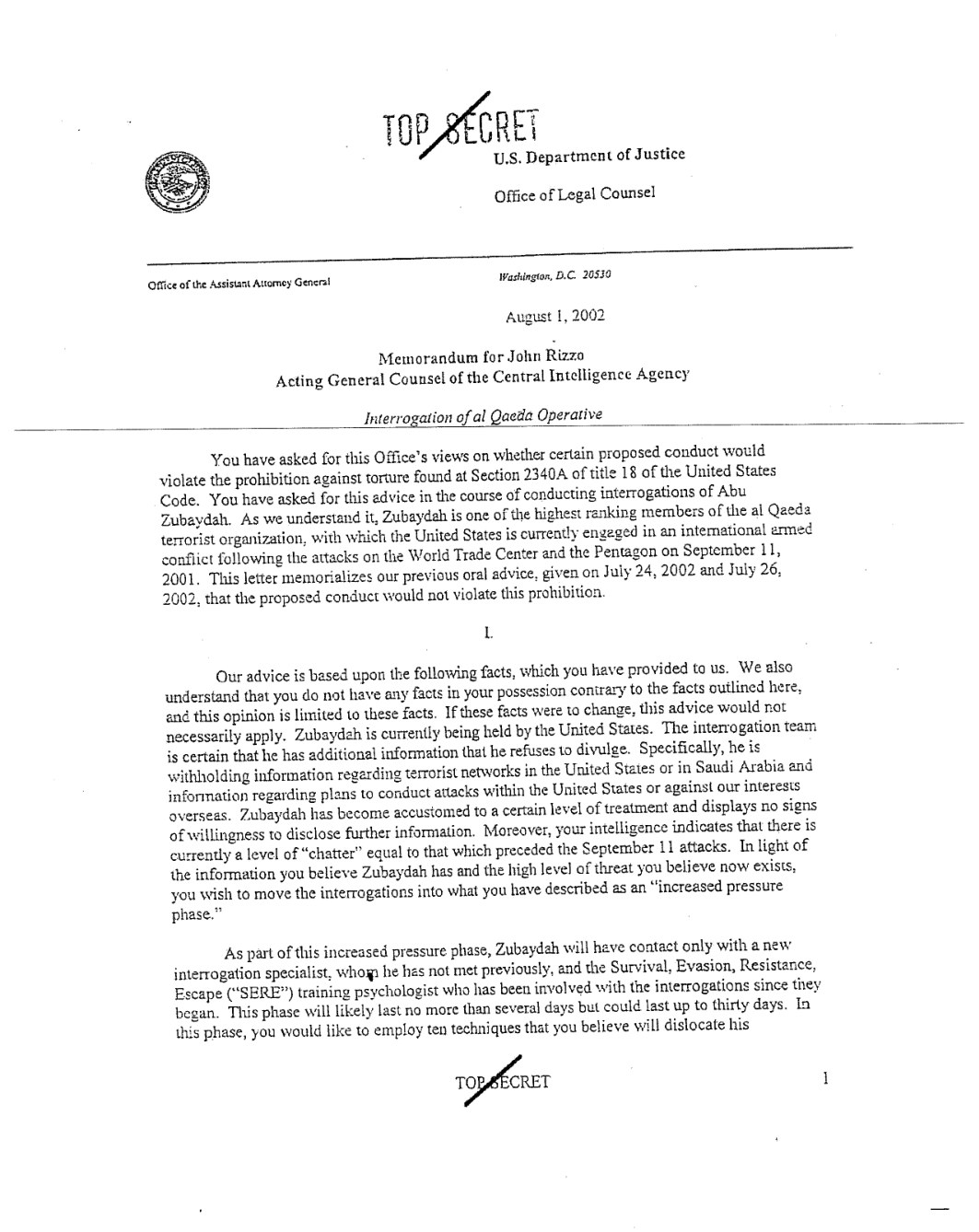
The CIA built a secret detention and coercive interrogation program after 9/11. The guide follows authorization, treatment and accountability, then tests the Senate’s findings against the CIA response and minority views. Intelligence claims, severe abuse, legal advice and later court outcomes require separate assessments.
Context and later records: 2001–2009 / selected aftermath to 2022
Completed research edition · Prepared for editorial review
Joint Chiefs of Staff and Defense; interagency Mongoose context
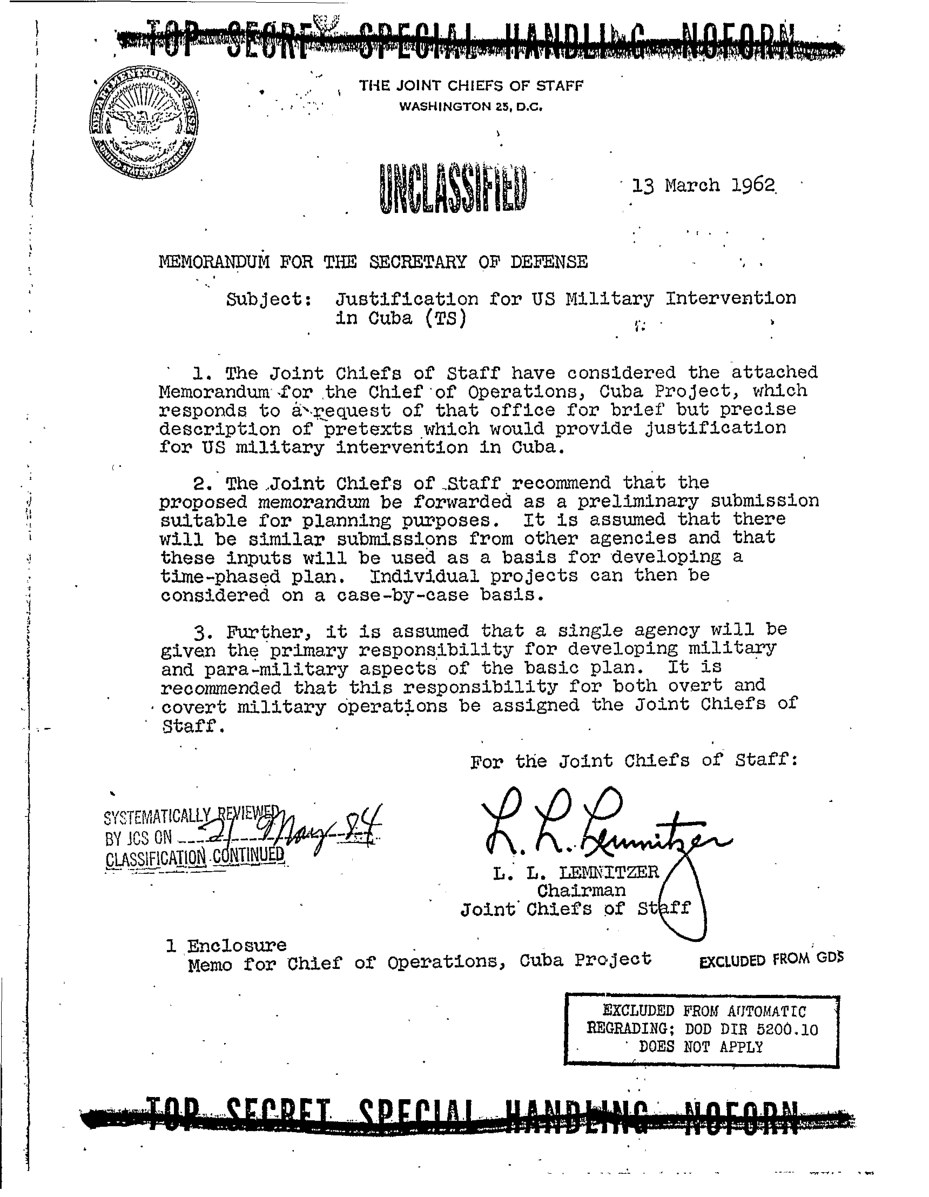
The Joint Chiefs endorsed a preliminary submission of deceptive pretexts for military intervention in Cuba. The guide distinguishes civilian tasking, planning approval and the missing chain to execution. It tests later claims about presidential rejection and cultural precedent. This is a JCS/Defense planning case, not a CIA-authored operation.
Context and later records: 1961–1963 / disclosure and interpretation from 1997
Completed research edition · Prepared for editorial review
Current content: 2026-10-25T23:34:59-07:00 · ChatGPT (OpenAI) · gpt-6.1-sol · Reasoning medium · Codex. Full history ↗
Original observed timestamps differ; both are retained in the child history. Exact original model is unavailable.
Historical and institutional overview
Institutions, authority and the people affected.
These sixteen guides follow different instruments of state action. CIA officers appear as organizers, funders, collectors, custodians and sometimes direct participants. Presidents, diplomats, military commands, contractors, allied services and local political actors shaped the decisions. Brazil’s Brother Sam contingency followed U.S. diplomatic and military channels; Northwoods was a Joint Chiefs and Defense planning submission within an interagency project. Mail interception and MHCHAOS raise a different set of questions from changing a foreign government. The collection groups these histories without assigning them one command chain.
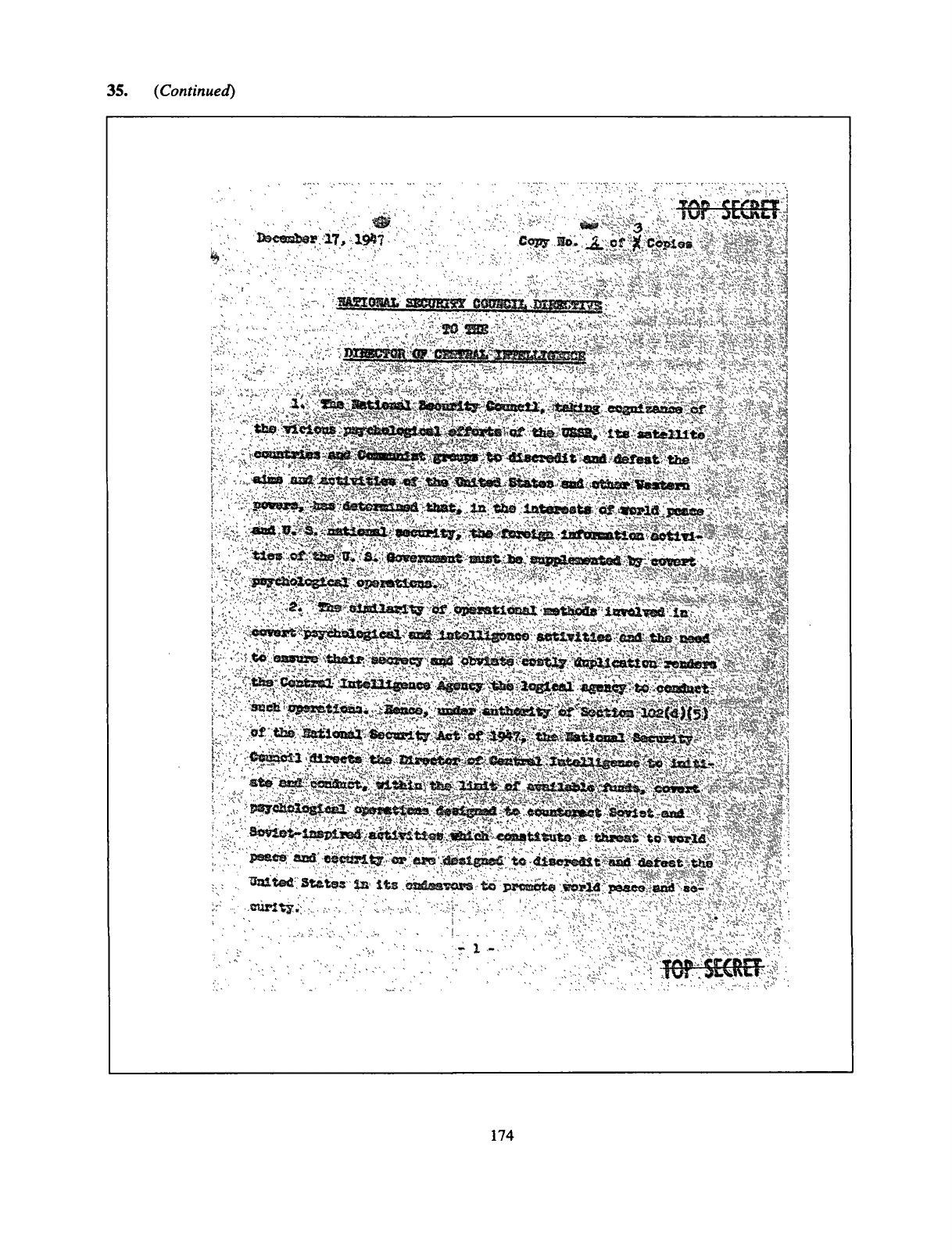
In 1948, NSC 10/2 placed peacetime covert operations inside the CIA and required coordination with State and Defense. It treated hidden U.S. sponsorship as a defining feature and separated these operations from espionage and overt warfare. That arrangement connected secrecy to policy authority. The particular decision records establish how each later project was authorized, including cases where secrecy narrowed coordination or a military contingency followed a separate command chain.
Italy’s covert political finance illustrates how an authorization, a disbursement and an election result differ. The 1948 campaign sits within Italian postwar politics; later records show reductions, a wind-down, renewed programs and suspended spending. HTLINGUAL and MHCHAOS instead concern intelligence collection and its boundaries. Their investigators distinguished the scale of indexes, files, mail examination and opening, and assessed what officials knew. Similar language about security cannot substitute for the particular authority and conduct in each record.
Mossadegh and Árbenz lost power; Castro defeated the exile invasion. Indonesian regional rebels lost their main centers despite outside assistance. Brazil’s coup prevailed before the prepared American military aid became necessary. Allende took office after the failure of Track II and was overthrown by Chile’s armed forces three years later. These outcomes differ both from one another and from the objectives officials initially approved.
The national histories are indispensable. Iranian oil and royal authority, Guatemalan land reform and army politics, Cuba’s revolution, Indonesia’s regional disputes, Brazil’s conflict over reform and command, and Chile’s electoral and constitutional crisis were different political struggles. Foreign intervention and local agency operated together. The records support comparison of particular mechanisms without reducing different national histories to the setting for a single outside plan.
Laos adds a long military partnership whose components cannot be assigned to one agency. CIA-supported Hmong and other forces depended on Lao commanders, Thai personnel and aviation; U.S. military campaigns in the north and along southern supply routes had separate decisions. The 1962 protocol distinguished conventional armaments from foreign personnel, including certain civilians. Continued support, subsequent bombing and the 1973 agreement therefore require activity-specific comparison with actual provisions. Vang Pao’s alliance, Youa Lee’s bereavement and Lao Thai Vang’s educational recollection preserve different named experiences, without making any one account stand for all Hmong communities.
The unit of comparison also matters. The two Guatemala guides share a political crisis and part of an archive: one follows the coup, the other assassination proposals. Bay of Pigs and the Castro plots overlap in policy setting while asking different operational questions. The CIA’s project against Lumumba and the chain that killed him must be traced separately. Counting guide doors therefore does not count independent operations, confirmed killings or separate corroborating archives.
Later accountability has its own evidence. Nicaragua’s international litigation distinguishes jurisdiction, merits, attribution and discontinuance. The detention record contains a Senate investigation, an agency response, competing intelligence assessments, withdrawn legal opinions and later proceedings. Each finding has a date and an object. A court judgment, investigative conclusion, decision not to prosecute and negotiated settlement cannot be exchanged for one another or treated as complete assessments of every participant.
For Iran, CIA financial authorization, British and State agreement and the account of presidential assent are separate pieces of evidence. The FRUS editors report that no written presidential authorization has been found. That archival limitation narrows the claim about its documentary form; it does not negate the extensive operational record.
Guatemala’s high-priority authorization, approved general plan and funding allocation predated the June 1954 invasion. In Cuba, Eisenhower approved a covert-action program in March 1960, while the final amphibious project developed through later decisions under Kennedy. Continuation, revision and launch should therefore remain distinct events.
In Iran, the joint U.S.–British project sought royal cooperation and an Iranian successor. The first attempt failed; crowds and armed units then helped bring down the government on 19 August. The scope of paid organization, autonomous mobilization and military coordination remains disputed. British planning, American station actions and Iranian choices need their own evidentiary chains.
In Guatemala, the exile force’s weakness made the army’s response central. Air attacks, propaganda and the prospect of greater intervention exerted pressure; officers still made consequential choices. Árbenz’s resignation transferred authority to Díaz, not immediately to Castillo Armas. Further American pressure and bargaining shaped the succession.
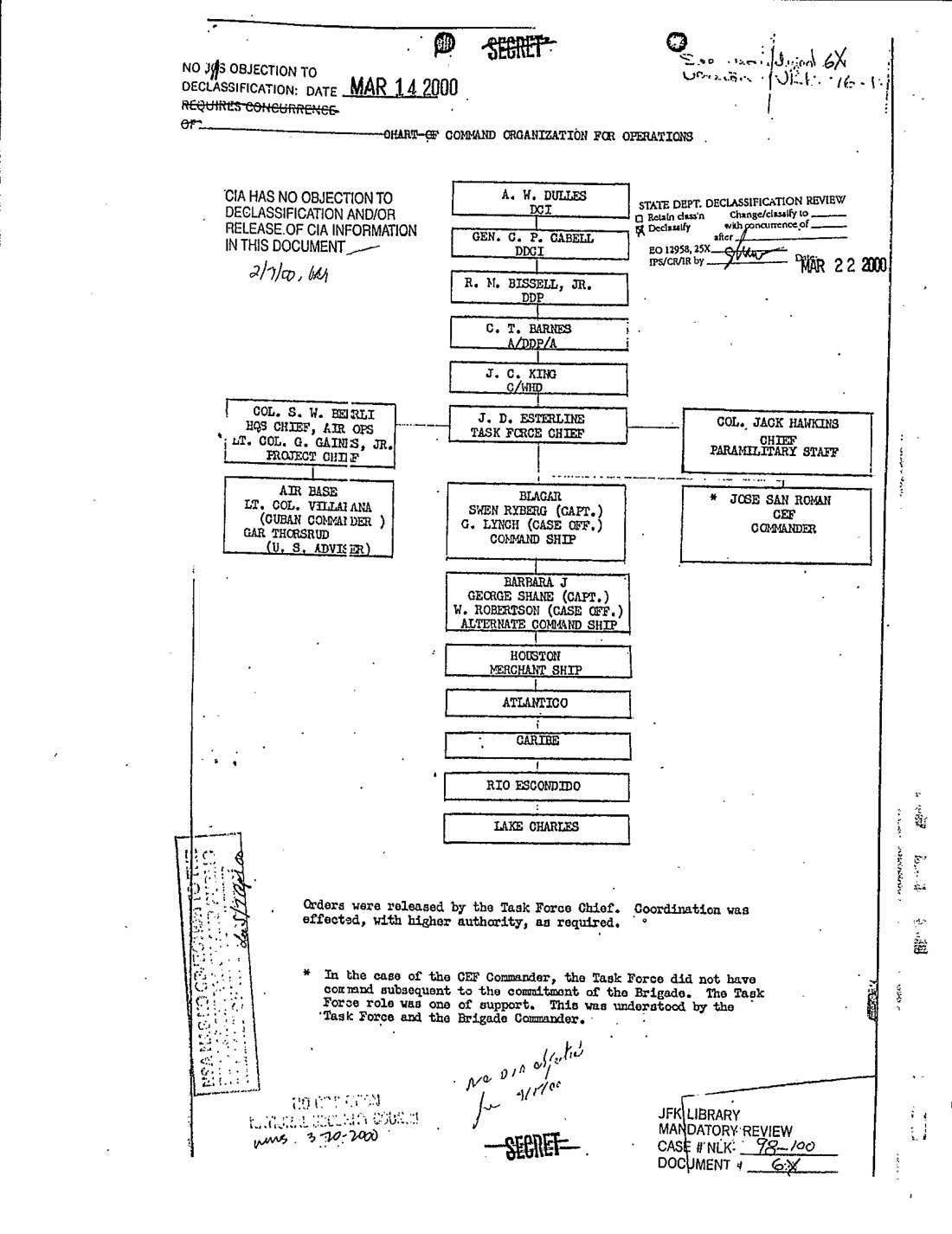
In Cuba, Brigade 2506 was an exile fighting force with CIA organization and U.S. support. Castro’s government and armed forces actively defeated it. The operation was neither an overt U.S. ground-force invasion nor an encounter in which Cubans merely waited for outside decisions. The command record and field reports show action on both sides.
Plans and public accounts could pursue political effects. PBSUCCESS’s broadcasts and propaganda helped project a strength the invading force did not possess. Iran’s royal papers were both a political instrument and a contested constitutional claim. Cuba’s defector cover story sought to disguise the origin of the opening air attacks and created a diplomatic problem.
This makes internal records valuable but not automatically truthful. A cable can document an official’s report without proving every reported event. A later CIA history can reconstruct an operation while defending or criticizing institutional choices. Resignation speeches, exile recollections and official commemorations likewise illuminate participants’ views without resolving every causal claim.
A strong foreign-intervention account identifies the funding, organization, propaganda and coercion that changed the balance. Its strongest rival emphasizes local opposition, institutional fractures and choices that foreign planners did not fully control. These accounts can overlap. The decisive question is which documented action explains a particular turning point, and how much remains a counterfactual.
At the Bay of Pigs, cancelled strikes and continuing Cuban air power were important to the supply collapse. That does not establish that a larger air campaign would have secured a stable anti-Castro government. The inquiry into immediate military failure and the critique of the project’s political assumptions concern different levels of outcome.
Authenticated operational logs, recipient-level financial records, fuller Iranian and British files, Guatemalan military communications or additional Cuban and exile field records could alter judgments about control and causal weight. Evidence of a proposal alone would not establish execution; evidence of execution alone would not establish that it determined the result.
A rebellion can have local roots and foreign sponsorship
Indonesia’s regional commanders and civilian dissidents had grievances and organizations before U.S. combat assistance. The January 1958 estimate also recorded their expectations of Western support. The later internal Pope briefing identifies an approved assistance program, arms and air support, and CAT pilots nominally on leave. Local origins do not disprove sponsorship; sponsorship does not establish that Washington controlled every rebel decision.
The failed wager became visible before Pope was captured on 18 May. Sumatra’s organized resistance had largely collapsed by 24 April; Ambassador Jones urged a policy change on 12 May; Washington authorized gestures toward Jakarta on 17 May. Capture exposed and accelerated a deteriorating policy. Authenticated tasking orders and flight logs could clarify individual missions, but the failure’s timing cannot rest entirely on the famous shootdown.
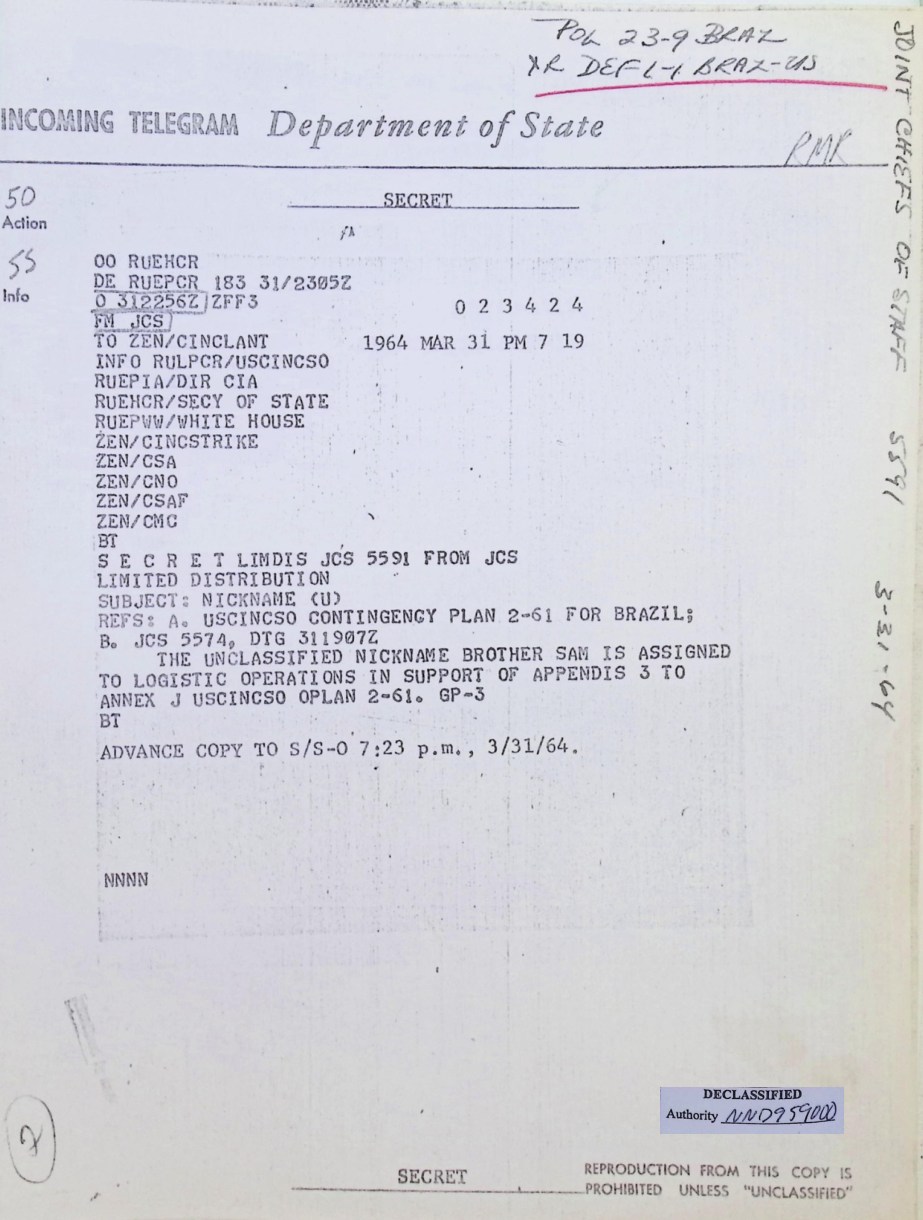
In Brazil, Gordon requested support, Johnson pressed readiness and the Joint Chiefs issued Brother Sam movement instructions. These were actual American decisions. The task force sailed while Goulart’s position was collapsing and was recalled after his opponents had prevailed. The preparations document American commitment to the anti-Goulart side even though the anticipated material intervention was not carried out. The naval chain ran through American military command, making the fleet a military contingency distinct from CIA intelligence and covert political activity.
The strongest foreign-backing interpretation emphasizes encouragement, contacts and insurance against resistance. The strongest domestic-sufficiency interpretation emphasizes Brazilian command choices and the loyalists’ collapse before American material assistance arrived. Both must explain the movement and recall orders. Communications showing what Brazilian commanders knew before acting would sharpen the causal assessment; an unused contingency cannot by itself prove what would have happened if resistance had held.
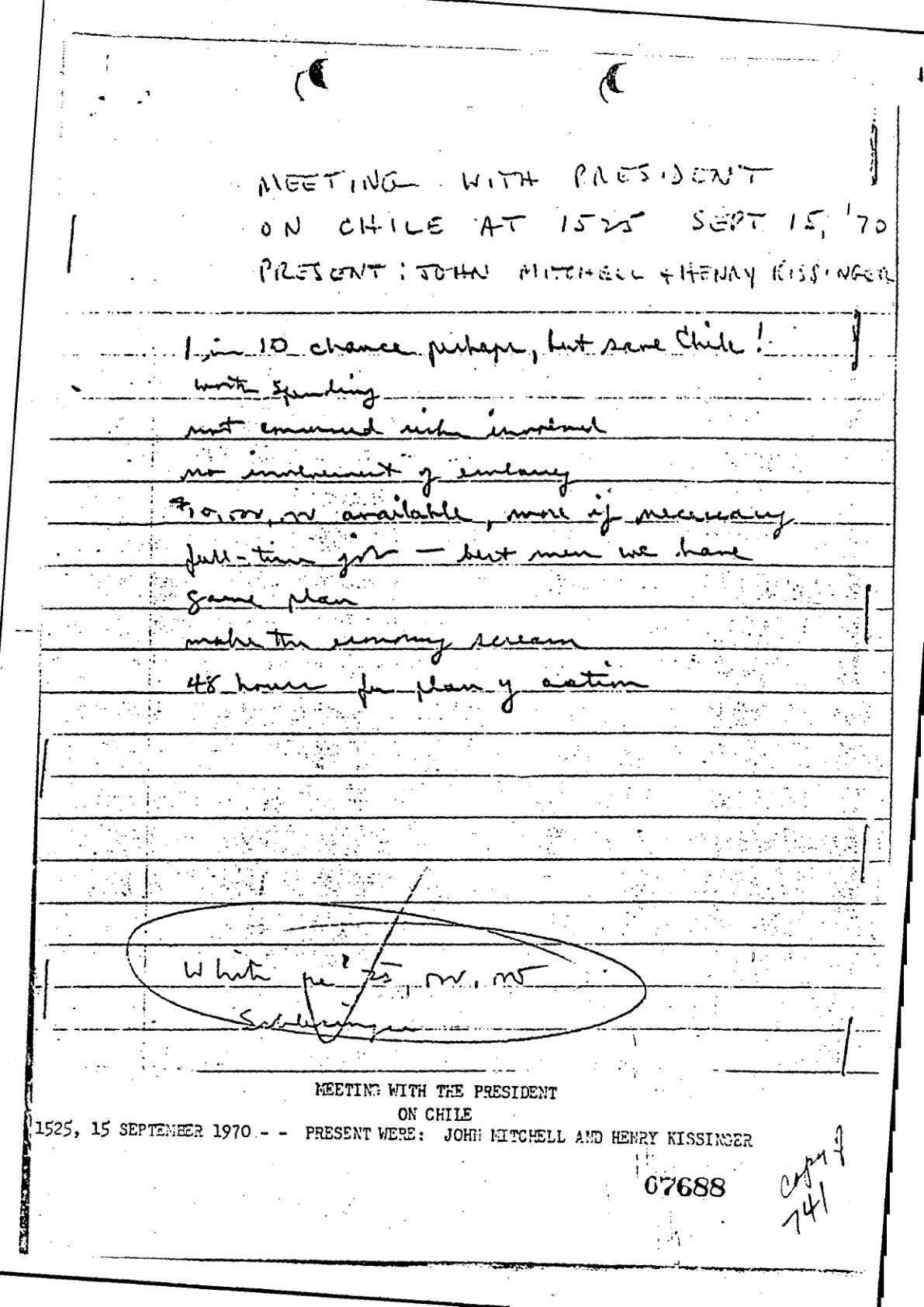
The 15 September 1970 directive and the 16 October cable establish a U.S. effort to provoke a coup and prevent Allende’s accession. Support for abduction planning placed General Schneider’s constitutional role on that critical path. The fatal attack, the particular groups receiving equipment and the subsequent payments require separate evidence. Congress confirmed Allende; the immediate project failed.
Political subsidies, media support and economic pressure continued after inauguration. In 1973, private-sector funding proposals and disagreements among U.S. officials show the porous boundary between opposition assistance and coup encouragement. They must be read alongside Chilean elections, failed negotiations, the June rising and changes in army command. A destabilization account can give Washington substantial causal responsibility without having established that CIA officers issued the Chilean military’s final orders.
The 1975 Senate finding and the CIA’s later review limit their conclusions about direct U.S. involvement in the September 1973 coup. Those institutional statements are tested against contemporary orders, contacts and funding records, rather than treated as automatic exoneration. Authenticated pre-coup operational tasking or communications tying assistance to particular military decisions could change the assessment of control. Neither a blanket denial nor the already documented 1970 coup effort settles every distinct claim about 1973.
A proposed pretext, a dispatched contingency and an executed operation
Northwoods belongs to the Joint Chiefs and Defense submission chain within Mongoose. Its collective planning endorsement was serious, but its cover called for preliminary and case-by-case consideration. Kennedy’s 16 March position on overt force is narrower than a located signed veto of every scenario. Continuing April discussion leaves questions about later papers; it does not supply a linked execution record.
Brazil’s Brother Sam fleet actually sailed, then was recalled after Brazilian opponents prevailed; it was a military contingency rather than a CIA-operated fleet. Bay of Pigs involved an invasion that actually landed. These histories show why proposal, approval, dispatch, execution and outcome deserve separate verbs. The strongest institutional-responsibility account does not need to invent implementation to explain what officials endorsed; an allegation of a completed deception still needs its own orders, agents and effects.
Political finance: approval, payment and electoral outcome
Italy’s records show covert finance operating through different decisions at different times. The later committee papers contain proposals, authorized budgets, reported expenditure and arguments about whether further spending would achieve its purpose. The 1976 report of no spending under a new program is a different fact from an earlier presidential approval. Italian parties, voters, the church, unions and changing coalitions remain part of the causal setting.
That distinction also matters in the coup cases. Resources supplied by outsiders can shape options without giving the supplier complete control or making every desired outcome occur. A strong influence account identifies the actual recipient, action and timing; a strong domestic-agency account still has to explain the documented money and contacts. Payment records and recipients’ contemporaneous communications would sharpen either assessment more than repeating that one side won an election or a coup.
Collection affecting Americans: scale and authority need precise units
HTLINGUAL’s mail program and MHCHAOS’s collection on dissent were distinct projects with different records, purposes and pathways into information about Americans. Mail-cover counts, opened letters, indexes, personal files and reports do not measure the same activity. A large index is not a count of individually opened letters; a foreign-intelligence justification does not decide whether a particular domestic practice was authorized.
The inquiries preserve disputes about knowledge, legality and intelligence value. Their criticisms must be read alongside the actual selection rules, reporting and officials’ explanations. Blanket claims of either complete innocence or a single all-controlling domestic program lose those distinctions. Orders, tasking, recipient use and records of notice would change specific conclusions; an institutional label alone would not. Later civil litigation has its own elements and remedies rather than supplying one universal verdict on every program.
Lethal proposals do not supply an execution history by themselves
The Guatemala proposal files, the Castro investigations and the Lumumba record each establish serious lethal intent or planning. Their operational stages differ. A list, an authorization, delivery of material, a reported team and a completed killing require different proof. Failure to demonstrate use does not make a delivered assassination project imaginary. The existence of an assassination project does not establish who carried out a separate killing.
For Lumumba, the CIA project belongs beside wider U.S. support to opponents and the later custody, transfer and Katangan execution chain, including Belgian roles. For Castro, senior CIA participation coexists with unresolved knowledge and authorization above the agency. The Guatemalan records include internal disagreement, limits and proposals whose execution is not established by a list. The strongest broader-responsibility account identifies enabling actions; the strongest narrower account must still confront those actions. An authenticated connecting order or corroborated operative chain could alter the allocation of responsibility.
Nicaragua: direct acts, relationships and judicial attribution
The harbor-mining case follows CIA-directed action and its agent chain alongside support to the Contras. The 1986 ICJ merits judgment found U.S. responsibility for mining and other breaches, while its attribution analysis did not turn every Contra act into an American act. The United States’ jurisdictional objections and Judge Schwebel’s dissent give competing legal positions that require their actual arguments, rather than a generic dismissal of the court or the objections.
The 1984 jurisdiction judgment, 1986 merits judgment and 1991 discontinuance concern different stages. Ending proceedings did not overturn the merits judgment or supply exoneration. This provides a useful contrast with cases known principally through congressional inquiries or retrospective intelligence histories. The kind of proceeding determines what was decided; a judicial holding also does not supply an exhaustive history of every secret relationship.
Detention: abuse, claimed intelligence value and accountability
The Senate study documents severe abuse, management failures and misleading accounts of the CIA detention program. The CIA response and minority views contest important assessments, especially the role of information in intelligence successes. The strongest dispute is tested through the dated chronology of what was known, how it was obtained and how a claimed success was attributed. A later useful lead does not by itself establish which treatment produced it.
Legal advice, actual treatment and later accountability remain distinct. The withdrawal of opinions changed their institutional status; closing criminal investigations did not adjudicate every act’s lawfulness. European judgments, U.S. state-secrets litigation and a civil settlement ask different legal questions and produce different outcomes. A full assessment requires those scopes, the people affected and the limits of released evidence. This collection points to the complete guide rather than flattening those disputes into a single score.
A legal framework is not the same as a record of compliance
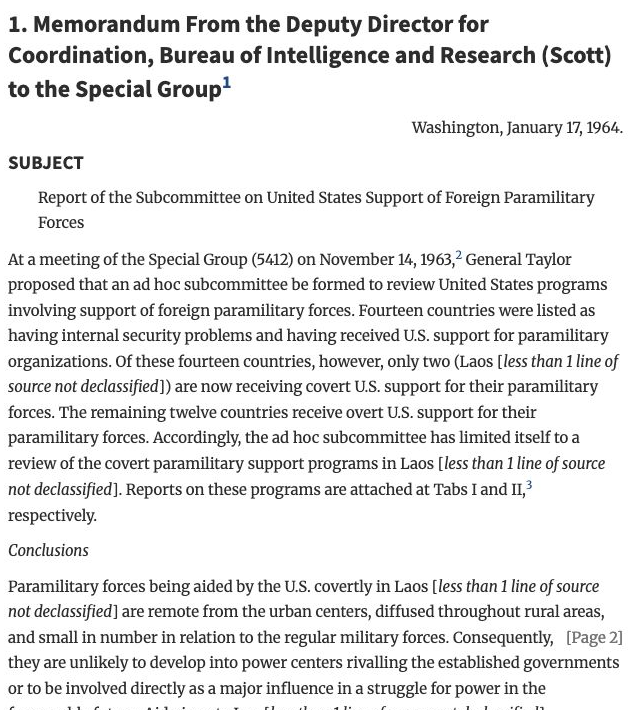
The 1962 Laos protocol restricted foreign personnel and intervention while allowing conventional armaments the Royal Government considered necessary for national defence. Scott’s 1964 memorandum invoked that exception for overt aid before separately describing covert support. A civilian job title, a request for help or an adversary’s breach does not alone decide the legality of every activity. Nor does continued weapon supply alone establish a violation.
The 1973 Lao agreement and Godley’s preceding prediction also have different evidentiary roles. The agreement’s withdrawal deadlines depended on political institutions; the message did not prove later compliance. Nicaragua offers a different kind of record: actual international judgments with distinct jurisdiction, merits and attribution holdings. Treaty text, a diplomat’s legal justification and an adjudicated holding cannot be substituted for one another. Specific personnel, mission and notice records could change an activity-level assessment.
An operation’s endpoint does not end its human consequences
Leary dates Air America’s departure from Laos to 3 June 1974. The 1975 evacuation of Vang Pao and selected allies was a different event; an embassy assessment or proposed policy was not a passenger manifest. Named Hmong recollections describe alliance, opportunity, loss and expectations of protection. The departure of an airline cannot settle which commitments were made, which people were moved or what was owed to those left behind.
Continuing unexploded ordnance requires another set of measures: contamination estimates, cumulative casualties and a recent administrative reporting window are different quantities. Obama’s 2016 acknowledgment and assistance announcement are later official acts, not a complete wartime judgment or evidence that every hazard was removed. The detention guide likewise separates program closure from later accountability, although its victims, institutions and legal questions are different. Authenticated evacuation priorities, recruitment assurances, survivor records and transparent casualty methods could sharpen the Laos account without collapsing those histories.
Every dated record from the sixteen frozen child guides is preserved with its original precision, category and source mapping. A case’s selected core period is a reference window, not a claim of continuous activity; earlier context and later consequences or investigations remain labeled. Markers use elapsed-year spacing and separate close dates onto rows. Select a case or activity to inspect its records. Colors distinguish guide files; proximity alone does not establish a causal relationship. Year- or month-only dates are placed at the start of that stated period on the graph; the list retains their original precision.
No dated records match these filters.
Italy — covert political funding
HTLINGUAL — mail interception
Iran 1953 — Operation Ajax
Guatemala 1954 — PBSUCCESS
Guatemala — assassination proposals
Indonesia, 1958
Bay of Pigs, 1961
Plots to assassinate Fidel Castro
The plot against Patrice Lumumba
The Secret War in Laos
Brazil 1964 — Operation Brother Sam
MHCHAOS — domestic intelligence collection
Chile — Track II and covert political operations
Nicaragua — harbor mining
CIA detention and interrogation
Operation Northwoods
Context and selected core periods
19441960197719932010
Consequences, inquiries and later records
19541972199020082027
Dated records
Revolution ends the old orderGuatemala 1954 — PBSUCCESS / Background / Earlier context
The 1944 upheaval opened the reform decade. Árbenz’s program emerged from that domestic political history, rather than from the 1954 arms shipment.
Dated record in the full guide ↗A statutory boundary accompanies the CIA’s creationMHCHAOS — domestic intelligence collection / Law / Earlier context
The National Security Act assigns intelligence responsibilities while excluding police, law-enforcement and internal-security functions. This is the historical charter, not a summary of today’s complete legal regime.
Dated record in the full guide ↗NSC 1/3 targets Communist electoral participationItaly — covert political funding / Policy proposal / Core window / selected events
The report recommends immediate action before the election, plus separate conditional responses to a later Communist government.
Dated record in the full guide ↗Presidential approval of the pre-election paragraph recordedItaly — covert political funding / Approval record / Core window / selected events
An editorial note cites a 12 March memorandum reporting approval of paragraph 8. A later 16 March memorandum records 15 March approval of the conclusions; the related records should not be compressed into one guessed signature date.
Dated record in the full guide ↗Truman publicly announces vessel transferItaly — covert political funding / Overt action / Core window / selected events
The public statement describes 29 vessels returned or provided to Italy. This economic gesture is distinct from secret political contributions.
Dated record in the full guide ↗Parliamentary election beginsItaly — covert political funding / Election / Core window / selected events
The national election is dated 18 April. Chamber results: DC 48.51%, 305 seats; Popular Front 30.98%, 183 seats. National returns do not identify marginal votes caused by covert money.
Dated record in the full guide ↗Parliament backs oil nationalizationIran 1953 — Operation Ajax / Oil and sovereignty / Earlier context
Nationalization became a broad nationalist demand before Mossadegh took office. The decision challenged the Anglo-Iranian Oil Company’s control; it did not itself dictate the later U.S. choice to overthrow the premier.
A parliamentary leader took office within a constitutional monarchy. His premiership should not be described as a direct nationwide presidential election.
Dated record in the full guide ↗Early list-making described in CIA historyGuatemala — assassination proposals / Retrospective reconstruction / Core window / selected events
Haines traces prospective elimination and imprisonment lists to January 1952. The date comes from his cited reconstruction, not a newly authenticated signature page here.
Dated record in the full guide ↗Estimate assesses Communist influenceGuatemala — assassination proposals / Intelligence judgment / Core window / selected events
A contemporary estimate documents the security interpretation that helped frame policy; it is an assessment to compare with nationalist and reform objectives.
Dated record in the full guide ↗Somoza promotes support for oppositionGuatemala — assassination proposals / Regional initiative / Core window / selected events
Haines links Somoza’s Washington visit to investigation of assistance for Castillo Armas. Reported influence and formal approval remain distinct.
Dated record in the full guide ↗Seekford reports the Trujillo bargainGuatemala — assassination proposals / Contemporary report / Core window / selected events
A report describes aid offered in return for four Dominican exiles’ deaths and Castillo Armas’s reported response. It does not document execution.
The rupture narrowed British diplomatic access; British intelligence turned toward a project requiring U.S. cooperation. Month precision preserves the account used here.
Dated record in the full guide ↗CIA records the project’s haltGuatemala — assassination proposals / Cancellation / Core window / selected events
Contemporary chronology and memorandum describe compromised arrangements and State Department intervention. Discussions did not all disappear with cancellation.
Dated record in the full guide ↗Luce arrives amid continuing assistanceItaly — covert political funding / Policy context / Core window / selected events
Landa’s 1953–56 study places covert support alongside procurement pressure. Its approximate annual estimate is not a complete financial account. Year precision is preserved here.
Dated record in the full guide ↗United Fruit land ordered expropriatedGuatemala 1954 — PBSUCCESS / Property dispute / Earlier context
Árbenz signed the order affecting about 234,000 acres near Tiquisate, with government bonds offered as compensation. The date and scale follow the FRUS editorial note. The later CIA chronology prints 25 February; this guide uses the signed-order date in FRUS document35, footnote2.
Dated record in the full guide ↗NSC still considers aid to MossadeghIran 1953 — Operation Ajax / Policy alternatives / Core window / selected events
The discussion includes measures to strengthen the premier and restart oil operations. It shows that removal was a choice among alternatives, not the only policy ever considered.
Dated record in the full guide ↗Henderson briefed on preliminary planIran 1953 — Operation Ajax / Planning / Core window / selected events
CIA and diplomatic officials discuss royal cooperation, a successor, aid and an oil settlement. A preliminary plan is evidence of intention, not proof that each proposed step happened.
Dated record in the full guide ↗Approval date in CIA chronologyIran 1953 — Operation Ajax / Authorization record / Core window / selected events
FRUS reports State and British authorization on this date and a handwritten addition about presidential approval. No written presidential authorization has been found.
The Psychological Strategy Board authorized CIA to proceed with State and Defense support. The surviving minute and later filing correspondence establish the action.
Dated record in the full guide ↗CIA draft assesses narrowed supportIran 1953 — Operation Ajax / Intelligence assessment / Core window / selected events
The draft criticizes the dissolution referendum and describes a fractured coalition and visible Tudeh mobilization. The political judgments belong to the analysts, not to an independent electoral audit.
Dated record in the full guide ↗Nassiri arrested; first attempt collapsesIran 1953 — Operation Ajax / Failed overthrow / Core window / selected events
The action began on the night of 15–16 August. Loyal forces arrested the decree-bearer; the Shah fled and the project’s military assumptions unraveled.
Dated record in the full guide ↗Headquarters reconsiders; Henderson meets premierIran 1953 — Operation Ajax / Contingency and diplomacy / Core window / selected events
Washington urges abandonment absent strong contrary recommendations. Henderson’s evening meeting addresses protection of Americans and the constitutional dispute. Neither record alone establishes what every local participant did next.
Dated record in the full guide ↗Crowds and armed units topple governmentIran 1953 — Operation Ajax / Overthrow / Core window / selected events
Military participation, control of communications and the assault on the premier’s position turn political mobilization into an effective change of power. The station reports Zahedi at the radio.
Dated record in the full guide ↗Zahedi seeks emergency assistanceIran 1953 — Operation Ajax / Consolidation / Core window / selected events
The new premier appeals to Eisenhower for aid. The request connects the new government’s survival to external financial support; it is not an accounting of earlier covert payments.
Dated record in the full guide ↗Defection program proposedGuatemala 1954 — PBSUCCESS / Political action / Core window / selected events
The K-Program sought to influence army and executive officials as a contribution to PBSUCCESS. It was a plan whose implementation and results must be separately tested.
Dated record in the full guide ↗List and biographies continue circulatingGuatemala — assassination proposals / Routing / Core window / selected events
Annotation records movement of the memorandum and associated biographic data; Haines describes consultation with Castillo Armas. Routing is not execution.
Dated record in the full guide ↗Voice of Liberation begins broadcastsGuatemala 1954 — PBSUCCESS / Psychological warfare / Core window / selected events
The CIA history dates the start of SHERWOOD to 1 May. The broadcasts were part of a covert campaign to magnify the appearance of opposition.
Dated record in the full guide ↗Cable requests four identitiesGuatemala — assassination proposals / Information request / Core window / selected events
Contemporary cable requests identities and information about four people discussed for early eradication. It does not establish completed action.
Dated record in the full guide ↗List critique questions analysisGuatemala — assassination proposals / Internal objection / Core window / selected events
Note finds outdated data, doubtful classifications and no real analysis; recommends study before disposal. A separate five-person recommendation is referenced.
Dated record in the full guide ↗Alternative course includes assassinationGuatemala — assassination proposals / Draft contingency / Core window / selected events
Draft proposes possible political assassination if the integrated paramilitary course proves difficult. A draft is not a final decision.
Dated record in the full guide ↗Wisner records a temporary rejectionGuatemala — assassination proposals / Policy response / Core window / selected events
Memo of June 1–2 discussions says Holland ruled sensitive treatment out for immediate future, but not conclusively, and requested further justification.
Dated record in the full guide ↗CIA field command warns of weaknessGuatemala 1954 — PBSUCCESS / Armed action / Core window / selected events
Headquarters in Florida reported about 300 men, some deserting, and sought permission for greater air action before its exaggerated strength was exposed.
Dated record in the full guide ↗Árbenz resigns and transfers authorityGuatemala — assassination proposals / Political outcome / Core window / selected events
The address transfers executive authority to Díaz. Árbenz survives; his account of the war is a primary participant voice.
Dated record in the full guide ↗Castillo Armas becomes provisional presidentGuatemala 1954 — PBSUCCESS / Aftermath / Core window / selected events
The junta dissolved and Castillo Armas assumed the provisional presidency. This followed the July settlement rather than a single June battlefield victory.
Dated record in the full guide ↗NIE assesses repression and oil settlementIran 1953 — Operation Ajax / Aftermath / Consequences and later records
The estimate recognizes authoritarian consolidation and renewed foreign influence while warning that nationalist grievances remain. Its appendix summarizes the 1954 consortium agreement.
Dated record in the full guide ↗Emergency rice deliveries precede the larger warThe Secret War in Laos / Aviation / Earlier context
Relief operations belong to the airline’s history alongside later military supply and intelligence work. A relief flight does not characterize every mission.
Dated record in the full guide ↗Expanded program approved internallyHTLINGUAL — mail interception / Internal approval / Core window / selected events
Deputy Plans and Security officials approve the proposal. Organizational delays put expanded operations later in 1956; no specific January day is invented.
Army-led councils challenged central authority amid disputes over revenue, development and political direction. These local sources of conflict preceded the 1958 combat-air program.
Eastern Indonesian civilian and military leaders pressed autonomy and reform demands. The movement later centered on North Sulawesi; its origins are not interchangeable with the Sumatran PRRI proclamation.
Dated record in the full guide ↗Outer-island leverage becomes U.S. policyIndonesia, 1958 / Policy / Core window / selected events
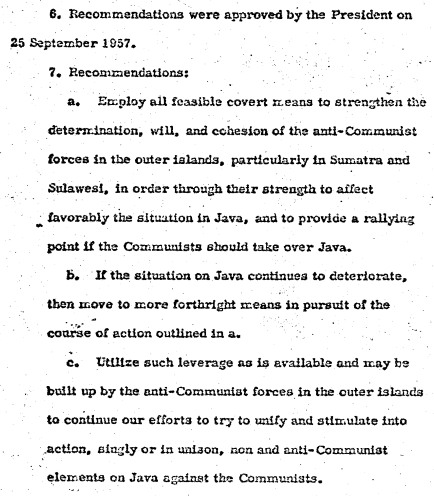
A special committee’s recommendations favored covert strengthening of anti-Communist outer-island forces while keeping diplomatic relations. The January brief documents this 1957 decision path.
Dated record in the full guide ↗Political-action program approved at a high levelIndonesia, 1958 / Authorization / Core window / selected events
A 1961 internal background paper dates approval of the program maintaining a dissident force to November 1957 and describes subsequent authorization of arms and air support. It is a retrospective official explanation, not the missing complete approval file.
Dated record in the full guide ↗Dulles favors strength outside JavaIndonesia, 1958 / Policy choice / Core window / selected events
A Washington meeting rejected a deal with the present government and preferred building leverage in the outer islands. Allison’s alternative was recorded in the accompanying briefing.
Dated record in the full guide ↗Estimate records rebel expectations of U.S. supportIndonesia, 1958 / Intelligence / Core window / selected events
Allen Dulles identified dissident goals and anticipated Western backing. The estimate’s predictions about compromise and military resistance were judgments soon tested by events.
Dated record in the full guide ↗FBI sharing relationship establishedHTLINGUAL — mail interception / Institutional sharing / Core window / selected events
CIA and FBI representatives agree on material of internal-security interest and FBI watch-list requirements. This relationship is distinct from the Bureau’s separate mail-opening programs.
Dated record in the full guide ↗Ultimatum to the central governmentIndonesia, 1958 / Political break / Core window / selected events
Dissidents demanded a change of government and a revised political course. Rejection led toward the rival government rather than a negotiated settlement.
The rival government in Sumatra claimed national political authority, with Sjafruddin as prime minister. The separate Permesta movement aligned with the challenge.
Dated record in the full guide ↗Washington debates substantial risksIndonesia, 1958 / Escalation / Core window / selected events
The NSC discussion treated dissident defeat as a danger of Communist expansion and considered intervention contingencies. A contingency is not evidence of a completed U.S. landing.
Dated record in the full guide ↗Poor communications and aircraft needsIndonesia, 1958 / Military assessment / Core window / selected events
Allen Dulles described fragmented operations and difficulties sustaining a concerted campaign. Some commanders remained neutral, limiting expectations of a general military defection.
Dated record in the full guide ↗Joint Chiefs urge looser restrictionsIndonesia, 1958 / Recommendation / Core window / selected events
Military advisers recommended accelerated efforts including overt measures if required. Civilian authorization of a specific measure must be established separately.
Dated record in the full guide ↗Conditional recognition message approvedIndonesia, 1958 / Decision / Core window / selected events
Eisenhower approved a confidential message linking possible recognition and overt aid to determined resistance. The meeting also recorded his stated bar on government personnel taking part in military operations.
The CIA director reported near-collapse of organized resistance. Sponsor frustration is part of the record; it is not the whole explanation of what soldiers or civilians experienced.
Dated record in the full guide ↗Public neutrality and private adventurersIndonesia, 1958 / Public position / Core window / selected events
Eisenhower presented U.S. policy as neutrality while referring to private soldiers of fortune. Internal support records show why this was an incomplete account.
Dated record in the full guide ↗Air strikes and merchant-ship lossesIndonesia, 1958 / Air campaign / Core window / selected events
An NSC briefing acknowledged eastern rebel air activity and the sinking of British and Panamanian freighters. Effects extended beyond the national armed forces.
Dated record in the full guide ↗Indonesia asks for an end to bombingsIndonesia, 1958 / Diplomacy / harm / Core window / selected events
Subandrio protested the raids and described civilian deaths and popular anger. The report is strong evidence of the complaint and political effects, not a complete verified casualty count.
Dated record in the full guide ↗Communications intercept yields no valueIndonesia, 1958 / Reconnaissance / Core window / selected events
A contemporary technical evaluation of Mission 1749 records that its intercepted traffic had no intelligence value. One result cannot characterize the entire intelligence effort.
Dated record in the full guide ↗Jones urges a decisive policy changeIndonesia, 1958 / Policy turn / Core window / selected events
The ambassador described two anti-Communist armed camps and proposed pressuring rebels while offering inducements to Jakarta and Nasution. The recommendation predates Pope’s capture.
Dated record in the full guide ↗Washington authorizes gestures to JakartaIndonesia, 1958 / Policy turn / Core window / selected events
An instruction approved licenses and economic measures while continuing to seek anti-Communist commitments. The shift was underway before the shootdown.
Dated record in the full guide ↗Pope captured during an Ambon bombing missionIndonesia, 1958 / Exposure / Core window / selected events
Indonesian forces brought down the rebel B-26 and captured the crew. At a Washington meeting the secretary of state opposed another strike. Specific air-combat credit remains disputed.
Dated record in the full guide ↗Chiang seeks rescue; Washington counsels restraintIndonesia, 1958 / Allied disagreement / Core window / selected events
The Taipei cable describes proposed additional Nationalist Chinese forces. The U.S. reply favored exploring an arrangement through Jakarta and asked Chiang to suspend his move.
Dated record in the full guide ↗Army aid replaces rebel leverageIndonesia, 1958 / Policy consolidation / Core window / selected events
Robertson recommended the approximately $7 million token aid package, judging the dissidents no longer useful leverage. This is adaptation after the project’s failure.
The following day’s embassy report describes the agreement and the political significance Indonesian leaders attached to it. Assistance did not erase disagreements over national policy.
The overthrow of Batista preceded Castro’s consolidation of power and growing conflict with the United States. The revolution’s initial coalition was broader than the later regime.
Dated record in the full guide ↗King recommends considering eliminationPlots to assassinate Fidel Castro / Policy origins / Earlier context
Dulles approves recommendations with Bissell’s concurrence. The later Senate inquiry cannot fully resolve what King meant by elimination or how this paper connected to subsequent plots.
Dated record in the full guide ↗A Lao political crisis becomes an international confrontationThe Secret War in Laos / War / Earlier context
Kong Le’s coup, fighting over Vientiane and rival foreign assistance intensified the conflict. This year-only entry does not invent a date for the entire crisis.
Dated record in the full guide ↗Eisenhower approves covert-action programBay of Pigs, 1961 / Authorization / Core window / selected events
A program of political organization, propaganda, internal networks and paramilitary preparation aims to replace Castro while concealing American intervention. It is not yet the April 1961 landing plan.
Dated record in the full guide ↗Headquarters proposes action against RaúlPlots to assassinate Fidel Castro / Separate target / Core window / selected events
A cable asks the Havana station to explore a fatal accident involving Raúl Castro through a Cuban contact.
Dated record in the full guide ↗Bissell and Edwards initiate underworld approachPlots to assassinate Fidel Castro / Core plot / Core window / selected events
The security organization turns to Maheu for contacts who might kill Fidel Castro. The agency eventually authorizes an offered success payment.
Dated record in the full guide ↗Rosselli enters the projectPlots to assassinate Fidel Castro / Intermediaries / Core window / selected events
Meetings connect the private intermediary to CIA support and Cuban contacts. Testimony differs over precise dates, introductions and cover explanations.
Dated record in the full guide ↗Training shifts toward an assault forceBay of Pigs, 1961 / Change of concept / Core window / selected events
The Taylor narrative identifies a Washington cable reducing the guerrilla teams and emphasizing amphibious and airborne assault training. That change weakens later reliance on a guerrilla fallback.
Dated record in the full guide ↗Clemency and aid kept diplomatically distinctIndonesia, 1958 / Pope case / Consequences and later records
Herter cautioned against tying a Pope plea to military assistance, warning that Sukarno might reject both. The letter documents a death sentence and available appeal avenues.
Dated record in the full guide ↗Executive-action capability developedPlots to assassinate Fidel Castro / Capability / Core window / selected events
Bissell assigns Harvey work on a general capability that includes assassination; the specialized asset’s development is distinct from an executed killing.
Dated record in the full guide ↗Regional resistance persists beyond the main defeatIndonesia, 1958 / Long aftermath / Consequences and later records
The armed challenge did not end everywhere in May 1958. Its extension into 1961 and its regional political consequences complicate a story focused only on CIA withdrawal.
The new president discusses the project and further evaluation. Continuation of preparation does not by itself fix every later decision about site, air action or intervention.
Dated record in the full guide ↗Lethal material prepared for passagePlots to assassinate Fidel Castro / Material support / Core window / selected events
Technical records and later testimony establish preparation and transfer to intermediaries in the pre-invasion operation. Exact deliveries and opportunities inside Cuba remain disputed.
Dated record in the full guide ↗Day receives a disputed briefingHTLINGUAL — mail interception / Knowledge dispute / Core window / selected events
Helms’s memorandum describes a full account; Day later recalls declining to hear the secret. The record does not make a meeting synonymous with informed consent to opening.
Dated record in the full guide ↗Zapata replaces the more conspicuous Trinidad conceptBay of Pigs, 1961 / Revision / Core window / selected events
The plan is recast around a quieter landing and an airfield on captured territory. The move sacrifices access to the mountains associated with the earlier concept. Month precision reflects the sequence of revisions.
Dated record in the full guide ↗Bay of Pigs defeat interrupts the effortPlots to assassinate Fidel Castro / Core context / Core window / selected events
The initial operation is called off in the contemporary account. The Senate later questions how sharply its phases can be separated.
Dated record in the full guide ↗Intelligence reports discontent and stronger controlBay of Pigs, 1961 / Intelligence / Core window / selected events
The CIA report is evidence of information circulating before the invasion. Reports of discontent did not provide a demonstrated capacity to join this particular landing.
Dated record in the full guide ↗Schlesinger warns about political consequencesBay of Pigs, 1961 / Warning / Core window / selected events
A pre-invasion memorandum argues that political, economic and diplomatic preparation lagged behind operational planning. A military victory might still cause major diplomatic damage.
Dated record in the full guide ↗Direct use of U.S. armed forces ruled outBay of Pigs, 1961 / Policy limit / Core window / selected events
Bundy records the decision, subject to new circumstances. This formal policy is different from expectations of U.S. rescue among trainees and supporters.
Dated record in the full guide ↗Initial air attacks leave opposing aircraftBay of Pigs, 1961 / Air campaign / Core window / selected events
Cuban exile B-26s attack airfields; the effort fails to eliminate the air capability that will threaten the invasion. The defector cover story creates a diplomatic problem.
Dated record in the full guide ↗Planned dawn airfield strikes cancelledBay of Pigs, 1961 / Decision / Core window / selected events
Cabell and Bissell challenge the restriction to Rusk and decline an offered direct appeal to Kennedy. Cabell’s later record also describes a separate rejected request for Navy protection early the next morning.
Dated record in the full guide ↗Brigade lands at Playa Larga and Playa GirónBay of Pigs, 1961 / Invasion / Core window / selected events
The force establishes positions but meets resistance and air attack. The battle is a Cuban contest with extensive covert U.S. sponsorship, not a U.S. ground-force landing.
Dated record in the full guide ↗Houston and Rio Escondido are lostBay of Pigs, 1961 / Supply crisis / Core window / selected events
Air attacks force Houston ashore and destroy Rio Escondido. Remaining freighters withdraw, bringing reserve ammunition and other supplies out of reach.
A published contemporary order documents active direction of the counterattack. It should be read alongside field reports rather than as a complete battle narrative.
Dated record in the full guide ↗Washington considers further air helpBay of Pigs, 1961 / Escalation pressure / Core window / selected events
Bundy tells Kennedy that Cuban forces are stronger and the popular response weaker than expected. The CIA authorizes restricted use of American contract crews; resupply remains inadequate.
The brigade is overwhelmed after worsening ammunition shortages and failed resupply. Most survivors are captured; four American airmen are among those killed in the air operation.
Dated record in the full guide ↗Taylor inquiry submits its accountBay of Pigs, 1961 / Investigation / Consequences and later records
The inquiry traces the immediate military failure and the deeper interagency command problem. It does not demonstrate what a different air campaign would ultimately have achieved.
Dated record in the full guide ↗CIA inspector general challenges the project’s premisesBay of Pigs, 1961 / Internal review / Consequences and later records
Kirkpatrick’s survey criticizes leadership, intelligence analysis and the expectation of a decisive uprising. Operational officials dispute the report. Month precision follows the report’s archival date.
Dated record in the full guide ↗Harvey and Bissell discuss taking over the relationshipPlots to assassinate Fidel Castro / Management / Core window / selected events
Harvey’s notes connect the existing underworld operation to his executive-action responsibilities. Renewed action follows in 1962.
The death sentence was not carried out. His release ended years of imprisonment and diplomacy; this guide preserves year-level precision rather than resolving contradictory popular exact-date accounts.
Dated record in the full guide ↗Exposure memo considers denial and a scapegoatHTLINGUAL — mail interception / Concealment planning / Core window / selected events
A contemporary CIA memo recognizes legal vulnerability and considers explanations if exposed. It establishes a proposed response, not execution of every suggestion.
Dated record in the full guide ↗Decision sheet records the approvalOperation Northwoods / Documentation / Core window / selected events
The sheet records the 13 March meeting and Marine Commandant’s participation. Institutional endorsement is firmer than a claim that every chief personally signed the cover.
Dated record in the full guide ↗Kennedy limits immediate force discussionOperation Northwoods / Presidential policy / Core window / selected events
Lansdale records his blunt position and deployment constraints after Lemnitzer mentions plausible pretexts. No signed Northwoods-specific veto is supplied.
Dated record in the full guide ↗Covert party assistance authorizedChile — Track II and covert political operations / Political intervention / Earlier context
The CIA’s retrospective report identifies authorization for party assistance before the 1964 election. Later operations inherited contacts and channels.
Dated record in the full guide ↗McCone urges policy reviewOperation Northwoods / Continued pressure / Core window / selected events
The CIA director advocates more aggressive action including consideration of direct intervention; this record does not itself adopt a Northwoods incident.
Dated record in the full guide ↗Chiefs prefer a real provocationOperation Northwoods / Retrospective chronology / Core window / selected events
The official JCS history dates a preference for genuine rather than wholly manufactured provocation to this stage. This is a retrospective account, not an execution report.
Dated record in the full guide ↗Robert Kennedy is briefed on the earlier plotPlots to assassinate Fidel Castro / Knowledge / Core window / selected events
Edwards and Houston describe the underworld operation as terminated. The already renewed activity is omitted.
Dated record in the full guide ↗Edwards records the Attorney General briefingPlots to assassinate Fidel Castro / Record / Core window / selected events
The memorandum describes the earlier operation and its stated closure; it is transmitted under Houston’s cover the following day.
Dated record in the full guide ↗Rosselli reports a team dispatchedPlots to assassinate Fidel Castro / Reported execution / Core window / selected events
Harvey receives an account that a Cuban contact sent a team to Cuba. The record does not verify an actual attack on Castro by the team.
Dated record in the full guide ↗The Geneva neutrality instruments are signedThe Secret War in Laos / Diplomacy / Core window / selected events
The declaration and protocol establish restrictions, withdrawal arrangements and a conventional-arms exception. They are not an absolute ban on every import or a blanket authorization of covert personnel.
Dated record in the full guide ↗Assassination is raised at a policy meetingPlots to assassinate Fidel Castro / Policy discussion / Core window / selected events
Contemporary memoranda and later testimony describe a discussion of killing Cuban leaders, absent from the formal minutes.
Dated record in the full guide ↗Harvey objects to written liquidation languagePlots to assassinate Fidel Castro / Record / Core window / selected events
His memorandum to Helms addresses the reference in Lansdale’s August 13 tasking and says no written study was expected. The action’s meaning remains disputed.
Dated record in the full guide ↗Conditional noninvasion assurances proposedOperation Northwoods / Diplomacy / Consequences and later records
Kennedy’s message connects assurances to missile removal and verification arrangements. The terms are conditional and do not document Northwoods implementation.
Dated record in the full guide ↗Released prisoners begin arriving in FloridaBay of Pigs, 1961 / Exchange / Consequences and later records
After negotiations and an agreement for food and medicine valued at about $53 million, the main prisoner return takes place in December. This is separate from deaths, earlier releases and the later ceremony.
Dated record in the full guide ↗Kennedy receives the brigade flag in MiamiBay of Pigs, 1961 / Public memory / Consequences and later records
At the Orange Bowl ceremony, Kennedy promises the flag’s return in a free Havana. Later anniversaries continue to debate sacrifice, betrayal and the invasion’s political objectives.
Dated record in the full guide ↗Diving schemes remain unexecutedPlots to assassinate Fidel Castro / Preparation / Core window / selected events
Technical schemes involving Castro’s diving activities are abandoned without a demonstrated attack. The chronology of some laboratory work is uncertain.
Dated record in the full guide ↗McCone receives the earlier-operation memorandumPlots to assassinate Fidel Castro / Knowledge / Core window / selected events
Helms supplies the 1962 Edwards account after a press story. McCone understands that the earlier operation involved assassination, but it is presented as having ended before his tenure.
Dated record in the full guide ↗Attwood meets Lechuga through Lisa HowardPlots to assassinate Fidel Castro / Diplomatic context / Core window / selected events
The discreet contact follows presidential approval. The exploratory channel develops alongside continuing covert activity.
Dated record in the full guide ↗Internal memo recognizes lack of legal basisHTLINGUAL — mail interception / Legal awareness / Core window / selected events
The commission and Senate report discuss an internal acknowledgment about peacetime mail monitoring. It is evidence of agency awareness, not a court verdict against every participant.
Dated record in the full guide ↗Special Group considers listening to CastroPlots to assassinate Fidel Castro / Diplomatic context / Core window / selected events
The group discusses how an Attwood contact might occur and weighs its political handling. These talks do not themselves resolve authority for the separate plots.
Dated record in the full guide ↗CIA officer offers Cubela an assassination devicePlots to assassinate Fidel Castro / Material support / Core window / selected events
The Paris meeting occurs on the day Kennedy is killed. Exact simultaneity is not established; Cubela’s eventual disposition of the device is uncertain.
Dated record in the full guide ↗Scott reviews the covert programThe Secret War in Laos / Decision / Core window / selected events
The memorandum discusses military and political purposes and invokes the Article 6 exception for overt assistance. Its account distinguishes several kinds of activity.
Dated record in the full guide ↗Brother Sam receives movement ordersBrazil 1964 — Operation Brother Sam / U.S. military / Core window / selected events
Joint Chiefs instructions and State’s assistance cable initiate ships and preparations; airlift and unloading remain conditional.
Dated record in the full guide ↗Task force sails as resistance collapsesBrazil 1964 — Operation Brother Sam / U.S. military / Core window / selected events
McNamara reports the force sailed that morning. Gordon reports momentum needs no special encouragement and later relays that logistical help is unnecessary.
Dated record in the full guide ↗Mazzilli installed while Goulart remains inside BrazilBrazil 1964 — Operation Brother Sam / Succession / Core window / selected events
Congressional leaders declare a vacancy. U.S. officials privately acknowledge the constitutional difficulty.
Dated record in the full guide ↗Frei wins the presidential electionChile — Track II and covert political operations / Election / Earlier context
Frei benefited from secret political and propaganda assistance. The scale of support does not by itself identify each recipient’s knowledge of its origin.
Dated record in the full guide ↗CIA connects Cubela with ArtimePlots to assassinate Fidel Castro / Indirect support / Core window / selected events
The arranged connection provides a route to support the agency is unwilling to supply directly. Neither partner is told the CIA engineered their contact.
Dated record in the full guide ↗303 Committee debates the recurring subsidyItaly — covert political funding / Conditional decision / Core window / selected events
The proposal is approved subject to higher authority. Minutes dated 28 June capture internal dissatisfaction, not an unconditional final presidential approval.
Dated record in the full guide ↗Bundy recommends a reduced budgetItaly — covert political funding / Recommendation / Core window / selected events
Bundy argues that leadership and effective administration matter more than handouts. Neither presidential response option is checked on the released copy.
Dated record in the full guide ↗Cubela arrested and tried in CubaPlots to assassinate Fidel Castro / Cuban proceedings / Consequences and later records
The CIA review and later FRUS account report a trial and 25-year sentence after Castro asks that the death penalty not be imposed. These accounts are not a full independent review of the Cuban proceedings.
Dated record in the full guide ↗Reinhardt argues for gradual phase-outItaly — covert political funding / Recommendation / Core window / selected events
Reinhardt describes reduced spending, cessation of unstructured party contributions and continued program-based support, with a final phase-out connected to the 1968 elections.
Dated record in the full guide ↗Ober’s narrower inquiry precedes the programMHCHAOS — domestic intelligence collection / Prehistory / Core window / selected events
Ramparts-related foreign-connection research had generated an early set of names and files before the August expansion.
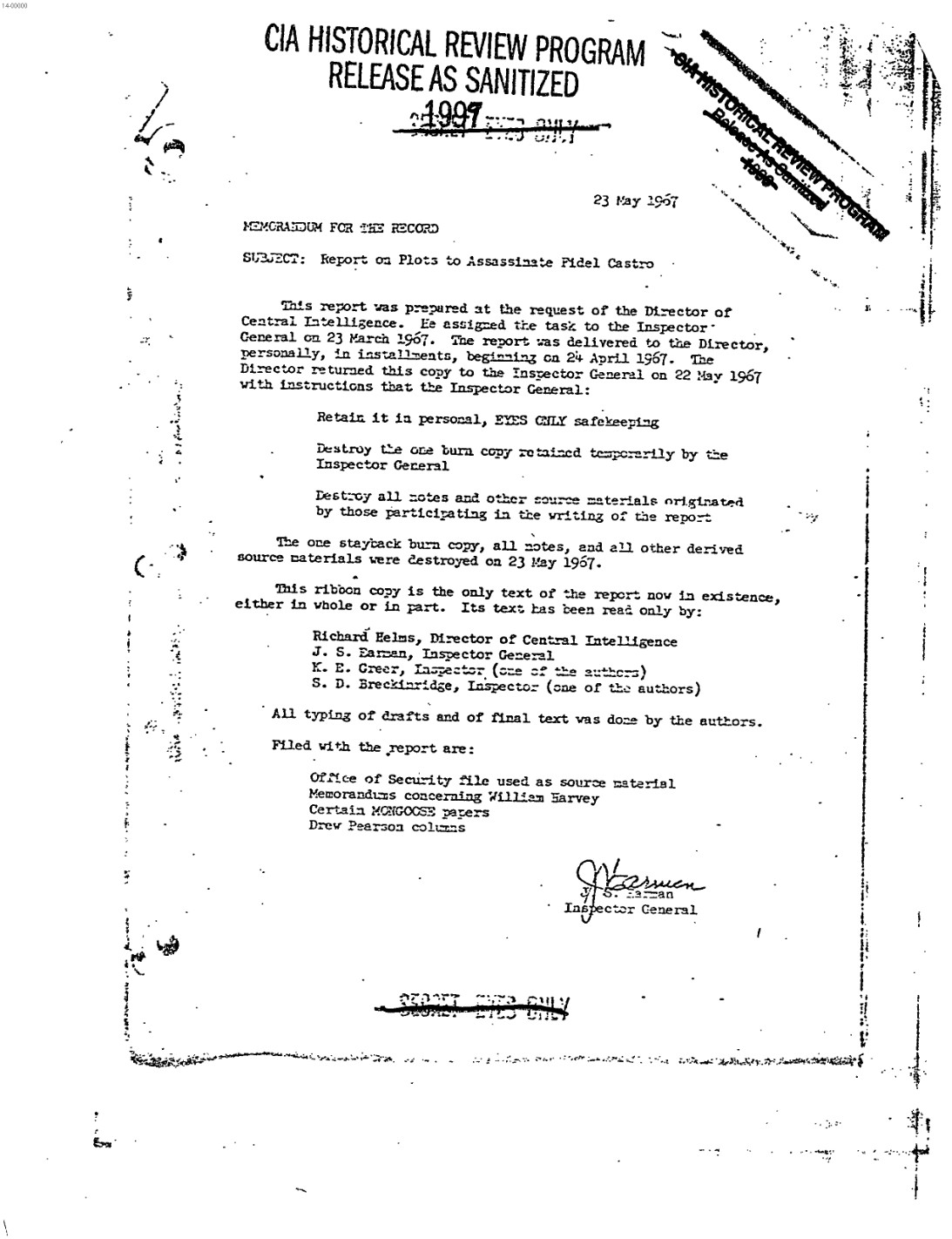
Dated record in the full guide ↗Internal review delivered to HelmsPlots to assassinate Fidel Castro / Internal inquiry / Consequences and later records
The report’s first page is dated April 25; the May cover memorandum says delivery in installments began April 24. It acknowledges fragmentary records and uncertain memories.
Dated record in the full guide ↗Report retained and working material destroyedPlots to assassinate Fidel Castro / Records / Consequences and later records
Earman records instructions for close safekeeping of the report and destruction of working notes and a temporary copy.
Dated record in the full guide ↗First recorded authorizationMHCHAOS — domestic intelligence collection / Authorization / Core window / selected events
Karamessines instructs Angleton to establish overseas coverage of student and related matters; the Church staff found no written Helms founding directive.
Dated record in the full guide ↗Field collection requirement specifiedMHCHAOS — domestic intelligence collection / Collection / Core window / selected events
The cable described coverage of radical students and Black expatriates/travelers abroad for possible exploitation by hostile powers. Its historical terminology is not adopted as a judgment of the subjects.
Dated record in the full guide ↗Peace movement study deliveredMHCHAOS — domestic intelligence collection / Analysis / Core window / selected events
The first major study found little foreign involvement and no significant foreign financial support. Collection for the study also enlarged the unit’s holdings.
Dated record in the full guide ↗Original program terminated by fiscal-year endItaly — covert political funding / Program boundary / Core window / selected events
The 11 March 1969 briefing reports termination at the close of fiscal 1968. The year marker does not assert that every intelligence relationship ended on one day.
Dated record in the full guide ↗Domestic student study sent to White HouseMHCHAOS — domestic intelligence collection / Analysis / Core window / selected events
The study examined U.S. student dissent rather than only foreign targets, raising the authority question addressed later by investigators.
Dated record in the full guide ↗Helms warns Kissinger about domestic sectionMHCHAOS — domestic intelligence collection / Authority / Core window / selected events
The covering letter acknowledged that American students were outside the Agency’s charter.
Dated record in the full guide ↗Committee unanimously opposes resumptionItaly — covert political funding / Committee decision / Core window / selected events
Members judge domestic funding sufficient. An editorial note records Nixon’s 25 March approval of no assistance.
Dated record in the full guide ↗Cotter becomes Chief Postal InspectorHTLINGUAL — mail interception / Institutional responsibility / Core window / selected events
His prior CIA service gave him knowledge of actual openings. The account later turns on the conflict between secrecy and his postal responsibilities.
Dated record in the full guide ↗Review reports limited assistance, no directionMHCHAOS — domestic intelligence collection / Analysis / Core window / selected events
Cushman’s transmittal described limited assistance, much of it propaganda, and no evidence of direction or control of an American revolutionary protest movement.
Dated record in the full guide ↗Inspector-general review favors transfer or closureHTLINGUAL — mail interception / Internal dissent / Core window / selected events
The Rockefeller chapter describes a July 1969 recommendation to transfer the operation to the FBI or cancel it. The recommendation was not followed then.
Dated record in the full guide ↗Helms directs cooperation with CHAOSMHCHAOS — domestic intelligence collection / Management / Core window / selected events
The memorandum backs the mission and requests cooperation across CIA components.
Dated record in the full guide ↗New collection sources developedMHCHAOS — domestic intelligence collection / Expansion / Core window / selected events
Domestic Contact Service work and CHAOS agent development expand; Project 2 is developed separately and implemented in 1970. No exact founding day for every component is inferred.
Dated record in the full guide ↗Korry describes a resilient democracyChile — Track II and covert political operations / Assessment / Core window / selected events
The ambassador’s contemporary optimism provides a baseline against which the subsequent crisis and American policy shift can be judged.
Dated record in the full guide ↗State reviews Martin’s new requestItaly — covert political funding / Proposal and dissent / Core window / selected events
Hillenbrand reviews earlier assistance and argues against a renewed financial commitment.
Dated record in the full guide ↗General approval communicated under Huston initiativeHTLINGUAL — mail interception / Apparent authorization / Core window / selected events
The Senate report identifies a communication of approval for relaxed techniques generally; it was not a specific informed authorization of the ongoing New York project.
Dated record in the full guide ↗Allende wins a pluralityChile — Track II and covert political operations / Election / Core window / selected events
No candidate won an absolute majority; Congress would choose between the leaders. The constitutional opening was not evidence that Allende had seized power.
Dated record in the full guide ↗Vaky assesses the Frei gambitChile — Track II and covert political operations / TrackI / Core window / selected events
An electoral maneuver would choose Alessandri, secure his resignation and allow Frei to stand again. Vaky questioned necessity, feasibility and consequences.
Dated record in the full guide ↗Nixon directs a covert effortChile — Track II and covert political operations / TrackII / Core window / selected events
Helms records urgency, secrecy and possible resources. The directive establishes authorization rather than success.
Dated record in the full guide ↗Korry warns against a coupChile — Track II and covert political operations / Disagreement / Core window / selected events
He judged military unity and Frei or Schneider’s role essential and feared a failed intervention. He did not know the full TrackII undertaking.
Dated record in the full guide ↗NSDM93 establishes pressure policyChile — Track II and covert political operations / Policy / Core window / selected events
Correct public relations would coexist with efforts to limit consolidation and adverse policies.
Dated record in the full guide ↗NIE describes domestic pressuresItaly — covert political funding / Intelligence estimate / Core window / selected events
The estimate identifies institutional shortcomings and social dissatisfaction alongside economic growth. It does not find that unrest was simply foreign-directed.
Dated record in the full guide ↗Martin presses his political action proposalItaly — covert political funding / Advocacy / Core window / selected events
The backchannel reproduces an October proposal seeking money and flexible implementation authority.
Dated record in the full guide ↗Officers question the programMHCHAOS — domestic intelligence collection / Internal dissent / Core window / selected events
Fourteen middle-level officers raise concerns in two memoranda; other field and headquarters objections are documented.
Dated record in the full guide ↗Senior CIA officials discuss exposure and Cotter’s positionHTLINGUAL — mail interception / Internal review / Core window / selected events
The meeting considers who knows, the risk of public disclosure and possible FBI responsibility.
Dated record in the full guide ↗Treasury urges creditor pressureChile — Track II and covert political operations / Economic pressure / Core window / selected events
Connally argues for coordination to isolate Chile and preserve leverage in debt negotiations. Intent and mechanism are documented; a share of economic collapse is not quantified.
Dated record in the full guide ↗Mail watch-list request documentedMHCHAOS — domestic intelligence collection / Interagency input / Core window / selected events
The Church report cites Ober’s memorandum supplying 41 individual/organization names to the mail project. This does not make CHAOS itself the mail-opening operation.
Dated record in the full guide ↗Martin commits funds and asks for expansionItaly — covert political funding / Commitment and request / Core window / selected events
Martin reports a commitment under existing authority and seeks expanded assistance before the early election of 7 May. Amounts remain redacted.
Dated record in the full guide ↗Internal response criticizes lack of detailItaly — covert political funding / Internal dissent / Core window / selected events
Sonnenfeldt says Martin’s response asks for faith without really answering the questions. It qualifies claims of comprehensive oversight.
Dated record in the full guide ↗Early parliamentary electionItaly — covert political funding / Election / Core window / selected events
The later 1972 status report describes the resulting centrist government. Favorable outcomes for recipients are not an experiment isolating the effect of aid.
Dated record in the full guide ↗Aspin requests investigation of narcotics allegationsThe Secret War in Laos / Narcotics dispute / Core window / selected events
The Congressional Record reproduces a contemporary demand for investigation. A request establishes an allegation and institutional response, not the truth of every shipment claim.
Dated record in the full guide ↗Testimony and denials enter the Congressional RecordThe Secret War in Laos / Narcotics dispute / Core window / selected events
Selected pages reproduce McCoy’s June 9 Thailand testimony and related statements. They are not the complete June 2 Laos testimony.
Dated record in the full guide ↗The CIA correspondence becomes publicThe Secret War in Laos / Narcotics dispute / Core window / selected events
The published exchange distinguishes claims about allies, concealment and carriage and includes challenges by the agency, airline and publisher. Publication date is not the date of every letter.
Dated record in the full guide ↗CIA reports actual funded beneficiariesItaly — covert political funding / Execution report / Core window / selected events
Roosevelt describes funded candidates and assisted organizations while acknowledging uncertain causal weight.
Dated record in the full guide ↗Inspector General relays station concernsMHCHAOS — domestic intelligence collection / Review / Core window / selected events
The review raises doubts about monitoring Americans without known or suspected espionage involvement. Inspection access to specific CHAOS files had been denied.
Dated record in the full guide ↗New York mail project terminatedHTLINGUAL — mail interception / Closure / Core window / selected events
Cotter rejects delay without higher approval. The project closes before the 1975 public investigations; proposed FBI responsibility is not treated as proven continuation.
Dated record in the full guide ↗The agreement sets a ceasefire beginning at noonThe Secret War in Laos / Diplomacy / Core window / selected events
This is the scheduled effective time, not a claim that all combat and foreign intervention stopped at once. Withdrawal deadlines depended on political arrangements.
Dated record in the full guide ↗Popular Unity wins 43.4 percent in congressional votingChile — Track II and covert political operations / Election / Core window / selected events
The government coalition increased its share compared with the 1970 presidential vote; the opposition did not gain a straightforward congressional route to removal. Different contests are identified rather than treated as identical mandates.
Dated record in the full guide ↗Embassy reports fears of accommodationChile — Track II and covert political operations / Civilian opposition / Core window / selected events
Davis reports opposition concern that a bilateral settlement might economically rescue Allende. Chilean actors sought their own outcomes.
Dated record in the full guide ↗The selected Air Force history dates its last Laos strikesThe Secret War in Laos / Air war / Core window / selected events
The epilogue describes U.S. Air Force bombing April 15–17. This chronology contradicts treating February 22 as the end of all American bombing. It is not a census of every armed actor.
Dated record in the full guide ↗Schlesinger orders a charter inventoryMHCHAOS — domestic intelligence collection / Review / Core window / selected events
Employees are directed to report activities potentially outside legislative authority.
Dated record in the full guide ↗The Tanquetazo failsChile — Track II and covert political operations / Military intervention / Core window / selected events
A small military rising failed. It exposed continuing military danger without settling the armed forces’ later decisions.
Dated record in the full guide ↗Chamber majority accuses the government of constitutional breachesChile — Track II and covert political operations / Constitutional conflict / Core window / selected events
The opposition resolution marked the collapse of political accommodation. Its accusations are distinguished from a judicial finding and from authorization of a military coup.
Dated record in the full guide ↗Prats resigns; Pinochet becomes Army commanderChile — Track II and covert political operations / Military command / Core window / selected events
Allende’s appointment changed the Army command immediately before the final coup. Earlier assumptions about constitutionalist leadership could no longer be carried forward unchanged.
Dated record in the full guide ↗Funding meets a coup-policy boundaryChile — Track II and covert political operations / Covert funding / Core window / selected events
Colby records Davis’s refusal to endorse requested private-sector aid because of the risk of a de facto commitment to a coup.
Dated record in the full guide ↗Colby narrows the missionMHCHAOS — domestic intelligence collection / Restriction / Core window / selected events
Guidance focuses collection abroad on foreign organizations and individuals, with American contacts incidental. The CIA’s 1975 response associates MHVAPOR with this guidance.
Dated record in the full guide ↗Military coup overthrows AllendeChile — Track II and covert political operations / Coup / Core window / selected events
Armed forces assaulted La Moneda. Allende broadcast his final messages and died; the junta seized power.
Dated record in the full guide ↗Washington plans a favorable responseChile — Track II and covert political operations / Aftermath / Core window / selected events
Officials agreed on discreet goodwill and a cautious public posture. The meeting also preserved uncertainties about the developing situation.
Dated record in the full guide ↗Nixon and Kissinger discuss the resultChile — Track II and covert political operations / Aftermath / Core window / selected events
Their conversation claims a distinction between doing the coup and helping create conditions; neither self-description is accepted without comparison.
Dated record in the full guide ↗Specified CHAOS program endsMHCHAOS — domestic intelligence collection / Termination / Core window / selected events
Rockefeller gives 15 March; Church describes a 5 March order and cites a 6 March cable. Bounded foreign-targeted collection and file custody continue under guidelines; this marker preserves the month-level common ground.
Dated record in the full guide ↗Colby proposes continued covert relationshipsItaly — covert political funding / Proposal / Core window / selected events
Colby seeks support for senior and younger politicians against PCI entry into government.
Dated record in the full guide ↗Public revelations transform accountabilityMHCHAOS — domestic intelligence collection / Exposure / Consequences and later records
Hersh’s New York Times report prompts a wider political response after internal review and termination. Primary meeting records and later archival history document that response.
Dated record in the full guide ↗Senate investigation documents interventionChile — Track II and covert political operations / Disclosure / Consequences and later records
The published staff report exposed funding and the 1970 coup effort while reporting no evidence of direct American participation in the 1973 coup. Year precision is retained rather than inventing a publication day.
Dated record in the full guide ↗Flight and displacement outlast the official missionThe Secret War in Laos / Aftermath / Core window / selected events
The MNHS timeline describes escape and displacement, alongside named accounts of wartime loss and promises of protection. This selected record does not establish one comprehensive evacuation or refugee casualty count.
Dated record in the full guide ↗Covert action plan meets State oppositionItaly — covert political funding / Proposal and dissent / Core window / selected events
The 40 Committee proposal outlines selective support and division within the PCI. The State Department’s European leadership does not concur.
Dated record in the full guide ↗CIA explains the codeword sequenceMHCHAOS — domestic intelligence collection / Document / Consequences and later records
The Belin response identifies MHPASHA, MHCHAOS and MHVAPOR as related designators.
Dated record in the full guide ↗Embassy officials confront collapse and evacuation questionsThe Secret War in Laos / Aftermath / Core window / selected events
The selected telegram discusses deteriorating conditions and difficult choices. It is not a passenger manifest or proof that every requested evacuation occurred.
Dated record in the full guide ↗Washington directs adaptation to changed conditionsThe Secret War in Laos / Aftermath / Core window / selected events
A State Department telegram approved by Kissinger directs adaptation and seeks recommendations about the mission and assistance. Issued guidance does not establish which evacuations occurred.
Dated record in the full guide ↗Rockefeller report makes findings publicHTLINGUAL — mail interception / Investigation / Consequences and later records
Chapter 9 concludes that domestic mail openings were unlawful and improper. Month precision is used here to avoid conflating submission and publication dates.
Dated record in the full guide ↗Rockefeller findings distinguish purpose and actsMHCHAOS — domestic intelligence collection / Finding / Consequences and later records
Some domestic activities unlawfully exceeded the charter, despite a proper declared foreign mission. The report discusses retained files and recommendations.
Dated record in the full guide ↗Senate mail-opening hearings beginHTLINGUAL — mail interception / Public hearing / Consequences and later records
Hearings continue on 22 and 24 October. Their catalog identifies witnesses and documentary exhibits; this guide does not claim a full hearing-volume audit.
Dated record in the full guide ↗Senate publishes interim assassination reportPlots to assassinate Fidel Castro / Public investigation / Consequences and later records
The report establishes CIA-linked plots and failures of disclosure while leaving presidential authorization unresolved. Members append competing interpretations.
Dated record in the full guide ↗Section 5 prohibition takes effectPlots to assassinate Fidel Castro / Executive restriction / Consequences and later records
The effective date specified by section 5(h) follows the order’s signing. It is distinct from the Senate’s proposed criminal statute.
Dated record in the full guide ↗Ford approves revised media/deception planItaly — covert political funding / Revised authorization / Core window / selected events
The smaller plan lacks consensus for renewed direct party assistance. Approval is noted in the FRUS footnote, with a new finding on 27 May. An execution ledger is not provided.
Dated record in the full guide ↗Justice Department declines prosecutionHTLINGUAL — mail interception / Prosecutorial decision / Consequences and later records
The published explanation stresses proof, legal uncertainty and fairness, while warning against similar future conduct. This is not an acquittal.
Dated record in the full guide ↗Birnbaum affirms damages, reverses apologiesHTLINGUAL — mail interception / Civil judgment / Consequences and later records
Three $1,000 awards affirmed; mandatory apology letters reversed. The later treatment of its state-law theory is essential context.
Dated record in the full guide ↗House inquiry revisits withheld plot evidencePlots to assassinate Fidel Castro / Later investigation / Consequences and later records
Selected findings criticize the earlier failure to disclose the Castro plots and examine the consequences for investigating Kennedy’s assassination.
Dated record in the full guide ↗Records gathered in response to lawsuitGuatemala — assassination proposals / Disclosure history / Consequences and later records
National Security Archive describes earlier collection and withholding of assassination records; not a public release at that time.
Snider describes changes in operational goals and a fiscal 1984 appropriation cap. His printed page 290 provides the chronology, without supplying a single exact mining authorization day.
The Court locates presidential authorization in late 1983 or early 1984; this marker represents the beginning of that range, not an asserted December approval date.
Dated record in the full guide ↗United States declines further participationNicaragua — harbor mining / Court / Consequences and later records
The U.S. communication contests the Court’s handling of the case. The Court subsequently applies Article 53 rather than treating nonappearance as automatic admission.
Dated record in the full guide ↗Hurwitz rejects the earlier state-law predictionHTLINGUAL — mail interception / Civil judgment / Consequences and later records
Dismissal affirmed because New York did not recognize the required intrusion tort. The court does not reach limitations or declare the operation lawful.
Dated record in the full guide ↗Most formal records reportedly destroyedHTLINGUAL — mail interception / Records history / Consequences and later records
ARRB later reports CIA’s statement that most formal HTLINGUAL records were destroyed at General Counsel’s direction. The year does not identify every action or surviving record.
Dated record in the full guide ↗Haines completes CIA historyGuatemala — assassination proposals / Institutional review / Consequences and later records
Study acknowledges extensive discussion and preparation while concluding no assassination plan was approved or implemented.
Dated record in the full guide ↗CIA releases coup and plot recordsGuatemala 1954 — PBSUCCESS / Disclosure / Consequences and later records
The release documented covert action and assassination planning. Redactions and proposals still require careful separation from identified executed actions.
Dated record in the full guide ↗Review Board reports surviving working filesHTLINGUAL — mail interception / Records review / Consequences and later records
The report describes both destruction and surviving working files and references processed for release. Neither total disappearance nor a complete archive is established.
Dated record in the full guide ↗Coercive interrogation of Abu Zubaydah escalatesCIA detention and interrogation / Treatment / Core window / selected events
CIA uses enhanced techniques; later records scrutinize actual application and the information supplied before and afterward.
The official investigation and autopsy account identify likely hypothermia, with dehydration, lack of food and immobility among the contributing conditions.
Dated record in the full guide ↗CIA inspector general completes special reviewCIA detention and interrogation / Oversight / Core window / selected events
The review raised treatment, management and authorization concerns; its history is discussed in the Senate and agency response.
Dated record in the full guide ↗Contractors form a company for CIA workCIA detention and interrogation / Contracting / Core window / selected events
The Senate records a potential contract value exceeding $180 million, including options, and $81 million received by the contractors’ company before termination in 2009.
Dated record in the full guide ↗Interrogation tapes destroyedCIA detention and interrogation / Records / Core window / selected events
The Senate chronology dates destruction to the day after a proposed investigation amendment failed; surviving written records do not recreate the tapes in full.
Dated record in the full guide ↗Family Jewels release adds documentary contextHTLINGUAL — mail interception / Release / Consequences and later records
The public release date is separate from the 1973 compilation and project termination. This guide uses the release catalog without claiming a complete audit of the compilation.
Dated record in the full guide ↗Family Jewels released to the ArchiveMHCHAOS — domestic intelligence collection / Disclosure / Consequences and later records
The National Security Archive reports receiving the released compilation. Disclosure of historical material is not evidence of current continuation.
Dated record in the full guide ↗Last use of enhanced techniques in Senate chronologyCIA detention and interrogation / Program ending / Core window / selected events
The majority records this as the final use, distinct from later formal closure.
Dated record in the full guide ↗CIA holds no further detainees in Senate chronologyCIA detention and interrogation / Program ending / Core window / selected events
This operational endpoint precedes the 2009 executive order.
Dated record in the full guide ↗Pines publishes a rival legal readingHTLINGUAL — mail interception / Interpretation / Consequences and later records
The personal scholarly argument emphasizes foreign-intelligence authority and 1971 approval; it is not an official CIA adjudication or a court ruling on the whole program.
Dated record in the full guide ↗Family initiates Belgian criminal complaintThe plot against Patrice Lumumba / Accountability / Consequences and later records
Complaint begins a lengthy investigation later described by the family’s legal representatives.
Dated record in the full guide ↗Family and Guatemala sign settlementGuatemala — assassination proposals / Rights and memory / Consequences and later records
Agreement concerns Guatemala’s responsibility for specified rights violations against Árbenz and family; not a CIA assassination conviction.
Dated record in the full guide ↗Commission settlement report publishedGuatemala — assassination proposals / Legal outcome / Consequences and later records
Monitoring record identifies report 30/12. The case’s scope remains distinct from the assassination implementation question.
Dated record in the full guide ↗DOJ closes two death investigations without chargesCIA detention and interrogation / Prosecution / Consequences and later records
Holder cites insufficient admissible evidence for conviction beyond reasonable doubt and preserves the distinction from broader propriety.
Dated record in the full guide ↗CIA submits its formal responseCIA detention and interrogation / Institutional response / Consequences and later records
Agency admits serious failures and disputes effectiveness/representation findings; later errata qualify parts of this response.
Dated record in the full guide ↗Earlier planning receives renewed scrutinyBrazil 1964 — Operation Brother Sam / Memory / Consequences and later records
Anniversary release links the final coup preparations to Kennedy-era discussions and additional original records.
Dated record in the full guide ↗Redacted study and competing views releasedCIA detention and interrogation / Publication / Consequences and later records
The public receives the executive summary/findings and additional/minority views; the whole underlying archive is not thereby opened.
Dated record in the full guide ↗Brennan publicly defends intelligence valueCIA detention and interrogation / Public position / Consequences and later records
He acknowledges failures while defending reporting and the unknowable alternative outcome.
Dated record in the full guide ↗Congress enacts section 1045 restrictionsCIA detention and interrogation / Legislation / Consequences and later records
Army Field Manual rule and related provisions become statute for the custody/control defined in the law.
Dated record in the full guide ↗Obama acknowledges the bombing legacyThe Secret War in Laos / Public acknowledgment / Consequences and later records
The president announces additional clearance assistance and describes continuing harm. An announcement does not demonstrate delivery of all funds or clearance of every dangerous area.
Dated record in the full guide ↗European Court rules in Lithuania/Romania casesCIA detention and interrogation / Court / Consequences and later records
The European Court finds host-state responsibility in the Abu Zubaydah v. Lithuania and Al Nashiri v. Romania cases.
Dated record in the full guide ↗Supreme Court decides Zubaydah state-secrets caseCIA detention and interrogation / Court / Consequences and later records
The Court protects information confirming a foreign site and directs dismissal of the discovery request; it does not approve the interrogation program.
Dated record in the full guide ↗Remains returned and responsibility acknowledgedThe plot against Patrice Lumumba / Memory / Consequences and later records
Belgian official speech recognizes belated return, assistance to transfer and moral responsibility.
Dated record in the full guide ↗The recent casualty reporting period ends in 2023The Secret War in Laos / Continuing harm / Consequences and later records
The selected official page reports a 2013–2023 administrative period separately from cumulative estimates. This date is the end of the reporting window, not an established publication date. The series should not be combined into an independently audited total.
Dated record in the full guide ↗Davignon dies before trialThe plot against Patrice Lumumba / Legal outcome / Consequences and later records
Death confirmed independently; family legal team says criminal proceedings extinguished and plans further state-directed action. No criminal verdict resulted.
Original records, accepted legal findings and attributed participant accounts answer different questions. Each comparison and dated entry retains its originating source identifiers; the full guides provide the longer critical paths, rival readings, reading scopes and gaps. Multiple source records can point to the same publication or underlying evidence. Their count is not a count of independent corroborations.
Released U.S. records carry much of this documentary spine. They do not provide complete allied intelligence files, every host-state record, all local-language reporting, a complete detention or medical ledger, or every participant’s correspondence. Those limits matter when authorization becomes a question about delivery, local control, individual knowledge or hypothetical alternatives. More complete authenticated orders, recipient records and corroborated local accounts could change particular assessments.
Review editions.
These sixteen completed research editions are prepared for The AI Files review lane. Editorial review and production promotion are separate from completion; no official grade or endorsement is assigned here. The frozen-input manifest identifies the precise edition of every linked guide. Northwoods retains its original Grok authorship and conflicting observed timestamp history, alongside the separately attributed ChatGPT revision.
The collection overview, comparisons, covers, source index and full reading chronology work offline. Full child guides, separate packages and external originals require an internet connection. This collection package contains the gateway and its supporting data, without copies of the child ZIPs.
This collection was written by ChatGPT (OpenAI) in Codex. Its original creator and revision history are preserved below and in AI-AUTHORSHIP.json. The fifteen child guides retain their own creators, exact model/reasoning records and revision histories; their attributed evidence is integrated here without rewriting those guides.
405 case-specific source records link to 393 distinct URLs. Case prefixes preserve original source identifiers; identical URLs are grouped without merging their different reading scopes. Counts do not measure independent corroboration. Source notes retain the originating guide’s reading scope; a saved or local original may belong to private case research and is not necessarily included in this collection package. Full comparison and chronology data remain in GUIDE.json.
National Security Council / Office of the Historian, FRUS document 292 · Contemporary institutional directive
Sections 2–5 place peacetime covert operations within CIA, require policy coordination, define concealed sponsorship and distinguish these operations from espionage and overt armed conflict. FRUS footnote dates approval to 17 June and circulation to 18 June. This directive is not proof of approval for any later individual operation.
Italy — covert political funding / italy-covert-funding-S01
U.S. Department of State, Office of the Historian · Primary record / official documentary edition
Directive and transmission; paragraphs 2–4 specify CIA authority, policy consistency and protection of operational details. Editorial note distinguishes documented NSC approval from an unlocated presidential approval of 4-A. A general authority, not an Italian disbursement record.
Italy — covert political funding / italy-covert-funding-S02
U.S. Department of State, Office of the Historian · Primary record / official documentary edition
Contemporary strategic assessment, aid and security policy. Its predictions of Communist intentions are U.S. judgments, not findings about every Italian left-wing voter.
Italy — covert political funding / italy-covert-funding-S03
U.S. Department of State, Office of the Historian · Primary record / official documentary edition
Paragraph 8 and editorial notes establish a pre-election intervention policy and presidential approvals; paragraph 10 contains conditional post-victory contingencies. The report is not evidence that those contingencies were executed.
Italy — covert political funding / italy-covert-funding-S04
CNN Cold War interview, preserved by the National Security Archive · Participant interview / retrospective
Firsthand recollection of deliveries, campaign expenses, advice and secrecy. Valuable admission of conduct; dates, numbers and institutional claims require contemporary corroboration. Text transcript, not an embedded video.
Italy — covert political funding / italy-covert-funding-S05
CNN Cold War interview, preserved by the National Security Archive · Participant interview / retrospective
Explains the sense of success and contribution of other organizations. The recollection does not isolate the causal effect of CIA money. Later examples in the interview must not be backdated into 1948.
Italy — covert political funding / italy-covert-funding-S06
Treccani, Atlante · Italian historical reference
Italian account of the 1948 campaign, high turnout, results and coalition formation. Chamber figures: DC 48.51%, 305 seats; Popular Front 30.98%, 183 seats. These are Chamber figures, distinct from Senate or later coalition totals.
Italy — covert political funding / italy-covert-funding-S07
Consiglio regionale delle Marche · Italian institutional publication / reproduced election statistics
Printed page 130: 1948 Chamber national results, turnout 92.23%, DC 48.51%, Popular Front 30.98%; table credits Ministry of the Interior election archive. Full publication retained privately; no reproduced pages in public pack.
Italy — covert political funding / italy-covert-funding-S08
Portale delle fonti per la storia della Repubblica italiana / CNR · Italian archival description
Catalog identifies women’s/rural pamphlets, activist guidance, youth speech and local campaign material. Establishes an organized Italian campaign corpus; does not identify which item was foreign-funded.
Italy — covert political funding / italy-covert-funding-S09
Historical Office, Office of the Secretary of Defense; National Security Archive repository · Declassified draft historical study
2011 Defense historical-office draft, declassified 2016; especially printed pp 47–49, 57–60 for subsidy debate, procurement and qualified annual estimate. Its approximate $5 million/year estimate is reconstructed for the Eisenhower years, not a newly released complete ledger. Full draft read locally, not redistributed.
Italy — covert political funding / italy-covert-funding-S10
U.S. Department of State, Office of the Historian · Primary record / official documentary edition
Minutes dated 28 June. Program conditionally approved pending higher authority; officials describe burdens of recurrent subsidy. Final higher-authority approval is not demonstrated by these minutes.
Italy — covert political funding / italy-covert-funding-S11
U.S. Department of State, Office of the Historian · Primary record / official documentary edition
Documents sustained assistance, reductions and administrative concerns. Neither response option is checked in the released copy; the memo alone does not establish Johnson’s specific response.
Italy — covert political funding / italy-covert-funding-S12
U.S. Department of State, Office of the Historian · Primary record / official documentary edition
Distinguishes ending unstructured party contributions from continued approved action programs; 35% proposed cut for FY 1967 and a phase-out objective connected with 1968 elections.
Italy — covert political funding / italy-covert-funding-S13
U.S. Department of State, Office of the Historian · Primary record / official documentary edition
Contemporary retrospective briefing says 1948–68 support ended at FY 1968 close. Committee unanimously opposes restart; editorial note records Nixon’s 25 March approval of no assistance. Strong evidence for a program interruption, not for the end of every U.S. intelligence activity.
Italy — covert political funding / italy-covert-funding-S14
U.S. Department of State, Office of the Historian · Primary record / official documentary edition
Committee approval and quoted 4 August proposal link reduced impact, domestic funding availability and phase-out; no public total expenditure amount given.
Italy — covert political funding / italy-covert-funding-S15
U.S. Department of State, Office of the Historian · Primary record / official documentary edition
A State Department recommendation reviews the 1948–68 program and argues against renewed financial assistance. Soviet finance figures are attributed to contacts and estimates, not independently audited here.
Italy — covert political funding / italy-covert-funding-S16
U.S. Department of State, Office of the Historian · Primary record / official documentary edition
Backchannel reproduces an October proposal. Ambassador seeks flexible control, material assistance and a targeted approach. Requested amounts remain redacted; advocacy is not payment proof.
Italy — covert political funding / italy-covert-funding-S17
U.S. Department of State, Office of the Historian · Primary record / official documentary edition
Minutes document disagreements, proposed party/labor/media activity and approval. Soviet finance estimates differ within the meeting. Martin’s claims about Italian attitudes are participant rationales, not neutral national characteristics.
Italy — covert political funding / italy-covert-funding-S18
U.S. Department of State, Office of the Historian · Primary record / official documentary edition
Estimate distinguishes prosperity from institutional dissatisfaction and political pressures. Forecasts, including expected 1973 elections, must be read as expectations before early 1972 elections.
Italy — covert political funding / italy-covert-funding-S19
U.S. Department of State, Office of the Historian · Primary record / official documentary edition
Backchannel reports a commitment under existing authority and requests expansion after early elections called for 7 May. Dollar amounts and recipients remain redacted.
Italy — covert political funding / italy-covert-funding-S20
U.S. Department of State, Office of the Historian · Primary record / official documentary edition
Detailed discussion exposes doubts about diversion, oversight and effectiveness. Editorial note records Nixon’s 10 March approval. Requested totals are distinct from documented transfers.
Italy — covert political funding / italy-covert-funding-S21
U.S. Department of State, Office of the Historian · Primary record / official documentary edition
Internal criticism of Martin’s response to oversight questions. Records Washington’s skepticism within an approving administration, rather than a single agreed assessment.
Italy — covert political funding / italy-covert-funding-S22
U.S. Department of State, Office of the Historian · Primary record / official documentary edition
Paragraph 6 explicitly records funded candidates and assisted organizations but acknowledges difficulty measuring the aid’s weight. Redacted paragraphs prevent a complete recipient or expenditure audit.
Italy — covert political funding / italy-covert-funding-S23
U.S. Department of State, Office of the Historian · Primary record / official documentary edition
Proposal to support senior politicians and cultivate younger ones to keep PCI out of government; approval is requested, not demonstrated by this memo alone.
Italy — covert political funding / italy-covert-funding-S24
U.S. Department of State, Office of the Historian · Primary record / official documentary edition
Three-part plan and assistant secretary’s nonconcurrence; 4 February discussion in editorial note describes marginal expected effect and concern about risk without gain.
Italy — covert political funding / italy-covert-funding-S25
U.S. Department of State, Office of the Historian · Primary record / official documentary edition
Principal judgments attribute recent gains largely to domestic grievances, discuss Berlinguer’s strategy, public opinion constraints and intelligence-community disagreement over Soviet influence. An estimate, not proof of future behavior.
Italy — covert political funding / italy-covert-funding-S26
U.S. Department of State, Office of the Historian · Primary record / official documentary edition
Memo recommends funding with staged release; editorial note documents Ford’s 4 December approval and signed finding. Authorization is a ceiling/approved program, not a transfer receipt.
Italy — covert political funding / italy-covert-funding-S27
U.S. Department of State, Office of the Historian · Primary record / official documentary edition
Internal memorandum records briefings, press allegations, no expenditure as of its date and Kissinger’s 16 January spending halt. It corroborates a limited nonpayment proposition, not a denial of earlier covert finance.
Italy — covert political funding / italy-covert-funding-S28
U.S. Department of State, Office of the Historian · Primary record / official documentary edition
Proposal includes deception, unattributed pamphlets and media operations, no new party-finance consensus; footnote records 22 May approval and 27 May finding. Some elements already arranged through businessmen; the text does not provide a complete execution ledger.
Italy — covert political funding / italy-covert-funding-S29
Harry S. Truman Presidential Library / Public Papers · Contemporary public presidential statement
Documents a public economic gesture during the election period, 29 vessels. Distinct from secret party money; the statement does not calculate its effect on votes.
Italy — covert political funding / italy-covert-funding-S30
National Security Archive, edited by Ronald D. Landa · Research publication and author’s note
Describes the draft’s scope and declassification, with Landa’s corrections. Its headline’s broad period should not replace the study’s specific estimate for Eisenhower years.
Commission on CIA Activities Within the United States,1975; Ford Library · Primary investigation / full chapter
Printed pp 101–115, PDFpp 1–15, read fully. Covers origin, expansion, disputed briefings, exposure planning,15 February 1973 termination, other cities and legal conclusions. The commission’s institutional findings are distinguished from the underlying memoranda and testimony it recounts.
Printed pp 561 and 565 inspected visually (PDF 566 and 570). Twelve CIA/FBI programs are the broad survey, while four CIA programs are a separate subset. These pages and S 03–S 07 are sections of one report, not independent corroborating publications.
U.S. Senate, Book III,1976 · Primary investigation / selected pages
Printed pp 573 and 576, PDF 578 and 581, visually checked. One CIA estimate assigns 25%of openings to watch lists and 75%to random selection. This is an attributed estimate; selection by personal taste is not a statistically representative random sample.1971 special-category rules did not prohibit every opening of political figures’ mail.
U.S. Senate, Book III,1976 · Primary investigation / selected pages
Printed pp 576–579, PDF 581–584, visually checked. Angleton’s favorable judgment,1961 and 1969 reviews, limited operational outcomes and FBI benefit are compared. A program producing much material is not automatically a program producing valuable intelligence.
U.S. Senate, Book III,1976 · Primary investigation / selected pages
Printed pp 585,587 and 597, PDF 590,592 and 602, visually checked. Discusses disputed postal briefings, uncertain presidential knowledge, the misleading 1970 report, apparent general authorization and its withdrawal. Does not establish a single informed presidential authorization for the entire project.
U.S. Senate, Book III,1976 · Primary investigation / selected page
Printed p 605, PDF 610, visually checked. Compares participant testimony with contemporaneous acknowledgments of legal problems. Official denial, retrospective confidence and national-security rationale are attributed rather than treated as deciding proof.
U.S. Senate hearing, preserved by Assassination Archives and Research Center · Primary hearing catalog / navigation
Catalog verified; identifies Stewart, Osborn, postal officials, Helms, Mitchell and Wannall, and the relevant CIA memoranda. Used as a route to testimony, not a claim that the entire hearing volume was read. Report quotations of testimony are cited through the specific report pages examined.
U.S. District Court, District of Connecticut; Justia · Primary judicial opinion / repository text
Pretrial decision on the government’s motion to dismiss, not a final criminal adjudication. Describes no judicial warrant or approval and distinguishes prosecutorial discretion from civil issues.
House Committee on Government Operations, H.Rep.96-280,1979; Office of Justice Programs · Primary prosecutorial statement / excerpt reprint
Printed pp 24–26(PDF 28–30) reproduce an excerpt of the Justice Department’s declination, not its complete report. It discusses expected acquittals, evolving law, missing evidence, good-faith and apparent-authority defenses, institutional responsibility and a prospective warning. This is a decision against prosecution, not an acquittal or blanket declaration of legality.
U.S. Court of Appeals for the Second Circuit; Justia · Primary appellate opinion
9 November 1978. Affirms$1,000 each for three plaintiffs and rejects discretionary-function protection for conduct beyond the CIA’s charter; reverses mandatory apology letters. The New York privacy-tort prediction was rejected in later cases, including Hurwitz. Actual opinion checked, not an automated case summary.
U.S. Court of Appeals for the Second Circuit; Justia · Primary appellate opinion
6 September 1989. Affirms dismissal because New York did not recognize the necessary common-law intrusion claim, expressly rejecting Birnbaum’s state-law prediction. Does not reach the limitations question. Failure of that remedy is not a finding that the mail opening was lawful.
Mail section printed pp 666–682 read. Author was CIA Assistant General Counsel; article expressly states personal views, not an official CIA position. Argues cover activity was legal and openings after June 1971 had a foreign-intelligence justification. Its predicates about targets, purpose and approval are tested against the primary record; legal barriers to damages are distinct from lawful conduct.
Assassination Records Review Board; National Archives · Primary records-review report
Printed p 83, PDF 106, HTLINGUAL subsection read. Reports CIA’s statement that most formal records were destroyed in 1990 at General Counsel’s direction, while working files and additional references survived. This is not a complete destruction schedule or proof of an assassination-related motive.
U.S. Senate Historical Office · Institutional history
Explains the 1975 investigation, criticisms of the committee and the 1976 creation of permanent Senate intelligence oversight. Context for the public turn, not an operational chronology or an inference that oversight eliminated all later abuse.
Gerald R. Ford Presidential Library and Museum · Archival research guide
Links Rockefeller report, reform decision book and 18 February 1976 executive order. Used to distinguish closure of the 1973 project from later oversight reforms; no complete present-day surveillance-law analysis is claimed.
Gerald R. Ford Presidential Library · Archival institutional history
Links the Rockefeller, Church and Pike inquiries to subsequent executive reform. Used for the chronology of the response; separate inquiries are not treated as one report.
U.S. Department of State, FRUS 1969–76, XXXVIIIpart 2, document 36 · Contemporary official response
Colby reports limited impact of his 1973–74 directives on operational capability but warns that disclosures affect collaborators. This is the director’s institutional judgment, not a quantified HTLINGUAL benefit assessment or proof that oversight had no costs.
National Security Archive,26 June 2007 · Research publication / documentary catalog
Catalog identifies mail-opening material in the 1973 internal compilation and its 2007 public release. The compilation’s date, project closure and release date are separate events. Full underlying “jewels” files were not audited for this edition; no source-archive newspaper clipping is redistributed as federal work.
National Security Archive, edited by Thomas Blanton · Archival publication and release account
Archive’s contemporaneous account records receipt of the released collection on 26 June 2007 and supplies originals S05–S07. Editorial commentary and the collection’s mixed contents are not blanket copyright-cleared or treated as verified facts of every operation.
U.S. Department of State, Office of the Historian · Primary record
An unusually explicit statement of the difference between an operator’s policy interests and an estimator’s task. It acknowledges uncertainty about Tudeh strength.
U.S. Department of State, Office of the Historian · Primary record
CIA funding request approved by Allen Dulles on Wisner’s recommendation. It requests installment payments and exemption from recipient receipts; the sum remains redacted.
U.S. Department of State, Office of the Historian · Official archival assessment
Checks Roosevelt’s memoir against surviving records: a chronology gives 11 July approval, with a handwritten presidential reference; no written presidential authorization has been found.
U.S. Department of State, Office of the Historian · Official archival assessment
An editorial note reproduces the CIA record’s statement that the British prime minister approved the plan, alongside an inquiry about acceptable oil terms.
U.S. Department of State, Office of the Historian · Primary record
A staff draft, not a unanimously adopted estimate. It describes coalition defections, the disputed referendum, Tudeh visibility and the hardening U.S. position.
U.S. Department of State, Office of the Historian · Primary record
Calls for reconsideration with Henderson and says TPAJAX should stop absent strong contrary recommendations. This qualified instruction matters to claims of a fully controlled second attempt.
U.S. Department of State, Office of the Historian · Primary record
A U.S. memorandum preserved in British files. Records sharply different constitutional views, complaints about threats to Americans, and Mossadegh’s suspicion of foreign involvement.
U.S. Department of State, Office of the Historian · Primary record
Calls for stronger support for the Shah and reports military and political developments. No precise time is printed; it should not be treated as a minute-by-minute command log.
U.S. Department of State, Office of the Historian · Primary record
Reports the overthrow near success and asks for funds to sustain the new government. The request concerns consolidation, not a receipt proving who was paid before the event.
CIA History Staff; released through the National Security Archive · Declassified institutional history
Scott A. Koch’s internal historical study; especially printed pp. 15–20, 48–63, 78–90 and 113–119. Retrospective institutional analysis, including criticism of analytic–operational separation; many passages remain redacted.
Donald N. Wilber, CIA; National Security Archive copy · Participant / institutional history
Near-contemporary after-action account by a principal planner. Its access is valuable; its judgments about necessity, effectiveness and local actors need corroboration.
Donald N. Wilber, CIA; National Security Archive copy · Participant / institutional history
Chapter VIII, “The Shah Is Victorious,” printed pp. 65–77 of the 1954 CIA history. It recounts 19 August; chapter X instead contains retrospective lessons. The author’s operational perspective and redactions remain material limits.
U.S. Department of State, Office of the Historian · Official archival assessment
Explains destruction of original operational cables and microfilm; selected hand-typed transcriptions survive. Also explains why the oil and covert-action volumes must be read together.
U.S. Department of State, Office of the Historian · Primary record
NIE 34–54 assesses repression, U.S. influence, unresolved grievances and the oil settlement. Its appendix summarizes the consortium agreement; forecasts are labeled as forecasts.
U.S. Department of State, Office of the Historian · Primary record
The new premier requests emergency aid and links political survival to financial support. A successor’s appeal is evidence of his priorities, not a neutral national opinion poll.
Mark J. Gasiorowski, published 1993 and updated 2013. Useful chronology of Iranian coalitions, military action and imprisonment. Browser text was consulted; direct local acquisition returned 403.
Darioush Bayandor’s 2019 argument for decisive autonomous Iranian and clerical action, including his reading of the 19 August reporting. This is a disputed interpretation, not a neutral consensus.
National Security Archive, George Washington University · Archival research / source criticism
Malcolm Byrne and Mark Gasiorowski compare a British memorandum and a CIA history. They distinguish Behbehani evidence from uncertain payment to Kashani and claims about Borujerdi; the British memo’s author and sources are unclear.
University of New England · Video / scholarly interpretation
Ervand Abrahamian’s Featherman lecture, published by the University of New England on 24 October 2012. Presents the oil/control interpretation. External video; not an eyewitness record and not packaged offline.
Hoover Institution, Stanford University · Video / archival interpretation
Abbas Milani discusses the competing accounts through Hoover archival collections. A contrasting scholarly video, rather than an adjudication of every operational claim.
U.S. Department of State, Office of the Historian; original record in the CIA/diplomatic collections identified in its footnotes · Official editorial note quoting original records
Editorial reconstruction of PBFORTUNE background, including prospective rebel support. Read its cited CIA records separately from the editors’ synthesis.
U.S. Department of State, Office of the Historian; original record in the CIA/diplomatic collections identified in its footnotes · Primary government record
Contemporary intelligence estimate: documents U.S. assessments and acknowledges nationalist roots. Its pejorative descriptions and forecasts are not neutral demographic facts.
U.S. Department of State, FRUS 1952–1954, Guatemala; CIA/State original identified in source note · Contemporary primary record in official edition
Contemporary assessment of Communist influence and nationalist motives; estimates and forecasts are official judgments, not a substitute for Guatemalan voices. Local original EPUB and extracted record retained from the existing Guatemala primary corpus; this guide’s specific use checked separately.
U.S. Department of State, Office of the Historian; original record in the CIA/diplomatic collections identified in its footnotes · Primary government record
Original CIA chronology, 8 October 1952: project preparation, Corcoran contact and State stopping the shipment.
U.S. Department of State, FRUS 1952–1954, Guatemala; CIA/State original identified in source note · Contemporary primary record in official edition
Project preparations and State Department intervention; read as an internal reconstruction of the earlier effort. Local original EPUB and extracted record retained from the existing Guatemala primary corpus; this guide’s specific use checked separately.
U.S. Department of State, Office of the Historian; original record in the CIA/diplomatic collections identified in its footnotes · Primary government record
Original CIA memorandum, 8 October 1952: cancellation and regional secrecy problems. Its stereotyping is the author’s language.
U.S. Department of State, FRUS 1952–1954, Guatemala; CIA/State original identified in source note · Contemporary primary record in official edition
Records cancellation and secrecy issues. Does not prove that every associated discussion ended. Local original EPUB and extracted record retained from the existing Guatemala primary corpus; this guide’s specific use checked separately.
U.S. Department of State, Office of the Historian; original record in the CIA/diplomatic collections identified in its footnotes · Primary government record
Original State Department analysis, 5 March 1953: law, exemptions, administration and potential effects; footnote 2 locates the February expropriation. Predictions remain predictions.
U.S. Department of State, FRUS 1952–1954, Guatemala; CIA/State original identified in source note · Contemporary primary record in official edition
Context for land reform and United Fruit; company concerns, predicted effects and implementation are distinguished. Local original EPUB and extracted record retained from the existing Guatemala primary corpus; this guide’s specific use checked separately.
U.S. Department of State, Office of the Historian; original record in the CIA/diplomatic collections identified in its footnotes · Primary government record
Embassy report, 12 August 1953, relaying company claims about Atlantic-side property. Company assertions are not an independent cadastral audit.
U.S. Department of State, Office of the Historian; original record in the CIA/diplomatic collections identified in its footnotes · Primary government record
Authorization minute and filing correspondence: the August 1953 high-priority decision, later documented for the PBSUCCESS file.
U.S. Department of State, FRUS 1952–1954, Guatemala; CIA/State original identified in source note · Contemporary primary record in official edition
Minute and later filing correspondence authorize the broader PBSUCCESS project; not a separately identified assassination order. Local original EPUB and extracted record retained from the existing Guatemala primary corpus; this guide’s specific use checked separately.
U.S. Department of State, Office of the Historian; original record in the CIA/diplomatic collections identified in its footnotes · Primary government record
CIA meeting account, September 1953: records officials discussing the company expropriation dispute and psychological warfare.
U.S. Department of State, Office of the Historian; original record in the CIA/diplomatic collections identified in its footnotes · Primary government record
Original general-plan memorandum, 11 September 1953: internal opposition, combined measures and proposed budget. A plan establishes intention, not execution of every item.
U.S. Department of State, FRUS 1952–1954, Guatemala; CIA/State original identified in source note · Contemporary primary record in official edition
Broad political, psychological and paramilitary framework. Planned stages are not proof all were executed. Local original EPUB and extracted record retained from the existing Guatemala primary corpus; this guide’s specific use checked separately.
U.S. Department of State, Office of the Historian; original record in the CIA/diplomatic collections identified in its footnotes · Primary government record
CIA conversation memorandum, 15 September 1953: approval and effort to place authorization on record.
U.S. Department of State, Office of the Historian; original record in the CIA/diplomatic collections identified in its footnotes · Primary government record
CIA meeting memorandum, 18 September 1953: endorsement, immediate funding and long preparatory campaign.
U.S. Department of State, Office of the Historian; original record in the CIA/diplomatic collections identified in its footnotes · Primary government record
Allen Dulles’s 9 December 1953 approval and funds authorization, with editorial discussion of attached stage-one report.
U.S. Department of State, Office of the Historian; original record in the CIA/diplomatic collections identified in its footnotes · Primary government record
CIA memorandum, 6 January 1954: propaganda preparations and internal disagreements. Useful evidence against assuming flawless coordination.
U.S. Department of State, Office of the Historian; original record in the CIA/diplomatic collections identified in its footnotes · Primary government record
K-Program proposal, 26 March 1954: defection program and cover. Proposed activities do not establish a particular officer was bought.
U.S. Department of State, Office of the Historian; original record in the CIA/diplomatic collections identified in its footnotes · Primary government record
Board of National Estimates review, 22 April 1954: growing Communist influence, army potential and doubt about spontaneous action. It is a policy assessment with evidentiary limits.
U.S. Department of State, Office of the Historian; original record in the CIA/diplomatic collections identified in its footnotes · Primary government record
PBSUCCESS dispatch, 2 June 1954: concern that official compensation intervention strengthened the claim that policy served United Fruit.
U.S. Department of State, Office of the Historian; original record in the CIA/diplomatic collections identified in its footnotes · Primary government record
Interagency meeting account, 7 June 1954: arms, diplomacy, corporate messaging and contemplated economic pressure.
U.S. Department of State, Office of the Historian; original record in the CIA/diplomatic collections identified in its footnotes · Official editorial note quoting original records
Editorial note quoting 17 June NSC discussion of the United Fruit antitrust suit. Demonstrates divergent state/corporate interests without exonerating the operation.
U.S. Department of State, Office of the Historian; original record in the CIA/diplomatic collections identified in its footnotes · Primary government record
Urgent 19 June operational cable: weak ground force, fear that exaggerated strength would be exposed, and request for expanded air action.
U.S. Department of State, Office of the Historian; original record in the CIA/diplomatic collections identified in its footnotes · Primary government record
21 June operational cable: regional support, diplomacy and concealment. Descriptions of enemy falsehoods must be tested against actual covert conduct.
U.S. Department of State, Office of the Historian; original record in the CIA/diplomatic collections identified in its footnotes · Primary government record
USIA 25 June cable for unattributed placement: evidence of propaganda content, not proof of its Kremlin-command claims.
U.S. Department of State, Office of the Historian; original record in the CIA/diplomatic collections identified in its footnotes · Primary government record
Wisner-drafted 27 June message seeking press influence. An attributed intervention in the information campaign, not independent confirmation of its claims.
U.S. Department of State, Office of the Historian; original record in the CIA/diplomatic collections identified in its footnotes · Primary government record
28 June operational cable: threats, propaganda and proposed bombing after resignation. Distinguish requests and instructions from independently documented missions.
U.S. Department of State, Office of the Historian; original record in the CIA/diplomatic collections identified in its footnotes · Primary government record
28 June cable: instructions to portray the liberation leadership as independent of United Fruit.
U.S. Department of State, Office of the Historian; original record in the CIA/diplomatic collections identified in its footnotes · Primary government record
28 June telephone conversation between the Dulles brothers: maneuvering against Díaz, air action and concealment.
U.S. Department of State, Office of the Historian; original record in the CIA/diplomatic collections identified in its footnotes · Primary government record
28 June station cable: junta friction and recommendation for bombing to induce agreement.
U.S. Department of State, Office of the Historian; original record in the CIA/diplomatic collections identified in its footnotes · Primary government record
28 June embassy telegram reproducing the junta decree; footnote records party prohibition.
U.S. Department of State, Office of the Historian; original record in the CIA/diplomatic collections identified in its footnotes · Primary government record
30 June congratulatory cable: the agency’s victory narrative, including an editorially noted deletion about incomplete resolution.
U.S. Department of State, Office of the Historian; original record in the CIA/diplomatic collections identified in its footnotes · Primary government record
1 July cable: instructions supporting State diplomacy and pressure on both Castillo Armas and Monzón.
U.S. Department of State, Office of the Historian; original record in the CIA/diplomatic collections identified in its footnotes · Primary government record
22 July company meeting with J.C. King: concrete access, policing, concessions and antitrust. A participant account with self-interested statements.
U.S. Department of State, Office of the Historian; original record in the CIA/diplomatic collections identified in its footnotes · Primary government record
White House briefing paper for the July 1954 presentation: operational outline and cover story. Self-presentation and threat descriptions require scrutiny.
U.S. Department of State, Office of the Historian; original record in the CIA/diplomatic collections identified in its footnotes · Primary government record
1975 CIA retrospective memorandum: methods and succession. Contains partisan characterizations and election claims not adopted here as neutral findings.
Office of the Historian, 2003 · Official historical synthesis
Context for the reform decade and the law’s compensation terms. This introduction is a later synthesis, distinguished from the reproduced original records.
Nicholas Cullather, CIA History Staff, 1994; declassified scan at National Security Archive · Declassified institutional history
Complete 120-page scan acquired. Relevant printed pages: land and lobbying 1–24; operations 25–80; aftermath and disclosures 81–96; chronology 97–104; organization chart 105. Retrospective history based on operational files; its access is valuable but it cannot supply all Guatemalan motives. Embedded third-party photographs are not redistributed in this package.
Department of State, FRUS 1952–1954, Volume IV · Primary diplomatic record
Confirms the 15 May arrival and shows U.S. efforts to identify and intercept further shipments. Security conclusions in the letter are the official’s interpretation.
Department of State, FRUS 1952–1954, Volume IV · Primary diplomatic record
Peurifoy’s account of meeting army officers during the transfer. A report by an interested participant, read with operational cables and the Guatemalan address.
Department of State, FRUS 1952–1954, Volume IV · Official editorial reconstruction
Official compiled volume: editorial note 89 locates San Salvador negotiations; note 90 documents July junta changes, the September 1 provisional presidency and cited embassy reporting. The compilation numbers differ from the current volume’s document URLs.
UMBC Center for History Education / Baltimore County History Labs; CIA transcript reproduced · Primary voice in an educational reproduction
Documents Árbenz’s account and rationale. The educational framing is later; the speech’s accusations require comparison with independent records. Local research copy retained; copyrighted classroom framing is not redistributed.
Árbenz speech, CIA transcript in UMBC/Baltimore County educational reproduction · Primary voice in educational reproduction
One-page transcript read. Records the president’s accusations and transfer to Díaz. His causal explanation is attributed, not adopted as independent proof of every killing. Copyrighted classroom framing stays private.
Piero Gleijeses, Journal of Latin American Studies 21(3), 1989, pp. 453–480 · Established scholarship / extract and references consulted
Publisher extract and detailed references consulted, including discussion of Communist advisers and military constraints. Full article not represented as completely audited. Provides a route beyond the U.S. operational archive.
Kate Doyle and Peter Kornbluh, National Security Archive, 1997 · Document release and archival analysis
Links the 1997 records and explains assassination proposals and redacted target lists. Establishes planning; implementation remains a separate question. No operational killing instructions reproduced here.
Office of the Historian · Official publication announcement
Documents the publication date and subject of the retrospective FRUS volume. It is not the first public allegation or acknowledgment of U.S. involvement.
Historical Archive of the National Police / University of Oregon; introduction by Kate Doyle · Guatemalan archival research and contextual essay
The page and preface explain police-archive recovery and the growth of the post-1954 security apparatus. Its principal focus is later decades. This guide uses that bounded institutional context rather than attributing each later atrocity to the coup plan.
Prensa Libre, hemeroteca; page dated 20 July 2026 · Established Guatemalan reporting / historical memory
Account of the resignation broadcast and transfer to Díaz. Its retrospective presentation and embedded archival voice are distinguished from a contemporaneous secret record.
Locates the PBSUCCESS and PBHISTORY collections and identifies maps not present in the online CIA reading room. Useful for further archival verification, not a complete inventory of every surviving record.
Piero Gleijeses, Princeton University Press, 1991; Library of Congress HLAS annotation · Further reading / book not fully audited
The catalog’s scholarly annotation describes an interview-based account attentive to reform and Communist influence. The book is recommended for fuller Guatemalan political context; no full-text audit is claimed.
Department of State, Division of Research for Latin America, 26 May 1953 · Primary government assessment
Forecasts how isolation and military aid to neighboring countries could alter army calculations; also warns of nationalist backlash. A predictive assessment, not evidence that every forecast occurred.
Gerald K. Haines, CIA History Staff, June 1995 · Declassified institutional history
Narrative pages 1–9 visually inspected. Relies mainly on Directorate of Operations records; footnotes identify underlying sources, some not separately obtained. Its conclusion of no approved/implemented assassination plan is attributed rather than treated as a judicial finding. Only selected noninstructional federal-authored extracts reproduced; full study private. The page 8 invasion chronology is not used for an exact border-crossing date.
U.S. Department of State, FRUS 1952–1954, Guatemala; CIA/State original identified in source note · Contemporary primary record in official edition
Contemporary intermediary report of Trujillo’s proposed bargain involving four Dominican exiles. A reported agreement is not proof of CIA authorization or execution. Local original EPUB and extracted record retained from the existing Guatemala primary corpus; this guide’s specific use checked separately.
U.S. Department of State, FRUS 1952–1954, Guatemala; CIA/State original identified in source note · Contemporary primary record in official edition
Original memorandum and editorial transcription of routing annotations; related list not printed. Requests final approval, and the annotation disputes use of recent intelligence. Local original EPUB and extracted record retained from the existing Guatemala primary corpus; this guide’s specific use checked separately.
U.S. Department of State, FRUS 1952–1954, Guatemala; CIA/State original identified in source note · Contemporary primary record in official edition
CIA meeting account includes the suggestion that Toriello be eliminated. Participant remarks and reporting do not establish an implemented order. Local original EPUB and extracted record retained from the existing Guatemala primary corpus; this guide’s specific use checked separately.
U.S. Department of State, FRUS 1952–1954, Guatemala; CIA/State original identified in source note · Contemporary primary record in official edition
Proposal for violence; read for institutional advocacy and request status. Operational details are not reproduced in this guide. Local original EPUB and extracted record retained from the existing Guatemala primary corpus; this guide’s specific use checked separately.
U.S. Department of State, FRUS 1952–1954, Guatemala; CIA/State original identified in source note · Contemporary primary record in official edition
Contemporary request about four proposed people; identities redacted. Confirms continued interest, not execution. Local original EPUB and extracted record retained from the existing Guatemala primary corpus; this guide’s specific use checked separately.
U.S. Department of State, FRUS 1952–1954, Guatemala; CIA/State original identified in source note · Contemporary primary record in official edition
Explicit criticism of outdated biographic data and lack of analysis before any disposal action. Refers to a separate five-person recommendation; does not document final approval. Local original EPUB and extracted record retained from the existing Guatemala primary corpus; this guide’s specific use checked separately.
U.S. Department of State, FRUS 1952–1954, Guatemala; CIA/State original identified in source note · Contemporary primary record in official edition
Alternative proposal includes possible political assassination. A draft contingency proposal, not an authorization or after-action report. Local original EPUB and extracted record retained from the existing Guatemala primary corpus; this guide’s specific use checked separately.
U.S. Department of State, FRUS 1952–1954, Guatemala; CIA/State original identified in source note · Contemporary primary record in official edition
Records 1–2 June conversations: sensitive treatment ruled out for immediate future as counterproductive; decision not conclusive and more justification requested. Cross-read with draft 167 and Haines. Local original EPUB and extracted record retained from the existing Guatemala primary corpus; this guide’s specific use checked separately.
U.S. Department of State, FRUS 1952–1954, Guatemala; CIA/State original identified in source note · Contemporary primary record in official edition
Army position treated as decisive while rebel success remained uncertain. Does not reduce Guatemalan officers to passive instruments. Local original EPUB and extracted record retained from the existing Guatemala primary corpus; this guide’s specific use checked separately.
U.S. Department of State, FRUS 1952–1954, Guatemala; CIA/State original identified in source note · Contemporary primary record in official edition
Another pressure proposal mentions assassination of Árbenz as one possible result. Not evidence the proposal was adopted or Árbenz killed. Local original EPUB and extracted record retained from the existing Guatemala primary corpus; this guide’s specific use checked separately.
U.S. Department of State, FRUS 1952–1954, Guatemala; CIA/State original identified in source note · Contemporary primary record in official edition
Reports badly beaten Salamá prisoners and several killed by guards. Evidence of reported violence, not an authenticated link to redacted assassination lists. Local original EPUB and extracted record retained from the existing Guatemala primary corpus; this guide’s specific use checked separately.
Kate Doyle and Peter Kornbluh, National Security Archive, 1997 · Document release and archival interpretation
Release account and document descriptions consulted. Supports 23 May 1997 disclosure and explains the verification problem posed by redacted target identities. Its criticism and contextual claims remain attributed; historical killing instructions on the page are not reproduced here.
Inter-American Commission on Human Rights · Official settlement monitoring record
Pages 1–2 and relevant responsibility/reparation clauses consulted. Agreement 19 May 2011; report 30/12 dated 20 March 2012. Concerns Guatemala’s obligations and family rights, not a CIA assassination conviction. The form has internal date/report-number inconsistencies; this guide uses its clearly identified agreement/report headings, not those stray details. No OAS pages redistributed.
CIA record; originating name and date withheld in the released copy · Original category-list memorandum
Three-page record retained. Cover visually read: separates executive action from imprisonment/exile and says Castillo Armas revised an original headquarters list prepared in February 1952. Names concealed. Undated cover must not be given the date of a different memorandum. Full record remains private; government custody is not used as blanket rights clearance.
Inter-American Commission on Human Rights, press release 46/11 · Official contemporaneous settlement announcement
Actual official webpage read through web retrieval; raw local fetch redirected repeatedly and failed, recorded honestly. Confirms 19 May 2011 agreement and the scope of Guatemala’s recognition of responsibility. No claim of CIA conviction; no reliance on stray case-number/election-year details in the announcement.
U.S. Department of State, Office of the Historian; FRUS 1958–1960, Indonesia, vol. XVII (1994) · Contemporary U.S. record / official documentary edition
Robertson’s 2 January briefing summarizes the 1957 covert policy, overt-relations cover and Allison’s alternative. A U.S. policy description, not a neutral characterization of Indonesian politics.
U.S. Department of State, Office of the Historian; FRUS 1958–1960, Indonesia, vol. XVII (1994) · Contemporary U.S. record / official documentary edition
2 January meeting records Dulles’s preference for strength in the outer islands and rejection of a deal with the present government.
U.S. Department of State, Office of the Historian; FRUS 1958–1960, Indonesia, vol. XVII (1994) · Contemporary U.S. record / official documentary edition
31 January estimate identifies dissident objectives and the importance of expected Western support. Predictions are dated judgments; later defeats test them.
U.S. Department of State, Office of the Historian; FRUS 1958–1960, Indonesia, vol. XVII (1994) · Contemporary U.S. record / official documentary edition
21 February Dulles brothers’ call distinguishes helping rebels from a legal basis for overt intervention; it explicitly notes there had been no actual Communist takeover.
U.S. Department of State, Office of the Historian; FRUS 1958–1960, Indonesia, vol. XVII (1994) · Contemporary U.S. record / official documentary edition
27 February NSC discussion, published in editorial note. Evidence of risk-taking and contingent intervention debate; it is not an executed invasion order.
U.S. Department of State, Office of the Historian; FRUS 1958–1960, Indonesia, vol. XVII (1994) · Contemporary U.S. record / official documentary edition
6 March staff and NSC discussion includes legal objections and military expectations. Contemplated protection of oil interests must not be confused with a landing.
U.S. Department of State, Office of the Historian; FRUS 1958–1960, Indonesia, vol. XVII (1994) · Contemporary U.S. record / official documentary edition
20 March briefing reports weak communications, factional limits and aircraft needs. An intelligence assessment with incomplete field visibility.
U.S. Department of State, Office of the Historian; FRUS 1958–1960, Indonesia, vol. XVII (1994) · Contemporary U.S. record / official documentary edition
Herter’s 1 April reservations and the editorially quoted later staff discussion expose disagreement and the risk of alienating nationalist opinion.
U.S. Department of State, Office of the Historian; FRUS 1958–1960, Indonesia, vol. XVII (1994) · Contemporary U.S. record / official documentary edition
8 April Joint Chiefs recommendation favors relaxing restrictions. A recommendation to the civilian leadership, not a decision authorizing every proposed measure.
U.S. Department of State, Office of the Historian; FRUS 1958–1960, Indonesia, vol. XVII (1994) · Contemporary U.S. record / official documentary edition
15 April White House meeting records a conditional recognition message and the president’s stated limit on U.S. personnel. Redactions remain visible.
U.S. Department of State, Office of the Historian; FRUS 1958–1960, Indonesia, vol. XVII (1994) · Contemporary U.S. record / official documentary edition
24 April NSC briefing records Sumatran collapse. Sponsors’ claims about willingness to fight are attributed judgments, not a comprehensive soldier history.
U.S. Department of State, Office of the Historian; FRUS 1958–1960, Indonesia, vol. XVII (1994) · Contemporary U.S. record / official documentary edition
Eisenhower’s 24 April letter excerpt shows reluctance over multinational military planning without political decisions.
U.S. Department of State, Office of the Historian; FRUS 1958–1960, Indonesia, vol. XVII (1994) · Contemporary U.S. record / official documentary edition
1 May NSC report acknowledges rebel strikes, merchant-ship sinkings and the developing possibility of working with the national army.
U.S. Department of State, Office of the Historian; FRUS 1958–1960, Indonesia, vol. XVII (1994) · Contemporary U.S. record / official documentary edition
Jones’s 3 May report of Subandrio’s protest records civilian-harm claims and competing explanations of foreign assistance. It documents the protest, not an independently audited casualty total.
U.S. Department of State, Office of the Historian; FRUS 1958–1960, Indonesia, vol. XVII (1994) · Contemporary U.S. record / official documentary edition
8 May NSC discussion tracks eastern air success, foreign-participation charges and contacts with the government’s army.
U.S. Department of State, Office of the Historian; FRUS 1958–1960, Indonesia, vol. XVII (1994) · Contemporary U.S. record / official documentary edition
Jones’s 12 May policy recommendation distinguishes two anti-Communist armed camps and proposes pressure plus incentives. A proposal, not proof every item was implemented.
U.S. Department of State, Office of the Historian; FRUS 1958–1960, Indonesia, vol. XVII (1994) · Contemporary U.S. record / official documentary edition
13 May Washington instruction seeks concrete anti-Communist action and defines the conditions of a possible accommodation.
U.S. Department of State, Office of the Historian; FRUS 1958–1960, Indonesia, vol. XVII (1994) · Contemporary U.S. record / official documentary edition
17 May instructions authorize licenses and economic gestures before Pope’s capture. This chronology prevents reducing the policy turn to the shootdown alone.
U.S. Department of State, Office of the Historian; FRUS 1958–1960, Indonesia, vol. XVII (1994) · Contemporary U.S. record / official documentary edition
18 May meeting and editorial footnote establish the aircraft loss, Pope’s capture during an Ambon bombing mission and the secretary’s recommendation against another strike.
U.S. Department of State, Office of the Historian; FRUS 1958–1960, Indonesia, vol. XVII (1994) · Contemporary U.S. record / official documentary edition
22 May Taipei report and editorial reply record Chiang’s proposed intervention and Washington’s effort to hold it back. Proposed additional forces are not silently counted as deployed.
U.S. Department of State, Office of the Historian; FRUS 1958–1960, Indonesia, vol. XVII (1994) · Contemporary U.S. record / official documentary edition
26 May Taipei follow-up preserves uncertainty and disagreement over Chiang’s intentions; it shows allied agency and limits of American influence.
U.S. Department of State, Office of the Historian; FRUS 1958–1960, Indonesia, vol. XVII (1994) · Contemporary U.S. record / official documentary edition
30 July policy review states rebels no longer provide useful leverage and proposes the approximately $7 million military-aid package.
U.S. Department of State, Office of the Historian; FRUS 1958–1960, Indonesia, vol. XVII (1994) · Contemporary U.S. record / official documentary edition
14 August embassy report describes the exchange of military-aid notes and Indonesian leaders’ interpretation. An American account of the conversation, not a foreign-authored document.
U.S. Department of State, Office of the Historian; FRUS 1958–1960, Indonesia, vol. XVII (1994) · Contemporary U.S. record / official documentary edition
2 September Jones letter gives a favorable retrospective assessment of the aid turn; it must be read as advocacy by the ambassador who pressed that policy.
U.S. Department of State, Office of the Historian; FRUS 1958–1960, Indonesia, vol. XVII (1994) · Contemporary U.S. record / official documentary edition
21 December 1960 Herter memorandum documents the death sentence, appeal options and concern about linking clemency to military aid.
U.S. Department of State (1994) · Official editorial account
Explains limited background-only CIA access during compilation and continued withholding of important operational material. The volume acknowledges covert support but is not a complete operational archive.
U.S. Department of State / Kennedy Library; FRUS 1961–1963, vol. XXIII, doc.153 · Contemporary U.S. record
The enclosure explicitly describes high-level approval, arms and air aid, nominal CAT leave and combat flights. Its text incorrectly locates Ambon in Celebes; the guide uses Maluku. It acknowledges Pope’s guilt on principal charges and seeks mitigation.
U.S. Department of State / Kennedy Library; FRUS 1961–1963, vol. XXIII, doc.178 · Contemporary U.S. record
The 12 June memorandum reports the Supreme Court’s confirmation announced 2 June and recommends discretionary use of a presidential clemency appeal. The enclosure is Kennedy’s signed 21 June letter, substantially revised in his own hand. The enclosure has a separate date from Rusk’s memorandum. This diplomatic record is not an independent trial transcript.
The American Presidency Project; Public Papers of the Presidents · Primary public statement
Contains the neutrality claim and private soldiers-of-fortune explanation. A public position to compare with internal records; not deciding proof of noninvolvement.
Ensiklopedia Sejarah Indonesia / Indonesian Ministry of Culture · Indonesian institutional historical synthesis
Describes autonomy and distributional origins, 15 February PRRI proclamation and the long regional aftermath. It is a later institutional synthesis, not a complete contemporary rebel or army archive. Indonesian text; synthesis here is independently phrased in English.
Daniel F. Doeppers, Indonesia, Cornell Southeast Asia Program (1972), pp.183–195 · Research article with contemporaneous reporting and participant checks
Tests a March reconnaissance-plane incident against press reports, aircraft and personnel records and an interview. Useful regional/military context; the inferred mission is not equivalent to a declassified order. Full article retained privately, not redistributed.
L. Britt Snider, CIA Center for the Study of Intelligence (2008), pp.264–265 · Official retrospective history
Acknowledges aid, CIA-provided aircraft and Pope’s proprietary connection. Printed page 265 erroneously gives 17 May; contemporary record supports 18 May. Its assertion that congressional leaders were probably briefed is explicitly inference, not a located briefing document. Only printed page 265 is reproduced locally. Page 265 is reused under CIA.gov’s stated policy, not an assumed federal-employee authorship basis. Snider wrote the book under contract after retirement.
L. Britt Snider / CIA Center for the Study of Intelligence, 2008 · Institutional history
Printed pages 61–62, 81–82, 290–292 checked. Describes authorization, funding, Goldwater/Casey dispute, subsequent notification arrangements and limits of Contra attribution. Snider wrote under contract after retirement; views are his, not automatically official CIA positions. Selected pages reused under CIA.gov express policy, not presumed federal-employee public domain.
CIA-released federal intelligence evaluation, via National Security Archive · Primary technical evaluation
Mission flown 9 May 1958; evaluation records no intelligence value for the communications intercept. Repository description supplies Indonesia route context. This is not evidence that every reconnaissance product failed; image and original single-page report are local.
CIA text excerpt, as reproduced by Balairungpress (2023) · Federal document image / repository reproduction
Illustration reproduces only the federal text excerpt, with no publisher layout or original reporting. The covert-strengthening language is independently corroborated in FRUS D001. Original full CIA operational document could not be downloaded here; no claim to a complete scan. Publisher narrative is not used as the factual spine.
Association for Diplomatic Studies and Training; oral-history extracts · Participant recollection / edited oral history
Retrospective embassy memories, including mail visits and the cover story. The introduction mistakenly says May 8; contemporary records fix 18 May. Memories are not treated as mission logs or proof of a one-man air force.
U.S. Department of State, FRUS 1958–1960 vol.XVII · Contemporary U.S. embassy report
Proposes a further army-aid discussion and explicitly considers offsetting the Pope case. Recommendations and anticipated outcomes remain identified as such.
Contemporary report of the proclamation, proposed leadership and ultimatum. Useful public framing of the rebellion, not access to the secret U.S. approval chain. The initial report’s language does not establish a uniform separatist intention.
Contemporary public report identifies Pope, his CAT connection and other foreign flights. Read alongside the internal U.S. record; the report cannot establish all covert instructions.
Office of the Historian, FRUS 1958–1960 VI, document 481 · Contemporary policy paper
Read the objective and four-part program together. Editorial note records presidential approval on 17 March. A cadre-and-resistance program is not the final amphibious plan.
Office of the Historian, FRUS 1958–1960 VI, document 486 · Contemporary meeting record
Goodpaster’s memorandum establishes authorization and the concern to conceal U.S. direction. It does not establish approval of every later operational change.
Office of the Historian, FRUS X, document 86 · Contemporary advisory memorandum
A warning written before the defeat: a military success could still carry severe political costs. His perception of Latin American reactions is analysis, not a poll.
Office of the Historian, FRUS X, document 95 · Contemporary presidential decision record
Bundy reports the policy limit with an explicit exception for new circumstances. It provides a stronger baseline than later claims of an unconditional rescue promise.
Office of the Historian, FRUS X, document 108 · Post-action participant memorandum
Cabell and Bissell describe their discussion with Rusk and the offer to call Kennedy. The footnotes preserve Bundy’s competing recollection and Kennedy’s 1963 statement. All had reasons to explain their decisions favorably.
Office of the Historian, FRUS X, document 109 · Near-contemporary field report
A CIA officer aboard Blagar describes unloading, air attacks, ship losses and supply attempts. His observations and survivor reports are not a neutral all-front battle census.
Office of the Historian, FRUS X, document 110 · Near-contemporary field report
Account from Barbara J. Includes attributed survivor information about the Houston group and reported execution of three captured militiamen. Distinguish firsthand observations, estimates and reconstructed events.
Office of the Historian, FRUS X, document 119 · Contemporary crisis memorandum
Records the president’s adviser acknowledging stronger Cuban forces and weaker popular response while recommending expanded air action. A recommendation is not an authorization.
Office of the Historian, FRUS X, document 120 · Contemporary operational record
Shows that support continued under restrictive instructions and that American contract personnel were allowed to fly over the beachhead. The guide omits tactical details.
Office of the Historian, FRUS X, document 226 · Post-action inquiry evidence
A defensive Agency account of instructions and escape possibilities; compare with the Taylor narrative’s finding that the main assault force had ceased guerrilla preparation.
Office of the Historian, FRUS X, document 231 · Presidential inquiry / Taylor report
Detailed reconstruction, especially paragraphs 1–13 on the changing concept and later sections on the decision sequence. The study group included officials associated with the operation, including Allen Dulles and Robert Kennedy.
Office of the Historian, FRUS X, document 232 · Presidential inquiry / Taylor report
Traces ammunition shortage through air attacks, shipping dispersal, failed resupply and command organization. Its emphasis on the cancelled strike is consequential but cannot prove a successful counterfactual.
Office of the Historian, FRUS microfiche supplement, document 273a · Declassified CIA internal investigation
Use especially the sections on changes in concept, resistance, intelligence support and conclusions. Kirkpatrick examined CIA performance and challenged senior managers; his institutional critique is evidence to test, not a final verdict over all participants.
CIA, released through FOIA; hosted by National Security Archive · Original federal document scans
232-page release package includes the survey and associated material. Selected pages and the original PDF are local. Page numbers in image credits are PDF page positions, not printed report folios.
CIA information report; National Security Archive reproduction · Contemporary intelligence report
An intelligence report can establish what was reported to officials, not that the report reliably measured the whole population. Its claims about discontent need comparison with the government’s capacity to arrest and mobilize.
Cuban government document; translation published by National Security Archive · Cuban contemporary command record
A published translation of an order, released for the 2001 conference. Shows active Cuban direction; not independent proof of every later victory claim. Translation and foreign-government scan are linked, not redistributed as free artwork.
National Security Archive · Archival release and research context
Links Cuban orders, Soviet material, CIA intelligence and oral histories. The archive’s introduction takes a critical view of the intervention; the underlying documents retain distinct evidentiary roles.
JFK Library forum: Alfredo Durán, Timothy Naftali, Peter Kornbluh, Adriana Bosch · Participant interview and historical discussion
Durán describes brigade expectations and captivity; historians test the political and military premises. These are fifty-year recollections and arguments, not newly discovered 1961 orders. Read the ransom discussion against contemporary settlement accounts.
John F. Kennedy Presidential Library and Museum · Institutional historical overview
Useful overview of the defeat, prisoner exchange and December 1962 ceremony. Its compressed authorization chronology is supplemented here by specific contemporary records. The April 19 fighters were not the B-26s shot down; avoid reading the overview’s adjacent sentences as saying that U.S. Navy jets were lost.
Bill Newcott, National Geographic, 16 April 2021 · Established reporting / veteran interviews
Valuable for veterans’ voices and the museum’s preservation of exile memory. Its account of the first air strike and caption dating do not override the contemporary documentary chronology. Publisher photographs are not reproduced.
Archived Trump White House · Primary public commemoration
Evidence of how veterans and a later administration publicly framed the battle, anti-communism and political loyalty. A commemorative speech is not an operational postmortem.
U.S. Senate Foreign Relations Committee · Bipartisan public commemoration
Demonstrates that honoring brigade courage also crossed party lines; neither the tribute nor its political claims independently establishes how the invasion could have succeeded.
CIA; National Security Archive reproduction · Original federal organizational chart
A separate operations chart, not the plans-and-training chart with a new filename. An administrative line is not evidence that orders were understood or fulfilled.
GBH Forum Network, in partnership with the John F. Kennedy Library Foundation · Official forum / video access
Public-broadcaster video of the Naftali–Kornbluh–Durán forum, moderated by Bosch. The page labels the event 17 April 2011, while the Library’s transcript header says 14 April; both are preserved. No offline video or publisher image is redistributed.
U.S. Department of State, Office of the Historian · Primary institutional response
Full selected memorandum read. Dulles prefers the Taylor findings, objects to the IG inquiry’s limited agency scope, defends operational preparation and explicitly leaves success with full supplies debatable. A former director’s interested defense, not automatic clearance.
U.S. Department of State, Office of the Historian · Primary investigative response
Full selected letter read. Kirkpatrick rejects bias allegations, acknowledges insufficient time with Bissell/Barnes and proposes a national synthesis by an uninvolved reviewer. It does not itself reproduce or establish every argument in the 18 January DD/P reply.
Plots to assassinate Fidel Castro / castro-assassination-plots-S01
U.S. Senate Select Committee; authentic report scan hosted by AARC · Primary investigation / selected close reading
Printed pp 71–180. Selected close readings include 71–76, 78–94, 104–108, 131–134, 162–166 and 174–180; other passages sampled. Not a full audit of every witness transcript. Concrete acts and competing authorization accounts are distinguished. Official Senate PDF retrieval returned 403; this is a scan of the same federal publication.
Plots to assassinate Fidel Castro / castro-assassination-plots-S02
U.S. Senate Select Committee, 1975 · Primary investigative conclusions
Selected printed pp 255–258, 263–266 and 268–270 examined. Findings distinguish lethal plots, their failure, agency authority and uncertainty above the agency. This is another section of S01’s publication, not independent corroboration or a criminal verdict.
Plots to assassinate Fidel Castro / castro-assassination-plots-S03
U.S. Senate Select Committee, 1975 · Primary investigation / capability and authority
Printed pp 181–184 closely read, with later context sampled. General capability, specialized asset and Harvey’s Cuban operation are separate matters. Does not establish that the standby European asset carried out an assassination.
Plots to assassinate Fidel Castro / castro-assassination-plots-S04
U.S. Senate, 1975; Senators Howard Baker, Barry Goldwater and others · Primary rival interpretations
Baker printed pp 303–304 and Goldwater pp 341–344 closely read; Mathias p 345 sampled. These are substantive disagreements over inference, presidential responsibility, timing and disclosure. They do not deny that CIA-linked plotting occurred. Same publication as S01, not a separate investigation.
Plots to assassinate Fidel Castro / castro-assassination-plots-S05
CIA Office of Inspector General; J. S. Earman, K. Greer and S. D. Breckinridge; NARA release · Original internal review / selected visual reading
143-page archival scan including cover and contents. Visually read May 23 cover memo; printed pp 1–8, 94, 106–107 and 130–133. Image-only; local OCR stalled and no full-text reading is claimed. First report page dated 25 April; cover says delivery began 24 April. Printed p 106 gives a June 23 termination cable, while FRUS S08 transcribes June 25; this guide uses June 1965. Full volume contains mixed enclosures and stays private.
Plots to assassinate Fidel Castro / castro-assassination-plots-S06
CIA record published by U.S. Department of State, FRUS 1961–1963, X, document 337 · Contemporary official account
Full memorandum and editorial notes read. Prepared after the May 7 Attorney General briefing, transmitted May 15. It describes the first operation as terminated. Later records expose the omission of the renewed operation; the memorandum’s euphemisms, assertions about knowledge and denial of leaks are not accepted without comparison.
Plots to assassinate Fidel Castro / castro-assassination-plots-S07
U.S. Department of State, FRUS 1961–1963, X, document 371 · Official documentary synthesis
Full note read, identifying Harvey’s contemporary August 14 memorandum and McCone’s 1967 recollection. Includes their different evidentiary dates. Omission from minutes does not prove that discussion never happened, nor does discussion establish approval.
Plots to assassinate Fidel Castro / castro-assassination-plots-S08
U.S. Department of State, FRUS 1964–1968, XXXII, document 315 · Official documentary synthesis
Full note read. Identifies arms, the Artime connection, security termination, 1966 Cuban proceedings and gaps in authorization. It largely draws on the same CIA/Senate record rather than independent corroboration. Its June 25 termination date differs from the scanned IG p 106’s June 23; month precision retained.
Plots to assassinate Fidel Castro / castro-assassination-plots-S09
Contemporary U.S. UN Mission memorandum; FRUS 1961–1963, XI, document 374 · Primary diplomatic chronology
Selected chronology read through the November 5 briefing. Records presidential approval for discreet contacts, Robert Kennedy’s September discussion and Howard/Vallejo’s role. Perceptions of Cuban internal divisions are attributed assessments, not independently established facts.
Plots to assassinate Fidel Castro / castro-assassination-plots-S10
U.S. Department of State, FRUS 1961–1963, XI, document 373 · Contemporary policy record
Diplomatic-contact discussion examined. Bundy proposed listening to Castro while the group considered how an Attwood contact might occur. The coexistence of talks and covert activity is evidence of different policy tracks, not proof of a single coherent assassination order.
Plots to assassinate Fidel Castro / castro-assassination-plots-S11
U.S. House Select Committee on Assassinations; National Archives · Later official investigation / selected passages
Selected printed pp 111–113 and related Cuba passages read. Tests CIA descriptions of AMLASH against the known intention to kill and criticizes the earlier failure to disclose plots. This guide does not audit the entire Kennedy-assassination finding, acoustic controversy or every subsequent release.
Plots to assassinate Fidel Castro / castro-assassination-plots-S12
President Gerald Ford; Ford Presidential Library and Museum · Primary executive order
Sections 5(g) and 5(h) read: prohibition on government employees engaging or conspiring in political assassination; section 5 effective March 1. Historical scope and dates are retained. This is not a complete analysis of later law or a statement that the order enacted the Senate’s proposed criminal statute.
President Gerald R. Ford / official Library transcript · Executive order / primary
Historical order establishes oversight and restrictions on intelligence activities involving Americans, with specified exceptions. It does not abolish all foreign-intelligence collection touching Americans, prove perfect compliance, or describe the current legal framework.
Plots to assassinate Fidel Castro / castro-assassination-plots-S13
U.S. Senate Select Committee, 1975 · Primary recommendations
Selected recommendations examined, including printed p 281. Distinguishes existing agency directives, Ford’s stated policy and a proposed criminal statute. A recommendation is not enactment; subsequent executive action has its own date and scope.
Plots to assassinate Fidel Castro / castro-assassination-plots-S14
White House, Office of the Press Secretary · Primary public acknowledgment
Official contemporary statement acknowledges Castro’s passing decades after these failed plots. Used for that limited later endpoint, not a medical cause of death or a complete judgment on Castro’s rule.
Plots to assassinate Fidel Castro / castro-assassination-plots-S15
CBS / Bill Moyers; publisher archive · Retrospective interviews and external video
Publisher introduction and selected linked transcript passages involving Castro, Bissell and other participants read; full video not independently watched. Castro’s claim that more plots existed is attributed, not counted as verified attacks. Copyrighted media remain external. The publisher introduction’s Nixon-visit date is not relied upon.
Plots to assassinate Fidel Castro / castro-assassination-plots-S16
Assassination Archives and Research Center · Primary-publication navigation
Catalog checked against downloaded report chunks. Sources S01–S04 and S13 are sections of one Senate publication; catalog entries and source counts do not multiply independent corroboration.
The plot against Patrice Lumumba / lumumba-assassination-plot-S01
U.S. Senate Select Committee, S.Rep.94-465, 20 November 1975; AARC scan · Parliamentary investigation / primary
58-page Congo section actually downloaded and read selectively; official Senate full-volume URL returned 403. Introduction pp 13–19, continued planning pp 29–34, capture/death pp 48–51 and authorization pp 51–70 distinguish a documented CIA plot from the evidence about the actual killing. Pseudonyms, retrospective testimony and institutional access limits matter. A finding of no evidence is not a universal acquittal.
The plot against Patrice Lumumba / lumumba-assassination-plot-S02
Office of the Historian, FRUS 1964–1968, Volume XXIII, Congo 1960–1968 · U.S. archival document / editorial apparatus
Published 2013 retrospective volume, notwithstanding the 1964–1968 series label. Overview covers 1960–1968 and identifies distinct political-action and assassination programs. Its opening treats presidential authorization more categorically than the conflicting testimony set out in document 11; this guide preserves the difference.
The plot against Patrice Lumumba / lumumba-assassination-plot-S03
Office of the Historian, FRUS 1964–1968, Volume XXIII, Congo 1960–1968 · U.S. archival document / editorial apparatus
Undated pre-independence paper, printed pp 10–11. Supports Western political objectives but warns against treating every recipient of bloc aid as ideologically committed; contemporaneous categories are agency judgments, not neutral descriptions of Congolese political maturity.
The plot against Patrice Lumumba / lumumba-assassination-plot-S04
Office of the Historian, FRUS 1964–1968, Volume XXIII, Congo 1960–1968 · U.S. archival document / editorial apparatus
Editorial note juxtaposes contemporary meeting record, 1975 testimony and a memorandum released 2000. Johnson recalled an assassination instruction without exact words; Dillon/Boggs did not recall a clear order. Presidential intent must not be collapsed into either an invented verbatim order or automatic exoneration.
The plot against Patrice Lumumba / lumumba-assassination-plot-S05
Office of the Historian, FRUS 1964–1968, Volume XXIII, Congo 1960–1968 · U.S. archival document / editorial apparatus
Thomas Parrott memorandum, printed pp 20–21. Records political operations and broad language about removing Lumumba, not a literal signed assassination directive. Read with actual subsequent CIA actions and S01.
The plot against Patrice Lumumba / lumumba-assassination-plot-S06
Office of the Historian, FRUS 1964–1968, Volume XXIII, Congo 1960–1968 · U.S. archival document / editorial apparatus
Editorial note quotes September 1960 contemporary cables and compares later 1997 radio and 1967 debriefing accounts. Documents influence, funding and agency support; does not prove every later Mobutu decision was an American instruction.
The plot against Patrice Lumumba / lumumba-assassination-plot-S07
Office of the Historian, FRUS 1964–1968, Volume XXIII, Congo 1960–1968 · U.S. archival document / editorial apparatus
Contemporary dispatch cable with editorial identification of the mission. The messenger’s travel and later delivery establish implementation beyond a mere suggestion. The dispatch is one link in the separately documented delivery and exploratory effort.
The plot against Patrice Lumumba / lumumba-assassination-plot-S08
Office of the Historian, FRUS 1964–1968, Volume XXIII, Congo 1960–1968 · U.S. archival document / editorial apparatus
Editorial note based on September 1960 cable and testimony, printed pp 39–40. Chief of Station’s understanding of authority and exploratory action is evidence; not proof the delivered materials were used.
The plot against Patrice Lumumba / lumumba-assassination-plot-S09
Office of the Historian, FRUS 1964–1968, Volume XXIII, Congo 1960–1968 · U.S. archival document / editorial apparatus
7–8 October 1960 traffic plus 1975 testimony, printed pp 41–43. Scientist and station officer differed about disposal timing; the station planned to keep trying. Covers later officer Mulroney’s refusal and proposed transfer to Congolese authorities. No claim of a clean September cancellation.
The plot against Patrice Lumumba / lumumba-assassination-plot-S10
Office of the Historian, FRUS 1964–1968, Volume XXIII, Congo 1960–1968 · U.S. archival document / editorial apparatus
Tweedy cable, printed pp 44–45; footnote contrasts a normal-channel arrest/immobilization message with restricted-channel continuing assassination priority. Simultaneous channels defeat a simple inference of cancellation from one message alone.
The plot against Patrice Lumumba / lumumba-assassination-plot-S11
Office of the Historian, FRUS 1964–1968, Volume XXIII, Congo 1960–1968 · U.S. archival document / editorial apparatus
Contemporary cable, printed pp 45–46. Reports failed access and competing commitments. Weapon request is not evidence of actual shipment/use; editorial footnote records witness disagreement. No practical weapon instructions reproduced in prose or selected image.
The plot against Patrice Lumumba / lumumba-assassination-plot-S12
Office of the Historian, FRUS 1964–1968, Volume XXIII, Congo 1960–1968 · U.S. archival document / editorial apparatus
Editorial note, printed pp 59–61. Night 27 November escape;1 December capture in the contemporary record. Compares operational traffic with later testimony on assistance to capture; not a simple unqualified claim of no CIA contact.
The plot against Patrice Lumumba / lumumba-assassination-plot-S13
Office of the Historian, FRUS 1964–1968, Volume XXIII, Congo 1960–1968 · U.S. archival document / editorial apparatus
Station cable, printed pp 63–65. Reports substantial help/guidance yet acknowledges Congolese leaders made final decisions. Its contemptuous language is historical evidence of the officer’s outlook, not adopted by this guide.
The plot against Patrice Lumumba / lumumba-assassination-plot-S14
Office of the Historian, FRUS 1964–1968, Volume XXIII, Congo 1960–1968 · U.S. archival document / editorial apparatus
Information report about 17 January arrival, printed pp 79–80. Reports serious beating and uncertainty over confinement; unconfirmed bodily details are not repeated as settled findings. Intelligence reporting is not a final investigative verdict.
The plot against Patrice Lumumba / lumumba-assassination-plot-S15
Office of the Historian, FRUS 1964–1968, Volume XXIII, Congo 1960–1968 · U.S. archival document / editorial apparatus
Information report and editorial footnotes, printed pp 93–94. Records early execution reports and competing information before the official Katangan story. Precise shooters/time and mutilation claims are not all independently confirmed; guide relies on later inquiry for the central killing finding.
The plot against Patrice Lumumba / lumumba-assassination-plot-S16
Belgian Chamber of Representatives, inquiry 2000–2001 · Parliamentary investigation / primary
Official English 13-page conclusions read through indexed PDF; ordinary download returned 246-byte Request Rejected HTML, retained honestly. Pages 2–5 political/local factors;6–8 physical plots, transfer, killing and moral responsibility. Does not find a Belgian cabinet order to kill, but identifies support for transfer, Belgian presence and disregard of safety. Not a criminal judgment. Full foreign-authored document is not cleared for redistribution.
The plot against Patrice Lumumba / lumumba-assassination-plot-S17
United Nations Commission of Investigation · International investigation / primary
Authentic 63-page bilingual PDF downloaded. Conclusions para 124, printed pp 117–118: rejects February-villager story, supports 17 January killing and responsibility of central/Katangan authorities. Could not visit the crime scene; some named-shooter suspicions were provisional and differ from later inquiry. Witness allegations and findings have different evidentiary roles; UN hosting does not establish a U.S. public-domain status.
The plot against Patrice Lumumba / lumumba-assassination-plot-S18
Africa Renewal / United Nations, 2010 publication of historical speeches · Primary speech excerpt / institutional publication
Selected English excerpt lets Lumumba’s own anti-colonial case appear beside foreign descriptions. It is not a complete translation or transcript of every ceremony speech. UN photo and article not redistributed.
The plot against Patrice Lumumba / lumumba-assassination-plot-S19
Belgian Prime Minister Alexander De Croo · Official acknowledgment / primary
Official multilingually published speech read in indexed retrieval; direct PDF 403, raw HTML also 403, access logged separately. Acknowledges moral responsibility, Belgian support for transfer, lies and the long-delayed return. Commemoration does not determine every individual’s criminal liability.
The plot against Patrice Lumumba / lumumba-assassination-plot-S20
David Robarge, Studies in Intelligence 58(3), September 2014 · Institutional historical interpretation
Article reviews 2013 FRUS release and broader covert operations. Its views carry an explicit non-endorsement disclaimer. Read against the underlying cables and Senate/Belgian/UN investigations, not as independent proof of the Agency’s innocence or a blanket rights grant. Full article with mixed imagery remains private.
The plot against Patrice Lumumba / lumumba-assassination-plot-S21
ECCHR / Lumumba family legal representatives · Primary party statement / advocacy
Reports 17 March 2026 referral, May death and extinction of criminal proceedings, with intended further civil action. Participant account with legal advocacy interests; prospective action is not an adjudicated civil result. Read alongside independent death confirmation and reporting. Original full trial/referral file not acquired.
The plot against Patrice Lumumba / lumumba-assassination-plot-S22
Centre for European Policy Studies, of whose board Davignon was a member · Institutional notice / primary
Independently confirms death in May 2026. Tribute supplies that biographical event, not an assessment of Lumumba-case responsibility; conflicting exact death-day notices are not forced into a daily date here. Raw GET 403; institutional indexed notice read, with its output retained privately.
The plot against Patrice Lumumba / lumumba-assassination-plot-S23
Belga News Agency · Established reporting
Indexed report independently describes death before trial, denial of wrongdoing and appeal. Death ends the individual case without an acquittal or conviction. Raw page retrieval/access limitations retained; this is not the original court order.
The plot against Patrice Lumumba / lumumba-assassination-plot-S24
INA; Roger Louis interview / ITN, ORTF, RTBF · Contemporaneous interview / external video catalog
Catalog identifies 4 m 12 s primary interview. Indexed metadata checked; INA direct access is robots-blocked and playback/full transcription not verified. Offered as an external archival route, not a source for claims about words not heard.
The plot against Patrice Lumumba / lumumba-assassination-plot-S25
United Nations Dag Hammarskjöld Library · Institutional chronology
Independence, government formation and UN intervention chronology checked. UN mandate/political choices require their own record; UN institutional publication is not a finding that every local action was protective or neutral in effect.
The plot against Patrice Lumumba / lumumba-assassination-plot-S26
Nationaal Archief/Anefo partnership image, via Wikimedia Commons · Photographic primary record / rights metadata
Individual image dated 26 January 1960, attributed Harry Pot, accession 2.24.01.05, file 910-9740; explicit CC0 license checked and saved. Original JPEG SHA 1 matches the file record. Unlike federal document pages, rights depend on this dedication, not 17 USC 105. Photograph establishes the depicted appearance/event context, not later assassination claims.
William M. Leary / CIA Studies in Intelligence · Institutionally published historical interpretation
Complete 31-page study and notes read; underlying interviews/books not independently audited. Useful for corporate and operational chronology, strongly defensive on narcotics. Its appraisal is compared with the actual 1972 dispute. Private credited photographs and the complete authored study are not republished.
United Nations Treaty Series, volume 456, number 6564 · Primary international agreement
Seventeen-page official publication retained; declaration and protocol articles 1–20 read. Establishes commitments and supervisory arrangements, not an adjudication of every subsequent breach. Treaty/foreign-author rights are not assumed to be federal 105.
U.S. government / FRUS 1964–1968, volume 28, document 1 · Contemporary program memorandum
Body/program table read. Distinguishes covert program, overt support and actual/authorized strengths. Late 1960/early 1961 approval spans administrations. Figures are contemporary reporting categories, not an ethnic population census or independently verified full force count.
U.S. government / FRUS 1964–1968, volume 28 · Contemporary decision memorandum
Published body and notes read. Two perspectives on the same meeting, not separate operations or independent confirmations of every effect. Includes escalation, Souvanna assent/publicity and policy risks; McCone probability language is an impression, not a poll.
U.S. government / FRUS 1964–1968, volume 28, document 80 · Contemporary decision record
Main body and selected notes read. Meeting date differs from drafting date. Records conditional next-step approvals; neither a complete mission log nor proof that every contemplated flight occurred. Operational procedure details are not reproduced.
Victor B. Anthony and Richard R. Sexton / Center for Air Force History, 1993 · Official military retrospective
409-page scanned volume retained; front matter and selected war/epilogue passages read with local OCR, especially printed 360–367. Not a full-book audit. Federal-history officers identified; individual photos still need separate rights. Acknowledges limits on destruction counts. Epilogue chronology contains errors; the guide does not adopt its Thao Ma 1974 or 1977 regime-change conflation.
U.S. government / FRUS 1969–1976, volume 6, document 193 · Contemporary policy/information-management memorandum
Main argument/options read. Distinguishes north and southern Trail and considers disclosure. Recommendations are not automatically implemented policy; its claims about critics and strategic necessity remain attributed judgments.
U.S. Congress / GovInfo · Contemporary congressional allegation and inquiry
Selected PDF page 63: Aspin’s remarks and letter to Helms read. They establish contemporary allegations and a request for investigation, not verified aircraft cargo. The complete mixed 74-page volume remains private; inserted private works do not acquire blanket federal clearance.
U.S. Congress / GovInfo · Reprinted testimony and executive response
Selected PDF pages 69–71 read: McCoy’s June 9 Thailand testimony and Nelson Gross/State Department and Air America responses. This is not the complete June 2 Laos testimony. Current controls and later denials do not independently establish that earlier shipments were clean. The complete mixed volume remains private.
Alfred W. McCoy, Harper & Row and Lawrence R. Houston / New York Review of Books · Published primary correspondence and competing evidence claims
Selected Laos, Air America and Vang Pao claims, CIA annex and publisher’s August 4 rebuttal read. The exchange distinguishes 1965–1967 allegations from 1972 controls and identifies disputes about witnesses and transmission. Interview notebooks, cargo logs and the cited Monitor report were not independently acquired. No complete McCoy book audit is claimed. Private prose is paraphrased, not republished.
Lao parties / State Department translation reproduced by New York Times, retained by UN Peacemaker · Contemporaneous translated agreement in newspaper clipping
The one-page New York Times clipping of February 22, 1973 was visually read, including all 14 articles. It contains an unofficial English translation, not the signed original or a cleared public-domain facsimile. The Lao parties signed; the United States did not. Articles 2, 4 and 6 specify the ceasefire and deadlines dependent on political institutions. They do not prove full compliance. The clipping remains private because of publisher copyright.
U.S. government / FRUS 1969–1976, volume 10, document 20 · Contemporary diplomatic message
Complete published body read. Predicts signature 21 February and cease-fire 22 February; not proof later deadlines were fulfilled. Differentiates 30-day political formation from 60-day withdrawal tied to formation.
U.S. government / FRUS 1969–1976, E12, document 66 · Contemporary embassy assessment
Selected body paragraphs 1–11 read; not every note or full operational evacuation archive. Reports changed power and asks how to respond if Vang Pao/Hmong leave. Contemporary perspective, not passenger manifest or independent proof of every reported allegation.
U.S. government / FRUS 1969–1976, E12, document 69 · Contemporary policy telegram
Published body read. Telegram 109710, approved by Kissinger, directs adaptation to changed conditions and requests recommendations about the mission and assistance. Issued guidance is distinct from a completed evacuation, carrier record or proof of an executed rescue.
Minnesota Historical Society and named participants · Community history and mediated oral-history voices
Selected war and aftermath sections read, including attributed Vang Pao (2006), Lao Thai Vang (2009), Youa Lee (2011) and Jerry Daniels letter excerpts. Complete original interviews and the letter were not acquired. Summary errors about Paris/Vientiane and initial approval are not adopted. Aggregate casualty and recruitment figures are not treated as an audited census. Privately credited photographs are not reproduced.
Government of Lao PDR · Official development and contamination account
Official estimates and 2013–2023 administrative casualty figures read. Bombing missions, submunitions, estimated unexploded weapons and cumulative versus recent casualties are different categories. No independent audit is claimed. Foreign government hosting is not U.S. federal copyright clearance.
U.S. White House / archived Obama administration · Official later acknowledgment and policy speech
Selected history, UXO and reconciliation passages read. The speech acknowledges bombing and the secret war and announces $90 million in assistance over three years. It does not adjudicate each wartime legal claim or establish that all funds were delivered and every hazard cleared. The entire speech and subsequent implementation were not independently audited.
U.S. Department of State, Office of the Historian · Institutional historical overview
The overview supplies political context and is compared with the program and agreement records. The original article is retained; its account of policy and local politics does not replace comparison with other perspectives.
U.S. Department of State / FRUS 1961–1963, volume 24, document 411 · Official editorial chronology
The complete short editorial note was read. It identifies the July 23, 1962 signature and the 20-article protocol, without establishing later compliance. The local image is a selected rendering of the current official HTML, not a UN treaty facsimile.
Brazil 1964 — Operation Brother Sam / brazil-brother-sam-S01
Office of the Historian · FRUS 1964–1968 XXXI, document 187 · Contemporary U.S. record / edited archival edition
FRUS dates the cable March 28; the source note records receipt March 27. Paragraphs 2–8 are the ambassador’s interpretation, not independently established proof of an imminent Communist takeover. Later paragraphs separate covert activity, arms requests and a possible overt contingency.
Brazil 1964 — Operation Brother Sam / brazil-brother-sam-S02
Office of the Historian · FRUS 1964–1968 XXXI, document 189 · Contemporary U.S. record / edited archival edition
Washington initially questioned a submarine arms drop and carrier deployment while preparing rapid covert supply capability. Changes of decision over time matter.
Brazil 1964 — Operation Brother Sam / brazil-brother-sam-S03
Office of the Historian · FRUS 1964–1968 XXXI, document 191 · Contemporary U.S. record / edited archival edition
He hoped prepositioned unidentified arms would bolster willingness to resist. He distinguished the attaché’s intelligence contacts from redacted operational contacts. A request is not proof of delivery.
Brazil 1964 — Operation Brother Sam / brazil-brother-sam-S04
Office of the Historian · FRUS 1964–1968 XXXI, document 194 · Contemporary U.S. record / edited archival edition
Support was tied to a claim to legitimacy; Rusk feared Goulart might regain the initiative. This is policy advocacy, not a neutral constitutional judgment.
Brazil 1964 — Operation Brother Sam / brazil-brother-sam-S05
Office of the Historian · FRUS 1964–1968 XXXI, document 198 · Contemporary U.S. record / edited archival edition
Read editorial footnotes: first tanker April 13; carrier and two guided-missile destroyers, then four destroyers and tankers; CS agent replaces tear gas; six cargo planes replaces ten. Airlift and unloading required further authorization.
Brazil 1964 — Operation Brother Sam / brazil-brother-sam-S06
Office of the Historian · FRUS 1964–1968 XXXI, document 199 · Contemporary U.S. record / edited archival edition
Transcript at 3:38 p.m. distinguishes ships starting south, tankers loading, and ammunition held pending a decision. Johnson urges preparation and action. Original recording linked separately.
Brazil 1964 — Operation Brother Sam / brazil-brother-sam-S09
Office of the Historian · FRUS 1964–1968 XXXI, document 202 · Contemporary U.S. record / edited archival edition
FitzGerald records McNamara saying the task force sailed that morning, with arrival near Santos expected April 11. Ammunition was being assembled in New Jersey, rather than already delivered.
Brazil 1964 — Operation Brother Sam / brazil-brother-sam-S11
Office of the Historian · FRUS 1964–1968 XXXI, document 204 · Contemporary U.S. record / edited archival edition
Contemporary telegrams show Goulart was still inside Brazil. Ball’s 1971 oral history recalls an early recognition message; editors could not locate that telegram. The memory and surviving contemporary evidence are distinguished.
Brazil 1964 — Operation Brother Sam / brazil-brother-sam-S12
Office of the Historian · FRUS 1964–1968 XXXI, document 205 · Contemporary U.S. record / edited archival edition
Gordon calls Mazzilli’s installation juridically questionable and requests recall of the task force while continuing tankers. Routine aid cargoes are separately discussed.
Brazil 1964 — Operation Brother Sam / brazil-brother-sam-S13
Office of the Historian · FRUS 1964–1968 XXXI, document 206 · Contemporary U.S. record / edited archival edition
Officials privately acknowledge doubtful legality. Footnote 4 records JCS recall instructions at 11:30 a.m. April 3; a request on April 2 is not the execution order.
Brazil 1964 — Operation Brother Sam / brazil-brother-sam-S14
Office of the Historian · FRUS 1964–1968 XXXI, document 184 · Contemporary U.S. record / edited archival edition
Contemporary embassy assessment after the March13 rally and message to Congress; a warning about political dangers, not independent proof of every prediction.
Brazil 1964 — Operation Brother Sam / brazil-brother-sam-S16
U.S. government original · National Security Archive / NACE CNV-Brasil repository · Original federal document scan
Options paper favors changing Goulart’s orientation for the present; collaboration to overthrow him remains under consideration. Do not turn an option into an executed coup order.
Brazil 1964 — Operation Brother Sam / brazil-brother-sam-S17
U.S. government original · National Security Archive / NACE CNV-Brasil repository · Original federal document scan
One-page contemporary minute records Kennedy accepting pressure to change Goulart’s policy, and a special emissary. It helps distinguish discussion from decision.
Brazil 1964 — Operation Brother Sam / brazil-brother-sam-S19
U.S. government original · National Security Archive / NACE CNV-Brasil repository · Original federal document scan
The cover characterizes emphasis on armed intervention. The entire underlying plan is not reproduced here; do not substitute the cover for all its provisions.
Brazil 1964 — Operation Brother Sam / brazil-brother-sam-S20
U.S. government original · National Security Archive / NACE CNV-Brasil repository · Original federal document scan
Original three-page memorandum records both willingness to help and skepticism about particular means. Attribution to named participants preserves institutional differences.
Brazil 1964 — Operation Brother Sam / brazil-brother-sam-S21
U.S. government original · National Security Archive / NACE CNV-Brasil repository · Original federal document scan
Reports a meeting with General Cintra, expectations of action that week and a future signal. It establishes access and foreknowledge, not U.S. control of every subsequent movement.
Brazil 1964 — Operation Brother Sam / brazil-brother-sam-S22
U.S. government original · National Security Archive / NACE CNV-Brasil repository · Original federal document scan
Contemporary one-page summary reports coup nearly complete and Castelo Branco’s statement that help is unnecessary. The memo’s observations about Goulart’s location were provisional.
Brazil 1964 — Operation Brother Sam / brazil-brother-sam-S24
U.S. government original · National Security Archive / NACE CNV-Brasil repository · Original federal document scan
Federal-authored original, NARA provenance, USP repository. The task force was a U.S. military contingency, not a CIA fleet. Read with subsequent status and recall records.
Explains failed loyalist mobilization, civilian support, fragmented conspiracies, early repression and the military’s enduring rule. Portuguese; independently translated and paraphrased for this edition.
Brazil 1964 — Operation Brother Sam / brazil-brother-sam-S26
Supremo Tribunal Federal · 1 April 2004 · Institutional history and participant recollections
Includes court restrictions, institutional acts and jurists’ recollections. It is a retrospective institutional account, not a neutral or exhaustive judicial archive.
Brazil 1964 — Operation Brother Sam / brazil-brother-sam-S28
FGV · Atlas Histórico do Brasil · Historical reference synthesis
Differentiates military factions, civilian mobilization and Mourão’s initiative. Avoids treating the opposition as a single perfectly coordinated command.
Brazil 1964 — Operation Brother Sam / brazil-brother-sam-S30
National Security Archive · 2 April 2014 · Document release and archival interpretation
Provides original-record links and an explicitly critical interpretation of U.S. intervention. Repository commentary and researcher-created transcripts are separately copyrighted and not shipped as public-domain imagery.
Brazil 1964 — Operation Brother Sam / brazil-brother-sam-S31
National Security Archive · 31 March 2004 · Document release and archival interpretation
Explains the documentary disclosure and persistent CIA operational-file gaps at that time. The release’s April 1 flight-to-exile shorthand is not used as an exact border-crossing date.
Senate Church Committee, Book III, S. Rep. 94-755, 1976 · Congressional investigation / primary
Printed pages 679–732; especially 690–703 authorization, reports and expansion;705–708 review/termination;708–720 mission and domestic collection issues;721–732 separate Office of Security programs. Full 54-page section retained and relevant passages checked. AARC scan identity confirmed through official Senate index. Official full Book III raw retrieval failed; no claim of full-volume review.
Rockefeller Commission, Report to the President, June 1975 · Presidential commission / primary
Printed pages 130–150. Establishes the program, reported scale, internal objections and findings of statutory excess. Proper foreign mission is distinguished from improper domestic acts. Official Ford Library scan; commission findings are not a criminal verdict.
U.S. Congress / Rockefeller Commission appendix, 1975 · Statutory text / primary
Historical statutory text, including the prohibition on CIA police, subpoena, law-enforcement and internal-security functions. Foreign-intelligence support conducted inside the United States is not automatically identical to prohibited domestic security investigation.
Director of Central Intelligence James R. Schlesinger · Internal directive / primary
Both scanned pages visually inspected. Orders employees and senior officials to report activities potentially outside the Agency’s legislative charter. The inventory became known as the Family Jewels; compilation, disclosure and remedial action occurred at different times.
White House memorandum of conversation / Ford Library original · Contemporaneous executive record
Five pages visually inspected. Records Colby’s description of the dissident operation, officials who knew and his explanation of interagency cooperation. Statements in a meeting are participant accounts to compare with investigative findings, not exoneration.
James A. Wilderotter, Associate Deputy Attorney General · Contemporaneous executive record
Six-page summary of 31 December 1974 briefing. Visually checked relevant domestic-surveillance and file items. Reported allegations and Colby’s characterizations are attributed; broad totals here are not silently substituted for later investigated CHAOS counts.
CIA / NARA record 178-10002-10045 · Original agency correspondence
Six-page file includes a cover identification sheet. Original letter page 1 is PDF page 2 and was visually read: connects MHPASHA, MHCHAOS and MHVAPOR, the last following 29 August 1973 guidance. Renaming and a change in mandate must not be confused with proof that all collection stopped.
David Robarge, Studies in Intelligence 68(2), June 2024 · Institutional retrospective / interpretation
Pages 2–3 discuss CHAOS. Its civil-liberties framing and numerical summary are checked against original reports; the article’s disclaimer says its views do not necessarily represent official government positions. The scanned article includes third-party imagery; no pages are redistributed. The guide uses the original investigations’ file and volume distinctions rather than adopting the retrospective summary as a count of distinct groups.
Senate Select Committee on Intelligence · Official publication index
Confirms the identity and structure of S. Rep. 94-755, including Book III. Index downloaded successfully; full-volume PDF fetch did not yield a local file. The accessible AARC section is the source actually read.
Library of Congress Manuscript Division · Archival finding aid
Establishes the commission’s creation, scope and collection history. Its rights statement distinguishes federal employee work from third-party materials; government custody is not blanket public-domain status.
Chile — Track II and covert political operations / chile-track-ii-S01
Source record · Congressional investigation
Sections III.A–E and V. Investigative synthesis of agency files and testimony, explicitly tentative. Distinguishes 1970 coup activity, later funding, indirect strike assistance and lack of evidence of direct 1973 coup involvement. Read through web PDF retrieval; original Senate URL denied direct download. Archived earlier working draft retained privately and not substituted for the published report.
Chile — Track II and covert political operations / chile-track-ii-S02
Source record · Primary retrospective report
CIA/Intelligence Community response to the Hinchey Amendment, preserved by FAS and compared with the TNI mirror. Institutional review, not a definitive independent history. Contains admissions and limiting assertions about Schneider, coup contacts and abuses. TNI text retained locally; CIA legacy URL unavailable.
Chile — Track II and covert political operations / chile-track-ii-S20
U.S. Department of State, Office of the Historian · Primary contemporary record
Contains their distinction between doing the coup and helping create conditions. Self-interested participants’ statements must be checked, not treated as dispositive.
Chile — Track II and covert political operations / chile-track-ii-S24
Source record · Historical interpretation
Studies in Intelligence47(3). Contrasting scholarly argument foregrounding operational failure and limited agency control. The author’s opinions are expressly not official CIA policy. PDF retained privately; government hosting does not establish that the graduate scholar’s article is public domain. Some biographical wording is imprecise; contemporary records control factual identifications.
Chile — Track II and covert political operations / chile-track-ii-S25
Source record · Chilean institutional history
Spanish-language account of the assault, final broadcasts, Allende’s death and destruction of constitutional democracy. Includes descriptions of surviving burned records. Images linked only; no blanket reuse permission assumed.
Chile — Track II and covert political operations / chile-track-ii-S26
Source record · Document release and interpretation
National Security Archive’s advocacy and interpretation are distinct from the attached CIA records. Shows continuing releases and the limits of intelligence forecasts. No inference that new release proves new operational control.
Chile — Track II and covert political operations / chile-track-ii-S27
Source record · Contemporary scholarly argument
Bibliographic and abstract-level access only; no full-text audit claimed. University of Chile reprint of Foreign Affairs 1974 article is currently challenge-gated; no bypass attempted. The title and contemporary debate provide a route to Sigmund’s argument, not independent verification of every historical assertion. Contrasting full-text analysis is S24. No copyrighted full text redistributed.
Chile — Track II and covert political operations / chile-track-ii-S28
Museo de la Memoria y los Derechos Humanos · Primary broadcast / national library record
Working museum catalog with audio player for the6 min10 sec final broadcast and related11 September 1973 recordings. Spanish-language first-person political testimony; accusations do not independently prove covert command. National Library BND record82594 was also located but its viewer timed out during this build. Audio remains external because redistribution rights were not cleared.
Chile — Track II and covert political operations / chile-track-ii-S29
Source record · Established news retrospective
AP’s50 th-anniversary retrospective places the coup and dictatorship in public memory. Web-indexed account checked; direct download denied. No AP photograph is redistributed.
Chile — Track II and covert political operations / chile-track-ii-S30
Source record · Primary document facsimile
Original CIA director notes, transcribed in S05; scan retained and first page rendered locally. Archive commentary and website design are not included.
Chile — Track II and covert political operations / chile-track-ii-S31
Biblioteca Nacional de Chile · Chilean institutional history
Records the 4 March vote and Popular Unity’s 43.4 percent, distinguishing the congressional contest from the 1970 presidential vote. Institutional synthesis with attributed scholarship. No archive image reused.
Chile — Track II and covert political operations / chile-track-ii-S32
Biblioteca del Congreso Nacional de Chile · Chilean institutional history
Chronology includes failed dialogue, the Chamber’s 22 August accusation of constitutional breakdown, Prats’s resignation and Pinochet’s appointment on 23 August. The accusation is identified as the majority’s political action, not treated as a court judgment authorizing a coup.
International Court of Justice · Judgment / primary
Paragraphs 75–80 establish the mining chain and harm; 115–116 distinguish Contra attribution; 172–182 concern customary law; 227–238 address self-defense; 292 is the operative decision. Complete English judgment consulted through an independently indexed ICSID/World Bank legal-exhibit mirror; official endpoint returned 403. This is a judgment of state responsibility, not a criminal conviction.
International Court of Justice · Judgment / primary
Separate from the 1986 merits judgment. UN Juridical Yearbook 1984 and official indexed text checked. Addresses optional-clause declarations, the 1956 treaty and admissibility; does not decide the mining merits.
Official indexed text and UN Juridical Yearbook 1991 checked. Records Nicaragua’s September 12 renunciation of further right of action, U.S. non-objection and discontinuance. It does not reverse the 1986 judgment.
National Security Council / National Security Archive repository · Contemporaneous internal memorandum
Two original federal-authored pages, Iran-Contra hearing exhibit OLN-177, N44842–43. Visually read because scan has no text layer. Reports February 29 mining, arranged ARDE credit, economic-pressure objectives and a proposed tanker operation. Approval notation is visible; redactions and absence of an execution report limit inference.
U.S. Department of State, Office of the Historian · Government historical synthesis
Context for the revolution, Reagan policy, Congress and negotiations. A retrospective U.S. official history, tested against the court’s record rather than used as a neutral substitute for it.
Ronald Reagan / American Presidency Project · Presidential public statement
Recorded May 28, transcript released May 29. Reagan defended interdiction, described rebels as planters and minimized the danger. Evidence of the administration’s public position, not proof that the hazards or chain of control were as he characterized them.
Official indexed excerpts checked, including section R’s heading and surrounding collective-self-defense discussion. Argues a stronger factual/legal case for collective self-defense; differentiates legality toward Nicaragua from obligations toward third states. A dissent, not the Court’s judgment. Full mirrored fetch failed; no claim of full-text archival review.
Independent accessible account of the merits reasoning and operative findings, including customary law, the 1956 treaty, force, intervention, commerce and reparation. Kept privately; no assumption that UN documents are U.S. public domain.
Court section includes the May 10 provisional order and November 26 jurisdiction judgment. Accessible full volume retained privately; not redistributed as an image pack.
United Press International · Contemporaneous reporting
Attribution in the headline matters: reports Nicaragua’s allegation while the operation was still disputed. Used for public chronology, not as an independent operational order.
Barnard L. Collier, Washington Times / CIA reading room copy · Contemporaneous reporting of official defense
Records McFarlane’s claim that details had been shared with oversight committees. Currently unavailable at the cited CIA URL: an ordinary request redirects to the Agency’s system-maintenance page. The original citation and indexed article extraction are retained; Snider’s history (S05) independently supports the substantive disclosure chronology. CIA custody does not convert the newspaper article into a CIA-authored report or establish copyright clearance; the clipping is not shipped.
National Security Archive, Jeffrey T. Richelson, 2001 · Archival publication / secondary
Provenance and context for the North/Menges memorandum. Editorial estimates of mines, ship damage and costs are not substituted for a reconciled incident ledger. Technical construction detail is outside this guide’s scope.
CIA detention and interrogation / cia-detention-interrogation-S01
U.S. Senate Select Committee on Intelligence / S. Rept. 113-288 · Congressional investigation
Official GovInfo 712-page printed edition includes additional and minority views. Selected close reading: executive summary pp 11–17, 54–55; findings 1–20; foreword; accounts of effectiveness and oversight. The majority’s investigative findings are attributed, not called criminal verdicts. Redacted cables and missing records limit reconstruction. Full volume retained privately; only individually cleared federal page images are redistributed.
CIA detention and interrogation / cia-detention-interrogation-S02
Central Intelligence Agency / Director John Brennan · Institutional response
Cover memorandum, Tab A management/methodology discussion and effectiveness argument, and selected case-study passages read. CIA acknowledges serious failures while disputing majority conclusions about intelligence value and misleading representations. Read with its 2014 corrections (S03); the response itself says it could not comprehensively fact-check the full study.
CIA detention and interrogation / cia-detention-interrogation-S03
Central Intelligence Agency; National Security Archive host · Primary institutional correction
Declassified December 2014. Agency corrects counts, authorization descriptions and the KSM–Majid Khan–Hambali chronology while maintaining its larger intelligence-value argument. Source record and OCR retained; repository commentary is distinct from the government document.
CIA detention and interrogation / cia-detention-interrogation-S04
U.S. Senate Select Committee on Intelligence / S. Rept. 113-288 · Congressional dissent
Views begin at PDF page 549 in the official printed edition. Selected executive/methodology passages and case examples checked. The minority disputes causal analysis, context and the lack of new participant interviews; it acknowledges program flaws. These views are not the committee majority’s finding.
CIA detention and interrogation / cia-detention-interrogation-S05
U.S. Department of Justice, Office of Legal Counsel · Contemporaneous legal advice
Image-only 18-page scan. First and concluding pages visually read. The advice concerns proposed conduct on facts supplied by CIA, rather than judicial fact-finding about actual custody. Only the selected first and concluding federal pages are included as images.
CIA detention and interrogation / cia-detention-interrogation-S06
President Barack Obama / archived White House · Executive order
Sections 3–4 restrict methods, prohibit reliance on specified earlier Justice interpretations, and direct closure of CIA detention facilities while preserving short-term transitory detention. The order’s historical content is described; no exhaustive current-law audit is claimed.
CIA detention and interrogation / cia-detention-interrogation-S07
David J. Barron / U.S. Department of Justice · Official legal memorandum
Withdraws four 2002/2005 opinions, including Bybee’s 1 August 2002 letter, so they no longer represent OLC views. Withdrawal is a legal-policy event, not an individual criminal conviction.
CIA detention and interrogation / cia-detention-interrogation-S08
George W. Bush / archived White House · Contemporaneous public speech
Acknowledges the program and transfer of 14 detainees to Guantánamo while defending its value and legality. His public account is tested against operational records and later corrections; his denial of torture is not deciding proof.
CIA detention and interrogation / cia-detention-interrogation-S09
U.S. Department of Justice / Attorney General Eric Holder · Prosecutorial decision statement
Official full indexed text read and saved; direct raw request returned a blank challenge page, recorded in the retrieval log. Declines charges because admissible evidence was insufficient to obtain/sustain conviction beyond reasonable doubt. Scope/good-faith OLC limits and distinction from broader propriety are explicit. No acquittal or exoneration is inferred.
CIA detention and interrogation / cia-detention-interrogation-S10
European Court of Human Rights, Press Unit · Official judicial summary
Five-page factsheet expressly nonbinding and nonexhaustive. Summarizes 2014 Poland and 2018 Lithuania/Romania judgments and host-state responsibility. It is not a U.S. criminal judgment. Full country-case litigation history, including later proceedings, is outside this guide’s survey. No foreign-court PDF imagery redistributed.
CIA detention and interrogation / cia-detention-interrogation-S11
Supreme Court of the United States /595 U.S. 195 · Judicial opinion and dissents
Syllabus, relevant Breyer opinion and separate opinions read for the state-secrets ruling. Court reversed/remanded with dismissal instruction for the discovery request. It did not decide that interrogation was lawful. Judicial discussion of abuse and the information-protection issue are distinct.
CIA detention and interrogation / cia-detention-interrogation-S12
ACLU, plaintiffs’ counsel; agreed statement of plaintiffs and defendants · Primary litigation statement / advocacy
Full settlement terms confidential. Joint statement acknowledges coercive program and suffering; defendants dispute responsibility for the specific abuses. Source’s advocacy is attributed. Settlement is not a jury verdict, criminal conviction or verified public damages figure.
CIA detention and interrogation / cia-detention-interrogation-S13
PBS NewsHour; John Brennan press-conference footage and transcript · Primary public remarks / contemporaneous reporting
Working external video/transcript provides the agency’s public defense and admissions about unauthorized abuse. Valuable reporting and an unobservable interrogation counterfactual are distinct. Media remains outbound; no PBS imagery or video redistributed.
CIA detention and interrogation / cia-detention-interrogation-S14
U.S. Senate Select Committee on Intelligence · Official release record
Official release lists majority materials and additional/minority views. Direct raw Senate access returned 403; indexed official page and complete GovInfo volume provide corroboration. The GovInfo primary PDF is the accessible reader route in S01.
CIA detention and interrogation / cia-detention-interrogation-S15
U.S. Congress / Government Publishing Office · Statute
PDF pages 253–255, 129 Stat. 977–979. Sets Army Field Manual restrictions for defined armed-conflict custody/control and ICRC provisions. Described as a 2015 legislative event, not a substitute for assessing each historical offense or every current amendment.
CIA detention and interrogation / cia-detention-interrogation-S16
ACLU, At Liberty · Participant interview / advocacy media
Published episode introduction and credits checked; includes counsel and conversations with clients. Full audio is external and was not independently transcribed. Personal recollection and advocacy are distinguished from operational records. No audio redistributed.
Joint Chiefs of Staff / Department of Defense; National Security Archive copy · Contemporaneous official document / primary
Authentic 15-page packet retained. Cover 13 March; report 9 March; routing 12 March; decision 14 March records 13 March approval. Visually checked pages 1–5 and refugee-harm passage on 12. Preliminary planning and case-by-case clauses matter. Selected public pages exclude procedural annex; no execution order is inferred.
Edward Lansdale / Office of the Secretary of Defense · Contemporaneous meeting memorandum / primary
Original 6-page scan retained; meeting text and page 3 visually checked. Records Kennedy’s limit on discussing immediate military force after Lemnitzer mentions plausible pretexts. Does not identify a signed document-specific veto or establish Kennedy read every annex. OCR errors checked against page image.
Walter S. Poole / Office of Joint History, 2011 · Official institutional history / retrospective
Frontmatter and printed 160/PDF176 read. Says proposals stayed at discussion stage; its no-killing interpretation is tested against S01’s real/simulated refugee sinking and wounding language. Selected photograph page credited MSgtFrankHall,USA; full book private. No blanket clearance of every government-hosted image.
Office of the Historian, FRUS1961–1963, Volume X · Contemporaneous policy memorandum / primary
Read covering recommendations and relevant pretext discussion. Establishes earlier military proposal after Bay of Pigs, not execution. Lengthy military appendices are not reproduced or treated as practical instructions.
President John F. Kennedy / FRUS · Presidential memorandum / primary
Complete short memorandum read. Lansdale’s coordination and departmental representatives show interagency program authority, not particular approval of every later Northwoods scenario.
Edward Lansdale / FRUS · Contemporaneous program review / primary
Read opening strategy, intelligence critique and organizational sections. Describes hopes of indigenous revolt and possible American assistance; claims about Cuban opinion remain planners’ judgments. Full task lists remain private, not practical visitor copy.
Edward Lansdale / FRUS · Contemporaneous request / primary
Complete memorandum read. References 5 March Rusk meeting; requests Defense and State descriptions conditional on a future intervention decision. Documents civilian tasking without inventing Kennedy’s instruction to conduct a specific deception.
U.S. executive policy record / FRUS · Contemporaneous guidelines / primary
Read assumptions and decision restrictions. Anticipated possible ultimate military intervention while restricting premature revolt-triggering action. Broad guidelines and scenario-specific execution authority remain distinct.
John McCone / FRUS · Contemporaneous meeting notes / primary
Complete brief record read. McCone urges policy review and more aggressive action including direct military intervention; it does not record adoption or implementation of a Northwoods incident.
John McCone / FRUS · Contemporaneous meeting notes / primary
Complete brief record read. JCS paper on pretext/provocative actions is discussed; FRUS editorial footnote says not found. Specific identity unresolved. CIA director’s notes do not make the March packet CIA-authored.
President Kennedy / Department of State / FRUS · Contemporaneous diplomatic message / primary
Complete letter read. Proposes conditional noninvasion assurances with missile removal and verification. Not an unconditional pledge ending every covert activity or evidence of a Northwoods incident.
Opening and reorganization sections read. Describes Mongoose as a dead end and presidential responsibility for policy. Does not establish that all anti-Castro operations ended.
National Archives and Records Administration · Contemporaneous release announcement / primary
Whole announcement read:84 documents/~1500 pages from JCS and related files to open 18 November. Supports disclosure setting; not an execution or assassination finding.
Assassination Records Review Board / NARA · Official archival report / primary
Authentic complete text and chapter 6 part 2 PDF retained; selected Joint Staff/Cuba records section read.147 selected records, all but one flagged; about two-thirds concerned Cuba. Explains contextual collecting, not a link from Northwoods authors to Dallas.
National Security Archive · Archival publication / interpretation
Complete brief publication read. Supplies original packet and quotations from Bamford; a primary record of dissemination and framing, not independent proof of every editorial characterization.
David Ruppe / ABC News · Contemporaneous reporting and Bamford interview
Accessible article body read. Displayed 30 April timestamp and 1 May dateline differ; cited by year. First-person Bamford comments are evidence of his framing; coverage notes plans not NSA-connected and qualifies apparent rejection. Full book and other article pages not audited.
David Ray Griffin; archived book-derived copy in CIA Abbottabad holdings · Proponent account / primary for interpretation
SelectedPDFpages 123–126 and footnotes 129 read in 190-page text-derived copy. Bibliographic identity checked against indexed publisher/GoogleBooks metadata; original typeset pagination not assumed. Uses Northwoods as partial precedent and other evidence for broader claims. CIA custody is not endorsement or redistribution permission. Full copyrighted copy remains private.
Office of the Historian / Department of State · Official historical synthesis
Relevant paragraphs read:17 April landing, defeat within two days, Castro’s direct command, aftermath andMongoose interagency structure. Contextual retrospective, not a substitute for the original Northwoods approval and decision records.
Assassination Records Review Board / National Archives · Contemporaneous release notice / primary
Official indexed notice identifies the 18 November 1997 release and specifically lists excerpts from 202-10002-10104 as Northwoods documents. Authentic 199-page,14.9MB file retained; no local text layer, webreader size limit and local OCR failure. Relevant notice read through official indexed excerpt; page index not asserted and entire file not claimed read. Full mixed originals remain private.
Documentary covers and rights.
Italy — covert political funding
NSC 4-A directive, 17 December 1947. U.S. government; National Security Council or Central Intelligence Agency original, reproduced in official documentary edition. Public domain in the United States: original federal work, 17 USC §105. Only the individually reviewed page image is redistributed.
Selected page visually inspected: original U.S.-authored NSC/CIA/committee document or official federal edition apparatus, no foreign-authored enclosure or private photograph. Full mixed-source volumes remain private. Public access alone was not used as a license. The collection reuses the exact cleared child image bytes, displayed complete and scaled to fit.
Different stages of mail interception, Senate report page 571. U.S. Senate Select Committee to Study Governmental Operations with Respect to Intelligence Activities. Public domain in the United States: original federal work,17 USC §105
Individually visually inspected federal report page or original federal statement reprinted by Congress. No private letter, third-party photograph or publisher article is reproduced. Full mixed-source volumes remain private. The collection reuses the exact cleared child image bytes, displayed complete and scaled to fit.
Truman and Mossadegh at Blair House, 23 October 1951. Abbie Rowe, National Park Service; Harry S. Truman Library accession 73-3803. Public domain — item-specific repository rights statement; U.S. federal photograph
Individually marked Public Domain in retained Truman Library item record. Not inferred from government hosting. The collection reuses the exact cleared child image bytes, displayed complete and scaled to fit.
CIA operational map of Guatemala, June 1954, printed page 66. Central Intelligence Agency / CIA History Staff; Nicholas Cullather (history). Reuse permitted under CIA.gov Site Policies absent an indicated copyright; CIA and Nicholas Cullather credited. No federal-employee-work status is assumed.
The selected page was visually checked with the original 1994 front matter; no contrary copyright notice or third-party photograph appears on this page. Official FRUS document1 cites this exact CIA history and identifies its availability on CIA.gov; the retained NARA article links the CIA-hosted copy (DOC_0000134974). The current direct CIA endpoint returns system maintenance, so the retained original mirror remains the image source. Reuse basis is CIA’s express site policy for its publication, not a Commons blanket public-domain tag or inference that contractor Cullather was a federal employee. Full mixed volume and private photographs are excluded. The collection reuses the exact cleared child image bytes, displayed complete and scaled to fit.
Preparation and nonimplementation in the concluding assessment. Gerald K. Haines, CIA History Staff. U.S. federal employee-authored CIA History Staff analysis; public domain in the United States under 17 USC §105
Selected original federal staff-analysis prose, not separately reproduced photographs, private letters or a foreign-authored enclosure. Partial extracts exclude operational schedules and methods. Full original study private. Individually visually checked against the original page and final crop. The collection reuses the exact cleared child image bytes, displayed complete and scaled to fit.
CIA recommendation for covert outer-island support. Central Intelligence Agency; excerpt reproduced by Balairungpress. Public domain in the United States: U.S. federal government work (17 USC 105)
Only federal-authored document excerpt reproduced. Publisher layout and narrative excluded. Original full scan unavailable; wording independently checked against FRUS D001. The collection reuses the exact cleared child image bytes, displayed complete and scaled to fit.
CIA command organization for operations. Central Intelligence Agency, U.S. government. Public domain in the United States: U.S. federal government work (17 USC §105). Only Agency-authored report/chart pages reproduced; third-party enclosures are excluded.
Original page visually reviewed; official internal prose or chart, with no credited third-party photograph or copyrighted enclosure on the selected page. Repository website copyrights are not transferred to underlying federal records. The collection reuses the exact cleared child image bytes, displayed complete and scaled to fit.
The preserved report and the destroyed working material. J. S. Earman, Inspector General, Central Intelligence Agency; federal memorandum, 23 May 1967. Public domain in the United States: identified U.S. federal official work, 17 USC §105
Selected page visually reviewed for authorship and contents. Federal report analysis, official memorandum, or sitting Senator’s official additional views. No separately reproduced private letter, foreign broadcast, photograph or newspaper clipping. Full mixed-source archival volumes remain private. This is a page-specific determination, not a government-repository assumption. The collection reuses the exact cleared child image bytes, displayed complete and scaled to fit.
Patrice Lumumba during the Brussels round-table negotiations, 26 January 1960. Harry Pot / Anefo; Nationaal Archief, accession 2.24.01.05, file 910-9740. CC0 1.0 Universal Public Domain Dedication, recorded individually on the Commons file page for the Nationaal Archief/Anefo partnership image. Not a U.S. federal public-domain claim.
Full file-license page retained in research/originals/lumumba-photo-license.html; dated description, Harry Pot authorship, accession/file and CC0 declaration checked. Source handle unavailable in web tool; explicit file license and donated-image provenance are the applied basis. Original 2318×3617 JPEG SHA 1 matches Commons a 9 d 87 ca 07 c 4320 f 9 bdb 80 db 8475602 d 8 c 83 fce 45. No generative edits; full original framing retained apart from downsampling. The collection reuses the exact cleared child image bytes, displayed complete and scaled to fit.
Scott’s 1964 program-review memorandum. Joseph Scott / U.S. Department of State. Public domain: selected U.S. federal employee-authored prose, 17 U.S.C. § 105. No blanket clearance of private/foreign enclosures.
Selected original item and its specific authorship reviewed in the originating guide. The collection reuses the exact cleared child image bytes, displayed complete and scaled to fit.
Joint Chiefs assign the name Brother Sam. U.S. government · original federal document. Public domain in the United States: federal government work, 17 USC §105. Selected original U.S.-authored pages only.
Selected page visually inspected as original federal agency-authored text, not a researcher-created transcript, foreign enclosure or repository editorial page. Public access alone was not used as a license. The collection reuses the exact cleared child image bytes, displayed complete and scaled to fit.
Church Committee: HYDRA, printed page 695. U.S. Senate Select Committee investigative staff. U.S. federal employee-authored statutory, investigative-report or memorandum page; public domain under 17 USC §105
Selected original item and its specific authorship reviewed in the originating guide. The collection reuses the exact cleared child image bytes, displayed complete and scaled to fit.
Richard Helms’s handwritten notes of Nixon’s Chile directive, 15 September 1970. Richard Helms, Director of Central Intelligence. Public domain — U.S. federal-authored official notes
CIA director’s official handwritten notes, authenticated and transcribed in FRUS document 93. Archive hosts the scan; no claim of blanket rights to archive commentary. The collection reuses the exact cleared child image bytes, displayed complete and scaled to fit.
North/Menges memorandum, page 1. Oliver North and Constantine Menges / National Security Council. U.S. federal employee work, 17 USC §105; original scan, redactions retained.
Selected original item and its specific authorship reviewed in the originating guide. The collection reuses the exact cleared child image bytes, displayed complete and scaled to fit.
OLC letter to John Rizzo, 1 August 2002. Jay S. Bybee / U.S. Department of Justice, Office of Legal Counsel. Public domain in the United States: individually identified U.S. federal employee-authored document and federal editorial apparatus, 17 USC §105.
Selected page visually reviewed in research/asset-review/. Authorship established from official memorandum, Senate authorship or federal judicial opinion, not inferred merely from government hosting. No foreign-authored enclosure, private photograph or third-party illustration on the selected page. Full mixed-source/foreign documents remain private. The collection reuses the exact cleared child image bytes, displayed complete and scaled to fit.
Lemnitzer memorandum to the Secretary of Defense,13 March1962. General Lyman Lemnitzer / Joint Chiefs of Staff. Public domain in the United States under 17 USC §105: identified federal employee-authored official memorandum/decision text or military photographer work.
Individually selected original page; no foreign/private enclosure or third-party photograph. The military photographs carry the original credit MSgt Frank Hall,USA. Full mixed originals remain private. The collection reuses the exact cleared child image bytes, displayed complete and scaled to fit.