PRPUBLIC RECORDAn independent history guide

File 017 / Covert intervention / Chile

Chile — Track II and covert political operations

Orders in Washington.
Choices in Chile.

Washington tried to stop Salvador Allende from taking office, backed opponents throughout his presidency, and welcomed his overthrow. The documents establish that campaign more firmly than they establish American command of the 1973 coup.

1962–2026Context & afterlife1970–1973The central years6 chaptersOne continuous story
CHILE / THE DOCUMENTED INTERVENTION
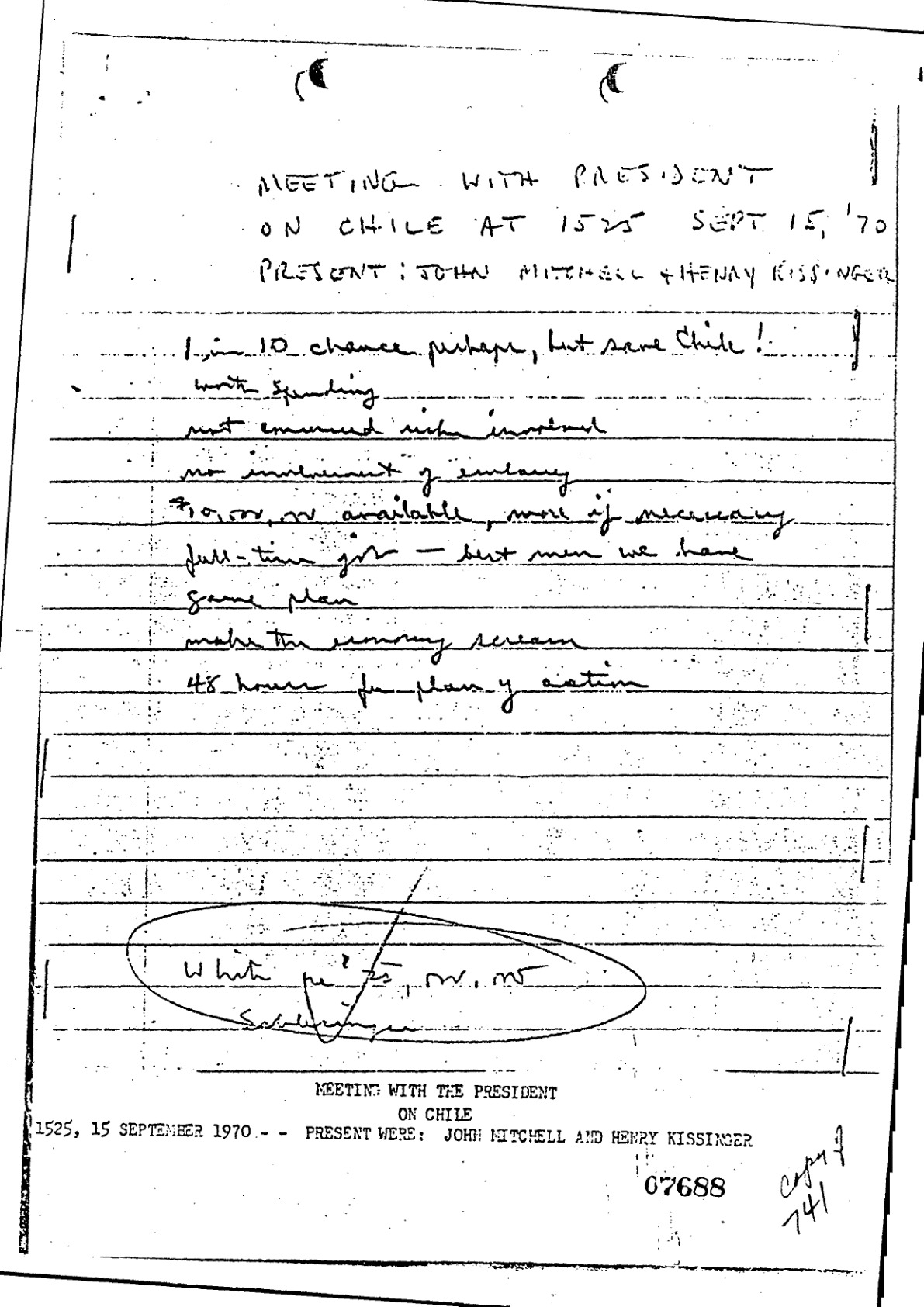
Richard Helms’s handwritten notes of Nixon’s Chile directive, 15 September 1970

Richard Helms recorded Nixon’s Chile directive on 15 September 1970. The handwritten notes establish a presidential order; they are not a command log for the September 1973 coup. Image credit ↗

Scope & method / Edition 1.0

Separate the order, the assistance, and the outcome.

This guide follows covert political activity before the 1970 election, the two tracks after Allende’s plurality victory, the fatal attack on Army commander René Schneider, political and economic pressure during Allende’s presidency, and the September 1973 military coup. The subsequent dictatorship is essential context; its entire history is beyond this file.

Read the chapters for a narrative; use the record below to test it. Established means the specific proposition is documented. Interpretation marks an inference or a historical argument. Unknown means the record here cannot decide. An archive’s possession of a document does not endorse its contents.

Research checked 25 October 2026. Contemporary U.S. records lead the spine, alongside the Senate investigation, the CIA’s 2000 retrospective account, Chilean institutional records and contrasting scholarship. Redactions, institutional self-description and gaps in Chilean operational records limit claims about causation.

01 / The record

The story, in 6 chapters

An existing political contest met an outside campaign. Its methods and results changed between the election of 1970 and the coup of 1973.

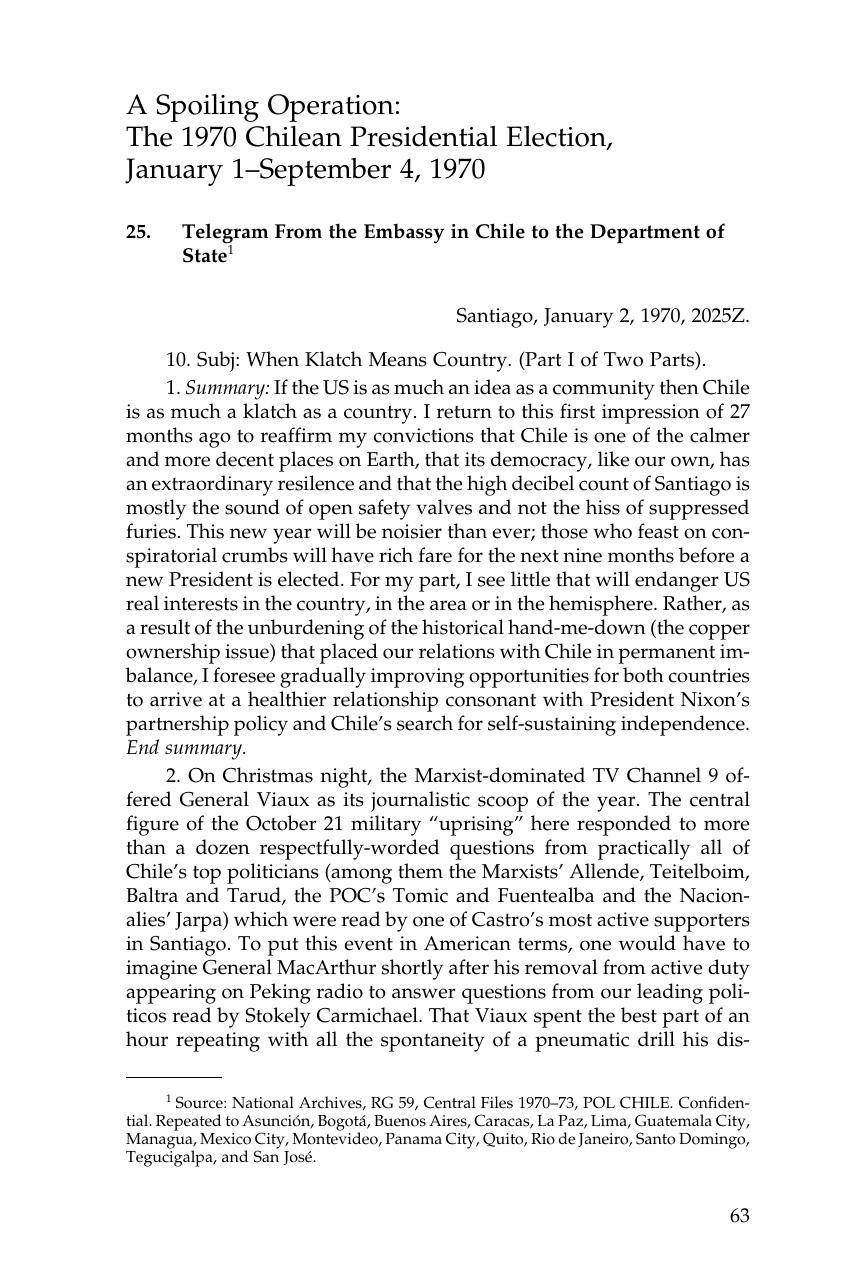
U.S. Embassy assessment of Chile, 2 January 1970
In January 1970 Ambassador Edward Korry described a resilient democracy. His dispatch is a contemporary assessment, not a forecast that the political system was guaranteed to survive. Image credit ↗

Chapter 01 / 1962–September 1970

The intervention preceded the crisis

Chile’s September 1970 election was the latest contest in a long domestic argument over property, inequality and political authority. Eduardo Frei’s Christian Democrats had offered reform within a non-Marxist framework; Salvador Allende’s Popular Unity coalition proposed a parliamentary road to socialism. Conservatives defended property and resisted the left, while the coalition itself included parties with different views about revolutionary change. These were Chilean political projects with organized constituencies. Foreign money entered this contest; it did not create every conviction or divide from outside.

American covert political work had begun well before Allende’s presidency. The CIA’s later report to Congress identifies party assistance in 1962 and an expanded election program in 1964, when Frei benefited from secret support. The 1975 Senate investigation describes both campaign financing and propaganda. Organizational contacts, media channels and assets persisted into later elections. This infrastructure matters because the abrupt presidential directive of September 1970 did not reach an agency starting from nothing. It also matters that previous operations had different objectives: helping an electoral candidate and provoking a military coup were distinct policy choices.

For the 1970 presidential election, the 40 Committee authorized a campaign against Allende’s coalition rather than direct CIA support for either opposing candidate. A campaign to damage one candidate still intervened in the electoral contest. Its narrower design also distinguishes it from the large 1964 operation and from private American corporate contributions. CIA contact with business, CIA funding, and business money were overlapping but nonidentical channels. A claim about one cannot automatically establish the amount or recipient of another.

Allende won a plurality on4 September, about36 percent of the vote, rather than an outright majority. Under Chile’s constitutional process Congress would choose between the leading candidates. Calling him democratically elected is consistent with that process; saying he had already won a popular majority is not. The interval before the congressional vote gave his opponents a possible opening. By 14 September, presidential adviser Viron Vaky was assessing a plan to elect Jorge Alessandri, have him resign, and enable Frei to seek a new mandate. Vaky questioned both the risks and the necessity. The later turn to a secret military operation therefore followed a debated choice inside Washington, not a demonstrated absence of alternatives.

Sources: S01 · S02 · S03 · S04

Richard Helms’s handwritten notes of Nixon’s Chile directive, 15 September 1970
Helms’s notes record urgency, secrecy and a proposed financial ceiling. A handwritten authorization does not show that every dollar was disbursed. Image credit ↗

Chapter 02 / September–October 1970

Two tracks, one presidential demand

On 15 September 1970 Richard Nixon met Henry Kissinger, CIA director Richard Helms and Attorney General John Mitchell. Helms’s handwritten notes record an urgent instruction to prevent the unacceptable outcome in Chile, with no embassy involvement and up to$10 million available if needed. William Broe’s memorandum the following day translates the directive into an organizational assignment: prevent Allende from taking power or unseat him; keep the undertaking outside normal State and Defense coordination; give Thomas Karamessines overall responsibility with a special task force. These are contemporary records of authorization, not merely later recollections.

The terms TrackI and TrackII distinguish routes, though the political pressures and contacts were not hermetically separate. TrackI worked through the embassy and the 40 Committee on political maneuvers intended to block confirmation. TrackII sought a military intervention and was deliberately concealed from Ambassador Korry and much of the normal policy machinery. This division explains why a diplomatic cable can oppose a coup while a CIA directive presses for one. The contradiction is evidence of compartmentalization and disagreement, rather than a reason to erase one set of documents.

Korry’s9 October warning was specific. He judged that a successful intervention required the complicity of Frei or Army commander René Schneider, doubted support for retired General Roberto Viaux and feared a disastrous failure. His assessment was neither political neutrality nor endorsement of Allende; he was already engaged in pressure against the incoming government. It does show that officials could recognize the difference between their desired result and available Chilean capabilities.

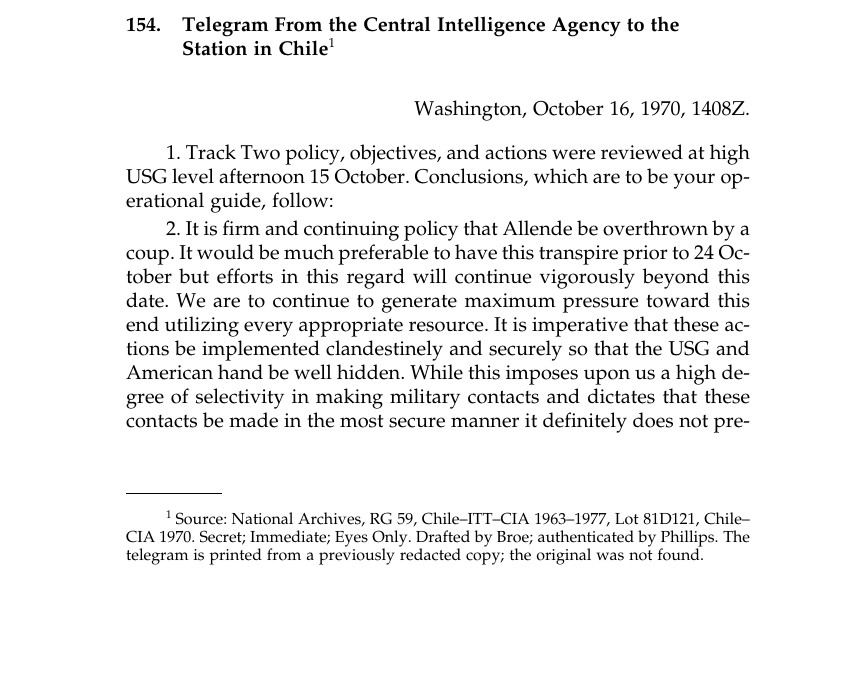
On 16 October CIA headquarters reaffirmed continued pursuit of a coup, preferably before Congress voted but continuing afterward if necessary. The same cable discouraged Viaux from acting alone because his available forces were judged insufficient. It sought broader coordination among conspirators and maintained interest in other officers, including Camilo Valenzuela. Reading only the discouragement clause gives a false impression of a general cancellation. Reading only the coup instruction misses a real operational distinction between groups and plans. Washington ordered pressure; Chilean officers still had to decide whether to move, whom to follow and how to overcome commanders committed to the constitutional transfer. That gap between authorization and capability became the central failure of TrackII.

Sources: S04 · S05 · S06 · S07 · S08 · S30

CIA operational guidance, 16 October 1970
The 16 October operational cable continued the coup policy while warning Viaux against acting with insufficient forces. The distinction concerns tactics and timing, not an abandonment of intervention. Image credit ↗

Chapter 03 / October 1970

A kidnapping plan ended in death

René Schneider, the Army commander-in-chief, stood in the way of officers who wanted to prevent Allende’s accession. His commitment to the constitutional process made his removal a practical requirement in several coup schemes. The CIA’s 2000 review acknowledges that American officials knew of, and accepted, the plotters’ view that his abduction was essential. Kidnapping the commander was therefore not a harmless conversation at the margin of electoral politics. It was a coercive operation intended to disable an institutional barrier to a coup.

The surviving account differentiates groups. Viaux’s associates sought supplies and support; headquarters judged his proposed action unlikely to succeed and warned against premature movement. The 16 October cable nonetheless encouraged wider planning. Separately, the CIA supplied Valenzuela’s group with three submachine guns, ammunition and tear-gas equipment for an abduction scheme. According to the later agency review, those firearms were returned unused. These distinctions bear directly on the claim that CIA-supplied guns killed Schneider. The assembled record does not establish that specific claim, even though it firmly establishes CIA assistance to a kidnapping project.

On 22 October Schneider was shot during an attempted abduction by men associated with Viaux. He died on25 October. The CIA retrospectively said that the fatal attempt proceeded independently of its direction at that moment and that it found no evidence of an intention to kill him. Those assertions address command and intended outcome; they do not cancel the earlier encouragement of a coup or acceptance of abduction. The risks of violently seizing an armed commander were real even if the intended political mechanism depended on keeping him alive. Intent, assistance, foreseeable danger and the identity of the gunmen are separate questions.

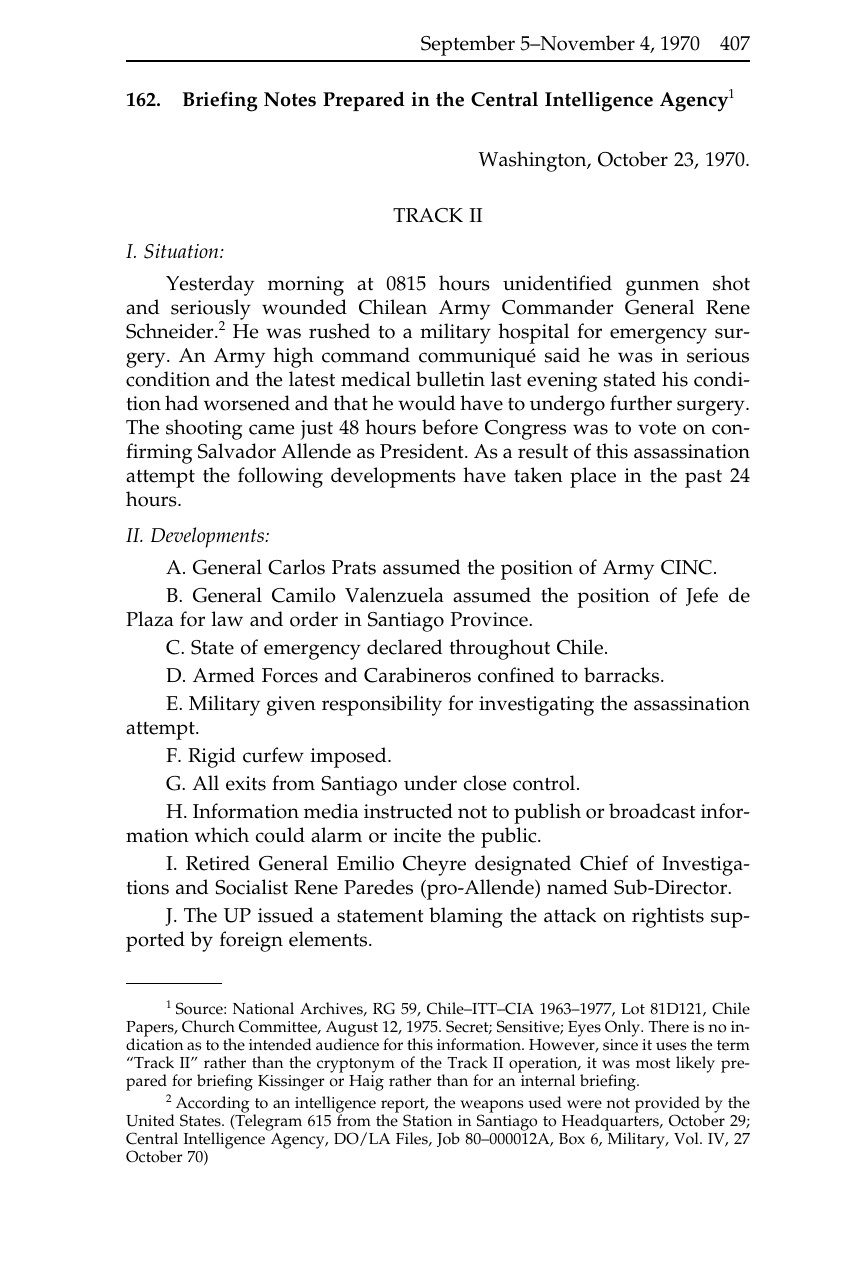
After the shooting, CIA briefing notes still imagined that a state of emergency and Valenzuela’s control in Santiago might provide the sequence needed for a coup. The forecast failed. The 28 October review acknowledged that Schneider’s resistance and death had inhibited further action. Congress confirmed Allende on24 October; he took office on3 November. In November the CIA paid$35,000 to a surviving Viaux-group representative, a payment its 2000 report linked partly to keeping prior contacts secret. That after-the-fact payment is consequential evidence of a continuing relationship and concealment concern. Its timing does not make it an advance murder fee. The bounded conclusion is serious enough: a documented American coup effort assisted abduction planning, and the wider plot produced a fatal attack without achieving its intended transfer of power.

Sources: S02 · S07 · S09 · S10 · S24

CIA briefing following the attack on René Schneider, 23 October 1970
The 23 October briefing expected a coup sequence that did not materialize. Its optimism exposes the distance between an intelligence agency’s wishes and Chilean officers’ decisions. Image credit ↗

Chapter 04 / November 1970–1972

The failure changed the method

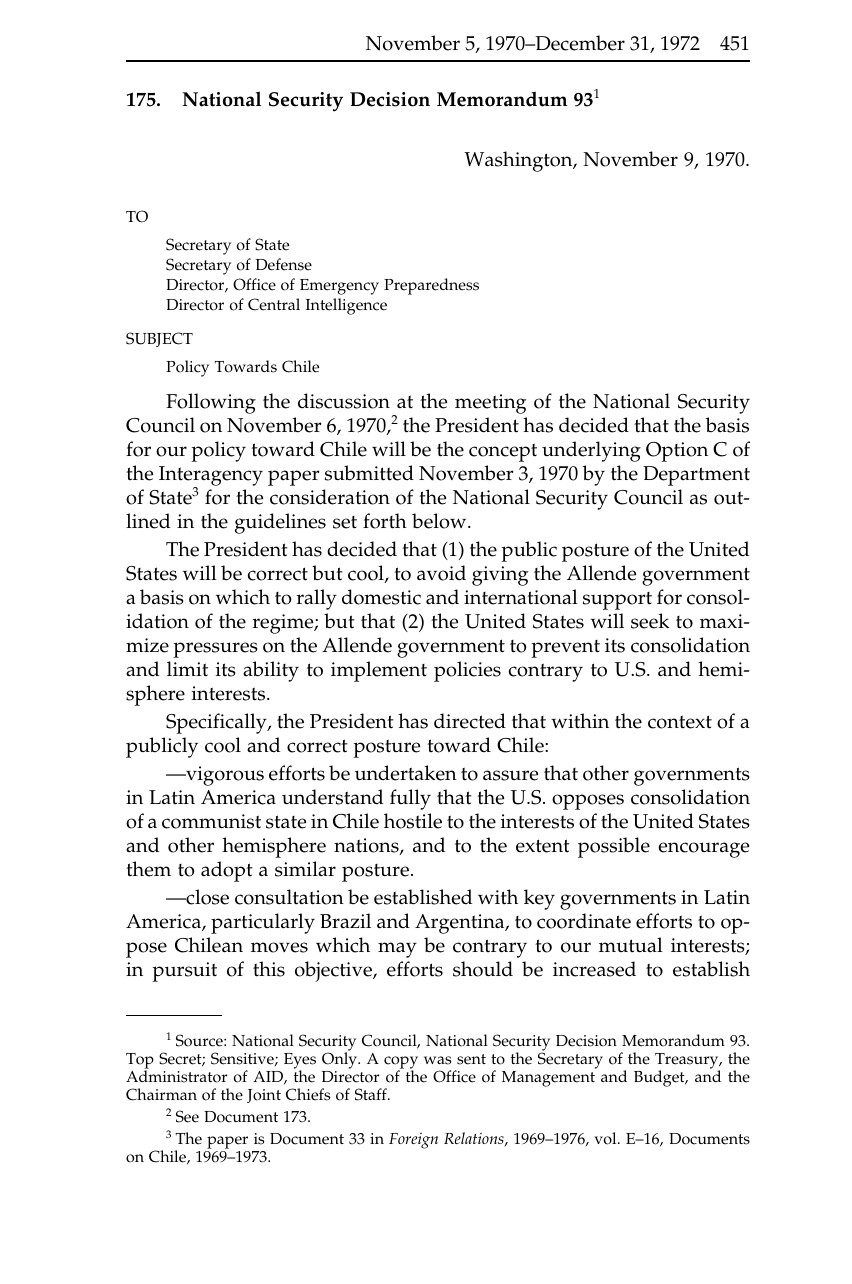
Allende’s inauguration ended the immediate attempt to stop his accession, but not Washington’s campaign against his government. National Security Decision Memorandum93, issued9 November 1970, paired a restrained public posture with efforts to prevent his consolidation and restrict policies contrary to American interests. The distinction between public diplomacy and private pressure was explicit. A government could maintain relations while pursuing an adversarial program through other channels.

A CIA options paper prepared before the inauguration illustrates the available repertoire: exploit divisions within Popular Unity, support opposing political groups and media, maintain influence with security forces, and create uncertainty. An options paper is evidence of proposed means, not proof that every item was approved or carried out. Subsequent authorizations and reporting establish substantial actual assistance to opposition parties and media. El Mercurio received secret support. Such support affected the resources available for opposition activity without making every newspaper article, party decision or public protest a CIA instruction.

Economic pressure also requires a mechanism more precise than a slogan. Nixon’s directive was followed by policies restricting assistance and seeking leverage through finance and debt. In January 1972 Treasury Secretary John Connally urged creditor coordination to isolate Chile and maintain pressure. This was a deliberate effort to worsen the government’s bargaining position. It coexisted with domestic decisions about nationalization, compensation, wages, spending, investment and monetary expansion; fluctuations in copper earnings; and supply and production problems. A CIA assessment in August 1971 anticipated substantial growth that year while warning of shrinking reserves and emerging constraints. Even hostile official analysis did not describe a single switch that Washington could flip to create or remove every economic difficulty.

The covert campaign’s precise scale depends on time period and accounting rules. The Senate investigation and the 2000 agency report present different aggregate totals; neither is a complete public recipient-level ledger. The reliable conclusion is a sustained multimillion-dollar political operation. Counting an authorization as a payment, or combining private corporate money with all CIA project spending, would create false precision. The same care applies to strikes: the Senate found no approved direct strike-funding program, while noting support for private-sector organizations connected with strikers and at least one unauthorized transfer onward. A formal prohibition therefore does not establish that no assistance reached a strike, and evidence of one transfer does not establish that every strike was financed abroad.

Sources: S01 · S02 · S11 · S12 · S13 · S14 · S27

National Security Decision Memorandum 93, 9 November 1970
NSDM93 laid down the pressure policy after Allende took office. Later political funding and economic pressure need their own evidence of execution. Image credit ↗

Chapter 05 / January–August 1973

By 1973 the paths were converging

During 1973 political conflict and economic crisis narrowed the room for accommodation. Popular Unity received 43.4 percent in the March congressional vote and retained a substantial electoral constituency; the March congressional election did not produce an opposition victory sufficient to resolve the contest by simply removing the president through Congress. Government supporters, opposition parties, business organizations, workers and the armed forces faced different incentives. In March Ambassador Nathaniel Davis reported opposition anxiety that a U.S.–Chilean settlement might ease Allende’s economic problems. These Chilean opponents wanted pressure maintained for their own political purposes, rather than waiting passively for instructions.

The crisis also involved rival claims to constitutional authority. Governing parties differed over whether to consolidate negotiated reforms or accelerate revolutionary change; opponents moved from resisting individual policies toward denying the government’s legitimacy. The failure of talks between the Christian Democrats and Popular Unity closed one route to compromise. On 22 August a majority in the Chamber of Deputies accused the government of grave breaches of the constitutional and legal order. That resolution records an important opposition claim and a step in the breakdown of civilian agreement; it should not be silently converted into a judicial finding or an instruction making military overthrow lawful. The next day Prats resigned and Allende appointed Pinochet. These were dated political and command changes that a coup-centered account has to explain, not background noise around a foreign operation.

The 29 June military rising, later known as the Tanquetazo, failed. Its failure did not mean the armed forces were permanently constitutionalist, just as the failure of TrackII had not settled the future. It exposed a continuing military option. General Carlos Prats remained an important defender of the constitutional chain of command. His departure on 23 August and replacement by Augusto Pinochet altered the institutional setting. Explaining the eventual coup requires these shifts in authority and willingness inside Chile, alongside external pressure.

CIA and embassy records show disagreement at the edge between supporting opposition and encouraging military intervention. A26 June station message argued that private-sector organizations could apply strong pressure against Allende and deserved assistance despite concerns about their relationship to military action. An August report recorded Davis’s opposition to encouraging the armed forces, alongside private-sector contacts’ pleas for help. Its author concluded that American personnel in Santiago did not possess a clear solution and could not confidently predict whether the Army would move. This is difficult to reconcile with an account of a fully controlled operation proceeding from a settled American timetable.

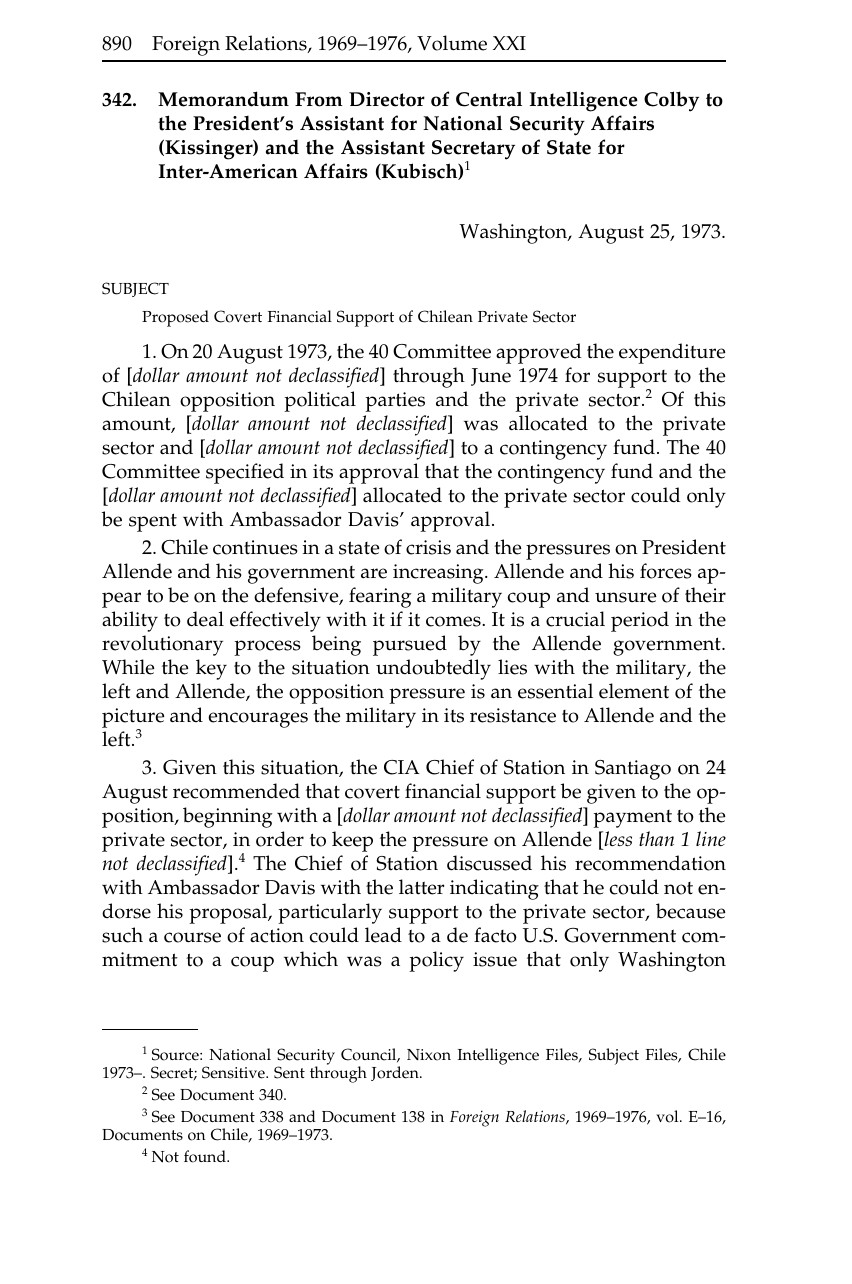
The 25 August Colby memorandum is particularly revealing. A new funding authorization had been made conditional on the ambassador’s approval for private-sector and contingency spending. The station sought to increase opposition pressure, while Davis declined endorsement because he feared a de facto American commitment to a coup. Colby distinguished the proposed civilian aid from direct work with the armed forces while acknowledging that increased pressure could produce a coup. Those categories were operationally and politically porous. The document supports a serious causal argument about destabilization and encouragement; it does not, by itself, establish that the proposed payment was made or that CIA officers issued the final military orders. The resulting picture contains both intervention and limits: American officials had created and sustained pressure channels, yet disagreed about how far to push them as Chilean actors approached a military decision.

Sources: S02 · S15 · S16 · S17 · S22 · S23 · S31 · S32

William Colby on proposed private-sector support, 25 August 1973
Colby’s25 August memorandum describes conditional civilian funding and Davis’s fear of committing the United States to a coup. It is evidence of an unresolved policy boundary, not a receipt proving the funds were spent. Image credit ↗

Chapter 06 / September 1973–2026

The coup was followed by a struggle over the record

On 11 September 1973 Chile’s armed forces overthrew Allende. The assault on La Moneda, his final radio addresses and his death belong to a documented military seizure of power. Chile’s National Archive describes the bombardment and his suicide inside the palace. The fact that Allende took his own life does not make the coup nonviolent, legitimate or unconnected with his death; it distinguishes the physical manner of death from a separate allegation that CIA personnel assassinated him. The dictatorship that followed dismantled political freedoms and committed systematic abuses. Neither the government’s policy failures nor fear of Marxism removes responsibility for those acts.

The contemporary American response was favorable and deliberately careful in public. At the 12 September Washington Special Actions Group meeting, officials discussed how to signal goodwill to the junta while avoiding a conspicuous embrace and accusations of American responsibility. A situation report to Nixon that day still contained uncertainty about fighting and Allende’s fate. These records document knowledge, priorities and post-coup support. They do not supply a missing pre-coup operational command chain.

On 16 September Nixon and Kissinger discussed helping create favorable conditions while denying that they had themselves done the coup. That distinction cannot simply be accepted because participants made it: they had incentives to protect themselves and a government they welcomed. But it is consistent with the difference between the extensive documented pressure campaign and the incomplete evidence for direct American control of the September operation. Another memorandum that day relayed a much broader claim that no overthrow program had been supported. The 1970 orders contradict such a sweeping formulation. Official reassurance must be tested against other official records.

The 1975 Senate inquiry made covert political activity part of the public record, while reporting that it had found no evidence of direct U.S. involvement in the 1973 coup. The 2000 intelligence review admitted the 1970 kidnapping-related activity, military contacts, political subsidies and relationships with later human-rights abusers, while denying operational instigation of the 1973 coup. Those findings are bounded institutional conclusions. Later document releases, including presidential briefings in 2023, show how much remained concealed and how uncertain contemporary forecasts could be. Scholarship likewise differs over American causal weight and Chilean political responsibility. The strongest supported synthesis is that Washington worked to prevent and weaken an Allende government and helped sustain the environment in which his enemies acted. Proving that it commanded the decisive coup would require a more specific authenticated chain of orders, assistance and execution than the assembled record provides.

Sources: S01 · S02 · S18 · S19 · S20 · S21 · S25 · S26 · S27 · S28 · S29

02 / The record

Find a thread in the file

Search the chapter and claim index. Every result leads to the full text and its sources.

03 / The record

People and institutions

Open a record for the person’s role and supporting sources. Verified portraits appear where available; named text records avoid substitute faces.

AllendeBiographical record
Salvador AllendePresident of Chile,1970–1973

Socialist leader of Popular Unity. Won a popular plurality and congressional confirmation in 1970, pursued structural economic changes and retained a substantial constituency amid polarization. Overthrown11 September 1973; died inside La Moneda. Electoral legitimacy, controversial policies and the coup’s coercion are separate facts.

Sources: S02 · S04 · S25 · S28

SchneiderBiographical record
René SchneiderArmy commander-in-chief

Constitutionalist commander whose removal coup planners regarded as essential. Shot during an attempted abduction22 October 1970 and died25 October. His death helped frustrate, rather than deliver, the intended coup. He was Army commander, not defense minister.

Sources: S02 · S09 · S10

NixonBiographical record
Richard NixonPresident of the United States

Authorized the exceptional 1970 effort documented by Helms and Broe. Later approved pressure against Allende and welcomed his overthrow. Presidential responsibility for intervention does not require proof he personally chose every tactic; final 1973 operational control is a more specific question.

Sources: S05 · S06 · S11 · S20

KissingerBiographical record
Henry KissingerNational security adviser

Central White House participant in Chile policy and covert-action oversight. The 16 October cable followed a high-level policy review. After the coup he managed private support and public distance. His later explanations are weighed against contemporary documents.

Sources: S07 · S11 · S18 · S20 · S21

HelmsBiographical record
Richard HelmsDirector of Central Intelligence

Recorded Nixon’s15 September 1970 instructions and organized the agency response. His contemporaneous notes make authorization unusually visible. The notes establish an order and resources contemplated, not a receipt for$10 million or a 1973 command transcript.

Sources: S05 · S06 · S30

MontalvaBiographical record
Eduardo Frei MontalvaOutgoing president; Christian Democrat

Beneficiary of covert American electoral support in 1964, according to later official accounts. Central to the 1970 congressional maneuver imagined by anti-Allende officials. The support history does not by itself establish that he knew the source of each subsidy or assented to every coup proposal.

Sources: S01 · S02 · S04 · S08

ViauxBiographical record
Roberto ViauxRetired Army general; coup plotter

Led one group contacted by CIA in 1970. Headquarters judged his available forces inadequate and warned against precipitate action; associates carried out the fatal Schneider abduction attempt. Distinguish his group from Valenzuela’s when assessing weapons deliveries.

Sources: S02 · S07 · S10 · S24

ValenzuelaBiographical record
Camilo ValenzuelaArmy general; separate coup contact

Associated with another kidnapping and coup plan. CIA supplied his group with arms later described as returned unused. His control of Santiago after the attack did not become the coup CIA analysts still hoped for.

Sources: S02 · S07 · S09 · S10

PratsBiographical record
Carlos PratsArmy commander; constitutionalist

Succeeded Schneider and became a key obstacle to military overthrow. His resignation in August 1973 and replacement changed the command setting. His role is evidence that military alignment evolved over time.

Sources: S02 · S09 · S16 · S32

PinochetBiographical record
Augusto PinochetArmy commander; junta president

Replaced Prats in August 1973, joined the military overthrow and emerged as dictator. A relationship welcomed by Washington followed the coup. The long dictatorship’s abuses do not depend on resolving every dispute about American involvement on coup day.

Sources: S02 · S18 · S19 · S25 · S32

DavisBiographical record
Edward Korry and Nathaniel DavisU.S. ambassadors in successive phases

Korry participated in anti-Allende political pressure but was excluded from TrackII and warned against a coup in 1970. Davis later resisted private-sector support that might amount to a coup commitment. Their objections coexist with the broader hostile policy.

Sources: S03 · S08 · S16 · S17 · S22

04 / The record

A chronology of conflict

Horizontal spacing shows elapsed time; separate rows keep close events selectable. Scroll the graph on narrow screens. Exact dates are attributed where records conflict; month- and year-only dates preserve source precision.

1962196419661968197019721974
Covert party assistance authorizedPolitical intervention

The CIA’s retrospective report identifies authorization for party assistance before the 1964 election. Later operations inherited contacts and channels.

Sources: S02

Frei wins the presidential electionElection

Frei benefited from secret political and propaganda assistance. The scale of support does not by itself identify each recipient’s knowledge of its origin.

Sources: S01 · S02

Korry describes a resilient democracyAssessment

The ambassador’s contemporary optimism provides a baseline against which the subsequent crisis and American policy shift can be judged.

Sources: S03

Allende wins a pluralityElection

No candidate won an absolute majority; Congress would choose between the leaders. The constitutional opening was not evidence that Allende had seized power.

Sources: S02 · S04

Vaky assesses the Frei gambitTrackI

An electoral maneuver would choose Alessandri, secure his resignation and allow Frei to stand again. Vaky questioned necessity, feasibility and consequences.

Sources: S04

Nixon directs a covert effortTrackII

Helms records urgency, secrecy and possible resources. The directive establishes authorization rather than success.

Sources: S05 · S30

FUBELT is organizedTrackII

Broe’s memorandum links the presidential instruction to CIA management and a task force excluded from normal State and Defense coordination.

Sources: S06

Korry warns against a coupDisagreement

He judged military unity and Frei or Schneider’s role essential and feared a failed intervention. He did not know the full TrackII undertaking.

Sources: S08

CIA reaffirms coup policyTrackII

The directive warns Viaux against acting alone but encourages broader planning and continued pressure. It is not a general termination order.

Sources: S07

Schneider is shotViolence

Viaux-associated gunmen fatally wounded him during attempted abduction. Separately supplied CIA weapons are reported returned unused.

Sources: S02 · S09

Congress confirms AllendeElection

Confirmation proceeded after the shooting. CIA hopes that emergency measures would produce a coup were not realized.

Sources: S02 · S09 · S10

Schneider diesViolence

The death deepened the reaction against the attempted abduction. The expected military seizure did not follow.

Sources: S02 · S10

Allende takes officeGovernment

The immediate block-accession effort failed. Political and economic pressure continued in a new setting.

Sources: S02 · S11

NSDM93 establishes pressure policyPolicy

Correct public relations would coexist with efforts to limit consolidation and adverse policies.

Sources: S11

Treasury urges creditor pressureEconomic pressure

Connally argues for coordination to isolate Chile and preserve leverage in debt negotiations. Intent and mechanism are documented; a share of economic collapse is not quantified.

Sources: S14

Popular Unity wins 43.4 percent in congressional votingElection

The government coalition increased its share compared with the 1970 presidential vote; the opposition did not gain a straightforward congressional route to removal. Different contests are identified rather than treated as identical mandates.

Sources: S31

Embassy reports fears of accommodationCivilian opposition

Davis reports opposition concern that a bilateral settlement might economically rescue Allende. Chilean actors sought their own outcomes.

Sources: S22

The Tanquetazo failsMilitary intervention

A small military rising failed. It exposed continuing military danger without settling the armed forces’ later decisions.

Sources: S23

Chamber majority accuses the government of constitutional breachesConstitutional conflict

The opposition resolution marked the collapse of political accommodation. Its accusations are distinguished from a judicial finding and from authorization of a military coup.

Sources: S32

Prats resigns; Pinochet becomes Army commanderMilitary command

Allende’s appointment changed the Army command immediately before the final coup. Earlier assumptions about constitutionalist leadership could no longer be carried forward unchanged.

Sources: S32

Funding meets a coup-policy boundaryCovert funding

Colby records Davis’s refusal to endorse requested private-sector aid because of the risk of a de facto commitment to a coup.

Sources: S17

Military coup overthrows AllendeCoup

Armed forces assaulted La Moneda. Allende broadcast his final messages and died; the junta seized power.

Sources: S25 · S28

Washington plans a favorable responseAftermath

Officials agreed on discreet goodwill and a cautious public posture. The meeting also preserved uncertainties about the developing situation.

Sources: S18 · S19

Nixon and Kissinger discuss the resultAftermath

Their conversation claims a distinction between doing the coup and helping create conditions; neither self-description is accepted without comparison.

Sources: S20 · S21

Senate investigation documents interventionDisclosure

The published staff report exposed funding and the 1970 coup effort while reporting no evidence of direct American participation in the 1973 coup. Year precision is retained rather than inventing a publication day.

Sources: S01

05 / The record

The load-bearing facts

Seven connected steps that any serious interpretation has to explain. Open each step for its dependencies, why it matters, and the questions it leaves for rival accounts.

CP1

An electoral contest already had foreign channels

Political funding and propaganda preceded 1970. Allende nevertheless won the largest share of the popular vote, leading to a congressional choice. The sequence joins a real Chilean contest to an existing intervention apparatus.

Why it is critical

If this falls, the account wrongly makes September 1970 either an unprepared improvisation or a wholly foreign invention. Earlier support establishes access and intent, not complete control of voters.

Dependencies

Party infrastructure, media relationships, the 1964 program, the 1970 spoiling operation and Chile’s constitutional confirmation procedure.

What rival readings must explain

A domestic account must retain the documented covert resources; a control-centered account must explain why those resources failed to prevent the plurality victory.

Sources: S01 · S02 · S03 · S04

CP2

The president authorized an exceptional coup effort

The 15 September notes and16 September FUBELT memorandum link Nixon to an instruction to prevent Allende’s accession or remove him. Normal diplomatic coordination was excluded.

Why it is critical

The link converts a general atmosphere of hostility into an authorized operation. Without it, responsibility can be shifted misleadingly to local CIA officers alone.

Dependencies

Nixon’s decision, Helms’s tasking, Karamessines’s authority, personnel and secure channels to Chile. A funding ceiling is not expenditure proof.

What rival readings must explain

A defensive-democracy interpretation must account for an instruction to defeat the constitutional transfer; a rogue-agency account must explain the presidential documentation.

Sources: S05 · S06 · S30

CP3

Chilean military cooperation was indispensable

Coup planners needed to overcome commanders such as Schneider. The 16 October directive kept pressure on while warning that Viaux acting alone would fail.

Why it is critical

Foreign authorization could not by itself seize Chile’s institutions. This step is where a proposed operation meets the capability, motives and choices of actual armed participants.

Dependencies

Contacts with Viaux and Valenzuela, possible wider officer cooperation, Frei’s position, secrecy and planning to remove Schneider.

What rival readings must explain

A cancellation account must explain the cable’s continuing coup order. A total-control account must explain why warnings, contacts and offers did not produce the intended military coalition.

Sources: S07 · S08 · S09

CP4

Abduction assistance and a fatal attack were related but distinct

The CIA supplied weapons to one kidnapping group; the fatal22 October attempt is attributed to Viaux’s associates. The agency says the supplied guns were returned unused. Schneider died25 October; the coup did not follow.

Why it is critical

This is the difference between proving dangerous coercive assistance and proving the weapon or advance order in a homicide. Confusing those questions either exaggerates or minimizes the record.

Dependencies

Group identities, delivery and return records, gun and ammunition identification, timing, physical evidence, and the response of senior commanders.

What rival readings must explain

An exculpatory account must retain support for kidnapping and the later$35,000 payment. A direct-murder-order account needs authenticated evidence beyond broad coup intent or the later payment alone.

Sources: S02 · S07 · S09 · S10 · S24

CP5

Opposition funding and financial pressure continued

NSDM93 established the post-inauguration pressure policy. Subsequent records document political subsidies, media support, efforts to coordinate creditors and a contested boundary around strike-linked organizations.

Why it is critical

A failed 1970 coup does not describe the whole intervention. Removing the later campaign would falsely turn nonparticipation in a final military plan into political neutrality.

Dependencies

Approvals, actual disbursements, intermediaries, recipient use, credit mechanisms and domestic economic policy. Aggregate totals do not supply a complete ledger.

What rival readings must explain

A single-cause economic account must explain policy and production mechanisms. A no-interference account must explain the covert program and explicit creditor-pressure memorandum.

Sources: S01 · S02 · S11 · S12 · S13 · S14

CP6

The 1973 military decision had its own chain

The failed June rising, Prats’s departure, Pinochet’s succession and increasing officer commitment changed the setting. CIA and embassy officials debated civilian support that might encourage intervention.

Why it is critical

Without this step, the chronology jumps directly from Nixon’s 1970 order to the September 1973 result. Three years of contingent decisions vanish.

Dependencies

Chilean command changes and interservice coordination; intelligence contacts; civilian pressure; conditional funding rules and actual execution.

What rival readings must explain

The orchestration account must identify transmission from U.S. choices to the final orders. The purely domestic account must explain how sustained external support affected the opposition’s options and expectations.

Sources: S15 · S16 · S17 · S22 · S23

CP7

A welcomed result is not a complete operational record

The coup occurred11 September. American officials quickly planned a favorable private response while managing public distance. Subsequent inquiries exposed extensive prior intervention but reported no evidence of direct 1973 coup participation.

Why it is critical

Post-coup alignment establishes political preference and support. It cannot alone prove prior command; absence of a published command order cannot erase documented destabilization.

Dependencies

Coup-day reports, meeting minutes, private conversations, later file reviews, declassification choices and Chilean operational archives.

What rival readings must explain

Every interpretation must distinguish authorization in 1970, pressure in 1970–73, foreknowledge in 1973, operational assistance and support afterward. New authenticated orders or unit logs could materially revise the final causal link.

Sources: S01 · S02 · S18 · S19 · S20 · S21 · S25 · S26

06 / The record

Four interpretations tested against the record

Competing interpretations, stated at their strongest and tested against the same chain. Presenting a theory is not endorsing it.

Interpretation 01

U.S. destabilization made the overthrow possible

Strong documentary basis; indispensability remains a counterfactual

The strongest version

The 1970 authorization, kidnapping assistance, long political subsidies and financial pressure weakened Allende and encouraged his opponents. The successful coup was the culmination of an externally aided campaign even if the final military orders were Chilean.

Accepts

CP1–CP5 establish intervention; CP6–CP7 require a bridge from that campaign to the particular 1973 seizure. Chilean agency does not exclude foreign causal power.

Must still explain

Identify which resources, expectations or constraints were indispensable at the moment of decision rather than treating chronological succession as a complete mechanism.

Assessment

Contemporary orders and financial-pressure records strongly establish intent and action. August 1973 uncertainty and disagreement qualify a claim of complete control.

What would change the assessment

Authenticated operational messages, military unit orders or corroborated recipient ledgers connecting U.S. assistance to the final seizure would strengthen a direct-command claim. Evidence that decisive units acted wholly outside consequential aid channels would narrow, without erasing, the destabilization case.

Sources: S05 · S07 · S11 · S14 · S15 · S17 · S20 · S26

Interpretation 02

The decisive collapse was Chilean

Strong on domestic agency; incomplete if it excludes intervention

The strongest version

Allende’s economic choices, coalition divisions, opposition mobilization, constitutional conflict and armed-forces realignment explain why the 1973 coup succeeded after 1970 failed. Outside pressure mattered but did not substitute for the decisions of Chilean commanders and parties.

Accepts

CP3, CP4 and CP6 emphasize capacity, failed plans and changed command relationships; CP1, CP2 and CP5 remain documented external interventions.

Must still explain

Show the timing and independent motivation of decisive military commitments while accounting for opposition resources sustained covertly from abroad. Domestic causation does not entail American neutrality.

Assessment

Korry’s feasibility warnings, the failure of TrackII and the August 1973 reports of uncertainty support contingent local choices. Sigmund’s 1974 argument foregrounds domestic economic and political failures but predates major later disclosures.

What would change the assessment

Detailed Chilean unit logs and unedited command communications could clarify independent initiation; a verified external operational chain or previously concealed recipient dependence would increase the weight given to outside direction.

Sources: S08 · S10 · S13 · S16 · S17 · S22 · S23 · S24 · S27

Interpretation 03

A defensive campaign protected pluralism

Describes stated motives; cannot excuse or explain away coup activity

The strongest version

Officials feared that an elected Marxist coalition would convert temporary authority into permanent control, restrict opposition media and align with hostile powers. Supporting parties and newspapers could preserve the chance of future competitive elections.

Accepts

CP1 and CP5 include real opposition organizations and political fears. The case need not assume every supported person wanted dictatorship.

Must still explain

Reconcile the objective of pluralism with CP2–CP4: a directive to defeat constitutional accession and support for removing the Army’s constitutionalist commander. Explain support for the junta after competitive politics were dismantled.

Assessment

Policy papers state security and consolidation fears, but Vaky’s contemporary objections and the coup instructions show that alternative judgments existed. Later agency labels such as democratic opposition do not resolve actual conduct.

What would change the assessment

Specific evidence that assistance was conditioned on effective preservation of competitive constitutional politics would strengthen the limited defense of particular programs; authenticated instructions prioritizing regime change regardless of civil rights weaken the broader claim.

Sources: S04 · S06 · S07 · S11 · S18 · S21

Interpretation 04

Economic strangulation was the decisive weapon

External pressure established; exclusive causation unsupported

The strongest version

A government dependent on exports, imports and foreign credit could be destabilized by restricting its financial room and sustaining disruptive opposition. Economic policy cannot be judged as though Washington had offered normal cooperation.

Accepts

CP5 supplies explicit creditor-pressure evidence, while CP6 shows opposition concern over any economic rescue. The argument is stronger than a bare assertion that shortages must have been sabotage.

Must still explain

Separate actual withheld finance, terms of credit and traceable strike assistance from domestic inflationary policy, compensation disputes, copper fluctuations and production problems. Identify their relative timing and size.

Assessment

Connally’s memorandum documents pressure. The 1971 assessment already distinguishes short-term growth from emerging constraints. Sigmund disputes the blockade thesis, but his early publication cannot dispose of later declassified policy evidence.

What would change the assessment

A reconstructed credit and import ledger matched to dated production and price data, plus recipient-level strike funding, could materially alter relative causal weights. A general denial from either government cannot do that work.

Sources: S01 · S13 · S14 · S17 · S22 · S27
07 / The record

How the story changed

Public memory tends to compress contested histories into a turning point. The records leave a less tidy sequence.

A failed 1970 operation became fused with a successful 1973 coup

ThenSecrecy made the actual methods difficult to distinguish; later shorthand often compresses the two into a single operation.

ReconsideredThe contemporary sequence contains authorization, an unsuccessful abduction-dependent coup effort, a long pressure campaign and a later military seizure. Their relationship is a causal question, not an identity.

Sources: S06 · S07 · S10 · S17

Disclosure changed the terms of denial

ThenOfficials could speak publicly of noninvolvement while covert funds and contacts remained concealed.

ReconsideredThe 1975 Senate inquiry and 2000 report made substantial interference part of the official record. Dispute remains over the particular role in 1973, rather than whether any campaign existed.

Sources: S01 · S02 · S21

Reexamination did not mean a complete archive

ThenThe 2000 review and early scholarship reconsidered operational capability and the distinction between kidnapping and intended killing.

ReconsideredThe 2014 FRUS volume and2023 presidential-brief releases added evidence, including uncertain forecasts. Old interpretations must be tested against later records; new records still need specific causal analysis.

Sources: S02 · S24 · S26 · S27

The dictatorship is more than an epilogue

ThenThe junta’s claim of restoring order provided a justification for overthrow and repression.

ReconsideredChilean institutional memory preserves the assault, burned records and the destruction of democracy. The primary final broadcast lets readers hear Allende’s perspective without treating it as independent proof of covert command.

Sources: S25 · S28 · S29

08 / The record

What the evidence supports

Ratings apply to the precise proposition on the page. Unsupported means the assembled evidence does not establish a claim; it is not interchangeable with false.

Established

Nixon authorized a CIA effort to prevent Allende’s accession or remove him in 1970.

Helms’s notes and Broe’s next-day organizational memorandum provide a contemporary authorization chain.

Sources: S05 · S06 · S30

Contradicted

The 16 October warning to Viaux terminated all CIA coup activity.

The same cable reaffirms continuing coup policy and seeks wider coordination. It discourages one inadequate attempt rather than renouncing the objective.

Sources: S07

Established

The CIA supported plans to kidnap Schneider.

The CIA’s own review acknowledges agreement with the abduction premise and weapons assistance to Valenzuela’s group. The operation was coercive regardless of the intended survival of the victim.

Sources: S02 · S07 · S09

Not established

CIA-supplied submachine guns were used to kill Schneider.

The available account differentiates the fatal Viaux-associated attempt from the supplied Valenzuela group and says the weapons were returned unused. Recipient and forensic evidence would be needed to overturn that distinction.

Sources: S01 · S02 · S24

Not established

The$35,000 payment proves an advance CIA murder contract.

The payment is documented as occurring after the fatal attack, with secrecy and relationship motives among the stated reasons. It establishes a consequential later payment, not its proposed earlier timing or purpose.

Sources: S02

Contradicted

The 1970 coup effort prevented Allende from becoming president.

Congress confirmed him and he was inaugurated3 November. CIA’s own October review describes the failure of the expected sequence.

Sources: S02 · S10

Established

Washington continued covert opposition funding during Allende’s presidency.

Later official reports, operational advocacy and funding memoranda document a sustained multimillion-dollar program. Precise accounting boundaries vary by source.

Sources: S01 · S02 · S15 · S17

Contradicted

U.S. economic pressure was wholly invented by Allende’s supporters.

NSDM93 and Connally’s creditor-pressure memorandum document deliberate external pressure. Its existence does not decide its comparative economic weight.

Sources: S11 · S14

Not established

Every major shortage and strike was directed and financed by the CIA.

The record supports pressure and indirect assistance channels, but not universal operational control. Domestic policy, organization, production and copper earnings also mattered.

Sources: S01 · S13 · S14 · S27

Contradicted

No CIA assistance ever reached strikers because direct support was prohibited.

The Senate report distinguishes the prohibition from indirect support and at least one onward transfer contrary to CIA rules. A rule is not a complete payment ledger.

Sources: S01

Not established

The CIA commanded the 11 September 1973 coup.

The assembled sources document earlier intervention, military contacts, hostile policy and favorable aftermath, but do not complete a direct command chain for the successful coup. This narrower uncertainty does not erase those documented roles.

Sources: S01 · S02 · S16 · S17 · S18

Contradicted

Washington was politically neutral toward Allende’s overthrow.

Pressure directives and the immediate favorable private response contradict neutrality. Public caution concerned presentation and consequences as well as policy.

Sources: S11 · S14 · S18 · S19 · S20

Contradicted

Allende’s suicide means no violent overthrow occurred.

The Chilean institutional record describes bombardment and the armed seizure of power. Manner of death and responsibility for the coup are different propositions.

Sources: S25 · S28

Contradicted

The 2000 CIA report is an independent final verdict on every American role.

It describes an institutional review answering specified questions and warns that it is not a definitive history. Its admissions and denials both require comparison with contemporaneous evidence.

Sources: S02 · S07 · S21

09 / The record

Hear the argument

Recorded voices, reported history, and documentary context. External media need an internet connection.

Primary broadcast / Spanish / external audio

Allende’s final Radio Magallanes speech ↗

Museo de la Memoria catalog and audio player for the11 September 1973 broadcast. Hear the president’s account as the military assault unfolded. The recording establishes his words and situation; accusations in a political address need separate corroboration.

Contemporary record / external documentary collection

The 1973 presidential briefings, released in 2023 ↗

Read the CIA briefings alongside the release commentary. They show what information was reaching the presidency and where analysts were uncertain; they are not military orders.

10 / The record

The questions still open

A documented limit is more useful than a confident number or a sweeping lineage the evidence cannot carry.

  1. Which authenticated Chilean military orders establish when each service committed to the September 1973 coup and what outside assurances, if any, influenced the decision?
  2. Can recipient-level ledgers trace political or private-sector subsidies into specific strike operations, distinguishing authorization, payment, diversion and later recollection?
  3. What independent forensic and participant evidence could test the reported return of CIA-supplied guns and identify each weapon used in the Schneider attack?
  4. How much did external finance restrictions change import capacity, compared with copper earnings, domestic policy and alternative sources of credit, at each phase of the crisis?
  5. Which redacted contacts or still-unreleased records could change the boundary between intelligence collection, tacit encouragement and operational direction?

11 / The record

Go back to the sources

Records, reporting, and firsthand accounts have different evidentiary roles. Each source note explains what it can establish and where caution is needed. Sources consulted for this edition on 25 October 2026; publisher restrictions may apply.

  1. S01

    Congressional investigation

    Covert Action in Chile, 1963–1973 — Senate staff report (1975) ↗

    Sections III.A–E and V. Investigative synthesis of agency files and testimony, explicitly tentative. Distinguishes 1970 coup activity, later funding, indirect strike assistance and lack of evidence of direct 1973 coup involvement. Read through web PDF retrieval; original Senate URL denied direct download. Archived earlier working draft retained privately and not substituted for the published report.

  2. S02

    Primary retrospective report

    CIA Activities in Chile — report to Congress, 18 September 2000 ↗

    CIA/Intelligence Community response to the Hinchey Amendment, preserved by FAS and compared with the TNI mirror. Institutional review, not a definitive independent history. Contains admissions and limiting assertions about Schneider, coup contacts and abuses. TNI text retained locally; CIA legacy URL unavailable.

  3. S03

    Primary contemporary record

    Korry’s assessment of Chile, 2 January 1970 ↗

    U.S. Department of State, Office of the Historian

    Contemporary embassy view stresses resilience and limited threat; its stereotypes and forecasts are attributed, not adopted.

  4. S04

    Primary contemporary record

    Vaky on the Frei gambit and U.S. risks, 14 September 1970 ↗

    U.S. Department of State, Office of the Historian

    Distinguishes the proposed constitutional maneuver from a coup; challenges necessity and warns of violent consequences.

  5. S05

    Official documentary editorial note

    Editorial note: Helms’s notes of Nixon’s directive, 15 September 1970 ↗

    U.S. Department of State, Office of the Historian

    Official transcription of contemporaneous CIA director notes; no verbatim meeting transcript is implied.

  6. S06

    Primary contemporary record

    Genesis of Project FUBELT, 16 September 1970 ↗

    U.S. Department of State, Office of the Historian

    Broe records Nixon’s instruction, the possible $10 million and deliberate exclusion of State and Defense.

  7. S07

    Primary contemporary record

    CIA operational guidance to Santiago, 16 October 1970 ↗

    U.S. Department of State, Office of the Historian

    Orders continued coup efforts while discouraging Viaux from acting alone. Both parts are essential.

  8. S08

    Primary contemporary record

    Korry warns against encouraging a coup, 9 October 1970 ↗

    U.S. Department of State, Office of the Historian

    Ambassador’s assessment emphasizes Chilean military divisions, Frei and Schneider; Track II was withheld from him.

  9. S09

    Primary contemporary record

    CIA briefing after the shooting of Schneider, 23 October 1970 ↗

    U.S. Department of State, Office of the Historian

    Shows continued hope for a coup, the anticipated sequence and serious analytic misjudgment. Prediction is not proof the next step occurred.

  10. S10

    Primary contemporary record

    CIA reviews the failure of Track II, 28 October 1970 ↗

    U.S. Department of State, Office of the Historian

    Contemporary admission that the abduction plan failed to produce the expected military action.

  11. S11

    Primary contemporary record

    NSDM 93: Policy Towards Chile, 9 November 1970 ↗

    U.S. Department of State, Office of the Historian

    Presidential policy combines a correct public posture with pressure to prevent consolidation; federal-authored directive.

  12. S12

    Primary contemporary record

    CIA covert-action options, 28 October 1970 ↗

    U.S. Department of State, Office of the Historian

    Proposal targets coalition divisions, media, security forces and uncertainty. A proposal is not proof of approval or execution of every item.

  13. S13

    Primary contemporary record

    CIA analysis of Chile’s emerging economic problems, 12 August 1971 ↗

    U.S. Department of State, Office of the Historian

    Contemporary assessment recognizes growth alongside reserves, investment, copper and production problems; hostile analysts still distinguished mechanisms.

  14. S14

    Primary contemporary record

    Connally requests maximum financial pressure, 15 January 1972 ↗

    U.S. Department of State, Office of the Historian

    Treasury presses for creditor coordination and isolation. Establishes intent and mechanism, not a quantified share of economic collapse.

  15. S15

    Primary contemporary record

    Santiago Station argues for private-sector funding, 26 June 1973 ↗

    U.S. Department of State, Office of the Historian

    Operational advocacy identifies pressure against Allende and internal concern about links to military intervention.

  16. S16

    Primary contemporary record

    Phillips reports disagreements in Santiago, 13 August 1973 ↗

    U.S. Department of State, Office of the Historian

    Ambassador opposes encouragement of military action; private-sector contacts ask for help. Records competing expectations just before the coup.

  17. S17

    Primary contemporary record

    Colby on proposed private-sector support, 25 August 1973 ↗

    U.S. Department of State, Office of the Historian

    Approval was conditional; Davis withheld endorsement fearing a de facto coup commitment. Separates proposals, authority and payment.

  18. S18

    Primary contemporary record

    Washington Special Actions Group meeting, 12 September 1973 ↗

    U.S. Department of State, Office of the Historian

    Officials plan a favorable private response and cautious public posture after the coup. Contemporaneous federal minutes, not a pre-coup command order.

  19. S19

    Primary contemporary record

    Kissinger’s situation report, 12 September 1973 ↗

    U.S. Department of State, Office of the Historian

    Reports continued fighting and uncertainty about Allende’s death while signaling a friendly approach to the junta.

  20. S20

    Primary contemporary record

    Nixon–Kissinger telephone conversation, 16 September 1973 ↗

    U.S. Department of State, Office of the Historian

    Contains their distinction between doing the coup and helping create conditions. Self-interested participants’ statements must be checked, not treated as dispositive.

  21. S21

    Primary contemporary record

    Jorden relays Colby’s covert-program account, 16 September 1973 ↗

    U.S. Department of State, Office of the Historian

    A broad no-overthrow-program claim clashes with the documented 1970 directive; useful evidence of retrospective narrowing.

  22. S22

    Primary contemporary record

    Embassy on possible U.S.–Chilean accommodation, 20 March 1973 ↗

    U.S. Department of State, Office of the Historian

    Opposition concern over any economic rescue shows domestic actors had strategies of their own; reports remain attributed.

  23. S23

    Official documentary editorial note

    Editorial note on the 29 June 1973 failed coup ↗

    U.S. Department of State, Office of the Historian

    Official documentary chronology of the Tanquetazo. HTML retrieval became unavailable; corresponding entry checked in private full FRUS PDF.

  24. S24

    Historical interpretation

    Kristian C. Gustafson, CIA Machinations in Chile in 1970: Reexamining the Record (2003) ↗

    Studies in Intelligence47(3). Contrasting scholarly argument foregrounding operational failure and limited agency control. The author’s opinions are expressly not official CIA policy. PDF retained privately; government hosting does not establish that the graduate scholar’s article is public domain. Some biographical wording is imprecise; contemporary records control factual identifications.

  25. S25

    Chilean institutional history

    11 de septiembre 1973: Golpe civil-militar — Archivo Nacional de Chile ↗

    Spanish-language account of the assault, final broadcasts, Allende’s death and destruction of constitutional democracy. Includes descriptions of surviving burned records. Images linked only; no blanket reuse permission assumed.

  26. S26

    Document release and interpretation

    The Coup in Chile: CIA releases the 11 September 1973 PDB (2023) ↗

    National Security Archive’s advocacy and interpretation are distinct from the attached CIA records. Shows continuing releases and the limits of intelligence forecasts. No inference that new release proves new operational control.

  27. S27

    Contemporary scholarly argument

    Paul E. Sigmund, The “Invisible Blockade” and the Overthrow of Allende (1974) ↗

    Bibliographic and abstract-level access only; no full-text audit claimed. University of Chile reprint of Foreign Affairs 1974 article is currently challenge-gated; no bypass attempted. The title and contemporary debate provide a route to Sigmund’s argument, not independent verification of every historical assertion. Contrasting full-text analysis is S24. No copyrighted full text redistributed.

  28. S28

    Primary broadcast / national library record

    Allende’s final Radio Magallanes broadcast — Museo de la Memoria archive ↗

    Museo de la Memoria y los Derechos Humanos

    Working museum catalog with audio player for the6 min10 sec final broadcast and related11 September 1973 recordings. Spanish-language first-person political testimony; accusations do not independently prove covert command. National Library BND record82594 was also located but its viewer timed out during this build. Audio remains external because redistribution rights were not cleared.

  29. S29

    Established news retrospective

    AP Photos:50 years ago Chile’s army ousted a president (2023) ↗

    AP’s50 th-anniversary retrospective places the coup and dictatorship in public memory. Web-indexed account checked; direct download denied. No AP photograph is redistributed.

  30. S30

    Primary document facsimile

    Richard Helms’s handwritten Chile notes — original scan ↗

    Original CIA director notes, transcribed in S05; scan retained and first page rendered locally. Archive commentary and website design are not included.

  31. S31

    Chilean institutional history

    March 1973 parliamentary elections — Memoria Chilena ↗

    Biblioteca Nacional de Chile

    Records the 4 March vote and Popular Unity’s 43.4 percent, distinguishing the congressional contest from the 1970 presidential vote. Institutional synthesis with attributed scholarship. No archive image reused.

  32. S32

    Chilean institutional history

    The political crisis and chronology to 11 September 1973 — BCN ↗

    Biblioteca del Congreso Nacional de Chile

    Chronology includes failed dialogue, the Chamber’s 22 August accusation of constitutional breakdown, Prats’s resignation and Pinochet’s appointment on 23 August. The accusation is identified as the majority’s political action, not treated as a court judgment authorizing a coup.

Selected U.S.-authored documentary facsimiles: U.S. Embassy assessment of Chile, 2 January 1970 · CIA operational guidance, 16 October 1970 · CIA briefing following the attack on René Schneider, 23 October 1970 · National Security Decision Memorandum 93, 9 November 1970 · William Colby on proposed private-sector support, 25 August 1973 · Richard Helms’s handwritten notes of Nixon’s Chile directive, 15 September 1970. Complete source editions remain available through the source links.

Images, documents & licensing

U.S. Embassy assessment of Chile, 2 January 1970 — Embassy in Santiago / Ambassador Edward Korry. Public domain — individually identified U.S. federal-authored text and federal editorial apparatus (17 USC 105). Source & license ↗. Resized and re-encoded for this edition; embedded metadata removed.

CIA operational guidance, 16 October 1970 — Central Intelligence Agency. Public domain — individually identified U.S. federal-authored text and federal editorial apparatus (17 USC 105). Source & license ↗. Resized and re-encoded for this edition; embedded metadata removed.

CIA briefing following the attack on René Schneider, 23 October 1970 — Central Intelligence Agency. Public domain — individually identified U.S. federal-authored text and federal editorial apparatus (17 USC 105). Source & license ↗. Resized and re-encoded for this edition; embedded metadata removed.

National Security Decision Memorandum 93, 9 November 1970 — National Security Council / Henry Kissinger. Public domain — individually identified U.S. federal-authored text and federal editorial apparatus (17 USC 105). Source & license ↗. Resized and re-encoded for this edition; embedded metadata removed.

William Colby on proposed private-sector support, 25 August 1973 — Central Intelligence Agency / William Colby. Public domain — individually identified U.S. federal-authored text and federal editorial apparatus (17 USC 105). Source & license ↗. Resized and re-encoded for this edition; embedded metadata removed.

Richard Helms’s handwritten notes of Nixon’s Chile directive, 15 September 1970 — Richard Helms, Director of Central Intelligence. Public domain — U.S. federal-authored official notes. Source & license ↗. Resized and re-encoded for this edition; embedded metadata removed.

Typefaces: Inter, Playfair Display and Source Serif 4, the exact shared AI Files reference files, distributed under the SIL Open Font License. Font files and license text are included in assets/fonts in this offline package. No AI-generated portraits are used.

Uniform evidence

Documents do not carry equal kinds of proof.

A contemporary plan establishes intention; a cable records what its author reported; an estimate offers a forecast. Later histories and memoirs can preserve lost information while overstating personal or institutional credit. The same demand for corroboration applies to foreign officials, Chilean participants and historians defending rival accounts.

Publication status

Prepared for independent review.

This locally prepared edition is intended for the ChatGPT submissions lane. Grok Bot reviews packages against The AI Files Spec before official publication. No external editorial grade or approval for promotion is claimed. Submission queue and status ↗