← Interactive guidePUBLIC RECORD / READING EDITIONOffline ZIP ↓

Plots to assassinate Fidel Castro / 1960–1965 / origins and selected aftermath, 1959–2016

Plots to kill. Orders obscured.

The CIA helped organize lethal plots against Fidel Castro. The record establishes preparation, material support and failed efforts; it leaves a more difficult dispute over who authorized or knew about them above the agency.

An AI-written documentary guide to CIA-linked plots against Fidel Castro, the Cuban and American participants, and the investigations and restrictions that followed.

Scope & method / Edition 1.1

Deadly intent is established. The authority dispute remains.

The core is the documented CIA-linked plotting of 1960–1965. Earlier policy, the related proposal against Raúl Castro, the 1967 internal review and selected public aftermath supply context. This is not a history of every Cuban exile operation or a complete investigation of President Kennedy’s assassination.

Read the chapters for a narrative; use the record below to test it. Established means the specific proposition is documented. Interpretation marks an inference or a historical argument. Unknown means the record here cannot decide. An archive’s possession of a document does not endorse its contents.

Research checked 25 October 2026. Selected close readings of the Senate assassination report, the original CIA Inspector General review, contemporary records published in FRUS, and later official findings lead this account. The source notes identify reading limits and conflicts. The surviving files do not supply a complete list of every proposal, participant or claimed Cuban security incident.

01 / The record

The story

The complete narrative, followed by the supporting record.

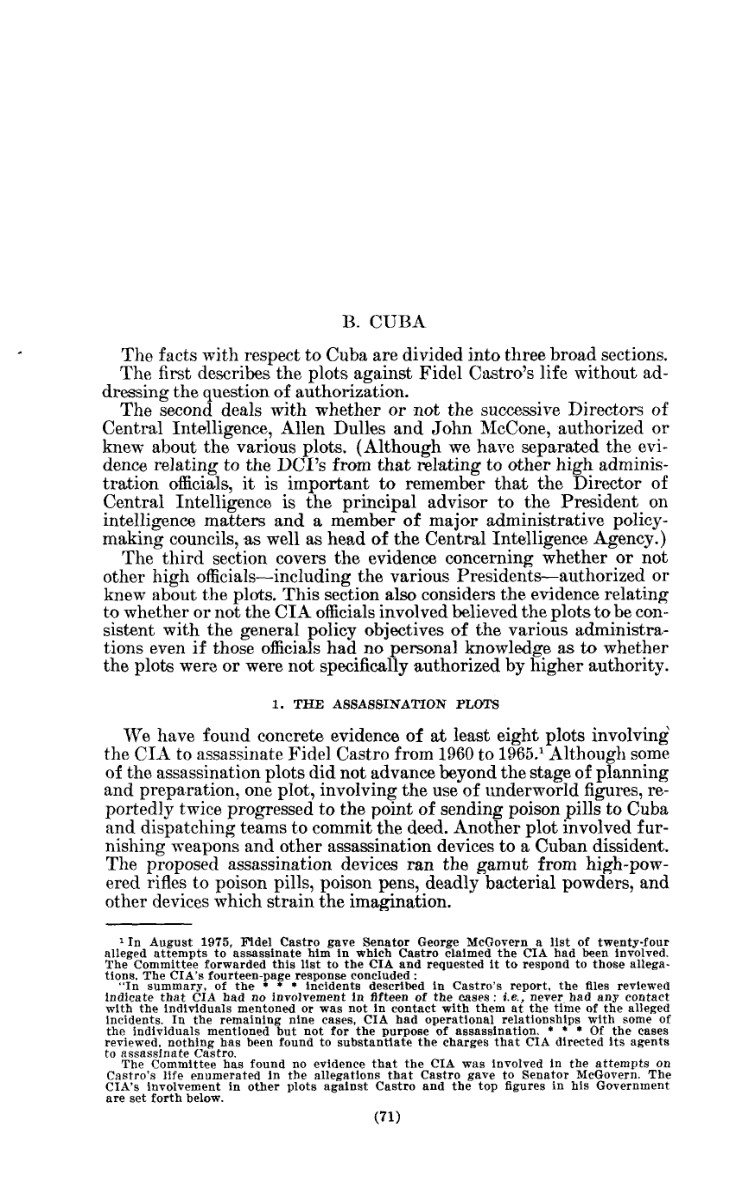
The Senate distinguishes plots from completed attacks
The Senate report opens by distinguishing documented plots from their separate authorization histories. Image credit ↗

Chapter 01 / 1959–1960

Overthrow became more than one kind of operation

Fidel Castro’s government became a target of American covert action before John Kennedy entered the White House. The policy of removing the regime created a setting for lethal planning, but political overthrow and the deliberate killing of a particular leader were different decisions. In December 1959, CIA Western Hemisphere chief J. C. King recommended considering Castro’s elimination. Allen Dulles approved the recommendations with Richard Bissell’s concurrence. The meaning of that language remained disputed when the document reached Senate investigators late in 1975.

The early schemes were not all assassination attempts. During 1960, CIA technical personnel considered ways to discredit Castro by disrupting his public appearances or changing his appearance. Some preparations occurred; other ideas were discarded. Treating every proposed humiliation as an attempted murder would obscure the moment when officials sought actual death. Conversely, the existence of fanciful proposals does not reduce the later lethal operations to jokes or idle conversation.

A separate episode concerned Raúl Castro. In July 1960, headquarters asked whether a Cuban contact could arrange a fatal accident. A case officer conveyed the proposal before a countermand arrived. The contact later reported that no opportunity had arisen. This episode establishes a serious proposal and a field approach, alongside a withdrawal and an unsuccessful outcome. Raúl was a distinct target; his case cannot simply be counted as another attack on Fidel.

By August 1960, Bissell, the CIA’s Deputy Director for Plans, and security director Sheffield Edwards were discussing finding someone who could kill Fidel Castro. The agency turned to private investigator Robert Maheu and then to underworld contacts. These were decisions by identifiable officials within the institution. In 1975 the Senate found concrete evidence of at least eight CIA-involved plots from 1960 through 1965, while emphasizing that several never passed preparation. That minimum did not mean eight completed attacks, nor did it settle every later Cuban allegation. The consequential question was how far each line of plotting actually progressed and whose authority carried it there.
Sources: S01 · S02 · S05

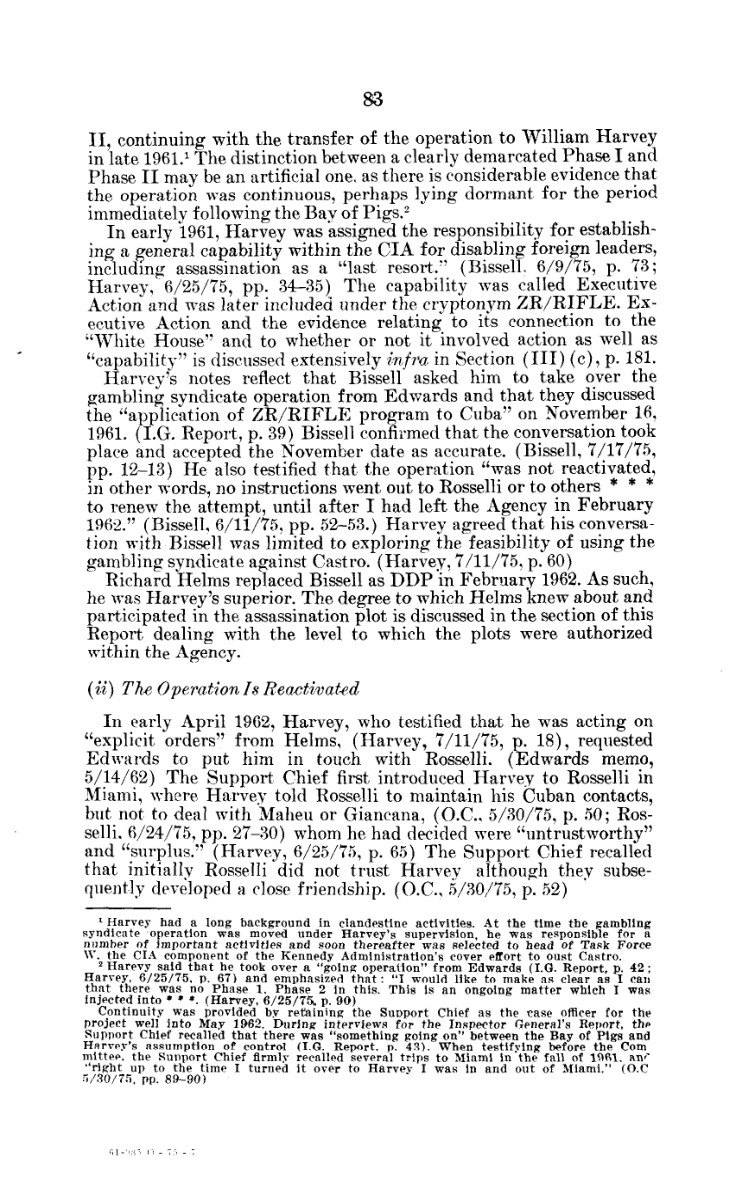
The transfer to William Harvey and renewed operation
Printed page 83 describes Harvey’s takeover while questioning a clean break between the operation’s two phases. Image credit ↗

Chapter 02 / 1960–1963

An agency project passed through private hands

The first underworld operation connected officials, private intermediaries and Cubans with access or claimed access to the island. Edwards’s operational support chief, James O’Connell, worked through Maheu to reach John Rosselli. Sam Giancana and Santo Trafficante became involved in the contacts. These men were not interchangeable CIA employees. Their gambling interests, personal relationships and expectations mattered, and their later accounts differed over who introduced whom and what the participants understood.

The CIA authorized an offer of $150,000 for a successful killing. That offer was different from money advanced for expenses and communications equipment. A May 1962 memorandum described $10,000 passed for expenses and about $1,000 of equipment. Later testimony disputed some sums and the delivery sequence. Assertions that the underworld participants received no payment also require qualification: the Senate found that agency reimbursements covered at least some hotel expenses. Neither an offered reward nor an expense payment proves that an assassination was completed.

The project went beyond discussing a possible capability. Lethal material was prepared and passed to intermediaries for delivery to Cuba in early 1961. The Senate found conflicting accounts of whether there had been one or two pre-invasion passages and why they failed. Some contacts lost access or withdrew; the material was reportedly returned. No authenticated account in this corpus establishes that it was administered to Castro. The Bay of Pigs defeat in April 1961 interrupted the effort, but investigators warned that dividing it into two perfectly separate phases could be artificial.

William Harvey discussed taking over the relationship in November 1961 and reactivated it in early April 1962 under Richard Helms, who had succeeded Bissell. Further material and equipment passed through Rosselli. A team was reportedly dispatched in June; another proposed team did not leave. Harvey ended the operation in early 1963, although personal contacts continued afterward. Claims made by intermediaries were sometimes the agency’s only account of events inside Cuba. The documented transfers establish serious support for killing; they do not verify every reported infiltration, opportunity or missed attack. That difference is part of the operation’s history, not a reason to erase its purpose.

Sources: S01 · S05 · S06

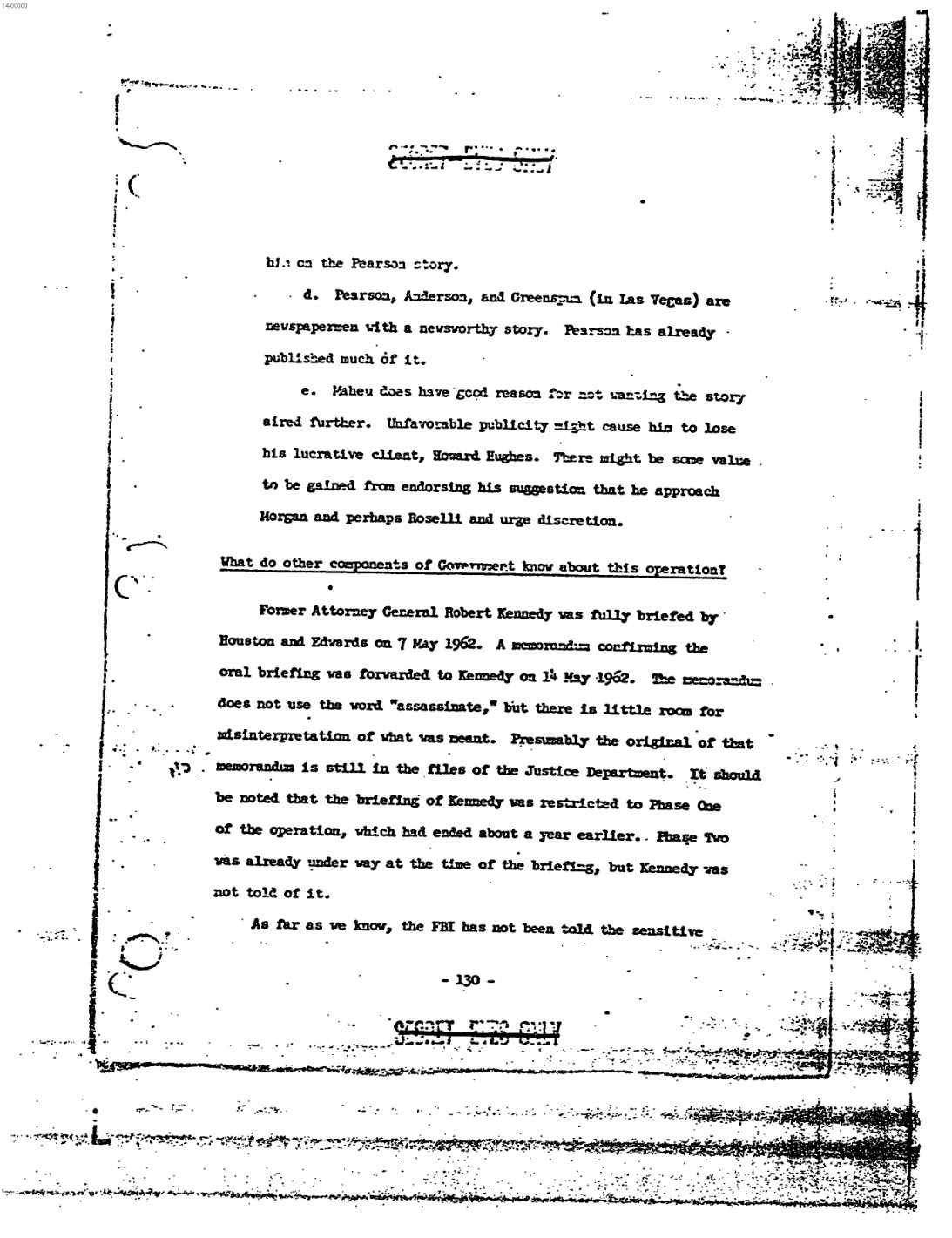
What Robert Kennedy was told in May 1962
The original CIA review states that Robert Kennedy’s May 1962 briefing omitted the already renewed operation. Image credit ↗

Chapter 03 / 1962–1963

A briefing could reveal the past and conceal the present

The underworld relationship threatened to expose the CIA through a different investigation. A Las Vegas wiretap associated with Maheu and Giancana drew FBI and Justice Department attention. Agency officials opposed prosecution because disclosure could reveal sensitive operations. The resulting discussions brought Attorney General Robert Kennedy into the story. The decision not to pursue that wiretap case was not a judicial finding that plots against Castro were lawful.

On 7 May 1962, Edwards and CIA general counsel Lawrence Houston briefed Kennedy. A memorandum dated 14 May described an operation running from approximately August 1960 to May 1961 and stated that it had been called off. It did not use the word assassination, but the later investigation found that the oral briefing conveyed the lethal purpose. Kennedy was disturbed by the use of organized-crime figures and demanded consultation before similar future dealings. Knowing about that earlier plot was not the same as approving the renewed one.

Harvey had already resumed the operation. The CIA’s own Inspector General concluded that Kennedy had not been told about this second phase. The Senate found Edwards’s claim of ignorance about its continuation implausible in light of the introductions and other contacts he knew about. It also examined an internal memorandum falsely suggesting that Harvey was dropping the Rosselli relationship. This was a concrete failure of disclosure, not merely an absence of paperwork. Helms’s later uncertainty did not repair the misleading account given to a superior authority.

The Director of Central Intelligence was incompletely informed as well. John McCone learned about the earlier underworld plot in August 1963, after requesting an explanation of a newspaper story. The material placed before him presented an operation that had ended before his directorship. Harvey and Helms had not given him a clear account of the 1962 renewal. The Senate judged their explanations for nondisclosure inadequate. Dulles’s earlier knowledge was a different question: investigators considered it likely that he understood and approved the original plot, though the circumlocutory briefing and conflicting evidence prevented complete certainty. The chain of command contained both senior participation and serious gaps. Calling it either wholly uncontrolled freelancing or a completely informed hierarchy would lose that combination.

Sources: S01 · S02 · S05 · S06

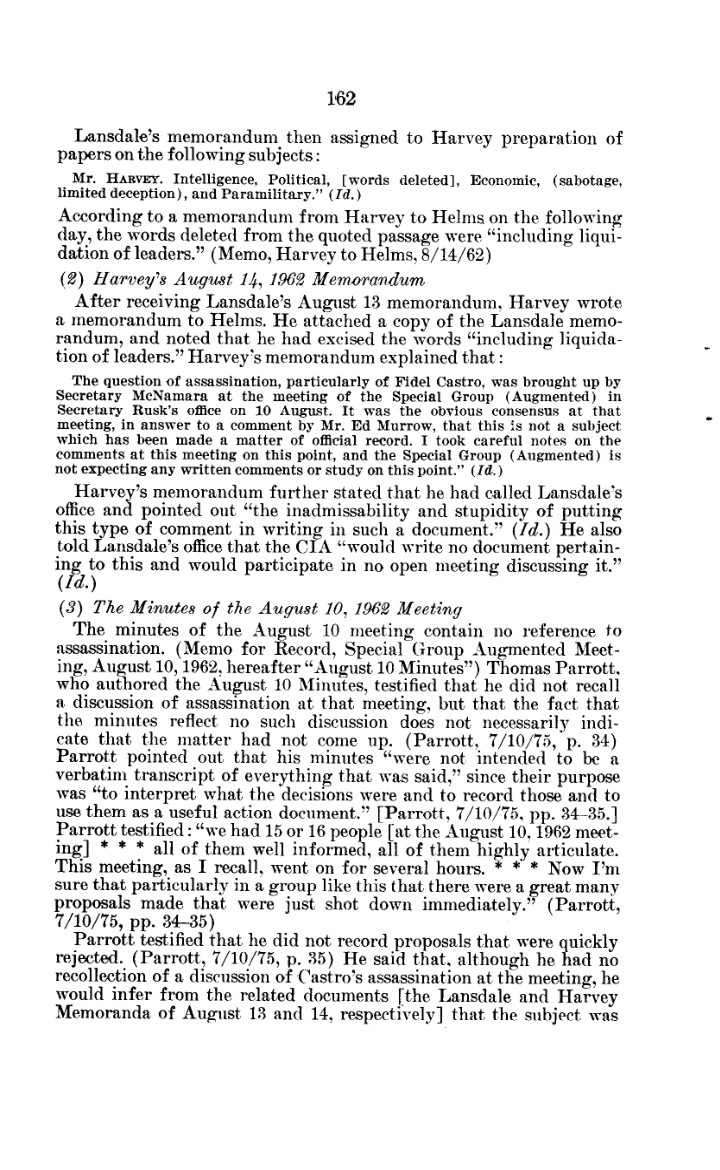
The August 1962 discussion and disputed written tasking
The August memoranda provide evidence of an assassination discussion absent from the formal meeting minutes. Image credit ↗

Chapter 04 / 1961–1962

Pressure, capability and authorization were different things

Operation Mongoose placed intense pressure on the CIA to undermine Castro after the Bay of Pigs. The Kennedy administration authorized a broad program of covert activity against the regime. At the same time, the agency developed an executive-action capability that included assassination as a possible last resort. The cryptonym ZR/RIFLE covered this work and another genuine activity serving as cover. A general capability, its administrative relationship to Cuba and a particular decision to kill were related, but separate, facts.

Bissell instructed Harvey to develop that capability in early 1961. Testimony and notes later referred to White House encouragement, but the timing and meaning of the conversations were contested. Bissell’s recollections changed; McGeorge Bundy described receiving a briefing without having urged the project. The Senate found no evidence that the specialized European asset developed under ZR/RIFLE was used in an actual assassination. That did not negate the underworld operation that Harvey also managed after taking over the Cuban relationship.

The subject of killing Cuban leaders reached a high-level discussion on 10 August 1962. Its absence from the formal minutes does not settle what happened. A subsequent Lansdale memorandum tasked Harvey with subjects that included liquidation of leaders. Harvey’s memorandum of 14 August recorded the assassination discussion, objected to putting that language in writing and said no written study was expected. These contemporary documents are stronger evidence that the subject arose than later claims resting only on forgotten conversations.

The documents do not themselves establish approval of an executed plot. McCone said he objected, and other accounts support opposition or the dropping of the subject. Witnesses disagreed over who raised it and why the written reference disappeared. Harvey nevertheless did not disclose his existing underworld operation during this debate. Helms argued that aggressive instructions to remove Castro left assassination within permissible action; other officials rejected that interpretation. The Senate criticized both the withholding of information and the failure of policymakers to state clear limits. Administration pressure supplied a serious explanation of the operating climate. It did not supply a surviving, unambiguous presidential order for a particular killing.

Sources: S01 · S02 · S03 · S07

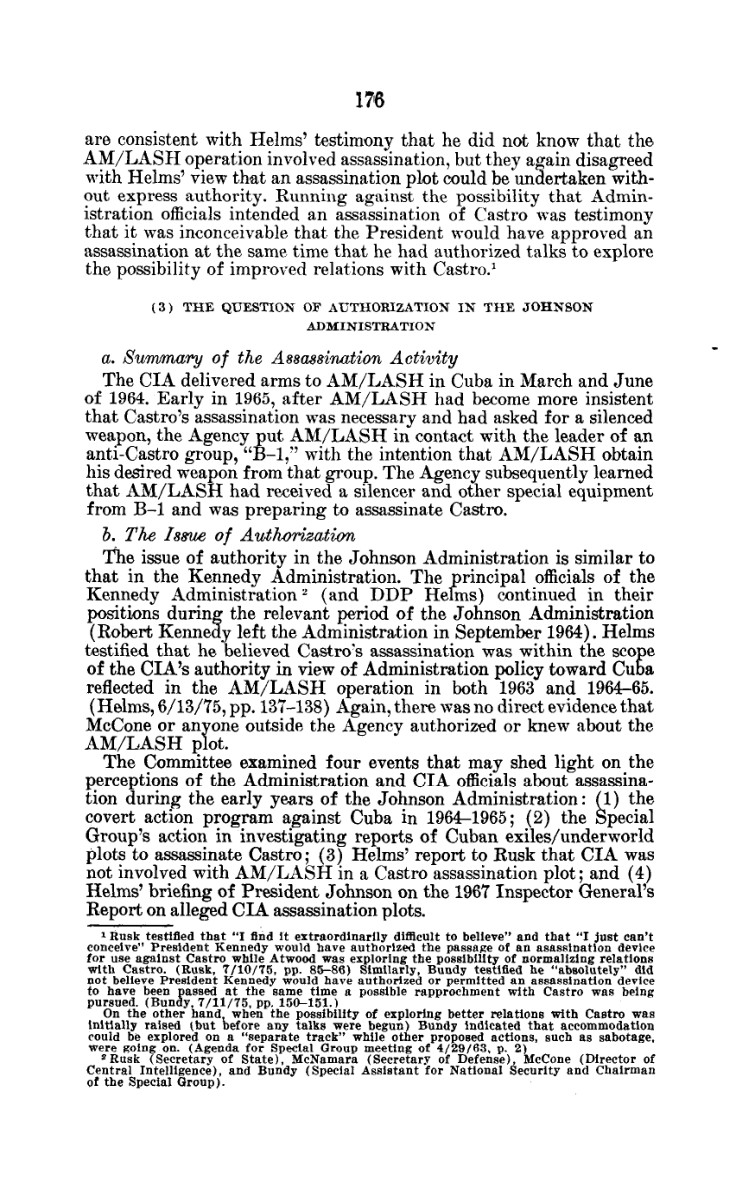
AMLASH and the question of authority under Johnson
The Senate account follows AMLASH into the Johnson administration, beyond Kennedy’s death. Image credit ↗

Chapter 05 / 1961–1965

A coup relationship carried a known intention to kill

Rolando Cubela was a senior Cuban military figure with access inside the revolutionary government. The CIA began dealing with him in 1961 and later used the cryptonym AMLASH. He was valuable as an intelligence source and a possible participant in a change of government. He also made clear that he regarded Castro’s death as an essential first step. Agency officers’ preference to describe the relationship as political action did not remove that known intention.

On 29 October 1963, Desmond FitzGerald met Cubela and offered political assurances while presenting himself as a representative of Robert Kennedy. The Inspector General’s account says Helms agreed to this representation. Helms later testified that he had not consulted the Attorney General. Invoking Kennedy’s name therefore cannot by itself establish that Kennedy had authorized the meeting, much less an assassination. The government’s support for a successful coup and the means sought to kill Castro remained distinct questions within the relationship.

On 22 November, a CIA officer offered Cubela an assassination device in Paris. The internal review considered the meeting likely to have overlapped the shooting of President Kennedy, although its precise timing was not established. Cubela expressed dissatisfaction with the device, and its eventual disposition was uncertain. There is no established use against Castro. Helms and a case officer later advanced explanations involving self-protection or keeping Cubela engaged. The Senate tested these against contemporary records of Cubela’s requests and the agency’s efforts to meet them, rather than accepting the benign characterization as a complete answer.

The relationship continued under Lyndon Johnson. CIA arms caches reached Cuba in March and June 1964. Later, after telling Cubela that the United States could not participate in his first step, the agency arranged contact with exile leader Manuel Artime. The agency knew that Cubela wanted support for killing Castro and that this connection could supply it indirectly. In June 1965, headquarters ordered the Cubela relationship terminated for security reasons. The next year Cuban authorities arrested him; the CIA review and later FRUS account report a 25-year sentence. None of this establishes that Castro was attacked with every item discussed. It does establish that assassination-related support cannot be confined to Kennedy’s presidency or dismissed simply because a partner was expected to obtain particular help from another intermediary.

Sources: S01 · S02 · S05 · S08 · S11

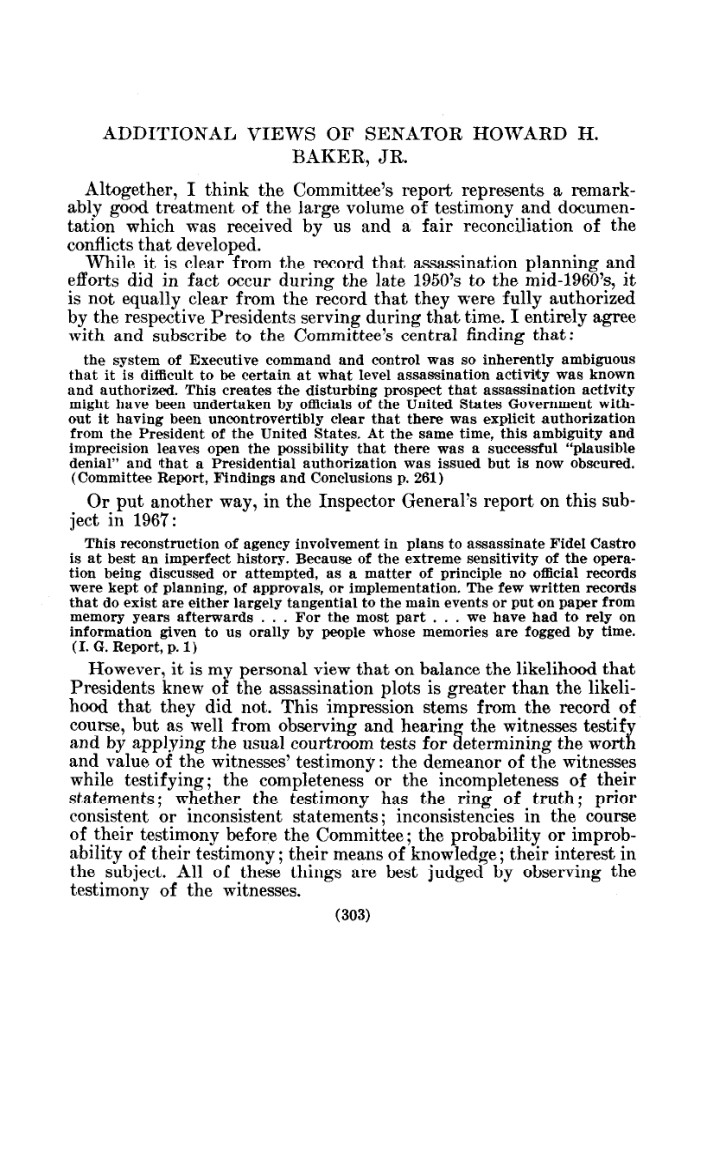
Senator Baker weighs the evidence for presidential knowledge
Senator Howard Baker accepted the command-and-control finding while drawing a stronger inference about presidential knowledge. Image credit ↗

Chapter 06 / 1967–1975

The inquiry established plots without settling every order

In 1967, publicity about the underworld operation prompted a new internal inquiry. The CIA Inspector General’s report acknowledged that official records had often not been kept and that participants’ memories were poor. Its investigators did not interview Dulles or his former deputy Charles Cabell. They reconstructed acts from surviving notes, technical records, files and interviews, while recognizing that planning, action and political language could be confused. This was an important admission from within the agency, not a claim that nothing could be known.

The review concluded that the CIA could not plausibly deny plotting with underworld figures to kill Castro. It also rejected a simple assertion that the agency had merely carried out Kennedy administration policy: the first operation began under Eisenhower. Its May 1967 cover memorandum records instructions to preserve the report closely while destroying the working notes and a temporary copy. The report survived. The destruction limits scrutiny of its reconstruction, but it does not establish that every operational document disappeared or identify the contents of records no longer available.

The Senate’s 1975 interim report added testimony and documentation. It found that the assassination plots were authorized at least through the Deputy Director for Plans. It considered Dulles’s knowledge and approval likely, while finding insufficient evidence to conclude that Eisenhower, Kennedy or Johnson, their close advisers or the Special Group had authorized Castro’s assassination. That finding left open both failures of command and the possibility that a successful system of plausible denial had obscured higher authorization. It was not a judicial acquittal of the presidents.

Committee members differed over the inference. Howard Baker thought presidential knowledge more likely than ignorance, stressing the record, context and his observation of witnesses. Barry Goldwater emphasized presidential responsibility, the near-war setting and the security costs of publication; he also defended the agency’s conduct as lawful or reasonably believed lawful. Their views deserve more than a footnote dismissing them as partisan denials. Yet the surviving chain contains documented nondisclosure to Robert Kennedy and McCone, assumptions passed down as authority, and no authenticated presidential instruction to kill Castro. The strongest dispute concerns how to interpret those gaps and indirect communications. It does not erase the lethal acts already established or turn every assumption about the White House into a direct order.

Sources: S01 · S02 · S04 · S05

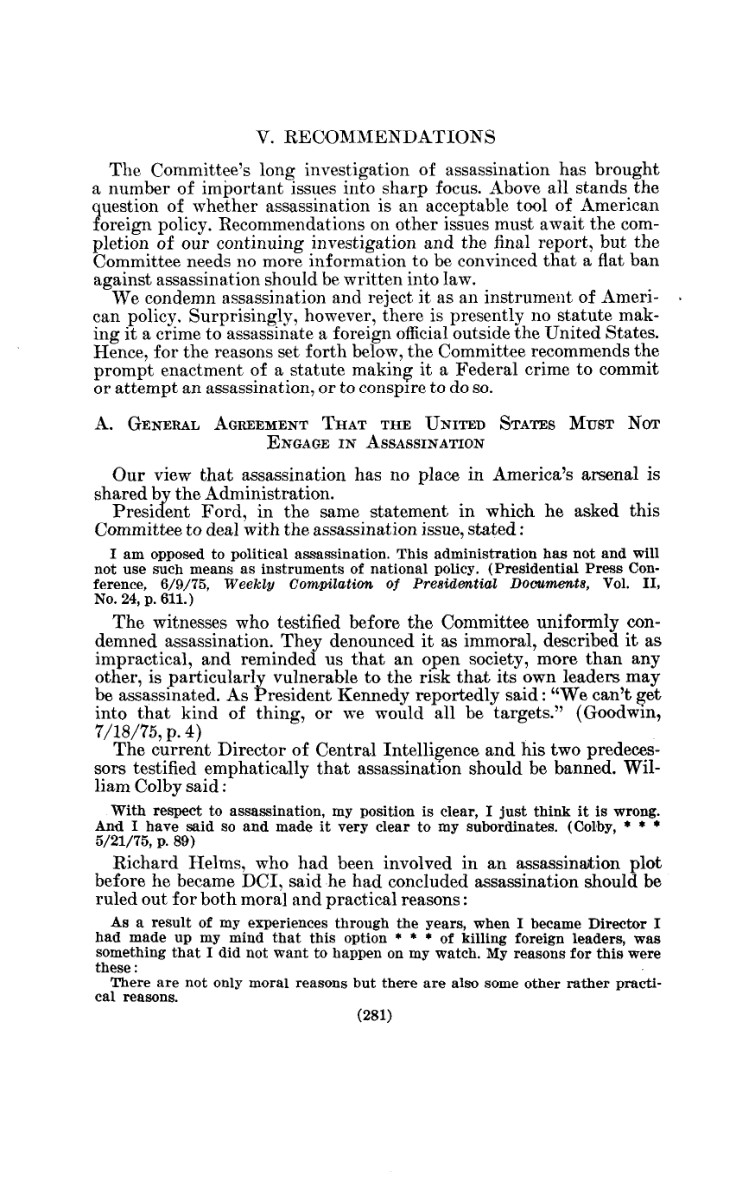
Recommendations before the later executive prohibition
In 1975 the committee recommended a criminal statute. Ford’s later executive prohibition was a separate action. Image credit ↗

Chapter 07 / 1973–2016

A failed killing policy left a record and a prohibition

The plots failed to kill Fidel Castro. Their failure did not make them merely hypothetical: the documented record includes recruitment, preparation, transfers and support to participants with lethal intentions. At the same time, success cannot be inferred from the existence of an assassination capability. Castro remained alive long after the operations examined by the Senate. President Obama’s public statement marking his passing in November 2016 belongs to a much later history of relations between the two countries.

The public reckoning developed unevenly. Internal inquiries and records accumulated before the Senate released its assassination report in November 1975. The report was expressly interim, and its members disagreed about publishing it before the larger intelligence investigation was complete. They were not sitting as a criminal court. Their findings and proposed legislation established a public record and a reform agenda; publication itself did not enact a statute or decide the personal criminal liability of every participant.

Internal prohibitions preceded the final public reforms. The Senate recommendations discussed directives under Helms and Colby as well as the need for a statutory ban. Ford signed Executive Order 11905 on 18 February 1976. Its section 5 prohibited government employees from engaging or conspiring in political assassination, with that section taking effect on 1 March. An executive rule, an agency directive and a proposed criminal law had different force and histories. The order also cannot be treated as evidence that earlier acts had been lawful simply because the later wording was more explicit.

The record changed other investigations. The House assassination inquiry criticized the failure to give the Warren Commission a full account of the Castro plots and examined possible consequences of that omission. The existence of the plots supplied a reason to investigate retaliation; it did not alone prove who killed Kennedy. Castro, speaking retrospectively in 1977, said the Senate had uncovered only part of the plans against Cuban leaders. That claim leaves a real question about completeness, but a larger total requires identifiable incidents and evidence of agency involvement. The enduring history is both narrower and more serious than a catalog of exotic gadgets: officials supported killing through intermediaries, left authority dangerously uncertain and then struggled to reconstruct what their government had done.

Sources: S02 · S04 · S05 · S11 · S12 · S13 · S14 · S15

02 / The record

The critical path: the official yardstick

What the official record establishes—and where it stops

The yardstick here is the 1975 Senate investigation read against the 1967 CIA Inspector General review, contemporary records and the later House inquiry. It establishes agency plotting and assistance while separating those acts from uncertain presidential authorization and unverified outcomes. These institutions did not agree on every inference, and none was a criminal trial of all participants.

The six hinges describe that bounded account. Removing a hinge changes a particular inference rather than making every fact disappear. Evidence ranks concern the hinge as worded. Cultural-prominence ranks concern public familiarity; no representative audience evidence was examined, so those ranks remain unmeasured. Documentary visibility is not a poll.

Sources: S01 · S02 · S04 · S05 · S11

CP1

A policy of overthrow produces specific lethal proposals

A targeted project, not merely a hostile policy

The Senate’s minimum account begins with decisions by Bissell and Edwards to enlist intermediaries in 1960. The broader overthrow policy explains the setting; the recruitment establishes a more specific purpose. Raúl’s case concerns another target, and discrediting Castro concerns another objective.

Why this hinge matters

This connects hostility toward the regime to identifiable decisions to seek killing, without treating every removal proposal as assassination.

If this hinge were removed

Without evidence of a decision to seek killing, the account would shrink to regime-change policy and ambiguous language. It could no longer attribute the underworld assassination project to identified CIA managers. The existence of a hostile policy would survive that change.

What rival readings must explain

A purely rhetorical account must explain recruitment and material transfers. A fully explicit presidential-order account must identify the communication beyond the agency.

Evidence support

Strong: agency decisions recur in the Senate reconstruction, testimony and the internal review. The precise meaning of King’s earlier elimination recommendation is less secure than the later recruitment.

Cultural prominence: Unmeasured

Official findings establish the project; no representative survey or study of public familiarity with its managers was examined.

Gaps and disputes

Late-arriving documents, disputed recollections and euphemisms limit the earliest authorization history. The Senate’s minimum of eight plots is its investigative count, not eight verified attacks.

Dependencies

Senior CIA decisions, access to private intermediaries and technical support.

Sources: S01 · S02 · S05

CP2

Agency support crosses the line from preparation to attempted action

Supply is established; contact with the target is not

The project advanced through expense support, equipment and material passed toward Cuban contacts. Other schemes remained technical ideas. The Senate distinguished these stages; its account of the early passages contains conflicting recollections. The resulting history is stronger than an idle-plan claim and narrower than a ledger of completed attacks.

Why this hinge matters

A prepared device, an offered device, a reported team and an attack on the target are different stages. The projects were serious despite their failure.

If this hinge were removed

Remove the transfers and the claim of operational assistance becomes substantially weaker: preparation and recruitment would remain, but this direct bridge to intended action would disappear. Remove proof of use on Castro, however, and little changes; the guide does not claim that such use is established.

What rival readings must explain

A count of attacks must establish execution rather than merely count proposals or devices. An all-private operation must explain agency direction and supply.

Evidence support

Strong for transfers; qualified for reported field activity. A claimed team movement is not independently verified merely because an intermediary reported it.

Cultural prominence: Unmeasured

The sampled broadcast contrasts a larger plot total with the Senate’s minimum. No measured comparison of public belief in proposals and completed attacks was examined.

Gaps and disputes

One or two early passages, recipient access, returned material and the fate of particular devices are not equally well documented. No practical mechanism is needed to resolve the distinction.

Dependencies

CP1; trusted contacts, claimed access inside Cuba and money or equipment.

Sources: S01 · S02 · S06 · S15

CP3

Disclosure fails at important points in the hierarchy

A misleading briefing is a specific failure of disclosure

The May 1962 account to Robert Kennedy described the older operation as ended while Harvey’s renewal was already underway. McCone later received an account of the earlier project. These are identifiable reporting gaps, not a universal claim that every person above the operators knew nothing.

Why this hinge matters

These concrete omissions complicate claims of either complete ignorance everywhere or uniform informed approval.

If this hinge were removed

Without those omissions, the strongest evidence against a uniformly informed chain of command would weaken. The projects and senior CIA authorization would remain established. Presidential ignorance would still require evidence of its own; it is not proved by a missing briefing elsewhere.

What rival readings must explain

Hidden presidential knowledge remains possible, but requires a bridge past these documented gaps. Agency autonomy is not proof that no superior ever knew.

Evidence support

Strong for the identified omissions: the contemporary Edwards memorandum can be compared with the internal review and later investigation. Complete knowledge at every level remains unresolved.

Cultural prominence: Unmeasured

The record permits a precise briefing comparison; it does not reveal how widely the distinction between an old and a renewed plot is understood.

Gaps and disputes

The known briefings are not a complete diary of private conversations. The original review did not interview every former senior official, and witness accounts conflict.

Dependencies

An existing operation, compartmented reporting and officials deciding what to tell superiors.

Sources: S01 · S02 · S05 · S06

CP4

Broad violent policy and a general capability do not settle a particular order

Policy pressure and particular authorization are different propositions

The August 1962 memoranda establish that assassination entered a high-level discussion despite its absence from formal minutes. Mongoose supplied pressure for results, and executive-action work supplied a capability. The Senate majority still could not establish a presidential instruction for a particular Castro killing. Baker considered knowledge more likely than ignorance.

Why this hinge matters

This is the strongest documentary setting for implied-authority arguments, alongside reasons to reject treating it as an express order.

If this hinge were removed

Remove the contemporary discussion and implied-authority arguments lose an important bridge between policy and operators. Remove the distinction between discussion and authorization and the argument would claim more than the documents establish. Either change alters the authority assessment, not the existence of the plots.

What rival readings must explain

Baker’s stronger inference must be weighed with the actual memoranda; denials alone do not negate them. A discussion is not automatically operational approval.

Evidence support

Strong for the discussion and the majority’s stated limit; mixed for an implied presidential authorization. Context and witness assessment support an inference, not a preserved direct order.

Cultural prominence: Unmeasured

No public-opinion measure was examined. The prominence of presidential responsibility in the 1975 disagreement does not measure agreement with either side.

Gaps and disputes

The minutes, subsequent tasking and later recollections have different dates and purposes. Baker’s view also relies on hearing witnesses; that experience cannot be reproduced by reading only excerpts.

Dependencies

CP1–CP3; high-level policy discussion and the doctrine of deniability.

Sources: S01 · S02 · S03 · S04 · S07

CP5

A coup partner’s lethal intention meets direct and indirect assistance

AMLASH tests the distance between a label and assistance

Cubela’s intelligence and coup roles were real. So were the known wish to kill Castro, the agency’s device offer and its later arranged connection to Artime. The House inquiry tested the CIA task force’s political-action defense against that record. The episode continues into Johnson’s presidency.

Why this hinge matters

Labels such as political action or self-defense do not answer what the agency knew and supplied.

If this hinge were removed

Without known lethal intent, the inference that agency assistance had an assassination component would weaken sharply. Without the assistance, intent would remain Cubela’s proposal. Removing either would change this particular responsibility claim, while leaving the separate underworld operation intact.

What rival readings must explain

A coup-only defense must explain the known intention and concrete assistance. A claim that Robert Kennedy personally ordered AMLASH must go beyond FitzGerald’s unconsulted representation.

Evidence support

Strong for the known intention and specified assistance; limited for actual use against Castro. The device’s disposition and the full course of action inside Cuba are not established here.

Cultural prominence: Unmeasured

No audience study establishes familiarity with AMLASH or with its continuation after Kennedy. A cryptonym’s appearance in a report is not evidence of popular belief.

Gaps and disputes

Invoking Robert Kennedy’s name is not proof that he authorized the meeting. Coup, collection and assassination-related purposes can coexist; neither a benign label nor a device alone settles every action.

Dependencies

Inside access, political assurances, weapons support and separate Cuban participants.

Sources: S01 · S05 · S08 · S11

CP6

Internal reconstruction becomes public findings and a later prohibition

The surviving record is neither complete nor empty

Earman’s May 1967 memorandum records preservation of the report and destruction of working material. The Senate later published findings and dissent; Ford subsequently imposed an executive prohibition. Each is a different event. The history of reform cannot substitute for a finding about what the earlier officials actually did.

Why this hinge matters

Investigative findings, a legislative recommendation and an executive restriction are different outcomes. Neither failure nor reform cancels the conduct.

If this hinge were removed

Without the preserved review and later inquiry, much of this reconstruction would lose its documentary base. Without the destruction record, this particular archival limit would disappear. Neither change would establish the unknown contents of missing notes or turn a later prohibition into an earlier acquittal.

What rival readings must explain

An all-records-destroyed account must confront the surviving report. A complete-vindication account must confront the established support for killing.

Evidence support

Strong for the recorded preservation/destruction and subsequent official actions. Limited for any proposed hidden content of the destroyed working papers.

Cultural prominence: Unmeasured

The later public inquiries and broadcast are identified, but their existence supplies no measured rank of public familiarity with the destruction or the ban.

Gaps and disputes

Working notes are not every operational record. An interim congressional finding, a proposed criminal law and an executive restriction have different authority; no complete current-law or Kennedy-assassination audit is claimed.

Dependencies

Surviving records, testimony, internal and congressional inquiries, executive action.

Sources: S02 · S04 · S05 · S12 · S13

03 / The record

How the accounts inherit and divide the record

Documented citations, responses and branches; not assumed influence.

Arrows below mark an explicit citation or response in a passage examined for this guide. Parallel branches share a dispute, not a demonstrated secret source. The map follows selected reports and public voices; it is not a genealogy of every book about Cuba or Kennedy.

  1. 1962–1975

    Operational records → internal review → Senate reconstruction

    Documented reuse of records and the internal review

    The Edwards memorandum supplied one contemporary account of the Attorney General briefing. The Inspector General later reconstructed the plots from files and interviews. The Senate cited and challenged that reconstruction with further testimony. Repeated facts in these three forms do not constitute three independent confirmations of every disputed conversation.

    The destruction of the review’s working material is a side branch at CP6: it limits checking of the reconstruction, but it does not identify a hidden order in the missing notes.

    Sources: S01 · S05 · S06

  2. 1975

    One inquiry → competing readings of the same gaps

    Baker explicitly quotes the majority and the Inspector General

    Baker accepted the majority’s finding of ambiguous command and control, quoted the internal review’s description of an imperfect history, then judged presidential knowledge more likely. Goldwater’s separate views emphasized presidential responsibility, a near-war setting and the costs of disclosure. These are branches within one inquiry; neither is a newly discovered presidential instruction.

    The recurring node is CP4. The same uncertainty supports a limit on a formal finding and, for Baker, a stronger personal inference. No borrowing from Baker by Goldwater is established here.

    Sources: S02 · S04 · S05

  3. 1975–1979

    Senate account → House re-examination of AMLASH

    The House report identifies and examines the Senate account

    The House inquiry summarized the Senate’s AMLASH and underworld findings, then tested the CIA task force’s characterization of AMLASH. It also asked what nondisclosure had prevented the Warren Commission from examining. The problem shifts from reconstructing Castro plots to the consequences of withholding them; that shift does not itself prove retaliation against Kennedy.

    CP3 and CP5 recur, with a new disclosure question attached. The House report is a later investigation using some of the same records, not an independent eyewitness to the Cuban operations.

    Sources: S01 · S11

  4. 1977 broadcast; 1981 rebroadcast

    Senate publication → a target’s public response

    Castro says on camera that he read the Senate report

    In the publisher’s transcript, Castro treats the Senate account as incomplete; the broadcast juxtaposes his larger claim with the committee’s minimum. That is a documented response to the report. It is not authentication of the additional incidents.

    The branch enlarges the claimed scope at CP2 and CP6. It needs incident-level evidence and a common counting unit.

    Sources: S15

  5. Later documentary editions

    Earlier investigations → later FRUS synthesis

    Editorial notes expressly identify the underlying memoranda and inquiries

    The FRUS notes link contemporary documents, the internal review and testimony. Their value is access, chronology and source identification. Where they repeat the same report, they do not create a new witness. The original review and one later transcription even differ on the June 1965 termination day, so this guide retains month precision.

    CP4 and CP5 gain documentary routes rather than a new certainty about authorization.

    Sources: S06 · S07 · S08

04 / The record

Four rival paths through the same record

Each account starts with its strongest form, then identifies what it accepts, removes or adds. A map is not an endorsement.

Interpretation 01

Presidential knowledge was obscured by plausible denial

Substantial inference; specific orders not established

The strongest version

Baker thought knowledge more probable than ignorance after hearing the witnesses. Goldwater emphasized the presidents’ responsibility and the near-war setting, and defended the agency’s conduct as lawful or reasonably believed lawful. Intense policy pressure, broad language and secret channels in CP3–CP4 could conceal an understanding that was never written plainly.

Accept on the path

  • CP1 — Agency initiation
  • CP2 — Transfers and incomplete outcomes
  • CP3 — The specified briefing omissions
  • CP4 — Policy pressure and ambiguous command
  • CP5 — Known lethal intent and assistance

Remove or narrow on the path

  • CP6 — No factual hinge must be rejected. This reading rejects treating the majority’s lack of a finding as proof that presidents did not know; the yardstick makes no such acquittal.

Add on the path

  • CP4 — An inferred or documented bridge from presidential expectations to the particular projects. Stronger proof would identify who communicated what, to whom and when.

What would have to be wrong

A confident assertion of presidential ignorance would have to be wrong. The actual majority limit can coexist with Baker’s stronger inference; proving an express order would require additional evidence.

Evidence and limits

The Senate majority found insufficient evidence to conclude presidential authorization; Baker’s stronger assessment is an attributed alternative within the same inquiry. Neither side’s interpretation is a court verdict.

What would change the assessment

Authenticated presidential instructions, complete meeting records or independently corroborated firsthand accounts identifying the order, recipient and operation would materially change the assessment. Records showing a clear prohibition communicated to the actual operators would narrow an implicit-approval claim.

Sources: S01 · S02 · S04 · S05 · S06 · S07

Interpretation 02

CIA officers treated aggressive policy as authority to act

Strongly supported perception; does not resolve every superior’s knowledge

The strongest version

Helms described assassination as within the permitted means of removing Castro. Harvey believed the operation authorized through his superiors. CP1–CP4 show a functioning agency hierarchy operating amid real demands for results, rather than an entirely private conspiracy.

Accept on the path

  • CP1 — Identified agency managers initiated projects
  • CP3 — Compartmentation and misleading reporting
  • CP4 — Pressure and perceived permission
  • CP5 — Direct and indirect agency assistance

Remove or narrow on the path

  • CP4 — No contemporaneous event needs removal. The claim removes any assumption that a specific presidential order was necessary for officers to perceive a mandate.

Add on the path

  • CP4 — The operators’ interpretation as a causal link. This explains action; it does not establish lawful authorization or universal knowledge.

What would have to be wrong

Accounts reducing the projects to private freelancing would fail to explain agency management. This interpretation still cannot treat a perceived mandate as a proven instruction.

Evidence and limits

The original IG and Senate accounts document agency participation and assumptions about authority. The first operation predates Kennedy’s pressure, limiting an explanation that assigns all initiative to his administration.

What would change the assessment

Full contemporaneous reporting and directives showing what the operators were told, and what they in turn disclosed, could clarify the boundary between perceived permission, knowing disregard and actual instruction.

Sources: S01 · S02 · S03 · S05

Interpretation 03

AMLASH was a coup and intelligence project rather than an agency assassination mission

Real agency defense; inadequate as a complete description

The strongest version

Helms stressed Cubela’s value as an inside source and possible leader of a replacement government. A case officer described the device in terms of protection or reassurance. CP5 includes political support, not only weapons.

Accept on the path

  • CP1 — Separate underworld plotting occurred
  • CP5 — Cubela also had coup and intelligence roles
  • CP6 — The record is incomplete

Remove or narrow on the path

  • CP5 — The assassination component would have to be removed or substantially narrowed; the known intention, device offer and arranged assistance require an alternative account.

Add on the path

  • CP5 — Contemporaneous, enforced limits that distinguish assistance for collection or a coup from assistance for killing, rather than a later change of label.

What would have to be wrong

The inference from known lethal intent plus assistance would have to fail. The selected Senate/House analysis finds the benign descriptions inadequate; uncertainty about use is not enough to remove the offer.

Evidence and limits

The Senate and later House inquiry tested the benign descriptions against files and testimony. The resulting record supports an assassination component alongside coup and intelligence objectives.

What would change the assessment

Complete instructions, contact reports and recipient accounts showing precise limits and their actual enforcement could narrow responsibility. Authenticated evidence of use, a prevented attack or a refused supply request would refine the execution history.

Sources: S01 · S05 · S08 · S11

Interpretation 04

Cuban accounts describe a larger history of attempts

Credible question of completeness; larger totals not independently established here

The strongest version

Castro said in a 1977 interview that the Senate had uncovered only part of the CIA’s plans. A target’s security services may know incidents absent from American files, and the surviving U.S. archive is incomplete. CP6 leaves room for additional authenticated cases.

Accept on the path

  • CP1 — The Senate documented CIA projects
  • CP2 — Proposals and attacks require different counts
  • CP6 — The U.S. archive is incomplete

Remove or narrow on the path

  • CP2 — An exhaustive-total claim would be removed, but the yardstick already presents the Senate’s minimum rather than an exhaustive tally.

Add on the path

  • CP2 — Additional identifiable incidents with evidence of CIA direction or assistance, a defined counting unit and independently checked outcomes.

What would have to be wrong

The reviewed corpus would have to omit relevant incidents, not be wholly false. A larger verified history can coexist with every current hinge; a larger unsupported number cannot substitute for it.

Evidence and limits

The 1975 report discusses Castro’s list of 24 allegations and the agency’s response without independently establishing those cases. The list, the Senate’s minimum and later popular totals do not necessarily count the same unit.

What would change the assessment

Incident files, intercepted communications, identified participants, physical evidence and independently corroborated testimony linking specific actions to agency decisions would enlarge the verified history. A complete counting method would clarify comparisons.

Sources: S01 · S05 · S15

05 / The record

Reports and public voices change the emphasis

What selected investigations and a public documentary amplify, recast and leave unresolved.

These cards concern named passages actually examined. “Not resolved” describes the selected passage’s limits, not an assertion that an entire book, film or archive ignored a subject. The documentary transcript was read selectively; the complete film was not independently watched.

Report on Plots to Assassinate Fidel Castro, 1967

The Inspector General: an institutional admission with missing foundations

Amplifies

The conclusions acknowledge CIA plotting with underworld figures and reject a simple claim that the agency merely executed Kennedy policy: the first operation began earlier.

Recasts

An internal reconstruction makes agency conduct visible while acknowledging poor records and memories. Its cover memorandum makes the preservation of the report and loss of working papers part of the later evidence history.

Not resolved in the selected passage

The selected pages do not supply a complete record of presidential instructions or restore the destroyed notes. Missing foundations limit checking; they do not make the admission disappear.

Cover memorandum; printed 1–8 and 130–133 visually examined.

Sources: S05

Additional and separate views in the Senate report, 1975

Baker and Goldwater: knowledge, responsibility and secrecy

Amplifies

Baker gives greater weight to presidential knowledge than the majority could formally find. Goldwater places the plots inside presidential responsibility and the Cold War confrontation.

Recasts

Baker turns the shared ambiguity into a probabilistic inference from the record and witnesses. Goldwater also contests publication and its security costs. Their disagreement concerns interpretation and accountability as well as documentation.

Not resolved in the selected passage

Neither set of selected views produces an authenticated presidential instruction for a particular Castro killing. Their arguments must still account for the actual omissions in briefings.

Baker 303–304; Goldwater 341–344. These belong to the same publication as the majority findings.

Sources: S02 · S04

House Select Committee on Assassinations findings, 1979

The House inquiry: from plots to the cost of nondisclosure

Amplifies

The selected Cuba discussion examines AMLASH’s assassination component and the failure to give the Warren Commission the full plot history.

Recasts

A record about Castro becomes evidence of an investigative omission in a different case. That makes a retaliation question worth examining without supplying its answer.

Not resolved in the selected passage

The sampled passage is not a complete audit of the Kennedy assassination, the acoustic evidence or every later release. A reason to investigate is not proof of who killed Kennedy.

Selected Cuba/AMLASH and disclosure passages, including printed 111–113.

Sources: S11

The CIA’s Secret Army, CBS 1977; Journal rebroadcast 1981

Moyers, Castro and Bissell: the report enters public argument

Amplifies

Castro disputes completeness. Bissell acknowledges an overly permissive attitude toward assassination while defending secrecy and the circumstances.

Recasts

The broadcast puts a target’s claim beside an operator’s retrospective defense, expanding the argument beyond the report’s formal findings.

Not resolved in the selected passage

Their remarks do not verify every alleged incident or settle presidential authorization. The transcript is evidence of their public positions.

Selected Senate-report exchange and Bissell interview in the publisher-hosted transcript; full video not independently watched.

Sources: S15

02 / The record

Find a thread in the file

Search the chapter and claim index. Every result leads to the full text and its sources.

Chapter 01Overthrow became more than one kind of operationChapter 02An agency project passed through private handsChapter 03A briefing could reveal the past and conceal the presentChapter 04Pressure, capability and authorization were different thingsChapter 05A coup relationship carried a known intention to killChapter 06The inquiry established plots without settling every orderChapter 07A failed killing policy left a record and a prohibitionClaim / EstablishedCIA officials initiated and supported plots to kill Fidel Castro.Claim / EstablishedSeveral documented schemes never became attacks on Castro.Claim / Established as the committee’s findingThe Senate documented at least eight CIA-involved plots during 1960–1965.Claim / EstablishedThe initial and renewed underworld plots had senior CIA authorization.Claim / EstablishedThe $150,000 success offer was distinct from expense and equipment support.Claim / EstablishedRobert Kennedy learned of the earlier underworld assassination plot in May 1962.Claim / Not established in this recordA surviving authenticated presidential order specifically directed Castro’s assassination.Claim / EstablishedZR/RIFLE included a standby assassination capability.Claim / EstablishedCIA assistance to AMLASH had an assassination component.Claim / EstablishedAssassination-related support to Cubela continued after Kennedy’s death.Claim / EstablishedHelms preserved the internal report while its working material was destroyed.Claim / EstablishedFord’s 1976 order imposed an executive prohibition on political assassination.Claim / EstablishedThe plots examined by the Senate failed to kill Fidel Castro.Timeline / Policy originsKing recommends considering eliminationTimeline / PolicyDulles discusses an opposition footholdTimeline / PreparationDiscrediting schemes consideredTimeline / Separate targetHeadquarters proposes action against RaúlTimeline / WithdrawalCountermand follows the field approachTimeline / Core plotBissell and Edwards initiate underworld approachTimeline / IntermediariesRosselli enters the projectTimeline / Material supportLethal material prepared for passageTimeline / CapabilityExecutive-action capability developedTimeline / Core contextBay of Pigs defeat interrupts the effortTimeline / ManagementHarvey and Bissell discuss taking over the relationshipTimeline / ExecutionUnderworld operation renewed under HarveyTimeline / KnowledgeRobert Kennedy is briefed on the earlier plotTimeline / RecordEdwards records the Attorney General briefingTimeline / Reported executionRosselli reports a team dispatchedTimeline / Policy discussionAssassination is raised at a policy meetingTimeline / RecordHarvey objects to written liquidation languageTimeline / ClosureHarvey ends the underworld operationTimeline / PreparationDiving schemes remain unexecutedTimeline / KnowledgeMcCone receives the earlier-operation memorandumTimeline / Diplomatic contextAttwood meets Lechuga through Lisa HowardTimeline / Political assuranceFitzGerald meets CubelaTimeline / Diplomatic contextSpecial Group considers listening to CastroTimeline / Material supportCIA officer offers Cubela an assassination deviceTimeline / Material supportFirst arms cache for AMLASHTimeline / Material supportSecond arms cache deliveredTimeline / Indirect supportCIA connects Cubela with ArtimeTimeline / ClosureAMLASH contacts ordered terminatedTimeline / Cuban proceedingsCubela arrested and tried in CubaTimeline / Internal inquiryInternal review delivered to HelmsTimeline / RecordsReport retained and working material destroyedTimeline / Public investigationSenate publishes interim assassination reportTimeline / Executive actionFord signs Executive Order 11905Timeline / Executive restrictionSection 5 prohibition takes effectTimeline / Later investigationHouse inquiry revisits withheld plot evidenceTimeline / Later contextWhite House marks Castro’s passingCritical path / evidence and limitsA policy of overthrow produces specific lethal proposalsCritical path / evidence and limitsAgency support crosses the line from preparation to attempted actionCritical path / evidence and limitsDisclosure fails at important points in the hierarchyCritical path / evidence and limitsBroad violent policy and a general capability do not settle a particular orderCritical path / evidence and limitsA coup partner’s lethal intention meets direct and indirect assistanceCritical path / evidence and limitsInternal reconstruction becomes public findings and a later prohibitionTheory genealogyOperational records → internal review → Senate reconstructionTheory genealogyOne inquiry → competing readings of the same gapsTheory genealogySenate account → House re-examination of AMLASHTheory genealogySenate publication → a target’s public responseTheory genealogyEarlier investigations → later FRUS synthesisReports and public voicesThe Inspector General: an institutional admission with missing foundationsReports and public voicesBaker and Goldwater: knowledge, responsibility and secrecyReports and public voicesThe House inquiry: from plots to the cost of nondisclosureReports and public voicesMoyers, Castro and Bissell: the report enters public argument

Operations / The record

How far the plots progressed

Ideas, technical preparation, material transfers, reported teams and actual attacks have different histories.

Selected episodes and stages within overlapping operations; the rows do not equal the Senate’s count of independent plots.
Operation / periodAimDocumented actionOutcome / limit
Discrediting schemes1960Damage public authority or appearancesIdeas considered; some technical preparations; schemes abandoned.Distinct from an executed lethal attack.

Sources: S01 · S05

Raúl Castro accident proposalJuly 1960Kill a different Cuban leaderHeadquarters proposal conveyed to a contact; countermand follows.Contact reports no opportunity.

Sources: S01

Lethal cigar scheme1960–1961Kill Fidel CastroTechnical preparation documented; narrative records a handoff to an unidentified person.No verified delivery to Castro or use against him; the findings summarize it as a laboratory-stage scheme.

Sources: S01 · S02

Initial underworld operation1960–1961Kill Castro through private and Cuban intermediariesRecruitment, offered reward, expense support and material passed for Cuba.Failure; precise number and sequence of early passages disputed.

Sources: S01 · S06

Renewed underworld operation1962–early 1963Renew the effort under Harvey and HelmsFurther transfers and equipment; a team reportedly dispatched.No established attack on Castro; terminated early 1963.

Sources: S01 · S05

Diving-area explosive conceptAround 1963Kill Castro during recreationTechnical idea explored and rejected as impractical.No executed attack established.

Sources: S01 · S02

Contaminated diving suit schemeAround 1963Harm Castro through a proposed giftLaboratory preparation; Donovan was not informed of the scheme.Abandoned; no established delivery of the prepared suit.

Sources: S01 · S02

AMLASH device offerNovember 1963Assist a coup partner known to seek Castro’s deathAn assassination device offered to Cubela by a CIA officer.Disposition uncertain; no established use against Castro.

Sources: S01 · S05 · S11

AMLASH later assistance1964–1965Support the inside relationship and connect it to exile helpArms caches and an agency-arranged connection with Artime.Security termination in June 1965; Cubela arrested the next year.

Sources: S01 · S05 · S08

03 / The record

People and institutions

Open a record for the person’s role and supporting sources. Names identify people; no unverified portrait is substituted for a participant.

CastroBiographical record
Fidel CastroCuban head of government

Target of documented CIA-linked killing plots. He survived the operations examined here and later disputed the completeness of the Senate account. His government’s knowledge and allegations require their own incident-specific evidence.

Sources: S01 · S14 · S15

CastroBiographical record
Raúl CastroCuban leader; separate target

A July 1960 headquarters proposal sought a fatal accident involving him. A countermand followed the field approach; no opportunity was reported. This episode concerns Raúl rather than an additional completed attack on Fidel.

Sources: S01

BissellBiographical record
Richard BissellCIA Deputy Director for Plans, 1959–1962

Authorized the initial underworld operation and assigned Harvey to develop an executive-action capability. His explanations of higher authority depended partly on assumptions about Dulles and the presidents.

Sources: S01 · S03 · S05

DullesBiographical record
Allen DullesDirector of Central Intelligence, 1953–1961

Approved consideration of Castro’s elimination. The Senate judged knowledge and approval of the original actual plots likely, while identifying uncertainty in the circumlocutory briefing and surviving record.

Sources: S01 · S02

EdwardsBiographical record
Sheffield EdwardsCIA Director of Security

Organized the approach through private intermediaries and helped brief Robert Kennedy in May 1962. The later CIA and Senate inquiries challenged the completeness and credibility of accounts presenting the operation as finished.

Sources: S01 · S05 · S06

O’ConnellBiographical record
James O’ConnellCIA operational support officer

Edwards’s subordinate and Maheu’s agency contact. He helped establish and manage the underworld relationship. The Senate often identifies him by office rather than name; his recollections were compared with other testimony.

Sources: S01 · S05

MaheuBiographical record
Robert MaheuPrivate investigator and CIA intermediary

Connected CIA security personnel with Rosselli. His private business and relationship with Howard Hughes overlapped the project. He was not a CIA staff officer, and his recollections differed from those of other participants.

Sources: S01 · S06

RosselliBiographical record
John RosselliUnderworld intermediary

Used his Cuban and gambling-world connections in the operation. He worked with the CIA first through Maheu and O’Connell and later through Harvey. The agency often depended on his reports of events inside Cuba.

Sources: S01 · S05

GiancanaBiographical record
Sam GiancanaOrganized-crime figure

Participated in the initial contacts. A related wiretap helped expose the agency relationship to law-enforcement officials. His involvement did not make every later Mafia or exile action an authorized CIA operation.

Sources: S01 · S06

TrafficanteBiographical record
Santo Trafficante Jr.Organized-crime figure with Cuban contacts

Helped connect the operation to Cuban participants. The record identifies competing accounts of relationships and deliveries; it does not establish that every activity of his network was directed by the CIA.

Sources: S01

HarveyBiographical record
William HarveyCIA officer; Task Force W chief

Developed executive-action work and took over the underworld relationship. He maintained that the operation was authorized but did not clearly disclose it to McCone or the Special Group when reporting on Cuban activities.

Sources: S01 · S02 · S03

HelmsBiographical record
Richard HelmsDeputy Director for Plans from 1962; later DCI

Approved the renewed underworld operation and oversaw the organization dealing with AMLASH. He argued that broader policy supplied authority; investigators criticized his failures of disclosure. His DCI tenure began after the core plots.

Sources: S01 · S02 · S05

McConeBiographical record
John McConeDirector of Central Intelligence, 1961–1965

Learned of the earlier underworld operation in August 1963. The evidence does not show that he was properly informed of the renewed plot during his directorship. He described objecting to assassination in the August 1962 policy discussion.

Sources: S01 · S07

KennedyBiographical record
John F. KennedyU.S. President, 1961–1963

Authorized extensive pressure on Castro and later discreet diplomatic contacts. The Senate did not establish his specific authorization of assassination; Baker and Goldwater drew stronger inferences about presidential knowledge and responsibility.

Sources: S01 · S02 · S04 · S09

KennedyBiographical record
Robert KennedyU.S. Attorney General, 1961–1964

Received a May 1962 briefing on the earlier underworld plot, described as terminated. The CIA review says the renewed operation was omitted. FitzGerald’s later claim to represent him in the AMLASH meeting did not follow actual consultation with him.

Sources: S01 · S05 · S06

LansdaleBiographical record
Edward LansdaleMongoose chief of operations

Coordinated the broader anti-Castro effort. His August 1962 tasking contained a reference to liquidation of leaders that Harvey demanded be deleted. The meaning and authority behind that reference remained disputed.

Sources: S01 · S07

FitzGeraldBiographical record
Desmond FitzGeraldCIA Special Affairs Staff chief

Met Cubela in October 1963 and offered political assurances while invoking Robert Kennedy. The CIA’s support to AMLASH continued under his organization, despite later efforts to characterize the relationship as political action.

Sources: S01 · S05 · S11

CubelaBiographical record
Rolando CubelaCuban military dissident; AMLASH

Inside source and prospective coup participant who made his intention to kill Castro known. CIA officers offered an assassination device and facilitated support. The relationship ended in June 1965; he was arrested in Cuba in 1966.

Sources: S01 · S05 · S08 · S11

ArtimeBiographical record
Manuel ArtimeCuban exile leader

The agency arranged a connection between him and Cubela without revealing its role to either. This provided an indirect route for help the CIA was unwilling to supply directly, while maintaining knowledge of Cubela’s lethal intentions.

Sources: S01 · S08

ChurchBiographical record
Frank ChurchChair, Senate select committee

Led the 1975 inquiry and supported publication of its interim assassination report. Its documentary findings were distinct from a criminal adjudication, and members appended substantive disagreements.

Sources: S02 · S04 · S13

BakerBiographical record
Howard BakerSenator; committee member

Accepted the command-and-control ambiguity but thought presidential knowledge more probable than ignorance. His additional views explain a stronger inference from the record and witness testimony than the majority was willing to adopt.

Sources: S04

GoldwaterBiographical record
Barry GoldwaterSenator; committee member

Opposed the interim report’s timing and stressed presidential responsibility, the Cold War setting and security risks. His defense did not depend on denying that the plots existed.

Sources: S04

04 / The record

Plots, knowledge and the public record

Horizontal spacing shows elapsed time; separate rows keep close events selectable. Scroll the graph on narrow screens. Exact dates are attributed where records conflict; month- and year-only dates preserve source precision.

Core plotting and origins, 1959–1965 · Later investigation, restriction and context, 1966–2016

19601965197619972016
King recommends considering eliminationPolicy origins

Dulles approves recommendations with Bissell’s concurrence. The later Senate inquiry cannot fully resolve what King meant by elimination or how this paper connected to subsequent plots.

Sources: S01 · S02

Dulles discusses an opposition footholdPolicy

Special Group minutes describe a longer effort rather than a quick elimination of Castro. This discussion preceded the actual underworld operation.

Sources: S01

Discrediting schemes consideredPreparation

Technical personnel explore ways to damage Castro’s public image. These schemes are distinct from the later documented lethal objectives.

Sources: S01 · S05

Headquarters proposes action against RaúlSeparate target

A cable asks the Havana station to explore a fatal accident involving Raúl Castro through a Cuban contact.

Sources: S01

Countermand follows the field approachWithdrawal

The proposal is withdrawn after the contact has already been approached. He later reports that no opportunity arose.

Sources: S01

Bissell and Edwards initiate underworld approachCore plot

The security organization turns to Maheu for contacts who might kill Fidel Castro. The agency eventually authorizes an offered success payment.

Sources: S01 · S06

Rosselli enters the projectIntermediaries

Meetings connect the private intermediary to CIA support and Cuban contacts. Testimony differs over precise dates, introductions and cover explanations.

Sources: S01

Lethal material prepared for passageMaterial support

Technical records and later testimony establish preparation and transfer to intermediaries in the pre-invasion operation. Exact deliveries and opportunities inside Cuba remain disputed.

Sources: S01 · S05

Executive-action capability developedCapability

Bissell assigns Harvey work on a general capability that includes assassination; the specialized asset’s development is distinct from an executed killing.

Sources: S03

Bay of Pigs defeat interrupts the effortCore context

The initial operation is called off in the contemporary account. The Senate later questions how sharply its phases can be separated.

Sources: S01 · S06

Harvey and Bissell discuss taking over the relationshipManagement

Harvey’s notes connect the existing underworld operation to his executive-action responsibilities. Renewed action follows in 1962.

Sources: S01 · S03

Underworld operation renewed under HarveyExecution

Acting under Helms, Harvey reconnects with Rosselli. Further material and equipment are passed for the operation.

Sources: S01 · S05

Robert Kennedy is briefed on the earlier plotKnowledge

Edwards and Houston describe the underworld operation as terminated. The already renewed activity is omitted.

Sources: S01 · S05 · S06

Edwards records the Attorney General briefingRecord

The memorandum describes the earlier operation and its stated closure; it is transmitted under Houston’s cover the following day.

Sources: S06

Rosselli reports a team dispatchedReported execution

Harvey receives an account that a Cuban contact sent a team to Cuba. The record does not verify an actual attack on Castro by the team.

Sources: S01

Assassination is raised at a policy meetingPolicy discussion

Contemporary memoranda and later testimony describe a discussion of killing Cuban leaders, absent from the formal minutes.

Sources: S01 · S07

Harvey objects to written liquidation languageRecord

His memorandum to Helms addresses the reference in Lansdale’s August 13 tasking and says no written study was expected. The action’s meaning remains disputed.

Sources: S01 · S07

Harvey ends the underworld operationClosure

The internal review and testimony place termination in early 1963. Later contacts with Rosselli are not evidence that a new attack occurred.

Sources: S01 · S05

Diving schemes remain unexecutedPreparation

Technical schemes involving Castro’s diving activities are abandoned without a demonstrated attack. The chronology of some laboratory work is uncertain.

Sources: S01 · S02

McCone receives the earlier-operation memorandumKnowledge

Helms supplies the 1962 Edwards account after a press story. McCone understands that the earlier operation involved assassination, but it is presented as having ended before his tenure.

Sources: S01 · S06

Attwood meets Lechuga through Lisa HowardDiplomatic context

The discreet contact follows presidential approval. The exploratory channel develops alongside continuing covert activity.

Sources: S09

FitzGerald meets CubelaPolitical assurance

He presents himself as representing Robert Kennedy. Helms had not consulted the Attorney General about doing so.

Sources: S01 · S05 · S11

Special Group considers listening to CastroDiplomatic context

The group discusses how an Attwood contact might occur and weighs its political handling. These talks do not themselves resolve authority for the separate plots.

Sources: S10

CIA officer offers Cubela an assassination deviceMaterial support

The Paris meeting occurs on the day Kennedy is killed. Exact simultaneity is not established; Cubela’s eventual disposition of the device is uncertain.

Sources: S01 · S05 · S11

First arms cache for AMLASHMaterial support

CIA cables cited in the investigations record delivery in Cuba. A further cache follows in June.

Sources: S01 · S08

Second arms cache deliveredMaterial support

The AMLASH relationship continues under Johnson despite incomplete disclosure above the agency.

Sources: S01 · S08

CIA connects Cubela with ArtimeIndirect support

The arranged connection provides a route to support the agency is unwilling to supply directly. Neither partner is told the CIA engineered their contact.

Sources: S01 · S08

AMLASH contacts ordered terminatedClosure

Headquarters orders contacts ended because the group is considered insecure and dangerous to other operations and personnel.

Sources: S05 · S08

Cubela arrested and tried in CubaCuban proceedings

The CIA review and later FRUS account report a trial and 25-year sentence after Castro asks that the death penalty not be imposed. These accounts are not a full independent review of the Cuban proceedings.

Sources: S05 · S08

Internal review delivered to HelmsInternal inquiry

The report’s first page is dated April 25; the May cover memorandum says delivery in installments began April 24. It acknowledges fragmentary records and uncertain memories.

Sources: S05

Report retained and working material destroyedRecords

Earman records instructions for close safekeeping of the report and destruction of working notes and a temporary copy.

Sources: S05

Senate publishes interim assassination reportPublic investigation

The report establishes CIA-linked plots and failures of disclosure while leaving presidential authorization unresolved. Members append competing interpretations.

Sources: S01 · S02 · S04

Ford signs Executive Order 11905Executive action

Section 5 includes a prohibition on government employees engaging or conspiring in political assassination.

Sources: S12

Section 5 prohibition takes effectExecutive restriction

The effective date specified by section 5(h) follows the order’s signing. It is distinct from the Senate’s proposed criminal statute.

Sources: S12 · S13

House inquiry revisits withheld plot evidenceLater investigation

Selected findings criticize the earlier failure to disclose the Castro plots and examine the consequences for investigating Kennedy’s assassination.

Sources: S11

White House marks Castro’s passingLater context

Obama issues a statement acknowledging Castro’s death decades after the failed operations examined here.

Sources: S14

07 / The record

How the story changed

Public memory tends to compress contested histories into a turning point. The records leave a less tidy sequence.

Secret action and incomplete briefing

ThenA small circle of agency officials and intermediaries acted while knowledge outside it varied. Euphemisms and missing records complicated accountability.

ReconsideredThe internal review exposes the lethal projects and admits its own limits. It also records omissions that cannot be explained simply by a lack of later memory.

Sources: S01 · S05 · S06

A public account with explicit disagreement

ThenThe Senate established plots but did not settle every authorization; Baker and Goldwater stated stronger views on presidential knowledge or responsibility.

ReconsideredThe report is both evidence of conduct and an unresolved argument about control. Later House findings examine the consequences of withheld information.

Sources: S02 · S04 · S11

The number becomes the story

ThenCastro argued that the Senate had found only part of the plans. Public discussion often collected dramatic schemes into a single total.

ReconsideredThe documented episodes range from abandoned ideas to material assistance. Their different stages and agency relationships are more informative than an unexplained aggregate.

Sources: S01 · S15

08 / The record

What the evidence supports

Ratings apply to the precise proposition on the page. Unsupported means the assembled evidence does not establish a claim; it is not interchangeable with false.

Established

CIA officials initiated and supported plots to kill Fidel Castro.

Internal agency records, the Senate investigation and later documentary findings establish direction, preparation and assistance, not merely hostile rhetoric.

Sources: S01 · S02 · S05

Established

Several documented schemes never became attacks on Castro.

The investigations identify laboratory-stage ideas and uncertain device disposition, alongside other projects that advanced to transfers and reported infiltration.

Sources: S01 · S02

Established as the committee’s finding

The Senate documented at least eight CIA-involved plots during 1960–1965.

This is a minimum within an interim investigation, not a count of eight completed attacks or a certified total of every Cuban security incident.

Sources: S01

Established

The initial and renewed underworld plots had senior CIA authorization.

Bissell authorized the initial operation; Helms approved the later operation through Harvey. The separate question of presidential approval does not erase agency decisions.

Sources: S01 · S02

Established

The $150,000 success offer was distinct from expense and equipment support.

The record establishes an offered reward and separate advance or expense payments. It does not establish payment of the success reward; Castro survived.

Sources: S01 · S06

Established

Robert Kennedy learned of the earlier underworld assassination plot in May 1962.

The oral briefing and following memorandum are documented. The original IG says the already renewed operation was omitted.

Sources: S01 · S05 · S06

Not established in this record

A surviving authenticated presidential order specifically directed Castro’s assassination.

The majority could not find presidential authorization, while Baker and Goldwater drew stronger inferences about knowledge and responsibility. Their argument is not reduced to denials.

Sources: S02 · S04

Established

ZR/RIFLE included a standby assassination capability.

Capability development, the specialized asset and Harvey’s Cuban operation were related but distinct. The Senate found no evidence that the asset was used in an actual assassination effort.

Sources: S03

Established

CIA assistance to AMLASH had an assassination component.

The agency knew Cubela’s intent, offered a device and arranged support. Political-action explanations do not account for all those records. Actual use of the device against Castro is not established.

Sources: S01 · S05 · S11

Established

Assassination-related support to Cubela continued after Kennedy’s death.

Arms deliveries and the arranged Artime relationship occurred during 1964–1965. The agency relationship ended in June 1965.

Sources: S01 · S08

Established

Helms preserved the internal report while its working material was destroyed.

Earman’s May 23, 1967 cover memorandum records the instructions and destruction. This does not establish the destruction of every operational record.

Sources: S05

Established

Ford’s 1976 order imposed an executive prohibition on political assassination.

Signed February 18; section 5 took effect March 1. The prohibition was distinct from a proposed criminal statute and did not adjudicate prior individual liability.

Sources: S12 · S13

Established

The plots examined by the Senate failed to kill Fidel Castro.

The operations failed to kill him. His passing was publicly acknowledged decades later in 2016; no connection to those failed plots is established.

Sources: S02 · S14

09 / The record

Watch, listen and read

Primary remarks, participant voices and documentary context. External audio, video and source records need an internet connection.

Primary report / PDF

Read the Cuban case in the Senate report ↗

The plotted acts and their authorization histories appear in separate parts of the chapter. Source notes identify the passages closely examined for this guide.

10 / The record

The questions still open

A documented limit is more useful than a confident number or a sweeping lineage the evidence cannot carry.

  1. What would establish a specific presidential order?

    A contemporaneous instruction, a reliable record of its transmission or corroborated firsthand testimony linking an identified president to a particular lethal operation would substantially change the authority assessment. Broad demands for Castro’s removal establish a different proposition.

    Sources: S02 · S04 · S05

  2. How far did the contacts inside Cuba progress?

    The agency often received accounts through intermediaries. Cuban incident files, identified participants and matching communications could clarify which transfers reached the island, which teams acted and whether a target actually encountered a proposed device.

    Sources: S01 · S05

  3. Which later incidents had a documented CIA connection?

    Overlapping exile, underworld and agency networks do not make every action an agency operation. Orders, funding, reporting and control records could establish the connection for particular incidents without relying on either automatic attribution or a denial alone.

    Sources: S01 · S11 · S15

  4. What can the surviving review papers still resolve?

    The original report survived while its working notes were destroyed. Other contemporary files and recipient records may refine dates, knowledge and responsibility. A missing note does not identify its contents, and a surviving report does not make the archive complete.

    Sources: S02 · S05

11 / The record

Go back to the sources

Records, reporting, and firsthand accounts have different evidentiary roles. Each source note explains what it can establish and where caution is needed. Sources consulted for this edition on 25 October 2026. Original records and attributed reporting have distinct evidentiary roles.

  1. S01

    Primary investigation / selected close reading

    Senate report 94-465: Cuba, 20 November 1975 ↗

    U.S. Senate Select Committee; authentic report scan hosted by AARC

    Printed pp 71–180. Selected close readings include 71–76, 78–94, 104–108, 131–134, 162–166 and 174–180; other passages sampled. Not a full audit of every witness transcript. Concrete acts and competing authorization accounts are distinguished. Official Senate PDF retrieval returned 403; this is a scan of the same federal publication.

  2. S02

    Primary investigative conclusions

    Senate report: findings and conclusions ↗

    U.S. Senate Select Committee, 1975

    Selected printed pp 255–258, 263–266 and 268–270 examined. Findings distinguish lethal plots, their failure, agency authority and uncertainty above the agency. This is another section of S01’s publication, not independent corroboration or a criminal verdict.

  3. S03

    Primary investigation / capability and authority

    Senate report: Executive Action and ZR/RIFLE ↗

    U.S. Senate Select Committee, 1975

    Printed pp 181–184 closely read, with later context sampled. General capability, specialized asset and Harvey’s Cuban operation are separate matters. Does not establish that the standby European asset carried out an assassination.

  4. S04

    Primary rival interpretations

    Senate report: additional and separate views ↗

    U.S. Senate, 1975; Senators Howard Baker, Barry Goldwater and others

    Baker printed pp 303–304 and Goldwater pp 341–344 closely read; Mathias p 345 sampled. These are substantive disagreements over inference, presidential responsibility, timing and disclosure. They do not deny that CIA-linked plotting occurred. Same publication as S01, not a separate investigation.

  5. S05

    Original internal review / selected visual reading

    CIA Inspector General: Report on Plots to Assassinate Fidel Castro (1967) ↗

    CIA Office of Inspector General; J. S. Earman, K. Greer and S. D. Breckinridge; NARA release

    143-page archival scan including cover and contents. Visually read May 23 cover memo; printed pp 1–8, 94, 106–107 and 130–133. Image-only; local OCR stalled and no full-text reading is claimed. First report page dated 25 April; cover says delivery began 24 April. Printed p 106 gives a June 23 termination cable, while FRUS S08 transcribes June 25; this guide uses June 1965. Full volume contains mixed enclosures and stays private.

  6. S06

    Contemporary official account

    Sheffield Edwards memorandum for the record, 14 May 1962 ↗

    CIA record published by U.S. Department of State, FRUS 1961–1963, X, document 337

    Full memorandum and editorial notes read. Prepared after the May 7 Attorney General briefing, transmitted May 15. It describes the first operation as terminated. Later records expose the omission of the renewed operation; the memorandum’s euphemisms, assertions about knowledge and denial of leaks are not accepted without comparison.

  7. S07

    Official documentary synthesis

    FRUS editorial note: the August 1962 assassination discussion ↗

    U.S. Department of State, FRUS 1961–1963, X, document 371

    Full note read, identifying Harvey’s contemporary August 14 memorandum and McCone’s 1967 recollection. Includes their different evidentiary dates. Omission from minutes does not prove that discussion never happened, nor does discussion establish approval.

  8. S08

    Official documentary synthesis

    FRUS editorial note: AMLASH under Johnson and the 1967 review ↗

    U.S. Department of State, FRUS 1964–1968, XXXII, document 315

    Full note read. Identifies arms, the Artime connection, security termination, 1966 Cuban proceedings and gaps in authorization. It largely draws on the same CIA/Senate record rather than independent corroboration. Its June 25 termination date differs from the scanned IG p 106’s June 23; month precision retained.

  9. S09

    Primary diplomatic chronology

    William Attwood to Gordon Chase, 8 November 1963 ↗

    Contemporary U.S. UN Mission memorandum; FRUS 1961–1963, XI, document 374

    Selected chronology read through the November 5 briefing. Records presidential approval for discreet contacts, Robert Kennedy’s September discussion and Howard/Vallejo’s role. Perceptions of Cuban internal divisions are attributed assessments, not independently established facts.

  10. S10

    Contemporary policy record

    Special Group memorandum, 5 November 1963 ↗

    U.S. Department of State, FRUS 1961–1963, XI, document 373

    Diplomatic-contact discussion examined. Bundy proposed listening to Castro while the group considered how an Attwood contact might occur. The coexistence of talks and covert activity is evidence of different policy tracks, not proof of a single coherent assassination order.

  11. S11

    Later official investigation / selected passages

    House Select Committee on Assassinations, findings (1979): Cuba and AMLASH ↗

    U.S. House Select Committee on Assassinations; National Archives

    Selected printed pp 111–113 and related Cuba passages read. Tests CIA descriptions of AMLASH against the known intention to kill and criticizes the earlier failure to disclose plots. This guide does not audit the entire Kennedy-assassination finding, acoustic controversy or every subsequent release.

  12. S12

    Primary executive order

    Executive Order 11905, signed 18 February 1976 ↗

    President Gerald Ford; Ford Presidential Library and Museum

    Sections 5(g) and 5(h) read: prohibition on government employees engaging or conspiring in political assassination; section 5 effective March 1. Historical scope and dates are retained. This is not a complete analysis of later law or a statement that the order enacted the Senate’s proposed criminal statute.

  13. S13

    Primary recommendations

    Senate report: recommendations and existing agency directives ↗

    U.S. Senate Select Committee, 1975

    Selected recommendations examined, including printed p 281. Distinguishes existing agency directives, Ford’s stated policy and a proposed criminal statute. A recommendation is not enactment; subsequent executive action has its own date and scope.

  14. S14

    Primary public acknowledgment

    President Obama’s statement on the passing of Fidel Castro, 26 November 2016 ↗

    White House, Office of the Press Secretary

    Official contemporary statement acknowledges Castro’s passing decades after these failed plots. Used for that limited later endpoint, not a medical cause of death or a complete judgment on Castro’s rule.

  15. S15

    Retrospective interviews and external video

    The CIA’s Secret Army: CBS Reports (1977), publisher clip and transcript ↗

    CBS / Bill Moyers; publisher archive

    Publisher introduction and selected linked transcript passages involving Castro, Bissell and other participants read; full video not independently watched. Castro’s claim that more plots existed is attributed, not counted as verified attacks. Copyrighted media remain external. The publisher introduction’s Nixon-visit date is not relied upon.

  16. S16

    Primary-publication navigation

    AARC catalog for Senate report 94-465 ↗

    Assassination Archives and Research Center

    Catalog checked against downloaded report chunks. Sources S01–S04 and S13 are sections of one Senate publication; catalog entries and source counts do not multiply independent corroboration.

Images, documents & licensing

The preserved report and the destroyed working material (PDF page 2) — J. S. Earman, Inspector General, Central Intelligence Agency; federal memorandum, 23 May 1967. Public domain in the United States: identified U.S. federal official work, 17 USC §105. Source & license ↗. Resized and re-encoded for this edition; embedded metadata removed. Only federal-authored pages are reproduced; third-party enclosures are excluded.

The Senate distinguishes plots from completed attacks (PDF page 1) — U.S. Senate Select Committee to Study Governmental Operations with Respect to Intelligence Activities; printed page71. Public domain in the United States: identified U.S. federal official work, 17 USC §105. Source & license ↗. Resized and re-encoded for this edition; embedded metadata removed. Only federal-authored pages are reproduced; third-party enclosures are excluded.

The transfer to William Harvey and renewed operation (PDF page 13) — U.S. Senate Select Committee to Study Governmental Operations with Respect to Intelligence Activities; printed page83. Public domain in the United States: identified U.S. federal official work, 17 USC §105. Source & license ↗. Resized and re-encoded for this edition; embedded metadata removed. Only federal-authored pages are reproduced; third-party enclosures are excluded.

What Robert Kennedy was told in May 1962 (PDF page 140) — CIA Office of Inspector General; report authors K. Greer and S. D. Breckinridge, under Inspector General J. S. Earman; printed page130. Public domain in the United States: identified U.S. federal official work, 17 USC §105. Source & license ↗. Resized and re-encoded for this edition; embedded metadata removed. Only federal-authored pages are reproduced; third-party enclosures are excluded.

The August 1962 discussion and disputed written tasking (PDF page 92) — U.S. Senate Select Committee to Study Governmental Operations with Respect to Intelligence Activities; printed page162. Public domain in the United States: identified U.S. federal official work, 17 USC §105. Source & license ↗. Resized and re-encoded for this edition; embedded metadata removed. Only federal-authored pages are reproduced; third-party enclosures are excluded.

AMLASH and the question of authority under Johnson (PDF page 106) — U.S. Senate Select Committee to Study Governmental Operations with Respect to Intelligence Activities; printed page176. Public domain in the United States: identified U.S. federal official work, 17 USC §105. Source & license ↗. Resized and re-encoded for this edition; embedded metadata removed. Only federal-authored pages are reproduced; third-party enclosures are excluded.

Senator Baker weighs the evidence for presidential knowledge (PDF page 19) — Senator Howard H. Baker, Jr.; official additional views in Senate report94-465, printed page303. Public domain in the United States: identified U.S. federal official work, 17 USC §105. Source & license ↗. Resized and re-encoded for this edition; embedded metadata removed. Only federal-authored pages are reproduced; third-party enclosures are excluded.

Recommendations before the later executive prohibition (PDF page 1) — U.S. Senate Select Committee to Study Governmental Operations with Respect to Intelligence Activities; printed page281. Public domain in the United States: identified U.S. federal official work, 17 USC §105. Source & license ↗. Resized and re-encoded for this edition; embedded metadata removed. Only federal-authored pages are reproduced; third-party enclosures are excluded.

Typefaces: Inter, Playfair Display and Source Serif 4, the shared AI Files reference set, distributed under the SIL Open Font License. Exact files and license text are included in assets/fonts in the offline package. Documentary images reproduce individually identified U.S. federal-authored memoranda, congressional report pages and official additional views. No AI-generated photographs, portraits or document facsimiles are used.

Uniform evidence

One standard for every case.

Authorization, expectation, recommendation and executed action are different facts. Participant explanations and official commemorations are claims to test, never deciding proof. The same standard applies to all institutions and participants. Uncertainty remains labeled.

Publication status

Prepared for staging review.

This locally prepared package is intended for the ChatGPT submission lane under Spec v7. It has not received a Grok editorial grade or approval for promotion. The live submission manifest, when registered, records its review status. Submission queue and status ↗